
The answer is “yes,” but it takes a lot of work.
This is a sensitive topic, but, if I am to be rigorously honest, mental health is one that needs to be posted. Mental Health, like it or not, is a taboo, carries with it a stigma, and visions of psych wards staffed by Nurse Cratchet right out of the 1950’s. The self-righteous are known to use it as a weapon, a useful tool for manipulation or blackmail, or justifying superiority.
Fact is, 46 percent of Americans will have a mental illness sometime in their life. One in five will have a diagnosable mental health condition in any given year. (mental health America dot org)
Talking about one’s personal mental health exposes vulnerabilities, but, in my case, is an opportunity for healing, triumph, and perseverance. Successfully navigating through this mine laden field, one is better educated, is able to employ a tool box of self-care, and has empathetic insight that brings strength to relationships.
I’m a better pastor because I have walked the valley of the shadow of death.
The day of this writing is Good Friday, the day of crucifixion, blood, scorn, and death writ large on the I-Max screen of life. Redemption is a gift from God, laid at the feet of the cross, ours to claim and benefit. God made the call, Jesus made the sacrifice, humankind benefited. God’s grace is amazing.
My Diagnostic Statistical Manual of Psychiatric Conditions, the DSM-3, in my library is well worn from use from years of providing crisis intervention and psychiatric assessments services at Eastway Community Mental Health (Dayton, OH) and Clifton Springs Hospital and Clinic (Clifton Spring, NY). I’ve interviewed and seen it all: homicidal or suicidal people, depression, bi-polar disorders, schizophrenia, borderline personality, and everything in between.
On this day, the DSM-3 would be used for me.
I was at the top of my game, or so I thought; a successful parish pastor for ten years, chairing the District Committee on Ordained Ministry and serving on the Conference Board. I was running North of 300 calls a year as a volunteer firefighter/medic, working every third night conducting psychiatric assessments, living on caffeine and peering dangerously at the cliff edge, observing others falling over, smugly thinking to myself that it could never happen to me. Our beloved family dog, Job – named after the Old Testament portrait of suffering, had aged out and we had to have him euthanized. Oh, how I cried.
Then, our son, Christian was born, given birth through trauma and now diagnosed with pervasive developmental disabilities. Our home had become a revolving door of early intervention professionals. Before Christian had learned to walk, we put Christian on the peanut bus to take him to the regional school for handicapped (I hate that word) children.
It felt to me like I was on a carousel, the world was spinning past, yet, I was revolving in the opposite direction.
The signs were obvious to others, but my lack of introspective insight left me blind to the dark clouds that were moving in like a Canadian cold front. Weight had always been a challenge to me; I had put on a hundred pounds. Check that box. Mood was depressed, chronically running on empty. Check that box. Situational stressors were off the chart. Check that box, too.
For the large part, the church leadership team was wonderful, compassionate and accommodating of my community based ministry. All but one. An ultimatum was thrown down, “If you force me to pay our Conference apportionments,” he said, “I’ll quit.” He was a reputable local businessman who was used to getting his own way.
Ultimatums, I had learned in graduate school, were nuclear bombs in human relationships. The professor had taught us seminarians that ultimatums should always be called out. “I call your bluff, and raise you another twenty.” Never give in to ultimatums.
I didn’t, and neither did the church Board. If looks could kill.
The next Sunday, prior to worship, during the parish announcements, the treasure stood, swore at the assembled (yes, he used Ralphie’s choice word that got his mouth washed out with soap), threw the church checkbook into the air and loudly informed us that he quit. One well-meaning man from the congregation walked him out. In the church foyer they loudly argued. We all could hear the entire commotion. We feared that the confrontation would break into fisticuffs. The outside door slammed shut, and he was never seen in the church building again.
I sat in my revered seat in front of the traumatized congregation and cried. Humpty Dumpty broke.
For the next year and eight months I worked to put Humpty Dumpty back together again. I went on disability leave. We purchased a house in town and a new pastor was appointed to the church.
The dark clouds of depression overwhelmed me. Blessed are those professional clinicians who gathered as a team to help me stand, learn to walk, and, in time, led me back to health. The inpatient and outpatient help I received was exceptional. Medication and Dialectical Behavior Therapy (DBT) broke the situational stress that pushed me over the precipice. Once the storm clouds parted, intensive interventions prevented chronic depression from metastasizing. I was given space and time to safely wean off the sedating psychoactive medication. It took more than a year and a half to get back on my feet and feel confident about returning to parish ministry.
I’ve been depression free for over 25 years.
DBT filled my toolbox with all things necessary to maintain stable mental health. I learned the importance of setting boundaries and sticking to them, of self-assessment (what to watch for and how to ask for additional help if needed), how my relationship with family and loved ones needed repair (and how best to work on it), and how to restore professional self-confidence.
I was called by God to be a parish pastor, and nothing in heaven or hell was going to change this fact. A few insights:
First, I lost some friends and colleagues. Too bad, so sad. Don’t let the door hit you on the ass as you leave. I don’t know if they couldn’t handle the stigma, or if my circumstances led them to wonder about their own vulnerabilities. Perhaps they thought life was just easier to not know, to remain ignorant, to deny the possibility. It is just easier to go along and get along, than to have someone have a mental health crisis that you have to deal with. I don’t know, neither did I feel the need to investigate further. Exit interviews are not necessary, nor my cup of tea. Those individuals who meant the most stuck to me, visited me, prayed with me, gave encouragement, and endorsed my progress. These cheerleaders were true angels, gifts of grace from God.
Thank you. You know who you are.
Secondly, my fall and healing were hard on my wife and family. They sacrificed much to accommodate my resurrection. God’s love brought us together, and it was God’s love that saw us through. Every day brings new revelations, opportunities, insights. Maintaining good mental health is all about being made new. It isn’t taken for granted; it is to be practiced with gratitude.
Thirdly, I’m grateful to the United Methodist Church for providing leave and disability support for clergy like me. Yes, it is a Conference expense item. In this era of cuts and declining support, this benefit should be aggressively maintained and strengthened. The Church is a means of God’s redemption and healing. The shepherd leaders are in need of this grace, as well as the laity. We don’t shoot our wounded; we pick them up, dress their wounds, and take them to the inn to recuperate. This is who we are, who we are called to be.
Lastly, work with my psychiatrist helped me identify priorities. This changed and energized my parish ministry. I culled all work on denominational boards and committees, tempered my participation in conference politics, and brought focus to the communities I served. I ditched the fire department, quit my part time job at Clifton Springs, and slept peacefully through the night. I got my weight under control, for the time being, and my physical health improved.
—
I plunged beneath the lane lines and waded to the open lane. Cold; bone chilling cold. Like being plunged into baptismal waters. But, once wet, acclimation comes quickly, exposing a resilient character trait that keeps me coming back.
“Stay with me, remain here with me, watch and pray, watch and pray.” (1991 Les Presses de Taizé, GIA Publications, Inc.) This beautiful Taizé worship chant rolls my synapse, reminds me of the prior evening’s Maundy Thursday service, focuses my meditation this Good Friday, as I pull myself back and forth, keeping to my swimming lane. Reach. Plunge. Pull. Breathe.
Stay with me. It is as if these were words of Jesus spoken to his drowsy disciples in the Garden of Gethsemane. Remain here with me almost sounds like a plea.
How many laps had passed by?
Watch. Be on the lookout for God to do something cosmically awesome right before our eyes. And pray. Open the channel of communication between God and the self.
Pull and breathe.
Time has passed. 15 laps had to be completed, “don’t you think?” my inner voice inquires my own conscience. Stay with me. Remain here with me. Watch and pray.
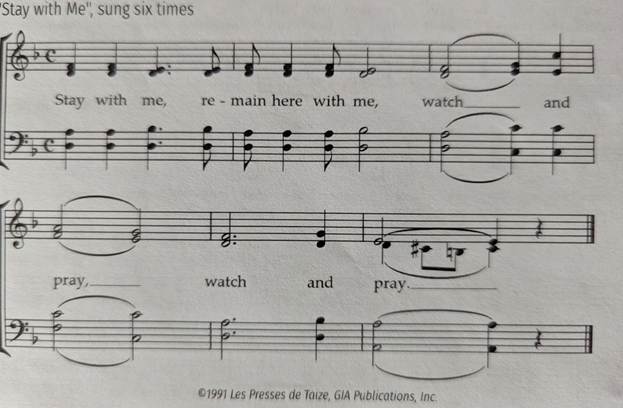
Stay. Remain. Watch. Pray.
___
Prioritization in life didn’t happen overnight. It took years of hard work, coaching, networking, discernment, and prayer. The payoff has been life changing. Some of these changes took over a decade to implement.
Discovered and honed values identified these main concerns:
1. Disability & Theology.
Christian received early intervention service through Wayne ARC at Roosevelt Children’s Center, so I found my way onto the Board of Directors. Twelve (or so) members of the board wielded a $65m budget, serving thousands of people, staff, and families. My voice at the table was welcomed and appreciated, much more so than in the denomination (where 800 gathered annually to debate a $4m budget). An added benefit was that I learned how non-profit organizations operated. Finance. Human Relations. Publicity. Quality Assurance and Improvement. Corporate compliance. It was a brave new world.
2. Compassionate Eldercare.
In time, my mother had been diagnosed with Alzheimer’s disease and began a long good-bye of more than twenty years. I found my way onto the Rochester Presbyterian Home (RPH) Board of Directors. It was an expansive, multi-campus of homes for the elderly. The RPH was known to be a world leader in dementia care. Though separated from my mother in geography, we connected with a compassion for seniors and their care. I chaired the capital campaign to expand to an additional campus. The depth and breadth of my not-for-profit experience was growing.
3. Addictions, Mental Health, and Rehabilitation.
A family member had suffered from alcoholism for decades, destroying family, jobs, and relationships. He crashed his car and live to tell about it. He asked me for help, and I did my best to rescue him from the quicksand of addictions. One night he called me from jail and asked if I could bail him out. He had been arrested at a DWI roadblock. He lost his license, and I became his personal driver. He attended out-patient rehab through FLACRA (Finger Lake Addiction, Counseling, and Resource Agency), which helped to save his life. He is over twenty years sober, and I could not be more proud of him.
Over the years, I had led countless parishioners to FLACRA and Alcoholic’s Anonymous.
I joined the FLACRA Board. Today, I’m completing my second stint as Board Chair and have been blessed with more than two decades of service. We are a $35m organization that provides wrap around in-patient, out-patient counseling, supportive living, and employment services, employing nearly 600 staff. FLACRA does amazing, lifesaving work. We are blessed with an exceptional CEO and executive staff.
4. Campus Ministries.
Lastly, I joined the Board of Genesee Area Campus Ministries (GACM). It was a campus chaplain who looked me in the eye in my Freshman year of college and asked me where I was going in my life; a real wake up call. I’ve been paying it back with my service on GACM for the past twenty plus years, providing a chaplain and ministry to students at the University of Rochester and Rochester Institute of Technology.
Wow! How did I ever become so blessed? A major depressive episode turned into personal growth and strength and community service. Priorities led me to compassionate efforts in the areas of developmental disabilities, aging, addiction, and campus ministries.
God’s healing favors descended on me, not because of what I said or did, but solely, wholly by God’s amazing grace. Humpty Dumpty had been put back together again. Thank you, Lord.
 Breaking Yokes