45. Jim, Betsey, and the Gift of Silence

A good lay leader is such an asset to a congregation and a blessing to the pastor. They can provide a trusted sounding board for the possible, a breath of the Spirit’s guidance, and a faithful confidant. They function as a bridge between the pastor and the parish, serving on all church committees, and are in a position to be an effective communicator with members and friends of the congregation.

“Should I go visit so-and-so?” I’d ask Jim.

“Yeah, that would be a good idea. He is the second cousin of so-and-so, you know.”

Good to know. Vernon Lee, a mentor, saint, and denominational leader had counseled me early on to make it a point to learn the people’s history better than any one person knows it themselves. Jim was always willing and able to help me connect the dots, fill in the blanks.

Jim was an exceptional lay leader when I served the United Methodist Church in Palmyra. He was a confirmed bachelor, who lived with his aging, widowed mother. He did all the shopping, taking her to her doctor appointments, watching over her like a hawk. His car was recognizable where ever he went, a tan Bonneville, I seem to recall. He was also the village mayor, a person whom the general public endowed their stewardship and trust. 

Jim walked everywhere throughout the village. It gave him a feel for the grass roots of the community. He’d wave and greet everyone he met or passed by. Be they a kid on a bike or an elder on the front porch, Jim had the gift of being a good neighbor. He’d stop to talk with anyone on a wide range of topics – can you fix that pot hole at the corner? Or, What’s up with the fire department budget? Or, thank the police chief for bring back my lost cat. Jim was a man about town.

Though he easily exceeded ten thousand steps a day, we’d often walk the village together after dark. We’d be done with church meetings, or, he’d have the village board meeting behind him. We both needed to unwind, to talk out the stress, and wear off some shoe leather. We’d inspect the village water works, streetlights casting long shadows around the parameter. Jim and I would visit the combined village and town gas pumps and check for open doors at the village DPW. We walked the village cemetery, taking notice of fresh graves, straw, and grass seed. 

Sometimes we’d walk along the railroad right of way, pausing when a distant train whistled it’s approach. We’d step behind cover and experience the passing thunder from a safe distance, watch the color lit signals reset and go dark. Our conversations ranged from the informative to the sublime, from humorous to the tragic, from superficial to profound theological questions that plumbed the depths of the human condition. 

Mostly, I appreciated how Jim held a reverential respect for silence, the ebb and flow of sacred space between us, where thoughts freely came and went, or where nothingness became a welcomed familiar. A respected seminary professor once taught us that when you don’t know what to say, “keep your mouth shut.”

Presence speaks louder than words. Showing up; that’s what the Lord expects, laity and Ordained alike. Be the embodied presence of our loving and merciful God.

Silence.
Presence.

Just show up. 

___

We know who we are. Lap swimmers are creatures of habit, predictable, trustworthy, locker room mates of few words. Goggles and towel separate us from our pickleball and weight room cousins. Words would be wasted when an eye and nod of the head will do. I see you. I respect you. 

We look for each other. When absences occur, it is impossible to help but wonder. Are they okay? Did something happen that disrupted their schedule? Are they on the way to some distant vacation? If so, good on them. 

Windows on the south side of the pool give brief glimpses of the larger world when the crawl stroke takes me down the lane. Returning eastbound, I see a familiar, disinterested lifeguard, watching the clock for fifteen minutes to drip down the drain, anticipating relief from another guard rocking flip-flops and the red cross.

Hourly workers tend to watch the clock. 

Yesterday’s blowing snow is replaced this morning by a beautiful sunrise, west Texas orange and red, the cosmic sphere rising in the dawning sky. Spring is in the air, and, boy, does it ever smell good!

Today I ask to share a lane with an unfamiliar face. “Sure,” he smiled. “No problem. Do you prefer a side?”

This give and take is an important social lubricant, under the guise of reducing the risk of collision.

“Naw,” I replied. “I’m slow on both sides of the lane.” We share a smile in the moment. He heads out in front of me. I wait to give him a head start. 

Silence is a beautiful thing.

We are silent partners, sharing a common space and time. Unlike my walks with Jim, we remain obscure and unknown to each other. Is he a person of faith? I wonder. Children? Grandchildren? What did he do for a living? He left before me and vacated the locker room before I finished my shower. Yet, his face and kindness remained, as a whisper of potential for meeting again, perhaps, some day. 

Silence is good. For waiting. For wondering. For dreaming. For praying. Thank you, Lord, for the gift of silence, and for the ability to share your silence with a friend. 

___

Silence isn’t naturally comfortable, at least in my case.

The scenery around the retreat center was Rio Grande brown and flat, wind swept, with few natural trees, bookended with stunning sunrises and sunsets. Our group was a cohort of younger pastors from around the country, each paired with a denominational leader or seminary professor, a mentor who would help shape our life, call, and career.

Chapel was a shared experience, with devotions multiple times a day. Early in this post-graduate program, a worship leader invited each in attendance to enter into five minutes of sitting in silence. One would think a bunch of pastors wouldn’t have any problem sitting in silence.

You’d be wrong.

I sat and stared at my wristwatch. The sweep second hand took forever to work its way around. My weight shifted, from one cheek to the other. There was an itch on my nose. Someone coughed. The pew on which I sat cracked. Thoughts raced though my head. Tangents, snippets, randomness, questions that couldn’t be answered. There is a sound of undisciplined silence, and I discovered it is as deafening as tinnitus.

“Five minutes is up. Let’s talk about what just happened.”

The debrief revealed a shared experience, and it wasn’t good. Distrust. Uncertainty. A space filled with anxiety, anger, and justification. The troubles of the world filled our spiritual containers, yet the drain was clogged and all the flotsam and jetsam overflowed. Like innocent bystanders with mouth agape, watching the train wreck of the soul in slow motion, unable to control, slow, or stop the flow.  

Is it possible to just be? This was uncharted waters.

Put a crimp on thinking. Throttle thoughts and distractions. Breathe; deeply breathe. Listen. Dial in the hearing. Narrow the eyes, just enough to welcome the shadows yet ward off the temptation to sleep.

Become one with the silence.

For me, silence has become God’s gift ready for me to claim.

___

Betsey was a colleague, twenty-five or so years my senior, a contemporary of my father (and his generation). She and Dad were buddies, hanging together at clergy gatherings and conferences. Years later she reported, after the daily session they’d sometimes go out and have a beer. Or two. Or three. This was in spite of his promise to my mother that he’d never drink again.

A resentment arose from me after hearing of Dad’s alcoholic transgressions, but, over time, and with greater understanding of his traumatic younger life, I’ve forgiven his flaws and let go of these harmful thoughts.  

My first encounters with Betsey were not positive. When I visited annual conference, usually supporting camping and retreat ministries, I observed that Betsey was one often at the microphone, asserting her case, advocating for justice, calling out hypocrisy. She was a bra burning, tie dyed, anti-war feminist, Selma marcher of the first kind. She was obviously no friend of the bishop. Yet, neither were they foes. Other female clergy members of conference loved her and often rallied at her side.

Women clergy seemed to have a thing among themselves. It was mysterious; a secret bond, or so it seemed, unknowable to men. It made other male clergy and me jealous.

As a co-chair of the Board of Ordained Ministry, I had to deal with Betsey when I came through the ordination process. When all was said and done but the bishop’s laying on of hands, I got a note in the mail with her return address. It looked like it was written in pencil on a piece of brown paper torn from a grocery bag. The note informed me that, in lieu of the traditional ordination gift from the conference, the Board of Ordained Ministry decided to make a gift to Africa University, in our name. 

Without our permission. Without our input. Gee, thanks for asking. The message I heard was, take it, new guy, and like it. Welcome to the union. And, oh. I wasn’t worthy of a decent piece of paper, or the effort of a typewriter?

Though her loud-and-proud presence repelled me, and the resentments I harbored from the gift I didn’t receive continued to gnaw away at my serenity, there was something more about Betsey that caused me to pause, to wait, to watch and listen for the Spirit to move. God was using Betsey to catch my attention, lassoing her into my sphere of friends with the invitation for us to become friends. 

We two could not be more unlikely friends.

In time, we got to know each other. Social circles began to overlap. I witnessed Betsey weave her means of grace serving as defense counsel to clergy charged in church trials, one in our conference and another in a neighboring conference. Though guilty of dishonoring the office of the Ordained, every defendant deserved competent counsel. And Betsey gave it her best effort. 

Betsey was not afraid to call any bishop on the phone, day or night, and demand an accounting. She’d stop in the conference office un-announced and request the treasurer go over with her the budget and pension numbers for the ensuing year. She served a minimum of one week per summer at one of our camp sites, ensuring kids had a chance to have a personal relationship with a female clergy person. Being a role model was important, and her actions spoke louder than words. 

The church calls forth strong, independent clergy women, and it’s past time for us men to pay attention. I loved it. 

Betsey was a butterfly at annual conference. One clergy, one laity, parity in decision making, gather for three days of annual conference, usually at a regional college or conference center. We worship and learn together, celebrate retirements, honor the dead, conduct ordinations and consecrations, pass resolutions, and debate a proposed budget. Passing a budget means sharing the burden equitably among local churches.

I was Ordained in the former Central NY Conference, centered in the Finger Lakes region. Consolidations over the years led to the North Central NY Conference, and, to the Upper New York Conference (when Western, Troy, and Wyoming conferences were added). Think of it this way: Big meeting, chaired by the bishop, produced by conference staff. It is time to socialize, caucus, and toe the line defined by Robert’s Rules of Order. Attendees grab free pens and tchotchkes from vendor tables, drink bad coffee, and gather for terrible meals.

In later years, I learned to lodge with local clergy colleagues, instead of grabbing a hotel room. This allowed us to show up to conference late in the morning, and leave early in the afternoon. Attend only to be seen. Keep under the radar.

We learned nothing we could say or do would impact the agenda or momentum of legislation, so why bother? For the colleagues and I who ran in the same social circles, annual conference was a three day affair to gather around an evening camp fire, talk about the challenges we overcame the prior year slugging it out in the parish, to catch up on family and friends, and to reminisce with embellishment past escapades of pastoral ministry. Often, cigars and alcohol were involved. Nuff said. 

Over the years Betsey circled into these gatherings for annual conference. We’d meet and stay at the local home of one of our colleagues, or at our family cottage on Bradley Brook. We’d sing. We cried. We shared responsibility for preparing meals. We had some of the finest steaks off the grill. We ate, drank, and smoked until we fell into our respective beds to sleep the night away, waking the next morning to do it all over again. 

We’d sit in silence around a campfire.

When Betsey’s husband died, we all showed up. Nothing need said. We gathered from across the state, just because that’s what we do. She bought the bar that day. By this time, I was living sober (thankfully so).

In her retirement, Betsey was surrounded by a close knit family she loved to take on worldly travels. From Iceland to Antarctica. It was ironic that I received news of her sudden, unexpected death while I was with my family in Alaska, exploring faraway lands, glaciers, and seas. Though unable to attend her funeral on the opposite side of the continent, the silent space between us was powerful, and brought me to tears. It still does.

Silence makes room for the Spirit to fill.

Over the years our numbers diminished. What is left of our dwindling group of clergy colleagues gathered last year for the annual conference memorial service. Betsey was one of many of our colleagues being remembered that day.

Betsey was something more to us. We honored her memory. We are grateful that we shared the journey together. Her name was read, and the bell was rung. We bowed in reverence to the loving God of our experience. In the silence, the pause, the in-between, we whispered “thank you.”
44. Man Down

A good EMS call is an adrenaline rush no pharmacological recipe could come close to replicating. After years of training and experience all of us medics were never out of earshot from our portable pagers. They recharged batteries on the bed stand. They hung on our hips as we made our way throughout the day. Pity the poor fool who lost their pager, or worse, were unwitting accomplices to their destruction. 

Driving a pumper on a Thursday training evolution, I parked the water heavy iron monster, set the emergency brake, and bent over to chalk the wheels. Little did I know, my pager slipped off my belt, slid to the ground, and landed right in front of the rear wheels. After training, hanging up my gear, I felt for my pager. It was one of those “Oh, crap!” agonizing moments of frantic searching, all for naught. I lived with a spare replacement and the shame of losing face in front of the other members of my EMS crew and line firefighters. 

The next spring, at the annual banquet, I did the requisite chaplain duty of saying grace and introducing the M.C. for the evening, a well-known local radio personality. Introductions were made of the incoming team of officers. Thanks were extended to the outgoing group. The awards came after steak and deserts. Many in attendance were six or more drinks into the festivities. The chief called me forward.

“Oh, great. Now what did I do?”

He held a wrapped gift and began to make his presentation, pulling slowly on his prepared speech to wring out the maximum drama. He told the story of my lost pager and frantic, unsuccessful attempt to locate it. A lot of cat calls, hooting, and laughter was hitting me like a fire hose. My cheeks burned red with embarrassment. I smiled, forced a thank you, and accepted his gift. 

“Go ahead,” he said. “Unwrap it right now in front of everyone.”

One hundred fifty firefighter, spouses, and distinguished guests shifted forward in their chairs and looked intently at my unenviable position. Gift paper shredded to reveal a homemade plaque, on which was glued thousands of destroyed pieces of my former pager. The chief saw it on the ground after I pulled the chalks and drove off, crushing it beneath the real wheels of my fire truck. He saw the opportunity and seized the day. Good on him. 

It was the only pager I had to replace. 

___

“Man down” was an EMS call we all lived for. The response was always balls to the walls, drop everything, and hit the gas. Calls were generally categorized by type: either medical or traumatic, and, severity: Critical, Unstable, Potentially unstable, and Stable. Training gave us the acronym we used by memory: “Fit to CUPS”. Our department ran “Ya’ll come” calls, as opposed to shift work, like paid and other agencies. The tones dropped, tripping everyone’s pager, and you responded. On EMS calls, some responded to the barn to drive the rig, others of us carried equipment in our personal vehicles and drove directly to the scene. You’d see medics who made a bare minimum of calls per month show up at “man down” calls and try to take over. Talk to the hand, dude. 

Some were funny, despite the fact that a life was dangling by a thread.

“Man down. Not breathing,” the 911 dispatcher told us after dropping our pager tones. As per protocol, an Advanced Life Support paramedic team was dispatched from 20 miles away. The call was a good six miles from our station into our neighboring fire district. I was the Intermediate Life Support medic, so I’d be the first on scene and be able to initiate immediate care. If the paramedic made it there before we left, great; join the party. If not, we were told not to delay transport and head for the hospital. Maybe we could meet enroute, but today, it was unlikely.

The call was to a large farmhouse at the end of a long country lane. “AM-24 on scene,” Vern, my driver, informed dispatch. On the gurney I loaded the medic bag, Oxygen tank, defibrillator, portable radio. The kitchen door opened to my banging. “You call for the ambulance?” I asked the woman who answered the door. She was barely dressed with a toddler on her hip. Another near naked woman with a baby on her hip was cooking bacon on the stove. “He’s in there,” she pointed over her shoulder with her thumb. 

Vern and I pushed in to the bedroom. We found a middle aged buck naked male laying face up on the bed. Full Monty. Was there a smile on his face? I don’t know. He wasn’t talking. Or breathing. I called on the radio for more help and pulled him off the bed to the floor and began CPR. Memory fades, but I probably attempted to jump start his heart into a survivable rhythm. In time, more of my crew arrive. They took over the thump and pump while I sunk an E.T. tube, taking control of his respirations. The IV could wait until the back of the ambulance. ALS was still fifteen minutes out. Time to hit the gas and haul ass. 

Stretcher and patient, equipment, and crew pushed out the bedroom, through the kitchen and out to the idling ambulance. Barely pausing to notice, the two mommas and babies continued to go about their business in the kitchen, as if it was another ordinary morning. I paused for a moment, “What is his name?” I asked, the Patient Care Record (PCR) and clip board in hand. One looked at the other; they both look back at me, in unison shrugged their shoulders and said, “I don’t know.” 

Most were not. 

Two a.m. Nothing good happens at 2:00 a.m. “Man down.” The address was well known to me, elderly members of my parish, the parents of one of our village cops. In a flurry, I dressed, called in route, and met the wife at the back door. “Bill is in the bathroom,” she cried.

Lots of cardiac arrests take place on the commode. We were taught in training that the same nerves that are used to strain are also the ones that control normal heart rhythms. Push too hard or too long, and that predisposed vessel or electrical pathway just might blow. Poop is often involved. It isn’t pretty and I’ve been at that retching call far too many times.

Problem was, this evening, Bill was wedged unconscious against the bathroom door, preventing it from opening more than a sliver. “Bill!” I shouted. No response. “You awake?” Pushing hard, I could see there wasn’t any movement. Eyes closed, head down, chin buried in his chest. Grace, his wife, sobbed in the background. Still by myself, I got on the radio and called for more help. Shit. I couldn’t get in to get him out. I needed beefy firemen with wrecking tools. Fast. 

Yet, never one to give up easily …

I pushed and pulled with all my might. Leaned my shoulder into everything I had to give. “Sorry, Grace. The door has to go,” I apologized. Seeing this unsolvable puzzle blocking any hope for a successful outcome, she mumbled, “Do what you gotta do, Pastor Todd.” 

BAM! I hit the bathroom door, breaking it off its hinges, knocking Bill completely off the commode. I struggled through the debris and dragged him by his nightshirt, pajama bottoms down around his ankles, into the kitchen. “CPR in progress. Hit our tones again for more help,” I called into my radio. I thumped and pumped all by myself. Five compressions, one breath. Wash. Rinse. Repeat. 

Exhausting. Sweat in the eyes. Where was my crew? Sirens wailed throughout the village. If Bill had any chance, it was with me. His pastor. His medic. From experience, the outlook didn’t look good. Crews began to call on scene. Between compressions, I caught a glimpse of highly polished shoes and a police officer’s cuffs. “Give me a hand, buddy,” I called to the cop talking on his portable. 

He froze. “Come on, dude. I need a hand.” He didn’t move. I continued CPR until I rolled off completely whipped by my arriving crew. “What in the actual …” I was about to cuss just as I caught sight of the frozen police officer. Recognition was immediate. It was Bill’s son. “I can’t,” he cried. “I couldn’t.” 

At the end of the day, it wouldn’t have mattered. Bill had been down and not breathing long enough on the commode nothing could have been done to change the outcome, even though we tried. Minutes matter when brain cells go without oxygen, and they only get oxygen from the blood cells pumped by the heart. The pump stops, the brain dies. That’s all she wrote.

The family recognized our effort and memorial donations came into our Fire Department and the church. I sat in the same kitchen with a cup of coffee with Grace and her son a few months later. “How would you like the memorial money used?” I asked. 

“Bill loved stained glass windows at church. What do you think? Is there any way this could be possible?”

Above the East entrance to the Palmyra (formerly) United Methodist Church there is a stained glass window in memory of Bill. May it long stir fond memories and witness to the benefits of a depth of faith.

The lap pool called my name twice this past week, instead of the usual Monday, Wednesday, Friday two-step. The transition weather we are experiencing between winter and spring tends to give wild fluctuations off the beam of emotional stability. Nothing quite like a forecaster’s prediction of snow after a week of mild calm. In a lame excuse to myself, a vigorous walk on the indoor track would have to do.

Laps are reflective, meditative; uninterrupted silence where thoughts tend to invite and invoke critical moments in life. Man down calls invoke memories of my father’s sudden cardiac death over forty years ago, September 30, 1985. He had recently completed a cardiac stress test and received a clean bill of health. He jogged multiple times a week, keeping his weight under control and his inner demons at bay. Newly appointed to a church in Central New York, one morning he fell weak, tired, lost consciousness and died.

On the ambulance, we called it DRT. Dead. Right. There.

Mom had just gotten him in the car to drive to the doctor’s office when his mortal fire was extinguished. The medic on the ambulance who responded? Yeah. Unbeknownst to me, she would become one of my instructors when I went through training and recertifications. It’s a small world, filled with divine agents of God’s amazing grace.

As my arms and shoulders tired, I thought about the anxiety carried forward attributed to my father’s death. He died at age 59, three months, nine days. Translated to my own life, that year was one where I watched the calendar closely. Would I survive the old man? There are thousands of reasons for a heart to stop, which gives pause to downing that greasy hamburger and fries. Was I fated by poor genetic sequencing?  I inquired of my siblings, each expressing relief when they aged one day older than dad.

Last year, visiting my brother, a retired physician, we were talking about dad’s unexpected sudden cardiac arrest. We both outlived our fated genetics, I observed. “What do you mean?” Bryan responded. “It wasn’t genetics that killed dad. It was a virus.”

I blinked once. Twice. Three times. Did I hear what I thought I heard?

Yep. My brother gave me the detailed account of how he insisted on having an autopsy performed after Dad’s unexpected death. The finding? His heart was inflamed by a viral infection and had swelled to over three times it’s normal size. Swelled heart inside a fixed container resulted in a heart that grew progressively inefficient and eventual death. “Moral of the story?” my brother paused for effect. “Always get your vaccines.”

And for all those years of worry? Thankfully, they are all behind me, like the final stroke on my last lap before the showers.

___

Some “man down” calls just made me angry.

Memorial Day. Kids off from school. Big parade planned in the village. High school bands were marching in hot, wool uniforms. A brief service at the village cemetery planned by the American Legion completed the annual ritual. As fire department chaplain and local church pastor, my roll was to provide the invocation and benediction in my fire department dress uniform. As a N.Y. State certified medic, I’d ride shotgun in the ambulance, tucked nicely behind every truck the chief could get on the road. We had both our rigs in the parade, each loaded with a full crew in dress uniforms. Siren jockeys deafened the crowd. Firefighters riding the trucks dressed in bunker gear tossed hard candy to scampering children in the crowd.

In front of our ambulance marched the American Legion color guard. You’ve seen them; guys dressed in spit polished shoes and starched uniforms, toting flags of state and nation, or, sporting rifles used for a twenty-one gun salute in the cemetery. Most had beer bellies hanging over their belt, or long hair and a beard, a far cry from their active duty days. Lots of gray hair were tucked underneath service hats, adorned with pins and patches.

The route was long through the village under a hot sun. Didn’t bother me; I closed the window and turned up the air conditioning. The parade concluded at the cemetery; a right turn, roll under the arches (while fire trucks returned to base), then snaking our way to the veteran’s memorial, on a hill, center rear. Podium and bleachers under beautiful hardwood branches waited for our arrival. Thousands of patriotic neighbors lined the path and crowded in at our destination.

It was a beautiful day for a parade.

I saw him drop. It was called a witnessed arrest. The moment his heart seized to a stop, the Legionnaire 20 feet in front of our ambulance lost consciousness and slumped like a bag of potatoes to the ground. Vern hit the brakes and got on the radio, calling for help. Within 10 seconds half the medics in our department were on our feet, hauling equipment, and rushing to the unconscious veteran’s side. The marching band stopped playing. People surrounding the entry road to the cemetery bunched into a crowd. Hundreds came together like subway riders at rush hour, each straining to see what often isn’t seen by the general public.

We know CRP and put it to practical use nearly on a weekly basis. Basic Life Support (BLS) medics started the thump and pump. My Advanced Life Support (ALS) partner opened the airway kit and prepared to intubate. Another of our crew used trauma scissors to bare the patient down to his shorts and socks. I worked the semi-auto cardiac defibrillator, placing sticky electrode pads on his hairy chest, ankles and wrists.  

“Everybody! Clear!” I ordered. This gave us a clean strip to read, record, and interpret, as well as, healthy separation of my crew from the massive amounts of joules I was prepared to release from the unit’s high-tech batteries. I switched to manual. I wanted full control of the trigger in the right handed paddle. Conductive jell was spread liberally. “Charging to 120.” The internal capacitors filled with the tell-tale whine. I paused to survey the scene.

A pulseless, breathless patient. Everyone on my crew letting go and stepping back. Time slowed. I saw the crowd and squinted, the hot sun in my eyes, humidity as thick as molasses, sweat rolling into my eyes, perspiration soaking my shirt, soon to make me clammy. Spectators, hushed,  watching the drama unfolding before their very eyes, seeing what shouldn’t be seen. A man’s life account being settled, his existence held at the precipice edge, the raging current pulling at his lifeless body.

And there was an idiot with a camcorder. Red LED blinking not 20 feet away.

“Aug!” my inner voice turned rage inside out, “Stop CPR. Clear.” Everyone obeyed. “Shocking 120!” as I depressed the trigger, the patient shuttering as expected. Normal sinus rhythm was nowhere to be found. The tape printed an exotic cardiac rhythm way beyond my pay grade to make hide or hair of its meaning. All I knew was that it remained a shockable rhythm even though there wasn’t a pulse or breath. “Stop CPR. Clear.” The scene remained safe. “Charging to 200. Shocking 200!”

The neanderthal with the camcorder perched on his shoulder squeezed in closer, tighter. The captain of our ambulance stood back, arms crossed, doing his own survey of the scene, taking it all in. “Clear,” I called out a third time. We only got three chances in the field. Someone trained to a higher level of care might have different rules, but I was three shocks and done. CPR stopped a third time and everyone backed off, yet again. “Charging to 360.” I waited for the alerting tone indicating a full charge. “Shocking 360!”

Nothing, damn it. “Resume CPR.” Jimmy would try his ET and IV sticks inside the rig, away from prying eyes. “Let’s load and go,” I yelled. Swinging onto the rig, I looked back for a moment, right into the lens of the camcorder staring me in the face. The brief pause almost irrupted like a volcano of rage, veins in my temple bulging. Lips tightened, less I say something regrettable, the door slammed shut behind me. For a moment I let the anger dissipate before refocusing on the task at hand. All hands were needed. A job needed to be done.

It didn’t come as a surprise. No, the patient did not survive. Few did. What surprised me most, is that the entire Memorial Day parade “man down” call, fully recorded on videotape, did not end up on the evening news. Thank you, God.  

43. Can Humpty Dumpty Be Put Back Together Again?

The answer is “yes,” but it takes a lot of work.

This is a sensitive topic, but, if I am to be rigorously honest, mental health is one that needs to be posted. Mental Health, like it or not, is a taboo, carries with it a stigma, and visions of psych wards staffed by Nurse Cratchet right out of the 1950’s. The self-righteous are known to use it as a weapon, a useful tool for manipulation or blackmail, or justifying superiority. 

Fact is, 46 percent of Americans will have a mental illness sometime in their life. One in five will have a diagnosable mental health condition in any given year. (mental health America dot org)

Talking about one’s personal mental health exposes vulnerabilities, but, in my case, is an opportunity for healing, triumph, and perseverance. Successfully navigating through this mine laden field, one is better educated, is able to employ a tool box of self-care, and has empathetic insight that brings strength to relationships. 

I’m a better pastor because I have walked the valley of the shadow of death.

The day of this writing is Good Friday, the day of crucifixion, blood, scorn, and death writ large on the I-Max screen of life. Redemption is a gift from God, laid at the feet of the cross, ours to claim and benefit. God made the call, Jesus made the sacrifice, humankind benefited. God’s grace is amazing.

My Diagnostic Statistical Manual of Psychiatric Conditions, the DSM-3, in my library is well worn from use from years of providing crisis intervention and psychiatric assessments services at Eastway Community Mental Health (Dayton, OH) and Clifton Springs Hospital and Clinic (Clifton Spring, NY). I’ve interviewed and seen it all: homicidal or suicidal people, depression, bi-polar disorders, schizophrenia, borderline personality, and everything in between. 

On this day, the DSM-3 would be used for me.

I was at the top of my game, or so I thought; a successful parish pastor for ten years, chairing the District Committee on Ordained Ministry and serving on the Conference Board. I was running North of 300 calls a year as a volunteer firefighter/medic, working every third night conducting psychiatric assessments, living on caffeine and peering dangerously at the cliff edge, observing others falling over, smugly thinking to myself that it could never happen to me. Our beloved family dog, Job – named after the Old Testament portrait of suffering, had aged out and we had to have him euthanized. Oh, how I cried. 

Then, our son, Christian was born, given birth through trauma and now diagnosed with pervasive developmental disabilities. Our home had become a revolving door of early intervention professionals. Before Christian had learned to walk, we put Christian on the peanut bus to take him to the regional school for handicapped (I hate that word) children. 

It felt to me like I was on a carousel, the world was spinning past, yet, I was revolving in the opposite direction.

The signs were obvious to others, but my lack of introspective insight left me blind to the dark clouds that were moving in like a Canadian cold front. Weight had always been a challenge to me; I had put on a hundred pounds. Check that box. Mood was depressed, chronically running on empty. Check that box. Situational stressors were off the chart. Check that box, too. 

For the large part, the church leadership team was wonderful, compassionate and accommodating of my community based ministry. All but one. An ultimatum was thrown down, “If you force me to pay our Conference apportionments,” he said, “I’ll quit.” He was a reputable local businessman who was used to getting his own way. 

Ultimatums, I had learned in graduate school, were nuclear bombs in human relationships. The professor had taught us seminarians that ultimatums should always be called out. “I call your bluff, and raise you another twenty.” Never give in to ultimatums. 

I didn’t, and neither did the church Board. If looks could kill.

The next Sunday, prior to worship, during the parish announcements, the treasure stood, swore at the assembled (yes, he used Ralphie’s choice word that got his mouth washed out with soap), threw the church checkbook into the air and loudly informed us that he quit. One well-meaning man from the congregation walked him out. In the church foyer they loudly argued. We all could hear the entire commotion. We feared that the confrontation would break into fisticuffs. The outside door slammed shut, and he was never seen in the church building again. 

I sat in my revered seat in front of the traumatized congregation and cried. Humpty Dumpty broke. 

For the next year and eight months I worked to put Humpty Dumpty back together again. I went on disability leave. We purchased a house in town and a new pastor was appointed to the church. 

The dark clouds of depression overwhelmed me. Blessed are those professional clinicians who gathered as a team to help me stand, learn to walk, and, in time, led me back to health. The inpatient and outpatient help I received was exceptional. Medication and Dialectical Behavior Therapy (DBT) broke the situational stress that pushed me over the precipice. Once the storm clouds parted, intensive interventions prevented chronic depression from metastasizing. I was given space and time to safely wean off the sedating psychoactive medication. It took more than a year and a half to get back on my feet and feel confident about returning to parish ministry. 

I’ve been depression free for over 25 years.

DBT filled my toolbox with all things necessary to maintain stable mental health. I learned the importance of setting boundaries and sticking to them, of self-assessment (what to watch for and how to ask for additional help if needed), how my relationship with family and loved ones needed repair (and how best to work on it), and how to restore professional self-confidence. 

I was called by God to be a parish pastor, and nothing in heaven or hell was going to change this fact. A few insights:

First, I lost some friends and colleagues. Too bad, so sad. Don’t let the door hit you on the ass as you leave. I don’t know if they couldn’t handle the stigma, or if my circumstances led them to wonder about their own vulnerabilities. Perhaps they thought life was just easier to not know, to remain ignorant, to deny the possibility. It is just easier to go along and get along, than to have someone have a mental health crisis that you have to deal with. I don’t know, neither did I feel the need to investigate further. Exit interviews are not necessary, nor my cup of tea. Those individuals who meant the most stuck to me, visited me, prayed with me, gave encouragement, and endorsed my progress. These cheerleaders were true angels, gifts of grace from God. 

Thank you. You know who you are. 

Secondly, my fall and healing were hard on my wife and family. They sacrificed much to accommodate my resurrection. God’s love brought us together, and it was God’s love that saw us through. Every day brings new revelations, opportunities, insights. Maintaining good mental health is all about being made new. It isn’t taken for granted; it is to be practiced with gratitude. 

Thirdly, I’m grateful to the United Methodist Church for providing leave and disability support for clergy like me. Yes, it is a Conference expense item. In this era of cuts and declining support, this benefit should be aggressively maintained and strengthened. The Church is a means of God’s redemption and healing. The shepherd leaders are in need of this grace, as well as the laity. We don’t shoot our wounded; we pick them up, dress their wounds, and take them to the inn to recuperate. This is who we are, who we are called to be. 

Lastly, work with my psychiatrist helped me identify priorities. This changed and energized my parish ministry. I culled all work on denominational boards and committees, tempered my participation in conference politics, and brought focus to the communities I served. I ditched the fire department, quit my part time job at Clifton Springs, and slept peacefully through the night. I got my weight under control, for the time being, and my physical health improved.

I plunged beneath the lane lines and waded to the open lane. Cold; bone chilling cold. Like being plunged into baptismal waters. But, once wet, acclimation comes quickly, exposing a resilient character trait that keeps me coming back.

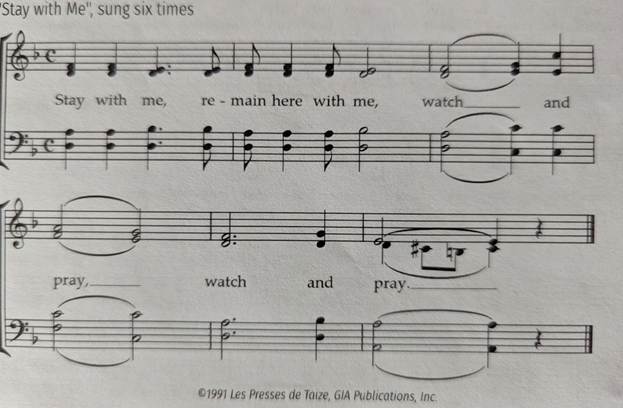
“Stay with me, remain here with me, watch and pray, watch and pray.” (1991 Les Presses de Taizé, GIA Publications, Inc.) This beautiful Taizé worship chant rolls my synapse, reminds me of the prior evening’s Maundy Thursday service, focuses my meditation this Good Friday, as I pull myself back and forth, keeping to my swimming lane. Reach. Plunge. Pull. Breathe.

Stay with me. It is as if these were words of Jesus spoken to his drowsy disciples in the Garden of Gethsemane. Remain here with me almost sounds like a plea.

How many laps had passed by?

Watch. Be on the lookout for God to do something cosmically awesome right before our eyes. And pray. Open the channel of communication between God and the self.

Pull and breathe.

Time has passed. 15 laps had to be completed, “don’t you think?” my inner voice inquires my own conscience. Stay with me. Remain here with me. Watch and pray.

Stay. Remain. Watch. Pray.

___

Prioritization in life didn’t happen overnight. It took years of hard work, coaching, networking, discernment, and prayer. The payoff has been life changing. Some of these changes took over a decade to implement.

Discovered and honed values identified these main concerns:

1. Disability & Theology.

Christian received early intervention service through Wayne ARC at Roosevelt Children’s Center, so I found my way onto the Board of Directors. Twelve (or so) members of the board wielded a $65m budget, serving thousands of people, staff, and families. My voice at the table was welcomed and appreciated, much more so than in the denomination (where 800 gathered annually to debate a $4m budget). An added benefit was that I learned how non-profit organizations operated. Finance. Human Relations. Publicity. Quality Assurance and Improvement. Corporate compliance. It was a brave new world. 

2. Compassionate Eldercare.

In time, my mother had been diagnosed with Alzheimer’s disease and began a long good-bye of more than twenty years. I found my way onto the Rochester Presbyterian Home (RPH) Board of Directors. It was an expansive, multi-campus of homes for the elderly. The RPH was known to be a world leader in dementia care. Though separated from my mother in geography, we connected with a compassion for seniors and their care. I chaired the capital campaign to expand to an additional campus. The depth and breadth of my not-for-profit experience was growing.

3. Addictions, Mental Health, and Rehabilitation.

A family member had suffered from alcoholism for decades, destroying family, jobs, and relationships. He crashed his car and live to tell about it. He asked me for help, and I did my best to rescue him from the quicksand of addictions. One night he called me from jail and asked if I could bail him out. He had been arrested at a DWI roadblock. He lost his license, and I became his personal driver. He attended out-patient rehab through FLACRA (Finger Lake Addiction, Counseling, and Resource Agency), which helped to save his life. He is over twenty years sober, and I could not be more proud of him. 

Over the years, I had led countless parishioners to FLACRA and Alcoholic’s Anonymous.

I joined the FLACRA Board. Today, I’m completing my second stint as Board Chair and have been blessed with more than two decades of service. We are a $35m organization that provides wrap around in-patient, out-patient counseling, supportive living, and employment services, employing nearly 600 staff. FLACRA does amazing, lifesaving work. We are blessed with an exceptional CEO and executive staff. 

4. Campus Ministries.

Lastly, I joined the Board of Genesee Area Campus Ministries (GACM). It was a campus chaplain who looked me in the eye in my Freshman year of college and asked me where I was going in my life; a real wake up call. I’ve been paying it back with my service on GACM for the past twenty plus years, providing a chaplain and ministry to students at the University of Rochester and Rochester Institute of Technology. 

Wow! How did I ever become so blessed? A major depressive episode turned into personal growth and strength and community service. Priorities led me to compassionate efforts in the areas of developmental disabilities, aging, addiction, and campus ministries.

God’s healing favors descended on me, not because of what I said or did, but solely, wholly by God’s amazing grace. Humpty Dumpty had been put back together again. Thank you, Lord.