
43. Can Humpty Dumpty Be Put Back Together Again?

The answer is “yes,” but it takes a lot of work.

This is a sensitive topic, but, if I am to be rigorously honest, mental health is one that needs to be posted. Mental Health, like it or not, is a taboo, carries with it a stigma, and visions of psych wards staffed by Nurse Cratchet right out of the 1950’s. The self-righteous are known to use it as a weapon, a useful tool for manipulation or blackmail, or justifying superiority. 

Fact is, 46 percent of Americans will have a mental illness sometime in their life. One in five will have a diagnosable mental health condition in any given year. (mental health America dot org)

Talking about one’s personal mental health exposes vulnerabilities, but, in my case, is an opportunity for healing, triumph, and perseverance. Successfully navigating through this mine laden field, one is better educated, is able to employ a tool box of self-care, and has empathetic insight that brings strength to relationships. 

I’m a better pastor because I have walked the valley of the shadow of death.

The day of this writing is Good Friday, the day of crucifixion, blood, scorn, and death writ large on the I-Max screen of life. Redemption is a gift from God, laid at the feet of the cross, ours to claim and benefit. God made the call, Jesus made the sacrifice, humankind benefited. God’s grace is amazing.

My Diagnostic Statistical Manual of Psychiatric Conditions, the DSM-3, in my library is well worn from use from years of providing crisis intervention and psychiatric assessments services at Eastway Community Mental Health (Dayton, OH) and Clifton Springs Hospital and Clinic (Clifton Spring, NY). I’ve interviewed and seen it all: homicidal or suicidal people, depression, bi-polar disorders, schizophrenia, borderline personality, and everything in between. 

On this day, the DSM-3 would be used for me.

I was at the top of my game, or so I thought; a successful parish pastor for ten years, chairing the District Committee on Ordained Ministry and serving on the Conference Board. I was running North of 300 calls a year as a volunteer firefighter/medic, working every third night conducting psychiatric assessments, living on caffeine and peering dangerously at the cliff edge, observing others falling over, smugly thinking to myself that it could never happen to me. Our beloved family dog, Job – named after the Old Testament portrait of suffering, had aged out and we had to have him euthanized. Oh, how I cried. 

Then, our son, Christian was born, given birth through trauma and now diagnosed with pervasive developmental disabilities. Our home had become a revolving door of early intervention professionals. Before Christian had learned to walk, we put Christian on the peanut bus to take him to the regional school for handicapped (I hate that word) children. 

It felt to me like I was on a carousel, the world was spinning past, yet, I was revolving in the opposite direction.

The signs were obvious to others, but my lack of introspective insight left me blind to the dark clouds that were moving in like a Canadian cold front. Weight had always been a challenge to me; I had put on a hundred pounds. Check that box. Mood was depressed, chronically running on empty. Check that box. Situational stressors were off the chart. Check that box, too. 

For the large part, the church leadership team was wonderful, compassionate and accommodating of my community based ministry. All but one. An ultimatum was thrown down, “If you force me to pay our Conference apportionments,” he said, “I’ll quit.” He was a reputable local businessman who was used to getting his own way. 

Ultimatums, I had learned in graduate school, were nuclear bombs in human relationships. The professor had taught us seminarians that ultimatums should always be called out. “I call your bluff, and raise you another twenty.” Never give in to ultimatums. 

I didn’t, and neither did the church Board. If looks could kill.

The next Sunday, prior to worship, during the parish announcements, the treasure stood, swore at the assembled (yes, he used Ralphie’s choice word that got his mouth washed out with soap), threw the church checkbook into the air and loudly informed us that he quit. One well-meaning man from the congregation walked him out. In the church foyer they loudly argued. We all could hear the entire commotion. We feared that the confrontation would break into fisticuffs. The outside door slammed shut, and he was never seen in the church building again. 

I sat in my revered seat in front of the traumatized congregation and cried. Humpty Dumpty broke. 

For the next year and eight months I worked to put Humpty Dumpty back together again. I went on disability leave. We purchased a house in town and a new pastor was appointed to the church. 

The dark clouds of depression overwhelmed me. Blessed are those professional clinicians who gathered as a team to help me stand, learn to walk, and, in time, led me back to health. The inpatient and outpatient help I received was exceptional. Medication and Dialectical Behavior Therapy (DBT) broke the situational stress that pushed me over the precipice. Once the storm clouds parted, intensive interventions prevented chronic depression from metastasizing. I was given space and time to safely wean off the sedating psychoactive medication. It took more than a year and a half to get back on my feet and feel confident about returning to parish ministry. 

I’ve been depression free for over 25 years.

DBT filled my toolbox with all things necessary to maintain stable mental health. I learned the importance of setting boundaries and sticking to them, of self-assessment (what to watch for and how to ask for additional help if needed), how my relationship with family and loved ones needed repair (and how best to work on it), and how to restore professional self-confidence. 

I was called by God to be a parish pastor, and nothing in heaven or hell was going to change this fact. A few insights:

First, I lost some friends and colleagues. Too bad, so sad. Don’t let the door hit you on the ass as you leave. I don’t know if they couldn’t handle the stigma, or if my circumstances led them to wonder about their own vulnerabilities. Perhaps they thought life was just easier to not know, to remain ignorant, to deny the possibility. It is just easier to go along and get along, than to have someone have a mental health crisis that you have to deal with. I don’t know, neither did I feel the need to investigate further. Exit interviews are not necessary, nor my cup of tea. Those individuals who meant the most stuck to me, visited me, prayed with me, gave encouragement, and endorsed my progress. These cheerleaders were true angels, gifts of grace from God. 

Thank you. You know who you are. 

Secondly, my fall and healing were hard on my wife and family. They sacrificed much to accommodate my resurrection. God’s love brought us together, and it was God’s love that saw us through. Every day brings new revelations, opportunities, insights. Maintaining good mental health is all about being made new. It isn’t taken for granted; it is to be practiced with gratitude. 

Thirdly, I’m grateful to the United Methodist Church for providing leave and disability support for clergy like me. Yes, it is a Conference expense item. In this era of cuts and declining support, this benefit should be aggressively maintained and strengthened. The Church is a means of God’s redemption and healing. The shepherd leaders are in need of this grace, as well as the laity. We don’t shoot our wounded; we pick them up, dress their wounds, and take them to the inn to recuperate. This is who we are, who we are called to be. 

Lastly, work with my psychiatrist helped me identify priorities. This changed and energized my parish ministry. I culled all work on denominational boards and committees, tempered my participation in conference politics, and brought focus to the communities I served. I ditched the fire department, quit my part time job at Clifton Springs, and slept peacefully through the night. I got my weight under control, for the time being, and my physical health improved.

I plunged beneath the lane lines and waded to the open lane. Cold; bone chilling cold. Like being plunged into baptismal waters. But, once wet, acclimation comes quickly, exposing a resilient character trait that keeps me coming back.

“Stay with me, remain here with me, watch and pray, watch and pray.” (1991 Les Presses de Taizé, GIA Publications, Inc.) This beautiful Taizé worship chant rolls my synapse, reminds me of the prior evening’s Maundy Thursday service, focuses my meditation this Good Friday, as I pull myself back and forth, keeping to my swimming lane. Reach. Plunge. Pull. Breathe.

Stay with me. It is as if these were words of Jesus spoken to his drowsy disciples in the Garden of Gethsemane. Remain here with me almost sounds like a plea.

How many laps had passed by?

Watch. Be on the lookout for God to do something cosmically awesome right before our eyes. And pray. Open the channel of communication between God and the self.

Pull and breathe.

Time has passed. 15 laps had to be completed, “don’t you think?” my inner voice inquires my own conscience. Stay with me. Remain here with me. Watch and pray.
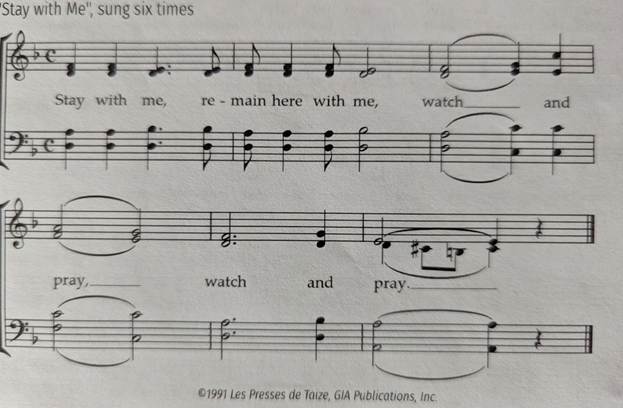
Stay. Remain. Watch. Pray.

___

Prioritization in life didn’t happen overnight. It took years of hard work, coaching, networking, discernment, and prayer. The payoff has been life changing. Some of these changes took over a decade to implement.

Discovered and honed values identified these main concerns:

1. Disability & Theology.

Christian received early intervention service through Wayne ARC at Roosevelt Children’s Center, so I found my way onto the Board of Directors. Twelve (or so) members of the board wielded a $65m budget, serving thousands of people, staff, and families. My voice at the table was welcomed and appreciated, much more so than in the denomination (where 800 gathered annually to debate a $4m budget). An added benefit was that I learned how non-profit organizations operated. Finance. Human Relations. Publicity. Quality Assurance and Improvement. Corporate compliance. It was a brave new world. 

2. Compassionate Eldercare.

In time, my mother had been diagnosed with Alzheimer’s disease and began a long good-bye of more than twenty years. I found my way onto the Rochester Presbyterian Home (RPH) Board of Directors. It was an expansive, multi-campus of homes for the elderly. The RPH was known to be a world leader in dementia care. Though separated from my mother in geography, we connected with a compassion for seniors and their care. I chaired the capital campaign to expand to an additional campus. The depth and breadth of my not-for-profit experience was growing.

3. Addictions, Mental Health, and Rehabilitation.

A family member had suffered from alcoholism for decades, destroying family, jobs, and relationships. He crashed his car and live to tell about it. He asked me for help, and I did my best to rescue him from the quicksand of addictions. One night he called me from jail and asked if I could bail him out. He had been arrested at a DWI roadblock. He lost his license, and I became his personal driver. He attended out-patient rehab through FLACRA (Finger Lake Addiction, Counseling, and Resource Agency), which helped to save his life. He is over twenty years sober, and I could not be more proud of him. 

Over the years, I had led countless parishioners to FLACRA and Alcoholic’s Anonymous.

I joined the FLACRA Board. Today, I’m completing my second stint as Board Chair and have been blessed with more than two decades of service. We are a $35m organization that provides wrap around in-patient, out-patient counseling, supportive living, and employment services, employing nearly 600 staff. FLACRA does amazing, lifesaving work. We are blessed with an exceptional CEO and executive staff. 

4. Campus Ministries.

Lastly, I joined the Board of Genesee Area Campus Ministries (GACM). It was a campus chaplain who looked me in the eye in my Freshman year of college and asked me where I was going in my life; a real wake up call. I’ve been paying it back with my service on GACM for the past twenty plus years, providing a chaplain and ministry to students at the University of Rochester and Rochester Institute of Technology. 

Wow! How did I ever become so blessed? A major depressive episode turned into personal growth and strength and community service. Priorities led me to compassionate efforts in the areas of developmental disabilities, aging, addiction, and campus ministries.

God’s healing favors descended on me, not because of what I said or did, but solely, wholly by God’s amazing grace. Humpty Dumpty had been put back together again. Thank you, Lord.

41. Are You Thinking of Harming Yourself or Someone Else?

No textbooks were involved in this reflection. These pastoral observations come from lived experience and the blessings of a fulfilling apprenticeship in the learned art of psychiatric assessments. The reader is welcome to take from my musing; what works, what doesn’t, and discard the rest.

“Are you thinking of harming yourself or someone else?” This seems like such a simple question. If it is so simple, try asking it of someone else.

“How dare you?” “It’s none of your business.” “Don’t you know who I am?” Strap in for the expected whiplash reaction. Because an anticipated response has the potential to damage or harm a relationships. It can be far easier to avoid the issue. Don’t talk about the elephant in the room, and, maybe, it will go away. Other than lawyers, who wants confrontation, anyways?

If you don’t know; ask.

Your curiosity didn’t come out of nowhere. You wonder about a person’s safety for a reason. It might be the way they look, suspicious behavior, or sudden changes in life status. In my experience, faith suggest that these moments of questions are intersections between God and consciousness; or, God moments, using common language. Could it be that God wants you to know? Could it be that God has already been priming the pump? Could it be that God chose you to be the one who prevents a tragedy?  

When asked respectfully and compassionately, most people who have experienced homicidal or suicidal thoughts will honestly respond. Why? Because they’ve come to believe that you care. Most desire to be rid of such hideous, unrelenting thoughts. Telling someone else can ease the burden. Don’t we all want to be made whole?

Keep a box of tissues close at hand.

It is as if thoughts of homicide or suicide are signs of weakness. When connected to one’s mental health, thoughts of self-harm or harming others arise from more complicated processes. In my experience conducting psychiatric assessments some of those sources may be childhood sexual abuse, trauma, a manipulative religious experience, alcohol or substance abuse, sudden onset of situational stress, disease and neurological chemical imbalances, and, drawing an unlucky hand, simple genetics.

Abused children grow up to be messed up adults. Those adults are at risk of sharing the pain with others, the consequences infecting successive generations, thus perpetuating the original sin. Prisons, psychiatric hospitals, and therapist chairs are overflowing with adult survivors of childhood sexual abuse. Responsible adults are good and faithful stewards of the community’s children, blood relative, or not. Responsible people look after one another. Thank you, Lord, for highly trained, committed professionals who are able to intervene and break the cycle of child abuse, and provide effective treatment methods that lead to healing.

Trauma is a can of whoop-ass, when unleashed. Trauma gets burned into the neuronal pathways of the brain. Traumatic memories don’t seem to fade, like other, less significant memories, like the color of the most recent car that pulled into the neighbor’s driveway.

Traumatic memories tend to bloom and grow over time, if left untreated. Traumatic impacted imagination tends to fill in missing details, causing  memory to become more vivid or realistic, some memories based in reality, others, not so much. Those protein encrusted electrical pathways from brain cell to brain cell remain active day and night, often abruptly interrupting sleep with nightmares, or interfering pleasant experience with intrusive, disturbing thoughts. Trauma is a specialty in mental health unto itself, requiring far smarter and more experienced people than me to walk with people in a journey toward wellness.

Yep, bad religious experiences can make people crazy enough to take a life, their own or someone else. Bad theology can lead to guilt, depression, a pervasive sense of failure. Charismatic, manipulative religious leaders can take advantage of people’s weakness or lack of self-esteem. Inflexible doctrine, fundamentalist polity, judgment, fear, and manipulation are tools of religious extremists, at either end of the theological spectrum. This can contribute to an erosion of mental health. When in doubt, erring on the side of grace and love always works for me. Or, perhaps, a graceful approach allows God to work through me.

Drugs and alcohol, really, both two sides of the same coin, can make people homicidal or suicidal. What first is a means to feel better, when misused over a period of time, can lead some people to frantic, unrelenting obsessions for more, and more, and more. The research community is far better equipped to find safer, more effective means of symptomatic relief or diseases altering qualities, than I am. Self-medication is a bad strategy for living a healthy, fulfilling life, especially in this day and age with access to a wide array of effective, therapeutic treatments.

Sudden stress can make people snap. I’ve seen it happen far too often. Lose a job; jump in front of a train. A sudden death of a child; take a high dive off a bridge. Devastating diagnosis; go find your revolver. Caught in a crime; find a piece of rope. Intervention of a loved one, pastor, or professional clinician is essential to heading off deadly behavior in these, or similar, unfortunate circumstances.  

Brain chemistry can become unsettled, leading to pervasive thoughts of wanting to hurt self or others. General medical conditions, such as urinary tract infections, thyroid disease, poly pharmacy (taking a mixture of medications with troublesome  side effects), malnutrition, and others … can all lead one to the crazy train bound for destruction.

Chronic mental diseases, such as untreated (or undertreated) bipolar disorder and schizophrenia will often include delusional mortal thoughts. A thorough physical exam by a professional clinician is absolutely required of everyone who finds themselves thinking about harming themselves or others.

Get thee to your primary care physician – immediately! – if thinking of hurting yourself or others. Speak candidly with your doctor. Suppress fear or guilt and lay it all out there for their evaluation. They can’t be your best doctor if they don’t have all the information.

Whole libraries have been written about each of these contributing factors for malignant ideation. If interested, dig deeper. Explore. Read. Take a class. Work on a degree. Just as important: be kind, tolerant, understanding. Listen. Be curious. Build trust. Recognize your limits and set boundaries. Be humble enough to bring people to a competent mental health professional.

Have compassion for those hurt or broken, either by their own bad choices or just the circumstances of nature. Ask to be a channel of God’s love to a world full of hurt and harm.

Be the balm of Gilead that heals the wounded soul.

Laps at the pool the other day flew by as if a flash. My thoughts were filled with gratitude, with a focus on my learning to swim.

Dad had operated a learn to swim program for the American Red Cross at the new Jamestown High School pool in the early 1960’s. He and my older brother, Steve, even had a program to teach individuals with Down Syndrome how to swim, one of the first of its kind in the nation, or so I was told.

I was taught to hold my breath, put my face in the water, and blow bubbles. Once accomplished, I was shown how to dog paddle. Before I knew it, I was navigating around the shallow end of the pool. Later, I began to mimic the strokes of more advanced swimmers, learning rhythmic breathing, the crawl stroke, the back and side strokes.

The water gave me a freedom to maneuver, to go where I wanted to, to explore, and meet other people. Learning to dive to the bottom instilled a sense of freedom in three dimensions. My sister, Cindy, was a member of the synchronized swim team. She moved with beauty, grace, and efficiency through the water. Steve on the diving board gave me the confidence to enter the water head first. If he could do it, so could I. Learning to swim built self-confidence.

Swimming is a gift that I don’t take for granted. It can save a life. It is good for the soul. Fifteen laps ticked by; before I knew it, I was under a hot shower afterwards feeling the warmth of God’s love and the gratitude for a wonderful family.

The not-so-obvious follow up question to a positive response addresses lethality. “What are your plans?”

A lethal homicidal or suicidal individual most often will have thought through elaborate plans and set in place necessary means to complete their deed. Multiple prior attempts increases the risk. Less lethal is the person who may have had thoughts, but who haven’t thoroughly thought through their plan.

For a psychiatric assessment officer such as myself, experience and collaboration with other clinical professionals will conduct a risk assessment. Risk cannot be truly eliminated, but it can be appropriately managed. It is the art of balancing risk and reward. Only those who are assessed to be actively lethal and have a plan to carry it out are appropriate for involuntary commitment to a secure psychiatric hospital. Even then, the confinement is for a short period of time, with periodic re-assessment such that an individual’s civil rights are not violated.

The goal is immediate treatment, stabilization, and release with immediate, intensive out-patient follow-up care. Medication balances the playing field; counseling provides insight, education, support, and healing.

“What brings you to the hospital this evening?” I asked the ten year old girl sitting on the gurney before me.

“The police brought me here,” she replied. Her mother and siblings were waiting in tears in the emergency room waiting room just down the hallway.

“Can you tell me why the police brought you here?”

“I pushed my friend in front of a school bus,” she replied.

“What made you do that?”

“She is a bully and she is trying to steal my boyfriend,” I seem to recall her answer.

Thereupon the table was set to uncover all the key motives and factors that led up to this near tragic encounter. She was amazingly candid with me. I was truly curious about her experience. I got the sense that she was measured, calculated, and logical in her thinking. At that moment, she intended to kill.

“Do you plan to try to kill her again?” I asked.

“Yep. At the very next chance I get.”

That sealed the deal. I finished the interview, thanked her for being honest and truthful with me, and departed to set into motion an intervention that I hoped and prayed would reduce her lethality, stabilize her mental health, and start her on the long journey of healing and recovery.

Psychiatric assessments are team work. We are cautious, never punitive, always acting in the best interests of the patient and family. A sad reality, in that day and age, New York State was resource poor in the treatment of pediatric and adolescent psychiatric patients. The demand far exceeded the supply. I ran my report past the E.R. doctor and got his signature. I consulted with the on call psychiatrist. She agreed.

I updated her mother that we were admitting her daughter to involuntary in-patient psychiatric care. This took time. A lot of tears flowed. Guilt and regret. One can only imagine. Her emotional support took time and greatly drained me. “Sit tight,” I finally got around to saying, “and I’ll get back to you when I find your daughter a place.”

But where is there an open bed?

The University of Rochester, only 45 minutes away, was at capacity. The next nearest hospital was in Hornell, a good hour and a half. Nothing. I called the children’s unit in Buffalo. No dice. The Mohawk Valley. Nope. I was striking out left and right. I finally found an open bed in the lower Hudson River valley, over four hours away. I had no choice. “I’ll take it.”

I arranged for the doctor to doctor transfer, the nurse to nurse coordination, and for the local ambulance crew to make the transport. Paperwork was faxed back and forth. No medic likes a long transport of an involuntary psychiatric patient, let alone a child.

“Oh, the poor mother,” I thought to myself. The long distance separation would make the necessary family therapy a real challenge. Hopefully, stabilization would be quick and discharge to a local out-patient setting could ease the family stress.

And so it went. I wished her well and smiled as I closed the door on the ambulance. There was nothing more than I could do at that point than to deliver her over to the grace of God.

In that time and place, homicide didn’t happen. Neither did I hear anything later. And that, beloved, is a blessing.

40. Homicide and Mental Health In the Parish

About 2:00 am on a Saturday night my pager went off. It was always on alert, charged, by the side of my bed. “Man down. Main Street; in front of the Baptist Church. Police on scene.” Holy cow, this was a mere fifty yards from my parsonage, tucked in behind the United Methodist Church on the opposite corner. 

I put on my coveralls and shoes, grabbed the pager, and headed for my truck parked around back. Too close to drive, I fetched my medic kit, oxygen tank, automated external defibrillator (AED), and radio. In the self-made medic kit were a stethoscope, blood pressure cuff, gloves, trauma dressings, forceps, a flashlight, glucose in squeeze tubes, and other assorted supplies.

“Palmyra 1415,” I called dispatch, “I’m on the scene,” even as I rounded the corner. I was close, but still had not laid eyes on what was going down. I was prepared for anything.

Or, so I thought.

I rounded the church to find a police cruiser with lights flashing, driver side door open, radio blaring, parked half in the street and half in the driveway next to the Baptist Church. On the sidewalk laid a man, face down. No cop to be found. Where was the perpetrator? Where is the village cop?

I thought to myself. Is the scene safe? This is one of the foundational lessons of Emergency Medical Services. One does not need to become a second victim.

I carefully approached, finding no one around. The man had no pulse and wasn’t breathing. I rolled him over on his back and noticed a blood stain growing on the left side of his chest. “Palmyra 1415,” I called again, “expedite the rig, start Advanced Life Support, and hit our pagers again for more help. CPR in progress.”

Then I started one person CPR.

What is taught in class is far different than the real thing. I’ve probably done CPR more than two hundred times. Never is it sanitary, especially in the elderly. Ribs get broken. People spew. The patient before me had been drinking beer all day, I later learned, and he responded like Vesuvius. Fifteen and two, was the standard of the day for one person CPR; fifteen compressions, followed by two breaths. Two mouth-to-mouth breaths. No, I did not have a CPR mask.  

Just hurl and get it out of your system, I learned early on. So I wretched to the side without breaking stride. Fifteen compressions, followed by two more breaths. What is also neglected in training is how exhausting CPR can be. Relief is necessary to maintain effective, uninterrupted compressions and breath. I was quickly losing steam. 

Then, a pair of shoes appeared next to me. “Jump in,” I asserted quite forcefully, “take over compressions.” No need for someone else to be covered in bile and vomit. “Palmyra AM-24 on the scene,” I heard on the radio. The scene was bathed in halogen headlights. Help had arrived. I didn’t even hear them calling dispatch that the ambulance and crew was responding.

Sirens, police cars, cars driven by my crew with flashing blue lights descended on the scene. It was like the cavalry was arriving. My crew took over CPR. Trauma scissors removed the patient’s shirt and pants, exposing one entry wound on the left side, between ribs. The open wound was oozing blood. The AED pads were applied and the machine was turned on. “Halt CPR,” I ordered. Asystole appeared on the screen, or, as everyone else knows it, flatline. Asystole is not a shockable cardiac rhythm. His heart had stopped beating and no amount of electrical charge could get it started again. 

With every compression, he continued to spew. The Endo-Tracheal tube slid between his vocal chords and was firmly placed, exactly as advertised. Thank you, Lord, for bright headlights and near perfect anatomy. The Bag-Valve-Mask (B.V.M.) was attached, making reparations much easier.  

As he was being packaged on a backboard and lifted onto the gurney, I got an I.V. established. There was no flash of blood, telling me his blood pressure was non-existent. Yet, the D5W dripped into his collapsing veins. Off we went in the ambulance. No Advanced Life Support was available, hence, the cardiac drugs would have to wait until the emergency room. My certification allowed me to start I.V.s and sink E.T. tubes, not pass pain relieving or cardiac medications. My crew did the thump and pump all the way to Newark Wayne, the closest hospital. We were all covered in spew. 

Windows open, exhaust fans on high, the AC cranked to 10; nothing could mask the smell. I made the radio call to the hospital and it must have sounded on the other end like I was in an open cockpit airplane. In the age before cell phones, we called in our patient reports to the emergency department over the open radio. Everyone with a scanner was privy to identity and health care information.

The backup alarm pulsed as my driver backed us into the ER bay. The doctor opened the back doors as soon as the rig came to a stop. His mouth was agape, surveying the organized chaos before him. He, too, turned shades of green, but refused to wretch. Wheeled into the trauma bay, the backboard and patient slid to the table under the bright lights of broken biology. 

Experience taught me to make the verbal report, then bow out and head to the janitors sink to fully immerse myself under pouring water, washing the offending fluid down the drain. The crew followed my example. We became like showered rats. 

Burned forever in my memory is the sight I witnessed while under the blessed stream of cleansing water. The patient was on the table, his left ribcage was lifted, and the doctor was up to his elbows reaching into the victims chest to message the heart. Rural EDs are often staffed with general practitioners, not specialists or surgeons. My doctor this evening literally had more than a handful. 

“Call it,” he told his code team. “The left ventricle is cut in two.” His gloved hand withdrew from the cavity. Without a left ventricle, blood can’t be pumped into the circulatory system. Life isn’t possible. He was dead before I got to him. 

A few weeks later, I’m gathered with my clergy colleagues around the breakfast table at a local diner. Bacon. Scrambled eggs, covered in Tabasco. Wheat toast. The same order for the past fifty years. We talked of church, parishioners, town gossip, the state of the country. Love was our common language, Jesus was our common redeemer. 

The door was awkwardly pushed open. In walked an elderly woman, assisted by a walker. She scanned the dining room. She set eyes on us and began to shuffle our way. “Don’t look now, but, I think we have a visitor.” We all tried to look innocent, uncertain what was to unfold. 

The woman stopped at the end of our table and asked, “Are you the group of ministers from town?” “Yep,” we all shook our head in agreement. “Is one of you Reverend Goddard from the Methodist Church?” She asked. Others sighed in relieve while I looked up and squirmed. “What can I do for you,” I asked, trying to force a smile. 

“You’re a medic on the ambulance, aren’t you?” 

“That would be me.”

“Were you on duty the night my son was killed?” She asked. Pause, then silence.

“Yes. Yes, I was,” I whispered.

He and his girlfriend had been drinking beer all day and had a fight late at night. The domestic dispute came out the back door and into the front yard. Neighbors called 911. She pulled a steak knife and sunk it into his chest. As he collapsed, she threw the knife into the bushes and ran. The police officer pulled in, and commenced to pursue, leaving just the victim for me to find. 

“Did he suffer?” she whispered.

It was like the Oxygen was sucked from the room and everything moved in slow motion. Carefully, gently, I responded, “No ma’am. Your son did not suffer.”

“Oh, thank you,” she surprise me. I rose to her embrace. “I’m so glad he didn’t suffer and that you were with him when he died.” Thank you, she repeated, wiping away the tears. Thank you.

You are welcome. 

—   

The pool felt good this morning. Lap after lap slid by, the silent count drummed by in my brain. Water walkers were in the lane to my left, swimmers churning water, passed me on my right. 

Slow is how I like to go. Deliberate. Disciplined. Holding back my full potential. 

Lent is a season of discipline, I remind myself.

Speed and strength are but memories of my youth. Wisdom keeps me in my place, protecting my geriatric frame and muscles from injury or harm. Head up. Eyes up, straining to look forward. Reaching, pulling, flying my hand over the surface back to the water before me. 

My hand skimming over the water, like the breath of God in the Creation. Ruach. 

The wind blows where it will. We neither know from where it came, or where it goes. That’s what Jesus said, so scripture informs us. 

Reach. Breathe. Pull. 

Where is it that I am going? Do we pull, or, are we pulled?

—-

Life settled down the eight years I served the parish in Palmyra. Church attendance hovered around ninety every Sunday. We were an active congregation, engaged in numerous local and distant missions. Church leadership liked to complain a lot, but we held it together for the common good.

We hosted twice a year chicken BBQs to bolster income, directing cars though the parking lot to a place where packaged dinners can be run out to the car. We cooked 625-750 chickens each round, halved, and flipped on huge home made wracks. Members of the parish were generous with donations of their time, pies, and all the makings for coleslaw. Our parsonage smelled like BBQ chicken for two weeks after each event.

My wife, Cynthia, was making the commute to her labor and delivery job in Geneva. Our son was taken to and from daycare in Canandaigua. There were church meetings a couple of times a week, senior citizens Bible study down at the high rise apartment complex in town, hospital and shut-in calls, worship planning, and sermon writing. I leveraged my math and computer science undergraduate to build a church web page right after Al Gore invented the internet. We were one of the first church web pages in existence. Email was delivered to my computer; too bad, in the early years, few were online to send it. There was no time for slowing down. In my early 30’s I felt invincible, professionally on an upward trajectory. The sky held no limits.

Except, I felt like I wanted more.

So, I did my medic thing and answered fire calls. I answered more than three hundred ambulance calls and over a hundred fire calls a year. House fires, car wrecks, heart attacks, strokes, childbirth, flooded basements, brush fires, mutual aid, homicides, suicides, you name it. Code 2479 meant “calling hours are from 2 to 4 pm, and 7 to 9.” The adrenaline rush was addictive.

I was the chairperson for the district Board of Ordained Ministry, the first committee beyond a local church were a person begins to explore a potential call to ordained ministry. This was a responsible volunteer job, balancing the reports and responsibilities for about thirty people at a time. The bishop placed me on the Conference Board of Ordained Ministry, a front row seat where all the sausage is made. Who gets in? Who’s in trouble? Who gets their ministerial status changed?

And yet, I wanted more. What about my seminary training and experience at Eastway Community Mental Health (Dayton, Ohio) conducting crisis interventions and psychiatric assessments? Though there was plenty of mental health concerns in the parish, I was wondering what kind of opportunities existed in the community.

A newspaper ad caught my attention. Clifton Springs Hospital and Clinic (CSHC) was looking for part-time Psychiatric Assessment Officers (PAOs). It felt like the heavens opened and the voice of God spoke. It wasn’t about the money; the church was fairly compensating me. My empathy for people suffering mental health crisis ran deep, especially those who faced the challenges of chronic disease. It was more about the thrill of busting into somebody’s mess and being the one to make everything better.

I applied and was hired. After a period of orientation in the day clinic, I was signed up on the rotating call schedule. Every third night between 7:00 pm and 7:00 am, I was the PAO on call for the emergency department. Everyone in psychiatric crisis from a three county area were brought into our ED for assessment. They came by police, ambulance, or they just walked in. Because of my role on the volunteer ambulance, I already knew and liked the ED doctors and nurses, and they liked me. In time, the psychiatrist I worked for grew to know and trust my work. If it was my opinion that a person was in need of involuntary treatment, with the power of a physician’s signature, they were taken away, most often never to be seen by me again. I was in and out of a persons mess in one hour or less; and that was the way I liked it.

Some nights on call, the pager was silent as a stone, and I’d get a good night sleep. Other nights, I’d get called in five or six times. Often, I’d be assessing one patient, or writing up my notes, when another person came in to the ED. In good weather, I loved to zoom in on my Honda CB-750, dressed in leather and helmet. The doctors called it a “donor cycle.” That always made me smile. I didn’t care; I looked and felt bad-assed.

Major depression was probably the most common complaint. A lot of people will have a major depressive episode in their lives, where they might lose weight, inability to sleep, feel long periods of depressed mood, or might have pervasive homicidal or suicidal thoughts. If untreated, depression can become chronic. Note to self: if overwhelmed by depression, get help. Get treated before an episode of depression changes brain chemistry and you’re left with a life-long, chronic disease. Assessment is straight forward. Treatment is effective. Medication and counseling works wonders. And medication is improving all the time.

Five or six major depression assessments in a row tended to make me feel a little depressed myself, so I loved to have the occasional bipolar or schizophrenic patient come along to mix things up. You know, to keep things interesting. Our team and I conducted assessments on children and youth, and elders and the frail. Drugs and alcohol, oh, my, led to substance abuse disorders, self-medicating, and additional poor life choices. The hospital was blessed with an out-patient mental health program, in-patient, a drug and alcohol floor, and even provided electro convulsive therapy (E.C.T.s), an effective and modern treatment for depression. The only mode we had lacking was an in-patient adolescence unit, but then, at that time, few hospitals provided psychiatric care for kids.

My plate was full. In fact, I was juggling a lot of plates. But, for the time being, I was able to keep them all spinning.