48. Honeoye Falls, Walworth, and West Walworth: Zion

Disability was not a destination. At least, not for me. Not now. It was respite, a temporary pit stop, a time to refresh, renew, refocus, to build back strength. Cynthia and I bought a house on the west side of town, and with the assistance of members of the Palmyra church, fire department, and family, we made the move. It was quite a sight to see my son’s backyard jungle gym on the back of Buddy’s tow truck, making the turn at the four corners. It nearly swiped the stop light.

We settled in. Made a nest. With no pressure, I was free to meet with my care team, get Christian on and off the bus to his pre-K special education program at Roosevelt Children’s Center, and to get Nicholas off to middle school each morning and welcome him home every afternoon. In between moving from Labor and Delivery nursing jobs, Cynthia worked a short time as a school nurse at Roosevelt, where she could take a more active role in Christian’s early childhood education. I’d answer a few ambulance and fire calls, but I began to slowly back away.

I didn’t need to add to the pile of traumatic stress. Over time, the pile needed to shrink.

Respite was found and tapped beside the CSX mainline. Each night, I’d park on the north side of Division Street, far enough away from the village to hear the crickets chirping in the summer, or snow gently falling in the winter. When squinting the ears, one could hear the distant horn and churning of diesel engines, nearly imperceptible at first, yet faintly present, taking time to build like an approaching storm. Watch; try not to blink, less the signal light, suspended by the rusted iron gantry, glow to life, granting engineer and conductor safe passage. In the quiet, I’d watch and wait.

Listening. Patient, actively listening for the still, small voice of God calling my name.

Got a call from one of the Bishop’s district superintendents (who would one day be elected Bishop himself) offering to take me out to lunch. The lunch was nice. His expense account picked up the tab. We didn’t talk about anything profound. He was truly caring about my life, call, health, and progress towards wellness. We parted with a smile and a handshake. Nothing more; nothing less.

Soon thereafter, a call came from the Rochester district superintendent, asking me if I wanted to cover the final three months of the year for a colleague who was out on medical leave. “I heard you were doing much better,” she said to me.

“Yes. Yes, I am. Thank you for the vote of confidence. I feel great.” I paused, thinking about who served in what churches where.

“It’s about a forty-five minute drive. It would be full time. The appointment would only be to fill in until the end of June. You’d be great.”

“I’ll take it!” I felt a wave of relief. God did have a place for me. I had a shot to reestablish my call to pastoral ministry. Within a week the Staff Parish Relations Committee (SPRC) met with the district superintendent and me and the announcement of the Bishop’s appointment was made official. Welcome to Honeoye Falls United Methodist Church.

I found a hurting church. I was on the mend. Together, we made a great team. God began to do great things with us. The family fell right in and we had a new church home. Over the course of those three months my confidence returned. It felt great being a servant, shepherd pastor. Nothing to encumber me, weigh me down, or bring distractions. Just kind, loving people who were just as eager to love me back.

Three days a week I’d spend time in my new church office, staying late for the occasional meeting, working from my laptop and cell phone, both marvels of technology that greatly assisted the work of pastoral ministry, constant companions for the later thirty years of ministry.

One Sunday I made a point of Jesus fishing for men (and women), using my fly fishing rod to whip a tapered line above the heads of the congregation. Toddlers and gray haired old ladies alike loved it. The visual demonstration served to weld into memory the value and importance of fishing for people to bring them into a relationship with Jesus.

The Memorial Day committee made it a point to include me in the Memorial Day parade and service at the cemetery. Prayers were said, the band played, a senior sang our beloved anthem. Prayers were spoken aloud with humble thanksgiving into a portable public address system. With three cracks, seven members of the local Legion fired in tribute to Americans loved and lost during time of war. Less we forget the pain of war, the message was crystal clear, let us always be cautious and reflective before the violence card is unleashed in reckless abandoned.  

“If only I could stay here, serving these lovely people,” I thought to myself.

But, it was not to be.

An aborted attempt was made to drop us into a city parish, one who didn’t like the changing neighborhood and rip tide of crime that was assaulting the region. The city school district was beset with waste and corruption, suffocating under a blanket of poverty. Health care and higher education took up the mantle of a shrinking middle class, even as Kodak, Busch and Lomb, and Xerox were fading away. The gap between the haves and the have nots was widening each year, and in the crevasse left between, crime and poverty filled the vacuum. As we left the meeting of a dying church longing for the energy of yesteryear, Cynthia and I were both in tears.

The district superintendent wasn’t naive. She saw clearly the parish killing dynamics at work. Thankfully, it wasn’t me. God’s grace allowed me to dodge a bullet.

Patience. Wait for the call. Have confidence. God has not let us down in the past. Something was bound to happen the Spirit was primed to move.

___

No pool today.

It isn’t as if I don’t have the time. I just don’t have the energy. It feels familiar like last year’s virus, or like prior fluctuations in blood chemistry, regular adjustments being necessary to keep me from nutritional Armageddon. Having the stomach removed and internal plumbing reconfigured will do that to a guy.

Time to call the doctor.

Growing up in the great depression, mom and dad would only call a doctor if death was imminent. By that time, what’s the point? at least that was my thought in middle age. Now that retirement has come and I’m riding the wave of Medicare, I can’t help but wonder.

Just when is it time to call the doctor?

Perhaps tests and scans fail to reveal the source of malaise? What then? I’m not a fraud, but what would the doctor think? Spend all that money, only to have it result in a shrug of the shoulders and the insincere assurance that “we’ll keep an eye out for any changes?”

The thought of crawling through the water with arms that hang heavy keeps me home with my head in a book. Friday will come, and with it, new medical expenses. With the new Medicare Advantage plan, at least the membership at the pool will be free.

We had not even lived in our newly purchased house for two years when we sold it for a loss. It was okay, the new parish had a parsonage, and it was only twenty minutes away.

Walworth and West Walworth: Zion were the answer to our prayers. We were much closer to Rochester than Roosevelt Children’s Center, so Cynthia resumed her Labor and Delivery nursing career at a large city hospital. She also enrolled, thanks to the generosity of her aunt, in a Master’s degree program at the University of Rochester to become a licensed, certified midwife, a mid-level practitioner of women and babies health care. Her call to the ministry of nursing was expanding and growing, opening new doors of possibilities. She was positioned to make a difference in the lives of many new mothers and families, many from the poorest neighborhoods. Nicholas was enrolled in the Wayne Central middle school and Christian continued in his early childhood education at Roosevelt.

Walworth, with the parsonage right next door, was the former Episcopal Methodist Church on the east side of town. West Walworth: Zion was the former Evangelical United Brethren Church on the, you guessed it, west side of town.

Zion had settled immigrant German families into lowland muck farms when America was fresh and new. Services were led in German until the first decade of the twentieth century.

Walworth people saw themselves as the sophisticated, educated members of town, an upper-middle class affluent suburb. West Walworth people reminded me they rode to school on an underpowered school bus during the great depression. East side; white collar. West side; blue collar. It was a town with two church cultures.

I followed a wonderful pastor and family who had served the people of this two-point parish for fourteen years. She did a great job. There was no way I could fill her shoes, so I tried not to.

As in prior parishes, I was blessed with two wonderful lay leaders. Jacque, in Walworth, drove a 1970’s era Lincoln, is a bra burning plank holder in the ERA, was a special education teacher for the Sisters of Mercy, and would, one day, retire from teaching and go the route of serving as a licensed local pastor. She knew where all the bodies were buried and was eager to fill me in on the details if it could further my ministry and the church.

Sharon, in West Walworth: Zion, was a recognized leader in church and community. She was the number two person at the local chapter of the Alzheimer’s Association, well connected in the United Way and Lifespan, and was a killer euchre player. Loyal, with no exceptions, Sharon would fight and die for the rights and wellbeing of others.

Now, that’s what is called amazing grace.

It was good to only move a short distance to start serving a new appointment. Neighboring school districts. Same funeral directors. Same hospitals to make calls. Same ecumenical clergy breakfast group. Familiar back roads. The CSX mainline was never far away, the distant crossing horn fading to silence on hot summer nights.

September rolled around. School sales abounded. Life in the parish began to tick up with the start of Sunday school. Worship was planned through New Years around a table that included Jacque, Sharon, and pianist and organ player. The Sunday evening praise band thought it was beneath them to plan. It smothered the Spirit, so they claimed. Perhaps it was the inability to sing on key. I don’t know; just thinking out loud.

Tuesday was crisp and clear. I rode my Yamaha to breakfast at the Yellow Mills Diner with my clergy buddies. As I zipped up my leather jacket to leave I overheard a stranger speaking with the cashier something about an airplane crash in New York.

CNN was leading with the headline of breaking news, showing a live shot of a burning, bellowing World Trade Center building making its last gasp. Reporters with head down and hand covering an ear, each brought a unique perspective to unfolding events.

From the left of the live frame flew another airliner, straight into the other twin tower, banked at a cruel angel, slicing through space and time, shrapnel flying, rolling fire like napalm. Horrifying. Instant death. It was an American trauma, sucking in all to the live broadcasts. Pentagon. Shanksville, PA. Combat air patrol circling above American cities.

“Uncle Todd? What are you calling me for?” my niece asked as soon as she picked up my call. “No time for questions. If you’re in Manhattan, get out now!” “But I’m at an audition for a Broadway play. I can’t leave.” “Run. Please run.” My brother, watching events unfolding in my living, room hung his head and prayed.

News slowly came in. Her uncle David, who taught at Columbia, and suffered from advancing Parkinson’s was last heard from near ground zero. He got out, made every human effort to get away, swept up in the dust covered frantic crowd of New Yorkers fleeing for their lives. He made it. Aunt Esther’s call was a huge relief.

Like most congregations across the land, people were devastated. Many had personal connections with the 9/11 attacks. Others were stranded in airports when airliners were grounded. Nearly everyone wondered: what was the next shoe to drop? And, where would it land?

Is this an act of God? Good? Bad? Evil? Whom should I believe? Whom should I fear. I felt in my bones the need to gather.

That evening we did just that. We came together, two churches as one. We prayed and sang, mourned and cried, recognized there are many more unanswerable questions than there were answers. It felt to me at the time that this would be the moment in history where society would begin a return to roots of faith, anchored deep in family and culture.

There was a surge in worship attendance, for a time. But that time was surprisingly short. In place of reflection, prayer, and discernment the cultural landscape and airwaves were quickly filled with talking heads and war-mongering commentators calling for revenge and  retribution. Instead of a message of love your enemies and pray for those who persecute you, the message of an eye for an eye and a tooth for a tooth was demanded by an angry electorate.

Thinking back, what could have the Church done differently leading up to 9/11 and in the days thereafter? So much of the effort in the 1980’s and -90’s was building and deploying programs for church growth, despite the fact that overall worship attendance continued to plummet like a rock.

Something new. Something shinny. Sign up for this program. Sign up for that. Get on board, or get left behind.

Then, boom. One bookend began with the fall of the Soviet Union and the end of the cold war. The other was defined by 9/11. In between was a peace dividend that never was, a nation dividing into rigid, non-compromising  ideologies, and a new definition for “sexual relations.” The world as we knew it came to an end.

Observing the bookends in one’s life is helpful for uncovering meaning, understanding, comprehension. “Ah, yes,” I say to myself. “Now I see.”

It’s time for a pipe.

47. Ordination and Two Women

“Hey, Todd. I’d like to talk with you about becoming Ordained. I think I’d like to get Ordained to perform weddings. You know, to be of service.” My friend asked me innocent enough after our group meeting, not knowing the weeks I’d ponder his question and the waves of emotions that would sweep through me. 

“Yes, of course,” I responded with a forced smile. “Anytime.”

My wife looked at me with that puzzled look on her face. “What do I think ordination means to me?” She repeated my question. Silence filled the air as she thought. “Well,” she began.

“I mean,” I interrupted her, “get Ordained just to perform marriages? You can get that online for the price of ten minutes and thirty-five bucks. But what does it mean? If a United Methodist lay person obtains an online certificate of ordination does that renounce their membership?” It remained a mystery to me. 

“In that case,” she resumed, “ordination means nothing more than the ability to conduct a civil ceremony.” Not a church service, not an act of worship, not a recognized ordinate of the Church. Her clarity swept the fog away and revealed the hard reality of today’s Church in American society. 

Online ordination was a certification to conduct a civil ceremony. Nothing more, nothing less. It held no religious or theological weight.

Civil forces are eroding the foundation of the Christian Church. School activities have taken-over time previously dedicated to youth fellowship, Christian education, mission work, and camping. Church softball and basketball leagues have been replaced by intermural sports. Community festivals, complete with carnival rides, beer tents, and marching bands have replaced church picnics, dish-to-pass fellowship dinners, and game nights.

Wedding venues have replaced church weddings and funeral chapels have removed church funerals from the sanctuary table. Civil religion, resplendent with nationalism, has hijacked two thousand years of deep theological thought and practice. Even the term “evangelical” has been corrupted to reflect a political reality, rather than a fervent, passionate desire to bring people into a relationship with Jesus Christ. 

The throne of Christ hasn’t been abdicated, it has been overthrown in an unopposed palace coup. 

The innocent question from my friend, who grew up in the Church, but, in adulthood, walked away from organized religion has caused me to think more deeply the reality of my own ordination, what it means, and why it is important. 

Ordination is Christ centered. The God of my experience and tradition was manifest as the Creator’s son, Jesus Christ. This is not to exclude the experience or tradition of others. I come to The Way in and through Jesus. I follow his teachings and pattern my behavior on him, to the best of my limited ability. Forgiveness, redemption, and salvation, both personal and corporate, are freely given as gifts of grace through Christ from a loving God. 

Ordination is Holy Spirit infused recognition of a call to pastoral ministry. The Holy Spirit first worked internally, in my experience, casting for me the vision of serving as a pastor, a shepherd leader, of communities of faith assigned to me. My call began in childhood, developed and matured in youth, and came to fruition when I was nineteen. 

“Todd, what are you going to do with your life?” The college chaplain asked me with compassion and love in his eye. Over a period of months, words began to form and I confessed to the local parish pastor that I felt called to Ordained Ministry. That got the ball rolling.

The Holy Spirit worked externally, first in my local church and the Pastor-Parish Relations Committee. We talked, thought, prayed. Did they see in me what God was revealing? Would it be a call to parish ministry, or to engineering a new road through town? They must have liked what they saw and responded to the Spirit’s prompt. I was passed on from the local church to a District Committee on Ordained Ministry and assigned a mentor. 

The Holy Spirit was at work in my mentor and the District Committee. We studied together, met multiple times a year to gauge progress and provide guidance, each time assessing if the Spirit was ripening my spiritual fruit, strengthening my vine and branches. Concentric circles of Spirit led affirmation were spreading ever outward. 

By the power and guidance of the Holy Spirit, I survived the required background checks and psychological assessments, earned a bachelor’s degree and completed seminary. The local church and District Committee still met with me on a regular basis, even when I was handed off to the Conference Board of Ordained Ministry.

The Conference Board represented Ordained clergy from across the state. They received my records, visited me in seminary, met with me annually, confirmed my trajectory towards ordination, all the while, being led by the power and direction of the Holy Spirit. Concentric circles of affirmation, like water in a pond disturbed by a falling pebble, began locally and spread globally. Two step ordination assured a successful probationary period of service, coming to completion in two years with full membership and ordination as Elder. The entire Spirit led process took seven years. 

Ordination is humble service. The self is replaced with God at the center. Accomplishments are attributed to God. Thanks goes to God. My life, my soul, my all, is given wholly to God and God’s service. The DNA of servant leadership began with the Apostle Peter, given the keys to the kingdom by Jesus, with the exclusive authority for the good stewardship of the Church. The Ordained are stewards of the office, Episcopal leaders, Diaconal support, and Elders serving as parish pastors. We share stewardship of the efficient, effective, transparent use of money and property wholly for the purpose of Christ and his Kingdom. 

Ordination is stewardship of the Sacraments. Baptism and Eucharist are commands of Jesus, Holy Spirit fueled and led activities that initiate one into Christianity and nourish the faithful, uniting us with Christ and the common vision to complete God’s kingdom on earth as it is in heaven. Initiation is one and done. Eucharist is ongoing and never ending, mysterious, yet filling. Awesome, always refreshing and filling. Give us today, nourishment sufficient for today’s work.

Ordination is stewardship of The Word. Over centuries the Church has recognized specific writings as sacred, Holy Spirit inspired and empowered texts that are useful for Christian initiation, teaching, guidance, and inspiration. Scripture becomes the foundation for music, instruction, meditations, prayers, lyrics, proclamation. To the Ordained is the charge to proclaim The Gospel, literally meaning “the Truth of Jesus Christ”, to all the world. Uncut. Uncensored. As recorded in the Biblical books of Matthew, Mark, Luke, and John. The proclamation of The Word has been my lifetime of labor, of love, of stewardship, given to me.  

Ordination is stewardship of order. Order must be made out of the chaos of the masses. To the Ordained is given the charge to establish and maintain order, modify order as the Spirit so moves to keep the Church relevant and engaged in culture and society. In the United Methodist tradition, order is codified by The Book of Discipline, approved by a global conference of equal lay and clergy delegates, chaired by a rotation of bishops, held once every four years. The process of change is deliberately slow and intentional, giving space for the Holy Spirit to work through discernment, study, and dialogue. 

Ordination is the union of authority and responsibility for the Church of Jesus Christ. The weight of service is symbolized by the yoke worn around the neck, the stole, often resplendent with colors and symbols of Christian seasons, celebrations, or sacred events. 

The right to wear the yoke is reserved to the few who are called and affirmed, the Ordained, stewards of the Church of Jesus Christ, successors of the Apostle Peter, each and every one of us, prepared to lay down our lives in sacred defense of the faith. 

The Ordained, present company included, are less than perfect. I cannot pretend to be. Thus, the Church on earth is routinely human. This is no excuse for failing to strive for perfection, the completion of Christ’s kingdom on earth as it is perfect in heaven. 

We do our best. I do my best. When I fail, I confess my sins, repent, ask God for forgiveness, make repairs, and start all over again. God has always responded with amazing, abundant grace and love, redemption and salvation. This is The Way of the cross of Jesus Christ. God has never let me down. 

I attacked the pool this morning fitted out in a Pentecost red, skin tight, streamlined swim suite. It hid some of the physical defects and signs of aging, but not all. It streamlined my stroke and make forward propulsion more efficient. Lord knows how good it felt not to be dragged down by a baggy suit and ballooning pockets. 

One. One God.

Two. God created Adam and Eve, in the near perfect image of God. 

Three. Father, Son, Holy Spirit. Creator. Redeemer. Sustainer. 

Four. Scripture, tradition, reason, experience; the quadrilateral of Wesleyan based faith. 

Five. Pente, as in Pentecost, or fifty. Fifty days following the resurrection of Jesus, he sent God’s replacement, the Holy Spirit, to guide and sustain us until Christ comes again.

Six. Six points of the Jewish star. 

Seven. The Lord created the heavens and earth in six days, then rested the seventh. Seven is Sabbath. Keep it holy. 

Eight. Hum. The higher the number the more difficult it becomes to keep track of my laps with numbers associated with faith. 

I make it to fifteen, and I’m done. Spent. Breathing hard. Steady myself by reaching and touching the wall. The hot shower felt, oh, so good. So good. 

It was a cold, damp, misty Monday morning, one which the Spring’s rain slicken roads and swelled creeks. Trees held the moisture, dripping the excess, under a dark, grey dawn. A young woman prepared for the office, dressed modestly, rolling on her tight stockings that revealed the muscles of youthful legs.

Driving to work on back country Wayne County roads, something cause her to swerve her late model SUV, skidding head on into a bridge abutment, flipping upside down, falling into the swift muddy creek below. Submerged, only the tires remained above the tide. Time ticked by.

The pager startled me to consciousness. “MVA. Car into a creek.” The coveralls slipped on, followed by shoes and car keys. My wife told me to be careful. Out the door I went, headed to the fire station, where our two ambulances silently stood ready, connect to an electrical land line to ensure all batteries were fully charged.

The call was way out at the furthest part of our district, a good 15 minute drive, when the roads were dry and free from traffic. One of our chiefs reported on scene and immediately called for a wrecker with a heavy duty winch. This couldn’t be good.

Safe extraction takes time. Years of training culminated with two brave firefighters dawning wet suits, harness, and ropes. No one knew if the submerged vehicle was occupied. Only the four tires stood sentinel like gravestones above the swirling water. Slowly, deliberately, the two descended the steep bank, a whole line of firefighters holding their tether in belay.

I watched the orchestra from the safety of the bridge. The tow truck backed to the edge, extended it’s crane, and slowly lowered the weighted steel cable over the side. The rescuers in the water knew exactly how to rig the automobile to hard points. When cleared, the winch slowly began to grind lifting the car from the watery grave. When above the rail, the operator, Buddy, a friend of the department, pivoted the boom and swinging, inverted SUV over to the road, water pouring from every compartment. Cable released, and a crowd of beefy firefighters flipped the car onto its wheels.

Equipment was piled on the waiting stretcher and backboard. I rolled it over to the driver’s door and pulled on the handle. It sprung open. Water cascaded out. In the driver’s seat was the woman, head down, looking as if she was taking a nap. I unbuckled the seat belt and we carefully pulled her out, laying her on the backboard.

She was as cold as ice, dark and grey, her long hair splayed around her head. There was no pulse, no respirations, no signs of life. The only anomaly I could see was a mid-thigh tear in her left stocking. A beautiful, young woman, on her way to work, now a corpse before me.

She had been submerged well over an hour, by the time she was found missing from work and people began to search for her. No, we would not start CPR or make any other life saving efforts. We were later informed that the autopsy revealed a mortal closed head injury that was the cause of death. She was dead from the initial impact, before she hit the water.

All that was left was to spread a linen blanket lovingly over her corpse and wait for the medical examiner to arrive.

After thirty years, sometimes I wonder why I write about these tragedies. Their memories remain vivid and real, down to the tear in a woman’s stocking. Hundreds of other scenes from my experience will remain unwritten. Only a few, the chosen, have I decided to put words to paper. Anonymity is always a critical element, never wanting to add to another’s grief.

Yet, I write. In doing so redemption fills my soul and brings me healing. Bad things happen, in spite of my will and every effort. Birth. Life. Death. Eternal life. It’s not about me. This is God’s kingdom, not mine. Rather, I’ve come to know the privilege of being present, being the tangible evidence of a loving God, even in the presence of unfathomable tragedy.  

It was a mid-summer, hot afternoon, one where the cicadas buzzed in the trees and a cool glass of ice tea on the front porch provided sweet relief. “MVA, route 31, east of town,” my pager tripped then squawked the details of the call.

It was a routine cycle of response, honed by training, tempered by experience. The flashing blue light on my dashboard urged me to go faster, maturity reigned me back. Eagerness and adrenaline is no substitute for physics or adherence to traffic law. The fire house was enroute to the scene, so I parked, ran in and jumped into the passenger seat of the rig.

Vern was my driver. Old. Reliable. Confirmed bachelor, Vern; who had a habit of baptizing the radio and lights and siren console with a cup of black coffee. “Hit it, Vern,” and off we went, entering the cue of responding police cars and fire chiefs also responding to the call.

One day in the near future I would conduct Vern’s funeral. He was found dead in his recliner, pager still working. We closed his casket with Vern dressed in his fireman’s dress uniform, working pager at his side. Hefty firefighters hoisted his casket to the hose bed of the pumper for his final ride to the cemetery. There wasn’t a dry eye in the company.

We pulled up to the scene. Two cars smashed in a head on collision, still smoldering, in the middle of the road, both vehicles crushed by the violent impact, passenger compartments folded tight by torn metal, covered in cubes of safety glass. If ever there was a text book evolution for the Jaws of Life, this was it.

A woman’s arm hung loosely from the driver’s compartment, attached to a crushed body, trapped in unnatural positions. There were no airbags in this era, only seat belts. A lot of good her seatbelt did for her. Her face was towards me, narrow slits in her eyes, just enough for me to believe that she was still alive and straining to peek out.

She had a pulse, weak, as it was. As the firefighters began their extraction with their noisy engine and jaws, I held her hand and placed my other upon her head. “It’s going to be alright,” I lied to her. “We just have to get you out of here.”

We were taught in training to never lie to a patient, to provide promises that couldn’t be kept. But in that moment, I lied. Not to mislead, rather, to bring comfort to a woman in the last moments of life.

Her pulse faded, then stopped. The guys on the jaws were frustrated; there just were not any hard points left on the car from which to spread, wedge, or pry. I would not let go of her hand, no matter how much it ached to maintain the position, no matter how cramp my legs became. Oh, my back ached. Yet, I held on.

It was well over an hour after her last heart beat that the wreck finally gave up it’s driver. Even the coroner arrived on scene and pronounced her dead before we were able to glide the corpse onto the backboard and stretcher. We were not allowed to transport the dead, so we waited for the local undertaker to be paged and dispatched. All we could do was cover the body and wait.

I did not know her name or family, yet I knew the grief that would fall upon them. It was important, at least to me, knowing that she did not die alone; knowing that she had died with someone who loved her, holding her hand. This was the best I could do.

I remember sitting on the back of the rescue truck pouring a cold bottle of water over my head and crying.

Welcome to my life: ordained pastor, volunteer medic, psychiatric assessment officer. This was the crucible of ministry.

43. Can Humpty Dumpty Be Put Back Together Again?

The answer is “yes,” but it takes a lot of work.

This is a sensitive topic, but, if I am to be rigorously honest, mental health is one that needs to be posted. Mental Health, like it or not, is a taboo, carries with it a stigma, and visions of psych wards staffed by Nurse Cratchet right out of the 1950’s. The self-righteous are known to use it as a weapon, a useful tool for manipulation or blackmail, or justifying superiority. 

Fact is, 46 percent of Americans will have a mental illness sometime in their life. One in five will have a diagnosable mental health condition in any given year. (mental health America dot org)

Talking about one’s personal mental health exposes vulnerabilities, but, in my case, is an opportunity for healing, triumph, and perseverance. Successfully navigating through this mine laden field, one is better educated, is able to employ a tool box of self-care, and has empathetic insight that brings strength to relationships. 

I’m a better pastor because I have walked the valley of the shadow of death.

The day of this writing is Good Friday, the day of crucifixion, blood, scorn, and death writ large on the I-Max screen of life. Redemption is a gift from God, laid at the feet of the cross, ours to claim and benefit. God made the call, Jesus made the sacrifice, humankind benefited. God’s grace is amazing.

My Diagnostic Statistical Manual of Psychiatric Conditions, the DSM-3, in my library is well worn from use from years of providing crisis intervention and psychiatric assessments services at Eastway Community Mental Health (Dayton, OH) and Clifton Springs Hospital and Clinic (Clifton Spring, NY). I’ve interviewed and seen it all: homicidal or suicidal people, depression, bi-polar disorders, schizophrenia, borderline personality, and everything in between. 

On this day, the DSM-3 would be used for me.

I was at the top of my game, or so I thought; a successful parish pastor for ten years, chairing the District Committee on Ordained Ministry and serving on the Conference Board. I was running North of 300 calls a year as a volunteer firefighter/medic, working every third night conducting psychiatric assessments, living on caffeine and peering dangerously at the cliff edge, observing others falling over, smugly thinking to myself that it could never happen to me. Our beloved family dog, Job – named after the Old Testament portrait of suffering, had aged out and we had to have him euthanized. Oh, how I cried. 

Then, our son, Christian was born, given birth through trauma and now diagnosed with pervasive developmental disabilities. Our home had become a revolving door of early intervention professionals. Before Christian had learned to walk, we put Christian on the peanut bus to take him to the regional school for handicapped (I hate that word) children. 

It felt to me like I was on a carousel, the world was spinning past, yet, I was revolving in the opposite direction.

The signs were obvious to others, but my lack of introspective insight left me blind to the dark clouds that were moving in like a Canadian cold front. Weight had always been a challenge to me; I had put on a hundred pounds. Check that box. Mood was depressed, chronically running on empty. Check that box. Situational stressors were off the chart. Check that box, too. 

For the large part, the church leadership team was wonderful, compassionate and accommodating of my community based ministry. All but one. An ultimatum was thrown down, “If you force me to pay our Conference apportionments,” he said, “I’ll quit.” He was a reputable local businessman who was used to getting his own way. 

Ultimatums, I had learned in graduate school, were nuclear bombs in human relationships. The professor had taught us seminarians that ultimatums should always be called out. “I call your bluff, and raise you another twenty.” Never give in to ultimatums. 

I didn’t, and neither did the church Board. If looks could kill.

The next Sunday, prior to worship, during the parish announcements, the treasure stood, swore at the assembled (yes, he used Ralphie’s choice word that got his mouth washed out with soap), threw the church checkbook into the air and loudly informed us that he quit. One well-meaning man from the congregation walked him out. In the church foyer they loudly argued. We all could hear the entire commotion. We feared that the confrontation would break into fisticuffs. The outside door slammed shut, and he was never seen in the church building again. 

I sat in my revered seat in front of the traumatized congregation and cried. Humpty Dumpty broke. 

For the next year and eight months I worked to put Humpty Dumpty back together again. I went on disability leave. We purchased a house in town and a new pastor was appointed to the church. 

The dark clouds of depression overwhelmed me. Blessed are those professional clinicians who gathered as a team to help me stand, learn to walk, and, in time, led me back to health. The inpatient and outpatient help I received was exceptional. Medication and Dialectical Behavior Therapy (DBT) broke the situational stress that pushed me over the precipice. Once the storm clouds parted, intensive interventions prevented chronic depression from metastasizing. I was given space and time to safely wean off the sedating psychoactive medication. It took more than a year and a half to get back on my feet and feel confident about returning to parish ministry. 

I’ve been depression free for over 25 years.

DBT filled my toolbox with all things necessary to maintain stable mental health. I learned the importance of setting boundaries and sticking to them, of self-assessment (what to watch for and how to ask for additional help if needed), how my relationship with family and loved ones needed repair (and how best to work on it), and how to restore professional self-confidence. 

I was called by God to be a parish pastor, and nothing in heaven or hell was going to change this fact. A few insights:

First, I lost some friends and colleagues. Too bad, so sad. Don’t let the door hit you on the ass as you leave. I don’t know if they couldn’t handle the stigma, or if my circumstances led them to wonder about their own vulnerabilities. Perhaps they thought life was just easier to not know, to remain ignorant, to deny the possibility. It is just easier to go along and get along, than to have someone have a mental health crisis that you have to deal with. I don’t know, neither did I feel the need to investigate further. Exit interviews are not necessary, nor my cup of tea. Those individuals who meant the most stuck to me, visited me, prayed with me, gave encouragement, and endorsed my progress. These cheerleaders were true angels, gifts of grace from God. 

Thank you. You know who you are. 

Secondly, my fall and healing were hard on my wife and family. They sacrificed much to accommodate my resurrection. God’s love brought us together, and it was God’s love that saw us through. Every day brings new revelations, opportunities, insights. Maintaining good mental health is all about being made new. It isn’t taken for granted; it is to be practiced with gratitude. 

Thirdly, I’m grateful to the United Methodist Church for providing leave and disability support for clergy like me. Yes, it is a Conference expense item. In this era of cuts and declining support, this benefit should be aggressively maintained and strengthened. The Church is a means of God’s redemption and healing. The shepherd leaders are in need of this grace, as well as the laity. We don’t shoot our wounded; we pick them up, dress their wounds, and take them to the inn to recuperate. This is who we are, who we are called to be. 

Lastly, work with my psychiatrist helped me identify priorities. This changed and energized my parish ministry. I culled all work on denominational boards and committees, tempered my participation in conference politics, and brought focus to the communities I served. I ditched the fire department, quit my part time job at Clifton Springs, and slept peacefully through the night. I got my weight under control, for the time being, and my physical health improved.

I plunged beneath the lane lines and waded to the open lane. Cold; bone chilling cold. Like being plunged into baptismal waters. But, once wet, acclimation comes quickly, exposing a resilient character trait that keeps me coming back.

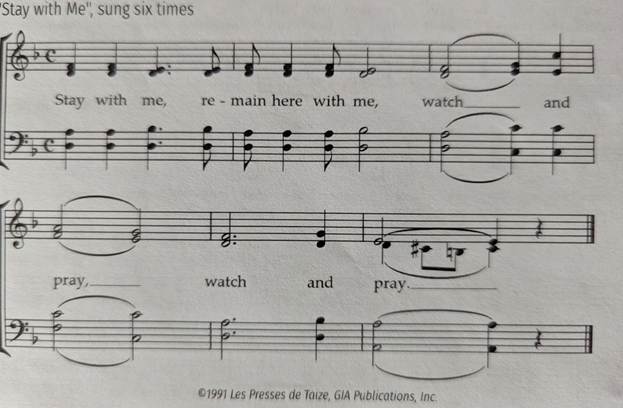
“Stay with me, remain here with me, watch and pray, watch and pray.” (1991 Les Presses de Taizé, GIA Publications, Inc.) This beautiful Taizé worship chant rolls my synapse, reminds me of the prior evening’s Maundy Thursday service, focuses my meditation this Good Friday, as I pull myself back and forth, keeping to my swimming lane. Reach. Plunge. Pull. Breathe.

Stay with me. It is as if these were words of Jesus spoken to his drowsy disciples in the Garden of Gethsemane. Remain here with me almost sounds like a plea.

How many laps had passed by?

Watch. Be on the lookout for God to do something cosmically awesome right before our eyes. And pray. Open the channel of communication between God and the self.

Pull and breathe.

Time has passed. 15 laps had to be completed, “don’t you think?” my inner voice inquires my own conscience. Stay with me. Remain here with me. Watch and pray.

Stay. Remain. Watch. Pray.

___

Prioritization in life didn’t happen overnight. It took years of hard work, coaching, networking, discernment, and prayer. The payoff has been life changing. Some of these changes took over a decade to implement.

Discovered and honed values identified these main concerns:

1. Disability & Theology.

Christian received early intervention service through Wayne ARC at Roosevelt Children’s Center, so I found my way onto the Board of Directors. Twelve (or so) members of the board wielded a $65m budget, serving thousands of people, staff, and families. My voice at the table was welcomed and appreciated, much more so than in the denomination (where 800 gathered annually to debate a $4m budget). An added benefit was that I learned how non-profit organizations operated. Finance. Human Relations. Publicity. Quality Assurance and Improvement. Corporate compliance. It was a brave new world. 

2. Compassionate Eldercare.

In time, my mother had been diagnosed with Alzheimer’s disease and began a long good-bye of more than twenty years. I found my way onto the Rochester Presbyterian Home (RPH) Board of Directors. It was an expansive, multi-campus of homes for the elderly. The RPH was known to be a world leader in dementia care. Though separated from my mother in geography, we connected with a compassion for seniors and their care. I chaired the capital campaign to expand to an additional campus. The depth and breadth of my not-for-profit experience was growing.

3. Addictions, Mental Health, and Rehabilitation.

A family member had suffered from alcoholism for decades, destroying family, jobs, and relationships. He crashed his car and live to tell about it. He asked me for help, and I did my best to rescue him from the quicksand of addictions. One night he called me from jail and asked if I could bail him out. He had been arrested at a DWI roadblock. He lost his license, and I became his personal driver. He attended out-patient rehab through FLACRA (Finger Lake Addiction, Counseling, and Resource Agency), which helped to save his life. He is over twenty years sober, and I could not be more proud of him. 

Over the years, I had led countless parishioners to FLACRA and Alcoholic’s Anonymous.

I joined the FLACRA Board. Today, I’m completing my second stint as Board Chair and have been blessed with more than two decades of service. We are a $35m organization that provides wrap around in-patient, out-patient counseling, supportive living, and employment services, employing nearly 600 staff. FLACRA does amazing, lifesaving work. We are blessed with an exceptional CEO and executive staff. 

4. Campus Ministries.

Lastly, I joined the Board of Genesee Area Campus Ministries (GACM). It was a campus chaplain who looked me in the eye in my Freshman year of college and asked me where I was going in my life; a real wake up call. I’ve been paying it back with my service on GACM for the past twenty plus years, providing a chaplain and ministry to students at the University of Rochester and Rochester Institute of Technology. 

Wow! How did I ever become so blessed? A major depressive episode turned into personal growth and strength and community service. Priorities led me to compassionate efforts in the areas of developmental disabilities, aging, addiction, and campus ministries.

God’s healing favors descended on me, not because of what I said or did, but solely, wholly by God’s amazing grace. Humpty Dumpty had been put back together again. Thank you, Lord.

42. Don’t Look Under the Tarp & Be Careful For What You Pray For

There is a reason police, fire rescue, and EMS people cover up a corpse. There is a dignity angle to it. A dignified conclusion to life should highlight the positive aspects of a person’s legacy. Final memories should be of love, warmth, butterflies, and licking puppy dogs. Covering a corpse protects a person’s dignity.

There is a modesty angle, too. Sometimes private parts of the body are exposed by the violence of injury or the circumstances of intervention. Avert the eyes, shield the view of others. Use a blanket, sheet, or tarp. If ever there is a time to be serious, this is it. Be the professional. 

There is a respect angle to be considered. Those old bones and brains propelled a person through life, the good and the bad, down valleys filled with the shadow of death, and back up to mountain peaks. Those arms held newborn babies. Those eyes witnessed a thousand sunsets. That butt occupied chairs in countless classrooms. Those feet completed marathons or took romantic strolls in the park. Props to God’s creation for the gift of cells and sinew, teeth and bones.  

For the Christians in the room, there is a theological angle to be considered. We are Jesus people, resurrection believers. The soul has left the body and now resides with God. No need to watch flesh decay to dust. Close the casket and celebrate the greatness of our God who forgives and saves! 

Yes, rubberneckers slow and stare, hoping to sneak a peek, as if some mystery is being withheld, as if some conspiracy is unfolding. Maybe, if I rush home I’ll see it on the local news.

The tarp, tent, or blanket is there for other reasons, too. I have covered the deceased to stop the trauma, to limit the shock to a minimum few, and to preserve the mental health of everyone involved. 

Such occasions are not for the squeamish. The topic isn’t covered in training, leaving first responders to default to instincts, experience, or a gut feeling. Some are blessed with more insight, others, less. Many are the rookie responders who get one look or whiff of a traumatic scene, drop everything, and quit on a dime. It is a shame that we invest a lot of time and money into training, but when it comes to prevention and preservation of mental health, first responds are often met with the sounds of crickets. 

Old school responders might play the “time to get tough, kid” card.

We shouldn’t shoot our wounded. Jesus told a story of how a mixed race immigrant found a beaten man by the side of the road, bound his wounds, and took him to an inn to rest and heal up. He even paid the bill before it came due. So should we. There is a lesson here.

Wise veterans of shock trauma have to protect ourselves. One look is all it takes. “Okay, everybody out.” Evacuate the scene, establish a perimeter, work with police to use tarps or tents. Look once, but again only if necessary. No need to burn that memory into your own synapse so completely it takes years of therapy to break up and get it out of your system. I learned the hard way.

Mature, first responder leadership will also take into account the composition of responding crews. Does an eighteen year old rookie need to look for body parts, or would they better be posted at the intersection detouring traffic? Some are more psychologically vulnerable than others. The big mouth, tall-tale master of exaggeration might better monitor the pump panel or stay at the base monitoring the radio. The parent of many children probably shouldn’t be eager to volunteer to troll the bottom of the canal with grappling hooks in search of a drowned child (especially, if other first responders are available). Leaders need to know their crews. 

Take care of your first responders. For the rest of us, mind our own business and go about our day. Don’t stare. Refrain from gossip. Discipline engagement on social media. If television reporters show up, step back, count to ten, talk it over privately with trusted others (professionals, if available), then, and only then, should one consent to carefully engage with media. First responders should always seek the advice of command. 

Unfortunately, someone has to clean up. Sometimes that person was me. The coroner needed assistance, an undertaker needed a helping hand, the hose line needed someone on point to dilute and dissipate blood, an officer seeks a pastor to assist with a notification. Here I am, Lord; take me.

Each time it happened I tried to answer the call with eyes wide open, knowing full well that I was taking a bullet so someone else didn’t have to. I knew beforehand that I would need follow up care and was risking a lifetime of therapy. My mental and emotional health is good today, only because a community of professionals have invested in me best practices to manage stress and limit the impact of trauma. 

Education has been really important for my wellbeing. Taking part in a county-wide Critical Incident Stress Debriefing (CISD) Team, resourced by recognized leaders in in trauma, has been instrumental for my own healing, as well as the healing of others. Furthermore, I’ve been blessed with a good psychiatrist for nearly thirty years; we’ve been through the shit together.  

Even the strongest have our limits. I take myself with a grain of salt.

Monday morning and it is back in the pool. No fuss. No muss. Just 15 hard fought laps. Not even a flesh wound to someone going through Seal training or preparing for an Olympic medal.

I’m just a little known, retired clergyman, trying my best to stay healthy and limber.

As I pull through the water, I think of my latest book, written about the Krupp dynasty in Germany. This family of industrialists made the arms and weapons of war, from – the first Kaiser and the Franco-Prussian war, when steel overcame brass canons, through the first world war, to the National Socialist Party (led by the Evil One who shall not be named) of the second world war, – to the modern era. Politics, fortunes, and racism brought about mass slaughter and atrocities that shocked the world. Millions died in anonymity. Disappeared. Simply vanished.

“Please, Lord,” I petition, “wash my sins away, the sins of my generation and those who came before me. Create in us a pure heart, to navigate your ways of peace and justice, of love and grace, that such evil may be extinguished and never appear again.”

Fifteen and done.

The shower is hot and restorative.   

“Now I lay me down to sleep, I pray thee Lord, my soul to keep. God bless Mom and Dad, and please send me a baby brother.” My son had been making his nighttime petition to God for nearly ten years. It wasn’t like he was dissatisfied with Cynthia or me; he just observed other kids in the neighborhood, church, and school who did have brothers or sisters, and he wanted one, too. 

Specifically, he wanted a brother. 

Circumstances of life and health made the probability of another pregnancy highly unlikely. We didn’t want to bust his bubble, but we also wanted to parent with honesty and love. After all, who was I to suggest that God couldn’t perform the miraculous? I’m an Ordained pastor, after all. We are in the business of miracles (at least God is), so, what’s so wrong with giving in and allowing our son to pray for a miracle brother? 

I’m not saying Christian, our second born son, is the result of an immaculate conception, but the hand of God was somehow involved. An angel, lightning bolt, or seductive dream? I don’t know. One day the rabbit died. All three of us were thrilled with the prospects of a second child. An ultrasound confirmed my wife’s suspicions. The water in the pool of Siloam rustled and the Holy Spirit breathed new life into our family. 

Throughout my life I’ve witnessed prayer answered so frequently I wonder how anyone can remain an atheist. Prayer is often answered differently than what was asked for or expected. But, answered, none-the-less. God’s ways are not our ways, and they certainly are not mine.

When the Lord heard my nine year old son’s nightly petition for a baby brother, eventually something had to give. Nicholas wouldn’t let up. He wouldn’t cave in. My wife is a career labor and delivery nurse. Experience taught us to temper our enthusiasm. Too many things can go wrong. So, let’s put off telling others for as long as possible, so we thought. Her gynecologist was as surprised as any of us. Given her history, she didn’t think it was possible. 

Everything held fast. Eventually we informed family, church, and friends. We made prenatal appointments and I attended birthing classes once again. At this point in our lives, we were both in our late 30’s; old, but not really old. Nicholas was filled with excited anticipation. By golly, he asked and God answered! From his perspective, he was responsible for my wife’s conception. 

Delivery was planned with the Midwifery practice where Cynthia worked. She knew all of the providers and was comfortable with their care. They had just opened a state of the art, free standing birthing center. We were given a due date. The women in our life threw baby showers. Everything seemed like the trains were running on time.

The day arrived, but the baby just refused to budge. Stop the presses! The midwife made a sudden change of plans. We’d have to travel the ten city blocks to the hospital for delivery, if necessary, by cesarian section. Who doesn’t like driving through one of the most dangerous urban sections of town in the middle of the night with your wife in labor?

Christian was born with great difficulty. He made his appearance in this world as white as 20-pound Georga Pacific copy paper. He made no attempt to breath. White quickly turned to blue. Alarms sounded, crash carts appeared, and highly energetic clinicians gloved up and dived in. Blood splattered on the ceiling. Our newborn son was whisked away faster than I could process what was happening. “Come with us,” a member of the perinatal resuscitation team invited. 

Stay with my wife? Or go with our baby? I had never faced such a dilemma. With Cynthia’s post-partum nod, I followed my newborn son to the intensive care nursery, while cardio-pulmonary resuscitation was taking place. 

Christian survived, thankfully so. During his discharge, he experienced what was thought to be a seizure, so, instead of home, he was rushed by ambulance to the highest level of care, a pediatric intensive care unit across town. For days specialists ran tests and continuous EEG’s. In the day of analog paper records, Christian did his part to clear the rain forest. 

Finding nothing, he was discharged to home a week or so later. Cynthia, Nicholas, and I were thrilled. Family and church celebrations ensued. Everyone and everything was progressing according to plan. Christian was baptized by his beaming grandfather Irving and we all enjoyed a big pot roast meal after church. 

Every baby who goes through the NICU has a follow on assessment at six months. Just the policy, I assume. Cynthia was back to work, so I packed up baby, stroller, and diaper bag and went to the Kirsch Center for what I thought would be a routine appointment. 

A parade of Medical Doctors and PhDs made their examinations, often with a gaggle of interns, residents, and post docs in tow. People smiled but didn’t say much. Hush whispers made the whole hospital floor seem more like a monastery than a highly specialized regional medical center. I thought to myself, “we aren’t in Kansas anymore.” I was in over my head and out of my league. 

The final assessment was conducted by a developmental neurologist, a brain doctor without knives for infants and children. After his evaluation, he picked up his clipboard and began to fill in the paperwork. Check boxes were labeled “Normal” and “Abnormal.” Christian got a perfect score. Every abnormal check box was checked with a deliberate stroke of the pencil and a verbal confirmation.

It was like an anvil being pounded without mercy. “Abnormal. Abnormal. Abnormal.” Page two. Three. Four. The walls started to breathe and I broke out in sweats. I grabbed Christian in my arms and hurried out the exam room and made haste to the closest men’s room. As soon as the stall door closed, I broke out in sobs. 

The universe tore, and it felt like I was falling through the crack. 

On the way home I called my brother, a primary care physician, who lived and practiced on the other side of the state. It was a first generation cell phone, the size and weight of a brick, with a rigid foot long antenna sticking out the top. Cell phones were so new there wasn’t any stigma about talking on the phone while driving. My brother must have been between seeing patients because he immediately took my call. I cried on the phone. I relayed what was taking place, fighting static and distorted sound.

“Todd,” he said to me, “take a deep breath. It’s going to be alright. Just breath. Everything is in God’s hands.” He assured me that our hospital had some of the best in the world specialists in developmental medicine. He had heard of the developmental pediatrician assigned to us, even had attended her lectures. This was the major leagues. 

I pulled into the parsonage and parked the car, next to a car that didn’t look familiar. I got Christian out of the car seat, grabbed all his gear and made our way to the door. 

On the porch was a woman waiting for us. “Hi, my name is Rosemary,” she greeted me. “I’m from the county health service. I was told that you are just returning from the hospital and had received bad news. I’m here to help.”

I was floored. Overwhelmed. Swamped by God’s amazing grace. 

God was working though science and technology, medicine and communication, to activate a network previously unknown and unseen, of therapists, specialists, educators and providers – angels, every one – who would become a part of our lives and family. Each worked to maximize Christian’s developmental potential, the thought being, early intervention leads to lifelong benefits. 

Cynthia and I recall each name with fondness: Maida, Diane, Kathy, Eric, Rosemary, Dr. Hyman, Annie, Sue C., and Sue M. Occupational therapists, physical therapists, speech therapists. Craniosacral therapy; brushing Christian’s entire body, head to toes. Early child intervention. Our front door became a revolving door of specialists coming and going. By twelve months of age, Christian was on the peanut bus to a specialty school operated by Wayne County ARC (Roosevelt Children’s Center) that offered the exact early child intervention he needed.

No one had a name for it beyond the DSM catchall: “pervasive developmental delays, or PDD for short.” No one could predict what the outcome would be. Could he grow to be a doctor or lawyer, or a plumber or electrician? Would he be in a group home or confined to a wheel chair? No one knew, and false hopes and speculation was discouraged. 

“Just enjoy your baby,” Doctor Hyman told us, “and make certain Christian makes all the appointments with the services I prescribe.” “Will do,” Cynthia and I promised, outwardly confident of God’s amazing grace, inwardly scared as chickens being chased by a fox in a hen house. 

We were entering a brave new world. And neither of us felt especially brave.

37. Farts in a Submarine and Peeing in a Pool

The parsonage in Palmyra was large and well maintained, though the basement was dark and creepy. Few churches are good landlords, but the good people on the Board of Trustees in Palmyra kept the parsonage up to snuff.

The parish supplied parsonage was right behind the church at the four corners in the center of town. It is fondly remembered as being large enough to have played basketball in the attic, pocket doors between downstair rooms, two fireplaces, and a stained glass lined staircase that wound its way upstairs from the first floor. It had four bedrooms and a parlor; big enough for me to comfortably set up a home office.

We had a key to the church in the parsonage foyer, hung on a hook on the backside of the door jam, chained to an oversized block of brass. It was an ingenious effort to prevent the key from walking off. I still think everyone in town had a key to the church and our house. Common were the late Saturday nights after the bars let out that we’d have a drunk leaning against our doorbell, slurring, drooling, begging for dollar or a ride home. 

The back door exited right on the church parking lot. Our son, Nicholas, and I enjoyed riding our bikes on that parking lot, playing an improvised version of polo, using hockey sticks and pucks. I’m sure the neighborhood talked about the new crazy Methodist pastor playing with his son. It didn’t matter to me what other people thought. A father playing with their son was a reputation well earned, I thought to myself.

We used thick sticks of chalk to draw on the pavement and the sidewalk connecting the parking lot to the church. Encouragement; everyone needs some! Faith; “Come, join us!” “Grow deep your faith.” “Rise and shine! Give God the Glory!” It was sidewalk evangelism at its finest.

The church, parsonage, and parking lot were right in the center of village life. Two doors to the North was the old village cemetery, overlooking the Erie Canal. The eldest brother of the founder of Mormonism, Joseph Smith, is buried there. Mormon pilgrims from all over the world come to visit the grave of Alvin Smith.

During the summer, tour busses would pull into our parking lot, where my son and I played, to drop off and pick up pilgrims. Not once or twice; multiple times a day. It was unsafe. No one asked permission. This practice exposed the church to unacceptable liability and risks, so I thought. I put my foot down and told the local community that the church parking lot could not be used for tour busses. 

My response was like a fart in a submarine. The message to our Mormon neighbors was loud and clear. Palmyra took notice. Colleagues raised an eyebrow. Certainly, some giggled about the crazy Methodist bicycle riding, polo playing, preacher and his son.

A true benefit of serving in a larger village church is the blessing of likeminded colleagues from other Christian denominations. We, local clergy, met weekly for breakfast at one of the village restaurants. Presbyterian, American Baptist, Roman Catholic, Episcopalian, Friends, United Methodist. It didn’t matter. Those who gathered around the table were safe. None would be promoted or elected to be your supervisor. There is no risk of saying or doing something that would damage a career.

It was a good opportunity for fellowship, to network community resources, sometimes, to just let down our hair and be silly. Families from different churches married one another. We covered for each other when vacations were taken and made hospital calls when another was out of town.

We learned about one another: best practices, denominational differences, career risks and rewards. We talked about undertakers; who paid what for funerals. And we talked about musicians; “anyone know where I can find a good cellist for a wedding?” Our families and spouses enjoyed each other. It is a joy to work together, collaborate on community wide ministry projects, and to establish a track record of success.

We shared communities secrets. Confidence was held. We could be safe with each other over a plate of scrambled eggs, toast, and bacon. Kids. Schools. Local politics. Rumors. Gossip. Births. Deaths. Adultery, divorce; you name it. We heard and saw it all. Peers serving sibling faith communities became fast friends, tenured anchors of objectivity and wisdom, lifelong blessings. 

Thank you, Lord, for my clergy colleagues and friends.

One local tradition was the Advent choir festival, an annual gathering of choirs on the first or second Sunday of Advent. It was held late in afternoon to a standing room only packed house. Choirs shared Advent and Christmas anthems. We always ended with one of the choir directors leading all the choirs and congregation in singing Handel’s “Hallelujah Chorus” from Messiah. It was glorious! Lay and clergy members from the ecumenical community packed the host sanctuary. A collection was always taken on behalf of a local charity. 

One year we received a request. Could the choir from the Mormon Stake take part in the Advent Choir Festival? Debate circled the clergy breakfast table. We each consulted our respective church boards, councils and choirs, superintendents and Bishops. We debated, gathered information, discerned, and prayed. 

No formal vote was taken, but, over the course of time it became apparent to us clergy leaders that Joseph Smith’s Latter Day revelations of God and his visitation by the Angel Moroni were inconsistent with our revelation and experience of God. Joseph Smith’s choice was to lead his followers away from traditional dogma. He left us; we didn’t leave him. His experience of God was not ours. Larger ecumenical claims of faith were not on our radar, neither would be the Mormon experience. The answer was no. 

A second fart in a submarine brought each of us clergy a smirk and eyeroll from the waitress serving our weekly bacon and eggs.

Bright flashes and an intense headache on one side of my head caught my attention. Stroke? Or, something else?

Blood pressure: normal. Pupils, equal and reactive. Vitals were all within normal limits. Check. Check, and check. Though after hours, time to call the doctor.

Long story short, a retinal hemorrhage has sidelined my swimming. Rotating my head back and forth to rhythmic breathing makes for a shaken snow globe like experience.

Guess I’ll never be a fighter pilot.

Floaters, the doctor called them. Good thing, because floaters, together with tinnitus, could be easily mistaken for hallucinations. The doctor assured me vision will return to normal in six months. In the short term, no bending, lifting, or rotating my head. With a snow storm bearing down on the region, it means no snow shoveling (for the win!).

Aging is a beautiful thing.

An elevated walking track above a gymnasium full of pickle ball courts has to make due for the time being. My wife allows me to use one of her mechanical counters to keep track of laps. If only there was some kind of equivalent for swimmers, I think to myself. It is satisfying to punch the counter with the completion of every revolution around the track.

The competition below makes me think of the waiting room filled with newly retired people coming in for physical therapy at the specialized orthopedic hand clinic. A motor vehicle collision gave me a seat at the table in the department of broken toys. For many it was a pickle ball related injury that curbed their enthusiasm and made them bow in submission at the table of orthopedic repair and rehabilitation. 

“What happened to you?” I ask, as I elevate my broken arm and cast. “I broke my arm playing pickle ball,” was a common answer. My cast was purple. Others were pink, green, and red. Were we color coded in this strange new world? We looked at each other and shook our heads in silence, waiting for our names to be called.

Twenty laps on the walking track equals a mile and a half. Good to know. Not bad for this old geezer with two titanium knees.

— 

I received a call from one of the local Mormon missionaries, who asked to speak with me. “Yes, of course,” I replied. We set a time and date to meet at the parsonage, in our parlor. Only the brightest and best looking missionaries are sent from Salt Lake City to Palmyra for their one year service obligation. They want to put their best foot forward. I can’t blame them. I would, too. 

The door opened to my surprised. The Mormon missionary was right from central casting. He was a newly retired television anchorman from Utah. Fit and handsome, high and tight. With him, was Jud, one of my church leaders; a man born and bred, dyed in the wool, United Methodist. His lineage was peppered with a long history of Methodist circuit riders and church leaders. Jud was a veteran of the Battle of El Amin, made deaf by unrelenting artillery, and I greatly respected him.

“Pastor Todd,” the elder Morman missionary began, “I brought Jud with me to talk about his possible conversion to Mormonism.”

Jud adjusted the volume on his hearing aids, gave me a wisp of a smile and twinkle of his eye.  

Poaching members from other churches is called proselytizing, and it is hugely frowned upon by fellow clergy and our respective denominations. It is like peeing in your neighbor’s swimming pool; you just don’t do it. Apparently our Mormon neighbors had not received the memo. 

I smiled, thanked the missionary for being straightforward with me, and politely asked him to leave. I wasn’t being rude; just being honest. His protest faded, but eventually he gave up, turned on his heels and left. Jud and I sat on my front porch watched him drive out from the church parking lot. 

“You weren’t really planning to become a Mormon,” I said to Jud. 

“No,” he chuckled. “But I thought it would get a good rise out of you.” And so he did. Jud, my beloved church leader, generous and mischievous, wrinkled by wisdom and experience, reserved and dignified in a beautiful sort of way. He and I sat quietly on my front porch that warm summer day in the shadow of the church steeple, watching and listening to the life of Palmyra going about its business. And life was good.

The attempt to poach Jud and his wife from my flock came after an interview by a reporter from a Mormon magazine. I had been new, and didn’t know any different. The reporter took a nice picture. The article was kind and professional. After the proselytizing pee in my swimming pool, I wouldn’t be interviewed for any more articles about my progressive theology.

The final straw came at the end of my first year. Local clergy were invited to front row seats and the VIP treatment at the annual outdoor Mormon pageant. Famous Mormon celebrities, Donnie and Marie, were going to play the lead roles. The critically acclaimed Tabernacle choir was going to perform. This ten-day repeat performance traditionally drew thousands of the curious from the region. My own mother reported that she had attended once in her youth.

It was a clandestine effort to grow the Mormon church.

So, my colleagues and I declined to be used as props for their predatory evangelism. Nope, neither would we volunteer to flip hamburgers and hot dogs in their festival booths. None of us, we determined, would allow the mission and ministry of our local parishes to be undermined and ruined by our less than honorable neighbors, no matter how nicely they dressed, proclaimed lily white American values, or claimed to be followers of Jesus. 

Tolerance and respect are qualities that I’ve tried to practice and encourage others to develop in their journey of faith. I really tried to keep an open mind regarding our Mormon neighbors, but they never made it easy. I wished it was different, but I eventually came around to the opinion that the effort to proselytize members from others is so hard wired into the Mormon faith that there wasn’t anything I could do to change it. Wishing it away wasn’t going to change it. The only cooperation was to not cooperate.

Others have wondered over the years, how I can be so tolerant and welcoming to people of other faiths and religions, but be so cold to Mormons. Being neighborly must be reciprocal. I’ve tried to go overboard, to exceed expectations with abundant hospitality, to surpass Mr. Rodgers at being a good neighbor. But, once burned, shame on me. Twice burned, shame on you. 

It is important to live my values, make my stand, and never compromise my faith. Always be kind. Smile. But be firm. It is possible to say “no” and to remain friends. Sometimes, I just have to walk away. 

35. Discerning a Way Forward

The two of us worked out a way that we could function as a pastoral team to support the needs of the people, despite our personal differences and uncomfortable circumstances. We kept lines of communication open between us. We shared equally the responsibility of preaching and leading worship. We were professionals, we told ourselves, and, by golly, we should act like it. 

The winds of war were shifting the year before I had moved from Dresden. Across the lake was the chief Army Depot for the East Coast. A cruel, greedy dictator’s action to steal his neighbors oil half a world away was waking a slumbering American giant. Huge C-5A cargo jets cycled in and out of the military airfield, withdrawing munitions, depositing them in distant lands. Trains plied the iron, loaded with the means of war, unloading at East Coast docks. 

Politicians postured. Lines in the sand were drawn. The era felt as if we were being flung into the inevitable, a clash of extreme violence.

“Blessed are the peacemakers,” I recall preaching from Gospel beatitudes, to two full worship services each Sabbath, averaging over 350 per Sunday. One or two showed their disgust, got up and walked out. The hint of Christian nationalism was starting to show itself, and the future was cloudy, at best, apocalyptic, at worst. 

The lesson of disgruntled members of the parish for me was to grow a thicker hide. Stand convicted on the Gospel, the Truth of Jesus Christ, and let the chips fall where they may. Some, I’m sure, hate our Lord’s message of love God, love neighbors, love your enemies, and pray for those who persecute you. While it may feel like a personal rejection, from my Christian milieu, turning one’s back on Jesus, is a rejection of God. 

It isn’t, and never was, all about me. The conflict is a deeper struggling for meaning, a conflict that is written in the DNA of the human experience. In my own attempt to square the circle, I’ve come to believe in the Divine Providence of a loving God. At the same time, I recognize that the evil of this world, if left unchecked, will destroy with wonton abandon. 

The only logical conclusion is that it takes brave men and women to make a stand opposed to violence and evil, that the rest of humankind may live in peace. I’m grateful that God calls others to positions of responsible deterrence. Concurrently, I’m grateful to be called in a different direction, to tend the flock of the faithful, to preach the Word, and celebrate the Sacrament. Blessings to those called and prepared brave men and women who stand firm in the breach of impending violence, prepared to risk it all, be they fighter pilots, submariners, or cops on the beat. 

Others just see the world differently.

Ministry in the heart of the Finger Lakes of New York was good. We are blessed with four distinct seasons of the year, rare cases of catastrophic climatic events, and prosperous hamlets, villages, and towns. 

Healthcare has always interested me. Had it not been for a bad experience back in high school biology class, I could have gone the way of medical school, as my older brother did. Our city congregation was blessed with numerous doctors, nurses, therapist, and social workers.

One physician was about my age, married and had three beautiful children, two sons and a daughter. He was balancing the work, family matrix. After a difficult clinical shift, he would often stop by my parsonage to destress over cigars in my garage.

He was raised in a progressive Christian family, his parents serving as missionaries in South America. He learned to fly the missionary airplane into and out from jungle stations before he learned to drive a car. Home schooled, he went to a prestigious university and graduated from an exceptional medical school. Less than ten years into his profession, he was the head of a department at one of the local hospitals. He was going places.

Just not the places I expected.

There was a nurse, he explained to me, who desired to expand their relationship from the bedside to the bed. He was tempted by the sugarplum imagination of passionate adultery with another woman. He had even confessed his temptation with his wife. Yet, he claimed, he did not know what to do. What was my take on it? He asked.

A quick response is unusually a bad reaction, no matter how well meaning, in my experience. I puffed on my cigar in deep thought. My soul was frightened, fearful that one wrong word would result in utter catastrophe. A loving, talented wife. Three beautiful children. A professional reputation. A lifetime of deep faith and Christian morality. All this, and more, hung in the balance. I recalled my wife’s disgusting reports of similar behavior at her hospital. Colleagues disreputable behavior causing painful harm in clergy families and local churches also raced through my mind. 

“Don’t do it,” I finally broke the silence. Absolute truth and honesty surprised both him and me. It had to be said. I proceeded to lay out the dilemma with my God given talent for mathematics and logic. “Are you prepared to live a dishonest life?” I concluded. 

“No,” he slowly resolved. “I am not.”

But what about his matrimonial confession? His wife most certainly was feeling lost, betrayed, on the verge of abandonment. “Have your wife meet you here,” I’m strategizing even as I’m thinking. God, Don’t leave me now, I’m thinking to myself. “My wife and I will leave the house to just the two of you so you can talk it out.” Space and time would give him the opportunity to express his resolve to end the amorous flirtation and create the possibility for healing to take place. 

My friend and parishioner made the call. My wife and I went shopping. Something Divine must have taken place. In time, he left his prestigious position and took another at an academic hospital in the mid-West. We exchanged Christmas cards for years thereafter. Their letters were filled with family, love, and faith. 

My heart was contented. God’s healing grace is truly amazing. 

Laps in the pool this morning blew by. I started sharing a lane with a gentleman who I was becoming familiar with through our greetings in the locker room and on the pool deck. He is kind and considerate, values I appreciate and try to reciprocate. He finished his laps just as I was about to get started. 

As I reached for the final wall, another swimmer joined me. We exchanged pleasantries. I was breathing heavily, cooling down, thinking about the hot shower that was waiting for me. “You know,” he began, “I appreciate swimmer’s courtesies. Some are more readily willing to share a lane, others not so much.”

I agreed. “We only rent a lane for a short period of time,” I struggled to find the right words. “It’d not like we own it.” Mutual respect among swimmers avoids collisions and injury.

“If only the rest of the world was as kind and considerate as you are,” he concluded. The silence hung pregnant in the moment. I departed, leaving behind a blessing, wondering if I was worthy of his kind words. 

Sometimes circumstances demand that I just take it, God’s grace be praised. 

My petition to the Bishop’s office for a move was met with silence. I had two solid years of fruitful ministry, five years of full-time tenure. It was just the fact that my sails were cut from different cloth from my appointed partner. I needed to captain my own ship. 

Bigger churches and larger compensation appointments were the first to fall with the start of the new year. Moves traditionally took place the end of June, the beginning of July. The telephone rang mid-March and the call was from the District Superintendent, an old friend of the family, serving in the rural Adirondacks. “The Bishop and I would like to send you to …,” he began. 

My heart fell as fast as the Roadrunner’s anvil.

A quick reaction is a bad one. Hold your tongue, I told myself. Pause. Count to ten, my mother taught me. He offered me a two point charge, a larger village church and a small country chapel. It was miles away from civilization and the nearest hospital where my wife, Cynthia, could continue with her call as a labor and delivery nurse. 

Fortunately, I was the benefactor of a two-year continuing education opportunity with Perkin’s School of Theology at Southern Methodist University. I was placed in a core group of eleven youthful peers from across the country, paired with two seasoned elders, visionary leaders from their respective Annual Conferences. My mentor was the pastor of the Methodist cathedral in Houston, Texas. He visited me twice in New York. I made the sojourn four times to a restful Episcopal retreat center in Flower Mound, Texas. Dr. Stan Menkin, a professor at Perkin’s brought us all together.

Episcopal appointment making was one of the topics. Each subject matter required a lot of reading and writing in preparation, and resulted in lively discussion within our core group when we met.

Don’t make a snap decision, was the wisdom. Give room for the Holy Spirit to speak. Consultation is the word used in The Book of Discipline of The United Methodist Church. Our mentors concluded: Take the gift of consultation to do your homework, discern the Spirit’s will, then come to a conclusion and make your case forthrightly. 

“Give me 48 hours and I’ll get back to you,” I told the Superintendent. 

My wife and I set out for an anonymous visit to the prospective parish. We tried our best to keep an open mind. We visited some firefighters washing their firetruck on the ramp of the village fire station. We had lunch in the local diner. We took a long walk down Main Street and visited the swings at a local park. What is the mood of the community? How are the schools? What keeps people occupied? What do you do for fun? We asked around, a lot. 

The local papermill was closing. People were either hardscrabble farmers or public employees of the town or school district. Storefronts were abandoned. Housing was in decay. Life had boomed in the 1950’s, but had gone downhill ever since. The nearest labor and delivery hospital was an hour away. Lake effect snow fell each season with apocalyptical effect. The parsonage was physically attached to the church.

The Spirit was speaking. 

“No,” I responded to my disappointed colleague. “I’m not feeling called to a parish and town in decline, where my wife would be unemployed, and where we couldn’t meet our student loan responsibilities.”

“But, could you do the job?” He asked me again and again, like a hammer and chisel searching for a crack. Of course I could do the job, I asserted with all my five years of pastoral experience. “I just don’t believe I’m called to take this appointment.”

And thus I hung it all out there. “I’ll get back to you,” he replied.

Back to waiting …

Meanwhile, the fire alarm fired off my pager at three in the morning. “Tree down on West Lake Road,” I heard as I dressed, got in my truck, and activated my flashing blue light. 

An ice coated tree lay across the road, and all the associated downed power lines were draped like spaghetti in the darkness. An ice storm had taken up residence throughout the Finger Lakes. The paid firefighters (with the responding engine) and I listened to a cascade of calls flowing in from the dispatcher. Trees down. Power out. Smell of gas. Traffic lights dark. More crews. More engines. More fire companies across the region were being called to duty.

“Can you remain here protecting the road with your blue light while we start answering the other calls?” The paid guys asked. “Sure,” I responded. “Go ahead.”

Ice and falling branches sounded like breaking glass as I waited sentinel at my post. Little did I know at the time, but ice pulled the electrical service box from my parsonage, like it had from thousands of other houses throughout the city. My wife and son waited in darkness and dropping temperatures. She had to get our son to day care. Was it going to open? She had to get to work; mommas in labor don’t wait for no ice storm. While I was working fire calls, she was working the complex decision tree that was facing families everywhere.  

I was out for four days and nights with the fire department while my wife and son relocated to her parents’ house in Syracuse. They had lights and heat. The local Chase-Pitkin’s hardware store opened it’d darkened doors to the fire department. The kind general manager donated a pallet of new chain saws for the fire department; I used mine nearly continuously for the next week. Generous, oh my goodness. The world is full of great people like that store manager.

It broke my heart to pump out flooded basements and turn off utilities to families in need. The risk of accidental death was far too great. We delivered food and potable water, drove people to dialysis, and kept people’s home oxygen supplies replenished.

The second telephone call came a few weeks later. “The Bishop and I would like you to take an appointment to Palmyra.” It was only fourteen miles away, still in the familiar Finger Lakes. It was a one point charge. Cynthia would still be able to commute to her hospital in Geneva. I was ecstatic. “But wait,” I told myself. Take a breath. Count to ten. “Take the gift of consultation to do your homework, discern the Spirit’s will and direction, before you make a decision.”

Thankfully, I did. The judgment was made; the die was cast. We would be moving in June and I would become the captain of my own ship, once again.

Thank you, God, for the gift of discernment, for the clarity of your will, and for the opportunity to serve the faithful members of a new congregation.  

34. Disillusioned but Wiser & Parish Ministry Undercover

After three years in my first parish I was asked to move. Ordination and full membership box, checked. This modestly increased my compensation package, but it just wasn’t in the cards for both churches to sell more hamburgers at the county Fair to cover my additional cost. We were happy where we were planted; the people were happy with my effort. The only thing that didn’t add up was the Conference minimum base salary and the bottom line. 

My wife, Cynthia, was comfortably employed by Geneva General Hospital, working nights and weekend doing labor, delivery, and post-partum care. She was hitting her stride, fulfilling God’s call for her life, doing her best to keep the obstetricians from knee capping each other, and expanding her circle of friends and coworkers. I pale in her shadow.

My new appointment was within commuting distance to Cynthia’s hospital. I was to serve as a co-pastor with someone who was fifteen years my senior. That’s what I was told, anyways. The vision of a big church with lots of people, far reaching missions and ministry, and a bump in compensation was too much for my pride to turn down. With three years of tenure, I can now look back and see how entirely naive I was.  Indeed, pride comes before the fall.

My partner was at the top of his game, politically connected with the Bishop and conference leadership, and well liked among peers. He looked and acted the part. In hindsight, he was probably excited by the possibilities of a bigger church, having an associate pastor and staff, and the prestige it provided. It also helped that he had family in the new church. 

My district superintendent sold me a bill of goods, some true, some not-so-much, and a whole lot of obfuscation. “There is a bit of a mess to clean up,” he repeated to me, an echo that led me to my first appointment. I showed up July first to find the larger office was already claimed, and I was to be happy with one half its size. Red flag, number one.

A prior beloved pastor left behind in a closet an aerosol can labeled “Bullshit Repellent”. We both laughed at the find. I should have been paying closer attention.

The people were wonderful to Cynthia and me, welcoming us to our new parsonage, making us to feel right at home. The staff became like a second family, Joanne running the office, Frank the custodian, Trixie on the organ, Sharon the choir director, and Barb the head of Christian education. All top shelf, first class professionals. 

Frank made the best coffee, and could often be found loafing in the boiler room, chair tipped back, his eyes closed in rest. The floors shined. The job got done, so, who should care?

Likewise, church leadership was excellent, local business leaders, a healthy mix of gender, background, and experience. All, well-educated, lifelong United Methodists and disciples of Jesus. The congregation was generous in sharing their time, talents, prayers, and gifts. Groups of the willing were being added to the roles with each new membership class. Fewer were quietly exiting by the back door. Racial diversity was lacking, yet, we were blessed beyond imagination.

One undertaker in the congregation was known to palm me a one hundred dollar bill at holiday time. Nice.

The second red flag was soon to be raised. In walked a former pastor to say “hello,” when, in fact, he appeared to be showing off two trophy women, one under each arm. He had left with a spouse dying of cancer, and under a pall of infidelity. The first attempt to move him was aborted when the new church learned of his portfolio and told the Bishop to go back to the starting block. His second attempt at assignment would end in unflattering ways, with alleged victims writing to me and drawing me into his mess. He was forced into retirement, but never asked to surrender his credentials. 

My foxhole just wasn’t deep enough.

The next red flag rose when we divided up assignments. Working with the Capital Fund campaign and the Board of Trustees was mine. Finance and Staff-Parish went to my partner. The one who is the steward of the money makes the rules, a painful point when it came to negotiating my future compensation. 

Other troubling red flags tipped up. No, I could not keep some things secret, especially where ethical lines were alleged to be crossed. No, I was never in the room, a la Alexander Hamilton, but I was being pulled into other situations where I was absolutely uncomfortable. Neither did I get any support for my less-than-forthcoming District Superintendent. 

It didn’t take long for trust to break down and for me to be seen as a potential liability. After two years, I was thankful for the experience, but I realized I was the captain of my own ship. Instead of ducking behind cover, it was time to maneuver.  We parted ways without any hard feelings, on my part, anyways. But our relationship would never be close. Over time, much has been forgotten, thankfully, but it was time to ask for another appointment.  

The lap pool at the Jewish Community Center is down for maintenance this week, forcing me to forgo my three times a week pattern of swimming. We are all in need of retreat, fixing, healing, cleaning, and restoration. Even community assets like pools, recreation centers, and houses of worship need time and attention, I suppose. 

I laced up my Pentecostal red walking sneakers, planning to take on the walking track. Elevated above a gym that hosted three pickleball courts filled with competitive geriatric players, the walking track appeared unusually occupied this morning. Probably displaced lap swimmers, like myself. My wife allowed me to borrow her mechanical lap counter; an occupied mind easily loses track of such mundane details. Ear buds, inserted; Handel’s Messiah is especially poignant this season of Advent. 

The voice of Isaiah spoke powerfully through the eons. “‘Comfort, O comfort my people,’ says the Lord. 

Twenty laps ticked off before I knew it. Arms waving, conducting an orchestra of my imagination, I’m sure others stared in disbelief at this self-absorbed nut job. 

Both my artificial knees held up without a whisper of pain. Thank you, Lord.

My original office just wouldn’t do. It was small, a closet really, right off the main welcome desk and administrative work station. Noise and constant interruptions were not conducive to the thinking, reading, and writing necessary for an Ordained, parish pastor. 

Ministry happens in the interruptions, a wise seminary professor once told me. Even he would be seeking new real estate given the unrelenting interruptions. A former storage room right off the choir room was perfect. Large windows gave me a northern view. And quiet; listen to the quiet! In moved a desk, my Kay Pro computer, books, and assorted office supplies. 

Patterns are revealed over time and with an attention to details. Each week, an older pensioner would walk across the church lawn to the center where a three inch pipe stood silently a foot tall. Just what was that pipe? And where did it go? The gentleman unslung five or six one gallon jugs, inserted a hose down the pipe, and began to crank a hand operated pump. Dark fluid began to fill the jugs. When finished, he carried the jugs to the trunk of his car, retrieved his pump, and drove off. Once a week, like clockwork. 

After a few weeks of this carefully choreographed routine, I decided I needed to meet this man. “Hi. I’m Todd, one of the new pastors here,” I introduced myself. “Who might you be?” Even as he continued to crank his pump he looked up and smiled. He introduced himself as a former custodian. He further told me that a former pastor had given him permission to draw off fuel oil as he needed, since the buried fuel tank was no longer used. A natural gas boiler had replaced an oil burner years earlier.

“Is it okay with you?” He asked.

“Yes, certainly,” I paused. “How long have you been doing this?”

“Oh,” he stroked his chin in thought, “probably for the past twenty years, or so.” 

Here was something they don’t teach in seminary.

The concerns of the chair of the Board of Trustees were embedded in the wrinkles above his eyebrows. He obviously had never known of the buried fuel oil tank in the church yard. His concern for the elderly gentleman paled in priority to a larger pan of frying fish.

“Wonder how big it is?” He asked. We had no idea, other than it had been pumped out a few gallons each week for the past twenty years.

“I wonder if it is leaking?” He wondered out loud. 

At the next meeting of the Board, the chairperson had the newly discovered fuel oil tank at the top of the agenda. Members shared concerns based on their knowledge and experience. What about the DEC (Department of Environmental Conservation)? They didn’t think highly of potential or actual fuel spills. Remediation costs were always astronomically high.

What about the city’s Historical Conservation Commission? Nobody on Main Street could so much as paint their house a different color (or pick their nose) without pre-approved permission. Professed ignorance was no defense. A long history of punitive fines proceeded our deliberations. 

Everyone talked themselves out. Apparently, there was no solution to this Gordian knot. No notes in the minutes were recorded and no decision was made; the topic was tabled by inaction. The chair moved on to the next agenda item and we got on with it. I could see from his demeanor that he was still working on a solution to the buried fuel oil tank in his brain, even as other items were checked off the agenda. Prayer. Motion to adjourn. We departed for the evening. 

A week, or so, later, I opened the shades on my office window and noticed a newly reseeded area of lawn where the pipe once stood. At eight in the morning, the church was just awakening. Downstairs in the kitchen, hot water was dripping into a basket full of grounds. The dew was still wet on the grass. I walked over to investigate. Hum. “What in the devil is this all about?” I wondered. Escaping my notice were two tractor trailer low boys parked in the back parking lot. By the time I returned to my office, they were gone. 

“What happened to the yard?” I asked the chairperson over the phone. 

“Is there a problem?” He asked. 

“No, its just that yesterday, the yard was green and this morning there is a 20 by 40 foot patch of newly seeded ground covered in straw.” I noticed the pipe was missing, but failed to mention it.

“I guess the boys got to work last evening,” he said, “but I’ve got to swear you to secrecy.” 

After dark the preceding evening, the chair had called in a favor. One of his friends owned an excavating company. With stealth and speed, a crew moved in with a shovel and cutting torches. Out they pulled a six-thousand gallon empty fuel oil tank, thankfully with no signs of leakage, cut it into quarters, and chained the remains to flatbed trailers. With my back turned in the morning, his guys departed with all the evidence taken to the scrap yard. Ten wheel dump trucks had filled the hole; the area hand graded and raked. Seed and straw completed the clandestine mission. No one the wiser, except the Board chair and this new, green-horned pastor. 

“Your secret is safe with me,” I replied.

That was nearly forty years ago and all the suspects I’m sure are gone to their heavenly reward. I am thankful that everything turned out okay, there were no leaks, and not a penny of church money was used. Whenever I’ve driven by, I take notice that the grass is still green. The only regret came when I informed the retired pensioner the next week that his old reliable source of free fuel oil had dried up. 

The new parish and parsonage was in a smaller city. There were even movie theaters in town. Funny how one remembers what is important. We moved from being a big fish in a small pond to becoming a small fish in a big pond. The local fire department had both paid, union firefighters, and, three companies of volunteers. My former neighbor, George, well connected in the volunteer fire service made the customary introductions. 

“You’d fit in fine with the Merrell Hose,” the full-bodied paid guy said, as he tilted back in his chair. That was fine with me.

The Arenea Hose company was the traditionally Roman Catholic company. The Hook and Ladders were an assortment of cast offs, want-to-be paid guys, and manual laborers. The Merrells were the Protestant guys (we were all male), the oldest fire company East of the Mississippi, we were told, and composed of all the local doctors and lawyers in town. No, most did not actually respond to calls or fight fires; they left that up to about five of us willing young bucks.

The Merrells meetings were held in secret, in an upstairs room of one of the city fire stations. High backed chairs lined the four walls. A desk, gavel, and chest were located in the center. Votes were cast by placing a white or black marble in the hole in the top. I received not one black ball, was voted in, and shown to my chair. Wow. Cool beans. I was in. They even assigned me a chair.

The Merrells raised money by their bi-monthly steak and clam roasts. It was quite the social affair. Liquor flowed unabandoned. Some of the money went to charity. Some of the funds went to outfit the actual volunteers who answered calls with only the best firefighting equipment money could buy. I received new bunker gear, a leather helmet, a grin, and a handshake. That helmet was a status symbol, the envy of every other firefighter in the region. 

The call came in for a fully involved house fire on Fort Hill Avenue. I drove to the scene and met the pumper and paid crew on scene. The first rule I was taught early on, was only union guys were allowed to touch a fire truck. Rule number two: volunteers don’t violate rule number one.

I backed up and a self-contained breathing apparatus (SCBA) was hung on my back. Straps were pulled tight, hose attached to my face mask, and air was turned on, just as I had been trained. Brian Mace, another Merrell guy, was my interior attack buddy. 

We grabbed an uncharged inch-and-a-half hose line, handed to us by the white helmet safety officer standing at the door. Glass was breaking, flames were rolling inside, and it appeared as if the house was building up pressure. We handed our ID tags with the safety officer and entered into Dante’s Infernal. Black smoke descended from the ceiling down, forcing us to our hands and knees. The fire had started in a wood stove at the far end of the room. We pushed the hose line ahead as we slowly, but deliberately, advanced. Flashover was imminent. Brian was in the lead with a radio and I was right behind him. He was much more experienced, and I felt confident he knew what he was doing.

The ceiling by the double walled stovepipe blew out and fire filled the room with explosive force. Brian called for water and opened the valve. We knelt and held on tight, ready for the surge of water. As the 60 psi stream hit the fire in the ceiling, the blown in insulation soaked up every drop of water that hadn’t be converted to steam. The ceiling sagged with the added weight and let loose right on top of us. We were driven flat to the ground. I was knocked silly. 

The hot water and steam flowed from the shower over my battered and bruised body, as I stood in silent reflection and nursed an ice cold beer. Thoughts of life, death, and eternal life flashed before my closed eyes. I was thankful for the Hopewell firefighters who arrived on scene just in time to bring their own hose line in, all the while dragging Brian and my sorry asses outdoors to safety. Just. In. Time. 

Thank you, Hopewell Fire Department.

My tie and dress shirt was ruined. Pants were torn and smelled of smoke. They could be replaced. But, I was alive. Brian was alive. We survived. We all survived; nobody was injured. The collective effort of volunteer and paid professionals saved the house from further damage. After a few months of intensive clean up and remodeling, the family returned to their house and home, none the wiser. 

Fire and furry humbled me, leaving me wiser, smarter, thankful for God’s amazing gift of grace: the ability to live to see another day. Thank you, Lord.

31. Lent, a Bat from the Belfry, Tech in the Parish, and the Yates County Fair

Lent is a time of year for personal reexamination of one’s spiritual health, relationship with God, and our personal journey with Christ. It is forty days long that, except for Sundays, grants recognition of Jesus journey in the wilderness, being tempted by the Devil. Every Sunday is a celebration of the resurrection, hence, every Sunday is a mini Easter. As Lent progresses towards Holy Week, we spiritually journey with Jesus from the Judean wilderness to Jerusalem atop Mt. Zion. The journey is uphill all the way, and, as such, is only for those who dare. 

Do you have the right stuff?

The wilderness is a windswept gravel and sand mountainous expanse between Jerusalem (to the West) and Jericho (to the East). Four times in my life I’ve been privileged to lead pilgrims to the Holy Lands and to sit quietly on a dusty ridgeline taking in the environment of the wilderness. It is humbling to consider the temptation to eat where there is no food, to drink where water is rare. As the sun sets, oppressive heat is replaced by bone chilling cold.

If Christ could resist the Devil’s temptation to turn stones to bread, can I not resist the temptations of daily living? If Christ could reject a challenge to his sovereignty, can I also not resist challenges to my call and Ordained Ministry? “What wondrous love is this?” My thoughts return to the sacred hymn in the silence of the wilderness that surrounds me. 

Lent in the parish included both a personal call for introspection and a communal call for learning and shared fellowship. We’d host Wednesday evening dish-to-pass dinners followed by a Bible study or an appropriately themed movie. It was a time to be together, to be as one, as the Eucharist liturgy reads, one with each other and one with our God. 

Back in the day (Now you know that I am old!) I had arranged for the delivery of 16mm films to be delivered weekly from the Conference Resource Library. This was years before projectors and Power Point. The church had a cantankerous movie projector that displayed the 16 millimeter film on a flimsy screen. As the dessert was cleared and coffee cups refilled, all settled in for an inspiring Lenten movie. 

The lights went out and we all settled in for the show. People were happy. I was happy, content with myself that I was providing spiritual guidance for my flock.

Suddenly, a shadow swooped across the screen. Then, back again. “What was that?” I heard some startled to awareness. That was a mischievous bat, nothing more than a flying mouse that probably was housed in the church belfry. Children squealed. Mothers ducked for cover. The men entered the gauntlet determined to put a heroic end to the bat’s misadventure. 

It was a free for all!

The lights flew on. Coats were stripped from hangers and a half dozen men began chasing the offender with the hope of bagging him. After several failed attempts, amidst a crowd of now shrieking children and mothers  telling their husbands to “do something,” the men regrouped. What to do? 

“I’ve got a tennis racket in my truck,” one gentleman offered. The rest of us wondered what he had a tennis racket in his truck for? Playing tennis wasn’t exactly a thing in rural Yates County. “The bat’s radar won’t see it coming.” 

The refined dinner and a movie group of parishioners became a cheering crowd as the lone man chased the bat around the fellowship hall, flailing with a tennis racket. Finally, a swift backhand launched the bat across the room, knocking it silly. A coat was quickly thrown over it. A group of victorious men walked the bat-in-a-coat out the side door and set it free into the night air. 

It took a while for proper Lenten decorum to be reestablished. When all were settled in, the lights went out, the projector was restarted, and the movie returned to it’s inspirational self. 

An athlete I am not. Don’t even pretend to be. I swim my fifteen laps every Monday, Wednesday, and Friday morning, not because I want to, not because I like to, but because my doctor and medical research has demonstrated the importance of regular exercise. 

“If I had it my way,” I thought to myself this morning, “I’d be home in my nice warm bed.” 

This morning I dug at the water, fluttering my kick, raising my heart rate for a half an hour. Three groups of five, my brain tells me, is an easy way to keep pace, an easy way to keep count. Except, I have been known to lose track, lost in meditation or thought.

Reach and pull. Reach and pull. My reach extends my arms as far forward as I am able, stretching sinew and muscle, causing oxygenated blood to surge and flow. My fuselage rolls with each reach, giving opportunity to breath out of the side of my mouth in a rhythm worthy of a drummer. 

Just as quick as it starts, I’m done, leaning against the end of the lane gasping to catch my breath. The lifeguard takes notice. I nod that I am okay. I just need to catch my breath. 

There are times throughout my pastoral ministry that I’ve needed to just stop and catch my breath. Periods of hard work and preparation, followed by execution, relief, exhaustion, and nodding to sleep in my easy chair. 

Technology was breaking out all around me. Copy machines became small and affordable. Stencils and ink spewing AB Dick duplicating machines were relegated to the junk closet in every church. Bulletins and newsletters could be typed and copied much easier, much faster. 

I bought my first personal computer; portable it was called. My new K-Pro sported two five and a half inch floppy disk drives and a whopping 16 k of working memory. It weighed in at about thirty pounds. Portable? Just barely.

Programs were on one drive, data was saved on the other. My K-Pro spoke programming languages I was familiar with, harking back to my college days working IBM and DEC mainframes. The only thinks lacking on my new K-Pro were the punch cards and a printer. New daisy wheel printers were expensive, but I bit the bullet and had one delivered to the parsonage. 

Parishioners scratched their heads in wonder. 

Lightyears before email and the internet, it was hard to imagine what a computer and printer could do for a parish pastor. I provided printed spread sheets for finance teams and the Board of Trustees. I began to print a bulletin and monthly newsletter, run it over to the corner store where the one copy machine in the entire village was located, pay five cents a copy, fold and press, and, boom, it was like Jesus turning water into wine.

My volunteer printer and AB Dick bulletin maker, covered in ink when that contraption blew up one morning, spewing ink from head to toe and across the walls and ceiling, thought I was able to walk on water.

Who was I to bust her bubble?

The county fair came every July. Each of my two churches ran a food stand on the main thoroughfare, selling hamburgers, hot dogs, fries, macaroni salad, homemade pie, and assorted other things. The question became, which of the two booths were you going to work, Pastor?

I couldn’t prioritize one over the other, neither could my choice reflect any preference or quality of food. The Fidelus Class of young adults, who’s average age was about 65, ran the one booth, while the other was operated as a Y’all Come type of affair. Everyone was expected to volunteer and make donations. If you couldn’t come up with four or more home baked pies, and schedule yourself for 16 hours’ worth of shifts flipping burgers, you’d better send a sizable check. The two concession stands stood on opposite sides, facing one another. My choice would be affirmed by one, at the same time, observed by the other.

What was I to do?

So, I did what any young buck, newly ordained, inexperienced pastor would do; I did both. The best controversary was the one avoided, I naively thought to myself. How soon I would learn different.

The week of the county fair, I rotated on a daily basis between the two booths. No time to prepare for Sunday; I was stuck working twelve or more hours each day hawking food to fair goers. At the end of fair week my first year in the parish, I was beat! Completely and utterly exhausted, and everything about me smelled of grease. The following Sunday should have been a vacation Sunday, but, nope, I was too green to know better and nobody was forthcoming to tell me different.

By God’s grace, each year I learned. Each year, I got better.

I learned to stop and catch my breath.

26. Laundry, Sin, and a Kid Named JAC

The living conditions were pretty spartan. I was given a third floor apartment with uneven floors, an ancient kitchenette and rusty shower. My bed and mattress was early American threadbare. Interior exit was to a hallway, an exterior exit that I most often used was by metal fire escape.

Stan and his family lived in an adjacent house. The kitchen and dining room were directly below. Alcoholics Anonymous held their regular meetings in the downstairs conference rooms and frequently clogged the urinals with cigarette butts. Stan was the director and direct supervisor.

One Saturday morning he sent me to the basement with a pipe wrench and step ladder. The sewage pipe from the first floor men’s room was clogged and I needed to clean it out. As soon as I had the waste pipe separated, the gush of effluent hit me square in the face. The job was completed and I quickly jumped into a long hot shower. 

Hospitality was job one at Camp Miami. I’d welcome guests, give them the fire drill spiel, point out where the linens and bathrooms were located, and enjoy meals with them in the dining room. There was a large outdoor swimming pool that required upkeep and maintenance. Cleaning it with an acid wash was not my favorite task. 

A family of skunks moved into one of our many campsites in our back forty. Campers and counselors alike were spooked. Stan knew that I had my 12 gauge pump locked in the trunk of the car. He asked me if there was something I could do about it.

One early morning when there were no campers or staff in the campsite, I drove out and set up shop. Sure enough, along down the path came mom, dad, and lots of children skunks. It took mere seconds to empty the chamber and five in the magazine. I should have felt bad about unleashing violence and death upon defenseless critters, but the smell quickly brought me to my senses and the awareness that I had not made plans for the disposal of their remains. I returned with a shovel and scooped up the bloody remains into the kitchen pickup truck. Evidence of the slaughter was deposited in the dumpster behind the kitchen. I thought my mission was complete.

It wasn’t.

The smell was terrible. It mixed with the aroma of the kitchen, making the cook mad. The pickup continued to smell even after I hosed out the back. “Todd,” Stan told me, “get some Clorox from the storage closet and a good broom and clean it out.” Wonderful. I scrubbed the truck clean as a whistle. After the trash company emptied the dumpster, I did the same, holding my nose and trying not to gag. But, I cleaned up my mess. Had my mother known, she’d be proud.

Mom would not have approved of the way I did my laundry. Clean cloths would be dumped on my bed. I didn’t have time to fold and store them, so, I figured, if I showered before bed, I’m be clean, the cloths would be clean, and all would be good. Neither would I need to change sheets. 

All wasn’t good when Cynthia flew to Dayton for her planned visit. I picked her up at the airport and brought her to my apartment at Camp Miami. She looked at the pile of cloths on my bed and probably realized that I was more than a boyfriend, but if our relationship was going to go any further that I would become a project for her transformation. 

We sat one evening on a recliner in the living room with her on my lap. We talked about the future, our hopes and dreams, of family and children, of her nursing career and my future serving as a pastor. “Do you think we are ready for marriage?” I asked. “I think so,” she replied. “Then, will you marry me?” I proposed. She rolled her eyes and said “yes.” Forty years later, we remain happily married, having raised two wonderful sons, both retiring from jobs when God called us to serve, blessed beyond any fathomable possibility. 

Our memories don’t coincide. Perhaps I sabotaged the laundry by mixing colors and whites, or, it was just my lazy attitude about folding and putting away the clean laundry. Whatever and however it happened, Cynthia ended up doing the laundry.

I don’t take her kindness and grace for granted. Cynthia is God’s gift to me. Full stop.

— 

I was so tired this morning, I rolled out of bed, dozed at my 6:30 am video meeting and got myself ready for the pool. As I handed Cynthia off to the gym, I told her, “pray I don’t fall asleep doing laps and drown.” 

The water was crisp and fresh, like fall apples snapped from the tree. I woke, in the proper sense of the term, only to realize that I was the only one swimming laps this morning. No distractions. God is good.

As water was pulled across my skin, leaving eddies, swirls, and bubbles in my wake, I thought of how busy I had become in retirement. I chair two not-for-profits boards, and constantly worry over the responsibilities of income, expenses, jobs, the mission and people we serve. The home owners association board on which I serve is undertaking a big project and I don’t want to offend my neighbors. I’ve been asked to serve on another board, because of my experience. Is this an appeal to my pride? I ask myself as the laps tick by.

I don’t know. So much of life is unknown and unknowable. What is God’s will and how will I know if I get it right?

Theodicy is the study of sin and evil, and God’s hand in it. Dr. Inbody taught the class. It was his specialty, and he taught with passion. He would write a book “The Transforming God: An Interpretation of Suffering and Evil” (1997) on the topic. In the opening chapter of the book, Ty told us a story of Indian lore, in an effort to warn us of the dangers associated with studying evil.

A rabbit is much faster than a cobra, yet cobras regularly feast on rabbits. “How can this be?” Ty asked us. The answer was eye contact. The hungry cobra will spy a rabbit, obtain eye contact in an almost trance like state, and slowly, deliberately, approach to within striking distance. Whereupon, the snake would strike its killing foe. His point: Don’t stare at evil for too long without a break. Step back, focus on other things, pleasurable things. Refresh and restore before diving back into the study of evil, less thee become consumed by it. Good advice.

The common belief that God took someone and caused their death disturbed me. It still does. It appears inconsistent with the God of my experience, One that loves completely and desires the best of every person. Ty’s class on Theodicy provided me a framework for ministry in the midst of death and dying.

I do not believe God creates suffering. The biological nature of the human condition is confined by lifespan, blood vessels with weak spots, lungs that are vulnerable to environmental stress, brains that are oxygen sensitive, bodies formed nearly, but less-than perfect, in the image of God.

I do believe God is deeply moved by human suffering and actively seeks ways of transforming suffering and evil into good, as he writes “through an influential and persuasive process, not a controlling one.” Believing that God is a partner with creation, it is my personal experience that God’s presence and active involvement in suffering brings a rich personal meaning to our ministry and service to others.

Whenever I counseled parishioners over the course of my pastoral ministry, I’ve encouraged those enduring suffering and grief to pay attention to their God given spiritual antenna, to watch and listen for the movement and words of God in their presence. God may be experienced through the loving touch of a nurse, the words of kindness and love from a family member or friend, or by an extravagant act of kindness by a total stranger.

It was about eight o’clock in the evening when the emergency tones went off on the patrol car’s radio. “Man down. Ponderosa Steak House.” The address followed, along with the dispatch of fire, rescue, and EMS agencies. Steve hit the lights and siren and floored the accelerator. I was riding the evening shift with the Miamisburg Police Department with my favorite officer, S.K. Wiley.

“Turn off the air conditioner, Padre!” Steve yelled at me, as he had every bit of grip handling the Ford Crown Victoria through heavy traffic. Cut out the air conditioner and more power would be available to the engine, or so it was thought.

We pulled in the Ponderosa to find the restaurant emptied of patrons standing outside, and a parking lot full of emergency vehicles. Steve and I went in, believing our presence could actually change a tragic outcome. In front of the deep fryer lay an adolescent male being worked on by the paramedics. We called it “the old thump and pump,” while more informed sources would call it CPR. “Gotta get him to the ER,” the one medic yelled. Quickly a stretcher appeared, the boy was transferred with hardly a missed beat or rescue breath. In a flash they were gone.

“Come on, Padre,” Steve motioned to me, “Time for you to earn your keep.”

We arrive at the hospital emergency room to find a crowded trauma bay. Doctor’s with arms across the chest, giving directions to the numerous specialists crowding around. Social workers made notifications. Scribes documented. Cops and paramedics and firefighters lingered off to the side, spilling into the hallway. Lots of onlookers stood as silent observers with looks of reverence, concern, and prayer.

Compressions continued. Manual respirations were modified by a mechanical respirator. IV lines ran open, drugs were pushed, a lumen was thread into the stomach, a catheter was inserted into his penis. Naked, splayed as if crucified, eyes wide open, pupils fixed and dilated.

With nothing to say, I stood sentinel as time ticked by, the clerical collar chaffing at my neck. A hospital social worker made her way over to Steve and I. She whispered to me “His mother and family are waiting in the consultation room. They’ve just been told there wasn’t anything more that can be done.”

JAC, his initials, had suffered a sudden hemorrhage in the blood vessels of his brain. Unconsciousness was quick. After the rapid onset of a severe headache, he probably didn’t suffer pain. He dropped like a sack of potatoes, right in front of the greasy fryer where he was working. Death was denied and delayed by the life saving and life sustaining efforts of modern medicine. “Would you come and speak with them?”

Anguish. Pure, unfiltered grief poured forth from their soul. “Before they turn off the respirator, would you baptize my son?” JAC’s mother asked. “He’s never been baptized and I don’t want him to go to hell.”

This was no time for a theological discussion on the fine points of Theodicy. Though I was an un-ordained seminarian the details of such ecclesiasticism were not relevant. The unforeseen consequences I could and have to deal with at some later time would have to wait. From an emerging spring of pastoral care and compassion I assured his mother, “Yes, of course, ma’am. I will baptize your son.”

We gathered. Bereaved  and broken family and friends circled close, supported by hospital staff and a host of neighbors, some in uniform, others not, many openly weeping. Mom was by my side caressing her son’s hair. A registered nurse held an emesis basin filled with water. “What name is given this child?” I asked. “JAC,” his mother replied. I baptized Jeffery in the name of the Father, Son, and Holy Spirit, my first baptism, a child of God, prepared for imminent death and eternal life.

Afterward I consoled weeping first responders, including the on-call Captain of the police department. JAC’s family and his were next door neighbors. Their kids played together. The ride back with Steve was silent, each of us lost in our own thoughts, tears dabbed from our eyes.

In the days that followed, I was given absolution from my senior pastor in Miamisburg and the faculty from the seminary. Pastoral care apparently trumps polity and doctrine. The parents asked that I’d conduct the funeral. I would, of course, and I did. To date, it was the largest funeral I’ve been privileged to celebrate. JAC’s classmates, seniors at the High School, one and all, attended, ‘en mass. Teachers and staff gave up their seats to elders in the overflow crowd and stood in God’s holy presence. He was the “Voice of the Vikings” I learned, the student announcer for the radio and public address broadcasts for every home football and basketball game. JAC’s voice had drawn silent.

The high school principle invited me to stop by and talk with a few of the kids. I spoke with perhaps three groups of ten, each session running about an hour. They, we cried, as I told them what had happened. The truth displaced rumors and assumption. They needed to know. From someone who was there. Who was trustworthy. This, I did. With the care and compassion I’ve come to know as divine grace, I poured it all out for those kids. In those moments, my spiritual antenna hummed as unlike anytime before.

God was there. God loves. And, miraculously, God healed. 

God loves you, and so do I.

23. God Talk, Ricky, and The Turkey in the Straw

As it turns out, a lot of people down through the ages have been thinking and talking about God. I wasn’t unique. Theology is quite literally God Talk. Theo- = God, -ology = words and the study of God. One doesn’t need to be Clergy to think and talk about God. Rather, it is everyone’s best interest for Clergy to spark discussions about who and what God is, how God has worked and acted through the ages, and one’s personal experience with the God of their revelation. 

What is God’s will; and, is my will aligned with God’s will? How does God reveal God’s self to humankind, in general, and to me, in particular? What are the benefits of God’s presence and influence? What are the characteristics of God’s divinity and, in the Christian experience, humanity? 

In addition to introductory classes in Old Testament, New Testament, Hebrew and Greek, I was privileged to take Introduction to Theology in my first semester at United Theological Seminary. Dr. Tyron Inbody taught the class. He quickly became one of my many heroes.

Ty taught us the unique language of theology, derivatives of Greek, Latin, and German, words found only in theological scholarship. It is helpful to discussion if everyone uses a common language, not so different than the language unique to medicine or law. Ty opened up to me an expansive cosmos, created out of divine joy and love. 

Whip smart, articulate, and a leading academic, Ty had learned his trade at the University of Chicago, from the presence of luminaries in the field, including Paul Tillich. He studied in the original French and German, taught with passion and context, and wrote prolifically. Ty was the real deal. Every single moment I was in Ty’s presence, I wanted to learn more. He had a talent of bringing the leading theologians of the age to United, many of whom were controversial, to expose us to the fullness the discipline had to offer. 

Doyle and I slid into our seats just as the class was about to begin, each of us sporting a big gulp from 7-Eleven. Before us was Norman Pittenger from Oxford, a guest of Dr. Inbody, to teach us about his work in the field of process theology. Pittenger spent a lifetime thinking, learning, teaching, and writing books expanding upon process theology. Long hair, unkept, very non-British, Doyle and I made our entrance. Dr. Pittenger pointed at Doyle and me and asked Ty, “what exactly is that?” Was he asking about the big gulp or Doyle and me? 

Process theology, was birthed in the later 1800’s by the writing of Alfred North Whitehead (I have all of his books, as I have read all of Pittenger). It gave birth to liberation theology, which spread with Evangelical fervor throughout central and south America and into Africa. No, it wasn’t communism disguised as church. It is the voice of the oppressed, the poor, the hungry and homeless. It opposed power, violence, and the evil of the world. Liberation theology was the movement of people who sought to be free, to live lives of meaning, to love and to be loved.

Now we are talking. 

What appeals to me about a process theology worldview is the intimacy of God. God did not create the world, set the earth spinning on its axis, and walk away with eternal disinterest.

It has been, and continues to this day, my experience of God acting and reacting in every moment (actual occasion, in process parlance) of life. I make a bad decision, God adapts. God acts, and I have the freedom to respond. God’s love is manifest in drawing me to make God’s approved choices (God’s will). God lures me towards a life of perfection, my own imperfection leads to the next actual occasion where I’m given an opportunity for redemption, to right the ship, and align myself better with God’s will for my life. 

As I approached the pool this morning, a swimmer finished his laps, got out and graciously offered me my own lap personal lane. “I warmed it up for you,” he smiled. “Why, thank you,” I replied. 

Lap speed is so over rated. The temptation is to pull too hard and injure a shoulder, kick too hard and run out of breath, try to keep up or draw ahead with swimmers in adjacent lanes. 

Avoid temptation, I tell myself. 

A half-hour swim is a half an hour, whether it is a half a mile or a mile and a half. The cosmos doesn’t care. Though my cardiologist might want me to do more, I’m trying to ride the fine line between quality and longevity of life, living faithfully, listening and responding to God’s encounters in every actual occasion. 

“Hello. Eastway Community Mental Health. This is the Crisis Center. How can I help you?” This was the corporate greeting with which we were taught to answer every call for help. 

“This is Ricky,” the barely audible, raspy voice whispered. His throat had held court to a lifetime of cigarettes, crack cocaine, and every form of alcohol known to human kind. As far as I could tell, none of the crisis counselors on staff had ever met Ricky in person. He was always a 3:00 am caller on the crisis line, calling from a payphone primed with his last dime. 

“How can I help you, Ricky?” I asked. The line was silent, but I knew I had to wait. Be patient, I told myself. His brain cells weren’t firing on all cylinders and his cerebrospinal fluid was intoxicated with industrial solvents, his recent MO, dumpster diving the factories in East Dayton in search of chemicals to sniff. 

“I need help, man.”

Prior attempts to get Ricky to come in had been unsuccessful. He was homeless and proud of it. He had rags and cardboard boxes sufficient to survive the coldest of winters. If he ate, it wasn’t much, and must have been whatever he happened upon in dumpsters. He was a black ring wraith who ruled the night.

“Can I get you to come in and talk to me? I can get you some hot coffee and something to eat.” I tried. Lord knows, I tried, not knowing these would be the last words I’d ever have a chance to speak to him.

Word of his death spread rapidly through our crisis team. Dayton PD had found his body in a dumpster, his head crushed when the lid fell on him. Factory-sized and scaled dumpsters were like that. Ricky’s life had meaning to his mother. He meant something to me, though I didn’t have the words to articulate it. 

Addiction is a ravishing disease. Progressive. Fatal. Yet, every actual occasion is an opportunity for God’s gift of grace to make a better decision, to hold addiction in hibernation, to suspend the craving and orient the whole self to God, light, and love. 

Years passed. Memories faded. Some attempted to keep Ricky alive with prank calls to new staff members. I couldn’t join in the cruel laughter. Ricky and thousands of other clients at Eastway deeply touched my heart, gave me a lifelong empathy for people who struggle with chronic mental health diseases or addictions.

Every parish I ended up serving had its share of people with mental health challenges and addictions. Experience at Eastway gave me the tools for my toolbox to work with these kinds of people, empathy to love when others judged or rejected, light in a world of shadows and darkness.

Common Meal at United and it was the day before Thanksgiving. Following lunch, campus would empty for the holiday weekend; everyone gone except for the few of us who hailed from a homeland too distant to return. We planned to get together for our own dish-to-pass thanksgiving meal at one of our apartments. We’d have plenty of time to study for the end of term and to get a jump start on the papers that were due. 

Dr. Jim Nelson stood and the room fell silent, upper class students with foreknowledge of that which was to come extended reverence where reverence was due. Jim was a professor of something that I don’t remember anymore, but it didn’t matter. He was an elder among professors, a teacher who’s pastoral approach and wisdom was absorbed by every student in his class. 

Dr. Nelson wore his life long struggle with depression on his sleeve. I could feel that it was a deep source of his empathy and love. You could see it in the contours of his face, wrinkles and shadows deep with meaning. Depression was yes, a struggle, but yet, even yet, a blessing, a gift from God, from which Jim drew and drank. 

Jim stepped onto his chair, then onto his table. The room was silent. He smiled. “Turkey in the Straw” was piped in from the public address system. Off came his pants, baring for the world to see Jim’s skinny, bony, hairy legs. He sang the lyrics and danced awkwardly as if the room was a Dodge City shindig.

We stood in awe of greatness. We clapped and stamped, whistled and hollered. We cheered Dr. Nelson and this encounter with God, humanity, with us lowly seminary students in the basement dining room of Fouts Hall. 

That actual occasion had meaning and I knew it. 

Decades later, I’ve emulate Dr. Nelson, dancing my own Turkey in the Straw for day programs, families, and friends in local churches I had the privilege to serve. Every time I’ve done so, it was with a smile on my lips and a prayer of thanksgiving in my heart for God’s enormous, amazing grace, and the lives of those like Ty Inbody, Ricky, and Jim Nelson.

God loves you. And so do I. Cue the music, please.