45. Jim, Betsey, and the Gift of Silence

A good lay leader is such an asset to a congregation and a blessing to the pastor. They can provide a trusted sounding board for the possible, a breath of the Spirit’s guidance, and a faithful confidant. They function as a bridge between the pastor and the parish, serving on all church committees, and are in a position to be an effective communicator with members and friends of the congregation.

“Should I go visit so-and-so?” I’d ask Jim.

“Yeah, that would be a good idea. He is the second cousin of so-and-so, you know.”

Good to know. Vernon Lee, a mentor, saint, and denominational leader had counseled me early on to make it a point to learn the people’s history better than any one person knows it themselves. Jim was always willing and able to help me connect the dots, fill in the blanks.

Jim was an exceptional lay leader when I served the United Methodist Church in Palmyra. He was a confirmed bachelor, who lived with his aging, widowed mother. He did all the shopping, taking her to her doctor appointments, watching over her like a hawk. His car was recognizable where ever he went, a tan Bonneville, I seem to recall. He was also the village mayor, a person whom the general public endowed their stewardship and trust. 

Jim walked everywhere throughout the village. It gave him a feel for the grass roots of the community. He’d wave and greet everyone he met or passed by. Be they a kid on a bike or an elder on the front porch, Jim had the gift of being a good neighbor. He’d stop to talk with anyone on a wide range of topics – can you fix that pot hole at the corner? Or, What’s up with the fire department budget? Or, thank the police chief for bring back my lost cat. Jim was a man about town.

Though he easily exceeded ten thousand steps a day, we’d often walk the village together after dark. We’d be done with church meetings, or, he’d have the village board meeting behind him. We both needed to unwind, to talk out the stress, and wear off some shoe leather. We’d inspect the village water works, streetlights casting long shadows around the parameter. Jim and I would visit the combined village and town gas pumps and check for open doors at the village DPW. We walked the village cemetery, taking notice of fresh graves, straw, and grass seed. 

Sometimes we’d walk along the railroad right of way, pausing when a distant train whistled it’s approach. We’d step behind cover and experience the passing thunder from a safe distance, watch the color lit signals reset and go dark. Our conversations ranged from the informative to the sublime, from humorous to the tragic, from superficial to profound theological questions that plumbed the depths of the human condition. 

Mostly, I appreciated how Jim held a reverential respect for silence, the ebb and flow of sacred space between us, where thoughts freely came and went, or where nothingness became a welcomed familiar. A respected seminary professor once taught us that when you don’t know what to say, “keep your mouth shut.”

Presence speaks louder than words. Showing up; that’s what the Lord expects, laity and Ordained alike. Be the embodied presence of our loving and merciful God.

Silence.
Presence.

Just show up. 

___

We know who we are. Lap swimmers are creatures of habit, predictable, trustworthy, locker room mates of few words. Goggles and towel separate us from our pickleball and weight room cousins. Words would be wasted when an eye and nod of the head will do. I see you. I respect you. 

We look for each other. When absences occur, it is impossible to help but wonder. Are they okay? Did something happen that disrupted their schedule? Are they on the way to some distant vacation? If so, good on them. 

Windows on the south side of the pool give brief glimpses of the larger world when the crawl stroke takes me down the lane. Returning eastbound, I see a familiar, disinterested lifeguard, watching the clock for fifteen minutes to drip down the drain, anticipating relief from another guard rocking flip-flops and the red cross.

Hourly workers tend to watch the clock. 

Yesterday’s blowing snow is replaced this morning by a beautiful sunrise, west Texas orange and red, the cosmic sphere rising in the dawning sky. Spring is in the air, and, boy, does it ever smell good!

Today I ask to share a lane with an unfamiliar face. “Sure,” he smiled. “No problem. Do you prefer a side?”

This give and take is an important social lubricant, under the guise of reducing the risk of collision.

“Naw,” I replied. “I’m slow on both sides of the lane.” We share a smile in the moment. He heads out in front of me. I wait to give him a head start. 

Silence is a beautiful thing.

We are silent partners, sharing a common space and time. Unlike my walks with Jim, we remain obscure and unknown to each other. Is he a person of faith? I wonder. Children? Grandchildren? What did he do for a living? He left before me and vacated the locker room before I finished my shower. Yet, his face and kindness remained, as a whisper of potential for meeting again, perhaps, some day. 

Silence is good. For waiting. For wondering. For dreaming. For praying. Thank you, Lord, for the gift of silence, and for the ability to share your silence with a friend. 

___

Silence isn’t naturally comfortable, at least in my case.

The scenery around the retreat center was Rio Grande brown and flat, wind swept, with few natural trees, bookended with stunning sunrises and sunsets. Our group was a cohort of younger pastors from around the country, each paired with a denominational leader or seminary professor, a mentor who would help shape our life, call, and career.

Chapel was a shared experience, with devotions multiple times a day. Early in this post-graduate program, a worship leader invited each in attendance to enter into five minutes of sitting in silence. One would think a bunch of pastors wouldn’t have any problem sitting in silence.

You’d be wrong.

I sat and stared at my wristwatch. The sweep second hand took forever to work its way around. My weight shifted, from one cheek to the other. There was an itch on my nose. Someone coughed. The pew on which I sat cracked. Thoughts raced though my head. Tangents, snippets, randomness, questions that couldn’t be answered. There is a sound of undisciplined silence, and I discovered it is as deafening as tinnitus.

“Five minutes is up. Let’s talk about what just happened.”

The debrief revealed a shared experience, and it wasn’t good. Distrust. Uncertainty. A space filled with anxiety, anger, and justification. The troubles of the world filled our spiritual containers, yet the drain was clogged and all the flotsam and jetsam overflowed. Like innocent bystanders with mouth agape, watching the train wreck of the soul in slow motion, unable to control, slow, or stop the flow.  

Is it possible to just be? This was uncharted waters.

Put a crimp on thinking. Throttle thoughts and distractions. Breathe; deeply breathe. Listen. Dial in the hearing. Narrow the eyes, just enough to welcome the shadows yet ward off the temptation to sleep.

Become one with the silence.

For me, silence has become God’s gift ready for me to claim.

___

Betsey was a colleague, twenty-five or so years my senior, a contemporary of my father (and his generation). She and Dad were buddies, hanging together at clergy gatherings and conferences. Years later she reported, after the daily session they’d sometimes go out and have a beer. Or two. Or three. This was in spite of his promise to my mother that he’d never drink again.

A resentment arose from me after hearing of Dad’s alcoholic transgressions, but, over time, and with greater understanding of his traumatic younger life, I’ve forgiven his flaws and let go of these harmful thoughts.  

My first encounters with Betsey were not positive. When I visited annual conference, usually supporting camping and retreat ministries, I observed that Betsey was one often at the microphone, asserting her case, advocating for justice, calling out hypocrisy. She was a bra burning, tie dyed, anti-war feminist, Selma marcher of the first kind. She was obviously no friend of the bishop. Yet, neither were they foes. Other female clergy members of conference loved her and often rallied at her side.

Women clergy seemed to have a thing among themselves. It was mysterious; a secret bond, or so it seemed, unknowable to men. It made other male clergy and me jealous.

As a co-chair of the Board of Ordained Ministry, I had to deal with Betsey when I came through the ordination process. When all was said and done but the bishop’s laying on of hands, I got a note in the mail with her return address. It looked like it was written in pencil on a piece of brown paper torn from a grocery bag. The note informed me that, in lieu of the traditional ordination gift from the conference, the Board of Ordained Ministry decided to make a gift to Africa University, in our name. 

Without our permission. Without our input. Gee, thanks for asking. The message I heard was, take it, new guy, and like it. Welcome to the union. And, oh. I wasn’t worthy of a decent piece of paper, or the effort of a typewriter?

Though her loud-and-proud presence repelled me, and the resentments I harbored from the gift I didn’t receive continued to gnaw away at my serenity, there was something more about Betsey that caused me to pause, to wait, to watch and listen for the Spirit to move. God was using Betsey to catch my attention, lassoing her into my sphere of friends with the invitation for us to become friends. 

We two could not be more unlikely friends.

In time, we got to know each other. Social circles began to overlap. I witnessed Betsey weave her means of grace serving as defense counsel to clergy charged in church trials, one in our conference and another in a neighboring conference. Though guilty of dishonoring the office of the Ordained, every defendant deserved competent counsel. And Betsey gave it her best effort. 

Betsey was not afraid to call any bishop on the phone, day or night, and demand an accounting. She’d stop in the conference office un-announced and request the treasurer go over with her the budget and pension numbers for the ensuing year. She served a minimum of one week per summer at one of our camp sites, ensuring kids had a chance to have a personal relationship with a female clergy person. Being a role model was important, and her actions spoke louder than words. 

The church calls forth strong, independent clergy women, and it’s past time for us men to pay attention. I loved it. 

Betsey was a butterfly at annual conference. One clergy, one laity, parity in decision making, gather for three days of annual conference, usually at a regional college or conference center. We worship and learn together, celebrate retirements, honor the dead, conduct ordinations and consecrations, pass resolutions, and debate a proposed budget. Passing a budget means sharing the burden equitably among local churches.

I was Ordained in the former Central NY Conference, centered in the Finger Lakes region. Consolidations over the years led to the North Central NY Conference, and, to the Upper New York Conference (when Western, Troy, and Wyoming conferences were added). Think of it this way: Big meeting, chaired by the bishop, produced by conference staff. It is time to socialize, caucus, and toe the line defined by Robert’s Rules of Order. Attendees grab free pens and tchotchkes from vendor tables, drink bad coffee, and gather for terrible meals.

In later years, I learned to lodge with local clergy colleagues, instead of grabbing a hotel room. This allowed us to show up to conference late in the morning, and leave early in the afternoon. Attend only to be seen. Keep under the radar.

We learned nothing we could say or do would impact the agenda or momentum of legislation, so why bother? For the colleagues and I who ran in the same social circles, annual conference was a three day affair to gather around an evening camp fire, talk about the challenges we overcame the prior year slugging it out in the parish, to catch up on family and friends, and to reminisce with embellishment past escapades of pastoral ministry. Often, cigars and alcohol were involved. Nuff said. 

Over the years Betsey circled into these gatherings for annual conference. We’d meet and stay at the local home of one of our colleagues, or at our family cottage on Bradley Brook. We’d sing. We cried. We shared responsibility for preparing meals. We had some of the finest steaks off the grill. We ate, drank, and smoked until we fell into our respective beds to sleep the night away, waking the next morning to do it all over again. 

We’d sit in silence around a campfire.

When Betsey’s husband died, we all showed up. Nothing need said. We gathered from across the state, just because that’s what we do. She bought the bar that day. By this time, I was living sober (thankfully so).

In her retirement, Betsey was surrounded by a close knit family she loved to take on worldly travels. From Iceland to Antarctica. It was ironic that I received news of her sudden, unexpected death while I was with my family in Alaska, exploring faraway lands, glaciers, and seas. Though unable to attend her funeral on the opposite side of the continent, the silent space between us was powerful, and brought me to tears. It still does.

Silence makes room for the Spirit to fill.

Over the years our numbers diminished. What is left of our dwindling group of clergy colleagues gathered last year for the annual conference memorial service. Betsey was one of many of our colleagues being remembered that day.

Betsey was something more to us. We honored her memory. We are grateful that we shared the journey together. Her name was read, and the bell was rung. We bowed in reverence to the loving God of our experience. In the silence, the pause, the in-between, we whispered “thank you.”

36. A Church on Every Corner, A Bar on Every Block – Poop, Pee, Vomit, and Blood

Palmyra is known for being the birthplace of Mormonism, the cult of Joseph Smith, and I was appointed to serve the local United Methodist parish. It is the only place in North America, I was told with hometown pride, that sported four churches on four corners. Mine was on the northwest corner. If asked which steeple was taller, I’d make the claim that ours was six inches taller than the others. True, or not? I don’t know, but it always made me laugh. 

While there was a church on every corner, there was also a bar on nearly every block. From fire and EMS calls, I’d come to know each of our watering holes, and those who frequented them, like the back of my hand. Palmyra was on the original Erie Canal. Booze, drinking, and fighting were central to life on the canal, a legacy that continues to this day.

Cannon Hill was so named because when the canal opened in 1825 a cannon was fired from the modest peak; one of a long string of celebratory cannons fired in succession from Manhattan to Buffalo. A hundred years later, the outdated canal was updated to the Barge Canal, which is still in operation, more so for pleasure boating than commerce. When the New York Central came through town, commerce transferred from canal boat to the high iron. 

In the center of town there was an iron flag pole, nearly a hundred feet high. We often trained on it with the aerial platform from the fire department. The pole had a patriotic history, but was tarnished with drunken and suicidal opportunist. Many a crowd I witnessed at its base, encouraging one to jump. Not a good look by the Chamber of Commerce. Eventually, village leaders welded steel plates to restrict access. Too many horses had already fled the barn. At least progress was being made. 

The church building was built of similar red brick architecture as other churches across upstate New York, two towers in front, with a tall steeple capping the one over the entrance. It was fun to climb the hidden access, circular staircase up the one tower, cross over the sanctuary rafters to the steepled tower, then climb ladders up to the bell. From this pigeon poop encrusted lair, one could look straight down Main Street, State Route 31, both East and West, and down Route 21 to the South and Division Street over the canal to the North. It was always peaceful and calm high above the village below. 

The sanctuary was modernized, everything was able to be repositioned. Worship in the round? No problem. Traditional back to front? Many hands make light work. Even the (expensive to maintain) pipe organ was connected by an electrical umbilical cord such that the console could be relocated to an ideal location. Cool beans. 

We were blessed with great people and families in Palmyra, though my volunteer team of church leaders didn’t always agree or get along. We held it together for eight years, a good run for any pastor and parish, ending with as many people in worship as when I started. Maintaining worship attendance was a win in the 1990’s when all the world was idolizing church growth and the mega church phenomena. Even then, mainline Protestant churches were in decline. The director of the New York State Council of Churches at that time described the religious environment as “an angry electorate,” and that the people in our pews were a reflection of the larger community. What did grow during my tenure was the endowment, more than tenfold, due to some very generous members of the parish and intensive efforts to provide exceptional pastoral care.  

From my prior experience assisting a capital fund drive and from my work in Palmyra, I learned that giving begins and ends with relationships. A cold solicitation rarely produces fruit. Making friends, developing friendships, building trust, showing oneself dependable, sharing trials and tribulations, mutually enjoying the joys of life’s success, traveling the journey of life together; this is the successful recipe for developing a culture of generosity. There are no shortcuts. 

The pool this morning didn’t happen. My shoulders and neck have been stiff and painful all week. Range of motion is suffering. The thought of fifteen laps of crawl stroke is a non-starter. 

“If it hurts, Don’t do it,” is common medical advice that gives me cover to take a day off. Maybe if I let my body rest and heal? That’s it! That’s the ticket; but, when presented to my wife, the medical professional in our household, I get the stern look out of the top of her eyes. 

“Have you called the doctor?” 

“No.”

“Why not?”

We’ve been through this a thousand times before. We both know the script. “I hate to waste money only to be told there isn’t anything more that can be done other than Tylenol and rest.” No one needs a medical degree for acetaminophen and bed rest.

“But, maybe it is something else.” (Pause for effect) “If you’re not feeling better by next week, will you call the doctor?” 

“Okay,” I concede, defeated by my aging body and prideful mind. 

The village fire department was one of the larger ones in Wayne County. We had about forty active volunteers, three pumpers, a brush truck, rescue truck, and aerial platform. Though we had no paid firefighters, lots of young bucks would hang out at the station just waiting for calls, watching television, or wasting time on video games. Training was held every Thursday evening and Sunday morning. Each volunteer was required to attend and participate in a certain number of yearly training sessions to keep in good standing.

I was warmly welcomed; after all, I had experience as a driver, pump operator, interior firefighter, and chaplain (though I was happy to yield my interior firefighting skills to younger and stronger members of the department). It didn’t take long before I was elected President of the company, a non-line officer. I was not elected to be a firefighting officer, like one of the four chiefs, captains, and lieutenants. They got radios, colored helmets, and red lights and sirens for their personal vehicles. My responsibilities were purely social, raising money, renting the hall, bringing in new members, sending cards and flowers, ensuring the beer machine and bar was stocked.

We also had two ambulances. We were a mixed department, running both fire and EMS calls. We were called the Oxygen Squad from the days when we supplied Oxygen dependent residents with free tanks of pressurized gas from a cascade system installed at the fire hall. We took care to ensure people had an uninterrupted supply of this life essential commodity.

I was intrigued. 

Did I have the chops to learn how to take a blood pressure? Start an IV? Save a stabbing victim? Did I have the stomach to deal in the industry of mayhem and death? My wife was a labor and delivery nurse. She spoke the language of medicine and knew the difference between proximal and distal. My dad had served as a navy medic during World War Two, training and serving to do some of the most horrific tasks known to human kind. If dad could do it, well. So could I. I signed up to take the Emergency Medical Technician course, offered for free by the State of New York, to become an entry level medic on our fire department ambulance. 

Our emergency medical services, essentially rescue, first aid, and transport to the local hospital, was a community service handed over from local undertakers, fifty years earlier. We were dispatched three times more for EMS than for fire or rescue calls. My highest year, I ran 325 EMS calls; I would guess, that averages to about three hours a day. A rival, competitive not-for-profit ambulance also ran in town, but their availability and quality suffered. Today, both services have quit the field to for-profit ambulance companies. At least modernization has given some of the young bucks a job and a paycheck. 

There was a lot to learn.

The course was long and thorough, covering everything from trauma to medical emergencies, helicopter transport, to the jaws of life. From birth to death, from the time a call is dispatched to when you call the rig back in service. Just about everything that can happen is covered. Law, consent, ethics, mass casualties, heart attacks, strokes, burns, amputations, weather disasters. You name it. We even learned were the best donut and coffee shops were located between the hospital and station.

The course ran twice a week for six months. Reading and comprehension before every class was essential. Lectures by senior instructors, doctors, and nurses were common. Time had to be spent with experienced, senior medics answering calls. We had weekly tests, final test, and a practical exam at the end. The wash out rate was pretty high.

I strived for perfection. I was scared half to death that the one answer I got wrong could result in the injury of death of someone. The responsibility that came with the credentials and patch weighed heavily on me. Rookie medics need not worry, for within our squad, outside of the class, we were paired up with veterans and taught the ropes. 

Poop. Pee. Vomit. Blood. These were the essential body fluids that defined many calls. Brains, too; they became fluid if dropped from sufficient height. Can’t forget the calls that involved brains. The more common body fluids were also the means to break in the new medics, present company included. Could I do what had to be done without being sick myself? Only time would tell. 

One rite of passage for new medics was when a patient had to be fully immobilized. This was to protect the head, neck, and spine from further injury. This was the result of motor vehicle collisions, falls, and other traumatic incidences. Head stabilized. Check. C-collar, used to immobilize the head and neck, sized and fitted. Check. Patient fixed to a rigid back board to protect the spine. All check. A good evolution results in a patient hog tied and gussied up like a thanksgiving turkey, fully unable to protect their own airway. 

And then, there is the meal they ate right before becoming my injured patient. Three tacos covered in jalapenos. All you can eat pasta buffet. Burgers, fries, and chocolate milkshakes. Lying flat and strapped to a stretcher in the back of a moving ambulance. On a warm summer night. You get the picture. It doesn’t take long for one to start to get that Pepto feeling. 

Pro tip: aggressively open windows, crank vent fans on high, and turn the air conditioning up to 10. Pro experience, learned in the heat of the call: despite the best efforts to reduce a patient’s nausea, sometimes what went down is bound to come up.

Both veteran and rookie medics sit on side benches, flanking the patient, hog tied and strapped down to the rigid back board. The veteran medic, learned by fire and experience, knows to aggressively unstrap, lift, and tilt the back board on its side, allowing the immobile patient to let gravity clear their airway. Tip it away and all the productive content, if aimed correctly, coats the rookie medic with a baptism of all things holy, head to toe. It happened to me; in turn, I passed on this sacred tradition to those who followed in my footsteps. It isn’t pretty. It’s not a nice thing to do. But it was our rite of passage.

Remember your baptism, and be thankful.

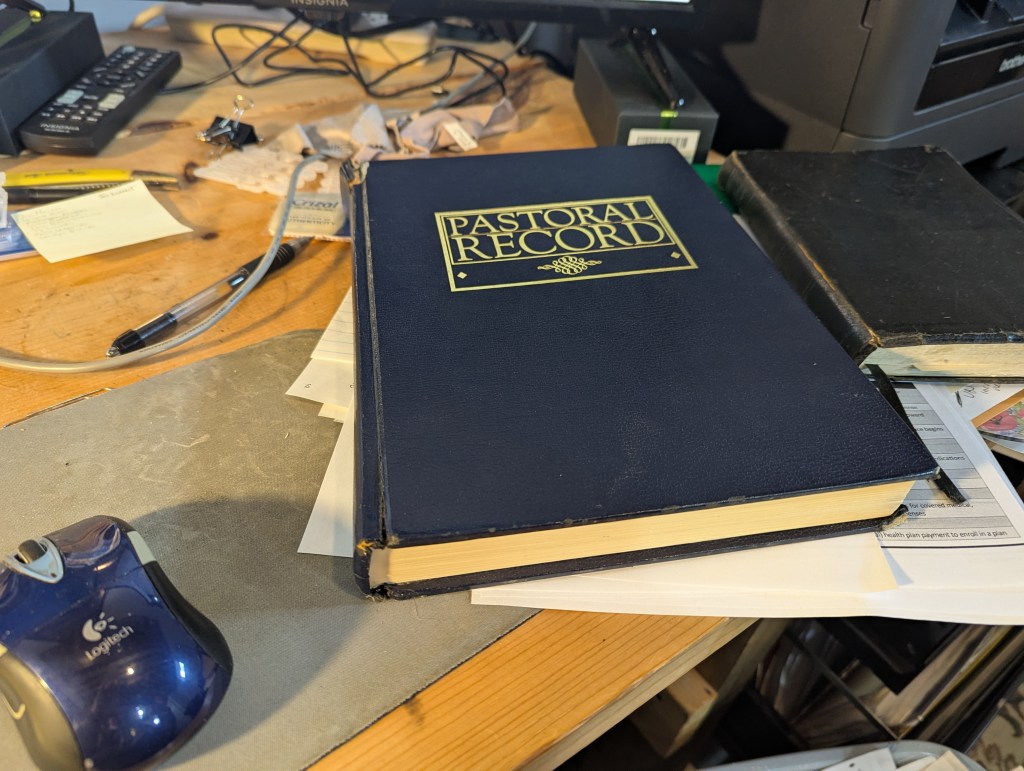
Before leaving my student church in Ohio, the congregation had a celebration for me. One gift I received was from my senior pastor, Nunzio Donald Catrone. The gift was a blank book titled “Pastoral Record.” It’s significance didn’t register in 1986, but as years began to accumulate, the pages became filled with names, dates, and significant notations. Baptisms, marriages, and deaths each have a section.

For the past week I’ve been thinking about Francis. Her entry in my Pastoral Record is January 11, 1996.

Francis was a member of my congregation in Palmyra. She was widowed perhaps fifteen years prior to my arrival. She was proud of her marriage, though their love never produced any children. Her husband had been the village postmaster and a faithful Episcopalian. She was a Methodist, and proud of her independence. Her house was on top of Cannon Hill, a house at the end of the street, the backyard sloped down to the original Erie Canal (in the foreground) and the Barge Canal, a hundred yards beyond.

Children in the neighborhood avoided Francis and her home. Mrs. B was thought to be a witch, ogre, or some other monster who feasted on the unsuspecting child who was caught crossing her yard or peeking in her window. Francis attended church every week, sat front and center, and took in every word of my sermons. She especially loved Summer worship. Bring a folding lawn chair on Sunday evenings; I’ll provide the lemonade. Age compressed her bones and joints, losing her six inches, or so. Francis was being doctored for a heart condition.

It was so enjoyable to stop by and visit on hot summer afternoons. Francis would serve me tea under a tree in her back yard. The flies would be buzzing. People passed, walking the canal path down below us. Time slowed. We’d talk about the past, my most recent sermon, faith, hopes, and fears. Though she was a woman of strong faith, she, like most of us, also had her fears.

Living alone, she feared calling for help, if and when the time came that she found herself in distress. She had a scanner, like most residents in the village, that monitored the fire and ambulance frequencies. Scanners were the source of gossip and juicy speculation. Though we had codes for many circumstances, mostly we spoke on the radio in plain English. She was modest and didn’t want her name and address broadcast publicly for all the world to hear.

Over the course of five years I received her call numerous times in the dead of night. “Pastor Todd, can you come,” she whispered. “Did you call 911?” I’d ask, rubbing the dirt from my eyes, according to our well-worn script. “No, I don’t want to start any trouble.”

“Any chest pains or trouble breathing?” Her answer was always a resounding “Yes! I can’t hardly breath,” she’d say. I could almost see her squirming. “I’ll be right over.”    

A quick-to-don pair of coveralls hung from the closet door next to the bed. Shoes and my department cap, and I was out the door. My Ford Ranger carried a small Oxygen tank, a manual defibrillator, a first aid kit, and my radio. My call sign was Palmyra 14-15. “Fire Control, this is Palmyra 14-15. Dispatch my rig to this address for chest pains and trouble breathing.” The three minute head start would give me precious time to make a thorough assessment of Francis before my crew arrived with the ambulance.

Time and again, we’d take Francis to the hospital to have her stabilized, admitted, healed, and discharged. Each time her heart grew weaker and weaker.

Calls taking Francis to the hospital in the middle of the night were special. I did what needed to be done; repeat vitals, heart monitored, high flow Oxygen, IV started (I had since taken advanced courses and certifications), and, if needed, called for a higher trained medic (to pass medication) to intercept us during transit (though protocol called for the request, a higher level of care in the field was rarely needed). When completed, I turned the lights down low, tucked her in, and held her hand. I’d pray with her; we prayed that the current crisis and pain would end, for diagnostic clarity for the doctor, for compassion for her bedside caregivers, to safely return home.

Francis liked that I prayed with her and for her.  

“Pastor Todd, could you stop by the house this week sometime?” she called. “Yes, of course.” Tea beneath the tree was always a happy place for the both of us.

“My doctor wants me to have open heart surgery,” she stated matter of factly. “Split me right down the middle.” She paused, biting her lower lip. “I thought I’d run it by you. What do you think?” she asked.

Time slowed like molasses in wintertime. What did I think? I’m just a medic on the ambulance. I don’t know about such things, I thought to myself.

Except… Except that I was Francis’s pastor. I did know a little something about faith, life, death, and eternal life. I knew Francis, her life, her passions, her love, her wishes. She and I shared a sacred place between us. We truly loved each other, as only a pastor can love, like a sister or a child, as a shepherd and a sheep.

As we talked, listing pros and cons, discussing risks and rewards, Francis found herself coming to the conclusion that she would have the surgery. We prayed together. The date and time were set. I met her at the regional cardiac surgery hospital as she was being prepped. “You sure you want this?” I asked, holding her hand. She looked so small in the oversized hospital bed. “Yes,” she said, “I’m ready.”

Those were the last words I heard Francis speak.

She became one of those far too frequent individuals who the doctor would proclaim “the surgery was successful,” but they lost the patient. She was splayed like the crucified Christ, being kept alive by artificial respirator, drugs, and fluids. No family; I was alone by her side.

I cried.

For years I felt the guilt of talking her into a surgery that she would not survive. In time, the guilt dissipated. Acceptance has taken its place. As her wounds have healed her into eternal life, so, too, have I been healed from the regret, mourning, and loss of a dear friend and parishioner. God shared Francis with me, for a time. When that time was up, that was it. God led her home. I can now see how Francis was God’s gift of grace to this simple parish pastor.  

A number of months later, the church received in the mail a letter from her estate lawyer, a copy of the will, and the largest check I had ever seen with my eyes. Amazing grace. I’ve heard the sound.