December 13, 2020 – Third Sunday of Advent – Gaudete Sunday
The Rev. Todd R. Goddard, Pastor
Rush United Methodist Church
Isaiah 61:1-4, 8-11
The spirit of the Lord God is upon me, because the Lord has anointed me; he has sent me to bring good news to the oppressed, to bind up the brokenhearted, to proclaim liberty to the captives, and release to the prisoners; to proclaim the year of the Lord’s favor, and the day of vengeance of our God; to comfort all who mourn; to provide for those who mourn in Zion— to give them a garland instead of ashes, the oil of gladness instead of mourning, the mantle of praise instead of a faint spirit. They will be called oaks of righteousness, the planting of the Lord, to display his glory.
They shall build up the ancient ruins, they shall raise up the former devastations; they shall repair the ruined cities, the devastations of many generations. For I the Lord love justice, I hate robbery and wrongdoing; I will faithfully give them their recompense, and I will make an everlasting covenant with them. Their descendants shall be known among the nations, and their offspring among the peoples; all who see them shall acknowledge that they are a people whom the Lord has blessed.
I will greatly rejoice in the Lord, my whole being shall exult in my God; for he has clothed me with the garments of salvation, he has covered me with the robe of righteousness, as a bridegroom decks himself with a garland, and as a bride adorns herself with her jewels. For as the earth brings forth its shoots, and as a garden causes what is sown in it to spring up, so the Lord God will cause righteousness and praise to spring up before all the nations.
John 1:6-8, 19-28
There was a man sent from God, whose name was John. He came as a witness to testify to the light, so that all might believe through him. He himself was not the light, but he came to testify to the light.
This is the testimony given by John when the Jews sent priests and Levites from Jerusalem to ask him, “Who are you?” He confessed and did not deny it, but confessed, “I am not the Messiah.” And they asked him, “What then? Are you Elijah?” He said, “I am not.” “Are you the prophet?” He answered, “No.” Then they said to him, “Who are you? Let us have an answer for those who sent us. What do you say about yourself?” He said, “I am the voice of one crying out in the wilderness, ‘Make straight the way of the Lord,’” as the prophet Isaiah said. Now they had been sent from the Pharisees. They asked him, “Why then are you baptizing if you are neither the Messiah, nor Elijah, nor the prophet?” John answered them, “I baptize with water. Among you stands one whom you do not know, the one who is coming after me; I am not worthy to untie the thong of his sandal.” This took place in Bethany across the Jordan where John was baptizing.
(Centering Prayer)
Advent; a time of revelation.
A four-week season preceding Christmas
Where God is revealed for all to see.
The prophet Isaiah and Gospel author of Mark have revealed the past two Sundays
God is forgiving, compassionate and kind, and faithfully keeps promises.
It is almost as if
God is everything the world isn’t.
The world is stained by sin; the Lord is forgiving.
The world is cold and hard; the Lord is compassionate and kind.
The world is full of liars, cheats, and swindlers; the Lord faithfully follows through with every promise and keeps every covenant.
God’s word is GOLD.
Last Sunday, scripture revealed that
The Lord works and plays in the wilderness.
The Lord actively seeks our confession and repentance.
This draws people to Jesus, like people were drawn to confess their sins to John and be baptized by him in the Jordan River.
We learned that God takes notice of you, all the relationships you maintain, all the plates you are trying to keep spinning.
Nothing goes unnoticed in your life, the triumphs and tragedies; the good, bad, and ugly.
God notices
Failing test scores, breaking up with a boyfriend, piles of dirty laundry, flaring tempers, never ending trips to the doctor’s office, meeting with the funeral director.
From mountaintop to valley floor,
God loves you anyway.
As I reflect on my personal journey of faith,
My walk with the Lord,
The God revealed thus far this Advent
Squares itself perfectly
With the God of my experience.
I have experienced God’s forgiveness, and continue to do so, especially so when I make it a point to ask.
Weekly worship keeps me honest.
I experience the compassion and kindness of the Lord, usually every day, often without even asking.
God’s grace and love are the air that I breath and the water I drink.
The Lord has never let me down. Period.
The God of my experience is bulletproof faithful.
The one place I’m certain to find the Lord? It’s when I’m lost in my own wilderness.
Listening to a single mother crying that she can’t feed her children,
Mourning the death of a parent or friend,
Getting knocked down, beat up, and left for dead;
That’s my wilderness.
Once lost, I am found.
That is where I have found the Lord.
Faith has made me compulsive.
I can’t help myself;
I just blurt out my sins, known and unknown, when I experience the presence of God.
The blood of the cross keeps washing me clean,
Scrubbing me over and over again.
The blood of the cross
Keeps calling me to a higher standard,
Keeps drawing me towards Christian perfection.
There hasn’t been one thing in my life that I’ve been able to hide from the Lord.
I’ve tried and failed.
The God of my experience knows me like an x-ray,
Inside and out,
Through and through.
If you are to fill in the blank: “The God of my experience ________”
What would you say?
Reflect.
Write it out.
Make it real.
Has the God revealed this Advent
Squared itself with the God of your experience?
…
Today, the prophet Isaiah testifies further.
The Lord sent Isaiah on a mission:
To bring good news to the oppressed,
To bind up the brokenhearted,
To proclaim liberty to the captives, and release to the prisoners;
To proclaim the year of the Lord’s favor, and the vengeance of our God;
To comfort all who mourn. – Isaiah 61:1-3
There is a lot of territory to cover here.
I’ll be short and to the point.
1. The Lord takes sides, and it’s never with the oppressor, the powerful, or the wealthy.
If you want to join up with the Lord, choose to side with the oppressed.
The good news to the oppressed is that
The Lord is on your side and so are all the Lord’s followers.
The Lord’s game plan?
Right every wrong.
Though derided and despised,
The Lord’s under dogs always come from behind for the win.
God’s kingdom will come.
Make certain you are on the winning team.
2. What breaks your heart?
What has broken your heart?
Failure? Broken promises? Others letting you down, or, you letting others down?
The Lord gathers the shattered pieces of your broken heart
And binds them back together again.
That’s what God does.
A heart bound by God
Isn’t a heart constrained,
It is a heart being healed.
3. Prisoners, listen up.
Weather your cell is made of bars and cinder blocks, or,
Your prison is a guilty conscious that just won’t go away,
The Lord wants you set free.
Free from your past,
Given all the room you need to repent with a vow to do better.
Free to get a fresh start.
Preceding and greater than the American Constitution
The Lord wills Freedom. Liberty.
The Lord want you free to make your own choices.
Make good choices.
4. In debt? Out of money? Out of ideas to stay afloat?
Comfort, O comfort my people, says your God. Speak tenderly to Jerusalem, and cry to her that she has served her term, that her penalty is paid, that she has received from the Lord’s hand double for all her sins.
A voice cries out: “In the wilderness prepare the way of the Lord, make straight in the desert a highway for our God. Every valley shall be lifted up, and every mountain and hill be made low; the uneven ground shall become level, and the rough places a plain. Then the glory of the Lord shall be revealed, and all people shall see it together, for the mouth of the Lord has spoken.” A voice says, “Cry out!” And I said, “What shall I cry?” All people are grass, their constancy is like the flower of the field. The grass withers, the flower fades, when the breath of the Lord blows upon it; surely the people are grass. The grass withers, the flower fades; but the word of our God will stand forever.
Get you up to a high mountain, O Zion, herald of good tidings; lift up your voice with strength, O Jerusalem, herald of good tidings, lift it up, do not fear; say to the cities of Judah, “Here is your God!” See, the Lord God comes with might, and his arm rules for him; his reward is with him, and his recompense before him. He will feed his flock like a shepherd; he will gather the lambs in his arms, and carry them in his bosom, and gently lead the mother sheep.
Mark 1:1-8
The beginning of the good news of Jesus Christ, the Son of God.
As it is written in the prophet Isaiah,
“See, I am sending my messenger ahead of you, who will prepare your way; the voice of one crying out in the wilderness: ‘Prepare the way of the Lord, make his paths straight,’”
John the baptizer appeared in the wilderness, proclaiming a baptism of repentance for the forgiveness of sins. And people from the whole Judean countryside and all the people of Jerusalem were going out to him, and were baptized by him in the river Jordan, confessing their sins. Now John was clothed with camel’s hair, with a leather belt around his waist, and he ate locusts and wild honey. He proclaimed, “The one who is more powerful than I is coming after me; I am not worthy to stoop down and untie the thong of his sandals. I have baptized you with water; but he will baptize you with the Holy Spirit.”
Prayer.
Advent lifts the veil
Revealing the nature and characteristics of God.
Revelation creates and builds anticipation in the faithful.
We learn more about our Creator.
Our experience of working with God increases.
Our relationship with the Lord deepens
Until that promised moment arrives
When Jesus Christ comes again.
Last Sunday the prophet Isaiah and the Gospel of Mark
Led us to remember
God is forgiving, compassionate and kind, and faithfully keeps promises.
Scripture calls to our attention
The God who created us is the same One who nurtures and grows us,
Forming and shaping us according to God’s need and will.
Today, more is revealed.
By the end of Advent,
Come Christmas day,
We will echo the words of Isaiah
Lifting our voice with strength
Speaking to the people of the world,
“Here is your God!” – Isaiah 40:9
I’m able to identify four revelations of God through scripture today.
…
1. God works in the wilderness.
The wilderness for our Hebrew, Jewish ancestors was
Egyptian captivity (approximately 1,500 B.C.E.),
Defeat and exile as prisoners of war to Assyria (740 B.C.E.),
Defeat and exile again, this time by the Babylonians (587 B.C.E.).
Defeat. Exile. Prison. Slavery.
That’s some serious wilderness.
Yet, the wilderness is where God likes to play.
Perhaps that is what drove John the Baptist out into the wilderness.
If you are going to lead people to God,
Draw them to where the prophet Isaiah told them God would be …
Not in their fancy temple or beautiful synagogues …
Not places of power, authority, or grandeur.
Seeking after the Lord in the wilderness is de-centering.
Not seeing God in the usual places;
In sanctuaries and churches,
In volunteering or missions,
Can begin to feel like we’ve been abandoned
By our divine Creator and heavenly Father.
If you are looking for the Lord,
Don’t look here.
Search the wilderness.
Where is your wilderness?
For some a health or emotional crisis
is a wilderness experience.
For others wilderness might come with being laid off, or
Hungry bellies and empty cupboards.
When facing the most difficult times,
When journeying through wilderness,
It is often my pastoral guidance
To fine tune your spiritual radar
To be alert to God’s presence and work.
Whether you are facing one enormous disaster
Or multiple crisis that just keep piling up and never seem to end,
This is exactly the time to
Watch, listen, be aware.
God is near.
God speaks through
The calming voice of a first responder,
A warm casserole or pot of chicken soup from a friend,
A prayer with a fellow church member.
Time alone by the creek, in the meadow or woods,
In the isolation of quarantine.
The Lord’s healing balm of Gilead
Working in and through others
Makes straight a highway for our God.
Likewise, be aware
God is speaking, working, acting in and through you
When you are led to respond to the needs of others in crisis.
Walking with others through their wilderness
Is one of the most Jesus-like things the faithful can do.
….
2. God seeks confession and repentance.
John appears in the wilderness
Preaching and practicing a baptism of repentance
For the forgiveness of sins. – Mark 1:4
His words and his actions
Draw the crowds.
John cries with his voice
Where no one is there to listen.
He cries out in the wilderness
Confess your sins.
Repent of your former ways.
Be baptized and let your sins be washed away.
You are forgiven.
And people came.
Like water drawn to a sponge
Confession drew the crowds into the wilderness.
A willingness to turn broken lives around and return to God drew the crowds.
Better than a Billy Graham altar call
John the Baptizer brought in the crowds by the boatload
Who wanted to confess their sins,
Repent of their ways, and
Be forgiven.
Cynics tell me the Church isn’t sustainable or vital
Solely based on the Gospel of Jesus Christ.
I believe they are wrong.
I’ve wagered my life and my call on it.
It is the gracious act of Jesus Christ …
… crucified on the cross …
That once and for all
Grants forgiveness of sins.
Jesus paid for our sins with his life.
As long as there is a need to confess sins and be forgiven
People will be drawn to Jesus.
Confession is good for the soul, it is said.
Confession also brings out the crowds and
Breathes vitality into the life of the Church.
“I’ve just to tell someone,” I’ve thought through my guilt.
Confess, the Gospel tells us.
Get it off your chest.
Make your confession to God.
By the very nature of sin and the brokenness of humankind
Confession is never be a one-and-done deal.
Confession must be on-going, never ceasing,
To the point such that it becomes the posture of the faithful.
Confession is both individual and collective.
All of us together are guilty of institutional sins
So all of us together must collectively confess our sins.
Our collective repentance results in change for the good,
The transformation of the world,
Progress towards God’s fulfilled kingdom.
Confessing our sins together has the added benefit of keeping everyone honest.
It is tempting to confess other people’s sins.
That is called playing the blame game.
Living in indignant judgment.
Corporate confession requires us to
Look our sisters and brothers in the eye,
Hold one another accountable,
Keep each other honest.
….
3. What we go through hasn’t escaped God’s notice.
The Lord knows what’s happening.
The Lord knows what is going down.
For nothing can be hidden from God.
Nothing.
Not motive or intent.
Not greed or lust.
Not envy or desire.
Nothing can escape God’s notice.
This is sobering.
Recognizing the omniscient nature of God,
Being aware that God sees all and knows all,
Should drive us to our knees in humble introspection.
Ask yourself,
What are the secrets in my life
That I have been trying to conceal from God?
Pastoral counseling classes in the seminary teach that
Secrets are a sure sign of sin and dysfunction.
The Lord observes everyone, remembers everything, forgets nothing.
One might escape human justice.
There is no escape the Lord.
The all-seeing and all-knowing nature of God should also be comforting.
No matter what crisis you face,
No matter what desert you cross,
No matter how severe the pandemic this may become,
The Lord takes notice.
Oh, the sorrows that fill our soul,
The withering storms through which we sail,
The trials and temptations we endure.
God takes notice.
The Lord seeks to comfort us.
“Comfort, O comfort my people,” says our God.
The day is soon upon us when our term will be served,
When our penalty will be paid, and
When the abundance of the Lord will return two-fold.
– Isaiah 40:1-2
….
4. Lastly, we are reminded
We remain God’s own, even in exile and loneliness.
The Lord does not abandon his own children.
Rarely before is this message so poignant
Than today, at Covid-19’s ground zero;
Where emotions are raw,
Needs go unmet,
And anger bleeds through every aspect of life.
The Lord isn’t preventing the pandemic from happening,
But the Lord has given us the scientist the knowledge to bring it under control.
The Lord hasn’t turned a cold shoulder,
The Lord has sent us medical professionals to heal and care for us throughout the duration.
The Lord isn’t shielding us from loss and sorrow,
But the Lord is opening our heart and deepening our resolve
To be more supportive, empathetic, loving of our neighbors.
We remain God’s beloved.
We remain in need of forgiveness.
We remain in need of salvation.
….
Out of wilderness,
God is further revealed this Advent day.
God works in the wilderness;
This is where the Lord can be found.
Where is your wilderness?
Are you seeking after the Lord in your wilderness?
God seeks confession and repentance.
Can you give it up?
Are you able to repent and improve?
Are you ready to experience the blessing of forgiveness,
The gift of Jesus Christ?
What we go through hasn’t escaped God’s notice.
God knows your pain, your sorrow, your suffering.
What prophet-strength comfort can be found
By connecting your wilderness
With the temptation of Christ,
The baptism of Christ,
The crucifixion of Christ?
We remain God’s own, even in exile and loneliness.
O that you would tear open the heavens and come down, so that the mountains would quake at your presence— as when fire kindles brushwood and the fire causes water to boil— to make your name known to your adversaries, so that the nations might tremble at your presence! When you did awesome deeds that we did not expect, you came down, the mountains quaked at your presence. From ages past no one has heard, no ear has perceived, no eye has seen any God besides you, who works for those who wait for him. You meet those who gladly do right, those who remember you in your ways. But you were angry, and we sinned; because you hid yourself we transgressed.
We have all become like one who is unclean, and all our righteous deeds are like a filthy cloth. We all fade like a leaf, and our iniquities, like the wind, take us away. There is no one who calls on your name, or attempts to take hold of you; for you have hidden your face from us, and have delivered us into the hand of our iniquity. Yet, O Lord, you are our Father; we are the clay, and you are our potter; we are all the work of your hand. Do not be exceedingly angry, O Lord, and do not remember iniquity forever. Now consider, we are all your people.
Mark 13:24-37
“But in those days, after that suffering,
the sun will be darkened,
and the moon will not give its light,
and the stars will be falling from heaven,
and the powers in the heavens will be shaken.
Then they will see ‘the Son of Man coming in clouds’ with great power and glory. Then he will send out the angels, and gather his elect from the four winds, from the ends of the earth to the ends of heaven.
“From the fig tree learn its lesson: as soon as its branch becomes tender and puts forth its leaves, you know that summer is near. So also, when you see these things taking place, you know that he is near, at the very gates. Truly I tell you, this generation will not pass away until all these things have taken place. Heaven and earth will pass away, but my words will not pass away.
“But about that day or hour no one knows, neither the angels in heaven, nor the Son, but only the Father. Beware, keep alert; for you do not know when the time will come. It is like a man going on a journey, when he leaves home and puts his slaves in charge, each with his work, and commands the doorkeeper to be on the watch. Therefore, keep awake—for you do not know when the master of the house will come, in the evening, or at midnight, or at cockcrow, or at dawn, or else he may find you asleep when he comes suddenly. And what I say to you I say to all: Keep awake.”
Prayer.
Welcome to Advent;
A season of watching,
Waiting,
For our Savior’s return.
During this time of intense, expectant waiting,
The nature and character of God is revealed
With clarity unlike few other times of the year.
God is revealed.
Revelation,
More than the final book of the Bible,
More than an end-time promises,
God is revealed as an active dance partner in the human divine relationship.
The prophet Isaiah reports of a spiritual nostalgia in a devastated people.
Remember when?
Remember when the Lord forgave our inequity,
Warmed the heart of Cyrus the Great, and
Returned us to our promised land?
Remember.
God is forgiving.
God is compassionate and kind.
God faithfully keeps promises.
But now, the world has turned into smoldering destruction.
Again.
Built up; beat down.
Built up; beat down.
The people of Israel had seen their land re-conquered,
Their rebuilt Temple destroyed,
Their lives in ruins.
Our ancestors felt as if God was hiding his face.
O God, they cried.
Our God, who ripped open the heavens and
Showed your face to Moses,
Where are you now?
Now, our world feels like it has turned into smoldering destruction.
Remember 39 weeks ago?
Yes, I’ve been counting the weeks.
Our spiritual nostalgia
Forgets imperfections and
Enhances grandeur
That may or may not have been real.
Church life back in early March was great, predictable, sustainable.
Spiritual life was simplified;
Occasional attendance,
Prayer before a meal,
Catching up over coffee or casserole, and
Dropping an Abraham into the basket.
Now, we’ve been shut down.
We feel broken down,
And when we look around
There is a whole lot of darkness.
Where is your face, O Lord?
It’s like we’ve been abandoned,
Just like Israel.
Remember.
God is forgiving.
God is compassionate and kind.
God faithfully keeps promises.
The nature and character of God is revealed during Advent.
….
Like Israel,
Our hope is grounded in God’s revealed nature and character.
God is our father, Isaiah proclaims,
The father of creation,
Who created us as children,
Each of us created as a nearly perfect copy of God.
God planted within us
Mustard seed sized faith,
Tended and nurtured,
Watered and fed.
God has gifted us
The love of a Savior and
The power of a Spirit filled breath.
Our creative and loving parent
Raises us as children into spiritual maturity,
In a relationship bonded by life, love, goodness, pity, and compassion;
Qualities of every good mother and father.
The Lord is our Father,
The prophet Isaiah proclaims,
As a potter and
We as clay.
We are the clay.
The Father forms us.
Shapes us.
Builds us up.
Breaks us down.
Working us.
Freeing us from every imperfection.
We are the work of his hands.
We become who God shapes us to be.
Remember.
God is our creator.
God nurtures and grows,
Forms and shapes us according to need and will.
The nature and character of God is revealed during Advent.
….
This past Thursday,
We pushed ourselves away from the Thanksgiving table
Full of food
And content with life …
Mostly.
Partially.
Some of us.
Well, all right. Who are we kidding?
There might be some who can be painted into a Norman Rockwell painting,
“When the Son of Man comes in his glory, and all the angels with him, then he will sit on the throne of his glory. All the nations will be gathered before him, and he will separate people one from another as a shepherd separates the sheep from the goats, and he will put the sheep at his right hand and the goats at the left.
Then the king will say to those at his right hand, ‘Come, you that are blessed by my Father, inherit the kingdom prepared for you from the foundation of the world; for I was hungry and you gave me food, I was thirsty and you gave me something to drink, I was a stranger and you welcomed me, I was naked and you gave me clothing, I was sick and you took care of me, I was in prison and you visited me.’
Then the righteous will answer him, ‘Lord, when was it that we saw you hungry and gave you food, or thirsty and gave you something to drink? And when was it that we saw you a stranger and welcomed you, or naked and gave you clothing? And when was it that we saw you sick or in prison and visited you?’
And the king will answer them, ‘Truly I tell you, just as you did it to one of the least of these who are members of my family, you did it to me.’
Then he will say to those at his left hand, ‘You that are accursed, depart from me into the eternal fire prepared for the devil and his angels; for I was hungry and you gave me no food, I was thirsty and you gave me nothing to drink, I was a stranger and you did not welcome me, naked and you did not give me clothing, sick and in prison and you did not visit me.’
Then they also will answer, ‘Lord, when was it that we saw you hungry or thirsty or a stranger or naked or sick or in prison, and did not take care of you?’
Then he will answer them, ‘Truly I tell you, just as you did not do it to one of the least of these, you did not do it to me.’ And these will go away into eternal punishment, but the righteous into eternal life.
Prayer.
Heaven is to grace
What Hell is to judgment.
As followers of Jesus,
Believing that Jesus
Assumed all our sins
On the cross,
We’ve become comfortably acculturated
With grace as the staple diet
Of organized Protestant Christian faith.
Believe in Jesus
And be saved.
Jesus says he is the way, the truth, and the life.
Follow him and be saved.
Boom!
Count me in.
Sprinkle me with water and
Teach me the secret handshake.
Case closed.
Go home and enjoy the other six and a half days of the week.
The great reformer, Martin Luther, proclaimed
We are judged by faith alone,
And on this article alone he wrote, “the Church stands or falls.”
(Martin Luther, 1537, Smalkald Articles)
John Wesley brought laser focus to God’s grace.
For Wesley, grace is prevenient:
Given by God before we knew we needed it.
Grace is justifying:
We are forgiven of our sins
Simply because we believe.
Grace is sanctifying:
Replacing our imperfections
With the perfect love of God.
The second chapter of Ephesians defines the Protestant, Methodist experience:
“For by grace you have been saved through faith, and this is not your own doing; it is the gift of God— not the result of works, so that no one may boast. For we are what he has made us, created in Christ Jesus for good works, which God prepared beforehand to be our way of life.” – Ephesians 2:8-10
Sola Fide, pronounced So-la Fee-day:
the Doctrine of Justification by Faith, and
Sola Gratia, pronounced So-la Grat-e-a,
The doctrine of Salvation by grace
Defines the chasm that
Separates us from our Roman Catholic sisters and brothers.
Through a uniquely Protestant world view
We have come to know
A graceful God
That carefully considers a resume built on faith,
Without taking into consideration works, good or bad.
Our Protestant heritage teaches us that belief leads to reward:
Believe in Jesus Christ.
Your sins are forgiven, and off you go to heaven.
Zippidee do dah.
Yet,
The reality of sin
Is like the thin strata of smoke from a wood fire
Wisping through the neighborhood.
The smoke just hangs in the air on cold, quiet mornings.
Sin.
Without wind it seeps in everywhere,
Distorting sight and delivering a signature smell.
There are consequences for sinful behavior that are important to acknowledge,
And the Gospel of Matthew holds our feet to the fire.
Judgment is the consequence of sin.
We, Hushpuppy wearing, grace toting Protestants,
Find ourselves in an uneasy position wrestling with judgment
With the close of this liturgical year.
(Today is called Reign of Christ, or, Christ the King.
Next Sunday is the First Sunday of Advent,
The Gospel of Mark will take Matthew’s place,
And a new liturgical year will begin.)
Christ is our king! We joyfully proclaim.
Matthew reports the king holds each of us accountable for our behavior.
Jesus plays the judgment card in spades.
Today, Jesus and judgment are addressed with uncomfortable transparency.
…
This 25th chapter of Matthew is
A real slice of humble pie
To grace believing Protestants.
Two weeks ago we heard of the
Unfortunate, unprepared bridesmaids
Waiting for the delayed bridegroom to arrive.
They waited with insufficient lamp oil.
As a result of their behavior
They were shut out
– SHUT OUT –
Of the wedding reception,
With Divine judgment we’ve not heard before.
The Master’s voice snaps from behind the closed door:
“Truly I tell you, I do not know you.” (25:12)
What?
Wait! We respond.
“I do not know you”?
That is not the God I know, I protest.
Heaven is to grace
What Hell is to judgment.
Last Sunday,
Our distress mounted with the Parable of the Talents.
We squirmed anxiously in our seats
When the Master
Belittles and berates the servant who buried his talent
Instead of investing it like the other two.
“You wicked and lazy slave!”
“Take the talent from him and give it to the one with the ten.”
“As for this worthless slave,
throw him into the outer darkness,
where there will be weeping and gnashing of teeth.” (25:26, 28, 30)
What?
Wait! We respond.
I don’t know that god.
This visual is more like a Soviet gulag
Then a sermon from Jesus.
Heaven is to grace
What Hell is to judgment.
….
500 years ago we parted ways
with the Roman Catholic preoccupation with Works Righteousness.
Fear, intimidation, and inquisition were used to oppress the faithful.
Like their Pharisaic forefathers fifteen hundred years earlier,
Sacred texts had been codified into
Onerous and inflexible Church doctrines
Frightening the masses into submission
In the shadow of the sword or guillotine.
The laundry list justifying Works Righteousness
– the central belief that the guilty are judged
and the guiltless are deemed righteous –
has been long cited by scripture:
Hebrew scripture, New Testament Epistles, even directly from the lips of Jesus in the Gospels.
For example,
Matthew 5:20 Jesus says,
“For I tell you that unless your righteousness
surpasses that of the Pharisees and the teachers of the law,
you will certainly not enter the kingdom of heaven.”
The list justifying Works Righteousness equals
The list justifying Sola Fide and Sola Gratia.
Are we forgiven and saved by
what we do, or,
Are we forgiven and saved by
what we believe?
What are we to believe?
Like many things in life
Faith v works are not mutually exclusive.
I’d suggest faith v works are mutually dependent.
Looking back over my history of preaching on this passage,
I’ve noticed a personal, evolving belief.
Early in my pastoral ministry,
I hammered home Sola fide and Sola Gratia
Like every good Protestant preacher is expected to do.
I employed every Lutheran and Wesleyan doctrine I could lay my hands on;
Sadly, I must admit,
To the neglect of Works Righteousness.
“What we believe leads to good works,
But good works do not lead to belief,”
I was often quoted to say.
Yet, as I’ve aged
The more I believe in
The value of a carefully balanced, mutually dependent approach:
We can no more neglect scripture because it doesn’t meet our needs
Then we can elevate selected scripture to support our position.
Belief in Jesus is essential.
What is also essential is
Doing the work of Jesus.
One leads to the other;
Does it really matter which comes first?
Personal behavior is important, Jesus tells us in Matthew 25.
It is our Christian obligation to feed hungry people,
To give water to those who thirst,
And to welcome strangers with hospitality.
Failure to do so is equivalent to choosing our own promised judgment.
It is our Christian responsibility to cloth those who need clothing,
To take care of the sick,
To visit the condemned in prison.
Failure to do so will result in our King casting us out into eternal fire.
Be forewarned.
It is our obligation,
Not because we fear judgment,
But because Jesus engaged in good works, outreach, and ministry.
And we should follow his example.
It is our obligation,
Because our good works points the world straight to Jesus.
Our good works bring attention to God.
Our good works bring praise and glory to God.
God loves the last, the least, the lost, the poor, the disposed, the widow, and the orphaned.
And so, too, should we.
Doing so, is God’s greatest glory.
And places the Lord front and center
In the spotlight of the world’s stage.
…
This is a week of Thanksgiving.
Let us safely gather around
Our pandemically subdued Thanksgiving tables.
Mourn not what is lost this holiday.
Give thanks for what has been found.
Close your eyes and
With every ounce of your imagination
Taste and see the abundance of our gracious and loving God.
Remember to give thanks over the food and the hands that prepared it.
It is appropriate to thank God for the abundant grace and love
That has flooded our lives.
Giving thanks is a sign of our faith and belief.
Give thanks to God for planting a mustard seed size faith in us before we were born.
Thank God for nurturing our faith,
Justifying our faith, and
Sanctifying our faith.
Our Gospel lesson for today suggests that we boldly take one additional step:
Transform the blessing of your table
Into works of righteousness in the streets.
Don’t expect the government to feed the hungry;
It is our responsibility to make certain our neighbors are fed.
Charities can only do so much.
It is our Christian obligation to care for the sick and visit people in jail.
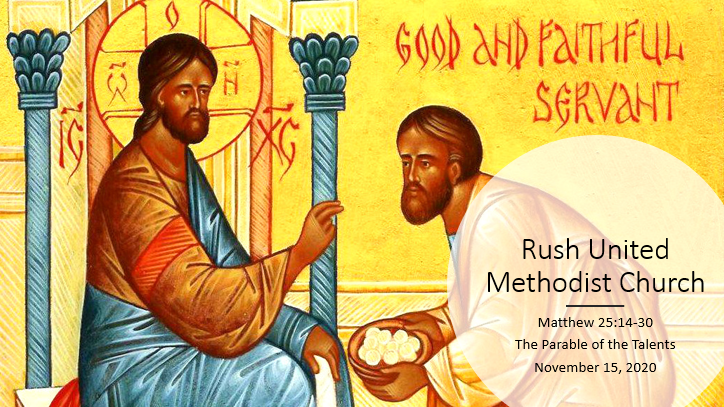
“For it is as if a man, going on a journey, summoned his slaves and entrusted his property to them; to one he gave five talents, to another two, to another one, to each according to his ability. Then he went away.
The one who had received the five talents went off at once and traded with them, and made five more talents. In the same way, the one who had the two talents made two more talents. But the one who had received the one talent went off and dug a hole in the ground and hid his master’s money.
After a long time the master of those slaves came and settled accounts with them. Then the one who had received the five talents came forward, bringing five more talents, saying, ‘Master, you handed over to me five talents; see, I have made five more talents.’ His master said to him, ‘Well done, good and trustworthy slave; you have been trustworthy in a few things, I will put you in charge of many things; enter into the joy of your master.’
And the one with the two talents also came forward, saying, ‘Master, you handed over to me two talents; see, I have made two more talents.’ His master said to him, ‘Well done, good and trustworthy slave; you have been trustworthy in a few things, I will put you in charge of many things; enter into the joy of your master.’
Then the one who had received the one talent also came forward, saying, ‘Master, I knew that you were a harsh man, reaping where you did not sow, and gathering where you did not scatter seed; so I was afraid, and I went and hid your talent in the ground. Here you have what is yours.’
But his master replied, ‘You wicked and lazy slave! You knew, did you, that I reap where I did not sow, and gather where I did not scatter? Then you ought to have invested my money with the bankers, and on my return I would have received what was my own with interest. So take the talent from him, and give it to the one with the ten talents. For to all those who have, more will be given, and they will have an abundance; but from those who have nothing, even what they have will be taken away. As for this worthless slave, throw him into the outer darkness, where there will be weeping and gnashing of teeth.’
Prayer.
Thank you for your financial commitment to the mission and ministry of our parish and for promptly returning your completed Pledge Card.
What may appear to be the perfect ending to our annual Stewardship Drive
The parable Jesus serves up for us today is a lot more complex.
The obvious and easy question is,
What are you doing with what you are given?
Are you making what God has given you greater for the Lord’s benefit?
Or, are you hiding away your time, talent, and treasures
Hoping to skate through life on the cheap?
What are you doing?
This is a good starting place.
Is faith so shallow it only requires going through the motions?
… show up for worship (as little as possible)?
… drop an Andrew Jackson or a check into the basket when prompted?
… purchase some baked goods to “support” Promise Land or our South Africa missions?
(Sarcasm)
“I’ll tell you what,
Burying my talents
Saves me a lot of time and effort when I have better things to do, and
Burying my talents
Saves me a ton of money that would otherwise be wasted on the church.
Why tithe if I don’t have to?
Sunday’s are meant for sleeping in.
Maybe I can
Just put a lid on this Jesus talk and
Hope it all works out in the end.”
(End Sarcasm)
What are you doing?
Perhaps there is something deeper, quietly stirring in your soul.
Instead of waiting for a personal or family crisis to kick faith into gear
Perhaps now is the time to make some investments
Into personal faith development.
The timing couldn’t be better as travel restrictions and
Stay at home requests increase.
If you’re going to put in 45 minutes on the treadmill,
How about 45 minutes in exercising your spiritual life?
Pray, and learn about prayer.
Study scripture, and experience God working through scripture in your life.
Learn about the early Church, martyrs, leaders, and thinkers.
Engage in missional outreach by making neighbors into friends.
Grow that circle of friends bigger, and
Love every one of them as if each is your long-lost child.
What are you doing? Jesus is asking those who follow him,
Knowing full well that he would soon
Suffer, die, resurrect, and ascend into heaven
With the promise to return
At some unknown and unknowable future date and time.
The choice is yours.
How are you going to spend your time and money waiting for me to return? Jesus is asking.
Are you flying economy class …
Faith on the half-shell?
Or, is it time to upgrade with
an investment in personal spiritual development?
What are you doing? Is a good place to start, but
There is more here ripe for discovery.
…
1. First, when Jesus is talking about Talents,
He’s talking about money;
Cold hard cash.
Jesus is not talking about God-given abilities, gifts or graces.
The definition of “talents” expanded beyond money to include abilities, gifts, and graces in old English during the middle ages.
One Talent equaled 6,000 Denarius.
A Denarius is the daily wage.
So, one Talent is worth 6,000 days of work.
In today’s terms,
At a modest annual income of $40,000 per year
1 Talent would equal $600,000.
That’s a lot of money to bury in the back yard.
Likewise, 2 Talents = $1.2 million.
5 Talents = $3 million.
The example Jesus uses in the Parable of the Talents
Is one of hyperbole;
Excessive, over-the-top abundance.
Jesus isn’t using for his example a couple of bucks, or
A couple hundred, or even
A couple thousand dollars.
Jesus is talking millions.
In this parable Jesus personifies God as the Master.
Jesus is quite intentionally composing a character of his heavenly Father.
God is incredibly trusting, giving great stewardship responsibility,
Each according to their ability. (25:15)
The least abled was entrusted with $600,000!
Our God is one of abundant, amazing grace.
Jesus characterizes God as kind and generous, who is enormously thankful.
“Well done, good and trustworthy servant; You have been trustworthy in a few things, I will put you in charge of many things.” (25:21)
I’d call that
Getting a bonus and receiving a promotion,
Earned for work well-done.
Jesus fills his character palate by describing God as being positive and joyous.
“Enter into the joy of your master,” the master grants his faithful servants. (25:21)
In other words, God invites the productive, the fruitful, the faithful into God’s own joy.
There is no hint here of a God who is harsh, rash, or vindictive.
I wonder where that assumption came from?
…
2. The foil for the parable is the servant who buried the talent and waited for his master’s return.
Why did he bury it and wait?
Why didn’t he take the initiative and invest the one talent like the other two?
He reveals his motive when asked:
“Master, I knew that you were a harsh man, reaping where you did not sow, and gathering where you did not scatter seed; so I was afraid, and I went and hid your talent in the ground.” (25:24-25)
He was afraid.
He was afraid of his master.
The servant who buried his one talent
Assumed the master to be a harsh man.
Harsh?
Based on what?
The parable already established the master as being generous, kind, grateful, thankful, and full of joy.
Nary a hint of evidence exists to lead one to believe the master was a harsh man.
Jesus reveals in this parable that
False assumptions lead to poor decisions which leads to disastrous outcomes,
Especially when we are naturally biased to do the least amount of effort to just get by.
He was afraid.
Fear is a lousy motivator.
Fear of aging boosts sales of anti-wrinkle Aveeno and man boosting Nugenix.
Fear of torture makes people confess to both the truth and falsehoods.
Fear of hell and damnation has been a staple of some Christian communities for centuries, creating untold harm to God’s beautifully created human condition.
Fear that leads to paralysis results in Divine anger and judgment.
“you wicked and lazy slave!” = an accurate observation of the servant’s effort.
“you knew, did you?” = you think you’re so smart?
“I reap where I did not sow, and gather where I did not scatter?” = you calling the Lord a thief? (25:26)
“As for this worthless slave, throw him into the outer darkness”
Not the inner darkness.
“Throw him into the outer darkness, where there will be weeping and gnashing of teeth.” (25:30)
Looking for a fair trial?
Don’t anger the Judge with false accusations.
That right there
Is the judgment of an angry God.
Paralysis.
Laziness.
Wickedness.
Worthless effort.
Believing we are smarter than everyone else.
Making false accusations.
These are the behaviors Jesus warns his disciples about in this age
As we await his promised return.
…
3. There are two possible outcomes for those entrusted with the master’s wealth:
An invitation into the joy of the master, or,
Being thrown into the outer darkness, where there will be weeping and gnashing of teeth.”
The judgment of the master is pre-determined, pre-established, and all are forewarned.
Our final outcome is completely dependent on the choices we make.
We choose the judgment we receive.
In other words, we are responsible for our choices and actions.
I know responsibility is a dirty word to many in this day and age.
Yet, Jesus takes the unpopular stance of holding his disciples
Accountable and responsible for our actions.
Each of us are held accountable by the Master.
These are the questions for my own accountable discipleship:
– Are the words I choose consistent with the grace and love of Jesus Christ?
– Are my efforts worthy or commensurate with His suffering on the cross?
– Is my love for God and neighbor an accurate, proportional reflection of God’s love for me?
I err, just like everyone else.
Yet, I firmly believe that all failures are forgiven for all those baptized and clothed in Christ.
In the long view, critical self-reflection helps keeps my spiritual journey on the right trajectory.
Faith without actions is dead, the Apostle Paul reminds us.
Satisfaction with the status quo stinks like a week-old dead fish.
Until Christ promised return and His kingdom is fully established on earth as it is in heaven,
There is work to be done,
Here in Rush,
In Monroe and Livingston Counties,
In the United States, and
Around the world.
Faithfulness is not merely obedience to God’s direction,
But also to how we use this in between time until Jesus returns.
Living, growing, vibrant faith smells as sweetly as a vase full of Spring flowers.
Living faith, motivates each of us to take initiative and risks.
To those of greater ability, greater effort and risks are expected.
You think you’re so smart?
The master expects you to dedicate more of your intelligence to the benefit of the kingdom.
You think you’re so affluent?
The master expects you to contribute more of your wealth for the benefit of the kingdom.
You think you are so naturally gifted?
The master expects you to contribute more hours of productivity than everyone else for the benefit of the kingdom.
“Then the kingdom of heaven will be like this. Ten bridesmaids took their lamps and went to meet the bridegroom. Five of them were foolish, and five were wise. When the foolish took their lamps, they took no oil with them; but the wise took flasks of oil with their lamps. As the bridegroom was delayed, all of them became drowsy and slept.
But at midnight there was a shout, ‘Look! Here is the bridegroom! Come out to meet him.’
Then all those bridesmaids got up and trimmed their lamps. The foolish said to the wise, ‘Give us some of your oil, for our lamps are going out.’ But the wise replied, ‘No! there will not be enough for you and for us; you had better go to the dealers and buy some for yourselves.’
And while they went to buy it, the bridegroom came, and those who were ready went with him into the wedding banquet; and the door was shut. Later the other bridesmaids came also, saying, ‘Lord, lord, open to us.’ But he replied, ‘Truly I tell you, I do not know you.’
Keep awake therefore, for you know neither the day nor the hour.
Prayer.
So this is how it is all going to play out.
Jesus tells us the Temple will be destroyed.
It was.
Jesus tells us there will be false prophets who claim to be the Messiah.
There were.
He tells us there would be wars, famines, and earthquakes.
Yep. There has been. And they are still taking place.
Jesus warned of persecutions.
Those who follow Jesus and live by his truth will be hated, persecuted, and killed.
Indeed, the history of Christianity has been written by the blood of martyrs and saints.
Read all about it in the 24th chapter of Matthew.
It’s a downright depressing message.
If this is all there was on the recruiting poster
No one would inquire further.
Efforts at disciple making would become futile.
Even the rank-and-file faithful would begin to turn on each other and,
As Jesus said, “the love of many will grow cold.” (24:12)
On the eve of his arrest, trial, and persecution
Jesus tells us
This is how it is going to play out.
Why tell us this? I have to ask.
Why the discouraging message?
It’s occurred to me
The Jesus we want is not the Jesus we are given.
We want a gentle Jesus, meek and mild,
Born a vulnerable baby,
A smart and curious youth,
An adult shepherd tending his sheep.
Instead, the Gospel reveals a Jesus who addresses the social injustices of his day,
Who divides families and allows a rich young ruler to just walk away.
It is almost as if confrontation and revolution are coded in his DNA.
The Jesus we get confronts demons and devils and overcomes them all.
He challenges the authority of religious leaders and smashes their money changing tables.
The Jesus we get is willing to prune the vine to increase the yield.
Jesus loves the world, at the same time, his standards of judgement are set so impossibly high that every one of us fall short of his glory.
The temptation I have
Is to believe life plays itself out like a well written obituary,
That death is the final chapter,
And memories are swept away with the eons of time.
I must not yield to this temptation,
And neither should you.
The temptation I have
Is to become so engaged in the pragmatic struggles of life,
… education, career, marriage, health, …
That I lose sight of the justifying, saving grace of Jesus Christ.
Yield not to temptation
And I won’t either.
It is possible to be given
both the cold, hard truth
and the promise of hope at the same time.
Jesus does it in spades.
Eternity has no end.
Eternal life never plays out.
Resurrection is the promise of a loving God
Who seeks to pull us through the suffering of these times
Into an eternal age when Christ returns
And his kingdom is established on earth as it is in heaven.
Today’s parable of the ten bridesmaids
Gives us a road map for discipleship,
To keep us strong and endure
As long as it takes.
Jesus tells us
Be patient,
Be prepared,
Stay awake, and
Trim your lamp.
1. First,
Be patient.
The groom is delayed. (25:5)
We haven’t somehow missed the coming of Christ.
He promised to return.
He just hasn’t arrived for us yet.
Thus, we proclaim, “Christ will come again.”
Maybe in our lifetime, maybe not.
God’s time is not our time.
Christ will come some time in eternity.
Patience is an acquired skill that can be learned and
A spiritual discipline that can be practice.
It would be instantly gratifying to know exactly when Christ returns,
The day, the hour,
Because we could goof off until the last moment, then
Straighten up and
Polish our crown.
But no one knows, or can know, the day nor the hour,
Jesus teaches. (25:13)
It’s a foolish waste of time to try to figure it out;
Time that could be better spent
Being prepared.
2. Which brings us to the second point: Be prepared.
In this parable
Prepared bridesmaids
Bring a lamp,
Sufficient oil, and
A means to trim the flame.
There is nothing passive about preparation.
Just ask a Boy Scout, a Fire Chief, or an Army General.
Being prepared for the return of Jesus requires us
To make active preparations to meet him face-to-face.
Because one day we will.
Learn to walk like Jesus.
Learn to talk like Jesus.
Learn to act like Jesus.
Being prepared means making haste
To love and to be loved,
To forgive and to be forgiven,
To build God’s kingdom,
To anticipate the return of Christ.
3. Stay awake.
No one knows the day or hour.
Take note:
10 out of 10 bridesmaids fall asleep,
Both the wise and foolish.
Which is to say,
We all need our rest.
But when you rest, post a watch.
We are dependent on one another to maintain vigilant watch,
To watch and wait,
To sound the alert when the bridegroom returns,
To wake every resting soul.
Individual effort doesn’t cut it.
Being Church is a team sport.
Discipleship requires a group effort,
A body, a community,
To work round the clock and around the world,
To work and to wait patiently for Christ’s return.
4. Lastly, Jesus tells us with this parable to
Trim your lamp; because we are in it for the long haul.
One trims a lamp to conserve fuel.
The trade off is that the lamp gives off less light.
The sacrifice is worth it, Jesus tells us,
Because endurance is also an important spiritual discipline
To be learned and practiced.
There are no days off when it comes to discipleship.
There is no vacation to eat, drink, and be merry.
There is no retirement to rest on your laurels.
Being patient, prepared, and alert means every follower of Jesus
Must be willing to conserve and endure until he returns.
This includes the practice of good stewardship,
Maintaining healthy, moral and ethical boundaries, and
Living a life of love, for both God and neighbor.
…
It appears terribly uncaring and un-God like
For the wise bridesmaids to not share their lamp oil, and
For the bridegroom to shut the door to the wedding banquet
in the face of the foolish bridesmaids.
But note this,
Both circumstances are reversible.
Neither are permanent.
Oil was purchased, abet late; but, purchased none the less.
Good move, ladies.
You’ve made the first step towards redemption.
It remains possible for the foolish bridesmaids
To come to know the bridegroom in the future,
To one day be welcomed into the wedding banquet.
A wedding banquet wasn’t a 7 until midnight affair
Like they are nowadays.
Wedding celebrations were weeks on end, and then some.
The Lord makes it possible for the wine to hold out for ever.
When Jesus saw the crowds, he went up the mountain; and after he sat down, his disciples came to him. Then he began to speak, and taught them, saying:
“Blessed are the poor in spirit, for theirs is the kingdom of heaven.
“Blessed are those who mourn, for they will be comforted.
“Blessed are the meek, for they will inherit the earth.
“Blessed are those who hunger and thirst for righteousness, for they will be filled.
“Blessed are the merciful, for they will receive mercy.
“Blessed are the pure in heart, for they will see God.
“Blessed are the peacemakers, for they will be called children of God.
“Blessed are those who are persecuted for righteousness’ sake, for theirs is the kingdom of heaven.
“Blessed are you when people revile you and persecute you and utter all kinds of evil against you falsely on my account. Rejoice and be glad, for your reward is great in heaven, for in the same way they persecuted the prophets who were before you.
…
Prayer.
The Christian calendar always recognizes
The first day of November as All Saint’s Day.
This is a day to pause and remember our Christian loved ones,
Who have left this mortal life,
And who now benefit from the gift of eternal life
In the presence of God.
Few anticipated salvation and eternal life more than John of Patmos,
The author of the apocalyptic book of Revelation.
Revelation is the last book of the Bible.
John of Patmos, like other late first century Christians,
Suffered persecution, tribulation, exile, and martyrdom
During the Roman rule of Domitian, from 81 to 96 AD.
John was exiled by Rome to an island in the Aegean Sea, off the coast of Greece.
On this island, named Patmos,
John experienced visions from God about the future-
Death, divine judgment, and eternal life.
His colorful descriptions of these visions
Paint a heaven with the Lord upon the throne,
Surrounded by every saint
Ever to live, and die, and be resurrected into eternal life.
John describes the cloud of saints as
Those “who have come out of the great ordeal.”
(Revelation 7:14)
Indeed, life is a great ordeal.
Beginning with the miracle of conception,
Life is given and guided by the hand of our Divine Creator,
The same author of the universe,
The one who makes each of us in his own image.
God is at the wheel and
We are along for the ride.
And what a ride it is!
Each of us have very different life trajectories,
Yet, there are some events and ideals that all Christians hold in common.
…
1. Every disciple of Jesus Christ
Has first been chosen by almighty God
To come to the baptismal waters
And become united in baptism.
By our common baptism we are united
With Jesus,
With every Christian who has come before us,
With every Christian now living, and
With every future Christian God will be calling to the water.
Baptism unites us,
Levels the playing field,
And forever marks us
Undeniably as Jesus’ own.
Remember the baptism of your loved ones.
Remember your baptism.
And be thankful.
…
2. To live is to stand with both feet firmly planted on this earth.
All Christians share the fact that we were, or are, human.
We are united by our hunger and our thirst.
We are united by scorching heat and blowing snow.
We are united by our love and our grief,
Evident by the tears in our eyes.
And together,
Jesus leads us to the springs of the water of life.
(Revelation 7:17)
Living according to the will of God
Is living a life that is blessed.
Blessed doesn’t mean charmed or privileged.
To receive God’s blessing means that God approves
Of righteous effort and behavior.
God approves,
His Son assures us in his Sermon on the Mount,
Of those who are poor in spirit.
God approves of those who mourn.
God approves of the meek.
God approves of those who hunger and thirst for righteousness.
God approves of those who are merciful, pure in heart, and who work for peace.
God approves for those chose to follow God
When it would be easier not to,
And as a result, end up on the receiving end of persecution.
Christians are united by God’s blessings and grace,
Not only in God’s present approval,
But also in God’s future promise.
Those who live in God’s present approval
Are promised the kingdom of heaven,
Are promised God’s comfort,
Are promised to inherit the earth.
Those who are blessed today
Will be filled tomorrow.
Those who grant mercy
Will receive God’s mercy.
Those whom God approves will see God’s face,
Will be forever called and known as God’s own children,
And will inherit the kingdom of heaven.
Today’s approval
Results in eternal grace.
Remember how God has blessed our beloved saints,
Whom we remember this day.
Rest assured God’s promise is fulfilled.
Give thanks for God’s blessings in your life
And look forward to receiving His future promise.
…
3. Every disciple of Jesus Christ
Endures the fury of temptation to violate God’s laws and will.
John of Patmos writes
“These are they
who have come out of the great ordeal;
They have washed their robes
and made them white
In the blood of the Lamb.”
(Revelation 7:14)
Everyone sins.
The saints we remember today
Have sinned.
We share with them and with each other the Devil’s fire,
Attempting to navigate this mortal life through Daniel’s furnace,
Walking the valley in the shadow of death.
As we are united by our temptation and sin,
So, too are we united by our Lord’s grace;
His forgiveness
Through his crucifixion.
We ask John, “How can blood wash clean a white robe?”
When that blood is Jesus’ own blood
And we stand in the soiled robe of sin.
We are unified in our petition to be cleansed.
And we are united in God’s mercy and grace
With the gift that Jesus gives to each of us.
By his death,
We are washed clean.
Remember no more
The sins of those who have now died in the Lord.
Forget their trials, temptations, and sins.
Jesus has; and so, too, should we.
Confess the name of Jesus.
Claim him as your Lord and Savior.
And receive the forgiveness of your every sin.
…
4. Lastly, every disciple of Christ
Living in this kingdom
Can expect to be united with every other disciple
Living in the heavenly kingdom,
Standing before the throne
Worshipping God, singing
“Amen!
Blessings and glory and wisdom and thanksgiving
And honor and power and might
Be to our God
Forever and ever!
Amen.”
(Revelation 7:12)
We will join with our beloved saints who have preceded us
In God’s eternal kingdom.
Jesus assures us that he’s prepared our place.
He’s given us his Holy Spirit to guide us there.
And Jesus has promised us
That we will be united with his saints around the throne.
There will be no sin,
No temptation,
No broken relationships;
Because each of us will be standing in a span clean robe,
Newly washed.
Wesley called this perfection.
John calls this God’s heavenly banquet.
Jesus promised us that he is looking forward to greeting each of us,
Soon face to face.
Hold tight to the memories our saints have given us;
Especially their witness and strength of faith.
Allow God to use these memories to guide and direct
Our own journey through this great ordeal.
Give thanks to God
For sharing with us for a time our beloved saints.
Give thanks to God for receiving each of them home.
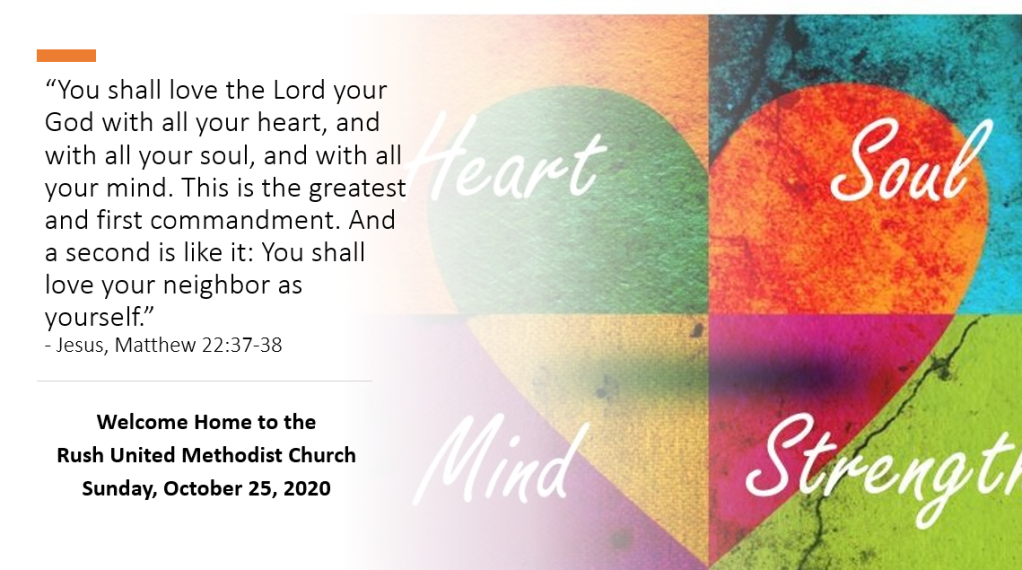
When the Pharisees heard that he had silenced the Sadducees, they gathered together, and one of them, a lawyer, asked him a question to test him. “Teacher, which commandment in the law is the greatest?” He said to him, “’You shall love the Lord your God with all your heart, and with all your soul, and with all your mind.’ This is the greatest and first commandment. And a second is like it: ‘You shall love your neighbor as yourself.’ On these two commandments hang all the law and the prophets.”
Now while the Pharisees were gathered together, Jesus asked them this question: “What do you think of the Messiah? Whose son is he?” They said to him, “The son of David.” He said to them, “How is it then that David by the Spirit calls him Lord, saying, ‘The Lord said to my Lord, “Sit at my right hand, until I put your enemies under your feet”’? If David thus calls him Lord, how can he be his son?” No one was able to give him an answer, nor from that day did anyone dare to ask him any more questions.
Prayer.
Put away your fluffy felt board Jesus,
Because the conflict between Jesus and Temple authorities
These past few Sundays have been high stakes, high drama, public confrontations.
They challenge his authority.
Jesus dishes it right back,
Exposing their lies, fraud, hypocrisy, and sin for all the world to see.
It is helpful to recognize the Gospel lessons of the past few weeks
Would fit better if proclaimed during Holy Week,
Instead of at the end of the liturgical year.
Every October / November
Gospel readings
Focus on the high stakes encounters between Jesus and the authorities
Between his triumphant entry into Jerusalem on Sunday
And his tragic death on the cross on Friday.
Let there be no mistake:
Jesus came to Jerusalem to die and rise again.
He didn’t come to celebrate the Passover
Only to return home the following week
Like all the rest of the happy campers.
Jesus came to Jerusalem to provoke a people
From accepting the status quo to taking action,
To wake them from a mindless, sleepy faith
To an active, growing, relational faith
In a loving God.
Jesus was seeking conversion.
Jesus calls, trains, and deploys disciples
To witness their faith,
To spread the Gospel, and
To bring forgiveness and salvation to a yearning world.
So, this is where we are at today:
Jesus had entered Jerusalem,
Marched up to the Temple,
Overturned the money changers tables,
And faced off with religious and secular authorities
In a revolving door, tag team effort of entrapment.
They questioned his authority to teach.
Jesus taught them parables that
Indicted organized religion
And individual greed.
The parable of two sons, wicked tenants, the wedding banquet
Upended tables of power, authority, and what it means to live faithfully.
Last week, Jesus was questioned about paying taxes and tithing
Allowing him to reset people’s assumptions about faith.
Today, Jesus had silenced the Sadducees’ question about the resurrection,
Leaving the path clear for the Pharisees
To tag in and make one last attempt
At going for the pin.
A lay leader of the Temple,
A lawyer, by trade,
Asks Jesus, “Teacher, which commandment in the law is the greatest?”
Every Jew would have known the answer to this question,
Just as every American knows George Washington was our first president.
He isn’t testing Jesus’ knowledge.
He is testing Jesus’ methods.
He is probing to see if Jesus has the wear-with-all
To debate in their high powered, elite academic circles.
Are you worthy, Jesus?
“Teacher, which commandment in the law is the greatest?”
The answer is so basic to faith
Every Jewish child is taught to pray
By starting out with reciting this Law,
Called the Shema (from the first word, Hear, as it is in Hebrew).
This is Shema
Word for word right out of the Torah, our Old Testament, Deut. 6:4-5
“Hear O Israel: the Lord thy God is one! You shall love the Lord your God with all your heart, and with all your soul, and with all your mind.”
What was so astonishing was the fact that Jesus didn’t stop there.
He continued on by attaching to the Shema
A previously unrelated law from Leviticus 19:18, 34
Merging these two ideals into one-
“and you shall love your neighbor as yourself.”
Never before had these Laws been brought together;
United by Jesus to provide the pivotal point
For God and Humankind’s Salvation History.
Not only does Jesus make this addendum,
But he invites them to debate other aspects of the law.
Let’s talk Messiah, people.
The Gospel of Matthew begins with lineage from David to Jesus
And here,
Jesus quiets his critics
With the unanswerable,
How can King David have the Messiah,
The Son of God,
In his lineage?
Outmatched, outwitted, outplayed
The Pharisees scurried away.
Jesus is the lone survivor.
And they did not dare ask him any more questions.
Love God;
Love neighbors.
It is as simple as that.
Most of us today appreciate
The simplicity of this statement on the surface
But, if you are like me,
This simplicity leads me to ponder more deeply
“What does it mean to love God?”
“What does it mean to love neighbors?”
….
Hear, O Israel,
Love the Lord your God.
Love, in this use, is not emotional or romantic.
Love isn’t all talk.
Love God with action!
Open your heart and allow the Holy Spirit of God to sweep you away!
Jump to the front of the line, eager for baptism,
Being named once and for all time
As a disciple of Jesus.
Fall in love with Jesus and show your love for him every day.
Act like you are in love.
Fall on your knees and seek God’s repentance and forgiveness for past sins.
Return to those you have harmed, and make it right.
Serve the Lord full time.
Pray, study, discern, act
Fulfilling God’s will for you and your life.
Attend worship and give God praise and thanks.
Open, jump, fall, return, serve, attend …
These are action words,
Because loving God means actions speak louder than words.
….
Hear, O Israel
Love your neighbors as yourself.
What does it mean to love our neighbors?
Every Hebrew scholar worth their weight
Will follow the Reece’s Pieces trail
Jesus leaves for us to follow back to Leviticus 19.
Here we find insight to what Jesus means
When he tells us to love our neighbors.
First, our neighbors are our kin and our clan.
Hear these words
“You shall not hate in your heart anyone of your kin; you shall reprove your neighbor, or you will incur guilt yourself. You shall not take vengeance or bear a grudge against any of your people, but you shall love your neighbor as yourself: I am the Lord.”
– Leviticus 19:17-18
No problem we say to ourselves.
I love my family;
Blood is thicker than water, after all.
I love my friends;
We’ve got each other’s back.
I love my church;
After all, we all get along.
Which
This pastor must observe:
“In what delusional world do we think we live?!!!”
Life is full of dysfunctional families, broken friendships, and conflict laden churches!
Love is action!
Therefore, to love our neighbors as ourselves, we must
“You shall rise before the aged, and defer to the old; and you shall fear your God: I am the Lord. When an alien resides with you in your land, you shall not oppress the alien. The alien who resides with you shall be to you as the citizen among you; you shall love the alien as yourself, for you were aliens in the land of Egypt: I am the Lord your God.”
– Leviticus 19:32-34
Loving our neighbor
Means we love the alien in our midst.
Jesus did not have Star Trek in mind!
Aliens are travelers from other lands,
People beyond our own family and clans.
Jesus is asking us to love people beyond our circle of safety and security;
People we don’t know and have never met.
Who are these neighbors Jesus is calling us to love?
Homeless.
Poor.
Unemployed and underemployed.
Children.
Seniors.
People with different abilities.
Those suffering from illness or disease.
People who are guilty and incarcerated.
People immigrating to our land.
Loving them means more than naming them.
Reach out.
Visit.
Meet new people.
Make new friends.
Volunteer.
Get to know the waitress who waits on you,
The receptionist who welcomes you to the doctor’s office,
And the grocery store employee who
Helps you locate that one item on the grocery list you just can’t find.
Draw up your inner courage,
Place your trust that the Spirit will support you.
Live beyond yourself,
Placing the needs of someone else before your own.
Seek out new stories
And make the intentional effort to sit on your own.
Make yourself curious about the rest of the world,
Learn how it works,
And how God has knit us all together.
Loving our neighbors means living for others more than living for ourselves.
Dearly beloved sisters and brothers,
Reach up to God with praise, thanksgiving, and love.
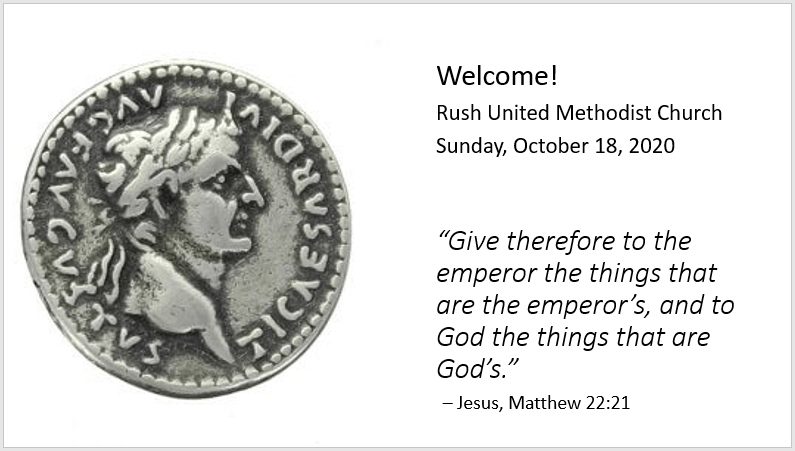
Then the Pharisees went and plotted to entrap him in what he said. So they sent their disciples to him, along with the Herodians, saying, “Teacher, we know that you are sincere, and teach the way of God in accordance with truth, and show deference to no one; for you do not regard people with partiality. Tell us, then, what you think. Is it lawful to pay taxes to the emperor, or not?” But Jesus, aware of their malice, said, “Why are you putting me to the test, you hypocrites? Show me the coin used for the tax.” And they brought him a denarius. Then he said to them, “Whose head is this, and whose title?” They answered, “The emperor’s.” Then he said to them, “Give therefore to the emperor the things that are the emperor’s, and to God the things that are God’s.” When they heard this, they were amazed; and they left him and went away.
Prayer.
The preacher’s dilemma for today is
How does one preach about traps
Without falling into one?
Our dilemma in experiencing this Gospel text is
How far are you and I willing to walk with Jesus
Up Calvary’s hill
– the Via Dolorosa –
With him to his crucifixion?
Verbal blows had been exchanged
In our Lord’s confrontation with Jewish leaders:
First the Chief Priests and elders of the people,
Then Pharisees joined the party,
In today’s continuous text, the Herodians are added to the interrogation.
Next Sunday, some Sadducees will join the brawl.
This high intensity challenge of Jesus’ authority in the Temple
Would within a few hours
Result in Jesus’ arrest, trial, abuse, crucifixion, and death.
Civil authority was clashing with kingdom authority.
Politics makes for strange bedfellows
Kind of like this diverse gathering of Jewish leaders
Conspiring to trap Jesus.
The Chief Priest and their family ran the Temple.
Sadducees were leaders of a sect that did not believe in the resurrection.
Pharisees were righteous and well-educated lay people.
The Herodians were Jews loyal to Rome (their occupiers).
Leaders, followers, and collaborators;
United for one common purpose –
To trap Jesus,
To destroy Jesus,
To remove Jesus from the playing field,
To erase every memory and aspiration he created.
Politics makes for strange bedfellows.
Pharisees and Herodians working together would have been as likely as
Mitch McConnell and Chuck Schumer agreeing on a new Supreme Court nominee.
I try to keep my politics out of preaching.
The Gospel is my politics.
That is the way I like to keep it.
Get Jesus in trouble with Rome
And they’d crucify him.
Trap Jesus by getting him in trouble with the populist,
And a lynch mob would take care of business.
Blood was in the water,
And it drew every variety of shark in for the kill.
Civil authority clashing with kingdom authority.
As we celebrate the 503 anniversary of the Protestant Reformation this month,
It is good to remember Martin Luther
Who understood this titanic clash as being between
Civil righteousness and Spiritual righteousness.
Civil righteousness is compliance with civil law.
We construct a system to organize ourselves.
We refine the system.
And we are held accountable for adhering to the system.
Civil righteousness is demonstrated by how lawfully we act in society.
Spiritual righteousness, however, regards our relationship with God.
Spiritual righteousness is not determined by our actions
But is demonstrated by God’s love in Jesus Christ.
The contrast is between our dual citizenship:
We are citizens of both the state and citizens of heaven.