When Jesus saw the crowds, he went up the mountain; and after he sat down, his disciples came to him. Then he began to speak, and taught them, saying:
“Blessed are the poor in spirit, for theirs is the kingdom of heaven.
“Blessed are those who mourn, for they will be comforted.
“Blessed are the meek, for they will inherit the earth.
“Blessed are those who hunger and thirst for righteousness, for they will be filled.
“Blessed are the merciful, for they will receive mercy.
“Blessed are the pure in heart, for they will see God.
“Blessed are the peacemakers, for they will be called children of God.
“Blessed are those who are persecuted for righteousness’ sake, for theirs is the kingdom of heaven.
“Blessed are you when people revile you and persecute you and utter all kinds of evil against you falsely on my account. Rejoice and be glad, for your reward is great in heaven, for in the same way they persecuted the prophets who were before you.
…
Prayer.
The Christian calendar always recognizes
The first day of November as All Saint’s Day.
This is a day to pause and remember our Christian loved ones,
Who have left this mortal life,
And who now benefit from the gift of eternal life
In the presence of God.
Few anticipated salvation and eternal life more than John of Patmos,
The author of the apocalyptic book of Revelation.
Revelation is the last book of the Bible.
John of Patmos, like other late first century Christians,
Suffered persecution, tribulation, exile, and martyrdom
During the Roman rule of Domitian, from 81 to 96 AD.
John was exiled by Rome to an island in the Aegean Sea, off the coast of Greece.
On this island, named Patmos,
John experienced visions from God about the future-
Death, divine judgment, and eternal life.
His colorful descriptions of these visions
Paint a heaven with the Lord upon the throne,
Surrounded by every saint
Ever to live, and die, and be resurrected into eternal life.
John describes the cloud of saints as
Those “who have come out of the great ordeal.”
(Revelation 7:14)
Indeed, life is a great ordeal.
Beginning with the miracle of conception,
Life is given and guided by the hand of our Divine Creator,
The same author of the universe,
The one who makes each of us in his own image.
God is at the wheel and
We are along for the ride.
And what a ride it is!
Each of us have very different life trajectories,
Yet, there are some events and ideals that all Christians hold in common.
…
1. Every disciple of Jesus Christ
Has first been chosen by almighty God
To come to the baptismal waters
And become united in baptism.
By our common baptism we are united
With Jesus,
With every Christian who has come before us,
With every Christian now living, and
With every future Christian God will be calling to the water.
Baptism unites us,
Levels the playing field,
And forever marks us
Undeniably as Jesus’ own.
Remember the baptism of your loved ones.
Remember your baptism.
And be thankful.
…
2. To live is to stand with both feet firmly planted on this earth.
All Christians share the fact that we were, or are, human.
We are united by our hunger and our thirst.
We are united by scorching heat and blowing snow.
We are united by our love and our grief,
Evident by the tears in our eyes.
And together,
Jesus leads us to the springs of the water of life.
(Revelation 7:17)
Living according to the will of God
Is living a life that is blessed.
Blessed doesn’t mean charmed or privileged.
To receive God’s blessing means that God approves
Of righteous effort and behavior.
God approves,
His Son assures us in his Sermon on the Mount,
Of those who are poor in spirit.
God approves of those who mourn.
God approves of the meek.
God approves of those who hunger and thirst for righteousness.
God approves of those who are merciful, pure in heart, and who work for peace.
God approves for those chose to follow God
When it would be easier not to,
And as a result, end up on the receiving end of persecution.
Christians are united by God’s blessings and grace,
Not only in God’s present approval,
But also in God’s future promise.
Those who live in God’s present approval
Are promised the kingdom of heaven,
Are promised God’s comfort,
Are promised to inherit the earth.
Those who are blessed today
Will be filled tomorrow.
Those who grant mercy
Will receive God’s mercy.
Those whom God approves will see God’s face,
Will be forever called and known as God’s own children,
And will inherit the kingdom of heaven.
Today’s approval
Results in eternal grace.
Remember how God has blessed our beloved saints,
Whom we remember this day.
Rest assured God’s promise is fulfilled.
Give thanks for God’s blessings in your life
And look forward to receiving His future promise.
…
3. Every disciple of Jesus Christ
Endures the fury of temptation to violate God’s laws and will.
John of Patmos writes
“These are they
who have come out of the great ordeal;
They have washed their robes
and made them white
In the blood of the Lamb.”
(Revelation 7:14)
Everyone sins.
The saints we remember today
Have sinned.
We share with them and with each other the Devil’s fire,
Attempting to navigate this mortal life through Daniel’s furnace,
Walking the valley in the shadow of death.
As we are united by our temptation and sin,
So, too are we united by our Lord’s grace;
His forgiveness
Through his crucifixion.
We ask John, “How can blood wash clean a white robe?”
When that blood is Jesus’ own blood
And we stand in the soiled robe of sin.
We are unified in our petition to be cleansed.
And we are united in God’s mercy and grace
With the gift that Jesus gives to each of us.
By his death,
We are washed clean.
Remember no more
The sins of those who have now died in the Lord.
Forget their trials, temptations, and sins.
Jesus has; and so, too, should we.
Confess the name of Jesus.
Claim him as your Lord and Savior.
And receive the forgiveness of your every sin.
…
4. Lastly, every disciple of Christ
Living in this kingdom
Can expect to be united with every other disciple
Living in the heavenly kingdom,
Standing before the throne
Worshipping God, singing
“Amen!
Blessings and glory and wisdom and thanksgiving
And honor and power and might
Be to our God
Forever and ever!
Amen.”
(Revelation 7:12)
We will join with our beloved saints who have preceded us
In God’s eternal kingdom.
Jesus assures us that he’s prepared our place.
He’s given us his Holy Spirit to guide us there.
And Jesus has promised us
That we will be united with his saints around the throne.
There will be no sin,
No temptation,
No broken relationships;
Because each of us will be standing in a span clean robe,
Newly washed.
Wesley called this perfection.
John calls this God’s heavenly banquet.
Jesus promised us that he is looking forward to greeting each of us,
Soon face to face.
Hold tight to the memories our saints have given us;
Especially their witness and strength of faith.
Allow God to use these memories to guide and direct
Our own journey through this great ordeal.
Give thanks to God
For sharing with us for a time our beloved saints.
Give thanks to God for receiving each of them home.
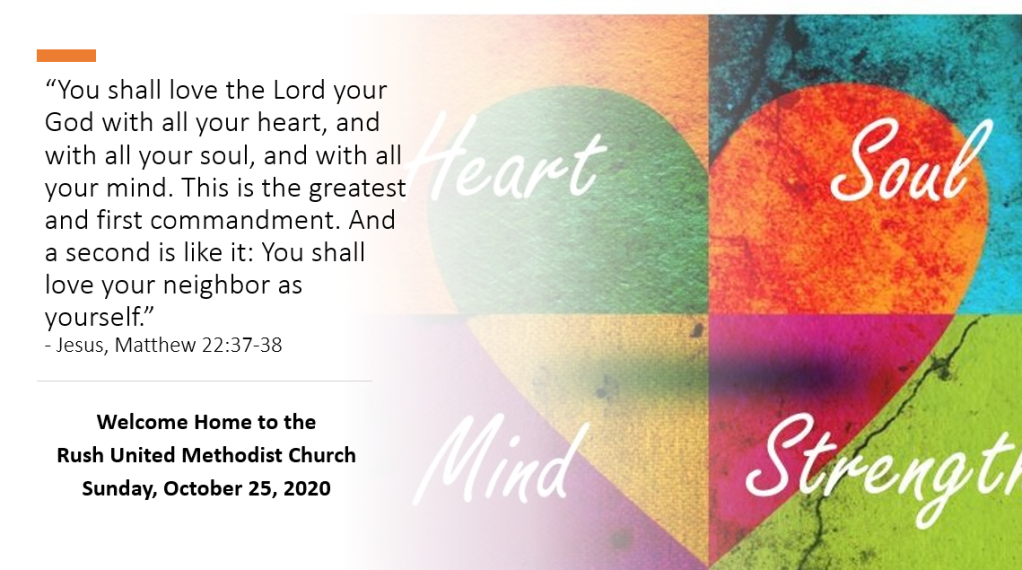
When the Pharisees heard that he had silenced the Sadducees, they gathered together, and one of them, a lawyer, asked him a question to test him. “Teacher, which commandment in the law is the greatest?” He said to him, “’You shall love the Lord your God with all your heart, and with all your soul, and with all your mind.’ This is the greatest and first commandment. And a second is like it: ‘You shall love your neighbor as yourself.’ On these two commandments hang all the law and the prophets.”
Now while the Pharisees were gathered together, Jesus asked them this question: “What do you think of the Messiah? Whose son is he?” They said to him, “The son of David.” He said to them, “How is it then that David by the Spirit calls him Lord, saying, ‘The Lord said to my Lord, “Sit at my right hand, until I put your enemies under your feet”’? If David thus calls him Lord, how can he be his son?” No one was able to give him an answer, nor from that day did anyone dare to ask him any more questions.
Prayer.
Put away your fluffy felt board Jesus,
Because the conflict between Jesus and Temple authorities
These past few Sundays have been high stakes, high drama, public confrontations.
They challenge his authority.
Jesus dishes it right back,
Exposing their lies, fraud, hypocrisy, and sin for all the world to see.
It is helpful to recognize the Gospel lessons of the past few weeks
Would fit better if proclaimed during Holy Week,
Instead of at the end of the liturgical year.
Every October / November
Gospel readings
Focus on the high stakes encounters between Jesus and the authorities
Between his triumphant entry into Jerusalem on Sunday
And his tragic death on the cross on Friday.
Let there be no mistake:
Jesus came to Jerusalem to die and rise again.
He didn’t come to celebrate the Passover
Only to return home the following week
Like all the rest of the happy campers.
Jesus came to Jerusalem to provoke a people
From accepting the status quo to taking action,
To wake them from a mindless, sleepy faith
To an active, growing, relational faith
In a loving God.
Jesus was seeking conversion.
Jesus calls, trains, and deploys disciples
To witness their faith,
To spread the Gospel, and
To bring forgiveness and salvation to a yearning world.
So, this is where we are at today:
Jesus had entered Jerusalem,
Marched up to the Temple,
Overturned the money changers tables,
And faced off with religious and secular authorities
In a revolving door, tag team effort of entrapment.
They questioned his authority to teach.
Jesus taught them parables that
Indicted organized religion
And individual greed.
The parable of two sons, wicked tenants, the wedding banquet
Upended tables of power, authority, and what it means to live faithfully.
Last week, Jesus was questioned about paying taxes and tithing
Allowing him to reset people’s assumptions about faith.
Today, Jesus had silenced the Sadducees’ question about the resurrection,
Leaving the path clear for the Pharisees
To tag in and make one last attempt
At going for the pin.
A lay leader of the Temple,
A lawyer, by trade,
Asks Jesus, “Teacher, which commandment in the law is the greatest?”
Every Jew would have known the answer to this question,
Just as every American knows George Washington was our first president.
He isn’t testing Jesus’ knowledge.
He is testing Jesus’ methods.
He is probing to see if Jesus has the wear-with-all
To debate in their high powered, elite academic circles.
Are you worthy, Jesus?
“Teacher, which commandment in the law is the greatest?”
The answer is so basic to faith
Every Jewish child is taught to pray
By starting out with reciting this Law,
Called the Shema (from the first word, Hear, as it is in Hebrew).
This is Shema
Word for word right out of the Torah, our Old Testament, Deut. 6:4-5
“Hear O Israel: the Lord thy God is one! You shall love the Lord your God with all your heart, and with all your soul, and with all your mind.”
What was so astonishing was the fact that Jesus didn’t stop there.
He continued on by attaching to the Shema
A previously unrelated law from Leviticus 19:18, 34
Merging these two ideals into one-
“and you shall love your neighbor as yourself.”
Never before had these Laws been brought together;
United by Jesus to provide the pivotal point
For God and Humankind’s Salvation History.
Not only does Jesus make this addendum,
But he invites them to debate other aspects of the law.
Let’s talk Messiah, people.
The Gospel of Matthew begins with lineage from David to Jesus
And here,
Jesus quiets his critics
With the unanswerable,
How can King David have the Messiah,
The Son of God,
In his lineage?
Outmatched, outwitted, outplayed
The Pharisees scurried away.
Jesus is the lone survivor.
And they did not dare ask him any more questions.
Love God;
Love neighbors.
It is as simple as that.
Most of us today appreciate
The simplicity of this statement on the surface
But, if you are like me,
This simplicity leads me to ponder more deeply
“What does it mean to love God?”
“What does it mean to love neighbors?”
….
Hear, O Israel,
Love the Lord your God.
Love, in this use, is not emotional or romantic.
Love isn’t all talk.
Love God with action!
Open your heart and allow the Holy Spirit of God to sweep you away!
Jump to the front of the line, eager for baptism,
Being named once and for all time
As a disciple of Jesus.
Fall in love with Jesus and show your love for him every day.
Act like you are in love.
Fall on your knees and seek God’s repentance and forgiveness for past sins.
Return to those you have harmed, and make it right.
Serve the Lord full time.
Pray, study, discern, act
Fulfilling God’s will for you and your life.
Attend worship and give God praise and thanks.
Open, jump, fall, return, serve, attend …
These are action words,
Because loving God means actions speak louder than words.
….
Hear, O Israel
Love your neighbors as yourself.
What does it mean to love our neighbors?
Every Hebrew scholar worth their weight
Will follow the Reece’s Pieces trail
Jesus leaves for us to follow back to Leviticus 19.
Here we find insight to what Jesus means
When he tells us to love our neighbors.
First, our neighbors are our kin and our clan.
Hear these words
“You shall not hate in your heart anyone of your kin; you shall reprove your neighbor, or you will incur guilt yourself. You shall not take vengeance or bear a grudge against any of your people, but you shall love your neighbor as yourself: I am the Lord.”
– Leviticus 19:17-18
No problem we say to ourselves.
I love my family;
Blood is thicker than water, after all.
I love my friends;
We’ve got each other’s back.
I love my church;
After all, we all get along.
Which
This pastor must observe:
“In what delusional world do we think we live?!!!”
Life is full of dysfunctional families, broken friendships, and conflict laden churches!
Love is action!
Therefore, to love our neighbors as ourselves, we must
“You shall rise before the aged, and defer to the old; and you shall fear your God: I am the Lord. When an alien resides with you in your land, you shall not oppress the alien. The alien who resides with you shall be to you as the citizen among you; you shall love the alien as yourself, for you were aliens in the land of Egypt: I am the Lord your God.”
– Leviticus 19:32-34
Loving our neighbor
Means we love the alien in our midst.
Jesus did not have Star Trek in mind!
Aliens are travelers from other lands,
People beyond our own family and clans.
Jesus is asking us to love people beyond our circle of safety and security;
People we don’t know and have never met.
Who are these neighbors Jesus is calling us to love?
Homeless.
Poor.
Unemployed and underemployed.
Children.
Seniors.
People with different abilities.
Those suffering from illness or disease.
People who are guilty and incarcerated.
People immigrating to our land.
Loving them means more than naming them.
Reach out.
Visit.
Meet new people.
Make new friends.
Volunteer.
Get to know the waitress who waits on you,
The receptionist who welcomes you to the doctor’s office,
And the grocery store employee who
Helps you locate that one item on the grocery list you just can’t find.
Draw up your inner courage,
Place your trust that the Spirit will support you.
Live beyond yourself,
Placing the needs of someone else before your own.
Seek out new stories
And make the intentional effort to sit on your own.
Make yourself curious about the rest of the world,
Learn how it works,
And how God has knit us all together.
Loving our neighbors means living for others more than living for ourselves.
Dearly beloved sisters and brothers,
Reach up to God with praise, thanksgiving, and love.
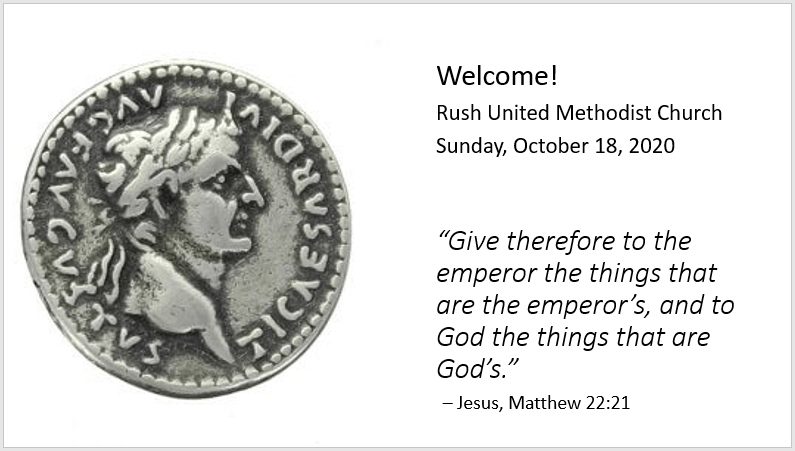
Then the Pharisees went and plotted to entrap him in what he said. So they sent their disciples to him, along with the Herodians, saying, “Teacher, we know that you are sincere, and teach the way of God in accordance with truth, and show deference to no one; for you do not regard people with partiality. Tell us, then, what you think. Is it lawful to pay taxes to the emperor, or not?” But Jesus, aware of their malice, said, “Why are you putting me to the test, you hypocrites? Show me the coin used for the tax.” And they brought him a denarius. Then he said to them, “Whose head is this, and whose title?” They answered, “The emperor’s.” Then he said to them, “Give therefore to the emperor the things that are the emperor’s, and to God the things that are God’s.” When they heard this, they were amazed; and they left him and went away.
Prayer.
The preacher’s dilemma for today is
How does one preach about traps
Without falling into one?
Our dilemma in experiencing this Gospel text is
How far are you and I willing to walk with Jesus
Up Calvary’s hill
– the Via Dolorosa –
With him to his crucifixion?
Verbal blows had been exchanged
In our Lord’s confrontation with Jewish leaders:
First the Chief Priests and elders of the people,
Then Pharisees joined the party,
In today’s continuous text, the Herodians are added to the interrogation.
Next Sunday, some Sadducees will join the brawl.
This high intensity challenge of Jesus’ authority in the Temple
Would within a few hours
Result in Jesus’ arrest, trial, abuse, crucifixion, and death.
Civil authority was clashing with kingdom authority.
Politics makes for strange bedfellows
Kind of like this diverse gathering of Jewish leaders
Conspiring to trap Jesus.
The Chief Priest and their family ran the Temple.
Sadducees were leaders of a sect that did not believe in the resurrection.
Pharisees were righteous and well-educated lay people.
The Herodians were Jews loyal to Rome (their occupiers).
Leaders, followers, and collaborators;
United for one common purpose –
To trap Jesus,
To destroy Jesus,
To remove Jesus from the playing field,
To erase every memory and aspiration he created.
Politics makes for strange bedfellows.
Pharisees and Herodians working together would have been as likely as
Mitch McConnell and Chuck Schumer agreeing on a new Supreme Court nominee.
I try to keep my politics out of preaching.
The Gospel is my politics.
That is the way I like to keep it.
Get Jesus in trouble with Rome
And they’d crucify him.
Trap Jesus by getting him in trouble with the populist,
And a lynch mob would take care of business.
Blood was in the water,
And it drew every variety of shark in for the kill.
Civil authority clashing with kingdom authority.
As we celebrate the 503 anniversary of the Protestant Reformation this month,
It is good to remember Martin Luther
Who understood this titanic clash as being between
Civil righteousness and Spiritual righteousness.
Civil righteousness is compliance with civil law.
We construct a system to organize ourselves.
We refine the system.
And we are held accountable for adhering to the system.
Civil righteousness is demonstrated by how lawfully we act in society.
Spiritual righteousness, however, regards our relationship with God.
Spiritual righteousness is not determined by our actions
But is demonstrated by God’s love in Jesus Christ.
The contrast is between our dual citizenship:
We are citizens of both the state and citizens of heaven.
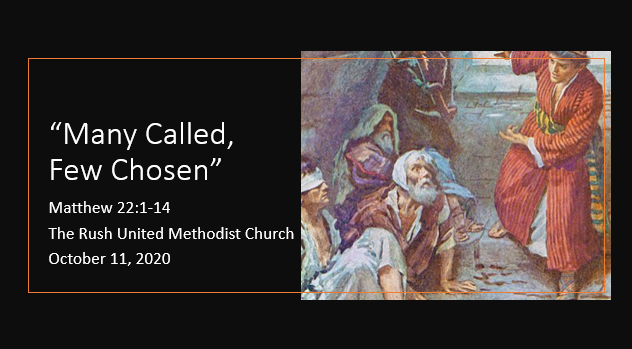
Once more Jesus spoke to them in parables, saying: “The kingdom of heaven may be compared to a king who gave a wedding banquet for his son. He sent his slaves to call those who had been invited to the wedding banquet, but they would not come. Again he sent other slaves, saying, ‘Tell those who have been invited: Look, I have prepared my dinner, my oxen and my fat calves have been slaughtered, and everything is ready; come to the wedding banquet.’ But they made light of it and went away, one to his farm, another to his business, while the rest seized his slaves, mistreated them, and killed them.
The king was enraged. He sent his troops, destroyed those murderers, and burned their city.
Then he said to his slaves, ‘The wedding is ready, but those invited were not worthy. Go therefore into the main streets, and invite everyone you find to the wedding banquet.’ Those slaves went out into the streets and gathered all whom they found, both good and bad; so the wedding hall was filled with guests.
“But when the king came in to see the guests, he noticed a man there who was not wearing a wedding robe, and he said to him, ‘Friend, how did you get in here without a wedding robe?’ And he was speechless. Then the king said to the attendants, ‘Bind him hand and foot, and throw him into the outer darkness, where there will be weeping and gnashing of teeth.’ For many are called, but few are chosen.”
Prayer.
This parable
Causes me to remember my defiant adolescence.
With hair down to my shoulders,
Sporting rose colored glasses,
I’d turn off my loud rock and roll,
Come bounding down the parsonage stairs
Burst into the kitchen
And ask dad for the keys to the car.
Inevitably, my mother would turn away from
The dishes in the sink or dinner on the stove.
She would take a look at my outrageous tee shirt or clothing, and say
“You’re going out looking like that?”
“Yeppers, mom. Catch you on the flip side of life.”
And off I’d go,
Acting as if there was no accountability, …
… Knowing full well that there was.
This parable is the third in a row.
It is important to be reminded that
Jesus is confronting the Temple authorities,
The Chief Priests, Pharisees, and leaders of the people.
The confrontation in Matthew 21 and 22 is explosive,
Extremely dangerous, and potentially violent.
For contextual reasons,
It is important to remember that this confrontation
Is taking place in the final days of Jesus’ life.
Try to imagine this confrontation taking place
During the early days of Holy Week;
Monday, Tuesday, or Wednesday.
Just remember,
Jesus only has hours to live,
Share a final meal with his disciples,
Wash their feet,
Be arrested and tried and condemned,
And be crucified.
Time is short.
If ever there was a moment
To clearly and concisely communicate to the world
What the Kingdom of God looks like,
It was now.
Characteristics of God’s Kingdom have been revealed by Jesus
Throughout this high-stake confrontation in Matthew 21 and 22.
This is what we have learned so far:
Jesus’ authority comes from God, his heavenly Father.
God’s Kingdom is inclusive.
Those who do the will of God, in spite of past sins, will go first into the Kingdom.
God seeks justice and righteousness.
God’s Kingdom is given to those who bear fruit.
Today, Jesus turns up the gain,
Amps it up, and
Takes this confrontation over the top.
It isn’t pleasant.
This isn’t the Christmas baby Jesus
Or the gentle Jesus, meek and mild, with children sitting on his lap surrounded by cute little lambs.
That’s the Jesus we want,
But that isn’t the Jesus we get.
This is our Jesus,
At the height of his ministry,
Fulfilling the will of the Heavenly Father.
He is filled with disciplined, righteous anger
Confronting authority,
Speaking truth to power.
The environment is teetering on the edge of explosive violence.
Why is Jesus whacking the hornets’ nest?
Jesus confronts Temple authorities
To expand our comprehension of the Kingdom of God.
There is more to learn and his time is short.
This parable causes us to ask
What kind of power does God exercise?
And how does God exercise it?
A closer look.
The King interacts on three occasions with four different players.
1. The first player the king engages is the royal elite.
These are the ones who would not come,
Despite two personal invitations.
What kind of person in royal circles declines an invitation from the king?
They owe their status and influence to their proximity to the throne.
Why wouldn’t they come,
Unless they, themselves had reason to believe
They would be called to accountability?
Had they become so smug that they had nothing to fear?
But those who believed and acted as if they were first in the kingdom,
… The A listers …
… The Primadonnas …
Didn’t really know their king and
They didn’t want to be held accountable by him.
(Sounds to me like the Chief Priest, Pharisees, and the elders of the people)
The king’s response is proportional:
First, he decides to send a second invitation.
When even the second invitation is mocked …
Made lite by some,
Ignored by others, and
Flaunted by still others,
They seize the king’s slaves,
Mistreat some and kill others,
Then, and only then, the king resorts to judgment.
Judgment rains down.
He “destroyed those murderers and burned their city.” (22:7)
There is a price to be paid for rejecting the king.
Yes, there is accountability, Jesus’ parable teaches us.
There is accountability in the Kingdom of Heaven.
The king will not be rejected.
Judgment is decisive.
2. The next two players the king engages are commoners,
Described as both the good and the bad.
Peasants?
A king mixing with mere commoners?
This is over the top!
This is Good News for those who are left out and
Treated with contempt
By the aristocracy.
Both the good and the bad are invited, and they come.
In some respect
This was an offense to the good;
They’d been working in the vineyard since the early morning,
Then along comes those who were hired at an hour before quitting time?
However, they get a free meal out of it;
So why not attend?
Good news is still good news.
It was also good news to the bad people on Main street.
The invitation wasn’t predicated on their behavior or reputation.
The invitation was color blind.
It demonstrates the king’s hope for
Transformation in the present and
The hope for a better future.
This was of greater importance than
Any sin they had committed in the past.
The king believes in redemption,
A second chance.
A wedding hall filled with guests
Would have certainly pleased the king.
The banquet was over the top;
Oxen, fat calves, a royal banquet unlike anyone has ever experienced,
A true feast, where all could gather and eat their fill.
(Much like our communion table)
With this second encounter with both the good and the bad
Jesus’ parable also teaches us that
The king’s grace is inclusive and unconditional.
The invitation to the banquet is extended to everyone.
The king’s grace is abundant,
Rich and overflowing,
Exceeding the expectations and the experience of his people.
Amazing grace, how sweet the sound!
Now that’s some good news!
3. The last player the king engages in this parable
Is the man caught not wearing a wedding robe
In open defiance of the king.
One could possibly title this final portion of the parable
“The Parable of the Wedding Crasher”.
Oh, the king gets his wedding feast,
But he noticed a man who was not wearing a wedding robe.
Again, the king is patient and proportional:
He gives the man who is openly defying him
An opportunity to justify his behavior.
“Friend,” he asks,
“how did you get in here without a wedding robe?” (22:12)
The man is speechless.
Perhaps he is speechless because he had earlier witnessed the king’s wrath.
Judgment had resulted in death.
Perhaps he is speechless because he had witnessed
The mercy the king had shown
By including both the good and the bad at the wedding banquet.
There is plenty in this parable that leaves us speechless.
The King passes judgment,
But notice, again, judgment is limited.
“Bind him hand and foot, and throw him into the outer darkness, where there will be weeping and gnashing of teeth.” (22:13)
The phrase Jesus uses
“weeping and gnashing of teeth” to pronounce judgment
Has been used three times before in Matthew (8:12, 13:42, 13:50)
And will be used twice again (24:51, 25:30)
Mostly in the context of a parable.
Don’t assume this is a reference to hell.
I’d suggest this is Jesus’ way to simply indicate
Their removal from the banquet at hand.
He doesn’t kill the wedding crasher,
Unlike those who rejected him.
Defiance might get you kicked out,
But it didn’t preclude the possibility of his future return.
O, dear Judas. Rejection of the king leads to death.
But defiance, dear Peter; there remains hope for redemption.
In a powerful way, Jesus reiterated that,
Yes, there is accountability in the Kingdom of Heaven.
The King will not be rejected.
The King will not be mocked.
Judgment may be proportional,
But it is decisive.
The King’s grace is inclusive and unconditional.
The invitation to the banquet is extended to everyone.
The King’s grace seeks the redemption of his people.
The King’s grace is abundant,
Rich and overflowing,
Exceeding the expectations and the experience of his people.
Jesus uses this parable to fill in some of the remaining characteristics
About what life is like in the Kingdom of Heaven.
He tells us a lot about the power of God,
His heavenly Father and our King.
What kind of power does God exercise?
And how is it exercised?
God’s power comes from grace.
God gives everyone a second chance.
God acts with discipline and proportionately.
God includes everyone, the good and the bad.
This is good news because
God has a place in the kingdom,
At the table,
For everyone,
Including both you and me.
God’s power comes from restraint.
Vengeance is the Lord’s, and God’s alone.
There is no place for vengeance in the life of a follower of Jesus.
This is an especially important message to us
As we attempt to navigate life and faith in our turbulent world.
Leave vengeance up to God, knowing that it is only used as a last resort.
God’s greatest desire is for everyone to enter the Kingdom
And to feast at the heavenly feast.
This is good news!
Let there be no misunderstanding.
Don’t believe that we can take advantage of God’s grace.
“Listen to another parable. There was a landowner who planted a vineyard, put a fence around it, dug a wine press in it, and built a watchtower. Then he leased it to tenants and went to another country. When the harvest time had come, he sent his slaves to the tenants to collect his produce. But the tenants seized his slaves and beat one, killed another, and stoned another. Again he sent other slaves, more than the first; and they treated them in the same way.
Finally he sent his son to them, saying, ‘They will respect my son.’ But when the tenants saw the son, they said to themselves, ‘This is the heir; come, let us kill him and get his inheritance.” So they seized him, threw him out of the vineyard, and killed him. Now when the owner of the vineyard comes, what will he do to those tenants?”
They said to him, “He will put those wretches to a miserable death, and lease the vineyard to other tenants who will give him the produce at the harvest time.”
Jesus said to them, “Have you never read in the scriptures: ‘The stone that the builders rejected has become the cornerstone; this was the Lord’s doing, and it is amazing in our eyes’?
Therefore I tell you, the kingdom of God will be taken away from you and given to a people that produces the fruits of the kingdom. The one who falls on this stone will be broken to pieces; and it will crush anyone on whom it falls.”
When the chief priests and the Pharisees heard his parables, they realized that he was speaking about them. They wanted to arrest him, but they feared the crowds, because they regarded him as a prophet.
Prayer.
The high stakes, life or death, confrontation with the religious authorities continues for Jesus,
As he transitions from his first of three parables to this, his second.
Pharisees had circled in with the Chief Priests and elders of the people
Challenging Jesus’ authority
Right there on the Temple steps.
How dare he enter the city like royalty and overturn the money changing tables in the Temple?
Which is better, Jesus asked, a son who sins then does right?
Or, a son who makes promises but fails to keep them?
The answer, of course, is the one who sins, repents, and does right;
You know, kind of like a tax collector or prostitute who turn back on their former ways, stops the sin, and follows God.
But, whoa to those who are all talk and no substance;
You know, kind of like hypocritical, crooked religious authorities.
Either you’ve got a moral compass, or you don’t.
Either you are moving towards God, or you’re not.
In today’s second parable Jesus teaches about wicked tenants
Who woefully abuse the landowner’s servants,
Even killing the landowner’s son,
Abusing the extended authority of the landowner.
Jesus asks the religious authorities what should be done.
The Chief Priests, elders of the people, and Pharisees show their stripes
By their violence filled answer:
The landowner should kill the wicked tenants, they replied.
There you have it.
Kill ‘em. Kill them all.
Not exactly a pro-life position.
High-five, however, for law and order.
Jesus holds high the essential truth he intends to teach with this parable:
Those who fail to produce,
Those who break apart and destroy,
Those who would kill the Son,
Those are the ones who will have the kingdom taken away.
Wicked tenants are like religious authorities who have no God,
Who perpetuate corruption for personal gain,
Who exert power, control, and authority,
Who publicly speak faith but privately practice otherwise.
Leadership matters.
Producing fruits of the kingdom matters.
It matters so much,
This parable about wicked tenants
Compels us to ask three important questions.
1. First, what does God loving, Jesus following, leadership look like?
Who will answer the call?
Who is going to step up and take responsibility?
Leadership should be on the mind of every Nominating committee headed into Church Conference season.
As we pray we listen and discern who will lead us with Spirit filled conviction in coming years.
Who has the talent to get the job done?
Who has the track record of getting work done?
Who is reliable, dependable, and lives by faith?
Likewise, leadership should be in the thoughts of every follower of Jesus.
What am I being called to do?
What is the Lord’s will and the best way for me to fulfill it?
Some are called to social action,
Others to missions,
Even others to preach the Word, maintain order, and celebrate the Sacraments.
Every follower of Jesus is called.
Do something.
Do something productive.
Cooperation with each other is essential for unity.
Communication must be clear, concise, and align with behavior.
Results strengthen the Body.
Results matter.
Results matter to God.
Whatever your call to leadership looks like, or
Wherever your call to leadership takes you, or
With whoever the Lord is calling you to serve,
Produce good fruits for the Lord.
Accept nothing less from yourself
Than excellence.
2. Secondly, what are the fruits of God’s Kingdom?
We should not assume that people know,
Especially newer Christians.
The astute student of New Testament Greek will notice
The Greek word for “fruits”
Shares a common root with
The Greek word for “blessed.”
(KARpoud visa vi maKARioi, Interlinear Greek-English New Testament)
Jesus is pointing his finger back to his Sermon on the Mount,
The Beatitudes,
In the opening chapters of his teaching and ministry.
Those who have ears to hear
Know that Jesus is teaching us that the fruits of God’s Kingdom
Are blessings,
Blessing others.
Those who bless the poor, those who mourn, the meek, the hungry, the merciful … are producing fruits of God’s Kingdom.
Those who bless the pure in heart, the peacemakers, and victims of persecution … are producing fruits of God’s Kingdom.
Those who dig into the work of ministry seasoned with salt, shining the light of Christ to the world, and who follow the Law and prophets … are producing fruits of God’s Kingdom.
Bless those discipline their anger,
Who reconcile with their estranged sister or brother.
Bless those who do not retaliate, who love and pray for their enemies.
Bless those who give to the poor, who pray and fast, and who serve only God.
Bless those who do not judge others, but leave judgment up to the Lord.
Bless those who seek after God, who do unto others the way you would have them do unto you.
Bless those who love God, love their neighbors, and have are known as Jesus followers because of their love.
Bless those who hear the words of Jesus and does them.
People that bless are people that produce.
These are the people producing fruits of God’s Kingdom.
3. Thirdly, what fruits of the Kingdom,
However large or small,
Are you tending right now?
As you contemplate your personal fruits of Kingdom production,
In tribute to my mother, Alice Goddard,
Who died in the Lord this past Tuesday,
I’ll witness to her fruits of the Kingdom.
As a pastor’s wife of 19 years
There wasn’t a church floor that she didn’t scrub,
… On her hands and knees.
She blessed God and fellow Christians with spic and span clean floors,
Reflecting a belief in a God of creation, beauty, and perfection.
She baked multiple apple pies a week, blessing members of the parish and the larger community with her love and witness.
A slice of apple would come with an invitation to come to church
And an invitation to follow Jesus.
She blessed my brothers, sister, and me with faith in Jesus Christ, that became for each of us the Light of the World.
Her blessings flowed with her habit of tithing, attending worship without fail, and actively working in United Methodist Women to reach out in mission to the world.
My mother produced a lot of fruit in her 95 years.
What fruits of God’s Kingdom
Are you tending right now?
How’s production?
I can not remember a previous time in my life
That has been more important to be laser focused on producing fruits for God’s Kingdom.
This despicable pandemic is wearing people down and it’s not going away anytime soon.
Headed into winter,
It is more important than ever to be
Disciplined, discerning, and determined to bear fruit,
To bring blessing, to produce results, to pronounce joy.
Discipline.
It is all about Christian maturity.
Discernment.
It is all about listening for God’s will.
Determination.
It is all about our willingness to act,
To follow through,
To get the job done.
…
What does God loving, Jesus following, leadership look like?
When he entered the temple, the chief priests and the elders of the people came to him as he was teaching, and said, “By what authority are you doing these things, and who gave you this authority?” Jesus said to them, “I will also ask you one question; if you tell me the answer, then I will also tell you by what authority I do these things. Did the baptism of John come from heaven, or was it of human origin?” And they argued with one another, “If we say, ‘From heaven,’ he will say to us, ‘Why then did you not believe him?’ But if we say, ‘Of human origin,’ we are afraid of the crowd; for all regard John as a prophet.” So they answered Jesus, “We do not know.” And he said to them, “Neither will I tell you by what authority I am doing these things.
“What do you think? A man had two sons; he went to the first and said, ‘Son, go and work in the vineyard today.’ He answered, ‘I will not’; but later he changed his mind and went. The father went to the second and said the same; and he answered, ‘I go, sir’; but he did not go. Which of the two did the will of his father?” They said, “The first.” Jesus said to them, “Truly I tell you, the tax collectors and the prostitutes are going into the kingdom of God ahead of you. For John came to you in the way of righteousness and you did not believe him, but the tax collectors and the prostitutes believed him; and even after you saw it, you did not change your minds and believe him.
Prayer.
The trains ran on time, so to speak.
One hundred years before Jesus
The conquering Romans and
Family leaders from one of many branches of Judaism
Came to an agreement.
Winners make the rules.
Rome spelled out the terms to the agreement:
You and your family collect taxes and keep a small cut for yourselves.
You keep the peace so we can spend our time expanding the Empire.
Rome had the weapons, soldiers, and a winning record.
The family could choose any color for their chariot,
As long as it was black.
The deal had worked well for one hundred years.
Only one, single Legion of troops were needed at Caesarea on the coast and
A small garrison in Jerusalem.
On the grand scale of the Roman Empire,
Palestine was a small backwater that needed little attention.
Palestine also so profitable to Rome they practically printed them money.
Any hint of insurrection or revolt
Was quickly and violently put down.
Word of any potential rebellion would have been uncovered
by an extensive network of spies.
Intelligence would make its way to the Priestly family,
Who passed it on to the appointed Roman governor,
Who commanded the troops
With orders to fill up the dungeons and speed up crucifixions.
Taxes flowed in.
The Priestly family wealth and status increased.
Temple efficiency improved.
New sources of income were found.
Temple markets selling purebred sacrificial doves and lambs, and,
Currency exchanges swapping out money for the local shekel
Were big money makers,
All under the watchful eye of the Priestly family.
Authority was passed from generation to generation.
The peace was kept.
Few things are more beautiful than a well-organized syndicate.
Then Jesus comes and kicks in the door.
Prior to the Gospel passage for today,
Jesus makes his triumphant entry into the city,
Dressed in royal colors,
Riding a donkey to fulfill messianic expectations
Leading a parade of protesters
Waving palm branches and exercising
What we would call their First Amendment rights
(Sadly, they had no American Constitutional rights),
Shouting, “Hosanna! Hosanna! Blessed is the One who comes in the name of the Lord!”
Word quickly made its way to Temple chambers.
A new challenger to the throne had come to town.
Intelligence was quickly passed to the Roman muscle housed in the Antoni Fortress adjacent to the Temple.
Swords were sharpened.
Knives were honed.
Armor would be polished.
Crosses for crucifixions, hammers, and nails were readied for use.
The alert status for today’s Gospel
Is Defcon 5.
One minute to midnight.
Jesus kicks the hornet’s nest.
He cleanses the Temple,
Overturning the money changer’s tables,
Overturning tables of people selling doves for sacrifice.
“The money! The money!” the bean counters probably cried, as coins scattered everywhere.
The crowd loved it.
Jesus was sticking it to the man.
Even onlooking children loved it.
When children cried out “Hosanna to the Son of David!” (21:15)
The Chief Priest’s blood began to boil.
Before Jesus could be arrested,
He snuck out the backdoor for a night in the ‘burbs.
Bethany, across the valley was only a short walk to the Temples steps
Where Jesus is found teaching today.
Jesus was a wanted man.
Jesus kicked the hornet nest a second time.
The knives came out.
“By what authority are you doing these things,” the Chief priests and elders of the people asked,
“and who gave you this authority?” (21:23)
It was a moment of deafening silence.
Electricity filled the air.
A keg of dynamite was primed and fused.
Soldiers who accompanied the Chief Priest and elders tightly gripped their swords.
The standoff between Temple authorities and Jesus came to a head,
Just like a charged, downtown standoff between protesters and police.
One could see the angry stares,
The careful dance,
The trickling beads of sweat.
To the crowd’s delight,
Jesus, the country bumpkin from Galilee,
Kicked in the door,
Kicked over the hornet’s nest,
Not once, but twice in two days!
And now, he sticks it to the man a second time.
He did it with an unanswerable question
That every self-respecting leader in charge should be able to answer.
Jesus asks the unanswerable question right out there for all the world to hear.
Either way they answered Jesus
Would result in disaster.
They knew they couldn’t answer.
“We do not know,” they replied from their painted-in corner. (21:27)
Jesus wasn’t going to answer their question about authority …
… until they answered his question about the baptism of John.
Instead, Jesus does what Jesus does best.
He teaches in parables.
He tells three stories,
Each with an underlying message,
The first of which concludes today’s Gospel passage.
Sinners, like tax collectors and prostitutes,
At first deny the will of their father by doing wrong.
But, they reconsider and turned around and did the right thing.
Initially they didn’t believe the baptism of John the Baptist came from God,
But now, even they do.
Why can’t you Temple authorities be more like tax collectors and prostitutes?
Why can’t you believe that authority comes from God?
This is THE question of the day.
Why is it so hard to believe authority comes from God, and behave accordingly?
The world tells us otherwise.
The world tells us authority comes simply because you are a biological parent.
The world tells us authority comes from earning a place at the table:
Education. Credentials. Certifications. A license to practice.
Authority comes from the teacher or professor with the power of the grade.
Authority comes from wealth, tucked away, drawing interest, freeing up time for other endeavors or interests.
The world tells us authority comes with a badge and a gun,
Power projected like a boxer standing over a vanquished foe
Or an aircraft carrier deployed to a distant gulf.
Jesus tells us authority comes God.
Authority comes from the voice of the I AM,
Who whispered creation into being,
Who spoke from a cloud at our Lord’s baptism and said,
“This is my Son, the Beloved, with whom I AM well pleased.” (3:17)
Authority came from the very same voice with the very same words on the Mount of Transfiguration. (17:5)
Authority comes from God, and from God alone.
Authority speaks power.
No mortal power can compare to the power of God.
Our imagination is incapable of grasping the fullness of God’s infinite power.
The creator of the atom splits it.
The maker of matter destroys and returns it to energy without a second thought.
The giver of life overcomes death with eternal life.
Now, that’s power.
All authority and power comes from God.
Authority directs, commands, and controls the future into being.
Like an admiral commanding fleets of ships,
Divine authority shapes today
To ensure Divine resolution tomorrow.
How is it that God can make such over the top promises?
How is it that God has a perfect record of promises fulfilled?
To speak of God’s faithfulness
Is to speak of the Lord’s ability to shape the world
Into God’s planned outcome.
God’s planned outcome is for
God’s kingdom to come to earth as it is in heaven.
All authority, power, and control comes from God.
Our Authority rules with grace and love.
Look to Jesus, Son of God, fully human, fully Divine.
Look to Jesus and witness the characteristics of God’s Authority.
Jesus exerts his Divine Authority to bring mercy to the last, least, and lost of this world.
Jesus exerts his Divine Authority to forgive every sin,
Repair every broken relationship,
Return all people into perfect communion with God.
Jesus exerts his Divine Authority to open every tomb,
Win victory over the grave,
And deliver the world into eternal life.
This is the nature of our Divine Authority.
Grace and love; and it comes first and only from God.
All God’s authority, power, and control is finely balanced by God’s grace and love.
…
Jesus stares down the Chief Priests and elders of the people,
“For the kingdom of heaven is like a landowner who went out early in the morning to hire laborers for his vineyard. After agreeing with the laborers for the usual daily wage, he sent them into his vineyard. When he went out about nine o’clock, he saw others standing idle in the marketplace; and he said to them, ‘You also go into the vineyard, and I will pay you whatever is right.’ So they went. When he went out again about noon and about three o’clock, he did the same.
And about five o’clock he went out and found others standing around; and he said to them, ‘Why are you standing here idle all day?’ They said to him, ‘Because no one has hired us.’ He said to them, ‘You also go into the vineyard.’
When evening came, the owner of the vineyard said to his manager, ‘Call the laborers and give them their pay, beginning with the last and then going to the first.’ When those hired about five o’clock came, each of them received the usual daily wage. Now when the first came, they thought they would receive more; but each of them also received the usual daily wage. And when they received it, they grumbled against the landowner, saying, ‘These last worked only one hour, and you have made them equal to us who have borne the burden of the day and the scorching heat.’
But he replied to one of them, ‘Friend, I am doing you no wrong; did you not agree with me for the usual daily wage? Take what belongs to you and go; I choose to give to this last the same as I give to you. Am I not allowed to do what I choose with what belongs to me? Or are you envious because I am generous?’ So the last will be first, and the first will be last.”
Prayer.
To label a parable is to interpret it.
This is always a fun way to begin a Bible study:
Tell everyone to cross out the nifty title
Slipped in-between the text
In their version of the Bible
And replace it with a title of their own.
Discuss.
To label a parable is to interpret it.
For years I’d been content to accept the title given me
By the New Revised Standard Version,
The academic brand I prefer,
For this particular Gospel parable.
It is titled “The Parable of Laborers in the Vineyard.”
One might just as easily title this parable
“The Parable of the Just and Generous Owner,” or
“The Parable of the Grumbling Workers,” or
“The Parable of the Provocative Land Owner.”
In a similar way,
To create a sermon title
Is to give the listeners a clue
To how the preacher is interpreting the Gospel.
If I called it “Moaning and Complaining” you might believe
That my interpretation of Matthew 20
Is focused on the discontented laborers.
Had I titled today’s sermon “Grace and Generosity”
Your imagination might be led in a completely different direction.
To label a parable of Jesus is to interpret it.
What if some parables are more complicated? …
… Stacks of multiple layers of meanings?
What if Jesus desired to communicate different messages
To different audiences
Over the span of time, distance, situation, and circumstances?
What if Jesus desired a parable’s meaning to evolve over the life span
Of the person in the audience,
The disciple doing the listening?
At the risk of pushing this, or any other parable, for that matter,
Too far or too hard,
I’d like to suggest there are at minimum
Three different ways,
Three different lenses,
Three different world views,
To view this parable from Matthew 20.
It all begins with what you call it.
1. Let’s title this parable
“The Parable of the Just and Generous Land Owner.”
This is the easiest, simplest, most obvious path of interpretation
Any thoughtful disciple can take.
Indeed, I have taken this world view many times
In prior sermons on this passage.
A just and generous land owner
Assumes that the land owner is a representation of God.
God is just,
exactly like this land owner.
Certainly justice is high up on God’s list of values.
A parable of a justice minded God squares itself with other teaching of Jesus.
A just God is consistent with Hebrew scripture (the Old Testament),
And a justice abiding God fits in well with Acts and the Epistles.
Indeed, God is faithful to his word.
Just as the land owner pays each worker what was promised,
God is just,
Making certain that everyone who is willing and able to work is hired.
All are paid sufficiently to support themselves and their needs for the day.
No one goes hungry.
Everyone gets paid.
God is generous, especially when it comes to
Making certain His will is accomplished.
Likewise, the land owner pays at what amounts to be a greater rate
As the shadows lengthen and the day grows long.
Money is no barrier to God winning,
Getting work done.
Achieving and exceeding goals,
Bringing in the harvest.
When viewed through the lens of a just and generous God,
Our Lord’s parable casts God as the ultimate landowner.
It gives God the sufficient goodness
And true-to-your-word honest integrity
To be a loving, understanding God.
God uses all of the created order for God’s good and will,
Even if we fail to see it.
In Jesus’ earlier words,
“God’s perfection is exemplified in God’s rain on the just and the unjust.” (Matthew 5:48)
In our world of a just and generous God
Jesus chides us to stop moaning and complaining!
Stop with the envy and resentment.
Don’t complain about what others receive,
and don’t complain about what you think you deserve.
Stop viewing the world as if you’re looking with an evil eye or an angry heart!
Jesus brings encouragement to be thankful for the God we got.
Every promise is kept.
Every need is met.
Like the story of God liberating the children of Israel from slavery, and
like the story of the cross …
… of how Jesus liberates us from sin and death …
… our parable for this morning isn’t about worldly wisdom.
It is a story about divine grace;
of God’s unlimited love and concern for every last one of us.
It isn’t about what we deserve
but rather it is about what we need,
and how God generously provides,
sometimes even when we don’t deserve it.
But, perhaps today
Jesus is calling us to label his parable differently.
2. Let’s consider titling this parable from Matthew 20
The “It’s Five O’Clock Somewhere Parable.”
No.
I’m not talking about justification for drinking.
If we call this parable “It’s Five O’Clock Somewhere”
We are freed to pull back the curtain
And have our assumptions about normal life deeply challenged.
Perhaps Jesus intends the focus of this parable to be
Those who are last hired,
Those who had to wait until five o’clock to be chosen.
In doing so,
The land owner is cast in a much more negative view.
Indeed, one could not associate God with the wealthy land owner.
Take God right out of the picture.
Think of the wealthy vineyard owner as nothing more than a shrewd businessman.
The land owner,
Desperate to bring in the harvest,
Approaches the last to be hired and asks,
“Why are you standing here idle all day?”
They said to him,
“Because no one has hired us.” (20:6-7)
Who is in the employment line at five o’clock in the afternoon?
Who are the last to be chosen?
Well, it certainly wasn’t the strongest workers.
It wasn’t the vineyard workers with the greatest experience.
It wasn’t the agri-tech researchers from Cornell Cooperative Extension.
It wasn’t the most efficient or most able.
Those hired at five o’clock in the afternoon were the disabled;
People who were physically and mentally frail.
Standing on this street corner was
The single mother who fed her 3 children tea for lunch
Because she had no food in the cupboard.
(By the way, they are home alone, without a baby sitter or day care)
Waiting in his wheelchair is the man who had been
Shunned by his parents and shamed by his peers.
At five in the afternoon there
Was that kid on the autism spectrum
Rolling his head back and forth
Who’d been bullied by others and told all his life
That he’d never amount to anything.
The homeless, the diseased, the addicted,
And all the residents from the local asylum and poor house
Were the last ones remaining on that street corner,
Waiting in the hot sun,
Patiently,
All-day long.
They were the most desperate to earn a check.
Yet, they were the most willing to work to the best of their abilities.
“Why are you standing here idle all day?”
When I hear the landowner ask this question,
I get mighty angry.
They said to him,
“Because no one has hired us.” (20:6-7)
This makes me want to cry.
Calling this parable taught by Jesus
“It’s Five O’Clock Somewhere Parable”
Describes a normal way of life and blows it up.
Blows. It. Up.
This turns everyday life inside out and upside down.
Be careful, because
This world view is revolutionary.
It better aligns this parable with the Beatitudes earlier in Matthew.
Blessed are, Jesus teaches us.
Blessed are …
The poor,
Those who mourn,
The meek,
Those who hunger and thirst.
Blessed are …
The merciful,
The pure in heart,
The peacemakers.
And blessed are the persecuted.
Blessed are those who have waited in line all day,
Judged unworthy time and time again,
Yet, who keep the faith unto the end.
We are forced to bless others even when we feel
They’re all a bunch of freeloaders
Gaming the Medicaid system for additional food stamps.
We are forced to bless others even when we feel like
The boss is cheating me out of overtime and
I’m working myself to death at my second, part-time job,
Just to make mortgage and car payments.
We are forced to bless others
Even when we feel like we are the ones being ripped off.
This parable exposes the
Problem with identifying people’s worth with what they earn.
It reveals how wages divide the world.
And it is like a cold splash of water in the face
Waking us to the danger of assuming the rest of the world
should be the same as me.
Perhaps, Jesus is suggesting,
Every life has value.
Every person is important.
Every individual is necessary to fulfill God’s will,
To complete the Kingdom of God.
3. Let’s consider calling this parable of Jesus
“The Parable of the Provocative Land Owner.”
This world view builds on the previous example.
In the same way, God cannot be assumed to be the wealthy landowner.
Perhaps Jesus paints this parable in a way
That draws attention to the attitude of the landowner.
Let’s take a deeper look.
“I will pay you whatever …” (20:4)
It is as if he couldn’t be troubled with calculating the expense.
“Why are you standing here idle all day?” (20:6)
What are you? Blind? Or just plain ignorant?
Then, he acts like he’s poking a stick in the eye of those first hired:
“Call the laborers and give them their pay, beginning with the last and then going to the first.” (20:8)
I’m going to provoke those I hired first,
By schooling them and shaming them in front of everyone else,
That I’m paying the last hired the same amount as I paid those hired earlier.
It’s my money;
I’ll do with it what I want!
“Friend” he says to those who grumbled and complained,
“I am doing you no wrong.” (20:13)
Correctly translated,
“friend” is a sneer,
Intended to provoke a reaction!
When viewed this way
The landowner incites envy.
The landowner provokes those who brought him success.
“That pastor Todd is starting to sound like a communist!”
Well, no.
That’s what our biased culturalism leads us to believe.
When workers are nothing more than fuel to be burned
Or fodder for cannons,
Then what Jesus is revealing about our world
Is a limited and false justice.
He is pulling back the curtain and exposing a world
Of justice available to the few who can afford it,
Where kids are drafted and blindly sent into the line of fire,
Where an organization hires its own investigator to conduct a so called independent investigation.
Oh, come on!
…
Wait.
That looks like our world!
Justice works just fine for
Those who are able to buy a plane ticket or fill their gas tanks to get out of the path of the hurricane,
Those able to donate enough money to have a building dedicated with their own name on it.
Justice works out swell for
Those who have friends in high places.
Justice works just fine for people with networks,
Who know politicians,
And who will never be eligible for the services of a public defender.
But,
What about those who had to ride out the hurricane?
Who are standing in a pile of rubble that used to be called “home”?
What about those who had to clean up the banquet hall after the dedication? Where good food went to waste, the bathrooms were left a mess, and where the wait staff was treated like dirt?
What about those who have been victimized,
Who filed a complaint,
Only to have it dismissed because it was decided to be “Unfounded”?
What about those who don’t have a friend,
Never knew a person in a high place,
And who lives a life alone?
Jesus is describing a divided world,
Not a world of relationships, healing and wholeness.
The contrast that Jesus creates with this parable
When we title it “The Parable of the Provocative Land Owner”
Is one that calls each of us into community,
Restoration, and
Healing
With each other
And with our God.
The world divides us;
Separates us into parties and factions,
Into casts and classes,
Into those who are saved
(those who are in)
And those who are not.
Scripture accurately describes the world
As “original sin”
Or, as the Apostle Paul describes it,
The work of “the flesh.”
Opposing this world
Is the Gospel of Jesus Christ,
Where God’s grace is inclusive of every individual,
Where God’s justice is sufficient,
Where God’s love is universal,
Where God’s forgiveness is unconditional,
And where God’s salvation is without exception.
That’s the God that I believe in.
When we remove the parable from the surrounding text
We are left with a preposition and a conclusion
That goes like this:
“The kingdom of heaven is”
Where “the last will be first, and the first will be last.” (20:1, 16)
As you consider your own title for this parable,
Carefully consider this value statement:
“the last will be first, and the first will be last.”
Does this lead you to any conclusions?
Can you see the mind of Christ,
Feel his heart,
And understand his will?
For some of us,
Our Gospel is a reminder of divine grace,
Not about what we deserve,
But about how our generous God provides
Sometimes even when we don’t deserve it.
For others,
Our Gospel reminds us that
Every life has value.
Every person is important.
Every individual is necessary to fulfill God’s will,
To complete the Kingdom of God.
And yet for others,
Our Gospel teaches us that
While the world attempts to divide us
Our Lord and our God
Is always at work to unite us,
To welcome into community,
To welcome into relationship,
To welcome into his kingdom
The last and the least and the lost and the left behind.
Then Peter came and said to him, “Lord, if another member of the church sins against me, how often should I forgive? As many as seven times?”
Jesus said to him, “Not seven times, but, I tell you, seventy-seven times.
“For this reason the kingdom of heaven may be compared to a king who wished to settle accounts with his slaves. When he began the reckoning, one who owed him ten thousand talents was brought to him; and, as he could not pay, his lord ordered him to be sold, together with his wife and children and all his possessions, and payment to be made. So the slave fell on his knees before him, saying, ‘Have patience with me, and I will pay you everything.’ And out of pity for him, the lord of that slave released him and forgave him the debt.
But that same slave, as he went out, came upon one of his fellow slaves who owed him a hundred denarii; and seizing him by the throat, he said, ‘Pay what you owe.’ Then his fellow slave fell down and pleaded with him, ‘Have patience with me, and I will pay you.’ But he refused; then he went and threw him into prison until he would pay the debt.
When his fellow slaves saw what had happened, they were greatly distressed, and they went and reported to their lord all that had taken place. Then his lord summoned him and said to him, ‘You wicked slave! I forgave you all that debt because you pleaded with me. Should you not have had mercy on your fellow slave, as I had mercy on you?’ And in anger his lord handed him over to be tortured until he would pay his entire debt.
So my heavenly Father will also do to every one of you, if you do not forgive your brother or sister from your heart.”
Prayer.
Without question,
Jesus is making preparations
For his imminent absence.
What happens with his followers after he ascends to the Father?
He’s going to great efforts to school his disciples;
Teaching them
How to become effective Apostles
Called and sent throughout the world,
How to become his living Body,
How to behave and act,
How to organize the Church,
And, of course, what to teach.
From this eighteenth chapter of Matthew
It’s quite clear that Jesus has a realistic expectation
About what the Church will face and how his disciples will respond.
To address these issues,
Jesus teaches with parables that exaggerate and are amplified;
Creating, for some, a disturbing image of the Church.
Disturbing?
Yes, disturbing.
Let’s think about it.
Cause a little one who believes in Jesus to stumble?
Anchor him down and throw him into the sea to drown. (18:6-7)
Tempted to stumble yourself?
Cut off your foot and throw it away. (18:8)
Tempted to look at something you shouldn’t?
Pluck out your eye and throw it away. (18:9)
Missing a member?
Leave the 99 surrounded by wolves,
And search for the lost until he or she is found. (18:10-14)
Have a conflict with another church member?
Go directly to resolve the issue.
If that doesn’t work, take a witness.
It that doesn’t work, take it before the church.
If that doesn’t work, keep reaching out until the sinner is returned and restored. (18:15-17)
Bind the good,
But damn to hell the sin and evil of the church. (18:18)
Church.
Beautiful, isn’t it?
His expectations were realistic.
The way Jesus taught church leadership was over the top.
(It’s not like we haven’t been exposed to hyperbole in our lives!)
The way Jesus teaches is over the top.
Then Peter came and said to him,
“Lord, if another member of the church sins against me, how often should I forgive? As many as seven times?” (18:21)
Nice try, Peter.
Nice try with that attempt to impress the Master
With that hyperbolic impersonation.
Peter probably was thinking to himself,
“If I inflate forgiveness from a one-to-one
To a seven-to-one prospect,
Jesus will be impressed with my grasp of forgiveness
And with my ability to adapt to his teaching style!”
Ha! Peter.
You’re such a smart guy.
You’re not even in the same league.
“Not seven times, but, I tell you, seventy-seven times.” (18:22)
For those of you attempting to do the multiplication in your head,
The answer is 539.
That’s a whole lot of forgiveness.
That’s over the top forgiveness,
A command to forgive
Unlike the world has ever seen before.
This Gospel passage and parable
Has caused me to consider, and reconsider,
A lot about forgiveness,
Both in the context of the Gospel
And in the context of the daily life of Jesus’ disciple.
This is what I am led to share with you:
1. First, the statement “if another member of the church sins against me”
Implies some other person in the church is actually guilty of sin
And I am the victim.
Sometimes this is the case.
Sometimes, however, we mistakenly believe ourselves
To be the victim of sin,
Blaming others,
When no sin was intended or committed.
There have been times in my own life
When I have felt like someone hurt or harmed me,
When, actually, I wasn’t.
I was wrong.
I responded like every member of the Goddard family tree
With the good old fashion Pennsylvania Dutch pout-and-silence treatment.
I responded with sin of my own: unwarranted anger, hurt, and judgment.
Many times it is my wife, Cynthia, who wakes me up to my error.
Other times awareness comes through reflection, prayer, or therapy.
Awareness of my own fault
Calls me back to the altar of forgiveness.
2. Secondly, I believe it is important to distinguish between
An apology, forgiveness, and reconciliation.
Compare and contrast these three …
… apology, forgiveness, and reconciliation …
… to more fully explore our Lord’s Gospel instruction and intent.
An apology is simply “a regretful acknowledgment of an offense or failure.”
(Definition by Google)
An apology begins with self-awareness
And ends with an “I’m sorry.”
Short. Sweet. To the point.
It begins internally.
Courage is revealed when it is taken externally to the one who was hurt.
Saying “I’m sorry”
Is the foundation,
The beginning step that leads to healing.
That courage is the catalyst that can propel the offended
To the next step towards healing
Our prayer of Confession Sunday during worship
Serves as our apology to God
For our prior offenses and failures.
Our Lord’s response is Holy Communion,
Sharing His Body and Blood.
The gift of the cross
Is Christ’s response to our apology.
Let that sink in for a moment.
Contrasting with an apology,
Forgiveness is the next step on the journey towards healing.
Forgiveness is intentional and voluntary.
Forgiveness does not require the participation of the offender.
Forgiveness is an internal process
“by which a victim undergoes a change in feelings and attitude regarding an offense, lets go of negative emotions such as vengefulness, with an increased ability to wish the offender well.”
(Definition by Wikipedia)
Forgiveness sets you free.
Working through the hurt,
Drawing insight about what happened,
Making a decision to let go of the anger and grudge,
Rebuilding your safety net …
All this is an intentional decision to move forward
And not dwell in the past.
The past isn’t erased,
But the painful memory from the past is changed
Into an optimistic hope for the future.
Pain from our past
That is transformed into hope
Is God’s gift to us when we make the decision
To engage in the hard work of forgiveness.
Jesus wants us set free;
Free from our sins,
Free from the hurt others have done to us,
Free from everything that inhibits us from moving forward with hope.
We’ve got to want it.
We are called to do it.
Take responsibility, Jesus tells us.
Forgive.
Be forgiven.
Unlike an apology and forgiveness, which are internal,
Reconciliation is interpersonal;
Between two people.
Reconciliation requires the work and cooperation of two individuals,
The offender and the victim.
Therefore, reconciliation is not always possible.
It is terribly frustrating when one desires reconciliation,
But their efforts are rebuffed by the other.
This prevents healing from taking place.
Standoffs can take years.
Barriers can remain for generations.
Reconciliation requires dialogue;
The two parties to sit down and talk,
To sit down and listen to one another.
Stories need to be exchanged.
Hurt must be expressed.
Empathy must be given room to grow.
Like lancing a boil
Remorse must be genuine and authentic.
Restoration must be made.
Repentance, with the vow to never re-offend,
Is the beginning of rebuilding trust.
That’s reconciliation.
Reconciliation is complete
When the kingdom of God is complete and sin is no more.
Reconciliation is complete
When the relationship between God and humankind
Is completely and eternally restored.
3. Third. Our Gospel lesson from Matthew 18
Tells us about the intensity and frequency of forgiveness.
Forgiveness isn’t a one-and-done type of thing.
One doesn’t forgive then “get over it.”
Forgiveness is a process,
Ongoing,
That never ends.
Seven times seventy-seven
Speaks about over the top quantity of forgiveness.
Perhaps Jesus is suggesting with his hyperbola that
Seven times seventy-seven
Speaks about the duration it takes to accomplish forgiveness.
Forgiveness never ends.
Early on, when one makes the decision to begin forgiveness
With the goal to be freed and have hope restored,
The intensity will be enormous.
The pain is raw and visceral.
The offense still hurts.
But, with time, and with intentional effort,
Intensity does lessen its grip.
Air returns to the room.
Despair fades.
Hope grows.
It’s almost possible to taste God’s gift of freedom.
Time doesn’t heal old wounds by itself.
Time must partner with an intentional effort to forgive.
I’m still working on forgiveness from forty years ago.
I’m still working on forgiveness from what I’ve done
… And from what has been done to me …
Just this past week.
Forgive.
Be forgiven.
Keep at it.
It gets better with time and effort.
4. Lastly, it is important to observe
From our parable for today
That forgiveness always has a social consequence.
The other slaves witnessed the injustice being committed
And reported the offense directly to the king.
There is always a ripple in the social fabric
When forgiveness is made
And when forgiveness is withheld.
The social reality of forgiveness
Is easily understood when viewed through an economic world view,
Like how Jesus constructs this parable.
Money that is loaned, debts are paid or debts are forgiven;
Or not.
Courts award fines in an awkward effort to maintain a semblance of justice.
We, western, modern Americans understand money.
Money is quantifiable. Countable.
We understand money.
So Jesus’ parable of the Unforgiving Servant
Is easily understood by most of us here today.
But what if
We view our Lord’s command to forgive
Frequently and lavishly and extravagantly
Through the world view of a victim of a violent sexual assault?
Forgiveness might take a lifetime,
Or it may never come at all.
If, thanks be to God, the victim of a violent sexual assault
Is able to bring herself to a place of forgiveness,
What happens to the rest of the world?
Other victims?
Other families?
What takes place in the thoughts of future jurors sitting in a court room?
Does this bring healing to the police officer who completed their investigation and made an arrest?
Or is the police officer disgusted with a victim’s forgiveness
And testimony at sentencing?
Are there other world views through which we can
Discover new characteristics of forgiveness?
I suspect there are.
Forgiveness not only changes the victim.
Forgiveness changes the world.
This is Christ’s intent.
Forgiveness must be frequent, lavish, and over the top.
Forgiveness must be enormous, beyond imagination.
Forgiveness must be ongoing, tenacious, relentless.
Efforts to forgive must never end.
On our journey towards reconciliation,
Jesus recognizes that
Not everyone will be able to turn that corner of forgiveness,
Not everyone is capable of forgiving and being forgiven.
This is precisely where life intersects with faith,
Where atonement compliments our failed efforts,
Where Jesus completes forgiveness
And we are set free.
What is unforgiveable to me,
Is forgiven by Jesus Christ.
Seven times seventy-seven is over the top forgiveness!
“If another member of the church sins against you, go and point out the fault when the two of you are alone. If the member listens to you, you have regained that one. But if you are not listened to, take one or two others along with you, so that every word may be confirmed by the evidence of two or three witnesses. If the member refuses to listen to them, tell it to the church; and if the offender refuses to listen even to the church, let such a one be to you as a Gentile and a tax collector.
Truly I tell you, whatever you bind on earth will be bound in heaven, and whatever you loose on earth will be loosed in heaven. Again, truly I tell you, if two of you agree on earth about anything you ask, it will be done for you by my Father in heaven. For where two or three are gathered in my name, I am there among them.”
Prayer.
Follow the recipe;
Get predictable results.
This simple statement is a core value
For many things
From successfully franchising a business
To solving advanced mathematical equations.
Follow the recipe;
Get predictable results.
There is a beauty to mathematics
That slowly revealed itself to me in high school and in college.
As I took more classes, I understood more, and I got better at it.
My grades improved with every mathematics class I took.
I appreciate the logic that serves as the foundation for math.
It is the same foundation that served Sir Isaac Newton 350 years ago
and the Babylonians two-thousand years before Newton.
A mathematical proof that displays
Symmetry, simplicity, efficiency, and purpose
(In my humble opinion)
Provides a natural elegance that is unmatched in the natural world.
The recipe is proof,
Confirmed by theoretical mathematicians
Who have built on the historical work of predecessors.
Proofs, like Supreme Court decisions, are built on prior proofs.
There are always new hypothesis to make
and new proofs to be solved.
Like cooking, there are always new dishes to create.
The role of the applied mathematician
Is to find the right recipe for the problem or puzzle at hand and
Add the data.
In our age of server farms, artificial intelligence, and quantum computers,
Applied mathematicians simply
Feed in quality data and
Wait for the results to come out.
Follow the recipe;
Get predictable results.
Order a Big Mac from any McDonalds on the planet
And you can be reasonably assured that your hamburger
Will look and taste the same.
From Jerusalem to Johannesburg,
From Miami to Manilla,
McDonalds franchise employs the same recipe.
McDonalds, and every other successful franchise,
Teaches managers and line workers the same curriculum,
Arranges the same supply streams for every ingredient,
And will even go to the extra effort to
Design, build, and deploy the same cooking ovens, efficient kitchen layouts, and production processes to every restaurant.
The recipe becomes baked in as dogma;
All in the name of quality control,
All in the effort to serve every customer the same hamburger
That satisfies expectation
Based on prior experiences.
The same sandwich from McDonalds,
Like the same cup of coffee from Dunkin Donuts,
Is the result of a very disciplined approach to the axiom:
Follow the recipe;
Get predictable results.
Our Lord’s instruction today,
As uniquely recorded in the Gospel of Matthew,
Appear to be the perfect application to this approach.
Jesus offers a three-step recipe for predictably resolving church conflicts.
This is how it works:
First, go and try to resolve your conflict one-to-one.
Second, if step one is unsuccessful, return with one or two witnesses, and try to resolve the offense.
Third, if steps one and two are unsuccessful, take your conflict before the church and allow the church to resolve the issue.
Many congregational and community churches
Have this three-step recipe for dealing with intra-church conflict
Written right into their church constitution and bylaws.
Certainly every mainline denomination
Teaches this approach to conflict resolution.
United Methodists have baked this simple and efficient
Christ directed process,
directly into our dogma:
The Book of Discipline.
Of course,
The results have been perfectly predictable:
The church is absent of conflict
and all Christians live in perfect harmony and bliss.
(Under this mask is a sarcastic smirk)
What gives?
We follow the recipe,
Yet, we still live in conflict.
Sometimes,
Jesus correctly observes,
Even these 3 disciplined steps will fail to resolve church conflicts.
Sometimes, those of us who have long experience in church leadership know, this three-step approach can be disastrous;
Even blow up in our face and cause irreparable damage.
What gives?
We follow the recipe,
Yet, we still live in conflict.
Oh, the pain of conflict.
Theological progressives are pitted against conservatives.
Biblical literalist defend ground just as fiercely as academics.
Debates over human sexuality is a blood sport.
Ultimatums are thrown like hand grenades.
Baptist churches, I once heard, Multiply by division.
United Methodist churches do it, too.
Some deeply wounded Christians
Are dragged from the battlefield of church conflict
Never to heal or return to church again.
Life has never been simple.
Each of us mix into the simple recipe
Pride and predigest,
Emotional fragility and family dysfunction,
Financial pressures, poor judgment, and bad decisions.
We juggle
Employment and the need to contribute,
Health challenges and caregiving,
Patriotism and party.
Oh, yeah.
Pour a few gallons of pandemic in the bowl and mix thoroughly.
What gives? Pastor Todd.
If Jesus gives us the cure, why aren’t we using it?
If life was only so simple, we sigh.
If only life was so simple.
Hum.
Simple.
Think about it.
Simplicity.
It’s a clue.
Simplicity is necessary for our axiom to be true:
Follow the recipe;
Get predictable results.
Most of our conflicts are simple,
And, therefore, are easily corrected when we
Faithfully and dutifully apply
Our Lord’s three-step recipe for conflict resolution.
Most conflicts are so simple, they are resolved at step one.
“I’m sorry. I made a mistake. Can you help me fix it?”
“No problem. I always appreciate the assistance.”
“Next time, I’ll try to be more thoughtful.”
Reconciliation takes place
Everyone goes home happy.
Reconciliation is the goal Jesus desires.
Reconciliation is the goal;
Individual reconciliation and
The healing (reconciliation) of the community.
The problem that we face,
The problem Jesus correctly identifies,
Is that sometimes human nature isn’t quite so simple.
There might be too many variables,
Too many competing motives,
In our lives and intersecting world views.
Each variable threatens the predictability of the outcome.
The more variables
The higher the likelihood
Our expected batch of grandma’s delicious chocolate chip cookies
Will come out of the oven
A melted mixture of unrecognizable mush.
Once Jesus lays the foundation
For the simple application of conflict resolution,
Jesus pivots
To address the more rare
but highest profile disagreements.
Jesus steers us in an important new trajectory
When he teaches his disciples,
That these three steps fails to resolve the conflict,
“let such a one be to you as a gentile and a tax collector.” – Matthew 18:17b
This isn’t a catch all
Terms of service agreement
approved by the company’s legal team.
This isn’t a cover your backside strategy used by Jesus
to address every possible conflict and force a one-size-fits-all solution.
Treating those with whom we have unresolved conflicts with …
… as gentiles and tax collectors
Is a consistent application of Jesus’ core values.
Treating those who have sinned against us
As gentiles and tax collectors
Is how Jesus reached out in mission and ministry.
Reaching out to gentiles and tax collectors is
Christ’s approach to a broken world.
Who did Jesus reach out to?
Gentiles!
You know, gentiles
Like soldiers and their household, Canaanite women, and widows.
Who did Jesus reach out to?
Tax collectors!
You know, tax collectors
Like Matthew and Zacchaeus.
How did Jesus do it?
With abundant, overwhelming grace,
With lavish, exorbitant forgiveness,
With universal, unconditional acceptance.
How does Jesus bring healing and reconciliation?
Forgiveness; not once over.
7 times 77. That’s overwhelming forgiveness.
7 time 77 covers all possible conflicting complexities,
With plenty of left over.
That is what it means to be awash in grace.
That is abundant forgiveness.
That is so much love,
Christ’s outreach can only be considered Divine.
How did Jesus do it?
With amazing love,
Such amazing love
That He was willing to die for you and me.
Amazing love how can it be?
That you my king would die for me
Amazing love I know its true
Its my joy to honor you
In all I do
I honor you.
(Chris Tomlin lyrics)
Yes, Jesus allowed the rich, young ruler to walk away disappointed,
And, yes, I believe Jesus allows us today
To let a disappointed, disgruntled member of the church walk away.
However,
Jesus never intends this to be
The end of the story or
The final word.
Jesus died on the cross for the rich young ruler.
Reconciliation by the cross of Jesus Christ always has the last word.
Jesus gives to each disciple
The responsibility to unrelenting reconciliation.
Continue to reach out.
Never giving up.
Never letting go of the unrepentant.
A reconciliating God demands a reconciliating community.
Reconciliation and healing is God’s highest goal.
In the Church of Jesus Christ,
There are no throwaway or disposable people.
There are no irresolvable conflicts.
Conflicts may have long histories and be really complicated,
But none are beyond reconciliation.
When people get angry and church blows up,
As Jesus knew it inevitably would,
Jesus wants us to respond with abundant grace and amazing love.
Pay attention to how Jesus reached out to gentiles.
Note how Jesus reached out to tax collectors.
Watch for how Jesus approached the broken, diseased, and castaway people of the world.
Go and do likewise.
Go and do likewise.
Lastly
Jesus promises
Where two or three are gathered in His name,
Jesus is there among them.
– Matthew 18:20
This appears to be a simple enough of a principle.
With every ounce of my pastoral authority,
Allow me to encourage us
To behave accordingly.
Live as if Jesus is in the room.
Because he is.
Affirm, or bind, all that is good and Godly,
And do it with authority,
Because Jesus is among us.
Reject, destroy, or loose, all that is opposed to God,
And do it with authority,
Because Jesus is right here by our side.
Let the chips fall where they may,
But always act for what is good, right, pure, and just.
A disciplined community of faith
Strives for civility
With a goal of reconciliation.
Always err on the side of God.
Err on the side of abundant grace and amazing love,
Because this is the Good News Jesus calls us to bind and proclaim.
Jesus supports us in our worship and in our study,
In our homes and in our places of employment,
In our lives and in our hearts.
“Low I am with you always, to the end of the age,” – Matthew 28:20
Jesus promises.
May we never forget,
May we never take for granted,
Jesus presence in our lives today.
Follow the recipe;
Get predictable results.
While this may be true for most of life,
Many times life is more complicated.
All conflicts cannot be resolved using
A simple three-step recipe.
Love is more complicated than a mathematical algorithm.
Christ’s forgiveness and salvation is more complex than a franchise burger joint serving up a burger and fries.
There is a community component to our complexity;
There is a Kingdom of God component to it, too.
It’s complicated.
Life is complicated.
We can only do life,
We can only find abundant life
By embracing the grace and love of God;
Spreading it thick like peanut butter throughout every aspect of life.
Share the grace and love of God
Especially with those with whom we have unresolved conflicts,
With the ultimate goal of healing and reconciliation;
Let love be genuine; hate what is evil, hold fast to what is good; love one another with mutual affection; outdo one another in showing honor. Do not lag in zeal, be ardent in spirit, serve the Lord. Rejoice in hope, be patient in suffering, persevere in prayer.
Contribute to the needs of the saints; extend hospitality to strangers. Bless those who persecute you; bless and do not curse them. Rejoice with those who rejoice, weep with those who weep.
Live in harmony with one another; do not be haughty, but associate with the lowly; do not claim to be wiser than you are.
Do not repay anyone evil for evil, but take thought for what is noble in the sight of all. If it is possible, so far as it depends on you, live peaceably with all.
Beloved, never avenge yourselves, but leave room for the wrath of God; for it is written, “Vengeance is mine, I will repay, says the Lord.”
No, “if your enemies are hungry, feed them; if they are thirsty, give them something to drink; for by doing this you will heap burning coals on their heads.” Do not be overcome by evil, but overcome evil with good.
Prayer.
In our epistle for today,
the apostle Paul correlates
to the work and words of Jesus
as found in the Gospels.
Paul’s words are an echo to the Sermon on the Mount,
the Beatitudes,
the large and expansive texts
when Jesus prepares his followers
for his eventual absence.
In short, Paul, today, is staking the claim
for a more greatly defined
Christian ethic and morality.
Romans 12:9-21.
Bookmark your Bible.
These are our values.
The Law could only take us so far.
The Law defines the playing field within which
the faithful know
we can act
with a reliable assurance
that our behavior is in bounds,
that our behavior is righteous.
Jesus brings the faithful to a new, elevated level of righteousness.
Kill your neighbor; obviously, that is outside the field,
and deemed, unrighteous.
Treat your neighbor poorly, however,
or with disrespect;
and one still would have been okay,
as long as they abided by the letter of the Law.
Our God of grace wants more.
Jesus wants more.
The apostle Paul
was willing and able to
serve it up on a platter in this,
his letter to first century Christians living in Rome.
Jesus leaves the old Jewish Law in place.
The playing field of Law remains, on which he builds.
Jesus spends a lifetime of ministry
Creating an environment of Christian values;
The marks of a true Christian.
By word and deed,
Jesus describes our values and how our values should be used in mission and ministry.
Like a stadium makeover or renovation,
many improvements to the old fence and field needed to be made.
What about the last, the lost, the least?
Jesus reached out to them,
much to the chagrin of the Jewish authorities.
What about the diseased, the unclean, the blind, and the lame?
Jesus cured their disease,
made them clean,
gave them sight,
and made them walk.
Sometimes Jesus even performed miracles on the Sabbath!
That wasn’t work.
Jesus performed merciful, loving acts of a merciful and loving God!
Jesus is God.
Jesus is
One and the same God
Who created all things,
One and the same God
Who created the Sabbath.
Paul, today,
makes a summary response to the Gospels
for the benefit of his church in Rome,
and for the benefit of the Church universal
(with a capital “C”)
(capital “C” includes both you and me).
It is in our interest to pay attention.
The words of the Apostle Paul
reflect the Gospel,
the Good News of Jesus Christ, and
clearly define our Christian values.
“Let love be genuine,” Paul begins.
Each of us believe
we are experts at being able to read the intent of others.
Paul is speaking for himself.
He is saying,
Make my motives pure.
Make your motives pure.
Let love be the only motive to define our relationship.
This may sound simple,
but, in practice, it is hard to do.
Love is easily adulterated or corrupted.
It is hard to weed out competing temptations.
“What can you do for me?”
invades our thinking
as soon as we reach out in love to another.
The love of Christ can expect no reward,
because we don’t own it.
We merely pass it on.
The Christian life serves only as a pass-through,
A channel for the love of God to flow into the world.
The only reward is
A stronger faith and deeper relationships with our neighbors.
When that is made strong,
affection naturally follows.
Hate evil.
It is the only thing Christians are allowed to hate.
Evil is anything that separates us from God.
The byproduct of evil is sin.
Evil is personified by those who wield violence for personal gain.
Evil is given life when greed is allowed to be undisciplined.
Evil replicates with division, hatred, and oppression.
Evil crushes others, feeds on destruction, and behaves without conscience.
Evil is an intoxicating drink,
when once tasted,
plants the seeds of addiction and dependency,
far more insidious than drugs or alcohol.
Evil never fully goes away.
Evil becomes the chronic illness,
that, at best, can be managed,
but at worst, can never be satisfied
until
Like locus in a tree
It kills the host.
Instead,
hold fast to what is good,
Paul tells us.
This is what is good:
being so concerned,
so involved,
so immersed in the work of the Spirit and the lives of others,
that needs can be anticipated long before they present,
and those needs can be addressed,
long before they spin out of control into problems.
People have a need to be treated with respect;
so it is good to show them honor.
People need to be treated with fairness and equality;
so do not be haughty,
as if you are better,
more deserving,
or smarter than you are.
People have a need for the basics of life:
food, shelter, and clothing.
So, if it is at all possible to extend a helping hand
to those without food, shelter, or clothing …
to meet their needs,
the world will be in a much better place.
“Live peaceably with all.”
People have a need for peace;
to be left in peace,
and to live in peace with neighbors.
Allow our Christian lives
to permeate with peacemaking,
bridge building,
problem solving,
so that we can all live in peace together.
Peace is only stable
when everyone gets a fair shake.
Until families and friends of color get a fair deal,
There is no peace.
There will be no peace.
Until families and neighbors who identify themselves as LGBTQ are treated equally and respectfully,
There is no peace.
There will be no peace.
Until neighbors with disabilities are fully included and have a voice at the table,