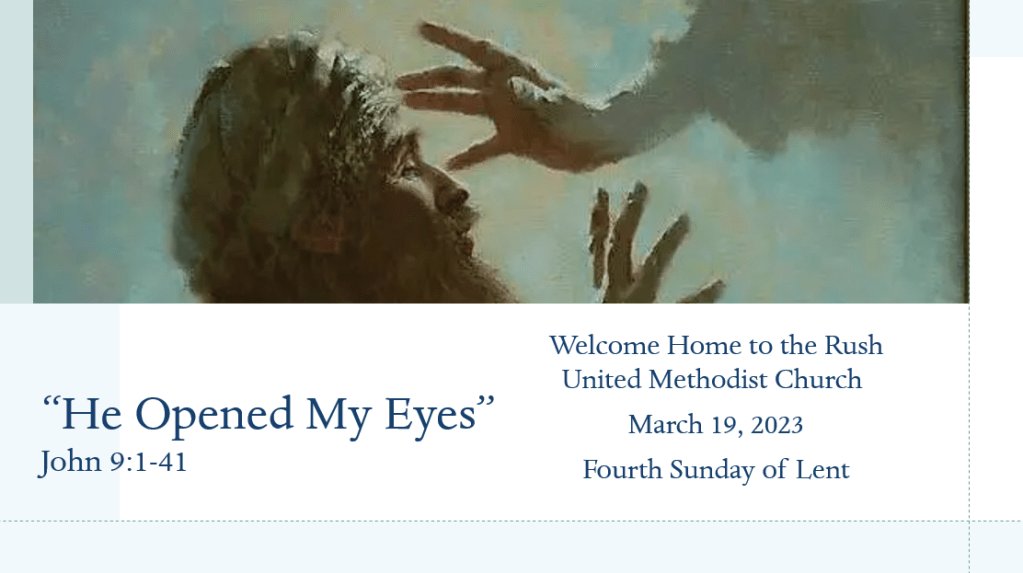
1. Does it matter that that this person was born blind, as opposed to being blinded after birth? Would your opinion be different if you had been born blind?
2. Did the man born blind need fixing?
3. Are trials God’s way to punish us for some unfaithful act we’ve committed?
4. Is blindness literal, or a metaphor for spiritual blindness?
5. What was the purpose of this miracle?
6. Why does John take such effort to report all the details of this miracle?
Just because the Gospel has been my life’s focus, interest, and study doesn’t mean I don’t still have questions.
What questions dare you ask?
…
Let’s first look through a wide aperture,
Take in a wide-angle view of the Gospel.
Today’s gospel slowly
Almost painfully
Unfolds for us
In such a way
That it is a perfect metaphor
For Lent.
Lent begins in darkness;
Total, complete,
Dark-as-dark-as-the-darkest night,
Black-as-the-blackest ink.
The darkness of the wilderness
Is caste by the devil
With temptations
And all that is evil.
For forty days and forty nights
Jesus resists,
And we are given hope
That He just might be the light.
Perhaps the world does not need
To wait in darkness anymore?
Indeed, as Lent unfolds,
Light appears
Slowly, but surely.
And progressively
More and more light creeps in.
The penitent disciple of Christ
Travels the journey
And undergoes an awakening.
Nicodemus sneaks away
Under cover of darkness
To come and inquire of Jesus.
You must be changed
– Born from above –
Jesus teaches him.
For all those who believe in Jesus
Will be saved.
The first sliver of light
breaks into the darkness.
The water at Jacobs well
Is replaced with living water.
He is that living water;
Drink him in
And never thirst for more.
His light is lifted up.
And today,
His light increases in intensity
Such that even those born blind
Still can see.
…
Time to zoom in,
To listen,
To look,
To explore God’s amazing gift of the Gospel of John.
Chapter 9 is not a miracle story,
Although, it begins with a miracle.
This is a story of enlightenment
Coming to a man born blind.
Receiving his vision
Is just the beginning of his
Spiritual awakening
and awareness.
First his neighbors are amazed,
But they don’t know what to do with him.
So they bring him to the authorities;
The religious authorities.
(How’s that for neighbors!)
His sight divides the opposition.
Some noted Jesus didn’t observe the Sabbath.
Others wondered how a sinner could be blessed.
“What do you say about him?”
they asked.
“It was your eyes he opened,”
they accused.
(And we were led to believe
they were the authorities!
If they were the authorities,
Why would they have to ask?)
He said, “He is a prophet.”
Ah! Here we have it:
The second sign of this man’s
Spiritual awakening.
The man born blind,
The one who Jesus gave vision,
For the first time,
Has now moved beyond the literal miracle.
This man makes his first statement of faith:
“He is a prophet!” He witnesses.
“He is a prophet!” (9:17)
He says
To a less than receptive audience.
Conjecture.
Opinion.
Spit balling.
Eliminate all the obvious answers and go with what is left.
Jesus is a prophet.
How’d that go over?
The crowd is
One that will soon join in cries “Crucify Him!”.
The crowd is
One that smells blood in the water.
The crowd is
One that has homicide flowing in their veins.
Witness.
Witness makes
The light shine brighter.
Note to self: witness make the light shine brighter.
Just as Jacob’s well served as
A baptismal font
And Jesus became himself
Living water,
A means of initiation
Into Jesus’ community,
So too has His saliva
Mixed with dirt
Spread on the eyes
And washed in the pool
Known as Siloam …
… this mud
Has become a baptismal rite
of cleansing,
of joining,
and of eternal life.
Unsatisfied,
And still divided,
The religious authorities drag in his parents.
Fearing their own skin,
The parents only report the facts.
They do not draw conclusions.
The authority’s flaw
Was to call this man back a second time.
With a diverse mix
Of sarcasm, logic, law, and lecture
Our healed man,
With a masterful stroke,
Demonstrates the fact that
He now stands in nearly complete illumination.
“Never since the world began”
the new disciple speaks,
“has it been heard
that anyone
opened the eyes of a person born blind.
If this man were not from God,
he could do nothing.” (9:33)
And with that,
They drove him out.
Jesus immediately seeks him out
To bring the circle round full
to a close.
“Do you believe in the Son of Man?”
“Who is he, sir?
Tell me so that I may believe in him.”
“You have seen him,”
and the one speaking with you is he.”
Illumination is complete.
The final sign of his spiritual awakening has taken place,
with his words,
“Lord, I believe.”
“Lord, I believe.”
“And he worshiped him.” (9:38)
As Lent unfolds,
Light appears
Slowly, but surely.
Progressively
More and more light creeps in.
Gathering light is poignant in the northern hemisphere.
Now when Jesus learned that the Pharisees had heard, “Jesus is making and baptizing more disciples than John” —although it was not Jesus himself but his disciples who baptized— he left Judea and started back to Galilee.
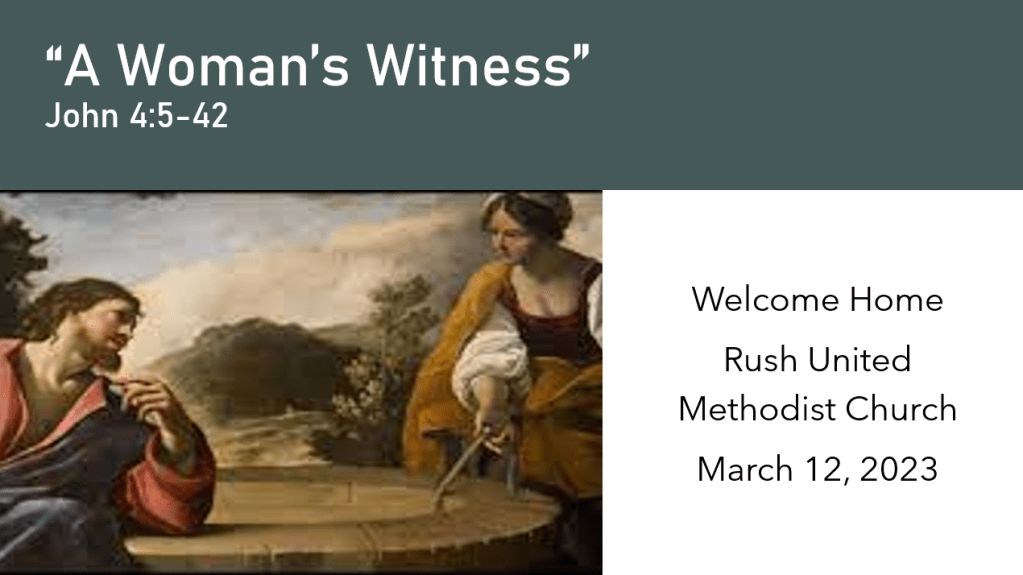
But he had to go through Samaria. So he came to a Samaritan city called Sychar, near the plot of ground that Jacob had given to his son Joseph. Jacob’s well was there, and Jesus, tired out by his journey, was sitting by the well. It was about noon. A Samaritan woman came to draw water, and Jesus said to her, “Give me a drink.” (His disciples had gone to the city to buy food.) The Samaritan woman said to him, “How is it that you, a Jew, ask a drink of me, a woman of Samaria?” (Jews do not share things in common with Samaritans.) Jesus answered her, “If you knew the gift of God, and who it is that is saying to you, ‘Give me a drink,’ you would have asked him, and he would have given you living water.” The woman said to him, “Sir, you have no bucket, and the well is deep. Where do you get that living water? Are you greater than our ancestor Jacob, who gave us the well, and with his sons and his flocks drank from it?” Jesus said to her, “Everyone who drinks of this water will be thirsty again, but those who drink of the water that I will give them will never be thirsty. The water that I will give will become in them a spring of water gushing up to eternal life.” The woman said to him, “Sir, give me this water, so that I may never be thirsty or have to keep coming here to draw water.” Jesus said to her, “Go, call your husband, and come back.” The woman answered him, “I have no husband.” Jesus said to her, “You are right in saying, ‘I have no husband’; for you have had five husbands, and the one you have now is not your husband. What you have said is true!” The woman said to him, “Sir, I see that you are a prophet. Our ancestors worshiped on this mountain, but you say that the place where people must worship is in Jerusalem.” Jesus said to her, “Woman, believe me, the hour is coming when you will worship the Father neither on this mountain nor in Jerusalem. You worship what you do not know; we worship what we know, for salvation is from the Jews. But the hour is coming, and is now here, when the true worshipers will worship the Father in spirit and truth, for the Father seeks such as these to worship him. God is spirit, and those who worship him must worship in spirit and truth.” The woman said to him, “I know that Messiah is coming” (who is called Christ). “When he comes, he will proclaim all things to us.” Jesus said to her, “I am he, the one who is speaking to you.”
Just then his disciples came. They were astonished that he was speaking with a woman, but no one said, “What do you want?” or, “Why are you speaking with her?” Then the woman left her water jar and went back to the city. She said to the people, “Come and see a man who told me everything I have ever done! He cannot be the Messiah, can he?” They left the city and were on their way to him. Meanwhile the disciples were urging him, “Rabbi, eat something.” But he said to them, “I have food to eat that you do not know about.” So the disciples said to one another, “Surely no one has brought him something to eat?” Jesus said to them, “My food is to do the will of him who sent me and to complete his work. Do you not say, ‘Four months more, then comes the harvest’? But I tell you, look around you, and see how the fields are ripe for harvesting. The reaper is already receiving wages and is gathering fruit for eternal life, so that sower and reaper may rejoice together. For here the saying holds true, ‘One sows and another reaps.’ I sent you to reap that for which you did not labor. Others have labored, and you have entered into their labor.” Many Samaritans from that city believed in him because of the woman’s testimony, “He told me everything I have ever done.” So when the Samaritans came to him, they asked him to stay with them; and he stayed there two days. And many more believed because of his word. They said to the woman, “It is no longer because of what you said that we believe, for we have heard for ourselves, and we know that this is truly the Savior of the world.”
| Centering Prayer |
There are times the Gospel lesson
Just shocks me
With a new awareness,
With a new revelation,
With a new way of being presented;
Like sticking a wet finger in a light socket.
What new have we learned from this familiar story from John?
I’ve read and heard many sermons based on the Woman at Jacob’s Well
Where the preacher expounded at length
About this woman
Who came from a morally corrupt background,
Met Jesus at the well,
And had her sins forgiven.
I may have even preached a few of those sermons, myself.
Did anyone here today,
Who just experienced the proclamation of the Word,
Hear a statement proclaiming this woman was a sinner?
Did anyone hear Jesus forgiving her
Her sins?
No!
I challenge the modern assumption that this woman was morally corrupt!
She had been widowed or abandoned
By no fault of her own
By five …
…. Count them …
By five different men.
This woman wasn’t a sinner seeking forgiveness.
This un-named woman was a victim of men who treated her like property.
She was abandoned, isolated, marginalized, dehumanized.
There are times the Gospel
Is electrifying.
So, if this isn’t a narrative about sin and forgiveness,
What is this previously-assumed-to-be-familiar Gospel passage about?
In the preceding chapter of John
We heard last Sunday about Jesus in Jerusalem
Being visited under cover of night by Nicodemus,
A leader of the Jews.
(John 3:1)
Jesus is in the seat of power,
Being visited by the personification of power.
That narrative ends with one of Jesus’ most memorable statements:
“God so loved the world …”
(John 3:16)
Today, Jesus gives us a glimpse of what the rest of the world looks like.
He’s traveled north, into rural Samaria,
Meeting a woman
Who Jewish society treated as property,
As mixed race,
As abandoned, widowed, and marginalized.
She was the personification of one who has no power.
The contrast couldn’t be more profound.
Nicodemus and the power of the Sanhedrin and the power of Rome,
Vs. an unnamed Samaritan woman at a well.
Jacob’s well is significant.
Jacob met Rachael here.
In the days before
Tinder, Match Dot Com, and online dating,
This is where people came together to socialize, network, and, yes, to flirt.
The local water source was where people congregated.
This woman
Who has no name
Was at the well
To not only draw water,
But to find relationship.
She is seeking opportunities to belong.
She is searching for someone or a group of people
That will add value to her lonely, isolated, tragic life.
And it is here,
At Jacob’s well,
That she meets Jesus.
There are times the Gospel
Just shocks us.
In the Gospel of Matthew we have heard Jesus identified
On multiple occasions
As the Son of God.
At his baptism,
At his transfiguration,
We’ve heard the voice of God pronounce,
“This is my Son, the Beloved, with whom I am well pleased.”
There are no such pronouncements in the Gospel of John.
There are, however, famous “I am” statements,
The first of which occurs here:
“The woman said to him, “I know that Messiah is coming” (who is called Christ). “When he comes, he will proclaim all things to us.” Jesus said to her, “I am he, the one who is speaking to you.””
(John 4:25-26)
“I am” harkens back to Hebrew scriptures,
To our Jewish heritage,
To the mountain where God encountered Moses.
“I am who I am” the Lord proclaims.
Since then, “I am” is shorthand for Yahweh,
For the Creator and Lord of all.
John takes “I am” and runs with it:
“I am the Good Shepherd”
“I am the Way, the Truth, and the Life”
“I am the Vine, you are the branches”
Today’s Gospel from John is the first pronouncement of Jesus’ identity.
We not only learn who Jesus is,
Yahweh, the Creator, and Lord of all,
John reveals why Jesus has become God in the flesh.
The one and only time the Gospel of John uses the word “Savior”
Is found right here in verse 42:
The Samaritans … “said to the woman, “It is no longer because of what you said that we believe, for we have heard for ourselves, and we know that this is truly the Savior of the world.””
(John 4:42)
This narrative from the Gospel of John
Is a Rosetta Stone for his theology,
For the belief of the Early Church community
That sprung up around the Apostle John.
John identifies Jesus as God
And reveals his foundational theme
Of why he has come:
Jesus has come to be
The Savior of the world.
Jesus is calling us to a new understanding of “Savior” and “Salvation.”
Salvation is more than salvation from death.
Salvation is more than being saved into than eternal life.
The Savior of the world also brings salvation from isolation and marginalization.
Salvation is also being welcomed into friendships, relationships;
Into community.
God’s power doesn’t come from force or violence,
It comes from love.
God’s love might be academically explained
To people of power,
In positions of power,
In places of power.
But God’s love is experienced,
God’s love is poured out as life-giving living water
To people who have no power
Who exist on the fringes
Who, through no fault of their own,
Are marginalized by the world we live in.
This woman is searching for relationship
And Jesus gives her what she is seeking.
The major criticism of younger adults,
Millennials and GenX-ers,
Is that the Church has lost its relevance;
That we love God,
But that we’ve forgotten to love our neighbors.
“Go to church on Sunday
But forget about Jesus the rest of the week”
Is a biting, but astute, observation of our children and grandchildren.
Why isn’t the Church feeding the hungry,
Instead of writing a check?
Why isn’t the Church building a wheelchair ramp
For a neighbor newly immobilized,
Instead of hosting a Bible Study or gathered for a meeting?
Why isn’t the Church standing up and speaking out
Against racism, homophobia, and antisemitism?
Instead, many see the Church as judgmental, uncaring, and unconcerned.
Jesus goes to this woman and saves her.
Just as Jesus goes,
So too should you,
For you are the Church.
You are given the permission, the authority, the power of the Holy Spirit to go and save the world.
This essential, foundational passage from the Gospel of John
Prods us to go with love,
With God’s love,
And to make healthy relationships,
Founded upon Christ,
the solid rock upon which we stand.
Love others.
Serve others.
Bring the powerless back from the margins
And give them relationship.
Include the last, least, lost, and left behind into the Body of Christ, too.
The concluding point that is important to make
Is to recognize the result of this woman being saved by the Savior:
She runs back to town and tells everyone
“everything I have ever done.”
The Samaritan towns people were so convinced of her witness
They came to Jesus.
They sought Jesus out.
They invited Christ into their lives
And asked him to stay in their homes for two days!
And Jesus did!
“We know this is true!” They in turn witnessed.
Jesus “is truly the Savior of the world.”
This is what the salvation of Jesus Christ does to people’s lives.
Snatching people from loneliness, isolation, powerlessness, and the margins,
Giving and receiving life-giving relationships,
Nurtured by Christ’s living water,
Results in conversion, discipleship, and witness.
Our local church (little c)
And our catholic Church (big C)
Is alive and well today,
In part, because of the salvation of this woman by Jacob’s well,
Her encounter with Jesus,
Her testimony to her fellow Samaritans,
And for her continued testimony
That has trickled down
Generation upon generation thereafter.
Jesus saves.
Because of a woman’s witness,
So, too, dearly beloved, salvation has come to you and me.
Continue the legacy of Christ’s salvation.
Reach out with his love.
Reach out with Christ’s love to the margins.
That’s where the marginalized are found.
Reach out to save another …
And another …
And another …
That, one day, every knee will bow and every tongue will confess
Now there was a Pharisee named Nicodemus, a leader of the Jews. He came to Jesus by night and said to him, “Rabbi, we know that you are a teacher who has come from God; for no one can do these signs that you do apart from the presence of God.” Jesus answered him, “Very truly, I tell you, no one can see the kingdom of God without being born from above.” Nicodemus said to him, “How can anyone be born after having grown old? Can one enter a second time into the mother’s womb and be born?” Jesus answered, “Very truly, I tell you, no one can enter the kingdom of God without being born of water and Spirit. What is born of the flesh is flesh, and what is born of the Spirit is spirit. Do not be astonished that I said to you, ‘You must be born from above.’
The wind blows where it chooses, and you hear the sound of it, but you do not know where it comes from or where it goes. So it is with everyone who is born of the Spirit.” Nicodemus said to him, “How can these things be?” Jesus answered him, “Are you a teacher of Israel, and yet you do not understand these things? “Very truly, I tell you, we speak of what we know and testify to what we have seen; yet you do not receive our testimony. If I have told you about earthly things and you do not believe, how can you believe if I tell you about heavenly things?
No one has ascended into heaven except the one who descended from heaven, the Son of Man. And just as Moses lifted up the serpent in the wilderness, so must the Son of Man be lifted up, that whoever believes in him may have eternal life. “For God so loved the world that he gave his only Son, so that everyone who believes in him may not perish but may have eternal life. “Indeed, God did not send the Son into the world to condemn the world, but in order that the world might be saved through him.
| Centering Prayer |
When my father
Made the decision to
Walk away from his
Well-paying corporate finance job
In 1968,
I was seven years old.
He left to go back to school
And begin serving as a lay preacher in the new United Methodist Church
When he was forty-two years of age.
The world thought he was nuts.
His family did, too.
I remember in the summer of ‘68
Standing before the front doors
Of his first church,
Aptly named “Open Meadows UMC”
Standing by the wrought iron railing
Looking out across the road
And seeing fields of wheat
in three directions.
It was hot.
The wheat was golden brown.
I could see,
And for the first time I could understand,
Even at the young age of seven,
The connection
Between the invisible waves that swept across the fields
And the blowing of the hot, summer wind.
I will never forget that beautiful landscape
Awash in a sea of wind-swept grain.
In the 55 years that have passed
Since that hot summer day
I’ve learned a few things about the wind.
1. We’d like to believe that we can direct the wind.
Yeah. Not so much.
We can’t.
The winds of March prove otherwise!
Trees crack and fall over.
Debris rocket down the road.
Emergency crews cut up ice encrusted limbs fallen across the road
And utility crews work frantically to restore power.
Though our attempt at planting
Snow fences every fall
May go a long way towards safer roads
The occasional drift
Still finds a way
to make the unsuspecting driver
skid into the ditch.
The unanticipated white out
still cause pile ups
In spite of the best engineering
On the planet.
2. We think we are the only ones
who have wind.
We live in such small, self-centered worlds
Rarely leaving town,
Let alone the region, state, or country.
It becomes easy to mistakenly
Believe that all the world
Beyond our horizon
Is the same
And that we don’t need to be concerned with it.
There probably isn’t wind there, anyways,
Because we can’t see or feel it.
New Orleans becomes one and the same as Iraq.
Kenya might just as well as be Ruwanda or Darfur.
What’s the difference anyways?
We ask rhetorically.
They don’t have any stinkin wind;
You and I both know,
The wind only blows in Rush!
3. I’ve noticed that wind can be both good and bad.
Just as the wind can turn a windmill
Pumping water or generating electricity for the public’s good
That very same wind can
Blow the windmill down
Leading to regional flooding and power outages.
The same wind that brings satisfaction
To children flying a kite
Can bring despair and tears
When the kite gets blown into the trees.
The same wind that dries flooded valleys
Whips the Santa Anna up California canyons
driving brush and forest fires that consume farms and family homes.
Wind show no favorites
Makes no distinction between
the righteous and the unrighteous.
The same wind that had given me a pleasurable sail
Also swamped my boat.
…
Allow me to bring these observations
A little closer to home;
To hang some Biblical flesh
On these old bones.
Jesus tells the night stalking Nicodemus,
“The wind blows where it chooses,
and you hear the sound of it,
but you do not know where it comes from or where it goes.
So it is with everyone who is born of the Spirit.”
My personal experience
Confirms the accuracy of Jesus’ observation.
We hear the sound of the Spirit.
We experience the Spirit though our senses.
I feel God’s presence and approval
When making the right choice.
And I certainly have felt
The disapproval of God
When I’ve exercised my freedom
To make the wrong choice,
A choice contrary to God’s will.
As you reflect on your own experience,
Would you agree?
The Spirit does affect our thoughts.
It slips into the prayer life.
The Spirit’s desire slides into our conscience.
And sometimes
the Spirit will even smack us right between the eyes
With a reality check.
Everyone experiences it;
But only the few alerted and primed recognize the Spirit’s presence and guidance
For what it truly is.
We hear the sound of the wind
And we are made aware of its presence.
Less I push Jesus’ metaphor too far,
I believe,
Because it is my experience,
That there may be times in life in which
There is no perception of wind.
It may be blowing elsewhere,
But it doesn’t appear to be blowing here.
The Greek root for Spirit
Is pneuma,
Which literally means “breath.”
One can think of pneumonia
As a disease of breathing,
Or pneumatic tires
As tires inflated with air or breath.
What I believe is Jesus’ intent
Is to say that
Where there is
Air and breath
There is the Spirit of God,
Whether or not we perceive its presence.
Unfortunately, his intent
Is often lost in translation.
But it is vitally important to understanding his word:
The Spirit is omnipresent.
It is never further away
Than your next breath.
The problem often is that
We are memory dependent creatures.
We fail to be faith dependent disciples.
We forget;
Especially when times are affluent and abundant.
Like Israel
We forget how close God truly is;
How intimate God has made his dwelling in us.
We forget
Because we become numb in self-indulgence
To perceive the presence of the ever-present Spirit
Of our Heavenly Father.
…
We don’t know from where the wind comes,
Jesus tells us.
The Spirit is absolutely independent
To make its presence known
Or to remain hidden away
(But ever present).
The Spirit’s presence may be experienced
At any given moment.
This leads us to mistakenly
Believe that we can engage God in a game
Of divine fetch
As if there were no limits
To our petitions and intercessions.
We pray for winning lottery numbers
And when we lose
We whine like spoiled children.
Oh please!
God’s will trumps our will
Ten out of ten times.
When we fail to get our way,
We’ve failed to be obedient disciples.
We have failed to discern or follow
The will of God.
Yes, we are told
To ask
And it will be given.
But where we fail
Is when we are too impatient
to hear the rest of the thought:
We are told to ask
what the will of God is
In each particular setting and circumstance.
This is why
It is easy to mistakenly believe that
God somehow pops into
And out from life,
With seemingly sporadic randomness.
When we ask
“What is God’s will”
we refocus and become aware
of the Spirit already in our midst;
of the Spirit who had never left our side.
We don’t know
Where the Spirit goes.
All the barriers that
We like to place
Somehow get circumvented
By the relentless nature of the Spirit.
Some will be blown over and destroyed.
Barriers are built by humans:
Barriers of class, order, sexuality, gender identity,
religion, faith, values, and belief.
Barriers are created
By the implicit violence
Of assumptions,
Labels of “disabilities” or “retardation,”
Of rich or poor
Or black or white.
Barriers to the Spirit are created
When we choose a broad brush
To paint a world of divinely intentional created individuals.
Three strikes and you’re out
Is a barrier often used
To justify locking someone up
For the rest of their life
Or leading them to the hangman’s gallows.
Yet, we often fail to consider the
Presence and power of the Spirit
Even in the lungs of the condemned.
I have the privilege of experiencing the Spirit’s presence and movement with
Every letter I receive from my incarcerated parishioners.
Consider the issue of homelessness.
Labeling someone as homeless
allows us to inflict the violence of accommodation
because we rarely seek to understand
and correct the underling problems of individuals
that contribute to their homelessness.
…
So, where does this leave us?
What truth
Does this metaphor convey
That builds a foundation for faith?
1. Ultimately, God is in control; not humankind.
Less we throw up our hands
In self-serving fatalism
Consider the four-thousand-year history
Of our awareness of God’s initiative
Into the human condition.
God has taken responsibility for this creation.
God has made every effort to improve
Our circumstance.
We are in the sorry state of affairs
Specifically because we have failed to be
An obedient people,
Both collectively,
And as individuals,
Present company included!
2. God acts and reacts according to God’s motives.
Not ours.
Sometimes we know God’s motives.
Sometimes we think we know God’s motives.
But mostly, we don’t.
We see in a mirror dimly.
God’s greater plan
goes beyond the horizon of our experience and comprehension.
God’s greater plan
Exceeds the limits of our earthly life spans.
God’s greater plan
May, or may not, be synchronized with our plans.
But know this as true,
Based on our scripture, tradition, history, and experience
God’s greater plan
Is always in our self-interest;
It is always for our benefit.
It is always for the good.
God’s greater plan is motivated by love.
3. Finally, I believe we can take away
from this passage for this morning,
especially as we consider it through the lens of Lent,
the fact that the driving nature
behind the passion and death of Jesus
wasn’t driven by human motives,
as we are often tempted to assume.
It wasn’t.
We can’t blame Pilate or Herod or Judas or the Jews
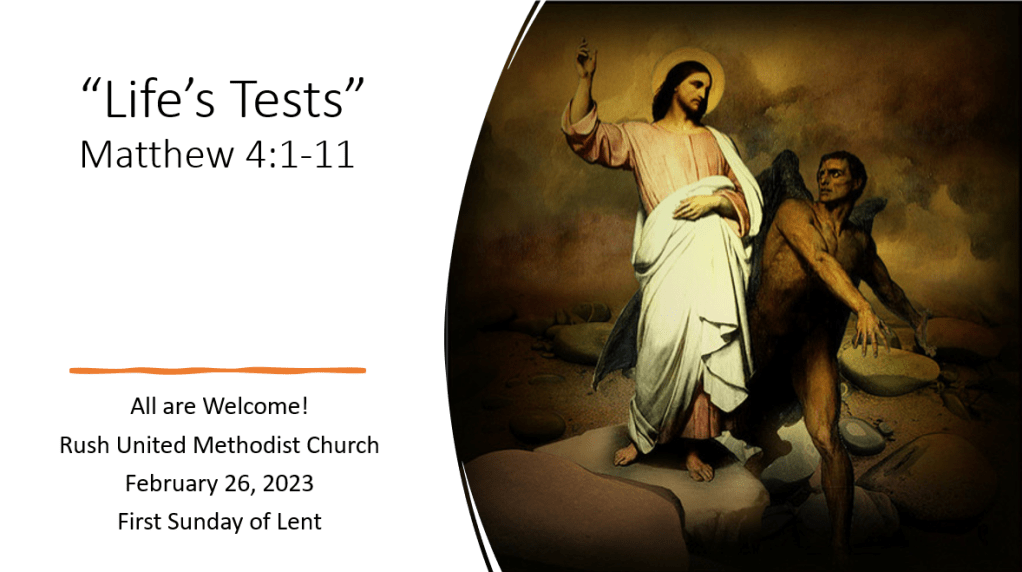
Then Jesus was led up by the Spirit into the wilderness to be tempted by the devil. He fasted forty days and forty nights, and afterwards he was famished. The tempter came and said to him, “If you are the Son of God, command these stones to become loaves of bread.” But he answered, “It is written, ‘One does not live by bread alone, but by every word that comes from the mouth of God.’”
Then the devil took him to the holy city and placed him on the pinnacle of the temple, saying to him, “If you are the Son of God, throw yourself down; for it is written, ‘He will command his angels concerning you,’ and ‘On their hands they will bear you up, so that you will not dash your foot against a stone.’” Jesus said to him, “Again it is written, ‘Do not put the Lord your God to the test.’”
Again, the devil took him to a very high mountain and showed him all the kingdoms of the world and their splendor; and he said to him, “All these I will give you, if you will fall down and worship me.” Jesus said to him, “Away with you, Satan! for it is written, ‘Worship the Lord your God, and serve only him.’”
Then the devil left him, and suddenly angels came and waited on him.
| Centering Prayer |
Imagine a time and a place far beyond here and now.
Imagine you and I are living in Seville, Spain.
Imagine we are living amid the Spanish Inquisition.
Now, imagine Jesus returned.
Jesus heals.
He performs miracles.
The people recognize and adore Jesus …
Which draws the attention of the Church and its’ inquisitors.
Imagine Jesus being arrested.
Jesus is tried and sentenced inside an hour
To be burned to death tomorrow morning.
Into our Lord’s cell
Steps the Grand Inquisitor.
Imagine the pregnancy of this moment.
The Grand Inquisitor informs Jesus
That the Church no longer needs him.
In fact, the return of Jesus would do nothing more than
Interfere with the mission of the Church.
Citing our Lord’s decisions not to capitulate to the Devil’s temptations in the wilderness,
The Grand Inquisitor tells Jesus that
While he is capable of wielding the freedom of choice wisely,
The people cannot.
The masses cannot be trusted with freedom.
This is why we have the Church,
The Grand Inquisitor informs Jesus,
For the Church is an institution where
Only a few are strong enough to
Bear the burden of freedom.
Let humankind live and die happy in ignorance.
…
Imagine the Grand Inquisitor telling Jesus that he was wrong
To reject each temptation by Satan.
Turn the stones to bread,
As men always follow those who feed their bellies.
Cast yourself down from the temple and be caught by your angels.
That would cement your divinity in the minds of people
And they would follow you forever.
Take control over every kingdom of the Earth
And the salvation of all people would be ensured for eternity.
Jesus, you were so, so wrong, the Inquisitor scorns.
Imagine, for a moment, the silence that follows.
Instead of answering,
Imagine Jesus rising,
Stepping forward, and
Kissing the Grand Inquisitor.
The cell door opens
Imagine Jesus walking away.
This scene I’ve asked you to imagine
Is the Cliff notes version of the Russian poem
Titled “The Grand Inquisitor”
By Fyodor Dostoyevsky,
As found in his novel, “The Brothers Karamazov.”
…
When we experience Jesus being tempted in the wilderness
The first Sunday of each-and-every Lent,
We tend to romanticize our Lord’s experience.
Experiencing “The Grand Inquisitor” strips us of all romanticism.
We are denuded of all allusions that
Jesus’s temptation in the wilderness by the Devil
Was a one-and-done item to be checked off
From his list of earthly accomplishments
That needed completed before his Passion and Death.
Forty days and forty nights in the Judean wilderness
Isn’t some sort of naked and afraid reality television show
Where Jesus is competing for daily immunity
Or facing nightly elimination.
Jesus is confronting issues of power and presumption;
Temptations you and I routinely fail.
The experience of Israel wondering in the wilderness
For forty years was a time of testing,
A humbling time for the people Israel,
allowing hunger
To teach them t
hat one does not live
by bread alone.
(Thanks to Preaching the New Common Lectionary, Craddock, Hayes, Holladay, and Tucker, 1986)
…
Likewise, Jesus is fasting
And being tested.
Jesus is fasting.
How has your Lenten fast been going?
Oh, you’ve failed already?
Good for you
You’re in good company.
I’m right there with you.
I attempted to fast from anger.
I, too, have already failed.
Turn to your left and right.
They’ve already failed, too.
We’ve all failed
And taken a bite of the Grand Inquisitor’s bread.
Unlike you and me,
Temptation is not some minor morality challenge.
Temptation for Jesus is a high stakes game of life or death.
Temptation is a testimony to his strength.
The greater the strength, the greater the temptation.
Temptation for Jesus
Is between our God of absolute,
Cosmically creative power,
To which all other gods are subordinate,
And the Devil personified himself.
The Devil is unable to even hold a candle
To Jesus Christ,
The Light of the World.
Great temptations are a sign of great power;
Powers and presumptions that must be addressed
In Christ’s Passion journey to the cross.
How does Jesus speak truth to power?
How does he respond to the Devil
Who “took him to a very high mountain
and showed him
all the kingdoms of the world and their splendor”?
– Matthew 4:8
How does Jesus answer the charges of the Council,
The accusations of the high priest, all the chief priests, the elders and the scribes?
– Matthew 14:53
How does Jesus answer Pontius Pilot who asks him
“Are you the King of the Jews?”
– Matthew 15:2
To the Grand Inquisitor,
Jesus responds with a kiss.
To Pilate, Jesus’ silence is deafening.
All of which begs us to ask,
What is our relationship with power?
How do you and I speak truth to power?
And, what does this say about our faith and belief?
…
Faith is something more than
Believing the right things,
Reciting the approved creeds,
Or falling in line with official Church teaching.
Faith is more than believing in an unseen God.
The temptations of Jesus in the wilderness
Leads us to view a life of faith
From an entirely different point of view.
Like Jesus
Lead with your strengths.
Your strength is your time.
Prioritize your time and make God your highest priority.
Now when Jesus heard that John had been arrested, he withdrew to Galilee. He left Nazareth and made his home in Capernaum by the sea, in the territory of Zebulun and Naphtali, so that what had been spoken through the prophet Isaiah might be fulfilled: “Land of Zebulun, land of Naphtali, on the road by the sea, across the Jordan, Galilee of the Gentiles— the people who sat in darkness have seen a great light, and for those who sat in the region and shadow of death light has dawned.” From that time Jesus began to proclaim, “Repent, for the kingdom of heaven has come near.”
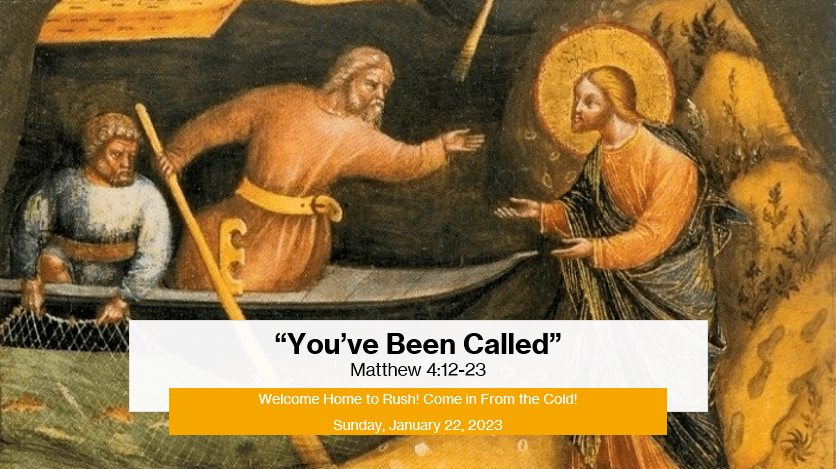
As he walked by the Sea of Galilee, he saw two brothers, Simon, who is called Peter, and Andrew his brother, casting a net into the sea—for they were fishermen. And he said to them, “Follow me, and I will make you fish for people.” Immediately they left their nets and followed him. As he went from there, he saw two other brothers, James son of Zebedee and his brother John, in the boat with their father Zebedee, mending their nets, and he called them. Immediately they left the boat and their father, and followed him.
Jesus went throughout Galilee, teaching in their synagogues and proclaiming the good news of the kingdom and curing every disease and every sickness among the people.
| Centering Prayer |
One of the many roles of being a pastor
Is to be an educator.
I’m always searching for new techniques
To help people study, think critically, and engage others
In Biblical, Theological, and Spiritual development.
I’m on the prowl for that new tool for your toolbox;
That educational wrench that assists you
To unlock understanding
Of scripture, commentary, or academic discourse.
The more you and I can learn about our God and sacred texts,
The closer we are drawn in
With God and one another
And the better we understand God’s will for our lives.
One tool for scriptural interpretation is pretty neat:
Read the text,
Go back to the section title
And cross it out.
What would you rename the section, and why?
Today’s two section titles in the New Revised Standard Version are
“Jesus Begins His Ministry in Galilee” and
“Jesus Call the First Disciples”.
Hum.
The first section I would rename
“Those Who Sat in Darkness Have Seen a Great Light”.
The second section I would title
“Building the Fellowship”.
What would you call these two narratives from our Gospel?
…
Jesus had most recently spent the past 40 days and nights
In the Judean wilderness being tempted by the Devil.
He was in the rugged, wild, mountainous territory
East of Jerusalem,
Between Jerusalem and Jericho,
Deep in the lower Jordan Valley,
In the vicinity of where John had been preaching and baptizing.
We begin on an ominous note;
On Herod’s command, John is arrested,
And Jesus, hearing the news,
Retreats 90 miles North to Galilee.
Yes, Jesus begins his public ministry in retreat,
Immediately following his baptism and temptation in the wilderness.
This is important to know:
Where Jesus starts his ministry is vitally important
To understand the deeper meaning of the text here in Matthew.
Jesus left Nazareth where he had been raised as a child …
… he moves out of his parents basement, if you will …
And moves to Capernaum, 30 miles away,
Located on the North shore of the Sea of Galilee,
In the tribal territory of Zebulun and Naphtali.
Remember the 12 tribes of Israel?
Isaiah had prophesized about Zebulun and Naphtali,
And Matthew repeats it here:
“the people who sat in darkness have seen a great light,
and for those who sat in the region and shadow of death light has dawned.”
(Isaiah 9:2, Matthew 4)
In our age
where we don’t think twice about summoning light
… we flick a switch or tap our phone …
It makes one wonder why
Zebulun and Naphtali sat in great darkness.
For crying out loud,
Someone flip a switch,
Download a flashlight app,
Light a candle, or something!
Indeed the darkness was all encompassing and complete.
The people of this region
Had become victims of repeated invasions and defeat
At the hand of foreigners.
Violence, death, prison, and exile had visited every home.
Geographically at the crossroads of three continents,
Babylon was the aggressor and occupier in the time of Isaiah.
Prior to Isaiah,
Zebulun and Naphtali
Had been conquered by the Philistines,
The Egyptians, and Canaanites.
The peaceful kingdom of David,
Lasted only for a period of about 70 years
… a thousand years before Jesus.
The Davidic kingdom was the only respite,
The only light,
The people of Zebulun and Naphtali had experienced.
That light was a momentary flash.
Pharaoh and his Egyptians flowed back in a violent expansion of their empire.
In time, the Assyrians swept through the land
And ruled with an iron fist.
The Babylonians occupied the land
Until Cyrus the Great of Persia took control
And allowed exiles to return home.
In generations prior to Jesus
Alexander the Great and the Greeks,
Ptolemy and the Seleucid (pronounced Se-leu-cid) dynasties
Traded punches and rolled through
With military might and horrific violence.
Most recently, is was Rome,
At the hand of Pompey the Great,
Who had brought darkness once again to Zebulun and Naphtali.
Up to the time of Jesus making his home in Capernaum,
There was only a thousand-year-old faded memory of
A brief flash of light
In a land of utter and complete darkness.
Jesus moves to Capernaum
And a new light dawns.
That’s kind of how it works with Jesus.
Let him move in.
His light shines,
And darkness is no more.
Which is not to say darkness, sin, suffering, and death
Are forever vanquished from your present or future.
The darkness of this world
And the darkness of Satan
Are like predators lying in wait, ready to pounce
At the first sign of personal weakness,
At the first symptom of waning faith,
At the first inclination of growing distance between yourself and God.
Make room in your life for Jesus
And allow yourself to fall in love with him.
That’s what vanquishes darkness.
That’s what grows deep our reservoir of faith.
That’s what gives you and me strength for the journey.
…
As I mentioned,
I’d title the second section of our Gospel
“Building the Fellowship.”
I refer to the disciples of Jesus as a fellowship
With a tip of my hat to one of my favorite fictional trilogies,
“The Lord of the Rings,” by J.R.R. Tolkien.
I swear, “The Lord of the Rings” got me through puberty.
The first of three books is dedicated to building a fellowship
Of individual, diverse characters
Dedicated to the purpose of saving the world.
Hum.
Kind of sounds like what Jesus was doing, doesn’t it?
Building a fellowship of individual, diverse characters
For the purpose of saving the world.
Our Gospel narrative from Matthew
Describes the calling of two brothers,
Both fishermen on the Sea of Galilee,
Peter and Andrew.
Jesus went from there and called
A second set of brothers,
James and John, sons of Zebedee.
The two brothers and their father
Are in a boat mending their nets.
Jesus calls together his fellowship of fishing brothers
With the invitation,
“Follow me, and I will make you fish for people.”
– Matthew 4:19
The word “immediately” is used in the case of both invitations.
Immediately they left their nets …
Immediately they left their boat and their father …
… and they immediately followed him.
Quick. Clean. Decisive.
That’s the way I like to do my shopping.
“Get your stuff and get out.”
Much can be speculated about what caused
Peter and Andrew,
James and John,
To make such an immediate
Life changing decision to follow Jesus.
Was it the invitation to fish for people?
Perhaps we could stop people on the street
And invite them to join us in fishing for people.
If it worked for Jesus, maybe it will work for us, too?
If this were true, our church would be packed every Sunday
And we’d be preparing for a building addition.
Was it the way Jesus looked? Or how he approached them?
Perhaps each of these four brothers
Had been asking themselves the deeper questions in life.
Perhaps they had been searching for answers.
Maybe they had been looking for direction.
I mean, fishing, day in and day out,
Under a hot sun or in a tempus storm,
Kind of gets old after a while.
While feast may be the up-cycle,
Famine was certain to visit every fisherman on occasion.
We might never know
What caused Peter and Andrew, James and John,
To drop everything and to accept the call.
Perhaps a different tack
Might shed light on the question:
What is it about Jesus that drew YOU to him?
Perhaps it was the witness of another?
Or a similar invitation to follow him and fish for people?
Maybe you, like me, are filled with deeper questions
About life, death, suffering, love, sin, evil, and God.
Perhaps Jesus rose to the top of your vat of questions
And provides the only reasonable answer that resonates with you.
I’d suggest two other possible answers why you and I have decided to follow Jesus.
1. First, we have a natural need for a divine companion.
I can’t tell you why,
Nor can I back up my opinion with data,
But it is my observation
That few of us want to go through life alone.
Others might provide friendship,
But only God incarnate is capable of providing
The necessary presence, power, and direction
That will take us through this life
And into the next.
2. Secondly, I suggest you and I have decided to follow Jesus
Because this is God’s will for our lives.
As one standing in the Wesleyan tradition, known as a Methodist,
I would call this Prevenient Grace.
God knows our need before our awareness.
God meets our needs prior to our needs being made known.
In other words,
Perhaps it is God that brought you along the path that led you to Jesus Christ
Because God knew you needed Jesus.
You and I need Jesus
To be the center and joy of our lives.
The invitation to join the Fellowship of Jesus
May have been the whisper that
Resulted in you coming to your baptismal waters.
There is one, last, thought I’ve been chewing on this past week
About this passage I’d title “Building the Fellowship.”
Many times we focus on the question,
What did Peter, Andrew, James, and John see in Jesus
That led them to abandon their lives and to follow him?
Turn the question around, and let’s ask,
What did Jesus see?
What was it that Jesus saw in these two sets of brothers
That led Jesus to believe
That these were the ones
He needed to build his fellowship?
… to build his church?
It’s pretty obvious
Jesus didn’t start building his fellowship
With the same strategy
A new president would use to build a cabinet of ministers, advisors, or confidants.
Jesus didn’t go directly to the smartest, most powerful, elites of his world.
Jesus didn’t go to influencers, politicians, or the wealthy.
Jesus bypassed the seminaries and graduate schools,
Temples and thrones,
The marketplace, industry, and every other institution of power.
To start building his fellowship
Jesus chose to go
With simple fishermen.
Did Jesus see within Peter
His characteristic of opening-mouth-and-insert-foot
As a beneficial character trait
That he needed for his group of disciples?
Maybe he saw within Peter
The potential for becoming
An effective preacher, witness, and leader
In the first-generation church?
Perhaps Jesus knew that the genesis of his church
Needed to expand into modern day
Turkey, the Balkans, Poland, Ukraine, and Russia?
… and Andrew was just the right person to do it?
Quite possibly Jesus had the foresight to know
That James was the one he wanted
To bear witness to his Transfiguration?
Maybe Jesus considered all the rest
But decided that only James could bear the burden
Of being the first to be martyred for his faith?
Maybe Jesus looked upon John,
Loved him,
And knew that he would be the one
He could count on to comfort his mother
As she witnessed his crucifixion?
In a similar way,
I’d suggest our Gospel asks us today
“What is it about YOU
That inspired Jesus to call YOU to join his fellowship?”
Is it your willingness to witness?
To invite?
To march?
To demonstrate?
Is it your willingness to preach?
To open prison doors?
To collect and distribute food to the hungry?
To make friends and build houses for people without four walls and a roof?
Is it your capacity to love, and to be loved?
To get on the floor with a toddler
And play and laugh with joyful abandon?
What is it about YOU
That led Jesus to claim YOU
As his own?
Dearly beloved,
Invite Jesus into your life,
To make his home in your heart.
Let the light of Christ shine
And chase away all darkness in your life.
Look to Christ.
Listen to his call.
Respond with confidence and determination.
Take part in this fellowship Christ has called together
In the beginning was the Word, and the Word was with God, and the Word was God. He was in the beginning with God. All things came into being through him, and without him not one thing came into being. What has come into being in him was life, and the life was the light of all people.
The light shines in the darkness, and the darkness did not overcome it. There was a man sent from God, whose name was John. He came as a witness to testify to the light, so that all might believe through him. He himself was not the light, but he came to testify to the light. The true light, which enlightens everyone, was coming into the world. He was in the world, and the world came into being through him; yet the world did not know him. He came to what was his own, and his own people did not accept him. But to all who received him, who believed in his name, he gave power to become children of God, who were born, not of blood or of the will of the flesh or of the will of man, but of God. And the Word became flesh and lived among us, and we have seen his glory, the glory as of a father’s only son, full of grace and truth.
(John testified to him and cried out, “This was he of whom I said, ‘He who comes after me ranks ahead of me because he was before me.’”) From his fullness we have all received, grace upon grace. The law indeed was given through Moses; grace and truth came through Jesus Christ. No one has ever seen God. It is God the only Son, who is close to the Father’s heart, who has made him known.
| Centering Prayer |
“In the beginning was the Word.”
The great philosopher John Locke observed
that words are “the sensible marks of ideas.”
In today’s gospel we learn that God has a new idea;
Indeed, God has a history of developing new ideas.
If God has a signature line, it would be
“I have a new idea!”
Experiencing our gospel fresh
Makes us think back to the original idea
From the words,
“In the beginning…”
Our gospel author intentionally calls to mind
The idea of Genesis;
That God was, and is, and will forever be
a God of creation.
Creation is God’s idea.
It is more than a plan.
It is God’s way of doing business;
An essential core of God’s divine nature.
God transformed an idea into action
And six days later the world as we know it
Was birthed and brought into being.
Our gospel author known as John
Tells us that God’s creation was fully God’s own.
God was, and is, responsible for every atom,
And all the space in-between,
in the cosmos.
Our divine Creator has a hand in
– Nature: earth, fire, air, and water
– Life: plants, animals, and humans
– Being: personality, conscience, and soul.
Being a God of new ideas,
Of always being in the business of creating,
Means that God is never stuck in the past,
Content to be a prisoner to what was,
what has been,
or how it was always done before.
And neither should we.
John paints a portrait of a forward leaning God,
Always on the cutting edge
Of transforming today’s dreams and ideas
into tomorrow’s reality.
It was, and is, an evolutionary leap forward
From just creating things
To creating life.
Yes, God evolved.
The idea that carbon-based cells
Can be filled with divine breath
And spring to life is simply astonishing.
God brought together physics and chemistry to create biology;
That the Holy Spirit might breath life into the world.
God has an intimate hand in the creation of each and every life,
– From seed to sperm,
from egg to mitosis,
from blood to every beating heart –
God has, and continues to be,
the one and only source of life.
Left to its own ends,
Life is pretty chaotic, unorganized, and ultimately meaningless.
Life without direction becomes self-centered, self-serving, and self-absorbed.
We live, we work, we procreate, we die.
We create artificial means to gauge success, such as money, property, or things.
But, at the end of the day,
life ends,
the body returns to ashes,
and everything we’ve accumulated is redistributed to the next generation.
Even God is able to see the futility of life lived inside a spinning wheel.
God’s new idea was to call, to covenant, to command, and to provide directive council.
It wasn’t enough to set the world into motion
Only to step back and watch the chaos begin.
God jumped in, made covenant with our father, Abraham,
To forever be our God, and we, God’s people.
God sent Moses,
Gave us Law, a framework for living together in peace, justice, and faithfulness.
Righteousness became our new salvation;
Life lived in complete harmony with our creator.
The Lord gave us direction,
Speaking through the voice of chosen prophets,
in an effort to reveal God’s divine will.
Judgment was quick, but just and fair.
One would think this would be a great plan;
An idea so good it would be
The last idea God would ever have to implement.
Yet, from the beginning,
From the very start,
When humans received the gift of personal will and free choice,
It is as if we’ve been in an eternal struggle with the very one who has given us life.
We are tempted to sin,
drawn to the darkness,
insistent on exercising our will.
We’ve never been able to let it go,
Let it be,
Or to just let God.
What was needed was a new idea.
Life by itself wasn’t sustainable.
God’s new creation,
Reported by John,
Is light, the light of all people.
God’s new idea,
Was to bridge the chasm between heaven and earth,
Directly enter this world through Mary’s womb,
And to become the guiding light;
that will overcome the darkness,
that will save all people.
“And the Word became flesh and lived among us.”
God’s new idea was to send us his son, Jesus.
The Word of God
Became the Flesh of God.
Instead of speaking through others,
God came, was born Jesus, and did the talking himself.
More than just talking, Jesus did the dying and the resurrecting, too!
In doing so,
Life took on new meaning.
Life became fulfilling.
Life took on a new purpose.
No longer are we simply meant to live, to breed, and to die.
We are meant to love, and to be loved
– to love our God, to love our neighbors, to love our enemies.
We are meant to forgive, and be forgiven
– to make things right with those we have crossed, to make things right with our God.
We are meant to save and to be saved
– to live forever redeemed, restored, and perfected eternally giving glory to God.
Moses brought the Law.
Jesus brings grace;
Not a free pass, mind you;
Healing and restoration for all those we have broken
If only we ask for forgiveness
and desire to not sin again.
The light of Jesus reveals truth wherever it shines.
Secrets are no more.
Nothing can hide,
For darkness is no more.
The last vestiges of temptation and sin are conquered.
All is revealed to God
Who stands as our eternal arbitrator.
Grace and truth defines Jesus Christ
Just as creation is the signature of God.
Where does this leave us today?
2023, merely a week away, will be a new year,
filled with new opportunities,
yet, filled with the same old temptations.
The Word didn’t become flesh for us to continue to live in 2022,
1990, or 1965, for that matter.
God’s new idea is made into flesh
To bring love to the new year,
To spread forgiveness of sins and proclaim pardon in 2023,
To be God’s grace revealing God’s eternal saving truth in 2023.
Take a look at the people around you.
They may appear to be the same old family members and friends.
But each is filled with God’s new creation, new ideas, new possibilities for the New Year.
Ask yourself, “how is Christ working though you to bring love, redemption and salvation into the world?”
God is not only creating something new within you,
But something new within each and every one of us.
Take a look at this bread and this wine we are about to consume.
It may appear to be the same old communion served the same old way.
But in this bread and in this wine
– in this body and blood of Christ –
is grace
is the illuminating truth
that will not only sustain you,
but will continue to light your way today, tomorrow, and for the rest of your life.