“Preparing a Way”

Romans 15:4-13 and Matthew 3:1-12

8 December 2019

The Rev. Todd R. Goddard, Pastor

Rush United Methodist Church


Matthew 3:1-12


In those days John the Baptist appeared in the wilderness of Judea, proclaiming, “Repent, for the kingdom of heaven has come near.” This is the one of whom the prophet Isaiah spoke when he said, “The voice of one crying out in the wilderness: ‘Prepare the way of the Lord, make his paths straight.’” Now John wore clothing of camel’s hair with a leather belt around his waist, and his food was locusts and wild honey. Then the people of Jerusalem and all Judea were going out to him, and all the region along the Jordan, and they were baptized by him in the river Jordan, confessing their sins.


But when he saw many Pharisees and Sadducees coming for baptism, he said to them, “You brood of vipers! Who warned you to flee from the wrath to come? Bear fruit worthy of repentance. Do not presume to say to yourselves, ‘We have Abraham as our ancestor’; for I tell you, God is able from these stones to raise up children to Abraham. Even now the ax is lying at the root of the trees; every tree therefore that does not bear good fruit is cut down and thrown into the fire. “I baptize you with water for repentance, but one who is more powerful than I is coming after me; I am not worthy to carry his sandals. He will baptize you with the Holy Spirit and fire. His winnowing fork is in his hand, and he will clear his threshing floor and will gather his wheat into the granary; but the chaff he will burn with unquenchable fire.”


Prayer.


Advent’s Gospel passages,

Both last Sunday and today,

Has led me to think deeply,

To ponder this question:

With Christ’s promised return

What needs to be done to prepare a way forward?


In other words,

What do I need to do as an individual,

And what do we need to do collectively as a Church,

To prepare a way forward

In our life

And in our world?

How do we prepare the way for the Lord?


John the Baptist had a vision for a way forward.

How do you draw a crowd in the middle of nowhere?

– If you’re looking for hunters, put out a deer lick.

– If you’re looking for protesters, put in a pipeline.

– If you’re looking for people to build God’s kingdom,

Call the world to confession and repentance.

Then warn them of the judgment that is to come.


Confession, repentance, and judgment.

Yeah, good times.


That might preach in the Bible belt,

But not so much in suburban Rochester.


Who doesn’t want to confess our personal failures, faults, and sins?

For those who don’t want to see or listen,

Who want to go through life in denial,

Confession may be equated with

Scrapping an open wound with a rusty razor blade.


But for the rest of us,

Take a look around.

The world is on fire

And many delight

In its incineration.


Look and see what is being done to the land and to our neighbors.

Listen to cries of those wrongly persecuted,

Violently accused,

Or simply, those unable to defend or care for themselves.

Is this a world we’re happy with?


I’m not happy with myself when I

Make generalized assumptions for the many

Based on the sinful behavior of a few.


I’m not happy with myself standing silently by,

Watching land being stolen, swindled,  or misused for profit or gain.


I’m tired of seeing justice purchased by those who can afford it,

Not by those who deserve it.


We have neighbors around the world fleeing war.

Others are fleeing narco-terrorism and cartels.

While we relax at home bingeing on Disney Plus and Netflix.


Hasn’t our individual and collective sin,

Both intentional and unintentional,

Commission and omission,

Caused enough pain and suffering?


It may not be easy or simple,

It may not be painless or without effort,


But the only path forward,

To prepare the way for the Lord’s coming,

Is the pathway that leads us through the valley of confession.


Confession is a dark valley

Where few willingly enter.

The pain is real, but the rewards are great.


Repentance clears the path through this valley.

Repentance clears all the rubble and destruction blocking our forward progress.

Repentance brings low the mighty

And lifts up the lowly.

Repentance crosses previously unpassable ravines,

Broken relationships, and festering wounds.

Repentance paves a highway for our God.


The rewards of confession and repentance

Is a life lived with Christ and in Christ,

Spirit filled,

Driving with power and authority the completion of the kingdom of God.


John the Baptist plunged the newly confessed

Under Jordan’s icy waters,

With a baptism of repentance,

Lifting them up,

Sending forth each newly baptized individual in a new direction,

Giving each a new vision

For preparing the way

And building God’s kingdom.


Confession identifies the way forward.

Repentance clears the way forward.

But what keeps us making forward progress?


A quick read of our Gospel

Might lead us to belief that fear of judgment is the answer.

If you and I fear the Lord’s judgment enough,

Then that fear will keep us from straying, erring, and sinning.

To which I ask:

How’s that working for you?


Fear is a terrible motivator.

Empty cathedrals in Europe stand

In silent witness to the truth that

Fear is a terrible motivator.


It hasn’t worked for the Church.

Fear doesn’t work for nations or states, either.

We should be on guard

To never wield the threat of fear

On behalf of the moral high ground,

Divine righteousness,

Or in the name of God.


The thorough read of the Gospel

Identifies the nature and purpose of fear.

Pharisees and Sadducees had come from Jerusalem

To be baptized by John.


They were undercover spies for the religious establishment;

Decision makers of the Temple.

Their role and purpose was to protect organized Judaism at all costs.

Their role was not serving the Lord or His people.

Their role was self-perseveration.


If organized religion has become poisoned, pathological,

And is engaged in pacifying the populous

Wielding the bully club of fear,

It is time for those responsible in Church leadership

To be separated from the wheat

And burned in unquenchable fire.


Yes. You heard me right.


Christ is coming to bring judgment

Upon those who use fear as a motivator for self-preservation,

For building up personal wealth,

For enlarging their kingdom of power.

That judgment is devastating

And it is permanent.


Instead

Work for Christ.

Live for Christ.

That’s how to avoid fear of the threshing floor.


The Gospel of Matthew

And the actions of John the Baptist

Point us in the direction of a way forward.


But what does it actually mean

To make progress

In preparing the world

For Christ to come?


The Apostle Paul provides some amazing insight

In the fifteenth chapter of his letter to the Church in Rome.


Paul’s landscape of faith was as divided in his day

As today’s American political landscape.

Paul’s religious reality was as divided in his day

As the Church is divided in our world today.

Paul was facing an uphill battle against those

Who had been Jews

But were now converted, baptized disciples of Jesus.

They claimed an exclusive inside-track to Christian perfection

Simply because they were children of Abraham,

Chosen by God.


Yet, God had called Paul to fish other seas,

To cast his net of discipleship to the Gentiles of the world,

Who lived beyond the horizon,

Especially to those who had no Jewish background.

It was, and is, God’s desire to be inclusive of all people,

To welcome everyone to Jesus’ feet

And everyone to feast at His table.


“God so loved the world …”

(John 3:16)


Preparing the way for the Lord to come

Means that


every disciple of Christ has an obligation

To live a life of radical, inclusive, authentic hospitality

For the complete transformation of the world.


Welcome the stranger,

even if they are immigrating from a foreign land.

Extend hospitality to the sojourner who is just passing through.

Give abundant encouragement,

A hand out and a hand up,

To those who are following behind in their journey of faith,

Just as others had done for us.

Welcome every person,

Regardless of history, record, or reputation.

Welcome everyone as a child of God and

As a person of worth.

Welcome all for the glory of God.


Welcoming everyone is harder than it sounds.

We naturally like to surround ourselves with those

Who think like us, act like us, look like us, and share the same values as we do.


Welcoming all requires us to expand our world view,

To expand our cultural boundaries,

To learn and listen to the needs of others.

Just as the Apostle Paul set out across the known world

So too should we.


Welcoming is an attitude that can begin anywhere.

One does not need to travel far to be a welcoming friend.

Welcoming is an intentional effort to expand our experience and world view;

To serve a meal at the soup kitchen,

To attend a Christmas party

at a local day program or supervised apartment complex,

To deliver meals on wheels

Or ring a bell.


Include everyone God sends our way

Into a circle of fellowship and friends

With the warmth of God’s love.


Welcoming often leads one further afield,

To cast off from the lakeshore,

To search other seas.

Like the Apostle Paul,

Welcoming one in the name of Jesus Christ

Prepares the way for Christ to return,

Not only here in Rush,

But also in Rome, New York and

Tecpan, Guatemala.


Traveling to Israel next month

Is not only a pilgrimage to the land of our faith,

But also an opportunity to extend welcome and friendship

In the name of Jesus Christ

With everyone we meet,

With everyone God sends our way.


Authentic, welcoming hospitality,

Making friends in the name of Jesus,

Leads to harmony.

If ever our divided world needed harmony,

It is today.


Our God of steadfastness and encouragement

Wants us to live in harmony with one another,

“in accordance with Christ Jesus,

so that together

you may with one voice

glorify the God and Father of our Lord Jesus Christ.”

– Romans 15:5-6


Harmony is the means to a Divine purpose …

To glorify God.

Regardless of your depth of faith or mine,

Living in harmony, glorifying God,

Is a whole lot better than

Living as adversaries,

Divided and at each other’s throats.


In an environment of hospitality and harmony,

Hope is possible.

Hope is probable.

Hope is certain to take root and grow

Until Christmas morning

When the hope of the world blossoms and blooms;

Becomes man,

One of us,

God in Christ

Born a child

Given to us as a gift

To save you and me

And to save our world.

12

Prepare the way,

O people of Israel!

Prepare the way,

Disciples of Christ.

Make your confessions.

Turn back from your former sinful ways.


Welcome with Christian love the stranger, the sojourner, the visitor.

Extend radical hospitality to acquaintances

And welcome them as friends.

This is how hope is created.

This is how harmony leads to peace and

justice spreads across the land.


This is how the preparation of Advent

Leads to the return of Christ,

All for the glory of God.

Prepare the way!

Prepare the way for the Lord!

Amen.
“History, Mystery, Majesty”

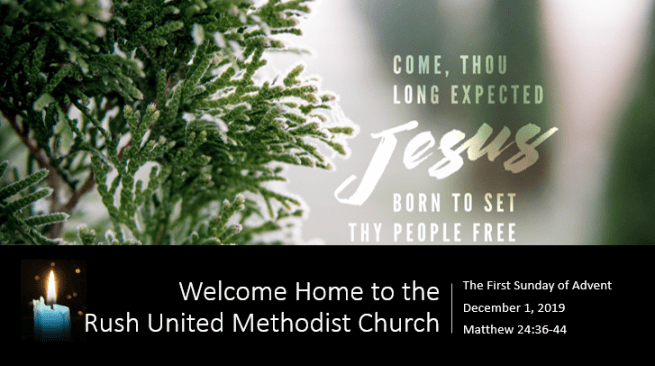
Matthew 24:36-44

December 1, 2019 – Advent 1, Year A

The Rev. Todd R. Goddard, Pastor

Rush United Methodist Church


Matthew 24:36-44


“But about that day and hour no one knows, neither the angels of heaven, nor the Son, but only the Father. For as the days of Noah were, so will be the coming of the Son of Man. For as in those days before the flood they were eating and drinking, marrying and giving in marriage, until the day Noah entered the ark, and they knew nothing until the flood came and swept them all away, so too will be the coming of the Son of Man. Then two will be in the field; one will be taken and one will be left. Two women will be grinding meal together; one will be taken and one will be left.


Keep awake therefore, for you do not know on what day your Lord is coming. But understand this: if the owner of the house had known in what part of the night the thief was coming, he would have stayed awake and would not have let his house be broken into. Therefore you also must be ready, for the Son of Man is coming at an unexpected hour.


1


Prayer.


Welcome to Advent;

A four-week season preceding Christmas;

A sacred time

Meant for our spiritual preparation.


During these cold and overcast days,

We remember God’s remarkable action in salvation history,

When Jesus,

Was born a baby in Bethlehem.

Mary, Joseph, angels, shepherds, and wise men all play a role in history’s greatest activity.


During Advent

We focus our thoughts on the mystery of incarnation.

We interpret Gospel and discern God’s revelation.

We experience sacrament,

Christ’s body and blood,

His presence among us and in us

To plumb the depths of God’s mystery.


Over these next four weeks

We anticipate the majesty of Christ’s promise

To return,

With justice and judgment,

To complete God’s kingdom.


History: a newborn baby, wrapped in swaddling cloths, laying in a manger.

Mystery: Christ with us and in us. What does this mean?

Majesty: Christ’s promise to return at any moment. What should we do?


What should we do?


Stop the music.

Cut the Christmas carols.

Suspend the shopping.

Postpone raising a tree and stringing the lights.

Jesus has other plans.


Nothing says “Welcome to Advent”

Quite like an apocalyptic Gospel passage of Jesus teaching

About the coming of the Son of Man, impending judgment, and possible death!


Insight to the future

often results in a change in current behavior.


There was once a time and era

when it wasn’t unusual for a relative to call

to inform the family that they were coming to town

… they couldn’t say exactly when …

and that they hoped to stop in to say “hi”

and maybe join the family for dinner.

(I know; in an era of cell phones and economy motels it is hard for some to imagine.)


“Certainly!” would be the hospitable response.

“Drop in any time.”

As soon as the phone was returned to its hook

(remember when phones had hooks?),

a flurry of housecleaning would ensue.

Sheets would be replaced on the bed,

the vacuum would roar to life,

the dust mop would be shook out the back door, sprayed with Pledge, and run across the floor.


All clutter would be swept away,

leaving the house with the smell of Lysol, Murphy’s Oil Soap, and a whole host of assorted household cleaning fluids.

Protesting to your mother would only result in a stern look

and a point to your offending domain with the implied command,

“clean up your room!”

Each ensuing day would be lived in expectation;

“will today be the day?”

Will the cousins, the aunt, or the uncle show up today? or maybe tomorrow?

We haven’t seen them in a while, I wonder what’s new?


Behavior changed until the time of their arrival.

Order was rigidly enforced.

Messes were immediately cleaned up.

Clutter wasn’t allowed to accumulate.

Nothing could disturb the carefully preserved order.

Life would be lived with spotless anticipation that at any moment,

the familiar station wagon would wheel into the driveway

and cousins would spill forth.


Insight to the future

often results in a change in current behavior.


I know I’m talking to the choir,

but our Gospel for this morning is the perfect opportunity

to recognize that life is defined by a limited span,

between birth and death.


Diseases aren’t terminal; life is.

Each of us will one day die.

This doesn’t change with a doctor’s diagnosis.

Every one of us are given a span of time

in which we can change the world with the

words we chose and

the choices we make.


Though we intellectually know that one day we will die,

it usually takes a long life to come to terms with this fact.

Our thoughts and faith require a long time to simmer in the pot of human development.

As we age and mature,

and as our bodies ache and begin to fail,

we begin to see the end of our earthly life more clearly.

Clarity comes to faith,

Allowing us to make preparation for the life that is to come.


Too bad most of us don’t do this at a younger age.

People wouldn’t take up smoking,

drive recklessly or

try street drugs

if they considered the mortal and eternal consequences of their actions.

It is a good thing to prepare,

and as your pastor,

I’d encourage you to start sooner rather than later.


With age and maturity comes insight to the future.

That often results in a change in current behavior.


If we were entirely self-absorbed and ego centric,

we would stop with our Gospel lesson for this morning

with the belief that it is entirely about death, dying and eternity.

But that is only half of the story.


In the time of Noah, we are reminded,

the people who faced judgment and death were those who didn’t get into the boat.

Noah and his family did.

Their lives were spared.


Jesus tells us this morning,

two will be in the field;

one will be taken and one left.

Similar to Noah,

the one taken will face judgment and death.

The one left behind is spared.


(It always makes me laugh when I think about false teaching about rapture.

Fact is, fear mongering end times nut job preachers and believers get it backwards.

Jesus clearly makes the case that you don’t want to be chosen for judgment and death.

You want to be judged, saved, and left behind to live another day!)


Yes, our Gospel is about judgment and death,

salted with a little bit of fear.

Jesus teaches about judgment and death

with the hope of changing our behavior.


But listen to the other side of the message.


Jesus is teaching that

A new day is dawning,

something great is coming,

and like Noah who faithfully built the ark and was saved,

and like the faithful worker laboring in the field who was left behind and was saved,

so, too, are we to prepare ourselves

for what the Lord has imminently in store for us,

his imminent return, judgment, and salvation.


It’s time to build an ark

And get in it,

For a storm is coming.


How are we to prepare?


Hear these words from the prophet Isaiah:


“The word that Isaiah son of Amoz saw concerning Judah and Jerusalem. In days to come the mountain of the Lord’s house shall be established as the highest of the mountains, and shall be raised above the hills; all the nations shall stream to it. Many peoples shall come and say, “Come, let us go up to the mountain of the Lord, to the house of the God of Jacob; that he may teach us his ways and that we may walk in his paths.”


For out of Zion shall go forth instruction, and the word of the Lord from Jerusalem. He shall judge between the nations, and shall arbitrate for many peoples; they shall beat their swords into plowshares, and their spears into pruning hooks; nation shall not lift up sword against nation, neither shall they learn war any more. O house of Jacob, come, let us walk in the light of the Lord!”

(Isaiah 2:1-5)


How are we to prepare ourselves?


The prophet Isaiah gives us a hint today.

The day is coming, Isaiah correctly observes,

when the nations of the world will stream to the mountain of the Lord.

Out of that mountain will come instruction.

The Lord will teach us his ways;

how to walk in his paths.


Those who follow the Lord’s way and walk in his path

will be passed over from death into life,

will receive the promise of a world

where there are no more weapons and war.

Swords will be recast into plows, and

Spears will be beaten into pruning hooks.


Weapons of death will be destroyed;

Recycled into agricultural implements and tools, and

All will be fed in peace.


Those who follow his ways and walk in his path

are given the promise that something new and wonderful is coming.

Live at war, in constant confrontation, fighting, and violence

and face judgment and death, or,

Live in eternal peace

by planting, pruning, feeding, and growing God’s kingdom.


What exactly does the Lord have in store for us?

we ask on this first Sunday of Advent.

What is so urgent that we should

run right home and get prepared?


Quite honestly,

Jesus is coming.


Advent is the annual metaphor

for the imminent return of Christ.

Christ is coming:

to those who rode out the flood with Noah and his family,

to those who haven’t be taken from the field to face judgment and death,

to those who have faithfully planted, pruned, and harvested,

to those who have listened to the Lord’s will and followed in the Lord’s ways.


“Therefore you also must be ready,”

Jesus teaches, “for the Son of Man is coming at an unexpected hour.”

(24:44)


Salvation is at hand.


Personally, it seems silly to set an arbitrary date for a birthday

when the baby Jesus comes and we throw a big party.

That was the first time around

With annual celebrations ever since.

Who doesn’t like a good party?


We don’t know, and have no way of knowing

how, or when, or even why Christ will come the next time around.

But he is coming;

so be prepared.


Insight to the future

often results in a change in current behavior.


If you see a light at the end of the tunnel,

You might want to get off the tracks.


If you knew a thief was coming,

you’d bolt the door,

get out the baseball bat, and

put on a cup of coffee to keep yourself awake.


Now that you know Christ is coming,

what are you going to do?

How will you change your behavior

knowing that Jesus might be waiting for you in the next minute, hour, or day?


I can’t answer this for you.

Neither does it help

for me to tell you what you have to do.


As for me and my life,

my preparations don’t focus on death and dying.

I’m focused on living and life;

eternal life with my Lord and Savior

starting new each moment

with my commitment to Him,

faithfully following his will, and

awaiting His triumphant return.


Like the Apostle Paul,

I live my life prepared to die,

(some days better than others)

prepared to welcome Christ when he returns,

by faithfully

listening to God’s will and

walking in His path.


The way of the Lord may be the road less traveled.

Yet, I invite you to join me.

Beloved house of Jacob, come, let us walk in the light of the Lord.

Prepare for the day when the Lord returns and

judgment will be at hand.


Embrace life!

Taste and see the richness of salvation.

The majesty of Advent welcomes the day we are passed over,

the divide between earth and heaven disappears.

Eternal peace is coming.

All will be filled.

Amen.

“This is My King!”

Luke 23:33-43

24 November 2019

the Rev. Todd R. Goddard, Pastor

Rush United Methodist Church


Luke 23:33-43

When they came to the place that is called The Skull, they crucified Jesus there with the criminals, one on his right and one on his left.

Then Jesus said, “Father, forgive them; for they do not know what they are doing.” And they cast lots to divide his clothing.

And the people stood by, watching; but the leaders scoffed at him, saying, “He saved others; let him save himself if he is the Messiah of God, his chosen one!”

The soldiers also mocked him, coming up and offering him sour wine, and saying, “If you are the King of the Jews, save yourself!” There was also an inscription over him, “This is the King of the Jews.”

One of the criminals who were hanged there kept deriding him and saying, “Are you not the Messiah? Save yourself and us!” But the other rebuked him, saying, “Do you not fear God, since you are under the same sentence of condemnation? And we indeed have been condemned justly, for we are getting what we deserve for our deeds, but this man has done nothing wrong.”

Then he said, “Jesus, remember me when you come into your kingdom.”

He replied, “Truly I tell you, today you will be with me in Paradise.”

Prayer.


Today is Christ the King Sunday,

The final Sunday of the Liturgical Year.

(from The Christian Year, JCJ Metford)


Starting next Sunday,

The First Sunday of Advent,

Our primary Gospel will change

From Luke to Matthew,

With the Gospel of John providing support

Throughout the year.


Christ the King,

Also known as the Reign of Christ, was

Formally declared by the

1st General Council of Constantinople, in 381 AD.


This is the official proclamation from our Church Fathers:


“… one like the Son of man was given dominion, and glory, and a kingdom, that all people, nations and languages should serve him; his dominion is an everlasting dominion, which shall not pass away, and his kingdom that which shall not be destroyed.”


Cyril, the Patriarch of Alexandria,


wrote about 60 years later,


“Christ has dominion over all creatures, …by essence and by nature.” His kingship is founded upon the hypostatic union. “…[T]he Word of God, as consubstantial with the Father, has all things in common with him, and therefore has necessarily supreme and absolute dominion over all things created.”


(https://en.wikipedia.org/wiki/Feast_of_Christ_the_King)


In other words,

Because Jesus and the Father are One God, and

Because our heavenly Father is our King,


Christ is our King

With total dominion over all things.


All on earth do dwell, we

Recognize the Sovereignty of Christ, our King,

Submit to the Will of Christ, our King,

Serve the Needs of Christ, our King, and we

Praise Christ, our King.


Today, we find


a broken, bloodied pulp

Crucified on a cross,

Looking less like a king,

Much more like a failed, broken man.

As we look up into his sorrowful eyes

We beg the question: What makes Christ our King?


What makes Christ our King?

6


“Father, forgive them; for they do not know what they are doing.”

(23:34)


Jesus was crucified at the place called The Skull

Along side two criminals,

and Jesus said,

“Father, forgive them; for they do not know what they are doing.”


People stood by, watching,

but did nothing.

Jesus said,

“Father, forgive them; for they do not know what they are doing.”


They cast lots to divide his clothing,

and Jesus said,

“Father, forgive them; for they do not know what they are doing.”


The leaders of the people scoffed at him,

and Jesus said,

“Father, forgive them; for they do not know what they are doing.”


The soldiers mocked him with sour wine,

and Jesus said,

“Father, forgive them; for they do not know what they are doing.”


One of the criminals mocked him,

and Jesus said,

“Father, forgive them; for they do not know what they are doing.”


Jesus is my King because He forgives my sins,

just as he forgave those who did him such an injustice.

And Jesus forgives your sins, too.


Jesus yielded not to temptation.


This wasn’t the first-time Jesus faced temptation.

At the beginning of His ministry,

He was in the wilderness 40 days with the devil,

was tempted 3 times,

but Jesus yielded not to temptation.


Today, Jesus was tempted to save himself,

just as the leaders of the people suggested,

but Jesus yielded not to temptation.


Jesus was tempted to save himself,

just as the soldiers suggested,

but Jesus yielded not to temptation.


Jesus was tempted to save himself and the criminals,

just as the one criminal insulted,

but Jesus yielded not to temptation.


Jesus is my King because

He gives me the strength to resist temptation.

Jesus walked in my shoes.

Jesus walks by my side.

He gives me the strength.

And he gives you the strength to resist temptation, too.


Jesus saves those who confess their sins and place their faith in Him:

“Truly I tell you, today you will be with me in Paradise.”

(23:43)


The wasn’t the first-time Jesus brought salvation

to one who confessed his sins and placed their faith in him.


Earlier, we heard of Zacchaeus.

“Today salvation has come to this house.”

“Truly I tell you, today you will be with me in Paradise.”


Confess your sins and place your faith in Jesus.


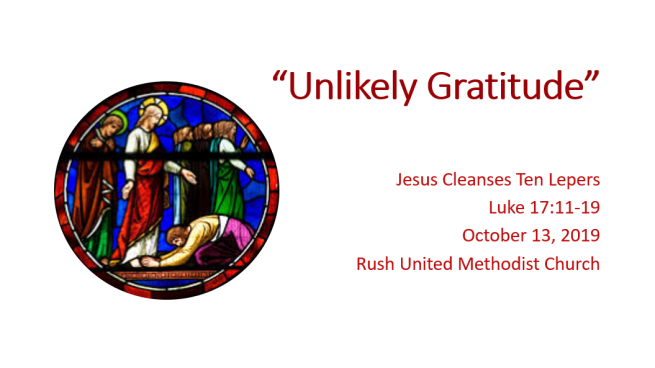
A few weeks ago,

we heard about one of 10 people healed of leprosy returned to Jesus to give thanks,

“Get up and go on your way;” Jesus told him,

“Your faith has made you well.”

“Truly I tell you, today you will be with me in Paradise.”


Confess your sins and place your faith in Jesus.


And before that, we heard the story of a prodigal son who returned to his father.

“Truly I tell you, today you will be with me in Paradise.”


Confess your sins and place your faith in Jesus.


Today, it is a convicted capital criminal,

who confesses his crime to Jesus,

as they were pierced and hung;

crucified side by side.


Imagine the faith of the condemned criminal.

He looks over at the nearly dead Jesus

And sees a crown,

Where I would have seen a grave.

“Jesus, remember me when you come into your kingdom,” he asked.

Jesus replied “Truly I tell you, today you will be with me in Paradise.”


Jesus is my King because He hears my confessions.

He hears my petitions and answers my prayers.

He saves me into Paradise.

And he can save you, too.


Kings are empowered by their people.

To what do you ascribe Christ as our King?

I am called to testify to Christ,

To point to Christ,

To proclaim Jesus Christ is my King.


He is

The one who forgives my sins.

Jesus is

The one who gives me the strength and the ability to resist temptations.

Jesus is

The one who hears my confessions, my petitions, and saves me into Paradise.


On this Christ the King Sunday,

I am called to give Jesus thanks;

thanks for these unlimited, unmerited gifts

of forgiveness, strength, and salvation.

Thank you, Jesus.


Claim your unlimited, unmerited gift of God’s grace for yourself.

Go forth and witness to what Christ has done for you.

Proclaim his sovereignty!

Give praise and thanks to Christ, our King!

Amen.

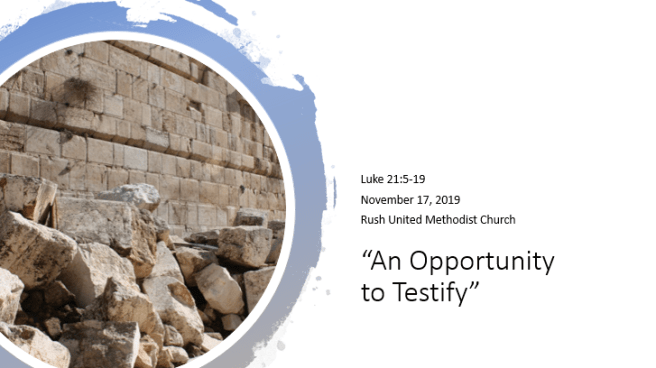
“An Opportunity to Testify”

1

The Rev. Todd R. Goddard, Pastor

Luke 21:5-19

When some were speaking about the temple, how it was adorned with beautiful stones and gifts dedicated to God, he said, “As for these things that you see, the days will come when not one stone will be left upon another; all will be thrown down.”

They asked him, “Teacher, when will this be, and what will be the sign that this is about to take place?”

And he said, “Beware that you are not led astray; for many will come in my name and say, ‘I am he!’ and, ‘The time is near!’ Do not go after them. “When you hear of wars and insurrections, do not be terrified; for these things must take place first, but the end will not follow immediately.” Then he said to them, “Nation will rise against nation, and kingdom against kingdom; there will be great earthquakes, and in various places famines and plagues; and there will be dreadful portents and great signs from heaven.

“But before all this occurs, they will arrest you and persecute you; they will hand you over to synagogues and prisons, and you will be brought before kings and governors because of my name. This will give you an opportunity to testify.

So make up your minds not to prepare your defense in advance; for I will give you words and a wisdom that none of your opponents will be able to withstand or contradict. You will be betrayed even by parents and brothers, by relatives and friends; and they will put some of you to death. You will be hated by all because of my name. But not a hair of your head will perish. By your endurance you will gain your souls.


Prayer.

Perspective changes with time and events.

I remember the view from the observation deck of the World Trade Center.

New York City, Central Park, the 5 boroughs, JFK, Ellis Island, the harbor were all so beautiful on that spring day in 1978.

After 9/11 and debriefing first responders, my perspective changed forever.

Perspective changes with time and events.

Nearly one-thousand years before Jesus

The Jerusalem Temple had been built and rebuilt numerous times.

The first Temple was built by Solomon in 966 BCE.


380 years later

Babylon reduced it to rubble in 586 BCE.


48 years later

Cyrus the Great used the same stones to rebuild it.


518 years later

Herod the Great completed a massive expansion and renovation in 20 BCE.


50 years later

Jesus taught his disciples

this Gospel lesson

at the front door

on the Temple steps.


There was no greater building in all the world,

So thought those under the age of 50 and who never traveled more than 90 miles from home.


The foundation itself towered 105 feet,

Built of enormous stones, some as large as 517 tons.

According to the Roman historian Josephus, 1,000 oxen were used to build the foundation. (https://www.biblicalarchaeology.org/daily/biblical-sites-places/temple-at-jerusalem/the-stones-of-herods-temple-reveal-temple-mount-history/)


Surely, the Temple would last forever.

Jesus had a perspective his disciples did not share.


All seeing, all knowing, all encompassing;


Eternal is God’s cosmic view.

Fully human and fully divine

Jesus definitely proclaimed the Temple’s destruction.

His disciples couldn’t see like Jesus

40 years into the future

When Rome would reduce the Temple to rubble once again.


I didn’t think the twin towers would ever come down, either.


The disciples of Jesus,

being taught by him on the Temple steps,

were focused on destruction and end times.


St. Luke’s generation of Christians

Seventy years later

Had a different perspective.


Rome destroyed the Temple and the City of Jerusalem in 70 AD.

Years later,

Sometime between 80 and 110 AD, scholars believe,

Our Gospel author, Luke, is testifying to the life, death, and resurrection of Jesus.


Luke is the one of many

Post-apostolic, first generation, first century, early Church fathers.

His testimony from 33 AD to 90 AD is preserved by storytelling, the oral tradition.

Later, the Gospel of Luke is first written,

Ink on parchment.


The audience of Luke’s witness were new Christians;

former Jews

Convinced and convicted by testimony of Christ’s death and resurrection.


First century Christians were in a mess!


They faced fire, destruction, defeat, and humiliation.

They suffered disease, famine, persecution, and martyrdom by the thousands.

They faced wars and insurrections;

Terrible portents at every turn.


They were not interested in the piles of rubble,

The building and grounds of the destroyed Temple.

What they needed was hope, assurance, … Good News

To lead them through the mess of their current crisis.

Luke delivers the Good News,

Using his keen memory, and

The memory of other Gospel authors.


Luke bears witness to Jesus

Who provides encouragement and teaches vigilance

In spades.


Jesus focus is on a new beginning,

Not on destruction or the end of time.

Yes, the world is a mess.

You’re facing terrible persecutions, famine, and plagues …

But …

The glass isn’t half-empty; it’s half-full.


These trials will provide you an opportunity to testify!


The word Testify is the key that unlocks the Gospel.


Be assured,

You don’t have to worry about what to say;

Jesus gives words for testimony.

Testimony convicts and converts;

Harvesting disciples by the bushel full.


Testify!

Tell the story.

Leave the rest up to God.


Be assured,

Jesus provides wisdom that is unmatched by any opponent.

Not everyone is going to like the fact that you’re living in the wisdom of Jesus.

Some will hate you, even members of your own family.

Some might even kill your mortal body.


Be assured,

Jesus promises,

No one can harm your immortal soul.

Not a hair on your head will perish.

Disciples of Jesus witnessing their faith get an iron dome of protection.


Endurance.

Faith.

This will gain your soul.


Can we connect the dots

And make the leap to our world today?


We’re in a mess!

If we are so smart why do we keep getting ourselves into wars?

Explain to me how Ivy League politicians put our sons and daughters into combat?

Can’t they negotiate away differences and avoid the violence?

Can’t we talk our way out of school yard fist fights?


If we are so smart why are we still plagued with the flu?

Thousands of researchers right here in Rochester

And millions around the world

are searching for cures to our most deadly diseases.

Progress comes in small increments.

Hope is measured in years.


If we are so smart why are there still famines?

Tell me why a change in global climate

can result in whole populations being flooded and going hungry.

Tell me why the families I meet in Guatemala cannot feed their children.

Malnutrition and starvation is a daily reality

Right here in our hemisphere,

Right next door.


California wildfires.

Caribbean hurricanes.

We can’t even predict, let alone stop, an earthquake.


We’re in a mess!

I haven’t mentioned school shootings or domestic terrorism.

Oh, yes; there is also the fact that every one of us

Comes from a dysfunctional family.

You can’t fool me.

We’ve all got skeletons in our closets.

“Parents and brothers, relatives, and friends;” Jesus explains

“And they will put some of you to death.” (21:16)


What are we to do?


Moving forward, Jesus tells us to testify;

Witness our faith to others.

Share what you’ve learned and what you have come to believe.

Make yourself a vessel through which the Holy Spirit can speak.

“Go therefore and make disciples of all nations,” the resurrected Jesus teaches,

“Baptizing them in the name of the Father and of the Son and of the Holy Spirit, and teaching them to obey everything that I have commanded you. And remember, I am with you always, to the end of the age.”

(Matthew 28:19-20)


What are we to do?

Jesus is telling us here to

Focus on the long game.

Testify with endurance.


Empires come and go.

Nations rise and fall.

God is eternal.

God’s plan for you and me is eternal, too.


What are we to do?

Here, and elsewhere, Jesus tells us to remain vigilant.

Watch.

Listen for signs of the times.

Be alert to God’s emerging kingdom.


The view from the observation deck

Pales in comparison to the Lord’s eternal history and promise.


Testify.

Endure.

Remain vigilant.

Be assured, our eternal interest is God’s greatest priority.

Amen.

“God of the Living”

Luke 20:27-40

10 November 2020

The Rev. Todd R. Goddard, Pastor

Rush United Methodist Church


Luke 20:27-40


Some Sadducees, those who say there is no resurrection, came to him and asked him a question, “Teacher, Moses wrote for us that if a man’s brother dies, leaving a wife but no children, the man shall marry the widow and raise up children for his brother. Now there were seven brothers; the first married, and died childless; then the second and the third married her, and so in the same way all seven died childless. Finally the woman also died. In the resurrection, therefore, whose wife will the woman be? For the seven had married her.”

Jesus said to them, “Those who belong to this age marry and are given in marriage; but those who are considered worthy of a place in that age and in the resurrection from the dead neither marry nor are given in marriage. Indeed they cannot die anymore, because they are like angels and are children of God, being children of the resurrection. And the fact that the dead are raised Moses himself showed, in the story about the bush, where he speaks of the Lord as the God of Abraham, the God of Isaac, and the God of Jacob. Now he is God not of the dead, but of the living; for to him all of them are alive.”

Then some of the scribes answered, “Teacher, you have spoken well.” For they no longer dared to ask him another question.


Prayer.


What happens when you die?


As long as there is life and breath

This is a question that can not be dismissed.

At the same time,

It can not be answered by reason or experience alone.

What happens when you die?


Jesus says little about the subject,

Other than a parable about a rich man and Lazarus and

A word to a thief on the cross.

His brevity makes this Gospel passage from Luke all the more important.

This Gospel passage invites each of us

to explore more deeply the question:

What happens when you die?


A careful examination of the details of Jesus’ encounter with the Sadducees

Raises a lot of serious, even troubling, questions.

Adding historical and critical context

brings into focus the central question at hand,

What happens when you die?


Jesus is in Jerusalem,

in the Temple teaching,

As Rabbi’s often did.

Some would teach students on the stairs leading up into the Temple,

Others would hold class in the shade of the porticos that ringed the perimeter of the plaza.


The time is near for Jesus;

He would die soon.


Chief priests, scribes, and elders were in the crowd of students

surrounding Jesus,

soaking up his every word.

They challenged his authority.

He risked upsetting the tenuous peace

Between Rome and the occupied population.


He risked undermining the Roman sanctioned

Temple authority and economy.

Upset cash flow and you’re in deep trouble really quick.


The chief priests, scribes, and elders wanted to lay hands on Jesus,

But they feared the people. (20:19)

So, they bid their time.

They recruited spies and lawyers to ask controversial questions,

Collect evidence, and

Waited for Jesus to hang himself.

Timing was everything.


Jesus is on a powder keg;

Barely weeks before he is arrested, abused, suffers, is crucified,

And his body laid into the tomb.


What happens when you die?


We tend to think of ancient, Rabbinical Judaism as being monolithic,

Of one mind,

But it wasn’t.

It was as fractured and diverse,

Different sects and schools of thought,

Full of landmines and debates,

Just as Christianity is today.


Consider Pharisees, Priests, Scribes, Essenes, and Sadducees;

A mixture of lay and clergy

With greatly divergent beliefs about God,

God’s present relationship with us,

And God’s future plan.


Pharisees, we heard last week, were a religious sect

Of both religious leaders and the laity, whose

Fundamental value was rigid adherence to the the Laws of Moses.

Pharisees were moral and theological conservatives.


Priests, on the other hand,

Were male descendants from Aaron,

The elder brother of Moses.

One wasn’t called to become a priest.

One was born a priest, or not.


Priests were charged with running the Temple.

Specifically,

Selling Temple raised sacrificial birds and lambs.

Priests oversaw the operation of ritual baths.

Priests collecting tithes from pilgrims.

They presiding over and participated in animal sacrifice, and

They maintained overall order.


Scribes were composed of Jewish aristocracy,

Whose function was to copy sacred manuscripts,

Making them learned in the Law.

Think of scribes as being seminary professors,

Experts in scripture

Who often served in positions of power in society.

For example, many served on the Sanhedrin

Who tried and convicted Jesus.


Essenes, only mentioned outside of the Bible,

Clustered in monastic communities, and

Held all things in common.

Essenes observed the Law of Moses,

Practiced ritual washing and purity, and

Professed belief in immortality but not resurrection of the body.


When it came to the topic of resurrection,

The debate within Judaism at the time of Jesus was raging.

Powerful people had a stake in the argument.

The stability of civilization and

authority of the Empire and Rabbinical Judaism were at risk.


The theological pump was primed for Jesus to be resurrected from the grave;

Which fanned the flame for early Christianity.

Former Jews who believed in resurrection of the body,

Looked upon the resurrected Christ standing right in front of their eyes,

Were immediately were convinced and converted.

Christ is risen!

We were right!


Sadducees approached Jesus this morning and lit the powder keg.

They did not believe in the resurrection.

To prove their point

They asked Jesus a question about resurrection,

Using an absurd example of the application of the law of Levirate Marriage.

Their question is nearly identical as recorded in Matthew and Mark.


Why would they ask about resurrection if they didn’t believe in it?

Like the Essenes, Sadducees did not believe in resurrection,

But did believe in eternal life.

Eternal life, it was believed, was

“Living on in one’s descendants and in their memory,”

They believed.

(The New Interpreter’s Bible, Vol. IX, p.388)


Levirate Marriage made this possible.

As prescribed in Deuteronomy 25,

(and in at least 3 other ancient societies)

If a husband dies,

The widow is to marry the next oldest brother-in-law.


Ancient Jewish society treated women as property,

Repugnant today,

But the reality in the time of Moses.


Levirate Marriage, as prescribed in the Law of Moses,

Was an ethical step forward,

Ensuring security for the widow,

Perpetuation of property, and

The provision of children.


Ah, the provision of children;

Eternal life, as the Sadducees thought.

Not physical, bodily resurrection,

But immortality through children and descendents.


The response Jesus makes rocked their world,

Just as he is about to upset ours.


….


What happens when you die?

Does our spirit live for ever?

Do we float in clouds?

Do we soar?

Are we filled with all knowledge

Of past, present, and future?


What happens when you die?

Are we reunited with family members?

How about uncle Ale, who spent time in prison for unspeakable crimes?

How about my spouse, who made my life a living hell?

Um, no thank you.


What happens when you die?

Is there a physical resurrection of our corpse?

Because, what the pathologist or mortician does pretty much upsets that apple cart.

Will there be a resuscitation of all corpses when Jesus comes again?


…..


Jesus uses the example of Levirate Marriage to teach us

That women are not to be treated as property,

But as children of God.

Men, take notice.

Women, stand tall.

While scripture may not treat everyone equally and respectfully,

God does.


At the same time, Jesus doubles down with Levirate Marriage.

He uses it to reveal God’s plan for death, resurrection, and eternal life.

If you’re interested in what happens when you or a loved one dies,

Pay attention!


Jesus says,

“Those who are considered worthy of a place in that age and in the resurrection from the dead neither marry nor are given in marriage. Indeed, they can not die anymore, because they are like angels and are children of God, being children of the resurrection.”

(20:35-36)


Let’s unpack this.


“Considered worthy”

Not all will be judged worthy,

Even though all will be forgiven of sins and judged with love.


“A place in that age and in the resurrection from the dead” …

Yes, Jesus teaches us,

There is eternal life and a future resurrection from the dead.

I’m pretty confident that the Creator of life

Is even able to knit muscles on old dry bones

And breathe life into a corpse.


“They are like angels and are children of God”

You’ve heard about angels, haven’t you?

Scripture is full of examples of God sending angels to carry out God’s plan.

Some angels bring good news,

Others bring words of warning.

Some come in dreams,

Others like to wrestle.


That angelic presence of a loved one?

Yeah.

That’s God’s gift to you.

Listen to what that angel has to day.

Give thanks to God for loving you so much

To think of you and to send you an angel.

Yes, angels are watching out over you and me

every moment of every day.

So, watch what you say and do!


“Those considered worthy … are children of the resurrection”;

That is … children of Jesus,

Who we quite famously know,

Rose from the dead.


Jesus cites the Patriarchs,

Moses, Abraham, Isaac, and Jacob,

as examples of resurrection,

Which isn’t terribly convincing to me.


His most convincing argument for resurrection

Lay in his future:

An empty garden tomb,

In an Upper Room,

On a walk to Emmaus, and

Breakfast on a lake shore.


We may confidently recite the Apostles’ Creed,

“I believe in … the communion of saints,

The forgiveness of sins,

The resurrection of the body,

And the life everlasting.”


Forgiveness of sin, resurrection, eternal life is

What happens when you die, Jesus tells us.

How God’s plan for resurrection and eternal life is implemented at death, however,

Is as much of a mystery to me, as it is to you.


What happens when you die?

The line between heaven and earth is drawn so thin

One is able to see the activity of God with crystal clarity.

There is nothing to fear.

There is everything to gain.

The Lord of resurrection and eternal life

Does not allow death to remain as the final judgement.

Our God, who knew us before our conception,

Created us, and breathed life into our lungs,

Is the Lord of life.


Jesus reminds us,

“I am the resurrection and I am life.

Those who believe in me, even though they die, yet shall they live,

And whoever lives and believes in me shall never die.”

(John 11:25-26)

Amen.

“Great is Your Reward”

1Luke 6:20-31

November 3, 2019 – All Saints’ Sunday

The Rev. Todd R. Goddard, Pastor

Rush United Methodist Church


Luke 6:20-31


Then he looked up at his disciples and said: “Blessed are you who are poor, for yours is the kingdom of God. “Blessed are you who are hungry now, for you will be filled. “Blessed are you who weep now, for you will laugh. “Blessed are you when people hate you, and when they exclude you, revile you, and defame you on account of the Son of Man. Rejoice in that day and leap for joy, for surely your reward is great in heaven; for that is what their ancestors did to the prophets.

“But woe to you who are rich, for you have received your consolation. “Woe to you who are full now, for you will be hungry. “Woe to you who are laughing now, for you will mourn and weep. “Woe to you when all speak well of you, for that is what their ancestors did to the false prophets.

“But I say to you that listen, Love your enemies, do good to those who hate you, bless those who curse you, pray for those who abuse you. If anyone strikes you on the cheek, offer the other also; and from anyone who takes away your coat do not withhold even your shirt. Give to everyone who begs from you; and if anyone takes away your goods, do not ask for them again. Do to others as you would have them do to you.


Prayer.


Blessed All Saints’ Sunday.


For 1,646 years

Christianity has celebrated with great respect

The memory and legacy of faithful disciples of Jesus Christ

Whose mortal life is ended, and

Whose eternal life with God and all the saints

has been confirmed.


All Saints’ Day,

The First of November,

Was first recognized by St. Ephrem in 373 A.D.

Due to the fact that so many Christians were being persecuted and martyred,

It became impossible for each Saint

to be given a unique day in a calendar year.

In time, November 1st

became the day we collectively recognize all the saints.


(By the way)

Halloween, was named from the Old English combination of

Hallow, meaning saint, and

Een, or eve, meaning the day prior to the celebration of the saint.

Secular ghouls and ghosts of the imagination soon followed.


All Saints’ Day is a holy day John Wesley loved.

“All Saints Day revolves around,” Wesley said,

“giving God solemn thanks for the lives and deaths of his saints”, including those who are “famous or obscure”.”

(Iovino, Joe (28 October 2015). “All Saints Day: A holy day John Wesley loved”. The United Methodist Church. Retrieved 20 October 2016.)


A saint is anyone in heaven,

Who collectively forms a “great cloud of witnesses”

Surrounding us, here on earth.

Hebrews 12:1-2 reads,


“Therefore, since we are surrounded by so great a cloud of witnesses, let us also lay aside every weight and the sin that clings so closely, and let us run with perseverance the race that is set before us, looking to Jesus the pioneer and perfecter of our faith, who for the sake of the joy that was set before him endured the cross, disregarding its shame, and has taken his seat at the right hand of the throne of God.”


The line between heaven and earth is very thin.


Saints are not perfect people.

They were sinners who ran a mortal race,

striving for perfection,

looking to Jesus.

Saints were people

Just like you and me.


The words and actions of saints serve as a witness to each of us:

This is the Christ I follow!

These are the mistakes I made!

Learn from these mistakes!

Grow!

Grow closer to Jesus!

Grow more disciples following Jesus!

Expand! Expand! Expand!


I appreciate the distinction that


saints are perfected sinners,

once mortal,

now immortal.

This contrast gives emphasis to Luke’s unique narrative of Jesus’ Beatitudes.

Blessed are … and

Woe to you.


Woe to you, mere mortals,

Inhabitants of aging, aching bodies!


Woe, or “ouai” in the Greek

– pronounced oo-ah-ee –

Is an emotional word, such as Yikes! Or Look Out!

(http://www.workingpreacher.org/preaching.aspx?commentary_id=4256)


Contrast woe with blessed,

As saints lifted into eternal glory!

Blessed, or “Makarios” in the Greek

– pronounced mak-ar-ee-os –

Means God’s benefits are extended to the one being blessed.

Salvation is God’s benefit extended to saints in heaven.

(Ibid.)


Jesus is teaching

God’s benefit of eternal life is gifted to

The poor, hungry, those who weep and mourn.

The Lord’s salvation is given to those

Who are hated, reviled, and defamed

Simply because the faith of their mortal life was defined by following Jesus.


Look out, you who are rich! Jesus is saying.

When your mortal life ends, you’re going to become poor.

You can’t take anything with you.


You who went back to the buffet for seconds and are so stuffed you need to loosen your belt?

Yikes! Jesus is saying. Death is going to bring a hunger that can’t be satisfied.


Look out! Those whose party never seems to end.

It’s coming to an end.

Time is running out.


Living on the path of discipleship leading to sainthood,

Means we love our enemies.

No exceptions.

Bless those who curse you, and

Pray for those who abuse you.


What will your obituary say?

How will your eulogy read?

What will be your legacy?


Will people say,

He was the most loving person?

Or, she was a blessing to all her neighbors, near and far?

Or, he was always praying; at the drop of a hat, he’d hold your hand and start praying?


Riding this mortal train to glory,

Means we don’t respond when insulted.

We just don’t.

We don’t retaliate when robbed.

We give to every beggar, knowing full well that

one or more don’t need our charity and will abuse our gift.

We lend

without the expectation that

what we lent

will ever be returned.


Making our way through life is a journey leading to Jesus.

Closing in on eternity and sainthood means

We live according to Christ’s Golden Rule:


“Do to others as you would have them do to you.” (6:26)


This is what Jesus taught;

This is how we are to behave.

This is the blessing,

The legacy,

Of All Saints’ Sunday.

Make it your legacy, too.


Thanks be to God.

Amen.

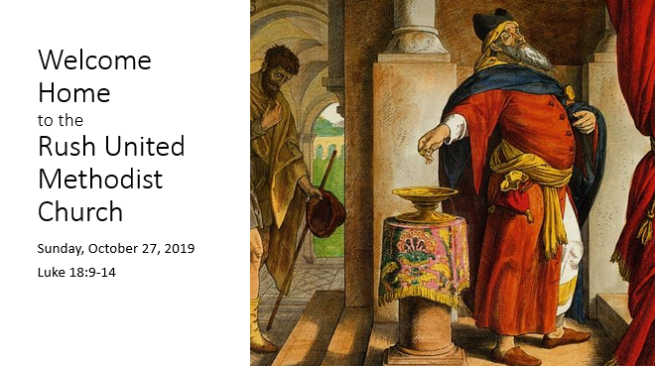
“The Upside Down World of Jesus”

1.pngOctober 27, 2019

The Rev. Todd R. Goddard, Pastor

Rush United Methodist Church


Luke 18:9-14


He also told this parable to some who trusted in themselves that they were righteous and regarded others with contempt: “Two men went up to the temple to pray, one a Pharisee and the other a tax collector.

The Pharisee, standing by himself, was praying thus, ‘God, I thank you that I am not like other people: thieves, rogues, adulterers, or even like this tax collector. I fast twice a week; I give a tenth of all my income.’

But the tax collector, standing far off, would not even look up to heaven, but was beating his breast and saying, ‘God, be merciful to me, a sinner!’

I tell you, this man went down to his home justified rather than the other; for all who exalt themselves will be humbled, but all who humble themselves will be exalted.”


Prayer.


Jesus tells a parable;

a parable that sets a trap.

The best traps are camouflaged in simplicity and in plain sight.

Do not be fooled by this simple parable!


Jesus sets this trap for any unsuspecting or uninformed disciple following him.

This parable is a trap set for you and me.


Wake up!

Pay attention!

Less the trap of this simple parable spring

and convict us of heresy and contempt.


Heresy and contempt.

You heard me right.

One wrong step and

you or I can step into the cow pie of heresy;

of violating two of the big ten commandments:

“I Am the Lord your God. Thou shall not have any gods before me.”

(Exodus 20:2-3)


One wrong step in a different direction will actuate the trap door;

dropping us into the dungeon of contempt;

unredeemed confinement,

exposing the disdain we harbor for others.


……


First, let’s deal with Heresy.

Heresy is a belief or opinion contrary to orthodox Christian doctrine.

Where is the heresy here?

and how can I learn to spot it, and

avoid stepping in it?


Pharisees in the time of Jesus often get a bad rap.

They aren’t villans, not hypocrites, nor necessarily adversaries of Jesus.

Scripture tells us that some are even sympathetic to Jesus.

The Pharisaic movement in ancient Israel sprung up in an effort to

emphasize obedience to the law of Moses.

It was a movement of both lay and rabbinical clergy.


Righteousness according to the law ensured

healthy spiritual disciplines,

healthy families and communities,

and for keeping the rites of kosher and cleanliness,

a way to encounter God’s holiness.


You or I could easily be Pharisees.


This Pharisee in today’s parable attends Temple.

Wonderful, we should attend worship, too.

The Pharisee prays a prayer of thanksgiving to God.

Great, we should offer to God prayers of thanksgiving, too.

So far, so good.


This is when the wheels come flying off.

He begins with the pronoun, “I”.

I give thanks

I’m not like that thief,

that rogue,

that adulterer,

THAT tax collector.


Three more times the Pharisee starts with “I”.

I exceed the minimum requirement to fast once a week.

I fast twice a week!

I exceed the minimum requirement to tithe 10% of my net income.

I tithe 10% of my gross income!


In fact,

the Pharisee is so full of himself;

He’s so full of his own righteousness

that he has lost the desire to place his whole trust in the Lord.

“I trust in myself and my own righteousness!” he’s thinking to himself.


He doesn’t need the Lord.

His trust is in his ability to follow the law of Moses without fail,

making his self-confidence greater than

his trust in the Lord.


This is the height of heresy.


The Lord reminds us, “I Am the Lord your God.”

You and I? We are not the Lord.

Living a good, clean life does not rocket us to the front of the line

Displacing God.


……….


Second, lets deal with the trap of contempt.

Because of the Pharisees self-imposed righteousness

He has developed a chronic disease known as spiritual superiority.


Spiritual superiority.

Oooh.

We all shift uncomfortably in our seats.


The Pharisee believed others were beneath consideration, worthless, or deserving scorn;

Especially those who intentionally broke the law of Moses,

Like thieves, rogues, adulterers, and tax collectors.

His disdain is exposed for all to see.


Contempt is a delusional belief that we know better than God

who should or who should not receive God’s mercy.


We do not.

We do not know better than God.


The Lord knows better than anyone

Where his mercy and grace are to be spread.

Mercy is the Lord’s prerogative and

Ours is not to judge.


Jesus is criticizing those who distinguish

Ourselves and our values from

“one of them.”


In God’s worldview

All are sinners, loved anyways.

All are fallen, redeemed anyways.

Even the most righteous still come up short of perfection, are saved anyways.


When we think of ourselves as holier than thou,

Better than “one of them,”

Our exalted contempt is flipped upside down by Jesus

And we find ourselves humbled.


Who are the “one of them” people in your world?


Are they communists, socialists, or a member of the opposite party?

Are they drug addicts, street people, or crazy people released from the asylum?

Are they owners, administrators, managers, or workers in the trench?

Are they officers, enlisted, or civilians?

Are they people with HIV, members of the LGBTQ community, people getting welfare handouts, or people with developmental disabilities?

Are they convicts, inmates, or felons?

Are they pimps, prostitutes, or people caught with their hand in the cookie jar?

Are they people with different skin colors, different accents, different faiths, from different lands?


Who are your

“one of them”?


We do love to paint people with a broad brush,

Lump people into stereotypes, because

Then, it’s easier to build a wall between us and them.


Contempt for “them”

does violence to the individual.


Every “one of them” has a name,

A story,

A history.

Every “one of them” is a child of God,

A person of worth,

Who is equally loved and cared for by the One who created

“them.”

Jesus died for every “one of them,”

An equal sacrifice,

Just as he died for me.


…………..


The traps of this simple parable are harsey and contempt,

But God’s gift of absurdly generous grace

Turns the world upside down.


Grace comes to none other than the foil of this parable:

The tax collector!


No one saw that coming!

The twist of this parable would have taken the breath away

from Jesus’ audience.

It should take our breath away, too.


Let’s talk about tax collectors,

People like Zacheus,

In the time of Jesus.


Tax collectors were notoriously corrupt.

They were hired contractors who worked on behalf of the Roman Empire,

The enemy occupiers of Israel.

These scoundrels would collect taxes

In neighborhoods, on highways, in markets, and at the dock.

Their take was anything they could collect above and beyond the Empire’s regulation.

They were dishonest, greedy, opportunist, collaborators;

Willing to victimize their own neighbors, family members, and friends.


Jesus, a respected Rabbi, associating with tax collectors would be scandalous in the eyes of every observant Jew.

Why would Jesus spend time with the likes of this?


(Mobster video clip: https://www.youtube.com/watch?v=-nHNHIDduH4)


In the parable, the tax collector stands far off.

He was probably afraid the roof of the Temple would collapse on him if stepped through the door.

He beats his breast, begs God for mercy, and confesses his sin.


That’s it.

He doesn’t promise to repent or change.

He doesn’t offer to go get an honest job.

He doesn’t volunteer to join the underground and become a part of the resistance.


“This man went down to his home justified,” Jesus declared.

The Pharisee had written him off.

But God had not.

The tax collector could only speak of his own brokenness.

And he is exalted.


Unburdened.

Vindicated.

Fully restored by God.

Wow!


Such is the nature of God’s absurdly generous grace.


………..


Dearly beloved,

This parable of the Pharisee and the tax collector

Warns us of the dangers of righteousness.

Living according to the law has mostly an upside to it, but

Yet, it has dangers.

The danger is that our trust can turn away from God.

We can turn inward,

trusting in ourselves,

Not in God.


We are warned of contempt;

For it reveals spiritual superiority,

Unsightly disdain for children of God.

We’ve been warned.

Don’t fall into the trap.


Indeed, even the most righteous of us,

Myself included,

are in need of contrition, repentance, and forgiveness.


Dearly beloved,

This parable resolves itself,

Completes the square,

In God’s absurdly generous grace;

A core characteristic of God.

We are launched into the upside down world of Jesus,

Where those who exalt themselves will be humbled,

And those who humble themselves will be exalted.


So, be humbled.

Seek God’s mercy.

Confess sins; the big, the little, the intentional, even those unknown.

Abide in this upside down world of Jesus

known as the Kingdom of God.

Amen.

“Lessons from People Who Wear You Out”

1

Luke 18:1-8

20 October 2019

The Rev. Todd R. Goddard, Pastor

Rush United Methodist Church


Luke 18:1-8

Then Jesus told them a parable about their need to pray always and not to lose heart. He said, “In a certain city there was a judge who neither feared God nor had respect for people. In that city there was a widow who kept coming to him and saying, ‘Grant me justice against my opponent.’


For a while he refused; but later he said to himself, ‘Though I have no fear of God and no respect for anyone, yet because this widow keeps bothering me, I will grant her justice, so that she may not wear me out by continually coming.’”


And the Lord said, “Listen to what the unjust judge says. And will not God grant justice to his chosen ones who cry to him day and night? Will he delay long in helping them? I tell you, he will quickly grant justice to them. And yet, when the Son of Man comes, will he find faith on earth?”


Prayer.


Our Gospel for today

Begins with praying always and not losing heart.

It takes a pit stop into persistence and justice.

And it concludes with a question about where faith will be found.


Undoubtedly, across the land

exceptional sermons will be delivered on each of these three points.


I am reminded by the wisdom of one seminary professor

taught us that every parable

is meant to communicate Divine truth.

At the same time,

every parable has a limit,

a capacity of what can be revealed.


In other words,

search for what God desires us to know,

but, don’t push the parable beyond its capacity

such that you begin to read into the story

personal agenda

Jesus never meant to be included.


Across the centuries,

spanning the globe,

crossing multiple cultures,

enduring transitions from oral, to written, to printed communication techniques

as well as multiple translations from one language to another to another,

It’s obvious

well intentioned editors have had a field day with this Gospel before us.


It has become a diverse mess,

a spray of divergent topics

that could obscure the essential Divine truth hidden within.

The challenge is to clarify;

to fine tune what is presented

into a clear concise message

we can apply to our lives today.


“Pray always,” Jesus says.

Clear. Concise. To the point.

Number one

Take home application I can implement immediately:

Pray always,

Even in the supermarket.


Pray without interruption,

without ceasing.

Pray continuously.

Pray persistently,

like a persistent, stubborn widow who won’t give up and won’t give in.

Pray like there is no tomorrow.

Keep praying because the Son of Man is coming

and he is expecting to find us in prayer.


Prayer is not a new topic in Luke.

When viewed inside the larger Gospel

we know the story begins

with the whole assembly of people praying outside the temple.

Jesus prays at his baptism.

He withdraws to pray at key points throughout his ministry.

Jesus prays such that he sweats blood on the Mount of Olives.

He instructs his disciples to pray for those who abuse them.

Jesus teaches his disciples to pray when they ask for instruction.

And Jesus assures us that the Holy Spirit comes to those who ask.


As Jesus was persistently in prayer throughout his life and ministry,

as he illustrates in this parable a widow who is persistence in her petition for justice,

so, too, are we to claim

the same persistence

for our prayer life.


Time for some introspection.

Consider our life, our actions, our behaviors:

Is everything we think, say, and do

firmly anchored in persistent prayer?


Persistent means always;

never ceasing.


Are we praying when we are shopping;

that our choices will reflect our stewardship of God’s creation?

Are we praying when we are picking our kids up from day care, school, or practice;

that our attitudes and language will be tempered by God’s love and wisdom?

Are we praying when we face temptation to do something we know we shouldn’t;

that God would steal our heart

and divert our attention to more faithful endeavors?

Are we praying when we wonder if we should stand up and speak out;

for God to channel our passion, to give us His words, and help keep us faithful?


It’s easy to pray occasionally;

when facing a personal crisis,

when set in routine,

or when we step foot into the sanctuary.

Praying persistently is advancing the spiritual life one step forward;

filling the in-between time

with our intentional effort to listen and speak with our God.


Time for some Extrospection.

Consider the life of our community of faith,

our church:

Is everything we think, say, and do

also firmly anchored in persistent prayer?


Can we let go and let God;

Give up our agenda and listen for God’s agenda to be made known to us?


When we talk finance

is it in such a way that reflects our prayerful revelation of God’s grace?


When we talk missions and outreach

is it in such a way that recognizes the fact that God is telling us to be like Jesus

reaching out to the last, the least, and the lost?


When we are pouring coffee, waiting tables, selling brownies, or mopping the floor

are we asking God to work through us to bless and love

everyone who enjoyed our turkey dinner?


Persistent means always,

whether we are gathered,

or whether we are deployed throughout the community.

Are we prayerfully supporting one another,

and through each other,

our neighbors, community, state and world?


God already knows what’s going on.

God wants us to pray to him because


Prayer changes the heart of the one doing the praying.


…..


“Pray always,” Jesus commands,

“and not to lose heart.”


Do not lose heart.

Keep faith.

Don’t lose heart.


Keep faith that God is in control,

today, tomorrow, and forever.

Today, most of us have the faith to pray.

We’ve come to worship after all.

In the spur of the moment

just about every Christian is able to muster up an

“Our Father, who art in heaven,”

“Now I lay me down to sleep,”

or “God is good, God is great.”


When the petition becomes a little bit more personal

– like a plea –

and when the petition is made not just one day,

but for a succession of days,

it becomes an intimate, ongoing conversation,

placing ourselves in the hands and arms of the one who created and loves us.


Do not lose heart, Jesus injects his confidence directly into our souls.

In the short term,

the persistent widow’s prayers for justice were not answered,

yet, she came back day after day,

knocking at the door of stubbornness.


Keep faith that

God’s time is God’s time,

not our time.


We live in God’s time.

We think we live in our time,

but it isn’t true.


“With the Lord one day is like a thousand years,

and a thousand years are like one day.”

– Apostle Peter, 2nd Letter to the Church in Greece, Turkey, and Asia, 2 Peter 3:8


When one talks resurrection and salvation

all talk is eternal.

All talk is God’s time.

It is according to God’s schedule that God responds.


Be there no misunderstanding;

God responds to every prayer.

Our job is to pray without ceasing,

with mustard seed sized faith,

and to keep knocking on God’s door.

Be assured, Jesus tells us,

persistent prayers are answered

always according to God’s time.


Do not lose heart;

keep faith

that every answered prayer,

that comes from God,

comes to us

from the one characteristic of God

that remains eternal and unchanging:

God’s everlasting love.


When Jesus says,

“Ask anything and God will grant it,”

we conveniently leave off that part “according to his will.”


“And this is the boldness we have in him,

that if we ask anything according to his will, he hears us.” 1 John 5:14


God’s will and motivation has always been for our personal and communal benefit.

Only a God who loved the world would send a son

to forgive us of the sins we’ve committed against Him and each other.


Only a God who loved the world would send His son

to win victory over death with a gift of eternal life.


When our persistent prayer

are according to God’s will to love us,

then, yes, every petition is granted.

When we believe our petitions haven’t been granted,

either it is because

what we’ve been asking for has been contrary to the will of God,

or,

what we’ve been asking for has yet to be revealed by God’s greater, long term plan.


Eventually, the persistent widow

was granted her petition.

She asked for justice and she got it.

Of course, justice is consistent with the love and will of God.

Why wouldn’t it be granted?

The point is

she was persistent in her petitions; and so should we.

She didn’t lose heart, she didn’t lose faith, and neither should we.


Jesus ends our Gospel for today

with what I believe is the perfect question:

“When the Son of Man comes, will he find faith on earth?” (18:8)


The beginning of an answer is found in the Gospel

where numerous people are commended for their faith:


  • the centurion who believes Jesus will heal his slave, even from a distance;
  • the sinful woman who anoints Jesus’ feet and loves much;
  • friends of the paralytic who are willing to cut a hole through a perfectly good roof;
  • the bleeding, unclean woman who touches Jesus’ clothes in the crowd and is healed;
  • the Samaritan with leprosy, whose gratitude turns him back to Jesus where he falls at his feet in thanksgiving;
  • and the blind beggar later in this chapter who sees Jesus for who he is and calls to him.


Yes, the Son of Man will find faith,

but Luke suggests that it may be in unexpected places,

not among the religious professionals

or the ones certain of their own righteousness.

10

Faith is found among

outsiders,

the unlovely,

the unclean,

the ones who are certain of their sinfulness.

Faith isn’t found within; it’s found outside, in the community, among those in greatest need.

(Thanks to: Meda Stamper, pastor, Anstey United Reformed Church, Leicestershire, England, as found at workingpreacher.org)


Signs of faith today

are people and communities persistently praying

in everything that is said and done.

Signs of faith today are evident

when culture is wrapped so tightly in persistent prayer

that peace replaces violence

God’s love drowns out hatred and prejudice,

and grace leads to life lived completely in the Spirit.


Signs of faith today

can be seen

in people and communities who persistently pray

and who do not lose heart,

who keep coming back

and coming back

and coming back

until the prayer is answered in God’s time,

or, until the Son of Man returns.

Whichever comes first.

It’s all good.


Don’t stretch the parable too far.

It was good advice.

Jesus gives his followers better advice:


Pray.

Pray always.

Pray and do not lose heart.


Be the Gospel.

Be the Good News of Jesus.

Amen.

“Unlikely Gratitude”

Luke 17:11-19

13 August 2019

The Rev. Todd R. Goddard, Pastor

Rush United Methodist Church


Luke 17:11-19


On the way to Jerusalem Jesus was going through the region between Samaria and Galilee. As he entered a village, ten lepers approached him. Keeping their distance, they called out, saying, “Jesus, Master, have mercy on us!” When he saw them, he said to them, “Go and show yourselves to the priests.” And as they went, they were made clean. Then one of them, when he saw that he was healed, turned back, praising God with a loud voice. He prostrated himself at Jesus’ feet and thanked him.

And he was a Samaritan.

Then Jesus asked, “Were not ten made clean? But the other nine, where are they? Was none of them found to return and give praise to God except this foreigner?” Then he said to him, “Get up and go on your way; your faith has made you well.”


Prayer.

1

A Story of Kings


There once was a commander of the Syrian army

By the name of Naaman.

He was loved by his men, for

He was strong and

The Lord, Yahweh, our God, brought him victory,

Though Naaman was a pagan and knew him not.


Naaman developed a disfiguring, communicable disease.

He suffered in isolation and shame.

How could he lead men if none would come near?


There was a great prophet of Yahweh

Who had developed the reputation as a healer.

The prophet lived in Israel,

South of the Syrian border,

His name was Elisha.


Naaman had to see Elisha

Even though Syria and Israel were adversaries,

As they are to this day.

The healer was behind enemy lines.


The intersection of Naaman and the Lord was heating up.


King Joram of Israel was suspicious of the king of Syria,

Who requested safe passage for his commander to visit Elisha.

Was this a pretext for starting a war?

What should he do?

Fear, anxiety, and uncertainty overwhelms King Joram.

He tears his shirt in frustration.

The crown’s concerns spread throughout the kingdom.


The prophet Elisha hears the news.

He sends for Naaman,

That he might come to know Yahweh;

The source of his victories,

The Lord of prophecy,

The God of healing.


Naaman comes.

Elisha tells him

“Go, wash in the Jordan seven time, and your flesh shall be restored and you shall be clean,” (2 Kings 5:10)


You’ve got to be kidding.


Desperation overcomes skepticism.

Naaman washes himself just as he was told.

He is healed of his leprosy.


At the intersection of Naaman and the Lord,

There is healing.

He renounces his former pagan god and

Claims the God of Israel,

Giving praise:

“Now I know that there is no God in all the earth except in Israel!” (2 Kings 5:15)


Naaman comes to the Lord and

Finds himself

At the intersection of faith and praise.


……………..


800 years later

Jesus is traveling to Jerusalem

Through the land of Elisha.


Leprosy was a disease of legend,

So easily transmitted and feared,

It left its victims in forced isolation.


Ten people with leprosy like Naaman approach Jesus.

All the while, they keep their distance.

A touch means becoming unclean and a time-consuming trip to the ceremonial baths and coming before the local priests.


Jesus was Jewish.

They were Samaritans.

They shared a common belief in Yahweh,

As do we.

Jesus was widely known throughout the region as a healer.

He attracted large crowds.

Jesus had something

These ten people with leprosy wanted:

To be cleaned, healed, and restored to normal life.

In short, to be made well.


“Jesus, Master, have mercy on us,” they cried. (17:13)

If Yahweh can heal Naaman,

So too, can the Lord use Jesus to heal us.


The region between Galilee in the north

And Judah and Jerusalem in the south

Had changed in the 800 years between Elisha and Jesus.

Samaria had been dominated by faithful Jews

From the 12 tribes of Israel,

Namely Ephraim and Manasseh.


About eighty years after Elisha

The region fell to the conquering Assyrians,

Who deported the best and brightest of the population to exile.


Assyrians settled in,

Intermarried with those who remained behind to tend the land.

To the Jews in Galilee and Jerusalem

The Samaritans became known as mixed raced collaborators with the enemy.


To talk about Samaritans

Is to bring up the topic of racism.


The divide deepened.

Most Samaritans remained faithful to Yahweh,

Yet were prohibited to travel to the Temple in Jerusalem.

They established their own local Temple first in Shechem,

Then to Shiloh.

Judaism schismed.

To the faithful Jews in the time of Jesus,

Samaritans were treated as pagans.


Samaritans.

Discriminated because of their mixed race;

Hated for their collaboration with the enemy;

Dismissed as pagans.

It is in this cultural context

Jesus enters when he stops in a village between Samaria and Galilee.


“Jesus, Master, have mercy on us,” they cried. (17:13)


Remember the parable of the Good Samaritan,

Also unique to the Gospel of Luke? (10:29-37)

When held in contrast with this narrative of Jesus healing ten people with leprosy

It is as if this

Miracle of healing becomes secondary.

When held in context with the narrative of the healing of Naaman

It is as if the Gospel is painting a far greater trajectory

Of God’s intervention in salvation history.


Imagine that.

A miracle may be pointing us to something more profound.


This story of healing

Reveals a deeper message of unlikely gratitude.


…………..


Allow me to bring laser focus on the one Samaritan

Who returned to Jesus.


“Then one of them, when he saw that he was healed, turned back, praising God with a loud voice. He prostrated himself at Jesus’ feet and thanked him. And he was a Samaritan.”

(17:15-16)


The text appears relatively simple and straight forward.

But, consistent with Luke, let us pay attention to details.


The first detail is the healed man

Came to an immediate awareness of God;

A display of God’s presence, power, and mercy.

He saw that he was healed.


For us today,

Are we as self-aware of God’s presence, power, and mercy?

Or, have our spiritual senses been so dulled by the world

That we’ve lost most of our situational awareness of God?


Have our spiritual senses been dulled by our passive approach to discipleship

That we’ve grown distant from the only source of healing,

The only solution to the fractures of the world

And the brokenness in our life?


Beloved, let us adjust our sets and tune our spiritual antenna.

Let us be aware of God’s presence, power, and mercy.


The second detail

Is that the man healed of leprosy changes his orientation towards God.

He walked away, but then

He turned back.

He returned to Jesus.


Oh, it is so easy to be healed by the Lord

And to simply move on,

As did the nine others who were made clean

But who failed to return.


Experiencing the presence, power, mercy, and grace of God’s healing intervention in our lives

Is an opportunity to repent

And to engage in the hard work of discipleship.


To turn back requires the intentional desire to change and grow in spiritual depth

Even though every one of us naturally resist change.

Repentance and change always begins with the self;

It always begins with me.


The third detail has much to teach us.

As the cleansed and healed man made his way back to Jesus,

He praises God with a loud voice!


Praise is recognition:

The source of healing is the object of praise,

None other than the Lord, our God.

Praise is reassurance:

Instilling confidence of faith within

And bearing testimony to others of

God’s greatness, glory, and mercy.

Praise is admiration of

God’s power, grace, and love.


And he did it loudly!

Shouldn’t our praise be loud, too!

Perhaps the cry room in the back should be reserved

For those who want to praise God in silence,

Because this sanctuary should be rocking!


The fourth detail is instructive.

The healed man prostrated himself at Jesus’ feet.


Do we place ourselves in a position of submission before Jesus?

Do we listen to his teaching at his feet?

Do we make our selves vulnerable before the Lord,

Placing ourselves completely, whole, utterly in the mercy of God?


The final detail is all about gratitude.

The healed man,

Mixed race,

A former foe,

One who had been considered a pagan like Naaman,

Gave thanks for what the Lord had done.


None were more unlikely to extend gratitude to God

Than this Samaritan man.

Yet, he did.

So, too, can you and me.


Beloved members and friends, guests and visitors,

The Gospel invites us today

To fill our hearts with gratitude.


Thank the Lord,

For all that has been, and

For where our spiritual journey has led us

To this day and time and place.


Thank the Lord,

For his faithfulness.

God keeps his covenants.

The One who created us stays in love with us.


The Lord’s faithfulness gives us assurance,

That if we follow wherever God is leading,

We will remain in God’s presence,

Strengthened by God’s power,

Blessed by God’s mercy and grace.


In this season of thanksgiving,

Let us thank the Lord

That, yesterday I may have been at war with God,

Emotionally and spiritually scared as a man with leprosy,

But today, I’ve been given a second chance

To turn back, and

Return to the feet of Jesus,

Cleansed, cured, and restored,

With a heart at peace.


“Get up and go on your way;” Jesus tells us.

“Your faith has made you well.” (17:19)


Our Lord’s invitation to us today

Is to place ourselves at

The intersection of faith and praise and gratitude.

That’s where we meet the Lord.

Amen.

“The Size of a Mustard Seed”

Luke 17:5-10, Proper 22 C, 6 October 2019

The Rev. Todd R. Goddard, Pastor

Rush United Methodist Church


Luke 17:5-10

The apostles said to the Lord, “Increase our faith!” The Lord replied, “If you had faith the size of a mustard seed, you could say to this mulberry tree, ‘Be uprooted and planted in the sea,’ and it would obey you.

“Who among you would say to your slave who has just come in from plowing or tending sheep in the field, ‘Come here at once and take your place at the table’? Would you not rather say to him, ‘Prepare supper for me, put on your apron and serve me while I eat and drink; later you may eat and drink’? Do you thank the slave for doing what was commanded? So you also, when you have done all that you were ordered to do, say, ‘We are worthless slaves; we have done only what we ought to have done!’”

5

Prayer.


Our Gospel lesson is a continuation of the past couple of Sundays.

You may remember

We left Jesus first teaching the disciples,

Then teaching the Pharisees

(who were lovers of money),

And, last week

The parable of the rich man and Lazarus.


Today, Jesus again turns to his disciples

And begins to teach

Four seemingly unconnected sayings

That are found in the first ten verses of chapter 17.

The first two are not included in our reading this morning;

Yet it is important to mention them.


The first saying

Is a warning to anyone who would cause someone to stumble,

That is, to temp someone to sin.

Jesus warns

“It would be better for you

If a millstone were hung around your neck

And you were thrown into the sea.”

– Luke 17:2

This is familiar for most of us. It’s also self-explanatory.


The second saying

Is Jesus giving instructions about

How one disciple is to treat another disciple who sins.

“You must rebuke the offender,”

Jesus instructs them,

“and if there is repentance,

You must forgive.”

– Luke 17:4

Again, straight forward.


Allow me to leapfrog the third saying and go right to the fourth.

The fourth saying of Jesus

Was read this morning and is found in verses 7-10.

Jesus makes his point with an illustration that causes us to shutter today,

Yet, this was a common cultural reality in the time of Jesus.


I doubt if any of Jesus’ disciples owned slaves.

At the same time, it was a slave holding society.

Slaves came primarily from military expansion, victory, and settlements.

Only the wealthy, politicians, and members of the military would have owned slaves.

Everyone would have been exposed to slavery

And known the ins and outs of how it worked.


The slave’s time and labor belongs to the master,

Therefore, the slave has no claim on the master

Even after a period of obedient service.

The point being,


We cannot put God into our debt.


God never owes us.

What we receive from God is kindness,

God’s grace,

Not reward for what we should do in the first place.

This is an important point:

What we receive from God is grace, not reward.


It is God’s nature to love, forgive, and save.

There isn’t a thing we can do to earn it;

It is already ours to accept.


….


My primary focus for today is upon the third continuous saying of Jesus,

Found in Luke 17:5-6, which reads:


“The apostles said to the Lord, “Increase our faith!”

The Lord replied,

“If you had faith the size of a mustard seed,

you could say to this mulberry tree,

‘Be uprooted and planted in the sea,’

and it would obey you.”


Note the fact that

It isn’t the disciples who ask,

Rather, it is the “apostles” who ask Jesus to

“increase our faith.”


The use of the word “apostles” indicates the fact

That this passage was most probably first written down

Almost two generations after Jesus.

Think about this dynamic for a moment;

The Gospel of Luke was written down nearly 50 to 70 years

After Jesus’ suffering, death, and resurrection.


It goes to show that

For those who follow Jesus,

Be they the original disciples,

The faithful members of the early, first century church,

Or even for us today,

It is normal and natural to find the demands of life

Seemingly too great for the faith that has already been given us.


What they are asking is, “Lord, make us adequate for being your disciples.”


This reminds me of the old hymn


“When the storms of life are raging, stand by me. (x2)

When the world is tossing me, like a ship upon the sea,

Thou who rulest wind and water, stand by me.”

(Words and music by Charles Albert Tindley, 1906)


Sometimes we feel like the weight of the world is crushing us,

The responsibilities thrust upon us are more than we can bear,

The expectations of family, work, and life exceed our capacity to endure,

And we, like the disciples of old cry out

“Lord, increase our faith!”

We cry out like the old hymn

“Lord, stand by me,

because I can’t stand alone any longer.”


Jesus reminds us


The faith we already have is more than adequate.


Our natural tendency is to think this is a parable about us.

We want to measure and quantify our faith.

We do so to correlate life’s events,

Suggesting that times of great faith is a sign of God’s favor

And times of weakened faith is a sign that we’ve fallen out of God’s favor

(which is patently untrue).


I’d suggest, however, Jesus teaches this parable

To reveal more about the characteristics about God, our Heavenly Father,

Than to teach his disciples about how to increase our faith.


Our faith taps us into the unlimited power of God.

God’s power is unlimited.

When our faith is connected with God’s infinite power

There is nothing God can’t do through us.

All things are possible by God

When working through willing disciples of His Son, Jesus Christ.


Jesus’ response to his disciples petition is quite familiar;

Familiar much more so to us from Matthew and Mark

Where “mountain” is substituted for “mulberry tree.”

“If you have faith the size of a mustard seed,

You could move a mighty mountain.”

– Paraphrased from Matthew 17:20 and Mark 11:23


Mulberry tree or Mountain,

… Six and one-half dozen the other …

Both employ impossible tasks at the time of Jesus.

Yes, the top of a mountain could be leveled and a temple built on top of it;

But move a whole mountain?

Whoa! I don’t think so;

Not in an era before shovels, earth movers, dynamite and pan dump trucks.


Likewise, it would have been quite impossible

For a mulberry tree,

A middle-eastern blackberry tree with an extensive root system

Which thrives in the desert,

To be transplanted from its original growing place

And be replanted in, or near, the sea.

It would be quite the impossible task!


Another point.

From the original Greek,

Our Lord’s words,

“If you had faith the size of a mustard seed,”

Implies or assumes an existing level of faith.


Specifically, Jesus isn’t questioning

Whether or not his disciples had any faith,

He was simply saying,

“If the faith you already have is equal to, or bigger than,

The size of a mustard seed …”


Friends, a mustard seed is the very smallest of seeds,

Nearly microscopic in size.


When looking at the tiny mustard seed

And comparing it to the decision to leave life and family behind,

To lay down their nets to come and follow Jesus,

Every one of his disciples would have thought,

“Well, yes. I do have at least THAT amount of faith!”


Today, when considering the tiny mustard seed

And comparing it to the decision to roll out of bed

And to come to worship on a Sunday morning,

Every one of us can also proclaim,

“Why, yes. I do have at least THAT amount of faith!”


If faith is even teeny-tiny in size,

It is sufficient to do the seemingly impossible for God.


You heard me right.

The faith you already have

Gives you the potential

To do the impossible.


Faith in Jesus Christ connects us to the power of God.

It taps us into the Almighty,

The Creator of the universe.

The faith you already have

Connects you directly into the power of God,

Enabling that power

To be put to use for God’s useful means.


Faith grows when we take God at his word.

God has been tugging at you all your life.

God has been whispering in your ear all your life.

God has been speaking to your conscience all your life.


It is God’s initiative,

God’s persistence,

God’s urging

That brought you forward to the baptismal font

And cleansed you with

Your baptismal waters.

Jesus has led you to the foot of his cross

To be washed clean of sin by his blood.


It is God’s prompting you,

Nagging you,

Urging you,

Longing for you to step forward again,

To partner with our Creator in this great endeavor,

To follow his lead and to expand his kingdom

On earth as it is in heaven.


….


So, what are the implications of this passage for our church family today?

Let’s call it “Mustard Seed Sized Faith”


Let’s take them one-by-one.


1. It is normal and natural to find the demands of life

Seemingly too great for the faith that has already been given us.

God’s vision is far greater than ours.

We get so focused on the here and now

And our personal challenges

That we are blinded to the possibilities of what God is creating.


We see our life and our church as broken, as limited, and vulnerable.

This is based upon the past and present.

But this is not the future reality to which God is calling us.


Take heart!

Be of good courage!

Wherever God is leading, let us follow,

Knowing in the depth of our bones

That God has given us all that is necessary for this journey.

The church of tomorrow

Will be what God wants it to be.


2. The faith we already have is more than adequate.

The particulars of doctrine don’t matter to God;

What matters to God is that

“we live by faith, not by sight.”

– 2 Corinthians 5:7

The fact that you are here right now,

In front of this altar and the cross of Jesus Christ,

Surrounded by this cloud of witnesses,

Tells me that though

None of us have seen Jesus,

Each of us live with Christ living in us

( – Galatians 2:20).

The breath of his Holy Spirit filling our lungs.


That’s sufficient.

That’s all you need.

Your faith is more than adequate.

Stop complaining and making excuses.

Move on.

Move this church forward

And bring it into the fullness of all that God wants us to be.


3. Our faith taps us into the unlimited power of God.

“With God all things are possible.”

– Matthew 19:26 and Mark 10:27

Jesus is claiming,

The God who created all there is,

All there ever has been,

And all there ever shall be,

Is a God of infinite power and ability.

Faith is like hooking in a power cable directly into God.

God’s will is the future’s reality for this congregation


Whether we like it, or not.

Whether we’re on board, or not.

Whether we cooperate, or not.

“Thy kingdom come, Thy will be done.”

– Luke 11:2


Grow this church two-fold in the next year?

Of course this is possible.

If this is God’s will, our faith can make this happen.


Though the opposite may be true,

It is important to recognize that

God is in the expansion business!


Faithfulness is the ability to pray,

“Use me, O Lord, …

Use this church, O Lord …

That Thy will may be done.”


4. If faith is even teeny-tiny in size,

It is sufficient to do the seemingly impossible.

Beloved friends, you’ve got this!

God’s future for us is not dependent

On how smart we are,

How creative we are,

Or how much money we have.

We’re tapped into the greatest power in the cosmos,

And through this power

“I can do all things through him who strengthens me.”

– Philippians 4:13

We’ve got this, if we want this

And if we are willing to be faithful.


5. Lastly, Faith grows when we take God at his word.

Disciples of Jesus,

Stop complaining and stop obsessing about all that distract our attention from Jesus:

Size, status, past mistakes, promises unfulfilled.


Let it go.

Let it be.

With Christ by our side,

There is no reason to be anxious about the future.

Our future is God’s to give,

For us to confidently claim.


Stop trying to quantify faith.

Faith will take care of itself,

Just so long as we continually attempt to seek God’s will

And follow God’s ways.


Living the quest to discern and follow God’s will

Normally, naturally, grows faith.

Instead of petitioning Jesus to increase our faith,

Perhaps we should spend more time asking our Heavenly Father

What he would have us do

And spend more time getting it done!


….


Dearly beloved,

Because of God love

The reality of God’s tomorrow is more wonderful than you or I can imagine.

In the meantime,

Take heart in the faith that you have been given.

Know that your faith is sufficient,

Because it connects us,

It binds us together with God,

Tapping us into God’s unlimited power.


Together, we can complete God’s will.

Together, we can do anything.

Amen.