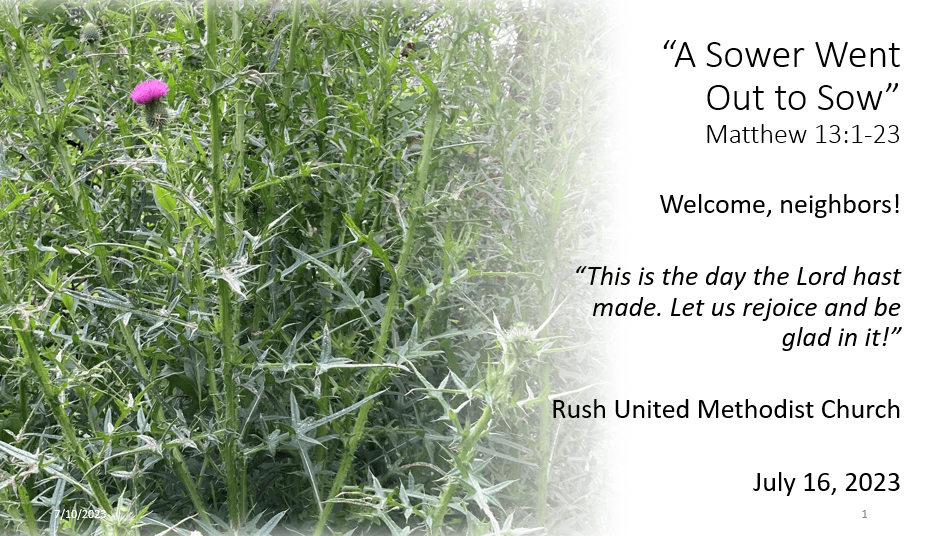
“A Sower Went Out to Sow”

July 16, 2023

The Rev. Todd R. Goddard, Pastor

Rush United Methodist Church

Matthew 13:1-23 (NRSV)

That same day Jesus went out of the house and sat beside the sea. Such great crowds gathered around him that he got into a boat and sat there, while the whole crowd stood on the beach.

 And he told them many things in parables, saying: “Listen! A sower went out to sow. And as he sowed, some seeds fell on the path, and the birds came and ate them up. Other seeds fell on rocky ground, where they did not have much soil, and they sprang up quickly, since they had no depth of soil. But when the sun rose, they were scorched; and since they had no root, they withered away. Other seeds fell among thorns, and the thorns grew up and choked them. Other seeds fell on good soil and brought forth grain, some a hundredfold, some sixty, some thirty. Let anyone with ears listen!” 

Then the disciples came and asked him, “Why do you speak to them in parables?” 

He answered, “To you it has been given to know the secrets of the kingdom of heaven, but to them it has not been given. For to those who have, more will be given, and they will have an abundance; but from those who have nothing, even what they have will be taken away. 

The reason I speak to them in parables is that ‘seeing they do not perceive, and hearing they do not listen, nor do they understand.’ With them indeed is fulfilled the prophecy of Isaiah that says: 

‘You will indeed listen, but never understand, and you will indeed look, but never perceive. For this people’s heart has grown dull, and their ears are hard of hearing, and they have shut their eyes; so that they might not look with their eyes, and listen with their ears, and understand with their heart and turn— and I would heal them.’ 

But blessed are your eyes, for they see, and your ears, for they hear. Truly I tell you, many prophets and righteous people longed to see what you see, but did not see it, and to hear what you hear, but did not hear it. 

“Hear then the parable of the sower. When anyone hears the word of the kingdom and does not understand it, the evil one comes and snatches away what is sown in the heart; this is what was sown on the path. As for what was sown on rocky ground, this is the one who hears the word and immediately receives it with joy; yet such a person has no root, but endures only for a while, and when trouble or persecution arises on account of the word, that person immediately falls away. As for what was sown among thorns, this is the one who hears the word, but the cares of the world and the lure of wealth choke the word, and it yields nothing. But as for what was sown on good soil, this is the one who hears the word and understands it, who indeed bears fruit and yields, in one case a hundredfold, in another sixty, and in another thirty.”

| Centering Prayer |

In recent days

Jesus has been traveling around the countryside,

stopping at many different cities,

always being followed by his disciples and the crowds.

The Pharisees had started to plot against Jesus,

planning how to destroy him.

He healed a man’s withered hand

and allowed his disciples to pluck and eat grain,

both events took place on the Sabbath.

This apparent violation of the Law raised their ire.

This morning we find Jesus by the Sea of Galilee,

perhaps in Capernaum,

where he taught as a child in the synagogue

and healed Peter’s mother-in-law.

Because so many followers crowded around him,

he got into a boat and slipped just offshore,

creating for himself the perfect, natural amphitheater

– Jesus on center stage –

with his audience rising up on the nearby shore.

It was a natural built,

Minor league coliseum;

The perfect setting for the Master to

Take center stage

To teach thousands of followers.

Jesus took advantage of the setting

by teaching his followers and the crowd in parables

– short stories whose purpose

is to make a point by analogy, comparison, or illustration.

Many have speculated

why Jesus spoke and taught so frequently in parables.

Why would his message be transparent to some

But intentionally opaque to others?

It is important to remember

The dangerous environment in which Jesus was immersed.

When surrounded by threats,

it was safest to speak in generalities,

with vagueness,

less one be arrested, tortured, and killed.

The less specific, the better.

Yet, Jesus’s parables were specific enough

so that, while some were left wondering what he was talking about,

his followers knew exactly what he was saying.

This, of course, makes all of us nervous

when we don’t immediately grasp the meaning of a parable!

Have no fear.

While some may believe

that Jesus is teaching in some kind of secret, cryptic code,

it only makes sense that he was

just being wisely cautious.

So this morning,

place in your mind’s eye

the image of Jesus in a boat,

floating just offshore.

He could have been at Durand Eastman beach, Casowasco, or Chautauqua.

Around him would have been a crowd of hundreds

– perhaps thousands –

standing and sitting at the water’s edge,

straining to hear his every word.

I highly recommend the book “Simple Church”

by Thom S. Rainer and Eric Geiger.

In this short book the authors describe two kinds of churches;

A simple church and a complex church.

The complex church is

One that deploys a smorgasbord of programs, events, and opportunities.

Generally, the larger the church,

the more resources it has to offer to members and friends.

Many have come to associate

activity with vibrancy,

especially those in the hierarchy.

While this complexity of programs may have curb appeal,

Especially to the occasional church shopper,

The author’s research has shown that complex churches

Foster stagnation, status quo, even decline.

The alternative is the simple church;

One that intentionally nurtures movement through the spiritual journey,

starting with the new Christian,

engaging people with vibrant worship,

leading each to deepen their faith

while reaching out to neighbors.

Love God,

Grow deep,

Reach out

To put it simply.

This simplicity is patterned after the first century description of church

In the Acts of the Apostles.

Programs that don’t reach up,

Grow people deep,

Or reach out

Are slowly, but intentionally eliminated.

New seeds are sown

To bring laser focus on leading people,

Moving and growing with people

In faith development

That leads to outreach and missions.

Simple churches, the authors cite in their research

Are becoming examples of new life,

Fertile growth,

And vibrant communities of faith,

Just as they once did two thousand years ago.

The key to transformational change

Is keeping it simple,

Seeking fertile soil,

Faithfully sowing seeds,

Nurturing the growth that God is providing.

In today’s parable

Three quarters of the seeds sown are complete and abject failures.

Henry Ford once said,

“Failure is simply the opportunity to begin again,

This time more intelligently.”

Keep sowing seeds.

It is, indeed, exceptionally easy for us

to dwell upon all of our efforts which have failed

– those ideas which have fallen upon the path

while others have come along and snatched them away,

or plans which have fallen upon rocky ground

and have quickly grown up but have just as quickly died away,

or hopes and dreams which have fallen in the midst of thorns

and others have quickly choked them off

before they could even begin to grow.

Yet, Jesus promises us that

“other seeds

fell on good soil and brought forth grain,

some a hundredfold, some sixty and some thirty.”

At the time of Jesus,

the finest harvest might bring in tenfold

– or ten times the amount of grain planted.

Farmers in the crowd listening to Jesus would have had a good chuckle.

Even with modern technology,

a good crop might bring in forty-fold.

Jesus wasn’t naive.

He was making a statement:

some of our efforts will succeed beyond our wildest dreams.

Some of the efforts and energies that we put in working for the Lord,

will bloom and grow far beyond the sum of everything we put into it.

Those ministries which take off,

do so not because of what we do,

but because of what God does

in and through us.

It is God who provides for the fertile soil.

It is God who provides for the necessary rain and sunshine.

We are simply required to sow seeds

and to nurture that which grows.

Successful kingdom building,

doing the Lord’s work,

requires a partnership with God and ourselves.

A few observations.

1. First, a seed is a seed is a seed.

That is, every seed is the same as every other seed,

worthy of the same consideration by the sower.

The only difference in the final outcome

depends upon where it is sown.

Seeds,

our visions, ideas, and plans for ministry

Come to us from God

Our Divine Creator.

Every seed is created with the same potential;

worthy of our efforts to sow.

If Jesus is telling us that only one in four

Stand a chance of taking root and prospering

We can’t risk losing any seeds.

It is wonderful to dream.

The more dreaming the better.

That is why we must be bold in our approach to mission and ministry;

Sowing every seed God gives us.

The more seeds that are sown,

the more opportunity for some seeds to grow

and grow abundantly.

2. Secondly, wise sowers will seek out the best soil.

Soil isn’t going to change its nature for our sake.

This is what it means for us today:

Avoid mission creep.

Avoid efforts that steal away the focus.

As my mother would say,

“Just because you can, doesn’t mean you should.”

Be smart in sowing.

Seek out fertile soil.

Search and find where the need is greatest;

Where the longing of the heart

and people’s deepest concerns can best be fed.

Jesus zeroed in on the deepest needs in his life and ministry.

He sowed seeds with the poor, the marginalized, with women, and children.

Jesus sowed seeds with those who were suffering illness, disease, and grief.

Jesus sowed seeds with a tax collector who was seeking a new heart

And with a paralyzed man lowered through a hole in the roof.

Let us boldly ask ourselves,

Where is the fertile soil today?

Where are we being led to sow God’s seeds?

3. Third,

from Jesus’s parable of the sower,

Jesus is preparing us to expect failure.

Despite our best efforts

Only twenty-five percent of the seeds fall upon fertile ground.

Keep sowing seeds!

I’ve learned with age and experience

That even failed efforts to grow God’s kingdom have merit.

Seeds that were sown twenty years ago,

Kindness that was extended,

Love that enabled you to go the second mile,

Grace that flowed through you and touched another,

May eventually take root.

Timing is everything.

Even worn paths

change and grow over with time.

Choking weeds eventually give way to trees and streams.

Rocky ground might slowly give way to rich topsoil.

Timing may be the key,

So, cultivate a culture of sowing.

Keep sowing,

Especially in the face of apparent failure,

If for no other reason

Then to maintain the discipline of sowing.

Jesus sowed throughout his ministry.

He only ended up with a handful of disciples in the end.

He had to repeat his message

of suffering, death, resurrection, and ascension

… multiple times …

Because those seeds didn’t take root

Until his disciples were changed by their experience and

They could find clarity with hindsight.

Yet, Jesus continued to sow

In his resurrection and

through his Holy Spirit.

Christ continues to sow seeds today

In and through our thoughts, words, and prayers.

His Spirit hasn’t stopped sowing

And neither should we.

Keep sowing.

4. Fourthly,

It is very clear that Jesus promises us that

even one small seed,

one idea,

one goal;

planted in fertile soil,

nurtured, cared for, and supported by God and the community,

can lead to a harvest abundant,

a harvest beyond our wildest dreams,

a vibrant ministry of our church of unmeasurable success.

One.

Seed.

Indeed, that one successful seed

Will more than make up for the other three that failed.

If one seed has the potential of a hundred-fold,

imagine what ten good seeds can do

– or a hundred!

Indeed, we are only limited by our ability to dream

and our capacity for faithfulness.

We are only limited by our ability to dream

and our capacity for faithfulness.

The goal of our Lord

for us, as individuals,

and for us, as His Church,

is the establishment

and fulfillment

of the kingdom of God,

bringing people to Jesus Christ,

nurturing each in our lifelong journey of faith.

God has called us to be faithful sowers,

people who are willing to work without ceasing,

committed to bringing about a successful harvest.

God supplies the seeds,

We simply sow as best we can.

God provides the soil, rain, and sunshine;

the growth and fulfillment of that kingdom.

Expect disappointments and failures.

Lots of them.

If you are not failing,

You’re not trying.

However, it is very clear that,

for those seeds landing upon fertile ground

which we tend, care, and nurture,

the harvest will be abundant beyond belief.

This foreknowledge easily makes up for lost seeds and efforts.

Can we dream?

Are we faithful?

If we can and

if we are,

let us sow.

Those who have ears to hear, let you hear.

Thanks be to God.

Amen.

“Where Rest is Found”

Matthew 11:16-19, 25-30

July 9, 2023

The Rev. Todd R. Goddard, Pastor

Rush United Methodist Church

Matthew 11:16-19, 25-30

“But to what will I compare this generation? It is like children sitting in the marketplaces and calling to one another, ‘We played the flute for you, and you did not dance; we wailed, and you did not mourn.’ For John came neither eating nor drinking, and they say, ‘He has a demon’; the Son of Man came eating and drinking, and they say, ‘Look, a glutton and a drunkard, a friend of tax collectors and sinners!’ Yet wisdom is vindicated by her deeds.”

At that time Jesus said, “I thank you, Father, Lord of heaven and earth, because you have hidden these things from the wise and the intelligent and have revealed them to infants; yes, Father, for such was your gracious will. All things have been handed over to me by my Father; and no one knows the Son except the Father, and no one knows the Father except the Son and anyone to whom the Son chooses to reveal him. “Come to me, all you that are weary and are carrying heavy burdens, and I will give you rest.  Take my yoke upon you, and learn from me; for I am gentle and humble in heart, and you will find rest for your souls.  For my yoke is easy, and my burden is light.”

| Centering Prayer |

This, then, is the preacher’s dilemma:

For the past few Sundays the Gospel has reported that

Jesus is preparing his disciples for his imminent absence.

Directly, and indirectly, Jesus has promised persecution to those who take up their own cross and follow him.

Taking up your own cross means you are willing to be crucified next to Jesus.

Crucified.

The misery begins much earlier:

Families will be set against families.

Some families will even try to throw you off a cliff.

Towns that don’t kill you; many will turn you away.

Trials, persecution, and death await those who follows Jesus.

Just last Sunday it was observed, discipleship is dirty work.

And here today, Jesus tells us:

“My yoke is easy and my burden is light.”

OK Jesus, you’ve got our attention.

What gives?

On the surface,

Jesus intended

Our Gospel lesson for this morning for the have not’s of the world.

In the time of Jesus, only a select few controlled wealth, wielded power, and exercised authority.

The majority of people earned the wealth for the elite.

Wealth was generated by the poor,

Income paid in taxes to the government and tithes to the Temple.

Exorbitant tithes and taxes landed in the hands of Rome and the Temple priests and authorities.

People suffered in slavery, or virtual slavery,

With tax rates and Temple tithes so unreasonable most lived in squalor.

People suffered with

Outrageously high infant mortality rates,

Malnutrition and starvation,

back breaking work from sun up to sun down every day,

contagious, infectious disease and disability.

Of those who made it to adulthood,

most never made it to their thirties or forties.

When Jesus earlier said, “Blessed are the poor” and

“Blessed are the persecuted”

These are the people he was talking about.

When Jesus says today, “My yoke is easy and my burden is light,”

He is speaking to the majority of serfs and slaves

Who have never heard of a God,

Let alone a God who loves them,

Who redeems them,

Who saves them.

Jesus exposes the hypocrisy of wealth

With this back-hand chastisement of the powerful, Priest, scribes, and Pharisees.

“They tie up heavy burdens (fortion), hard to bear, and lay them on the shoulders of others;

but they themselves are unwilling to lift a finger to move them” (23:4).

The focus of those with power

Is to remain in power;

To pass more laws,

More restrictions,

To tie people up with suffocating, burdensome, outrageous, intolerable policies and procedures, statutes, ordinances, and codes.

The goal of the powerful

Is to divert attention away from anything that may threaten the status quo

And lead people to believe distractions are important.

This is true in government.

This is true in organized religion.

This was true then.

This is true today.

“My yoke is easy and my burden is light,” Jesus proclaims.

In a life connected with Jesus,

Grace trumps Law ten out of ten times.

Love becomes the goal of righteousness.

And resurrection defeats death.

On another level, Jesus’ use of yoke

Causes one to think of what an ox would wear

In order to get work done.

The metaphor works because

Nearly everyone in Jesus’ audience would have known about oxen, yokes, and agricultural life.

Some yokes worked better than others.

Some were cushioned, while others bit into the flesh.

Pulling with the same force would have been easier with some yokes than for others.

Pulling for Rome would have been painful;

The tax collector would be labeled as a traitor, a collaborator, or the enemy.

It’s hard work to pull the yoke of Rome.

Pulling for Judaism would have been a lifestyle of laws about which  perfected righteousness is nearly impossible:

Diet,

Cleanliness,

Morality.

The yoke of the Temple was

Obligation,

Separation,

Judgment,

Damnation.

It’s hard work to pull the yoke of ancient, conservative Judaism.

With Jesus, work still needs to be done,

Let there be no misunderstanding;

But the work of witness, love, forgiveness, and salvation

Is far easier than pulling for the other competing principalities of this world.

The same is true today.

“Come to me, all you that are weary and are carrying heavy burdens,

and I will give you rest. 

My yoke is easy and my burden is light,” Jesus proclaims.

At the core, a yoke is what binds each of us together

– new Christian, maturing Christian, old Christian alike.

It is what binds us

To one another, to Christ, and to the Father.

This is where rest is found.

There is no Body of Christ in isolation.

Personal Christianity is an oxymoron.

The notion that I can believe in God on my own

Is Pantheism.

It isn’t Christian discipleship.

To be the Body of Christ,

We must join together.

We must pull together.

We must be unified as one.

The yoke of Christ is what makes it so.

In that oneness

is where rest is found.

When we are connected to one another and bound to Christ

We are ultimately bound to the Father.

Let not this homily descend into dogma or Trinitarian theology.

That being said,

Being bound to the Father,

The Creator of all there was, all there is, all there ever will be,

Is the perfection that John Wesley spoke about.

It is the pinnacle, the goal, of the Christian life.

Our heavenly Father

Is the Covenant maker:

“I will be your God; you will be my people.”

The Father chose us,

And when we choose to bind ourselves to the Father,

True rest can be found.

Our heavenly Father

Is the Law maker.

When we live according to the Law,

Not by obligation, but because of our choice, our faith,

True righteousness can be found,

And that is the place of rest.

Our heavenly Father

Is the loving father of Jesus;

Who loves the world so much

He gave us Jesus;

A love so profound

He allowed his son to die

To take away our sins.

The Father’s love is so eternal

Love rose Jesus from the grave,

And, so too, wins us victory over our grave

Granting us eternal life.

In our Father’s love

Is our place of rest.

Dearly beloved,

I invite you this this table

To taste and see the love that comes from the Father,

The love that is the Son,

The love that will never let you go.

Come to the table

And find your rest.

Amen.

“A Cup of Cold Water”

Matthew 10:40-42

July 2, 2023

The Rev. Todd R. Goddard, Pastor

Rush United Methodist Church

Matthew 10:40-42

“Whoever welcomes you welcomes me, and whoever welcomes me welcomes the one who sent me. Whoever welcomes a prophet in the name of a prophet will receive a prophet’s reward; and whoever welcomes a righteous person in the name of a righteous person will receive the reward of the righteous; and whoever gives even a cup of cold water to one of these little ones in the name of a disciple—truly I tell you, none of these will lose their reward.”

| Centering Prayer |

A little bit of kindness and hospitality goes a long way.

Here at the end of the tenth chapter of the Gospel of Matthew,

these final words of Jesus must have come as a welcome surprise to his disciples.

In a continuation of the past two Sundays,

Jesus was enlisting the help of his disciples

into welcome relief for his exhausting ministry

to the growing throngs of people:

of preaching, teaching, healing, casting out demons, and raising the dead.

If I had been one of his disciples

and Jesus told me that I’d be doing these things,

truth be told, I’d be incredulous.

I’d be scared to death.

“Healing lepers? You’ve got to be kidding. I’m not touching that!”

“Raising dead people? Thanks, but no thanks, I’m not in the Frankenstein business.”

“Preaching and teaching?” Couldn’t we just hire someone to do it for us?

“Leaving home, family, business, and money behind – certain to face persecution?”

I’ve got a mortgage payment to make.

There must be a better way.

Truth be told, ministry is hard work.

It’s dirty work.

And most of us would like an easier way out.

So when Jesus tells us this morning

that a cup of cold water

given to a parched throat

will do the trick

– we rise up and say “Amen to that, brother!”

Is Jesus setting the bar of expectation for discipleship

– a cup of cold water –

So low that we are distracted

From his greater message?

We live in a religious environment that celebrates bigness.

Big, fast growing auditorium type churches

are the envy of bishops, pastors and laypersons alike.

Big screens with professionally done presentations,

audio and video,

more volume for the bands,

more seating for the orchestra,

higher ranks for larger choirs,

atriums with welcoming kiosks, flowing fountains, and free cups of coffee,

big parking lots filled with big fleets of buses to bring attendees in,

big programs for kids and youth.

Church, like larger society, often reflects the same values:

It seems like the mantra is

more, bigger, and better.

The underlying message is

If you’re not big, you’re doing something wrong.

Today, Jesus lifts up small and seemingly insignificant acts of faithfulness;

welcoming a prophet or a righteous person,

welcoming Jesus,

or simply,

lauding the act of giving a cup of cold water to a little one.

You will receive the reward of the righteous.

None of these (acts of kindness) will lose their reward,

Jesus instructs his disciples.

Well, now, there you have it.

Even I lend my voice to

The voice of an anonymous person working the line,

Collecting spare change in a canning jar for junior’s college fund,

Suspicious of The Man.

Jesus speaks and

The little man wins.

Not the free market.

Not democracy, nor dictatorship.

Not the rich, nor the powerful.

Jesus speaks the language of

Welcome.

Hospitality.

Empathy.

Jesus wins.

Welcome.

Welcome one and all.

Welcome Jesus, and his disciples.

Welcome the prophet, and the righteous.

Welcome preschoolers and the children of faith.

Give them a cup of cold water to quench their thirst.

“preach it, Jesus!”

Can faithfulness really be this easy?

I mean what about “turn your other cheek,”

and “love your enemies and pray for those who persecute you”

and “go the second mile”

and “sell all that you have and give to the poor and come and follow me?”

What happened with those things?

Each time I’ve visited Washington, DC,

I am reminded of

The value of big thinkers, dreamers, and leaders.

Everything is big in Washington:

Museums, the Mall, the Houses of Government, Institutions of the State.

The nation’s capital was built in a small time by people with lofty aspirations.

There is always a need and a place for bigness in our world.

So, how does a little act of hospitality and kindness compare?

Today, Jesus tells us that smallness matters.

Details matter.

Genuine hospitality and simple acts of kindness

are just as important as the big issues of faithful discipleship.

In an environment today of Kia and Hyundai car-jackings,

offering someone a ride can be

a significant act of faithfulness.

In an era of home invasions,

answering the door with a smile and a kind “hello”

becomes a radical act of faithfulness.

In a hospital filled with antibiotic resistant diseases,

SARS, Mersa, and more flavors of Covid than you can shake a stick at,

the simple effort of showing up,

holding a hand,

becomes an act of radical discipleship.

Going to visit an old friend might mean

Risking fall or frail health.

That takes faith, my friends.

In today’s world where 26% of the earth’s population

does not have access to clean, potable drinking water

and 46% lack access to basic sanitation,

accepting a cup of clean, cold drinking water becomes a true act of faith

“and intestinal fortitude.”

(UN World Water Development Report 2023)

“In this kind of world,

a world of walls and barriers,

violence and intense loneliness,

Christian hospitality becomes a prophetic act.”

(Craig T. Kocher, Pulpit Resources, June 26, 2005)

Jesus tells us that smallness matters.

There are certainly many well-meaning speeches

That were delivered during this recent baccalaureate season.

Most offer wisdom about seizing opportunity,

Being the best you can be,

And leaving the world in a better state than the way you found it.

I’d like to add this wisdom of Jesus to the chorus for our new graduates:

Do your very best in the big things,

At the same time, make certain

you bring excellence to the small things in life.

Smallness matters.

Details matter.

Consider the way you greet someone.

A smile, eye contact, and a sincere look on your face

Is just as important as the business deal you are about to negotiate.

Remembering and using a person’s preferred name

Replaces an anonymous waitress

with a person of worth,

who has a valuable story to tell.

“Yes, ma’m,” and “No, thank you” are more than simple rules of etiquette.

They are radical acts of kindness.

“Political correctness” lost to angry partisans

Should be resurrected by the faithful,

renamed “love of neighbor,”

Empathy for the circumstance of others,

honesty, integrity, transparency, and always doing the right thing.

The use of simple social values

Communicates to the world that

Respect matters.

Dignity is worth preserving.

Love is important.

Faith has taught you well.

Christian hospitality becomes a prophetic act.

One final point:

In all things – big and small –

Do so in the name of Jesus Christ.

By our baptism

Each of us are given a new identity.

We share a common Heavenly Father,

A common blood line,

Co-mingling of both mortal and immortal DNA.

We have been marked as one of God’s precious, beloved children;

Named as a disciple of Jesus Christ, God’s own Son.

This is who we are;

Therefore, this is where life should point.

The socks we darn: we do it for the glory of God.

The email we send: we do it in the name of Jesus.

The family we build: we do it for Christ.

The budgets we create: we do it on behalf of Christ and his kingdom.

The laws we draft: we do so as a faithful child of a just, loving, and benevolent God.

Behavior matters;

In the big things,

In small things,

When no one is watching.

Behavior that exudes radical discipleship

Is a signpost directing the world to God.

Too often we forget this capstone of faith:

When we fail to connect actions with belief with a relationship with Jesus Christ,

When we stop using our life to point to Jesus, the cross, and the empty tomb,

Then we slowly become just another well-meaning humanitarian.

We slowly erode our identity of who we are, and whose we are.

So, in all things – big and small –

Do so in the name of Jesus.

A little bit of kindness and hospitality

In the name of Christ

Goes a long way,

Is as refreshing as a cup of cold water

In a parched, dried out world.

Disciplined, loving Christian behavior becomes

a prophetic act of radical discipleship.

A cup of cold water

When drawn from the well of faith

Becomes living water that

quenches every thirst

And leads to life eternal.                

Amen.

“The Weeping Prophet”

Jeremiah 20:7-13 and Matthew 10:24-39

June 25, 2023

The Rev. Todd R. Goddard, Pastor

Rush United Methodist Church

Jeremiah 20:7-13

O Lord, you have enticed me, and I was enticed; you have overpowered me, and you have prevailed. I have become a laughingstock all day long; everyone mocks me. For whenever I speak, I must cry out, I must shout, “Violence and destruction!” For the word of the Lord has become for me a reproach and derision all day long.

If I say, “I will not mention him, or speak any more in his name,” then within me there is something like a burning fire shut up in my bones; I am weary with holding it in, and I cannot. For I hear many whispering: “Terror is all around! Denounce him! Let us denounce him!” All my close friends are watching for me to stumble. “Perhaps he can be enticed, and we can prevail against him, and take our revenge on him.”

But the Lord is with me like a dread warrior; therefore my persecutors will stumble, and they will not prevail. They will be greatly shamed, for they will not succeed. Their eternal dishonor will never be forgotten.

O Lord of hosts, you test the righteous, you see the heart and the mind; let me see your retribution upon them, for to you I have committed my cause.

Sing to the Lord; praise the Lord! For he has delivered the life of the needy from the hands of evildoers.

Matthew 10:24-39

“A disciple is not above the teacher, nor a slave above the master; it is enough for the disciple to be like the teacher, and the slave like the master.

If they have called the master of the house Beelzebul, how much more will they malign those of his household!

“So have no fear of them; for nothing is covered up that will not be uncovered, and nothing secret that will not become known. What I say to you in the dark, tell in the light; and what you hear whispered, proclaim from the housetops.

Do not fear those who kill the body but cannot kill the soul; rather fear him who can destroy both soul and body in hell.

Are not two sparrows sold for a penny? Yet not one of them will fall to the ground apart from your Father. And even the hairs of your head are all counted. So do not be afraid; you are of more value than many sparrows.

“Everyone therefore who acknowledges me before others, I also will acknowledge before my Father in heaven; but whoever denies me before others, I also will deny before my Father in heaven.

“Do not think that I have come to bring peace to the earth; I have not come to bring peace, but a sword. For I have come to set a man against his father, and a daughter against her mother, and a daughter-in-law against her mother-in-law; and one’s foes will be members of one’s own household. Whoever loves father or mother more than me is not worthy of me; and whoever loves son or daughter more than me is not worthy of me; and whoever does not take up the cross and follow me is not worthy of me.

Those who find their life will lose it, and those who lose their life for my sake will find it.

| Centering Prayer |

The prophet Jeremiah was dealt a lousy hand.

Not flipping burgers at Burger King.

Not collecting garbage.

Not unclogging sewers or cleaning out septic tanks.

It was worse than that.

A lot worse.

God had a job that he couldn’t refuse.

Jeremiah was called by God to preach.

Preaching isn’t that bad.

It was the message

That came to defined his life.

The message God wanted to communicate to God’s chosen people

Gave Jeremiah the moniker

“The Weeping Prophet.”

The news wasn’t good.

This was God’s message to the people of Judah:

Stop worshipping idols. Worship only the Lord.

Stop following false prophets.

Temple priests are guilty of greed.

Stop altering sacred scripture to accommodate the worship of other gods.

Yeah.

Not exactly how to win friends and influence people.

That’s not all.

God had one more item to tell the people:

That Babylonian army closing from the north?

Yeah, they will destroy Jerusalem and all of Judah.

Punishment for sins.

Those not killed will be exiled,

Driven from God’s promised lands,

Banished to suffer for generations for their sins.

It’s a done deal.

No appeal.

1900 years later,

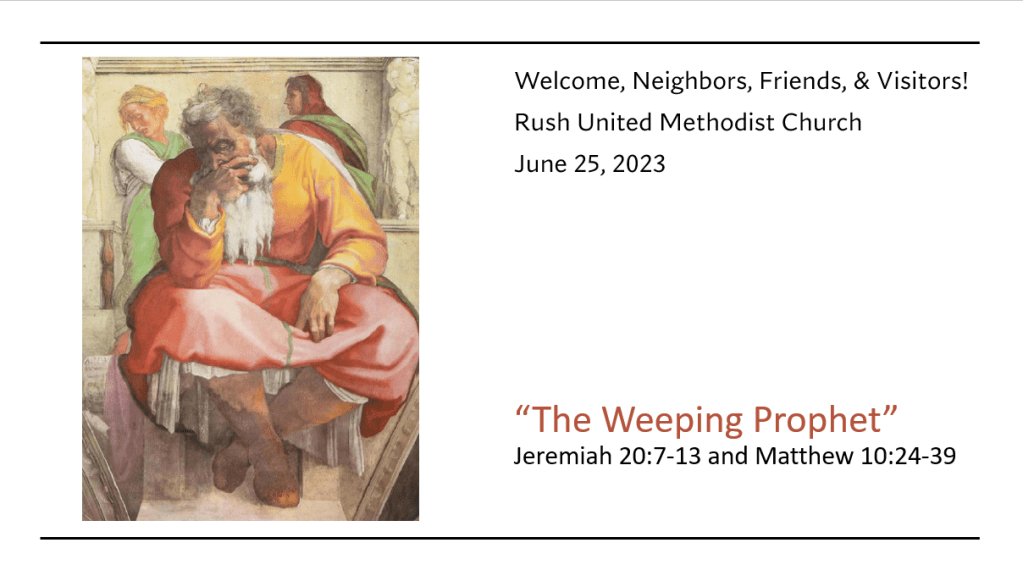
Even Rembrandt felt Jeremiah’s grief and pain.

Like Moses before him,

Jeremiah protested his life defining call.

God wasn’t hearing it.

Thanks for the input;

Now, zip it and get back in the game.

As soon as Jeremiah spoke

His cheery message of destruction and death,

His popularity plummeted.

Kings despised him.

Others plotted to kill him.

He was thrown into a cistern,

Trapped in mud,

Only to be saved by a slave.

Sound familiar?

Jeremiah complains to God,

Makes his lament,

Like any good child of Abraham.

God’s response?

Thanks for the feedback,

But, buckle down and ante up.

Nose to the grindstone, old chap.

Arrested.

Placed in stocks.

Mocked by all.

Assassination attempts.

All because

Jeremiah was being a faithful mouthpiece of God.

700 years later,

Matthew the tax collector,

And his larger Matthean community,

Felt Jeremiah’s pain.

Jeremiah’s story resonated with Matthew’s life experience.

Hated by the public.

Accused of collaborating with Rome,

An occupying enemy of the people,

Matthew preached that

Jesus was the fulfillment of Jewish expectation.

Jesus is the Messiah.

Follow him.

Matthew’s message was one that first century Jews did not want to hear.

Messiah? Savior of the people?

Jesus was

More like a major disappointment and a falling star from their myopic point of view.

For his efforts

Jesus was rejected in his own hometown,

By his own flesh and blood.

Jesus was rejected by organized religion;

Temple authorities,

Priests and pharisees, plotted against him,

Who had him arrested, tried, and killed.

For the Jews,

A cold, sealed tomb

Was the end of Jesus and his traveling salvation show.

Or so it seemed.

Today is Monday,

Tomorrow will be Monday.

Every day is Monday.

Everyday is Groundhog Day.

Life is misery, toil, suffering, slavery, and death.

“Life is a beach, and then you die,” my Uncle Dick would state.

Might just as well get used to it.

Matthew knew better.

The tomb wasn’t the final answer.

He had seen,

Personally witnessed,

the resurrection of Jesus and

Was personally commissioned,

Sent,

To spread the good news

Of what he had seen and experienced.

Today is

Release from captivity to sin and death.

Today is

The first day of your eternal life with Christ;

All for the low, low price

Of believing in him.

Carpe Diem.

Seize the Day.

Matthew preached first to the local Jewish community,

Then afield, tradition says.

He was led to Africa

Where he was martyred for this message.

Matthew’s band of brothers

(and sisters) carried on in Matthew’s name, call, and tradition.

They read the common text written by Mark

And used their memory of Matthew’s personal interactions with Jesus.

The Matthean community

Composed the text before us today;

The Gospel of Matthew.

It is in this context

They remembered and recorded

Jesus teaching.

“I have not come to bring peace, but a sword. For I have come to set a man against his father, and a daughter against her mother, and a daughter-in-law against her mother-in-law; and one’s foes will be members of one’s own household.” (10:34-36)

Dis me?

That’s one thing.

Dis my family,

Now you are itching for a fight.

Jesus condemns,

But doesn’t send to hell,

The actions of those who

Love others more than him.

Jesus condemns those who

Aren’t committed enough to risk their own lives

For the sake of following him and his message.

“Whoever does not take up the cross and follow me is not worthy of me.” (10:38)

Are you willing to die for Jesus?

We are asked today.

The mortal / immortal gordian knot

Makes me want to weep.

Just as Jeremiah wept,

So, too, did Jesus.

Just as Jesus lamented his rejection,

So, too, did Matthew and his community

Of Apostles.  

The Lord commanded Jeremiah

“And I will utter my judgments against them, for all their wickedness in forsaking me; they have made offerings to other gods, and worshiped the works of their own hands. But you, gird up your loins; stand up and tell them everything that I command you. Do not break down before them, or I will break you before them.” (1:16-17)

“Get yourself ready!”

(1:17)

God tipped him off to those who plotted against him.

God rose up and protected his life.

(11:18-2:6)

God is our protector-in-chief,

Our sword,

Our shield,

Our staff,

Our stay.

God is our anchor,

Our rock,

Our foundation

Upon which we stand.

“Do not fear …” Jesus commanded.

(10:28)

Not one sparrow falls without God’s knowledge.

Your value is greater than many sparrows.

God values you so much,

God even knows the number of hairs on your head.

“Do not fear …”

Our value comes from God,

Not from others.

Meaning comes from God.

Our call comes from God.

The message comes from God.

“Do not fear …”

Though others will mock,

Hate you,

Hurt you,

Serve you up to a martyr’s death,

God’s grace exceeds the expanse of cosmos, time, and space.

“Do not fear …”

Though others may kill,

Jesus saves.

Jesus saves.

You and I may not like the message of the cross.

But it is our responsibility to

Proclaim it from the housetops.

We may oppose the scandal of grace

Revealed by an empty tomb.

Yet, this is precisely the message

God intends the world to hear.

We may be persecuted, suffer, even die

For the privilege to carry God’s message

Of Jesus, and his love,

To a world of hatred, evil, and death.

Even still,

Buck up, old chap.

Dry the tears.

Nose to the grindstone.

God has you covered.

Lose your life for Christ’s sake;

Eternal life is returned to you.

Eternal life.

Yours.

All yours.

Claim it!

Proclaim it!

Amen.

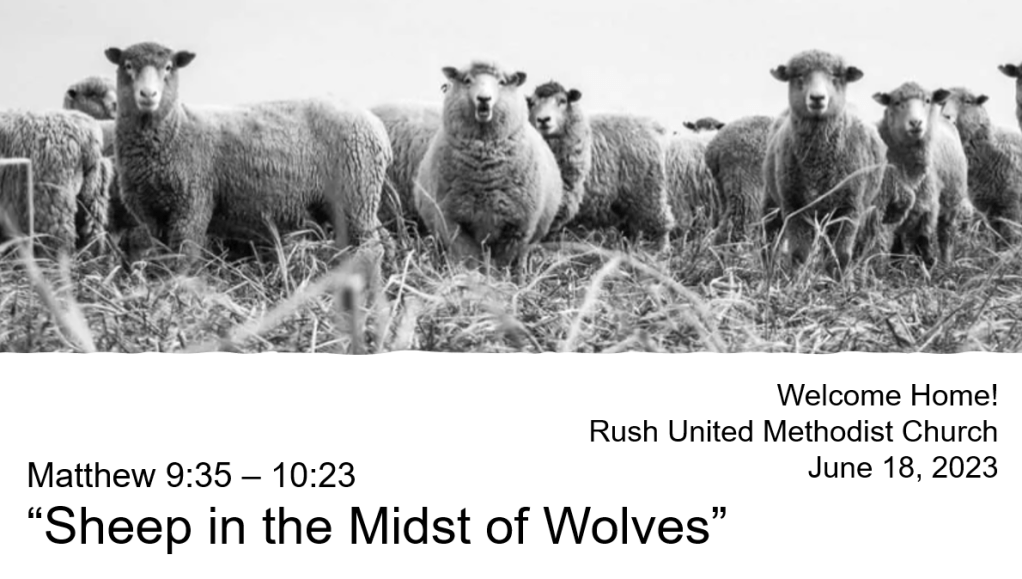
“Sheep in the Midst of Wolves”

Matthew 9:35 – 10:23

June 18, 2023

The Rev. Todd R. Goddard, Pastor

Rush United Methodist Church

Matthew 9:35 – 10:23

Then Jesus went about all the cities and villages, teaching in their synagogues, and proclaiming the good news of the kingdom, and curing every disease and every sickness. When he saw the crowds, he had compassion for them, because they were harassed and helpless, like sheep without a shepherd. Then he said to his disciples, “The harvest is plentiful, but the laborers are few; therefore ask the Lord of the harvest to send out laborers into his harvest.”

Then Jesus summoned his twelve disciples and gave them authority over unclean spirits, to cast them out, and to cure every disease and every sickness. These are the names of the twelve apostles: first, Simon, also known as Peter, and his brother Andrew; James son of Zebedee, and his brother John; Philip and Bartholomew; Thomas and Matthew the tax collector; James son of Alphaeus, and Thaddaeus; Simon the Cananaean, and Judas Iscariot, the one who betrayed him.

These twelve Jesus sent out with the following instructions: “Go nowhere among the Gentiles, and enter no town of the Samaritans, but go rather to the lost sheep of the house of Israel. As you go, proclaim the good news, ‘The kingdom of heaven has come near.’ Cure the sick, raise the dead, cleanse the lepers, cast out demons. You received without payment; give without payment. Take no gold, or silver, or copper in your belts, no bag for your journey, or two tunics, or sandals, or a staff; for laborers deserve their food. Whatever town or village you enter, find out who in it is worthy, and stay there until you leave. As you enter the house, greet it. If the house is worthy, let your peace come upon it; but if it is not worthy, let your peace return to you. If anyone will not welcome you or listen to your words, shake off the dust from your feet as you leave that house or town. Truly I tell you, it will be more tolerable for the land of Sodom and Gomorrah on the day of judgment than for that town.

“See, I am sending you out like sheep into the midst of wolves; so be wise as serpents and innocent as doves. Beware of them, for they will hand you over to councils and flog you in their synagogues; and you will be dragged before governors and kings because of me, as a testimony to them and the Gentiles. When they hand you over, do not worry about how you are to speak or what you are to say; for what you are to say will be given to you at that time; for it is not you who speak, but the Spirit of your Father speaking through you. Brother will betray brother to death, and a father his child, and children will rise against parents and have them put to death; and you will be hated by all because of my name. But the one who endures to the end will be saved. When they persecute you in one town, flee to the next; for truly I tell you, you will not have gone through all the towns of Israel before the Son of Man comes.

| Centering Prayer |

Our Gospel for today

Is the only occurrence in Matthew

Where the disciples of Jesus are named

And given the title of “Apostle”.

The word “Apostle” comes from the Greek “Apostolos”

Meaning “person sent.”

In today’s Gospel,

Disciples of Jesus

Are tasked with additional responsibilities.

Disciples not only follow Jesus;

– Learn his teachings and follow in his example –

Disciples are now sent,

Transformed into Apostles,

Sent,

First to Jews of the house of Israel,

(as we will explore here today) and

Later, to Samaria, and to the world.

(Acts 1:8)

Every nation.

Every race.

Every language.

Jews, Gentiles, and every other religion under the sun.

Sinners and saints alike.

The contrast is important.

Discipleship is about being filled with Jesus.

Apostleship is being sent to bring the world to Jesus.

Jesus mixes his metaphors today,

Referring to the crowd as sheep,

And to the world as abundant crops ready to be harvested.

Animal farming v. cash cropping.

It isn’t clean,

But Jesus gets the job done.

Sheeplike.

Reality check, with a large dose of humility:

Apostles of Jesus are like sheep.

1. Without the Good Shepherd we are prone to wander.

Take the eye off Jesus

and become easily distracted.

There is much to distract

Partisan politics, building wealth, amassing pride and power.

The fallen nature of life

Will go to the ends of the earth

To distract you and me from Jesus,

Our ultimate concern.

2. When we, like sheep,

Draw a deaf ear to the guidance and directives of Jesus,

The world becomes a tempting cacophony of competing calls;

Undisciplined pride,

Unrestrained anger,

Mindless Envy,

Objectified Lust,

Limitless Gluttony,

Poisonous Sloth.

3. Without the protection and guidance of our Good Shepherd

We are in constant, chronic mortal danger.

Without Christ, we risk body and soul.

Be not naïve,

Apostolic work

Is dangerous, life-threatening work.

Apostles are like sheep in the midst of wolves.

Vulnerable.

Being forewarned

demands apostles to be prepared.

I’d love to pepper my message

With heartwarming antidotes and stories

Of growth, success, and clean living.

Of little David slaying the mighty Goliath.

Nothing to be seen here.

Jesus is no vaccine that prevents pain, suffering, or death.

Apostles are betrayed.  

Hated;

Rejected by blood,

Well-meaning family members.

Apostles who carry Jesus to the world are

Persecuted by good Christian neighbors-about-town

Who dress up to go to church on Sundays.

Apostles, beware wolves.

Wolves hunt, and don’t give up.

Wolves kill, not like the regeneration of a video game.

Wolves kill dead.

Wolves feast with an unsatiable appetite.

Apostles can be expected to be arrested, charged, and prosecuted

As enemies of the people

As heretics of the Church.

Like a good Boy Scout, be prepared.

Put on Christ,

Shelter in his protective love.

Be filled with his power and strength of the Spirit.

Allow the Spirit of the Father speak in you and through you.

Be wise as serpents and innocent as doves.

Servant Laborers.

Apostles are disciples sent.

Sent by Jesus to do what?

1. First, take notice:

Here-to-for, Jesus has been a one-man-traveling-salvation-show.

It’s time to delegate,

To multiply.

Elementary level mathematics is a helpful metaphor.

One Jesus

commissions and sends

twelve disciples.

It would be great if the net would hold millions,

Thousands even,

Instead of just twelve.

Good laborers are hard to come by.

Yet. Twelve were enough to start with.

Twelve are enough.  

Apostles of Jesus are sent to multiply.

One becomes twelve.

Twelve becomes 144.

One forty-four becomes …

In a similar, but opposing way,

Apostles of Jesus are not in the subtraction or division business.

If you’re not building,

At best, you are maintaining the status quo,

Setting the table

For another generation to drive a stake through the heart.

At worst, if

you are not building Church,

The Body of Christ,

You’re destroying.     

Build.

Multiply.

Compound.

Light the afterburners.

Take supersonic your role

In building the Church of Jesus Christ.

2. Apostles of Jesus are sent to harvest.

Often, scripture uses harvest as a metaphor for the end times,

The return of Christ, and a final judgment.

No sign of that here.

Different sermon.

Different topic.

Another place.

Harvest:

Plentiful.

Abundant.

Full-to-overflowing is the harvest God provides.

Harvest isn’t just about

Swinging a scythe, gathering, separating, processing fruit, and burning the chaff.

Harvest demands compassionate Apostles

Who are willing to be servant laborers

Called and sent by Jesus.

Be the servant who

Proclaims the Good News.

This is the message to communicate through everything you think, say, and do:

God created you.

God loves you.

God forgives your sins.

God saves you into eternal life!

Pass it on!

Life happens in-between.

Illness, demons, and death.

So what?

God’s got you.

Be the servant who

Cures the sick, raises the dead, cleanse the lepers, and cast out demons.

We are in the fix-and-repair business.

Scavenge the junkyards of life.

The well have no need of a physician.

Seek out the lost, the left behind, the discarded and left for dead.

Fix the broken.

Heal.

Cleanse.

Purify the world with unblemished righteousness.

Be the servant laborer

Who places complete dependence upon God

And God alone.

One only needs bread daily.

Yesterday’s bread is today’s waste;

Tomorrow’s bread is wholly dependent on the grace of God.

Today’s bread is God’s intentional act to sustain and strengthen you.

God hasn’t failed once in the history of the world.

Grace won’t fail today.

Tomorrow? Nope.

As certain as tomorrow’s sunrise,

God provides, sustains, protects, loves.

Bank it.

Be the servant laborer

Who isn’t afraid to move on

if returns are not worthy of our heavenly Father and King.

Shake off the dust and leave.

In other words,

Leave the past behind.

Walk away from toxic circumstances and people

Who remain unmoved, unchanged,

Despite our every prayer and all our effort.

Pay attention to “return-on-investment”

More carefully than a corporate accountant.

“Shake off the dust from your feet as you leave that house or town.” (10:14)

Shake it. Leave it.

No apologies.

No regrets.

Let God judge.

Move on.

Servant laborers who cut losses and move on

discover a newfound serenity.

Peace becomes

the divine replacement

for anxiety, frustration, and failure.

“God; grant me the serenity to accept the things I cannot change,

To change the things I can change,

And the wisdom to know the difference.”

(Reinhold Niebuhr, https://en.wikipedia.org/wiki/Serenity_Prayer)

Self-flagellation ceases.

No dead horses are left to beat.

Moving on opens the door.

Peace once held, returns.

Peace returns to you.

Disciples learn and follow.

Apostles go and serve.

Be both / and.

Service is harvest focused.

Sick? Be healed.

Let me introduce you to the one who heals.

Follow him.

Dead? Bring life.

Let me introduce you to the Lord of life and resurrection.

He knows the way.

Jesus knows the tomb, but he also knows eternal life.

Follow him.

Filled with the devil? Satan! Be gone!

The Light has come to replace the darkness.

His name is Jesus.

Come and meet him.

Beloved, modern-day Apostles of Jesus;

It’s all about the harvest.

There is no time to wait.

No time for distractions.

The kingdom draws near, oh, so near.

Praise God

For the Apostolic authority,

Given and passed,

From generation to generation

To this age and time and place.

Simon Peter, the first among equals, and Andrew.

Adult sons of Zebedee, James and John.

Philip and Bartholomew.

Thomas, who demanded proof, and Matthew, the tax collector,

The son of Alphaeus, James,

And Thaddaeus,

Simon the Cananaean, and

Judas.

Even Judas.

Take thou authority.

Take the Good News.

Share the Good News.

The Lord of the Harvest is drawing his kingdom near.

Amen.

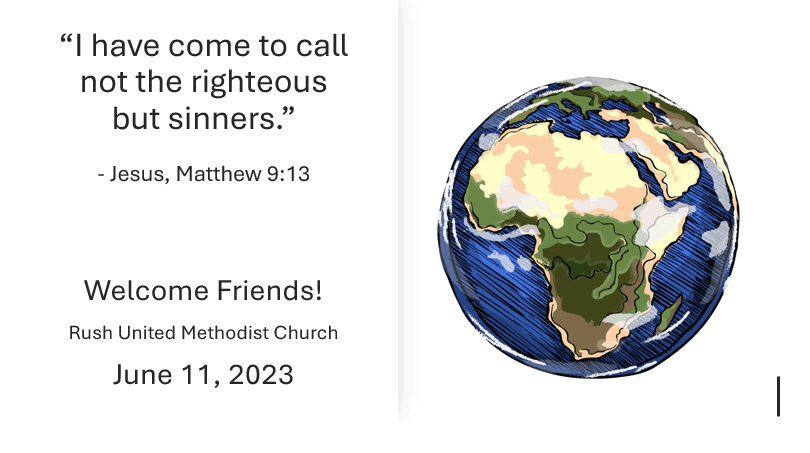
“Sinners Come to Church”

A Sermon for the African Immigrant Congregation,

Aldersgate United Methodist Church

Matthew 9:9-13, 18-26

June 11, 2023

the Rev. Todd R. Goddard, Pastor

Rush United Methodist Church

Matthew 9:9-13, 18-26

As Jesus was walking along, he saw a man called Matthew sitting at the tax booth; and he said to him, “Follow me.” And he got up and followed him. And as he sat at dinner in the house, many tax collectors and sinners came and were sitting with him and his disciples.

When the Pharisees saw this, they said to his disciples, “Why does your teacher eat with tax collectors and sinners?”

But when he heard this, he said, “Those who are well have no need of a physician, but those who are sick. Go and learn what this means, ‘I desire mercy, not sacrifice.’ For I have come to call not the righteous but sinners.”

While he was saying these things to them, suddenly a leader of the synagogue came in and knelt before him, saying, “My daughter has just died; but come and lay your hand on her, and she will live.”

And Jesus got up and followed him, with his disciples.

Then suddenly a woman who had been suffering from hemorrhages for twelve years came up behind him and touched the fringe of his cloak, for she said to herself, “If I only touch his cloak, I will be made well.”

Jesus turned, and seeing her he said,

“Take heart, daughter; your faith has made you well.”

And instantly the woman was made well. 

When Jesus came to the leader’s house and saw the flute players and the crowd making a commotion, he said, “Go away; for the girl is not dead but sleeping.”

And they laughed at him.

But when the crowd had been put outside, he went in and took her by the hand, and the girl got up.

And the report of this spread throughout that district.

| Centering Prayer |

There are many joys to being a pastor.

I’m surrounded with great people who are passionate about faith.

I’m privileged to be invited into the great celebrations of life’s passages-

birth, baptism, confirmation, graduations, weddings, anniversaries, and deaths.

Indeed, I draw strength and courage

from many examples of experience, faith, and hope.

My faith is deepened through

your commitment and resolve.

There are many joys to being a pastor.

In recent days,

I’ve come to recognize

That my life swims in an ocean of God’s grace.

At a young age

I dipped my toe into the surf.

It was a loving God who caught a hold of me,

Pulled me through a life altering undertow

Into a life of

abundant love,

extravagant forgiveness, and

eternal salvation.

There are many joys to being a pastor.

I don’t take lightly other people’s pain or suffering.

But, quietly, privately,

I do delight in self-imposed guilt.

This is what I mean-

when I was a medic on the ambulance,

taking a drunk from a bar fight to the hospital,

teeth knocked out like spilled Chicklets,

cussing and swearing to beat-the-band,

to have another member of the crew say

“by the way, I’d like you to meet Reverend Goddard…

I secretly delight in self-imposed guilt.

At the daily conclusion of Vacation Bible School

For 300 village children in Nicaragua,

We would team up

And hand out a small, sugar-coated roll

To each excited, squealing child.

To you or me

A roll would be

Just a roll.

To these children,

it was their daily bread.

I looked to

My fellow missionary traveler

Handing out rolls

And saw his face and tears when he

Realized he had enough spare money in his wallet

To feed 300 for a year.

Guilt has it’s place.

I realize guilt convicts.

I know that I’m unable

to sit on my holier-than-though, high horse for too long.

I put my pants on just like everyone else,

one leg at a time.

I know myself well enough

to recognize that

I am a sinner, no better, and no worse, than anyone else.

I have fallen short of God’s expectations and

I beg mercy and redemption before a benevolent, gracious God.

Guilty as charged.

Convicted of my sins.

I have no excuse,

Only confession.

There is no moral high ground here.

There is no pontifical, episcopal, or ordained protection

from the wages of sin.

Ordination doesn’t grant me a “Get out of jail free” card.

Neither is there safety

simply because you might be a Christian,

or in the failed attempt to lead a righteous life.

I applaud you for your effort;

but I know better.

Not only are we united by our common baptism,

but we are also united by our common sin.

Jesus said, “I have come to call not the righteous but sinners.” (Matthew 9:13)

I know that everyone of you is a sinner, because I am one, too.

Sinners come to church,

often led by the hand

by well-meaning parents.

Many do not come willingly.

Some may have put up a fight just an hour ago.

“I don’t want to go to church. Why do I have to go to church?

No one else from school is at church.

I hate church!”

But a rule is a rule,

so here you are,

arms folded,

brows furrowed,

determined not to get anything out of it.

“I’m here, but I don’t have to like it.”

Jesus said, “I have come to call not the righteous but sinners.” (Matthew 9:13)

Sinners come to church,

motivated by guilt or family pressure.

Out with friends last night until a late hour

– or early hour –

the incongruity between the party last night

and the service this morning is striking.

The posture is impossible to miss:

slouched rolled shoulders,

downcast eyes, queasy light headedness.

Thoughts are mostly “I just want this to be over with.”

Jesus said, “I have come to call not the righteous but sinners.” (Matthew 9:13)

Sinners come to church,

motivated by good intentions and true desire,

only to experience troubling thoughts.

Sin that’s deep, dark, and carnal.

Have you ever had a dirty thought during worship?

I have.

In the midst of sacred worship,

a thought turns to something that you are not supposed to think about,

and I certainly am forbidden to say.

Hormone driven thoughts lead to shame and fear

that God might be eavesdropping.

“Oh, my goodness! What’s wrong with my filthy mind?!”

Jesus said, “I have come to call not the righteous but sinners.” (Matthew 9:13)

Sinners come to church,

filled with new ideas,

calling into question

what is taught

and what they used to believe.

Youth challenging authority- Shocking!

Perhaps they don’t believe in God after all.

Perhaps this is a sham, a lie, a farce and no one should be here.

Organized religion is nothing more than organized crime.

It’s all a bunch of hooey!

Despite a newfound freedom to question,

most remain slaves to sin,

and like everyone else,

love to roll in the muck

with the pigs.

Jesus said, “I have come to call not the righteous but sinners.” (Matthew 9:13)

Sinners come to church,

upright and proper,

heads of the household,

respected members of the community,

who put on their Sunday’s best,

hoping to reflect an unblemished exterior.

But deep inside, all are wondering.

Wondering about those marriage vows.

Break them?

Who would know?

Wondering about children.

Is it right to bring innocent children into this world?

Who better to raise a bunch of sinners than sinners?

Wondering about …

the IRS return,

the little white lie on the timecard, or

the office supplies that make their way home.

Jesus said, “I have come to call not the righteous but sinners.” (Matthew 9:13)

Sinners come to church,

Elders pushing a walker or sporting a cane.

Middle aged …

Many have put on weight,

balding or graying,

divorced, depressed, or simply disillusioned.

starting to become a little ragged around the edges.

Life isn’t turning out like

What was expected thirty or forty years ago.

Youthful indiscretions securely vaulted and locked away in the past.

Aches and pains,

behind closed doors, belching (farting) and

belly-aching about every new twinge or pull,

all-the-while failing to follow the doctor’s advice.

A little too much wine with dinner,

a credit card overextended,

growing anxieties,

grown up kids who won’t move out.

Good old,

middle of the road,

over-insured, middle-aged sinners.

Jesus said, “I have come to call not the righteous but sinners.” (Matthew 9:13)

All kinds of sinners walk through the door of the church.

Some walking slowly,

stooped with age,

others running,

giggling, and paying no attention

to what anyone else might think.

Some have lost the sin of ambition, and

in its place are yielding to the sins of

despair, disappointment, resentment, or finality.

Some sinners come to church

wearing shoes made by children in sweat shops,

wearing clothing that is made by virtual slaves in developing world countries.

Some ate breakfast this morning

Mindful of those who have no breakfast,

While others come to know the injustice of global food distribution.

My consumption comes at the expense of others.

When I eat,

I force hunger on others.

Some sinners care …

but do nothing.

Other sinners could care less.

Jesus said, “I have come to call not the righteous but sinners.” (Matthew 9:13)

I’m the first to admit that

the biggest sinner might be the preacher,

the one who leads,

the one who does all the talking,

the spiritual shepherd of the flock.

It is far easier to do as I say,

not as I do.

Some may lift the office to a higher plane,

but I know that reverend is nothing more than a title,

and it doesn’t cut too deep.

We all come and close the door behind us.

There is no one without sin.

Not a one.

No one bears any more guilt than anyone else.

When it comes to sin

Size doesn’t matter.

We’re all in this together.

And Jesus walks into our life and says,

“Follow me, sinner. Follow me.”

Jesus Christ came into this world to save sinners!

“And suddenly

a leader of the synagogue came to Jesus.”

Jesus Christ came into this world to save sinners!

“And suddenly

a woman reached out and touched his garment.”

Jesus Christ came into this world to save sinners!

And suddenly,

oh, so suddenly,

you and me,

we find our voice.

Amazing grace, how sweet the sound,

that saved a wretch like me.

I once was lost,

but now am found,

was blind but now I see.”

“I’d like to come and dine at your table today,”

the Savior says, point directly at us.

So, gather we must,

around this table of God’s grace.

There is plenty of room for every sinner.

Make sure we make room for the Savior.

Would you just take a look

at the company Jesus keeps?

Outrageous …

Scandalous …

Amazing …

… just like God’s grace

The Word of the Lord,

as it has come to me.

Thanks be to God.

Amen.
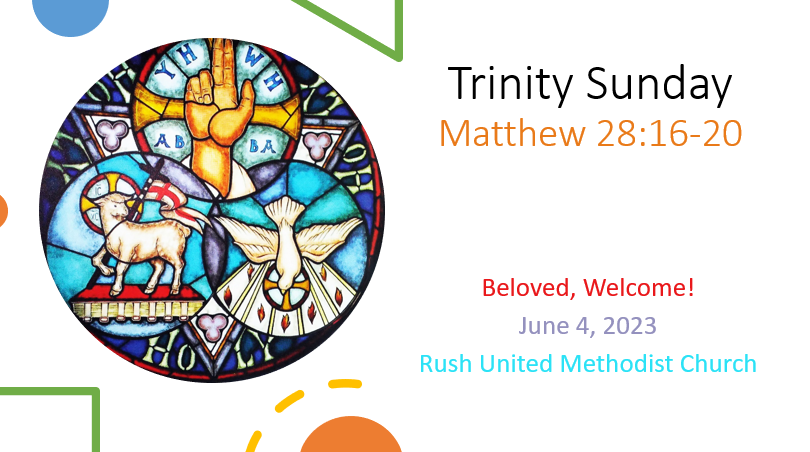
“Trinity”

Matthew 28:16-20

June 04, 2023

The Rev. Todd R. Goddard, Pastor

Rush United Methodist Church

Matthew 28:16-20

Now the eleven disciples went to Galilee, to the mountain to which Jesus had directed them. When they saw him, they worshiped him; but some doubted. And Jesus came and said to them, “All authority in heaven and on earth has been given to me. Go therefore and make disciples of all nations, baptizing them in the name of the Father and of the Son and of the Holy Spirit, and teaching them to obey everything that I have commanded you. And remember, I am with you always, to the end of the age.”

| Centering Prayer |

According to the Greek philosopher and mathematician, Pythagoras,

Three was considered the perfect number,

The number of harmony, wisdom, and understanding.

(Google search “meaning of three”)

There are three, wonderful creation stories in the Bible;

each serving a vital purpose.

Genesis 1:1-2:3, (which we read from this morning)

Genesis 2:4-25.

John 1:1-18.

Our God is a god of creation

as revealed through our scriptures

from before time,

up to, and including, today.

God is just as creative now

as God was on the first day.

“In the beginning,”

as the book of Genesis so majestically begins,

“when God created the heavens and the earth,

the earth was a formless void and darkness covered the face of the deep,

while a wind from God swept over the face of the waters.”

(Genesis 1:1-2)

The Wind,

known in the Hebrew as RUHAH,

was the Spirit of God

from the beginning of time.

In the second story of creation found in Genesis 2,

RUHAH makes yet another appearance:

“then the Lord god formed man from the dust of the ground,

and breathed into his nostrils the breath of life;

and the man became a living being.”

(Genesis 2:7)

The Spirit of God

fills our lungs

and gives us life.

The Spirit was, is, and will forever be,

that which gives us life,

life abundant.

In John masterful Gospel we hear,

“In the beginning was the Word,

and the Word was with God,

and the Word was God. He was in the beginning with God.

All things came into being through him,

and without him not one thing came into being.

What has come into being in him was life,

and the life was the light of all people.

… And the Word became flesh and lived among us.”

(John 1:1-4, 14)

The Word and God are one;

one in creation,

and one in the Spirit.

And the Word became Jesus

and dwelt among us.

Today is Trinity Sunday.

For history buffs,

Trinity Sunday is a day so designated by pope John XXII

who reigned from 1316-1334,

instituted as a universal feast

in honor of the Most Holy Trinity.

Also known as Whitsunday

By our Eastern Orthodox sisters and brothers,

Trinity Sunday continues to be celebrated almost 800 years later,

being deeply rooted in scripture,

our tradition,

and our experience.

The Doctrine of the Trinity is a foundational,

essential statement of Christianity.

It is unique to Christianity;

Islam and Judaism have

no similar statements of faith or

similar understandings of the Divine.

Unitarians and Jehovah Witnesses find it deplorable.

Foundational beliefs about our common belief

In a triune God was defined at the Council of Nicea in 325 A.D.,

Affirmed at Constantinople in 381 A.D,

And, therefore, it is imbedded in the Nicene Creed and the Apostles’ Creed.

The early church Fathers looked to the four Gospels,

Paul’s letters- known as epistles,

written to the churches he helped establish,

and weighed scripture with their own experience

to formulate this doctrine.

They focused on our Gospel passage for today,

the command of Jesus

to baptize in the name of the Father, Son, and Holy Spirit,

Trinitarian Baptism became a guiding principle in their work.

We baptize because Jesus told us to.

We baptize in the name of God our Father, Son, and Holy Spirit

Exactly as directed.

We teach newly baptized Christians the same content Jesus had taught his disciples,

Because we are faithful in following Christ’s commands.

This effort corrected some communities of faith

that had practiced baptizing in the name of Jesus only.

Being baptized in the name of the Father, Son, and Holy Spirit

indicates a new relationship,

a rebirth,

an adoption

involving all three faces of the Trinity.

[Richard Niell Donovan, copyright 2002, www.lectionary.org]

Simply stated,

“Christians believe that God is revealed (sic.) in three persons:

God the Father,

God the Son (Jesus),

and God the Holy Spirit (or Holy Ghost),

but these three persons are one and indivisible.”

[Dictionary of Christian Lore and Legend, JCJ Metford]

God in three persons,

persona in the Greek,

as in one actor on the stage

using three different masks to describe

the inner, dynamic, communal life of the Trinity.

Our own doctrine,

As found in Our Doctrinal Standards and General Rules

from The Book of Discipline of the United Methodist Church, state

“There is but one

Living and true God,

Everlasting,

Without body or parts,

Of infinite power, wisdom, and goodness;

The maker and preserver of all things,

Both visible and invisible.

And in the unity of this Godhead

There are three persons,

Of one substance, power, and eternity-

The Father, the Son, and the Holy Ghost.”

[The Book of Discipline, Year 2016, P.104. Section 3]

To talk in terms of Trinitarian language

means that we believe in the God of history;

as revealed to us in the history of Israel,

the works and acts of Jesus Christ as recorded in the Gospels,

and through the works of the Holy Spirit

empowering and sustaining the work of the faithful in the Church.

God, as the loving Father,

created in the first day,

and continues to create with us

in every subsequent day.

God, as the human Son Jesus Christ,

experienced the fullness of humanity,

established an example for Christian living,

forgave us our sins,

saves us into eternal life,

ascended into heaven,

and commissioned us to make disciples of all the world.

Jesus is the sole source of our redemption and salvation.

God, given to us as Spirit,

is God with us,

in every breath we take and in every deed we accomplish.

The Holy Spirit is with us

and in us.

To speak in Trinitarian language

we recognize the value of a tripart balance in the world

between God, humankind, and creation.

We speak in terms that value relationships;

an intimacy with God

and a commitment to one another.

In our politically correct world,

there has been efforts

to change the way we think and believe in terms of God as Father.

Often, Father is seen in terms of alpha male,

the dominant,  

too often, the abuser,

one who is quick to violence.

Often Trinitarian language will be substituted

with Creator, Redeemer, and Sustainer

– which speak to the works of the Godhead,

but not the identity of God.

A word of caution.

Before we abandon the words and commands of Jesus;

before we walk away from centuries of shared tradition and history;

perhaps we should consider

changing the way we think about fathers in society today.

Perhaps we should seek to restore fatherhood

into an institution of goodness, love, and forgiveness

– the way that God meant it to be.

York Peppermint Patties had a wonderful marketing tag line:

“It feels like I just bit into a York Peppermint Patty!”

It expresses the feeling of fresh,

A memory renewed with every bite,

The potential for future discovery or novelty.

When I come to recite the traditional Trinitarian formula,

“in the name of the Father, Son, and Holy Spirit,”

either in worship or in private prayers or devotion,

I like to think of it as like biting into a York Peppermint Patty!

A Trinitarian invocation provides a fresh recollection of God,

how God has acted throughout salvation history,

how God has been experienced in my own life, faith, and experience,

how God continues to work in the world today.

It is a renewal of the promise

that God will continue to be with us

“always, to the end of the age”

(Matthew 28: 20b),

just as God has been with us since the beginning of creation

when God traced our profiles,

man and woman,

created in the near image of God.

“God saw everything that he had made, and indeed, it was very good.”

(Genesis 1:31)

Speaking aloud Father, Son, Holy Spirit

is a reaffirmation of our covenant with God,

who formulated covenant with Abraham

– the Lord our God shall be our God, and we shall be His people.

It is an acceptance of the redeeming and saving acts of Jesus

done for our benefit.

It is an acknowledgment that the Holy Spirit is alive and well,

empowering disciples and churches today,

giving life to you and me and this great Church.

Reflection and prayer

focused upon the Trinity

is a great place for the new Christian to begin a life of faith.

The Trinity is a rich doctrine of faith

A diverse means of attracting and discipling

The naturalist,

The humanist,

The experiential.

The depth and breadth of Trinitarian doctrine

Can lead the matured Christian to reconsider and deepen faith.

My beloved,

today I invite you to join me in my belief,

solely by faith,

that in the “unity of this Godhead there are three persons,

of one substance,

power,

and eternity

– the Father, the Son, and the Holy Ghost.”

The Word of the Lord.

Thanks be to God.

Amen.

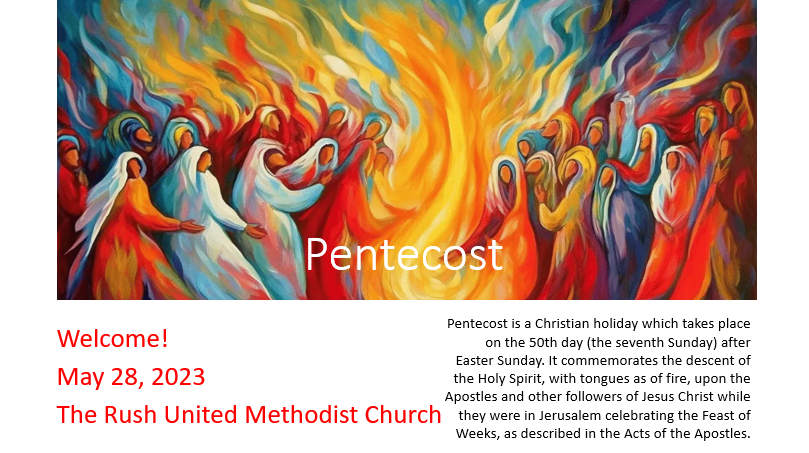
“Red!”

Acts 2:1-21

Pentecost – May 28, 2023

The Rev. Todd R. Goddard, Pastor

Rush United Methodist Church

Acts 2:1-21

When the day of Pentecost had come, they were all together in one place. And suddenly from heaven there came a sound like the rush of a violent wind, and it filled the entire house where they were sitting. Divided tongues, as of fire, appeared among them, and a tongue rested on each of them. All of them were filled with the Holy Spirit and began to speak in other languages, as the Spirit gave them ability.

Now there were devout Jews from every nation under heaven living in Jerusalem. And at this sound the crowd gathered and was bewildered, because each one heard them speaking in the native language of each. Amazed and astonished, they asked, “Are not all these who are speaking Galileans? And how is it that we hear, each of us, in our own native language? Parthians, Medes, Elamites, and residents of Mesopotamia, Judea and Cappadocia, Pontus and Asia, Phrygia and Pamphylia, Egypt and the parts of Libya belonging to Cyrene, and visitors from Rome, both Jews and proselytes, Cretans and Arabs—in our own languages we hear them speaking about God’s deeds of power.” All were amazed and perplexed, saying to one another, “What does this mean?” But others sneered and said, “They are filled with new wine.”

But Peter, standing with the eleven, raised his voice and addressed them, “Men of Judea and all who live in Jerusalem, let this be known to you, and listen to what I say. Indeed, these are not drunk, as you suppose, for it is only nine o’clock in the morning. No, this is what was spoken through the prophet Joel: ‘In the last days it will be, God declares, that I will pour out my Spirit upon all flesh, and your sons and your daughters shall prophesy, and your young men shall see visions, and your old men shall dream dreams. Even upon my slaves, both men and women, in those days I will pour out my Spirit; and they shall prophesy. And I will show portents in the heaven above and signs on the earth below, blood, and fire, and smoky mist. The sun shall be turned to darkness and the moon to blood, before the coming of the Lord’s great and glorious day. Then everyone who calls on the name of the Lord shall be saved.’

| Centering Prayer |

Red is my favorite color.

It has always been my favorite color.

And it will always be my favorite color.

As a child I fell in love with

fire engines.

Deep red.

A fire engine that wasn’t red just wasn’t a fire engine.

Unmistakable.

Unique.

No other vehicle on the road is that color.

Fire engines were to be respected,

breathed in fire, and

torqued out raw horsepower.

Real men ran fire engines.

Developing through the various children’s leagues of organized baseball,

I took on allegiance to

the Cincinnati Red’s.

It wasn’t the players, coach, or city of Cincinnati

that captured the imagination of a boy

from upstate New York.

It was the fact that they were the Red’s;

the Big Red Machine spoke to my soul!

Rose, Bench, Griffy, Parez, Conceptione, Morgan…

baby, they were Reds!

In seminary,

working towards my Master’s degree,

I was exposed to the basics of psychological testing.

I was intrigued by a number of questions on the MMPI,

the Minnesota Multiphasic Inventory,

which inquired about the color red.

I was told that people who tend to be attracted to red

often had some type indicators

which often present with schizophrenia.

I remember smiling,

holding my teeth together,

telling my mentor that I liked blue,

but knowing deep in my heart I am Red!

RED!

In the final weeks of my appointment as the associate pastor of

the Canandaigua UMC,

Summer 1991,

I decided to go out with a bang!

For Pentecost Sunday,

I ordered $4,000 worth of specially screened red tee shirts to hand out to worshippers.

And red we became!

It was glorious!

Leading worship for a congregation that appeared to be on fire with the Spirit.

It is only by the grace of God

that people offered to pay for their individual shirts

and I wasn’t held personally accountable!

I love Red!

Red is the color of fire,

the flames of the Holy Spirit,

as symbolized with the icon of the United Methodist Church,

as depicted by the cross and flame before you today.

The flames of the Holy Spirit gave birth and empowered

the beginning of Christianity

in our narrative from Acts of the Apostles this morning.

Just as St. Luke began his gospel with the birth of our Savior,

so too does the author of both Luke and Acts

begin his narrative with a birth;

the birth of the Church.

Those early disciples felt the coming of the Holy Spirit.

“The Hebrew word ruah,

the Greek pneuma,

and the Latin spiritus all mean

“air in motion,” “breath ” or “wind.”

According to ancient language scholars

The root meaning of spiritus is “power.”

(John J. Pilch, The Center for Liturgy at Saint Louis University).

The early disciples experienced the power of the Holy Spirit,

coming to them with divided tongues,

as of fire,

resting on each of them.

They were filled with the Spirit of God

and began to speak in all the languages of earth.

As the impious generation thousands of years earlier

erected a high tower called Babble,

and so brought about the division of the human race into many language groups,

at Pentecost, by contrast,

the piety of believers brought all these diverse languages into the unity of the Church.

Saint Augustine wrote

“What discord had scattered,

love was to gather together.

Like the limbs of a single body,

the separated members of the human race

would be restored to unity

by being joined to Christ their common head,

and welded into the oneness of a holy body by the fire of love.”

(Augustine)

“Ah,” the critics sneered, “They are filled with new wine.”

“No.

No, they are not,” Peter countered.

It is interesting that

the one who had denied Jesus three times only seven weeks earlier

is the one whose voice and stature rose above the crowd

and placed himself into a position to preach.

Peter begins by recalling the prophets of his Jewish foundation.

He recites Joel,

whose original prophecy to Israel was a pretense

of disaster and destruction.

However, for Peter,

Joel’s prophecy has been fulfilled in Jesus Christ himself,

“whose purpose is nothing less that the redemption of humankind.” (Cousar, Texts for Preaching: A Lectionary Commentary Based on the NRSV, Year C, 1994)

God’s judgment is no longer destruction.

God’s judgment is salvation,

a broken world redeemed, restored, recreated,

reunified with the Lord himself; that

“everyone who calls on the name of the Lord shall be saved.”

(Acts 2:21)

Peter probably had no idea

the implications of what he just spoke.

He was preaching to a thoroughly Jewish crowd.

He turned their religious life upside down.

No longer was faith accounted according to established orthodoxy:

the Torah, the Law,

and how righteously one observed the rules God put forth.

Now, faith is accounted

according to calling upon the name of the Lord;

bearing witnessing to Jesus Christ, the Son of God.

Yet, the Spirit had greater plans than Peter’s limited foresight.

The Spirit reached out to “all flesh,”

to Jews and Gentiles alike.

Oh, the scandal of the cross and empty tomb!

It wouldn’t be until the 10th chapter of Acts,

when Peter preaches to, converts, and baptizes

Cornelius and his host of Gentiles,

that Peter would begin to see the larger implications

of God pouring out His Spirit to “all flesh.”

The promise given by the Holy Spirit through Peter’s sermon,

that “everyone who calls on the name of the Lord shall be saved,”

became reality when Peter concluded his witness.

Everyone who

“welcomed his message were baptized,

and that day about three thousand persons were added.”

(Acts 2:41)

The first order of business for the disciples was proclamation.

Through witness and testimony,

disciples of Jesus were transformed into apostles of Jesus.

Following Peter’s sermon and the conversion of 3,000,

St. Luke reports in verse 42 that

“They devoted themselves to the apostles’ teaching and fellowship,

to the breaking of bread

and the prayers.”

(Acts 2:42)

The Holy Spirit fueled the revival,

provided all the energy necessary to kick the early Church into afterburners.

The apostles taught from their firsthand, eyewitness experience

about the life, passion, death, resurrection and ascension of Jesus.

The apostles taught from their Jewish experience

how Christ had impacted it, and

how their lives had changed as a result of Jesus.

The apostles spread their witness,

first to Jerusalem,

then to Judea and Samaria,

then to the ends of the earth,

just as Jesus had directed

immediately preceding his ascension into heaven.

What then

are we to glean from today’s

historical account of the coming of the Holy Spirit,

giving birth to the body, known as the Church?

What does it mean to me?

How does it impact my life today?

1. The Holy Spirit is a Spirit of Revival.

God is not content with leaving things the way they are.

God wants revival, renewal, a change of heart;

nothing less than the complete transformation of society.

We pray for Thy Kingdom to Come,

yet we act like we want to keep everything just the same.

The Holy Spirit of God fuels revival;

changed hearts, changed lives, a changed world.

Silent contentment smothers the Spirit;

chills it’s red flames with blue ice.

If God wants a revived, changed society,

then we should, too.

If God wants a revived, transformed church,

then we must open our hearts and submit our will.

Our passion for divine transformation

should burn red with desire,

as a fire in our bellies,

deep within our souls.

2. The Holy Spirit is given to all flesh;

that means you and me.

Pentecost reverses the curse of Babel.

The Holy Spirit of God comes in every language,

to every race,

through every culture,

to you and to me.

Though we are removed some 50 generations and half a world away,

the Holy Spirit is given to you and to me-

if only we claim it.

If only…

What a shame it would be

to leave the Holy Spirit unclaimed in our lives,

to allow it’s power to go untapped,

to enable the further secularization of the church.

What a shame it would be to leave the Holy Spirit unclaimed in our lives,

to allow ourselves and grow content with the way life is.

God wants to change the way life is!

God wants to transform your life and mine!

God wants to fuel our efforts on His behalf to transform the world,

to bring about His kingdom on Earth as it is in heaven.

The Spirit is given to you and to me

to make it happen.

3. God’s judgment is no longer destruction. God’s judgment is salvation. Let us never grow tired of this message.

This is the heart of God!

God’s desire is for us to keep ourselves attached to Him,

to graft our lives into his Divine nature,

to be united and joined together as the Body of Christ to the Body of Christ.

God sent us his Son, Jesus,

NOT to condemn the world,

But that the world might be saved through him.

(John 3:17)

We destroy ourselves when we separate ourselves from the Body of Christ,

when we allow ourselves to fall away from the refining fire of His love,

when we cut ourselves off from the fellowship of His Holy Spirit.

This is Hell,

when we separate ourselves from God.

“Turn back, O Man,”

and accept God’s gracious gift

of redemption and salvation

for your own life.

God wants you to be joined to him for eternity.

4. Finally, Proclamation is essential.

I remember listened to an interview with Peter Gomes many years ago,

(Plummer Professor of Christian Morals

and Pusey Minister in the Memorial Church at Harvard Divinity School).

Dr. Gomes said point blank

that he preaches for 35 minutes or more each Sunday.

Why should I be limited to 12 minutes

when we are dealing with the eternal nature of people’s souls?

The Word is life- eternal life.

We must join ourselves with the early apostles

and proclaim the witness that has been passed on to us.

Jesus died for our sins.

Jesus rose from the dead to give us eternal life.

Artificial Intelligence, or AI, is all the rage.

When asked to summarize the New Testament,

The AI response is right from the Gospel of John:

God so loves the world

“that He gave His only begotten Son,

that whosoever believes in Him,

shall not perish, but have eternal life.”

Believe it! Preach it!

Witness to it!

It is a matter of life or death;

eternal life or death.

The divine redemption and eternal disposition of the world

is dependent upon you witness, and mine.

Dearly beloved,

Red is not dead!

Red is alive and thrives!

We have been given the gift of the Holy Spirit.

It has been poured into the church.

It breaths and blows.

It rushes like the wind.

The Spirit is the red hot refining fire, tempering us, the Church,

to proclaim our witness to all the world.

May we receive it.

May we claim it.

May it empower us.

May we proclaim it.

“That everyone who calls on the name of the Lord shall be saved.”

Amen.

“Facing the Roaring Lion”

1 Peter 4:12-14, 5:6-11

Sunday, May 21, 2023

The Rev. Todd R. Goddard, Pastor

Rush United Methodist Church

1 Peter 4:12-14, 5:6-11

Beloved, do not be surprised at the fiery ordeal that is taking place among you to test you, as though something strange were happening to you. But rejoice insofar as you are sharing Christ’s sufferings, so that you may also be glad and shout for joy when his glory is revealed. If you are reviled for the name of Christ, you are blessed, because the spirit of glory, which is the Spirit of God, is resting on you. Humble yourselves therefore under the mighty hand of God, so that he may exalt you in due time. Cast all your anxiety on him, because he cares for you.

Discipline yourselves, keep alert. Like a roaring lion your adversary the devil prowls around, looking for someone to devour. Resist him, steadfast in your faith, for you know that your brothers and sisters in all the world are undergoing the same kinds of suffering.

And after you have suffered for a little while, the God of all grace, who has called you to his eternal glory in Christ, will himself restore, support, strengthen, and establish you. To him be the power forever and ever. Amen.

| Centering Prayer |

I cannot tell you why.

I’m only able to report to you

That which comes from my own personal experience:

I find great interest in the war in Ukraine.

Each evening

I watch YouTube for the latest developments

From the BBC and other international news outlets,

From domestic news sources,

From respected political scientist and historians, and

With much caution,

From individuals who have proven over time

Their front row seats to the conflict and

Their accurate assessments of events unfolding around them.

The geopolitics, expert analysis, technology, and 4K video

Keeps the war interesting, yet, sterile,

Beyond arm’s length,

Reducing the violence, tragedy, and suffering to

A screen reflecting suffering half a world away,

A podcast strong on subject but weak on context,

Rumbling sounds of artillery,

Images of graveyard services,

Processions led by orthodox priests,

Surrounded by mounds of graves decorated in national colors.

Propaganda is as real as water is wet.

Eyes wide open is only the first step in critical thinking.

Why are humans murdering each other? with such efficiency?

What are the Russians and Ukrainians thinking?

Perhaps we are not so evolved after all.

Follow the money, I warn myself;

Where does the money come from?

And where does the money go?

Will money follow failure?

Or does money always follow success,

Regardless of the moral high ground?

Has the Russian offensive failed?

When will the promised Ukrainian offensive begin?

Old, Russian grandmothers stating to correspondents on Moscow’s streets that the war is necessary.

Old, Ukrainian grandmothers from Kherson crying over the deaths of husbands, sons, grandsons.

The opening words of the Apostle Peter

Will be received differently

From civilians caught in the cross-fire of an existential struggle

Then from you and me.

“Beloved,” Peter begins.

Take note Lay Leaders and members of the Leadership Ministry Team

Church leadership

Begins and ends with love.

“Beloved, do not be surprised at the fiery ordeal that is taking place among you,” (present tense).

No surprise; for you were forewarned.

Jesus told you it was coming.

“It” being the “fiery ordeal.”

He even gave you the gift of the Holy Spirit

To endure,

To guide,

To ensure victory.

Fiery ordeal.

Quite the description of the predicament of the Early Church.

Promised.

Delivered.

Martyrdom was the reality

For first century Christians gaining a toe-hold in modern day Turkey.

It is

Collateral damage for those hunkered down in the trenches of the Donbas.

Pain; chronic pain.

Emotional, physical, spiritual.

Withered, shattered limbs, memory impairments, hardened livers.

Broken relationships, separation and divorce, death and grief, estrangement.

Broken lives.

Rock bottom.

The kaleidoscope of fiery ordeal

Is dependent upon circumstance, experience, perspective.

Fiery, destructive, and fully consuming,

Non-the-less.

….

Take the collective suffering of the world,

Compare and contrast with the pain Christ suffers,

“so that you may be glad and shout for joy when his glory is revealed.”

When.

Future tense.

A promise.

Hope.

Hope that is meant to be our daily bread,

Sustaining us

for this day of hunger and spiritual suffering,

With the promise that God will provide

More bread for tomorrow.

Purpose? You ask.

To make you glad and joyous, Peter replies.

Moping around?

Feeling sorry for yourself?

Grumpy? Grumbling? Complaining? Gossiping?

Undermining? Hurting? Destroying? Oppressing?

Awash with arrogance? Pride? Self-esteem?

Discontented? Malcontented?

Suffering anger that just won’t let go?

If life isn’t filled with joy and gladness, Peter observes,

The cross becomes a lie

And the empty tomb becomes a broken promise;

Grace denied,

Grace unrealized,

God gift unclaimed.

Happy?

Got joy?

Assess thyself.

Make corrections, as necessary.

That’s how to live

The life of faithfulness,

The abundant life promised by Peter,

Paid for by Jesus,

Fulfilled by our loving Father.

….

Oh, the anxiety of this age!

Oh, the suffering that humankind endures!

The Apostle Peter

Provides additional insights into the nature of God,

How we are to live,

And the danger we face. 

1. Our God is a god of love, who calls us beloved.

You are loved, good, bad, or indifferent, warts and all.

Accepted or rejected?

It doesn’t matter.

Your past indiscretions?

It doesn’t matter.

God loves you anyways.

God loves you in spite of yourself.

God love you just the way you are.

2. Our God blesses us
by sending us his Spirit
to take up residence in our lives.

The Holy Spirit moves in.

You’ve got a divine roommate.

It takes intentional effort to learn to live with a divine partner.

It takes a thoughtful, disciplined life to lead a life that is Spirt filled.

3. Our God cares for you.

What you do.

Who you are.

How you live. 

God notices.

God cares.

God cares and always desires your wellbeing,

Always.

Everywhere.

Without exception.

What is to be our response, according to Peter?

1. Rejoice!

Be glad for what God has done

And what God is doing for you.

Break out the sunshine.

Bring the joy of the Lord

To every room you enter,

To everyone you meet.

As you depart every room

Leave everyone with the aspiration that

“I want what he/she has.”

2. Be humble!

In due time, you will exalt,

You will crow like a pre-dawn rooster,

You will proclaim the glory of the Lord

Far and wide

To all who will listen.

Humility implies submission;

Submission to our higher power,

A willingness to place God’s will before our own.

3. Be calm.

Cast away anxiety.

Turn your life over completely to the care of God.

Calm awaits the faithful

Who are able to place trust completely

in God’s will, direction, and power.

Surrender entirely to the will of God.

Abandon completely

my will for Thy will.

4. Be disciplined.

Set a spiritual routine and stick to it.

Pray. Meditate. Listen. Learn.

Watch and listen for the essential truth of God

to speak to you through the reading of scripture.

Worship.

Service work. Mission work.

Love. God and neighbor.

A disciplined life is a predictable, routine life.

The good thing about a rut is when you’re in it you know where you are going.

Get in the rut of a disciplined life.

What are the dangers we face?

1. Keep alert because the devil is like a ravenous, roaring lion.

Hungry,

Ready to gorge and devour

The moment our attention wanes.

Hungry is the destroyer,

Who’s appetite can never be satisfied.

To roar is to intimidate, to communicate, to initiate.

Stand firm.

Denounce evil and speak truth without exception.

Parry the thrusts of evil slings and arrows

Remaining confident in the strength of the Lord,

And the strength the Lord has already given you.

2. Check evil with good.

Destroy darkness with light.

God wins, all the time.

Know it.

Live it.

Roaring is a call for reinforcements,

An acknowledgement of inadequacy.

When the devil roars in your life,

Consider it a pitiful cry for help,

Not an effort to induce terror.

Roaring is the herald that initiates kinetic warfare between evil and good.

Claws come out.

The lion makes ready the pounce,

Ready the assault.

The signs align to tip the hand,

That gives good the winning advantage.

The Godly read the signs and adjust accordingly.

3. Strengthen faith.

Train hard.

Learn, practice, repeat the spiritual disciplines,

The practice of the faithful.

Do not grow weary, but grow powerful.

Build and win the heart and mind of our neighbors.

Build and win the heart and mind of our creator, redeemer, savior.

4. Resist.

Resist evil, as if your life depends on it.

Because it does.  

Resist evil, as was promised at your baptismal waters.

Resist the fear of the devil’s roar.

The devil’s roar is

As shallow as a discounted grave,

As phony as a circus sideshow or a politician’s promise,

As powerful as a snail being salted.

The promise, Peter emphasizes,

Is in a post-suffering world:

That Christ himself will

Restore you,

Support you,

Strengthen you, and

Establish you.

The tears left on your pillow this morning,

Due to the fiery ordeal of pain, grief, and suffering

Are replaced by God’s grace,

God’s gift

Of the Holy Spirit,

Of God’s love,

Of God’s promise.

Beloved,

Claim this gift for your own

And know the joy of the Lord,

Now and evermore.

Thank you, Lord,

For the gift of the Apostle Peter,

His words and encouragement these Sundays in Easter.

May his correspondence with the first century Church

Remain an inspiration to us today.

Amen.

“Better to Suffer”

1 Peter 3:13-22

May 14, 2023

The Rev. Todd R. Goddard, Pastor

Rush United Methodist Church

1 Peter 3:13-22

Now who will harm you if you are eager to do what is good? But even if you do suffer for doing what is right, you are blessed. Do not fear what they fear, and do not be intimidated, but in your hearts sanctify Christ as Lord. Always be ready to make your defense to anyone who demands from you an accounting for the hope that is in you; yet do it with gentleness and reverence. Keep your conscience clear, so that, when you are maligned, those who abuse you for your good conduct in Christ may be put to shame. For it is better to suffer for doing good, if suffering should be God’s will, than to suffer for doing evil.

For Christ also suffered for sins once for all, the righteous for the unrighteous, in order to bring you to God. He was put to death in the flesh, but made alive in the spirit, in which also he went and made a proclamation to the spirits in prison, who in former times did not obey, when God waited patiently in the days of Noah, during the building of the ark, in which a few, that is, eight persons, were saved through water.

And baptism, which this prefigured, now saves you—not as a removal of dirt from the body, but as an appeal to God for a good conscience, through the resurrection of Jesus Christ, who has gone into heaven and is at the right hand of God, with angels, authorities, and powers made subject to him.

| Centering Prayer |

“Better to suffer

for doing good,” the Apostle Peter

Teaches his peeps.

Most of us know firsthand suffering for being bad.

My father taught me suffering for bad behavior

In the pre- anti corporal punishment days. 

Um. Yeah. His belt was useful

for more than

keeping his pants up.

(Dad’s; don’t. Just don’t.

Not unless you want to go back to

Living without indoor plumbing, or

Listening to RCA radio hour Sunday evenings.

Learn and practice

better alternatives

to corporal punishment.)

Be better.

“Better to suffer for doing good,” the Apostle Peter teaches.

This is a

Lesson that stands the test of time.

An Irondequoit Town judge taught me to suffer a $250 fine

For speeding on the Bay Bridge a number of years ago.

At least

the district attorney appeared sympathetic

To my pitiful, less-than-fully-forthcoming defense

citing the newness of my new

Subaru’s adaptive cruise control.

The judge; not so much.

I’m confident my insurance company never got the memo, either.

“Go easy on Todd,” I was willing the judge with all my telepathic powers.

“He is an honest guy. Really, he is,” I thought, while forcing a smile.

“He is a preacher. You know, trying to make the world better.”

“He doesn’t have money for a big fine.”

“He’s not like those people, over there.”

“Please, Lord. Let me off with a warning and I’ll never speed again.”

Lying to myself and to my God

Becomes quick the habit and

The downfall of humankind.

“Suck it up and own it, Todd,” my better conscience appealed.

Deep within

is a tendency to

Make every effort to wiggle out from responsibility,

Imagine unsurmountable difficulties,

A reluctance to face my own flaws with absolute honesty,

And an unwillingness to seek God’s strength, guidance, and assistance …

Until no other avenue is left available.

When no other options are on the table

Then, and only then, do I plead as a last resort,

“Lord, Jesus Christ,

Son of God,

Have mercy on me,

A sinner.”

(See Jesus Prayer, or The Prayer, at Wikipedia dot com)

“Better to suffer for doing good,” Peter teaches,

“than to be caught lying like a dirt bag,” I would add,

“because of the

shame

that dishonesty brings

To Jesus,

Our faith, and

Our call.”

The short of Peter’s message is

“do good!”

This is Peter’s answer to the question posed by many

Former Jewish,

Newly minted Christians,

Deployed to modern day Turkey in the first hundred years following the ascension of Jesus,

With a mission to witness to his resurrection

And an invitation to become his disciples.

Jesus.

Witness.

Invite.

“How are we to live?”

Step One: do good.

To do

Is to be active,

Not passive.

Take the initiative.

Don’t wait for others to step up, speak up, or act out.

Lead the way or get out of the way.

And, for goodness sake,

Don’t criticize people who do

Good.

With Jesus

It is active faith

Or, it is dead.

It is a relationship with Jesus

Or, it isn’t.

It is bearing fruit

Or, it is being pruned, cut, cast out, and burned with unquenchable fire.

Do,

Don’t just be,

Hoping to slide in under the radar of God’s judgment.

Failure to do good

Is just as bad as doing wrong, Peter implies.

Sitting on a fold-out picnic chair,

popping an umbrella, and

pouring yourself a beverage

For a front row seat to watch the world burn

Is not where any disciple of Jesus

Wants to be found.

Refuse to fail.

Resolve to fight for Christ,

Not with arms,

But with grace and love.

Fight for Christ until the bitter end;

Either the consummation of time

– Thy kingdom come, on earth as it in heaven –

Or, until Jesus returns in glory,

Just as he promised.

Do good.

Peter outlines the necessary characteristics

For Christians to do good.

Doing good begins with: make Jesus Christ your Lord,

The Apostle Peter writes. (3:15)

Everything else in heaven and earth

Is subjugated to our allegiance and fidelity to Jesus.

Everything else wins second place,

Gets a nice ribbon for runner up,

Becomes eligible for a participation award,

And a second to last page photograph in the

Mendon Honeoye Falls Lima Sentinel.

Christ alone

do we sanctify

as Lord and Savior.

Do good.

Do

this awesome, divine goodness

Without fear or intimidation (3:14)

With transparency and a willingness for audit (3:15)

With gentleness and reverence, and

With a clear conscience. (3:16)

The suffering we face doing good

Is the same suffering Christ experienced in dying

For the sole and solitary purpose

Of bringing you and me to God. (3:18)

That whole Noah and the ark story?

Yeah, it saved eight persons.

Whoop-de-(frikken)-do.

(No, I’m not going to say that from the pulpit)

You can almost imagine Peter counting the survivors of Noah and the flood on his fingers.

At best, Noah and the ark

Amounted to triple A ball,

With a complementary rainbow desert.

Jesus, however, is a completely different story, a horse of a different color.

God ascends to the top of the major leagues.

He suffers, dies, and is resurrected from the dead

For all humankind,

To bring every individual to God,

To forgive, wash clean,

And to save, eternal life

To all who will claim it.

Jesus,

Redemption and salvation,

Is dressed in pinstripes,

In 7th game of the world series,

Bottom of the nineth inning,

Two outs,

Game tied,

Kind of at-bat. 

Jesus was, and is,

The pivoting chapter in salvation history

When God stepped into the batter’s box

And made a Louisville Slugger statement for the ages.

Do the right thing,

Regardless of outcome or consequences.

When we do the right thing,

Always and everywhere,

We are freed from the suffocating house of cards

Known as dishonesty, lies, and bald-faced lies,

Expending unnecessary energy to maintain the untenable,

To keep every plate spinning,

In spite of the knowledge that

Eventually every plate falls.

Every lie shatters.

Every house of cards comes tumbling down

Under its own weight.

Do the right thing,

Regardless of outcome.

Be blessed,

Or be cursed.

Rest secure in knowing

You’ve done your best

To do the right thing.

Then, gather up

all your will, and

leave the rest up to God.

Amen.