“The Spirit of Truth”

Acts 2:1-4, 14, 16-21 and John 15:26-27 & John 16:4b-15

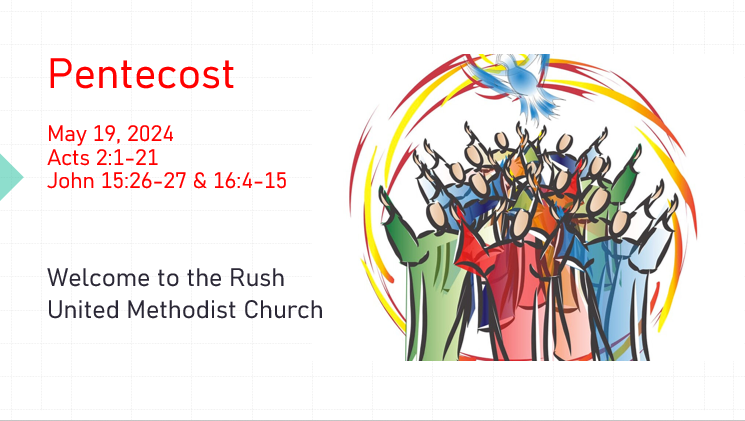
Pentecost

May 19, 2024

The Rev. Todd R. Goddard, Pastor

Rush United Methodist Church

Acts 2:1-4, 14, 16-21 (http://bible.oremus.org/?ql=393565860)

When the day of Pentecost had come, they were all together in one place. And suddenly from heaven there came a sound like the rush of a violent wind, and it filled the entire house where they were sitting. Divided tongues, as of fire, appeared among them, and a tongue rested on each of them. All of them were filled with the Holy Spirit and began to speak in other languages, as the Spirit gave them ability.

But Peter, standing with the eleven, raised his voice and addressed them, “Men of Judea and all who live in Jerusalem, let this be known to you, and listen to what I say. No, this is what was spoken through the prophet Joel: ‘In the last days it will be, God declares, that I will pour out my Spirit upon all flesh, and your sons and your daughters shall prophesy, and your young men shall see visions, and your old men shall dream dreams. Even upon my slaves, both men and women, in those days I will pour out my Spirit; and they shall prophesy. And I will show portents in the heaven above and signs on the earth below, blood, and fire, and smoky mist. The sun shall be turned to darkness and the moon to blood, before the coming of the Lord’s great and glorious day. Then everyone who calls on the name of the Lord shall be saved.’

John 15:26-27, 16:4b-15 (http://bible.oremus.org/?ql=393562159)

“When the Advocate comes, whom I will send to you from the Father, the Spirit of truth who comes from the Father, he will testify on my behalf. You also are to testify because you have been with me from the beginning. But I have said these things to you so that when their hour comes you may remember that I told you about them. “I did not say these things to you from the beginning, because I was with you. But now I am going to him who sent me; yet none of you asks me, ‘Where are you going?’ But because I have said these things to you, sorrow has filled your hearts.

Nevertheless I tell you the truth: it is to your advantage that I go away, for if I do not go away, the Advocate will not come to you; but if I go, I will send him to you. And when he comes, he will prove the world wrong about sin and righteousness and judgment: about sin, because they do not believe in me; about righteousness, because I am going to the Father and you will see me no longer; about judgment, because the ruler of this world has been condemned. 

“I still have many things to say to you, but you cannot bear them now. When the Spirit of truth comes, he will guide you into all the truth; for he will not speak on his own, but will speak whatever he hears, and he will declare to you the things that are to come. He will glorify me, because he will take what is mine and declare it to you. All that the Father has is mine. For this reason I said that he will take what is mine and declare it to you.

| Centering Prayer |

Exactly as Jesus taught

The Messianic Age ended!

He flew up into the air, hallelujah!

Jesus was the last, final messiah.

No need to wait for another.

Turn the page.

Exactly as Jesus promised

A new chapter in God’s unfolding salvation history began.

With Pentecostal fire

The Holy Spirit came upon and overwhelmed the obedient disciples,

Waiting in the Upper Room.

Thus began the age in which we continue to live to this day:

Welcome to the Holy Spirit Age.

The author of Acts reported what happened:

The Holy Spirit came with sound and heat,

Filling the entire house.

Sound filled the house:

“like the rush of a violent wind.” (Acts 2:2)

People who live in tornado alley would describe this

“like the sound of a freight train bearing down on them.”

Shelter in place, auntie Em! 

Heat filled the house:

“Divided tongues, as of fire, appeared among them, and a tongue rested on each of them.” (Acts 2:3)

Talk about running around with your hair on fire!

It’s like the house got blown down and set on fire.

As a result,

All “were filled with the Holy Spirit

And began to speak in other languages,

As the Spirit gave them ability.” (Acts 2:4)

No, they had not been drinking, as some speculated.

Peter set the record straight.

They were witnessing,

Just as Joel prophesized hundreds of years earlier.

Their multi-lingual witness

Revealed the coming of the Lord,

The presence of the Holy Spirit.

It was the dawn of a brand-new age.

As God came to earth as Son of God and Son of Man,

In the form of Jesus Christ,

God returned to the world as the Spirit,

The Advocate, the Paraclete, the Spirit of Truth.

The world had to know that God had returned to live among us;

Therefore, the message needed delivered in the languages of the world.

This explained what happened, on the day of Pentecost.

The question that begs to be asked is

“why?”

Why did Jesus leave his disciples and humanity behind?

Why did God return to humanity on Pentecost in the form of a Spirit?

Answering the “why?” question gives us insight

Into God’s motives;

God’s deep, longing desire

To love and save the world.

Scripture reveals three items that are essential for our understanding.

(It makes for a good three-point sermon, too!)

1. First, the Holy Spirit replaced Jesus

To transfer his power and authority to his Church.

“The Advocate will take what is mine and declare it to you,”

Jesus promises. (John 16:14)

The problem facing Jesus was

He was one man

Who could only be in one place

At one time.

His singularity

Limited his reach

And restricted his ability

To teach, heal, forgive and save

To only the individual directly before him.

God’s unfolding plan

Reveals the need for

The power and authority of Jesus Christ to scale

From the individual

To the global needs of humanity.

The transition from the Messianic Age to the Holy Spirit Age reveals

God’s deepest desire to spread his kingdom worldwide.

The power and authority of Jesus is available to all Spirit filled disciples.

When the Spirit fills us,

Starting with our baptism by water and Spirit,

We become the Body of Christ.

We assume the authority of Jesus.

And we are given the power of Jesus by the Holy Spirit,

With the responsibility to use it

According to God’s will.

2. Secondly, God’s work wasn’t completed in Jesus.

More needed done.

More needed taught.

Disciples need direction, guidance towards truth.

To this day

God’s will continues to be revealed,

Continues to adapt to the ground game,

Continues to adjust to the evolving needs of humanity.

As the world evolved, so too would God.

For scripture to be understood,

The Holy Spirit needs to flood the thoughts of the reader.

For the Gospel to be proclaimed,

The Holy Spirit needs to reveal its will to the preacher.

For the kingdom of God to be spread,

The Holy Spirit needs to empower advocates for

Justice,

Peacemaking,

And Social Holiness.

Jesus recognized the fact

That post-ascension apostles could not manage alone.

3. Lastly, in the final moments of Jesus’ instructions to his disciples,

He tells them that the Spirit must replace him,

To “prove the world wrong about sin and righteousness and judgment.” (John 16:8)

It would take the Spirit to do

That which Jesus was unable to do

In three key areas:

sin and belief,

righteousness in physical absence,

and judgment and condemnation.

For those who would be unmoved in believing or following Jesus,

Only the Holy Spirit would be able to bridge the gap,

And bring the unbeliever from the land of the lost

Into the kingdom of God.

For those who needed Christ’s physical presence

To prod their righteous behavior,

Only the Holy Spirit would be able to wheel them back into community.

Somehow, God still had to go after lost sheep.

For those whose self-judgment has opened the flood gates of self-condemnation,

Only the power of the Holy Spirit can save the condemned from drowning,

By extending forgiveness and the redemption of sins to the world.

Our Holy Spirit Age was a necessary transition

In our relationship with God,

And no one knew it,

Or could articulate it more accurately,

Than Jesus, himself.

The power and authority of Jesus

Had to be transferred to the Church

If Christianity was going to propagate the world.  

Disciples then, and every generation moving forward,

Depend upon the guidance and support of the Holy Spirit.

You and I; we couldn’t survive, let alone thrive, without the presence of the Spirit.

And the gift of the Holy Spirit of Truth,

Enlightens and brings to life the gifts of Jesus:

Forgiveness of sins,

Repentance,

And salvation.

Today we celebrate God’s gift of the Spirit,

A sign of his grace and overwhelming love

For you and me.

Thanks be to God!

Amen.

“Sent to Witness”

Luke 24:44-53

May 12, 2024 – Ascension of the Lord Sunday

The Rev. Todd R. Goddard, Pastor

Rush United Methodist Church

Luke 24:44-53 (http://bible.oremus.org/?ql=392965534)

Then he said to them, “These are my words that I spoke to you while I was still with you—that everything written about me in the law of Moses, the prophets, and the psalms must be fulfilled.” Then he opened their minds to understand the scriptures, and he said to them, “Thus it is written, that the Messiah is to suffer and to rise from the dead on the third day, and that repentance and forgiveness of sins is to be proclaimed in his name to all nations, beginning from Jerusalem. You are witnesses of these things. And see, I am sending upon you what my Father promised; so stay here in the city until you have been clothed with power from on high.”

Then he led them out as far as Bethany, and, lifting up his hands, he blessed them. While he was blessing them, he withdrew from them and was carried up into heaven. And they worshiped him, and returned to Jerusalem with great joy; and they were continually in the temple blessing God.

| Centering Prayer |

Blessings to all mothers,

To all who had mothers,

Mothers who lived up to the best of their ability

All the qualities

And the highest ideals

of a loving and nurturing motherhood.

Thank you, God, for mothers.

My own mother cried throughout my entire pregnancy, I’m told.

She cried because her obstetrician warned her that

She had endured three c-sections, but

She would not survive a fourth.

Her decision to continue my pregnancy

And not terminate my life meant

That she was willing to give her life that I might live.

Sacrificing your life that others might live.

I know the source of that love.

Thank you, God for mothers, flaws and all.

Not every mother is perfect,

That would be asking too much.

For some, a relationship with mom is complicated.

Today is a gift,

An emotional and spiritual opportunity to be reconciled,

To let loose God’s forgiveness, and

To be healed by God’s grace. 

Be sure to thank God for your mother

Before the sun sets this day.

—-

I have an announcement!

The Messianic Age is ended!

Hallelujah!

It’s done. Over. Long since gone.

Hallelujah!

With Christ’s ascension into heaven

The chapter of Jewish messianic expectation has been closed.

It was done.

All his disciples are told to stay in Jerusalem and wait

For the dawning of God’s next age to begin.

Sit tight.

Wait.

The new age is going to be awesome!

Our Jewish ancestors had plenty of reasons to watch and wait

For the messiah, the savior of the world, to come.

The promise of prophets Isaiah and Jeremiah

Echo back to Moses (see Deuteronomy 18:15-22);

That God was sending a savior to the world,

To redeem the world,

To fix the world of its original sin.

From scriptural authority,

Our ancestors anticipated

A human leader,

A blood line descendent from King David,

Sent by God with a plan

To reunify and gather together the tribes of Israel,

To remove foreign occupation,

To forgive sins and save the redeemed,

And to usher in an age of universal peace and God’s dominion.

The annunciation of Jesus in the Jerusalem Temple

Revealed Jesus as the much anticipated messiah,

Son of God, and descendent of David.

Of course, not everyone bought it,

Many still don’t.

But those of us who were his disciples,

And by our baptismal heritage his disciples today,

We know differently.

Jesus was the long-anticipated messiah;

That’s why we call him “the Christ,”

Literally meaning, Jesus the messiah.

Now, he had flown away,

Right out of their sight.

The wait must have been interminable,

Filled with anxiety and uncertainty.

Yet, Jesus had just opened their minds to the scriptures,

“that the Messiah is to suffer and to rise from the dead on the third day, and that repentance and forgiveness of sins is to be proclaimed in his name to all nations, beginning from Jerusalem.” (24:46b-47)

They knew the mission.

They knew the will of Jesus:

Begin with proclamations

Of repentance and forgiveness of sins in the name of Jesus

Starting right there in Jerusalem.

But, what’s next?

“Stay here in the city until you have been clothed with power from on high,” Jesus commanded. (24:49b)

Stay and wait.

Close one chapter.

Wait for the next chapter to begin.

Luke reports they passed the time

Worshipping Jesus and blessing God in the Temple.

He also tells us they chose a replacement disciple:

Matthias. (Acts 1:12-14)

Finally, Christ’s disciples understood.

No more secrets.

No more bumbling misunderstandings.

They knew what they had to do.

They just had to wait

To be clothed with God’s power.  

Our Lord’s band of brothers only had to sweat it out

Until Pentecost, for the coming of the Holy Spirit

(which we will celebrate next Sunday)

For the next chapter to begin.

The age of the Holy Spirit was about to begin.

Some might speculate that Jesus ascended to the Father

As some kind of reward for a job well done.

I see it differently.

I see the transition from one era to another

As a part of God’s unfolding, elegant plan

To love the world;

To set the table

For the Church to take root,

Experience explosive growth,

And spread throughout all nations.

When Christ dwelt among us,

He, and his small band of disciples, was the Church.

When Jesus became physically absent,

His body became the people who faithfully fulfilled his will

To witness to his death and resurrection.

His suffering and death had meaning;

Dying powerless,

At the same time, he took upon himself the sins of the world.

His resurrection had meaning;

Rising from the dead,

Eternal life given to all who believe.

Resurrection reveals cosmic power,

Divine power,

Power beyond human comprehension.

And now, in this new Holy Spirit age,

This divine power comes to all disciples.

We’ve become his body;

The Body of Christ,

Life drawn from the Holy Spirit,

A close up of a stone

Description automatically generatedWielding God’s power and authority.

One of the first crisis to hit the early Church

Was the failure of Jesus to return as they believed he promised.

There are a few in every generation who believe they are exceptional.

That Christ will return in bodily form

During their lifetime.

Many still believe this today.

Many a street preacher

And many tall steeple pastors

Will preach this very narrow assumption

Of our Lord’s physical return.

What could be wrong with Jesus flying back to earth

In an Elijah-like fiery chariot,

Leading the faithful in a victorious final battle of Armageddon;

Armies of righteousness bringing defeat to the devil and his minions,

Of good winning out over evil?

Second coming apocryphal images

Keep the mojo flowing

And, in my humble opinion, instill an unnecessary fear among the faithful.

Allow me to make this challenge.

Faith that is based on fear

Is not faith in a graceful and loving God.

Fear is a lousy motivator.

After a while, fear drains out

Leaving behind

Tears of disappointment and

A feeling of unfulfilled expectations.

Many have died in the Lord disappointed

That Jesus didn’t physically return during their lifetime.

The ascension of Jesus may be asking us

To broaden our field of vision,

Challenge our narrow and deeply engrained assumptions.

Let us consider a new way to contemplate the second coming of Jesus

In light of his ascension.

Allow me to ask,

Hasn’t Christ already returned?

Isn’t Christ present in his Body,

The communion of Saints,

The members of the faithful today

Who live Holy Spirit filled and sustained lives today?

Isn’t the Holy Spirit in this house today?

I’m suggesting that

both may be true:

Christ has returned by the presence of the Holy Spirit, and,

Christ will also come again,

In bodily form and in glory.

Christ has come!

That’s my witness.

And Christ will come again!

Scripture and the Christian journey lead me to believe

Christ has returned in the form of the Holy Spirit

That is present, powerful, and sustaining.

It is by the Spirit’s power

That we are able to preach repentance and forgiveness of sins,

That we are able to witness to the world the resurrection of Jesus.

We remain children of the Heavenly Father,

But now, we are God’s children living in the Holy Spirit age.

We have been given the mission to witness,

To proclaim in the name of Jesus

The repentance and forgiveness of sins.

We’ve been given the Pentecostal power and the authority

To witness to the world.

For we now, are the Body of Christ,

Redeemed by his blood.

Yes, Christ will come again.

He will come to greet each and everyone of us

With an outstretched hand

Welcoming each of us home into eternal life.

Christ coming again is our Lord’s most elegant fulfillment

Of his promise of eternal life.

In many ways,

The message and meaning of Christ’s ascension into heaven

Is more about us than it is about Jesus.

The ascension means

The messianic age has ended.

Jesus is gone.

He left.

But he left an open door.

The Holy Spirit comes at Pentecost

Ushering in a new age.

It’s now all on us

It’s up to us.

Where we are now the Body of Christ.

God gives us the power and authority,

But with it comes the responsibility to use it according to God’s will.

Dearly beloved,

Accept the responsibility.

Receive it with joy and thanksgiving!

Live faithfully according to Jesus’s commands and God’s will.

For we are now his body,

The Body of Christ.

Christ has come,

And Christ will come again.

Amen.

“Where there is Joy, there is Love”

John 15:9-17

May 5, 2024

The Rev. Todd R. Goddard, Pastor

Rush United Methodist Church

John 15:9-17

As the Father has loved me, so I have loved you; abide in my love. If you keep my commandments, you will abide in my love, just as I have kept my Father’s commandments and abide in his love. I have said these things to you so that my joy may be in you, and that your joy may be complete.

“This is my commandment, that you love one another as I have loved you. No one has greater love than this, to lay down one’s life for one’s friends. You are my friends if you do what I command you. I do not call you servants any longer, because the servant does not know what the master is doing; but I have called you friends, because I have made known to you everything that I have heard from my Father. You did not choose me but I chose you. And I appointed you to go and bear fruit, fruit that will last, so that the Father will give you whatever you ask him in my name. I am giving you these commands so that you may love one another.

| Centering Prayer |

I’d like to express my sincere thanks to Pastor Paddy

For covering for me the last two Sundays.

Paddy has been a friend and colleague for many years

And I’m always delighted when we can work together for God’s greater kingdom.

Thank you, Paddy.

Thank you to everyone who have showered me with prayers, cards, rides, and kindness.

Rehabilitation teaches me humility and gratitude.

Dependence upon others teaches me about my relationship with God.

Every thought.

Every prayer.

Every act of kindness is so appreciated.

Thank you.

Our Gospel for this morning is a continuation

Of last Sunday’s passage from John:

“I am the vine, you are the branches.”

(John 15:5)

Jesus is the vine.

You and I are the branches.

And our Heavenly Father is the Divine,

vine-growing Gardner.

This is a straightforward metaphor

With deep seeded implications.

When we make our soulful home in Jesus Christ,

– when we “abide” in Christ –

And since we keep His commandments,

To Love God and Love Neighbors,

Then we have joy,

– complete joy –

In our life.

Live in Christ.

Love God and Love Neighbors.

Be flooded with love and live in joy.

It’s that simple.

In my childhood

I attended vacation Bible school every summer.

Held at the Camp Street United Methodist Church in Jamestown, NY,

I can recall a hot, packed sanctuary

Filled with sweaty kids singing with gusto:

I’ve got the joy, joy, joy, joy,

down in my heart, down in my heart, down in my heart.

I’ve got the joy, joy, joy, joy, down in my heart to stay.

R: And I’m so happy! I’m so very happy!

I’ve got the love of Jesus in my heart!

And I’m so happy! I’m so very happy!

I’ve got the love of Jesus in my heart!

I’ve got the peace that passes understanding,

down in my heart, down in my heart, down in my heart.

I’ve got the peace that passes understanding, down in my heart to stay.

R: And I’m so happy! I’m so very happy!

I’ve got the love of Jesus in my heart!

And I’m so happy! I’m so very happy!

I’ve got the love of Jesus in my heart!

I’ve got the love of Jesus, love of Jesus,  

down in my heart, down in my heart, down in my heart.

I’ve got the love of Jesus, love of Jesus, down in my heart to stay.

R: And I’m so happy! I’m so very happy!

I’ve got the love of Jesus in my heart!

And I’m so happy! I’m so very happy!

I’ve got the love of Jesus in my heart!

If the essence of John 15, “I am the vine, you are the branches,”

Can be summed up in this simple children’s song,

Then, certainly, we should understand

The concept of Christ’s love and joy today.

Or, do we?

Many people are searching for love and joy these days,

Both inside and outside the Church.

Over the years,

I’ve taken notice of three different groups of people.

These different groups are not all inclusive of everyone in society.

I’ve just taking a keen interest in these three:

1) those who search for love and joy without a foundation of faith,

2) those searching with a life of casual or waning faith, and

3) those searching for love and joy with abiding faith.

One.

Sadly, there are some people raised with no exposure to a life of faith, or

Worse, yet, a negative exposure to faith.

When I used to conduct psychiatric assessments

for Clifton Springs Hospital,

I grew convinced that,

From my observations and experience,

Four basic things make people crazy:

  1. Bad genes,
  2. Abuse or violence in the house,
  3. Substance abuse,
  4. A traumatic exposure to religion,

Or, some combination of these four events.

People without a foundation of faith

Or who have been driven away from faith

Never learn of the generous and benevolent

Covenants God has made with us.

They have never experience the elegant design

balancing law and grace.

They have never come to know

The promise and hope of redemption and salvation.

They have never felt the love of Christ and His Church.

Where then do people turn who’ve never learned the Biblical story,

Or who’ve had the Biblical story warped and misrepresented?

Sadly, many turn to self-reliance, to self-gratification, to self-promotion.

Others become cauldrons of pride, ego, and grandiose delusions.

When the self isn’t strong, it breaks.

When the self doesn’t get it’s own way, it angers.

When the self has no answers, it despairs.

When the self runs out of everything else, the self

Ceases to be.

Fatalism has no joy, no hope, no promise.

Fatalism may be sufficient for some,

But it is does not sustain me.

Love may be found with people without faith.

But it is transient and mortal.

It is elusive and fleeting.

Love that never becomes larger

than something shared between one or two

Can hardly be expected to become the source of joy that many seek.

Two.

If you are a child of American culture in the past six decades,

Then you, as have I,

Have been exposed to a tragic deflation of Christianity.

I recall my father serving local churches in the 1960s and 70s,

Coming out of his office in despair,

Complaining about how difficult it was trying to

Motivate a congregation full of less-than-willing, apathetic volunteers.

Casual Christians are those, I’ve noticed,

Who seek

The benefits of the love and joy of Christ

But on a part time basis,

According to their terms,

Not according to God’s terms.

“Church is okay, so long as it doesn’t interfere with my life.”

The stories of faith may have been taught as a child or youth

But faith development was abruptly stunted by

A bad preacher,

A church fight,

Or a divided family.

The attitude of “Oh well, not much I can do about it”

Grows and proliferates like a thistle in a lawn

And has led to declining worship attendance.

I’ve even noticed a

Dwindling numbers of Christmas and Easter Christians. 

Nothing closes churches as fast as apathy;

The attitude

Of “I don’t care,”

Or the believe that there is something more important than

A relationship with Jesus Christ and His Body.

Please do not give me excuses or justification.

I’ve heard them all, anyway.

None of us answer to clergy.

Each of us answers to God.

Rush,

You may feel that you are stronger than this,

That we can continue to go on

Without any attention to slowly declining worship attendance

Or shrinking membership.

Yet, as I scan the landscape of Christianity and culture

In Upstate New York right now,

You know as well as I

The land is filled with closed churches.

Two former church buildings in our hamlet

Have “For Sale” signs hanging in their front yards.

Closed, boarded up, and repurposed church buildings

Serve as an ominous symbol

Of a life of faith built on terms

Other than God’s terms.

I do not mean to frighten or judge anyone.

I do mean to shed light on riding this old horse into the ground.

The goal isn’t about keeping churches open and clergy employed.

The goal should be

About living in the love of Christ

And experiencing His joy.

Three.

I’ve noticed there are a group of people

Happier than mothers on Mother’s Day;

People who don’t have to search for the love and joy of Christ,

Because they are already abiding in it.

Some in this group are rich with money, others,

not so much.

Some are youth, some middle aged, others are elders.

Some are new Christians,

others have been walking this journey all their life.

Some speak Spanish, some speak English, others speak something I’ll never understand.

They are easy to pick out in a crowd.

They are the ones loving God

And loving their neighbors.

Indeed, they are known as Christians

Simply by their love.

Those who love God

Make praise and thanksgiving of God their highest priority.

Period.

Nothing is more important in this earthly life.

Praising and glorifying God is done in worship,

What we’re doing right now,

With the Word of God lifted up with one hand

And our Prayers and Sacraments with God lifted up with the other.

On this Cinco de Mayo Sunday,

I am led to give thanks to God for my five opportunities

To travel to Nicaragua and Guatemala

On short-term mission trips.

There

I found an environment of fear and despair,

Generations of poverty and malnutrition,

Crime, and violence,

People with disabilities and their families, forgotten and thrown away,

Single mothers struggling to survive one day at a time.

At the same time

I discovered Church,

Part of the same Body of Christ to which we belong,

That is vibrant,

anchored in love,

overflowing with joy.

I discovered Church,

The same capital “C” Church

That our own Erma is experiencing this morning in South Africa,

That so abides in Christ

That is transformed into Christ’s pure and abundant love.

O the joy!

Of abiding in Christ’s steadfast love!

Loving God is only half the equation.

Loving God on Sunday

Means serving God and God’s people

the other 6 days of the week.

It’s as simple as that.

How do you spot people in a crowd

Who are living John 15:

“I am the Vine and you are the Branches”?

These are the people

Who please God 7 days a week,

365 days a year;

Returning praise and thanks with love on Sunday

And who reach out with discipleship and love

Every other day of the week.

Love God.

Love neighbor.

People that abide in love

Stick out in today’s world like a sore thumb.

Let us be those people.

Let us be people who love

And who are known by our love.

When we abide in God’s love

Our joy will be complete.

Amen.

“The Beginning of Forgiveness”

April 14, 2024

The Rev. Todd R. Goddard, Pastor

Rush United Methodist Church

Luke 24:36b-48

While they were talking about this, Jesus himself stood among them and said to them, “Peace be with you.”

They were startled and terrified, and thought that they were seeing a ghost. He said to them, “Why are you frightened, and why do doubts arise in your hearts? Look at my hands and my feet; see that it is I myself. Touch me and see; for a ghost does not have flesh and bones as you see that I have.”

And when he had said this, he showed them his hands and his feet. While in their joy they were disbelieving and still wondering, he said to them, “Have you anything here to eat?”

They gave him a piece of broiled fish, and he took it and ate in their presence.

Then he said to them, “These are my words that I spoke to you while I was still with you—that everything written about me in the law of Moses, the prophets, and the psalms must be fulfilled.”

Then he opened their minds to understand the scriptures, and he said to them, “Thus it is written, that the Messiah is to suffer and to rise from the dead on the third day, and that repentance and forgiveness of sins is to be proclaimed in his name to all nations, beginning from Jerusalem. You are witnesses of these things.

| Centering Prayer |

A number of years ago

The Gallup Organization

surveyed a large sampling of Americans and discovered

94% said that it is important to forgive,

85% said they needed some outside help to be able to forgive,

Yet, only 48% said that they usually try to forgive.

Help often comes from organized religion.

Indeed, forgiveness is central to

Judaism, Islam, BahaI, Buddhism, Hinduism, and many others.

And forgiveness is one of the highest ideals of following Jesus.

Jesus practiced forgiveness.

Jesus taught forgiveness.

Jesus continues to be the example that guides our attempts at forgiveness today.

When the risen Jesus tells his disciples,

And by extension, Jesus tells us today,

That we are to proclaim repentance and forgiveness

In the name of Jesus to all nations,

I’m thinking to myself,

“This, O Lord, is a mountain

I’m going to need help moving.”

“I need your help, O Lord,

For me to forgive

All those who have wronged me”

Throughout my life.

According to Gallup

I am an eighty-five percenter.

I can understand why less than half of us are even willing to try.

I need outside help.

I need God’s help.

I suspect many of you need help with forgiveness, too.

We need the Lord’s help because the list is long

And, the older we get,

The longer it grows.

My list begins with Mark Tober

Who punched me when I was in the 7th grade while I was walking my dog past his house.

He punched and bloodied me

Simply because he could.

It includes people who’ve

Rejected me,

Lied to me,

Misled me,

Laughed at me,

Betrayed me,

And people who have left me when I’ve fallen or failed.

We need our Lord’s help because the list includes

Some people who have cut deep;

Who’ve cut long,

Who have so traumatized by their words and behavior

That it has become nearly impossible to let go of them.

We obsess.

Our thoughts continue to hit the replay button in our memory.

We toss and turn at night.

Thoughts throughout the day are highjacked without our permission.

Time scabs over the old wound, but it never heals it.

Our thoughts exaggerate some circumstances and diminish others.

We allow ourselves to attach judgment

with words like shameful, sinful, and evil.

We justify ourselves,

While at the same time,

We condemn those who we feel

Have sinned against us.

You think I don’t know the baggage you are carrying?

Yeah, right.

I’m carrying the same backpack full of bricks, too.

This is why we – you and I – need the help of Christ.

Without Jesus

We sit and stew.

Without Jesus

We boil until we burn.

We burn and become the hell that everyone of us fears.

The fire and brimstone of hell

To be feared isn’t only found in the afterlife,

It breeds and grows in the unrepentant, unforgiving

Stubbornness that we refuse to give up

Right here in this life.

“Thus it is written,” Jesus says,

“that the Messiah is to suffer and to rise from the dead on the third day, 

and that repentance and forgiveness of sins is to be proclaimed in his name

to all nations, beginning from Jerusalem. 

You are witnesses of these things.”

(Luke 24:45b-48)

For Jesus,

repentance and forgiveness go hand in hand.

They mark the beginning and end of his earthly ministry.

Even though he was sinless,

Jesus received a baptism of repentance.

Jesus spoke forgiveness on the cross:

“Father, forgive them; for they do not know what they are doing.”

(Luke 23:34)

And in his resurrection, Jesus speaks repentance and forgiveness to us today.

Repentance stops sin dead in its tracks.

Repentance requires making a complete change

FROM pursuing our will,

TO surrendering our will;

FROM living a self-centered life,

TO pursuing God’s will.

Repentance demands that we don’t forget.

We don’t repeat the mistakes of our past.

Repentance breaks the dam of resistance

Allowing the grace of forgiveness to flow:

Between one another

And with our God.

Sometimes forgiveness is for

what others have done to us;

Sometimes it is for

what we’ve done to others.

For Jesus, he doesn’t appear to distinguish between the two.

“Forgive us our debts, as we also have forgiven our debtors.”

(Matthew 6:12)

The point is, forgiving others

Helps in obtaining forgiveness from others.

The world’s need for forgiveness

May appear to be overwhelming

To everyone except for God,

Yet, Jesus makes the point

That forgiveness begins when

you and I decide to take

that courageous first step.  

Forgiveness for our sins includes

Intentional self-awareness.

It might take working with a professional,

or simply a friend,

To crack open the inner soul

and make a thorough assessment

Of how, when, where, and to whom

Transgressions have occurred.

Forgiveness for the harm that we have done includes

Humility; a willingness to subject ourselves

To the consequences of the pain we have caused.

We are being called to create the world of forgiveness;

Where forgiveness practiced is a core value,

Such that forgiveness permeates every place we travel

And every chapter we are privileged to live.

Forgiveness flows

When we follow the example of Christ,

And, before you know it,

becomes contagious.

It returns to us

Spreading across our network of family and friends.

The life of Jesus was lived oozing forgiveness,

And so should ours today.

The Parable of the Prodigal Son

Is core to the teaching of Jesus:

It is all about forgiveness.

A forgiving father receives his repentant son home

And serves as an example to a spiteful older brother still working in the fields.

Collective forgiveness is the heart of the Lord’s Prayer.

“My Father” is replace by “Our Father”,

Indicating the depth and breadth required

Of effort and resources

To correct for past sins.

When questioned about quantity

Jesus responded to Peter’s question about forgiveness

By telling him to multiply it by 70 fold;

Seven times seventy times.

Jesus teaches about forgiveness with the

Parable of the Unforgiving servant.

(Matthew 18:21-35)

From Jordan River

To the Mount of Beatitudes,

From the cross on Calvary

To our third resurrection appearance experienced this morning:

Jesus taught forgiveness

By word and deed.

Jesus talked the talk

And walked the walk,

Teaching and modeling how his disciples

Are to create the world were forgiveness

Becomes the new normal;

Where hatred, grudges, and vengeance

Cease to exist and comes to an end.

Isn’t this what Christ really wants?

An end to all that separates us

One from the other?

Doesn’t Christ really want us

To end all that drives us apart from

The love and grace of our Heavenly Father?

Lastly, allow me to dispel the myth

That forgiveness is a sign of weakness,

As Machiavelli (and others) would suggest.

It is not.

Many will taunt us with the mistaken and misguided belief

that only the vanquished can forgive.

Jesus teaches us otherwise.

Forgiveness is great power to the powerless.

It becomes a preferred, selfless approach to servanthood.

Those who have power, lose it.

Those who have nothing

will be given the whole world.

Anyone can hold a grudge.

It takes a bigger man or woman

To forgive,

To heal,

And to move on.

Jesus is the beginning of forgiveness;

But it doesn’t end there.

Forgiveness is God’s grace

That is entrusted to the stewardship of every disciple of Christ.

The ability and will to create

God’s kingdom on earth

Anchored upon forgiveness

It the gift of Jesus to you and me.

By his command

Repentance and forgiveness of sins

Is to be proclaimed in his name to all nations.

May we accept this responsibility

By our words

And by our actions.

Amen.

“Gifts from Jesus”

John 20:19-31

April 7, 2024 – The 2nd Sunday of Easter

The Rev. Todd R. Goddard, Pastor

Rush United Methodist Church

John 20:19-31 (http://bible.oremus.org/?ql=389938149)

Prayer.

I’ve heard about Jesus and

I need to know more.

Think back with me.

John 1:45 – Philip speaks to Nathaniel

“We have found him about whom Moses in the law and also the prophets wrote, Jesus son of Joseph from Nazareth.”

Nathaniel responds,

“Can anything good come out of Nazareth?”

“Come and see.”

Nathaniel will have to encounter Jesus and draw his own conclusion.

Think back with me.

John 4:42 – Woman at the well goes to town after meeting with Jesus

“Come and see,” she invites,

Come and see a man who told me everything I have ever done!”

Many believed based on her report.

Many more believed because they experienced Jesus themselves.

“It is no longer because of what you said that we believe,

for we have heard for ourselves,

and we know

that this is truly the Savior of the world.”

Think back to last Sunday with me.

John 20:18 – Mary proclaiming to the disciples

“I have seen the Lord!”

She provided no evidence.

Neither were the fearful disciples buying her claim,

For their failure to respond speaks for itself.

Today, Jesus comes to them in the secured room and says,

“Peace be with you.”

Then, he shows them evidence of his crucifixion,

His hands and his side.

Due to his absence,

The Disciples witness to Thomas

“We have seen the Lord.” (20:25)

Thomas needs to see and experience Jesus just like Nathaniel,

Just like the people in the village the woman at the well went and told,

Just like Mary, waiting and weeping outside the tomb.

“Unless I see

The mark of the nail in his hands,

And put my finger in the mark of the nails and my hand in his side,

I will not believe.” (20:25)

I can’t fault Thomas.

He’s gotten a bad rap.

It isn’t as if he doubted.

His skepticism is a reflection of

The same need to see and experience the risen Christ,

Similar to Nathanial and the people from the woman’s village,

Just like the ten disciples locked away in the upper room after the resurrection,

Just like you and me today.

I’ve heard about Jesus, but I need something more.

Show me Jesus.

Show me Jesus.

I’ve learned over the years that Jesus doesn’t play fetch.

Jesus doesn’t respond to our every request, petition, or plead

Like a dog fetching a stick.

Jesus moves and acts

In his time

In the place of his choosing

On his terms.

Not on our terms.

Jesus is our God.

We are his disciples.

It’s good not to confuse this basic principle value

Of the relationship between our God and God’s people.

It is not my place to tempt the Lord.

We don’t command the Lord.

We don’t tell the Lord how to run his kingdom.

We don’t tell the Lord to show up.

If the Lord shows up, wonderful.

If the Lord doesn’t, the Lord has his reasons,

And it may, or may not be, our place to know.

Trust.

Trust in the Lord.

Trust in the Lord that he knows what’s he’s doing.

Then let it go.

Trust and release.

Show me Jesus, that I, too, might believe!

“What does it mean?”

the gospel of John is asking

In his account of Jesus appearing

First to the disciples,

Then, secondly, to Thomas.

What does it mean?

Jesus’ appearance is first by sight,

But is not dependent upon sight alone.

It is possible to come and see Jesus

without his physical presence,

Without acuity of vision and direct observation.

It is possible to come and see Jesus,

To come to believe in his resurrection and salvation,

Simply with an open mind and heart.

Allow me to help us to connect the dots.

Jesus’ visit to the disciples in the upper room wasn’t a courtesy call.

He had an agenda.

The gospel of John reveals two action items that were his greatest priority.

1. First, Jesus breaths upon his disciples

And gives to them the gift of the Holy Spirit.

Contrary to Luke / Acts account of the Holy Spirit descending

Fifty days after the resurrection of Jesus,

“with tongues as of fire”

As reported in Acts, chapter two,

John reports

Jesus gives to his disciples

The gift of the Holy Spirit on the evening of his resurrection.

The breath of Jesus,

The gift of the Holy Spirit,

The power of God Almighty taking up residence (abiding)

Reveals the resurrected Jesus much more powerfully

Than simple direct, visual, eye witness observation.

Christ is alive!

We are free to witness,

Because he has filled our lives with his Holy Spirit!

By filling us with the Holy Spirit

Jesus gives us the power of the Spirit,

That will sustain us when we run out of power.

Jesus breaths upon us the will of the Spirit,

That guides us when we become disoriented or lost.

Jesus fills us with the love of the Spirit,

Love that forgives,

Love that saves,

Love that will, one day, welcome us home.

The Holy Spirit

Is the gift of Jesus Christ

To his disciples

Authenticating his resurrection.

2. The second high priority item

Jesus sought to address

With his disciples locked away in the upper room for fear of their lives,

Was the command to forgive,

“If you forgive the sins of any, they are forgiven.

If you retain the sins of any, they are retained.” (20:23)

The power to forgive is an awesome responsibility.

“If” means yes or no.

It’s the injured party’s call,

Not the perpetrator.

If means “yes,” as a disciple of Jesus,

Given the gift of forgiveness

And the ability to grant forgiveness,

Then, if forgiveness is given, they are forgiven.

This power comes to us directly

From the sacrificial atonement of the cross,

Washing us clean of our sins by the blood of Jesus.

This makes us stewards of God’s grace,

The keepers and caretakers of God’s gift of redemption

To a world sinking in sin.

With a world in such desperate need of salvation,

Withholding the forgiveness of Jesus Christ

Appears to me to be poor stewardship of the gifts Jesus

Gives to us for safekeeping and responsible use.

What does it mean if

“If” means no?

What if the sins of another are retained?

Jesus says, “if you retain the sins of any, they are retained.” (20:23)

It doesn’t make sense

That Jesus,

The Son God sends to forgive and save the world,

Would commission his disciples to perpetuate sin

By the refusal of forgiveness.

What’s the buzz? Tell me what’s happening!

Indeed, the answer lays deeper in the translation.

“If you forgive the sins of any, they are forgiven them.

If you retain the sins of any, they are retained,”

Our gospel of John reads. (20:23)

Yet, in the translated Greek from the original Arabic,

There is no word for “sins” in the second conditional clause.

“If you retain …, they are retained.”

Consider the work of Biblical academics.

Scholars suggest a more accurate reading would be

“whomever you hold fast (or embrace), they are held fast.”

In other words,

Embrace those who have sinned against you.

Hold fast to those who have sinned against you.

Hold them tight.

Do not let go!

Offer forgiveness until they accept it.

Drown them with your love.

Let this sink in for a moment.

Forgive others.

Embrace and hold fast to those hard to forgive.

The implications are immense.

“Peace be with you,” Jesus introduction begins

Like it has so many times before.

“Peace be with you”

Becomes the common denominator that brings

Our post-resurrection appearances of Jesus together as one.

To see,

To experience,

The risen Christ

Is a gift of peace,

To be welcomed into the community of eye-witnesses

Who are transformed into evangelist-witnesses.

“We have seen the Lord!” (20:25)

“My Lord and my God!” (20:28)

Christ is risen!

The love of God,

As expressed through the gift of Jesus Christ,

Brings peace to the world.

To receive the gift of the Holy Spirit

Is a gift of peace,

Knowing that individually, and collectively,

The Holy Spirit will guide us,

Will support us,

Will sustain us,

And is leading us home

To abide with God for eternity.

To forgive, and be forgiven,

Just as Jesus directs,

Is to become the usher and stewards of peace in the world.

Forgive boldly.

For those who you can’t forgive today,

Embrace.

Hold tight to them

So that your faith might deepen such that

You can forgive them tomorrow.

Peace, I give to you, dearly beloved.

My peace I give to you.

The peace of Christ is what I give to you.

Let not your hearts be troubled.

Be filled with the Spirit and

Be at peace.

Amen.

(I’m grateful for creative inspiration that I’ve drawn from Mary Hinkle Shore’s commentary, as found at: http://www.workingpreacher.org/preaching.aspx?commentary_id=3619)

“Near the Tomb”

John 20:1-18

Easter Sunday, March 31, 2024

The Rev. Todd R. Goddard, Pastor

Rush United Methodist Church

John 20:1-18

Early on the first day of the week, while it was still dark, Mary Magdalene came to the tomb and saw that the stone had been removed from the tomb. So she ran and went to Simon Peter and the other disciple, the one whom Jesus loved, and said to them, “They have taken the Lord out of the tomb, and we do not know where they have laid him.” Then Peter and the other disciple set out and went toward the tomb. The two were running together, but the other disciple outran Peter and reached the tomb first. He bent down to look in and saw the linen wrappings lying there, but he did not go in. Then Simon Peter came, following him, and went into the tomb. He saw the linen wrappings lying there, and the cloth that had been on Jesus’ head, not lying with the linen wrappings but rolled up in a place by itself. Then the other disciple, who reached the tomb first, also went in, and he saw and believed; for as yet they did not understand the scripture, that he must rise from the dead. Then the disciples returned to their homes.

But Mary stood weeping outside the tomb. As she wept, she bent over to look into the tomb; and she saw two angels in white, sitting where the body of Jesus had been lying, one at the head and the other at the feet. They said to her, “Woman, why are you weeping?” She said to them, “They have taken away my Lord, and I do not know where they have laid him.” When she had said this, she turned around and saw Jesus standing there, but she did not know that it was Jesus. Jesus said to her, “Woman, why are you weeping? Whom are you looking for?” Supposing him to be the gardener, she said to him, “Sir, if you have carried him away, tell me where you have laid him, and I will take him away.” Jesus said to her, “Mary!” She turned and said to him in Hebrew, “Rabbouni!” (which means Teacher). Jesus said to her, “Do not hold on to me, because I have not yet ascended to the Father. But go to my brothers and say to them, ‘I am ascending to my Father and your Father, to my God and your God.’” Mary Magdalene went and announced to the disciples, “I have seen the Lord”; and she told them that he had said these things to her.

| Centering Prayer |

Christ is risen!

Alleluia!

This is such good news.

This is good news for both the rich and the poor,

The young and the old.

This is good news for us sinners

And this is good news for the Saints who have died in the Lord,

Having now gone on before us.

…                                                   

‘What makes this Easter any different from any previous Easter?’

I can’t help but asking.

First, we’ve welcomed Francesca and Michael into Christianity.

Their lives will be forever identified,

Marked, stamped, and branded

as followers of Jesus.

Let us pray they claim for themselves

God’s sustaining grace,

Continual repentance and forgiveness of sins, and

Eternal life.

Their future is filled with potential,

Bright and beautiful,

Ready to be claimed and realized.

May it be so.

‘What makes this Easter any different from any previous Easter?’

Secondly, we welcome

Paula to her spiritual home,

Here in Rush.

Welcome.

We are glad you are here!

Let us thank God

That our paths have converged at this time, in this place.

Let us pray that God bless our future together,

Provide insight to God’s will, and

Be blessed with all things necessary

To faithfully fulfill God’s desire

for the mission and ministry of our parish

and for you to find God’s path for you that leads to spiritual perfection.

‘What makes this Easter any different from any previous Easter?’

Christ is risen!

Alleluia!

Take it all in.

Breathe deep and remember prior Easters.

The mixture of sinner and saint,

Mortal and eternal,

Is brand new this year.

Some of our loved ones

made this same acclamation

In previous years, and,

have now received resurrection’s healing grace.

Just as Christ has risen and returned to the Father who created him,

So, too, have our loved ones returned to the Father,

Who have died a mortal, earthly death.

They have now been

Raised as Saints,

Resurrected with Christ into

The glory of eternal life with our God.

Broken relationships have been healed.

Sin and suffering has passed.

The pain of this world

Has been replace with eternal glory,

Joined around the throne,

All giving eternal praise to the Lord God, Almighty,

Alpha and Omega, beginning and end.

‘What makes this Easter any different from any previous Easter?’

Fourth, each of us are one year closer to our resurrection.

Today’s acclimation will be tomorrow’s glory.

This is not some morbid death wish.

This is our statement of faith in the Lord, Jesus Christ.

Placing ourselves outside an empty tomb,

Giving witness to the love of God

Who gave His only Son

That all the world might be saved.

This is a humble reminder

That while each of us draw an earthly breath

There still remains

Much to be accomplished,

Starting right now.

There is work to be done, beloved members and friends.

There is work to be done to build God’s kingdom

Right here on earth, just as it is in heaven.

There are people who have not yet heard the Good News

Or receive the call to follow Jesus Christ as his disciple.

There are those living lives marginalized

By poverty, illness, disease, addiction, loneliness, violence, or oppression

– the same people Jesus reached out to and included in the kingdom –

We are called to serve to serve them,

To lift them up,

To bring relief and release to each and their circumstance.

There are those living in darkness

Who have never experienced the light of God’s love, mercy, or healing.

Then, there are those,

Even some among us,

Who are searching for meaning, direction, or simply a sign

That will lead out of the quagmire

Back to the path

That returns each of us home

To the God who created and forever loves us.

‘What makes this Easter any different from any previous Easter?’

Fifth and finally, the humility of the cross

Has been replaced by the glory of an empty tomb.

To be true,

Humility isn’t unique to this year.

The humility of crucifixion is not time limited.

Neither is glory a unique celebration this Easter.

The promise of the empty tomb transcends time, place, and person.

Humility of the cross …

Your slate and mine have been washed clean.

The chains of our past have been broken.

We are remade with Christ

Born again

As whole people,

As God’s people.

This is a new day,

A new beginning,

A fresh start.

So, do not waste this opportunity.

Step forth with Christ from the empty tomb

Into the sunlight of God’s grace and love.

Let us taste and see

The glory of the risen Lord!

Amen.

Good Friday: Five Reflections on the Passion of Jesus Christ as Recorded in the Gospel of John

1. John 18:1-11

After Jesus had spoken these words, he went out with his disciples across the Kidron valley to a place where there was a garden, which he and his disciples entered. Now Judas, who betrayed him, also knew the place, because Jesus often met there with his disciples. So Judas brought a detachment of soldiers together with police from the chief priests and the Pharisees, and they came there with lanterns and torches and weapons. Then Jesus, knowing all that was to happen to him, came forward and asked them, “Whom are you looking for?” They answered, “Jesus of Nazareth.” Jesus replied, “I am he.” Judas, who betrayed him, was standing with them. When Jesus said to them, “I am he,” they stepped back and fell to the ground. Again he asked them, “Whom are you looking for?” And they said, “Jesus of Nazareth.” Jesus answered, “I told you that I am he. So if you are looking for me, let these men go.” This was to fulfill the word that he had spoken, “I did not lose a single one of those whom you gave me.” Then Simon Peter, who had a sword, drew it, struck the high priest’s slave, and cut off his right ear. The slave’s name was Malchus. Jesus said to Peter, “Put your sword back into its sheath. Am I not to drink the cup that the Father has given me?”

Reflection #1: “Resistance”

In John,

Jesus does not resist.

Jesus does not resist the detachment of soldiers,

Uniquely described in this Gospel,

Totaling an estimated 600 men.

Jesus does not resist the police from the Chief Priests and the Pharisees,

Estimated to be another 400 well armed men.

One thousand man posse.

Jesus does not resist the political and religious powers of this world

That have joined in opposition to the Word of God.

“In the beginning was the Word …

And the Word was made flesh and dwelt among us.” (1:1, 14)

Jesus does not resist,

But he remains in charge.

His hour had come.

He knew it.

He accepted it.

“Am I not to drink the cup that the Father has given me?” (18:11b)

Take heart.

Jesus remains in charge.

2. John 18:12-14

So the soldiers, their officer, and the Jewish police arrested Jesus and bound him.

First they took him to Annas, who was the father-in-law of Caiaphas, the high priest that year. Caiaphas was the one who had advised the Jews that it was better to have one person die for the people. 

3. John 18:15-18

Simon Peter and another disciple followed Jesus. Since that disciple was known to the high priest, he went with Jesus into the courtyard of the high priest, but Peter was standing outside at the gate. So the other disciple, who was known to the high priest, went out, spoke to the woman who guarded the gate, and brought Peter in. The woman said to Peter, “You are not also one of this man’s disciples, are you?” He said, “I am not.” Now the slaves and the police had made a charcoal fire because it was cold, and they were standing around it and warming themselves. Peter also was standing with them and warming himself.

4. John 18:19-24

Then the high priest questioned Jesus about his disciples and about his teaching. Jesus answered, “I have spoken openly to the world; I have always taught in synagogues and in the temple, where all the Jews come together. I have said nothing in secret. Why do you ask me? Ask those who heard what I said to them; they know what I said.” When he had said this, one of the police standing nearby struck Jesus on the face, saying, “Is that how you answer the high priest?” Jesus answered, “If I have spoken wrongly, testify to the wrong. But if I have spoken rightly, why do you strike me?” Then Annas sent him bound to Caiaphas the high priest.

5. John 18:25-27

Now Simon Peter was standing and warming himself. They asked him, “You are not also one of his disciples, are you?” He denied it and said, “I am not.” One of the slaves of the high priest, a relative of the man whose ear Peter had cut off, asked, “Did I not see you in the garden with him?” Again Peter denied it, and at that moment the cock crowed.

Reflection #2: “Jesus in Charge”

Jesus was arrested and forcibly held that night

In a dungeon beneath the house of Caiaphas.

He was lowered down by a rope.

One way in.

One way out.

One would think the authorities had the upper hand.

They moved the levers of influence.

They had the weapons.

They had the power.

Yet, Jesus remained in charge.

His hour had come.

Since Jesus raised Lazarus from the dead,

The outcome of his trial had been planned and settled.

The trial of Peter, on the other hand, would continue.

The trials of Apostles and Martyrs would continue.

Our trials today continue.

With premeditation,

Jesus was signed, sealed, and delivered to the cross.

God’s will was about to be done.

6. John 18:28-32

Then they took Jesus from Caiaphas to Pilate’s headquarters. It was early in the morning. They themselves did not enter the headquarters, so as to avoid ritual defilement and to be able to eat the Passover. So Pilate went out to them and said, “What accusation do you bring against this man?” They answered, “If this man were not a criminal, we would not have handed him over to you.” Pilate said to them, “Take him yourselves and judge him according to your law.” The Jews replied, “We are not permitted to put anyone to death.” (This was to fulfill what Jesus had said when he indicated the kind of death he was to die.)

7. John 18:33-38

Then Pilate entered the headquarters again, summoned Jesus, and asked him, “Are you the King of the Jews?” Jesus answered, “Do you ask this on your own, or did others tell you about me?” Pilate replied, “I am not a Jew, am I? Your own nation and the chief priests have handed you over to me. What have you done?” Jesus answered, “My kingdom is not from this world. If my kingdom were from this world, my followers would be fighting to keep me from being handed over to the Jews. But as it is, my kingdom is not from here.” Pilate asked him, “So you are a king?” Jesus answered, “You say that I am a king. For this I was born, and for this I came into the world, to testify to the truth. Everyone who belongs to the truth listens to my voice.” Pilate asked him, “What is truth?” After he had said this, he went out to the Jews again and told them, “I find no case against him.

8. John 18:38b-40

Pilate asked him, “What is truth?” After he had said this, he went out to the Jews again and told them, “I find no case against him. But you have a custom that I release someone for you at the Passover. Do you want me to release for you the King of the Jews?” They shouted in reply, “Not this man, but Barabbas!” Now Barabbas was a bandit. 

9. John 19:1-11

Then Pilate took Jesus and had him flogged. And the soldiers wove a crown of thorns and put it on his head, and they dressed him in a purple robe. They kept coming up to him, saying, “Hail, King of the Jews!” and striking him on the face. Pilate went out again and said to them, “Look, I am bringing him out to you to let you know that I find no case against him.” So Jesus came out, wearing the crown of thorns and the purple robe. Pilate said to them, “Here is the man!” When the chief priests and the police saw him, they shouted, “Crucify him! Crucify him!” Pilate said to them, “Take him yourselves and crucify him; I find no case against him.” The Jews answered him, “We have a law, and according to that law he ought to die because he has claimed to be the Son of God.” Now when Pilate heard this, he was more afraid than ever. He entered his headquarters again and asked Jesus, “Where are you from?” But Jesus gave him no answer. Pilate therefore said to him, “Do you refuse to speak to me? Do you not know that I have power to release you, and power to crucify you?” Jesus answered him, “You would have no power over me unless it had been given you from above; therefore the one who handed me over to you is guilty of a greater sin.” 

10. John 19:12-16a

From then on Pilate tried to release him, but the Jews cried out, “If you release this man, you are no friend of the emperor. Everyone who claims to be a king sets himself against the emperor.” When Pilate heard these words, he brought Jesus outside and sat on the judge’s bench at a place called The Stone Pavement, or in Hebrew Gabbatha. Now it was the day of Preparation for the Passover; and it was about noon. He said to the Jews, “Here is your King!” They cried out, “Away with him! Away with him! Crucify him!” Pilate asked them, “Shall I crucify your King?” The chief priests answered, “We have no king but the emperor.”

Then he handed him over to them to be crucified.  

Reflection #3: “Irony”

Oh, the irony of Jesus before Pilate!

Christ, the one in chains, is in charge!

Pilate the governor, shuffles back and forth with indecision

Like a school child trying to please everyone,

Pleasing no one.

Oh, the irony of Jesus before those who would indite him!

The Jewish crowd preached

Righteousness according to the Law, on the one hand,

Yet, they were calling for the murder of Jesus,

A violation of the Ten Commandments, on the other hand.

Oh, the irony of Jesus before his accusers!

How quickly they would confess their true faith:

“We have no king but the emperor.”

On Passover,

The anniversary of freedom from Pharaoh,

The new Pharaoh is embraced.

Oh, the irony.

11. John 19:16b-22

Then he handed him over to them to be crucified. So they took Jesus; and carrying the cross by himself, he went out to what is called The Place of the Skull, which in Hebrew is called Golgotha. There they crucified him, and with him two others, one on either side, with Jesus between them.

Pilate also had an inscription written and put on the cross. It read, “Jesus of Nazareth, the King of the Jews.” Many of the Jews read this inscription, because the place where Jesus was crucified was near the city; and it was written in Hebrew, in Latin, and in Greek. Then the chief priests of the Jews said to Pilate, “Do not write, ‘The King of the Jews,’ but, ‘This man said, I am King of the Jews.’” Pilate answered, “What I have written I have written.”  

12. John 19:23-24

When the soldiers had crucified Jesus, they took his clothes and divided them into four parts, one for each soldier. They also took his tunic; now the tunic was seamless, woven in one piece from the top. So they said to one another, “Let us not tear it, but cast lots for it to see who will get it.” This was to fulfill what the scripture says, “They divided my clothes among themselves, and for my clothing they cast lots.” 

13. John 19:25-27

And that is what the soldiers did. Meanwhile, standing near the cross of Jesus were his mother, and his mother’s sister, Mary the wife of Clopas, and Mary Magdalene. When Jesus saw his mother and the disciple whom he loved standing beside her, he said to his mother, “Woman, here is your son.” Then he said to the disciple, “Here is your mother.” And from that hour the disciple took her into his own home. 

14. John 19:28-30

After this, when Jesus knew that all was now finished, he said (in order to fulfill the scripture), “I am thirsty.” A jar full of sour wine was standing there. So they put a sponge full of the wine on a branch of hyssop and held it to his mouth. When Jesus had received the wine, he said, “It is finished.” Then he bowed his head and gave up his spirit. 

Reflection #4: “Our Good Shepherd and King”

“I am the Good Shepherd,” Jesus taught.

Indeed, Christ was the Good Shepherd until the end.

As he hung there dying

Jesus made arrangements for the care of his mother,

Mary the wife of Clopas,

and Mary Magdalene.

Jesus, the Good Shepherd, gives his life for his sheep.

Even Pilate knew what the crowd did not:

That Jesus was the King of the Jews.

He had it printed up there in three different languages

So that everyone would know where he stood.

“What I have written I have written,” he informs

Those who just confessed that the emperor was their king.

What would only become apparent in hindsight

Is that Jesus Christ is the King of all God’s creation.

By his death, he promised to ascend from the grave.

By his resurrection, he promised to ascend to the right hand of his Father.

These aren’t empty promises from a wise Rabbi

Who had a large following,

Who’s own followers turned on him.

These promises would be fulfilled

By the One who keeps his word,

Is faithful to his covenants,

Who has the power and the love

To be our King.

These are the promises of our King! 

15. John 19:31-37

Since it was the day of Preparation, the Jews did not want the bodies left on the cross during the sabbath, especially because that sabbath was a day of great solemnity. So they asked Pilate to have the legs of the crucified men broken and the bodies removed. Then the soldiers came and broke the legs of the first and of the other who had been crucified with him. But when they came to Jesus and saw that he was already dead, they did not break his legs. Instead, one of the soldiers pierced his side with a spear, and at once blood and water came out. (He who saw this has testified so that you also may believe. His testimony is true, and he knows that he tells the truth.) These things occurred so that the scripture might be fulfilled, “None of his bones shall be broken.” And again another passage of scripture says, “They will look on the one whom they have pierced.” 

16. John 19:38-42

After these things, Joseph of Arimathea, who was a disciple of Jesus, though a secret one because of his fear of the Jews, asked Pilate to let him take away the body of Jesus. Pilate gave him permission; so he came and removed his body. Nicodemus, who had at first come to Jesus by night, also came, bringing a mixture of myrrh and aloes, weighing about a hundred pounds. They took the body of Jesus and wrapped it with the spices in linen cloths, according to the burial custom of the Jews. Now there was a garden in the place where he was crucified, and in the garden there was a new tomb in which no one had ever been laid. And so, because it was the Jewish day of Preparation, and the tomb was nearby, they laid Jesus there. 

Reflection #5: “The New Exodus”

The dirty work was left up to the soldiers,

Grunts on the ground.

The very ones who had flogged Jesus,

Dressed him like a comic and struck him in the face,

Pounded stakes through his hands and feet,

And raised up wine on a stick right before Jesus died

Now had the responsibility to remove the corpse from the public’s eye.

It was the soldiers who hand divided his clothes,

Had scorned him with their taunts,

Who had cast lots for his seamless tunic,

To fulfill scripture.

Sometimes the movement of God

Is nearly imperceptible,

Like a 3.2 earthquake three states away.

It was the soldiers who didn’t break a corpse’s legs,

Instead pierced it in the side

“so that scripture might be fulfilled. (19:36)

The soldiers found more courage in scripture and in life

Than Joseph and Nicodemus could only find in death.

Christ dies as the Passover lamb,

Exactly according to scripture,

And thus his caretakers treat his corpse.

This Passover proclaims a new exodus,

Not from Egyptian slavery,

But from bondage to sin and death.

A new exodus has begun;

The water and blood of Christ co-mingled

Becomes a new cosmic reality.

Through Baptism and Eucharist

We now venture out into an unexplored spiritual landscape.

We now leave behind the self, the finality of death.

We now make a new exodus:

We are now the Body of Christ.

We’ve become his body.

“Love One Another”

John 13:1-17, 31b-35

Maundy Thursday, March 28, 2024

The Rev. Todd R. Goddard, Pastor

Rush United Methodist Church

John 13:1-17, 31b-35

Now before the festival of the Passover, Jesus knew that his hour had come to depart from this world and go to the Father. Having loved his own who were in the world, he loved them to the end. The devil had already put it into the heart of Judas son of Simon Iscariot to betray him. And during supper Jesus, knowing that the Father had given all things into his hands, and that he had come from God and was going to God, got up from the table, took off his outer robe, and tied a towel around himself. Then he poured water into a basin and began to wash the disciples’ feet and to wipe them with the towel that was tied around him.

He came to Simon Peter, who said to him, “Lord, are you going to wash my feet?” Jesus answered, “You do not know now what I am doing, but later you will understand.” Peter said to him, “You will never wash my feet.” Jesus answered, “Unless I wash you, you have no share with me.” Simon Peter said to him, “Lord, not my feet only but also my hands and my head!” Jesus said to him, “One who has bathed does not need to wash, except for the feet, but is entirely clean. And you are clean, though not all of you.” For he knew who was to betray him; for this reason he said, “Not all of you are clean.”

After he had washed their feet, had put on his robe, and had returned to the table, he said to them, “Do you know what I have done to you? You call me Teacher and Lord—and you are right, for that is what I am. So if I, your Lord and Teacher, have washed your feet, you also ought to wash one another’s feet. For I have set you an example, that you also should do as I have done to you. Very truly, I tell you, servants are not greater than their master, nor are messengers greater than the one who sent them. If you know these things, you are blessed if you do them.

When he had gone out, Jesus said, “Now the Son of Man has been glorified, and God has been glorified in him. If God has been glorified in him, God will also glorify him in himself and will glorify him at once. Little children, I am with you only a little longer. You will look for me; and as I said to the Jews so now I say to you, ‘Where I am going, you cannot come.’ I give you a new commandment, that you love one another. Just as I have loved you, you also should love one another. By this everyone will know that you are my disciples, if you have love for one another.”

| Centering Prayer |

Today’s message comes in three meditations.

1. Knowing.

Knowing that the devil had already put it into the heart of Judas to betray him,

Jesus loved his own who were in the world,

He loved them to the end;

Yes, even Judas Iscariot.

Knowing

That the Father had given all things into his hands,

And that he had come from God

And was going to God,

Jesus washed the disciples’ feet and wiped them with a towel,

An act that would have usually been relegated to

The servant of the lowest stature.

It must have been an interesting dynamic

When Jesus stoops to wash the feet of Judas.

What was Judas thinking?

Were his eyes filling with tears?

(I am responsible for Jesus’ death)

Or were his teeth clenched in rage?

(How could you bring us to the brink of victory, only to quit on us?)

John leaves little to the imagination what Jesus was thinking:

Love.

Service.  

Love, then serve.

Start with love.

Like the orthodox benediction says,

“Go in peace, to love and serve the Lord.”

Always start with love.

“Have you loved them first?”

I recently asked a church member

Who was filled with frustration

Over the apparent apathy of others.

Granted, apathy isn’t in the same league as betrayal;

But both are to be turned back to

Our Lord’s ultimate concern …

Love one another.

How does the fact that Jesus loved Judas

Enough to wash his feet,

Enough to love him to the end,

Impact your life

And your relationships today?

(Silent reflection)

2. Resistance.

While we don’t know how others responded,

Peter responds with resistance.

He resists Jesus’ effort to love him

Every step of the way.

Knowing

That his hour had come to depart from this world

And go to the Father,

Jesus comes to Simon Peter with a bowl and towel in hand.

Unlike Judas,

Who had conspired with the devil

And had already put his plan of betrayal into motion,

Simon Peter probably hadn’t even thought of denying Jesus.

It hadn’t even crossed his mind.

Denial had no premeditation.

Bold, brash, and full of himself;

Peter’s self confidence

And personal belief that

He was taking part in some grand, history making political insurrection

Probably keep him blind to his greatest vulnerability:

Denying Jesus if cornered and threatened.

To one degree, or another,

Isn’t our Christian bravado similar to Simon Peter’s?

Of course, we’d never deny Jesus,

Even if put in a pinch,

We say to ourselves.

Of course, we’d never allow Jesus to wash our feet,

Even though we are soiled and covered in filth.

Of course, we’d never allow Jesus to love us,

In such a way that would crack our most stubborn defenses.

But then, we find ourselves

Whistling while walking past the graveyard at night,

Wondering,

If it could happen to Simon Peter,

Maybe it could happen to me, too.

Would we deny Jesus if cornered or threatened?

Would you?

(Silent reflection)

3. Love.

Christian bravado has a wonderful antidote,

Jesus teaches us;

Humility.

Humble service.

Loving service.

Practically speaking,

Should we be in the business of foot washing for cleanliness sake?

Or, should we be in the business of serving others

To remove all that makes one and the world unclean?

Christ’s love is leading us to clean up the world,

Starting right here,

Right now,

With you and me

Before this Table.

There is no greater symbol of humility,

Of service and love,

Than our Lord, Jesus

Sharing his body and blood

For the forgiveness and salvation of creation.

His broken body and blood makes us clean.  

The loving sacrifice of Christ’s body and blood

Is cosmic in reach, while

Personal in experience.

Bread and wine fill us

And remind us,

Of God’s great love for us.

Love tenderizes the heart

And leads one to roll up the sleeves.

Love spreads

Faster than a rumor in the Kremlin,

Faster than a global pandemic,

Faster than an Olympic sprinter.

Likewise, love

Is more powerful than any medication or surgery,

Is more powerful than the armies of Sparta and Athens,

Is more powerful than the greatest hurricane or cyclone.

Love teaches by example

Causing all the world to take notice.

Love one another,

That all the world will

Know

That you and I

Are disciples of Jesus Christ.

Does the world see Jesus in your love?

(Silent reflection)

Amen.

“It is for This Reason …”

March 17, 2024

The Rev. Todd R. Goddard, Pastor

Rush United Methodist Church

John 12:20-33

Now among those who went up to worship at the festival were some Greeks. They came to Philip, who was from Bethsaida in Galilee, and said to him, “Sir, we wish to see Jesus.” Philip went and told Andrew; then Andrew and Philip went and told Jesus. Jesus answered them, “The hour has come for the Son of Man to be glorified. Very truly, I tell you, unless a grain of wheat falls into the earth and dies, it remains just a single grain; but if it dies, it bears much fruit. Those who love their life lose it, and those who hate their life in this world will keep it for eternal life. Whoever serves me must follow me, and where I am, there will my servant be also. Whoever serves me, the Father will honor.

“Now my soul is troubled. And what should I say—‘Father, save me from this hour’? No, it is for this reason that I have come to this hour. Father, glorify your name.” Then a voice came from heaven, “I have glorified it, and I will glorify it again.” The crowd standing there heard it and said that it was thunder. Others said, “An angel has spoken to him.” Jesus answered, “This voice has come for your sake, not for mine. Now is the judgment of this world; now the ruler of this world will be driven out. And I, when I am lifted up from the earth, will draw all people to myself.” He said this to indicate the kind of death he was to die.

| Centering Prayer |

One thing is becoming increasingly clear.

The older I get

The more focused becomes the line

Separating the HERE from the HEREAFTER.

Life and death and life everlasting take on

Greater depth and meaning

With each waking day,

With each creaking bone,

With every visit to the doctor,

With every hospital call,

With every passing funeral.

Children are full of life, vitality, and curiosity;

Exactly as kids should be.

Death only becomes a reality

If the family is exposed and is

Unable or unwilling to hide its mourning.

Though I’ve celebrated 274 funerals in my life,

And have attended a great many more,

The one I remember more than even my father’s,

Was looking at my aunt Thelma laid out at the funeral parlor, circa 1967.

According to the US Census Bureau,

She died at age 55.

Only now,

Can I begin to come to an understanding of my Uncle Toad’s crushing grief

As he held his head in his hands

And cried.

Seeing through the eyes of a 6 year old

My first corpse

Began the flow of mortality dripping

Drop by drop;

Carving its way in my life

With the passing of each family member, friend, and parishioner.

The drip accelerates with age,

Or, perhaps, it becomes more noticed.

Like hot water poured on a rooftop ice dam,

I can’t help but wonder when it will become my turn

To break loose,

Fly through the portal,

Cross the abyss,

And be set back home to my heavenly Father.

This is not a death wish.

Not at all.

This is simply wearing mortality on my sleeve.

In doing so,

I hope to give each of us permission

To talk about mortality and death openly;

Thoughtfully,

Respectfully,

And in the context of faith

As a disciple of Jesus Christ.

Beginning with ashes,

Lent reminds us of our mortality.

Lent does this to the faithful,

The observant,

The eager disciple.

So will today’s Gospel.

We find ourselves in the homestretch

Leading to the final destination

Of suffering, death, resurrection, and Jesus ascending back to the Father.

Jesus had been in Judea,

In the North Country.

Jesus responded to Mary and Martha’s request

From their home in a nearby suburb of Jerusalem,

In the South,

To call upon their sick brother, Lazarus.

By the time Jesus arrived

Lazarus was dead and buried four days.

Yet, Jesus commanded the tomb be opened.

After a conversation with His Heavenly Father,

Jesus commanded Lazarus to come out.

The resurrection of Lazarus became the

Spark that touched off the fire

In the Gospel of John

For the Chief Priest and the Pharisees to

Have Jesus arrested and killed.

Today, Jesus speaks about his death openly

To some non-Jewish sightseeing,

Curiosity seeking,

Greek tourists

Who happened to be in Jerusalem during the Passover.

They knew some people who knew some people …

Who knew two of Jesus’ disciples.

Andrew and Philip approach Jesus

With their acquaintance’ request

To see Jesus.

If it had been today,

They’d ask for Jesus for an autograph

And to pose for a selfie.

“Unless a grain of wheat falls into the earth and dies,

it remains just a single grain,

but if it dies it bears much fruit.”

– John 12:24

Jesus knows his agriculture.

A seed must stop being a seed

If it is to grow into a plant.

A seed that remains a seed

Is nothing more than just another grain of wheat ready for the grist mill.

Like a seed,

Jesus explains

he must cease to be as he was

If He is to return to the Father.

His purpose is not to be ground into flour.

Christ’s purpose is to willingly return to His Heavenly Father.

“Those who hate their life in this world will keep it for eternal life.”

– John 12:25

This, then is the Happy Meal prize …

This is the nugget of Grace

From our Gospel of John for today:

“And I, when I am lifted up from the earth, will draw all people to myself.”

– John 12:32

Jesus will be lifted up:

Think “Ascension”

– His return to the Father –

That all people

– Not just some people –

That all people will be drawn to Jesus

Into the presence of our Heavenly Father.

Jesus completes the circle.

At every location on His life circle

The invitation is made

For all who are created by the Father,

All creation,

To join with Christ

In returning to the Father.

Today, we celebrate Saint Patrick’s Day,

Recalling the 5th century Christian missionary and Bishop in Ireland.

Patrick’s father was a deacon and his grandfather a priest.

(Think about that for a moment)

Kidnapped and taken by Irish raiders as a slave,

He worked as a shepherd,

During which time Patrick came to know God.

He escaped Ireland,

Became a priest

And returned to convert pagan Irish to Christianity.

Saint Patrick is remembered

For bringing Christ to the people.

This is the purest sense of evangelism;

Introducing

the Jesus we follow

to others

That God may warm their hearts,

bring them to conversion,

and that, one day,

each may be returned to the Father.

Pause your holiday celebration and personal consumption today

For a moment of thanksgiving

For the example of St. Patrick.

Christ comes from God;

Is created as God’s own Son.

Christ is God’s gift to the world;

To humanity,

A free gift to you and me.

Jesus is born a baby.

Tell me

Who isn’t drawn into a deeper exploration of faith

With the Advent and birth narrative of Jesus?

Crowds come out on Christmas

Because of the invitation

To experience anew the gift

Of God’s only Son.

Christmas, viewed through the lens of John,

Is about incarnation

That invites the world

– everyone –

To hitch our wagons with Jesus

On life’s spiritual journey that returns us all to God.

Love’s Full circle.

Incarnation.

Compassion ministry.

Redemption.

Salvation.

Jesus comes round full circle

Through his teaching, healing, and raising from the dead.

Reaching out to the last, the least, the lost, the left behind;

All-the-while thumbing his nose at

The corruption that organized religion had assumed back in his day.

Jesus draws a completely different group of people

To Himself in His journey back to the Father.

The call to bring healing to this world

Appeals to some who are not led by a star to a baby in a manger.

A call for social transformation,

social justice, and

for laborers to usher in God’s Kingdom

will appeal to yet others

Into deeper exploration of faith,

On the journey back to the Father.

We have one week of reprieve before Holy Week.

The Passion, suffering, and death of Christ

Experienced during Holy Week

Will stir deep emotions

To all who hear,

To all who endure.

Avoid the temptation

To sanitize passion, torture, death, and burial.

Let his blood drip.

Likewise, an empty tomb and ascension back home to the Father

Will lead us

To lift eyes

To God.

Like crowds drawn to Criss Angel or Harry Houdini

There are throngs of people

Willing to pay good money to see

A certified corpse reanimated to live another day.

Penn and Teller draw millions to see one or the other levitate.

How about seeing Jesus whisked off into heaven?!!!

Oh my goodness,

Can someone get Jesus a Hollywood agent?!!!

My point being

Is that every place on the spiritual journey with Jesus

– from birth to ascension, and every place in between –

Is an invitation

That draws the

Sin soaked,

Redemption ready,

Salvation seeking world,

Back to the Father

Who first created us.

From the Father,

Jesus draws us all back to the Father

Who art in Heaven.

The appeal of Jesus can stand on its own two feet.

The invitation to join with Him on this spiritual journey appealed to us.

So why doesn’t it appeal to others?

Why aren’t people breaking down the doors of the church to come to Jesus?

The truth is, at least, twofold.

First, the appeal of the world is a powerful intoxicant.

Money, lust, power, envy and arrogance constantly call out, whispering:

Don’t follow Jesus.

Those who do are losers.

Freaks and geeks.

Money, lust, power, envy and arrogance lie to us all the time that

Their way is better than the way of Jesus.

So, don’t even start to listen his invitation to follow him.

Why aren’t people breaking down the doors of the church to come to Jesus?

The other half of the truth is that we’ve

Allowed ourselves to become the barrier that repels people away.

We’ve become the object.

Church growth has become the object.

Playing church and not being Church

has become our purpose

regardless of the fancy mission or vision statements that adorn our website.

As the letter of James says it this way:

Our double tongues,

Our partiality,

Our hypocrisy,

Our insincerity,

Our lies,

Our selfish ambition

And our trumpeted faith in the absence of fruit,

Drives the hungry and the seekers away from our sanctuaries

Like the castle’s door keeper.

The solution?

Cease and desist,

Confess, and repent.

The solution is to remove ourselves as barriers to people drawn to our Heavenly Father.

When we repent and return to the ways of God,

When we embrace humility,

Purify our hearts with confession and cleanse our hands of sin;

When we return to authenticity;

When we

Draw near to God, and allow ourselves to submit to Him,

Then the way is made clear

– the valleys are filled,

the mountains are made low,

the rough places are made plane –

That all might be drawn unfettered

Back full circle

On the journey that leads to the Father.

It is for this reason Jesus has come.

It is for this reason Jesus served, suffered and died.

It is for this reason Jesus was resurrected from the dead and ascended into heaven.

It is for this reason Jesus invites all to return with him back to the Father.

Join in the journey.

Make way for others to be drawn in, too.

Amen.

“Lifted Up”

Numbers 21:4-9, John 3:14-21

March 10, 2024

The Rev. Todd R. Goddard, Pastor

Rush United Methodist Church

John 3:14-21

And just as Moses lifted up the serpent in the wilderness, so must the Son of Man be lifted up, that whoever believes in him may have eternal life. “For God so loved the world that he gave his only Son, so that everyone who believes in him may not perish but may have eternal life. “Indeed, God did not send the Son into the world to condemn the world, but in order that the world might be saved through him. Those who believe in him are not condemned; but those who do not believe are condemned already, because they have not believed in the name of the only Son of God. And this is the judgment, that the light has come into the world, and people loved darkness rather than light because their deeds were evil. For all who do evil hate the light and do not come to the light, so that their deeds may not be exposed. But those who do what is true come to the light, so that it may be clearly seen that their deeds have been done in God.”

Prayer: Dear Jesus, you tell us that everything is possible for those who believe. We do believe; Lord, help us overcome our unbelief. (Mark 9:23-24) Amen.

Our Old Testament Lesson this morning is Numbers 21:4-9.

We find our Hebrew ancestors,

Newly freed from Egyptian captivity,

Recently saved from the Pharaoh’s pursuing army

By the Divine parting of the Red Sea and drowning of his soldiers.

God 1. Pharaoh 0.

The Hebrews were wandering in the Sinai wilderness

Searching for food and water.

They are a grumbling, cantankerous crew,

Making their complaints known to Moses and against God:

“Why have you brought us up out of Egypt to die in the wilderness?”

Lord knows,

I grumble like a bear coming out of hibernation

When I’m hungry and thirsty.

Doesn’t everyone?

The Lord responds

To criticisms and complaints

By sending poisonous serpents among the people.

Consider this a possibility next time you complain to God.

Serpents slithered among our Hebrew ancestors.

Some were bit and many died.

The Hebrews were smart enough

To associate their words and actions

With God’s response.

Cause and effect were clearly linked in their opinion.

Remember,

They witnessed God’s actions against Pharaoh that delivered them.

They are fresh off a victory!

So they went to Moses and confessed their sin,

Begging deliverance from the snakes:

“We have sinned

By speaking against the LORD and against you;

Pray to the LORD to take away the serpents from us.”

(Numbers 21:7)

So, like the obedient servant he was,

Moses prayed for his people.

God spoke to Moses;

Gave him an immediate response,

An immediate revelation:

“Make a poisonous serpent,

And set it on a pole;

And everyone who is bitten

Shall look at it and live.”

(Numbers 21:8)

When the people gazed upon the bronzed serpent on a pole,

Their attention turned to God.

Confidence and trust warmed hearts.

God healed them.

God saved their life from death.

Notice this little attention to detail:

God didn’t remove his serpents.

God provided a means of salvation from them.

Everyone who looks up,

Sees the faithful response to God’s command,

Will see the bronze serpent and will live.

Look up, and live.

Our Gospel lesson for this morning is from John 3:14-21.

There is so much here;

Let us focus upon on John, chapter 3, verses 14-15:

“And just as Moses lifted up the serpent in the wilderness,

So must the Son of Man be lifted up,

That whoever believes in him may have eternal life.”

(John 3:14-15)

The setting for this passage

Is Jesus’ late-night conversation with Nicodemus,

A Pharisee and leader of the Jews.

While Jesus is in Jerusalem for the Passover,

Nicodemus secretly seeks Jesus out,

Under cover of night,

And says to him,

“Rabbi,

We know that you are a teacher who has come from God;

For no one can do these signs that you do

Apart from the presence of God.”

(John 3:2)

Quite flattering, don’t you think?

To which, Jesus responds,

‘Very truly, I tell you,

No one can see the kingdom of God

Without being born from above.’

(John 3:3)

Thinking literally, Nicodemus asks

“How can anyone be born after having grown old?”

(John 3:4)

Jesus replies with his statement about being born anew, or from above:

‘Very truly, I tell you, no one can enter the kingdom of God without being born of water and Spirit. What is born of the flesh is flesh, and what is born of the Spirit is spirit. Do not be astonished that I said to you, “You must be born from above.” The wind blows where it chooses, and you hear the sound of it, but you do not know where it comes from or where it goes. So it is with everyone who is born of the Spirit.’

(John 3:5-8)

This is where the phrase “born again” originates.

When asked, “are you born again?”

Those who’ve been baptized by water and the spirit,

Can confidently answer, YES!

Born once, from your mother’s womb.

Born a second time, at your baptismal waters.

The conversation between Jesus and Nicodemus trails off

And John, the evangelist,

Continues Christ’s theological discourse.

Jesus reflects upon

Our Old Testament passage from Numbers,

“And just as Moses lifted up the serpent in the wilderness,

So must the Son of Man be lifted up.”

(John 3:14)

The Greek word Jesus uses for “lifted up” is

HYPSOUN

Which literally means one continuous ascent.

This word is found only three other times in the Gospel of John

  • When Jesus is lifted up onto the cross,
  • When He is raised up from the dead, and
  • And when Jesus is lifted up into heaven.

The Gospel author’s approach …

John’s approach … is this:

When he uses the words “lifted up”

John is intentionally

Equating it with SALVATION.

When Jesus is lifted onto the cross,

We are given salvation from sin (forgiveness).

When Jesus is lifted up from the dead

Salvation is given from death (that is, eternal life).

When Christ is lifted up into heaven,

We are granted salvation from Christ’s absence.

Christ leaves with us the presence of the Spirit (Holy Spirit).

The story doesn’t end with His ascension.

“…So must the Son of Man be lifted up…”

God’s salvation story is ignited new and fresh

With each generation of Christians.

The clarion call comes to each disciple

At the moment of conversion,

That is transformed into a duty,

A responsibility,

To lift up Christ,

That all the world

who gaze upon Jesus

might be saved.

Salvation isn’t a one-and-done deal.

It can only happen when Jesus is lifted up

And, like the rabbinical Jews of old said

In an effort to make sense of the Law,

This act will turn our minds to God.

I believe that the GEM in today’s passage

Is the timeless message

Calling us to lift up Jesus,

Like Moses lifted the serpent on a pole,

So that all who are broken,

All who have sinned,

All who have been hurt,

All who desire Christ,

May look upon Jesus, believe, and be saved.

It is our responsibility to lift Jesus up to the world,

– like a bronzed serpent on a stick –

– like a candle held high –

– like a city on a hill –

To offer God’s salvation to those who will see and believe.

If we don’t, who will?

Eleven years ago,

I spent twelve days in Israel and Italy.

I experienced the effort of fifty generations of faithful Christians

Making it their generation’s purpose

To lift up Jesus to the world.

“God so loved the world”

Is evident in Michelangelo’s “Creation”

Painted on the ceiling of the Sistine Chapel at the Vatican.

“That he gave His only Son”

Is evident in the Orthodox Church of the Nativity in Bethlehem,

filled with beautiful mosaics portraying our Savior’s birth.

“That who so ever believes in Him,”

Believing is evident on the shores of the Sea of Galilee,

The church of the Multiplication,

And the mount of Beatitudes.

“Shall not parish”

Is evident at the Church of the Holy Sepulcher,

Where Jesus was nailed to the cross,

Up-righted into a hole

And his broken body was laid upon a stone.

“But shall have everlasting life.”

Stepping inside the Garden Tomb,

Entering the Church of the Ascension,

Lifting eyes to the heights of St. Peter’s Basilica’s dome;

Each is a historical, archaeological testimony to Christ lifted up.

It is our responsibility to lift Jesus up to the world,

To offer God’s salvation to those who will see and believe.

If we don’t, who will?

Ask yourself

“In what ways have I lifted Jesus up this past week?”

“How have I testified to the glory of the Lord and the reality of His salvation?”

A while back an old friend

wanted to talk with me about his grandmother who died.

She never “knew the Lord,” he told me.

I could hear the concern in his voice.

“You’re worried for your grandmother, aren’t you?”

Without using words

He was asking me if she went to heaven or hell.

“The God that I’ve come to know

and experience and love in my life”

I began to testify,

“Doesn’t damn any of his beloved children to hell.”

We condemn ourselves.

But Jesus comes to save.

Hell is right here on earth.

Hell comes from wasting away a life determined not to believe,

Not placing trust in God.

Her hell is over now,

For now, she believes.”

Isn’t this what the Gospel says

When it reads “those who do not believe are condemned already.”

(John 3:18)

We judge ourselves,

By our belief or unbelief.

Opportunities abound for us to lift Jesus high;

To lift him high for others to see,

To believe,

And to be saved.

Consider all the people who meet in a day,

At work, home, social organization, scouts, politics, wherever.

Every day, there is a multitude of opportunities

To witness to the God of our experience,

To lift up Christ,

And to share His love.

Here are some proven tips: 

  • Stick to people you know, friends & family. Cold calling is silly and intrusive. Friends and family are the people with whom you’ve already established a high level of trust.
  • Allow others to share their hurts and pain in life with you. Just like the Hebrews, the ones who were bit by the poisonous serpents were the ones going to Moses for help. Do more listening and understanding than talking and preaching.
  • Begin with your own experience: “…the God I’ve come to know and experience and love in my life…” Speak about what you know.
  • Be honest in what you don’t know.
  • Share your faith, your inner beliefs, and in doing so, your witness lifts Jesus up high. So that, as it says in v.15, “whoever believes in him may have eternal life.”

It is humbling to consider, eternal life may be dependent upon our witness.

“And just as Moses lifted up the serpent in the wilderness,

So must the Son of Man be lifted up,

That whoever believes in him may have eternal life.”

(John 3:14-15)

Jesus was lifted up:

To death,

To resurrection,

To God on high.

Now, it is our responsibility,

As his followers,

To continue to stand up,

Speak out,

Lift him high

And offer Christ

As God’s gracious gift to the world.

The gift of Jesus

Is the gift of salvation.

Thanks be to God. Amen.