“Cry of Lament”

Luke 13:31-35

March 13, 2022

The Rev. Todd R. Goddard, Pastor

Rush United Methodist Church

Luke 13:31-35

At that very hour some Pharisees came and said to him, “Get away from here, for Herod wants to kill you.” He said to them, “Go and tell that fox for me, ‘Listen, I am casting out demons and performing cures today and tomorrow, and on the third day I finish my work. Yet today, tomorrow, and the next day I must be on my way, because it is impossible for a prophet to be killed outside of Jerusalem.’

Jerusalem, Jerusalem, the city that kills the prophets and stones those who are sent to it! How often have I desired to gather your children together as a hen gathers her brood under her wings, and you were not willing! See, your house is left to you.

And I tell you, you will not see me until the time comes when you say, ‘Blessed is the one who comes in the name of the Lord.’”

| Centering Prayer |

Lent is a time of prayer;

A continuous conversation directly with God.

Throughout salvation history,

The narrative of God’s creation and intervention in the lives of God’s people,

God expresses a consistent desire to be open and responsive to prayers.

Communication goes both ways.

When God does the talking, it is important for us to do the listening.

God speaks through our thoughts, dreams, visions, intuition, imagination, and creative arts.

God speaks through the words of others,

Through the presence of others,

Through the support of others.

God speaks in the movement of worship;

Scripture proclaimed,

Music and silence,

Sacraments celebrated, experienced, felt, tasted.

Listen.

Listen carefully.

Listen actively.

Listen attentively.

Write it down, less we forget.

There are times when we are directly connected to God in prayer

That we are the ones called upon to do the talking.

Our Biblical history is full of experiences where God longs to hear our voice.

Like a loving parent with an adult child far from home,

God wants us to pick up the phone and share some face time with us.

God wants us to take the time to put pen to paper and fill him in on our latest activities.

God wants to remain intimately engaged in every aspect of your life and mine.

There are many ways that we can do the talking.

Like a good pitcher, it’s good to be able to throw a lot of different kinds of pitches.

Mix it up.

Keep it diverse.

Make it fresh.

First, we can bless and praise the Lord.

Praise and adoration is all about putting into words

Our experience of a powerful, eternal, loving, gracious, forgiving, saving God.

Words come easier for some than for others;

Praise and adoration may be expressed with dance, instrument, ritual, color, or parament.

For others,

It may come simply from awareness

Of being in the presence of the Holy Spirit.   

Secondly, we can use prayer to ask God for what you need.

The fancy title for this is a “Prayer of Petition”.

Jesus tells us to ask, seek, knock.

So we should do it.

In need of forgiveness? Ask for it.

In need of help or support to get through a rough time? Ask for it.

In need of strength to ward off temptation. Ask.

God wants to be asked.

Just do it.

Thirdly, we can use prayer to ask God to assist others.

This is called a “Prayer of Intercession”.

Our prayers are not so much as an expectation that

God Doesn’t know what’s going on, or,

Isn’t concerned with what’s going on, or,

That God will get right to our intercessions

And answer every one of them just as we ask.

Our intercessions create a change in the heart of the one doing the praying.

Intercessions soften us up;

Creating a determination to partner with God

To address the needs of the world.

Fourthly, prayer can be used simply to say “thank you” to God for what God has given and for what God has done.

Attribute the goodness of the world to our God who wants the best for us.

Attribute the victories in life to our God who loves us and works on our behalf.

God’s miraculous work is sometimes obvious, often times not.

Leave nothing up to coincidence or luck.

Give thanks always.

Lastly, often overlooked, but highlighted by Genesis 15 and Luke 13

Is recognizing that cries of lament are also an essential means of prayer.

What is a lament?

Simply stated, a lament is making a complaint.

Stop complaining to one another.

Take your every complaint to the Lord.

Take them straight to the top.

When making your lament,

There is no need to ask for anything.

Simply name your pain.

Spell it out in every detail.

Make your pain God’s pain.

Make your problems God’s problems.

Make God complicit in your suffering.

Make your lament to God,

Leave it at God’s altar,

And walk away.

Leave the rest up to God.

This is exactly what Abram does with God.

God had made covenant with Abram way back in Genesis 12;

He would be given the land,

God would make him great,

Abram would become the progeny of generations of people,

Blessed by God,

Who would populate the earth.

Problem was, Sarai, Abram’s wife, was barren;

… and she was 90 years old. (Genesis 17: 17)

“Do not be afraid, Abram, I am your shield;

Your reward shall be very great.” (Genesis 15:1)

Reward? Payment?

Abram didn’t want material things;

He was already wealthy.

What Abram wanted was an heir.

Abram doesn’t ask for children;

He just lays it out there.

Abram named his pain,

And made his pain

God’s pain.

That’s a lamentation.

The Lord brought Abram outside and said,

“Look toward heaven and count the stars, if you are able to count them … So shall your descendants be.” (Genesis 15:5)

You’ll have so many offspring, you won’t be able to count them all.

God reaffirms the promise,

And takes his promise to the next level.

God expands the promise with unlimited abundance. 

God is open to our suffering.

God invites us to share our pain.

This is God’s promise when we cry with lament.

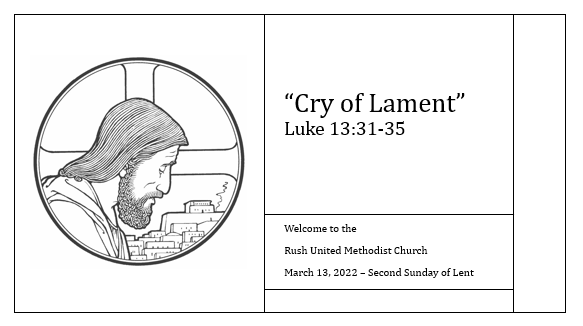
Jesus overlooks the city of Jerusalem

And he cries out in pain.

“Jerusalem, the city that kills the prophets and stones those who are sent to it!” (13:34)

Jerusalem, Jesus laments;

Who’s very meaning is peace.

-Salem comes from the Hebrew Salom, or Shalom.

Jerusalem had become a place of ruthless, destructive violence, stoning, and killing.

Jerusalem, Jesus laments;

This lament is a resounding echo of

Jesus being nearly thrown off a cliff and killed

After reading from the Isaiah scroll

In his hometown synagogue of Nazareth.

Jerusalem, Jesus laments;

Is located and established by David on top of Mount Zion.

David had the Ark of the Covenant,

The dwelling place of God,

Located in the center of God’s people

On top of the mountain.

God present.

God centered.

God with God’s people.

Jerusalem, Jesus laments;

Whose Temple crowned the peak of Zion,

Became the only place where there was a

Constant connection between heaven and earth.

The Holy of Holies was that intersection

Where God passed freely.

Jerusalem, Jesus laments;

The location where God engaged in constant warfare

Over the powers of sin and death

With none other than the devil himself,

Fighting with everything at stake,

Even the life of Jesus.

Jerusalem, Jesus laments;

Where belief had waned,

Where faith had become complicit with Rome,

Where organized religion had become drunk with power,

Where Herod Antipas was one of many tyrants the world would know.

Jerusalem, Jesus laments;

In this time of Lent,

Jerusalem becomes for us a foreshadowing

Of the Passion and Crucifixion of Jesus, yet to come.

Jesus cries with lament;

But this isn’t the final word.

Allow God to lead you outside

To gaze into the night sky.

“Look to the heaven and count them …

So shall your descendants be.” (Genesis 15:5)

Like with Abram,

God responds to the lament of Jesus

With reaffirmation and an expanded, abundant promise.

Jerusalem would not only become known for crucifixion,

Jerusalem would now become known for its empty tomb.

Jerusalem! We will celebrate in a few short weeks

Is become resurrection!

Ascension!

The descent of the Holy Spirit!

The origin for all apostolic missions!

The promised sign for the return of our Messiah, Jesus Christ!

When Jesus cries of lament,

You and I are given license to share our complaints with God, too.

There is no point in complaining to one another;

That only stirs up the hornet’s nest for no good reason.

Take your complaint straight to the top;

Straight to God.

Just spell it out.

Name it.

Invite God into your suffering.

Leave your pain at this altar

Confident in the knowledge, experience, and promise

Of a loving, gracious, and abundant God.

Amen.

“The Liar, and the Lies He Tells”

Luke 4:1-13

March 6, 2022 ~ Lent 1

the Rev. Todd R. Goddard, Pastor

Rush United Methodist Church

Luke 4:1-13

Jesus, full of the Holy Spirit, returned from the Jordan and was led by the Spirit in the wilderness, where for forty days he was tempted by the devil. He ate nothing at all during those days, and when they were over, he was famished.

The devil said to him, “If you are the Son of God, command this stone to become a loaf of bread.” Jesus answered him, “It is written, ‘One does not live by bread alone.’”

Then the devil led him up and showed him in an instant all the kingdoms of the world. And the devil said to him, “To you I will give their glory and all this authority; for it has been given over to me, and I give it to anyone I please. If you, then, will worship me, it will all be yours.” Jesus answered him, “It is written, ‘Worship the Lord your God, and serve only him.’”

Then the devil took him to Jerusalem, and placed him on the pinnacle of the temple, saying to him, “If you are the Son of God, throw yourself down from here, for it is written, ‘He will command his angels concerning you, to protect you,’ and ‘On their hands they will bear you up, so that you will not dash your foot against a stone.’” Jesus answered him, “It is said, ‘Do not put the Lord your God to the test.’”

When the devil had finished every test, he departed from him until an opportune time.

| Centering Prayer |

Initially I planned to title this message “Temptation.”

However, my thoughts, reflections, and prayers this week

Have taken me in a different direction.

So I’m calling this “The Liar, and the Lies He Tells.”

Over the years I have preached on this text many times,

usually focusing on temptation.

As I sat reading, rereading, and studying this Gospel narrative,

The role of the devil captured my attention.

We know that Jesus Christ is the head of the church;

and the church is the gathering of all disciples

engaged in His ministry of

grace, love, forgiveness, redemption, and salvation.

In today’s Gospel lesson,

we are presented with a stark contrast to Jesus and the church;

the complete opposite pole,

an absolute contradiction to

everything we believe and know to be true.

We are served up the devil on a silver platter,

the embodiment of all that is evil,

the head liar,

who rules over all that is sin, vile, and immoral.

When I came out of seminary,

I was naive,  

I was ready to explain away the devil and hell.

“After all, how can a loving God create a hell?”

Life and experiences the past 40 years have taught me otherwise.

We’ve become master craftsmen at building our own hell

And accommodating evil and sin.

The danger of denying the existence of evil and immorality

Is being swept away and overwhelmed

Before even being aware of its attack.

A ground war in Europe was unthinkable

Until ten days ago.

Online sports betting came out of nowhere.

Pornography is one click away,

Or less.

The county is being swamped by ghost guns

Being used largely by violent, young adults.

Lord, have mercy.

We are being smothered with apathy,

ungodly civil libertarians,

self-centered, instantly gratifying materialism, and

by freedom that has no responsibility.

Lord, have mercy.

Social trends reveal

Closing churches,

Declining attendance,

A society that is increasing a-religious,

even, anti-Christian.

The pandemic has been like throwing gasoline on the fire.

Lord, have mercy.

The Church’s silence on social issues

Is like handing over of the surrender flag to the devil himself.

One of my earliest memories of church,

was at the Camp Street United Methodist church

in Jamestown, New York.

This was before my father entered the ministry.

The pastor was H. K. Geiser.

I may have been 4 or 5 years old.

I still remember Rev. Geiser preaching in one sermon

that each of us face a fork in the road,

at one point or another in our life.

“The decision is up to you,” he preached,

“which direction will you choose?”

Which direction will you choose?

Will you choose Christ and His Church?

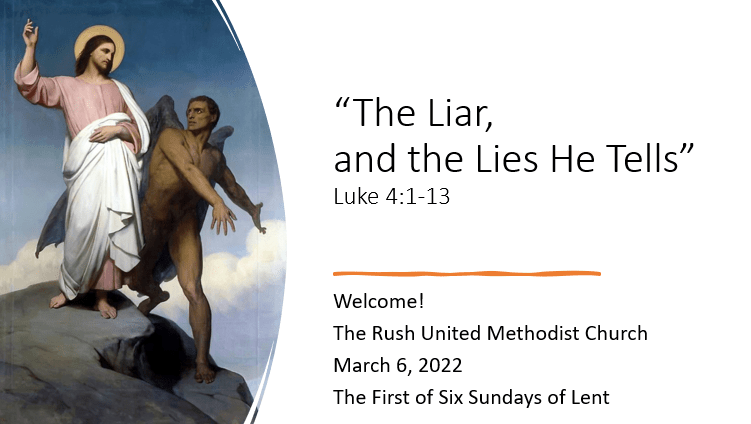
Or, will you choose the devil, the head liar, and the lies that he tells?

Making no choice

Makes one to risk it all,

To be caught and swept away

In the flood of sin and evil.

We hear Jesus was led into the wilderness by the Spirit.

It doesn’t say that the Spirit led him into temptation;

it simply says he was led into the wilderness.

This follows the proclamation of John the Baptist,

the Baptism of Jesus,

and a listing of Jesus’ ancestors.

His identity is firmly established.

Jesus is the one promised by John

who will baptize with fire and the Holy Spirit,

who will clear his threshing floor with his winnowing fork,

who will gather the wheat into his granary,

and burn the chaff in unquenchable fire (Luke 3:16-17).

Jesus is the Son of God, the Beloved,

with whom God is pleased (Luke 3:22).

Jesus is a direct descent of Adam,

the first son of God (Luke 3:23-38).

Jesus is the Messiah,

the Savior,

sent to save the world from going to hell.

Now he finds himself facing his first test.

Jesus is in the wilderness, alone,

when the devil comes knocking at his door.

Not just once.

Not just three times, as we like to remember.

But for 40 days the devil comes to Jesus and tempts him.

This is the first characteristic of the devil; the devil is persistent.

He will attack, and attack, and attack;

all the while trying to wear you down,

just like he tried to wear down Jesus.

If we are told time and again

that something evil is all right,

before you know it,

we’ll just start believing the lie that it is okay.

If it is legal it must be right.

But this is what the devil does;

his persistence lures us into the quicksand of sin,

and before we know it, we’re gone.

The devil comes to Jesus and

knows that he is hungry from his fast (Luke 4:2).

Call it paranoia, if you will, but

I believe our Gospel reveals that

the devil is able to identify with us and understand our needs,

just as he did with Jesus.

Jesus didn’t tell him that he was hungry.

The devil looked upon him and knew;

he knew that Jesus had hunger churning in him.

Consider the weakness you and I have today.

Couldn’t it be possible that

the devil knows our every weakness

and is poised ready to exploit them?

Just where do you think those thoughts come from?

thoughts tempting us to sin,

to steal,

to lie,

to abuse,

to exploit,

to objectify,

to destroy?

The Gospel reports that

“The devil said to him,

If you are the Son of God…’” (Luke 4:3).

Wait-a-minute-here, buddy-boy!

It’s already been established who Jesus is

and why he has come.

What the devil is doing is taunting;

he is taunting Jesus with the whole ‘if you are’ routine.

This is the next characteristic of the devil.

The devil taunts us,

just as he taunted Jesus.

These taunts come in many devious forms.

“Go ahead, you don’t need permission.

You are a good Christian.”

Or, “if you think you are so good,

then you would never

– wink, wink –

do something as terrible as this.”

My gracious,

Such delusional, self-justifying thinking

happens all the time.

Beware of the devil’s evil taunts!

The next characteristic of the devil

might be dismissed by some

as simply having bad manners,

instead of being outright evil.

The devil tells Jesus what to do;

he is bossy;

he is full of himself.

“Command this stone to become a loaf of bread.” (Luke 4:3)

Hold it right there, buster!

Don’t speak to Jesus that way.

You don’t speak to elders, teachers, pastors, parents, or grandparents like that.

Commanding people might have a place in the business world,

but not in the world of nurturing human relationships.

I’m tempted daily to become full of myself.

It is humbling to learn

that this is how the devil works

to weave evil into our world.

Jesus responds with scripture,

word for word from Deuteronomy, 

“It is written, ‘One does not live by bread alone.’”

When attacked by the head liar,

do what Jesus did:

return to the Word of God.

Fall back on scripture.

Let God speak through scripture to give you strength.

The devil resorts to

his main characteristic:

he is a liar, a big fat liar!

He takes Jesus to the top of the world and says to him,

“To you I will give their glory and all this authority;

for it has been given over to me.” (Luke 4:6).

Actually, no.

No it hasn’t!

It’s a lie;

the devil doesn’t have ownership of the world.

It isn’t in his authority.

The world’s glory isn’t his to give away.

Think of the lies in your experience.

The lies that have been told to you.

Consider the lies that you have told.

The big ones.

The small ones.

The ones distorted to fit our best narrative.

Dishonesty is the work of the devil in today’s world.

It is a way for sin and evil to stain society,

to ruin relationships,

to destroy trust.

When you feel tempted to not tell the truth,

know from whence that temptation comes.

“If you, then, will worship me, it will all be yours,”

the devil tells Jesus. (Luke 4:6)

Ah, the devil reveals his hand, doesn’t he?

The devil desires our worship.

Join me in my determination to never worship

anything or anyone other than God.

The devil knows that worship is one of the Ten Commandments,

as listed in Exodus and Deuteronomy,

given to us from God Almighty.

Again, Jesus relies upon the Word:

‘Worship the Lord your God, and serve only him.’” (Luke 4:8)

Know that what is flesh is flesh,

and what is God is God.

If we worship anyone or anything besides the Lord,

we are, in fact, worshipping the devil.

It doesn’t have to be pentagrams and satanic cults.

If you worship money, or your status, or the toys that fill your garage …

you are being lured

into worshipping the devil.

Can your bank account save you?

Can your title or position in the company save you?

Can your luxuries save you?

Let us turn our backs on flesh,

deny the world,

and worship only the Lord our God.

The devil taunts Jesus a second time.

If you are the Son of God …” (Luke 4:9)

Don’t be taken in by this ploy,

and I’ll tell you why.

It would be easy to suggest that the devil slow on the uptake,

that Jesus couldn’t be taunted.

But, remember,

we know the devil is persistent.

Quoting scripture isn’t beneath him!

He knows that Jesus draws strength from the Word.

“… it is written, 

‘He will command his angels concerning you, to protect you,’

and ‘On their hands they will bear you up,

so that you will not dash your foot against a stone.’” (Luke 4:10)

The devil quotes scripture!

Not just one verse,

but two verses, taken right from Psalm 91,

as we spoke in our Call to Worship this morning.

The devil is learned in the Word,

and he isn’t afraid to use it towards his own evil means.

Scripture can be used either

As a knife,

Or as truth that leads to the heart of God.

Because of this,

Christians need to keep a critical eye for those who quote scripture.

Ask yourself who? What? Where? When? How? And why?

Employ the Wesleyan Quadrilateral,

Scripture, tradition, reason, and experience.

Is it reasonable?

Is it traditional and does it fit with experience?

After all, God does work through history,

and has been at work in my experience, too.

The test I use is this;

Does it square itself with the Gospel?

Be wary of those who use the Word

To support their belief

– be they Sunday school teachers,

preachers,

even bishops or popes!

Discern.

Question.

Ask: Are there ulterior motives?

Is there a hidden agenda?

By quoting scripture,

the devil reveals that he is a trickster, too.

He tempts Jesus to call upon the angels to protect him,

as a demonstration of his power.

God’s power isn’t for testing purposes.

It is what it is!

God uses power only as God sees fit.

It isn’t some solution that we can conjure up,

to stop speeding bullets

end Covid,

or cause cancer to be cured.

Yes, God works miracles,

through Jesus,

through His disciples,

and through you and me.

Yes, Jesus tells us that his power will work through His faithful.

Yet, it isn’t our power that we are deploying.

It is God prerogative to work through us

when,

where,

and for whatever purpose God sees fit.

God used divine power to still a storm.

That doesn’t mean tomorrows storm will be stilled.

God has used divine power to give sight to the blind,

cast out demons,

heal the paralyzed,

and to raise from the dead.

Yet, God’s power is God’s prerogative, not ours.

Jesus responds directly from Deuteronomy once again,

“It is said, ‘Do not put the Lord your God to the test.’” (Deut.6:16).

Boom!

Jesus slams the door right in the devil’s face.

So, too, should we.

One last observation about the devil:

St. Luke reports

that even though the devil had finished every test,

he still wasn’t finished –

“he departed from him until an opportune time” (Luke 4:13).

Did I tell you that the devil is persistent?!

Let me think… when were those opportune times?

  • Remember Jesus’ struggle in the Garden of Gethsemane?
  • How about when the devil bought out Judas for a few pieces of silver?
  • And don’t forget Peter’s denial!
  • The ultimate “opportune time,” hanging on the cross, stripped, tortured, humiliated, and left to die – when Mark reports Jesus’ cry “My God, my God, why have you forsaken me?” (Mark 15:34)  

The devil waits for opportunity.

He is patient.

The devil is never done.

He is always waiting for that one way he can wiggle his way into your life.

It is up to you and me to deny the devil his opportunity.

Be strong!

Take courage!

Put on the armor of God!

Don’t give in!

If you succumb to temptation,

as on occasion we all do,

immediately repent,

call on the name of Jesus,

and you will be saved.

Jesus defends himself by walking in the Spirit.

He is born of the Spirit,

baptized in the Spirit,

led by the Spirit.

If we likewise lead our lives in the Spirit of God,

then we also will have a sure defense

against any evil that may assail us.

Jesus was prepared to defend himself from the devil.

We know it was his practice to attend synagogue,

to learn as a youth,

to teach,

and to preach.

Let us also find strength

Through the discipline

Of regular worship attendance.

Finally, Jesus found strength in the Word.

He relied upon scripture to repel

every temptation of the devil.

Let us work diligently to prepare ourselves in the same way.

It is essential that we learn the scriptures;

that we are constantly feeding our souls with the Word of God.

Beloved, do not be naive!

The devil is the very real embodiment

of all that is evil and sinful and immoral in this world.

These are his characteristics:

  • He is persistent.
  • He is able to identify with us and understand our needs.
  • He taunts us.
  • He tells us what to do, is bossy, and he is full of himself.
  • He is he is a liar, a big fat liar!
  • The devil desires our worship.
  • The devil quotes scripture!
  • The devil is a trickster.
  • The devil waits for opportunity and is patient.

Being aware

is being forewarned.

Being warned

calls us to be vigilant.

Being vigilant is to be prepared.

Being prepared is to be strong.

Find strength, beloved, in Christ,

and in His Word.

Amen.

“The Only Constant in Life”

Luke 9:28-36

February 27, 2022

The Rev. Todd R. Goddard, Pastor

Rush United Methodist Church

Luke 9:28-36

Now about eight days after these sayings Jesus took with him Peter and John and James, and went up on the mountain to pray. And while he was praying, the appearance of his face changed, and his clothes became dazzling white. Suddenly they saw two men, Moses and Elijah, talking to him. They appeared in glory and were speaking of his departure, which he was about to accomplish at Jerusalem. 

Now Peter and his companions were weighed down with sleep; but since they had stayed awake, they saw his glory and the two men who stood with him. Just as they were leaving him, Peter said to Jesus, “Master, it is good for us to be here; let us make three dwellings, one for you, one for Moses, and one for Elijah” —not knowing what he said. 

While he was saying this, a cloud came and overshadowed them; and they were terrified as they entered the cloud. Then from the cloud came a voice that said, “This is my Son, my Chosen; listen to him!” When the voice had spoken, Jesus was found alone. And they kept silent and in those days told no one any of the things they had seen.

| Centering Prayer |

I’m getting my taxes prepared March 25th.

I’m hoping for the best

But bracing for the worst.

It reaffirms one of many axioms of life to be true:

The only certainty in life is death and taxes!

Luke’s account of the transfiguration of Jesus

Reminds me of two additional axioms of life and faith:

The only absolute in life is the absolute love of God.

And, the only constant in life is the constant state of change.

Transfiguration, by definition is

“a complete change

In form or appearance

Into a more beautiful or spiritual state.” (Google Dictionary)

Something in Jesus changes.

Physically he changes.

Visually he changes.

The trajectory of his purpose, motive, and methods change.

I boldly suggest that the arc of God’s intervention in salvation history changes.

The Gospel invites us to keep pace with this change.

Are we up to the task?

Since Christmas, we have been following Jesus

Almost exclusively traveling throughout Galilee,

His hometown province in northern Israel.

Jesus launched his ministry of preaching, teaching, exorcism, and healing.

We remember how the ministry of Jesus began,

With his baptism and the gift of the Holy Spirit.

We recall Jesus calling his first disciples from the shore of the Sea of Galilee.

He orients them, instructs them, and prepares them to become apostles.

To this day, the Church draws heavily from Jesus’ Galilean ministry

To prepare people for a life of discipleship.

This is Christianity 101.

Word of mouth

Is the highest form of evangelism.

The presence and actions of Jesus draws a crowd.

Of course it would:

The world is in search of healing.

Just look at our long list of prayer concerns.

The world longs to learn the Word,

The truth about God,

Not some rigid fundamentalist rant.

A diverse crowd assembles,

Drawn like metal filings to a magnet.

The crowd included Jews and Gentiles,

Dark skinned, mixed race Samaritans from the South and

Caucasian, worldly Greeks from the North.

All surged to touch him, that they may be healed.

All crowded closes to hear and learn from Jesus.

Jesus ministered to every last one of them.

Jesus was preaching from the barrel,

Teaching his familiar Beatitudes.

Jesus preached truth.

What he taught was explosive, revolutionary, a complete reversal of the world’s order.

What Jesus taught reveals the details

Of a loving and gracious God,

Deeply invested in life and relationships.

The only constant in life is the constant state of change.

The mountain air was charged with electrons.

All that was needed was

A divine touch.

The moment was electric.

Jesus makes the pivot

In dazzling light.

Once the ozone cleared,

God’s arc of salvation history would begin to play out:

Passion,

Death,

Resurrection,

Ascension,

Followed by, as so eloquently described in the Gospel of Luke / Acts,

The coming of the Holy Spirit and the beginning of

The Spirit led, empowered Church.

To prepare for the monumental changes that Jesus enacts,

He takes Peter, James, and John on a prayer retreat.

They go to a near-by mountain top.

Being on top of a mountain frames the perception that one is near God.

Lisa, our in-house real estate agent would affirm the importance of

Location! Location! Location!

Good call, Jesus.

Just like all mountain top experiences in life,

One can not live at the peek for long:

Mountain tops are barren, windswept, and devoid of water.

The air is thin.

Mountain tops are cold, often overcast, and rushed:

One has to get down from the mountain before daylight is lost.

Jesus prays.

Peter, James, and John claim they were “just resting their eyes.”

Actually, they peek.

Reminiscent of a burning bush,

God’s presence is made known

When the appearance of his face changed

And his cloths became dazzling white.

Epiphany!

The whole manifestation of God in Jesus Christ his Son,

Confirms to a world languishing in sin and brokenness

That something new is in the making.

Epiphany! God with us, doing something new!

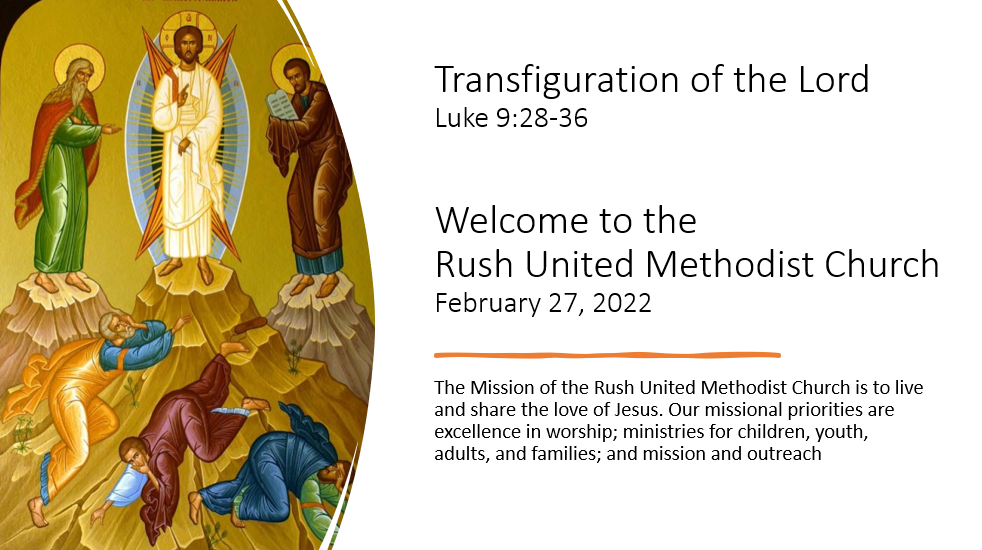
Moses appears before their eyes;

The first prototype sent by God

On a mission

To deliver to the world the gift of Law,

That the world might be saved from sin.

God desires the world to be saved from sin.

But as each successive wave of judges

Attempted to rule as God’s representatives,

Each judge sunk deeper into corruption, sin, and death.

(See the Biblical book of Judges)

Elijah appears before the eyes of Peter, James, and John.

Elijah is the forerunner,

Historically the next divine initiative

To warn the world of their sin

And to call the sinful to repentance.

The prophetic age used chosen individuals

To serve as God’s spokespersons

That the world may be saved by the repentance of sin.

God desires the world to be saved from sin.

Moses and Elijah together with Jesus;

The Messiah,

The circle of salvation is completed.

God steps directly onto the world stage

In the person of Jesus Christ.

Moses, Elijah, and now Jesus.

The only constant in life is the constant state of change.

It’s happening right before our eyes.

Luke is the only account of the Transfiguration to reports the content of their conversation:

“They appeared in glory and were speaking of his departure,

When he was about to accomplish at Jerusalem.” (9:31)

Already, Luke is one step ahead.

In hindsight, our Gospel author tells us that

God’s unfolding plan was never to stop

With death and resurrection.

God intended to send the gift of the Holy Spirit

To guide and empower us post-ascension,

After Jesus left with the promise to return.

God completely ignores Peter’s offer to Jesus

To draw out this moment of Epiphany.

The Lord doesn’t play fetch when it comes to

Our will, petitions, or prayers.

The Lord always acts

In God’s own time

In God’s own ways

According to God’s greater plans.

Note to self: playing fetch with God

Ends with a discouraged, shallow faith,

Feelings like you’re being ignored, and

Becoming ultimately frustrated.

I’d suggest that

Telling God what to do

Is irreverent, at best,

Idolatrous, at worst.

God doesn’t fetch.

God speaks from a cloud

With familiar, often repeated words,

“This is my Son, my Chosen; listen to him!” (9:35b)

Reminiscent of his baptism,

Jesus emerges into the newest era of life

With the same divine words that ushered in his first calling.

Jesus is clearly identified to Peter, John, and James

Who he is: God’s son, the anticipated Messiah, and

By what authority Jesus has license to act.

When Jesus speaks,

God is doing the talking.

When Jesus speaks,

God is doing the talking.

Better pay close attention.

The only constant in life is the constant state of change.

Jesus is transfigured from a teaching, preaching, healing, ministering Son of God

To a more beautiful, spiritual state.

Jesus is transfigured into

God on a mission

To bring redemption and salvation into the world;

God on a mission

To send the Holy Spirit to guide and develop

God’s kingdom on earth as it is in heaven.  

Individual salvation breaks open a new divine reality;

That God intends to save the collective whole

God intends to save the world.

God doesn’t exclude.

God leaves no one behind.

Nothing can separate you or me

From the love of God

Through Jesus Christ.

This change in God’s approach

Is dramatically revealed this coming week.

The Church likewise pivots from Epiphany to Lent.

The Ash Wednesday worship experience

Hits us with startling, mortal abruptness:

“Remember that you are dust, and to dust you shall return”

Spoken as ashes are imposed.

Yet, the anxiety of change is tempered

By the enduring axiom of God’s

Unending,

Unconditional,

Overwhelming

Love.

A living, breathing, resilient Church

Must be willing to pivot when God pivots.

The Church has endured much change down through the centuries.

Early apostles gathered to deal with how to fund the spread of Christianity.

Early Church leaders divided into East and West over beliefs, rule, and the wording of creeds.

Our Western Church divided again over the abuses of clergy and distorted doctrines.

Our Protestant heritage is marked with change

As there has been further division into denominations.

There will certainly be future divisions.

Will we pivot with God

Or will we cling to our former ways

And want to return to Egypt?

In our Wesleyan heritage

Change took place over issues of slavery,

The Sunday School movement, and

The Social Gospel movement.

Attendance and participation has ebbed and flowed,

Sometimes dramatically.

The only constant in life is the constant state of change.

United Methodist are teetering on the precipice of change.

At the last United Methodist General Conference

We decided to stay the course,

To exclude our LGBTQ sisters and brothers.

How’d that work out?

Everyone lost.

The issue is a growing theological fist fight since 1976

(and before).

We are good at kicking the can four years down the road

until our next General Conference.  

The Church will continue to lose

Until the decision is made

Collectively and individually

To boldly go where God is calling:

Unified by Christ.

An end to the fight.

A peaceable separation.

Epiphany?

God always shows up.

The mercy and love of God is with those who are hurt

Even as the future remains clouded in a fog of mystery.

If only answers came easily.

“Do not be afraid,” Jesus reassures on numerous occasions.

Do not be afraid of change.

Do not be afraid of adapting to change.

Change is coming from both within and from outside

The Church of Jesus Christ.

To believe in a relational God and

to follow Jesus as our Lord and Savior,

It is helpful to be aware of how God responds to the needs of the world.

Jesus changed at his transfiguration.

God changes to meet the needs of a needy world.

To keep in relationship with God,

We, too, must be willing to adjust course.

We, too, must be willing to leave the familiar Galilee behind

And journey with Jesus to Jerusalem,

To the cross and

To the tomb.

To keep moving towards Jesus,

We must move.

We must allow God to transfigure us.

Transfiguration is hard.

It requires us to give up the old, familiar, comfortable ways.

It forces us to trust in the Lord,

That the new and uncharted path down which we are being led,

Is indeed, the will and way of the Lord.

Transfiguration is frightening.

I don’t know what the new me will look like

Or where God will be calling me.

Transfiguration is uncertainty.

Through all the whirlwind of change

One thing remains firm, solid, and absolute:

The love of God.

God loves you.

God loves all children.

God created.

God continues to create.

Nothing stays the same.

Indeed, the only constant in life is change.

Jesus changed right before the eyes of his closest disciples.

He changed from being a preacher and miracle worker

Into Messiah, God’s chosen,

Redeemer and Savior of the world.

Jesus changes from life, to death, to resurrection, to Holy Spirit.

So too are we called to change;

To draw closer in our journey with Jesus Christ,

To respond to God’s evolving plan,

Bringing His kingdom to earth as it is in heaven.

Are you up to the challenge?

Amen.

“Do Unto Others”

Luke 6:27-38

February 20, 2022

The Rev. Todd R. Goddard, Pastor

Rush United Methodist Church

Luke 6:27-38

“But I say to you that listen, love your enemies, do good to those who hate you, bless those who curse you, pray for those who abuse you. If anyone strikes you on the cheek, offer the other also; and from anyone who takes away your coat do not withhold even your shirt. Give to everyone who begs from you; and if anyone takes away your goods, do not ask for them again. 

Do to others as you would have them do to you.

“If you love those who love you, what credit is that to you? For even sinners love those who love them. If you do good to those who do good to you, what credit is that to you? For even sinners do the same. If you lend to those from whom you hope to receive, what credit is that to you? Even sinners lend to sinners, to receive as much again. 

But love your enemies, do good, and lend, expecting nothing in return. Your reward will be great, and you will be children of the Most High; for he is kind to the ungrateful and the wicked. 

Be merciful, just as your Father is merciful.

“Do not judge, and you will not be judged; do not condemn, and you will not be condemned. Forgive, and you will be forgiven; give, and it will be given to you. A good measure, pressed down, shaken together, running over, will be put into your lap; for the measure you give will be the measure you get back.”

| Centering Prayer |

I’ve finally found a political party that I can support.

No. It’s not the Democrats.

Neither is it the Republicans.

Though I have a lot of Libertarian leanings, it is not the Libertarian party, either.

Socialist? Nope.

Communists? Heavens to Betsy, NO!

My politic is the Gospel.

I’d invite you to join me

In making the Gospel your politic, too.

I invite you to place Jesus Christ front and center in your life.

The Gospel is the Good News of Jesus Christ.

With Jesus as the top priority,

All other concerns of the world are transformed and

Fall into place in God’s order:

Politics.

Economics.

Ethics.

Business.

Law.

Science.

Health.

Relationships.

Family.

All must be reconsidered and reprioritized.

All have their foundations rocked and upset by Good News.

All take their place in a supportive role for the priority:

The ministry, message, and promise of Jesus Christ.

….

Rules.

Many individuals who decide to follow Jesus

Will look for a black-and-white list of rules to live by:

A Christian direction manual.

For many the Bible becomes this book of rules to be followed.

The Ten Commandment and the Beatitudes,

This Sermon on the Plain, as found in Luke,

Can be stripped down to bare bones

And reduced to a bulleted list.

These are the laws to live by.

These are the approved behaviors for Christian living.

Rules can only take you so far.

The problem with following a simple list of rules

Is that it stunts the growth of faith

And inhibits spiritual development.

Biblical inconsistencies undermine a fundamentalist belief.

We get stuck in the quagmire of righteousness and judgment.

Judgment and fear become the quicksand of a dead-end, failed faith.

When we become followers of rules

Instead of followers of Jesus

Rules become the new idolatry.

The Good News of Jesus Christ,

His mercy and grace,

Is drowned out by the noise of schism, inquisition, exorcism, and death.

Come with me, if you dare,

And let us discern Gospel more deeply.

Keep the rules, yes,

But let us draw a little bit closer to Jesus, if you dare.

….

Expectations.

Many Christians will experience

Jesus’ Sermon on the Plain

And say to ourselves, “Oh, boy.”

“I’m not worthy.”

“I don’t love enough.”

“I’m miserly and don’t like sharing.”

“I’m not merciful to others.”

“I’m way too judgmental of others.”

Others will say to themselves, “Yep, that’s me.”

“I try to love everyone.”

“I’m generous.”

“I’m merciful.”

“I try to be non-judgmental.”

“I try to forgive.”

Jesus is calling this diverse crowd of followers,

Gathered on the coastal plain,

Straining to hear his words and to be healed by his touch,

To ask themselves

“Am I living up to God’s expectations?”

“Am I living up to God’s expectations?”

You and me;

How are we doing?

Are we living up to God’s expectations

As outlined and taught by Jesus?

It’s nearly impossible to talk about enemies

Without militaristic testosterone laden bravado.

Talking about those who hate and curse you

Brings up painful memories of being bullied and humiliated.

Speaking about those who abuse you

Will be different for survivors of sexual abuse or rape

Than it is for those who’ve never been assaulted.

Abuse opens pandora’s box of pain and trauma.

Love

Can’t be an all-or-nothing proposition.

If it was,

Every one of us would come up short.

Love comes from God.

God’s expectation is that disciples of Christ

Are called to spread this love throughout every area of life,

Like smoothing cement from a concrete pour into every area of the form,

Or spreading icing completely covering a cake.

We are called to spread God’s love into every human relationship,

Starting with the easy,

Eventually smoothing love into the most

Painful, shameful, hurtful, broken areas of life.

Loving the easy makes it easier to love the less-than-easy.

Loving the less-than-easy makes it easier to love the hard.

Loving the hard makes it easier to love the enemy,

Those who hate and curse you,

Even those who’ve scared you with the shame of abuse.

Are we living up to God’s expectations, as Jesus taught?

Let’s talk about mercy.

How merciful are we towards others in this world?

Do we do good to those who are less fortunate than we are?

Are we generous,

to a fault?

Are we generous,

until it hurts?

Do we work to bring relief to those imprisoned by barriers and circumstances beyond their control?

Are we committed to serve, rather than being served?

Are we all in

Righting injustice and ending oppression?

Like love, mercy is an essential, core characteristic

Of our loving God,

Placed on display for all the world to see,

In the life and actions of Jesus.

How can you and I expand our capacity for mercy?

How can we expand our capacity for mercy?

The first place to start is to get off the couch,

Get out of the sanctuary,

Roll up the sleeves and get our hands dirty in the mission field.

Serve.

Volunteer.

Take a meal, deliver a meal.

Sort, sew, pack, and send.

Muck out, rebuild, and do it in the name of Jesus.

That is the intersection of mercy and love.

….

What’s at stake?

There is more.

The expanse and depth of the Gospel politic knows no end.

I continue to discover more

Every day I immerse myself in the Good News.

Let’s examine what is at stake here.

For Jesus the stakes weren’t simply

If people believed him or not.

The stakes of the Gospel ended up getting him murdered.

Jesus was crucified because of the Good News,

Because the norms of this world are upset.

The Gospel is revolutionary.

The primary sign of what is at stake in the Gospel of Jesus Christ

Is when the world pushes back;

When resistance rears its ugly head.

Resistance is always a sign of God’s presence, work, and will.

The hometown congregation threw Jesus out of the Synagogue.

Jesus was criticized by authorities for healing on the Sabbath and

Violating numerous other Jewish Laws.

Jesus upset cash flow, the Temple treasury, and angered the Finance Team.

Organized religion pushed back, using Rome as their blunt instrument.

Arrest, suffering, trial, humiliation, and death was intended

To put Jesus into the tomb

and keep him there,

once and for all.

We all know that’s not how it ended.

God always triumphs over resistance.

Good News proclaims redemption and salvation.

Good News paints a picture for what living in God’s kingdom looks like.

Our partnership with God and with one another

Is at stake moving forward

In our faithful effort to discern and follow God’s will,

As we engage in the sacred task of kingdom building.

Do unto others:

How we treat others

Matters.

How we treat others

Dives to the core of the Christian experience

And maturing faith.

God’s kingdom is a land at peace,

Where love and mercy abide,

Where judgment is replaced by acceptance and inclusion.

Expect resistance in our work of kingdom building,

Even as Jesus was resisted.

….

Rules.

Expectations.

Resistance.

Thus it is with Luke’s sermon on the plain.

Jesus invites us to grow deep,

To mature beyond living by rules.

Jesus invites us to grow deep,

To explore, develop, and mature our faith.

Jesus invites us to grow deep,

To come into God’s season

In God’s due time.

Amen.

“Blessings and Woes on the Plain”

Luke 6:17-26

13 February 2022

The Rev. Todd R. Goddard, Pastor

Rush United Methodist Church

Luke 6:17-26

He came down with them and stood on a level place, with a great crowd of his disciples and a great multitude of people from all Judea, Jerusalem, and the coast of Tyre and Sidon. They had come to hear him and to be healed of their diseases; and those who were troubled with unclean spirits were cured. And all in the crowd were trying to touch him, for power came out from him and healed all of them.

Then he looked up at his disciples and said: “Blessed are you who are poor, for yours is the kingdom of God. “Blessed are you who are hungry now, for you will be filled. “Blessed are you who weep now, for you will laugh. “Blessed are you when people hate you, and when they exclude you, revile you, and defame you on account of the Son of Man. Rejoice in that day and leap for joy, for surely your reward is great in heaven; for that is what their ancestors did to the prophets.

“But woe to you who are rich, for you have received your consolation. “Woe to you who are full now, for you will be hungry. “Woe to you who are laughing now, for you will mourn and weep. “Woe to you when all speak well of you, for that is what their ancestors did to the false prophets.

| Centering Prayer |

A friend and colleague of mine

Was telling me about a lunchtime conversation

She had with the highly acclaimed professor

of preaching and worship, Fred Craddock.

She asked if it was ever acceptable to preach the same sermon

As one delivered in a prior parish.

Professor Craddock replied with a smile,

“If it was good enough to preach it the first time,

It should be good enough to deliver it a second.”

Indeed, I have found

Gospel truth is eternal.

The core, raw exegesis never changes.

Update the context,

Modify the message to fit the life stories of the audience,

Draw out the essential truth,

Make the challenge, and

I’m good to go

For another Sunday in the pulpit.

My message today is original this week,

Though Jesus’s sermon probably wasn’t.

Like every good preacher,

Like circuit riders of old,

We suspect Jesus had a number of good sermons

That he would update,

Modify to fit the audience and circumstances,

And reuse.

The Sermon on the Plane is one of them.

The Gospel of Luke reports

The Beatitudes, or blessings,

Were delivered to

Both his disciples and

A multitude of people.

The crowd is diverse,

Mostly Jews from Judea and Jerusalem and

Gentiles from the coastal region of Tyre and Sidon.

A modified version of Jesus’s Beatitudes

is found in Matthew, chapter 5.

There, Jesus retreats from the crowds,

Went up a mountain, and

Taught only his disciples.

Instead of the four blessings

Delivered in Luke,

Jesus uses the private, intimate setting of a mountain top

To expand his blessings to nine.

Two different settings.

Two different audiences.

The same, essential Gospel truth.

A few thoughts.

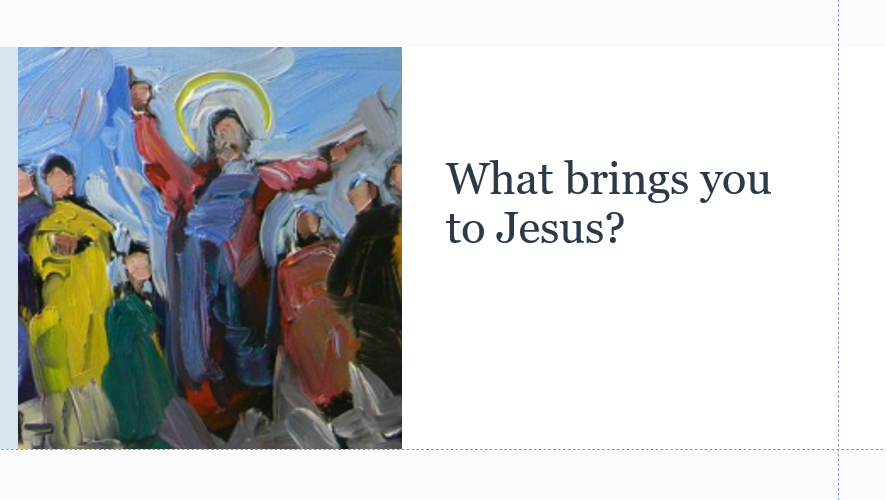
1. What brings you to Jesus?

Last Sunday I asked if someone was

Sent by God,

To fish for you,

Catch you, and

Reel you in,

and land you at the feet of Jesus.

A good fisherman can do that.

Yet, the Gospel of Luke today

Paints a more complete palate of

What motivated individuals

From all kinds of backgrounds

To travel great distances

To place themselves

On that flat plane

In a crowd

Surrounding Jesus.

Some came to hear him preach.

– Luke 6:18

They longed for the Word,

Christ’s essential truth,

God’s message and will

For the transformation of the world.

Some were sick

And came to be healed of their diseases.

– Luke 6:18

The sick gathered,

Despite social quarantine laws,

Because they believed Jesus could heal them.

Others were troubled with unclean spirits.

– Luke 6:18

Troubled emotionally?

As in having a mental health crisis?

Or having a chronic mental illness?

Perhaps.

Or being possessed by unclean spirits?

As in having evil taking up residence,

Abiding in you

In place of Christ and his love

Abiding in you?

What brings you to Jesus?

The eternal truth of the Gospel?

Oh, how I love the Gospel of Jesus Christ!

And I hope you share my enthusiasm.

Are you sick? Like with an illness or disease?

Jesus can heal you,

According to God’s will.

You won’t get what you don’t ask for.

Make the spiritual trek.

Place yourself in the crowd.

Ask to be healed.

Christ heals to bring laser focused attention

To God’s love and compassion.

Those healed are expected to witness,

To testify

To the world what Christ,

The Great Physician,

Has done.

Are you troubled with unclean thoughts or spirits?

Touch Jesus

For power comes out of him.

Be cleansed.

Be healed.

Touching Jesus today

Implies an intimate relationship

With the Body of Christ.

The Body of Christ,

The Church,

Is here to love and support you

And lead you to healing.

2. “Blessed are you who are poor,

For yours is the kingdom of God.”

– Luke 6:20

Simply put,

Economic status

matters to God.

God has given humankind sufficient abundance

That poverty should not exist.

Not now.

Not ever.

Period.

Where there is poverty

There are wealthy individuals withholding

Shares they are not entitled to.

Guilty as charged.

Lord forgive me.

But! I protest, attempting to plead my case,

Jesus means “poor in spirit!”

Not today.

Different sermon.

Different location.

Different audience.

Today,

Jesus is talking wealth and poverty,

The rich and the poor.

Jesus is talking about stewardship,

Our efforts to use the gifts God has given us

To eliminate poverty wherever it exists,

Both in the City of Rochester and rural Livingstone County,

In the hills of Guatemala,

In Palestinian camps,

and in the villages of distant South Africa.

God brings joy and perfect happiness to the poor

And future woes to those of us who are rich

Who are unwilling or uncaring to share the wealth.

“What’s in your wallet?” the television commercial asks.

Jesus is standing you and me straight up

Looking us right in the eye

Asking, “what are you doing

with what’s in your wallet?”

3. “Blessed are you who are hungry now,

for you will be filled.”

– Luke 6:21

Food matters to God.

Google reports that 800 million people

Live every day with food insecurity,

Without reliable access to

a sufficient quantity of affordable, nutritious food.

That’s one in ten of the 7.9 billion people in the world.

According to data published by the United Nations

The number of people who did not get adequate nutrition last year increased to 2.4 billion.

That’s 30% of the world.

The cause?

The UN cites

COVID, climate change, and conflict.

At the same time

Between 2000 and 2019

The world’s production of primary crops increased by 53%

According to ReliefWeb

Hitting a record high of 9.4 billion tonnes in 2019.

Food supply is increasing.

At the same time so is hunger.

What’s the deal?

The deal is you and me.

We waste food.

We hoard food.

Inflation and transportation costs

Disproportionately impact the poor.

Poverty and hunger are insidious reflections

Of our failure to act.

Woe to us

Who don’t need to check prices in the supermarket,

Whose refrigerator needs emptied of rotted or expired food,

Who have failed to support our local food pantry or soup kitchen

With gifts of food, money, or volunteer efforts.

You and I may not be able to solve world hunger,

But we can have a huge impact eliminating hunger right here in our community.

4. “Blessed are you who weep now, for you will laugh.”

– Luke 6:21

Jesus recognizes the fact that sorrow is one unfortunate characteristic of life,

Whether sorrow is due to death and grief,

Losses, such as employment or divorce,

Anxiety or depression,

Incarceration or hospitalization,

Regret or shame,

Natural disaster or just dumb luck. 

Sorrow is real.

Being a disciple of Jesus doesn’t shield one from sorrow or misfortune.

Each of us are one breath or one heartbeat away from catastrophe.

If you haven’t yet wept with sorrow,

Brace yourself.

Woe to you if you’re laughing now

for you will mourn and weep,

Jesus promises.

At the same time,

Jesus makes the point that God’s blessings go to the sorrowful,

For sorrow is not God’s intended goal for humankind.

The Lord wants us to live in joy!

Joy today and joy tomorrow!

Joy is the gladness of heart

that comes in knowing God,

Abiding in Christ, and

Being filled with the Holy Spirit.

Think of angelic joy coming to shepherds and

To the virgin Mary when told she was to carry and deliver God’s son.

Think of the joy of a wedding feast and an unending flow of wine!

Think of

Christ’s promise of a lifetime of joy to his disciples and

Of the early Church living in the joy of the Holy Spirit.

Joy is identified by Paul

As one of the fruits of the Spirit.

It is God’s intent

that you be filled with joy.

5. My final thought is on the fourth blessing

Jesus offers:

“Blessed are you when people hate you, and when they exclude you, revile you, and defame you on account of the Son of Man.”

Luke 6:22

It has taken a lifetime for me to learn

That being liked isn’t a goal or quality of my journey of faith.

Most everyone likes to be liked.

I like to be liked.

But my discipleship does not depend on what other people think about me.

Taking up a cross and following Jesus

Is going to lead to crossed sticks at times,

Sometimes even with people you love.

Discipleship depends on discerning the will of God

And faithfully fulfilling God’s will

as a servant leader.

Jesus and the Gospel is revolutionary.

God’s love and grace is counter-cultural.

As a Christian it means that

(as was promised at our baptismal waters)

We must work to

Renounce the spiritual forces of wickedness,

Reject the evil powers of this world,

And to repent of our sin.

This leads to those who personify evil and behave wickedly

to hate us and our God.

So be it.

The United Methodist version of our baptismal vows continue

To identify why discipleship may make you and me the targets of hatred.

It reads

“Do you accept the freedom and power God gives you

To resist evil, injustice, and oppression

In whatever forms they present themselves?”

That’s going to make evil people angry.

Standing up to injustice may win you Christian allies,

But it’s also going to upset those who thrive on the status quo.

Ending oppression isn’t going to be popular with the oppressors of this world.

So be it.

Our Savior’s response?

“Rejoice in that day and leap for joy, for surely your reward is great in heaven!”

Yes, the world will know that we are Christians by our love.

Let the world will also see us crazy Christians leaping around with joyful abandonment!

What brings you to Jesus?

For me,

It isn’t the thought or hope of a perfect life.

For me,

It is the blessings of discipleship,

The satisfaction and joy of serving on behalf

Of an all loving, gracious God.

May you also be so blessed.

Amen.

“The Call”

Luke 5:1-11

February 6, 2022

The Rev. Todd R. Goddard, Pastor

Rush United Methodist Church

Luke 5:1-11

Once while Jesus was standing beside the lake of Gennesaret, and the crowd was pressing in on him to hear the word of God, he saw two boats there at the shore of the lake; the fishermen had gone out of them and were washing their nets. He got into one of the boats, the one belonging to Simon, and asked him to put out a little way from the shore. Then he sat down and taught the crowds from the boat. When he had finished speaking, he said to Simon, “Put out into the deep water and let down your nets for a catch.” Simon answered, “Master, we have worked all night long but have caught nothing. Yet if you say so, I will let down the nets.” When they had done this, they caught so many fish that their nets were beginning to break. So they signaled their partners in the other boat to come and help them. And they came and filled both boats, so that they began to sink. But when Simon Peter saw it, he fell down at Jesus’ knees, saying, “Go away from me, Lord, for I am a sinful man!” For he and all who were with him were amazed at the catch of fish that they had taken; and so also were James and John, sons of Zebedee, who were partners with Simon. Then Jesus said to Simon, “Do not be afraid; from now on you will be catching people.” When they had brought their boats to shore, they left everything and followed him.

| Centering Prayer |

Yep.

They left behind the largest catch of their life

Just to follow Jesus.

Not that the fishing bug ever left them.

They returned for a one day outing after the resurrection

Where Jesus found them, shared breakfast on the beach, and questioned Peter’s love.

What would cause a person

To leave everything behind …

Family, job, hometown, home, everything …

To follow Jesus and

Transition from catching fish to catching people?

Perhaps

The fishermen

Had their pump primed

By what they heard:

Jesus teaching the crowd

While they quietly listened as they washed their nets?

Almost certainly,

It was the supernatural miracle

That pushed them over the edge …

At Jesus’ command

Both boats were filled with fish

Such that they began to sink.

Holy mackerel!

Recognizing the fact that Simon Peter

Found himself as an active participant

In the miraculous whirlwind of God’s direct intervention at the hand of Jesus,

He self-consciously drops in submission

Like a sack of potatoes.

“Go away from me, Lord, for I am a sinful man!” (Simon Peter, Luke 5:8)

Nope.

That wasn’t going to cut it.

Past sin doesn’t disqualify anyone.

No one gets washed out due to prior history, criminal record, or past sins.

The only thing that qualifies a person for discipleship

Is being chosen by God.

God present.

God at work.

God overcomes every obstacle,

Overlooks every transgression,

To bring God’s chosen into discipleship.

That’s how discipleship works.

A few thoughts.

1. You and I didn’t choose to follow Jesus.

God called you and me,

Just as God called James, John, and Simon Peter.

We don’t make disciples of Jesus.

God does.

Our role is to catch people,

Teach them,

Lead them,

Invite them

Into a relationship with Jesus Christ.

God’s role is to convert that individual into a disciple of Jesus.

My call began

When the Lord warmed my parent’s heart,

Leading them to bring me to my baptismal waters.

I was an infant and don’t remember my initiation into Christianity.

I do reaffirm the vows they made on my behalf at every subsequent baptism.

God’s call to follow Jesus evolves over time,

At least, it has with me.

In my experience

The call is new every day.

That’s a heavy responsibility.

The first conscious memory of my call

Came when I answered an altar call by Billy Glass,

A traveling evangelist.

I was probably about three years of age.

I knelt.

Hands were laid on my head.

I cried, and said, “Yes, Lord. I believe.”

After church during Christmas 1965

I walked past the Pastor’s Office

And saw H. K. Gaiser taking off his robe.

He saw me and invited me in.

He asked if I had a Bible.

I did not.

I hadn’t gone to kindergarten and had not yet learned to read.

He gave me this Gideons New Testament, with Psalms and Proverbs.

I was three and a half years old.

God was at work

Leading others to fish for me.

My parents.

Billy Glass.

Reverend Gaiser.

In the congregation today are two types of people:

Those who have already answered the call

And those who will.

If you’ve answered the call

And take following Jesus seriously

Reflect on how God called you.

Who did God use to catch you?

Tell God, “Thank you!”

How were you brought to acceptance of God’s invitation?

Praise God, from whom all blessings flow.

That moment when you responded like Isaiah, saying,

“Here am I; send me!”

Your sins were forgiven, and eternal life began,

Brought to you without personal cost

By the selfless death and resurrection of Jesus.

That’s some

Amazing grace,

Amazing love,

Right there.

My question to you is this:

What are you doing to catch others,

To reel them into God’s presence,

So God can do His conversion thing?

If you are one of those who have yet to answer the call,

What are you waiting for?

2. Past sin didn’t disqualify Peter,

And it isn’t disqualifying you, either.

Growing up a preacher’s kid,

I sowed my share of wild oats.

I attended church because I had to, but I had no idea why.

I did some things that would probably land me in jail today.

Out from under my parent’s thumb,

My first two years of college were out of control.

It was a college chaplain

Who stood me up,

Looked me straight in the eye, and asked,

“Todd. What are you doing with your life?

Where are you going?”

He was fishing.

Where was my life headed?

Where is your life headed?

I didn’t know,

But my spiritual antenna tingled,

calling me to attention.

I swerved to avoid the ditch.

I drove a carload full of fraternity brothers to Boston to cheer on our college hockey team.

Between games I visited a friend and fellow “preacher’s kid.”

She was a graduate student at Boston University and gave me a tour of the seminary.

Exiting the door of the chapel

I stood before the Martin Luther King memorial statue

And knew immediately where God’s call was leading me.

I was called to be a pastor,

A spiritual leader of congregations,

Just like my father,

Just like James and John, and Simon Peter who went before me.

Most individuals caught by disciples,

Called and converted by God,

Do not go on to become pastors.

Only some of us do.

As the Apostle Paul recognized

The trajectory of one’s call

Is defined by the spiritual gifts that God gives

And the disciple develops

For the common good

Throughout their life.

Are you called to pastoral ministry?

If you’re wondering, come see me.

Perhaps you’re given the gift of wisdom

And your call is to teach;

In the classroom, in Sunday school, in your writing, or in the coffee shop.

Perhaps you’ve been given the gift of healing

And your call is to the clinic, the bedside, the operating table, the back of an ambulance.

Where is God’s call for you? And

What are you doing to develop that call,

Learn, grow, maximize the talents God has already given you?

Answering the call

Is an ongoing process of discernment.

Ask God these questions:

Who is God calling me to become?

What does God want me to do?

Where is God sending me?

When and what’s the time frame? Because timing is everything.

How am I going to overcome every obstacle and ensure success?

Why me?

Why not me?

Though I answered the call to ordained ministry forty years ago,

I’m still answering God’s call for my life

Every single day.

What are you doing today

To discern and

Answer God’s call for your life?

3. Fishing for people and

Reeling them into God’s house

Is our common, equal responsibility.

The student,

The ditch digger,

The welder, plumber, and electrician,

The car salesperson,

The drive-through window employee who takes your order,

Are all called to fish for new disciples of Jesus.

The retiree,

The educator,

The preacher,

The healer,

The lawyer,

The programmer,

The prisoner and their guard,

Even the politician (pun, yes even the politician)

Are all called to fish for new disciples of Jesus.

If we are fishing,

But God isn’t catching.

That’s on us.

One does not just walk into Dick’s Sporting Goods,

Buy a rod and reel,

Stop by the bait store,

And immediately start filling up the cooler.

One must be taught to fish.

Teaching how to fish is done by those who have experience at successful fishing.

There are many different ways to achieve the same success.

There’s fly fishing (the only true kind of fishing, pun),

Bass fishing,

Downrigger fishing from a boat, and

There’s pulling copper.

(You can tell I’m a child of upstate New York)

Likewise, when fishing for people to become disciples of Jesus

There are many different techniques.

Learn what’s successful.

Do that.

Learn what isn’t successful.

Don’t do that.

Fish smarter, not harder or longer.

Use past experience to make improvements in future efforts.

In my experience,

What brings people to Jesus?

A lot of things:

A desire to turn life around.

A need for relationship and love.

Being broken.

A need for forgiveness.

The quest for eternal life.

A desire for sobriety.

Recognition that you’re in over your head.

Guilt.

Longing for meaning.

Searching for redemption.

Spiritual curiosity.

That’s the kind of tackle that

Has brought me success.

What brings you success? or

What’s it going to take to bring you to Jesus?

Prevenient grace is

That mustard seed size of grace that God planted in your life

Before you knew it was there or that it was needed to grow into something greater.

You and I didn’t supply it.

God already primed your pump.

Put the effort in.

Fish for people.

Bring people to Jesus.

Leave the rest up to God.

Amen.

“Rejection at Nazareth”

Luke 4:21-30

January 30, 2022

The Rev. Todd R. Goddard, Pastor

Rush United Methodist Church

Luke 4:21-30

Then he began to say to them, “Today this scripture has been fulfilled in your hearing.” All spoke well of him and were amazed at the gracious words that came from his mouth.

They said, “Is not this Joseph’s son?”

He said to them, “Doubtless you will quote to me this proverb, ‘Doctor, cure yourself!’

And you will say, ‘Do here also in your hometown the things that we have heard you did at Capernaum.’”

And he said, “Truly I tell you, no prophet is accepted in the prophet’s hometown. But the truth is, there were many widows in Israel in the time of Elijah, when the heaven was shut up three years and six months, and there was a severe famine over all the land; yet Elijah was sent to none of them except to a widow at Zarephath in Sidon. There were also many lepers in Israel in the time of the prophet Elisha, and none of them was cleansed except Naaman the Syrian.”

When they heard this, all in the synagogue were filled with rage. They got up, drove him out of the town, and led him to the brow of the hill on which their town was built, so that they might hurl him off the cliff. But he passed through the midst of them and went on his way.

| Centering Prayer |

This Gospel selection from Luke is a continuation of

Last Sunday’s illustrative narrative

Of Jesus returning to his hometown of Nazareth,

Attending Synagogue on the Sabbath

And reading from the Isaiah scroll.

Jesus chose

Selections from chapters sixty-one and fifty-eight.

“The Spirit of the Lord was upon me,” Jesus announced. (4:18)

The Holy Spirit was upon him, just as it had come to the Virgin Mary.

It was the same Holy Spirit that acted and spoke at the baptism of Jesus.

And it was the same Spirit that drove Jesus into the wilderness to face temptation and protect him from the Devil.

Luke reports that Jesus begins his ministry

by returning to the region of Galilee,

filled with the power of the Spirit,

Teaching throughout the area

In the numerous small towns and villages.

The presence, power, and action of the Holy Spirit in the life of Jesus

Is prominently displayed in the Gospel of Luke

And becomes a defining characteristic of the Church that would follow.

Where there is Church there is Spirit.

No Spirit? No Church.

Like a good Jewish, young rabbi,

Jesus reads aloud from one of the beloved Hebrew Prophets: Isaiah.

Good choice.

It was a people’s favorite.

You or I might be intimidated by going back to our hometown to preach.

Family, relatives, neighbors – they can all be harsh critics.

Pulling the Isaiah scroll was a good call on Jesus’ part.

Who doesn’t like to hear the pronouncement of

The forgiveness of debts?

Justice for the oppressed? and

Healing for the sick?

Who wouldn’t want to hear this proclamation from Isaiah

Especially if you felt

you were the victim

of poverty, injustice, or ill health?

Apparently Jesus’ one sentence sermon went over pretty well

Because when he said

“Today this scripture has been fulfilled in your hearing.” (4:21)

Luke reports that “All spoke well of him

And were amazed at the gracious words that came from his mouth.” (4:22)

I’m guessing people weren’t pleased with the brevity of Jesus,

Though some might have been happy because they had a roast in the oven

Or they wanted to get into the restaurant before the lunch crowd.

My guess is that they viewed themselves

As victims, not the perpetrators,

As the exploited, not the oppressors,

As those who had been harmed, not the ones causing suffering.

It is precisely at this moment that the wheels fall off

And Jesus nearly veers off a cliff.

Literally.

Light turns to darkness.

Acceptance is replaced with rejection.

What goes wrong? We are left to question.

Where is the Good News in a crowd rejecting Jesus,

Turning homicidal, and

Attempting to throw him off a cliff?

What are we to learn

And how can we apply what we learn

To our lives today?

A few thoughts.

1. The back of the sanctuary conversation

Turned on a light bulb for the hometown congregation

Of family, friends, and neighbors.

One (obviously distant) neighbor says

Hey! “is not this Joseph’s son?” (4:22)

It would be a mistake to read this

as if the questioner was filled with astonishment.

This isn’t confirmation of a hometown boy making good.

“Is not this Joseph’s son?” should be read dismissively,

With a dash of sarcasm and

A pinch of privilege.

“Is not this Joseph’s son?” someone sneers.

What lifts the veil is our Lord’s response to the people:

“And you will say ‘Do here also in your hometown the things that we have heard you did at Capernaum.’” (4:23)

In other words

From Jesus’ point of view

The people thought they were better than everyone else.

‘We’re as good as anyone else,’ was the sentiment of the congregation.

‘Actually, we’re better than everyone else.

Treat us with deferential entitlement.’

The people were turned completely upside down

When they realized that Jesus came to their synagogue

As the fulfillment of prophecy.

He wasn’t there to make friends.

Yes, Joseph was his father.

But also, yes, God was his heavenly Father,

Which they failed to grasp.

The presence of Jesus was bringing divine condemnation

For privileged entitlements

At the expense of the poor, the oppressed, and the broken.

None of us like

Getting blindsided by Jesus,

Publicly condemned,

Of having our system of beliefs completely pulled out from underneath us,

Of having our faith completely turned upside down exposing all of our hypocrisy and sin

For the whole world to see.

Come on, bro!

Don’t do me like that.

If Jesus only taught in the abstract

And only brought judgment upon others.

Today, Jesus gets personal.

The people of Nazareth respond violently, rejecting Jesus and his message outright.

This begs us to ask the question of ourselves

When and under what circumstances do I feel most confronted by Jesus?

What elements of the Good News do I reject completely?

What can turn my faith into a rage of anger?

Yes, I have questions and

So should you.

Is it the fact that we’ve hurt others, oppressed others, taken advantage of others?

How have we allowed this to happen?

What can we do to correct it?

Are we most uncomfortable when Jesus challenges our privilege,

Our entitlement, which we too frequently and conveniently deny?

Is it the fact that Jesus reveals each of us as flawed and broken?

Because he came to bring Good News and judgment,

Redemption and forgiveness.

Is it the fact that Jesus exposes our hypocrisy?

Out of one side of our mouths we agree with

“Love your enemy and pray for those who persecute you,”

Yet, out of the other side of our mouths we say

“Jesus didn’t live in the real world.

We must arm ourselves to the teeth

And defend what we’ve got.”

The kettle begins to boil.

Perhaps that’s the point:

That which we reject

Deserves our deepest attention.

The Good News bites,

It kicks more than Tabasco.

Jesus turns the world upside down,

Igniting the flames of a new revolutionary world order,

Where the last become first

And the first become last.

When we are the first,

we don’t like it anymore than the people of Nazareth did.

Pay attention to when the Gospel of Jesus is most revolutionary in your life and faith journey.

Instead of dismissing Jesus and throwing him off a cliff,

Dig deeper and examine how the Gospel’s bite

is an opportunity for spiritual growth.

2. Jesus pokes the hornet’s nest

When he probably could have left well enough alone

And slipped out the back door.

“The truth is,” Jesus lays down the gauntlet,

Elijah wasn’t sent to the chosen Hebrew widows.

God sent Elijah to Gentile widows.

Elisha wasn’t sent by God to the Israelite victims of leprosy.

God sent Elisha instead to heal Naaman, the Syrian.

In other words,

The Jewish Nazarenes probably heard Jesus say to them,

When compared to everybody else,

You’re not that special.

Yes, they’re precious and near perfect as a created child of God,

But their covenantal monopoly has just been broken.

They were unprepared and unable to hear

The exclusive covenant between the Lord and the descendants of Abraham

Was getting a messianic upgrade.

God was doing a new thing.

The age of the prophets had wound down.

The messianic age was dawning.

Jesus had come to save the world.

The world.

The whole world.

Jews and Gentiles alike.

Losing out on an exclusive contract hurts.

Consider, for a moment, how this might relate to you and me.

Do we ever find ourselves desiring the attention of someone special

Only to have them turn their attention elsewhere?

When others receive a blessing that we feel should have been ours?

Do we cursed because we felt it was undeserved or given at our expense?

Allow me to use the Gospel to disrupt our world view for a moment.

How do we feel about the alien at our door?

This is my house, my land, my country.

Why should the bounty of our community

Be extended to people from different lands?

How do we feel about those on public assistance, Medicaid, disability?

I work hard to pay taxes,

Why shouldn’t everyone else?

Jesus comes to save the world,

Not just the descendants of Abraham.

Allow me to churn your faith a bit,

How does it make us feel about God’s grace?

When God extends grace to others,

Are there times we react with jealousy?

When God reaches out with mercy and love to people who are different than we are,

Do we experience a twinge of “Hey, when do I get my share?”

Does God’s grace cause us to become resentful?

There’s plenty of grace to go around.

Consider our less-than-lovely responses to God’s grace towards others

As a wake-up alarm,

As a moment of epiphany,

A time when God breaks in and becomes manifest, present, and active in our world.

Pay attention!

Wake up when those internal alarm bells begin to ring,

For God is present and demands our attention.

Be intentional about self-awareness!

Listen for God to speak Good News!

Consider these moments as an epiphany

As an opportunity for us to drink God in, grow in faith, and

To draw closer and learn more about Jesus Christ,

To journey further along the way.

3. Add these two dynamics together

And you’ve got yourself some homicidal hometown heroes.

Having walked up this precipice outside of Nazareth numerous times myself

I can’t help but wonder how Jesus was able to

Pass “through the midst of them” (4:30) and go on his way.

The way isn’t wide enough.

The cliff, though not sheer,

Is steep enough to ensure anyone’s inability to escape.

Jesus was trapped.

There was no way out.

Death by hurling was the only possible end to the story.

So how’d he do it?

And, why is it important?

Luke leaves the details of escape intentionally obscure.

What we do know is that Jesus wasn’t sent to the world

To die on a mountain in Nazareth

At the hand of a homicidal mob.

Jesus was sent to die on a mountain in Jerusalem

To take away the sin of the world

That all the world might be saved.

His escape was vital for the sake of the world and

God made it happen.

I don’t know how.

I do know that God made it happen.

I’ve got more questions than answers.

Are there areas of life

From which Jesus needs to make an escape?

The American experience informs us that there should be a separation of Church and state

Religion and politics.

Jesus informs and influences our leaders,

At the same time, our leaders do not favor or exert control over Christ and the Church.

How about personally?

What are we up too that we shouldn’t be?

That would bring harm or discredit to Christ?

I suspect we all have time and experience where we are

A part of the crowd who tried to fling Jesus off the cliff,

Not a part of the crowd who let him escape?

God has created us with the capacity to change,

To grow,

To improve.

Our God is one of second chances;

Take advantage of this Divine gift of grace.

Do better.

Be better.

Make way for Christ to fulfill his will

In the world and

In you.

What can be found from this near-violent narrative?

The Holy Spirit empowers!

Jesus is the Messiah.

He’s come for the benefit of the world.

God shows no favorites.

Watch for God’s presence and action.

Make way for God’s will.

This works for me;

I trust it will work for you, too.

Amen.

“Anointed to Bring Good News”

Luke 4:14-21

January 23, 2022 – Epiphany 3

The Rev. Todd R. Goddard, Pastor

Rush United Methodist Church

Luke 4:14-21

Then Jesus, filled with the power of the Spirit, returned to Galilee, and a report about him spread through all the surrounding country. He began to teach in their synagogues and was praised by everyone. When he came to Nazareth, where he had been brought up, he went to the synagogue on the sabbath day, as was his custom. He stood up to read, and the scroll of the prophet Isaiah was given to him. He unrolled the scroll and found the place where it was written: 

“The Spirit of the Lord is upon me,

because he has anointed me to bring good news to the poor.

He has sent me to proclaim release to the captives

and recovery of sight to the blind,

to let the oppressed go free, 

to proclaim the year of the Lord’s favor.”

And he rolled up the scroll, gave it back to the attendant, and sat down. The eyes of all in the synagogue were fixed on him. Then he began to say to them, “Today this scripture has been fulfilled in your hearing.”

| Centering Prayer |

I would like to take a moment to

Thank my dear friend and colleague

The Rev. Padraic Collins-Bohrer

For his worship leadership these past two Sundays.

Both of his messages and celebrations of Holy Communion were inspiring to me.

Paddy is at the forefront of thought

Where theology and disability intersect.

He is a leader, example, and friend.

He has taught me much,

For which, I am grateful.

Last Sunday, the Gospel of John reported

That the kickoff of the ministry of Jesus took place

At the wedding in Cana, of Galilee.

It was the mother of Jesus who was responsible for his launch,

For, it was her prodding that led to Jesus turning water into wine.

Just as Paddy mentioned,

The kickoff of the ministry of Jesus takes place

Under entirely different circumstances in the Gospel of Luke.

Jesus had newly been baptized,

The Holy Spirit had descended upon him,

And a voice from heaven spoke,

“You are my Son, the Beloved; with you I am well pleased.” (3:21-22)

As if an intermission between acts,

Luke lists the ancestors of Jesus.

At the conclusion of the list, stretching back as far as Adam,

Luke reports

“Jesus, full of the Holy Spirit, returned from the Jordan and was led by the Spirit in the wilderness, where for forty days he was tempted by the devil.” (4:1-2a)

The conclusion of the temptation launches us into

The start of our passage,

“Then Jesus, filled with the power of the Spirit, returned to Galilee.” (4:14a)

The Holy Spirit descends upon Jesus

And takes up residence.

Jesus was filled by the Spirit.

The Holy Spirit led Jesus into the wilderness

Where Jesus was put to the test,

Providing Jesus with strength and guidance.

The Holy Spirit remains with Jesus

As he begins his Galilean ministry.

There is a theme here;

One that is obvious, even to the casual listener. 

There is a trend here;

One that should not be ignored.

The author of the Gospel of Luke

is the same author as the New Testament book,

The Acts of the Apostles.

The Holy Spirit is portrayed

as the activity and presence of God.

God shows up; think Epiphany!

God stands up; think Jesus and his ministry of teaching, preaching, prophesying, healing, and casting out demons.

God powers up; giving Jesus the power to fulfill Isaiah’s promise:

To bring good news to the poor,

To proclaim release to captives and recovery of sight to the blind,

To let the oppressed go free,

To proclaim the year of Jubilee, the year of the Lord’s favor.

God powers up the early Church;

giving the apostles the ability to truly set the church on fire,

Starting in Jerusalem, to Samaria, to all the world: think Pentecost!

Throughout The Acts of the Apostles

The Holy Spirit brings joy, guidance, miracles, and visions to the faithful.

The Spirit works to spread the mission,

To fulfill God’s will,

To expand God’s kingdom.

The Holy Spirit becomes a common experience,

The defining characteristic, of every new Christian community.

Note to self:

We are one in the Spirit,

we are one in the Lord,

or, we are nothing at all.

Note to the pessimists out there:

expect the ground to shake and to hear voices from the clouds.

Note to the optimists out there:

Now is the time

To be an open and willing vassal

For the Spirit to take up residence in your life.

Allow the Spirit to abide in you and to be in you.

Now is the time to allow the Holy Spirit to use you (and me)

to bring Jesus Christ to all the world!

I remember a video clip by the theologian, Leonard Sweet,

Which stated “Don’t invite people to church.

Invite people to Jesus.”

Invite people to Jesus

And let the rest take care of itself.

Amen, brother. Amen.

The Holy Spirit anoints Jesus

To fulfill his purpose

And complete his ministry.

The Holy Spirit answers the

What? Who? and For whom?

Questions about Jesus Christ.

It is through Jesus

That the act of the Holy Spirit reveals God’s

Enduring love for the poor, captives, oppressed and blind.

That which God perfects in love,

Leave it up to humankind to soil and ruin. Yes?

Sadly, yes.

We ruin the prophetic vision of Isaiah 61 and 58 which Jesus quotes

Because we tend to think of ourselves as the poor of this world.

We are not.

We think that we are being held captive by a world that is out to get us.

We tend to believe that we live a life of oppression

because of our faith, beliefs, or values.

We love to play the victim for all the trials and tribulations that befell us, and

We love to point the finger at personified evil himself – the devil.

Get over yourselves!

Harder yet,

I’m going to need help getting over myself.

It’s easy to tell others to take accountability for faith and discipleship,

It’s a lot harder for this preacher to confess

My complicit support of the rich and powerful of this world,

My biases and blinders that serve to enable and support oppression and captivity,

My ignorance and coldness that substitute the politics and economies of this world in place of the politics and economies of Jesus Christ.

When it comes to sins of commission,

I would expect that you are much like myself;

We are behaviorally conservative.

We’re followers of the Ten Commandments

And we take the righteous lifestyle seriously.

Yes, there are a few times we have failed,

But, we like to keep our failures to a minimum.

We like to keep our moral failures hush-hush.

Repent, seek forgiveness, make reparations, be restored …

And start all over again.

Wash, rinse, dry, repeat.

The rub comes when we plumb deeper into the life of discipleship

And explore our acts of omissions.

What have we failed to do?

Have we failed to speak up when we should have, and just remained silent?

Have we spoken truth to power, or just let it go?

Have we eaten while others have gone hungry?

Have we indulged in wealth while others suffer in poverty?

Have we exercised privilege even as others wait in lines?

Have we allowed oppression in whatever form it presents itself –

Racism, sexism, antisemitism, islamophobia, nationalism,

Or any other -ism you can think of –

To go unopposed and unchallenged?

Taking ownership of our complicit support

of the corrupt powers of this world

At the expense of the gracious and loving intentions of our God

Is the first step of redemption.

Taking accountability for our own inaction

Is what returns us to the purpose, ministry, and life of Jesus.

Authentic accountability leads us back to a synagogue in Nazareth,

Humbly before the master,

When today he sits, and begins to teach,

“Today this scripture has been fulfilled in your hearing.” (4:21)

Today.

Today! Jesus proclaims.

Real time, we are talking.

Right now.

The manifestation of God isn’t some

pie-in-the-sky future event we are to look forward to.

Today! Jesus proclaims.

Today!

Jesus lifts the poor from poverty,

Frees prisoners,

And fills the bellies of the hungry.

Today!

Jesus restores sight,

gives sight, and

gives new insight

Into what God’s kingdom and

What God’s kingdom can become.

Today!

Jesus brings release! Jubilee! A second chance.

Today!

Salvation has come.

Today, Jesus snaps,

just as he did to Zacchaeus.

Come down from that tree, for I’m going to your house today! (19:5)

“Today! Salvation has come to this house,” Jesus informs Zacchaeus. (19:9)

Today, Jesus replies to the condemned thief crucified next to him.

“Today you will be with me in paradise.” (23:43)

Today! Salvation is now

And you’re “it”!

Wow!

That’s some amazing grace, right there.

Especially poignant in the Gospel of Luke,

Jesus is characterized as

The one anointed,

Filled with the Spirit,

The one and the same Holy Spirit that empowers

Our Church and ourselves today.

Through Jesus

God shows up, stands up, powers up!

Jesus is named as our God who doesn’t wait.

Our God acts today! Immediately, if not sooner.

Presence. Action. and

Our God is one who brings salvation to the table,

Ours to claim, or to be ignored.

Jesus is ours for the taking,

So take him in, and

Lift him up.

Do it, today!

Amen.

“Word, Flesh, and Light”

January 2, 2022

John 1:1-18

The Rev. Todd R. Goddard, Pastor

Rush United Methodist Church

In the beginning was the Word, and the Word was with God, and the Word was God. He was in the beginning with God. All things came into being through him, and without him not one thing came into being. What has come into being in him was life, and the life was the light of all people.

The light shines in the darkness, and the darkness did not overcome it. There was a man sent from God, whose name was John. He came as a witness to testify to the light, so that all might believe through him. He himself was not the light, but he came to testify to the light. The true light, which enlightens everyone, was coming into the world. He was in the world, and the world came into being through him; yet the world did not know him. He came to what was his own, and his own people did not accept him. But to all who received him, who believed in his name, he gave power to become children of God, who were born, not of blood or of the will of the flesh or of the will of man, but of God. And the Word became flesh and lived among us, and we have seen his glory, the glory as of a father’s only son, full of grace and truth.

(John testified to him and cried out, “This was he of whom I said, ‘He who comes after me ranks ahead of me because he was before me.’”) From his fullness we have all received, grace upon grace. The law indeed was given through Moses; grace and truth came through Jesus Christ. No one has ever seen God. It is God the only Son, who is close to the Father’s heart, who has made him known.

| Centering Prayer |

This majestic opening to the Gospel of John

Leads me today

to meditation on three things:

Word, Flesh, and Light.

Let’s take a look at each.

Word.

The phrase

“In the beginning”

Always causes my heart to skip.

“In the beginning” is an intentional echo from

The opening line of the Book of Genesis.

“In the beginning God created the heavens and the earth.”

John uses “In the beginning”

To give us the same sense of awe of God and creation.

Our God creates.

This is God’s business.

God creates and it is good,

Good in the case of earth, sea, and stars,

Very good in the case of creating man and woman in God’s own image.

The prologue of the Gospel of John reports

There was nothing before the beginning.

There was and is

only God.

Everything else came thereafter

as a consequence of

God’s good, creative work.

The Book of Genesis gives name to the Creator God: Yahweh.

The Gospel of John gives another name to the same Creator God: Word.

Λόγος, Logos, noun, def. – Divine Expression.

( https://biblehub.com/interlinear/john/1.htm )

Logos. Divine expression. Beautiful, isn’t it?

The difference between Genesis and John is Jesus.

The Gospel reports the truth about Jesus,

The creative expression of

the expansiveness and extravagance of God’s love.   

As the new calendar year begins,

The opening prologue of the Gospel of John

Encourages us to be observant and vigilant throughout the year

For signs of Logos,

For Divine expressions of love.

Where might Logos be found in your life this coming year?

It won’t be found in isolation.

The Word, God,

Is most likely to be found

In acts of creating,

In loving,

In relationships.

When I think of places were creating takes place,

I think of the Arts: music, sculpture, poetry, and paint.

I think of the Environment: mountains, seas, forest, and sunsets.

I think of birth, death, and the fulness of imagination in-between.

In my opinion, that’s where Logos is likely to be found.

When I think of places were love takes place,

I think of parents, children, and families.

I think of the empathetic response to others in need, hunger, clothing, shelter, safety.

I think about answering the call to discipleship, servant leadership, selflessly, faithfully following the will of God.

That’s where you’ll most likely find Logos.

When I think of environments conducive of relationships,

I think of church,

an open, inviting, loving, generous, community of United Methodist right here in Rush.

I think of outreach, visiting, listening, responding to neighbors near and far.

I think of communion, with each other and with our God.

Watch.

Listen.

For the Logos in our midst.

Flesh.

Let me share with you a true story about

Ira Cribb (1851-1943).

A Google search of his name

Will inform you that

As highway superintendent

He developed

Oil and stone (macadamized) road treatment,

Became known as the “Father of Modern Highways.”

( http://www.townofcanandaigua.org/page.asp?id=141 )

But there was more to Ira

Then what is reported on the internet.

I learned about this remarkable man of faith from Joe Cribb,

His grandson,

My parishioner,

Surrogate court justice of Ontario County.

On a warm summer day

Judge Cribb walked me around

to the front lawn of the Canandaigua United Methodist Church building and

Pointed out to me his grandfather’s name

inscribed in stone

at the top of the belltower.

“His name wasn’t inscribed because he gave a lot of money,”

Judge Cribb explained,

“His name was inscribed because he served as the Superintendent of Works

When the building was built.”

This is how faithful and committed Ira Cribb was:

Ira took a leave of absence from his elected position for an entire year,

Pitched a tent and lived in the front yard,

To direct construction

Until the new church building was complete.

Only then did he return home to his family and get back to his job as highway superintendent.

Ira Cribb literally pitched a tent and dwelt in it.

I think of Ira every time

I experience the majestic words of John’s prologue,

“And the Word became flesh and lived among us,” – John 1:14

The word “lived” or “dwelt” is from the Greek, eskēnōsen,

A verb,

Defined as “tabernacled, to dwell as in a tent, encamp.

( ἐσκήνωσεν: eskēnōsen, verb – def. tabernacled, to dwell as in a tent, encamp )

( Biblehub, as found at https://biblehub.com/interlinear/john/1-14.htm )

God pitched a tent

To live among us.

“Just as God traveled with the people of Israel in the wilderness

by means of the “tent of meeting” in their midst,

John announces that God has chosen

to “tabernacle” among us

in an even more radical way,

by the Word embodied in human flesh.”

( Thanks to Elisabeth Johnson, as found at https://www.workingpreacher.org/commentaries/revised-common-lectionary/second-sunday-of-christmas-3/commentary-on-john-11-9-10-18-9 )

This pandemic is a painful reminder

Of how important in-person relationships

Are to our spiritual health and well-being.

God wouldn’t use prophets or angels to

Standoff, social distance, isolate, or quarantine any longer.

With the birth of Jesus

God is pitching a tent,

Throwing a tabernacle,

Taking up residence,

Right in the middle of humanity,

Up close and personal,

In your face,

In your life and mine.

As 2022 starts to be revealed

Watch for signs of Jesus getting personal with you.

The question isn’t if he will.

Believe me, Jesus will.

The question is whether or not

You’ll recognize Christ’s presence and action in your life,

And respond accordingly.

Light.

“What has come into being in him was life,

and the life was the light of all people.

The light shines in the darkness, and

the darkness did not overcome it.”

– John 1:4-5

The Light v Darkness metaphor for God v Sin,

Works well but isn’t perfect.

I am sensitive to my darker complexioned sisters and brothers.

Darkness does have some good features:

It is necessary for sleep.

It is essential for the development of film, if that is even done anymore.

It is required to gaze more clearly into the heavens.

Other than that, the benefit of darkness leaves me searching.

The Gospel intent is to expose the relationship between God and Evil.

They are polar opposites.

There is no middle ground.

This is a cosmic zero-sum game

Where God / Jesus is light, and

Satan / Evil is darkness.

Light destroys darkness,

Just as Jesus destroys sin

By his forgiveness and redemptive blood.

Light shines, revealing God’s glory.

The glory of God is revealed

In almighty power,

In omniscience presence,

In disciplined principles (known as Law),

In fidelity to covenants made and kept, and

In the person of Jesus Christ.

Light shines, reveals the fullness of God’s grace and truth.

By word and deed,

Jesus demonstrated that there is no “quit” with God.

Once God created you,

Nothing can separate you from God’s love.

There are no final chances.

The door always remains open.

The Lord will shepherd you until you choose to enter salvations door.

Light shines, revealing the way forward.

Christ has a purpose for you,

A direction for your life,

A lifestyle for the journey,

A destination for your future.

Where is God calling you?

Are you living a lifestyle worthy of Jesus?

What progress are you making?

Good questions to start a new calendar year.

Word, flesh, light.

Where will you find the Word this year?

Get used to the fact that God has pitched a tabernacle in humanity and has made the world God’s forever home.

What does Christ reveal to you? And what are you going to do about it.

Christ coming seems to ask more questions

Then providing quick, easy, cliche, or stock answers.

Take Jesus as serious as a heart attack.

A relationship with Jesus is hard work.

Be like Mary and

Ponder Him in your heart.

Amen.

“Connecting the Dots”

Luke 2:41-52

December 26, 2021, Second Day of Christmas, Year C

the Rev. Todd R. Goddard, Pastor

Rush United Methodist Church

Luke 2:41-52

Now every year his parents went to Jerusalem for the festival of the Passover. And when he was twelve years old, they went up as usual for the festival. When the festival was ended and they started to return, the boy Jesus stayed behind in Jerusalem, but his parents did not know it. Assuming that he was in the group of travelers, they went a day’s journey. Then they started to look for him among their relatives and friends. When they did not find him, they returned to Jerusalem to search for him.

After three days they found him in the temple, sitting among the teachers, listening to them and asking them questions. And all who heard him were amazed at his understanding and his answers.

When his parents saw him they were astonished; and his mother said to him, ‘Child, why have you treated us like this? Look, your father and I have been searching for you in great anxiety.’

He said to them, ‘Why were you searching for me? Did you not know that I must be in my Father’s house?’ But they did not understand what he said to them.

Then he went down with them and came to Nazareth, and was obedient to them. His mother treasured all these things in her heart.

And Jesus increased in wisdom and in years, and in divine and human favor.

| Centering Prayer |

Childhood waxes and wanes

in the early teens

when hormones give moxy

and a growth spurt gives

false confidence.

It is an awkward time.

Neurological connections

that operate

coordination

and good judgment

have yet to be threaded and sewn

into the neural network

by biology’s hand.

Females lead the way

(who’s surprised?)

and are the first to make

progress towards

a transformation

from a child

to a woman.

Males are slower to mature

(who’s surprised?)

insisting on holding on

to childhood’s last vestiges;

refusing to part with toys and immature behavior

from ages past.

Contemporary developmental psychologists

report insightful treasures

unlocked by years of research and study.

They tell us that

it is during these vulnerable years,

between when a

child is transformed

from a completely and wholly dependent individual

into an adult of legal

obligation and responsibility

that the ability to understand metaphor begins to take root.

For many

this is a time of great awakening,

a multi-year “ah, ha” moment

when one becomes aware

of deeper, additional meaning

to otherwise simple, ordinary stories.

Metaphor transforms a simple

two-dimensional world

into a multi-dimensional place

filled with texture and richness.

For example:

metaphor transforms the Ten Commandments

from a list to be memorized

by rote recitation

into God’s greater plan

for humanity to live together

with peace and justice with one another

and in harmony with a loving Creator.

Metaphor allows the

artist to mix primary colors

to unlock a whole new pallet

of infinite color and beauty.

Metaphor is the Spirit’s means

to breath new life

into otherwise suffocating

organized religion.

It was at this very time

at this great junction

in the life of the boy, Jesus,

when he and his parents

made the pilgrimage south

for the annual celebration of Passover.

They traveled a curculios route

(like a backward “C”)

to avoid Samaria

round and down the Jordan valley

and up the mountain

to Jerusalem’s Temple mount.

This was a family

and extended family event.

Tribal, if you will.

Some of the food was still on the hoof

being herded

along with cart and wagon

carrying tent and supplies

for a multi-day adventure

for these relative country bumpkins traveling to the big city of Jerusalem.

Undoubtedly

cousins played,

aunts planned and cooked,

and uncles talked politics and taxes.

Camped with the swelling

crowds, at, perhaps, Bethany

– a mere stone’s throw across the Kidron valley –

the family would return

to the Temple towering

over the ancient city.

Up the magnificent staircase

all would ascend,

stopping at times to rest

or to dip in the cool pools of water

placed to give

pilgrims ample opportunity

to wash

to cleanse

to become ceremonially clean

before setting foot

inside the sacred Temple courtyard.

The crowd’s gate and pace

would have been slow

and hot.

Parents patience

and tempers would be tested

by squirming children complaining.

“Are we there yet?”

“How many stairs are there left to go?”

At the top of the two grand

staircases would be

an expansive outdoor plaza

filled with the hustle and bustle of

banking and commerce.

Currency would be exchanged into the common Temple coinage

(Undoubtedly at an inflated rate).

Live animals would be sold by

Temple authorities,

at premium prices,

guaranteed unblemished and

raised in a sheltered flock,

to be used for slaughter and sacrifice

to a quiet and unseen God.

Men and boys would queue to the right

Women and girls to the left

to enter the indoor inner courtyard

where the Temple tax would be collected

and the animal would be sacrificed

by a member of the priestly family

standing before

the Holy of Holies

housing inside and out of view

the Arc of the Covenant.

Noise would be hushed

inside the Temple’s inner courts.

Holy men would be giving guidance and council

to those who sought them out

in quiet, reflective whispers

in a darkened room

lit only by the flicker

of candle and lamp.

It was here

that the young Jesus

had engaged in conversation

with teachers from the Temple’s court,

asking questions

listening for answers

applying his newly discovered tools of adolescence

to his budding faith.

It was here

in the midst of the

atonement substitution of animal sacrifice

– of personal sins in exchange for the life of the animal –

that Jesus began to construct

a faith built upon history,

tradition, scripture, and experience.

Jesus turns up missing.

His parents and family search

For him for three days

(I can’t even imagine.

Today, three amber alerts would have gone out and he’d be the lead story on the local news.)

His mother finds him

and says,

‘Child, why have you treated us like this?

Look, your father and I

have been searching for you

in great anxiety.’

In his mother’s eye

he was still a child

unconcerned and irresponsible.

But God was doing

greater things.

Jesus said to them,

‘Why were you searching for me?

Did you not know that I must be in my Father’s house?’

But they did not understand what he said to them.

In three short days

dependence for the child Jesus

had been transferred from earthly parents

to an adult Jesus

who recognized that his dependence

was now wholly, and exclusively

upon a heavenly Father.

Guidance and direction would come

less and less from Mary and Joseph,

and more and more from God above.

Many of us never make this connection,

and if we do,

it usually comes well into adulthood,

with wisdom and experience.

Some of us might recognize

these same feelings

on the occasion of a death of a parent.

Few, if any, of us

come to this understanding

during adolescence.

Being in “my Father’s house”

is more than being under the same roof.

It is about

wherein one places their dependence,

trust,

faith,

hope,

and belief.

It is about

Wherein one decides to abide.

Consider your own faith history.

When did you enter your Father’s house?

When did you become aware

of the reality

that God had already established?

Perhaps you are still in the process

of awakening

of connecting the metaphorical dots

that all of life

ultimately

is wholly and completely dependent

upon our loving God.

Perhaps you have already arrived,

And have lived comfortably in the Lord’s dwelling

For years or decades.

For me,

it didn’t come with baptism, confirmation,

or ordination;

though I suspect this is where

the seeds were first sown.

My awakening really took hold

when I walked

the Valley of the Shadow of Death.

I was juggling too much.

There was too much tragedy and death in my life.

Crisis begat crisis.

My emotional and spiritual health suffered.

The confluence was a wake-up call

for me to accept the fact that I was

no longer independent or self-reliant.

Neither was I dependent

upon my parents,

my father recently deceased.

I was no longer dependent

upon a church bound by appointment obligations.

I was no longer dependent

upon popular opinion.

When I woke to the fact

that my life is lived

completely supported and upheld by the grace of God,

my life and ministry turned a vital corner,

one that can’t be taught

but must be experienced,

one that John Wesley described

in his life

as when his “heart was strangely warmed”

while walking on Aldersgate Street in London.

Here we stand

perched on the precipice

of a new calendar year.

Let the new year ring!

2022

Is the year to

Abide in our Father’s house.

For some of us

Let the new year inspire us

To make the decision to dwell with the Lord,

To abide in God’s house,

And, like Jesus,

to more deeply inquire of God’s ways.

For others of us

Let the new year spur

a thankful memory of when we

took that developmental leap of faith,

entered our Father’s house,

and decided to stay.

May all of us be at home with the Lord

This new year,

To abide in his presence

And to partake of his grace.

Let the changing of the guard spark

a new and heartfelt desire

to sit and stay awhile

and inquire further.

We reside this day

in a sanctuary built of lofting wooden spars and trusses.

Yet, our Father’s house

isn’t found in these boards, carpeting, furniture, or candles.

Our Father’s house

can only be found

in the heart.

Amen.