“Jesus, Remember Me”

November 20, 2022

The Rev. Todd R. Goddard, Pastor

Rush United Methodist Church

Luke 23:33-43

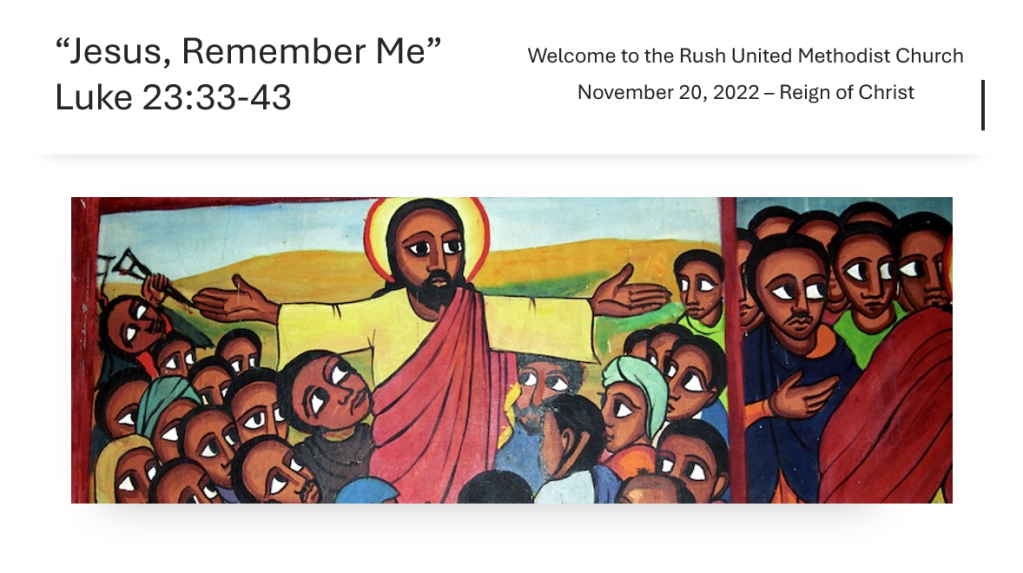
When they came to the place that is called The Skull, they crucified Jesus there with the criminals, one on his right and one on his left. Then Jesus said, “Father, forgive them; for they do not know what they are doing.” And they cast lots to divide his clothing. And the people stood by, watching; but the leaders scoffed at him, saying, “He saved others; let him save himself if he is the Messiah of God, his chosen one!” The soldiers also mocked him, coming up and offering him sour wine, and saying, “If you are the King of the Jews, save yourself!” There was also an inscription over him, “This is the King of the Jews.” One of the criminals who were hanged there kept deriding him and saying, “Are you not the Messiah? Save yourself and us!” But the other rebuked him, saying, “Do you not fear God, since you are under the same sentence of condemnation? And we indeed have been condemned justly, for we are getting what we deserve for our deeds, but this man has done nothing wrong.” Then he said, “Jesus, remember me when you come into your kingdom.” He replied, “Truly I tell you, today you will be with me in Paradise.”

| Centering Prayer |

Generally, we Americans bristle at the thought of monarchy.

Abusive, totalitarian monarchies drove immigration from every corner of Europe to the Americas.

It was one of our signature characteristics

Won for us in our Revolutionary war;

the idea that we would break from the king and elect our own leaders.

Colonists didn’t like heredity making that decision any more than we appreciated our tea being taxed.

We don’t like privilege.

We don’t like entitlements.

And we don’t like being told what to do by wealthy, privileged, entitled, kings or queens.

Yet, we still have this pathological voyeurism when it comes to royalty.

I admit, I tuned in for the wedding of Charles and Dianna and

was tragically shocked by Dianna’s death.

Most recently, I watched with interest the funerals of Prince Philip and Queen Elizabeth II.

On this, the last Sunday of the Liturgical Year,

we celebrate the Reign of Christ, or,

what used to be known as Christ the King.

By removing the word king,

we de-emphasize monarchy;

and by adding reign,

we more properly place the focus on God’s kingdom.

(or so I’m told by liturgical scholars!)

Through the past twelve months,

we’ve walked the pages of the Gospel of Luke,

followed Christ

from manger to ministry,

from passion to death,

and on Easter Sunday, we stepped with Christ out from the empty tomb

as people redeemed, saved, and commissioned for duty.

“Go make disciples,” the resurrected Jesus tells us,

with an authority that can only be described as “Divine.”

Yet, it was only a few days earlier

that Jesus’ broken body,

apparently defeated,

was hanging on the cross.

He was flanked by two opposing criminals like

our altar cross flanked by candles,

his bloodied, dying pulp elevated above the mocking crowd,

even as his followers “stood by, watching.”

One criminal, with one foot in the grave, and the other anchored by Satin,

temps Jesus with blatant self-interest:

“Are you not the Messiah?

Save yourself and us!”

Religious leaders scoffed at him with sarcasm

and with similar temptation,

“He saved others;

let him save himself,

if he is the Messiah of God,

his chosen one!”

They even mock him with twisted sarcasm

by posting a derisive inscription for all to see:

“This is the King of the Jews”

the very title Herod Antipas exclusively reserved for himself.

As if 40 days of dealing with the Devil in the wilderness wasn’t enough.

Saint Luke paints the picture of

hell-bound criminals and religious leaders

sharing the same boat

that is opposed to Christ and

bent on his destruction.

To which Jesus replies,

“Father, forgive them, for they do not know what they are doing.”

When Jesus makes his cross the symbol of forgiveness

he gives us a taste of his heavenly monarchy,

not one like we have rejected- wielding autocratic brutality,

rather, an eternal reign by a grace wielding King.

Many today may view the redemptive grace of Jesus Christ

as Christianity taking a soft approach to crime;

easy on the Law.

As if Christ gives us a get out of jail free card;

so eat, drink, and be merry!

for tomorrow we are forgiven anyway.

Luke’s narrative this morning tells us otherwise.

Forgiveness from the cross defines the eternal, all-inclusive monarchy of Christ!

Only a divine King has the power and authority to rule with such grace.

A judge and jury,

the gallows and the guillotine,

are replace by

“My son” or

“My daughter”

“go and sin no more; your faith has made you well.”

The grace of God,

Through the cross of Jesus Christ,

outdoes bruit force

When it comes to Christ and his Kingdom.

Grace vacates your conviction,

Extends forgiveness, parole, probation, and pardon.

The grace of God,

Through the cross,

Brings healing to repair the damage we have caused because of our sin and offenses.

Listen carefully:

“Go and sin no more.”

At the same time, Jesus is not alone.

The passive crowd stood by, watching.

Waiting.

Wondering.

It is easy for us to be critical of their posture,

but it is important to remember how powerless they were to earthly authorities.

Any attempt at intervention would have brought swift, violent reprisals.

Those soldiers,

With their spears and swords

Were formidable deterrents.

Do not underestimate the value of this crowd of witnesses, however.

God apparently had other plans.

These are the people who will soon bear testimony to both the death and resurrection of Jesus Christ.

They are essential first-person,

eye-witness accounts that will warm people’s hearts and change people’s minds.

Witnesses to the crucifixion of Jesus

are the first people

to become subjects under the new reign of Christ

and to be empowered by the gift of the Holy Spirit

to gather new subjects

into Christ’s heavenly kingdom.

Jesus is not alone on the cross, either.

The opposing criminal is balanced by another crucified for his crimes.

Instead of deriding Christ,

This man recognizes his own faults

and takes responsibility for his crimes.

“We have been condemned justly,” he proclaims.

“We are getting what we deserve for our deeds.”

In an attitude of confession, a willingness for repentance, and with an acceptance of the justice imposed upon him

this second crucified criminal expresses

extraordinary faith with his sincere petition:

“Jesus, remember me when you come into your kingdom.”

“Truly I tell you,” Jesus assures him,

“today you will be with me in Paradise.”

In a similar way to the passive crowd,

today we are called to be faithful witnesses

– paying careful attention to the disciplines of Bible study, prayer, and worship;

not taking our eye off of the cross of Jesus Christ  –

while at the same time, we are called and commissioned

to spread Christ’s kingdom by the power of our testimony.

This is how we celebrate the reign of Christ;

by expanding his Kingdom.

In a similar way to the penitent, faithful thief on the cross,

with sincere humility,

petition our King,

“Jesus, remember me when you come into your kingdom.”

It doesn’t take much to rebuke the opposing competitors to Christ’s Kingdom,

just faith the size of a mustard seed;

just the faith that has already been given to us from God above.

This preemptive gift of faith,

called “prevenient grace”;

it is what God gives us before we know of it, asked for it, or needed it.

Prevenient grace is unearned, undeserved, without price.

Prevenient grace makes it possible for each of us to directly petition Christ,

“Jesus, remember me when you come into your kingdom.”

Keep your eyes on the cross.

It is your forgiveness and mine.

Yet, the cross is more.

Jesus has transformed the cross

And it now has become the symbol for the eternal reign of Christ.

Watch, testify, make your petitions directly to Jesus;

these are the hallmark characteristics

of kingdom living,

of recognizing, honoring, and celebrating the

Reign of Christ.

Of his reign there will be no end.

Amen.

“An Opportunity to Testify”

Luke 21:5-19

November 13, 2022

The Rev. Todd R. Goddard, Pastor

Rush United Methodist Church

Luke 21:5-19

When some were speaking about the temple, how it was adorned with beautiful stones and gifts dedicated to God, he said, “As for these things that you see, the days will come when not one stone will be left upon another; all will be thrown down.” They asked him, “Teacher, when will this be, and what will be the sign that this is about to take place?” And he said, “Beware that you are not led astray; for many will come in my name and say, ‘I am he!’ and, ‘The time is near!’ Do not go after them.“ When you hear of wars and insurrections, do not be terrified; for these things must take place first, but the end will not follow immediately.” Then he said to them, “Nation will rise against nation, and kingdom against kingdom; there will be great earthquakes, and in various places famines and plagues; and there will be dreadful portents and great signs from heaven. “But before all this occurs, they will arrest you and persecute you; they will hand you over to synagogues and prisons, and you will be brought before kings and governors because of my name. This will give you an opportunity to testify. So make up your minds not to prepare your defense in advance; for I will give you words and a wisdom that none of your opponents will be able to withstand or contradict. You will be betrayed even by parents and brothers, by relatives and friends; and they will put some of you to death. You will be hated by all because of my name. But not a hair of your head will perish. By your endurance you will gain your souls.

| Centering Prayer |

People are gullible.

We want to believe what we believe.

We seek justification for what we believe.

We can look at facts and each draw separate conclusions;

Each according to our personal biases, needs, wants, and motives.

This alone should make us critical of other people’s conclusions.

Personally, I want you suspicious of mine

Because it is a healthy means of self-improvement

And it keeps me honest!

It also means that we should always be examining our own conclusions.

People are persuadable.

Our gullibility makes us vulnerable to the opinions of others.

We like to fit in;

Go with the flow,

Not make any waves.

Sometimes it is good to be persuaded.

We learn, we adapt, we grow.

New information allows us to grow our world view and mature.

Sometimes being persuaded is a liability;

Some call it “being a flip-flopper.”

It can be a sign of indecisiveness,

A lack of confidence,

Or a sign of weakness.

People are naturally paranoid.

A little dose is healthy;

It comes down to self-preservation.

Being suspicious helps keep us alive in an environment filled with danger.

Too much paranoia, however,

Becomes the natural default for those who can’t or won’t make the effort to draw their own conclusions

And if left unchecked

Can lead to unhealthy lifestyles;

Even illness.

People are overconfident.

We think we are smarter than we really are.

I know I am.

In my own mind, I’m downright brilliant.

I’m also sufficiently self-aware to know that this is not true.

We believe we can think our way through any problem,

Solve any puzzle,

Find a solution to any perplexing issue life happens to deliver.

We are confident.

We are can-do type of people.

We have been marinating in self-esteem since childhood.

We believe we can do anything.

We are Americans, after all!

Gullible, persuadable, paranoid, and overconfident.

That’s the human condition.

It is a blessing, and a curse.

People haven’t changed much these past 2,000 years.

In fact, not only was Jesus teaching his disciples about their present circumstances

He is also reaching to the future to speak to us here today.

Jesus is providing us tools with which we can use to make sense of our world.

In the time of Jesus,

And in centuries to follow,

There were individuals who claimed to know future events

Based on present circumstances.

“The Temple is destroyed and the nation is defeated;

This must be a sign of the apocalypse.

This must be a sign the end is near.”

“Don’t you believe it!” Jesus clearly states in today’s gospel.

For Luke and his audience in the early first century church

The Temple had been destroyed.

Luke was authored after the destruction of the Temple in 72 AD.

The nation was defeated.

Rome had burned it to the ground.

The few survivors were scattered to the far corners of the world

(known as the “diaspora”).

The people were gullible, persuadable, paranoid, and had a complete loss of confidence.

The end isn’t near,

Jesus reassures his future Apostles and church planters.

Persecution may be a reality.

Death was a certainty.

“Do not fear,” Jesus assures.

“Simply endure.”

“I will give you words.”

“I will save you.”

The curse of being naturally gullible, persuadable, paranoid, and over confident is that we draw similar conclusions about the future

Based on current world circumstances.

Don’t believe one word of it, we hear Jesus echoing today.

“Volcanoes and earthquakes,

War in Ukraine,

North Korea firing off missile left and right,

Car jackings and mass shootings,

Hacked emails, ransomware, and the dark net,

Are all signs the end must be near!”

From Watch Tower tracts to Hollywood movies and music,

We are constantly being tempted to believe in rapture, apocalypse, and the end of the world.

Just stop it.

What makes our generation any more exceptional than the prior 39 going back to Jesus?

“Beware that you are not led astray,” Jesus proclaims.

“Do not go after them …

The end will not follow immediately.”

Though fear monger politicians and snake oil peddling preachers

May be spreading terrifying tall tales,

(Often to pack their pews and fill their bank accounts)

Jesus is crystal clear:

Don’t believe it.

Future events cannot be foretold.

Neither can the will of God be maligned, corrupted, or railroaded

To satisfy human will.

Prophesy means looking at the horizon,

Seeing the storm clouds,

And drawing the conclusion that it is going to rain.

Prophesy does not convince God to put the clouds in the sky.

Prophesy does not predict when it will rain, how much it will rain, or how long it is going to rain.

Neither does prophesy draw conclusions that storm clouds are the result of God’s judgment.

Mostly, it rains just because it rains.

Prophets are not oracles or fortune tellers.

Mostly, prophets simply watch and listen and faithfully report what God wants them to hear.

A life lived in fear is a life of missed opportunities.

Fear prevents us from building up the kingdom of God:

Of eliminating barriers that divide us,

From ending poverty that plaques us,

Of establishing justice, mercy and grace throughout the land.

Fear prevents us from placing our trust in God.

We become fearful of placing our dependence in anyone other than our selves.

We don’t want to depend on others, and we don’t want to depend on God.

Fear creates false idols;

We trust our bank accounts, not God.

We build bigger and better barns.

We stockpile our treasures

And justify our hoarding by saying we are just “saving for a rainy day.”

We trust our instincts, not the word of God.

Fear makes us hibernate when we get home, lock our doors, and complain that the world is going to hell in a hand basket.

Fear breeds distrust and causes us to do irrational things.

Fear leads us to distrust people who look or believe differently.

Fear sucks us into get rich quick schemes,

Leads us to invest in swampland,

And opens our wallets to unproven cures.

Don’t drink the cool-aid!

Do not follow those who breed fear and discontent.

Do not be terrified

When you hear threats of terrorism, war, end times, a culture divided.

Do not be afraid.

God is in control.

God’s got this.

God has already saved you.

The assurance of Jesus is not always welcomed as good news.

Arrest, persecution, and death await.

Bad things do happen to good and faithful people.

Within two sentences

Jesus says some of you will be put to death,

Then promises “not a hair of your head will perish.”

Indeed, though all will die a mortal death,

Eternal life with God is a gift that can never be taken away.

Instead of fearing trials, temptations, plagues, and famines-

Instead of fearing the pain and suffering that life ultimately serves to everyone,

Jesus gives us another strategy,

Another tool for our faithful living:

Replace fear

With opportunity.

Take the opportunity of pain, suffering, and persecution

To testify to the redemption and salvation of Jesus Christ.

Testify to the dirty world who it was that washed you clean.

Testify to the world who embraces death and destruction

Who it is that has saved and recreated you as Christ’s disciple.

Instead of standing at the grave and fearing death,

Look into the face of death and proclaim

“I believe!”

I believe in both the cross and the empty tomb.

I believe in both death and resurrection.

I believe Jesus both died and was raised

And in doing so,

Won for us victory over the grave

And the gift of eternal life.

Testify your faith when life fails you.

Lift high the cross of Christ

When walking through the valley of the shadow of death.

Proclaim the sweet name of Jesus even when the devil looks you square in the eye.

Fear not..

Place your trust in God.

Refuse to succumb to fear.

When given the opportunity to witness, speak up and speak out!

Sharing your personal testimony repeatedly builds confidence.

Confidence overwhelms fear,

Allows faith to deepen,

And draws us closer to God.

Do not be afraid.

Just stick close to God.

Amen.

“The Hope to Which Saints are Called”

Ephesians 1:11-23 and Luke 6:20-31

All Saints Sunday

November 6, 2022

The Rev. Todd R. Goddard, Pastor

Rush United Methodist Church

Luke 6:20-31

Then he looked up at his disciples and said:

“Blessed are you who are poor, for yours is the kingdom of God.

“Blessed are you who are hungry now, for you will be filled.

“Blessed are you who weep now, for you will laugh.

“Blessed are you when people hate you, and when they exclude you, revile you, and defame you on account of the Son of Man. Rejoice in that day and leap for joy, for surely your reward is great in heaven; for that is what their ancestors did to the prophets.

“But woe to you who are rich, for you have received your consolation.

“Woe to you who are full now, for you will be hungry.

“Woe to you who are laughing now, for you will mourn and weep.

“Woe to you when all speak well of you, for that is what their ancestors did to the false prophets.

“But I say to you that listen, Love your enemies, do good to those who hate you, bless those who curse you, pray for those who abuse you.

If anyone strikes you on the cheek, offer the other also; and from anyone who takes away your coat do not withhold even your shirt.

Give to everyone who begs from you; and if anyone takes away your goods, do not ask for them again.

Do to others as you would have them do to you.

| Centering Prayer |

Our hope is in Jesus Christ.

Our hope is in Christ crucified and risen from the dead.

On this sacred Sunday

We celebrate

the saints from our church family and community

Who have died in the Lord this past year

And who now have received the fulfillment of hope;

The forgiveness and absolution of every sin,

and, the gift of eternal life.

Jesus Christ is what unites us.

He holds us together as one.

Our beloved saints

Were baptized by the same water that flowed over the Lord

When he was baptized in the chilly Jordan;

The same water that we were baptized with

Before our own font,

or in our own stream or lake.

Our beloved saints lived as sinners,

Much as we do,

Yet, returned to God’s house of prayer  

To seek forgiveness and absolution of sins.

Our beloved saints

Sat in these same pews and chairs,

And experienced the Word proclaimed

That gave the foundation for hope.

Our beloved saints

Came humbly before this same altar table,

And celebrated the sacrament of the Eucharist,

Bread and wine,

The Body and Blood of Christ,

Broken and shed for each and every one of us.

Indeed, Jesus Christ is what unites us.

From Ephesians 1:11-23 we read:

In Christ we have also obtained an inheritance, having been destined according to the purpose of him who accomplishes all things according to his counsel and will, so that we, who were the first to set our hope on Christ, might live for the praise of his glory. In him you also, when you had heard the word of truth, the gospel of your salvation, and had believed in him, were marked with the seal of the promised Holy Spirit; this is the pledge of our inheritance toward redemption as God’s own people, to the praise of his glory.

I have heard of your faith in the Lord Jesus and your love toward all the saints, and for this reason I do not cease to give thanks for you as I remember you in my prayers. I pray that the God of our Lord Jesus Christ, the Father of glory, may give you a spirit of wisdom and revelation as you come to know him, so that, with the eyes of your heart enlightened, you may know what is the hope to which he has called you, what are the riches of his glorious inheritance among the saints, and what is the immeasurable greatness of his power for us who believe, according to the working of his great power.

God put this power to work in Christ when he raised him from the dead and seated him at his right hand in the heavenly places, far above all rule and authority and power and dominion, and above every name that is named, not only in this age but also in the age to come. And he has put all things under his feet and has made him the head over all things for the church, which is his body, the fullness of him who fills all in all.

Today, we join with the saints

For the praise of Jesus Christ, and his glory,

As the Apostle Paul so eloquently wrote to the church in Ephesus.

Praise God from whom all blessings fall!

As the heavenly host sang

Glory to God in the highest,

and on earth peace among those whom he favors!

Give thanks to Jesus Christ for his inheritance,

His gifts of grace

To each of his disciples.

To know Christ,

To grow deeper in love with Christ,

To develop an understanding of the inheritance Jesus has given to us,

Like the saints before us,

We’ve been given a Spirit of wisdom and revelation.

Wisdom and revelation opens the eyes of our hearts

To know the hope to which saints are called.

Allow me for a moment,

To use the Gospel to bring our celebration of saints

Into the context of our current state of affairs.

Wisdom and revelation are in short supply this (and every) election cycle.

It appears “truth” has been the first casualty.

There are as many truths as there are news channels on cable television.

Without wisdom,

Without discernment that leads to God’s revelation,

There can be no truth,

Only half-truths, lies, and damn lies.

Jesus people, do not despair!

Jesus gives his disciples, you and me, our politic,

If only we choose to listen, to think, and to open our hearts.

The politic of the Christian are not Republican or Democrat,

Liberal or Conservative.

The Spirit has given to us the inheritance of Jesus;

His grace and

His word.

Today’s word comes from his “Sermon on the Plane.”

With saints who have gone before us,

We are united with Jesus Christ and his Gospel politic.

What say you about the poor?

“Blessed are you who are poor, for yours is the kingdom of God, … But woe to you who are rich, for you have received your consolation.” Jesus responds.

Wisdom comes when we discern God’s will

To wipe poverty off the face of the earth.

Poverty is the result of greed, theft, embezzlement.

Christ calls us to love our neighbor,

Not to swindle or steal from our neighbors.

Disciples of Jesus are called to teach the world,

By word and example,

How to love our neighbors, especially the poor.

What say you about the hungry?

“Blessed are you who are hungry now, for you will be filled.” Jesus responds.

Like at a restaurant when more friends arrive,

Is not God calling us to add another table?

To pull up more chairs?

Extend the table and add more chairs

Such that everyone who is hungry might be fed.

And, oh yeah, for those who have the means,

Pick up the check for those who don’t.

The weaponizing of food,

As is being done in the Russian Ukraine war,

Is an ghastly politic

That is contrary to the politic of the Gospel.

There is no reason for anyone to go hungry in the world today,

Either in North Korea, South Africa, Guatemala, or under the Court Street bridge.

It’s up to us, as Christ’s disciples, to ensure everyone is fed.

What say you about those who weep?

“Blessed are you who weep now, for you will laugh.” Jesus proclaims.

Saints who have gone before us tasted death and grief,

For many, numerous times in their lives.

Much of death and grief in our experience

Is at the natural conclusion of the life cycle.

Yet, there is also a secular politic of death

Being played out on battlefields

With horrific civilian casualties and

Refugees fleeing the violence.

Ideological politics

Grip global adversaries in war, or near war,

Leaving unintended, collateral damage spewing in every direction.

There is even a death politic in American culture

Where schools fail, crime roams, and families divide.

America cries with death and grief.

The world moans in travail with senseless murder and mayhem.

Yet, know this to be TRUE:

The politics of death have no rule over

Our Savior who triumphs over the grave!

Disciples of Jesus are called to stop the violence,

Stop the murder,

To heal and restore humanity

Such that every life is valued,

And only natural causes lead one home to eternal glory.

Comfort those who mourn in every circumstance.

God blesses, and calls us to open our hearts to those who weep.

Hold the world tenderly in the loving embrace of Jesus.

Dry the tears with assurance of faith,

Spoken in the language of love.

What say you about those who hate you?

“But I say to you that listen, Love your enemies, do good to those who hate you, bless those who curse you, pray for those who abuse you.” Jesus taught.

Certainly saints who have gone before us have tasted hatred,

Just as we have.

Hatred goes both ways;

Hatred that grows from envy or resentment,

Hatred that festers from discrimination or exclusion,

Hatred that is deeply rooted in our history or original sin.

Christ’s Gospel politic

Is a call for every disciple of Jesus to love enemies,

To do good to those who hate,

To bless those who curse,

To pray for those who abuse.

This is a far different politic than what is espoused by the world today.

The standards for Jesus’ politics

Are set extraordinarily high.

Many would call them naive;

That’s okay,

Bless those who call you naïve,

Who hate you,

Who exclude and revile you

And who defame you on account of the Son of Man.

Go ahead,

Turn to them, Jesus tells us,

And give them your blessing.

Jesus Christ unites us,

Joining with us,

Together with every Christian

Upon whose shoulders we now stand.

Our inherited gifts are forgiveness of sins

And the salvation of our souls.

Make faith our body politic.

Unlike social politics

Faith in Jesus Christ will never fail you.

Faith in Jesus Christ will always lead to an inner transformation from sinner to saint, to God healing and blessing the world.

Amen.

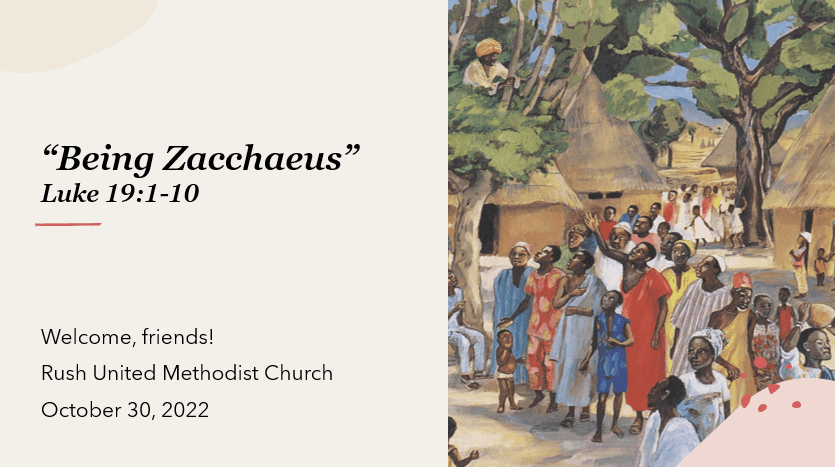
“Being Zacchaeus”

Luke 19:1-10

October 30, 2022

The Rev. Todd R. Goddard, Pastor

Rush United Methodist Church

Luke 19:1-10

He entered Jericho and was passing through it. A man was there named Zacchaeus; he was a chief tax collector and was rich. He was trying to see who Jesus was, but on account of the crowd he could not, because he was short in stature. So he ran ahead and climbed a sycamore tree to see him, because he was going to pass that way. 

When Jesus came to the place, he looked up and said to him, “Zacchaeus, hurry and come down; for I must stay at your house today.” 

So he hurried down and was happy to welcome him. All who saw it began to grumble and said, “He has gone to be the guest of one who is a sinner.” 

Zacchaeus stood there and said to the Lord, “Look, half of my possessions, Lord, I will give to the poor; and if I have defrauded anyone of anything, I will pay back four times as much.” 

Then Jesus said to him, “Today salvation has come to this house, because he too is a son of Abraham. For the Son of Man came to seek out and to save the lost.”

| Centering Prayer |

There are occasions

For all serious students of scripture

When something new appears

That so alters the way we think about a passage

That shakes faith and challenges us to the core.

Could this “something new”

Be a gift from God?

On many occasions, in my experience, it is.

Behold, the Spirit makes all things new.

I recently read an academic article suggesting that Zacchaeus’ stature may have

Entailed more than just being short.

There are linguistic hints that the author of Luke

Is suggesting that Zacchaeus was,

In fact, someone who looked like this:

An individual with dwarfism;

Most probably, a genetic disorder

That limited his height to under 4 feet 10 inches.

The proper term today is short stature,

Defined as a height with the lowest 2.3% of the general population.

The most common type of this condition is called achondroplasia

(A-chon-dro-pla-sia) and is

exhibited with disproportionate body features.

As is all too common even today,

Zacchaeus was one who almost certainly

Suffered from ridicule and social discrimination all his life.

Consider the implications of Zacchaeus being disabled;

Or, as I like to say it,

He was a person with different abilities, or, differently abled.

How does this alter the way

We experience the Gospel this morning?

What if that song of old

We learned in Sunday School

Or in Vacation Bible School

Would be rewritten like this?

Zacchaeus was a discriminated man,

an ostracized man was he,

And he climbed up in a sycamore tree,

for he wanted the Lord to see,

for he wanted the Lord to see.

And as the Savior passed that way,

he looked up in the tree.

And he said, “Zacchaeus! you come down,

for I’m going to your house to stay.”

“For I’m going to your house to stay.”

As opposed to other encounters

Jesus has with people of different abilities,

Here, today,

Jesus does not make an attempt to cure Zacchaeus.

Jesus doesn’t try to “stretch him out,”

“lengthen him up,”

Or “right size him,” as it were.

Today’s encounter with Jesus

Requires a deeper contemplation of faith, ability,

And our relationship with God.

Behold, the Spirit makes all things new.

Let’s take a closer look at Luke 19:1-10.

The Zacchaeus story immediately follows the

Story of the rich young ruler

(Who desired to follow Jesus,

Found the requirements too difficult,

And decided to walk away disappointed).

It also follows the story

Of Jesus restoring sight to a blind beggar

Who loudly asked to have his sight back.

Once his sight was restored,

The former blind man followed Jesus,

Glorified God,

Becoming a recognized celebrity.

The newly healed man became a catalyst for faith:

“and all the people,

When they saw it,

Praised God.”

– Luke 18:43b

Jesus entered Jericho

And was passing through it,

Down the north / south main thoroughfare.

Jericho was, and is, known as a City of Palms,

An oasis in the gravel desert

Watered by Elisha’s Spring;

Carefully channeled via aqueducts

From the surrounding mountains to the west.

The palm trees that line the streets are beautiful.

In the center of Jericho today is a small park

With a Zacchaeus tree in it,

An overgrown fig palm tree that is thousands of years old.

(Let that sink in for a moment).

Jesus is en-route from Galilee in the north,

To Jerusalem, straight uphill to the west, as the crow flies

14 miles away,

Or 30 miles by the treacherous, switch back, serpentine road.

People who are “short in stature”

(as Luke reports it)

Get picked on all the time;

Probably discriminate against

Just as many are today.

Offensive words today

Would have ancient counterparts.

I’m jumping to an assumption here,

But my guess is that a lifetime

Of trauma, ridicule, bullying, exclusion, and discrimination

Had probably left emotional scars on Zacchaeus

Leaving him bitter;

Which would be ironic,

Because his name, from the Greek, means “pure” and “innocent.”

This would be like the grumpiest person you know

Being named “Joy.”

Luke describes Zacchaeus as being

Not only a tax collector,

But the Chief Tax Collector.

Remember from last Sunday’s Gospel,

Tax collectors were hated as traitors and as extortionists?

Zacchaeus was the boss;

The head of them all.

This tells us that he was rich,

For he skimmed off the top of all his subordinates,

And, being a public figure,

That he was universally despised by his neighbors.

Zacchaeus was ambitious with his career.

He was at the top of his pay scale.

And he was rich.

For a moment

Hold in dynamic tension

The wealth of Zacchaeus

With that of the rich man and Lazarus (16:19-31).

With the same determination

That overcame a lifetime of almost certain ridicule,

That propelled him to the top of his corporate ladder,

Zacchaeus ran ahead of the crowd

That had come out to see Jesus with

His traveling

healing tour and

salvation show.

He ran ahead.

He climbed into an overgrown fig palm

And perched himself above the road in the branches.

Consider how ridiculous he must has looked.

He didn’t care what other people thought.

His emotional calluses were much too thick.  

He had power and money

And he’d come to see Jesus.

Talk about creative and expedient!

There is no wonder Jesus was stopped dead in his tracks.

He looked up,

Calls Zachaeus by name

(by the way, how did Jesus know his name?),

And invites himself over to his house

Right in front of a certainly flabbergasted crowd.

The crowd knows the sinful trade of the tax collecting community.

They would have been scandalized

That Jesus invites himself

To the home of the chief sinner.

As an uncomfortable hush descended upon the crowd,

Zacchaeus “hurried down and was happy to welcome him.”

Wow.

This is the third-time Jesus

Has chosen to eat with a tax collector

And the third time people have grumbled about it.

One would think,

Jesus of all people,

Would want to separate himself from sinners,

Wouldn’t you?

Apparently,

Jesus was sent to the world to eat with

And relate to sinners.

Oh, the scandal of the Gospel!

Instead of walking away sad,

Zacchaeus responds with exuberance!

I will give away half of my possessions to the poor, he promises.

On top of that,

Zacchaeus vows to pay back four times

Anyone who he had defrauded,

Which is double the requirement of Jewish Law.

In essence,

Zacchaeus is eagerly willing to work to overcome poverty

(Much of which Zacchaeus is personally responsible for creating).

And he is willing to make reparations

To everyone who he has treated unjustly.

That would be … everyone.

Zacchaeus is willing to give up nearly everything

To be saved from his sin,

To be reunited to his family as a child of Abraham, and

To be found by God.

Jesus’ mission has been fulfilled,

“to seek out and to save the lost.” (19:10)

… to seek and to save.

Are you willing to give up nearly everything?

I don’t know about you,

But I am.

What can we learn from Zacchaeus

That can be applied to our lives today?

First, Zacchaeus was determined.

Dare we exercise our discipleship

With the same amount of determination?

Can we race ahead of the crowd?

Can we risk the embarrassment of climbing up over the crowd?

Can we deploy the same amount of determination to lift Jesus up

For all the world to see and learn from Him?

Where is the Lord in today’s world?

The fact is

Most of the world has never seen Jesus

And wouldn’t know him if they bumped into one of his disciples.

Be determined to produce Jesus

And to wear Him on your sleeve.

Secondly, Zacchaeus was expedient.

One of my favorite lines from the movie Gettysburg

Is by Robert E. Lee confronting the overdue General Jeb Stuart.

When Jeb Stuart sees that his delay

May have very well cost Lee the battle

He offers to step down from his command.

“There is no time!!!” Lee thunders.

Zacchaeus knew there was precious little time to see the Savior;

That’s why he ran ahead.

There is no time for us to waste, either.

We must offer Christ to the world

With all his grace, love, forgiveness, and salvation

– a world desperately searching for what Christ has to offer –

– before it is too late

And even one is lost before we had a chance.

Thirdly, Zacchaeus is amazingly creative.

He broke the social standard,

Made a fool of himself;

Yet, his creativity stopped the Lord dead in his tracks.

So too, we need to be just as creative.

What new ways can we use to present Christ to the world?

How can we better share the Good News

Of his redemption and salvation?

Technologically? theatrically? artistically? with audio-visuals?

I do not like rap music;

However, look at what has happened

When rap was set to a Broadway show named “Hamilton”.

The creative genius of a writer

Turned Broadway upside down

And pulled the Arts from the Culture section of the paper

To the front page.

Fourthly, Zacchaeus was willing to repent

And so, too, should we;

On an ongoing, regular basis.

Although the story doesn’t specifically mention it,

It is quite easy for us to make the assumption that Zacchaeus,

By his actions,

Came to repentance:

Acknowledging his sin and

Swearing to make a 180-degree change in his life.

We, like Zacchaeus,

Are invited to acknowledge before God

The instances we have sinned,

And to make every attempt to correct our behavior

Such that we don’t sin again.

Lastly, Zacchaeus teaches us about the value of reparation.

Reparation is not a popular topic

Especially when spoken of in the context

Of U.S. politics,

Of American slavery,

Or Native American resettlement.

The Gospel suggests that we listen to Zacchaeus carefully.

Pay attention to Zacchaeus, what he says and what he does.

Disciples of Jesus

Must be willing to make reparations

For prior offences;

Amends and repayments

For prior acts of injustice.

When injustice has taken place

Let us dare to go the second mile,

To go beyond merely making it right.

Let us repay doubly the loss

When another has been hurt

As a result of prior sin.

Our efforts must not only fix the world

But they must improve the world.

Zacchaeus was no wee little man.

Zacchaeus was a child of Abraham,

Who acted with determination,

With expediency,

With creativity,

To repent,

To fix and

improve that which he had broken.

Today salvation came to Zacchaeus and his house.

Go and do likewise.

Invite salvation into your home, too.

Today, Zacchaeus was found.

Go and allow the Lord to find you, too.

Be Zacchaeus.

Amen.

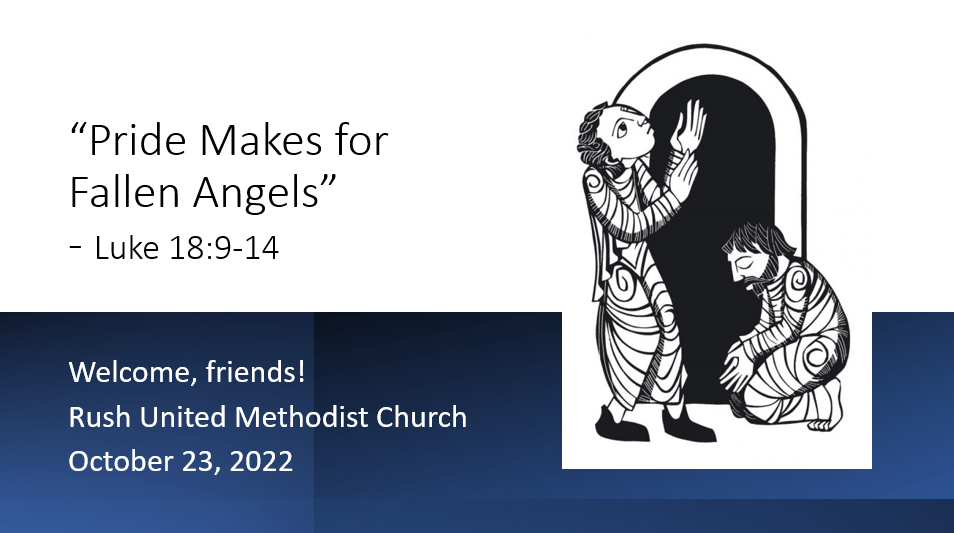
“Pride Makes for Fallen Angels”

Luke 18:9-14, Proper 25 C

October 23, 2022

The Rev. Todd R. Goddard, Pastor

Rush United Methodist Church

Luke 18:9-14

He also told this parable to some who trusted in themselves that they were righteous and regarded others with contempt: “Two men went up to the temple to pray, one a Pharisee and the other a tax collector. The Pharisee, standing by himself, was praying thus, ‘God, I thank you that I am not like other people: thieves, rogues, adulterers, or even like this tax collector. I fast twice a week; I give a tenth of all my income.’ But the tax collector, standing far off, would not even look up to heaven, but was beating his breast and saying, ‘God, be merciful to me, a sinner!’ I tell you, this man went down to his home justified rather than the other; for all who exalt themselves will be humbled, but all who humble themselves will be exalted.”

| Centering Prayer |

Our Gospel lesson

Follows last Sunday’s

“Parable of the Widow and the Unjust Judge.”

Jesus taught about the importance of prayer,

Persistent prayer.

Unrelenting prayer.

Praying for justice.

Praying, knowing God answers our prayers.

Today, Jesus immediately follows on with a second parable,

Often called “The Parable of the Pharisee and the Tax Collector.”

This is not a story about the virtues of righteous living.

This is a story about were one plants and grows their faith.

Jesus uses role reversal as a literary technique in this parable.

The status,

the values

of contrasting people

are exchanged                                                       

so that listeners are taken by surprise.

The good man goes away disappointed,

while the bad one leaves forgiven.

The angel is made into a devil,

And the devil is made into an angel.

In a way,

Jesus is painting a picture for us

of what the new age will be like.

The present, evil age will be brought down

and Christ’s new kingdom will take its place.

Take note of Jesus’ immediate audience.

They are described as

“some who trusted in themselves that they were righteous

and regarded others with contempt.” (18:9)

The practice of placing trust in yourself

and in your righteousness

is a type of

arrogant, self-assured piety.

Jesus is asking

Do you really think you don’t need to trust God?

Do you believe you are capable of such righteous behavior that you are without sin or blemish?

He is also making a statement about how one treats others.

Are we to despise others?

To regard others with contempt?

Clearly, Jesus is commenting that such behavior

it is a form of spiritual condescension.

Together, Jesus describes his audience

as being exactly like the character of the Pharisee

in his story: people filled with pride and arrogance.

The audience and the Pharisee are as one.

Brilliant!

This fictional Pharisee is an interesting guy.

Not all Pharisees were like this fella;

in fact, he was probably an exception.

There are many examples in the Bible and elsewhere

of Pharisees behaving better,

who were humble and compassionate.

Judaism placed a theological emphasis on legalism,

Righteous living, and merit.

In this environment

there was always the danger of spiritual pride.

This Pharisee did have some good attributes.

1. He attends temple and prays silently.

If they handed out perfect attendance pins,

He would have had oodles of them.

2. His prayer follows the Jewish liturgy of the day:

“Blessed art Thou, O Lord our God, King of the Universe

who …”

But then his prayer takes an unexpected turn and flies off the rails.

He thanks God that he was not like others in the crowd:

Thieves, rogues, adulterers, or even like that tax collector.

Thank God he wasn’t

Made a Gentile, a slave, a woman.

Thank God he wasn’t made … (you fill in the blank).

3. The Pharisee lives a righteous life, and

He makes it a point to remind God about it.

4. The Pharisee engages in the spiritual discipline of fasting.

He is proud to exceed expectations.

Instead of fasting once a week, he fasts twice.

5. The Pharisee is generous.

He gives tithes of everything he gets;

not just giving ten percent of his income

from agricultural products

as required by Jewish law.

He parses the language like a lawyer.

6. The Pharisee is a praying man.

In his prayer,

he recognizes that God is the source of his lot in life;

extending to him blessings of favor and prosperity.

He thanks God in his prayer,

(thanking God is always a good thing)

and he doesn’t ask God for anything in return.

There is no doubt about it,

this man was leading a life of exemplary righteousness.

That, nobody could deny.

Life was about to be turned upside down.

Then Jesus introduces to the audience the tax collector.

A number of years ago I received

One of those wonderful love letters from the IRS.

It was everything I imagined,

And worse.  

It might be more desirable to get a call

From your accountant telling you you’re broke

Or a call from your doctor informing you

that you have cancer.

Tax collectors in biblical times

Were loved even less than today’s tax collectors.

Rome set the tax rate;

often between 80 and 90 percent of people’s total income.

Such high taxes were required

to pay for very expensive Roman Legions

expanding the empire

and maintaining newly won territories.

Rome made the rules for collecting taxes.

They hired only willing collaborators.

The tax collector’s wage would be earned by commission,

on anything that could be collected above and beyond

the government tax.  

(And we think that taxes are high today!)

No wonder tax collectors

were often hated and thought of as extortionists.

To be a tax collector meant

they would have to profess their faith and allegiance

solely to Rome.

Besides being thought of as a dishonest extortionist,

the Jewish community

considered tax collectors disloyal to the people.

They were viewed as traitors.

Temple authorities would consider

A traitorous tax collector as “unclean”.

It appears that the tax collector in Jesus’ parable

Knew that he was unclean, too,

because we find him described in the story

“standing far off” away from the altar.

So here we have two people

on the hill of Zion in the temple praying;

two people who were

as different as black and white,

oil and vinegar,

day and night.

The audience to whom Jesus was speaking

probably began to believe at this point

that they understood how this parable concluded:

that Jesus was lifting up the virtues of righteousness.

(Perhaps you may have thought of this yourself.)

Instead, Jesus turns the world upside down.

The better characteristics of the Pharisee begin to tarnish.

Jesus knew that

“the proud are always most provoked by pride,”

because like the audience to whom Jesus was speaking,

Jesus paints the picture of this Pharisee

as one who trusts in his own righteousness,

despised others,

and was proud of who he was.

He lists all those who he is glad he is not like,

then he starts to make the case for himself.

Let’s be honest.

His prayer was never directed to God.

It’s focus is solely upon himself: I, I, I, …

look how righteous I am.

The worst part about the Pharisee

is that his idolatry is revealed.

He attempts to replace himself for God;

tries to take God’s place as the judge of other people’s soul:

“thank you that I am not like other people

– thieves, rogues, adulterers, or even like

THAT tax collector.”

Thank God I’m Not Like YOU!

And oh, how easy this is to do!

“America is adrift.”

“We need to turn back to God.”

“Those people are what’s wrong with our country.”

“What’s wrong with all those people

who don’t come to church?”

It is so easy to yield to the temptation

to use a broad paint brush to blame others,

to judge others:

their lifestyles,

values,

upbringing,

or economic status.

This is the pride

which makes us a fallen angel,

St. Augustine proclaimed.

Judging others puts us in the position of spiritual arrogance,

of thinking that we are superior to others.

But arrogance and thinking more of oneself than of others

is completely contrary to the grace of God.

Being better,

or more righteous,

or leading a more clean life

doesn’t make us more acceptable to God.

Only a life of faith does.

Only a life of faith makes us acceptable to God.

A life of faith gives God pleasure;

A life of faith like the sinful tax collector was leading.

He, on the other hand,

recognizes his own sinfulness

and throws himself upon the mercy of the Lord.

The tax collector places his trust in the Lord,

Not in himself.

Both the tax collector and the Pharisee

are perceptive enough to confront the issue of righteousness,

or the lack thereof.

But it was only the tax collector

who moved beyond the issue of righteousness

to that of faith.

It takes faith and a whole lot of courage

to present yourself wholly and submissively

at the feet of Jesus.

Whereas the Pharisee trusted in himself

for his righteousness to save him,

the tax collector rightly recognized

that it was not righteousness that provides salvation.

He trusted not in who he was but in who God is.

God is merciful.

He hoped not in what he had

but in what he might receive:

mercy and forgiveness.

It is when one can extend faith and trust beyond the self,

to call upon the mercy of the Lord,

that one can expect to be justified,

to be made whole and perfect,

by Jesus Christ, our Savior.

This passage is the core of our Wesleyan / Methodist ethos:

We are justified, or made complete with God,

by our faith, not by what we say or do.

This is the stumbling point that I mentioned earlier.

Too many times down through the centuries,

Christians have failed to see this parable

as one whose purpose was little more

than to address the issue of doing good works

and humbly seeking forgiveness.

This is a parable that addresses

the deeper issue of what it means

to place one’s faith and trust in the Lord;

how to enter into relationship with Jesus Christ,

and how to grow that relationship

through lifelong discipleship.

The first step is to appeal to the mercy of Jesus.

Fall submissively at his feet.

Confess your sins.

Try praying repeatedly the Jesus Prayer:

“Lord Jesus Christ, Son of God, have mercy on me, a sinner.”

This is true faith:

to trust in God,

and in God’s mercy,

instead of trusting in yourself.

When the Jews in the crowd

Understood the deeper meaning of this parable

They were outraged.

They lived, breath, and died by the Law.

It was the Law that saved you,

or so the Jewish mind thought.

Jesus’s teachings, therefore, were revolutionary:

that, what is important is faith,

not the actions of an individual.

Likewise, Jesus’s actions were revolutionary:

Justification comes at the foot of the cross

and salvation is a gift

left at the door of the empty tomb.

Jesus embodied a new covenant,

a new covenant that we celebrate with Eucharist,

that we remember by breaking, pouring and sharing

the body and blood of Jesus Christ.

This is not to say

that Jesus was unconcerned with people’s behavior.

Not at all!

Rather, Jesus is frying other fish.

Jesus was and is primarily concerned with faithfulness;

fidelity and trust in the mercy of the Lord.

While good works and righteous living

are always the evidence of faithfulness

it is possible to lead a good and moral life

outside of faith.

“What does this imply for us today?” you may ask.

“How is God speaking to me through our Gospel?”

We are all sinful.

Period.

Given this fact

Don’t try to fix problems of sinfulness by yourself.

Begin by seeking the mercy of God.

Go to the feet of Jesus and ask for his assistance.

Peter says it quite plainly,

“God opposes the proud, but gives grace to the humble.”

(1Peter 5:5)

At first you may feel empty;

as if it is silly to ask for God’s help,

to ask God to be merciful to “me a sinner.”

But after time and with practice,

faith in God begins to bloom and grow.

Suddenly, you’ll find yourself

seeking to lead a righteous life

because of this brand-new relationship

that is growing between yourself and God.

This is the type of relationship

that Jesus Christ is begging

to have with each of us.

Take the first step,

like the tax collector did,

to initiate the spark,

that will ignite the flame of the Holy Spirit

within our hearts.

“Pride changed angels into devils,”

St. Augustine proclaimed,

and “Humility makes one an angel.”

The Pharisee was made into devil.

And the tax collector?

“I tell you,

this man went down to his home justified …

for all who exalt themselves will be humbled,

but all who humble themselves will be exalted.”

Go, and do likewise.

Amen.

“Pray Like There is No Tomorrow”

Luke 18:1-8

October 16, 2022

The Rev. Todd R. Goddard, Pastor

Rush United Methodist Church

Luke 18:1-8

Then Jesus told them a parable about their need to pray always and not to lose heart. He said, “In a certain city there was a judge who neither feared God nor had respect for people. In that city there was a widow who kept coming to him and saying, ‘Grant me justice against my opponent.’ For a while he refused; but later he said to himself, ‘Though I have no fear of God and no respect for anyone, yet because this widow keeps bothering me, I will grant her justice, so that she may not wear me out by continually coming.’” And the Lord said, “Listen to what the unjust judge says. And will not God grant justice to his chosen ones who cry to him day and night? Will he delay long in helping them? I tell you, he will quickly grant justice to them. And yet, when the Son of Man comes, will he find faith on earth?”

| Centering Prayer |

Our Gospel for today

Begins with praying always and not losing heart.

It takes a detour into persistence and justice.

And it concludes with a question about where faith will be found.

Undoubtedly, across the land

Pastors will deliver fine, inspiring sermons on each of these three points.

I am reminded by the wisdom of one seminary New Testament professor

who made the point that every parable

is meant to communicate Divine truth, …

at the same time,

every parable has a limit to how far it can be pushed or wrung dry.

In other words,

Keep it simple.

Search.

Find.

Reflect.

Seek that which God desires us to know,

but, don’t push a parable of Jesus beyond its intent.

The danger is reading into the narrative our personal agenda or biases,

which can distort the intended message.

Across the centuries,

spanning the globe,

crossing multiple cultures,

enduring transitions from oral, to written, to printed communication techniques

as well as multiple translations from one language to another to another,

human editors have had a field day with today’s Gospel.

It has become a tangled furball,

a spray of divergent topics

that obscure the essential Divine truth hidden within.

The challenge is to clarify,

to fine tune what is presented

into a clear concise message

that can be applied to our lives today.

“Pray always,” Jesus says.

Pray without interruption,

without ceasing.

Pray continuously.

Pray persistently,

like a widow seeking justice

who won’t give up and won’t give in.

Pray day and night.

Pray like there is no tomorrow.

Keep praying because the Son of Man is coming

and he is expecting to find us in prayer.

Consider the common nature of prayer in Luke.

Jesus prays at his baptism.

He withdraws to pray at key points throughout his ministry.

Jesus prays such that he sweats blood on the Mount of Olives.

He instructs his disciples to pray for those who abuse them.

Jesus teaches his disciples to pray when they ask for instruction.

And Jesus assures us that the Holy Spirit comes to those who ask.

As Jesus was persistently in prayer throughout his life and ministry,

as he illustrates in this parable a widow who is persistence in her petition for justice,

so, too, are we to claim

the same persistence

for our prayer life.

Pray like there is no tomorrow!

Which is to say

“Pray in this moment.”

Time for some introspection.

Close your eyes.

Consider your life,

Your words,

Your actions.

Is everything you think, say, and do

firmly anchored to a foundation of prayer?

Persistent means always,

never ceasing.

Do you pray while shopping;

that choices will reflect your stewardship of God’s creation?

How about praying as you shuttle your kids to and from practice or games?

Do you pray that your attitude and language will be tempered by God’s love and wisdom,

And set a good example for other parents and families?

Do you pray when facing temptation?

When facing something you know you shouldn’t do,

but want to do anyway?

When tempted,

Do you ask for God to help you? Give you strength?

To divert your attention to more faithful endeavors?

When confronting injustice,

Do you pray to resist,

As we vowed at our baptismal waters?

Ask for strength and direction to resist oppression,

Wherever it be found.

Ask for God to channel your passion, to give you His words, and help keep you faithful?

It’s easy to pray occasionally;

when facing crisis,

when set in routine,

or when we step foot into the sanctuary.

Praying persistently is advancing the spiritual life one step further;

filling the in-between time

with our intentional effort to listen and speak with our God.

Time for some Extrospection.

Consider the life of our community of faith,

our church:

Is everything we think, say, and do

also firmly anchored to a foundation of prayer?

Can we let go and let God;

Give up our agenda and listen for God’s agenda to be made known to us?

When we talk finance

is it in such a way that reflects our prayerful revelation of God’s grace?

When we talk missions and outreach

is it in such a way that recognizes the fact that God is telling us to be like Jesus

reaching out to the last, the least, and the lost?

When we talk about a fund raiser,

are we asking God to work through us to bless and love

every one of our customers?

Persistent means always,

Praying as individuals and when we are gathered,

Here in the building or when we are deployed throughout the community.

Are we prayerfully supporting one another,

and through each other,

our neighbors, community, state and world?

“Pray always,” Jesus commands,

“and not to lose heart.”

Do not lose heart.

Keep faith.

Don’t lose heart.

Keep faith that God is in control,

today, tomorrow, and forever.

Today, most of us have the faith to pray.

We’ve come to worship after all.

In the spur of the moment

just about every Christian is able to muster up an

“Our Father, who art in heaven,”

“Now I lay me down to sleep,”

or “God is good, God is great.”

But when the petition is a little bit more personal

– like a plea –

and when the petition is made not just one day

but for a succession of days,

it becomes a little bit more dicey.

Do not lose heart, Jesus injects his confidence directly into our souls.

In the short term,

the persistent widow’s prayers for justice were not answered,

yet, she came back day after day,

knocking at the door of the stubborn judge.

Keep faith that

God’s time

is God’s time,

not our time.

We live in God’s time.

We think we live in our time,

but we don’t.

When one talks resurrection and salvation

all talk is eternal.

All talk is God’s time.

It is according to God’s schedule that God responds.

Be there no misunderstanding.

God responds to every prayer.

Our job is to pray without ceasing,

with mustard seed sized faith and to keep knocking on God’s door.

Be assured, Jesus tells us,

persistent prayers are

always answered

according to God’s will and according to God’s time.

Do not lose heart;

keep faith

that every answered prayer,

that comes from God,

comes to us

from the one characteristic of God

that remains eternal:

God’s everlasting love.

When Jesus says,

“Ask anything and God will grant it,”

we conveniently leave off that part “according to his will.”

“And this is the boldness we have in him,

that if we ask anything according to his will, he hears us.” 1 John 5:14

God’s will and motivation has always been for our personal and communal benefit.

Only a God who loved the world would send a son

to forgive us of the sins we’ve committed against Him and each other.

Only a God who loved the world would send His son

to win victory over death with a gift of eternal life.

When our persistent prayers

are according to God’s will to love us,

then, yes, every petition is granted.

When we believe our petitions haven’t been granted,

either it is because

what we’ve been asking for has been contrary to the will of God,

or,

what we’ve been asking for has yet to be revealed by God’s greater, long-term plan.

Eventually, the persistent widow

was granted her petition.

She asked for justice and she got it.

Of course, justice is consistent with the love and will of God.

Why wouldn’t it be granted?

The point is she was persistent in her petitions; and so should we.

She didn’t lose heart, she didn’t lose faith, and neither should we.

Jesus concludes our Gospel for today

with what I believe is the perfect question:

“When the Son of Man comes, will he find faith on earth?” – Luke 18:8

Consider numerous Gospel narratives where a multitude of people are commended for their faith:

  • A centurion who believes Jesus will heal his slave, even from a distance;
  • the sinful woman who anoints Jesus’ feet and loves much;
  • friends of a paralyzed man who are willing to cut a hole through a perfectly good roof;
  • the bleeding, unclean woman who touches Jesus’ clothes in the crowd and is healed;
  • the Samaritan healed of his leprosy, whose gratitude turns him back to Jesus where he falls at his feet in thanksgiving;
  • and the blind beggar later in this chapter who sees Jesus for who he is and calls out to him.

Yes, the Son of Man will find faith,

but Luke suggests that it may be in unexpected places,

not among the religious professionals

or the ones certain of their own righteousness.

Faith is to be found

among outsiders,

the unlovely,

the unclean,

those certain of their sinfulness.

(Thanks to: Meda Stamper, pastor, Anstey United Reformed Church, Leicestershire, England, as found at workingpreacher.org)

Signs of faith today

are people and communities persistently praying

every moment of every day,

in every circumstance,

in submission to God’s power and will.

Signs of faith today are evident

when culture is wrapped so tightly in persistent prayer

that peace replaces violence,

God’s love drowns out hatred, prejudice, and racism,

and grace leads to life lived completely in the Spirit.

Signs of faith today

can be seen

in people and communities who persistently pray

and who do not lose heart,

who keep coming back

and coming back

and coming back

until the prayer is answered in God’s time,

or, until the Son of Man returns.

Whichever comes first.

It’s all good.

This is good advice:

Don’t stretch the parable too far.

Jesus gives his followers better advice:

Pray.

Pray always.

Pray and do not lose heart.

Be the Gospel.

Be this Good News.

Amen.

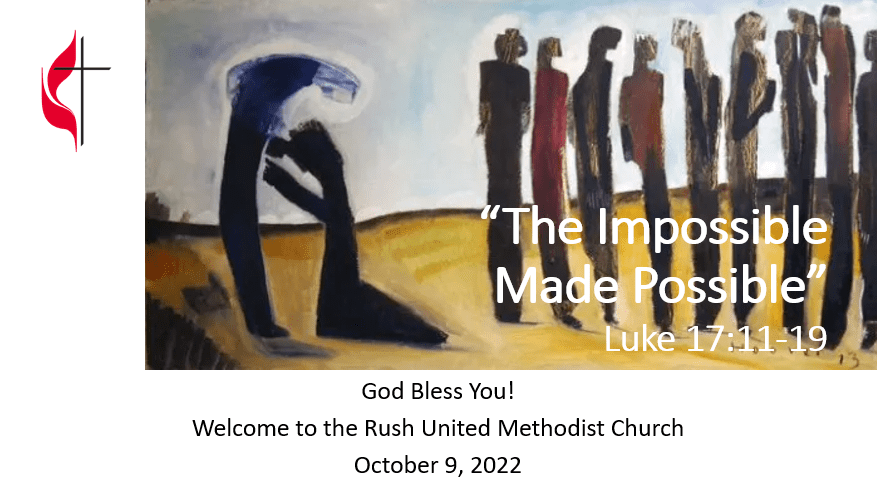
“The Impossible Made Possible”

Luke 17:11-19

October 9, 2022

The Rev. Todd R. Goddard, Pastor

Rush United Methodist Church

Luke 17:11-19

On the way to Jerusalem Jesus was going through the region between Samaria and Galilee. As he entered a village, ten lepers approached him. Keeping their distance, they called out, saying, “Jesus, Master, have mercy on us!” When he saw them, he said to them, “Go and show yourselves to the priests.” And as they went, they were made clean. Then one of them, when he saw that he was healed, turned back, praising God with a loud voice. He prostrated himself at Jesus’ feet and thanked him. And he was a Samaritan. Then Jesus asked, “Were not ten made clean? But the other nine, where are they? Was none of them found to return and give praise to God except this foreigner?” Then he said to him, “Get up and go on your way; your faith has made you well.”

| Centering Prayer |

The changing seasons-

In case you haven’t noticed

We are right in the final days …

Of election season.

Lawn signs have sprung up like daisies.

Television commercials portray political candidates

As fine, upstanding members of the community

Making promises everyone on the planet know they can’t keep,

All the while, tearing their opponent to pieces with innuendoes and lies.

America’s blood sport isn’t football;

It’s politics.

If there is a bright side to this season

It would be that, at least,

we are not settling debates with a duel,

Like Aaron Burr and Alexander Hamilton.

With candidates practically begging for each and every vote

I believe Christians have a prime opportunity

To look to the Word,

Listen to the whisper of God speak through the scriptures

And follow our Lord’s example of how to address some of today’s most challenging social problems.

Candidates on both sides of the aisle desperately want our vote

And to get it, they give us lip service saying they want our input.

Our input should come from a life walking with Jesus

Not by a life lived along political parties or partisan division.

Let’s take a walk with Jesus

From today’s Gospel:

“As he entered a village, ten lepers approached him.

Keeping their distance, they called out, saying, “Jesus, Master, have mercy on us!”

In that time and culture

It was common for people with unclean diseases to group together.

If one had leprosy,

He or she was considered unclean, untouchable.

Those with leprosy were forced to live

outside the protection of the city walls

or on the edge of town

to minimalize the risk of contamination.

Of course, this is where others with leprosy and other communicable diseases could be found.

The city gate was a convenient location to beg for alms, food, and mercy.

A gate was a natural funnel for the flow of travelers,

A perfect location for the unclean to congregate.

Not only is this quite possible that Jesus and his disciples

would have encountered groups of individuals

with leprosy, and similar diseases or disabilities, as they traveled,

it was a certainty.

The Gospel is full of stories about Jesus healing the blind, the lame, and demon possessed.

Jesus and his disciples encountered groups of sick,

diseased and dying outside of every town they approached.

Jewish law, and it’s strict interpretation and application of cleanliness laws,

Segregated families, friends, and neighborhoods.

This primitive system of isolation and quarantine

Provided minimal public health benefit.

Honestly, the true benefit was “Out of sight, out of mind.”

“If I don’t see my disabled cousin every day

then I don’t have to worry about her

and I’m free to go about my business.”

Just another example of how the brutal application of law

– especially religious law –

destroys grace and compassion.

Beware of the practice of rigid fundamentalism,

Absolute, strict adherence to law,

Be it ultra-orthodox Judaism,

Sharia Islamic law, or

Modern day Christian fundamentalism.

It doesn’t take much imagination to consider the word ghetto,

from the Hebrew,

literally a bill of divorce,

and to apply it to our gospel for today.

Jewish society had divided itself, creating a system of

haves v. have-nots,

inclusion v. exclusion,

loved v. those who are to be shunned; even hated.

Let me see.

Can I envision a time and place and circumstance were issues divide us?

The Gospel

Leads me to think about healthcare.

For some, healthcare is wonderful, measured by brand and co-pay.

For others, healthcare is broken pony

dividing people unequally

by zip code, income, gender, age, or race.

If we ask “what would Jesus do” about healthcare,

We only need to turn to today’s Gospel:

Ten people suffering from leprosy cry out to Jesus for mercy.

Jesus saw their circumstance.

Jesus heard their cry.

Jesus healed all ten lepers.

Every last one of them.

As United Methodists

We are a part of a long heritage of

Providing faith-based health care.

Methodist based hospital systems and clinics,

Across the nation and the world,

Stand as a testament to

Our great Wesleyan heritage

Of healing the sick,

Just as Jesus did.

My question is

Why don’t we do everything possible

To ensure that 10 out of 10 are healed?

Too bad, so sad,

if you can’t afford health insurance

Or if your deductible to so high

You can’t afford to use the health insurance you have.

I’m confident Jesus didn’t ask these ten people with leprosy

For their health insurance card and photo ID

Before he healed them and made them whole.

It is possible to improve access and utilization of healthcare,

When we consider the intersection between the life of Jesus and the principles of science.

Faith and medicine

can go hand in hand to ensure

All ten are healed;

No one is left behind at the city gate.

Health is not the only contemporary issue addressed by Jesus in today’s Gospel.

Jesus is traveling from Galilee, in the north,

to Jerusalem, 90 miles south,

through the region of Samaria.

Jewish Samaritans practiced a different kind of Judaism than everyone else.

The term Samaritan meant different things to different people,

depending upon your ancestry, location, and point of view.

To Jews whose ancestors had endured Babylonian exile over 700 years earlier,

Samaritans were descendants that had captured but not forced into exile.

They were conquered, left in place,

forced to collaborate with their occupiers.

Cultures collided.

They inter-married

resulting in bi-racial offspring.

To orthodox Jews

Samaritans were

Mixed race traitors

Practicing an unauthorized faith.

Additionally, during occupation,

Samaritans were forced to relocate the Temple,

due to travel restrictions to and from Jerusalem.  

They built a new local temple on Mt. Gerizim,

the traditional location of the near-sacrifice of Isaac.

Samaritans who lived between Galilee in the north and Judah in the south

Thought of themselves as the faithful ones.

Their blue-blood cousins from Jerusalem

Were the unfaithful ones.

The music stopped,

The charge was injustice,

They faced the Lord’s judgment,

Deemed guilty and sent into exile.

Samaritans hadn’t faced the Lord’s anger, judgment, and exile.

They resorted to survival tactics in the midst of an unmerciful occupier,

doing whatever it took to survive and to remain faithful to God.

They despised those who eventually returned, dismissed their Temple,

and rebuilt the Temple in Jerusalem.

By the time of Jesus, the Samaritans were treated as if they were second class Jews.

To Jews who lived in the north, in Galilee,

where Jesus matured and ministered,

Samaria was a place most travelers avoided.

Best to go around to the east to make the annual visit to Jerusalem and the Temple.

Take the road down the Jordan Valley

instead of the high road through the mountains and hills of Samaria.

Avoid Samaritans, and you won’t have to deal with them.

Treat them as if they are invisible.

Blame them for all that is wrong with our country,

because, well, it is better to blame someone else than to take responsibility for ourselves.

Sound familiar?

Immigration.

Racism.

Both, white hot;

Electrified issues today in

US partisan politics.

Some call it people illegal, others name them undocumented;

Regardless, it results in treating others as

Faceless objects,

Political pawns to press the advantage.

People get used and abused,

Treated as second-class citizens.

What did Jesus do?

The religious culture in which Jesus taught and ministered

Was tailor made to divide people.

Supported by powerful, occupying Roman legions,

Organized Judaism pitted

Jew v. Gentile.

Clean v. Unclean.

Priestly class v. the laity.

Rome v. Jew.

Men v. women.

Wealthy contributors v. the poor widow’s mite.

What did Jesus do?

Jesus included Gentiles into the kingdom,

Healed all and made everyone clean … even on the Sabbath!

He tore up the money changers in the Temple

And treated women as equals with men.

Oh, yes, he healed one Centurion’s servant and

Raised from the dead the daughter of a ruler of the synagogue.

Jesus elevates the foreigner, the immigrant, the migrant, for doing the right thing,

for returning and giving thanks to the Lord.

And like in so many other situations,

Jesus responds with the command,

‘Get up and go on your way;

your faith has made you well.’

We are called to do the same, too.

It begins with changing our attitudes,

ending our resistance to change,

and the acceptance of others,

simply the way they are: created beautiful and perfect in every possible way

by a loving and merciful God.

We don’t have to agree with others,

but we do have to tolerate and respect each other.

We don’t have to worship the same God,

but we do need to insist that all have the freedom to express their religious beliefs

however they see fit, and

without outside threat, risk, or danger.

We do need to stand up and speak out,

both in the voting booth and with our lobbying efforts,

to keep society a melting pot of individuals,

always refreshed with new members,

safe to raise our families,

respectful of our history,

tolerant of culture,

knowing that diversity makes us strong.

By faith in Jesus Christ, the impossible can be made possible.

Healing and restoration are possible.

All can be included in the kingdom,

Not because we say so,

But because it is the way of our Lord.

Amen.

“What is Expected of Me?”

Luke 17:5-10

October 2, 2022

the Rev. Todd R. Goddard, Pastor

Rush United Methodist Church

Luke 17:5-10

The apostles said to the Lord, “Increase our faith!” The Lord replied, “If you had faith the size of a mustard seed, you could say to this mulberry tree, ‘Be uprooted and planted in the sea,’ and it would obey you. 

“Who among you would say to your slave who has just come in from plowing or tending sheep in the field, ‘Come here at once and take your place at the table’? Would you not rather say to him, ‘Prepare supper for me, put on your apron and serve me while I eat and drink; later you may eat and drink’? Do you thank the slave for doing what was commanded? So you also, when you have done all that you were ordered to do, say, ‘We are worthless slaves; we have done only what we ought to have done!’”

| Centering Prayer |

“What is expected of me?”

This is a good question to ask when contemplating any new endeavor:

Applying to college.

Serving on a board.

Interviewing for a job.

Betrothal to be married.

Having a baby.

It is better to “look before you leap”

To have the facts up front

And to plan accordingly.

If one wants to be a disciple

Jesus is right up front about his expectations:

The investment is great, like building a tower

And, more risky, like going to war. (Luke 14)

Time is short and confidence is waning.

Though the disciples have no foreknowledge of impending crucifixion,

Jesus does.

The closer and closer they travel to Jerusalem

The exponential increase in danger

Is giving the disciples cause to lose confidence in the message,

To second guess the cause,

To question the strategy.

The stakes are high;

The consequences may be death.

Our gospel lesson for this morning is the 

Final two of 4 sayings of Jesus.

Jesus is speaking to his disciples;

Soon to be apostles.

He had completed his extensive teaching about money and wealth.

His words are most probably recorded in hindsight: post resurrection / ascension.

Scholars suggest these sayings are probably

Piecemealed together from throughout his ministry.

They are drawing close to his final destination: Jerusalem.

His purpose is simple and straightforward:

To teach the disciples what to do and how to do it after he leaves.

Clear expectations are a solid foundation

Upon which confidence can be built.

Indeed, like the disciples of old,

There is much for us to glean from today’s gospel.

First, Luke reports: It is better to have a millstone hung around your neck

and you tossed into the ocean

Than to cause a little one to stumble.

Secondly, Jesus teaches: If another sins,

Rebuke them first,

Then you must forgive them.

Like the patron at a fast-food joint who responds “Super size me!”

The disciples respond “Increase our faith!”

As if faith was a commodity

And more is always better.

What I think they are saying is “Make us adequate.”

Because right now, we aren’t feeling like we are adequate;

We don’t have what it takes.

We’re failing.

(Yes, the disciples were feeling just like us).

The mustard seed is smallest known seed at the time of Christ;

Smaller than a grain of sand.

In contrast is the mulberry tree,

Also known as a sycamore tree.

It has an extensive root structure

Supporting a massive tree, short but wide.

Faith the size of a mustard seed

Is sufficient to command a mulberry tree to be uprooted and thrown into the sea

“and it would obey you.”

Jesus’ response is an indirect affirmation of the faith they already have.

Jesus’ response is also an invitation to live and act in that faith.

With faith, quality is more important than quantity.

Faith equal in size to a mustard seed can do the impossible.

The Second of the two sayings has no modern day analogy.

It cannot be related to our employee / employer mentality.

Jesus is using the social reality of slavery in his times

(despicable in our modern setting) as a metaphor

To communicate a deeper truth.

This is master and slave relationship.

A slave works all day for the master in the field.

The slave comes in at dinnertime.

It is expected the slave will prepare the meal.

The slave should not expect reward for working in the fields all day;

And shouldn’t expect to rest and dine at the table with the master.

The slave’s time and efforts belong to the master.

Even a slave’s extra effort already belongs to the master.

Which tells us

There is no point of fulfilled duty.

Therefore, the slave has no claim on the master.

The relationship is not service = reward.

The relationship requires

quiet obedience.

What are we to benefit from today’s gospel?

How are these words of Jesus meant to change us?

I count five practical applications for our lives today.

1) Faith is not magic through which we can control God.

Don’t expect faith to remove the lump in your breast

(although, God is certainly able).

Expect a surgeon to remove the lump in your breast.

Expect God to walk with you,

guide and comfort you,

throughout your life.

Faith isn’t a magic show of healing:

people walking out of wheelchairs,

being slain in the spirit,

or speaking in tongues.

Faith isn’t a miraculous flood of post-pandemic people back to church, everyone eager to join, witness, and offer their abilities for servant leadership.

God cannot be controlled to do our bidding.

God does not play fetch.

2) Faith is cooperation with God to fulfill God’s will.

We pray “Thine will be done.”

We cannot expect Thine will to be done

until we give up OUR will;

until each of us give up my will.

To cooperate with God requires that we seek

God’s input into our every decision.

When is the last time we asked the question of ourselves,

“What does God want me to do right here, right now?”

To cooperate with God means that

We are constantly in dialogue with God

through prayer and meditation,

continual repentance,

by bathing in the scriptures,

by listening to our conscience and feelings,

by listening for the Spirit to speak through others.

3) God is not concerned with the quantity of our faith.

Just as with his 12 disciples, so too with us:

God affirms the faith we’ve already been given.

God invites us to live and work in the faith we have.

When we do, our faith will be increased.

The young John Wesley was taught “Preach faith until you have it. Once you have it, you will preach faith.”

There is no excuse for “I’m not strong enough,”

“I’ve never done that before,”

“I don’t think I can.”

The faith you already have, that brought you to worship today,

is strong enough to accomplish the seemingly impossible,

to do what ever God is calling you to do.

4) Faith puts you in touch with God and God’s power.

If we are willing servants of God…

If we are discerning the will of God…

Then there is nothing that cannot be done!

Nothing is impossible with God.

God created all there was, all that is, and will create all that ever will be.

God’s power, reach, and thoroughness are unbounded; unrestricted.

If in faith we call something to God’s attention, God will respond.

Sometimes not the way we desire.

Sometimes with miraculous outcomes.

Sometimes in ways unseen by us or in our lifetime.

Sometimes with something all together different,

but always better.

5) The faithful disciple is called to carry out the will of the master

Without expectation of praise.

Many would agree

We are honored, appreciated, celebrated, awarded, and thanked too much in our world today.

Trophy cases have run out of room, walls have too many plaques on them, files overflow with letters of accolades.

Disciples of Jesus Christ are called to live in quiet, humble obedience.

Our time and labor belongs to Jesus.

There is no way we can do enough,

let alone do more than our share.

There never comes a time when we can say,

“I’ve done my part. Time for someone else to take over.”

There never comes an earthly time when our service is completed

and we can sit down and be served.

God gives us grace, not reward.

It is only by God’s grace that we can live a life of service for our master, Jesus Christ.

It is only by God’s grace that we can give our lives and labors to Christ and his church.

It is only by God’s grace that we have been saved by faith;

Faith first planted within us,

Prevenient grace,

When our Lord breathed life into our soul.

Our gospel is about faith.

It serves to build self-confidence

Not in what we can achieve,

But in what God has already given us.

1) Faith is not magic through which we can control God.

2) Faith is cooperation with God to fulfill God’s will.

3) God is not concerned with the quantity of our faith, but in the quality of your faithfulness.

4) Faith puts you in touch with God and God’s power.

5) The faithful disciple carries out the will of the master without expectation of praise.

May we go forth with joyful, yet quiet, humble obedience.

Amen.

“The Rich Man and Lazarus”

Luke 16:19-31

Proper 21C, September 25, 2022

The Rev. Todd R. Goddard, Pastor

Rush United Methodist Church

Luke 16:19-31

“There was a rich man who was dressed in purple and fine linen and who feasted sumptuously every day. And at his gate lay a poor man named Lazarus, covered with sores, who longed to satisfy his hunger with what fell from the rich man’s table; even the dogs would come and lick his sores. 

The poor man died and was carried away by the angels to be with Abraham.

The rich man also died and was buried. In Hades, where he was being tormented, he looked up and saw Abraham far away with Lazarus by his side. He called out, ‘Father Abraham, have mercy on me, and send Lazarus to dip the tip of his finger in water and cool my tongue; for I am in agony in these flames.’ 

But Abraham said, ‘Child, remember that during your lifetime you received your good things, and Lazarus in like manner evil things; but now he is comforted here, and you are in agony. Besides all this, between you and us a great chasm has been fixed, so that those who might want to pass from here to you cannot do so, and no one can cross from there to us.’ 

He said, ‘Then, father, I beg you to send him to my father’s house— for I have five brothers—that he may warn them, so that they will not also come into this place of torment.’ Abraham replied, ‘They have Moses and the prophets; they should listen to them.’ 

He said, ‘No, father Abraham; but if someone goes to them from the dead, they will repent.’ He said to him, ‘If they do not listen to Moses and the prophets, neither will they be convinced even if someone rises from the dead.’”

| Centering Prayer |

Our Gospel lesson for this morning provides options;

We like choice, don’t we?

There are opportunities for the faithful Christian to make choices.

On the one hand,

It would be fully understandable for one to examine these words of Jesus

Through the lens of personal, eternal salvation

And believe that it is the intent of Jesus

and the point of Luke

That this is a parable about heaven

and the eternal disposition of the soul.

Does death deliver us to our eternal fate?

The apostle Paul suggest

that the hope for life resides on in the resurrection

(see 1 Thessalonians and 1 Corinthians).

Is this a parable meant to convey essential truth about heaven and hell, and what happens to you after you die?

On the other hand,

If we pay attention to Luke’s context,

From which we’ve been reading these past few Sundays,

We recognize that this parable follows the passage of:

The Widow’s coin,

The Prodigal’s inheritance,

And the Dishonest Manager’s handling of debt.

Is there a trend here?

(yes, of course there is)

Luke has been talking about money, treasures, and riches.

So why wouldn’t he be continuing the theme here?

This is parable of Jesus,

a fictional story created by Jesus,

about a broken man named Lazarus

and a rich man, commonly known as Di-ves.

This parable is a capstone in Luke,

a pinnacle of successive stories Jesus uses

to teach about the dangers of wealth.

When we experience this story,

consider these words echoing in the background:

+ Mary declaring her praise of God in the first chapter of Luke:

“He has brought down the powerful from their thrones,

and lifted up the lowly.”

+ When we experience this story,

consider a discreet, angry voice in the third chapter of Luke,

John the Baptist warning

“God is able from these stones

to raise up children to Abraham,”

and “the chaff he will burn with unquenchable fire.”

+ When we experience this story,

consider the voice of Jesus

who just taught in the sixth chapter of Luke

that “the kingdom of God belongs to the poor and the hungry,

but woe to those who are rich and who are full.”

Eternal life?

Dangers of wealth?

Yes.

The curious will note

This is the only parable Jesus creates

where he includes a name: Lazarus.

Jesus makes the story personal and intimate.

Jesus casts the Lazarus as someone who was disgusting.

It gives the parable a sense of familiarity, doesn’t it?

We all know someone who makes us sick.

The master storyteller

Tells his tale that

Lazarus was a despised man,

who threw himself at the gate of a rich man,

or was dumped there

(as the Greek suggests)

so that he might beg;

perhaps even obtain some of the wasted bread

used to clean dirty fingers.

(They didn’t have paper napkins at the time)

He was covered with sores.

Lazarus was seen.

He was known.

He was identified.

He was so weak,

he couldn’t prevent the dogs from licking his sores.

Jesus’ audience of rich Pharisees

probably were saying to themselves,

what did he do to deserve this?

for it was believed that hardships

where caused by God

as a result of unrighteous behavior.

Who sinned?

What was the sin that God punished with such a response?

Lazarus dies.

Did he die of starvation? disease? infection? or did the dogs …?

Premature death is just one of the consequences of being poor.

(Sigh)

Angels came,

gathered him up,

and carried him to Abraham.

There, Lazarus completes eternity in the bosom of Abraham.

Throughout this parable,

Lazarus is never spoken to,

and he never speaks.

The lowly is lifted up.

Then there is the rich man, Di-ves.

This is really a parable about him.

He lives a pampered life,

dressed like royalty in purple robes and fine linen,

feasting sumptuously every day,

using bread to wipe his greasy fingers

and throwing it on the floor.

The rich Pharisees probably thought he was blessed by God,

because of his accumulated excess.

Wealth is a sign of God’s approval, isn’t it?

And the rich man had more wealth than he could shake a stick at.

Wealthy often see wealth as a sign of God’s blessing.

The poor?

Not so much.

The rich man probably thought he had been blessed abundantly.

He overlooked the fact that Lazarus was begging at his gate.

In fact his table and his gate

separated himself from all the riffraff of society.

Have you noticed

that once one has achieved a minimum amount of money

to become self-supportive,

additional wealth only serves

to become additional insulation between the wealthy and the poor?

… and so it was with the Rich man.

Di-ves died and was buried

(notice the contrast to Lazarus,

who was immediately whisked away to the bosom of Abraham).

We must assume

The Rich man didn’t take his wealth with him.

He and his treasure were parted.

The Rich man, Jesus reports, was taken to hell, Hades, as it was called.

He was tormented and in flames.

There wasn’t much he could do.

But he could look up;

far away, in heaven

he could see Lazarus in the bosom of Abraham.

He recognized Lazarus!

This privileged millionaire knew Lazarus enough to avoid him on earth, yet he was able to recognize him in heaven.

How convenient.

In the torments and flames of hell,

Di-ves speaks as if Lazarus didn’t exist:

Father Abraham,” he calls,

hoping to play his trump card

(I’m one of your children, a family member, a child of Israel).

“Send Lazarus

to dip the tip of his finger in water and cool my tongue;

for I’m in agony in these flames.”

Lazarus is right there.

Yet, Di-ves acts as if he is invisible.

If you don’t see the poor, they must not exist.

(Sigh)

He acts with callous disregard.

He acts as if Lazarus is his servant. Or less.

What nerve!

Agh!

Abraham rebuffs him the first of three times:

“Remember that during your lifetime

you received your good things,

and Lazarus in like manner evil things;

but now he is comforted here,

and you are in agony.”

Di-ves tries a second time: “Father”

(another foolish attempt to play on Abraham’s goodness),

send Lazarus

“to my father’s house-

for I have five brothers-

that he may warn them,

so that they will not also come into this place of torment.”

He still acts with callous disregard.

Lazarus is no errand boy.

The (formerly) rich man doesn’t get it.

Lazarus isn’t a second-class citizen.

He is selfishly looking out for his own family,

not Lazarus, and no one else, either.

Abraham rebuffs him a second time:

“They have Moses and the prophets;

they should listen to them.”

Moses.

And the prophets.

Listen to the words of Moses in Deuteronomy,

as I’m certain the rich Pharisees knew from childhood:

“Do not be hard-hearted or tight-fisted toward your needy neighbor.” (Deuteronomy 15:7)

Consider the prophet, Isaiah, who spoke

“Is not this the fast that I choose; to loose the bonds of injustice, to undo the thongs of the yoke, to let the oppressed go free, and to break every yoke? Is it not to share your bread with the hungry, and bring the homeless poor into your house; when you see the naked, to cloth them, and not to hide yourself from your own kin?” (Isaiah 58:6-7)

“No, Father Abraham,”

Di-ves makes a desperate plead for a third time,

send Lazarus.

“If someone goes to them from the dead,

they will repent.”

Scare them with a ghost.

Consider all those who witness resurrection.

In hind-sight consider

those confronted with the witness of Jesus’ resurrection

who still do not believe.

“If they do not listen to Moses and the prophets,

neither will they be convinced

even if someone rises from the dead.”

You can be sure,

All who are in Luke’s post-resurrection audience

Get this ironic joke.

Is this a parable about heaven and hell

Or a story about wealth and riches?

Perhaps it is a little bit of both.

It certainly is a warning

We’d all be prudent to heed.

I’m uncertain God is in the hell creating business.

I do know that humankind has gotten pretty good at making our own hell.

We create hell

when we act with callous disregard for human suffering.

We create hell

when we stereotype and marginalize,

when we talk down to people,

when we use phrases “like them.”

We create hell

when we hurt other people,

either intentionally or unintentionally.

We create our own hell

when we act as if we were better than someone else.

We create our own hell

when we allow abundance, wealth or food

to come between us and someone in need.

We create our own hell

when we refuse to forgive and can’t ask for forgiveness.

We create our own hell

when we fail to love.

Hell is everything we believe, say, and do

that separates us from one another and from our God.

Although nothing can separate God from us,

hell is everything we do to separate ourselves from God.

Hell is not created by our loving God.

Hell is created by you and me.

Then when we die,

the hell we’ve created, we are warned,

is fixed,

“so that those who might want to pass from here to you

cannot do so,

and no one can cross from there to us.”

Unquenchable fire.

Gnashing of teeth.

Everlasting torment.

Fire and flames.

The ability to look up into heaven,

Like Di-ves, and see the results of our evil ways.

Yes, these are images we are given of hell;

the hell that is fixed after our death.

These are images that Jesus gives to us.

They serve as a warning.

It is wise to heed them.

So look to the needs of others,

Those right at our doorstep.

Look to our neighbors in need beyond the horizon.

Restore the broken.

Heal the sick.

Feed the hungry.

Welcome one; welcome all.

Make friends,

Be friends,

Live as friends,

as neighbors,

peaceably in God’s kingdom.

Make hell into a fading memory

That slowly, but surely, fades to black.

Amen.

“The Prudent Use of Wealth”

Luke 16:1-13

September 18, 2022

The Rev. Todd R. Goddard, Pastor

Rush United Methodist Church

Luke 16:1-13

Then Jesus said to the disciples, “There was a rich man who had a manager, and charges were brought to him that this man was squandering his property. So he summoned him and said to him, ‘What is this that I hear about you? Give me an accounting of your management, because you cannot be my manager any longer.’

Then the manager said to himself, ‘What will I do, now that my master is taking the position away from me? I am not strong enough to dig, and I am ashamed to beg. I have decided what to do so that, when I am dismissed as manager, people may welcome me into their homes.’

So, summoning his master’s debtors one by one, he asked the first, ‘How much do you owe my master?’ He answered, ‘A hundred jugs of olive oil.’ He said to him, ‘Take your bill, sit down quickly, and make it fifty.’ Then he asked another, ‘And how much do you owe?’ He replied, ‘A hundred containers of wheat.’ He said to him, ‘Take your bill and make it eighty.’ And his master commended the dishonest manager because he had acted shrewdly;

for the children of this age are more shrewd in dealing with their own generation than are the children of light. And I tell you, make friends for yourselves by means of dishonest wealth so that when it is gone, they may welcome you into the eternal homes.

“Whoever is faithful in a very little is faithful also in much; and whoever is dishonest in a very little is dishonest also in much. If then you have not been faithful with the dishonest wealth, who will entrust to you the true riches? And if you have not been faithful with what belongs to another, who will give you what is your own?

No slave can serve two masters; for a slave will either hate the one and love the other, or be devoted to the one and despise the other. You cannot serve God and wealth.”

| Centering Prayer |

Our Gospel passage for this morning

is a parable

followed by three declarative applications.

It is traditionally titled “The Parable of the Dishonest Manager.”

While true, the manager was squandering his master’s property,

Naming him dishonest can misdirect the faithful from the points Jesus is attempting to make with his audience.

What is his point?

Context is important.

Here are some observations.

1. First, Jesus is in his final weeks before his

Arrest, suffering, death, resurrection, and ascension.

It’s crunch time.

He is on the road,

Traveling from Galilee in the north

To Jerusalem in the south.

The closer to Jerusalem,

The larger the crowds.

Luke reports that the crowds were composed of

All the tax collectors and sinners, and,

Pharisees and scribes who complained about them.

2. Jesus is teaching in parables.

The parables of the Lost Sheep,

The Lost Coin, and

The parable of the Prodigal and His Brother

Immediately precede today’s

Parable of the Dishonest Manager.

The narrative of the Rich Man and Lazarus follows.

It is important to recognize that our parable for today

Is bookended by the Prodigal Son and His Brother and the Rich Man and Lazarus.

From a younger son who squanders his father’s possession by dissolute living to

The crisis of eternal life of Lazarus and a rich man sent to eternal Hades

We find a dishonest manager of his master’s treasure today

Smack dab, right in between.

3. The use of treasure and wealth

Is a common thread that draws our attention.

Jesus is teaching about what’s in your wallet and how are you using it?

He’s talking cold, hard cash.

Not volunteer time.

Not putting your skills and talents to use.

Jesus is talking about mammon

(Μαμμωνάς, Greek, def.- riches, money, possessions, property).

Cash, savings, pension, 401(k) and 403(b)s.

House, properties, and businesses.

The beginning of understanding Christ’s parable of

The Dishonest Manager

Starts with a personal review of your personal wealth.

4. The parable is a fictional story

Jesus created to

Communicate a deeper truth.

In the time of Jesus

It was common practice for wealthy landowners

To employ a professionally trained manager to manage their financial affairs.

They would have power of attorney,

The ability to buy, sell, borrow, and engage in business and commerce on behalf of the wealthy owner.

This shielded the rich from Jewish usuary laws, and,

Freed them to do whatever it is that wealthy people do.

Pass the Grey Poupon, please.

5. A professional manager, as we have in today’s parable,

Would earn their wage by adding a percentage of a loan

And skimming it off the top.

Let’s call it a “Steward’s Commission.”

Say a wealthy person had 60 containers of wheat to loan.

He could tell his manager to loan it out at an interest rate

Such that it would take 80 containers of wheat to pay off the loan.

The manager would mark up the loan to owe 100.

The rich man makes twenty.

The manager makes twenty.

It’s a pretty slick system for the wealthy;

Not so much for the poor debtors covered in sores laying at the gates. 

6. In today’s parable the rich man catches his manager with his hand in the cookie jar.

He was charged with squandering his property.

The manager neither denied the accusation,

Tried to defend himself, or

Attempted to beg off.

Guilty as charged.

What to do? He thought.

How does one respond?

How does one respond such that it his future is assured?

7. This is his plan:

Mark down each loan

By the amount of his cut.

This makes the debtor happy;

He or she feels they’ve received a discount.

This makes the wealthy man happy;

He or she has their loan paid off with interest.

The prudent manager doesn’t burn his bridges;

He makes certain

That the present crisis

Provides future opportunities.

What are we to learn and

how are we to apply what we’ve learned

to our circumstances?

Four things.

1. Keep yourself

future oriented;

You, personally,

And, in general, the Rush church family.

The temptation is to relive yesterday.

“Remember when” …

Our idyllic life growing up?

“Remember when” …

Our church was growing families, staff, and programs?

An equally dangerous temptation is to complain about today.

It is easy to become the victim of unrealized grief or loss,

To fester lingering feelings of rejection,

To blame the pandemic, prior or current pastors, and society as a whole.

Like the dishonest manager,

We can take control of our own destiny.

It is our choice,

Individually and collectively,

To plan and implement means to

Maintain our personal spiritual lives, and

To maintain and grow the vitality of the Rush church family.

The responsibility is shared.

The responsibility is ours.

2. We, children of the light,

(Disciples of Jesus)

Can learn from the children of the world,

Such as this dishonest manager.

The lesson isn’t dishonesty;

The lesson is prudence.

Prudent stewardship can be learned from

Your financial advisor from Goldman Saks as well as

The treasurer of the local Hell’s Angels gang.

Prudence is a universal virtue

that Jesus is teaching us to apply to our own lives,

Individually and collectively.

Discipline your financial and business life as much as possible.

Budget. Plan. Pay attention to details. Stick to it. Improve every day.

Trim spending on the self as much as possible.

Stick to the bare necessities.

Prudently put to use savings, assets, and property

To capitalize on present and future opportunities.

I’m look at Cindy, Michelle, and Eric;

Our chairpersons of the

Board of Trustees,

Finance Committee, and

Endowment Committee.

Is your committee acting with prudence?

Practicing good stewardship?

What are you and your committees doing well and what can you improve?

Budget. Plan. Pay attention to details. Stick to it. Improve every day.

3. Responsibility and fidelity in small things corelates with responsibility and fidelity in large things.

When it comes to personal wealth

God gives to some little,

To others much,

Each according to God’s will.

When it comes to the wealth entrusted to the church,

We’re talking about God’s money,

God’s property,

God’s affairs.

Handle with care.

‘nuff said.

4. Lastly, check your attitude about wealth.

No one can serve both God and wealth.

Ask yourself, will wealth govern my life?

Or, will God govern my life?

Are finances and property the purpose of our congregation,

Or, is our purpose

Discipleship to Jesus and

Loving neighbors in his name?

When wealth is managed prudently,

There is no anxiety,

There is absolute freedom to serve the Lord.

If all we’re focused on is wealth,

Obtaining wealth,

Growing wealth,

Using wealth for our own benefit,

Then we’re squeezing God out of our lives.

Keep your eyes on Jesus.

Trust in the Lord to take care of the rest. 

God has already given us more than we need.

Today’s question is

how will we use this amazing, abundant  grace of

Money, property, and income?

How will you put to use

your personal wealth

To serve the Lord

Prudently,

Responsibility, and with

Fidelity?

How will we,

As the Rush United Methodist Church family,

Use what God has given us to achieve the possible

Today and tomorrow?

Today’s Gospel is challenging;

But just wait to next week

When we find Lazarus begging at our front gate.

Amen.