32. What Parents and a Parish Teaches

Rural Yates County was the perfect place to begin my parish ministry. The people are salt of the earth, hardworking, generous above and beyond expectations. Faith runs deep. I had much to learn. 

Elderly residents of the local nursing home had much to teach me. I took my turn in the cue of pastors from nearby churches providing worship services on Sunday afternoon. Every six or eight weeks was my turn in the barrel. I quickly learned to bring my choir from Dresden. The overly sedated, room full of residents, dozing in Gerry-chairs were largely unresponsive to my skillfully crafted academic sermon of the day. When the choir began to sing one of the familiar gospel songs, everyone would perk up and began to sing. As soon as the song was complete and I began to speak again, everyone fell back asleep. 

I’ll take my humble pie with a slice of cheese, please.

An invitation came in soon after we moved in to join the Lectionary study group of United Methodist pastors that convened once a week in Geneva. Charlie Hess (who won the fishing boat in the Roman Catholic raffle, and refused to honor the Social Principles about gambling by giving it back) was the host pastor.

Sam Davis, smart as a tack, joined us from Seneca Falls. He never met a sugar donut he couldn’t resist, and ended up wearing powdered sugar all over his face and shirt. Gary Hakes hailed from Phelps, the father of one of my fishing camp nippers, and chair of the local chapter of Planned Parenthood. Progressive; my kind of guy. And Steve Parr, a long suffering elder serving a rural parish on the other side of the county, whose wife was the chaplain at the local private college. Steve was frugal, to the point of buying donuts in quantity from the local wholesaler then freezing them in his freezer. Instead of buying donuts from the local donut shoppe, he’d bring in frozen, sugar coated  pucks in a zip locked bag. Gotta love him.

The first morning I attended, I showed up with a stack of academic Biblical reference books and commentaries. Everyone burst out laughing. Sam Davis, a graduate of University of Chicago, was impressed. The next week, I bought the donuts.

The Lectionary study group taught me the value of peer fellowship, support, and humor. Life in the trenches of a Parish Pastor is rough, filled with huge doses of both laughter and tears. We were five white, privileged pastors dressed in Hush Puppies, raising families, juggling demands, and doing the best we could with what we had. With little supervision, we functioned as an accountable discipleship group. Our friendship lasted all lifelong. They are all gone now; I’m the last one standing. I smile with the warm memories of these giants in my life, gently guiding me through the challenges of Ordained Ministry. 

I learned much from the local undertakers.

Bruce owned one funeral home uptown in Penn Yan; Steve owned the other. The competition was friendly. Bruce served on the leadership team of a nearby United Methodist parish and he liked to gripe to me about the conference, Bishop, and denomination. He was also the source of much parish gossip: “I saw so and so at the pharmacy the other day. She was checking out with cart full of lubricating jell and weight loss supplements.”

Five minutes before one funeral, Bruce showed me a letter of complaint he sent to the bishop, claiming his pastor was engaged in inappropriate behavior. “What are you going to do about it,” he asked, the veins bulging from his temples and neck. “Well, nothing,” I replied, “because I have a funeral service to start.” 

Often the best response is a smile and silence. 

I couldn’t go to the pool this morning because a new clothing drying was being delivered. The old one stopped working after three years. Two hundred dollars for a repair man to assess the problem, then more to commence repairs, or, for a few dollars more, get a scratch-n-dent floor model replacement. I hate planned obsolescence and American consumerism. 

Two days ago I hit the pool for the first time in two weeks. We had traveled to the far coast to visit family. Cynthia and I took our time out and back, riding the train to take in all the scenery of our great land. Time with my brother and his family was priceless, much more fulfilling now that we are all retired. 

The water was cold and I doubted if I could swim hard for a full fifteen laps. But, I did. My arms and shoulders pulled at the water, pushing it behind, as my brain was lost in thought attempting to process all the conversations I had with family. 

What was the meaning of my (our) father’s early death? Does death have to have meaning? What about my (our) mother, living more than thirty years after dad died? That is a long time to be alone.

Our mother was a strong woman, I thought as I swam. She grew up in an orphanage, became the cutout for Rosy the Riveter, married dad after he returned from the Pacific, raised four children, followed Jesus and lived her life accordingly. When he died, she had to learn to make due on her own, balance a check book, return to driving, living independently. She did so with grace and humility. Mom died after nearly twenty years of Alzheimer’s in a nursing home at the height of COVID. Mom deserved better than me telling her that I loved her over the telephone while she took her final breaths.

My mother had taught me so much. Love. Faith. Grit. Hard work. And apple pies. Rare was the pie she didn’t give away to someone in need or from Dad’s parish or to a neighbor going through tough times. But every now and then, one of her pies were made just for us. 

The day was April 15th, a day made memorial by the Internal Revenue Service. In the dark of the early morning, the Plectron fired off the alarm to our volunteer fire department. Barn fire, at the cross roads of City Hill and Ridge. I jumped out of bed, stepped into my coveralls and shoes, and took off for the fire house, across the street and through two back yards. It was always a foot race to see who could get there first, Bill or me, my trusty church lay leader and friend. 

In the pre-dawn light I could see the mushroom cloud of a burning barn as I ran for the pumper. A barn to most of us is the image of rural life, a character from a Norman Rockwell painting, a calendar picture inviting us back to a simpler more wholesome time.

To a farmer, a barn is the center of a small business, generating income, often in competition with mounting expenses. A barn is a milking parlor, a hay mound, a storage space protected from wet elements. It houses valuable farm machinery, is home to cattle, a neighbor to a silo holding grain or chopped corn, and a place for kids to play.

This barn belonged to one of my church families. 

The string of pumpers, tankers, and the rescue truck snaked out of town, uphill in every direction. The water haulers carried a thousand or more gallons of water because only city people had hydrants. I drove the lead pumper, having won the foot race. Next to me was another volunteer, dressing and strapping in to his bunker gear to protect him from flame and heat.

The radio squawk from the chief, another one of my church leaders, now on scene in his personal vehicle, asking for mutual aid from at least ten neighboring fire departments. Barn fires needed a lot of water quickly. I feared this one was already beyond saving. 

I pulled into the farm yard to find the family and our chief frantically getting livestock and machinery out of the infernal. I had never seen a fire so large and frightening. “Oh Lord,” I prayed to myself, “don’t let me goof up.”

Tank-to-Pump lever; pulled. Pump primed. Hose lines laid and charged. Water flowing. Hard suction connected to the pump and pounded tight with a rubber mallet. Portable pond set up. Tankers from other departments arriving, waiting their turn to replenish the pond as fast as my pump would drain it. Sweat dripping in my eyes, tears for the family welling up in my eyes. 

My chief, Charlie, came over and looked me in the eye. “Todd,” he said somberly, “let someone else relieve you from the pumper. The family needs to see you inside the house.”

And so, the other shoe was about to drop. 

Around the dining room table sat Mom and dad, son and daughter, and a deputy sheriff. Eyes were down, the room was silent, the coffee pot announced a fresh pot was brewed. “Pastor Todd,” Mom said when she saw me, “come in and have a cup of coffee.” Mom was also a leader in my parish, a woman of strong faith, accustomed to hard work on the farm. 

The Sheriff asked the father about the farm and possible causes of the fire. Yes, there was electricity to the barn to run the lights and compressor for the milking machine. But he didn’t suspect there was a problem with the power. The night was clear so a lightning strike was doubtful. Dad truly had not a clue as to what may have started the barn fire. 

I sat waiting for divine inspiration. 

“Yesterday afternoon,” the son began speaking barely above a whisper, “my friend and I were playing in the barn. Just fooling around. We didn’t mean nothing. We got some matches and made a little fire. It didn’t get too big and we thought we put it out.”

The silence that followed was deafening. The guilt that descended was overwhelming. “I did it,” the young boy screamed, “but I didn’t mean to do it.” Tears burst the flood gate and he ran bawling to his room. The rest of us sat stunned in silence. 

“What do you want to do?” the deputy asked gently. All of us were thinking of legal actions, loss, and grief. All of us, except for dad. 

“When I was young,” dad began, “about the age of my son today, I, too, accidently burned down my Daddy’s barn. It was an accident. I knew, but no one else did. It’s been my secret these past forty years and it has always weighed heavy on my heart.” 

I thought of Christ on the cross, dying for our redemption. 

“The one person,” I carefully began, “who needs to hear your confession, is your son crying in his room.” 

The pause was pregnant. “You’re right, Pastor.” Dad pushed away from the table. “I gotta do what’s right.” Dad left us in the kitchen and went in to console and confess his sin to his son. 

That was a morning nearly forty years ago. It was a day in the life of this parish pastor where I learned about redemption, the depth of love Christ has for each of us, and the depth of love a father had for his son. 

30. The Post Office, Conflict, Voting, and Emergency Surgery

Life serving a small parish was good. Expectations were low, so it was easy to excel.

Mornings were spent in the church office. There was no heat. In fact there was no office. I simply made space for myself out of a large closet and had moved in a glass top antique desk. When the temperature dropped below freezing, my hand would stick to the glass. Parishioners took pity on me, even thought they wondered what I was doing in the church building every morning. Someone kindly provided a kerosene heater. 

Each morning the mail would come in at the post office around 10 am. It was a social event, where I could catch up with everything happening in the neighborhood. While the post mistress filled each box, about ten women and I waited intently for each mailbox to be filled. Each had a husband or a live-in man who worked out of town. My neighbor, George, and I were often the only men in the village between 7 am and 5 pm. 

One morning I went to fetch my mail, waited patiently for my mailbox to be filled, opened the locked door, and removed the contents. Everyone in that cramped, little post office looked at me, at the mail in my hand, and had a panic look of a deer in headlights bug eyes. “Oh, my,” I thought to myself. “What did I do now?”

On top of my stack of mail, in plain sight for all to see, was a pornographic magazine; not one that could be described as soft, filled with worthwhile articles, so said every male who nervously turned every page. No, it was a raunchy magazine, the kind that was mailed in a protective, tinted plastic sleeve. 

“It isn’t mine,” I protested, turning every shade of red. Snickers abounded.

I took it to the window, behind which the post mistress held court. “Oh,” she said, looking over her cat glasses that sported a silver chain drooped around her neck. “I must have put it into the wrong mailbox.” She promptly slid the offending item into the post office box right above mine. We all knew who owned that box. 

A year or two later, I conducted the funeral of said mailbox owner. He had been one of the last blacksmiths before hiring on to work the coal piles at the Greenidge electrical generation power station. Covered with coal dust, I could only see the white of his eyes when I’d see him after his work. Laying peacefully in his casket, I trusted that he was now at peace at home with his God. 

The pool this morning was all business. Get in, get it on, get it over with. My thoughts churned with my flailing crawl. I had been recent witness to a sudden, emotionally charged, vulgar laced slur that took everyone in the room by surprise. It was defensive, instinctual, verbal violence meant to hurt and to harm. 

Others responded with tempered defense, while my broken heart filled with empathy for the one who took the unwarranted brunt of the offense. How one responds to such harm defines character and spiritual wellness. 

Now there is something to focus on, as the laps churned away, the cool morning water providing me with a sense of balance and support. Character. Spiritual wellness.

No, I do not like conflict. Most people don’t, with the exception of lawyers. But I’ve learned with time and experience that conflict is best dealt with immediately, with confidence, and kindness.

Delay results in retrenchment, resentment, and deepening malaise. My response should be balanced with love and insight regarding motives of those involved. Is someone’s anger coming from a childhood experience, from demons of addiction, from anxiety over marriage, children, or employment? Is their outlash the result of an untreated mental health condition? Sometimes it is as simple as their dog biting them in the butt as they went out the door that morning on the way to work. 

I can’t take away the anger and hurt of this world. But my faith, in the God of my experience and understanding, is able to work a healing balm into every broken soul. 

The soap and hot shower after my laps this morning cleansed my body of the pool’s chlorine and brought restoration.

One church in town. One cemetery. One  village, I paternalistically considered my own. It was a privilege to be with my people in their disease and death, connected with family and ancestors that had gone on before them. Many were the graves at which I stood, leading prayers of reluctant release from this mortal life into the hands of our eternal God. 

Graves trembled with each passing coal train that fed Greenidge’s boiler, generating electrical power to homes throughout the Finger Lakes. Skiffs transported employees and navy personnel to and from the barge anchored in the center of Seneca Lake conducting top secret research. School busses picked up and dropped off children as they went to and from school up town in Penn Yan. The hotel served up game dinners for hunters and served cold beer to a sublime cliental. 

The local town offices were shared with the highway department and a substation for the State Police. My wife and I presented ourselves to vote before election officials. “Last name, please,” as if they didn’t know the new preacher in town. Out was hauled a large binder of registered voters. “I can’t seem to find you here,” she said, as she licked her finger and leafed through the pages. “You are registered Republican, aren’t you?”

The room fell silent. All eyes were on Cynthia and me. 

“Um. No,” I confessed. “We are registered Democrats.” 

“Oh,” she sighed as she pulled out a one page list from a file folder. “Here you are,” she smiled weakly. We cast our votes with humility, having learned our lesson in small town life. 

The women in town were strong and formidable. They worked the vines for the exploding New York wine industry, trimming with both hands in the cold of winter. They worked chores on dairy farms along with the men, milking cows 365 days a year. Never a day of rest.

Women buried their dead husbands and lovers, who died an early cancerous death as a result of working the coal plant. One tended her husband’s home dialysis, another a loving, devoted caregiver for her husband with Parkinson’s. Yet another stood by her man, even when her man proved unworthy of her faithful love. One woman aged gracefully with her retired husband, another spent her time baking the most delicious Danish pastries to be shared with neighbors (and the occasional visit by her pastor). 

Neither did I find any slackers among the men in town. Salt of the earth. Hard workers. Raising their families as best as they knew how. Oh, there were some exceptions, but they were rare.

The men in town were interesting characters. Those who displayed odd behaviors or a peculiar character added color to an otherwise drab environment. One played the marimba every Memorial Day at church, while another arranged for a high school senior to recite the Gettysburg Address. I discovered one dancing with a tree in his front yard, as I walked home after a late night church meeting. No, I did not suspect he was under the influence. That is just the way he was; happy to dosey doe with a Dogwood.

Conflict was rare. It was a thankful reprieve from future experiences. One couple thought I wasn’t sufficiently conservative in my interpretation of the Bible that they sat disapprovingly in their pew with arms crossed and scowls on their face. I would not apologize for emphasizing grace over judgment or love over law. I let Jesus do the talking for me. 

Sunday morning was chilly and snow swept as I headed out for worship at the other church of my appointment, a tiny church that sat in the middle of a cornfield at the intersection of a former stage coach stop. Reluctantly, I left Cynthia behind with our newborn son, Nicholas, who had been up all night crying and vomiting. The doctor up town agreed to open up his office and see them as soon as they could get there. Our neighbor, George, offered to go with  them to the doctor. Off we went our separate ways. 

After the early worship service, I returned to town. Time was of the essence, especially if delayed by a slow, rumbling coal train that blocked entry into the village. I quickly parked in my reserved spot and entered the church office to don my white clerical apparel. Just in time, I processed into the sanctuary to organ music and an assembling crowd speaking to one another in low murmurs. I took my seat up front, behind the pulpit and altar table. As the organ played, I closed my eyes attempting to center myself, and pray that Nicholas was okay. 

Serenity was broken as one of my Trustees (and fire chief) approached my chair. He leaned over and whispered in my ear. “George just went with Cynthia and Nicholas to the hospital in Geneva for emergency surgery. What do you want to do?” He asked. “I can take you to the hospital, if you want.”

“Yes, please,” was all I could weakly reply. 

I gathered my six page, double spaced, typed sermon and handed it off to my lay leader to read in my absence. Off we went. Buckled in. Lights and siren weren’t needed due to it being Sunday morning. Kindness. Appreciated beyond words. Thank you, Lord, for the kindness of a Parish who loved me back and a Trustee who delivered me to the hospital waiting room. 

A quick hernia repair and a short hospital stay averted catastrophe, and we returned home. Healed. Whole. Thankful.

29. Lights and Siren: Closing One Door, Opening Another

Before moving on to my first parish, I had to say goodbye to SK Wiley and friends at the Miamisburg Police Department. I rode road patrol with them a minimum of once per week my last year of seminary, usually the evening or late night shifts. I was privileged to get to know the officers well, learn their back stories, and of their present day joys and challenges. Saying goodbye was the least I could do; saying thank you for their gift to me and my professional development was even more important.

They pulled pranks on each other, shared tragedies, locked up the same career criminals, week in, week out, over and over again. Shared experience made them tight as a family, dysfunctions, and all. One moment I’d hear whining, “Yeah, that fat fornicator served in Viet Nam, but he spent his whole tour sitting on his ass changing airplane tires.” Or “hope his wife never hears from his mistress.” Or “Too bad he can’t hold his liquor. I found him last week sleeping in his car, passed out behind the wheel, stuck in a ditch, drunk as a cooter.”

It was a different time and a different era.

Yet, when the chips were down, everyone came out of the woodwork to protect one another. Be it “shots fired” or “personal injury accident” all stops were swept away, off duty cops responded, everyone, from the chief to the new hire, jumped into harm’s way. It was tight as blood, and I had been made an honorary member of the family. How cool was that?

There were too many experiences to write about, but here is a sampling: Doing donuts in the high school parking lot after a heavy snow, giggling like high school kids. There was the guy who hung himself in the basement, having his wife discover the grizzly scene. Then, the lady and her infant who’s pickup stalled on the railroad tracks, only to be demolished by a freight train. “You smashed up my brand new $50 truck?” her husband shouted at her over the phone.

I’ll never forget the kid arrested by an Indiana cop on a warrant in a city park, ready to be beaten to a pulp, until the young, inexperienced, poorly trained home-town-hero looked up and saw me standing there in my clerical collar with arms folded across my chest. Not on my dime, Jerk.

Playing the intruder in a darkened bar with an open door, crouching on a toilet in the women’s room, dressed in oversized protective padding, having the police dog sicked on me. Jake was good, even with one incisor missing. Everyone got a laugh of the terrified Padre.

Skyline Chili is a thing. I love it, a five-way topped with melted cheese and tabasco sauce. The local franchise charged us half price if the cop was in uniform and parked the cruiser out front. Problem was, after a five-way and four or more skyline slider hot dogs, the GI system responded with a plumb. “Damn, Padre!” Steve would yell at me. “Roll down your window cause I can’t breath!”

Steve’s radio crackled, “See the domestic, at such-and-such address.” “That’d be Jokie Horn and his girlfriend,” Steve told me. “Let’s go.”

Lights and siren. I love me some lights and sirens, revolving red and blue, both the wail and the European high-low. Traffic parts for you, especially for cops. For fire trucks and ambulances, not so much. I guess a badge, gun, and handcuffs make all the difference. Power. Authority. Command. It matters.

We pull up to find Jokie and his girlfriend duking it out on their front porch. Jokie has a handful of hair and she had cut Jokie face real good. Blood was everywhere. Both hillbillies were blind drunk. Snow was lightly falling and I can still remember seeing my breath. Must have been Christmas time.

Bam! Steve hit them both like a hurricane, while I stood back on the freshly shoveled front sidewalk, unknowingly stepping in something soft. They both collapsed like a house of cards. With Jokie and girlfriend cuffed and locked behind the cage in the back seat, we started the drive back to the station.

The smell of dog shit filled the cruiser. Jokie and his girlfriend began to complain and their eyes watered. The heater was on full blast, which made the situation all the worse. Tear gas would have been an improvement. Steve looked over at me, slammed on the brakes, and said, “Padre, if you go stepping in dog shit, be sure to wipe it off before getting in the car.”

“Yes sir,” I said giving him my best Gomer Pyle salute. I got out, cleaned off my shoe, wiped the floor mat in a snow bank, all the while, Steve, Jokie, and his gal were laughing themselves silly. “Jokie was beating on my face,” she later wrote out her complaint when she sobered up, “That’s why I called the P-O-L-L-I-C-E.”

I can’t make this stuff up.

Laps this morning were matter-of-fact, no nonsense, fifteen laps of up and back hard charging freestyle. My wife was late to breakfast, so she kindly sent me ahead with her promise to follow.

Our normal routine is for her to meet me when I emerge from the locker room. She’s able to use the machines in the Jewish Community Center that work her arms, legs, abs, and everything else in-between. She knows when I’m coming out because she hears the squeak of my wet Crocks, pink beauties that resemble oversized clown shoes. They protect my feet from the dangers of a dirty, viral infested locker room floors and pool deck. 

Laps today were meditative, restorative, quick to pass by. With each lap I thought of each year I served the churches in Dresden and Milo Center (1986-1989), Canandaigua (1989-1991), and Palmyra (1991-1999). The final two years (to make 15 laps) were painful but necessary years for a mid-career adjustment. 

Reflecting with each stroke I saw beautiful Finger Lakes and autumn leaves, back country roads and Mennonite buggies, and villages nestled in valleys, hidden by wood smoke from fireplaces and stoves. Snow days brought time to a standstill. Fresh plowed and tilled fields graced dairy farms, red barns, and blue silos. Vineyards laden with grapes and orchards of apples and peaches. Tall church spires pointed to heaven and graveyards marked the final repose of both sinner and saints. Trains moved commerce and fire sirens signaled  the ending of the day. 

Life in the Finger Lakes has been good.

One of my last opportunities to go on patrol with SK was hard. Emotionally, I knew I had to say good-bye. At the same time, I was having more fun in my clerical collar than should have been allowed. These cops were my cops, and I loved them all.

Steve loved to regale me with his stories of working at his previous department. He was the only white guy to successfully work undercover drugs in black neighborhoods, or so he said. Steve told me of responding to a call on Thanksgiving to find the whole family chowing down on turkey and gravy, even as dad laid with his face in his plate, a bullet hole in his forehead. “I told him to pass the meat,” momma said, and went right on eating. Yikes!

The cops provided perimeter security for a local factory, all very hush-hush, highly classified government stuff. The campus was ringed with military wire, elevated machine gun towers and missiles that pointed towards the sky. I kid you not. A middle of the night call went out, an alarm for a possible security breach. Blue and red lights are beautiful at night. No siren was needed, for the streets were empty during these early morning hours.

SK parked his cruiser diagonally across the intersection, he pointed toward a tree and said, “Padre, park your ass behind that tree and pray nobody starts shooting.” He didn’t have to ask me twice. I peeked out to see SK pop the trunk, put on tactical body armor, strap on a  helmet, and pulled out the coolest looking H&K submachine gun I’ve ever seen.

Now there’s something you don’t see every day.

I salute brother and sister law enforcement officers. They’re often down in the dirt, wrestling with the devil, day in day out, trying to hold their family and personal life together, and remain sane at the same time. It’s a tough job.

Bad cops? Yep. Thankfully, in my experience, they’re rare. Good cops? Lots more good cops than bad. Way more. Exceptional cops? There are a lot of them who live a disciplined life, who embody service and love of neighbor, give extra effort, and strive to be better every day. I hold all in my prayers and highest esteem.

It was really hard saying goodbye.

Those lights and sirens.

Writing about my experiences in the parish is complicated. “Do no harm,” my conscience tells me. I couldn’t bear to hurt anyone. Some have died in the Lord, yet, their legacy needs to be respected, defended even. Others live. Their confidences are not mine to share. Even the use of pseudonyms isn’t sufficient, for events may unintentionally identify individuals. 

Parishioners confide in their pastor. That information is theirs, not mine. They own it like a car and title, like a house and deed. I’m not free to share without express permission. Throughout my forty plus years in the parish, I’ve carefully created compartments in my mind to hold memories of confidences. Even a judge’s court order would not compel me to talk without explicit permission from the owner. My wife is not privy to these, nor anyone else on the planet, except for one: my psychiatrist. 

Having the support of a psychiatrist is an essential key to my success in the parish. I’ve been blessed with the same professional for over twenty-five years. He is the one source of objective feedback regarding my mental, emotional, and spiritual health. Our relationship is locked tight confidential. 

During periods of anxiety or stress, my psychiatrist has carefully monitored me and provided effective treatment. Symptoms of depression have been held in check. He’s taught me effective management techniques to remain healthy and productive. He has put more tools in my toolbox than all the workshops or continuing education experiences I’ve attended combined. He is a cheerleader, guide, counselor, and accountability check. I don’t get a free pass when I’ve screwed up. Rather, options are played out for redemption and healing. It also helps that he is a faithful layperson in a similar protestant denomination. He knows how the sausage is made.

Over the years, I’ve counseled new or less experienced pastors to get themselves a good psychiatrist. Not because I think they are crazy. No. We all need that someone we can go to when the going gets rough. And, yes, it can get rough in the parish. 

Okay. So I can’t betray confidences, but …

… there are stories of triumph to share, heartwarming experiences to tell about. There are moments of faith to witness. There are accounts of the movement of the Holy Spirit – the God of my experience – to testify. I’ve even been witness to miracles. My life lived in the Spirit gives me goosebumps when I fathom the blessings and grace I’ve received. 

This, I will attempt, with pastoral love and affection, with the sole purpose of giving glory to God. 

George and Laura were our neighbors. I came to love them both.

Each in their eighties (I would guess), George was retired from the local power plant; a boiler operator who spent his life watching and adjusting the ratio of coal, sulfur content, and oxygen being atomized and shot into a firebox. Industrial scale electricity generation, courtesy of New York State Electric and Gas. George spent a lifetime at top level engineering, critical thinking, and decision making. It was soot covering, sweat stained, muscle straining, salt of the earth hard, honest work. It fascinated me.

George smoked a pipe, so I did, too. He had a Sears lawn tractor; the church provided me with an identical grey Sears steed, so when he mowed, I mowed, too. George had a split rail fence between our houses that we’d lean against and talk about everything except getting down to doing something productive.

One hot, summer afternoon we took a break from mowing. We chatted small talk over the fence when a flatbed truck pulled into my back yard. The driver, a farmer from my parish, didn’t say a word. He just backed up to my door, left arm farmer tanned flopped out the window, navigating in reverse using his side mirrors. He squealed the brakes to a stop and tilted the bed. Off slid a wood crate full of freshly harvested cabbages. “This is for you and the misses,” he said, giving me the thumbs up.

“Good for the colon!” he grinned, and drove off.

“Now, what am I going to do with a crate of cabbages?” I wondered aloud. “If you don’t want them, I’ll take ‘em,” replied George. Visions of sauerkraut ferries danced in his head. George had a lifetime of being well prepared for such an occurrence.

Over the next couple of weeks, the neighborhood became saturated  in the smell of sauerkraut fermenting from his garage. Cut up in a 55 gallon barrel, simmering over a slow burning propane flame, George cooked down some mighty fine tasting, old fashioned kraut that he shared with the neighborhood. Um, good!

“Can you drive a fire truck,” George asked me as he pulled on his pipe. Cyntha and I had only moved in a week, or so, before. The parsonage had been left a wreck, so we stayed at a parishioner’s lake house for three weeks while work parties (and Cynthia) stripped wall paper, patched walls, repaired cabinets, replaced appliances, and painted. The parsonage was like new when we moved in. The generosity of parish volunteers still takes my breath away.

“I suppose I can drive anything, if you teach me,” I replied. “Good,” George replied. “Here is an application for the volunteer fire company,” he pulled the form from his pocket. That afternoon, George gave me my first orientation, most certainly before I was elected and approved.

There were three institutions in town, the church, fire company, and the Masonic Lodge. My church trustees were the fire chiefs and officers. They also served as the grand poo-baas in the lodge. I figured I could do two of the three. Being the pastor of the church, I was happy to be a worker bee in the fire company.

“Here’s the starter,” George patiently told me. “And over here is the radio, the lights, and siren.” Red and blue lights. And a siren. It was if my heart skipped a beat. Memories of Miamisburg flooded back to me. It didn’t come with a gun, badge, and a pair of handcuffs. But, it would do.

George and I would go on to putting out a lot of fires over the next three years. It was often just him and me in town during working hours. He was a county deputy fire commissioner, which entitled him to add a radio, emergency lights, and a siren to his F-100 brown pickup. Well into retirement, George would pull up behind my pumper at a scene, drag off a hose line, stretch it to where it needed to go. I charge it with water from the tank, and boom. George put the fire out.

Time to take the truck back to the barn, clean up, put everything back in order, and have a cup of coffee. Becoming a volunteer firefighter in Smalltown, USA was about as close to heaven as this country boy could get. And it came with lights and siren. Be still my soul.

One day, over the side yard fence, George had a pained look in his face. “What’s up,” I cheerfully asked. “My daughter has brain cancer.” Silence followed. What is there to say. My empathy and love for George and Laura were unbounded. “Would you take part in her funeral Mass?” he asked. “Yes, of course. It would be my privilege.

The Roman Catholic priest uptown was a good friend and trusted colleague. He was the fire chaplain for his department and a medic on the volunteer ambulance. We ran in the same circles. Our paths often crossed. Father M readily agreed to grant me access to all his bells and whistles.

The processional halted midway down the aisle and Father M began to use a mace to splash holy water around the casket. “In baptism, she was born to Christ. In baptism, she has died in Christ. In baptism, she has been welcomed home by Christ.” Or something like that. Father M stopped, pivoted in my direction and handed me the mace, smiling. When in Rome, I guess. I too, splashed the holy water. George and Laura took notice.

Not long thereafter, Laura became sick and was dying. Hospice arranged for a hospital bed to be place in the living room. My heart was breaking for George. With a stiff constitution, his faith saw him through. “Would you celebrate Laura’s funeral Mass with Father M?” “Yes, of course. It would be my privilege,” I repeated my promise. And I did.

George died a few years thereafter, perhaps of a broken heart. I cried deeply at the loss of my friend and neighbor. As a lifelong volunteer firefighter, his casket was carried on the hose bed of Dresden’s polished pumper from the funeral home to the Roman Catholic Church. Father M and I rode in the undertaker’s car at the front of the processional. The sky was turning black as we pulled up to the church and George’s casket was solemnly brought by the pallbearers into the sanctuary.

Midway through the funeral Mass the sound of rain on the roof and windows began to rise. Flashes of lightening increased in frequency. The roar of thunder growled over the church, village, and Finger Lakes region. Burial in a thunderstorm wasn’t going to be pretty. The church was full, mostly with volunteer firefighters in formal uniform dress. Midway through the funeral, pagers simultaneously went off, and a dozen or so local firefighters filed out before the Mass was done.

During the recessional, the rains came to an end and sunlight began to filter through the stained glass windows. We exited the church to witness a rainbow, beautiful and full of assurance, that hung above town. I said to Father M on the ride to the cemetery, “Wasn’t that just a beautiful sign from God?”

We pulled into the village cemetery and made our way to the open grave. There were three firetrucks parked off to the side, hoses lying on the ground, and the burnt trunk of a tree next to the grave. Yes. A bolt of lightening struck a tree beside George and Laura’s grave, just as we were prepared to say our final prayers. It was one of those God moments. A divine intervention for all of us to witness.

I’m still moved with emotion forty years later. Bearing witness to God’s grace, power, majesty, intervention is truly miraculous. Thank you, God, for extending to me your unmerited privilege.

16 Casowasco – The Dodge Power Wagon and Cynthia

My first summer on the camp staff, I was purebred maintenance. I didn’t have to interact with campers, and I liked it that way. In time it dawned on me that campers were the reason for us to exist; so, “maybe,” I thought to myself, “I should do something about it?”

Instead of hanging out at the staff house, I began to visit campfires each evening, join in the singing, even taking part in silly games or skits. In later years, summer staff, myself included, would rotate into and out of the role of counselor, sleeping in the same cabin as nippers and leading them throughout the day. Note to self: always claim the bed closest to the light switch. Also, when one nipper pees the bed, everyone airs out their sleeping bag the next morning on the clothesline.

There were three camp vehicles only the maintenance guys were allowed to drive. The yellow and white International tractor, about 20 shaft horsepower, the all-important mount for the hydraulic front loader, with brakes so bad it wouldn’t hold you if every direction was up. It was great for chaining and dragging timber, filling a dump truck with cinders, or depositing grease from the kitchen behind cars parked outside the staff house. Who? Me?

Then, there was the John Deere 3020, a 60 shaft horsepower bull, built of green painted iron, pumping hydraulic oil and testosterone. That John Deere would work all day and spit nails at night. It took many lessons before Don would give you the okay to operate it by yourself. It was a glorious day that Don told me to “take the Deere down to the creek (pronounced “crik”) and use the backhoe to learn how to move gravel around.”

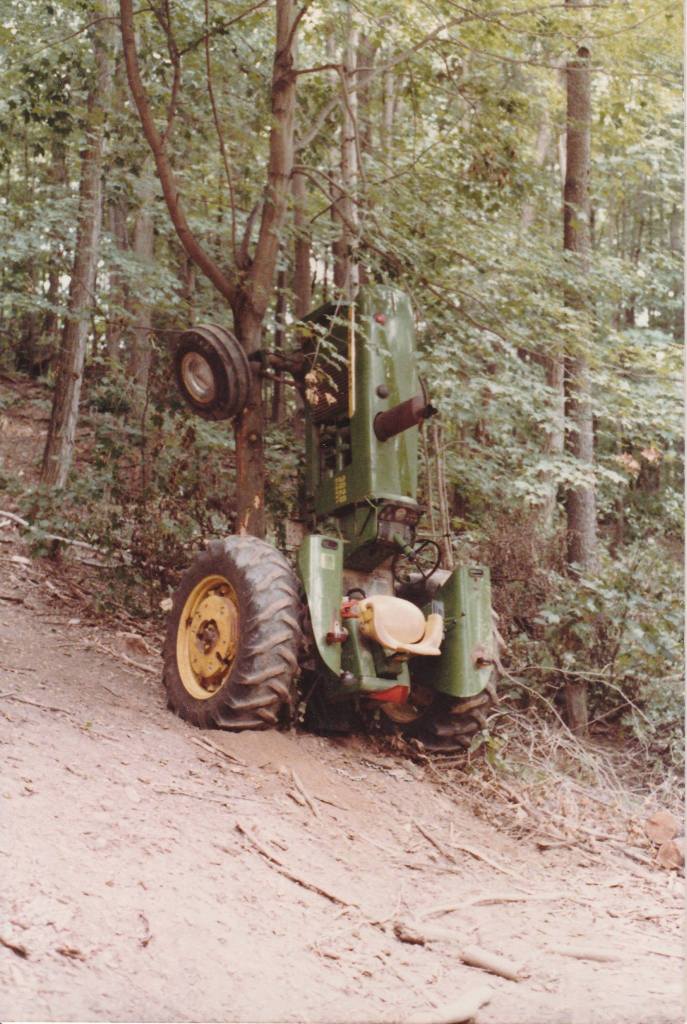
One “one-year-wonder” maintenance guy who thought he knew everything let the John Deere get away from him and he treed it nearly vertical, a hair’s width away from flipping it over backwards and crushing himself to death.

Then, there was the Dodge Power Wagon. Drop that baby into low range and it had power to eat trees and poop potted plants. It had dual wheels in the rear and a hydraulic dump bed that made it the ideal vehicle for bringing milk back from Auburn Dairy, taking loads of trash to the dump, or fetching new canoes from the Grumman factory in Marathon. It had an indestructible clutch and was known to slalom itself through trees in the Highlands. Like, nobody ever noticed? Yeah, right.

Saturdays were made for trips to the town dump. Carter on the kitchen staff loved to swing full garbage bags into the dump bed. It looked exciting enough, other staff would join in and all I had to do was lean on a post and look cool. I’d drive a load to the environmentally sad excuse for a landfill, back up to the edge, and pull the dump lever. Hearing the deposit was like music to my ears. I always will remember the town employee, sitting in his air-conditioned cab, idling his front loader, while looking at porn and sneaking nips of whiskey. He was fired, I’m told, one day when he was so drunk he rolled his loader into the pile.

The Dodge, with its tilt bed, was also useful for staff visits to the Auburn Drive-In Movie Theater on Saturday nights. A bit of bleach and a good scrub down after the dump run and the back of the truck was like new. We’d load it full of mattresses, sleeping bags, snacks, and libations and head out for a well-deserved night out. We’d park in the back row, lift the tilt bed a third of the way, and we had the ideal viewing platform for the larger-than-life movie screen. There was enough room for twenty of us. Many a budding romance began in the back of that Power Wagon.

One Saturday morning, the loading of garbage commenced. Carter looked like an Olympian discus champion. Onlookers and participants began to gather. As I sat back and watched others paint my white picket fence, I noticed one of the new female staff members jogging by, intent on keeping in shape, working up a sweat that was, well, something for me to ogle.

Something stirred. Flittered. You know. Like a prairie dog, I sat up and took notice. A thought like a flash of lightning grabbed my attention. Her name was Cynthia, and she was the new camp nurse.   

The pool this morning was a cool contrast to the heatwave we’ve been experiencing.

I lost count this morning of my laps, which is a rare thing for me to do. Instead of pushing out laps like counting contractions in labor, this morning I was distracted by thoughts of Casowasco and, yesterday, my first Sunday serving two new part time churches in retirement.

Was that three, or four laps?

People were nice, but there wasn’t a familiar face in either group. Everyone welcomed me, the new guy. I don’t feel like I am anything special. Like Lincoln was reported to say, “I can make a brigadier general in five minutes, but its hard to replace a hundred horses.” Forcing myself to be extroverted left me exhausted by the time I returned home.

The people tolerated the new guy. What will keep me coming back, however, is the honesty, is the authenticity, is the genuine love of God and neighbor that I’ve always found in small country churches. What a blessing! What a gift of grace.

The bush hog broke; rather, a blade was bent and needed replacing. My boss, Don, used the front loader to lift it vertical with a chain, giving us access to the naked underside. Smart, I thought. Don really knows what he is doing.

I held steady the giant steel disk on which the blades were attached while Don used a sledgehammer and wedge to pry the disk off the shaft. “You got it?” Don asked me before he gave it another wack. “I got it,” I confirmed as I tightened my grip.

Bam! The disk popped off and dropped to the ground. I was no match; the steel disk probably weighed fifty pounds more than I could lift. Had I been wearing steel toe work shoes, my life would have been radically different, tragic, possibly. The disk landed on top of my foot, split the nail of my big toe, and filled my boot with blood. Don put me in the Dodge and off we sped to the emergency room.

Twelve hours later, I was back at Casowasco, high as a kite on painkillers, my foot wrapped in tape and gauze, in the Nurse’s Quarters trying to make sense of my discharge instructions.  “Let me help you,” Cynthia told me.

“Yes, ma’m.” You can help me all day long!

I spent the next two weeks in her quarters, getting my wound cleaned and dressed, whether I wanted to, or not. I was out on disability, smiling on painkillers, and in the care of the attentive, and very good-looking, camp nurse.

Holy cow was Cynthia ever good to me. Before I could run another load of laundry, we became an item. I have no other explanation, except for God’s wonderful, bountiful, amazing grace. This year, we will be celebrating our fortieth wedding anniversary.

Once I returned back to work, things got a little cool between us. I couldn’t explain why. Perhaps because her dad was a pastor (like my dad) and served the Bishop as the Dean of the Cabinet? Yet, I found Cynthia lovely and gracious, highly intelligent, and personally driven. She had transferred from Ohio Wesleyan to Syracuse University to complete a degree in nursing, which added a whole extra year to her undergraduate. She had more grit than me, I thought to myself. Personally, I liked her pipe smoking dad, her Latin teacher mother (both had served on the Casowasco staff in the 50’s), and her older and younger siblings.

Cynthia’s father, Irving, already had an eye on me. He chaired a conference committee I was on. He ordered a truckload of firewood, which I dutifully delivered and dumped in his back yard in Syracuse. And the staff enjoyed surprising Irv, and his fellow District Superintendents, more than once having a cold one at the Owasco Inn in Moravia after the Bishop had left Casowasco for the night.

During my last year on the Casowasco staff, the summer of 1983, I was headed out for seminary, arriving early for a multi-week orientation for new students. I packed my car and headed for Dayton, Ohio. God was having me turn a new chapter in my life. Little did I know, the one being closed did not include Cynthia. That chapter was just starting to be written. Our relationship, though ebbed and flowed, was just getting started. Thank you, Lord!

15. Casowasco – Captain John and Clergy Shenanigans

John Spooner is a Casowasco legend. Many will remember him from his campfire ukulele strumming silly songs, his waterfront antics, his Venture 21 sailboat, Pegasus, and his wife, Clair, his son, Larry, and daughter, Louise. John was a second-career elementary school teacher from Barea, Ohio.

John’s first career was as a bachelor ship mate on Great Lake freighters, homeported out of Cleveland. He plied their magnificent waters from Duluth to Montreal, learning navigation and weather, lighthouse and reefs like the back of his hand. He recalled to me once that he enjoyed a day in port, showering and air-drying buck naked on the open hold of his ship, just as a tourist boat slowly chugged past, its rail filled with gasping sightseers.

It is unknown to me how Captain John came upon Casowasco, but he was a fixture when I arrived in 1979. It offered him a free dock to berth the Pegasus, and for the small price of teaching sailing on the camps Sunfish and Phantoms, and shifts lifeguarding nippers, the good Captain was free to fix and polish his beloved sailboat. Summers were grand, for John I’m sure, a restorative respite from elementary school life.

Each evening Captain John would join the rest of the summer staff rotating among campfires with his ukulele, singing songs that remain rooted in my memory. “All God’s Critters Got a Place in the Choir.” John was singing and practicing inclusion generations before it was being maligned as woke. “The Big Rock Candy Mountain” was one of my favorites, for it painted a picture of what the kingdom of God would look like, complete with the buzzing of the bees and the bubblegum trees.

His wife Clair, volunteered in the office. Larry, in high school at the time, was the camp Romeo. He was always on the prowl for members of the opposite sex. He was good looking and knew all the best places around camp to sneak away and swap spit. Louise was Cosmopolitan as fully as a teenage girl can be, blow drying her hair and painting here nails before that was a thing. I took her on an Adirondack canoe trip once. She assured us she could live without a blow dryer for a week. When it came time to drive home, she was a long time in the Pizza Hut’s women’s room. She said that she made work each day as she disappeared into the woods with a shovel, but her agony and groans said otherwise.

One evening at dinner, Captain John asked me if I wanted to go sailing that night. “In the dark?” I asked. “It will be perfect,” John assured me. “The moon will be full and the wind is expected to be brisk.” “Sure,” I agreed. This should be fun. It was just John and I tacking Owasco Lake at midnight. Other than red and green running lights, we were sailing like lightning, healed up until both our butts were soaked.

“I got something to show you,” John told me, with a twinkle in his eye. “I’ve been working on this all week.” What could it possibly be, I wondered? John slipped into the cabin and I heard a cassette tape sucked into a player. High on the two stays off the main mast, newly installed Radio Shack speakers came to life. Wagner’s Flight of the Valkyries woke the waves with a hundred decibels of pure exuberance. I stood, as if at attention, and directed the imaginary orchestra like a conductor, sans a wand. Wind and waves, speed and angels, sound and fury expanded my conception of God’s magnificent kingdom and the potential it is waiting to reveal.

Watch. Wait patiently. Expect the movement of the Holy Spirit. Lessons taught to me by Captain John. Thank you, Captain, my Captain.

Lane choice was no choice this morning. The only lane not occupied by two swimmers was lane 6, the outside lane of the aging pool. “Okay, then,” I thought as I slipped on my goggles and began my laps.

Lane 6 is the road less traveled for multiple reasons. At one end, entry stairs crowd the wall. A Hoyer lift held belts and pullies overhead, making for a cramped approach and turn. At the other end is a chrome ladder into the deep end. Catch a hand on that and, yikes! All of which to say, the sandpaper textured edge of the pool ran its length. Careful positioning avoided stubbed toes and jammed fingers, but also distracted my glide induced meditation. When in Rome, they say.

As I pulled my sorry butt and wrinkled body out of the pool, I saw a cue of three waiting for a lane to swim. I was ashamed to think to myself how I was mentally grumbling about swimming lane 6 all to myself while others were waiting just to begin their laps.

I’m not proud of how selfish and shallow I can be. It’s a character defect that I’ve worked a lifetime to perfect, and a lifetime to correct. Some days are better than others. Sigh. Forgive me, Lord.

United Methodist Clergy frequently made their way to Casowasco for meetings, retreats, visits, and to direct one of the many summer camps for children. I practiced this rhythm throughout my pastoral ministry, at times more frequently than others. Driving down to camp has always been like finding respite from the anxieties of the world, a chance to breathe deeply, to claim a bit of serenity, if even for a time before reentry into the storm tossed world.

Other than exposure to my dad, who ended up serving 19 years in the parish before dying young, and, Bob Stoppert, the Director / Manager, my perception of Methodist ministers was they were a bunch of conservative, straight laced, black suit kind of humorless Oxford wing tipped preachers, who wore protective rubbers at the first sight of rain.

I couldn’t have been more wrong.

Harry came to our staff table Sunday afternoon and reported in a booming voice that he needed “two gigantic red balls” for his camp. We about knocked ourselves out laughing so hard. Harry, in his naivety, had no idea why we were all laughing. Another preacher stopped if he saw any of us loafing and told us to give him ten pushups. He was also known to tell my buddy Clint to retrieve a flash light that fell through the hole landing on top of the pile in one of the Highland’s outhouses. Um, no thank you.

Gordon woke his camp every morning at 6 am clad only in a bathing suit and flip flops, blowing a tuba, sans a polished bell. He probably bought it at auction. He also had a habit of driving his boat right onto shore instead of taking a regular mooring like everyone else; fuel leak and scratches be damned. One night Gordon and his wife startled my gal and I down by the waterfront. He was pushing her in a stolen shopping cart on Galilee’s south lawn, testing it out for his camp “M*A*S*H.”

Sam was a socially awkward, lovable pastor, and academic who did his seminary work at the University of Chicago at the foot of Paul Tillich. His boney chicken dance broke the nose of one senior high girl on the south porch. His eye filled with tears over his guilt and remorse. Sam would eat his sugar donuts like a mad man, coving himself in powdered sugar, looking at us staring, asking, “What? What did I do now?”

Les, considered Casowasco a second home, without the taxes. He was frequently there on his day off. He showed up when the Bishop met with his cabinet of District Superintendents when it was appointment season. He could be found sulking in the hedges under a cracked window or outside a door hoping to catch a snippet of information about who was being sent where. As soon as he caught a whiff of information, he’d hit the telephone and get the rumor mill started. Les was a fly fisherman who taught me, along with others, to tie flies and fly fish lake, pond, and stream.

One morning, Les was marching his camp of older elementary campers down to the waterfront for a polar bear swim. We had been building a hip roof on the staff house and the building was draped with ladders and tarps, the grounds with stacks of shingles and pails of nails. As was his practice, Les called his gaggle to halt, threw open the door and began to sing at the top of his lungs, “Good morning to you! Good morning to you! You look kind of sleepy, in fact, you look creepy. Good morning to you!” At 6 am every morning, his camp’s chorus was not welcomed.

We prepared the ambush for his Friday morning arrival the evening before. We filled buckets full of water balloons and hoisted them to the roof. We ran hoses inside the staff house and charged them at the ready. We populated ourselves in the bushes and on the hillside fully ammo-ed up with hundreds of water filled projectiles. As soon as Les flung open the door and took a deep breath we sprung the trap. He was soaked with streams of water. The kids were bombed with water balloons, such they were dancing, laughing, and begging us to take aim for them. It was a slaughter. Everyone loved it. We still talk about it today, nearly fifty years later.

Lessons from a diverse community of Clergy men and women still guide me to this day. “Never fish from your own dock,” one mysteriously told me. He was in his second marriage with six children. “What?” I wondered. “It cost just as much to keep a full tank of gas as an empty one,” my future father-in-law told me before I went on a date. Pastors were a diverse bunch of folks. What I learned was that every one of them had a passion for Christ and a deep reservoir of faith.

Casowasco, where the butterflies fly and the bluebirds sing, at the Big Rock Candy Mountain.

14. Casowasco – Building Community

When the end of June arrived, the four of us guys migrated to the Staff House, now known as Wesley Lodge. Goodbye disgusting shower and the flea infested chemical toilet! We got indoor plumbing! The rest of the staff arrived and moved in. The ratio went from 4:0 to 6:25, men to women. Life was improving.

The prior seven weeks were devoted to getting the property in shape for summer camp. Most evenings, after a long workday and sailing / water skiing, we, few set about the task of building the long anticipated Fourth of July campfire.

Each year boats from around Owasco Lake would gather offshore to gather around our campfire, strategically located where the creek poured into the lake. It appeared to be safely positioned far enough away to keep embers from catching Galilee on fire, our signature Lodge, yet, close enough to the water that we could easily shove it into the lake if things got out of hand.

Dave, lifelong friend and best man at my wedding, was the chain saw guy. I was on the International tractor, using the front loader as an elevated platform and the hitch to drag logs. Clint, another dear friend, drove the dump truck, and climbed to the top of the stack to help Dave place the logs. We might have had one or two helpers, but mostly, it was the three of us.

We seldom found logs suitable for our efforts laying on the ground, so we went about the extensive woods searching for trees to fell and add to our stack. Dave would drop the tree and cut to length the largest logs to fit into the Dodge Power wagon dump bed. Clint would chain me up, first, to skid the logs, then, to attach them to my front loader so I could place them in the truck. The woods we worked could be anywhere between flat level to near vertical. Chains, cables, and winches, Oh my!

We’d take a load to the campfire site down by the lake, dump the load, and begin to lift each log onto the pile. We built a four-sided fire log cabin style, wide at the bottom, tapered to the top. We’d fill the interior with old firewood that had turned punky and couldn’t be used in any of the fireplaces. Our first year, the fire was built to 17 and a half feet tall. My final year, the campfire was built to 35 feet. Galilee was beginning to appear uncomfortably close.

It was not unusual for the coals to be a couple of feet deep and the fire to burn for four or more days afterward. Yes. It was a big campfire. And it got bigger every summer.

Dave, Clint, and I were a team. We worked well together, enjoyed each other’s company, and shared a humorous trait for pulling practical jokes. We pilfered another male staff member’s underwear, put them in zip lock bags, soaked them in beer, and froze them in the staff house freezer! We commandeered a younger clergyman’s canoe one night, hulled it up the dinning hall bell tower, and skewered it five stories high, for him to find the next morning as he came for breakfast. Alan, I’m looking at you. Priceless!

We hauled a sailboat to the reservoir at the camp entrance, placed the lifeguard tower over top the mailbox, and greeted Captain John and his family when they drove in from Ohio to spend the summer on staff. Yes, we were wearing life jackets. The mailman was also duly amused. NY State DOT had the audacity to place a stop sign at the entrance to our road. It made a very nice card table.  

These were but a tiny fraction of the high jinks we took part in while on the summer staff.

One June evening, as the last light of the day was fading and the three of us were dead tired, I was lifting the last of the logs to the top of the stack. Clint and Dave swung a log onto the pile and Dave commenced to cutting the notches to keep it from rolling and solidly in place.

In an absent-minded moment, Dave rested the idling chain saw on his thigh. Yikes! Blood went everywhere. I lowered him with the front loader, Clint threw him into the cab of the truck, and off they raced to the Emergency Room at Auburn Memorial Hospital. Forty plus stitches later, Dave returned a wounded soldier to the sympathy of the female staff. Clint and I just rolled our eyes.

Dave and Clint were joined with other male friends over the years; Rick, Dale, Scott, Larry, Bob, Mark, Carter, and others. Casowasco gave us a connection. Experience gave us strength. God wove us into a tapestry of grace that continues to hold me over four decades later.

Guys will be guys; for which I am thankful.

The pool this morning was calling me by name, gave me my own lane, and provided me with the necessary buoyancy of grace to swim my 15 laps. Other than to count the laps ticking by, it was hard to meditate, to focus my thoughts.

Thoughts of the recent Homeowners Association board meeting were interrupted by yesterday’s FLACRA’s all staff meeting. As the chair of the board, they insisted I be photographed presenting numerous awards to their respected recipients. I’m not that photogenic!

Breaking news, interrupted thoughts, thinking about my recent introduction to members of two small country churches where I agreed to serve part time in retirement. Did they like me? They seemed really nice. Would we come to love each other as a pastor loves their flock? Please, Lord; I hope so.

Most trips to the pool bring calm, clarity, focus. Today, not so much. Yet, I’m thankful and the laps give my muscles a good work out.

Bob called staff meetings each week on Sunday evening. Campers had moved in, parents left (either smiling or crying), and our staff needed to coordinate requests and activities. The craft room needed more supplies. The store was running low on Maple Walnut ice cream. Three campers were allergic to bees and had Epi pens in case they got stung.

Most staff meetings were in Bob and Ruth’s living room. We piled in laying on the floor or draped over the chairs, giving each other back rubs (my, oh, my). We laughed a lot and shared common misery, like tales of Saturday cabin cleaning. A toilet needed unplugged, additional sailboats needed to be brought out of storage, and the dock needed to be leveled (especially on hot days).

The schedule was posted such that a staff member was in attendance at every campfire each evening. We led the singing, guided the devotions, and closed with prayers. Rules were spoken, such as, “no put down phrases,” and “since everyone is new, you have the opportunity to be yourself and create the reputation you want to live with.” Good stuff, right there.

The rest of the staff and I learned how to live in community. How to express our needs. How to listen and respond with empathy. How to communicate, especially with members of the opposite sex. Yes, romances came and went, ebbed and flowed. We support each other and when there was a need, we all pitched in. When there was grief, we all responded with words of comfort and acts of kindness.

Christian community, I learned, is a beautiful thing. It can be found in a local church or an AA meeting just as it can be created and found at summer camp among the staff.

And then, there was Mary Jo.

She was new to the Staff and by this time, I was one of the veterans. My dad was an ordained pastor, appointed by Mary Jo’s father, the resident bishop. A resident bishop in the United Methodist Church has a lot of power, especially over who is sent where to serve which church. Compensation and steeple size matters. Politics and pride were in constant tension with the good-old-boys network. Yeah, back in the day, the bishop and his superintendents were all back-room cigar chomping white male  deal makers.

There are a lot of skeletons in them there closets.

They didn’t get a long. My dad was stubborn, a Don Quixote charging windmills of injustice, destined to short-term pastorates in small rural churches with tiny little steeples. Bishop Yeakel exuded power and authority, looked like he stepped right off a movie set, and was loved by all; except for those who crossed him. He was right at home in the bishop’s chair in are largest cathedrals, wearing his pointy hat and flowing robes.

To say it was chilly between Mary Jo and me would be an understatement.

After so many weeks of the silent treatment, following one Sunday evening staff meeting, Mary Jo pulled me aside, got right into my comfort zone and said, “Look. Your dad doesn’t like my dad. My dad doesn’t like your dad. But. That doesn’t mean we can’t be friends.”

I was stunned by Mary Jo’s stark honesty, her willingness to take risks for the sake of building a social network and our staff community, and her humility to swallow a healthy dose of pride. Yeah. Wow. “You’re right,” I said when the Spirit gave me a shove to break the deafening silence. “I’m willing to give it a try, if you are, too.”

The following day, Don has me using the backhoe to dig the footer for the staff house addition. It had to be straight, squared at the corners, and forty-eight inches deep to get the footer below the frost line. To this day, I still think a backhoe is a thing of beauty. In experienced hands, watching a backhoe work is like watching a maestro conducting an orchestra.

I wasn’t alone. Slightly behind me, my peripheral vision got a glimpse of Mary Jo standing, watching me dig. I turned, smiled, and shut down. “Good morning,” I said as I jumped down. I figured there was no better time like the present to start trying to be a friend. “Whatcha upto?” I asked.

“I always wanted to give that a try,” Mary Jo confessed. “It looks so cool.”

What an opportunity, I thought. “Hop up and let me show you how.” She sat in front of me. My arms wrapped around her and my hands guided her movement on the control levers. It was a little like that movie with the pottery wheel and music, but not really. It was more like two people who God had brought together to become friends.

Later, I was seeking a seminary to attend after I completed college. Mary Jo invited me to visit her in Dayton OH. She was going to be starting her second year at United Theological Seminary. Though accepted and tempted with generous financial packages, I didn’t want to attend where my dad attended (Drew in Madison NJ) or nearby Colgate (Rochester NY). I stayed with Mary Jo and slept on her apartment floor. She gave me the grand tour and introduced me to as many professors as she could find.

I was sold. If it hadn’t been for God working through Mary Jo, my life and call would have gone in entirely different directions.

Thank you, Lord, for the gift of Casowasco, for the people who became such important influences in my life, for lifelong friends, for community, for grace and love, for your call to be an ordained pastor.

11. The Smell of Hoppes

Tom’s kitchen table had been cleared after the evening meal. It was now set, with a base linen towel. Scattered on top were various rifle bits and pieces, displayed as if jewels under glass.

Tom had gone blind from macular degeneration. Yet, he insisted on cleaning guns when I returned from the field. Rifles for woodchucks or coy dogs, shotguns for fowl, rabbit or deer, pistol or revolvers for just plain fun.

Hoppes patches and oil were rubbed over every part, barrel, receiver, magazine before each was reassembled and gently returned to its case.

Residue from gunpowder and dirt from the Chemung River Valley spotted our oily rags. He and I sat at his table, rubbing and wiping, Tom listened to my most recent adventures, me listening to his tales from long ago. Into the evening we’d celebrate mass. Cleaning the guns Tom lent me was like the sacramental completion of the circle of life, from generation to generation.

Tom grew up in northeast Pennsylvania, depression poor, mining anthracite coal from the state’s deepest vanes. Dark, dangerous, unforgiving work could reduce a man to a gelatinous dark spot crushed into the floor of the mine, or, into a rasping, wheezing cancerous mesothelioma plaintiff in the blink of the eye.

During the great depression, Tom and his siblings worked two and three jobs to keep the household afloat. When the great war and shortages came, Tom was paid to run ration stamps out the back alley for complicit  store owners one step ahead of the federal agents. After the war, he settled into New York’s southern tier, bought and operated a gas station and repair shop in Elmira, filling tanks, replacing engine rings, and swapping out brake drums well into his seventies when his eyes began to fail.

A member of my father’s parish, Tom was a father figure my own dad couldn’t be. For my dad, guns were weapons of war that maimed with explosive violence, not tools for game or pleasure plinking. To think that a gun could bring together generations was beyond his experience and imagination. He’d prepared for burial too many of his generation, corpses violated by the unforgiving laws of chemistry and physics, flung without compassion by the brutality of war. But for Tom and me, Hoppes was the smell of our bread and wine.

“Lap Pool Closed” greeted me early the other morning, causing me to seethe. “I didn’t pay good money for a membership only to be denied at the door,” my sick brain whined and complained like a spoiled first world privileged brat.

“When the chemicals adjust to proper levels, they’ll call up and let us know the pool is open,” the blameless messenger smiled as she delivered up my bad news. Disrupt my routine and I tend to become more distempered than usual. Gnarly. Pessimistic, I’ve been described. Everyone who is surprised, raise your hand.

I’m working on it. I don’t want to be known as that ornery old man. I want to create the reputation I want to live with. You know what I’m talking about: kind, gracious, loving. Someone like Tom.

Rusty lived down the street from the parsonage. He and I were in the same grade, rode the same bus to school, and were often hunting partners. He was from a poor family, but he certainly knew just about everything when it came to the outdoors, hunting and fishing. What Tom didn’t teach me, Rusty often would show me. Game was plentiful behind town, down by the mainline Erie Lackawanna, where the muddy Chemung River wandered.

We liked to hunt pigeons from the railroad trestle, a three-span double-track bridge that paralleled the new highway bridge just a half mile upstream. Rusty and I would walk in single file with our 12 gage pumps at port arms down the center between track one on the north side and track two on the south, my right thumb resting on top the safety in the off position. Slow we’d stalk the filthy, good-for-nothing pigeons that roosted in the truss.

We’d usually make it center span before they’d spook and the whole mass would depart for the safety of any place other than there. Timing and a smooth pull were necessary for a safe and accurate shot. One in the chamber and four in the magazine would quickly be pumped out. If the lead was corrected for flight below and away, and, if by skill we successfully shot between the steel truss, we could bring down fifteen or twenty. Hit a girder and duck! Once the flock departed, we’d find cover in the steel and wait for first, their scout, then second, the flock to slowly but surely return to the roost. Wash, rinse, repeat. A good outing might bring two or three iterations of this killing cycle, littering the river, turning the water red.

A hot, summer afternoon found Rusty and I stalking Chemung’s filthy pigeons. Cicadas buzzed. Skeeter skimmed stagnant pools. The river flowed. The moaning of Jake brakes from eighteen wheelers further down the valley echoed into the hills and gulches so characteristic of the Southern Tier. The sun high in the sky bore down. Sweat stained our tee shirts and wet the brow. Safety off. Slow. Lift, advance, gently, step, one railroad tie to the next. Watching. Listen. Waiting for the first sign of a pigeon to stir.

What? Was? That? Head on a slow swivel, rotating from Rusty’s back to the horizon around behind us. There. A mile and half behind barely visible whiffs of soot ascended above the tree line, followed by six thousand horsepower of Erie Lackawanna muscle leaning into the corner, lining itself up for the bridge we were on. Thirty feet above the water. Dead center. Inches from the rails. Loaded shotguns un-safed.

Shit.

We just about did. “Run!” we both yelled simultaneously. Safe on, and I ran like the devil was licking at my ass. West we ran, feeling the bridge rumble when the groaning engines gained the distant bank. Can’t slow. Can’t slip. Can not, for God sake, put an ankle between ties. Snap, scream, and pink mist. Rusty, don’t you fall. As we gained the west shore, we angled across track two and flung our bodies and guns down the embankment, just as the lead engine, horn blaring, roared past. Tumbled and slid in a cloud of dust, soot, and railroad ash, guns protected by the roll.

Stunned, we righted ourselves. Sat silent as the caboose above glided past. Soon, the train disappeared down the straight, enveloped by the valley. I exhaled about the same time as Rusty and we burst out laughing.

How close. How incredibly lucky. How incredibly stupid we were, but we survived. The walk back to town was quiet. Pensive. He veered off to his house, and me to Tom’s.

The table was soon set. The smell of Hoppes appeared, drifted, enveloped two guys, one blind and old, the other young and not quite so full of spit and vinegar as before. The quiet was broken only when necessary. The table was so rich and full. Oh, how the memory warms my heart. God’s grace whispered as my shotgun was cleaned, reassembled, and returned to its fitting and proper place.    

10. Becoming a Wolverine

Don’t know why; all I know is that we had to pack up the house and move to another parsonage. Dad had a change of parishes, starting his third of four years of seminary. Hello! Chemung, here we come. Nestled in New York’s southern tier, Chemung is a small village on a ridge overlooking the Chemung River, which flowed west to east towards the Susquehanna. Annual flooding lends to dikes and dams, in a futile attempt to tame its brown moving effluent.

This would be the third high school in three years. My new identity was a Waverly Wolverine. I wasn’t looking forward to the change. New friends are hard to come by. Good friends are rare. Lifelong friends, linked by youth-filled common experiences and shared values, are like finding diamonds in the rough; diamonds that God planted for me to discover.

First day of school. Assigned homeroom. Mr. Allen took roll call. Everyone looked when my name was called. New guy! I was all alone.

Except.

Except Gary and Chuck reached out to me. They didn’t have to. But they did. They worked at the local hospital and nursing home in the kitchen washing pots and pans. They got me a job, and I fit right in, earning $2.20 an hour. Gary’s aunt ran the local American Legion. We got paid five bucks every Friday night to clean up after Bingo and set up for Saturday’s wedding. I’ve cleaned up enough dirty ashtrays for a lifetime. Sometimes the Legion bartender would put a case of beer on the back steps for us when we finished up. Life was good.

Gary and Chuck had known each other since before Kindergarten. They weren’t jocks, nerds, or potheads. They were middle average, often overlooked, underappreciated, under the radar flying, clean cut type of ordinary nice guys who welcomed me into their inner circle of acceptance.

They were awkward around girls, uncomfortable in their adolescent acne scarred skin, and always looking for a reason to sneak into or out of school. I fit right in. Gary drove a Ford LTD that was herded down the road, and Chuck drove a Ford Pinto, a stick shift on which we all learned. I got my senior license and often sported my dad’s dark green Plymouth Satellite. Gas was under a buck a gallon.

Gary, Chuck, and I hung out together. Worked on completing homework and lab assignments together (usually at Pudgie’s Pizza across the border in Athens, PA). We went to rock-n-roll concerts together. We saw some great bands. The late 1970s were some very good years! We experimented with alcohol together, swapped car stereos into and out of each other’s cars, and talked about dream girls together. All three of us had a poster of Farrah Fawcett on our bedroom wall.

Chuck and Gary were God’s gift to me. It has only taken me a lifetime to recognize the enormous impact this grace has had upon my life. Thank you, Chuck. Thank you, Gary. You guys mean more to me than you know.

Thank you, God, for Chuck and Gary.

The pool yesterday morning limbered me up and wore my ass out. Crawl, breast, elementary back. Down and back five times each, for a total of 15 laps. Doesn’t sound like much, but it is just right for me. Discipline is everything. Don’t try to increase time or distance. Faster is a false idol. Further is asking for trouble. Repetition is where the sweet spot it. The nice thing about falling into a rut is that you always know where you are going.

Yesterday, sunlight penetrated the dark grey winter sky and illuminated the lane I was swimming in. What a blessing! To roll my head and breath with each stroke, to bathe my face in the sunlight of God’s grace. Humbling.

The day was much like today. It was December, the Christmas time of year. Chuck, Gary, and I would rotate work schedules. However, whenever a tray girl called in sick, which was often, we would call in one other to cover their afterschool shift. We also elbowed our way into cooking on the weekends. The net result was that all three of us were often working the kitchen at the same time.

Saturday inventory was always an opportunity for us to express our creativity. The daytime (older) pots and pans guy frequently stole food out of the walk in. Every evening after sweeping and mopping the whole place, we’d put on some rock and roll music, throw a few pounds of steak into a frying pan with butter, break out the medicinal beer (for patient’s use only) and party on. Completing the monthly inventory sheets was an exercise in creativity. If Frank, our boss, ever caught on to our Tom foolery, he never let on.

Being festive, I wore a red Santa hat in the kitchen and sung Christmas carols. It was great delivering and picking up trays from patients, especially those unfortunates on the psych ward and the nursing home residents. Thoughts and fears brought my imagination to life as I entered and exited the locked units. What happens if someone jumped me? The movies Halloween and the Exorcist had just come out. Cue the slasher music. What if I went into a patient’s room to deliver a food tray and I found them dead? You know; not alive? Singing Christmas carols brought smiles to staff and patients alike. I had a talent to make people happy. Life was good.

I learned one of the nursing home floors wasn’t going to have a staff Christmas party. The direct care staff was bummed. I knew they worked hard, cleaning up the nasty, not making a dime more than minimum wage. They were pretty. I was looking for acceptance. They needed a party and I knew how to make people happy.

Frank kept a few bottles of hard liquor in his desk drawer locked in his office. Undoubtedly, it was a violation of hospital policy and he could be fired if caught. Hey? He was the director of dietary services. Who were we to care?

Gary, Chuck, and I just had a way about learning everything there was to learn about the people and the hospital / nursing home. It didn’t matter if they worked in dietary or laundry or administration, we always got the skinny.

One evening (doesn’t every good tale start out this way?), the three of us were done for the day and locking up. A knock on the kitchen door caused us to stop, look, turn down the volume, and wonder what we were being caught doing this time. A young aide shared her tale of woe. The three of us looked at each other, knew what had to be done, and sprung into action.

We raided Franks desk drawers and liberated his liquor cabinet. We mixed in a splash of eggnog, just enough to color and season the punch. We carefully wheeled the bowl of spiked merriment to the unfortunate staff working a distant floor. “Merry Christmas” we proclaimed, and parked our gift in their lounge.

It didn’t take long before everyone was singing, dancing, and telling us how wonderful we were. A great time was had by all. Thankfully, no one was harmed and the only casualties were those who suffered the hangover consequences the next morning. Frank never said nothing. How could he?   

Life carried on. I had found my place. I had found my home.