38. Gotta Shovel? Bag Pipes and the Motorcycle Clergymen

The experience of a snow day through the eyes of a child is awesome. It means a reprieve from school; sleeping in; Flexible Flyer sleds and Norwegian toboggans leaned against the garage; snow angels and evidence of less-than-successful snowman rolling efforts in the front yard; wet coats, hats, and mittens strewn about a home’s entryway; hot cocoa and rosy red cheeks. The State Education Department only allotted a specified number of flexible days that each district could use for snow. Any school district that went over, school days were tacked on at the end of school in June. Nobody wanted that!

The weather forecasters the prior week had been calling for a huge storm this weekend. Well, the cold and snow came to pass. Sixteen inches in my youth would have been a mere flesh wound. Today, it is a snowpocalypses. Everyone and everything shuts down, closes down, doesn’t go in to work. Just another day in Western and Central New York. When I shake my head with disdain, I can’t help but think to myself, “Yes, I have become my father.”

For years we lived within a mile of Lake Ontario. When the forecaster spoke about lake effect snow, we took notice. Fifteen miles away would get a flurry; we’d get two feet. One winter, our driveway had to be plowed out seventeen times. At twenty-five bucks a pop, back in the day, ouch! Snow was expensive. The town highway department would plow the snow back so far, then push the top even further back with an elevated wing, resulting in snowbanks with shelves of layered terraces. Impressive.

Palmyra was a good fifteen miles south of Lake Ontario, but we still received our share of winter punishment from both Lake Ontario and Lake Erie. John Blazey and his wife Alice, were members of the parish. John grew up working long hours to scrape together a living for his wife and family. He welded for the New York Central, the Town and Village. He repaired farm machinery, and sold lawn tractors and implements. In the winter, John would put a plow on his truck and set about plowing out the church and his neighbors. John used to have a wood stove in his store, where friends and neighbors would gather round to shoot the bull and catch up on the community news. For lunch, Alice would set a plate for family and employees of the store. All were welcome around their table.

As a member of the local fire department, we did our best to keep the community safe. There were about forty, or so, active members who kept up our training. I served as a driver (passed the NY State Emergency Vehicle and Pump Operator courses), as the department chaplain, and as a medic on the ambulance. I was getting too old to be going into burning buildings, so I took a pass on keeping up my certification and training for interior firefighting. I never liked heights, so I never qualified on the aerial truck other than as a driver and pump operator. I’ll carry a ladder, put up a ladder, even hold a ladder while someone climbs up or down. But don’t ask me to go up. Heights have never been my friend.

Our volunteer department were a bunch of loveable rugrats. We had all ages; young bucks right out of high school, old dogs with sixty or seventy years of service. We had four officers of each rank: chief, captain, and lieutenant. I was happy not taking a leadership position; the church was enough for me. Training and calls were a great relief, a way to stay in shape, a good social outlet, a wonderful way to keep my hand on the pulse of the community. We had professionals and factory workers, common laborers and union bosses, retired and those still working a regular job, night shift folks and out of towners. Some came for the quarter beers in the soda machine in the truck bay, others for the wild and crazy antics of the younger breed.

Being a volunteer, but highly trained medic on the fire department ambulance, we were always down at the firehouse. We averaged more than a call a day, so there was always something to do: wash a rig, restock inventory, training, delivering oxygen, updating paperwork, getting the oil changed, swapping out batteries, checking expiration dates. 24/7/365 we were on call, prepared for any emergency, be it a jetliner falling from the sky to a call for a back ache from a fall, three weeks earlier.

The county 911 dispatchers were wonderful to us. We got to know them by their voice and tone, their ability to sort sense out of chaos, and their willingness to go the extra mile for a neighbor in need. Every year they were invited to our annual banquet for a free steak dinner and award recognition. We’d get called out in the darkest of nights, in the foulest of weather, on a mutual aid call to a neighboring department that couldn’t raise a crew. Sometimes we’d drive for miles in uncharted territory, guided in by our dispatchers to the proper location.

In later years, our mongrel of a dog got loose one night after a High School Band Concert. I drove around the neighborhood, calling for that miserable dog, listening for any hint of a response. Then, there he was. Lying in the middle of the road, flat as a pancake. I fetched a shovel from the garage and carried his lifeless body back home. The family was sad at his death, but, truth be told, we had only had “Doc” for a year and he just had not fit in.

“911. State your emergency,” the operator spoke back on the phone, his voice sounding suspiciously like the County Fire Coordinator. Could he be taking a shift in the dispatch center? “I called the number for Animal Control. How did I get you?” I asked. “After hours, the call gets routed to the 911 center.” “How can I help you?”

All my fire department and ambulance experience placed a face on the familiar voice. “Rick, is that you?” “Yes, Todd,” he replied, undoubtedly he had all my contact information on the screen in front of him. I told him the tale of woe and how the appropriately licensed family dog had gotten loose and run over in the road. “What should I do,” I asked with the attitude of a good, law abiding citizen wanting to do the right thing and avoid any fines or penalties.

“Well,” Rick replied, both of us knowing full well the call was being recorded, “Do you have a shovel?” “Well, yes.” “How about you go bury him?”

The ophthalmologist is still prohibiting me from swimming. There the lap pool sits, silently waiting my return. Hard to believe, but I miss the routine; the locker room, familiar faces of people who share a common journey.

So, it is today 20 laps around the walking track. A mile and a half by my calculations, lost in thought, listening through earbuds to a podcast on politics. As the laps tick by, it is hard for me to think of all the acrimony that comes from the public square.

Families divided by one party or another, one policy or something else, threats and intimidations, quietly pushing mounds of mashed potatoes at family meals because the tension about the table is so thick it could be cut with a knife.

We are not meant to be this way.

When we know each other by name, it becomes much more difficult to demonize each other. When we are curious about each other’s lived experience, meaning and motive become more clear, love and grace become easier to extend, and receive.

My voice is so small, so little, so insignificant. Yet, my voice I raise and join the prophet Micah, “What does the Lord require? To do justice. Love kindness. Walk humbly with your God.”

Steve replaced Clint as the Presbyterian pastor across the street. Clint would be greatly missed from our breakfast group of community clergy. He and his young adult son (with autism) hand crafted fishing lures and sold them to bait shops in pre-internet days. They found a mutual passion and a means to provide gainful employment for a beloved son. Winners all around. 

Clint moved up to middle management in Presbyterian circles. Steve was his replacement. After a long search committee process, he and his family bought a house in town and moved in. We all came to love Steve and his quiet, reflective approach to circumstances. His congregation was perhaps the most affluent of all the churches. It certainly was larger. Steve was full of surprises.

One summer day, I was enjoying my front porch. A good book and a fine cigar always put me in a contemplative mood. A warm day with cicadas buzzing and a cold glass of diet Coke made it a perfect afternoon. 

The windows of the Presbyterian church across the street were open. I assumed they were open to ensure a flow of fresh air. Steve’s car was parked in the pastor’s designated parking spot in the lot. I knew he was in his office. Emanating from the sanctuary through the open windows came a loud, offensive wail, similar to a pig in heat, though I’ve never heard a pig in heat. The wail certainly impacted the Main Street intersection, and drivers who passed the offensive blast. It varied in frequency and pitch; always grating and painful. 

Over bacon and scrambled eggs the following week I asked our table of ecumenical representatives if anyone knew about the terrible noises coming from the Presbyterian church. No one had a clue. Steve arrived late, hung up his cowboy hat, and joined us at the table. “What’s up with the noise?” I asked. 

A smile and twinkle in his eye worked his timed response just perfectly. “I’ve started taking lessons on the bag pipes, and the sanctuary is the best place to practice,” he informed us. “Great,” I responded with a forced smile. “Hope that works out for you.” My church and parsonage were across the street, directly in the line of fire. All the while, I’m wondering how much I can endure of a student’s bag pipes. 

Besides fitting in well with his Scottish heritage, Steve informed the table of us clergy colleagues that, once he became proficient in “Amazing Grace”, he could sell his services for weddings and funerals at $250 a pop, as opposed to the fifty bucks we’d be lucky to earn from the undertaker, or the hundred bucks we might get from the parents of newlyweds. Bag pipes, vile as piss poured from a boot, paid better than preaching. 

And it was as simple as that.

I greatly admired Steve and his odd Presbyterian and Scottish customs. He was slightly older than me, and so were his children. In those days, Chrysler began to manufacturer a new type of vehicle, marketed for families with children. They called it a minivan. Those front wheeled drive beaters served a generation of American families, all the while inhibiting paternal testosterone. Nearly every family had one.

Looking out my office window, I noticed a motorcycle was parked in the pastor’s spot in the Presbyterian parking lot, replacing Steve’s familiar family hauler. I needed a break from my work, so I crossed the street and stopped into his office. “Who parked their motorcycle in your spot?” I inquired with a suspicious eyebrow. 

“That would be mine,” he looked up and grinned. “Get out of town,” I enthusiastically responded. “You got a motorcycle? You got a license?” I was standing in the midst of middle aged manhood, lone defiance to stifling cultural norms, the whole world expecting their pastors to behave in public and wear Hush Puppies. 

Our weekly clergy breakfast table began to be regaled with Steve telling us about his new friendship with his motorcycle mechanic, where he had most recently ridden, what new accessories for his bike he had just purchase from the mail order catalogue. It became too much for me to bear; I just had to have a motorcycle, too. 

The motorcycle bug also bit my Methodist colleague from the next town over. Don was a second career Ordained pastor and a regular at our weekly clergy breakfast table. Don and I both purchased motorcycles on the used market; entry level bikes that we thought would be easy to control. I believe Don had previously held a motorcycle endorsement on his license, so he just had to rebuild muscle memory. I had never had a motorcycle, so I had to start from the beginning. 

In New York State, anyone can get a permit, but one has to pass a written and road test to earn the coveted motorcycle endorsement on their driver’s license. Learning with a permit required that you rode with a licensed partner. “Would you ride with me?” I asked Steve. Of course he would. Presbyterian grace covered Wesleyan circuit riders. 

(It is said Episcopalians went West by Pulman car; Presbyterians came by stage coach; but Methodist won the West on horseback.)

Steve taught me well. In due time, I passed the written test and scheduled my road test. Steve drove his minivan and I followed on my $400 Honda CB750. The road test began at the DMV office at the county seat in Lyons. I was on time and eager to demonstrate my newly obtained two wheeled skills. The rule was that the evaluator would ride with the motorcycle licensed driver in a car, following the student rider, around a pre-defined course. 

The evaluator stormed around the corner and down the sidewalk. His appointment, prior to mine, had nearly killed him. He flunked her and walked back to the office, mad as a hornet. He forced a smile at me as he reviewed my paper work. He took note of Steve’s minivan, came to a stop, and leered over the top of his glasses. “Your test is canceled,” he announced. 

“But why?” We protested. The mini van’s registration was expired. He wasn’t allowed to evaluate a road test from a non-registered motor vehicle. Steve was smooth in his response. “Can you squeeze us in after lunch if we come back with a registered car?” The state evaluator looked at two middle aged Protestant pastors wearing Hush Puppies standing before him. He rolled his eyes and said, “Yes, I’ll see what I can do.” 

“Come with me,” Steve pulled at my elbow. We walked over to the Presbyterian church across the village park. He introduced me to his colleague, a newly installed pastor seated behind her desk. “Can I borrow your car?” She didn’t know us from Adam, but Presbyterians must know each other just by their scent. 

We returned to the DMV road test station with the keys to a brand new car, that was properly registered and inspected. Thank you, Jesus!

Passing the road test and getting my motorcycle endorsement was a piece of cake. Don, Steve, and I rode often together, many times apart. We did hospital calls on our bikes. We even arranged for an annual motorcycle ride fund raiser for the local Habitat for Humanity organization. Hot summer mornings, we three would pull into the diner together for our weekly clergy breakfast. 

One Fall Saturday, Steve was pulled over by the local constable for exceeding the posted speed limit. He reported the officer scanned his paperwork and asked him why he was going so fast through town. Steve sat on his bike and thought. He told the cop that he was the Presbyterian minister in town (obviously lobbying for sympathy and leniency) and that he was late for a wedding. Or funeral. Or, whatever ministers rush to.  

“Say, I’ve heard about you,” the village police officer replied. “You’re one of three preachers in town who just got their motorcycle licenses, aren’t you?” “Yep,” Steve reported he replied. “My Methodist colleagues, Don and Todd, also ride bikes with me.” Cool beans, the officer thought, and let Steve off the hook with a warning.

Ten minutes later, while the cop dozed behind the wheel at his speed trap, another motorcyclist speeds past. Officer friendly responds with lights and siren, pulling over the offender with haste. The motorcyclist removed his helmet and opened his jacket, exposing a clerical collar. With no time to call in his traffic stop, the cop walked up to the motorcyclist dressed in a collar and asked, “Just who in the hell do you think you are speeding through my town? Are you Don or Todd?”

Don reported his eyes grew wide at the apparent divine clairvoyance by the officer of the law, knowing without checking, the perpetrator of his near felonious offense. Don confessed his sin and disclosed his identity. “But, how did you know it was me?” He asked. 

“Because I just got done pulling over your buddy, Steve.”

And thus began the lore and oft repeated and exaggerated tale of the great clergy motorcycle caper.  

More than friends; closer than blood; God knows how much I loved my clergy colleagues. Our breakfasts were sacred; sacramental I’d suggest. Our love, eternal. Thank you, Lord.

“Could you please pass the Tabasco?”

Post Script: Don died this past year, his struggles with disease ended. The world is at a loss without him. We all miss him. Until we see each other once again, rest in peace, dear friend. Rest in peace.

37. Farts in a Submarine and Peeing in a Pool

The parsonage in Palmyra was large and well maintained, though the basement was dark and creepy. Few churches are good landlords, but the good people on the Board of Trustees in Palmyra kept the parsonage up to snuff.

The parish supplied parsonage was right behind the church at the four corners in the center of town. It is fondly remembered as being large enough to have played basketball in the attic, pocket doors between downstair rooms, two fireplaces, and a stained glass lined staircase that wound its way upstairs from the first floor. It had four bedrooms and a parlor; big enough for me to comfortably set up a home office.

We had a key to the church in the parsonage foyer, hung on a hook on the backside of the door jam, chained to an oversized block of brass. It was an ingenious effort to prevent the key from walking off. I still think everyone in town had a key to the church and our house. Common were the late Saturday nights after the bars let out that we’d have a drunk leaning against our doorbell, slurring, drooling, begging for dollar or a ride home. 

The back door exited right on the church parking lot. Our son, Nicholas, and I enjoyed riding our bikes on that parking lot, playing an improvised version of polo, using hockey sticks and pucks. I’m sure the neighborhood talked about the new crazy Methodist pastor playing with his son. It didn’t matter to me what other people thought. A father playing with their son was a reputation well earned, I thought to myself.

We used thick sticks of chalk to draw on the pavement and the sidewalk connecting the parking lot to the church. Encouragement; everyone needs some! Faith; “Come, join us!” “Grow deep your faith.” “Rise and shine! Give God the Glory!” It was sidewalk evangelism at its finest.

The church, parsonage, and parking lot were right in the center of village life. Two doors to the North was the old village cemetery, overlooking the Erie Canal. The eldest brother of the founder of Mormonism, Joseph Smith, is buried there. Mormon pilgrims from all over the world come to visit the grave of Alvin Smith.

During the summer, tour busses would pull into our parking lot, where my son and I played, to drop off and pick up pilgrims. Not once or twice; multiple times a day. It was unsafe. No one asked permission. This practice exposed the church to unacceptable liability and risks, so I thought. I put my foot down and told the local community that the church parking lot could not be used for tour busses. 

My response was like a fart in a submarine. The message to our Mormon neighbors was loud and clear. Palmyra took notice. Colleagues raised an eyebrow. Certainly, some giggled about the crazy Methodist bicycle riding, polo playing, preacher and his son.

A true benefit of serving in a larger village church is the blessing of likeminded colleagues from other Christian denominations. We, local clergy, met weekly for breakfast at one of the village restaurants. Presbyterian, American Baptist, Roman Catholic, Episcopalian, Friends, United Methodist. It didn’t matter. Those who gathered around the table were safe. None would be promoted or elected to be your supervisor. There is no risk of saying or doing something that would damage a career.

It was a good opportunity for fellowship, to network community resources, sometimes, to just let down our hair and be silly. Families from different churches married one another. We covered for each other when vacations were taken and made hospital calls when another was out of town.

We learned about one another: best practices, denominational differences, career risks and rewards. We talked about undertakers; who paid what for funerals. And we talked about musicians; “anyone know where I can find a good cellist for a wedding?” Our families and spouses enjoyed each other. It is a joy to work together, collaborate on community wide ministry projects, and to establish a track record of success.

We shared communities secrets. Confidence was held. We could be safe with each other over a plate of scrambled eggs, toast, and bacon. Kids. Schools. Local politics. Rumors. Gossip. Births. Deaths. Adultery, divorce; you name it. We heard and saw it all. Peers serving sibling faith communities became fast friends, tenured anchors of objectivity and wisdom, lifelong blessings. 

Thank you, Lord, for my clergy colleagues and friends.

One local tradition was the Advent choir festival, an annual gathering of choirs on the first or second Sunday of Advent. It was held late in afternoon to a standing room only packed house. Choirs shared Advent and Christmas anthems. We always ended with one of the choir directors leading all the choirs and congregation in singing Handel’s “Hallelujah Chorus” from Messiah. It was glorious! Lay and clergy members from the ecumenical community packed the host sanctuary. A collection was always taken on behalf of a local charity. 

One year we received a request. Could the choir from the Mormon Stake take part in the Advent Choir Festival? Debate circled the clergy breakfast table. We each consulted our respective church boards, councils and choirs, superintendents and Bishops. We debated, gathered information, discerned, and prayed. 

No formal vote was taken, but, over the course of time it became apparent to us clergy leaders that Joseph Smith’s Latter Day revelations of God and his visitation by the Angel Moroni were inconsistent with our revelation and experience of God. Joseph Smith’s choice was to lead his followers away from traditional dogma. He left us; we didn’t leave him. His experience of God was not ours. Larger ecumenical claims of faith were not on our radar, neither would be the Mormon experience. The answer was no. 

A second fart in a submarine brought each of us clergy a smirk and eyeroll from the waitress serving our weekly bacon and eggs.

Bright flashes and an intense headache on one side of my head caught my attention. Stroke? Or, something else?

Blood pressure: normal. Pupils, equal and reactive. Vitals were all within normal limits. Check. Check, and check. Though after hours, time to call the doctor.

Long story short, a retinal hemorrhage has sidelined my swimming. Rotating my head back and forth to rhythmic breathing makes for a shaken snow globe like experience.

Guess I’ll never be a fighter pilot.

Floaters, the doctor called them. Good thing, because floaters, together with tinnitus, could be easily mistaken for hallucinations. The doctor assured me vision will return to normal in six months. In the short term, no bending, lifting, or rotating my head. With a snow storm bearing down on the region, it means no snow shoveling (for the win!).

Aging is a beautiful thing.

An elevated walking track above a gymnasium full of pickle ball courts has to make due for the time being. My wife allows me to use one of her mechanical counters to keep track of laps. If only there was some kind of equivalent for swimmers, I think to myself. It is satisfying to punch the counter with the completion of every revolution around the track.

The competition below makes me think of the waiting room filled with newly retired people coming in for physical therapy at the specialized orthopedic hand clinic. A motor vehicle collision gave me a seat at the table in the department of broken toys. For many it was a pickle ball related injury that curbed their enthusiasm and made them bow in submission at the table of orthopedic repair and rehabilitation. 

“What happened to you?” I ask, as I elevate my broken arm and cast. “I broke my arm playing pickle ball,” was a common answer. My cast was purple. Others were pink, green, and red. Were we color coded in this strange new world? We looked at each other and shook our heads in silence, waiting for our names to be called.

Twenty laps on the walking track equals a mile and a half. Good to know. Not bad for this old geezer with two titanium knees.

— 

I received a call from one of the local Mormon missionaries, who asked to speak with me. “Yes, of course,” I replied. We set a time and date to meet at the parsonage, in our parlor. Only the brightest and best looking missionaries are sent from Salt Lake City to Palmyra for their one year service obligation. They want to put their best foot forward. I can’t blame them. I would, too. 

The door opened to my surprised. The Mormon missionary was right from central casting. He was a newly retired television anchorman from Utah. Fit and handsome, high and tight. With him, was Jud, one of my church leaders; a man born and bred, dyed in the wool, United Methodist. His lineage was peppered with a long history of Methodist circuit riders and church leaders. Jud was a veteran of the Battle of El Amin, made deaf by unrelenting artillery, and I greatly respected him.

“Pastor Todd,” the elder Morman missionary began, “I brought Jud with me to talk about his possible conversion to Mormonism.”

Jud adjusted the volume on his hearing aids, gave me a wisp of a smile and twinkle of his eye.  

Poaching members from other churches is called proselytizing, and it is hugely frowned upon by fellow clergy and our respective denominations. It is like peeing in your neighbor’s swimming pool; you just don’t do it. Apparently our Mormon neighbors had not received the memo. 

I smiled, thanked the missionary for being straightforward with me, and politely asked him to leave. I wasn’t being rude; just being honest. His protest faded, but eventually he gave up, turned on his heels and left. Jud and I sat on my front porch watched him drive out from the church parking lot. 

“You weren’t really planning to become a Mormon,” I said to Jud. 

“No,” he chuckled. “But I thought it would get a good rise out of you.” And so he did. Jud, my beloved church leader, generous and mischievous, wrinkled by wisdom and experience, reserved and dignified in a beautiful sort of way. He and I sat quietly on my front porch that warm summer day in the shadow of the church steeple, watching and listening to the life of Palmyra going about its business. And life was good.

The attempt to poach Jud and his wife from my flock came after an interview by a reporter from a Mormon magazine. I had been new, and didn’t know any different. The reporter took a nice picture. The article was kind and professional. After the proselytizing pee in my swimming pool, I wouldn’t be interviewed for any more articles about my progressive theology.

The final straw came at the end of my first year. Local clergy were invited to front row seats and the VIP treatment at the annual outdoor Mormon pageant. Famous Mormon celebrities, Donnie and Marie, were going to play the lead roles. The critically acclaimed Tabernacle choir was going to perform. This ten-day repeat performance traditionally drew thousands of the curious from the region. My own mother reported that she had attended once in her youth.

It was a clandestine effort to grow the Mormon church.

So, my colleagues and I declined to be used as props for their predatory evangelism. Nope, neither would we volunteer to flip hamburgers and hot dogs in their festival booths. None of us, we determined, would allow the mission and ministry of our local parishes to be undermined and ruined by our less than honorable neighbors, no matter how nicely they dressed, proclaimed lily white American values, or claimed to be followers of Jesus. 

Tolerance and respect are qualities that I’ve tried to practice and encourage others to develop in their journey of faith. I really tried to keep an open mind regarding our Mormon neighbors, but they never made it easy. I wished it was different, but I eventually came around to the opinion that the effort to proselytize members from others is so hard wired into the Mormon faith that there wasn’t anything I could do to change it. Wishing it away wasn’t going to change it. The only cooperation was to not cooperate.

Others have wondered over the years, how I can be so tolerant and welcoming to people of other faiths and religions, but be so cold to Mormons. Being neighborly must be reciprocal. I’ve tried to go overboard, to exceed expectations with abundant hospitality, to surpass Mr. Rodgers at being a good neighbor. But, once burned, shame on me. Twice burned, shame on you. 

It is important to live my values, make my stand, and never compromise my faith. Always be kind. Smile. But be firm. It is possible to say “no” and to remain friends. Sometimes, I just have to walk away. 

36. A Church on Every Corner, A Bar on Every Block – Poop, Pee, Vomit, and Blood

Palmyra is known for being the birthplace of Mormonism, the cult of Joseph Smith, and I was appointed to serve the local United Methodist parish. It is the only place in North America, I was told with hometown pride, that sported four churches on four corners. Mine was on the northwest corner. If asked which steeple was taller, I’d make the claim that ours was six inches taller than the others. True, or not? I don’t know, but it always made me laugh. 

While there was a church on every corner, there was also a bar on nearly every block. From fire and EMS calls, I’d come to know each of our watering holes, and those who frequented them, like the back of my hand. Palmyra was on the original Erie Canal. Booze, drinking, and fighting were central to life on the canal, a legacy that continues to this day.

Cannon Hill was so named because when the canal opened in 1825 a cannon was fired from the modest peak; one of a long string of celebratory cannons fired in succession from Manhattan to Buffalo. A hundred years later, the outdated canal was updated to the Barge Canal, which is still in operation, more so for pleasure boating than commerce. When the New York Central came through town, commerce transferred from canal boat to the high iron. 

In the center of town there was an iron flag pole, nearly a hundred feet high. We often trained on it with the aerial platform from the fire department. The pole had a patriotic history, but was tarnished with drunken and suicidal opportunist. Many a crowd I witnessed at its base, encouraging one to jump. Not a good look by the Chamber of Commerce. Eventually, village leaders welded steel plates to restrict access. Too many horses had already fled the barn. At least progress was being made. 

The church building was built of similar red brick architecture as other churches across upstate New York, two towers in front, with a tall steeple capping the one over the entrance. It was fun to climb the hidden access, circular staircase up the one tower, cross over the sanctuary rafters to the steepled tower, then climb ladders up to the bell. From this pigeon poop encrusted lair, one could look straight down Main Street, State Route 31, both East and West, and down Route 21 to the South and Division Street over the canal to the North. It was always peaceful and calm high above the village below. 

The sanctuary was modernized, everything was able to be repositioned. Worship in the round? No problem. Traditional back to front? Many hands make light work. Even the (expensive to maintain) pipe organ was connected by an electrical umbilical cord such that the console could be relocated to an ideal location. Cool beans. 

We were blessed with great people and families in Palmyra, though my volunteer team of church leaders didn’t always agree or get along. We held it together for eight years, a good run for any pastor and parish, ending with as many people in worship as when I started. Maintaining worship attendance was a win in the 1990’s when all the world was idolizing church growth and the mega church phenomena. Even then, mainline Protestant churches were in decline. The director of the New York State Council of Churches at that time described the religious environment as “an angry electorate,” and that the people in our pews were a reflection of the larger community. What did grow during my tenure was the endowment, more than tenfold, due to some very generous members of the parish and intensive efforts to provide exceptional pastoral care.  

From my prior experience assisting a capital fund drive and from my work in Palmyra, I learned that giving begins and ends with relationships. A cold solicitation rarely produces fruit. Making friends, developing friendships, building trust, showing oneself dependable, sharing trials and tribulations, mutually enjoying the joys of life’s success, traveling the journey of life together; this is the successful recipe for developing a culture of generosity. There are no shortcuts. 

The pool this morning didn’t happen. My shoulders and neck have been stiff and painful all week. Range of motion is suffering. The thought of fifteen laps of crawl stroke is a non-starter. 

“If it hurts, Don’t do it,” is common medical advice that gives me cover to take a day off. Maybe if I let my body rest and heal? That’s it! That’s the ticket; but, when presented to my wife, the medical professional in our household, I get the stern look out of the top of her eyes. 

“Have you called the doctor?” 

“No.”

“Why not?”

We’ve been through this a thousand times before. We both know the script. “I hate to waste money only to be told there isn’t anything more that can be done other than Tylenol and rest.” No one needs a medical degree for acetaminophen and bed rest.

“But, maybe it is something else.” (Pause for effect) “If you’re not feeling better by next week, will you call the doctor?” 

“Okay,” I concede, defeated by my aging body and prideful mind. 

The village fire department was one of the larger ones in Wayne County. We had about forty active volunteers, three pumpers, a brush truck, rescue truck, and aerial platform. Though we had no paid firefighters, lots of young bucks would hang out at the station just waiting for calls, watching television, or wasting time on video games. Training was held every Thursday evening and Sunday morning. Each volunteer was required to attend and participate in a certain number of yearly training sessions to keep in good standing.

I was warmly welcomed; after all, I had experience as a driver, pump operator, interior firefighter, and chaplain (though I was happy to yield my interior firefighting skills to younger and stronger members of the department). It didn’t take long before I was elected President of the company, a non-line officer. I was not elected to be a firefighting officer, like one of the four chiefs, captains, and lieutenants. They got radios, colored helmets, and red lights and sirens for their personal vehicles. My responsibilities were purely social, raising money, renting the hall, bringing in new members, sending cards and flowers, ensuring the beer machine and bar was stocked.

We also had two ambulances. We were a mixed department, running both fire and EMS calls. We were called the Oxygen Squad from the days when we supplied Oxygen dependent residents with free tanks of pressurized gas from a cascade system installed at the fire hall. We took care to ensure people had an uninterrupted supply of this life essential commodity.

I was intrigued. 

Did I have the chops to learn how to take a blood pressure? Start an IV? Save a stabbing victim? Did I have the stomach to deal in the industry of mayhem and death? My wife was a labor and delivery nurse. She spoke the language of medicine and knew the difference between proximal and distal. My dad had served as a navy medic during World War Two, training and serving to do some of the most horrific tasks known to human kind. If dad could do it, well. So could I. I signed up to take the Emergency Medical Technician course, offered for free by the State of New York, to become an entry level medic on our fire department ambulance. 

Our emergency medical services, essentially rescue, first aid, and transport to the local hospital, was a community service handed over from local undertakers, fifty years earlier. We were dispatched three times more for EMS than for fire or rescue calls. My highest year, I ran 325 EMS calls; I would guess, that averages to about three hours a day. A rival, competitive not-for-profit ambulance also ran in town, but their availability and quality suffered. Today, both services have quit the field to for-profit ambulance companies. At least modernization has given some of the young bucks a job and a paycheck. 

There was a lot to learn.

The course was long and thorough, covering everything from trauma to medical emergencies, helicopter transport, to the jaws of life. From birth to death, from the time a call is dispatched to when you call the rig back in service. Just about everything that can happen is covered. Law, consent, ethics, mass casualties, heart attacks, strokes, burns, amputations, weather disasters. You name it. We even learned were the best donut and coffee shops were located between the hospital and station.

The course ran twice a week for six months. Reading and comprehension before every class was essential. Lectures by senior instructors, doctors, and nurses were common. Time had to be spent with experienced, senior medics answering calls. We had weekly tests, final test, and a practical exam at the end. The wash out rate was pretty high.

I strived for perfection. I was scared half to death that the one answer I got wrong could result in the injury of death of someone. The responsibility that came with the credentials and patch weighed heavily on me. Rookie medics need not worry, for within our squad, outside of the class, we were paired up with veterans and taught the ropes. 

Poop. Pee. Vomit. Blood. These were the essential body fluids that defined many calls. Brains, too; they became fluid if dropped from sufficient height. Can’t forget the calls that involved brains. The more common body fluids were also the means to break in the new medics, present company included. Could I do what had to be done without being sick myself? Only time would tell. 

One rite of passage for new medics was when a patient had to be fully immobilized. This was to protect the head, neck, and spine from further injury. This was the result of motor vehicle collisions, falls, and other traumatic incidences. Head stabilized. Check. C-collar, used to immobilize the head and neck, sized and fitted. Check. Patient fixed to a rigid back board to protect the spine. All check. A good evolution results in a patient hog tied and gussied up like a thanksgiving turkey, fully unable to protect their own airway. 

And then, there is the meal they ate right before becoming my injured patient. Three tacos covered in jalapenos. All you can eat pasta buffet. Burgers, fries, and chocolate milkshakes. Lying flat and strapped to a stretcher in the back of a moving ambulance. On a warm summer night. You get the picture. It doesn’t take long for one to start to get that Pepto feeling. 

Pro tip: aggressively open windows, crank vent fans on high, and turn the air conditioning up to 10. Pro experience, learned in the heat of the call: despite the best efforts to reduce a patient’s nausea, sometimes what went down is bound to come up.

Both veteran and rookie medics sit on side benches, flanking the patient, hog tied and strapped down to the rigid back board. The veteran medic, learned by fire and experience, knows to aggressively unstrap, lift, and tilt the back board on its side, allowing the immobile patient to let gravity clear their airway. Tip it away and all the productive content, if aimed correctly, coats the rookie medic with a baptism of all things holy, head to toe. It happened to me; in turn, I passed on this sacred tradition to those who followed in my footsteps. It isn’t pretty. It’s not a nice thing to do. But it was our rite of passage.

Remember your baptism, and be thankful.

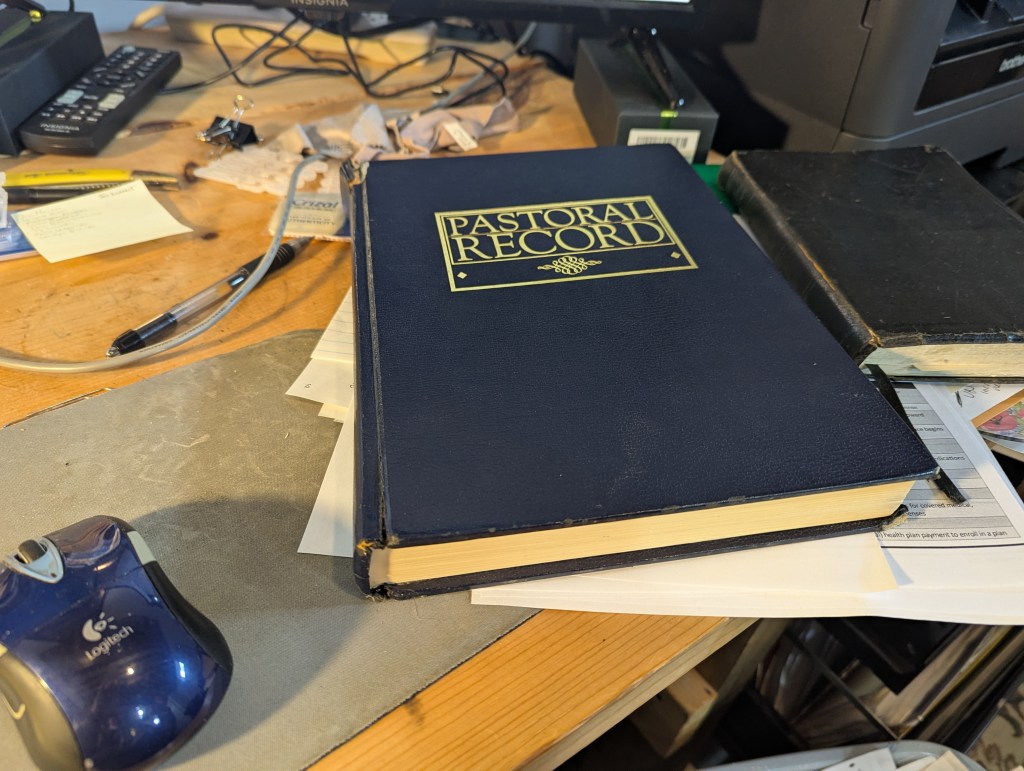
Before leaving my student church in Ohio, the congregation had a celebration for me. One gift I received was from my senior pastor, Nunzio Donald Catrone. The gift was a blank book titled “Pastoral Record.” It’s significance didn’t register in 1986, but as years began to accumulate, the pages became filled with names, dates, and significant notations. Baptisms, marriages, and deaths each have a section.

For the past week I’ve been thinking about Francis. Her entry in my Pastoral Record is January 11, 1996.

Francis was a member of my congregation in Palmyra. She was widowed perhaps fifteen years prior to my arrival. She was proud of her marriage, though their love never produced any children. Her husband had been the village postmaster and a faithful Episcopalian. She was a Methodist, and proud of her independence. Her house was on top of Cannon Hill, a house at the end of the street, the backyard sloped down to the original Erie Canal (in the foreground) and the Barge Canal, a hundred yards beyond.

Children in the neighborhood avoided Francis and her home. Mrs. B was thought to be a witch, ogre, or some other monster who feasted on the unsuspecting child who was caught crossing her yard or peeking in her window. Francis attended church every week, sat front and center, and took in every word of my sermons. She especially loved Summer worship. Bring a folding lawn chair on Sunday evenings; I’ll provide the lemonade. Age compressed her bones and joints, losing her six inches, or so. Francis was being doctored for a heart condition.

It was so enjoyable to stop by and visit on hot summer afternoons. Francis would serve me tea under a tree in her back yard. The flies would be buzzing. People passed, walking the canal path down below us. Time slowed. We’d talk about the past, my most recent sermon, faith, hopes, and fears. Though she was a woman of strong faith, she, like most of us, also had her fears.

Living alone, she feared calling for help, if and when the time came that she found herself in distress. She had a scanner, like most residents in the village, that monitored the fire and ambulance frequencies. Scanners were the source of gossip and juicy speculation. Though we had codes for many circumstances, mostly we spoke on the radio in plain English. She was modest and didn’t want her name and address broadcast publicly for all the world to hear.

Over the course of five years I received her call numerous times in the dead of night. “Pastor Todd, can you come,” she whispered. “Did you call 911?” I’d ask, rubbing the dirt from my eyes, according to our well-worn script. “No, I don’t want to start any trouble.”

“Any chest pains or trouble breathing?” Her answer was always a resounding “Yes! I can’t hardly breath,” she’d say. I could almost see her squirming. “I’ll be right over.”    

A quick-to-don pair of coveralls hung from the closet door next to the bed. Shoes and my department cap, and I was out the door. My Ford Ranger carried a small Oxygen tank, a manual defibrillator, a first aid kit, and my radio. My call sign was Palmyra 14-15. “Fire Control, this is Palmyra 14-15. Dispatch my rig to this address for chest pains and trouble breathing.” The three minute head start would give me precious time to make a thorough assessment of Francis before my crew arrived with the ambulance.

Time and again, we’d take Francis to the hospital to have her stabilized, admitted, healed, and discharged. Each time her heart grew weaker and weaker.

Calls taking Francis to the hospital in the middle of the night were special. I did what needed to be done; repeat vitals, heart monitored, high flow Oxygen, IV started (I had since taken advanced courses and certifications), and, if needed, called for a higher trained medic (to pass medication) to intercept us during transit (though protocol called for the request, a higher level of care in the field was rarely needed). When completed, I turned the lights down low, tucked her in, and held her hand. I’d pray with her; we prayed that the current crisis and pain would end, for diagnostic clarity for the doctor, for compassion for her bedside caregivers, to safely return home.

Francis liked that I prayed with her and for her.  

“Pastor Todd, could you stop by the house this week sometime?” she called. “Yes, of course.” Tea beneath the tree was always a happy place for the both of us.

“My doctor wants me to have open heart surgery,” she stated matter of factly. “Split me right down the middle.” She paused, biting her lower lip. “I thought I’d run it by you. What do you think?” she asked.

Time slowed like molasses in wintertime. What did I think? I’m just a medic on the ambulance. I don’t know about such things, I thought to myself.

Except… Except that I was Francis’s pastor. I did know a little something about faith, life, death, and eternal life. I knew Francis, her life, her passions, her love, her wishes. She and I shared a sacred place between us. We truly loved each other, as only a pastor can love, like a sister or a child, as a shepherd and a sheep.

As we talked, listing pros and cons, discussing risks and rewards, Francis found herself coming to the conclusion that she would have the surgery. We prayed together. The date and time were set. I met her at the regional cardiac surgery hospital as she was being prepped. “You sure you want this?” I asked, holding her hand. She looked so small in the oversized hospital bed. “Yes,” she said, “I’m ready.”

Those were the last words I heard Francis speak.

She became one of those far too frequent individuals who the doctor would proclaim “the surgery was successful,” but they lost the patient. She was splayed like the crucified Christ, being kept alive by artificial respirator, drugs, and fluids. No family; I was alone by her side.

I cried.

For years I felt the guilt of talking her into a surgery that she would not survive. In time, the guilt dissipated. Acceptance has taken its place. As her wounds have healed her into eternal life, so, too, have I been healed from the regret, mourning, and loss of a dear friend and parishioner. God shared Francis with me, for a time. When that time was up, that was it. God led her home. I can now see how Francis was God’s gift of grace to this simple parish pastor.  

A number of months later, the church received in the mail a letter from her estate lawyer, a copy of the will, and the largest check I had ever seen with my eyes. Amazing grace. I’ve heard the sound.