36. A Church on Every Corner, A Bar on Every Block – Poop, Pee, Vomit, and Blood

Palmyra is known for being the birthplace of Mormonism, the cult of Joseph Smith, and I was appointed to serve the local United Methodist parish. It is the only place in North America, I was told with hometown pride, that sported four churches on four corners. Mine was on the northwest corner. If asked which steeple was taller, I’d make the claim that ours was six inches taller than the others. True, or not? I don’t know, but it always made me laugh. 

While there was a church on every corner, there was also a bar on nearly every block. From fire and EMS calls, I’d come to know each of our watering holes, and those who frequented them, like the back of my hand. Palmyra was on the original Erie Canal. Booze, drinking, and fighting were central to life on the canal, a legacy that continues to this day.

Cannon Hill was so named because when the canal opened in 1825 a cannon was fired from the modest peak; one of a long string of celebratory cannons fired in succession from Manhattan to Buffalo. A hundred years later, the outdated canal was updated to the Barge Canal, which is still in operation, more so for pleasure boating than commerce. When the New York Central came through town, commerce transferred from canal boat to the high iron. 

In the center of town there was an iron flag pole, nearly a hundred feet high. We often trained on it with the aerial platform from the fire department. The pole had a patriotic history, but was tarnished with drunken and suicidal opportunist. Many a crowd I witnessed at its base, encouraging one to jump. Not a good look by the Chamber of Commerce. Eventually, village leaders welded steel plates to restrict access. Too many horses had already fled the barn. At least progress was being made. 

The church building was built of similar red brick architecture as other churches across upstate New York, two towers in front, with a tall steeple capping the one over the entrance. It was fun to climb the hidden access, circular staircase up the one tower, cross over the sanctuary rafters to the steepled tower, then climb ladders up to the bell. From this pigeon poop encrusted lair, one could look straight down Main Street, State Route 31, both East and West, and down Route 21 to the South and Division Street over the canal to the North. It was always peaceful and calm high above the village below. 

The sanctuary was modernized, everything was able to be repositioned. Worship in the round? No problem. Traditional back to front? Many hands make light work. Even the (expensive to maintain) pipe organ was connected by an electrical umbilical cord such that the console could be relocated to an ideal location. Cool beans. 

We were blessed with great people and families in Palmyra, though my volunteer team of church leaders didn’t always agree or get along. We held it together for eight years, a good run for any pastor and parish, ending with as many people in worship as when I started. Maintaining worship attendance was a win in the 1990’s when all the world was idolizing church growth and the mega church phenomena. Even then, mainline Protestant churches were in decline. The director of the New York State Council of Churches at that time described the religious environment as “an angry electorate,” and that the people in our pews were a reflection of the larger community. What did grow during my tenure was the endowment, more than tenfold, due to some very generous members of the parish and intensive efforts to provide exceptional pastoral care.  

From my prior experience assisting a capital fund drive and from my work in Palmyra, I learned that giving begins and ends with relationships. A cold solicitation rarely produces fruit. Making friends, developing friendships, building trust, showing oneself dependable, sharing trials and tribulations, mutually enjoying the joys of life’s success, traveling the journey of life together; this is the successful recipe for developing a culture of generosity. There are no shortcuts. 

The pool this morning didn’t happen. My shoulders and neck have been stiff and painful all week. Range of motion is suffering. The thought of fifteen laps of crawl stroke is a non-starter. 

“If it hurts, Don’t do it,” is common medical advice that gives me cover to take a day off. Maybe if I let my body rest and heal? That’s it! That’s the ticket; but, when presented to my wife, the medical professional in our household, I get the stern look out of the top of her eyes. 

“Have you called the doctor?” 

“No.”

“Why not?”

We’ve been through this a thousand times before. We both know the script. “I hate to waste money only to be told there isn’t anything more that can be done other than Tylenol and rest.” No one needs a medical degree for acetaminophen and bed rest.

“But, maybe it is something else.” (Pause for effect) “If you’re not feeling better by next week, will you call the doctor?” 

“Okay,” I concede, defeated by my aging body and prideful mind. 

The village fire department was one of the larger ones in Wayne County. We had about forty active volunteers, three pumpers, a brush truck, rescue truck, and aerial platform. Though we had no paid firefighters, lots of young bucks would hang out at the station just waiting for calls, watching television, or wasting time on video games. Training was held every Thursday evening and Sunday morning. Each volunteer was required to attend and participate in a certain number of yearly training sessions to keep in good standing.

I was warmly welcomed; after all, I had experience as a driver, pump operator, interior firefighter, and chaplain (though I was happy to yield my interior firefighting skills to younger and stronger members of the department). It didn’t take long before I was elected President of the company, a non-line officer. I was not elected to be a firefighting officer, like one of the four chiefs, captains, and lieutenants. They got radios, colored helmets, and red lights and sirens for their personal vehicles. My responsibilities were purely social, raising money, renting the hall, bringing in new members, sending cards and flowers, ensuring the beer machine and bar was stocked.

We also had two ambulances. We were a mixed department, running both fire and EMS calls. We were called the Oxygen Squad from the days when we supplied Oxygen dependent residents with free tanks of pressurized gas from a cascade system installed at the fire hall. We took care to ensure people had an uninterrupted supply of this life essential commodity.

I was intrigued. 

Did I have the chops to learn how to take a blood pressure? Start an IV? Save a stabbing victim? Did I have the stomach to deal in the industry of mayhem and death? My wife was a labor and delivery nurse. She spoke the language of medicine and knew the difference between proximal and distal. My dad had served as a navy medic during World War Two, training and serving to do some of the most horrific tasks known to human kind. If dad could do it, well. So could I. I signed up to take the Emergency Medical Technician course, offered for free by the State of New York, to become an entry level medic on our fire department ambulance. 

Our emergency medical services, essentially rescue, first aid, and transport to the local hospital, was a community service handed over from local undertakers, fifty years earlier. We were dispatched three times more for EMS than for fire or rescue calls. My highest year, I ran 325 EMS calls; I would guess, that averages to about three hours a day. A rival, competitive not-for-profit ambulance also ran in town, but their availability and quality suffered. Today, both services have quit the field to for-profit ambulance companies. At least modernization has given some of the young bucks a job and a paycheck. 

There was a lot to learn.

The course was long and thorough, covering everything from trauma to medical emergencies, helicopter transport, to the jaws of life. From birth to death, from the time a call is dispatched to when you call the rig back in service. Just about everything that can happen is covered. Law, consent, ethics, mass casualties, heart attacks, strokes, burns, amputations, weather disasters. You name it. We even learned were the best donut and coffee shops were located between the hospital and station.

The course ran twice a week for six months. Reading and comprehension before every class was essential. Lectures by senior instructors, doctors, and nurses were common. Time had to be spent with experienced, senior medics answering calls. We had weekly tests, final test, and a practical exam at the end. The wash out rate was pretty high.

I strived for perfection. I was scared half to death that the one answer I got wrong could result in the injury of death of someone. The responsibility that came with the credentials and patch weighed heavily on me. Rookie medics need not worry, for within our squad, outside of the class, we were paired up with veterans and taught the ropes. 

Poop. Pee. Vomit. Blood. These were the essential body fluids that defined many calls. Brains, too; they became fluid if dropped from sufficient height. Can’t forget the calls that involved brains. The more common body fluids were also the means to break in the new medics, present company included. Could I do what had to be done without being sick myself? Only time would tell. 

One rite of passage for new medics was when a patient had to be fully immobilized. This was to protect the head, neck, and spine from further injury. This was the result of motor vehicle collisions, falls, and other traumatic incidences. Head stabilized. Check. C-collar, used to immobilize the head and neck, sized and fitted. Check. Patient fixed to a rigid back board to protect the spine. All check. A good evolution results in a patient hog tied and gussied up like a thanksgiving turkey, fully unable to protect their own airway. 

And then, there is the meal they ate right before becoming my injured patient. Three tacos covered in jalapenos. All you can eat pasta buffet. Burgers, fries, and chocolate milkshakes. Lying flat and strapped to a stretcher in the back of a moving ambulance. On a warm summer night. You get the picture. It doesn’t take long for one to start to get that Pepto feeling. 

Pro tip: aggressively open windows, crank vent fans on high, and turn the air conditioning up to 10. Pro experience, learned in the heat of the call: despite the best efforts to reduce a patient’s nausea, sometimes what went down is bound to come up.

Both veteran and rookie medics sit on side benches, flanking the patient, hog tied and strapped down to the rigid back board. The veteran medic, learned by fire and experience, knows to aggressively unstrap, lift, and tilt the back board on its side, allowing the immobile patient to let gravity clear their airway. Tip it away and all the productive content, if aimed correctly, coats the rookie medic with a baptism of all things holy, head to toe. It happened to me; in turn, I passed on this sacred tradition to those who followed in my footsteps. It isn’t pretty. It’s not a nice thing to do. But it was our rite of passage.

Remember your baptism, and be thankful.

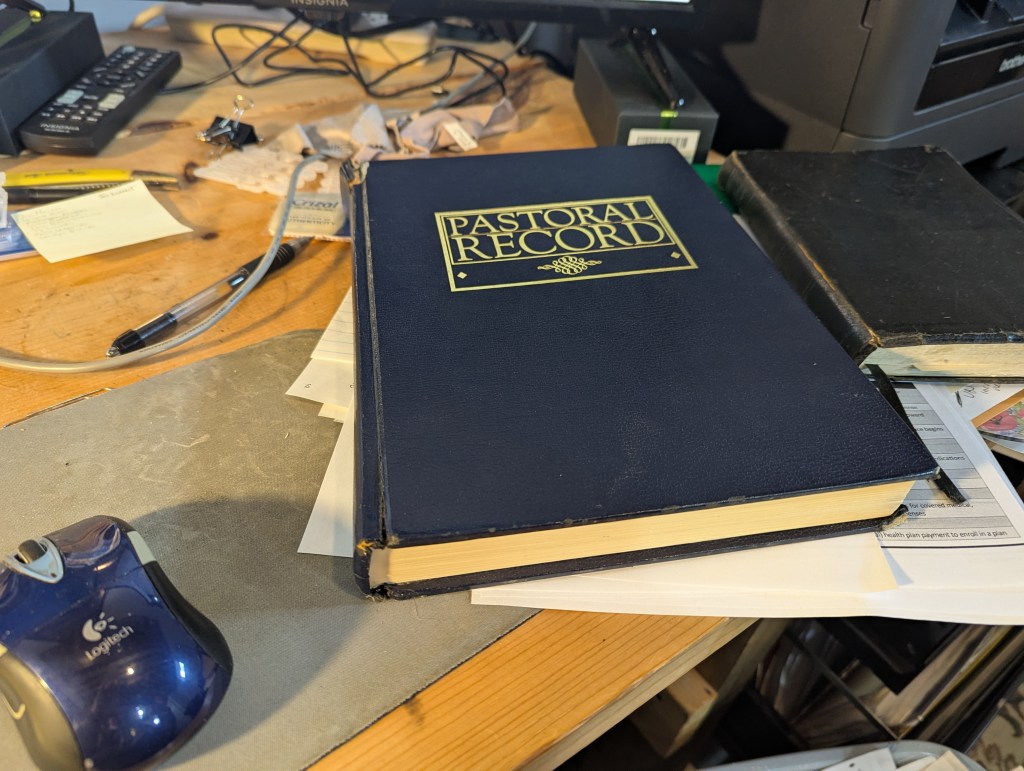
Before leaving my student church in Ohio, the congregation had a celebration for me. One gift I received was from my senior pastor, Nunzio Donald Catrone. The gift was a blank book titled “Pastoral Record.” It’s significance didn’t register in 1986, but as years began to accumulate, the pages became filled with names, dates, and significant notations. Baptisms, marriages, and deaths each have a section.

For the past week I’ve been thinking about Francis. Her entry in my Pastoral Record is January 11, 1996.

Francis was a member of my congregation in Palmyra. She was widowed perhaps fifteen years prior to my arrival. She was proud of her marriage, though their love never produced any children. Her husband had been the village postmaster and a faithful Episcopalian. She was a Methodist, and proud of her independence. Her house was on top of Cannon Hill, a house at the end of the street, the backyard sloped down to the original Erie Canal (in the foreground) and the Barge Canal, a hundred yards beyond.

Children in the neighborhood avoided Francis and her home. Mrs. B was thought to be a witch, ogre, or some other monster who feasted on the unsuspecting child who was caught crossing her yard or peeking in her window. Francis attended church every week, sat front and center, and took in every word of my sermons. She especially loved Summer worship. Bring a folding lawn chair on Sunday evenings; I’ll provide the lemonade. Age compressed her bones and joints, losing her six inches, or so. Francis was being doctored for a heart condition.

It was so enjoyable to stop by and visit on hot summer afternoons. Francis would serve me tea under a tree in her back yard. The flies would be buzzing. People passed, walking the canal path down below us. Time slowed. We’d talk about the past, my most recent sermon, faith, hopes, and fears. Though she was a woman of strong faith, she, like most of us, also had her fears.

Living alone, she feared calling for help, if and when the time came that she found herself in distress. She had a scanner, like most residents in the village, that monitored the fire and ambulance frequencies. Scanners were the source of gossip and juicy speculation. Though we had codes for many circumstances, mostly we spoke on the radio in plain English. She was modest and didn’t want her name and address broadcast publicly for all the world to hear.

Over the course of five years I received her call numerous times in the dead of night. “Pastor Todd, can you come,” she whispered. “Did you call 911?” I’d ask, rubbing the dirt from my eyes, according to our well-worn script. “No, I don’t want to start any trouble.”

“Any chest pains or trouble breathing?” Her answer was always a resounding “Yes! I can’t hardly breath,” she’d say. I could almost see her squirming. “I’ll be right over.”    

A quick-to-don pair of coveralls hung from the closet door next to the bed. Shoes and my department cap, and I was out the door. My Ford Ranger carried a small Oxygen tank, a manual defibrillator, a first aid kit, and my radio. My call sign was Palmyra 14-15. “Fire Control, this is Palmyra 14-15. Dispatch my rig to this address for chest pains and trouble breathing.” The three minute head start would give me precious time to make a thorough assessment of Francis before my crew arrived with the ambulance.

Time and again, we’d take Francis to the hospital to have her stabilized, admitted, healed, and discharged. Each time her heart grew weaker and weaker.

Calls taking Francis to the hospital in the middle of the night were special. I did what needed to be done; repeat vitals, heart monitored, high flow Oxygen, IV started (I had since taken advanced courses and certifications), and, if needed, called for a higher trained medic (to pass medication) to intercept us during transit (though protocol called for the request, a higher level of care in the field was rarely needed). When completed, I turned the lights down low, tucked her in, and held her hand. I’d pray with her; we prayed that the current crisis and pain would end, for diagnostic clarity for the doctor, for compassion for her bedside caregivers, to safely return home.

Francis liked that I prayed with her and for her.  

“Pastor Todd, could you stop by the house this week sometime?” she called. “Yes, of course.” Tea beneath the tree was always a happy place for the both of us.

“My doctor wants me to have open heart surgery,” she stated matter of factly. “Split me right down the middle.” She paused, biting her lower lip. “I thought I’d run it by you. What do you think?” she asked.

Time slowed like molasses in wintertime. What did I think? I’m just a medic on the ambulance. I don’t know about such things, I thought to myself.

Except… Except that I was Francis’s pastor. I did know a little something about faith, life, death, and eternal life. I knew Francis, her life, her passions, her love, her wishes. She and I shared a sacred place between us. We truly loved each other, as only a pastor can love, like a sister or a child, as a shepherd and a sheep.

As we talked, listing pros and cons, discussing risks and rewards, Francis found herself coming to the conclusion that she would have the surgery. We prayed together. The date and time were set. I met her at the regional cardiac surgery hospital as she was being prepped. “You sure you want this?” I asked, holding her hand. She looked so small in the oversized hospital bed. “Yes,” she said, “I’m ready.”

Those were the last words I heard Francis speak.

She became one of those far too frequent individuals who the doctor would proclaim “the surgery was successful,” but they lost the patient. She was splayed like the crucified Christ, being kept alive by artificial respirator, drugs, and fluids. No family; I was alone by her side.

I cried.

For years I felt the guilt of talking her into a surgery that she would not survive. In time, the guilt dissipated. Acceptance has taken its place. As her wounds have healed her into eternal life, so, too, have I been healed from the regret, mourning, and loss of a dear friend and parishioner. God shared Francis with me, for a time. When that time was up, that was it. God led her home. I can now see how Francis was God’s gift of grace to this simple parish pastor.  

A number of months later, the church received in the mail a letter from her estate lawyer, a copy of the will, and the largest check I had ever seen with my eyes. Amazing grace. I’ve heard the sound.

35. Discerning a Way Forward

The two of us worked out a way that we could function as a pastoral team to support the needs of the people, despite our personal differences and uncomfortable circumstances. We kept lines of communication open between us. We shared equally the responsibility of preaching and leading worship. We were professionals, we told ourselves, and, by golly, we should act like it. 

The winds of war were shifting the year before I had moved from Dresden. Across the lake was the chief Army Depot for the East Coast. A cruel, greedy dictator’s action to steal his neighbors oil half a world away was waking a slumbering American giant. Huge C-5A cargo jets cycled in and out of the military airfield, withdrawing munitions, depositing them in distant lands. Trains plied the iron, loaded with the means of war, unloading at East Coast docks. 

Politicians postured. Lines in the sand were drawn. The era felt as if we were being flung into the inevitable, a clash of extreme violence.

“Blessed are the peacemakers,” I recall preaching from Gospel beatitudes, to two full worship services each Sabbath, averaging over 350 per Sunday. One or two showed their disgust, got up and walked out. The hint of Christian nationalism was starting to show itself, and the future was cloudy, at best, apocalyptic, at worst. 

The lesson of disgruntled members of the parish for me was to grow a thicker hide. Stand convicted on the Gospel, the Truth of Jesus Christ, and let the chips fall where they may. Some, I’m sure, hate our Lord’s message of love God, love neighbors, love your enemies, and pray for those who persecute you. While it may feel like a personal rejection, from my Christian milieu, turning one’s back on Jesus, is a rejection of God. 

It isn’t, and never was, all about me. The conflict is a deeper struggling for meaning, a conflict that is written in the DNA of the human experience. In my own attempt to square the circle, I’ve come to believe in the Divine Providence of a loving God. At the same time, I recognize that the evil of this world, if left unchecked, will destroy with wonton abandon. 

The only logical conclusion is that it takes brave men and women to make a stand opposed to violence and evil, that the rest of humankind may live in peace. I’m grateful that God calls others to positions of responsible deterrence. Concurrently, I’m grateful to be called in a different direction, to tend the flock of the faithful, to preach the Word, and celebrate the Sacrament. Blessings to those called and prepared brave men and women who stand firm in the breach of impending violence, prepared to risk it all, be they fighter pilots, submariners, or cops on the beat. 

Others just see the world differently.

Ministry in the heart of the Finger Lakes of New York was good. We are blessed with four distinct seasons of the year, rare cases of catastrophic climatic events, and prosperous hamlets, villages, and towns. 

Healthcare has always interested me. Had it not been for a bad experience back in high school biology class, I could have gone the way of medical school, as my older brother did. Our city congregation was blessed with numerous doctors, nurses, therapist, and social workers.

One physician was about my age, married and had three beautiful children, two sons and a daughter. He was balancing the work, family matrix. After a difficult clinical shift, he would often stop by my parsonage to destress over cigars in my garage.

He was raised in a progressive Christian family, his parents serving as missionaries in South America. He learned to fly the missionary airplane into and out from jungle stations before he learned to drive a car. Home schooled, he went to a prestigious university and graduated from an exceptional medical school. Less than ten years into his profession, he was the head of a department at one of the local hospitals. He was going places.

Just not the places I expected.

There was a nurse, he explained to me, who desired to expand their relationship from the bedside to the bed. He was tempted by the sugarplum imagination of passionate adultery with another woman. He had even confessed his temptation with his wife. Yet, he claimed, he did not know what to do. What was my take on it? He asked.

A quick response is unusually a bad reaction, no matter how well meaning, in my experience. I puffed on my cigar in deep thought. My soul was frightened, fearful that one wrong word would result in utter catastrophe. A loving, talented wife. Three beautiful children. A professional reputation. A lifetime of deep faith and Christian morality. All this, and more, hung in the balance. I recalled my wife’s disgusting reports of similar behavior at her hospital. Colleagues disreputable behavior causing painful harm in clergy families and local churches also raced through my mind. 

“Don’t do it,” I finally broke the silence. Absolute truth and honesty surprised both him and me. It had to be said. I proceeded to lay out the dilemma with my God given talent for mathematics and logic. “Are you prepared to live a dishonest life?” I concluded. 

“No,” he slowly resolved. “I am not.”

But what about his matrimonial confession? His wife most certainly was feeling lost, betrayed, on the verge of abandonment. “Have your wife meet you here,” I’m strategizing even as I’m thinking. God, Don’t leave me now, I’m thinking to myself. “My wife and I will leave the house to just the two of you so you can talk it out.” Space and time would give him the opportunity to express his resolve to end the amorous flirtation and create the possibility for healing to take place. 

My friend and parishioner made the call. My wife and I went shopping. Something Divine must have taken place. In time, he left his prestigious position and took another at an academic hospital in the mid-West. We exchanged Christmas cards for years thereafter. Their letters were filled with family, love, and faith. 

My heart was contented. God’s healing grace is truly amazing. 

Laps in the pool this morning blew by. I started sharing a lane with a gentleman who I was becoming familiar with through our greetings in the locker room and on the pool deck. He is kind and considerate, values I appreciate and try to reciprocate. He finished his laps just as I was about to get started. 

As I reached for the final wall, another swimmer joined me. We exchanged pleasantries. I was breathing heavily, cooling down, thinking about the hot shower that was waiting for me. “You know,” he began, “I appreciate swimmer’s courtesies. Some are more readily willing to share a lane, others not so much.”

I agreed. “We only rent a lane for a short period of time,” I struggled to find the right words. “It’d not like we own it.” Mutual respect among swimmers avoids collisions and injury.

“If only the rest of the world was as kind and considerate as you are,” he concluded. The silence hung pregnant in the moment. I departed, leaving behind a blessing, wondering if I was worthy of his kind words. 

Sometimes circumstances demand that I just take it, God’s grace be praised. 

My petition to the Bishop’s office for a move was met with silence. I had two solid years of fruitful ministry, five years of full-time tenure. It was just the fact that my sails were cut from different cloth from my appointed partner. I needed to captain my own ship. 

Bigger churches and larger compensation appointments were the first to fall with the start of the new year. Moves traditionally took place the end of June, the beginning of July. The telephone rang mid-March and the call was from the District Superintendent, an old friend of the family, serving in the rural Adirondacks. “The Bishop and I would like to send you to …,” he began. 

My heart fell as fast as the Roadrunner’s anvil.

A quick reaction is a bad one. Hold your tongue, I told myself. Pause. Count to ten, my mother taught me. He offered me a two point charge, a larger village church and a small country chapel. It was miles away from civilization and the nearest hospital where my wife, Cynthia, could continue with her call as a labor and delivery nurse. 

Fortunately, I was the benefactor of a two-year continuing education opportunity with Perkin’s School of Theology at Southern Methodist University. I was placed in a core group of eleven youthful peers from across the country, paired with two seasoned elders, visionary leaders from their respective Annual Conferences. My mentor was the pastor of the Methodist cathedral in Houston, Texas. He visited me twice in New York. I made the sojourn four times to a restful Episcopal retreat center in Flower Mound, Texas. Dr. Stan Menkin, a professor at Perkin’s brought us all together.

Episcopal appointment making was one of the topics. Each subject matter required a lot of reading and writing in preparation, and resulted in lively discussion within our core group when we met.

Don’t make a snap decision, was the wisdom. Give room for the Holy Spirit to speak. Consultation is the word used in The Book of Discipline of The United Methodist Church. Our mentors concluded: Take the gift of consultation to do your homework, discern the Spirit’s will, then come to a conclusion and make your case forthrightly. 

“Give me 48 hours and I’ll get back to you,” I told the Superintendent. 

My wife and I set out for an anonymous visit to the prospective parish. We tried our best to keep an open mind. We visited some firefighters washing their firetruck on the ramp of the village fire station. We had lunch in the local diner. We took a long walk down Main Street and visited the swings at a local park. What is the mood of the community? How are the schools? What keeps people occupied? What do you do for fun? We asked around, a lot. 

The local papermill was closing. People were either hardscrabble farmers or public employees of the town or school district. Storefronts were abandoned. Housing was in decay. Life had boomed in the 1950’s, but had gone downhill ever since. The nearest labor and delivery hospital was an hour away. Lake effect snow fell each season with apocalyptical effect. The parsonage was physically attached to the church.

The Spirit was speaking. 

“No,” I responded to my disappointed colleague. “I’m not feeling called to a parish and town in decline, where my wife would be unemployed, and where we couldn’t meet our student loan responsibilities.”

“But, could you do the job?” He asked me again and again, like a hammer and chisel searching for a crack. Of course I could do the job, I asserted with all my five years of pastoral experience. “I just don’t believe I’m called to take this appointment.”

And thus I hung it all out there. “I’ll get back to you,” he replied.

Back to waiting …

Meanwhile, the fire alarm fired off my pager at three in the morning. “Tree down on West Lake Road,” I heard as I dressed, got in my truck, and activated my flashing blue light. 

An ice coated tree lay across the road, and all the associated downed power lines were draped like spaghetti in the darkness. An ice storm had taken up residence throughout the Finger Lakes. The paid firefighters (with the responding engine) and I listened to a cascade of calls flowing in from the dispatcher. Trees down. Power out. Smell of gas. Traffic lights dark. More crews. More engines. More fire companies across the region were being called to duty.

“Can you remain here protecting the road with your blue light while we start answering the other calls?” The paid guys asked. “Sure,” I responded. “Go ahead.”

Ice and falling branches sounded like breaking glass as I waited sentinel at my post. Little did I know at the time, but ice pulled the electrical service box from my parsonage, like it had from thousands of other houses throughout the city. My wife and son waited in darkness and dropping temperatures. She had to get our son to day care. Was it going to open? She had to get to work; mommas in labor don’t wait for no ice storm. While I was working fire calls, she was working the complex decision tree that was facing families everywhere.  

I was out for four days and nights with the fire department while my wife and son relocated to her parents’ house in Syracuse. They had lights and heat. The local Chase-Pitkin’s hardware store opened it’d darkened doors to the fire department. The kind general manager donated a pallet of new chain saws for the fire department; I used mine nearly continuously for the next week. Generous, oh my goodness. The world is full of great people like that store manager.

It broke my heart to pump out flooded basements and turn off utilities to families in need. The risk of accidental death was far too great. We delivered food and potable water, drove people to dialysis, and kept people’s home oxygen supplies replenished.

The second telephone call came a few weeks later. “The Bishop and I would like you to take an appointment to Palmyra.” It was only fourteen miles away, still in the familiar Finger Lakes. It was a one point charge. Cynthia would still be able to commute to her hospital in Geneva. I was ecstatic. “But wait,” I told myself. Take a breath. Count to ten. “Take the gift of consultation to do your homework, discern the Spirit’s will and direction, before you make a decision.”

Thankfully, I did. The judgment was made; the die was cast. We would be moving in June and I would become the captain of my own ship, once again.

Thank you, God, for the gift of discernment, for the clarity of your will, and for the opportunity to serve the faithful members of a new congregation.  

33. Clergy Scandals, Money, and Sex

Clergy are human, at least I am. Having outlived many of my peers and most of my mentors, I believe my observation of fellow clergy is accurate. Clergy are human, just like everybody else, stained by the same patina of temptation and sin.

How about the newer generation taking firm control of Saint Peter’s keys? How do they stack up? I just don’t know enough of the younger generation of clergy to make an informed opinion, but I suspect they are no different than my generation, or those that came before us.

Scandals? Yep. Hypocrisy? Without a doubt. Flawed? Yes, but not mortally so. Many rub their hands in glee wanting to hear all the salacious details of a fallen man or woman of the cloth. 

In my forty plus years in the parish, and the twenty, or so, years as a preacher’s kid, I’ve seen it and heard it all. I’ve learned how the sausage is made and I know where all the bodies are buried. Never let a good story get in the way of the truth, peers and I would toast around a campfire, when we annually gathered to heal and grieve. One would think that clergy are above good old fashioned gossip, but that isn’t the case. 

Sex and money are the two greatest temptation to clergy, present company included. Secrets, facts or otherwise, are safe with me; recognizing the pastoral counseling hypothesis that secrets are always a sign of disfunction. But, I will afford the reader with a few generalities that may benefit the Church of today, laity and clergy alike. 

Honest, self-awareness is a good thing.

1. Never have I heard or been aware of any abuse or exploitation of children by an Ordained clergy person in the United Methodist Church. It may have happened, but that is not my experience, nor on my watch when I had anything to do about it.

The Boy Scouts got a lot of headlines and the denomination settled a whopper of a class action lawsuit, but abuse and victimization, in my opinion and from my experience, did not involve the clergy person appointed to a parish with a scout troop, pack, or den.

Perpetrators were often found to be local scout leaders, not the clergy listed on the charter. Sadly, the settlement paints all clergy in unflattering colors and has contributed to much discouragement and discontent.

I am aware of one lawsuit filed against a parish by an individual who claimed to be victim while a member of the Boy Scouts, but, there was no evidence that they were ever a member of the Boy Scouts, nor did the church ever hold a charter. Opportunist? I suspect so.

Sadly, this spoils the efforts to bring healing and justice for those who have been truly victimized. 

2. Thief, or misuse of money. Mom and Dad taught me at a young age the Ten Commandments, including the law against stealing. Don’t take what doesn’t belong to you. This victimizes the person or organization from whom money is stolen. It further is an abrogation of God’s willful distribution of time, talent, and treasure. 

Clergy are not immune from the temptation to take what isn’t given or earned. Some have, and probably never will be caught. Others have been caught with their hands in the cookie jar, and, without exception have been turned over to the authorities for criminal prosecution and escorted out of the union of the Ordained. 

There is no justification for taking what doesn’t belong to you. Full stop. Period.

Low pay or poor compensation? Certainly. But, that isn’t an excuse for theft.  A lack of supervision or peer accountability? Welcome to the reality of the Ordained. We often call those who are young, independent, and resistant to joining with peers as lone rangers. Ordination isn’t a license to steal. A lack of self-esteem? Come on; theft is a massive over compensation for a personal, character defect. 

I mentioned to my psychiatrist recently that I estimate 90% of clergy are afflicted with clinical depression, of various severity, at one point or another in their career. Perhaps I shot high, but not by much. This is my opinion based on observation and experience. He was surprised, but I am not. Most of us tend to not take care of ourselves. My profession suffers from challenges of mental health, physical comorbidities, and, yes, spiritual crisis. Clergy are one hundred percent human, high blood pressure and morbid obesity, oh my. 

God has blessed me with a social circle, composed of professionals and peers, who hold me accountable, who improve my emotional awareness, and support me when I identify a character flaw and set about making corrective efforts. They are my coaches and cheerleaders, peers that would never abandon me, nor would I them. They mourn my loses, abide with me despite my flaws, and cheer my success, recognizing success finds its source in the amazing grace of God. 

My wife and our marriage has been a rock.

To be sure, some colleagues have abandoned me in my time of need. Don’t let the door hit you on the butt on your way out of my life. Leave me? You’re loss, not mine. I’ll try not to miss you.

My personal policy regarding finances has been to have as little to do as possible with the physical contact with money. Don’t leave me in charge of the cash box during the rummage sale or turkey dinner. Receive the offering plates from the ushers and immediately place them on the altar table, holding my empty hands high while praying a prayer of thanksgiving.

Honor the designation of every giver and gift, all-the-while, advocating for undesignated gifts, to give room for parish leadership to maneuver and lead. Advocate for parish funds with transparent stewardship, encouraging conservative principles, and ensuring regular audits. God’s money is God’s. Not mine.

I’ve also attempted to manage my personal finances with the same principles. I’m grateful for the advice early on in my ministry to save all that I can, give all that I can, and live within my means. It helps to be married to a spouse who generously and unselfishly contributed to our family finances from day one. 

It was six degrees this morning when I pried myself out of my heated lounger and left my fireplace to go to the pool. Bare feet in Crocks is cold! With two hoodies up one guy in the locker room told me, “Your look says it all.” 

Which, made the water feel colder than usual. Under the lane marker I bobbed, fully immersing myself in the same water that baptized my Lord, the same water that was used in my baptism, the same water that initiated Christian sinners and saints throughout the ages. One with Christ. One with each other. One in Christian unity. 

I pulled at the water, digging in with every stroke, breathing to my left, taking notice of the life guard who strikes a pose similar in my imagination to that of Jesus. On the return length, the low winter sun sparkled into the water, diffused as a prism distributes light across the spectrum, warm on my face when I rotate to take in each breath. How is it possible to feel the warmth of the sun on such a cold, winter day? 

God’s grace is awesomely amazing. 

3. Clergy sexual sin. Yep; it is a real thing. It breaks apart marriages, takes advantage of the vulnerable, and traumatizes parishes for generations. “We once had a pastor back in the day,” it was common to hear, “who had an affair with the church organist (or secretary) and ran off to Timbuktu.”

Sometimes, the old boy network would swing into action. For shame.

The Board of Ordained Ministry and the Bishop share in the responsibility for clergy conduct, sexual, and otherwise. As peers cycle on and off the Board, policies and enforcement ebbs and flows. As Bishops come and go, some were better than others for demanding a strict moral code of conduct. Some were swayed by the good-old-boys protective network, reassigning offenders to another location, often to offend again. Others took the time and effort for thorough investigations, careful application of Church law, as defined in our Book of Discipline, and imposed appropriate punishment. Policy consistency is an oxymoron, in my experience. Rarely have I heard or experienced efforts for healing, restoration, or support of a traumatized parish. 

This uneven, unhealthy approach to sex and sin, has been a source of frustration and discouragement to the rank and file, present company included. 

Boundary training, as is deftly labeled, has been all the rage in recent eras. Recognition of the inequality of power and authority has been helpful. Full stop measures, such as, sex between a pastor and a parishioner can never be consensual, have been long overdue. The topic may be obvious to those of us with conservative moral backgrounds, but is often bewildering to liberal others.

Peer trust is rare; one never knows who will become a District Superintendent or Bishop. Peer accountability, from my experience, is best when doled out by my psychiatrist and by peers who serve in other, sister denominations (who, therefore, pose no professional threat). I have come to love and treasure my Presbyterian, Episcopal, Lutheran, UCC, and Roman Catholic fellow clergy.

The waters are dangerous and murky. Divorce is a painful reality for some clergy, while completely outside of the experience of others. LGBTQ and transgender issues challenge even the best of us hush puppy liberals. Pornography is readily available and the bar of temptation is ridiculously low. There is so much I don’t know and I don’t want to embarrass myself by asking questions. Temptation is everywhere. The lowest common denominator default is to just pretend it doesn’t exist and that it can’t happen to me. 

Clergy are human. 

We should be held to the highest moral and ethical standards, and expect nothing less. At the same time, our humanness defines our imperfections, warts and all. 

It may be old school, but I learned early on to treat every person as a beloved sibling, sister or brother. When tempted, the abhorrent stigma of incest helps keep me in my lane. Lord, have mercy, and keep me on the up and up. 

I’d like to think that I’m non-judgmental, but that would be dishonest. I do judge others; all-the-while, I seek ways to mitigate risk, stay reasonably well informed, and apply best practices to my own life.

I find it difficult to relate to peers who have failed to live up to the high ideals of the ordained. It is easy for me to feel that those who have failed the Church have personally failed me. See them in a crowded room? Make way to the other side. It’s awkward to bump into a person who has shared the common path of serving as a parish pastor, yet, who has failed to live up to even the basic standards of professional conduct.

“I know what you know, even what you don’t think I know,” my interior voice says to myself. Not only do I frequently know them, but I know their families, too. Generations of clergy run deep. Who is married to who, as well as who owes who a favor, too often, has served as a “get out of jail free” card for offending clergy.  

A moral and ethical dilemma I’ve frequently faced is notification of clergy who follow me. Should I let them know the depth and breadth of trauma that others have inflicted on a parish, its members and friends? What about when a lay offender who demonstrates predatory behavior and simply moves on to another parish. Do I warn that pastor? I have gone to the District Superintendent (a representative of the Bishop’s office) with concerns, only to be rebuffed with “how would you like it if someone made the same accusations against you?”

In my experience, too little effort has been made by bishops and clergy to attend to issues of theft and sexual abuse in the parish. Abuse brakes people. The just response should be to open the flood gate. We should be compelled to do everything in our ability to heal, restore, and repair victims and congregations. Law enforcement should be involved immediately, even if it is remotely suspected that a law has been broken. The just response shouldn’t begin and end with a press statement from the Episcopal Office or with lawyering up.

It is easy for me to complain, since I’ve never served in church administration beyond that of a parish pastor, or as a member of the Board of Ordained Ministry. Yet, the sins of the Church have been a slow grind on me, and not in a good way. “And are we yet alive?” we sing when the ordained annually gather. Are we? Am I?

John Wesley outlined a life of grace, where the faithful is always moving on towards perfection. Today, I’m less than perfect; but committed to getting better. When tempted I make my confession to my psychiatrist, seek to change my ways, make amends such that I harm no one, and set about in a new direction with the goal of being perfected in the likeness of Christ. 

In short; confess, repent, make amends, become better. Do no harm. Keep my own nose clean. Wash. Rinse. Repeat. This is how God’s kingdom on earth approaches the perfection of God’s kingdom in heaven.

28. Graduation, Ordination, and Moving to Our First Parish

My three years of seminary were coming to a close. My Brother electric typewriter was plum worn out. My Merriam-Webster was stained, worn, and key pages were dogged. The binding was broken in numerous places. Classes were passed, oral and written exams were completed. All that remained was crossing the stage and receiving my Master of Divinity degree, dressed in a black academic robe and scarlet red Master’s hood. Hard. Long. Intense. I’m guessing we graduated two thirds of those who started. 

I was tired of reading “church stuff.” So, off I went to the Dayton Public Library and borrowed three Stephen King novels. Hibachi grills sprouted like daisies on campus with graduate families celebrating with picnics and social gatherings. Frisbees flew and snot nosed kids were ramming around the seminary campus. Life was good.

Graduation brought forth the question, “what’s next?” For some of us, it was back to our home conferences Board of Ordained Ministry (BOM) for written and oral examinations for recommendation, or not, for ordination as Deacon and Probationary Member of conference. My written packet was about 40 pages of double spaced content, six copies, mailed off in early January. Each of us had to travel to our respective conferences to sit for two days of oral exams. Being the tightest union imaginable, BOM didn’t want to let in any slackers. 

Those of us from Central New York sat for our exams at the Liverpool United Methodist Church (a suburb of Syracuse, NY). Those who passed, and not all of us would, were invited to the Bishop’s retreat at Casowasco, where Bishop Stith would spend three days with the proposed class of ordinands, lay down the law for all clergy members under appointment, and conference staff could provide an orientation for employment.

But, to get there, each of us had to get through oral exams. 

At that time BOM was composed of forty, or so, Elders, divided into interview teams of three or four. Members of the Board had read all of our written material; many marked them up in bright red pen. Interviews were categorized by topic and candidates would rotate like musical chairs. Eight hours of interview per day, with breaks for coffee and lunch. Afterwards, BOM members would meet, compare notes, and vote to recommend, or not, each candidate. It was exhausting, emotionally draining, and fraught with danger. 

Waiting for results was really hard. I just wanted to throw up. A number of my group were asked to come back next year. Thankfully, I passed and my bags were packed for Casowasco. 

Other than a few casual encounters with the Bishop, I really hadn’t met Bishop Stith. He was a big, lanky African American with a gentle countenance. Laid bare were his marching orders: No arrests, no infidelity, no stealing from parish funds. Discipline words and behavior. Dress professionally. You represent Christ and His holy Church. Act like it!

Because parish pastors are largely unsupervised day-to-day, we were required during our probationary period to keep a daily account of our time spent on parish activities, with reports to our local church Parish Pastor Committee and the BOM. We were, after all, probationers for a minimum of two years before becoming eligible for full ordination as Elders and full conference membership. The golden ticket.

Ei-ya, Captain!

Sage advice came from the Conference Council Director, Vernon Lee, and the Conference Treasurer, Roger Strait. They taught us the essentials no one had bothered to teach us in seminary; How to complete monthly expense reports, enroll in health insurance, and invest in the pension fund. “Save all you can,” Roger explained, “even to the point where it hurts.” We were also encouraged to opt in to Social Security, for participation is voluntary with clergy. I did. Now in retirement, I’m blessed more than I ever could have imagined forty years ago.

The Bishop had his flaws, as his behavior and service were negatively impacted years to come. Yet, he led the ordination retreat with grace and love. Roger and Vernon were two of the best, mentors for this green behind the ears candidate for ordination. I loved them all, and responded with enthusiasm. God gave me their friendship and wisdom. The least I could do was serve with integrity and honor.

The pool this morning was intimidating. My previous swim was all freestyle, no sluffing off or dogging it with a few laps of breast stroke. Half an hour of all out “get me some.” Could I do it again 48 hours later?

Half an hour of laps wouldn’t  even constitute a warm up for a high school swim team. SEAL training do this in their sleep. Who was I?

Retired. 64 years old. Nothing more than a wind bag full of excuses, I tell myself. 

So, I dug in, hit it with all my might. Each lap brought back memories of the associated grade in school. Lap six, sixth grade. You get the hint. Twelve grades and three years of college. Boom! Shut the door. No more laps until Monday, when, I’d start it all over again.

Again, I watched the soapy water swirl the filthy drain as I stood exhausted in the hot shower.

The Conference employs, we like to say in the United Methodist tradition, while the Bishop deploys. I was about to place myself in the bull fighting ring of appointments. Where were Cynthia and I going?

Loose ends in Dayton were tied up. Cynthia completed a year in the neo-natal ICU at Miami Valley Hospital. The U-Haul was packed and the apartment was swept clean. Even the Stephen King novels were returned to the library, read cover to cover. 

Being new and lowest on the seniority list, my appointment didn’t come through until the first of June. Big churches, tall steeple, and highest salaried pastors went in January. Everyone else in-between, in a complex Daisy chain succession of moves, were appointed and choreographed by the Bishop’s office. God bless their souls. 

Dresden and Milo Center was our destiny, located on the West side of Seneca Lake, in rural Yates County. The nearest civilization was the village of Penn Yan (Up town) and the City of Geneva (the city). Rural. Blue collar. My kind of people. The hills overlooking Seneca and Keuka Lakes were covered in dairy farms, vineyards, and back country roads. Salt of the earth people, descendants from the Revolutionary War soldiers given land grants following the conflict (much to the consternation of the Iroquois nation who were native to the land). 

The district superintendent, Jim Spear, the representative of the Bishop’s office met us in Geneva and drove both Cynthia and I to meet with the Pastor Parish Relations Committee (PPRC) of both churches. They were pleased as punch to meet us. Both Cynthia and I were all smiles. 

Yes, Geneva had a hospital with Labor and Delivery, so Cynthia would be employed in her call to nursing. God called her to become an OB/GYN nurse of the highest order, just as sure as God called me to serve as a parish pastor.

The parish paid $11k per year, so we could afford a car, pay off our student loans (amounting to over $21k), and buy a few groceries. Around the PPRC table were representatives of the parish; Wrinkles spoke of wisdom, calloused hands spoke of hard work, loving eyes revealed faith, deep and strong, like Seneca Lake, the largest and deepest of the Finger Lakes.  

Time to take a tour of the parsonage. Nervous glances around the table betrayed anxiety with the departing pastor and spouse. His efforts flamed out amidst scandal and pain. He was headed off to a life of a failed marriage, selling office products. The parsonage was left in disrepair and smelling like cats. As Jim drove us back home, tears were in Cynthia’s eyes. “Yep. There’s work to be done in Dresden and Milo Center. But that is just what you’re going to do,” he told us. 

And we did it.

Conference was held the third week in June in Hamilton, NY at  Colgate University. About 600 clergy and laity representing 300 local churches gathered for the annual event to celebrate our shared ministries, retirements, passages, election of new clergy candidates, and ordination. 

Cynthia and I stored all our earthly possessions in a parishioner’s garage in Dresden and stayed at her family’s cottage at Bradley Brook, just 8 miles away from sessions at Colgate. The day of my ordination I had to clear a clogged toilet, a portent of things to come? No, but funny and memorable, none-the-less.

In the super-secret clergy session, the Board of Ordained Ministry presented each of us candidates, one at a time to the clergy members. One stood alone on stage, facing the music. Questions? Anybody?

I don’t know how the other candidates fared, but I had numerous pastors stand and gush about what a good guy I was and affirmed my call. Cleared of my dad’s legacy, I stood on my own two feet. Once elected, the Bishop asked us as a group the traditional Wesleyan questions … “Will you …” “Are you so in debt to embarrass yourself?” (Always got a laugh) “Will you follow Christ? Preach the Gospel? Celebrate the Sacraments? Serve the people in your trust?” 

“Yes.” “Yes.” And “to the best of my ability.” You get the picture. 

Ordination was the final event of the three day conference. It was a worship service where all the bells and whistles were brought out and the finest liturgical wares were on display. Not only was Bishop Stith presiding, two prior Bishops were assisting, Bishop Ward, and Bishop Yeakel.

During Holy Communion, Bishop Stith rich baritone voice led the singing of the Epiclesis, to the tune of Tallis’ Canon. The congregation, many hundreds strong would respond:

1. Come, Holy Ghost, our souls inspire, And lighten with celestial fire,

thou the anointing Spirit art, who dost thy sacraments impart.

2. Thy blessed unction from above is comfort, life, and fire of love;

enable with perpetual light the dullness of our blinded sight.

3. Remember Saints who’ve passed this way, for us to follow every day;

May we keep true their faithful life, justice, forgiveness,  love, and light.

4. Anoint and cheer our soiled face with the abundance of thy grace;

keep far our foes; give peace at home; where thou art guide, no ill can come.

5. Teach us to know the Father, Son, and Thee, of both to be but one,

that through the ages allalong this may become our endless song.

6. Prepare Thy table for yourfeast Thy kingdom come, to all, the least.

Our bread and wine return to you Our gifts of praise, thanksgiving, too.

7. Flames of Thy Spirit forge us new, and blow a fresh Good News from you.

Praise to the Father, Christ the Son, and to Thy Spirit, three in one.

I was deeply moved. Singing this at the communion table would become my practice the next 39 years.

The time had come. Each candidate was called forward by their full name, knelt before the altar and all three Bishops placed their hand on our head, as they read the ancient liturgy. Their three hands were heavy, and I felt held down, as if to impart on me the ancient reverence of St. Peter. “Take Thou Authority …” Bishop Stith commanded.

The ordained pastor’s authority comes from the “Thou,” from God, as imparted through apostolic succession. They Keys to the Church, to lock and unlock heaven and hell, are passed to successive generations of the ordained. The Bishop’s public affirmation of the pastor’s call and ordination means that the channel of God’s grace is made through the hierarchy of the Church (The Body of Christ), made abundantly available to the sinners and saints in the pews.

Heady stuff.

With authority comes responsibility. The call is much greater than doing a job. Seminary was much more than learning a trade. Membership in the annual conference and the privilege of serving under Episcopal appointment was more than joining the best union in the world. In my experience, ordination became a wellspring of God’s grace, a channel of God’s redeeming love and acceptance, the gift of spiritual transformation and welcome into God’s heavenly kingdom. I had been called and affirmed as one of many stewards of Christ Holy Church.

Take a breath, Todd. Come Monday morning, he trash still needed to be put out to the curb.

27. United Sound, Clinical Pastoral Education (CPE), and the Blackbird Massacre

My third and final year of seminary was delayed a week while Cynthia and I honeymooned in Nova Scotia. We loaded up a rooftop carrier and headed out to Dayton. We moved into Roberts Hall, a newer residential building directly across the campus from Fouts Hall, my first year home. Roberts was more suited for married couples. Both buildings bred cockroaches like rabbits. Our neighbor down the hall used to collect dead cockroaches and deposit them weekly under the slot at the bursar’s window.

I just settled into fall classes and clinical pastoral education (CPE) at Kettering Memorial Hospital. Cynthia was looking for a job in labor and delivery and was quickly snatched up by Miami Valley Hospital to work in their neonatal ICU. My puny Eastway paycheck paled in comparison to her paycheck, a pattern that we would follow for the next forty years.

A month into the term and my father died of sudden cardiac arrest (see my earlier chapter about Bob Stoppert making the notification and giving Cynthia and I a blank check to fly home). I had a marvelous father the first twenty-five years of my life, mentor, and supporter of my call to ministry.

My dad and my new father-in-law, Irving, were like oil and water. Irv was the Dean of the Cabinet, the Bishop’s right hand man. Irv was the system. Dad was the crusader for the little guy, who always stood up for right over wrong, and was always vocal about bucking the system.

Dad served small steeple churches in rural upstate New York; Irv served the big suburban and urban churches. We didn’t have to worry about how our families would get along after dad died. Though I grieved his death, I was blessed with a strong, loving, and wise surrogate father, my father-in-law Irving, for the next twenty-five years. 

I was two weeks behind in my reading and classwork by mid-October. There would be no time for United Sound in my third year. United Sound was a choral, comedy, dance, skit group that traveled the country between terms each year, visiting churches served by United alumni. It was great fun pulling into an unknown town in a huge tour bus, to be assigned a host family, have them feed us a good home cooked meal and house us over night. We’d do our stick at their church, often drawing full sanctuaries of happy United Methodists. Aaron Shaffer was the director and Robert Simmons was the assistant.

Doc Simmons was the Dean of the Black Gospel Association of America. He taught fifty plus white seminary students how to sing black gospel. How to sway. How to repeat. How to move and be moved. And he was good at it. We’d sing twenty minutes of “If you confess the Lord, call him up” and have the whole house on their feet clapping, swaying, and praising the Lord. Truly phenomenal.

Doc also taught the young and naive how to play poker in the back of the tour bus between gigs, unloading the unsuspecting of excess money. Oh, how we loved both Aaron and Doc. 

The movement of the Holy Spirit was experienced where ever we traveled, whenever we performed, when we swayed and sang, and when we cracked corny jokes: “those who have ears to hear (pull out two cobs of corn), let them hear!” 

Our most notable gig was singing for General Conference in 1984, held in Baltimore, Maryland. This is a gathering every four years of about 500 elected clergy and 500 lay delegates from around the world to set policy for the United Methodist Church. It was the one and only General Conference I would attend, for I witnessed too much pride, ego, and hubris for my blood. Lots of want-to-be Bishop’s worked the crowd. Protesters for LGBT rights picketed outside. New Hymnal recommendations were finalized. Underneath it all was the common thread of United Methodist DNA, a belief and appreciation for the grace of God.

It was, and is, inspiring to witness such diversity of culture, language, and believe all under the big tent of United Methodism. Grace is how we roll. Though flawed, John Wesley, the Anglican priest responsible for the Methodist movement would have been proud.

The pool this morning. Three times a week, I return to the pool. 

I’ve never liked a dirty floor in locker rooms or on a pool deck. My toes curl with involuntary nerve when I see hair, dirt, or thread. Drains are to be especially avoided. Unseen bacteria lurks and athlete’s foot threatens. I wear Crocks, pink Crocks, whenever I can, burning routine deeply into my core, simplifying and making economies only a veteran lap swimmer can master. We know who we are. 

There is no rational explanation why I have such irrational beliefs about feet and deck. I’ve always thought my feet are ugly. Mine are also ticklish. Never have I hosted a foot washing service during Holy Week. Not going there. I may have been okay for Jesus, but not for me. Nope. Nadda. Zip it.

As I swim this morning, I meditate on the rest of the world who think rationally about feet and cleanliness. Consider how many children throughout the world who have no shoes, I think to myself. The shoeless children and adults who’ve I’ve worked with in Nicaragua and Guatemala are so different from me and my privilege. Where did I come from? How did this come to be?

Ten laps this morning of crawl stroke, five of breast. I finish under a hot shower staring at the drain.

Every candidate for ordination had to complete one unit of Clinical Pastoral Education. One unit could be earned part time in nine months, as I did, or full time in three. CPE met weekly for half a day, 12 of us in the program with our supervisors, to discuss the ministry implications of our projects or call time working as a chaplain in the hospital. 

Kettering Memorial Hospital was a regional cardiac transplant and bypass medical center, operated by the Seventh Day Adventist church. It was conservatively operated. No meat. No alcohol. No tobacco. No caffeine. No fun. But, who goes to a hospital to have fun?

Caffeine was smuggled in, to make my own tea or coffee. I’d carry in my own sandwiches to avoid the meat-like substitutes in the cafeteria. Yes, they served “Blam” which was compressed in a mold to look like ham, treated with artificial color and esters (because presentation and smell is everything), and was sliced and served with a smile.

On call chaplains slept in the doctor’s on-call suite and covered all hospital floors and departments. Weekend call was especially busy in the emergency room. 

AIDS was just emerging and threatened to burn the world down. In some ways my pastoral ministry could be defined by the AIDS pandemic at the beginning and COVID at the end. Not knowing how it was spread and the realization that AIDS is almost always fatal fueled the fire of fear, requiring patient visits while donning full environmental suits. Not exactly the setting conducive for good pastoral care, holding a hand, or communicating empathy. 

I had enough of my father’s German stubborn non-conformist values that when I was yelled at for not presenting myself one weekend call in a suit worthy of a chaplain, I went out and bought the cheapest polyester suit I could afford. It looked terrible, and I looked like a fly-by-night televangelist wearing it.

I became friends with a week-end ED doctor, much like myself, and we would meet after dark behind hedges beyond the ED entrance. Over cigars, we’d talk, debrief the trauma of the day, and just plumb the facets of life.  

Most of us dislike conflict and confrontations, myself included. One member of my CPE group was a 50’s something Roman Catholic Irish laywoman on a mission. She wanted to be Ordained, and saw the Church’s gender gap as an issue of injustice that she was determined to correct, even if it meant going directly to the Pope. She also had a son my age, who, she reported, looked just like me, with whom she was estranged. Thus, I became the focus of much of her rage over the next 9 months. 

My CPE supervisor was really good. He was able to help me to see interpersonal conflict as something more than an instinctual reaction like  touching a hot stove. Rage and anger came from somewhere unknown and unexplored. Secrets and estrangement were not personal, they were signposts pointing the observant towards a course of action that reflected the grace of God. My maturity struggled to keep up. 

Dick, my CPE supervisor, took me where my secular mental health training from Eastway Community Mental Health could not go. CPE revealed an intersection of theology, psychology, and pastoral ministry that resulted in me being molded into a better prepared parish pastor, even at the ripe age of 24. 

The shift supervisor, a sergeant who was known to frequent donut shops and hide his cruiser behind the store, called the third shift to attention, then started to hand out boxes of 12 gauge shells. He addressed the 7 patrol officers on the shift, and one awkward volunteer seminary student posing as a chaplain dressed in a clerical collar. “These are for our 2:00 am training. Everyone make sure your shotgun is clean and be on time. Dismissed.”

“Ei eye, chief,” SK Wiley said as he gave a Gomer Pyle salute and pulled me by the shirt to the parking lot.

I had been around the Miamisburg cops long enough to learn that most juvenal delinquents came to a fork in the road at some point in their early adolescence. Some went to prison for getting caught engaging in serious criminal activity, others became cops. Misbehaving was core DNA of every cop I got to know.

The first time I rode with Steve, he asked me if I was willing to shoot a man. “What?” I asked, caught completely off guard. “You, know,” he replied, “If some dirt bag is about to cap my ass, could you drop him with the shotgun?”

“Well, kind of, yes. Er, no. I don’t know,” I answered in honest frustration. My moral compass should have been better prepared and aligned. “If you can’t, you’re not riding with me.” There it was. Truth spoken and made real. Time for me to put up, or shut up and go home. “Okay. You’re right.” Yes, I would use the shotgun locked in the cruiser to protect my officer. “Good,” he replied, then showed me how the quick release worked. Imagine that, a padre with a shotgun.

If I had to, I was willing to take a life.

Two clicks of the microphone by each of the officers on duty alerted the shift sergeant that all were present and accounted for. Our respective patrol cars surrounded the city park in the center of town. This was a clandestine operation, even the dispatcher (pre-911 era) wasn’t told what was about to go down. One shotgun per cop, and we all huddled up, with me nervously wondering how many years I was going to spend in an Ohio State Penitentiary.

The City of Miamisburg had been overwhelmed by migrating black birds, who, for some unknown reason, interrupted their seasonal trek and vacationed for an enormous amount of time in the beautiful city of Miamisburg. The Chamber of Commerce should have been proud that all these black birds considered Miamisburg a destination vacation, except for all the shit they were depositing on resident’s cars. The birds roosted in the city park.

“On ‘three’, and everyone let loose,” the sergeant ordered. Everyone nodded and separated ten or fifteen yards. Everyone looked confident, except for the one female cop, who looked undersized compared to her shotgun.

“Three!” and the city erupted in gunfire. One chambered and five in the magazine, pumps making friction, and shell casings flying. Pause. Everyone is reloading. Bam! It’s off to the races again.

The effects of the heavy antiaircraft fire was immediate. Birds fell like rain. For every bird killed outright, three or four fell from the sky, wounded, flapping, squawking and screaming like beaked creatures do in death’s throws. For every wounded black bird dropped in our immediate vicinity, another half-dozen flew in fear far enough away before overcome by their wounds, they dropped into the neighborhood swimming pools, back yards, and driveways.

Heavy gunfire at 2 am lit up the emergency switchboard at the police station. The dispatcher was terrified; you could hear it in her voice.

The supervising sergeant was great at planning and execution, but poor at anticipating potential consequences. No one was hurt. Cops were laughing like school children. I thought it funny the female officer shot right over her twelve o’clock and nearly fell over backwards. But the black bird massacre created a huge mess, angered everyone who had to get up in a few hours for work, and scared the crap out of every child woken from sleep by gunfire.

Beauty is often found in recovery.

I’ve done boneheaded things in my life, made mistakes, said things I later regretted. I’ve learned, often times the hard way, that the sweetest part of life is often found in recovery; be it an apology, forgiveness, redemption. It may be found in sobriety, stability, learning new ways for embracing life and living with joy. Recovery is a gift of God’s grace, a beautiful thing.

That Miamisburg sergeant was twisting in the wind. Before his supervising lieutenant was dispatched and sent to the city park, the sergeant confidently stood, cued his mic and requested a DPW crew dispatched to the scene, complete with pickup trucks and shovels. Overtime be damned.

Within 20 minutes there were a dozen cops, another dozen city DPW workers, and one volunteer student chaplain whacking the wounded with shovels, scooping the deceased, fetching drowned remains from back yard pools, and tossing them in the back of the trucks. The dispatcher, enlightened to the tomfoolery imparted by the sergeant and officers, was an anchor of grace fielding calls on the emergency line from concerned and angry citizens.

That, right there, my friends is how one recovers from life’s misfortunes, personally or professionally. Take it. Own it. Do it. Recover like a boss!

26. Laundry, Sin, and a Kid Named JAC

The living conditions were pretty spartan. I was given a third floor apartment with uneven floors, an ancient kitchenette and rusty shower. My bed and mattress was early American threadbare. Interior exit was to a hallway, an exterior exit that I most often used was by metal fire escape.

Stan and his family lived in an adjacent house. The kitchen and dining room were directly below. Alcoholics Anonymous held their regular meetings in the downstairs conference rooms and frequently clogged the urinals with cigarette butts. Stan was the director and direct supervisor.

One Saturday morning he sent me to the basement with a pipe wrench and step ladder. The sewage pipe from the first floor men’s room was clogged and I needed to clean it out. As soon as I had the waste pipe separated, the gush of effluent hit me square in the face. The job was completed and I quickly jumped into a long hot shower. 

Hospitality was job one at Camp Miami. I’d welcome guests, give them the fire drill spiel, point out where the linens and bathrooms were located, and enjoy meals with them in the dining room. There was a large outdoor swimming pool that required upkeep and maintenance. Cleaning it with an acid wash was not my favorite task. 

A family of skunks moved into one of our many campsites in our back forty. Campers and counselors alike were spooked. Stan knew that I had my 12 gauge pump locked in the trunk of the car. He asked me if there was something I could do about it.

One early morning when there were no campers or staff in the campsite, I drove out and set up shop. Sure enough, along down the path came mom, dad, and lots of children skunks. It took mere seconds to empty the chamber and five in the magazine. I should have felt bad about unleashing violence and death upon defenseless critters, but the smell quickly brought me to my senses and the awareness that I had not made plans for the disposal of their remains. I returned with a shovel and scooped up the bloody remains into the kitchen pickup truck. Evidence of the slaughter was deposited in the dumpster behind the kitchen. I thought my mission was complete.

It wasn’t.

The smell was terrible. It mixed with the aroma of the kitchen, making the cook mad. The pickup continued to smell even after I hosed out the back. “Todd,” Stan told me, “get some Clorox from the storage closet and a good broom and clean it out.” Wonderful. I scrubbed the truck clean as a whistle. After the trash company emptied the dumpster, I did the same, holding my nose and trying not to gag. But, I cleaned up my mess. Had my mother known, she’d be proud.

Mom would not have approved of the way I did my laundry. Clean cloths would be dumped on my bed. I didn’t have time to fold and store them, so, I figured, if I showered before bed, I’m be clean, the cloths would be clean, and all would be good. Neither would I need to change sheets. 

All wasn’t good when Cynthia flew to Dayton for her planned visit. I picked her up at the airport and brought her to my apartment at Camp Miami. She looked at the pile of cloths on my bed and probably realized that I was more than a boyfriend, but if our relationship was going to go any further that I would become a project for her transformation. 

We sat one evening on a recliner in the living room with her on my lap. We talked about the future, our hopes and dreams, of family and children, of her nursing career and my future serving as a pastor. “Do you think we are ready for marriage?” I asked. “I think so,” she replied. “Then, will you marry me?” I proposed. She rolled her eyes and said “yes.” Forty years later, we remain happily married, having raised two wonderful sons, both retiring from jobs when God called us to serve, blessed beyond any fathomable possibility. 

Our memories don’t coincide. Perhaps I sabotaged the laundry by mixing colors and whites, or, it was just my lazy attitude about folding and putting away the clean laundry. Whatever and however it happened, Cynthia ended up doing the laundry.

I don’t take her kindness and grace for granted. Cynthia is God’s gift to me. Full stop.

— 

I was so tired this morning, I rolled out of bed, dozed at my 6:30 am video meeting and got myself ready for the pool. As I handed Cynthia off to the gym, I told her, “pray I don’t fall asleep doing laps and drown.” 

The water was crisp and fresh, like fall apples snapped from the tree. I woke, in the proper sense of the term, only to realize that I was the only one swimming laps this morning. No distractions. God is good.

As water was pulled across my skin, leaving eddies, swirls, and bubbles in my wake, I thought of how busy I had become in retirement. I chair two not-for-profits boards, and constantly worry over the responsibilities of income, expenses, jobs, the mission and people we serve. The home owners association board on which I serve is undertaking a big project and I don’t want to offend my neighbors. I’ve been asked to serve on another board, because of my experience. Is this an appeal to my pride? I ask myself as the laps tick by.

I don’t know. So much of life is unknown and unknowable. What is God’s will and how will I know if I get it right?

Theodicy is the study of sin and evil, and God’s hand in it. Dr. Inbody taught the class. It was his specialty, and he taught with passion. He would write a book “The Transforming God: An Interpretation of Suffering and Evil” (1997) on the topic. In the opening chapter of the book, Ty told us a story of Indian lore, in an effort to warn us of the dangers associated with studying evil.

A rabbit is much faster than a cobra, yet cobras regularly feast on rabbits. “How can this be?” Ty asked us. The answer was eye contact. The hungry cobra will spy a rabbit, obtain eye contact in an almost trance like state, and slowly, deliberately, approach to within striking distance. Whereupon, the snake would strike its killing foe. His point: Don’t stare at evil for too long without a break. Step back, focus on other things, pleasurable things. Refresh and restore before diving back into the study of evil, less thee become consumed by it. Good advice.

The common belief that God took someone and caused their death disturbed me. It still does. It appears inconsistent with the God of my experience, One that loves completely and desires the best of every person. Ty’s class on Theodicy provided me a framework for ministry in the midst of death and dying.

I do not believe God creates suffering. The biological nature of the human condition is confined by lifespan, blood vessels with weak spots, lungs that are vulnerable to environmental stress, brains that are oxygen sensitive, bodies formed nearly, but less-than perfect, in the image of God.

I do believe God is deeply moved by human suffering and actively seeks ways of transforming suffering and evil into good, as he writes “through an influential and persuasive process, not a controlling one.” Believing that God is a partner with creation, it is my personal experience that God’s presence and active involvement in suffering brings a rich personal meaning to our ministry and service to others.

Whenever I counseled parishioners over the course of my pastoral ministry, I’ve encouraged those enduring suffering and grief to pay attention to their God given spiritual antenna, to watch and listen for the movement and words of God in their presence. God may be experienced through the loving touch of a nurse, the words of kindness and love from a family member or friend, or by an extravagant act of kindness by a total stranger.

It was about eight o’clock in the evening when the emergency tones went off on the patrol car’s radio. “Man down. Ponderosa Steak House.” The address followed, along with the dispatch of fire, rescue, and EMS agencies. Steve hit the lights and siren and floored the accelerator. I was riding the evening shift with the Miamisburg Police Department with my favorite officer, S.K. Wiley.

“Turn off the air conditioner, Padre!” Steve yelled at me, as he had every bit of grip handling the Ford Crown Victoria through heavy traffic. Cut out the air conditioner and more power would be available to the engine, or so it was thought.

We pulled in the Ponderosa to find the restaurant emptied of patrons standing outside, and a parking lot full of emergency vehicles. Steve and I went in, believing our presence could actually change a tragic outcome. In front of the deep fryer lay an adolescent male being worked on by the paramedics. We called it “the old thump and pump,” while more informed sources would call it CPR. “Gotta get him to the ER,” the one medic yelled. Quickly a stretcher appeared, the boy was transferred with hardly a missed beat or rescue breath. In a flash they were gone.

“Come on, Padre,” Steve motioned to me, “Time for you to earn your keep.”

We arrive at the hospital emergency room to find a crowded trauma bay. Doctor’s with arms across the chest, giving directions to the numerous specialists crowding around. Social workers made notifications. Scribes documented. Cops and paramedics and firefighters lingered off to the side, spilling into the hallway. Lots of onlookers stood as silent observers with looks of reverence, concern, and prayer.

Compressions continued. Manual respirations were modified by a mechanical respirator. IV lines ran open, drugs were pushed, a lumen was thread into the stomach, a catheter was inserted into his penis. Naked, splayed as if crucified, eyes wide open, pupils fixed and dilated.

With nothing to say, I stood sentinel as time ticked by, the clerical collar chaffing at my neck. A hospital social worker made her way over to Steve and I. She whispered to me “His mother and family are waiting in the consultation room. They’ve just been told there wasn’t anything more that can be done.”

JAC, his initials, had suffered a sudden hemorrhage in the blood vessels of his brain. Unconsciousness was quick. After the rapid onset of a severe headache, he probably didn’t suffer pain. He dropped like a sack of potatoes, right in front of the greasy fryer where he was working. Death was denied and delayed by the life saving and life sustaining efforts of modern medicine. “Would you come and speak with them?”

Anguish. Pure, unfiltered grief poured forth from their soul. “Before they turn off the respirator, would you baptize my son?” JAC’s mother asked. “He’s never been baptized and I don’t want him to go to hell.”

This was no time for a theological discussion on the fine points of Theodicy. Though I was an un-ordained seminarian the details of such ecclesiasticism were not relevant. The unforeseen consequences I could and have to deal with at some later time would have to wait. From an emerging spring of pastoral care and compassion I assured his mother, “Yes, of course, ma’am. I will baptize your son.”

We gathered. Bereaved  and broken family and friends circled close, supported by hospital staff and a host of neighbors, some in uniform, others not, many openly weeping. Mom was by my side caressing her son’s hair. A registered nurse held an emesis basin filled with water. “What name is given this child?” I asked. “JAC,” his mother replied. I baptized Jeffery in the name of the Father, Son, and Holy Spirit, my first baptism, a child of God, prepared for imminent death and eternal life.

Afterward I consoled weeping first responders, including the on-call Captain of the police department. JAC’s family and his were next door neighbors. Their kids played together. The ride back with Steve was silent, each of us lost in our own thoughts, tears dabbed from our eyes.

In the days that followed, I was given absolution from my senior pastor in Miamisburg and the faculty from the seminary. Pastoral care apparently trumps polity and doctrine. The parents asked that I’d conduct the funeral. I would, of course, and I did. To date, it was the largest funeral I’ve been privileged to celebrate. JAC’s classmates, seniors at the High School, one and all, attended, ‘en mass. Teachers and staff gave up their seats to elders in the overflow crowd and stood in God’s holy presence. He was the “Voice of the Vikings” I learned, the student announcer for the radio and public address broadcasts for every home football and basketball game. JAC’s voice had drawn silent.

The high school principle invited me to stop by and talk with a few of the kids. I spoke with perhaps three groups of ten, each session running about an hour. They, we cried, as I told them what had happened. The truth displaced rumors and assumption. They needed to know. From someone who was there. Who was trustworthy. This, I did. With the care and compassion I’ve come to know as divine grace, I poured it all out for those kids. In those moments, my spiritual antenna hummed as unlike anytime before.

God was there. God loves. And, miraculously, God healed. 

God loves you, and so do I.

25. Summer Stars and Fall Youth Fellowship, 1984

First year of seminary was under my belt. Only two years to go. My buddy from North Dakota, Doyle, and I decided to stay in Dayton and work full time at our respective agencies. He was at the Dayton Free Clinic (I seem to recall) and I was at Eastway Community Mental Health, working the crisis lines and conducting psychiatric assessments. At 40 hours a week and at $5 an hour, two hundred bucks a week was money in the bank.

It was a brutally hot summer. Doyle and I were about the only two inhabitants in the four story residential apartment named Fouts Hall. We bought dart guns. Late nights we stalked each other in the dark, aiming for the forehead,  scaring the crap out of each other. Fouts Hall wasn’t haunted, but it would have been great to see ghosts of seminary students past pop up from the dark recesses of the basement every now and then. 

When it was too hot in the evening, we’d go to the one dollars movie theater in town that was air conditioned. We must have watched Ghost Busters fifty times that summer. Signory Weaver was oh, so hot. 

There was also a solitary video game machine in the basement of Fouts Hall that played Missile Command. We rigged it up so it didn’t cost us a quarter for each play. We got pretty good at it. Some dinners we’d go up to the roof through the escape hatch and grill hamburgers on a hibachi grill, drink beers, look up and stare at the stars, and talk about theology class. Being a fan of Karl Bart, Doyle called me a Bartian boob. In deference to Paul Tillich, I called him a Tillichian tit. A vertically crushed beer can flew nicely from the roof into the dumpster. Life was good. 

I did make a short break to return to upstate New York. I went to visit Cynthia, the former Casowasco nurse who had caught my eye. She invited me to camp out on her apartment floor in Cooperstown, where she was working her first job as a newly minted RN at the local hospital. 

My visit went better than expected. She worked during the day, but that left us with dinner and the evening to spend time together. The weather was great, the sunsets were romantic, and we made plans for her to visit me in the Fall in Dayton. Something was percolating deep inside; could it be God whispering to me? Life was looking up.

At some point during the summer of ’84, I answered a want ad for an assistant camp director at Camp Miami in Germantown, OH. It was right next to Miamisburg where I was to start my student pastorate. The job only took a few hours a week of my time and offered free room and board. Given my experience working at Casowasco, I landed the job and moved in prior to the start of the Fall term. 

I was juggling a lot. Forty hours at Eastway, soon to be cut to 20 when the semester started; Saturdays and Sundays at the Miamisburg United Methodist Church; evenings working at Camp Miami; plus a full load of five classes at United. There was no time for sleeping in. 

Laps in the pool this morning were saturated with memories of seminary, the people I met, the experiences I was privileged to attend, the mentors who kindly lent me a hand along the way. Selfishly, I enjoyed my own lane, pulling ten laps of crawl stroke, smoothing sifting sand for another five laps of breast stroke. 

I didn’t even take notice of the swimmers in other lanes. Nothing notable, swim, shower, repeat, just like every other Monday, Wednesday, and Friday. 

Fall term began and I inherited a Youth Fellowship group of about 50 kids. Yeah, back in the day, kids and youth went to church with their families. These formative experiences are lacking today when even large parishes struggle to get out a few kids for Youth Fellowship. 

I organized the kids to develop a leadership team that planned all events. We planned and carried out a short term mission trip, a canoe trip down the Great Miami River, visited the control tower of the Dayton International Airport (a church member was the FAA chief), and rock climbing and rappelling in South East Ohio. 

We partnered with Rick Stackpole’s youth group to hit the cliffs. The comedian Steven Write used to joke that he isn’t afraid of heights, he’s afraid of widths. I was just the opposite. I don’t do heights; never did, never will. Climbing was too much like work and the kids quickly petered out. They wanted the thrill of rappelling. 

Great. 

Off we hiked to the first cliff, about 30 feet high. It was a good teaching rock face. Our Christian guide and rope expert taught us how to hook up, lean over, and descend. Don’t look down. Keep your eyes up to watch the person above providing belay. Easy peasy. 

We graduated to the 65 foot cliff, then, for the finale, we hiked to the 130 cliff. The final 60 feet was cut out, so it was a free drop after about a 70 foot descent. I tried to act cool around the kids. To a person, they were gung ho. I was crapping my knickers.

Kids went over the ledge, exactly as instructed. We’d hear a hoot and holler as they free dropped the final height. My fellow seminary student and Casowasco alumni, Rick, was up, hooking onto the single line, and backing towards the edge. He looked confident. If he could do it, why couldn’t I? 

Rick went over the lip. The first few feed are the most difficult because the line is so short. It puts all your weight on your feet. With a yelp, Rick lost his footing and fell. Upside down. 130 feet above the ground. Frozen in place. I saw his head replace with his legs pointing straight up to the sky. I thought he’d died.

Nope, Rick was very much alive. The guide talked him how to right himself and begin his descent. Rick was able to get his shit together. Down he rappelled. Then the guide turned to me. It was my turn. How on earth was I supposed to follow that?

“How about I read to you a few Bible passages as you go over the edge?” He asked. Obviously, I wasn’t this guide’s first rodeo. “Yeah, whatever,” I replied, certain that my future involved the removal of my corpse from the bottom of the cliff. I was that scared. 

I backed up. My legs held. My eyes were locked on the guide, who read scripture from his pocket Bible. Jesus Saves, pop theology asserts. On that fall day, leaning backwards over the abyss, I discovered this to be true. I was saved from a fatal fall, embarrassment in front of my youth group, and from wetting myself with fear.

I swung on the rope, side to side, even finding a little bit of enjoyment. When I passed the undercut, I hung in the air, free of everything except the single line that held me suspended in the air. I stopped. Took in the scenery, then descended the final feet laughing out loud. 

No need to call the rescue squad or the undertaker. God is good.

A few weekends later, I found myself in the police station. My goal was to arrange for a mock DWI arrest for kids and parents. My role was to play the village idiot. The Miamisburg Police Department consisted of about 40 road patrol officers, five, or so, detectives, and assorted sergeants, lieutenants, captains, and a chief.

S.K. Wiley walked in and introduced himself, all five foot four, one hundred twenty pounds of him soaking wet. He looked bigger than his small stature because of the tactical vest he sported, his 40 caliber Glock on his hip, and shield on his chest. “You can call me ‘Steve’,” he said, “and I’ll call you Padre.” 

Gee. Thanks for asking. 

Over the two years I got to know Steve, I learned that what he lacked in size and strength, he more than made up for his deficit by his mouth. Loud. Stunning. Foul. Filthy. Steve walked and talked like he was the new sheriff in town. If the bad guy drew up short by Steve’s obnoxious, loud, sailor like tirades, it gave him the split second advantage of being able to slap the cuffs on them. 

“Padre, I’d be happy to arrest your ass in the church parking lot,” Steve said to me smiling. 

And so it came to be. 

That Sunday evening, I pulled in and parked next to Steve cruiser. His red and blue emergency lights were flashing. All fifty of my kids were gathered around, along with their parents, lots of snickering church members, and the curious from the neighborhood. Rev. Catronie stood in the front, with his arms crossed, smiling at what was about to come down. 

The cuff hurt. A lot. Steve bent me over and pushed me into the back seat of his cruiser, behind the plexiglass shield. My arms stretched behind my back. There was no position of comfort. We processed downtown in a parade of cars, ending at the city jail. Steve was laughing his ass off. 

We pulled into the Sally Port. Other officers ushered into the jail the crowd of youth and adults. They watched me get myself finger printed, a mug shot, and walked to the drunk tank. The place was packed with onlookers watching the local youth pastor getting arrested. Lots of oos and ahh were heard as they explored the confines, bars, locks, and drains. 

There in the drunk tank we talked about the dangers of driving while under the influence of drugs or alcohol. The cells stank of vomit and other bodily fluids. It probably surprised the cops in our midst when I led everyone in prayer. I prayed for those who faced addictions, who ran fowl of the law, for victims of addiction, those who were harmed. I prayed for the cops, for their safety, for their families. 

I suspect that prayer went a long way with the soon-to-be friends and officers of the Miamisburg Police Department. It sure impressed Steve. 

“How would you like to be our department chaplain,” the Captain asked me. “The chief said it would be okay. You can ride patrol with anyone any time, so long as you don’t get in the way.”

WOW. I could ride with cops. You know, like Adam 12. I would have to cut back on my hours at Eastway, but, yes, I could juggle it all. I was young, didn’t need much sleep, and the streets of Miamisburg were calling. 

“One thing, though,” the Captain continued. There is always one more thing. “Whenever you ride with one of my officers, you have to wear a clerical collar. The public needs to know who they are dealing with. You’re not a cop. You’re our chaplain.” 

Sign me up, baby! The rest is history.

24. First Year Winter Break and Spring Placement

Pass / Fail is a beautiful thing. I passed all my courses in the Fall and was set to begin Spring classes mid-January. The seminary would be a ghost town over break so it was time to return home for a few weeks.

Rick Stackpole and I had been friends over a number of years. He was the waterfront director at Casowasco when I was on staff. It was his underwear that we bagged in zip locks, filled with beer, and froze in the staff house freezer. What ever I gave, Rick returned in kind. Our practical jokes were the stuff of legend. We both were from central New York, he was from Bath and I was from Elmira, in the southern Tier. He was, and is, wicked smart. He was drawn in by his first term professor of Christian Education, Don Rogers, and felt like he was right at home. Both Rick and I were on the ordination track with the Board of Ministry. We shared the same District Board, based out of Elmira, and we were both scheduled for our annual interviews.

The District committee tracks candidates progress through a process that includes mentoring, supervision by the candidate’s local church, educational progress, psychological testing, and half a dozen other boxes that have to be  checked. They represent an ever widening circle of discernment to confirm a candidates call to ministry. During the third year of seminary, they pass the candidate off to the Conference Board of Ordained Ministry for possible membership in the conference and ordination. All in all, it was for me an eight year process. 

Rick and I carpooled and headed home over Christmas break. Night driving was preferable, so we set off from Dayton, Ohio headed to Elmira well into the evening. We drove into a wicked blizzard. Snow on the interstate between Columbus and Cleveland was piling up fast. No moon, it was as dark as the inside of a cave. It seemed like we were the only car on the road. I was just nodding to sleep when Rick yelled in terror. The car spun in circles, at least a 720, headed off road, and we ended up buried deep into a snow drift. 

Just great. Neither of us had any money. AAA was for rich people. And our luck ran out. We were going to be a day late and a dollar short. What are we going to do?

We keep the engine running and the lights on as we considered our options. After about a half hour we heard a tap on the window. An Ohio State Trooper had seen our tracks and lights in the snow drift, came to a stop, and hiked down to investigate. “You boys okay?” He asked. 

I don’t know about Rick but I was near tears in despair. He must have seen the look of fear and uncertainty in our eyes because he said, “Let’s see what we can do.” The trooper was massive, all muscle, built like a bull dog. I got out. Rick stayed behind the wheel. We pushed. Rick spun the tires. We rocked the car. Slowly, but surely, the car made its way back to the road, foot by foot. Both the trooper and I were drenched in sweat … poor guy. 

“Thank you,” I said as we were both bent over at the waist trying to catch our breath. “What do I owe you?” I naively asked. “What? What are you talking about?” The trooper replied. “This is what I do,” he said. “It’s all part of the job.” 

His job, his call to ministry, was to help young, idiot seminarians out of a snow bank, and get them safely back on their way home.

“Thank you, sir.” I said. Thank you, O Lord, for sending Rick and me a kind hearted, strong as an ox, Ohio State trooper. 

Laps are usually a time to quiet my mind, to meditate without interruption, to listen to the still soft voice of the Holy Spirit leading me in harmony with God’s will. Not this morning.

The pool was cool and I had a lane all to myself. I should have been content. Instead, my mind raced from topic to topic, issue to issue, from opportunity to threat that life was sending my way. 

“Be still,” I told myself. 

Drain the thoughts like pulling the plug in a water filled basin, I thought to myself. “Be quiet,” and observe the anxieties circle in vortex as the water is drained away. 

Ten laps of freestyle, I counted, along with another five of breaststroke. In the blink of the eye, I was standing under a hot shower washing the chlorine off my body. The water felt good, oh, so good.

The woman seated across the table looked pleasant enough. Roy C., a full time counselor in our Crisis Unit sat in the corner, observing, taking notes, looking at every aspect of my assessment. I was doing my best to appear non-threatening, kind, and respectful. The clinical phrase we used was “establishing a non-anxious presence.” Like a branding iron, pastors everywhere work their non-anxious presence.

“What brings you in today?” I asked quite innocently. 

“I had to wash my mother of her sins,” she replied. Her thick mental health record had tipped me off to a lifetime of physical, psychological, and sexual abuse at the hand of her mother. She showed no sign of fear, anxiety, or guilt. Not a care in the world.

“What happened?” I asked.

“I stabbed my mother with a butchers knife,” the woman smiled. My eyes widened. She proceeded to tell me that she then used the knife to dismember the corpse, cube the muscle, dump it all into the washing machine, added detergent, and set it on spin. “She’s all clean now,” she smiled at me. 

A danger to self or others, with the means and intent, was sufficient clinical criteria for admission to our locked psychiatric unit. Dayton Police handcuffed her and transported her to our unit located at the Dayton State Psychiatric Hospital. The crime was never mentioned on the news. I assume she was remanded by a judge to a forensic psychiatric facility, but I don’t know. I never heard from her again. 

Lord, have mercy. 

As spring term of our first year drew to a close, we were to be assigned to a student church for our middle year. I decided I wanted to stay on with Eastway Community Mental Health because I loved working with people in crisis and those with chronic mental health diseases. I was good at it and it was rewarding. I was young, needed little sleep, and it paid five bucks an hour. 

Regardless, I had to work in a parish setting twenty hours a week, supervised by a senior pastor, in addition to being a full time student, reading, writing, and attending class. Student churches treated seminary students like a new change of clothes. One would leave, another would take their place. The work was always leading the youth fellowship group, assisting in worship, and, rarely, filling the pulpit. 

I was assigned to the St. James United Methodist Church in Miamisburg, Ohio. It was a suburban community about ten miles south of the city of Dayton. The church was large, compared from my experience of United Methodist churches in central New York. Attendance was about 300, divided between two services on Sunday. I could give them all day Saturday and Sunday, but that was about it. 

The secretary smiled and pointed my way to the pastor’s office. My knock was timid. What was I expecting? I had no clue.

“Welcome to Miamisburg,” the short Italian gentleman stood from behind his desk, came around, and shook my hand. He appeared to genuinely want me to feel right at home. Hospitality on the half shell. “I’m Nunzio Donald Catronie,” he enunciated every syllable with a natural Italian accent. “But you can call me, Don.” 

I knew I was right where God wanted me to be. 

Don was a tenured elder in the West Ohio Conference. He was confident in his own skin. He’d seen it, done it, wrote the book on pastoral ministry. He was an exceptional mentor my second and third year of seminary. 

Don loved restoring old Toyota Celica and Civics in his garage, eagerly participated in youth events I arranged, and added many tools to my pastoral toolbox that would serve me well. One, was to always write out prayers in advance, otherwise “you end up saying the same old thing the same old way every time you pray. People deserve better,” he’d say. 

Two, when it came to setting the fee for doing a wedding, don’t fall into the same trap he had done in his early years serving the parish. “Never ask the groom, ‘how much is she worth to you?'” he reported. The first, and last time he did this, the groom pulled out his wallet and gave him a one dollar bill for his services. 

Don was such a blessing to me. He and his wife often welcomed me for lunch after Sunday services. He introduced me around town, with other Clergy, down at City Hall, the Rotary Club, and with families throughout the parish. The people of the Miamisburg United Methodist Church were kind and loving, gifting me with blessings and experiences that would serve me well. 

It was a Miamisburg city police officer by the name of S.K. Willey that would end up changing my life. 

23. God Talk, Ricky, and The Turkey in the Straw

As it turns out, a lot of people down through the ages have been thinking and talking about God. I wasn’t unique. Theology is quite literally God Talk. Theo- = God, -ology = words and the study of God. One doesn’t need to be Clergy to think and talk about God. Rather, it is everyone’s best interest for Clergy to spark discussions about who and what God is, how God has worked and acted through the ages, and one’s personal experience with the God of their revelation. 

What is God’s will; and, is my will aligned with God’s will? How does God reveal God’s self to humankind, in general, and to me, in particular? What are the benefits of God’s presence and influence? What are the characteristics of God’s divinity and, in the Christian experience, humanity? 

In addition to introductory classes in Old Testament, New Testament, Hebrew and Greek, I was privileged to take Introduction to Theology in my first semester at United Theological Seminary. Dr. Tyron Inbody taught the class. He quickly became one of my many heroes.

Ty taught us the unique language of theology, derivatives of Greek, Latin, and German, words found only in theological scholarship. It is helpful to discussion if everyone uses a common language, not so different than the language unique to medicine or law. Ty opened up to me an expansive cosmos, created out of divine joy and love. 

Whip smart, articulate, and a leading academic, Ty had learned his trade at the University of Chicago, from the presence of luminaries in the field, including Paul Tillich. He studied in the original French and German, taught with passion and context, and wrote prolifically. Ty was the real deal. Every single moment I was in Ty’s presence, I wanted to learn more. He had a talent of bringing the leading theologians of the age to United, many of whom were controversial, to expose us to the fullness the discipline had to offer. 

Doyle and I slid into our seats just as the class was about to begin, each of us sporting a big gulp from 7-Eleven. Before us was Norman Pittenger from Oxford, a guest of Dr. Inbody, to teach us about his work in the field of process theology. Pittenger spent a lifetime thinking, learning, teaching, and writing books expanding upon process theology. Long hair, unkept, very non-British, Doyle and I made our entrance. Dr. Pittenger pointed at Doyle and me and asked Ty, “what exactly is that?” Was he asking about the big gulp or Doyle and me? 

Process theology, was birthed in the later 1800’s by the writing of Alfred North Whitehead (I have all of his books, as I have read all of Pittenger). It gave birth to liberation theology, which spread with Evangelical fervor throughout central and south America and into Africa. No, it wasn’t communism disguised as church. It is the voice of the oppressed, the poor, the hungry and homeless. It opposed power, violence, and the evil of the world. Liberation theology was the movement of people who sought to be free, to live lives of meaning, to love and to be loved.

Now we are talking. 

What appeals to me about a process theology worldview is the intimacy of God. God did not create the world, set the earth spinning on its axis, and walk away with eternal disinterest.

It has been, and continues to this day, my experience of God acting and reacting in every moment (actual occasion, in process parlance) of life. I make a bad decision, God adapts. God acts, and I have the freedom to respond. God’s love is manifest in drawing me to make God’s approved choices (God’s will). God lures me towards a life of perfection, my own imperfection leads to the next actual occasion where I’m given an opportunity for redemption, to right the ship, and align myself better with God’s will for my life. 

As I approached the pool this morning, a swimmer finished his laps, got out and graciously offered me my own lap personal lane. “I warmed it up for you,” he smiled. “Why, thank you,” I replied. 

Lap speed is so over rated. The temptation is to pull too hard and injure a shoulder, kick too hard and run out of breath, try to keep up or draw ahead with swimmers in adjacent lanes. 

Avoid temptation, I tell myself. 

A half-hour swim is a half an hour, whether it is a half a mile or a mile and a half. The cosmos doesn’t care. Though my cardiologist might want me to do more, I’m trying to ride the fine line between quality and longevity of life, living faithfully, listening and responding to God’s encounters in every actual occasion. 

“Hello. Eastway Community Mental Health. This is the Crisis Center. How can I help you?” This was the corporate greeting with which we were taught to answer every call for help. 

“This is Ricky,” the barely audible, raspy voice whispered. His throat had held court to a lifetime of cigarettes, crack cocaine, and every form of alcohol known to human kind. As far as I could tell, none of the crisis counselors on staff had ever met Ricky in person. He was always a 3:00 am caller on the crisis line, calling from a payphone primed with his last dime. 

“How can I help you, Ricky?” I asked. The line was silent, but I knew I had to wait. Be patient, I told myself. His brain cells weren’t firing on all cylinders and his cerebrospinal fluid was intoxicated with industrial solvents, his recent MO, dumpster diving the factories in East Dayton in search of chemicals to sniff. 

“I need help, man.”

Prior attempts to get Ricky to come in had been unsuccessful. He was homeless and proud of it. He had rags and cardboard boxes sufficient to survive the coldest of winters. If he ate, it wasn’t much, and must have been whatever he happened upon in dumpsters. He was a black ring wraith who ruled the night.

“Can I get you to come in and talk to me? I can get you some hot coffee and something to eat.” I tried. Lord knows, I tried, not knowing these would be the last words I’d ever have a chance to speak to him.

Word of his death spread rapidly through our crisis team. Dayton PD had found his body in a dumpster, his head crushed when the lid fell on him. Factory-sized and scaled dumpsters were like that. Ricky’s life had meaning to his mother. He meant something to me, though I didn’t have the words to articulate it. 

Addiction is a ravishing disease. Progressive. Fatal. Yet, every actual occasion is an opportunity for God’s gift of grace to make a better decision, to hold addiction in hibernation, to suspend the craving and orient the whole self to God, light, and love. 

Years passed. Memories faded. Some attempted to keep Ricky alive with prank calls to new staff members. I couldn’t join in the cruel laughter. Ricky and thousands of other clients at Eastway deeply touched my heart, gave me a lifelong empathy for people who struggle with chronic mental health diseases or addictions.

Every parish I ended up serving had its share of people with mental health challenges and addictions. Experience at Eastway gave me the tools for my toolbox to work with these kinds of people, empathy to love when others judged or rejected, light in a world of shadows and darkness.

Common Meal at United and it was the day before Thanksgiving. Following lunch, campus would empty for the holiday weekend; everyone gone except for the few of us who hailed from a homeland too distant to return. We planned to get together for our own dish-to-pass thanksgiving meal at one of our apartments. We’d have plenty of time to study for the end of term and to get a jump start on the papers that were due. 

Dr. Jim Nelson stood and the room fell silent, upper class students with foreknowledge of that which was to come extended reverence where reverence was due. Jim was a professor of something that I don’t remember anymore, but it didn’t matter. He was an elder among professors, a teacher who’s pastoral approach and wisdom was absorbed by every student in his class. 

Dr. Nelson wore his life long struggle with depression on his sleeve. I could feel that it was a deep source of his empathy and love. You could see it in the contours of his face, wrinkles and shadows deep with meaning. Depression was yes, a struggle, but yet, even yet, a blessing, a gift from God, from which Jim drew and drank. 

Jim stepped onto his chair, then onto his table. The room was silent. He smiled. “Turkey in the Straw” was piped in from the public address system. Off came his pants, baring for the world to see Jim’s skinny, bony, hairy legs. He sang the lyrics and danced awkwardly as if the room was a Dodge City shindig.

We stood in awe of greatness. We clapped and stamped, whistled and hollered. We cheered Dr. Nelson and this encounter with God, humanity, with us lowly seminary students in the basement dining room of Fouts Hall. 

That actual occasion had meaning and I knew it. 

Decades later, I’ve emulate Dr. Nelson, dancing my own Turkey in the Straw for day programs, families, and friends in local churches I had the privilege to serve. Every time I’ve done so, it was with a smile on my lips and a prayer of thanksgiving in my heart for God’s enormous, amazing grace, and the lives of those like Ty Inbody, Ricky, and Jim Nelson.

God loves you. And so do I. Cue the music, please. 

22. Learning Church and The Dancing Lady

“Why do we attend church on Sunday?” I innocently inquired. The Sunday part, even I knew that Sunday was the third day after the crucifixion of Jesus when his tomb was found empty and he first appeared alive and resurrected to Mary and the disciples. Every Sunday is resurrection Sunday. But, why church? 

One would think that a preacher’s kid growing up and forced attendance to both Sunday school and church would have provided me a clue. But, nope. As a first year seminarian in the Introduction to Worship class led by Dr. McCabe, I sincerely didn’t know the “why” part of attending church.

Dr. McCabe’s tight lips betrayed a wisp of a smirk. “Mr. Goddard,” he began, pointing his index finger at my nose, “we attend worship to give praise and thanksgiving to God.” 

Boom! Like lightening and an energized light bulb above my head, I was given clarity to a question I long had wondered.

We gather, as a community of likeminded followers of Jesus, to praise God. Praise for God’s handiwork and marvelous creation, from atom to cosmos. Praise for God’s abundant, all encompassing, inexhaustible, unconditional love. Praise for God’s unmerited amazing grace that saved a wretch like me. I wasn’t feeling like a wretch, mind you, but, even I, a first year seminary student was self-aware of my imperfections. 

When we gather to worship God, we return our thanks. We thank God for the gift of scripture, God infused truth, Spirit filled insight and strength, that anchors my foundation of faith. We thank God for the gift of sacraments, initiation through baptism, sustenance for the journey with the body and blood of Christ. We thank God with such fervor that we sing out with hymns of praise, prayers of confession, intercession, and petition, and with silence to contemplate the awesome sauce of God’s plan. 

Praise and thanksgiving is a community effort on Sunday’s, as well as for weddings, and funerals. Praise and thanksgiving became my focus every time I placed the yoke of ordination around my neck, a stole resplendent with colors and symbols of the body of Christ across the centuries, at work to redeem and save the world. Sometimes praise and thanks were channeled to God by my labors of liturgy, sometimes in spite of me. Every moment at the pulpit or behind the altar, I experienced the awesomeness of responsibility, of privilege, of God’s imminence when leading worship. Leading worship is humbling, leading me to become greater disciplined, reflective, discerning.

In my 42nd year of leading worship I take to heart Dr. McCabe’s defining words that changed my life. I could get over Dr. McCabe’s pointy finger, and I did. Thank you, God, for Dr. McCabe and his impact on my life, call, and ministry.

The pool. My lane. This morning, I was uninterrupted. 

The water was cool and refreshing. The laps sailed by and in the blink of an eye, I was done. 

The water in which I swam, was the same water that baptized me in a little Evangelical United Brethren church (a predecessor denomination of The United Methodist Church) in Stillwater, New York. I swam in the same water that flowed among Jesus and John when Jesus was baptized in the Jordan River. The same molecules of water floated Moses, drifting him into the Egyptian bullrushes. The water that gave me buoyancy is the same water the Lord created, and found it good.

The water in which I swam is God’s gift of hospitality, of inclusion, welcoming even me into the community of sinners and saints, from time before, until time unending, salvation in the here and now and salvation into the eternal here after. 

We swim together.

The Rabbit died. 

My new-to-me yellow Volkswagen that carried me to Dayton to attend seminary wouldn’t shift into any forward gear. Reverse was good, but highly impractical in city traffic. My parents, poor as church mice, had nothing to give but empathy and prayers. Three days later (resurrection perhaps?), a check came in the mail from my older brother, Steve, 13 years my senior, and at that time, an unfamiliar brother who left for college the year I entered kindergarten. Steve wrote me a check to pay for the transmission repair. 

Did I mention God’s grace. Yup. Sustaining. Amazing. Thank you, Steve, if I hadn’t thanked you enough already. Thanks for throwing me a solid.

I arrived at my job as a crisis counselor at Eastway Community Mental health promptly at 6:45 am, giving the new shift an opportunity to be briefed by the overnight crew of any ongoing interventions before the start of the 7:00 am shift. Opening the double door to our lobby, I was greeted by a middle aged woman dancing barefoot on a coffee table, shrieking and laughing, obviously disconnected from reality, experiencing a psychotic episode. Now there is something you don’t see everyday. 

I passed her by, put my lunch in the fridge in the staff lounge, and took my place at my desk, waiting for report. Our desks were arranged in a circle, each with a telephone to receive crisis calls, under expansive skylights that welcomed in the daylight sun and gave sight to the rising moon. In the center of the circle was a rotating file with one dumb terminal, a Wang computer, that we all shared. It was State of the art, back in the day, a link with mental health records in Columbus. 

Dr. Rueth walked in, put his briefcase in his office and sat on a desk in our circle. “Anyone notice Mrs. So-and-so in the lobby?” Why yes, now that you mention it, I did. Dr. Rueth pointed at me and with a gesture invited me to follow him. We went to the waiting room. 

Slowly, gently, quietly, Dr. Rueth talked this psychotic woman off the table, took her by the hand, and led the two of us into his office. When he completed his assessment, Dr. Rueth walked her over to the day program, and brought her a cup of coffee, where she reconnected with reality, smiled, and thanked us. 

Wow. I was truly in the presence of greatness.

Afterwards, I learned that this woman was the wife of a prominent judge, who dominated and brutalized her in their marriage to the point where she would psychologically break from reality. She was a long term survivor of domestic abuse, her abuser protected by an unjust system of power and authority, disguised by the black robe of justice. 

In that time and era, in the absence of hard evidence, there wasn’t much that Dr. Rueth or I could offer her, except for a little bit of dignity, respect, and comfort. Our presence and undivided attention gave this woman a sense of worth and love, a lifeline of hope, as tenuous as it was, in a storm of uncertainty and evil abuse. 

It remains unknown to me how everything turned out, if it even did. She was a long-term client of Dr. Rueth, a woman he valued and treated with dignity and respect, simply because she was a child of God. She mattered. The lesson she taught me would last the rest of my life. 

People matter, much as I like to complain otherwise. Equal rights matters. People are not objects (the focus of objectification), where some are valued more or less than others. Power inequality cannot be dismissed as political wokeness. Life matters, because life is a good gift from God. 

Treat life kindly, beloved. Show respect. Love others, just as you are loved.