18. Casowasco – 2040

It is wonderful to recall fond memories of my youth, call to ministry, and deeply felt connections to Casowasco. But, I ask, what of Casowasco’s future? What can Casowasco become by the year 2040, a mere fifteen years from now?

Two conditions that must be honored are related to the property being sold to The United Methodist Church in 1948, namely, the site carry on the “Case” name (i.e. Casowasco), and, that the land be use in ministering to youth and children. These conditions must be honored. Our word matters.

In earlier years, stable leadership and the popularity of summer church camp proved widely successful. Former campers and staff have enriched local churches with exceptional lay members and clergy. In recent years, the popularity of summer church camping waned, leadership frequently changed, and Casowasco oversite lacked mission, vision, and accountability. Today, Casowasco sits empty, the property is heavily capitalized and in need of repair. Consultants have been employed by the church to lead discussions and to create a plan for the future.

One consideration that should not be given the light of day is selling the property. This would harm the integrity of the Upper New York Conference, alienate prior campers and staff, and violate our word to Gertrude Case, her family, and estate. Legacy needs preserved. Cremains need to be honored. Furthermore, the potential for real estate development is high. This would lead to an environmental disaster to the woods, watershed, and lake.

A vision forward is needed.

For a vision to be transformed into mission and evaluative goals, the first priority for the next 15 years is to create a solid foundation upon which Casowasco may be resurrected. To this end,

  1. The stewardship of Casowasco should be transferred to an independent not-for-profit corporation, while the ownership of the property must remain with the annual conference.
  2. A solid financial footing must be established by a capital fund drive by the annual conference to stabilize and eventually to improve the property, facilitate donor development, and to pursue investment and grant opportunities.
  3. An effective not-for-profit board should be exclusively United Methodist, employ capable, stable leadership, establish a long-range plan, and be held accountable for the achievement of measurable and realistic goals.
  4. The long-range plan should stabilize the property, enact sound economic principles for the buildings and grounds, and make plans for future site development.
  5. The long-range plan should grow the financial foundation, support an aggressive development effort, and be flexible to a changing market for camping and retreat ministries. Casowasco can become financially sustainable, especially when the potential for fund raising is unleashed. Prior campers and staff will be generous in their support, provided the necessary policies have been put in place to ensure fidelity and trust.
  6. The long-range plan should include for the gradual implementation of site use.

What might the Casowasco experience be like in the year 2040? I can imagine three opportunities for the future of Casowasco

  1. Children and Youth Ministries
  2. Lay and Clergy Development
  3. A Finger Lakes Education and Cultural Experience

Children ministries should be maintained on a deliberately modest scale, anchored to one lodge or site, should be themed, and should be limited to a limited number of weeks throughout the summer. Perhaps one lodge should survive and become the sole host for children’s seasonal camping.

Youth ministries should anchor district and conference councils of youth ministries, provide short term camping experiences over educational breaks, and, possibly serve as an educational incubator for innovative local church Christian education initiatives. Think: training and running an effective vacation Bible school by hosting a Bible school academy every spring. Think: youth retreats, training efforts for youth mission trips, youth trip camps.

Lay development. Casowasco should be dedicated to training, empowering, and deploying effective lay leaders in our churches. Casowasco could host efforts to license and credential lay ministers and local pastors. Think: Mission academy, to develop the mission potential of local churches; Stewardship school, to develop effective stewardship programs; and Justice Institute, to develop and deploy effective justice ministries throughout the conference, impacting the entire world.

Clergy Development. Casowasco can become a leader in clergy support and professional development, as well as nurturing physical, emotional, and spiritual health. Think: Preaching Academy, where pastors can hone their homiletical skills; New Pastor Start Up school, to orient new pastors to serving in our conference; Clinical Pastoral Education; spiritual guidance and retreats; and Board of Ministry meetings, retreats, and interviews. Consider partnering with The Upper Room, evangelism and discipleship ministries, local seminaries and universities.

A Finger Lakes Education and Cultural Experience. Casowasco can be transformed into an educational center of excellence, teaching visitors about the geology, flora, and fauna of the Finger Lakes, ecology and environmental history, history of native Americans and colonials, the Burned Over District of religious fanaticism, women’s suffrage, industrialism, and the Great Gatsby Era, as reflected by the Case family history. Think Elderhostel, Ted Talks, corporate leadership retreats. Think retreats that support sobriety, serenity, and spirituality. The only limit is our imagination.

These thoughts are not an attempt to derail the process of discernment that is taking place. Listening is essential. United Methodist across New York and beyond have much to teach us. Intentional, gentle policies and procedures must be put in place that honors the legacy of Casowasco, rebuilds trust, and affirms a future that only God knows, even as we faithfully attempt to discern God’s will moving forward.

I’m praying the Casowasco discernment process bears fruit, worthy of the Lord. God dreamt big; in six days the earth was created, and the Lord took an additional day for rest. I’m praying for the day that Casowasco will return to bearing fruit, worthy of the Kingdom. Decades of decline must end. The tomb is empty; Christ is risen, and so, too, should the Church. Parishes need to be resurrected and placed on a growth trajectory. Casowasco can be that springboard of new life, grace, peace, and hope for the future.
17. Casowasco – Fishing Camp

Casowasco is a tree lined retreat on the southwest shore of Owasco Lake, one of the picturesque Finger Lakes in central New York. Carved deep by retreating glaciers from an earlier age, Owasco, we were told, was the Native American name for “the crossing,” a trail that traversed the north end of each of the lakes.

The lake plunged to hundreds of feet of depth just off the Casowasco point, such that when I scuba dived the area it was like I was descending along an underwater cliff. I never made it deeper than 92 feet, which was plenty of depth to explore the cove and retrieve antique bottles and other such artifacts. Owasco lake is known for its ample stock of Lake Trout, Browns, and Rainbows, as well as perch, crappies, and bass.

Summer camp sessions ran from Sunday afternoon until Saturday morning. Individual lodges would feature themes. Camps were led by clergy volunteers and staffed by volunteer lay members from their church, with summer staff filling in where ever there was a need. I took my turn as a counselor at Older Elementary camps up at Mt. Tabor, connected to the main campus down below by the notorious Jacob’s Ladder, 164 steps of near vertical assent. Not my favorite, even though it sported “Counselor’s Bluff” where one could stop and catch your breath.

I staffed a tennis camp. No thank you; it got miserably hot out on the tennis courts. And, no, I had never played tennis. Not a recipe for success. I worked a bike camp, but, being a big guy I found the 35 miles a day on the road a non-starter. My hemorrhoids thank you.

Then, there was fishing camp, led by Charlie who was the pastor of the large United Methodist Church in Geneva, NY. Charlie had been leading the fishing camp for years before my arrival, and would continue on until I took it over ten years later in the mid-1990s. Charlie was mischievous, always had a twinkle in his eye, and had a heart for the kids and their safety.

He fished from a boat he won in a raffle at the St. Mary’s festival. Gambling, being a vice dis-allowed by God fearing Methodists, Charlie justified his win by saying it was his way to practice ecumenism and foster good relations with our Roman Catholic sisters and brothers. Bishop Yeakel turned a blind eye, so Charlie kept his boat.

Charlie fished for Lake Trout by pulling copper, and out fished everyone else by the bucket full. Pulling copper is an old method of fishing. Copper wire was unwound from a spool that replaced the turntable of an old Victrola. Semi-stiff and weighted, it would hang straight down from the boat.

A large silver spoon with hook was attached to the end. Jerking it along the bottom gave the appearance of a wounded bate fish. Lake trout pounced and Charlie would real them in. He’d return with three five-gallon pales chuck full of Lakers, which would result in an all-camp tutorial on how to clean fish and a lesson on wrapping and freezing the tasty filets.

Captain Bill was a charter boat operator we recruited to be on staff. He was an expert at trolling for trout. Bill’s service was to repay the pastoral care he and his family received when his younger son was dying with brain cancer. For years, Captain Bill launched his own 35 foot charter boat, supplied his own fuel, opened his heart, and taught campers about life, faith, and fish. Quality, bar none.

Mark, a young clergyman and a lifelong friend, would bring his boat and teach kids to jerk for perch and bass along shore and near the shallow end of the lake. Later years, Bill, my Lay Leader from Dresden, and, Vito, an auto parts store manager from my later church, would join us. Both were also expert fishermen, especially when it came to crappy, perch and bass.

Pete was a former camper enrolled at Cornell studying fishery sciences. Pete lived for fish, studying their environment, and protecting their habitat. He was smart as a tack, an expert in the field and an academic behind a computer screen, teaching me how to hand code my church web page back before Al Gore invented the internet.

Pete was a fly fisherman, second to none. He and Les (see my pervious post about Les sulking in the shrubs listening for appointment scuttlebutt) taught us all how to tie flies, cast, and stalk fish in every kind of setting. I’d frequently wake at 5 am to spy Pete fly fishing, standing in a row boat just off shore in the fog at morning’s first light. Pete’s passion for flyfishing was contagious. He taught me everything I know.

Arrangements were made to take the camp to the Onondaga County Fish Hatchery, where we were met with members of the local flyfishing club and the owners of the local Orvis store, who kindly supplied all the rods and equipment. Club members taught the campers how to catch trout. When a trout rises to strike a floating fly, it is like sticking your finger in a light socket! It is electrifying to experience the strike, set the hook, and reel it in. Arrangements were made with the director of the hatchery such that we could keep all the fish we caught, but, once we left the property, we were on our own.

Driving back to Casowasco that night with tired out campers and about 200 pounds of illegal trout in our trunk, we were careful not to break any speed limits. Cleaned outside the camp kitchen and frozen in the walk-in, each camper was able to take home Saturday morning at least ten pounds of Lake trout filets.

Every fish was a blessing.

—-

When I pushed off the side of the pool to begin my laps this morning, I had thought my reminiscence of Casowasco had come to an end. Oh, there are a thousand of stories I could share, some better, some worse, some funny, others, well, let’s not mention them in print. I’m full of it, afterall. The feedback has boosted my pride, but, to be honest, my ego is aging and the need for popular acceptance is waning. So be it.

The water was cool. My lane this morning was mine alone, meant for solitary contemplation, meditation, prayer. The water pulled and resisted, giving me a glimpse of the underwater world, that, absent of chlorine, could easily support … fish.

Pete was the apple of my eye when he graduated from Cornell. There were no openings at that time with New York State Department of Environmental Conservation, but with his impeccable credentials and enthusiasm, it was easy for Pete to find a staff position with the State of Wisconsin. He was married the summer before he left for out west in the middle of a fly-fishing stream. Though Pete assured me he’d take his vacation to attend my fishing camp each year at Casowasco, it was a sad goodbye as he packed his car with clothes and fishing gear and drove off to new adventures.

God knows how much we all loved Pete. He was like a little brother from another mother.

Pete was killed in a motor vehicle accident just a few weeks after he started his new dream job. His sobbing mother told me that his car was t-boned at an intersection that broke his spine and killed him instantly. Would Mark and I conduct his funeral? It was hard to believe. All of us reacted with grief and sorrow.

It was a bone-chilling cold February day we gathered at Casowasco’s unheated lakeside chapel to celebrate Pete’s short but bountiful life. Snow flakes drifted slowly to earth. One’s breath hung in the air. It was so cold the slide show we created from years of fishing camp froze and refused to cycle. Pete’s ashes were in an urn on the altar. Mark and I led the service, the family spoke, we eulogized, we prayed, we cried. Faith and eternal life were woven like a thin strand of 6-pound test fishing line.

At the final benediction, Mark and I carried the urn, led family and friends outside to the shore at the point. With Owasco’s waters gently lapping, we shoved off in a rowboat and interned Pete’s ashes back from where they came, into the waters from which he was baptized, welcomed into the loving arms of our God of the ages, the earth, the sky, the seas.

Each time I return to Casowasco, I think of Pete. Of fishing camp. Of all the dearly beloved souls God has included in my circle of life. When I stand on the point and look out at the lake, I know the trout are rising and Pete is near. What a blessing. What a blessing.

16 Casowasco – The Dodge Power Wagon and Cynthia

My first summer on the camp staff, I was purebred maintenance. I didn’t have to interact with campers, and I liked it that way. In time it dawned on me that campers were the reason for us to exist; so, “maybe,” I thought to myself, “I should do something about it?”

Instead of hanging out at the staff house, I began to visit campfires each evening, join in the singing, even taking part in silly games or skits. In later years, summer staff, myself included, would rotate into and out of the role of counselor, sleeping in the same cabin as nippers and leading them throughout the day. Note to self: always claim the bed closest to the light switch. Also, when one nipper pees the bed, everyone airs out their sleeping bag the next morning on the clothesline.

There were three camp vehicles only the maintenance guys were allowed to drive. The yellow and white International tractor, about 20 shaft horsepower, the all-important mount for the hydraulic front loader, with brakes so bad it wouldn’t hold you if every direction was up. It was great for chaining and dragging timber, filling a dump truck with cinders, or depositing grease from the kitchen behind cars parked outside the staff house. Who? Me?

Then, there was the John Deere 3020, a 60 shaft horsepower bull, built of green painted iron, pumping hydraulic oil and testosterone. That John Deere would work all day and spit nails at night. It took many lessons before Don would give you the okay to operate it by yourself. It was a glorious day that Don told me to “take the Deere down to the creek (pronounced “crik”) and use the backhoe to learn how to move gravel around.”

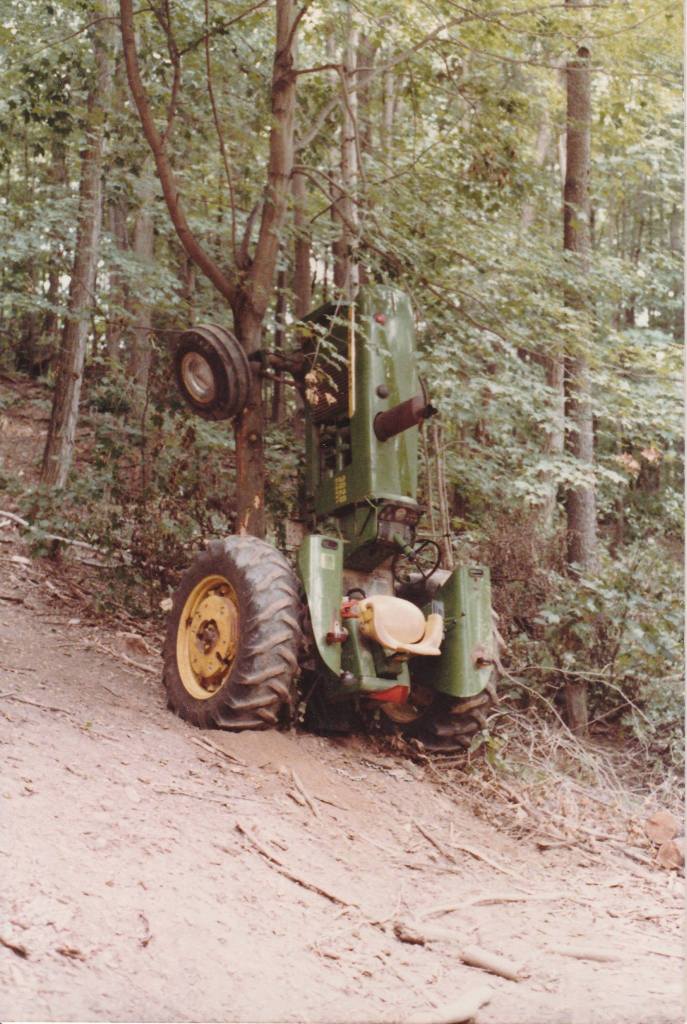
One “one-year-wonder” maintenance guy who thought he knew everything let the John Deere get away from him and he treed it nearly vertical, a hair’s width away from flipping it over backwards and crushing himself to death.

Then, there was the Dodge Power Wagon. Drop that baby into low range and it had power to eat trees and poop potted plants. It had dual wheels in the rear and a hydraulic dump bed that made it the ideal vehicle for bringing milk back from Auburn Dairy, taking loads of trash to the dump, or fetching new canoes from the Grumman factory in Marathon. It had an indestructible clutch and was known to slalom itself through trees in the Highlands. Like, nobody ever noticed? Yeah, right.

Saturdays were made for trips to the town dump. Carter on the kitchen staff loved to swing full garbage bags into the dump bed. It looked exciting enough, other staff would join in and all I had to do was lean on a post and look cool. I’d drive a load to the environmentally sad excuse for a landfill, back up to the edge, and pull the dump lever. Hearing the deposit was like music to my ears. I always will remember the town employee, sitting in his air-conditioned cab, idling his front loader, while looking at porn and sneaking nips of whiskey. He was fired, I’m told, one day when he was so drunk he rolled his loader into the pile.

The Dodge, with its tilt bed, was also useful for staff visits to the Auburn Drive-In Movie Theater on Saturday nights. A bit of bleach and a good scrub down after the dump run and the back of the truck was like new. We’d load it full of mattresses, sleeping bags, snacks, and libations and head out for a well-deserved night out. We’d park in the back row, lift the tilt bed a third of the way, and we had the ideal viewing platform for the larger-than-life movie screen. There was enough room for twenty of us. Many a budding romance began in the back of that Power Wagon.

One Saturday morning, the loading of garbage commenced. Carter looked like an Olympian discus champion. Onlookers and participants began to gather. As I sat back and watched others paint my white picket fence, I noticed one of the new female staff members jogging by, intent on keeping in shape, working up a sweat that was, well, something for me to ogle.

Something stirred. Flittered. You know. Like a prairie dog, I sat up and took notice. A thought like a flash of lightning grabbed my attention. Her name was Cynthia, and she was the new camp nurse.   

The pool this morning was a cool contrast to the heatwave we’ve been experiencing.

I lost count this morning of my laps, which is a rare thing for me to do. Instead of pushing out laps like counting contractions in labor, this morning I was distracted by thoughts of Casowasco and, yesterday, my first Sunday serving two new part time churches in retirement.

Was that three, or four laps?

People were nice, but there wasn’t a familiar face in either group. Everyone welcomed me, the new guy. I don’t feel like I am anything special. Like Lincoln was reported to say, “I can make a brigadier general in five minutes, but its hard to replace a hundred horses.” Forcing myself to be extroverted left me exhausted by the time I returned home.

The people tolerated the new guy. What will keep me coming back, however, is the honesty, is the authenticity, is the genuine love of God and neighbor that I’ve always found in small country churches. What a blessing! What a gift of grace.

The bush hog broke; rather, a blade was bent and needed replacing. My boss, Don, used the front loader to lift it vertical with a chain, giving us access to the naked underside. Smart, I thought. Don really knows what he is doing.

I held steady the giant steel disk on which the blades were attached while Don used a sledgehammer and wedge to pry the disk off the shaft. “You got it?” Don asked me before he gave it another wack. “I got it,” I confirmed as I tightened my grip.

Bam! The disk popped off and dropped to the ground. I was no match; the steel disk probably weighed fifty pounds more than I could lift. Had I been wearing steel toe work shoes, my life would have been radically different, tragic, possibly. The disk landed on top of my foot, split the nail of my big toe, and filled my boot with blood. Don put me in the Dodge and off we sped to the emergency room.

Twelve hours later, I was back at Casowasco, high as a kite on painkillers, my foot wrapped in tape and gauze, in the Nurse’s Quarters trying to make sense of my discharge instructions.  “Let me help you,” Cynthia told me.

“Yes, ma’m.” You can help me all day long!

I spent the next two weeks in her quarters, getting my wound cleaned and dressed, whether I wanted to, or not. I was out on disability, smiling on painkillers, and in the care of the attentive, and very good-looking, camp nurse.

Holy cow was Cynthia ever good to me. Before I could run another load of laundry, we became an item. I have no other explanation, except for God’s wonderful, bountiful, amazing grace. This year, we will be celebrating our fortieth wedding anniversary.

Once I returned back to work, things got a little cool between us. I couldn’t explain why. Perhaps because her dad was a pastor (like my dad) and served the Bishop as the Dean of the Cabinet? Yet, I found Cynthia lovely and gracious, highly intelligent, and personally driven. She had transferred from Ohio Wesleyan to Syracuse University to complete a degree in nursing, which added a whole extra year to her undergraduate. She had more grit than me, I thought to myself. Personally, I liked her pipe smoking dad, her Latin teacher mother (both had served on the Casowasco staff in the 50’s), and her older and younger siblings.

Cynthia’s father, Irving, already had an eye on me. He chaired a conference committee I was on. He ordered a truckload of firewood, which I dutifully delivered and dumped in his back yard in Syracuse. And the staff enjoyed surprising Irv, and his fellow District Superintendents, more than once having a cold one at the Owasco Inn in Moravia after the Bishop had left Casowasco for the night.

During my last year on the Casowasco staff, the summer of 1983, I was headed out for seminary, arriving early for a multi-week orientation for new students. I packed my car and headed for Dayton, Ohio. God was having me turn a new chapter in my life. Little did I know, the one being closed did not include Cynthia. That chapter was just starting to be written. Our relationship, though ebbed and flowed, was just getting started. Thank you, Lord!

15. Casowasco – Captain John and Clergy Shenanigans

John Spooner is a Casowasco legend. Many will remember him from his campfire ukulele strumming silly songs, his waterfront antics, his Venture 21 sailboat, Pegasus, and his wife, Clair, his son, Larry, and daughter, Louise. John was a second-career elementary school teacher from Barea, Ohio.

John’s first career was as a bachelor ship mate on Great Lake freighters, homeported out of Cleveland. He plied their magnificent waters from Duluth to Montreal, learning navigation and weather, lighthouse and reefs like the back of his hand. He recalled to me once that he enjoyed a day in port, showering and air-drying buck naked on the open hold of his ship, just as a tourist boat slowly chugged past, its rail filled with gasping sightseers.

It is unknown to me how Captain John came upon Casowasco, but he was a fixture when I arrived in 1979. It offered him a free dock to berth the Pegasus, and for the small price of teaching sailing on the camps Sunfish and Phantoms, and shifts lifeguarding nippers, the good Captain was free to fix and polish his beloved sailboat. Summers were grand, for John I’m sure, a restorative respite from elementary school life.

Each evening Captain John would join the rest of the summer staff rotating among campfires with his ukulele, singing songs that remain rooted in my memory. “All God’s Critters Got a Place in the Choir.” John was singing and practicing inclusion generations before it was being maligned as woke. “The Big Rock Candy Mountain” was one of my favorites, for it painted a picture of what the kingdom of God would look like, complete with the buzzing of the bees and the bubblegum trees.

His wife Clair, volunteered in the office. Larry, in high school at the time, was the camp Romeo. He was always on the prowl for members of the opposite sex. He was good looking and knew all the best places around camp to sneak away and swap spit. Louise was Cosmopolitan as fully as a teenage girl can be, blow drying her hair and painting here nails before that was a thing. I took her on an Adirondack canoe trip once. She assured us she could live without a blow dryer for a week. When it came time to drive home, she was a long time in the Pizza Hut’s women’s room. She said that she made work each day as she disappeared into the woods with a shovel, but her agony and groans said otherwise.

One evening at dinner, Captain John asked me if I wanted to go sailing that night. “In the dark?” I asked. “It will be perfect,” John assured me. “The moon will be full and the wind is expected to be brisk.” “Sure,” I agreed. This should be fun. It was just John and I tacking Owasco Lake at midnight. Other than red and green running lights, we were sailing like lightning, healed up until both our butts were soaked.

“I got something to show you,” John told me, with a twinkle in his eye. “I’ve been working on this all week.” What could it possibly be, I wondered? John slipped into the cabin and I heard a cassette tape sucked into a player. High on the two stays off the main mast, newly installed Radio Shack speakers came to life. Wagner’s Flight of the Valkyries woke the waves with a hundred decibels of pure exuberance. I stood, as if at attention, and directed the imaginary orchestra like a conductor, sans a wand. Wind and waves, speed and angels, sound and fury expanded my conception of God’s magnificent kingdom and the potential it is waiting to reveal.

Watch. Wait patiently. Expect the movement of the Holy Spirit. Lessons taught to me by Captain John. Thank you, Captain, my Captain.

Lane choice was no choice this morning. The only lane not occupied by two swimmers was lane 6, the outside lane of the aging pool. “Okay, then,” I thought as I slipped on my goggles and began my laps.

Lane 6 is the road less traveled for multiple reasons. At one end, entry stairs crowd the wall. A Hoyer lift held belts and pullies overhead, making for a cramped approach and turn. At the other end is a chrome ladder into the deep end. Catch a hand on that and, yikes! All of which to say, the sandpaper textured edge of the pool ran its length. Careful positioning avoided stubbed toes and jammed fingers, but also distracted my glide induced meditation. When in Rome, they say.

As I pulled my sorry butt and wrinkled body out of the pool, I saw a cue of three waiting for a lane to swim. I was ashamed to think to myself how I was mentally grumbling about swimming lane 6 all to myself while others were waiting just to begin their laps.

I’m not proud of how selfish and shallow I can be. It’s a character defect that I’ve worked a lifetime to perfect, and a lifetime to correct. Some days are better than others. Sigh. Forgive me, Lord.

United Methodist Clergy frequently made their way to Casowasco for meetings, retreats, visits, and to direct one of the many summer camps for children. I practiced this rhythm throughout my pastoral ministry, at times more frequently than others. Driving down to camp has always been like finding respite from the anxieties of the world, a chance to breathe deeply, to claim a bit of serenity, if even for a time before reentry into the storm tossed world.

Other than exposure to my dad, who ended up serving 19 years in the parish before dying young, and, Bob Stoppert, the Director / Manager, my perception of Methodist ministers was they were a bunch of conservative, straight laced, black suit kind of humorless Oxford wing tipped preachers, who wore protective rubbers at the first sight of rain.

I couldn’t have been more wrong.

Harry came to our staff table Sunday afternoon and reported in a booming voice that he needed “two gigantic red balls” for his camp. We about knocked ourselves out laughing so hard. Harry, in his naivety, had no idea why we were all laughing. Another preacher stopped if he saw any of us loafing and told us to give him ten pushups. He was also known to tell my buddy Clint to retrieve a flash light that fell through the hole landing on top of the pile in one of the Highland’s outhouses. Um, no thank you.

Gordon woke his camp every morning at 6 am clad only in a bathing suit and flip flops, blowing a tuba, sans a polished bell. He probably bought it at auction. He also had a habit of driving his boat right onto shore instead of taking a regular mooring like everyone else; fuel leak and scratches be damned. One night Gordon and his wife startled my gal and I down by the waterfront. He was pushing her in a stolen shopping cart on Galilee’s south lawn, testing it out for his camp “M*A*S*H.”

Sam was a socially awkward, lovable pastor, and academic who did his seminary work at the University of Chicago at the foot of Paul Tillich. His boney chicken dance broke the nose of one senior high girl on the south porch. His eye filled with tears over his guilt and remorse. Sam would eat his sugar donuts like a mad man, coving himself in powdered sugar, looking at us staring, asking, “What? What did I do now?”

Les, considered Casowasco a second home, without the taxes. He was frequently there on his day off. He showed up when the Bishop met with his cabinet of District Superintendents when it was appointment season. He could be found sulking in the hedges under a cracked window or outside a door hoping to catch a snippet of information about who was being sent where. As soon as he caught a whiff of information, he’d hit the telephone and get the rumor mill started. Les was a fly fisherman who taught me, along with others, to tie flies and fly fish lake, pond, and stream.

One morning, Les was marching his camp of older elementary campers down to the waterfront for a polar bear swim. We had been building a hip roof on the staff house and the building was draped with ladders and tarps, the grounds with stacks of shingles and pails of nails. As was his practice, Les called his gaggle to halt, threw open the door and began to sing at the top of his lungs, “Good morning to you! Good morning to you! You look kind of sleepy, in fact, you look creepy. Good morning to you!” At 6 am every morning, his camp’s chorus was not welcomed.

We prepared the ambush for his Friday morning arrival the evening before. We filled buckets full of water balloons and hoisted them to the roof. We ran hoses inside the staff house and charged them at the ready. We populated ourselves in the bushes and on the hillside fully ammo-ed up with hundreds of water filled projectiles. As soon as Les flung open the door and took a deep breath we sprung the trap. He was soaked with streams of water. The kids were bombed with water balloons, such they were dancing, laughing, and begging us to take aim for them. It was a slaughter. Everyone loved it. We still talk about it today, nearly fifty years later.

Lessons from a diverse community of Clergy men and women still guide me to this day. “Never fish from your own dock,” one mysteriously told me. He was in his second marriage with six children. “What?” I wondered. “It cost just as much to keep a full tank of gas as an empty one,” my future father-in-law told me before I went on a date. Pastors were a diverse bunch of folks. What I learned was that every one of them had a passion for Christ and a deep reservoir of faith.

Casowasco, where the butterflies fly and the bluebirds sing, at the Big Rock Candy Mountain.

14. Casowasco – Building Community

When the end of June arrived, the four of us guys migrated to the Staff House, now known as Wesley Lodge. Goodbye disgusting shower and the flea infested chemical toilet! We got indoor plumbing! The rest of the staff arrived and moved in. The ratio went from 4:0 to 6:25, men to women. Life was improving.

The prior seven weeks were devoted to getting the property in shape for summer camp. Most evenings, after a long workday and sailing / water skiing, we, few set about the task of building the long anticipated Fourth of July campfire.

Each year boats from around Owasco Lake would gather offshore to gather around our campfire, strategically located where the creek poured into the lake. It appeared to be safely positioned far enough away to keep embers from catching Galilee on fire, our signature Lodge, yet, close enough to the water that we could easily shove it into the lake if things got out of hand.

Dave, lifelong friend and best man at my wedding, was the chain saw guy. I was on the International tractor, using the front loader as an elevated platform and the hitch to drag logs. Clint, another dear friend, drove the dump truck, and climbed to the top of the stack to help Dave place the logs. We might have had one or two helpers, but mostly, it was the three of us.

We seldom found logs suitable for our efforts laying on the ground, so we went about the extensive woods searching for trees to fell and add to our stack. Dave would drop the tree and cut to length the largest logs to fit into the Dodge Power wagon dump bed. Clint would chain me up, first, to skid the logs, then, to attach them to my front loader so I could place them in the truck. The woods we worked could be anywhere between flat level to near vertical. Chains, cables, and winches, Oh my!

We’d take a load to the campfire site down by the lake, dump the load, and begin to lift each log onto the pile. We built a four-sided fire log cabin style, wide at the bottom, tapered to the top. We’d fill the interior with old firewood that had turned punky and couldn’t be used in any of the fireplaces. Our first year, the fire was built to 17 and a half feet tall. My final year, the campfire was built to 35 feet. Galilee was beginning to appear uncomfortably close.

It was not unusual for the coals to be a couple of feet deep and the fire to burn for four or more days afterward. Yes. It was a big campfire. And it got bigger every summer.

Dave, Clint, and I were a team. We worked well together, enjoyed each other’s company, and shared a humorous trait for pulling practical jokes. We pilfered another male staff member’s underwear, put them in zip lock bags, soaked them in beer, and froze them in the staff house freezer! We commandeered a younger clergyman’s canoe one night, hulled it up the dinning hall bell tower, and skewered it five stories high, for him to find the next morning as he came for breakfast. Alan, I’m looking at you. Priceless!

We hauled a sailboat to the reservoir at the camp entrance, placed the lifeguard tower over top the mailbox, and greeted Captain John and his family when they drove in from Ohio to spend the summer on staff. Yes, we were wearing life jackets. The mailman was also duly amused. NY State DOT had the audacity to place a stop sign at the entrance to our road. It made a very nice card table.  

These were but a tiny fraction of the high jinks we took part in while on the summer staff.

One June evening, as the last light of the day was fading and the three of us were dead tired, I was lifting the last of the logs to the top of the stack. Clint and Dave swung a log onto the pile and Dave commenced to cutting the notches to keep it from rolling and solidly in place.

In an absent-minded moment, Dave rested the idling chain saw on his thigh. Yikes! Blood went everywhere. I lowered him with the front loader, Clint threw him into the cab of the truck, and off they raced to the Emergency Room at Auburn Memorial Hospital. Forty plus stitches later, Dave returned a wounded soldier to the sympathy of the female staff. Clint and I just rolled our eyes.

Dave and Clint were joined with other male friends over the years; Rick, Dale, Scott, Larry, Bob, Mark, Carter, and others. Casowasco gave us a connection. Experience gave us strength. God wove us into a tapestry of grace that continues to hold me over four decades later.

Guys will be guys; for which I am thankful.

The pool this morning was calling me by name, gave me my own lane, and provided me with the necessary buoyancy of grace to swim my 15 laps. Other than to count the laps ticking by, it was hard to meditate, to focus my thoughts.

Thoughts of the recent Homeowners Association board meeting were interrupted by yesterday’s FLACRA’s all staff meeting. As the chair of the board, they insisted I be photographed presenting numerous awards to their respected recipients. I’m not that photogenic!

Breaking news, interrupted thoughts, thinking about my recent introduction to members of two small country churches where I agreed to serve part time in retirement. Did they like me? They seemed really nice. Would we come to love each other as a pastor loves their flock? Please, Lord; I hope so.

Most trips to the pool bring calm, clarity, focus. Today, not so much. Yet, I’m thankful and the laps give my muscles a good work out.

Bob called staff meetings each week on Sunday evening. Campers had moved in, parents left (either smiling or crying), and our staff needed to coordinate requests and activities. The craft room needed more supplies. The store was running low on Maple Walnut ice cream. Three campers were allergic to bees and had Epi pens in case they got stung.

Most staff meetings were in Bob and Ruth’s living room. We piled in laying on the floor or draped over the chairs, giving each other back rubs (my, oh, my). We laughed a lot and shared common misery, like tales of Saturday cabin cleaning. A toilet needed unplugged, additional sailboats needed to be brought out of storage, and the dock needed to be leveled (especially on hot days).

The schedule was posted such that a staff member was in attendance at every campfire each evening. We led the singing, guided the devotions, and closed with prayers. Rules were spoken, such as, “no put down phrases,” and “since everyone is new, you have the opportunity to be yourself and create the reputation you want to live with.” Good stuff, right there.

The rest of the staff and I learned how to live in community. How to express our needs. How to listen and respond with empathy. How to communicate, especially with members of the opposite sex. Yes, romances came and went, ebbed and flowed. We support each other and when there was a need, we all pitched in. When there was grief, we all responded with words of comfort and acts of kindness.

Christian community, I learned, is a beautiful thing. It can be found in a local church or an AA meeting just as it can be created and found at summer camp among the staff.

And then, there was Mary Jo.

She was new to the Staff and by this time, I was one of the veterans. My dad was an ordained pastor, appointed by Mary Jo’s father, the resident bishop. A resident bishop in the United Methodist Church has a lot of power, especially over who is sent where to serve which church. Compensation and steeple size matters. Politics and pride were in constant tension with the good-old-boys network. Yeah, back in the day, the bishop and his superintendents were all back-room cigar chomping white male  deal makers.

There are a lot of skeletons in them there closets.

They didn’t get a long. My dad was stubborn, a Don Quixote charging windmills of injustice, destined to short-term pastorates in small rural churches with tiny little steeples. Bishop Yeakel exuded power and authority, looked like he stepped right off a movie set, and was loved by all; except for those who crossed him. He was right at home in the bishop’s chair in are largest cathedrals, wearing his pointy hat and flowing robes.

To say it was chilly between Mary Jo and me would be an understatement.

After so many weeks of the silent treatment, following one Sunday evening staff meeting, Mary Jo pulled me aside, got right into my comfort zone and said, “Look. Your dad doesn’t like my dad. My dad doesn’t like your dad. But. That doesn’t mean we can’t be friends.”

I was stunned by Mary Jo’s stark honesty, her willingness to take risks for the sake of building a social network and our staff community, and her humility to swallow a healthy dose of pride. Yeah. Wow. “You’re right,” I said when the Spirit gave me a shove to break the deafening silence. “I’m willing to give it a try, if you are, too.”

The following day, Don has me using the backhoe to dig the footer for the staff house addition. It had to be straight, squared at the corners, and forty-eight inches deep to get the footer below the frost line. To this day, I still think a backhoe is a thing of beauty. In experienced hands, watching a backhoe work is like watching a maestro conducting an orchestra.

I wasn’t alone. Slightly behind me, my peripheral vision got a glimpse of Mary Jo standing, watching me dig. I turned, smiled, and shut down. “Good morning,” I said as I jumped down. I figured there was no better time like the present to start trying to be a friend. “Whatcha upto?” I asked.

“I always wanted to give that a try,” Mary Jo confessed. “It looks so cool.”

What an opportunity, I thought. “Hop up and let me show you how.” She sat in front of me. My arms wrapped around her and my hands guided her movement on the control levers. It was a little like that movie with the pottery wheel and music, but not really. It was more like two people who God had brought together to become friends.

Later, I was seeking a seminary to attend after I completed college. Mary Jo invited me to visit her in Dayton OH. She was going to be starting her second year at United Theological Seminary. Though accepted and tempted with generous financial packages, I didn’t want to attend where my dad attended (Drew in Madison NJ) or nearby Colgate (Rochester NY). I stayed with Mary Jo and slept on her apartment floor. She gave me the grand tour and introduced me to as many professors as she could find.

I was sold. If it hadn’t been for God working through Mary Jo, my life and call would have gone in entirely different directions.

Thank you, Lord, for the gift of Casowasco, for the people who became such important influences in my life, for lifelong friends, for community, for grace and love, for your call to be an ordained pastor.

13. Casowasco – Don and Bob

Don and Bob’s, now known as Don’s Original, is a hamburger joint in Rochester. Along Ontario’s shore, it has served Seabrease flocks with enough artery clogging fat to keep a cardiac practice printing money like there is no tomorrow. This is not the Don and Bob of today’s memory and reflection of serving on the Casowasco camp staff. Nor is a hometown burger stand about God’s prevenient grace, at least, as far as I can tell.

Don Welles was my boss, the property manager. He was a former dairy farmer from the southern tier, and therefore, an expert in all things construction, land management, McGiver style repair, and Guernsey milk. No one was better at running the John Deere or International tractors, not even by a long shot. Don was married to Beth, who was the food service manager, chief cook, and bottle washer. They had two girls and a dog, lived on site in a house attached to the dinning hall.

Don and Beth followed Court and Margarette Foster, living legends who opened and ran the place since Casowasco was sold by the Case estate to the church in 1948. They transformed the property into a children’s camp and retreat center until Court was tragically shot and killed by the mailman in a hunting accident within a stone’s throw of the hairpin curve. That curve, legend told, was also the location of a fatal sledding accident years ago, and where the morning breakfast driver would stop to stir the eggs before delivery to the Older Elementary camp above, called Mt. Tabor. Haunted hairpin? Who knows.

Four of us college guys on staff showed up in early May the day after the semester came to an end. We cleaned and mowed, repaired everything that broke over the winter … think endless water leaks from a cold winter and miles of plumbing. We got the place in shape before the rest of the staff arrived in Mid-June, followed soon thereafter with nippers (campers) arriving the last week in June.

We were housed in an old trailer with a flea infested chemical toilet and mold encrusted shower for a month and a half. Other than sleep and evening libation, we did not spend much time in that palatial dump. After 5 pm each day we’d water skied if the lake was smooth, or, took out sailboats if the wind was up. Each month we’d burn up 100 gallons of gas skiing until our legs fell off. Our earliest water ski was in March; our latest was in November. If the stars were out, we’d often paddle into the middle of Owasco Lake, lay in the bottom of the canoe, look up and wonder at God’s beautiful cosmos.

Other than a strong back and a willingness to learn, I had no skills. Don had to teach us everything; how to safely run a chainsaw, solder a copper pipe, clear a plugged toilet, patch a roof, and operate a backhoe. His leadership style was old school dairy farmer, wise and strong. He’d tell me what he wanted me to do. If I didn’t know how, he’d tell me, then Don would let me try. If I got it right the first time, great! If I fouled it up, we’d talk about it. He’d show me where I went wrong, then Don would have me try it all over again.

Don was patient and kind. Proper instruction followed by the freedom to try and learn by doing was a lesson well learned. I tried to practice Don’s pedagogy the rest of my life. Thank you, God, for the gift of Don.

Today was the second time back to the lap pool after a nasty case of Mononucleosis. For nine weeks, it kicked my butt, drained every ounce of energy out of my body, squeezed the sweat out of me, and kept me in bed or nodding on my recliner. My older brother, a newly retired primary care physician, told me that in his over 40 years of clinical experience, he never had a patient with Mono of “my advanced age.” Wonderful.

The water was fresh and clean. I glided as before, pushing off, inches above the bottom, centering on the tile rushing past my eyes, gently ascending post resurrection from near mortal illness until breaking surface and reaching for my first pull. The quiet was only broken by my thoughts of Casowasco from 1980 to 1984.

Bob ran the place. His formal title was Director / Manager, but he was so much more. He was an ordained United Methodist pastor (like my father), married to Ruth. They had middle school aged children, Mark and Kim. They lived in the manager’s house mid-way between the hairpin curve and the waterfront.  Bob knew way more than he let on, rarely got riled, and was wholly committed to building a staff and running the finest children’s church camp possible. Safety first, then faith formation took place in a milieu of grace and love.

Bob had an innocent and harmless humorous side about him, reflective of the culture of the day, but would never be spoken today. On days when he’d host interviews of college women to fill staff slots on the waterfront, kitchen, or craft shop, he’d mention it over his usual breakfast bowl of Cheerios. “Interviews today!” He’d announce. Don took Bob’s cue and the four of us guys nodded and grinned. Time to stain the siding outside the office. Let the parade of women commence! As each emerged from their interview, Bob would follow them out, stand near us watching each get into their car to leave. “Pass the bikini test?” He’d ask. Each of us would stare off and use our imagination to color inside the lines. “Yep, she does.” “Good, because I just offered her a job.”

My second year in engineering school was difficult. I lived in a campus apartment with hard partying fraternity members. We were often short of money for groceries and hunger was real. Bob threw the other guys and I a lifeline. Any weekend I wanted to drive the four hours from Clarkson to Casowasco the light would be on and the welcome mat would be rolled out. In exchange for a weekend of cutting and splitting firewood, Bob would load up my car with groceries from the kitchen and fill my tank full of gas. If it wasn’t for Bob’s fatherly love, I wouldn’t have made it through my second year of college.

A number of years later, I found myself newly married (Cynthia was the camp nurse) and just starting my third year of seminary in Dayton, Ohio. We just returned to the married student housing from a job interview and there was Bob sitting on a bench outside our building. “Bob! What are you doing here?” I asked. “I’m in Dayton for church meetings,” he replied, “when I got the call that your father died.”

Grief. Grieving. You get the picture.

Bob sat with us well into the evening, even as other students started dropping by with condolences and green bean casseroles. Sensing the time was waning, Bob pulled out his checkbook and wrote me a blank check. “You and Cindy need to get home for the funeral,” he said. I was stunned. I was completely overwhelmed by this tangible evidence of God’s amazing grace, the ocean in which I swim every day.

Overwhelming grace. Abundant generosity. This is the lesson I learned that day and have attempted to live the rest of my life.

Life is hard. Make it easier for others. Be the grace God calls us to be. Thank you, God, for the gift of Bob and his lessons about abundance and grace.

Bob retired long ago and moved away. News came from the conference office that he suffered declining health and recently died. Though I hadn’t seen him in years, it was like losing a second father. Rest in peace, friend. God loves you, and so do I.


  1. Where I’ve Been – Embracing Change: https://breakingyokes.org/2024/07/30/where-ive-been-embracing-change/
  2. From Whence I Came – Tears of a Birthing Mother: https://breakingyokes.org/2024/08/05/2-from-whence-i-came-tears-of-a-birthing-mother/
  3. Epiclesis: https://breakingyokes.org/2024/08/10/3-epiclesis/
  4. A Smidge of Grey: https://breakingyokes.org/2024/08/14/4-a-smidge-of-grey/
  5. Discipline, Honor, Integrity and Herb Larson: https://breakingyokes.org/2024/08/23/5-discipline-honor-integrity-and-herb-larson/
  6. Dairy Farmers, Bus Drivers, and Don Jordan: https://breakingyokes.org/2024/08/31/6-dairy-farmers-bus-drivers-and-don-jordan/
  7. Advent in August: https://breakingyokes.org/2024/09/07/7-advent-in-august/
  8. Addison and Vernon Lee: https://breakingyokes.org/2024/09/25/8-addison-and-vernon-lee/
  9. Discipline Matters: The Education of Todd Goddard: https://breakingyokes.org/2024/10/07/9-discipline-matters-the-education-of-todd-goddard/
  10. Becoming a Wolverine: https://breakingyokes.org/2024/12/17/10-becoming-a-wolverine/
  11. The Smell of Hoppes: https://breakingyokes.org/2025/03/11/11-the-smell-of-hoppes/
  12. Casowasco – My Beginning: https://breakingyokes.org/2025/03/28/12-casowasco-my-beginning/
  13. Casowasco – Don and Bob: https://breakingyokes.org/2025/05/31/13-casowasco-don-and-bob/

12. Casowasco – My Beginning

God had been moving quietly, subtly, deliberately in my life, beginning with my conception, periodically during my childhood, throughout my public school years. I didn’t see it then, but I see it now. My call to Ordained Ministry began before my call was discerned, characteristic prevenient grace that is rooted deep in the heart of the United Methodist experience. The fingerprints of God’s prevenient grace is written all over the first chapters of my life and development. Did you perceive it as you read through my story?

  1. Where I’ve Been – Embracing Change: https://breakingyokes.org/2024/07/30/where-ive-been-embracing-change/
  2. From Whence I Came – Tears of a Birthing Mother: https://breakingyokes.org/2024/08/05/2-from-whence-i-came-tears-of-a-birthing-mother/
  3. Epiclesis: https://breakingyokes.org/2024/08/10/3-epiclesis/
  4. A Smidge of Grey: https://breakingyokes.org/2024/08/14/4-a-smidge-of-grey/
  5. Discipline, Honor, Integrity and Herb Larson: https://breakingyokes.org/2024/08/23/5-discipline-honor-integrity-and-herb-larson/
  6. Dairy Farmers, Bus Drivers, and Don Jordan: https://breakingyokes.org/2024/08/31/6-dairy-farmers-bus-drivers-and-don-jordan/
  7. Advent in August: https://breakingyokes.org/2024/09/07/7-advent-in-august/
  8. Addison and Vernon Lee: https://breakingyokes.org/2024/09/25/8-addison-and-vernon-lee/
  9. Discipline Matters: The Education of Todd Goddard: https://breakingyokes.org/2024/10/07/9-discipline-matters-the-education-of-todd-goddard/
  10. Becoming a Wolverine: https://breakingyokes.org/2024/12/17/10-becoming-a-wolverine/
  11. The Smell of Hoppes: https://breakingyokes.org/2025/03/11/11-the-smell-of-hoppes/

My experience and perception of discernment is both personal and communal. God called me, pinging me like sonar. Even as a child, my spiritual antenna received the signal loud and clear. However, it took years for me to piece together the evidence that God’s hand was working in and through others at key moments in my life. It took a long time for me to get to an “aha” moment of recognition.

My call to ordained ministry wasn’t random. It wasn’t from out of the blue. Neither was it from a mentally delusional individual. God pumped the dime into the payphone and dialed my number. Over time, God worked through others, a community of disciples, to question me, encourage me, guide me to make choices that were consistent with a disciplined life of an ordained pastor. At first, it was informal. Friends and family. In time, others in the Church dropped hints. At the end of the process, it was the formality of Church polity; confirmation from the local church, the District Committee on Ordained Ministry, the Conference Board of Ordained Ministry, peer elders, and finally, the resident Bishop. My call took place over the first 26 years of my life.

I couldn’t bring myself to the pool this morning. My weekly self-injection 36 hours ago leaves me nauseous and without an appetite. Tomorrow morning I will swim. Reach. Pull. Kick. Push. Glide. Breathe. Uninterrupted silence, space for prayer, meditation, reflection.

Come, Lord. Come quickly.

Casowasco is a property on the shore of Owasco Lake, one of New York’s beautiful Finger Lakes. It is the former summer estate of Theodore Case and his family, an inventor who ran with the likes of George Eastman and Thomas Edison. Case on Owasco is 73 acres of woods, one mile of shoreline, and since 1948, it has served as a host for children and youth ministries operated by the United Methodist Church, as directed in the family’s bequest.

Summer, 1979. I graduated high school and prepared to attend Clarkson as an engineering student. Science and math came naturally to me. I took off two weeks from work to join my dad volunteering at a work camp at Casowasco. Bill Swales was the director. He was my dad’s District Superintendent. He knew of my interests. He was charged with building a solar hot water system for the Highlands, the camping area on the West end of the property. Bill needed a lifeline and he phoned a friend. I answered the call.

Over the course of two weeks I led the team clearing land (think chain saws, shovels, and heavy equipment), building the plumbing (think copper pipes, tin solder, valves, and couplings), and erecting a gravity system to provide hot water. It takes some serious planning and construction to safely locate a 500-gallon water tank eight feet above the floor and enable it to be annually winterized.

The buildout worked like a charm. The property manager, a pastor and Japanese scholar by the name of Bob Stoppert, took notice. He remembered my name. Mid freshman year Bob gave me a call and invited me to join his 1980 summer staff.

Confidence. Fleeting in adolescence, confidence is panned for like specks of gold. As it is discovered, developed, and amassed, it becomes a solid foundation for a fruitful life. Where is confidence found? In a phone call. Words of appreciation. Recognition of a strong work ethic. A twinkle in the eye; evidence of God’s greater will being lived out on stage and in the spotlight called youth.

What little confidence I gained in those two weeks at Casowasco would be shaken with a difficult freshman year at college. Everyone was way smarter than me. Alcohol and marijuana were as destructive to me as an unexploded time bomb. Fraternity life was a distraction and grades suffered. Developmentally, I wasn’t ready. It would take me an additional four years before I was truly prepared to grow up and move out to live independently. The summer of 1980 couldn’t come fast enough.

Move in day was as early in May as college let out. Maintenance staff were needed early to get the property ready for the first week of nippers, er, campers, as we called them. I went straight to Casowasco to open the next chapter in my call to ministry and life’s unfolding book.