“‘If’ – His Most Important Challenge”

Matthew 16:21-28

September 3, 2023

The Rev. Todd R. Goddard, Pastor

Rush United Methodist Church

Matthew 16:21-28

From that time on, Jesus began to show his disciples that he must go to Jerusalem and undergo great suffering at the hands of the elders and chief priests and scribes, and be killed, and on the third day be raised. And Peter took him aside and began to rebuke him, saying, “God forbid it, Lord! This must never happen to you.” But he turned and said to Peter, “Get behind me, Satan! You are a stumbling block to me; for you are setting your mind not on divine things but on human things.”

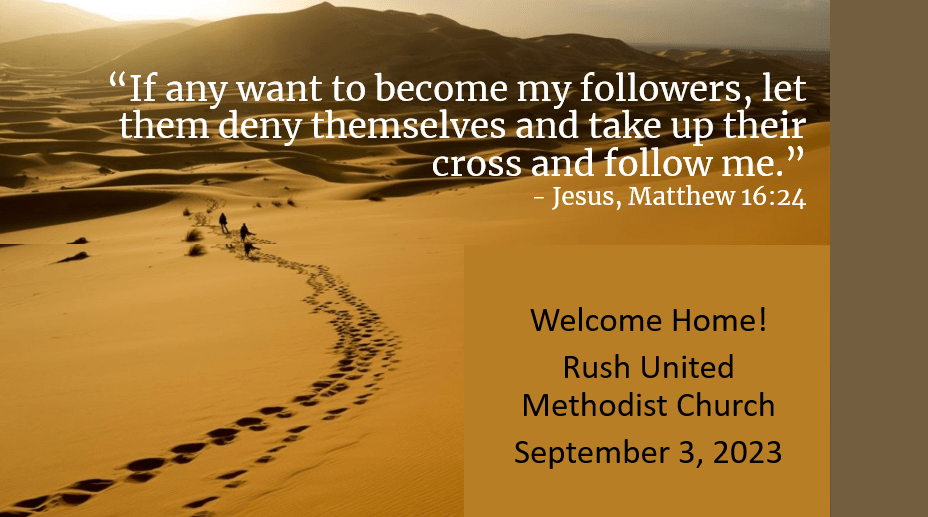
Then Jesus told his disciples, “If any want to become my followers, let them deny themselves and take up their cross and follow me. For those who want to save their life will lose it, and those who lose their life for my sake will find it. For what will it profit them if they gain the whole world but forfeit their life? Or what will they give in return for their life? “For the Son of Man is to come with his angels in the glory of his Father, and then he will repay everyone for what has been done. Truly I tell you, there are some standing here who will not taste death before they see the Son of Man coming in his kingdom.”

| Centering Prayer |

“Messiah, the Son of the living God,” Peter had correctly identified Jesus.

More than the son of Mary,

The boy from Nazareth,

The healer, miracle worker, and preacher

From up north

Who attracted great crowds of followers, imitators, and want-a-bees.

Flanked by idols to the Greek god Pan, and

The Philistine god, Baal, on his left,

With the ominous cave opening, on his right,

Believed by the population as being

the literal gate to hell,

Jesus advances to the next slide of his orientation curriculum

What it means to self-identify as messiah.

Messiah, classically defined,

the anointed leader, savior, deliverer of the Jewish nation

as prophesied in scripture.

Jewish descendant. Jesus checks that box.

Anointed with holy oil. Jesus checks that box in Matthew 26.

King of God’s Kingdom. Jesus, Son of the Father, next in line of succession. Check that box.

Ruler of God’s Kingdom during the messianic age,

An era of universal peace and brotherhood,

With an absence of evil.

Every one of his 12 disciples expected Jesus to check that box, too.

In the mind of Peter and fellow Jews

Danced the sugar-plum vision of Jesus ruling the messianic age;

Swords beaten into plowshares,

Wolf and lamb, natural predator and prey, living in peaceful harmony,

With the earth full of the knowledge of the Lord. (Isaiah 11:6-9)

Except, Jesus didn’t check that box.

Jesus had other plans.

What could be more important then

God solving their immediate problems?

Come on, God. Show your stuff.

Send your Son.

We will make him King.

Remove Rome.

And all will live happily ever after.

Lesson #1.

Avoid thinking small.

Yes. Your life,

Your social circle,

Your bubble,

The weather, your garden, the start of the new school year, the state of local politics,

Your reality, the good, bad, and ugly,

Are important to Jesus.

Yet, Jesus wants us to think bigger,

Bigger than human things.

Life, death, and eternity is greater than just you and me and that slow driver plugging up traffic by lingering in the left hand lane.

Christianity cannot be self-centered, Jesus is telling his disciples this morning.

Peter, you, and me fall down the bottomless hole of human things,

While, Jesus has his eye on divine things.

Personal salvation is wonderful

Until eyes are opened to the world burning.

Forgiveness of sins is great

Until pardon is withheld and amends fall on deaf ears.

Why fix and repair

When the same old wrong

Works so well to perpetuate and personify all that sucks in my life?

I can assign blame to everyone and everything bad in this world

Without ever lifting a finger of personal responsibility,

Because Jesus forgave my sins and I’m saved.

There are few greater criticisms of Christianity

That self-righteous, self-centered Christians.

With an eye on divine things,

Jesus is frying other fish.

Jesus wasn’t constrained by his small group,

Anchored to a temporal time and space,

Tethered to personal forgiveness and salvation.

Jesus was looking to the cross

While the world was looking for the crown.

Lesson #2.

Jesus was focused on divine things,

Facing the cross of crucifixion;

Soo, too, should we.

The cross of Jesus Christ

Transcends time and space,

Is God’s gift of grace to all people, nations, races, cultures,

Spanning all time; that which was, that which is, and that will be.

Fixing the stain of sin becomes the necessary prerequisite for the empty tomb and eternal life.

You can’t get there

Without first going through here.

Before you get to St. Peter

Make certain you are shaved, showered, and put on your Sunday best.

Temptation is to avoid Good Friday

And just show up for Easter sunrise,

Treating the passion of Christ

With antiseptic and a clean bandage.

Lesson #3.

Being a Jesus follower isn’t for sissies.

The very one to whom Jesus had just given the keys to the Church

Jesus calls out Peter for thinking “crown”

When he should have been thinking “cross.”

“Get behind me, Satan!

You are a stumbling block to me;

For you are setting your mind not on divine things but on human things.” (16:23)

As if a punch in the face and a bloody nose isn’t enough,

Jesus shares his expectation

That everyone who follows him

Should be expected to take a knockout punch.

The great “if” clause of the

“if/then” function

Becomes Christ’s most important challenge.

To be

Followers of Jesus

Requires

Denial,

A readiness to die,

A willingness to follow.

Denial.

A complete surrender of self.

Letting go of all control, ego, and pride.

A recognition that control is a mere illusion,

That all power is the exclusive domain of God.

Self-denial

Is best illustrated in our lesson from Romans (12:9-21)

Love.

Hold fast.

Serve.

Rejoice.

Be patient.

Persevere.

Contribute.

Extend hospitality.

Bless.

Live in harmony.

Feed the hungry,

Give drink to the thirsty.

Overcome evil with good.

Every quality implies a denial of self and the promotion of others.                                                    

A readiness to die.

There is an empty cross with your name on it.

There is one for me, too.

When eternal life is on the table

Why would any of us engage in a struggle to save our own life?

Live everyday prepared to die,

Is the sage advice of the Apostle Paul.

“For to me,” he writes to the church in Philippi,

“to live is Christ and to die is gain.” (Philippians 1:21)

“Follow me,” Jesus extends the invitation. (16:24)

Only after submission and sacrifice is one ready to follow Jesus.

If you want to know where Jesus goes and what Jesus does,

The follower needs to know Jesus inside and out.

Matthew, Mark, Luke, and John.

The Gospels

Report the Truth about Jesus Christ.

Learn from them.

Write them upon your heart.

What Jesus and his followers believed

Is found in Hebrew scriptures,

Which we call the Old Testament.

It establishes a foundation

Of God’s power and creation,

God’s love and covenant,

God’s desire and law.

To know Jesus means that one must know Adam, Moses, Abraham, the prophets, and the Psalmists.

What happened to the world

Because of God’s great loving gift of Jesus

Is recorded in the Acts of the Apostles through the book of Revelation.

We call it the New Testament.

The world was, and is, forever transformed,

Transfigured into a likeness of Christ,

The Body of Christ,

His Church

As it began to live out the call to discipleship.

To know Jesus

And to know of God’s great transformation

Is to be able to find ourselves in this transformation

And to make productive contributions

To its fulfillment.

Denial.

Willingness to die.

Follow. Faithfully following Jesus.

Yeah, discipleship isn’t easy;

But it is worth it.

Beloved,

Think big.

Think outside the box.

Forget the crown. Focus your eyes on crucifixion.

Seek and discover the divine things emerging around you.

Surrender, the Kinks sang.

Unlike their lyrics,

Jesus urges those who choose to follow

To give themselves away.

To be willing to even give away the precious gift of life.

For when God holds the gift of eternal life in hand,

What does it matter?

Surrender.

Take up your cross.

Know Jesus.

Follow his example.

Adhere to his lessons.

Some will find it easier than others.

Some will taste death before seeing Christ return.

Others will be blessed to bask in his glory.

Amen.

“Who Do You Say I Am?”

Matthew 16:13-20

August 27, 2023

The Rev. Todd R. Goddard, Pastor

Rush United Methodist Church

Matthew 16:13-20

Now when Jesus came into the district of Caesarea Philippi, he asked his disciples, “Who do people say that the Son of Man is?”

And they said, “Some say John the Baptist, but others Elijah, and still others Jeremiah or one of the prophets.”

He said to them, “But who do you say that I am?”  

Simon Peter answered, “You are the Messiah, the Son of the living God.”

And Jesus answered him, “Blessed are you, Simon son of Jonah! For flesh and blood has not revealed this to you, but my Father in heaven. And I tell you, you are Peter, and on this rock I will build my church, and the gates of Hades will not prevail against it. I will give you the keys of the kingdom of heaven, and whatever you bind on earth will be bound in heaven, and whatever you loose on earth will be loosed in heaven.”

Then he sternly ordered the disciples not to tell anyone that he was the Messiah.

| Centering Prayer |

Fresh out of seminary

I was too wet behind the ears

To be able to distinguish the difference between

Caesarea Philippi and Caesarea Martima.

Can you?

Using Tiberius on the Sea of Galilee in northern Israel as a navigational anchor,

Caesarea Martima is 51.4 miles southwest of Tiberius,

A coastal Roman capital on the Mediterranean.

Warm, sandy beaches with a protected port fed by a massive Roman aqueduct,

Caesarea Martima was a place of trade, commerce, military might, and Roman power.

Pontious Pilate called it home.

In contrast,

Caesarea Philippi is 46.7 miles due north of Tiberius.

It was a cool mountainous outpost at the base of Mt. Hermon,

Noted as the spring water source of the Jordan River.

Caesarea Philippi was deep in gentile country.

Caesarea Philippi was the nexus of Baal idol worship and allegiance to Greek gods and myth.

At this location the first king of Israel, Jeroboam,

Led the northern kingdom into idolatry.

Flanking the grottos where Jesus taught

Were rock carvings and statutes

Of Baal, Pan, and what was believed to be the pagan gate of Hades.

For the observant Jew

Caesarea Philippi was where the devil did his work.

The only thing in common was the name Caesarea;

An ominous homage to where true power lay;

Before the throne of Caesar,

Emperor of Rome.

Jesus brings his disciples on retreat.

Today’s gospel is a lesson in leadership development,

Taught from the heart of darkness.

Jesus had recruited his disciples,

Students who he demonstrated his divine powers of

Healing the sick, cleansing a person with leprosy, casting out demons, fixing a withered hand.

Jesus had taught his disciples in beatitude and parable,

What it meant to live a life of blessings,

To bring salt and light to a bland, dark world,

Filled with sorrow and sin.

Jesus taught

To temper anger and a prohibition on divorce,

To love enemies, to be charitable to the poor, and to pray without ceasing.  

He taught them to sow seeds, harvest fruit, and to remove and burn weeds

As a sign and symbol for disciple making.

Jesus had demonstrated to his disciples

The awesome, unlimited power of God,

Stilling a raging storm, walking on water, and feeding four thousand with seven loaves and a few small fish. (15:14)

Jesus had also warned his new disciples,

“Do not think that I have come to bring peace to the earth,”

Jesus warned with messianic overtones,

“I have not come to bring peace, but a sword!” (10:34)

Jesus turns and asks the group,

“Who do people say I am?”

The bland as milk toast

group of non-committal disciples

lowered their eyes,

kicked some dirt,

and responded with the safe answer.

“Some say John the Baptist, but others Elijah, and still others Jeremiah or one of the prophets.” (16:14)

John the Baptist: dead.

Elijah: dead.

Jeremiah: dead.

Jesus was no more the resurrection of a dead prophet

Then he is the resurrection of George Washington.

Which brings us to the first lesson for today.

1. When it comes to your relationship with Jesus, don’t play it safe.

Token, semi-annual appearances at worship

Is no substitute for a living, breathing, growing relationship with Jesus Christ.

Christmas Eve and Easter appearances may appease the family

But reflect a hope that is built on nothing less than sinking sand.

When it comes to Jesus, don’t play it safe.

The Church is not an organization to financially support,

a building to be repaired,

a politic to be mastered,

or a ladder for the ambitious to climb.

Work, without faith, is dead;

Just as dead as John the Baptist, Elijah, Jeremiah, and the other prophets.

Jesus narrows the search

From “who do people say the Son of Man is?”

To looking Peter in the eye, asking,

“who do you say that I am.”

Messiah! Peter, boldly proclaims,

Making reference to

Not bringing peace,

But the sword he had armed himself with

In anticipation of the messianic apocalyptical consummation of history and time.

You are the

Son of the living God!

Peter, correctly contrast

The living, breathing Jesus

Standing surrounded by all things idols and pagans

Beside the very entrance to what was believed to be the gates of hell.

2. Which brings us to the second point in today’s gospel:

When it comes to Jesus, go big or go home!

Bold is the faith of Christ’s true disciples;

Fearing none,

Every thread of embarrassment or self-doubt squared away.

Timid is the faith of chaff

That is gathered, cast out into the darkness, and burned in the fire.

Make bold your faith!

Say is loud.

Say it proud.

Shout it from a mountain top that all the world might know:

Jesus is Messiah,

Our Savior,

From sin to salvation,

From life to eternal life,

From the dust of mortality to immortality.

Messiah has come!

We need not wait for another.

Jesus breaks with the synagogue down the street.

Jesus become the one who will endure

“and the gates of Hades will not prevail against it.” (16:18)

We have a winner!

Jesus is Son of the living God,

Alive, at work

In your life and mine.

Deny his presence and will

at your own risk.

Accept the reality of Christ for your benefit, and for mine.

It is as if Peter wells in song:

“Christ is alive, and goes before us

to show and share what love can do.

This is a day of new beginnings;

our God is making all things new.”

(Words by Brian Wren, “This Is a Day of New Beginnings”, UMH# 383, v.4)

….

“Blessed are you, Simon, son of Jonah!

For flesh and blood has not revealed this to you,

but my Father in heaven.” (16:17)

Simon Peter hadn’t heard it on the grapevine.

It wasn’t sent out in a Rush Tidings, printed in Our Faithful Followers, or printed in the bulletin.

He didn’t read it in the Democrat and Chronicle or the Hometown Sentinel.

Peter listened for,

Paid attention to,

The revelation of God.

3. Which brings us to the third lesson for today.

Be silent.

Watch.

Listen.

Discern

The words and will of God.

Be patient.

Wait for the Lord.

Scripture tells us no less than fifteen times to

Wait for the Lord.

Blessed is the one,

Earlier the subjects of the Beatitudes,

Here, Blessed is Simon Peter,

Who faithfully reported the Good News given to him

From Our Father, who art in heaven.

How often do I jump to conclusions?

Conclude without facts, and leap to judgment?

How often do I make assumptions?

Draw correlations without first listening for the voice of God?

How often do I ignore all warning signs from God, and

make decisions without first considering the unintended consequences of my actions?

Wait for the Lord.

Why?

Because the Lord is ready and willing to speak

To those who are willing to listen.

Ah, Simon Peter,

The follower,

Destined to deny,

Is transformed into rock,

A solid foundation upon which

Christ will build his church.

Which brings us to point number four.

4. If Jesus could use Peter to build the Church, imaging what Christ can do with you.

Peter: blue collar, common fisherman.

Peter: a bone-headed, open mouth, insert foot kind of guy.

Peter: Three times a liar – I don’t know him. I’ve never seen him. I’ve never followed him.

Peter: Three times the penitent groveller. Yes, Lord. You know I love you. Yes, Lord. I love you. Yes, Lord. I love you.

Peter: Barbequed and martyred by the hand of Nero, crucified upside down, set afire.

If there was room at the table for Peter,

There is room for you.

If there is room at the table for me, I assure you,

There is room for you.

Christ can take the most beaten down, beaten up, shot to … smithereens

Body, mind, or spirit,

And use you as a foundation for the building of his church.

This is why we have no throw-aways, cast-offs, or cast-aways in the church.

If Jesus can use Peter,

Jesus can use you.

To Simon Peter,

Jesus gives the keys of the kingdom of heaven.

Not everyone gets a set of keys;

Only Peter

The rock,

The foundation of the Church

Upon which Jesus builds,

And builds,

And builds.

To Peter

And to his anointed, ordained called to follow in his footsteps,

Is given the responsibility of stewardship of the Church,

To bind and to loose,

Decisions that transcend the boundaries of earth and heaven.

Which brings us to the fifth and final point in today’s gospel:

5. Respect and support the chosen.

The yoke born by bishops, presbyters, elders, and deacons is heavy and leads to the cross.

“Bind” and “loose” were common to Jewish legal phraseology

Meaning to declare something forbidden or to declare it allowed.

A key is used to lock or unlock a door.

The key given to me at my ordination is used to open the door to Christ’s forgiveness and redemption to people broken by sin and evil.

An open door shows the way to the cross of Jesus Christ.

That same key given to me

is used to open the door of salvation

To invite the world to enter.

Beloved, step from your grave

And into the light of eternal life.

That same key

Locks the door

Providing protection to the church

From wolves who seek to destroy everything which Christ has built.

Heavy is this responsibility.

Heavier still is this responsibility

As I discern and consider the call of the next generation of

Called and ordained clergy of tomorrow’s Church.

What does this interaction

Between Jesus and Peter mean to us today?

1. When it comes to your relationship with Jesus, don’t play it safe. Spice it up and be bold!

2. When it comes to witnessing for Jesus, go big or go home!

3. At the same time learn patience. Be silent. Be patient. Wait. Watch. Listen. See. Discern the words and will of God.

4. Imagine what Christ can do with you and through you.

5. Respect and support the chosen. Our job is to protect the Church;

to open the door to Jesus Christ;

and to invite you to accept his grace of forgiveness, redemption, and salvation.

Amen

“Great Is Your Faith”

Matthew 15:10-28

August 20, 2023

the Rev. Todd R. Goddard, Pastor

Rush United Methodist Church

Matthew 15:10-28

Then he called the crowd to him and said to them, “Listen and understand: it is not what goes into the mouth that defiles a person, but it is what comes out of the mouth that defiles.”

Then the disciples approached and said to him, “Do you know that the Pharisees took offense when they heard what you said?”

He answered, “Every plant that my heavenly Father has not planted will be uprooted. Let them alone; they are blind guides of the blind. And if one blind person guides another, both will fall into a pit.”

But Peter said to him, “Explain this parable to us.”

Then he said, “Are you also still without understanding? Do you not see that whatever goes into the mouth enters the stomach, and goes out into the sewer? But what comes out of the mouth proceeds from the heart, and this is what defiles. For out of the heart come evil intentions, murder, adultery, fornication, theft, false witness, slander. These are what defile a person, but to eat with unwashed hands does not defile.”

Jesus left that place and went away to the district of Tyre and Sidon.

Just then a Canaanite woman from that region came out and started shouting, “Have mercy on me, Lord, Son of David; my daughter is tormented by a demon.”

But he did not answer her at all.

And his disciples came and urged him, saying, “Send her away, for she keeps shouting after us.”

He answered, “I was sent only to the lost sheep of the house of Israel.”

But she came and knelt before him, saying, “Lord, help me.”

He answered, “It is not fair to take the children’s food and throw it to the dogs.”

She said, “Yes, Lord, yet even the dogs eat the crumbs that fall from their masters’ table.”

Then Jesus answered her, “Woman, great is your faith! Let it be done for you as you wish.”

And her daughter was healed instantly.

| Centering Prayer |

Our Gospel lesson for this morning is quite remarkable.

It flies in the face of over a thousand years of Church doctrine.

It is this very inconsistency,

between the Biblical Word and Church doctrine,

that makes us squirm uncomfortably in our seats

when we experience the fullness of this passage

spoken and left to hang in our midst.

The fourth verse of the hymn, “Jesus Is All the World to Me”

helps define the issue.

It goes,

“Jesus is all the world to me, I want no better friend; I trust him now, I’ll trust him when life’s fleeting days shall end …” (Will Thompson, 1904, The United Methodist Hymnal, No. 469).

Our trust in Jesus doesn’t waver,

and it shouldn’t.

Our trust in Jesus is predicated upon the assumption

that Jesus never changes.

Jesus is the constant

in our relationship with the Divine.

That unchanging nature of Jesus brings us comfort, at times.

Though life might toss you about

and lead you down numerous valleys of the shadow of death,

the one thing that remains constant is Christ.

If all else fails us in life,

at least the one thing we can count on

is that Jesus will remain the same.

He is the same today as He was yesterday,

as He will be tomorrow.

The Jesus we received as a child,

is the same Jesus

that I will leave with my children.

Of this we are assured!

This unchanging nature of Christ

sent me rummaging through my old textbooks from seminary.

I searched the tried and true systematic theology

titled “Principles of Christian Theology,”

by John Macquarrie.

In his section The Person of Jesus Christ,

I found what I was after.

He writes

“The core of traditional Christology is, of course, the two-nature doctrine of the Chalcedonian definition, which speaks of one and the same Christ, Son, Lord, Only-begotten, recognized in two natures, without confusion, without change, without division, without separation;  the distinction of nature being in no way annulled by the union, but rather the characteristics of each nature being preserved and coming together to form one person and subsistence, not as parted or separated into two person, but one and the same Son and Only-begotten God the Word, Lord Jesus Christ.”

(Macquarrie, J., Principles of Christian Theology, Charles Scribner’s Sons, New York, 1966. p. 273)

There you have it.

Since The Fourth Ecumenical Council of Chalcedon

held in 451 AD,

the new orthodox doctrine has been laid down.

We believe in the unchanging nature of Jesus,

and have been doing so for the past 1,500 years.

A thousand years after the Council of Chalcedon,

Martin Luther, the Protestant reformer

penned the descriptive hymn “Ein’ Feste Burg”

or “A Mighty Fortress Is Our God.”

Listen to his second verse

“Did we in our own strength confide, our striving would be losing, were not the right man on our side, the man of God’s own choosing. Dost ask who that may be? Christ Jesus, it is he; Lord Sabaoth, his name, from age to age the same, and he must win the battle.” (United Methodist Hymnal, #110)

Apparently Luther intended to bring this doctrine

of the unchanging nature of Christ with him

to the newly reformed protestant church.

A hundred and fifty years later,

a contemporary of John Wesley, Isaac Watts,

certainly reflected on the psalmist

when he wrote the 4th verse of “O God, Our Help in Ages Past”

A thousand ages in thy sight, are like an evening gone; short as the watch that ends the night, before the rising son.” (United Methodist Hymnal, #117)

The Psalmist wrote in the 90th Psalm,

“For a thousand years in thy sight are but as yesterday when it is past, and as a watch in the night.” (Psalm 90:4 KJV).

It certainly doesn’t appear to be much change over time

in the nature of God.

Three hundred years after Luther

and a hundred-fifty after Isaac Watts,

a minister in the Free Church of Scotland,

Walter Chalmers Smith,

wrote in 1867 these well-known verses to our favorite hymn:

Immortal, invisible, God only wise, in light inaccessible hid from our eyes, most blessed, most glorious, the Ancient of Days, almighty, victorious, thy great name we praise.” (United Methodist Hymnal, #103)

This hymn is likely to be sung and affirmed

in any Christian church today.

Romans Catholics,

Eastern Orthodox,

and we Protestants alike –

all affirm

the unchanging, unmoving, immortal, invisible

nature of Jesus Christ.

As I look back at the history and development

of United Methodist doctrine,

I find in The Book of Discipline, Article II,

in the Doctrinal Standards of the Methodist Church to read:

“The Son, who is the word of the Father, the very and eternal God, of one substance with the Father, took man’s nature in the womb of the blessed Virgin; so that two whole and perfect natures, that is to say, the Godhead and Manhood, were joined together in one person, never to be divided; … “ (The Book of Discipline of the United Methodist Church 2004, P.103, pg. 60)

With this preamble

about the unchanging nature of Jesus Christ,

we are confronted this morning with Jesus,

who, when confronted by a desperate mother –

pleading for his mercy on behalf of her demon possessed daughter,

tells her “I was sent only to the lost sheep of the house of Israel.” (Matthew 15:24).

Jesus! that is cold!

Jesus is the one who left Jewish territory,

Invading this woman’s world.

Furthermore, this Canaanite woman,

An unclean outsider,

Demonstrates she has a better grasp of Jesus’ identity

Then his hand-selected disciples.

(With thanks to Carla Works, Professor of New Testament, Wesley Theological Seminary, Washington DC, as found at Working Preacher dot org)

This woman is persistent.

Note to self: persistence pays off,

when it comes to faith.

Be persistent.

She bites and doesn’t let go.

She comes back a second time,

kneeling at the feet of Jesus, pleading

“‘Lord, help me.’

He answered, “It is not fair to take the children’s food and throw it to the dogs.” (Matthew 15:25-26).

I may have done a lot of foolish things in my life,

but I have never in public

compared a parishioner to a dog.

But, there you have it

– if you want it that way –

the unchanging,

stubborn,

Pennsylvania Dutch nature of Jesus Christ,

laid right out before us

for all the world to see.

It fits the doctrine perfectly.

Knowing what I know,

having my background, experience and theological education,

if the story ended here,

I would have to cash in my credentials

as a baptized disciple of Christ and leave the church.

If I had to fall in and adhere lock-step

to an incomplete doctrine like this,

I would have never been able to take

that one additional step and responsibility of faith

– I would have never gone to the extra effort to developing

a personal relationship with Jesus Christ.

He would continue to be

a name in a book,

a principle in a text,

a bullet point in a lecture.

But Jesus is more.

I know Jesus Christ as a personal Lord and Savior,

just as much as I know him as the savior of the world.

Jesus, in my life, and in my experience,

is always changing.

He changes in response to the faith

I’m working, churning, growing.

The woman,

wells up in faith and confidence and says,

“Yes, Lord, yet even the dogs eat the crumbs that fall from their masters’ table.”(Matthew 15:27).

And I say, “yea! You go girl!”

Jesus would either change and embrace faith as it is brought to him,

or he would walk away unmoved.

It was his call;

his choice to make.

Jesus answered her,

“Woman, great is your faith! Let it be done for you as you wish.”

And her daughter was healed instantly. (Matthew 15:28)

I follow Jesus because

I know he moves and changes, develops, and grows.

If he were an unmoving, unchanging, uninvolved stone,

he could be replaced with

just about any other rock, idol, or fad that pass through life.

Jesus changes;

Meets me where I am,

Meets you where you are, too.

In fact, Jesus is so moved,

so involved in your life and mine,

that he responds to the human condition of sin.

He moves to bring forgiveness to repenting believers.

He allows himself to die upon a cross,

as a ransom payment,

for our trespasses.

And he makes one addition move,

in response to the mortal nature of humankind;

Jesus gives to us the gift of eternal life

by means of his resurrection from the grave.

Throughout Jesus’ life, he is moving.

He is responds to pleads of faith,

to a woman who falls at his feet begging for her demon possessed daughter,

to an unclean woman who reaches out to touch his garment,

to a woman drawing water from a well,

to a father whose child has died,

to two friends in mourning,

whose brother had died and laid three days cold in a tomb.

It is this nature of Jesus

– a God who responds with compassion and grace

to the desperate pleads of God’s people.

It is the grace of Jesus Christ that makes me his disciple.

It is the grace of Jesus Christ that makes him

a moving, changing, relational forgiver of sins, and savior of souls.

It is the grace of Jesus Christ

that comes to you today

in the form of an invitation,

to bring your life before him,

to kneel next to the mother in today’s Gospel, and plead,

“Accept me, Jesus. Accept even me.”

This amazing grace of Jesus Christ,

to forgive sins of sinners like us,

and to save wretched mortals like us,

is built on a solid foundation,

an absolute

which the doctrines of the Church

make every attempt to establish and reveal, and that is this:

The only thing unchanging about the nature of God

is God’s unchanging love for us.

The love of God for you,

His child is unending, unchanging, and without limits.

That’s what is unchanging about Jesus Christ.

The apostle Paul assures us

there is nothing that can separate anyone from the love of Christ.

Nothing; period.

In many ways,

I find I’m like that stubborn woman kneeling before Jesus,

refusing to take no for an answer.

That persistent faith is what opened the heart of Christ,

releasing the floodgates of grace.

Like that woman, join with me.

Lay your life before Jesus.

And don’t take no for an answer, either.

Dearly beloved, that persistent faith will save you, too.

Amen.

“Meatball, Line-Up, Angle of Attack”

August 13, 2023

Matthew 14:22-33

The Rev. Todd R. Goddard, Pastor

Rush United Methodist Church

Matthew 14:22-33

Immediately he made the disciples get into the boat and go on ahead to the other side, while he dismissed the crowds. And after he had dismissed the crowds, he went up the mountain by himself to pray. When evening came, he was there alone, but by this time the boat, battered by the waves, was far from the land, for the wind was against them. And early in the morning he came walking toward them on the sea. 

But when the disciples saw him walking on the sea, they were terrified, saying, “It is a ghost!” And they cried out in fear. 

But immediately Jesus spoke to them and said, “Take heart, it is I; do not be afraid.” 

Peter answered him, “Lord, if it is you, command me to come to you on the water.” 

He said, “Come.”

So Peter got out of the boat, started walking on the water, and came toward Jesus. But when he noticed the strong wind, he became frightened, and beginning to sink, he cried out, “Lord, save me!”

Jesus immediately reached out his hand and caught him, saying to him, “You of little faith, why did you doubt?” 

When they got into the boat, the wind ceased. And those in the boat worshiped him, saying, “Truly you are the Son of God.”

| Centering Prayer |

Did Jesus know where the stones were?

Did Peter get lucky?

Stepping on a few stones by chance,

But inevitably missing a step and start to sink?

Sounds like an old Rabbi, Priest, and Minister joke.

When I used to lead junior high fishing camp,

I would often be teased by campers

To get out of the boat, walk to shore, and return with something cold to drink.

Walking on water?

Sorry, folks. I missed that class in seminary.

Did Jesus know the weather forecast?

He sent the disciples out on a boat for a simple night crossing of the Galilee.

“Red sky in the morning, sailor’s warning;

Red sky at night, sailor’s delight,” my mother always used to say.

I’m thinking the disciples willingly got into the boat that evening

Because the lake was calm

And there was a glorious sunset.

It seams that while Jesus was great at weather control,

On this day, his weather forecasting was … below average.

As a pastor who always gets blamed for poor weather

And praised for good weather

“because I have a link to the man upstairs” wink, wink, nod, nod

I feel like I’ve been vindicated and somewhat relieved of my duty

To forecast the weather for your future special event.

Sorry folks, I missed that class in seminary, too.

While I may have missed those classes on walking on water and weather forecasting,

I have experienced numerous occasions

Where the presence and power of God has

Worked miracles in and through my obedient hands.

When I traveled to Galilee twelve years ago,

While on a boat floating in the middle of the Sea of Galilee

In a stiff wind, choppy surf, and overcast sky

I read the similar passage from Matthew 8

Where Jesus stills the storm.

I cried out “Be still!” exactly as I imagined

Jesus would have commanded.

God as my witness,

Together with about 40 pilgrims in my group,

The wind stopped, the lake smoothed, and sunshine peeked through the clouds.

Now that, my friends, is the power and presence of an omnipotent God.

Fundamentally, our Gospel for this morning

Is about how the presence and power of God is able to save

One person

And a whole community

From death

Into life … eternal.

Allow me, for a moment, to notice some of the gems in our scripture.

1. First, about the presence of God:

This is the first time the disciples are sent forth without Jesus.

Jesus is Emmanuel – “God with us”

Yet, at the same time,

Jesus made the disciples get into the boat

And go on ahead to the other side

While he dismissed the crowds and he retreats

Up the mountain to pray.

Nice vantage point, don’t you think?

Apparently, Jesus sends his disciples out

But watches them closely.

They are not allowed to get so far away

That he can’t immediately intervene, if necessary.

That is a nice metaphor for us today:

We never get too far away from Jesus

That he can’t immediately intervene in our lives, if necessary.

Our Gospel for this morning

Is about how the presence and power of God

Watches over us,

Cares for our wellbeing, and

Is able to save

One person

And a whole community

From death

Into life.

2. Secondly, it is hard to experience our Gospel for this morning

Without noticing all the intentional symbolism in the text.

Think of the mountain, where Jesus retreats to pray.

It should remind us today, just as it reminded early church fathers,

Of Mt. Sinai, Moses, and the Ten Commandments,

Mt. Tabor, teaching the crowds,

The mountain of Transfiguration, where Jesus is transformed and God speaks

The Mt. of Olives, where Jesus prays to and with the Father.

One communes with God on a mountain.

Think of the Boat;

It was an early church symbol for the church;

The gathering place and dwelling of the community of faith.

The Boat was necessary for survival,

The fragile difference between life and death

Keel, ribs, and hull separating one from the depths and all it’s unknown perils,

Is the communion we share with each other and with our God.

Think of the Sea, the chaos, created by God,

Yet, held in check by God.

Consider the Storm

As a symbol of the suffering the church faces:

Martyrdom, persecution, division, and tension.

These symbols serve as wonderful metaphors for us today:

Though the storms of life are raging all about

This is God’s plan,

These are God’s terms.

God is still in control.

The power of God is greater than the power of chaos and suffering.

Let there be no doubt,

No misunderstanding:

The power of God saves the church;

Every one of us gathered in the boat.

No one is lost.

No one is left behind.

Our Gospel for this morning

Is about how the presence and power of God is able

Watch and care for us

To see us through everything life has to throw at us

To save

One person

And a whole community

From death

Into life.

3. Thirdly, Peter, as always, is a gem in our Gospel this morning.

Peter makes three mistakes

We would be wise to learn from.

First mistake: Peter wants proof and temps Jesus to prove his identity.

Jesus assured him, “It is I; do not be afraid.”

But Peter answers, “Lord, IF it is you, command me to come to you on the water.”

What part of “Thou shall not tempt the Lord your God” did Peter not understand?

Note to self: don’t tempt God or place conditions upon God’s response.

Second mistake: Peter is in the boat.

Jesus is walking to the disciples and Peter in the boat on the stormy sea.

In spite of the fact

That Jesus is coming to the rescue,

Peter wants to step out of the boat,

To exert his will,

To prioritize his will over the will of Jesus.

Peter, what about thy will, not my will be done, don’t you understand?

There is a time,

This is the time,

For patience,

To sit on the hands,

Shut the mouth,

And wait for the will of God to reveal itself.

Third mistake: Peter becomes frightened and takes his eyes off Jesus.

He sees he is sinking

And he panics.

Landing an aircraft onboard a carrier

Naval aviators are taught to fly the ball,

That is to use visual perception to interpret glidepath information

To align perfectly with the boat.

The meatball indicates descent path.

Line-Up ensures landing on the centerline.

Angle of Attack indicates the correct attitude and airspeed.

Successful naval aviators never take their eye off the ball

When landing night or day.

Even a blink results in a wave off, at best,

A swim and the destruction of an aircraft, or

At worst, a certain fatal collision into the back of the boat.

Peter should have flown the ball.

As soon as Peter takes his eyes off of Jesus

He becomes a part of the chaos.

He loses faith and he doubts.

Note to self: keep your eyes upon Jesus.

As soon as we lose that personal, intimate, eye-contact with Jesus

We become the problem,

We become the chaos that is

Washington,

Ukraine and Russia,

Despair,

And death.

Our Gospel for this morning

Is about how the presence and power of God is able to save

One person

And a whole community

From death

Into life.

4. Finally, let us learn from how Jesus responds.

First, Jesus responds with these words of assurance:

“Take heart, it is I; do not be afraid.”

The I makes me think of the “I Am” on Sinai,

The self-identification of an omnipotent God.

Confidence comes from divine assurance.

God is with us.

God wins for us.

Secondly, Jesus responds by reaching out his hand:

“Jesus immediately reached out and caught him, saying to him, ‘You of little faith why did you doubt?’”

(Matthew 14:31)

Jesus catches us even when we doubt.

We are saved in spite of the fact that sometimes

Our doubt has grown to the size of a mountain and

Our faith has shrunk to the size of a mustard seed.

Jesus takes our hand

And saves us.

Period.

Finally, Jesus and Peter get into the boat, and the wind ceased.

Jesus finally commands the wind and it obeys.

At the end of the day,

God wins.

Yes, this should provide for us a sense that we will come into God’s kingdom;

Where calm has replaced chaos,

Where all are safely home,

Where God is eternally with us.

Fundamentally, our Gospel for this morning

Is about how

the presence and power of God is able to save

One person

And a whole community.

Keep your eye on Jesus.

Watch, listen, obey.

Be aware of God’s awesome presence,

God’s power and desire to save,

And of Christ’s amazing love.

Amen.

“Give Them Something to Eat”

Matthew 14:13-21

August 6, 2023

The Rev. Todd R. Goddard, Pastor

Rush United Methodist Church

Matthew 14:13-21

Now when Jesus heard this, he withdrew from there in a boat to a deserted place by himself. But when the crowds heard it, they followed him on foot from the towns. When he went ashore, he saw a great crowd; and he had compassion for them and cured their sick.

When it was evening, the disciples came to him and said, “This is a deserted place, and the hour is now late; send the crowds away so that they may go into the villages and buy food for themselves.”

Jesus said to them, “They need not go away; you give them something to eat.”

They replied, “We have nothing here but five loaves and two fish.”

And he said, “Bring them here to me.”

Then he ordered the crowds to sit down on the grass. Taking the five loaves and the two fish, he looked up to heaven, and blessed and broke the loaves, and gave them to the disciples, and the disciples gave them to the crowds. And all ate and were filled; and they took up what was left over of the broken pieces, twelve baskets full. And those who ate were about five thousand men, besides women and children.

| Centering Prayer |

Congratulations, Benjamin Thomas Kingsley, on this,

Your day of Baptism;

And to your parents, Dan and Kathy,

And to your brother, William.

Well done, good and faithful servants.

Benjamin, you should know

That your baptism was not a fluke or by chance.

Your baptism is highly intentional and set to be a defining moment in your life.

You see, God spoke to your mom and dad.

The Holy Spirit came upon them …

… in a dream,

through reflections upon scripture,

maybe through a sermon,

Even, possibly,

By means of stern admonitions of parents or grandparents.

This is your day, Benjamin.

This sermon is my gift to you.

Life lesson number 1, Benjamin:

God has a habit of achieving God’s will by what ever means available.

Jesus was, is, and will remain forever, the Son of a Loving Heavenly Father.

Jesus was sent to forgive the sins of the world

And to offer salvation to all who accept this gift

For the simple cost of belief.

Your baptism today, Benjamin,

Forges you as a disciple of Jesus.

Vows to follow Jesus Christ

have been made in your name

by your parents

Until the day comes when you are able to confirm these vows for yourself.

I look forward to that day

When you will complete God’s baptismal will for your life,

And accept Jesus Christ for yourself,

As your Lord and Savior.

Life lesson number 2, Benjamin:

You are a disciple of Jesus.

It’s a done deal.

Nothing you can do to change it.

God owns you.

God’s plan is for you to live as a faithful disciple of his son.

Thank goodness, our God is a loving, benevolent God,

Who has given us his Son as a gift of love.

You’ve got the rest of your life to learn everything you can about Jesus,

To discern and follow his will and ways,

To invite others to meet and follow him,

To build God’s kingdom on earth as it is in heaven,

To be forgiven of every sin, and

To claim eternal life.

Spend your time well.

Don’t waste away time.

Once time is gone, it is gone for good.

Life lesson number 3, Benjamin:

God has given you the members of the Rush United Methodist Church

To support you and your family,

To teach you all that has been taught to the rest of us about Jesus,

And to love God and serve our neighbors in need.

Crowds that surrounded Jesus

Wouldn’t leave him alone.

Jesus had compassion on them and cured their sick,

Even though, at the time,

He was grieving for the murder of his friend and cousin, John.

A crowd gives cover for complaints.

Don’t be that guy, Benjamin.

Instead, think of it this way:

This is your tribe.

Learn the best from them,

But don’t be afraid to discard worldly traits

That don’t square with the Gospel.  

Life lesson number 4.

Jesus was, and is, in the healing business, Benjamin.

So, too, should you.

Make it your business to bring God’s healing

To the sick of body,

The sick of mind,

The sick of spirit.

Heal with compassion, Benjamin,

Just like Jesus does.

Illness and disease are all around.

Hurt and brokenness divide families and alienate friends.

Be the healing hands of Jesus, Benjamin.

Lead with love.

Speak words of kindness.

Serve, instead of being served.

Give freely of your time, talent, and money to bring healing to those who are sick.

Where you see a need, meet it.

Lace up your sneakers and walk that 5k for breast cancer.

When you are older, volunteer and make contributions to organizations that facilitate healing.

When leadership openings arise,

Step up, man up, be that community servant leader and join the Board of Directors.

Life lesson number 5 Benjamin,

Is that, while people may fail you,

Jesus will never fail you.

He will abundantly provide.

No one in the crowd planned ahead by packing a lunch.

Short sighted disciples suggested

Jesus let them go to feed themselves.

Jesus has a different plan.

He wants his disciples to feed the crowds.

You can’t give what you don’t have,

So fill yourself up daily

With all the blessings a life of discipleship has to offer.

Study the Gospel.

Remain laser focused on Jesus.

Learn scripture inside and out.

Pray daily, and meditate on God’s word.

Watch and listen for God to act.

Discern God’s intent.

Act boldly.

Jesus will never fail to fill you up, Benjamin.

Just open yourself

To receive God’s abundant, amazing grace.

Life lesson number 6;

Jesus doesn’t take kindly to complaints.

Benjamin,

If Jesus tells you to do something,

Don’t complain that you lack the resources to get it done.

Complaints reflect poorly on God, you, and all other Jesus followers.

The only thing worse than whining

Are fingernails on a chalkboard.

Oops. You’ll probably never know what a chalkboard is.

Seriously,

When tempted to whine or complain

Step back.

Count to ten.

Pray. Listen. Think.

Consider alternatives to complaints.

Replace complaints with opportunities,

Even if solutions require personal sacrifice.

Jesus doesn’t suffer fools.

Life lesson number 7.

Don’t be a fool, Benjamin.

Weather it be work, school, church, or family,

Work hard.

Set goals.

Make progress.

Get it done.

Once you have faithfully fulfilled the will of God,

Move on to God’s next job.

Jesus tells us in Matthew 25

Fools fail to see the hungry, the thirsty, the stranger, the naked, the sick, or prisoners.

The wise not only see,

The wise meet and exceed the needs of others.

The wise feed, at the same time, they work to correct the root causes of hunger.

They quench the thirst of the thirsty, as well as help drill new water wells.

The wise welcomes strangers, as well as creates opportunities for a new life.

The wise clothe the naked, and support the Super Sale (unique to the Rush UMC),

The wise keeps in contact with the prisoner, and work tirelessly for justice.

The wise love God and

Love their neighbors.

Life lesson number 8, Benjamin.

Jesus has already given you everything necessary for the successful completion of God’s will and kingdom.

If you come up short,

It is because your stewardship hasn’t been up to snuff.

If you come up with an excess,

Say 12 baskets full,

You’re not giving enough away.

Expand your distribution plans.

God is not now, nor has ever been, a god of scarcity.

God is a god of abundance.

The problem, Benjamin,

Is when you or I become too greedy,

Too self-centered,

To see a neighbor in need

And to reach out with love.

Greed, ego, and pride suck the compassion right out of person.

Don’t be that guy, Benjamin. 

Life lesson #9,

Make it a habit, Benjamin:

Before every meal, first pause and give thanks to God

For the gift of our daily bread.

Jesus did it,

So, too, should we.

Don’t shirk praying if you are out in public,

Say, in a restaurant.

Let others witness your example.

Let others learn by your humble act of

Recognizing God

And giving thanks for the food you are served.

….

Life lesson #10,

Take the time, Benjamin,

To occasionally retreat from life

Just to take time for yourself.

Jesus did it,

And so, too, should you.

Take care of yourself.

Grow and be healthy.

Find time to rest and reflect,

Time to restore and revitalize,

Time to listen and learn.

Always keep learning.

Practice a healthy lifestyle

And you will always be prepared

For the crowd or crisis that is coming tomorrow.

….

It appears to me that others have been listening in, Benjamin,

To these life lessons I have shared with you,

That come from today’s Gospel from Matthew 14.

That’s great; because someone might learn something.

Someone might be bold enough to apply it to their own life.

(I’m looking at you, Mary Ann David!)

Someone might be bold enough to apply

These life lessons from Jesus to their own life.

I hope and pray

Many do.

Benjamin, I hope and pray

You do, too.

Amen.

“Parables of the Kingdom”

Matthew 13:31-33, 44-52

July 30, 2023

the Rev. Todd R. Goddard, Pastor

Rush United Methodist Church

Matthew 13:31-33, 44-52

He put before them another parable: “The kingdom of heaven is like a mustard seed that someone took and sowed in his field; it is the smallest of all the seeds, but when it has grown it is the greatest of shrubs and becomes a tree, so that the birds of the air come and make nests in its branches.”

He told them another parable: “The kingdom of heaven is like yeast that a woman took and mixed in with three measures of flour until all of it was leavened.”

“The kingdom of heaven is like treasure hidden in a field, which someone found and hid; then in his joy he goes and sells all that he has and buys that field.

“Again, the kingdom of heaven is like a merchant in search of fine pearls; on finding one pearl of great value, he went and sold all that he had and bought it.

“Again, the kingdom of heaven is like a net that was thrown into the sea and caught fish of every kind; when it was full, they drew it ashore, sat down, and put the good into baskets but threw out the bad. So it will be at the end of the age. The angels will come out and separate the evil from the righteous and throw them into the furnace of fire, where there will be weeping and gnashing of teeth.

“Have you understood all this?”

They answered, “Yes.”

And he said to them, “Therefore every scribe who has been trained for the kingdom of heaven is like the master of a household who brings out of his treasure what is new and what is old.”

| Centering Prayer |

In our Gospel lesson for this morning,

Jesus continues to teach his disciples

about the Kingdom of Heaven.

He teaches in parables,

inviting those who hear him

to come to their own conclusions.

Parables are vague by nature, designed to avoid a front-end conflict with potential adversaries.

Jesus often taught in parables to avoid a direct confrontation with the religious authorities in Jerusalem

and the civil authorities from Rome;

less they react before Jesus was prepared,

and have him arrested and killed prematurely,

preempting God’s heavenly design.

The risk Jesus makes

by teaching with intentional vagueness is that of mis-interpretation.

Not everyone will draw the same conclusions

from the same parable.

Cultural backgrounds, values, and experience are different for everyone.

How, then, the cynic asks,

can any conclusions be drawn from

the implied variability of Jesus’ parables?

Where is truth to be found?

The complexity of Jesus’ parable talk is simplified greatly by a number of his intentional strategies.

1. First, Jesus sticks to only a small, limited number of subjects for his parables.

He may have lots and lots of parables about the same topic

– like our Kingdom parables for today –

but the number of topics is purposefully reserved

for his most important themes.

This way

the audience is encouraged to experience many parables about the same theme.

When given sufficient room,

Essential Truth can be discovered very effectively,

by relating like parables together.

I think of this as giving Essential Truths “color.”

2. Secondly, Jesus reserves parable talk only for his most vital, essential themes –

– for example forgiveness,

love and compassion for God and neighbor,

and the Kingdom of Heaven.

On minor issues

or in an environment of privacy,

Jesus speaks quite freely.

He doesn’t tell a parable to the woman at Jacob’s well.

Neither does he use a parable with the individuals he physically heals or for whom he casts out demons.

I think of this as giving Essential Truths “depth.”

3. Finally, we find new meaning and expression

from the parables of Jesus

if we have a profound sensitivity to his nature,

his character,

his atonement and salvation.

Jesus was one who challenged authority,

reached out to the poor, the lost, the unclean, and the dispossessed.

So do his parables.

He was gracious and accepting without condition,

lifting people from the circumstances they found themselves in –

– or placed themselves in.

So do his parables.

Jesus was the only Son of God,

both human and divine;

when he speaks,

his words are the words of the Divine,

straight from the mouth of God.

The divinity of Christ

makes his parables Essential Truths, gifts from God,

worthy of our complete, undivided attention.

4. Finally, Jesus brings the gift of life;

through sin,

to redemption,

by means of the cross

– just like his parables –

and from redemption to eternal life, by means of the empty tomb

– just like his parables;

just like today’s parables of the Kingdom.

I think of this as giving Essential Truths “character.”

So what color, how deep, and what character are today’s parables of the Kingdom?

What Essential Truths can be mined from their nuggets?

What conclusions can be drawn?

The wait has been long and frustrating.

Each generation believes in its exceptionalism.

Truly these are the end times!

Christ will return at any time!

God’s kingdom will come with apocalyptic divine judgment.

The Bible says so.

Two thousand years of waiting

have required Christian believers, writers, and thinkers

to re-evaluate a messianic expectation

for a final, second coming,

and to consider

the Kingdom of Heaven

not as a future possibility,

but rather as

a past,

present,

and future unfolding reality.

The Kingdom of Heaven has come,

is come,

and will come again.

We affirm this each time we unify our voices in the litany,

“Christ has died, Christ is risen, and Christ will come again.”

We acknowledge this essential truth

every time we recognize the fact

that

all there is –

– the entirety of the cosmos –

– matter, and all things in-between –

– is a creation of God.

Life is solely the gift of a loving God.

We are God’s children,

this is God’s world,

and God is, even yet,

coming to final victory and glory.

It is inevitable;

This is God’s unfolding reality.

So, instead of talking about some future event,

allow our talk about the Kingdom of Heaven

to include God’s Kingdom that is already here.

What about these specific parables of the Kingdom for today?

We are given 5 parables with 4 elements of Truth in today’s carefully selected Lectionary texts.

1. Let’s take a look at the first one

in Matthew 13, verses 31 and 32.

Jesus tells his disciples

“The Kingdom of Heaven is like ….” The small mustard seed is sown into a field where it grows into a tree (v.31-32).

The logical conclusion that can be drawn is that

the apparent size of the Kingdom of Heaven

right here,

right now,

does not correlate with the fullness of God’s future kingdom.

There are a lot of preachers, scholars, believers, and followers

Through the ages

who think they know

just about all there is to know

about God’s heavenly kingdom.

This grandiose thinking is not limited to Christianity.

Irrational thoughts range from:

The outrageous

– “just strap some plastic explosives around yourself, son, and go walk into a crowd of people; paradise awaits you”

To the arrogant

– “there’s only 144,000 getting in, and I’m one of them, and you are not”

To the self-serving

– “break off all ties with family, sign your bank accounts and house over to me, drink some Kool-Aid, and together we’ll be in paradise.”

Some are known to baptize the dead.

Others will grant deification to a select group of males.

Yet others will attempt to literally “scare the hell out of you”

or try to tell you how you can earn your way into heaven.

Don’t believe a word of it!

The truth of the matter is

that all anyone knows

is equivalent to

the smallest possible seed.

Jesus tells us about that mustard seed,

and how it becomes a great bush or tree.

In other words,

as the lyrics of a secular song goes

– we’ve ain’t seen nothing yet!

2. The second parable of the Kingdom is about yeast.

Jesus uses yeast as his metaphor. Yeast mixed in

with three measures of flower

leavens all of the dough.

“He told them another parable: “The kingdom of heaven is like yeast that a woman took and mixed in with three measures of flour until all of it was leavened.”

(Matthew 13:33).

If thoroughly mixed,

yeast is evenly distributed throughout the batter.

Yeast yields Carbon-dioxide gas,

which is released as tiny bubbles.

Allowed to warm and rise, then baked in an oven,

Yeast leavened bread is light and uniform.

Parables of yeast informs me that

it is possible for

today’s Kingdom of Heaven

to be distributed everywhere,

leavening all people, cultures, and races.

A yeast-like Kingdom of Heaven is Not self-limited among us Christians.

Jesus stretches the Kingdom to include expressions of faith and revelation beyond our own experience.  

To all the corners of creation,

to every part of the dough,

God has spread the yeast.

It may not be risen or baked just yet

– the Kingdom isn’t complete,

As far as I know –

but the Divine plan has been implemented,

and it will encompass all,

everyone and everywhere, throughout all creation.

3. The next two parables are linked together by a common theme; finding something valuable,

then risking everything to obtain it.

A treasure hidden in a field, when found, is worth selling everything to purchase that field,

and thus becoming the owner of the treasure.

And a pearl of great value, when found, is worth selling everything in order to buy it up

(v.44-45).

These two parables of the Kingdom

cause many of us some level of unease

because the treasure is obtained

by questionable means.

It feels like house rules,

Tilted in favor of the dealer.

It isn’t lying,

but it isn’t being forthcoming with information, either.

If the owner of the field

knew the property’s true value,

there wouldn’t be a sale.

When measured by

the criteria of similar parables,

the life and actions of Christ,

and by the consistence, Essential Truth of the Gospel,

I believe Jesus is pointing us in a new direction with urgency:

… the Kingdom of Heaven is worth

risking everything

to make certain

you are a part of it.

God Kingdom is more valuable than money,

more important than house, job, or family.

The Kingdom of Heaven is,

as the great 20th Century theologian Paul Tillich used to say,

of “Ultimate Concern”

to the disciple of Jesus.

There is no greater concern than living for the Kingdom.

4. Which leads us to the fourth and final theme for today from our parables of God’s Heavenly Kingdom.

“Again, the kingdom of heaven is like a net that was thrown into the sea and caught fish of every kind; when it was full, they drew it ashore, sat down, and put the good into baskets but threw out the bad. So it will be at the end of the age. The angels will come out and separate the evil from the righteous and throw them into the furnace of fire, where there will be weeping and gnashing of teeth.”

(Matthew 13:47-50)

Jesus tells his disciples that

just like a net catches all fish,

so too does the Kingdom of Heaven, that all might be judged and separated.

Those deemed unacceptable will be destroyed.

Those that live in denial of the present Ultimate Concern,

who have no faith in the One who is both the Alpha and the Omega,

are those who be found unacceptable.

Cast out.

Tossed into the fire.

Annihilated,

and every memory erased.

Again, I know this illusion of ire, weeping, and gnashing of teeth is one that we would like to deny or ignore and hope that it goes away.

But the fact remains,

God is the final judge,

in a system that has

no higher appeal.

These parables should serve as a corrective warning;

a gentle, yet deliberate directive,

for everyone of us

who seek a relationship of faith and love

with our God,

and with Jesus the Son.

As evident last Sunday,

be assured,

all of us who live lives of faith,

that we have nothing to fear in God’s final judgment.

It is God’s good choice to save,

to protect,

to gather in all God’s children.

So, today,

God’s Kingdom has come

just a little closer,

has made a little more of an inroad into our lives,

has gathered a little more clarity.

By these gems

given to us by Jesus,

we know that the apparent size of the current Kingdom of Heaven

has nothing to do with the fullness that is bound to become in the future.

We know the Kingdom isn’t complete as of yet.

The Divine plan has been launched.

It will encompass all,

everyone and everywhere, throughout all creation.

We know the Kingdom of God is so important

that it is worth risking everything

to make sure we’re a part of it.

And we know,

that just like a net catches all,

so too does the Kingdom of Heaven, that all might be judged,

and those deemed unacceptable will be destroyed.

There is danger and opportunity in today’s parables of the Kingdom.

Be sure to steer clear of the danger. At the same time,

Make haste to seize every opportunity God provides.

The Word of the Lord, as it has come to me.

Thanks be to God.

Amen.
“Of Grain and Weeds”

Matthew 13:24-30, 36-43

July 23, 2023

The Rev. Todd R. Goddard, Pastor

Rush United Methodist Church

Matthew 13:24-30, 36-43

He put before them another parable: “The kingdom of heaven may be compared to someone who sowed good seed in his field; but while everybody was asleep, an enemy came and sowed weeds among the wheat, and then went away. So when the plants came up and bore grain, then the weeds appeared as well. And the slaves of the householder came and said to him, ‘Master, did you not sow good seed in your field? Where, then, did these weeds come from?’ He answered, ‘An enemy has done this.’ The slaves said to him, ‘Then do you want us to go and gather them?’ But he replied, ‘No; for in gathering the weeds you would uproot the wheat along with them. Let both of them grow together until the harvest; and at harvest time I will tell the reapers, Collect the weeds first and bind them in bundles to be burned, but gather the wheat into my barn.’” 

Then he left the crowds and went into the house. And his disciples approached him, saying, “Explain to us the parable of the weeds of the field.” He answered, “The one who sows the good seed is the Son of Man; the field is the world, and the good seed are the children of the kingdom; the weeds are the children of the evil one, and the enemy who sowed them is the devil; the harvest is the end of the age, and the reapers are angels. Just as the weeds are collected and burned up with fire, so will it be at the end of the age. The Son of Man will send his angels, and they will collect out of his kingdom all causes of sin and all evildoers, and they will throw them into the furnace of fire, where there will be weeping and gnashing of teeth. Then the righteous will shine like the sun in the kingdom of their Father. Let anyone with ears listen!

| Centering Prayer |

Wow.

We have today

Yet another interesting parable

– para bole’ – of Jesus.

This one is a bit more challenging.

My message for today will be

Two points, one short, one long, both of equal importance.

1. This is the second of three parables

That Jesus teaches to help describe the Kingdom of heaven.

Last week was about sowing,

Today, you could say the parable is about weeding.

The Gospel’s descriptive phrase,

Kingdom of heaven, as compared to Kingdom of God,

Is unique to the Gospel of Matthew.

What does this mean?

Matthew strings together multiple parables of Jesus

To describe to ever changing crowds and followers

What the Kingdom of heaven is like.

Consider the Kingdom of heaven being that

Which contrasts the differences between

The realm of God’s kingdom and

The kingdom of the Emperor.

The Emperor’s kingdom is time limited on earth,

While God reigns eternally, from above in heaven.

The act of Jesus being born …

… coming to earth …

Tears the fabric that separates the two kingdoms.

Jesus steps through the membrane

Representing the breakthrough of God’s kingdom on the earth.

This makes the Gospel political.

This makes Jesus political.

Through Jesus,

God opposes all politics and parties of this world

That do not square

With Christian living and values.

I’m registered independent.

I value honesty, integrity, humility, and service.

I believe,

When asked about my politics,

The best response is

“The Gospel is my politic.”

I’d encourage you to consider the same.

The risk, of course, is conviction by the same Gospel we so dearly love.

So here, a dichotomy is created,

A true dipolar with mutually exclusive contrasting choices.

Parables about the Kingdom of heaven

Force the audience pick a side,

To take a calculated risk:

Which kingdom will prevail?

The Kingdom of Heaven, or,

A kingdom of the world?

Whose empire do you chose?

Choose your allegiance,

And choose carefully.

To God

Or to the Emperor?

This is a potent, often times biting reality

For the modern-day Christian living in America.

Many feel the push-pull of competing voices

Between faith and country.

Yes, patriotism runs deep.

Yes, we love our history, traditions, and institutions.

Yes, we love our culture, country, constitution, and rule of law.

I love this country, this land, our people, our freedom and liberty

As much as any other law-abiding citizen.

At the same time,

I recognize

Love is not exclusive,

But allegiance is.

Neither politicians nor policies can save us.

Neither democracy nor dictators can save us.

Neither the state nor its military can save us.

Salvation comes exclusively at the hand of the Lord,

Through His Son, Jesus Christ.

“The kingdom of heaven is like …” Jesus begins.

Choose your allegiance,

And chose carefully.

2. Also unique to Matthew

Is the impossible-to-evade theme of judgment.

We’re talking here

End-time judgment,

Final harvest,

Four horsemen of the apocalypse kind of judgment.

Truth be told?

All cards on the table?

I’m not one of those pastors or preachers

That likes to focus on judgment,

Hell-fire and brimstone, a

Gozer and Ghostbusters final smackdown.

What makes me uncomfortable

Is the long history of the Church using

The threat of judgment

To abuse power,

To exercise power and authority.

Judgment is a better anvil than hammer;

A better backstop than a no-hitter;

A better perry than a thrust.

I don’t interpret the Bible to be lopsided

Or weighted in favor of law and punishment,

To the exclusion of, or

At the expense of,

The grace and redeeming love of a merciful God and heavenly Father.

God’s grace is balanced,

Tempered, and

True;

The finest characteristic of United Methodism.

At the end of the day,

Even the penalties of the highest court in the land

Are limited by the defendant’s mortal lifespan.

Brick and mortal cells,

Bars and locks of iron,

Have a limited time and season.

Rust. Erosion. Closure.

Death.

All limit the capacity and span of human judgment.

God’s judgment is eternal.

Therefore, it is wise to treat God’s judgment with the respect it deserves.

Matthew hits on judgment

time and again,

Sunday after Sunday

this Summer and Fall,

Making it necessary to address God’s judgment,

Without predigest or apology.

Come around the first of every month,

The rent must be paid.

Are you a law-and-order kind of person?

You want judgment?

Well, Matthew’s got judgment,

And this first Gospel serves it up in spades.

Like a compliant child or a dutiful tenant,

I’ll line up and take my Castor Oil.

I will pay the rent.

Boldly, I will address the issue of judgment

As uniquely discussed in Matthew.

It doesn’t mean I have to like it.

After a multiple preliminary reads of Matthew 13 this past week,

It didn’t take much time

To return to our opening Skit on a Stick,

Our Call to Worship,

Psalm 86,

To find shelter from the promised judgment.

For you, O Lord, are good and forgiving, abounding in steadfast love to all who call on you. (86:5)

I give thanks to you, O Lord my God, with my whole heart, and I will glorify your name forever. For great is your steadfast love toward me; you have delivered my soul (86:12-13)

The reality that judgment is coming

Is like being on the receiving end of an artillery barrage.

The crack of the gun

Is followed by the whoosh of Armageddon.

The faithful better be hugging the bottom of the foxhole,

And, I’d suggest,

clutching a copy of Psalm 86 in hand.

Take comfort.

The Psalmist reminds all of us who

Fear judgment and are filled with anxiety.

Take comfort the Psalmist sings,

“But you, O Lord, are a God merciful and gracious,

Slow to anger and abounding in steadfast love and faithfulness.”

– Psalm 86:15

When it comes to the Kingdom of heaven,

If judgment is involved,

I don’t know about you, but,

I’m looking forward to standing before

A merciful and gracious appellate judge;

One who is slow to anger,

Who is abiding in steadfast love,

And who is faithful to their promise.

Even yet, Jesus concludes this parable with

“I will tell the reapers,

Collect the weeds first and bind them in bundles to be burned,

But gather the wheat into my barn.”

– Matthew 13:30b

As if this isn’t sufficient,

Early church editors emphasize Jesus’ interpretation:

“The Son of Man will send his angels, and they will collect out of his kingdom all causes of sin and all evildoers, and they will throw them into the furnace of fire, where there will be weeping and gnashing of teeth.”

– Matthew 13:41-42

Weeping and gnashing of teeth.

Good luck to any this morning who

Attempt to sugar-coat this Gospel passage.

What then are we to say?

What is to be learned about judgment,

And how can our insight be used to make

A thoughtful, faithful mid-course correction

On our journey of faith?

Unlike the previously mentioned issue of allegiance,

Which is an all-or-nothing proposition,

I’d suggest the faithful,

True blue disciples of Jesus,

Are a both/and concoction

Of both sinners and saints.

Our hypocrisy is hanging out there for everyone to see,

Both from within and from the outside:

“People that go to church,

Who call themselves Christians,

are some of the biggest sinners on the planet.

What a bunch of hypocrites.”

You’ve heard it.

I’ve heard it.

Guilty as charged.

I deserve nothing less than being first in line

To be thrown into the unquenchable fire,

To be consumed by

The gnashing of teeth

Of unmentionable beasts.

My guess is that I’ll be in good company.

If the point of judgment is punishment

Then every thoughtful disciple of Jesus Christ must ask,

“Then why has God given us Jesus?”

Christ died to take away our sin.

The fancy word for this is “redemption”.

We’ve been redeemed, forgiven, and cleansed by the crucifixion of Jesus.

Christ rose from the dead to save us into the eternal kingdom of God.

The eloquent term is “salvation”.

God sent Jesus to redeem and save the world,

To transform every sinner into a saint,

Using the lifespan to mold and shape each person

Exactly as God intends.

QED, people of faith who are disciples of Jesus.

Quod Erat Demonstrandum.

Thus, it is demonstrated:

We are sinners,

Imperfect, flawed, and fractured.

At the same time,

We are redeemed and saved …

Living saints,

Identified and called by God,

Making progress towards perfection,

Eternal life.

Christ has made it so.

When the time of judgment comes,

And, yes, every seed will see a time of harvest,

“The Son of Man will send his angels, and they will collect out of his kingdom all causes of sin and all evildoers, and they will throw them into the furnace of fire, where there will be weeping and gnashing of teeth.”

– Matthew 13:41-42

Angels, or agents of Jesus Christ,

Will harvest and collect out …

Pay attention to the wording here …

“all causes of sin and evildoers”.

What falls into that category of “all causes of sin”?

Every cause of sin

Can be traced back to the presence and behavior

Of the Devil in the creation story …

… the slithering, fast-talking snake.

Adam and Eve are tempted to take a stand as an equal with

God, their creator.

This, of course, is absurd, from our hindsight perspective,

The fact is: they took the bait.

They opened the door for every cause of sin

To enter into Paradise

To the smug satisfaction of the Devil himself.

Every cause of sin

will be collected out and thrown into the furnace of fire.

Every temptation,

Every desire to equal or best ourselves with our creator,

Every thought of another god or competing idol,

Including power, wealth, violence, domination …

All of it …

Will be collected out by the Son of Man and His angels, and

Will be burned with fire.

In the kingdom of heaven

There is no cause of sin.

The kingdom of heaven will be as pure as the driven snow.

What falls into the category of “evildoers”?

Who … are to be judged and punished?

Matthew and his editors report Jesus saying the following:

“the weeds are the children of the evil one, and the enemy who sowed them is the devil.”

– Matthew 13:38b-39a

Children of the Devil are the evil subjects of this parable.

Be warned.

They live amongst us, though they avoid us.

They do their work in the dark,

practicing their behavior in secret.

In the kingdom of heaven

There are no evildoers,

Nor will there ever be.

As both sinner and saint,

I’d suggest that

When I take the bait of temptation

And engage in behavior I’d rather kept in secret,

Then I’m doing the work of the Devil.

Secrecy is a sign! A red flag warning!

Danger, Will Robinson!

Avoiding the work of the saints

Is the same as doing the work of the Devil.

Avoidance of what is good and right is a tell-tell sign!

Listen to the voice of experience:

Don’t submit to temptation and engage in the work of the Devil!

Run away!

Run from temptation!

I’ve touched the hot stove

And it grievously burns.

It burns badly.

If necessary, run away and get help.

Speak with the pastor, a counselor, a peer.

Support is found in the community of fellow disciples,

Those people, I’d suggest,

Are angels

Who God sends our way.

“The wages of sin is death,”

The Apostle Paul correctly proclaims in his letter to the church in Rome.

“But the free gift of God is eternal life in Christ Jesus our Lord.”

– Romans 6:23

The judgment of sin is being thrown into the furnace of fire.

The free gift of God,

Which is the definition of “Grace”

Is eternal life in Christ,

Or, as Matthew concludes,

“Then the righteous will shine like the sun in the kingdom of their Father.”

– Matthew 13:43

Those who the angels of the Son of Man separates out from the weeds,

Will shine like the sun,

Will be eternal stars,

In the Father’s kingdom.

Dearly beloved,

Jesus gives his disciples guidance

Through this, his parable of the weeds.

Are you interested in taking his advice?

If so,

Chose God, and God’s kingdom.

Make your allegiance with God,

not with the Emperors or kingdoms of this world.

Fear not impending judgment.

Our God’s purpose isn’t to punish.

God intends to cleanse the world of sin and to lead everyone,

By the hand of Jesus,

Back through the divide

Into God’s Heavenly kingdom.

Run from temptation.

Live in the light.

And together,

Let us shine like the sun.

Amen.

“A Sower Went Out to Sow”

July 16, 2023

The Rev. Todd R. Goddard, Pastor

Rush United Methodist Church

Matthew 13:1-23 (NRSV)

That same day Jesus went out of the house and sat beside the sea. Such great crowds gathered around him that he got into a boat and sat there, while the whole crowd stood on the beach.

 And he told them many things in parables, saying: “Listen! A sower went out to sow. And as he sowed, some seeds fell on the path, and the birds came and ate them up. Other seeds fell on rocky ground, where they did not have much soil, and they sprang up quickly, since they had no depth of soil. But when the sun rose, they were scorched; and since they had no root, they withered away. Other seeds fell among thorns, and the thorns grew up and choked them. Other seeds fell on good soil and brought forth grain, some a hundredfold, some sixty, some thirty. Let anyone with ears listen!” 

Then the disciples came and asked him, “Why do you speak to them in parables?” 

He answered, “To you it has been given to know the secrets of the kingdom of heaven, but to them it has not been given. For to those who have, more will be given, and they will have an abundance; but from those who have nothing, even what they have will be taken away. 

The reason I speak to them in parables is that ‘seeing they do not perceive, and hearing they do not listen, nor do they understand.’ With them indeed is fulfilled the prophecy of Isaiah that says: 

‘You will indeed listen, but never understand, and you will indeed look, but never perceive. For this people’s heart has grown dull, and their ears are hard of hearing, and they have shut their eyes; so that they might not look with their eyes, and listen with their ears, and understand with their heart and turn— and I would heal them.’ 

But blessed are your eyes, for they see, and your ears, for they hear. Truly I tell you, many prophets and righteous people longed to see what you see, but did not see it, and to hear what you hear, but did not hear it. 

“Hear then the parable of the sower. When anyone hears the word of the kingdom and does not understand it, the evil one comes and snatches away what is sown in the heart; this is what was sown on the path. As for what was sown on rocky ground, this is the one who hears the word and immediately receives it with joy; yet such a person has no root, but endures only for a while, and when trouble or persecution arises on account of the word, that person immediately falls away. As for what was sown among thorns, this is the one who hears the word, but the cares of the world and the lure of wealth choke the word, and it yields nothing. But as for what was sown on good soil, this is the one who hears the word and understands it, who indeed bears fruit and yields, in one case a hundredfold, in another sixty, and in another thirty.”

| Centering Prayer |

In recent days

Jesus has been traveling around the countryside,

stopping at many different cities,

always being followed by his disciples and the crowds.

The Pharisees had started to plot against Jesus,

planning how to destroy him.

He healed a man’s withered hand

and allowed his disciples to pluck and eat grain,

both events took place on the Sabbath.

This apparent violation of the Law raised their ire.

This morning we find Jesus by the Sea of Galilee,

perhaps in Capernaum,

where he taught as a child in the synagogue

and healed Peter’s mother-in-law.

Because so many followers crowded around him,

he got into a boat and slipped just offshore,

creating for himself the perfect, natural amphitheater

– Jesus on center stage –

with his audience rising up on the nearby shore.

It was a natural built,

Minor league coliseum;

The perfect setting for the Master to

Take center stage

To teach thousands of followers.

Jesus took advantage of the setting

by teaching his followers and the crowd in parables

– short stories whose purpose

is to make a point by analogy, comparison, or illustration.

Many have speculated

why Jesus spoke and taught so frequently in parables.

Why would his message be transparent to some

But intentionally opaque to others?

It is important to remember

The dangerous environment in which Jesus was immersed.

When surrounded by threats,

it was safest to speak in generalities,

with vagueness,

less one be arrested, tortured, and killed.

The less specific, the better.

Yet, Jesus’s parables were specific enough

so that, while some were left wondering what he was talking about,

his followers knew exactly what he was saying.

This, of course, makes all of us nervous

when we don’t immediately grasp the meaning of a parable!

Have no fear.

While some may believe

that Jesus is teaching in some kind of secret, cryptic code,

it only makes sense that he was

just being wisely cautious.

So this morning,

place in your mind’s eye

the image of Jesus in a boat,

floating just offshore.

He could have been at Durand Eastman beach, Casowasco, or Chautauqua.

Around him would have been a crowd of hundreds

– perhaps thousands –

standing and sitting at the water’s edge,

straining to hear his every word.

I highly recommend the book “Simple Church”

by Thom S. Rainer and Eric Geiger.

In this short book the authors describe two kinds of churches;

A simple church and a complex church.

The complex church is

One that deploys a smorgasbord of programs, events, and opportunities.

Generally, the larger the church,

the more resources it has to offer to members and friends.

Many have come to associate

activity with vibrancy,

especially those in the hierarchy.

While this complexity of programs may have curb appeal,

Especially to the occasional church shopper,

The author’s research has shown that complex churches

Foster stagnation, status quo, even decline.

The alternative is the simple church;

One that intentionally nurtures movement through the spiritual journey,

starting with the new Christian,

engaging people with vibrant worship,

leading each to deepen their faith

while reaching out to neighbors.

Love God,

Grow deep,

Reach out

To put it simply.

This simplicity is patterned after the first century description of church

In the Acts of the Apostles.

Programs that don’t reach up,

Grow people deep,

Or reach out

Are slowly, but intentionally eliminated.

New seeds are sown

To bring laser focus on leading people,

Moving and growing with people

In faith development

That leads to outreach and missions.

Simple churches, the authors cite in their research

Are becoming examples of new life,

Fertile growth,

And vibrant communities of faith,

Just as they once did two thousand years ago.

The key to transformational change

Is keeping it simple,

Seeking fertile soil,

Faithfully sowing seeds,

Nurturing the growth that God is providing.

In today’s parable

Three quarters of the seeds sown are complete and abject failures.

Henry Ford once said,

“Failure is simply the opportunity to begin again,

This time more intelligently.”

Keep sowing seeds.

It is, indeed, exceptionally easy for us

to dwell upon all of our efforts which have failed

– those ideas which have fallen upon the path

while others have come along and snatched them away,

or plans which have fallen upon rocky ground

and have quickly grown up but have just as quickly died away,

or hopes and dreams which have fallen in the midst of thorns

and others have quickly choked them off

before they could even begin to grow.

Yet, Jesus promises us that

“other seeds

fell on good soil and brought forth grain,

some a hundredfold, some sixty and some thirty.”

At the time of Jesus,

the finest harvest might bring in tenfold

– or ten times the amount of grain planted.

Farmers in the crowd listening to Jesus would have had a good chuckle.

Even with modern technology,

a good crop might bring in forty-fold.

Jesus wasn’t naive.

He was making a statement:

some of our efforts will succeed beyond our wildest dreams.

Some of the efforts and energies that we put in working for the Lord,

will bloom and grow far beyond the sum of everything we put into it.

Those ministries which take off,

do so not because of what we do,

but because of what God does

in and through us.

It is God who provides for the fertile soil.

It is God who provides for the necessary rain and sunshine.

We are simply required to sow seeds

and to nurture that which grows.

Successful kingdom building,

doing the Lord’s work,

requires a partnership with God and ourselves.

A few observations.

1. First, a seed is a seed is a seed.

That is, every seed is the same as every other seed,

worthy of the same consideration by the sower.

The only difference in the final outcome

depends upon where it is sown.

Seeds,

our visions, ideas, and plans for ministry

Come to us from God

Our Divine Creator.

Every seed is created with the same potential;

worthy of our efforts to sow.

If Jesus is telling us that only one in four

Stand a chance of taking root and prospering

We can’t risk losing any seeds.

It is wonderful to dream.

The more dreaming the better.

That is why we must be bold in our approach to mission and ministry;

Sowing every seed God gives us.

The more seeds that are sown,

the more opportunity for some seeds to grow

and grow abundantly.

2. Secondly, wise sowers will seek out the best soil.

Soil isn’t going to change its nature for our sake.

This is what it means for us today:

Avoid mission creep.

Avoid efforts that steal away the focus.

As my mother would say,

“Just because you can, doesn’t mean you should.”

Be smart in sowing.

Seek out fertile soil.

Search and find where the need is greatest;

Where the longing of the heart

and people’s deepest concerns can best be fed.

Jesus zeroed in on the deepest needs in his life and ministry.

He sowed seeds with the poor, the marginalized, with women, and children.

Jesus sowed seeds with those who were suffering illness, disease, and grief.

Jesus sowed seeds with a tax collector who was seeking a new heart

And with a paralyzed man lowered through a hole in the roof.

Let us boldly ask ourselves,

Where is the fertile soil today?

Where are we being led to sow God’s seeds?

3. Third,

from Jesus’s parable of the sower,

Jesus is preparing us to expect failure.

Despite our best efforts

Only twenty-five percent of the seeds fall upon fertile ground.

Keep sowing seeds!

I’ve learned with age and experience

That even failed efforts to grow God’s kingdom have merit.

Seeds that were sown twenty years ago,

Kindness that was extended,

Love that enabled you to go the second mile,

Grace that flowed through you and touched another,

May eventually take root.

Timing is everything.

Even worn paths

change and grow over with time.

Choking weeds eventually give way to trees and streams.

Rocky ground might slowly give way to rich topsoil.

Timing may be the key,

So, cultivate a culture of sowing.

Keep sowing,

Especially in the face of apparent failure,

If for no other reason

Then to maintain the discipline of sowing.

Jesus sowed throughout his ministry.

He only ended up with a handful of disciples in the end.

He had to repeat his message

of suffering, death, resurrection, and ascension

… multiple times …

Because those seeds didn’t take root

Until his disciples were changed by their experience and

They could find clarity with hindsight.

Yet, Jesus continued to sow

In his resurrection and

through his Holy Spirit.

Christ continues to sow seeds today

In and through our thoughts, words, and prayers.

His Spirit hasn’t stopped sowing

And neither should we.

Keep sowing.

4. Fourthly,

It is very clear that Jesus promises us that

even one small seed,

one idea,

one goal;

planted in fertile soil,

nurtured, cared for, and supported by God and the community,

can lead to a harvest abundant,

a harvest beyond our wildest dreams,

a vibrant ministry of our church of unmeasurable success.

One.

Seed.

Indeed, that one successful seed

Will more than make up for the other three that failed.

If one seed has the potential of a hundred-fold,

imagine what ten good seeds can do

– or a hundred!

Indeed, we are only limited by our ability to dream

and our capacity for faithfulness.

We are only limited by our ability to dream

and our capacity for faithfulness.

The goal of our Lord

for us, as individuals,

and for us, as His Church,

is the establishment

and fulfillment

of the kingdom of God,

bringing people to Jesus Christ,

nurturing each in our lifelong journey of faith.

God has called us to be faithful sowers,

people who are willing to work without ceasing,

committed to bringing about a successful harvest.

God supplies the seeds,

We simply sow as best we can.

God provides the soil, rain, and sunshine;

the growth and fulfillment of that kingdom.

Expect disappointments and failures.

Lots of them.

If you are not failing,

You’re not trying.

However, it is very clear that,

for those seeds landing upon fertile ground

which we tend, care, and nurture,

the harvest will be abundant beyond belief.

This foreknowledge easily makes up for lost seeds and efforts.

Can we dream?

Are we faithful?

If we can and

if we are,

let us sow.

Those who have ears to hear, let you hear.

Thanks be to God.

Amen.

“Where Rest is Found”

Matthew 11:16-19, 25-30

July 9, 2023

The Rev. Todd R. Goddard, Pastor

Rush United Methodist Church

Matthew 11:16-19, 25-30

“But to what will I compare this generation? It is like children sitting in the marketplaces and calling to one another, ‘We played the flute for you, and you did not dance; we wailed, and you did not mourn.’ For John came neither eating nor drinking, and they say, ‘He has a demon’; the Son of Man came eating and drinking, and they say, ‘Look, a glutton and a drunkard, a friend of tax collectors and sinners!’ Yet wisdom is vindicated by her deeds.”

At that time Jesus said, “I thank you, Father, Lord of heaven and earth, because you have hidden these things from the wise and the intelligent and have revealed them to infants; yes, Father, for such was your gracious will. All things have been handed over to me by my Father; and no one knows the Son except the Father, and no one knows the Father except the Son and anyone to whom the Son chooses to reveal him. “Come to me, all you that are weary and are carrying heavy burdens, and I will give you rest.  Take my yoke upon you, and learn from me; for I am gentle and humble in heart, and you will find rest for your souls.  For my yoke is easy, and my burden is light.”

| Centering Prayer |

This, then, is the preacher’s dilemma:

For the past few Sundays the Gospel has reported that

Jesus is preparing his disciples for his imminent absence.

Directly, and indirectly, Jesus has promised persecution to those who take up their own cross and follow him.

Taking up your own cross means you are willing to be crucified next to Jesus.

Crucified.

The misery begins much earlier:

Families will be set against families.

Some families will even try to throw you off a cliff.

Towns that don’t kill you; many will turn you away.

Trials, persecution, and death await those who follows Jesus.

Just last Sunday it was observed, discipleship is dirty work.

And here today, Jesus tells us:

“My yoke is easy and my burden is light.”

OK Jesus, you’ve got our attention.

What gives?

On the surface,

Jesus intended

Our Gospel lesson for this morning for the have not’s of the world.

In the time of Jesus, only a select few controlled wealth, wielded power, and exercised authority.

The majority of people earned the wealth for the elite.

Wealth was generated by the poor,

Income paid in taxes to the government and tithes to the Temple.

Exorbitant tithes and taxes landed in the hands of Rome and the Temple priests and authorities.

People suffered in slavery, or virtual slavery,

With tax rates and Temple tithes so unreasonable most lived in squalor.

People suffered with

Outrageously high infant mortality rates,

Malnutrition and starvation,

back breaking work from sun up to sun down every day,

contagious, infectious disease and disability.

Of those who made it to adulthood,

most never made it to their thirties or forties.

When Jesus earlier said, “Blessed are the poor” and

“Blessed are the persecuted”

These are the people he was talking about.

When Jesus says today, “My yoke is easy and my burden is light,”

He is speaking to the majority of serfs and slaves

Who have never heard of a God,

Let alone a God who loves them,

Who redeems them,

Who saves them.

Jesus exposes the hypocrisy of wealth

With this back-hand chastisement of the powerful, Priest, scribes, and Pharisees.

“They tie up heavy burdens (fortion), hard to bear, and lay them on the shoulders of others;

but they themselves are unwilling to lift a finger to move them” (23:4).

The focus of those with power

Is to remain in power;

To pass more laws,

More restrictions,

To tie people up with suffocating, burdensome, outrageous, intolerable policies and procedures, statutes, ordinances, and codes.

The goal of the powerful

Is to divert attention away from anything that may threaten the status quo

And lead people to believe distractions are important.

This is true in government.

This is true in organized religion.

This was true then.

This is true today.

“My yoke is easy and my burden is light,” Jesus proclaims.

In a life connected with Jesus,

Grace trumps Law ten out of ten times.

Love becomes the goal of righteousness.

And resurrection defeats death.

On another level, Jesus’ use of yoke

Causes one to think of what an ox would wear

In order to get work done.

The metaphor works because

Nearly everyone in Jesus’ audience would have known about oxen, yokes, and agricultural life.

Some yokes worked better than others.

Some were cushioned, while others bit into the flesh.

Pulling with the same force would have been easier with some yokes than for others.

Pulling for Rome would have been painful;

The tax collector would be labeled as a traitor, a collaborator, or the enemy.

It’s hard work to pull the yoke of Rome.

Pulling for Judaism would have been a lifestyle of laws about which  perfected righteousness is nearly impossible:

Diet,

Cleanliness,

Morality.

The yoke of the Temple was

Obligation,

Separation,

Judgment,

Damnation.

It’s hard work to pull the yoke of ancient, conservative Judaism.

With Jesus, work still needs to be done,

Let there be no misunderstanding;

But the work of witness, love, forgiveness, and salvation

Is far easier than pulling for the other competing principalities of this world.

The same is true today.

“Come to me, all you that are weary and are carrying heavy burdens,

and I will give you rest. 

My yoke is easy and my burden is light,” Jesus proclaims.

At the core, a yoke is what binds each of us together

– new Christian, maturing Christian, old Christian alike.

It is what binds us

To one another, to Christ, and to the Father.

This is where rest is found.

There is no Body of Christ in isolation.

Personal Christianity is an oxymoron.

The notion that I can believe in God on my own

Is Pantheism.

It isn’t Christian discipleship.

To be the Body of Christ,

We must join together.

We must pull together.

We must be unified as one.

The yoke of Christ is what makes it so.

In that oneness

is where rest is found.

When we are connected to one another and bound to Christ

We are ultimately bound to the Father.

Let not this homily descend into dogma or Trinitarian theology.

That being said,

Being bound to the Father,

The Creator of all there was, all there is, all there ever will be,

Is the perfection that John Wesley spoke about.

It is the pinnacle, the goal, of the Christian life.

Our heavenly Father

Is the Covenant maker:

“I will be your God; you will be my people.”

The Father chose us,

And when we choose to bind ourselves to the Father,

True rest can be found.

Our heavenly Father

Is the Law maker.

When we live according to the Law,

Not by obligation, but because of our choice, our faith,

True righteousness can be found,

And that is the place of rest.

Our heavenly Father

Is the loving father of Jesus;

Who loves the world so much

He gave us Jesus;

A love so profound

He allowed his son to die

To take away our sins.

The Father’s love is so eternal

Love rose Jesus from the grave,

And, so too, wins us victory over our grave

Granting us eternal life.

In our Father’s love

Is our place of rest.

Dearly beloved,

I invite you this this table

To taste and see the love that comes from the Father,

The love that is the Son,

The love that will never let you go.

Come to the table

And find your rest.

Amen.

“A Cup of Cold Water”

Matthew 10:40-42

July 2, 2023

The Rev. Todd R. Goddard, Pastor

Rush United Methodist Church

Matthew 10:40-42

“Whoever welcomes you welcomes me, and whoever welcomes me welcomes the one who sent me. Whoever welcomes a prophet in the name of a prophet will receive a prophet’s reward; and whoever welcomes a righteous person in the name of a righteous person will receive the reward of the righteous; and whoever gives even a cup of cold water to one of these little ones in the name of a disciple—truly I tell you, none of these will lose their reward.”

| Centering Prayer |

A little bit of kindness and hospitality goes a long way.

Here at the end of the tenth chapter of the Gospel of Matthew,

these final words of Jesus must have come as a welcome surprise to his disciples.

In a continuation of the past two Sundays,

Jesus was enlisting the help of his disciples

into welcome relief for his exhausting ministry

to the growing throngs of people:

of preaching, teaching, healing, casting out demons, and raising the dead.

If I had been one of his disciples

and Jesus told me that I’d be doing these things,

truth be told, I’d be incredulous.

I’d be scared to death.

“Healing lepers? You’ve got to be kidding. I’m not touching that!”

“Raising dead people? Thanks, but no thanks, I’m not in the Frankenstein business.”

“Preaching and teaching?” Couldn’t we just hire someone to do it for us?

“Leaving home, family, business, and money behind – certain to face persecution?”

I’ve got a mortgage payment to make.

There must be a better way.

Truth be told, ministry is hard work.

It’s dirty work.

And most of us would like an easier way out.

So when Jesus tells us this morning

that a cup of cold water

given to a parched throat

will do the trick

– we rise up and say “Amen to that, brother!”

Is Jesus setting the bar of expectation for discipleship

– a cup of cold water –

So low that we are distracted

From his greater message?

We live in a religious environment that celebrates bigness.

Big, fast growing auditorium type churches

are the envy of bishops, pastors and laypersons alike.

Big screens with professionally done presentations,

audio and video,

more volume for the bands,

more seating for the orchestra,

higher ranks for larger choirs,

atriums with welcoming kiosks, flowing fountains, and free cups of coffee,

big parking lots filled with big fleets of buses to bring attendees in,

big programs for kids and youth.

Church, like larger society, often reflects the same values:

It seems like the mantra is

more, bigger, and better.

The underlying message is

If you’re not big, you’re doing something wrong.

Today, Jesus lifts up small and seemingly insignificant acts of faithfulness;

welcoming a prophet or a righteous person,

welcoming Jesus,

or simply,

lauding the act of giving a cup of cold water to a little one.

You will receive the reward of the righteous.

None of these (acts of kindness) will lose their reward,

Jesus instructs his disciples.

Well, now, there you have it.

Even I lend my voice to

The voice of an anonymous person working the line,

Collecting spare change in a canning jar for junior’s college fund,

Suspicious of The Man.

Jesus speaks and

The little man wins.

Not the free market.

Not democracy, nor dictatorship.

Not the rich, nor the powerful.

Jesus speaks the language of

Welcome.

Hospitality.

Empathy.

Jesus wins.

Welcome.

Welcome one and all.

Welcome Jesus, and his disciples.

Welcome the prophet, and the righteous.

Welcome preschoolers and the children of faith.

Give them a cup of cold water to quench their thirst.

“preach it, Jesus!”

Can faithfulness really be this easy?

I mean what about “turn your other cheek,”

and “love your enemies and pray for those who persecute you”

and “go the second mile”

and “sell all that you have and give to the poor and come and follow me?”

What happened with those things?

Each time I’ve visited Washington, DC,

I am reminded of

The value of big thinkers, dreamers, and leaders.

Everything is big in Washington:

Museums, the Mall, the Houses of Government, Institutions of the State.

The nation’s capital was built in a small time by people with lofty aspirations.

There is always a need and a place for bigness in our world.

So, how does a little act of hospitality and kindness compare?

Today, Jesus tells us that smallness matters.

Details matter.

Genuine hospitality and simple acts of kindness

are just as important as the big issues of faithful discipleship.

In an environment today of Kia and Hyundai car-jackings,

offering someone a ride can be

a significant act of faithfulness.

In an era of home invasions,

answering the door with a smile and a kind “hello”

becomes a radical act of faithfulness.

In a hospital filled with antibiotic resistant diseases,

SARS, Mersa, and more flavors of Covid than you can shake a stick at,

the simple effort of showing up,

holding a hand,

becomes an act of radical discipleship.

Going to visit an old friend might mean

Risking fall or frail health.

That takes faith, my friends.

In today’s world where 26% of the earth’s population

does not have access to clean, potable drinking water

and 46% lack access to basic sanitation,

accepting a cup of clean, cold drinking water becomes a true act of faith

“and intestinal fortitude.”

(UN World Water Development Report 2023)

“In this kind of world,

a world of walls and barriers,

violence and intense loneliness,

Christian hospitality becomes a prophetic act.”

(Craig T. Kocher, Pulpit Resources, June 26, 2005)

Jesus tells us that smallness matters.

There are certainly many well-meaning speeches

That were delivered during this recent baccalaureate season.

Most offer wisdom about seizing opportunity,

Being the best you can be,

And leaving the world in a better state than the way you found it.

I’d like to add this wisdom of Jesus to the chorus for our new graduates:

Do your very best in the big things,

At the same time, make certain

you bring excellence to the small things in life.

Smallness matters.

Details matter.

Consider the way you greet someone.

A smile, eye contact, and a sincere look on your face

Is just as important as the business deal you are about to negotiate.

Remembering and using a person’s preferred name

Replaces an anonymous waitress

with a person of worth,

who has a valuable story to tell.

“Yes, ma’m,” and “No, thank you” are more than simple rules of etiquette.

They are radical acts of kindness.

“Political correctness” lost to angry partisans

Should be resurrected by the faithful,

renamed “love of neighbor,”

Empathy for the circumstance of others,

honesty, integrity, transparency, and always doing the right thing.

The use of simple social values

Communicates to the world that

Respect matters.

Dignity is worth preserving.

Love is important.

Faith has taught you well.

Christian hospitality becomes a prophetic act.

One final point:

In all things – big and small –

Do so in the name of Jesus Christ.

By our baptism

Each of us are given a new identity.

We share a common Heavenly Father,

A common blood line,

Co-mingling of both mortal and immortal DNA.

We have been marked as one of God’s precious, beloved children;

Named as a disciple of Jesus Christ, God’s own Son.

This is who we are;

Therefore, this is where life should point.

The socks we darn: we do it for the glory of God.

The email we send: we do it in the name of Jesus.

The family we build: we do it for Christ.

The budgets we create: we do it on behalf of Christ and his kingdom.

The laws we draft: we do so as a faithful child of a just, loving, and benevolent God.

Behavior matters;

In the big things,

In small things,

When no one is watching.

Behavior that exudes radical discipleship

Is a signpost directing the world to God.

Too often we forget this capstone of faith:

When we fail to connect actions with belief with a relationship with Jesus Christ,

When we stop using our life to point to Jesus, the cross, and the empty tomb,

Then we slowly become just another well-meaning humanitarian.

We slowly erode our identity of who we are, and whose we are.

So, in all things – big and small –

Do so in the name of Jesus.

A little bit of kindness and hospitality

In the name of Christ

Goes a long way,

Is as refreshing as a cup of cold water

In a parched, dried out world.

Disciplined, loving Christian behavior becomes

a prophetic act of radical discipleship.

A cup of cold water

When drawn from the well of faith

Becomes living water that

quenches every thirst

And leads to life eternal.                

Amen.