“What am I Going to Do?”

Luke 1: 26-38, 46-55

December 24, 2023 | Fourth Sunday of Advent

The Rev. Todd R. Goddard, Pastor

Rush United Methodist Church

Luke 1: 26-38, 46-55

In the sixth month the angel Gabriel was sent by God to a town in Galilee called Nazareth, to a virgin engaged to a man whose name was Joseph, of the house of David. The virgin’s name was Mary.

And he came to her and said, “Greetings, favored one! The Lord is with you.”

But she was much perplexed by his words and pondered what sort of greeting this might be.

The angel said to her, “Do not be afraid, Mary, for you have found favor with God. And now, you will conceive in your womb and bear a son, and you will name him Jesus. He will be great, and will be called the Son of the Most High, and the Lord God will give to him the throne of his ancestor David. He will reign over the house of Jacob forever, and of his kingdom there will be no end.”

Mary said to the angel, “How can this be, since I am a virgin?”

The angel said to her, “The Holy Spirit will come upon you, and the power of the Most High will overshadow you; therefore the child to be born will be holy; he will be called Son of God. And now, your relative Elizabeth in her old age has also conceived a son; and this is the sixth month for her who was said to be barren. For nothing will be impossible with God.”

Then Mary said, “Here am I, the servant of the Lord; let it be with me according to your word.”

Then the angel departed from her.

And Mary said, “My soul magnifies the Lord, and my spirit rejoices in God my Savior, for he has looked with favor on the lowliness of his servant. Surely, from now on all generations will call me blessed; for the Mighty One has done great things for me, and holy is his name. His mercy is for those who fear him from generation to generation. He has shown strength with his arm; he has scattered the proud in the thoughts of their hearts. He has brought down the powerful from their thrones, and lifted up the lowly; he has filled the hungry with good things, and sent the rich away empty. He has helped his servant Israel, in remembrance of his mercy, according to the promise he made to our ancestors, to Abraham and to his descendants forever.”

| Prayer |

An angel visited Zechariah

To tell him

His wife, Elizabeth, would bear a son, John,

Who will be great.

Who will be filled with the Holy Spirit.

Who will turn the hearts of the people,

To make ready a people prepared for the Lord.

“I am an old man,” the unbelieving Zechariah protested,

“and my wife is getting on in years.”

I am too old to get a new testimony.

“I am Gabriel.

I stand in the presence of God,

And I have been sent to speak to you

And to bring you this good news.”

Luke 1:19

“Oh, my. What am I going to do?”

Zechariah wondered.

For his disbelieve,

The angel Gabrial made Zechariah mute,

Unable to speak

Until the day

these things occurred.

The tone went off,

indicating a police emergency somewhere in the city of Miamisburg. 

The police officer with whom I was riding that night swore under his breath

since he only had a half hour left to his shift.

“Forty-one,” the radio squawked. 

“Just our luck, it’s in our beat,”

the officer said as he picked up the mike. 

“Over time tonight.”

“You have a car v train personal injury accident

at the Linden Avenue Chessie railroad crossing.”

It didn’t take long for us to get to the scene.

Sure enough, there was a three-engine freight train stopped,

blocking the crossing. 

We drove down the service road

to the lead engine,

our red and blue revolving flashing lights

reflecting off box cars, steel rail, and oil-stained ballast.

We found beside the lead locomotive

the engineer and conductor doing their best

to comfort a sobbing woman and

her two screaming, crying children. 

Scattered around us were the remains

of what once had been a rusty old pickup truck.

The story spilled out of this poor woman;

obviously a mother

whose household was at or below the poverty level. 

Her husband had just bought this second-hand truck.

This woman had taken their “new” truck out

to pick up her children at her sister’s house. 

On the way back, the clutch failed and

she coasted to a stop right on the railroad tracks. 

Not knowing what to do,

she and her children threw on the four-way flashers

and went to find help.

You know the rest of the story.

We took her down to the station,

got a statement and

encouraged her to call her husband. 

Mom sat across the table from me

Tearful and beside herself

While the children were exploring the police station. 

“Oh, my. What am I going to do?”

Just call him and tell him what happened,

I counseled, safely behind my clerical collar.

She hesitated and slowly dialed the old rotary phone.

“Honey,” she started carefully,

“the kids and I are alright.

We’re down here at the police station.

Your new truck was hit by a train.”

I could hear the screaming from the phone.

“You smashed my brand new fifty-dollar pickup truck?

How could you!”

He was filled with volcanic rage,

But she and her children were alright.

A portion of the Gospel for this morning

Is called the Canticle of Mary,

Or, more simply,

The Magnificat.

“My soul magnifies the Lord,

And my spirit rejoices in God my Savior.”

Luke 1:46-47

Because of the special significance of Mary,

The mother of Jesus,

for our Roman Catholic and Eastern Orthodox sisters and brothers,

We, Protestants have de-emphasized this passage.

We haven’t ignored it.

We just haven’t highlighted it.

St. Luke develops an interesting storyline

In his opening chapter,

Serving as a wonderful prologue

To the birth narrative of the second chapter.

Six months after the elderly and barren Elizabeth became pregnant,

this same angel, Gabriel,

came to an engaged virgin,

named Mary,

who lived in Nazareth. 

Like Elizabeth

He told her that she, too,

would become pregnant,

but that her pregnancy

would be the result of the work of the Holy Spirit. 

“The Holy Spirit will come upon you,” he said,

“and the power of the Most High will overshadow you;

therefore the child to be born will be called holy,

the Son of God.”

“Oh, my. What am I going to do?”

Mary certainly wondered.

Mary set out,

Went with haste,

To a Judean town in hill country,

Visiting the house of the muted Zechariah and her cousin, Elizabeth.

The child leapt in Mary’s womb.

Quickened,

As known in some cultures.

Leapt for joy, Mary described

As she began her song of praise.

“My soul magnifies the Lord,

And my spirit rejoices in God my Savior.”

Luke reports

Mary remained with Elizabeth about three months

Then returned to her home.

Luke 1:56

When Mary became pregnant,

both she and Joseph were in quite a pickle. 

It didn’t make any difference how she got pregnant. 

The fact remained that she was unmarried and pregnant. 

Mary and Joseph had one of three choices.

They could

1) go through the procedure of a legal divorce,

required at that time even for those who were engaged. 

The only problem

was that Mary would have been stoned to death as an adulterous. 

Um. No.

2) they could quickly marry

and take the ridicule of family and friends

when their child was born. 

The only problem with that was that

they would have been shunned by the community

for such a scandalous deed.

Sigh, and groan.

What’s behind door number 3?

The only other possibility was that they could

3) marry and then move to another town

where they wouldn’t be known and have their child.

Think a little deeper.

Consider the doubt

That must have grown.

“Was Mary really being faithful?”

Joseph probably thought to himself. 

“Maybe I was only dreaming about the angel Gabriel. 

Maybe Joseph snuck into our house late one night

and I was just too sleepy to remember,”

Mary may have thought. 

“After all, the Messiah is to be born in Bethlehem,

More than 90 miles south of here,

not here in Nazareth. 

Certainly, we have no reason to go to Bethlehem.”

“Oh, my. What am I going to do?”

(Beginning to sound familiar?)

Yes, this morning we find Mary in quite a pickle. 

Both she and Joseph would have to leave their homes in disgrace. 

Certainly, they would have to be married,

even though more than ten years separated their ages.

Mary would have been feeling much the same

as that woman who had just had her husband’s pickup truck smashed by the train. 

“Oh my, what am I going to do?”

“The children and I are alright,” the mother told her husband.

“My soul magnifies the Lord,” Mary proclaimed,

“and my spirit rejoices in God my savior.”

A donkey carried her to where the star rested,

To a stable in Bethlehem.

I suspect life serves up

for just about each of us

Moments when we are forced to ask

“Oh, my. What am I going to do?”

“I am going to pray out loud,”

I thought to myself.

If I’m talking

The medic will know I’m still breathing

And my airway is clear.

“Lord, Jesus Christ,

Have mercy on me,

A sinner,”

I repeated hundreds of times

To the tune of whirling Mercy Flight blades

As I was flown as a patient

on the air ambulance

from Geneva to Strong Memorial Hospital.

The flight medic eyed me.

“What are you doing?”

he yelled,

Leaning close over my face.

“I’m praying,” I replied

As loud and as forcefully as one lung would allow.

“Oh,” he said to me,

Giving me the look of suspicion.

You know the look.

He gave me that look.

I’m praying.

What am I going to do?

I’m going to pray.

The Spirit of the Lord came to me

And told this country preacher to pray,

Bold and out loud

With breath I didn’t have,

With a Spirit given to me

By a merciful God above.

“Oh, my. What am I going to do?”

Many ask this question during Advent.

Hospice and overnight vigils.

Death and mourning.

Loss of job.

Separation and divorce.

Addictions. Substance abuse.

Sick kids and unbearable co-pays.

Accident and disability.

Unexpected pregnancy and loss.

You name it,

There are many reasons for lament

To paint our Christmas blue.

Disbelief leaves us mute,

Without witness or testimony,

As Zechariah experienced.

Mary knew a better way.

Even though Mary was a seemingly insignificant,

impoverished member of the Jewish community in Nazareth;

even though Mary faced almost certain public disgrace;

even though Mary would be forced to leave her home;

and even though tremendous doubt clouded their past and their future,

God came to her! 

Mary knows a better way.

God comes to the poor. 

God comes to the unassuming. 

God came to the last person who we could ever expect,

Gave her a new witness,

a new testimony,

and made her the mother of our salvation. 

“Oh, my. What am I going to do?”

When life runs you over

Magnify the Lord!

Confess and pray.

Christ came.

Christ is come.

Christ will come again.

Use what voice the Spirit has given you

To make a new witness,

A new testimony,

That brings glory to God in the highest,

That proclaims peace,

That ushers in justice,

That weaves a masterpiece of love

Of a Son given,

A Son denied,

A Son risen victorious over sin and death.

Never mind the look.

That’s what we do.

This is who we are.

Watch.

Wait.

Is it the angel Gabriel?

Is it the Spirit of the Lord?

Is it the bold witness of an unsuspecting girl

That is ready to burst

And break life wide open?

Come to Bethlehem and see.

Amen.

“Keep Awake”

Mark 13:24-37

December 3, 2023

The Rev. Todd R. Goddard, Pastor

Rush United Methodist Church

“But in those days, after that suffering,

      the sun will be darkened,

      and the moon will not give its light,

and the stars will be falling from heaven,

      and the powers in the heavens will be shaken.

Then they will see ‘the Son of Man coming in clouds’ with great power and glory. Then he will send out the angels, and gather his elect from the four winds, from the ends of the earth to the ends of heaven.

“From the fig tree learn its lesson: as soon as its branch becomes tender and puts forth its leaves, you know that summer is near. So also, when you see these things taking place, you know that he is near, at the very gates. Truly I tell you, this generation will not pass away until all these things have taken place. Heaven and earth will pass away, but my words will not pass away.

“But about that day or hour no one knows, neither the angels in heaven, nor the Son, but only the Father. Beware, keep alert; for you do not know when the time will come. It is like a man going on a journey, when he leaves home and puts his slaves in charge, each with his work, and commands the doorkeeper to be on the watch. Therefore, keep awake—for you do not know when the master of the house will come, in the evening, or at midnight, or at cockcrow, or at dawn, or else he may find you asleep when he comes suddenly. And what I say to you I say to all: Keep awake.”

| Centering Prayer |

Our gospel lesson for today from St. Mark

is a part of a chapter

that is very different from the rest of the book.

Up to the thirteenth chapter of Mark

the narrative has to do with the life and teachings of Jesus.

Following this chapter,

the narrative takes a turn toward Jerusalem,

taking the audience through the passion, death, and resurrection of Christ.

However this thirteenth chapter

sticks out like an underfed Thanksgiving turkey or

a reindeer with a red nose.

It is as if

Jesus underwent a complete change of personality.

Instead of preaching, teaching or healing,

Jesus begins to foretell the future,

specifically about the coming of the Son of Man.

He starts to prophecies:

making predictions about future events based upon current realities.

Biblical scholars have identified

the characteristics of this chapter as “apocalyptic,”

a common style and message that is found

in both Jewish and early Christian history.

Indeed, similar words and phrases can be found in the Old Testament book of Deuteronomy, Daniel, Ezekiel, and Isaiah,

as well as in the New Testament book of Revelations.

The common apocalyptic theme revolves around

The culmination of history,

An end time,

When all is revealed,

The Son of Man returns, and

God’s judgment is proclaimed.

In every case, apocalyptic scripture is authored

at a time of crisis or historical stress.

In the Old Testament

some of it was written during the time of Exile,

when people were taken from their land,

farms and houses were destroyed,

families where separated,

war, hunger, and starvation were widespread, and

people were taken hostage to a foreign land.

Sounds painfully familiar.

The Old Testament time of Exile was one where prophets looked at the social fabric,

connected the crisis of the community with unfaithfulness to God’s Laws, and,

on God’s behalf, proclaimed judgment upon the people.

In the New Testament,

apocalyptic writers borrowed from their Jewish roots

when their Christian community faced persecution and death

at the hand of the Romans.

Christians were hunted,

captured,

fed to the lions,

boiled in oil, and

crucified upside down before mass crowds.

Believe it.

Before the Roman emperor Constantine was converted

and brought with him the empire in 322 A.D.,

there were some truly dark days for Christianity,

marked by torture and martyrdom.

Apocalyptic sprang forth in these crisis environments

like ice cold water from a mountain stream.

“Parousia” became the key desire.

Parousia means “the coming, to become present, God present with us.”

Christians facing martyrdom

prayed fervently for Parousia,

for Jesus to come and to free them from persecution.

Expectations were high:

Come, Jesus come!

Kick out the oppressors and

rise up the oppressed into a new kingdom

– on earth as it is in heaven –

where peace, love, and justice will reign.

It was this context

in which our gospel author was writing.

In today’s world,

Apocalyptic could only find agency

In a Hamas tunnel or a Ukrainian trench.

The thirteenth chapter of St. Mark’s gospel

was written in the midst of deadly persecution

to a people facing violence and death at every turn,

because of their faith,

their choice to become a disciple of Jesus Christ.

Antiochus IV, and his legions of Roman soldiers,

were tightening down the civil strife and unrest

that engulfed Judea in the second half of the first century.

It is in this context that Mark recalls from the oral tradition

Jesus’ answer to the disciple’s questions:

when? and

what will be the signs?

I understand Jesus to be

anticipating the needs of all those who would, and will, suffer for him.

Jesus was not only speaking to his disciples,

But he is also speaking to the members of the first century church, and

to you and me today.

Jesus will return and

God’s kingdom will be established

after the temple is destroyed,

after much suffering, and

after many cosmic disruptions:

the sun and moon will darken,

the stars will fall, and

the heavens will be shaken.

Then the event will take place,

the Son of Man will come,

not like MacArthur landing on a beach,

but from a cloud,

with power and majesty.

Justice will be executed and

the elect will come from everywhere to join him.

But when will this be?

(I’d like to know,

You know,

So I can plan accordingly)

Jesus clearly tells his disciples that

it can happen at any time.

Just like a budding fig tree is a sign

of the end of the rainy season in Palestine and the start of the hot summer,

so too will there be signs of his coming.

Only God knows exactly when.

If everyone knew, well, then

no one would have to keep watch.

No one would have to act

with a sense of imminence and urgency.

The early church acted with a sense of imminence and urgency

Unlike any time before or since.

That first century church took the Gospel and shared it,

as if there was no tomorrow,

because they believed there wasn’t.

They made it their imminent concern

to spread faith in Jesus Christ

– his redemption and salvation –

to all four corners of the globe.

Success was most pronounced in places of

crisis and persecution.

“If Jesus planned on gathering his elect,

then we should try to make as many people his elect

as quickly as we can,” or so it was reasoned.

When they talked about saving people to Jesus Christ,

they actually meant it.

For only the elect, the chosen, the few, the faithful

would be gathered and saved.

As time went on and no big event took place,

no flashy Parousia occurred,

the church faced a crisis of faith.

Theologians returned to the drawing board.

Either Jesus wasn’t coming, or

he is coming in some other fashion than a global consuming apocalyptic event.

After 2,000 years,

With few exceptions,

the church (and I) have stopped waiting

for a literal, big time event.

Yes, there are still a few,

mainly from conservative fundamentalist backgrounds who are still in crisis,

who still wait,

who still calculate the coming of the Lord,

who run the numbers and roll the dice.

But for the large part,

the end has been rethought.

As for me and my house,

The end has come, and is yet coming.

This message of Jesus

is something that has obtained greater clarity with

notable life events and

with the passing of time.

For me,

after prayer, biblical study, and a lifetime of spiritual development,

the coming of Jesus is an event that occurs

when we surrender our will to God’s will,

when we receive the forgiveness of our sins,

and when we claim Christ’s salvation as our own.

The Holy Spirit fills us in our salvation.

The death of this mortal body

Ceases to be a life-and-death struggle or apocalyptical crisis.

Death becomes an occasion for celebration.

The struggle and pain of this mortal life is ended.

The final journey is complete.

Christ has come, we say.

Christ is come.

Christ will come again.

But, for many,

the coming of Jesus is an event that occurs at the onset of death.

No one knows when death comes,

not even the death-row felon.

It can be as quick as the next heartbeat or

as long as the slow 2 to 20 year progression of Alzheimer’s disease.

Death can be at our doorstep with the change of a traffic light or

Death can wait for over a hundred years.

When death comes,

and I can assure you it will for each of us,

that is when our Lord will come.

How or why, I don’t know.

I only know that it takes faith to believe;

faith in the assurance of Jesus when he said,

“Lo, I will be with you always.”

Christ will come to judge the quick and the dead.

Until that time comes,

we are told to keep watch,

to actively wait,

to act with the same sense of imminence and urgency

that empowered the early church.

This is the message that is ours this day.

This is the value of the biblical apocalyptic for our church 2,000 years later.

This is the value of apocalyptic, for your faith and mine.

Advent is the time of watching,

of waiting expectantly,

for the coming of Jesus.

The past narratives of the annunciation, conception, and birth of Jesus,

the writings of the Old Testament prophets, and

the proclamation of John the Baptist in the wilderness

all become the living sign and symbol

of the Christ that is certain to come.

We are called

to carry out our Christian commission to make disciples of all the earth,

baptizing in the name of the Father, Son, and Holy Ghost,

We are called

to spread the Good News of the Gospel of Jesus Christ – to love our God and our neighbors – as if there is no tomorrow,

because there may not be.

Jesus has given to us this sense of urgency.

Watch.

Wait.

The time is coming.

It is coming soon.

Be prepared.

Prepare others.

Prepare the world for the coming of the Lord.

The good thing about urgency

is that it makes one put life into perspective.

Priorities have to be made.

If something just isn’t important enough, it doesn’t get done.

There is just enough time to get done everything that needs done,

So don’t become distracted by the irrelevant.

Disregard the unimportant.

When our priorities get out of alignment,

we lose the sense of urgency,

of the imminence of Christ, and

we fall deaf to this morning’s Gospel message.

To a large extent this church,

and every church,

has lost some of its sense of urgency.

The maintenance of the building becomes more important than

Filling our pews or growing our Sunday School.

The pastor’s popularity becomes more important

than winning people to Jesus Christ.

Restructuring of the institutional framework becomes more important

than creating disciple making ambassadors and placing them into the mission field.

It is easy to forget that

Each of us is a hair’s breadth away from disability, coma, or death.

It is easy to slow down and become complacent with the status quo.

With a loss of inertia and momentum

It quickly becomes too much effort to change and grow.

But scriptures tell us this morning that

this is no time to be complacent.

  • There is no time to kick back and relax.
  • There is no time to allow negative or pessimistic attitudes to keep us from moving forward.
  • There is no cost that is too big to keep us from completing the will of God for us and for our lives.
  • There is no time to be held back for a lack of committed people. The Lord has you and me.
  • There is no time to toil over figures which add up to defeat or failure.

Lean into Christ.

Together we make three.

There is a majority the general population who are unchurched,

who need to be made disciples of Jesus and baptized by his Spirit.

What does apocalyptic mean for us today?

It means that

we are called to recapture the zeal and vitality that was once ours,

both here (at Rush) and for the church around the world.

This apocalyptic urgency is a gift to us,

to you and me and our church.

It is a gift from God.

It is one of God’s many ways to inspire us,

to cheer us on,

that we might thrive and grow into the future.

Leave here today with a sense of urgency in everything you do.

Open yourself and allow yourself to be filled with the Holy Spirit.

Watch and listen for what God is calling you to do.

Pray.

Listen.

Discern.

Then do what God wants you to do.

Do it with excellence.

Do it with a sense of urgency.

That is the only way to keep watch!

Behold, the Lord is closer than you think,

even behind the next door.

The word of our Lord.

Thanks be to God.

Amen.

Where I’ve Been

My apology for my silence the past two and a half months.

I’ve been recovering from a high speed automobile collision. Death nearly kissed me. However, God has a new testimony for me, its content and direction still being revealed.

Weekly sermons return, with my return to full-time pastoral ministry, effective December 1, 2023. Thank you for following my blog, my weekly post. It is fitting that my return begins with the first Sunday of Advent.

Watch. Wait. Christ is coming!

Reflection on The Lord’s Prayer

The Rev. Todd R. Goddard, Pastor

Rush United Methodist Church

Three Newsletter Articles for Three Months (August – October, 2023)

The Lord’s Prayer has been a staple in my life, an anchor for my spiritual journey. As I’ve aged, matured, and gathered life experiences, my appreciation and understanding of these sacred directions for prayer has evolved and borne great fruit. Prayer is one of my spiritual disciplines, which I practice at numerous times of the day, drawing deep on memorized prayers, scripture, or free thought and expression.

It is my practice that, at the end of the day, I recite the Lord’s Prayer, slowly, thoroughly, and without interruption or intruding thoughts. A tangential distraction causes me to stop, breath deep, and start again from the top. Rarely does it take more than three or four attempts to exercise the Lord’s Prayer in deliberate completeness. When successful, anxieties cease, and blessed sleep gently comes.

The Lord’s Prayer is recorded in both Matthew 6:9-13 and Luke 11:2-4. The text from Matthew is longer and falls on the ear of a Gentile audience, many with little or no religious experience. Luke is short, sweet, and to the point, intended to be consumed by former Jews who have left behind their orthodox rabbinical upbringing and started the spiritual journey as disciples of Jesus.

The Bible you are reading is a better translation than the dusty Bible on a bookshelf that hasn’t been opened in years. Versions draw from multiple source documents in the original Greek, Aramaic, and Latin. Translations attempt, sometimes better, other times worse, to correlate the old with the new, across cultures, times, and distance. New language becomes old with the setting sun. What was new yesterday isn’t in use today. Consider how English has changed just in the short span of our lifetime.  

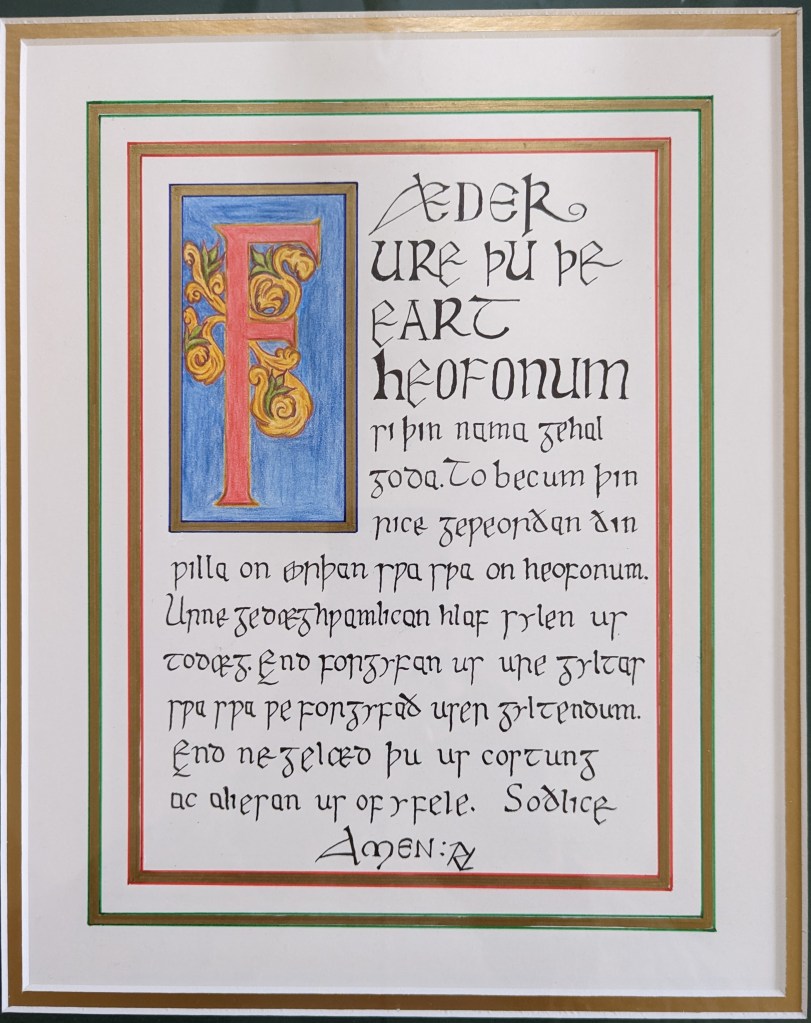
This photograph is an etching of the Lord’s Prayer in old English, created by my friend, Russell, who is completing his term in Federal prison. He created it, sent it to his mother who framed it, and she gave it to me. It is a kind gift, which I greatly treasure. It is written in English, yet, can any one read it for me?  My point is, knowing and respecting the limitations of language brings great sensitivity and insight into scripture and interpretation.

I was taught as a child the Lord’s Prayer from the 1662 Edition of the Anglican Book of Common Prayer, as replicated in the United Methodist Book of Worship. Though I didn’t know the source, rote memory has burned these directions of Jesus into my spiritual DNA. Accepting each word at face value frees me to contemplate deeper meaning and understanding.

“Our Father which art in heaven” is an introduction that reveals much about the one praying and the divine recipient of our prayer. “Our,” implies a collective whole. It doesn’t begin with an individualistic “My”. The Father is shared by all creation. The paternal reference to God is an attempt to personify the loving parenthood of our creator. We share a common father, whose creative effort is the source of life, and whose every effort is for the benefit and welfare of humankind. This makes us sisters and brothers, united with God’s Son, Jesus Christ, whose common family trait is love. When we forget our common father and unity with Christ, we begin to fail and fall from grace.

“Hallowed be thy Name;” From Exodus we know that the word ‘hallowed’ means to render sacred, to consecrate, or to be made holy. Both casual and profane uses of God’s name does not render to God the justice ‘hallowed’ expects. God’s name should never be used to express selfish anger, the execution of a contract, or in threat of damnation.  What if we fail to uphold our word, sworn in God’s name? What if we assume divine power that isn’t ours to claim or wield? God’s name is holy; treat it as such, with sparing respect and reverence. The use of God’s name should only be in the context of worship, bringing focus to glory, honor, and praise. Otherwise, I attempt to limit my use of God’s name to extend God’s blessing and love. These uses demonstrate sacred respect.

“Thy kingdom come, Thy will be done, in earth as it is in heaven.” The word ‘Thy’ implies ownership and stewardship. This isn’t my kingdom, or your kingdom. Let’s get this straight: this is God’s kingdom. God created each of us, gave us life, and set us in God’s kingdom to fulfill God’s will. This is our purpose in life. Thy will is easily misunderstood as my will. The first step of kingdom transformation begins with personal transformation; from the self-centered ‘I’ to the God-centered “Thy.” Understanding God’s will takes effort to watch, listen, and discern. God’s will often becomes known in private and confirmed in community. Prayer is confirmed or dismissed by a community of praying sisters and brothers. God’s kingdom in earth, as it stands today, is incomplete. More needs done, and it is our job to do it to the very best of our ability. Jesus equates a future completed earthly kingdom with the current heavenly kingdom. This perfection is that which God’s seeks.

The wind gently blew down the St. Lawrence River valley, from left to right, west to east, carrying with it the aroma of summer weed pollen and fresh marine vegetation. Our family pop-up camper occupied a site right on the beach looking north. A central campfire was surrounded by numerous pup tents. Canada, a whole civilization, was on the north side, who’s presence was felt, but inhabitants too distant to be seen. The sun was yet to rise, giving a hint of light and warmth to those who dared to stir. Bacon cracked in the cast iron frying pan. A bowl of batter and whisk were poised at the ready. Squatting, our stomachs waited for our daily bread.

My dad was the pastor of the Sinclairville United Methodist Church in the late 60s. The ten, or so, elementary school aged kids and I were recent graduates of his acolyte orientation program. Successful graduates were given the privilege of lighting the altar candles prior to worship and extinguishing them at the end. Our final pass/fail project was to memorize and recite both The Apostle’s Creed and The Lord’s Prayer. The promise of a St. Lawrence camping trip and belly full of bacon and pancakes marked our success.

Jesus taught his disciples to pray “Give us this day our daily bread.”

He doesn’t say to look for discounts and sales, load up the freezer, or to stock up for a rainy day. The image of Bread from Heaven from Exodus 16 should linger. This day; means today. Daily bread; sufficient from start to finish, sunup to sundown. No more, no less. We are compelled to trust that just as the Lord has provided for today, so, too, will the Lord provide for our every nutritional need tomorrow. Excess that we stock away will only turn to rot.

Jesus responds to the temptation by the devil in the wilderness to turn stones into bread with his answer, “It is written, ‘One does not live by bread alone, but by every word that comes from the mouth of God.’” (Matthew 4:4). The word from the mouth of God feeds us, just as certainly as our evening supper. Seek, knock, open, find. Feast on the word of God, as found in scripture and Gospel. Drink from the fountain of the water of life, and thirst no more. Drink from the cup shared with you, and taste the salvation of God.  

The God of my experience has abundantly provided for my physical, emotional, and spiritual sustenance each and every day of my life, from bottle and breast, to the skim and Kashi I had for breakfast this morning. Fresh each day, the word of God has sustained me, just as it is able to sustain you.

“And forgive us our trespasses, as we forgive them that trespass against us” Jesus taught. Trespass. Sin. Debts. Whichever. Whatever. What works for you is the best translation to use.

An honest, transparent, authentic petition for forgiveness requires absolute humility. It recognizes the fact that a sin has been committed, either with an intentional act to harm (commission), or, by a failure to act (omission). It requires an admission of guilt, a confession of our moral failure. No one likes to admit they are wrong, your pastor not withstanding! But, wrong I am, to confront evil, injustice, racism when ever and where ever I’ve found them. I am wrong to break any of the ten commandments, just as I am wrong to exaggerate the truth. Sin is not confined by size or impact. Big, or small, frequent or infrequent, sin is sin. Harming another requires sincere forgiveness.

Forgiveness requires one to cease and desist. Stop the sin; and vow to sin no more; that’s called repentance. Forgiveness requires reparations. Fix and repair the damage I’ve done. Make it right, as if sin hadn’t occurred in the first place.

Forgiveness is a three-way intersection. Sin is the abuse of another. We sin against God. And we harm ourselves. Our forgiveness is a willingness to repair what we’ve broken, bringing restoration with others, with our God, and within ourselves. Forgiveness comes first from God, through the redemptive act of Jesus Christ, and is given to us as a gift of grace as a tool to wield, that God’s kingdom may become perfected on earth as it is in heaven.

There is a word that connects the two phrases about trespasses. The word is “as”. Forgiveness given is to be balanced with forgiveness received. A world out of balance abuses the perfect nature of God’s intent for the redemption of humanity.

Lastly, forgiveness is a habit of experience that we are to teach by word and example to the next generation. Just as we have received forgiveness as a gift from God, so, too, are we to pass the gift on to our children. Give it away. Teach it well. Be certain to make the connection between forgiveness and the cross of Jesus Christ. He died to take our sin away; vow to not to muck it up again. You’ve cleaned up; keep yourself clean; and, lend a hand to help others keep themselves growing among moral, ethical, and spiritual lines, too.

When we gather for worship, the Lord’s Prayer plays a prominent part in the liturgy, the ebb and flow of Word proclaimed and Prayers at the Eucharistic Table. Though visited occasionally by the three-year lectionary guide, it is our United Methodist habit to include the Lord’s Prayer on a weekly basis. It is elemental to our faith.

When we have no words, Jesus gives us words. When lost, the Lord’s Prayer provides orientation and stability when most needed. When my mind races down tangential rabbit holes, the Lord’s Prayer provides me center, quiet, and peace. Balance is restored, forgiveness is granted, danger is averted. God’s kingdom is lifted high, God’s power and glory is acknowledged, and God’s name is appropriately hallowed.

A quick back-of-the-napkin summation tells me I’ve celebrated 271 funerals, 128 weddings, and led more than 1,824 worship services. I estimate I’ve recited the Lord’s Prayer over 19,000 times each night before sleep. That is a lot of Lord’s Prayer. It has become for me the common strand of spiritual DNA that links me to sinners and saints, past, present, and future. It joins Jesus to my hip, sharing heart and hands.

Standing in the Lyons, NY cemetery recently, reading from my 1965 Book of Worship, my aging fingers traced the sacred words, illuminated by the afternoon sun, as we bid good-bye and laid Paul to rest. The 21,223rd recitation of the Lord’s Prayer was just as deep and heartfelt as the first. Prayer changes this disciple for the better, and can do the same for you, too.

Jesus says, “And lead us not into temptation, but deliver us from evil.” Too often, this thought is broken into two, leading to the misunderstanding that God would somehow lead us into temptation. No. This is a recognition that evil and temptation are a present and dangerous part of the world. This recognizes God’s promise to be present, to give us strength, and to give us guidance to steer clear of temptation and evil. When we do fail and step into the mire of sin, God’s promise, made manifest by the redemption of Jesus Christ, throws us a lifeline and gives us a second chance.

God desires our righteousness; our adherence to law and fidelity to faith. Healing and well-being follow.

You and I will face temptations and evil. Count on it. Ignore it at your own peril. Pastors and faith leaders are magnets for the evil of this world. I know this to be true. The Lord’s Prayer gives me confidence to square off with the devil and stair him down. No one can do this on individual merit or strength. You and I are free to lean heavy into God’s presence and power.

“For thine is the kingdom, the power, and the glory,” Jesus continues. This is God’s kingdom. Thanks for asking. Not yours, not mine, not Albany’s, nor Washington’s. This is God’s kingdom and we are so privileged to be citizens benefiting of God’s love, mercy, and grace. God’s power reigns supreme. There are no competitors. We need fear no enemy, no government, no competitor to our faith and values. When we know God has all power, we are freed from a fear-based existence. Living free from fear is a life transformed, a new heaven, and a new earth. To God be the glory, a recognition of what God has done throughout salvation history, from the first day of creation to your most recent heartbeat. To God be the glory, winning victory over death, the creator of mortal life, the giver of eternal life.

“For ever and ever,” Jesus concludes. Time is suspended in God’s kingdom. “A thousand years is like a day to the Lord” the apostle Peter reminds the Church. The Alpha and the Omega invites us into an ocean of grace to eternally benefit from God’s love and power. These are not circular theological discussions meant to appease the uninformed and ignorant. The Lord’s Prayer is our stake in the sand, making our claim as disciples of Jesus, confident in our faith, placing our complete and whole trust in the Lord.

Beloved, join me in prayer; the Lord’s Prayer.

Todd

“Forgiveness From Your Heart”

Matthew 18:21-35

September 17, 2023

The Rev. Todd R. Goddard, Pastor

Rush United Methodist Church

Matthew 18:21-35

Then Peter came and said to him, “Lord, if another member of the church sins against me, how often should I forgive? As many as seven times?”

 Jesus said to him, “Not seven times, but, I tell you, seventy-seven times.

“For this reason the kingdom of heaven may be compared to a king who wished to settle accounts with his slaves. When he began the reckoning, one who owed him ten thousand talents was brought to him; and, as he could not pay, his lord ordered him to be sold, together with his wife and children and all his possessions, and payment to be made. So the slave fell on his knees before him, saying, ‘Have patience with me, and I will pay you everything.’ And out of pity for him, the lord of that slave released him and forgave him the debt.

But that same slave, as he went out, came upon one of his fellow slaves who owed him a hundred denarii; and seizing him by the throat, he said, ‘Pay what you owe.’ Then his fellow slave fell down and pleaded with him, ‘Have patience with me, and I will pay you.’ But he refused; then he went and threw him into prison until he would pay the debt.

When his fellow slaves saw what had happened, they were greatly distressed, and they went and reported to their lord all that had taken place.

Then his lord summoned him and said to him, ‘You wicked slave! I forgave you all that debt because you pleaded with me. Should you not have had mercy on your fellow slave, as I had mercy on you?’ And in anger his lord handed him over to be tortured until he would pay his entire debt.

So my heavenly Father will also do to every one of you, if you do not forgive your brother or sister from your heart.”

| Centering Prayer |

I. Matthew chapter 18 is a lesson:

Jesus teaches his disciples

how they can organize and get along

once he is absent.

St. Matthew recalls his personal experience.

He draws on the memorized oral tradition.

He referenced bits and pieces of written material circulating from the community of Mark’s followers.

St. Matthew puts it all together

to deliver Christ’s message

to disciples of Jesus,

to members of Matthew’s early church community, and

to us today.

Prior to this morning, Jesus taught

  1. To become humble like little children.

  2. Not to cause any little ones to stumble (remember the mill stone around the neck!).

  3. To cut off or pluck out the part of the body that causes you to sin (ouch).

  4. To go after the one who has gone astray, leaving the 99 behind (lost sheep).

  5. Last Sunday, instructions concerning conflict between yourself and someone else:

  a. First, go to the person alone. If that doesn’t work…

  b. Second, return to the person with 2 or 3 witnesses. If that doesn’t work…

  c. Third, take the person and the issue before the church. If that doesn’t work, the person cuts themself off from the church, then…

  d. Treat them as a Gentile and a tax collector. That is, constant vigilance and receptiveness to their return to the community.

II. Our Gospel lesson picks up the story here this morning.

Poor old Peter,

if only he would keep his big mouth shut!

If he had, we would be

much the poorer for it.

Peter asks the question,

in response to Jesus’ teaching about how to deal with internal conflict,

“what then, is the standard of mercy?”

“To what extent do we forgive?”

  a.  There is the Jewish standard:

God forgives 3 times, as recorded in Amos 1:3, 2:1.

The prophet Amos makes the case:

Man could not be more gracious than God.

  b. Peter asks,

how about twice the Jewish standard (2X3)

plus one for good measure? (2X3+1)

“How often should I forgive?

As many as seven times?” (18:21)

Perhaps he was thinking, “won’t Jesus think that I’m quite the compassionate guy?”

  c. Jesus: “Not seven times, but,

I tell you, seventy-seven times.”

Forget the prophetic standard.

Not 3.

Nope. Forget Peter’s standard.

Not 7.

What is Jesus’ standard?

Forgive 77 times.

In other words

The forgiveness that you grant to others should be ABSURDLY HUGE.

Forgiveness is not proportional.

Forgiveness is not mathematical.

I’d suggest

Jesus is hinting

Forgiveness should reflect the abundance of God’s grace.

Jesus’ provides a common financial illustration

To communicate his point.

He uses everyday finances,

Something everyone in his audience could relate to.

Talent

The King’s manager owed his King 10,000 talents.

Estimates vary regarding how much one talent was worth,

Anywhere between $1,000 and

20 years of wages for the common worker.

In today’s wages

The King’s manager owed his King

Between $10,000 and $1,200,000.

We are talking a lot of money!

10,000 talents is an unimaginable amount of debt,

Especially since it is owed to a

King with an army

Of collection agents!

Denarii

A denarius was a small silver Roman coin.

Think of it like a modern-day dime.

Roman soldiers were paid about 225 denarius per year.

1 Denarii = about 1 days wage.

In today’s wages

About $137.

In other words,

It takes many thousands of denarii to equal 1 Talent.

The slave owed the King’s manager 100 denarii,

Not even one tenth of a Talent.

He owed the manager pocket change.

Remember, the manager owed his King

(possibly) millions of dollars.

The contrast is huge!

Pocket change verses millions.

III. With this fictional story

Jesus redefines forgiveness.

The new standard for forgiveness is

Shock and awe.

Forgiveness should

Not be proportional.

Nothing even close.

Forgiveness must be

Like a dam that breaks,

A flood that gushes,

Like a collapsing and exploding black hole,

Like the depth and breadth of an ocean,

Like nuclear fission lighting up the night sky.

Overwhelming,

Incomprehensible,

Extravagant.

Impossibly huge.

Forgiveness should drown

both giver and receiver

in God’s abundant, amazing grace.

This is the magnitude of Christ’s forgiveness.

This then, is the standard of mercy that Jesus calls for:

forgive one another,

forgive without reservation,

forgive without end.

Remember the sins of others no more.

IV. There is a second measure of Good News in our Gospel lesson for today:

it lays in the illustration that Jesus tells,

as it relates to his previous teaching.

Last Sunday:

Jesus taught about

reconciling two conflicting members of the faith community.

Reconciliation = reunification of the whole.

Jesus’ illustration today nudges reconciliation one step further:

reconciliation is found through forgiveness.

Reconciliation

is dependent upon the King’s manager,

who, in turn,

is expected to forgive the Slave who owes him.

Forgiveness is for Jesus: the NEW DIVINE STANDARD.

  a. “Blessed are the merciful, for they shall obtain mercy.” (5:7)

  b. “If anyone strikes you on the right cheek, turn the other also.” (5:39)

  c. “And forgive us our debts, as we also have forgiven our debtors.” (6:12)

  d. “For if you forgive others their trespasses, your heavenly Father will also forgive you.(6:14)

  e. “Be merciful, just as your Father is merciful. Do not judge, and you will not be judged; do not condemn, and you will not be condemned. Forgive, and you will be forgiven.” (Luke 6:36-37)

The contrast is clear:

Old Standard: Law, Judgement, Old Testament.

NEW DIVINE STANDARD: Forgiveness, Jesus, New Testament.

Christ’s new desired outcome is that forgiveness leads to reconciliation.

IV. Which brings us to the third gem in today’s Gospel lesson:

True forgiveness comes from the heart.

It must be Genuine,

not contrived,

not forced,

not an attempt to outdo the goodness of someone else.

Authentic forgiveness is about God’s grace.

Jesus’ teaching is not a story to be moralized.

Jesus’ teaching is about the TRUE EXPERIENCE OF GRACE.

God’s grace is absurdly huge!

  a. Like the King in His illustration, God’s grace is without limit or end.

  b. It is only dependent on one thing: our willingness to extend grace and forgiveness to someone else.

Just as God’s grace comes from the heart,

So, too, should be the way we treat others.

Jesus followers lead with the heart.

V. The joy of heavenly living is found in the act of forgiveness.

God uses the same standard of judgement with us,

when it comes to forgiveness,

that we are to employ with others.

This is Good News to some, but

Bad, very Bad News for others:

folks who carry a grudge,

the eternal chip on their shoulder;

folks who are always looking to find fault with someone else;

folks who are more concerned with rules than with relationships.

Therefore, vow to be absurd! …

to forgive others who have hurt us…

to forgive them as abundantly, as lavishly, as Jesus forgives us.

This is Christ’s invitation to you:

Lay down your burdens,

give up harboring those bad memories,

those past sins,

and go…

go to the one who has hurt you,

and with all your heart,

forgive them everything,

and remember their sin no more.

If they accept: wonderful!

If they don’t: wipe the dust off your feet and move on.

Harbor no ill will.

There will be sadness in their rejection.

There should be joy in the hope, anticipation, expectation

Of future reconciliation.

If you say that it can’t be done,

God’s limitless grace makes even the seemingly impossible truly possible.

This is the stuff that miracles are made from!

VI. Go, sisters and brothers, go.

Immerse yourself in God’s grace.

Forgive from the depth of your heart,

Wait for the miracle.

Be reconciled.

Thanks be to God.

Amen.

Invocation

Monroe County Legislature

September 12, 2023

The Rev. Todd R. Goddard, Pastor

Rush United Methodist Church

Creator of cosmos,

Genesis of life, health, and breath,

Spirit of wind, sunlight, and rain,

Radiance of moon and stars;

Come to your chosen and anointed Monroe County representatives

Assembled this evening,

Leaders of diverse faith, culture, and values.

Visit them with your Spirit and

Visions of direction, conviction, and power.

Impart

Voice to speak for the voiceless,

Repair for the broken,

Hospitality to welcome visitors, neighbors, and friends,

Healing for all who are addicted, harmed, or grieved,

Support for widows, children, the aged, and homeless,

Justice, fairly enforced

Equal opportunity for all.

By the same measure of grace afforded me

Prosper our people,

Increase our gratitude,

Deepen our faith, and

Expand our compassion and love.

In the name of the incarnate Lord of my experience,

Jesus Christ,

Mercifully, hear our prayer.

Amen.

Presentation by Monroe County Legislator, Steve Brew

“Caring Enough to Confront”

Matthew 18:15-20

September 10, 2023

The Rev. Todd R. Goddard, Pastor

Rush United Methodist Church

Matthew 18:15-20

“If another member of the church sins against you, go and point out the fault when the two of you are alone. If the member listens to you, you have regained that one. But if you are not listened to, take one or two others along with you, so that every word may be confirmed by the evidence of two or three witnesses. If the member refuses to listen to them, tell it to the church; and if the offender refuses to listen even to the church, let such a one be to you as a Gentile and a tax collector. Truly I tell you, whatever you bind on earth will be bound in heaven, and whatever you loose on earth will be loosed in heaven. Again, truly I tell you, if two of you agree on earth about anything you ask, it will be done for you by my Father in heaven. For where two or three are gathered in my name, I am there among them.”

| Centering Prayer |

Since last Sunday,

Jesus and his disciples

Journeyed south,

First, to his transfiguration,

Then, with his face oriented to Jerusalem,

to Galilee, specifically, Capernaum,

Where Jesus tells his disciples a second time

That he will be betrayed, killed, and resurrected on the third day.

(16:21-23, 17:22-23)

It appears he is driving home a point;

Making a statement

That his followers should pay attention.

Indeed, the pinnacle event in the life of Christ

Was his denial, betrayal, passion, suffering, death, and resurrection.

Sorry to all the Christmas aficionados.

Annunciation, immaculate conception, and incarnation,

St. Nicholas, decorated Christmas trees, candles on the window sill, and lightly falling snow,

Great in their own right,

Serve only as elaborate stage scenery for

Christ’s penultimate act,

His passion, death, and resurrection.

Christ’s messianic fulfillment of the Father’s will

Demonstrated God’s great love for us;

An unbounded commitment to the redemption and salvation of humankind,

Fulfilled responsibility for the stewardship of creation,

And a pledge to, lo,

Remain with us always.

Jesus Christ, Son of God.

Commitment.

Responsibility.

Pledge.

Oh, boy. Three ideals and values

That make this son of a Pennsylvania Dutch family

Approach with apprehension.

Yet, commitment, responsibility, and pledge

Speak to our own baptismal vows,

To the vastness of God’s unlimited grace and love,

And to our place in God’s evolving, maturing kingdom.

Dare we speak openly about commitment?

My own, and the commitment of those around us?

Do we stand idle while some fall inactive

Or backslide themselves into the category of “nones”?

Oooo.

It is as if

commitment in this day and age is a dirty word.

Dare you and I speak about responsibility honestly and transparently?

It is my responsibility to teach every child and new disciple

All that has been taught me.

Am I living up to the task?

Is my commitment commensurate

With Christ’s commitment to redeem the sins of the world?

It is my responsibility to lead people to Jesus,

Introduce them to the Way,

And leave the rest up to God.

Am I?

It is my responsibility to love,

Love God,

Love neighbors,

Love enemies,

To show the world that, by our love, we are known as disciples of Jesus.

Have I?

Oooo.

It is, as if,

Responsibility in this day and age is a dirty word.

Dare I speak about my oath, my promise, my pledge?

I will be loyal to the United Methodist Church.

I will support the mission and ministries of the Rush United Methodist Church.

I pledge my support to Christ and his Church

with my time, talent, and treasures.

Do I accept the responsibility given to me to love and loyalty

That Christ bore upon himself with his suffering, passion, and death?

I pledge a tenth of my time, every day,

To acts of charity, outreach, and ministry.

I pledge a tenth of all I earn

To return to God

Who first gave it.

Oooo.

It is as if

Pledge is just another topic that,

If we don’t talk about it

Maybe it will just go away.

Besides, polite people don’t talk about commitment, responsibility, and pledge.

Or do they?

(I think I just did)

Jesus pledged to give his life, his all.

Can I?

In today’s Gospel passage

Jesus introduces his disciples to a fourth uncomfortable

Situation that needed addressed

If his Church had any hope of surviving

The growth and expansion primed to detonate

Following his ascension into heaven.

Oooo.

Confrontation. Conflict.

Dare we speak about it

Or do we do

what all polite Christians do

when confronted with conflict?

Avoid it!

And if it can’t be avoided,

Sweep it under a carpet,

Pretend it never happened,

And just move on?

All, too often, I’ve seen

By pastor and parish alike,

The “I’m out of here” trigger being prematurely pulled.

Sometimes, it is just easier to pull the ejection seat,

get out of there,

and deal with the regrets later.

Confrontation and conflict?

I’m no district attorney.

I’d rather stick my head in a hot oven

Or walk over broken glass.

Jesus shows us another way.

Today, Jesus helps us to reframe, refocus,

The way we address the inevitable conflict in our lives

And outlines a healthy means of intervention

That can lead to personal, spiritual growth and greater institutional strength.

Jesus tells us

To care enough to confront

Those who sin against us

With the goal of retaining the sinner.

Confront;

Not to estrange

But to retain.

Jesus paints the picture of what healthy intervention

And what a healthy congregation looks like.

Here are some pointers:

1. If you find yourself in conflict with someone else,

Address it directly and promptly.

Do not delay,

For delay only allows dysfunction to grow and resentments to fester.

2.  Do not drag a third party into your conflict.

To do so invites the third party to pick a side

To promote an unhealthy “us verses them” partisan divide.

3. Do not gossip

For gossip only fuels pride and promotion.

I’d love the Finance team to put a twenty-five-cent contribution cup on my desk

For everyone who comes to me saying, “some people are saying…”

4. Do not by-pass the process Jesus outlines.

There is a reason Jesus prescribes a graduated approach to conflict resolution.

Don’t jump ahead.

Follow his linear, proportional design.

5. No one can control the response of another.

As I recently heard,

“It is none of my business what other people think of me.”

What others think of you is between them and God.

Others might dismiss you,

Become angry with you, or

Grow to resent you.

Then again

Your care may be the open door

Through which healing and restoration can take place.

In 1901 French archaeologist working in modern day Iran

Discovered 282 laws inscribed on an upright stone pillar.

These laws were inscribed between 1,792 and 1,750 BCE

By the King of Babylon, Hammurabi.

These legal codes were assembled

From around his growing, expanding kingdom,

Aggregated to provide one universal set of laws for a growing, diverse population.

In the prologue

Hammurabi states that he wants

“to make justice visible in the land,

to destroy the wicked person and the evil-doer,

that the strong might not injure the weak.”

“The laws themselves support this compassionate claim,

and protect widows, orphans and others

from being harmed or exploited.”

(as found at ushistory dot org)

‘An eye for an eye and a tooth for a tooth’

Is the cliff notes summation of a legal leap forward for humankind.

A response to injustice must adhere to an expectation of proportional response.

Murder, is responded in kind: capital punishment.

Robbery, is addressed with confinement and restitution.

Poke out my eye, and you, likewise, would have your eye poked out.

Proportionality is a good first step

And Jesus is quick to build on it.

1. If there is one who sins against you, something small,

go to that person individually first,

and try to settle it

… so that one is regained.

2. If that doesn’t work,

consult with one or two others and take them with you.

Try to settle it

… so that one is regained.

3. If that doesn’t work, tell it to the church,

and allow the church to attempt to work it out

… so that one is regained.

4. If that doesn’t work,

Jesus says “Let such a one be to you as a Gentile and a tax collector.”

There is much debate about what he means here.

The common belief is that if a person rejects you, others, and the church,

then we must let them go,

yet, all the while,

watch, hope, and pray

(like a prodigal’s father)

for their eventual return.

At every step of the process

Jesus outlines, the goal is

“so that one is regained.”

Just as in minor offenses,

A proportional response also provides for justice in major crimes.

If the issue is large and serious,

the degree of response should be likewise.

Serious crimes or conflict that involve violence,

Jesus would agree,

require the guidance of community standards and laws,

a just legal system,

and the active response of the church.

Serious crimes cannot and should not

be just swept under the table, as if they didn’t exist.

At the same time,

even serious criminal offenses do not cut someone off

from the love of God or the grace of the church.

At all times law and grace must be balanced,

with the goal “that one is regained.”

“That one is regained”

Gives meaning to proportionality.

Like a the wizard pulling levers behind a curtain

Jesus is showing us behind the scene

What it means to preserve the health and welfare of human relationships

And the wellness of the Church.

Strong relationships are able to bear issues of sin and conflict.

It doesn’t mean we have to like conflict.

But, of the grace extended, we are given all we need, and more,

To bring healing and restoration to that which is broken.

Constructive confrontation

identifies the transgression that has occurred,

the barriers that have been crossed.

Hurt people hurt others.

Healing sometimes has to return to and fix the original sin.

Sometimes times people who hurt others may be unaware of their sin. Confrontation identifies the offense and names it for what it is.

Constructive confrontation communicates

the fact that you are committed to your relationship.

You’re not going to walk away mad.

You will not going to take your marbles and go home.

You are committed to working it out.

This is what friends do.

This is what disciples of Jesus do.

Deal with issues while they are small, and they rarely become large.

Proactive conflict resolution is vital to ensure the integrity, health, and wholeness of the Church.

Lastly, dealing with conflict and sin

makes a statement about the God we believe in.

Our God doesn’t guarantee us an easy life;

but God does guarantee us that we will have a divine companion with us every step of the way as we navigate through life.

Life is fraught with those who hurt you,

and, regrettably, the hurt we cause others.

We are a community of sinners,

Seeking redemption,

striving to become a community of saints- more like Jesus every day.

Today’s Gospel gives practical advice from our Lord himself, about how we are to live together as disciples of Jesus; how we should care enough to confront those who hurt us.

Confrontation can be the open door,

leading towards a process of repentance, restoration, and, finally, forgiveness.

Be not afraid.

Do not fear. Do not avoid.

Avoid the temptation to hide.

Do not run away.

You and I?

We can do this.

If only we surrender with a “yes.”

Jesus is with us.

Jesus gives us the strength.

Jesus shows us the way.

The Word of the Lord, as it has come to me. Thanks be to God. Amen.
“‘If’ – His Most Important Challenge”

Matthew 16:21-28

September 3, 2023

The Rev. Todd R. Goddard, Pastor

Rush United Methodist Church

Matthew 16:21-28

From that time on, Jesus began to show his disciples that he must go to Jerusalem and undergo great suffering at the hands of the elders and chief priests and scribes, and be killed, and on the third day be raised. And Peter took him aside and began to rebuke him, saying, “God forbid it, Lord! This must never happen to you.” But he turned and said to Peter, “Get behind me, Satan! You are a stumbling block to me; for you are setting your mind not on divine things but on human things.”

Then Jesus told his disciples, “If any want to become my followers, let them deny themselves and take up their cross and follow me. For those who want to save their life will lose it, and those who lose their life for my sake will find it. For what will it profit them if they gain the whole world but forfeit their life? Or what will they give in return for their life? “For the Son of Man is to come with his angels in the glory of his Father, and then he will repay everyone for what has been done. Truly I tell you, there are some standing here who will not taste death before they see the Son of Man coming in his kingdom.”

| Centering Prayer |

“Messiah, the Son of the living God,” Peter had correctly identified Jesus.

More than the son of Mary,

The boy from Nazareth,

The healer, miracle worker, and preacher

From up north

Who attracted great crowds of followers, imitators, and want-a-bees.

Flanked by idols to the Greek god Pan, and

The Philistine god, Baal, on his left,

With the ominous cave opening, on his right,

Believed by the population as being

the literal gate to hell,

Jesus advances to the next slide of his orientation curriculum

What it means to self-identify as messiah.

Messiah, classically defined,

the anointed leader, savior, deliverer of the Jewish nation

as prophesied in scripture.

Jewish descendant. Jesus checks that box.

Anointed with holy oil. Jesus checks that box in Matthew 26.

King of God’s Kingdom. Jesus, Son of the Father, next in line of succession. Check that box.

Ruler of God’s Kingdom during the messianic age,

An era of universal peace and brotherhood,

With an absence of evil.

Every one of his 12 disciples expected Jesus to check that box, too.

In the mind of Peter and fellow Jews

Danced the sugar-plum vision of Jesus ruling the messianic age;

Swords beaten into plowshares,

Wolf and lamb, natural predator and prey, living in peaceful harmony,

With the earth full of the knowledge of the Lord. (Isaiah 11:6-9)

Except, Jesus didn’t check that box.

Jesus had other plans.

What could be more important then

God solving their immediate problems?

Come on, God. Show your stuff.

Send your Son.

We will make him King.

Remove Rome.

And all will live happily ever after.

Lesson #1.

Avoid thinking small.

Yes. Your life,

Your social circle,

Your bubble,

The weather, your garden, the start of the new school year, the state of local politics,

Your reality, the good, bad, and ugly,

Are important to Jesus.

Yet, Jesus wants us to think bigger,

Bigger than human things.

Life, death, and eternity is greater than just you and me and that slow driver plugging up traffic by lingering in the left hand lane.

Christianity cannot be self-centered, Jesus is telling his disciples this morning.

Peter, you, and me fall down the bottomless hole of human things,

While, Jesus has his eye on divine things.

Personal salvation is wonderful

Until eyes are opened to the world burning.

Forgiveness of sins is great

Until pardon is withheld and amends fall on deaf ears.

Why fix and repair

When the same old wrong

Works so well to perpetuate and personify all that sucks in my life?

I can assign blame to everyone and everything bad in this world

Without ever lifting a finger of personal responsibility,

Because Jesus forgave my sins and I’m saved.

There are few greater criticisms of Christianity

That self-righteous, self-centered Christians.

With an eye on divine things,

Jesus is frying other fish.

Jesus wasn’t constrained by his small group,

Anchored to a temporal time and space,

Tethered to personal forgiveness and salvation.

Jesus was looking to the cross

While the world was looking for the crown.

Lesson #2.

Jesus was focused on divine things,

Facing the cross of crucifixion;

Soo, too, should we.

The cross of Jesus Christ

Transcends time and space,

Is God’s gift of grace to all people, nations, races, cultures,

Spanning all time; that which was, that which is, and that will be.

Fixing the stain of sin becomes the necessary prerequisite for the empty tomb and eternal life.

You can’t get there

Without first going through here.

Before you get to St. Peter

Make certain you are shaved, showered, and put on your Sunday best.

Temptation is to avoid Good Friday

And just show up for Easter sunrise,

Treating the passion of Christ

With antiseptic and a clean bandage.

Lesson #3.

Being a Jesus follower isn’t for sissies.

The very one to whom Jesus had just given the keys to the Church

Jesus calls out Peter for thinking “crown”

When he should have been thinking “cross.”

“Get behind me, Satan!

You are a stumbling block to me;

For you are setting your mind not on divine things but on human things.” (16:23)

As if a punch in the face and a bloody nose isn’t enough,

Jesus shares his expectation

That everyone who follows him

Should be expected to take a knockout punch.

The great “if” clause of the

“if/then” function

Becomes Christ’s most important challenge.

To be

Followers of Jesus

Requires

Denial,

A readiness to die,

A willingness to follow.

Denial.

A complete surrender of self.

Letting go of all control, ego, and pride.

A recognition that control is a mere illusion,

That all power is the exclusive domain of God.

Self-denial

Is best illustrated in our lesson from Romans (12:9-21)

Love.

Hold fast.

Serve.

Rejoice.

Be patient.

Persevere.

Contribute.

Extend hospitality.

Bless.

Live in harmony.

Feed the hungry,

Give drink to the thirsty.

Overcome evil with good.

Every quality implies a denial of self and the promotion of others.                                                    

A readiness to die.

There is an empty cross with your name on it.

There is one for me, too.

When eternal life is on the table

Why would any of us engage in a struggle to save our own life?

Live everyday prepared to die,

Is the sage advice of the Apostle Paul.

“For to me,” he writes to the church in Philippi,

“to live is Christ and to die is gain.” (Philippians 1:21)

“Follow me,” Jesus extends the invitation. (16:24)

Only after submission and sacrifice is one ready to follow Jesus.

If you want to know where Jesus goes and what Jesus does,

The follower needs to know Jesus inside and out.

Matthew, Mark, Luke, and John.

The Gospels

Report the Truth about Jesus Christ.

Learn from them.

Write them upon your heart.

What Jesus and his followers believed

Is found in Hebrew scriptures,

Which we call the Old Testament.

It establishes a foundation

Of God’s power and creation,

God’s love and covenant,

God’s desire and law.

To know Jesus means that one must know Adam, Moses, Abraham, the prophets, and the Psalmists.

What happened to the world

Because of God’s great loving gift of Jesus

Is recorded in the Acts of the Apostles through the book of Revelation.

We call it the New Testament.

The world was, and is, forever transformed,

Transfigured into a likeness of Christ,

The Body of Christ,

His Church

As it began to live out the call to discipleship.

To know Jesus

And to know of God’s great transformation

Is to be able to find ourselves in this transformation

And to make productive contributions

To its fulfillment.

Denial.

Willingness to die.

Follow. Faithfully following Jesus.

Yeah, discipleship isn’t easy;

But it is worth it.

Beloved,

Think big.

Think outside the box.

Forget the crown. Focus your eyes on crucifixion.

Seek and discover the divine things emerging around you.

Surrender, the Kinks sang.

Unlike their lyrics,

Jesus urges those who choose to follow

To give themselves away.

To be willing to even give away the precious gift of life.

For when God holds the gift of eternal life in hand,

What does it matter?

Surrender.

Take up your cross.

Know Jesus.

Follow his example.

Adhere to his lessons.

Some will find it easier than others.

Some will taste death before seeing Christ return.

Others will be blessed to bask in his glory.

Amen.

“Who Do You Say I Am?”

Matthew 16:13-20

August 27, 2023

The Rev. Todd R. Goddard, Pastor

Rush United Methodist Church

Matthew 16:13-20

Now when Jesus came into the district of Caesarea Philippi, he asked his disciples, “Who do people say that the Son of Man is?”

And they said, “Some say John the Baptist, but others Elijah, and still others Jeremiah or one of the prophets.”

He said to them, “But who do you say that I am?”  

Simon Peter answered, “You are the Messiah, the Son of the living God.”

And Jesus answered him, “Blessed are you, Simon son of Jonah! For flesh and blood has not revealed this to you, but my Father in heaven. And I tell you, you are Peter, and on this rock I will build my church, and the gates of Hades will not prevail against it. I will give you the keys of the kingdom of heaven, and whatever you bind on earth will be bound in heaven, and whatever you loose on earth will be loosed in heaven.”

Then he sternly ordered the disciples not to tell anyone that he was the Messiah.

| Centering Prayer |

Fresh out of seminary

I was too wet behind the ears

To be able to distinguish the difference between

Caesarea Philippi and Caesarea Martima.

Can you?

Using Tiberius on the Sea of Galilee in northern Israel as a navigational anchor,

Caesarea Martima is 51.4 miles southwest of Tiberius,

A coastal Roman capital on the Mediterranean.

Warm, sandy beaches with a protected port fed by a massive Roman aqueduct,

Caesarea Martima was a place of trade, commerce, military might, and Roman power.

Pontious Pilate called it home.

In contrast,

Caesarea Philippi is 46.7 miles due north of Tiberius.

It was a cool mountainous outpost at the base of Mt. Hermon,

Noted as the spring water source of the Jordan River.

Caesarea Philippi was deep in gentile country.

Caesarea Philippi was the nexus of Baal idol worship and allegiance to Greek gods and myth.

At this location the first king of Israel, Jeroboam,

Led the northern kingdom into idolatry.

Flanking the grottos where Jesus taught

Were rock carvings and statutes

Of Baal, Pan, and what was believed to be the pagan gate of Hades.

For the observant Jew

Caesarea Philippi was where the devil did his work.

The only thing in common was the name Caesarea;

An ominous homage to where true power lay;

Before the throne of Caesar,

Emperor of Rome.

Jesus brings his disciples on retreat.

Today’s gospel is a lesson in leadership development,

Taught from the heart of darkness.

Jesus had recruited his disciples,

Students who he demonstrated his divine powers of

Healing the sick, cleansing a person with leprosy, casting out demons, fixing a withered hand.

Jesus had taught his disciples in beatitude and parable,

What it meant to live a life of blessings,

To bring salt and light to a bland, dark world,

Filled with sorrow and sin.

Jesus taught

To temper anger and a prohibition on divorce,

To love enemies, to be charitable to the poor, and to pray without ceasing.  

He taught them to sow seeds, harvest fruit, and to remove and burn weeds

As a sign and symbol for disciple making.

Jesus had demonstrated to his disciples

The awesome, unlimited power of God,

Stilling a raging storm, walking on water, and feeding four thousand with seven loaves and a few small fish. (15:14)

Jesus had also warned his new disciples,

“Do not think that I have come to bring peace to the earth,”

Jesus warned with messianic overtones,

“I have not come to bring peace, but a sword!” (10:34)

Jesus turns and asks the group,

“Who do people say I am?”

The bland as milk toast

group of non-committal disciples

lowered their eyes,

kicked some dirt,

and responded with the safe answer.

“Some say John the Baptist, but others Elijah, and still others Jeremiah or one of the prophets.” (16:14)

John the Baptist: dead.

Elijah: dead.

Jeremiah: dead.

Jesus was no more the resurrection of a dead prophet

Then he is the resurrection of George Washington.

Which brings us to the first lesson for today.

1. When it comes to your relationship with Jesus, don’t play it safe.

Token, semi-annual appearances at worship

Is no substitute for a living, breathing, growing relationship with Jesus Christ.

Christmas Eve and Easter appearances may appease the family

But reflect a hope that is built on nothing less than sinking sand.

When it comes to Jesus, don’t play it safe.

The Church is not an organization to financially support,

a building to be repaired,

a politic to be mastered,

or a ladder for the ambitious to climb.

Work, without faith, is dead;

Just as dead as John the Baptist, Elijah, Jeremiah, and the other prophets.

Jesus narrows the search

From “who do people say the Son of Man is?”

To looking Peter in the eye, asking,

“who do you say that I am.”

Messiah! Peter, boldly proclaims,

Making reference to

Not bringing peace,

But the sword he had armed himself with

In anticipation of the messianic apocalyptical consummation of history and time.

You are the

Son of the living God!

Peter, correctly contrast

The living, breathing Jesus

Standing surrounded by all things idols and pagans

Beside the very entrance to what was believed to be the gates of hell.

2. Which brings us to the second point in today’s gospel:

When it comes to Jesus, go big or go home!

Bold is the faith of Christ’s true disciples;

Fearing none,

Every thread of embarrassment or self-doubt squared away.

Timid is the faith of chaff

That is gathered, cast out into the darkness, and burned in the fire.

Make bold your faith!

Say is loud.

Say it proud.

Shout it from a mountain top that all the world might know:

Jesus is Messiah,

Our Savior,

From sin to salvation,

From life to eternal life,

From the dust of mortality to immortality.

Messiah has come!

We need not wait for another.

Jesus breaks with the synagogue down the street.

Jesus become the one who will endure

“and the gates of Hades will not prevail against it.” (16:18)

We have a winner!

Jesus is Son of the living God,

Alive, at work

In your life and mine.

Deny his presence and will

at your own risk.

Accept the reality of Christ for your benefit, and for mine.

It is as if Peter wells in song:

“Christ is alive, and goes before us

to show and share what love can do.

This is a day of new beginnings;

our God is making all things new.”

(Words by Brian Wren, “This Is a Day of New Beginnings”, UMH# 383, v.4)

….

“Blessed are you, Simon, son of Jonah!

For flesh and blood has not revealed this to you,

but my Father in heaven.” (16:17)

Simon Peter hadn’t heard it on the grapevine.

It wasn’t sent out in a Rush Tidings, printed in Our Faithful Followers, or printed in the bulletin.

He didn’t read it in the Democrat and Chronicle or the Hometown Sentinel.

Peter listened for,

Paid attention to,

The revelation of God.

3. Which brings us to the third lesson for today.

Be silent.

Watch.

Listen.

Discern

The words and will of God.

Be patient.

Wait for the Lord.

Scripture tells us no less than fifteen times to

Wait for the Lord.

Blessed is the one,

Earlier the subjects of the Beatitudes,

Here, Blessed is Simon Peter,

Who faithfully reported the Good News given to him

From Our Father, who art in heaven.

How often do I jump to conclusions?

Conclude without facts, and leap to judgment?

How often do I make assumptions?

Draw correlations without first listening for the voice of God?

How often do I ignore all warning signs from God, and

make decisions without first considering the unintended consequences of my actions?

Wait for the Lord.

Why?

Because the Lord is ready and willing to speak

To those who are willing to listen.

Ah, Simon Peter,

The follower,

Destined to deny,

Is transformed into rock,

A solid foundation upon which

Christ will build his church.

Which brings us to point number four.

4. If Jesus could use Peter to build the Church, imaging what Christ can do with you.

Peter: blue collar, common fisherman.

Peter: a bone-headed, open mouth, insert foot kind of guy.

Peter: Three times a liar – I don’t know him. I’ve never seen him. I’ve never followed him.

Peter: Three times the penitent groveller. Yes, Lord. You know I love you. Yes, Lord. I love you. Yes, Lord. I love you.

Peter: Barbequed and martyred by the hand of Nero, crucified upside down, set afire.

If there was room at the table for Peter,

There is room for you.

If there is room at the table for me, I assure you,

There is room for you.

Christ can take the most beaten down, beaten up, shot to … smithereens

Body, mind, or spirit,

And use you as a foundation for the building of his church.

This is why we have no throw-aways, cast-offs, or cast-aways in the church.

If Jesus can use Peter,

Jesus can use you.

To Simon Peter,

Jesus gives the keys of the kingdom of heaven.

Not everyone gets a set of keys;

Only Peter

The rock,

The foundation of the Church

Upon which Jesus builds,

And builds,

And builds.

To Peter

And to his anointed, ordained called to follow in his footsteps,

Is given the responsibility of stewardship of the Church,

To bind and to loose,

Decisions that transcend the boundaries of earth and heaven.

Which brings us to the fifth and final point in today’s gospel:

5. Respect and support the chosen.

The yoke born by bishops, presbyters, elders, and deacons is heavy and leads to the cross.

“Bind” and “loose” were common to Jewish legal phraseology

Meaning to declare something forbidden or to declare it allowed.

A key is used to lock or unlock a door.

The key given to me at my ordination is used to open the door to Christ’s forgiveness and redemption to people broken by sin and evil.

An open door shows the way to the cross of Jesus Christ.

That same key given to me

is used to open the door of salvation

To invite the world to enter.

Beloved, step from your grave

And into the light of eternal life.

That same key

Locks the door

Providing protection to the church

From wolves who seek to destroy everything which Christ has built.

Heavy is this responsibility.

Heavier still is this responsibility

As I discern and consider the call of the next generation of

Called and ordained clergy of tomorrow’s Church.

What does this interaction

Between Jesus and Peter mean to us today?

1. When it comes to your relationship with Jesus, don’t play it safe. Spice it up and be bold!

2. When it comes to witnessing for Jesus, go big or go home!

3. At the same time learn patience. Be silent. Be patient. Wait. Watch. Listen. See. Discern the words and will of God.

4. Imagine what Christ can do with you and through you.

5. Respect and support the chosen. Our job is to protect the Church;

to open the door to Jesus Christ;

and to invite you to accept his grace of forgiveness, redemption, and salvation.

Amen

“Great Is Your Faith”

Matthew 15:10-28

August 20, 2023

the Rev. Todd R. Goddard, Pastor

Rush United Methodist Church

Matthew 15:10-28

Then he called the crowd to him and said to them, “Listen and understand: it is not what goes into the mouth that defiles a person, but it is what comes out of the mouth that defiles.”

Then the disciples approached and said to him, “Do you know that the Pharisees took offense when they heard what you said?”

He answered, “Every plant that my heavenly Father has not planted will be uprooted. Let them alone; they are blind guides of the blind. And if one blind person guides another, both will fall into a pit.”

But Peter said to him, “Explain this parable to us.”

Then he said, “Are you also still without understanding? Do you not see that whatever goes into the mouth enters the stomach, and goes out into the sewer? But what comes out of the mouth proceeds from the heart, and this is what defiles. For out of the heart come evil intentions, murder, adultery, fornication, theft, false witness, slander. These are what defile a person, but to eat with unwashed hands does not defile.”

Jesus left that place and went away to the district of Tyre and Sidon.

Just then a Canaanite woman from that region came out and started shouting, “Have mercy on me, Lord, Son of David; my daughter is tormented by a demon.”

But he did not answer her at all.

And his disciples came and urged him, saying, “Send her away, for she keeps shouting after us.”

He answered, “I was sent only to the lost sheep of the house of Israel.”

But she came and knelt before him, saying, “Lord, help me.”

He answered, “It is not fair to take the children’s food and throw it to the dogs.”

She said, “Yes, Lord, yet even the dogs eat the crumbs that fall from their masters’ table.”

Then Jesus answered her, “Woman, great is your faith! Let it be done for you as you wish.”

And her daughter was healed instantly.

| Centering Prayer |

Our Gospel lesson for this morning is quite remarkable.

It flies in the face of over a thousand years of Church doctrine.

It is this very inconsistency,

between the Biblical Word and Church doctrine,

that makes us squirm uncomfortably in our seats

when we experience the fullness of this passage

spoken and left to hang in our midst.

The fourth verse of the hymn, “Jesus Is All the World to Me”

helps define the issue.

It goes,

“Jesus is all the world to me, I want no better friend; I trust him now, I’ll trust him when life’s fleeting days shall end …” (Will Thompson, 1904, The United Methodist Hymnal, No. 469).

Our trust in Jesus doesn’t waver,

and it shouldn’t.

Our trust in Jesus is predicated upon the assumption

that Jesus never changes.

Jesus is the constant

in our relationship with the Divine.

That unchanging nature of Jesus brings us comfort, at times.

Though life might toss you about

and lead you down numerous valleys of the shadow of death,

the one thing that remains constant is Christ.

If all else fails us in life,

at least the one thing we can count on

is that Jesus will remain the same.

He is the same today as He was yesterday,

as He will be tomorrow.

The Jesus we received as a child,

is the same Jesus

that I will leave with my children.

Of this we are assured!

This unchanging nature of Christ

sent me rummaging through my old textbooks from seminary.

I searched the tried and true systematic theology

titled “Principles of Christian Theology,”

by John Macquarrie.

In his section The Person of Jesus Christ,

I found what I was after.

He writes

“The core of traditional Christology is, of course, the two-nature doctrine of the Chalcedonian definition, which speaks of one and the same Christ, Son, Lord, Only-begotten, recognized in two natures, without confusion, without change, without division, without separation;  the distinction of nature being in no way annulled by the union, but rather the characteristics of each nature being preserved and coming together to form one person and subsistence, not as parted or separated into two person, but one and the same Son and Only-begotten God the Word, Lord Jesus Christ.”

(Macquarrie, J., Principles of Christian Theology, Charles Scribner’s Sons, New York, 1966. p. 273)

There you have it.

Since The Fourth Ecumenical Council of Chalcedon

held in 451 AD,

the new orthodox doctrine has been laid down.

We believe in the unchanging nature of Jesus,

and have been doing so for the past 1,500 years.

A thousand years after the Council of Chalcedon,

Martin Luther, the Protestant reformer

penned the descriptive hymn “Ein’ Feste Burg”

or “A Mighty Fortress Is Our God.”

Listen to his second verse

“Did we in our own strength confide, our striving would be losing, were not the right man on our side, the man of God’s own choosing. Dost ask who that may be? Christ Jesus, it is he; Lord Sabaoth, his name, from age to age the same, and he must win the battle.” (United Methodist Hymnal, #110)

Apparently Luther intended to bring this doctrine

of the unchanging nature of Christ with him

to the newly reformed protestant church.

A hundred and fifty years later,

a contemporary of John Wesley, Isaac Watts,

certainly reflected on the psalmist

when he wrote the 4th verse of “O God, Our Help in Ages Past”

A thousand ages in thy sight, are like an evening gone; short as the watch that ends the night, before the rising son.” (United Methodist Hymnal, #117)

The Psalmist wrote in the 90th Psalm,

“For a thousand years in thy sight are but as yesterday when it is past, and as a watch in the night.” (Psalm 90:4 KJV).

It certainly doesn’t appear to be much change over time

in the nature of God.

Three hundred years after Luther

and a hundred-fifty after Isaac Watts,

a minister in the Free Church of Scotland,

Walter Chalmers Smith,

wrote in 1867 these well-known verses to our favorite hymn:

Immortal, invisible, God only wise, in light inaccessible hid from our eyes, most blessed, most glorious, the Ancient of Days, almighty, victorious, thy great name we praise.” (United Methodist Hymnal, #103)

This hymn is likely to be sung and affirmed

in any Christian church today.

Romans Catholics,

Eastern Orthodox,

and we Protestants alike –

all affirm

the unchanging, unmoving, immortal, invisible

nature of Jesus Christ.

As I look back at the history and development

of United Methodist doctrine,

I find in The Book of Discipline, Article II,

in the Doctrinal Standards of the Methodist Church to read:

“The Son, who is the word of the Father, the very and eternal God, of one substance with the Father, took man’s nature in the womb of the blessed Virgin; so that two whole and perfect natures, that is to say, the Godhead and Manhood, were joined together in one person, never to be divided; … “ (The Book of Discipline of the United Methodist Church 2004, P.103, pg. 60)

With this preamble

about the unchanging nature of Jesus Christ,

we are confronted this morning with Jesus,

who, when confronted by a desperate mother –

pleading for his mercy on behalf of her demon possessed daughter,

tells her “I was sent only to the lost sheep of the house of Israel.” (Matthew 15:24).

Jesus! that is cold!

Jesus is the one who left Jewish territory,

Invading this woman’s world.

Furthermore, this Canaanite woman,

An unclean outsider,

Demonstrates she has a better grasp of Jesus’ identity

Then his hand-selected disciples.

(With thanks to Carla Works, Professor of New Testament, Wesley Theological Seminary, Washington DC, as found at Working Preacher dot org)

This woman is persistent.

Note to self: persistence pays off,

when it comes to faith.

Be persistent.

She bites and doesn’t let go.

She comes back a second time,

kneeling at the feet of Jesus, pleading

“‘Lord, help me.’

He answered, “It is not fair to take the children’s food and throw it to the dogs.” (Matthew 15:25-26).

I may have done a lot of foolish things in my life,

but I have never in public

compared a parishioner to a dog.

But, there you have it

– if you want it that way –

the unchanging,

stubborn,

Pennsylvania Dutch nature of Jesus Christ,

laid right out before us

for all the world to see.

It fits the doctrine perfectly.

Knowing what I know,

having my background, experience and theological education,

if the story ended here,

I would have to cash in my credentials

as a baptized disciple of Christ and leave the church.

If I had to fall in and adhere lock-step

to an incomplete doctrine like this,

I would have never been able to take

that one additional step and responsibility of faith

– I would have never gone to the extra effort to developing

a personal relationship with Jesus Christ.

He would continue to be

a name in a book,

a principle in a text,

a bullet point in a lecture.

But Jesus is more.

I know Jesus Christ as a personal Lord and Savior,

just as much as I know him as the savior of the world.

Jesus, in my life, and in my experience,

is always changing.

He changes in response to the faith

I’m working, churning, growing.

The woman,

wells up in faith and confidence and says,

“Yes, Lord, yet even the dogs eat the crumbs that fall from their masters’ table.”(Matthew 15:27).

And I say, “yea! You go girl!”

Jesus would either change and embrace faith as it is brought to him,

or he would walk away unmoved.

It was his call;

his choice to make.

Jesus answered her,

“Woman, great is your faith! Let it be done for you as you wish.”

And her daughter was healed instantly. (Matthew 15:28)

I follow Jesus because

I know he moves and changes, develops, and grows.

If he were an unmoving, unchanging, uninvolved stone,

he could be replaced with

just about any other rock, idol, or fad that pass through life.

Jesus changes;

Meets me where I am,

Meets you where you are, too.

In fact, Jesus is so moved,

so involved in your life and mine,

that he responds to the human condition of sin.

He moves to bring forgiveness to repenting believers.

He allows himself to die upon a cross,

as a ransom payment,

for our trespasses.

And he makes one addition move,

in response to the mortal nature of humankind;

Jesus gives to us the gift of eternal life

by means of his resurrection from the grave.

Throughout Jesus’ life, he is moving.

He is responds to pleads of faith,

to a woman who falls at his feet begging for her demon possessed daughter,

to an unclean woman who reaches out to touch his garment,

to a woman drawing water from a well,

to a father whose child has died,

to two friends in mourning,

whose brother had died and laid three days cold in a tomb.

It is this nature of Jesus

– a God who responds with compassion and grace

to the desperate pleads of God’s people.

It is the grace of Jesus Christ that makes me his disciple.

It is the grace of Jesus Christ that makes him

a moving, changing, relational forgiver of sins, and savior of souls.

It is the grace of Jesus Christ

that comes to you today

in the form of an invitation,

to bring your life before him,

to kneel next to the mother in today’s Gospel, and plead,

“Accept me, Jesus. Accept even me.”

This amazing grace of Jesus Christ,

to forgive sins of sinners like us,

and to save wretched mortals like us,

is built on a solid foundation,

an absolute

which the doctrines of the Church

make every attempt to establish and reveal, and that is this:

The only thing unchanging about the nature of God

is God’s unchanging love for us.

The love of God for you,

His child is unending, unchanging, and without limits.

That’s what is unchanging about Jesus Christ.

The apostle Paul assures us

there is nothing that can separate anyone from the love of Christ.

Nothing; period.

In many ways,

I find I’m like that stubborn woman kneeling before Jesus,

refusing to take no for an answer.

That persistent faith is what opened the heart of Christ,

releasing the floodgates of grace.

Like that woman, join with me.

Lay your life before Jesus.

And don’t take no for an answer, either.

Dearly beloved, that persistent faith will save you, too.

Amen.