“Our Father’s Good Pleasure”

Luke 12:32-40

11 August 2019

The Rev. Todd R. Goddard, Pastor

Rush United Methodist Church
1

Luke 12:32-40

“Do not be afraid, little flock, for it is your Father’s good pleasure to give you the kingdom.

Sell your possessions, and give alms. Make purses for yourselves that do not wear out, an unfailing treasure in heaven, where no thief comes near and no moth destroys. For where your treasure is, there your heart will be also.

“Be dressed for action and have your lamps lit; be like those who are waiting for their master to return from the wedding banquet, so that they may open the door for him as soon as he comes and knocks. Blessed are those slaves whom the master finds alert when he comes; truly I tell you, he will fasten his belt and have them sit down to eat, and he will come and serve them. If he comes during the middle of the night, or near dawn, and finds them so, blessed are those slaves. “But know this: if the owner of the house had known at what hour the thief was coming, he would not have let his house be broken into. You also must be ready, for the Son of Man is coming at an unexpected hour.”


Prayer.


Fear is a powerful motivator.

Fear has been a tool of many:

Nations, dictators, and their military,

Law enforcement and criminal justice,

Schools, nuns and principals, even

Organized religion.


Fear of going to hell

Has been effectively defining what is

and what isn’t

acceptable behavior

For Catholic and Christian Conservative cousins

For centuries.


Hell and damnation

Drove the Church to the

Altar of indulgences, and to the

Golden calf of wealth.


Two early Church Fathers,

St. Athanasius and St. John Chrysostom,

Are credited with the observation that

“The pathway to hell is paved with the skulls of priests.”


Clergy who fail to take notice of these words are either ignorant or dead.

This is the humble fear I experience

Every time I place the yoke of the ordination stole

On my shoulders and around my neck.

Many long for the benefits of ordination;

Few recognize the deadly risks and dangers.

Crucifixion is for keeps.


Fear is a two-sided actor performing on the stage of life.


The positive results of fear include

A fight or flight neurochemical response that serves self-preservation.

Healthy fear contributes to

Discipline and conformity.

Healthy fear leads to faithful diligence.


There are some negative, unintended consequences of fear.

Chronic fear can lead to normalization;

Eventually, the adrenalin rush just wears off.

We let our guard down and in rush the wolves.


Fear can drive people over the edge.

People can be pushed an inch too far,

Throw in the towel and just walk away.


Fear can lead to decline and failure.

Empty are the cathedrals of Europe and

Many mainline churches in America.


Jesus,

In the Gospel of Luke

Begs us to ask the deeply existential question,


“What is it that we fear?”


What do you fear?

Aging, disease, suffering, death?

The safety of loved ones? Yourself?

Running out of money?

The humiliation of getting fired, caught, or dropping down the socio-economic ladder?


What do we fear as the Rush United Methodist Church?

Decline in membership or attendance?

Not able to pay our bills? Raise enough money? Keep the property in repair?

Disengagement from missions and ministries that are central to our culture, identity, and faith?

Division in the denomination that demands a divided and contentious response?


What is it that we fear?


When we peel back the lid containing our deepest fears

And honestly examine what we find,

The Gospel sings the tender assurance of Jesus saying,


“Do not be afraid, little flock.” (12:32)


Do not be afraid,

Jesus echoes the familiar reframe of Old Testament / Hebrew prophets;

Casting the tapestry for his audience

(including all of us here today)

Of our Heavenly Father’s greatest characteristics.


Be assured


It is God’s desire to give us God’s greatest gift;

His kingdom.

So, here’s the deal:

God good pleasure is to give us his kingdom.

The King wants to give his servants everything!

Have you ever heard of that?!!!


Therefore, we need of nothing.

Baptism claims our status as citizens of God’s kingdom.

We need nothing of this world

Other than a connection with God,

A personal relationship with Jesus Christ.


Kingdom living isn’t about obtaining more;

God is already giving us everything.

Kingdom living is all about being good managers,

Good stewards,

Of what God has already given.


Kingdom living is abundant living.

The grace and love of God,

Demonstrated through the words and deeds of Jesus,

Meets our needs and

Exceeds our needs!

God’s grace and love floods into our life,

Spilling over into our neighbor’s lives;

Floating us from this life

To the life that is to come.


Christian discipleship is living in a seller’s market.

Sell possessions, Jesus tells us. (12:33)

They’re distracting.

We don’t need them, anyways.


Give alms, Jesus tells us. (12:33)

Alms are gifts of charity to the poor.

When giving to the poor,

There is no expectation of reciprocity.

The poor can’t pay you back.

Nor should they.


Sell, and it’s gone.

Give. No strings attached.

Give it away and don’t expect anything to be returned.


Kingdom living radically separates us

From the wealth and possessions of this world

And ropes us into relationship with our neighbors,

Specifically, our poorest neighbors,

In God’s kingdom world.


“For where your treasure is, there your heart will be also,” Jesus correctly observes. (12:34)


I never knew how many Subaru Outbacks there were on the road

Until I bought one of my own.

Now, that’s all I see.

It seems like everyone is driving an Outback!


In a similar way,

Jesus recognizes that when we

Use the proceeds from our garage sales and

Give the proceeds to the poor,

Our heart follows.


The heart follows the gift.


We begin to notice the poor more.

We begin to see the poverty that was always present,

But it was the (Jesus directed) gift of charity

That removed the scales from our eyes.


Invest in charity,

Time, talent, money, and

God’s kingdom comes into laser focus.

The kingdom reveals itself.

Our heart follows and is forever the Lord’s.


When Luke knits this all together with

This simple parable about the unexpected return of the master

There is revealed in today’s Gospel one additional essential truth about God:


Faithful discipleship demands diligence.


Waiting is not idling.

Waiting is firing on all cylinders,

Revving the engine,

Kicking in the turbocharger,

Popping the clutch, and

Squealing the tires.


Waiting is working with diligence,

Taking the best care of the Kingdom we’ve already been given.

Waiting means leading by serving,

Serving those who would otherwise be expected to serve and

Serving those who could never repay you.


Faithful diligence in kingdom living

Removes the fear of the unexpected return of Jesus

And the outcome of our forthcoming judgment.

Fear of judgment is gone!


“Do not be afraid, little flock,” Jesus said.

God is happy to give you everything.

God is giving us his kingdom.

It’s up to us to take care of it.

Amen.
“Foolish Abundance”

1

Luke 12:13-21

4 August 2019

The Rev. Todd R. Goddard, Pastor

Rush United Methodist Church


Luke 12:13-21


Someone in the crowd said to him, “Teacher, tell my brother to divide the family inheritance with me.” But he said to him, “Friend, who set me to be a judge or arbitrator over you?” And he said to them, “Take care! Be on your guard against all kinds of greed; for one’s life does not consist in the abundance of possessions.”

Then he told them a parable: “The land of a rich man produced abundantly. And he thought to himself, ‘What should I do, for I have no place to store my crops?’ Then he said, ‘I will do this: I will pull down my barns and build larger ones, and there I will store all my grain and my goods. And I will say to my soul, ‘Soul, you have ample goods laid up for many years; relax, eat, drink, be merry.’

But God said to him, ‘You fool! This very night your life is being demanded of you. And the things you have prepared, whose will they be?’

So it is with those who store up treasures for themselves but are not rich toward God.”


Prayer.


I like my financial advisor.

We’ve been going to him for years.

He’s got a nice office in an upscale building.

The coffee is free and the bathrooms are immaculate.


When I saw him a few weeks ago

I didn’t ask him what he thought about

this narrative and parable from Luke,

But I wish I had.


My guess is that he would appeal to my conservative financial sensibilities:

What has the rich farmer done wrong?

One could argue that he is wise and responsible,

Investing for the long-term.

He operates a thriving business.

Production is efficient and has led to an excess of supply.

What’s wrong with setting aside savings for future golden years?


….


“Guard against all kinds of greed,” Jesus tells us. (12:15)

The problem of greed,

Jesus correctly observes,

is that it steals the focus away from God,

away from neighbors and one another,

– where life is lived –

and inappropriately places our focus on the abundance of possessions.


When we chose possessions over people

we surrender our lives

and find ourselves increasingly isolated.

When we chose possessions over God

we surrender our souls

and find ourselves increasingly without meaning.


The issue does not appear to be one of quantity.

In other words, I find little evidence in the Gospels

that wealth, per se, is evil.

God and wealth both have claim on us.

Face it, we need stuff to live.

We have to carry a balance to avoid bouncing checks.

We have to make plans for our future finances

when we no longer earn a paycheck.


The issue continually addressed by Jesus

Is about where our priorities lie.

Where is life focused?


Do you think about things?

Have you given the Amazon app a good work out this past week?

Do you daily check the stock market or fluctuations in net worth?

Do you obsess about money or things?


Because when we do, we’re not thinking about God.

We’re not listening to the whisper of the Spirit

about God’s will for our lives.

We’re not paying attention to God’s plan for our riches and things.


This is the Gospel’s promise:

If we keep our eye on Jesus,

Listen to and prioritize every word he speaks,

and live according to the will of the Holy Spirit,

God will get each of us through the eye

of any old needle.


Life doesn’t consist in the abundance of possessions.

Life only has meaning when it’s lived

faithfully according to the will of God.

Not for nothing,

but when one person has abundance

it often means

it has come at the expense of another.

When we see huge differences in wealth,

where people with much

live next to people with little

– poverty, hunger, powerlessness –

a culture of greed is nurtured and fertilized.


Is this the world Jesus wanted to preserve?

Absolutely not!

Christians cannot be in the business of nurturing and growing greed.

Loving our neighbor means

reaching out from our abundance,

– be it two pennies or two million –

to the last, the least, the lost, the left behind,

the poor, the widow, the orphaned, the diseased, and those left for dead.


This is not political.

This is all about the kingdom of heaven that Jesus is creating

Right here on earth,

Right here in Rush.


….


Today’s parable from Jesus is correctly titled

“The Parable of the Rich Fool”.

Fools are not unique to wealthy people.

In my humble opinion

fools are evenly distributed across the clergy and the socioeconomic spectrum.


Today, however, Jesus is talking about a rich fool.

His foolishness operates at many levels.


First, this rich farmer is a lone ranger.

He lives life in isolation.

He thinks to himself.

He questions himself.

He draws conclusions by himself.


Where is his family?

Perhaps they are engaged in an inheritance dispute

Like the one that led to this parable.

Where are his farm workers?

Wouldn’t a wise manager consult their staff? Their workers?

Where are his neighbors?

We hear nothing about living in relationship within a larger community,

Seeking wisdom, experience, or guidance.

How is God supposed to speak

If not through the words and actions of neighbors?

Faith in isolation, in the absence of community, is folly.

What a fool.


Secondly, the argument can be made that the rich man is a poor planner.

Granted, farming success or failure

ebbs and flows with the seasons and the weather.

Most farmers I’ve known are modest, conservative members of the Grange.


This rich man planted way too much for his established capacity to harvest, store, market, and transport his crop.

Lets just say

He was in way over his head,

Rolling the dice at the high stakes table.

What a fool.


Thirdly, before you tear down the storage capacity you have

wouldn’t it make more sense to build new, improved barns first,

so that business could be seamlessly transitioned from the old barns to the new one?

What happens if the contractor walked off the job?

or weather struck and building was delayed weeks on end,

Leaving crops to over ripen and rot in the fields?

Even I can see that this would be foolish.

What a fool.


Fourth, you’d rather place your faith

in storage capacity

than in God?

Seriously?


So, what happens when funnel clouds appear over the hill?

We’ve all seen the video of barns, silos, and flying cows.

Or what happens next year when drought hits and the oversized barns are empty?

Eventually food runs out.

Markets go up and markets go down.

But the everlasting love and sustenance of God never waivers.

It’s foolish to trust in anything but God!


Fifth, eat, drink, and be merry?

What about the farm workers

who made the abundant harvest possible?

Are you seriously thinking of partying it up in front of those

by whose sweat and hard work

pulled you away from the brink of failure?

That’s mighty selfish of you.

How about throwing a party for those who earned it

and not for yourself

and your foolish failure to plan?

What a fool.


Lastly, the rich fool failed to plan for the most important thing:

His day of reckoning with God.


We all know a fool when we see one.

So does God.

“You fool!” God says to him.

What God gives, God can take away.

Life, given by God, can be demanded this very night.

Abundance, given by God, will be redistributed

by your estate and a handful of lawyers in a New York minute.


And what will it have gained you?

Is this the legacy you want to leave behind?


….


Meaning in life comes

when we make Jesus our life’s focus.

This is when we are rich towards God.

Meaning comes

when we slice out greed from our heart

and replace it with love of God and love of neighbor.

Meaning comes

when we are so focused on Jesus

that the background noise of this world is drowned out

and we can only hear his Spirit’s whisper.


Greed is such an easy temptation;

this is why is must be greatly opposed.

No one is more greatly tempted than me.

Who wouldn’t want to see a swelling retirement account,

a beautiful house,

and a swag-o-licious sports car in the driveway?

Who wouldn’t want to attend a church

with a million-dollar endowment,

an excess of money in current expenses,

and carpeting without coffee stains?


Yet, these things take our eyes off the prize.

The prize is Jesus.

God has given us all that we need,

the question is

how are we distributing it?


My eyes are on Jesus

when I share generously out of my abundance.

My eyes are on Jesus

when I encourage others to listen to the Gospel

and apply the stewardship of Jesus to their lives, too.


Dearly beloved,

join me in storing up treasures towards God.

Let us stop building bigger barns

and let us build bigger the kingdom of God.

Amen.

“Praying with Persistence”

1

Luke 11:1-13

July 28, 2019 – Proper 12, Year C

The Rev. Todd R. Goddard, Pastor

Rush United Methodist Church


Luke 11:1-13


He was praying in a certain place, and after he had finished, one of his disciples said to him, “Lord, teach us to pray, as John taught his disciples.”

He said to them, “When you pray, say: Father, hallowed be your name. Your kingdom come. Give us each day our daily bread. And forgive us our sins, for we ourselves forgive everyone indebted to us. And do not bring us to the time of trial.”

And he said to them, “Suppose one of you has a friend, and you go to him at midnight and say to him, ‘Friend, lend me three loaves of bread; for a friend of mine has arrived, and I have nothing to set before him.’ And he answers from within, ‘Do not bother me; the door has already been locked, and my children are with me in bed; I cannot get up and give you anything.’ I tell you, even though he will not get up and give him anything because he is his friend, at least because of his persistence he will get up and give him whatever he needs.

“So I say to you, Ask, and it will be given you; search, and you will find; knock, and the door will be opened for you. For everyone who asks receives, and everyone who searches finds, and for everyone who knocks, the door will be opened.

Is there anyone among you who, if your child asks for a fish, will give a snake instead of a fish? Or if the child asks for an egg, will give a scorpion?

If you then, who are evil, know how to give good gifts to your children, how much more will the heavenly Father give the Holy Spirit to those who ask him!”


Prayer.


“Prayer catapults us,” Richard Foster writes

In his book Celebration of Discipline.

“Prayer catapults us

Onto the frontier of the spiritual life.”

(Celebration of Discipline The Path to Spiritual Growth, Foster, Richard J., Chapter 3, pg. 33)


The word catapult

Ignites my creative imagination.

In my mind’s eye I can begin to search for the connection between

A catapult and prayer:

October pumpkins being chucked by modern catapults to the delight of children, and

Jets in full afterburner being flung into flight off an aircraft carrier,

Come to mind.


Prayer, therefore, is about instant acceleration

From stationary to speed,

From potential energy to kinetic energy,

From passive inattention to full-court engagement

With our God.


Prayer.

Instant.

Maximum.

Fold your hands,

Close your eyes,

And expect to be shot out of a catapult

Directly into the heart of God.


Beloved,

Pray.

Pray often.

Pray on your own.

Pray with another.

Pray in silence.

Pray out loud.

Use prayer to ask for what is needed.


The temptation is to end the sermon here,

With this summary string of moralizations.


No, you’re not getting a 5 minute sermon,

Much to everyone’s disappointment!


The other temptation is to undress the Lord’s Prayer line by line.

We’d be here to 5 o’clock.


That’s not going to happen either,

Much to everyone’s relief!


………….


Where is the intersection of life and prayer? And

How can this impact our lives?

I’d suggest the Gospel of Luke begs us to be catapulted further –

Instantly accelerated

Into the frontier

Of Spiritual life.


Jesus creates for us a vision of what that spiritual frontier looks like

When he teaches disciples how to pray.

These are a few of the many gems I’ve discovered this week

I’m called to share with you:


  1. Jesus prepares himself for every significant life event by starting with prayer.

Jesus prayed at his Baptism,

Before starting his ministry in Galilee,

Before choosing his 12 disciples,

Before feeding 5,000,

Before miracles, healings, and exorcisms,

Before raising Lazarus from the dead,

Before turning towards Jerusalem and the start of his passion.

Jesus prayed in the garden and on the cross.


In each instance,

Jesus sought God’s thoughts,

Desired the things God desired,

Loved the things God loves,

Willed the things God willed.

Progressively, Jesus became the will of God

In the unfolding of God’s salvation history.


Prayer is God’s invitation

For you and me to become active participants

In God’s unfolding plans,

In God’s developing kingdom.


  1. Pray like this, “Our Father …”

Addressing God as Father is a desire

To obtain the same intimate relationship Jesus had

With his Heavenly Father.


In this day and age,

It is understandable to be gender sensitive

When it comes to speaking about our God

Who clearly displays both masculine and feminine loving parental characteristics.

Let us chase from our minds

Those hurtful images or experiences some of us have of an abusive parent.


Jesus wants more for you and me.


Jesus wants us to dwell with God,

To live with the Lord,

And to receive every benefit of his Father’s perfect, loving, generous, grace.

Likewise, Jesus desires to dwell in you and me,

To have a pathway of vulnerability opened to God

Where God can wholly enter and make a home in our lives.


  1. Praying the Lord’s Prayer is a statement about the God of our experience.

To do so is to stake the claim that

God is trustworthy.

God listens.

God’s nature is to be accessible and approachable.


Fear not!

Come to the table as the Lord’s guest.

Eat and drink and fellowship,

In the presence of God, almighty.


If ever you or I have felt all alone in this world

It isn’t because God has left us.

It’s because we’ve closed the conduit of prayer,

We’ve cut the umbilical cord

Between God and us.


To pray is to trust.

We boldly build faith through the work of prayer.

To pray is to be confident.

We know beyond all shadow of a doubt,

That God hears our prayers,

Desires our prayers, and

Acts on our prayers.


Prayer brings us into a spiritual intimacy with God

Unlike any other spiritual discipline.


  1. To pray is to change.

In my experience,

Prayer changes me much more than my prayers have changed God.


I’m more likely to change

Because I’m more likely to be wrong!

I’m more likely to not be listening to God, or

Deaf to God speak through others.

I’m more likely to change

Because my will is bent to sin,

And the Evil One makes every effort to lead me astray,

To tempt me to wrong,

To sink my battleship.


Prayer changes me,

Makes me strong,

Draws me close,

Keeps me connected with God’s will and unfolding plan.

Prayer can do the same for you, too.


To pray is to change.

Does God change?

Scripture is full of examples of God changing his attitude towards us

As a result of our change in behavior.


When we sin,

And turn away from Jesus,

The Lord is grieved and disappointed.

We have a history of God’s corrective actions:

Floods, slavery, and exile,

– there’s even the belly of a whale in there somewhere –

Just to name a few.


When we repent of our sins

And turn in faith to Christ,

God responds with peace, hope, and salvation.

Scripture is full of God’s blessings

For those who abide in his word

And live according to his will.


Behavior matters; both good and bad.

Prayer is an example of good, faithful behaviors;

Behaviors that disciplined disciples of Jesus are encouraged to engage in,

That change God’s attitudes towards us,

That draws us closer to the Lord.


  1. I don’t know about you, but

I’m cranky when I’m roused from sleep in the middle of the night.


In this brief, uniquely Lukan parable,

God is the kind of listener who is willing and able

To be roused out of bed.

We bang on God’s door with

anaideia: (ἀναίδεια), pronounced (anna-ee-die-ah),

Which translated from ancient Biblical Greek into modern, Western English means:

Shameless persistence.

(https://biblehub.com/greek/335.htm).


The gem of understanding here is the word “shameless;”

To pray and petition without regard to what others think,

To pray and petition without shame, but with persistence.


In today’s words,

When we pray,

Just put it out there.

Lay it out there before God and let God take it from there.


Shameless persistence on the one hand,

Is met with hospitality on the part of the homeowner, on the other.

Of course no one likes to be roused in the middle of the night,

But the fact that the homeowner,

None other than the Lord himself,

Does get up.

The homeowner give his neighbor everything he needs.


God’s application of ancient, oriental hospitality brings honor to both,

To both the one doing the praying and to God,

The recipient of our prayers,

Fulfilling every petitioner’s needs.


To pray is to honor God.

In doing so shamelessly,

Our needs are met.


  1. Lastly, prayer leads to the gift of the Holy Spirit.

The heavenly Father gives his Holy Spirit to all who ask him.

There’s no need to wait for Pentecost.

Prayer immediately brings the presence of the Holy Spirit.


Need forgiveness?

Pray! Ask!

BOOM! The Holy Spirit is here, granting forgiveness.


Need strength to get through a tough patch?

Pray! Seek!

BOOM! The Holy Spirit is here, giving strength in spades.


Need direction? Discernment? What God’s will is for life?

Pray! Knock!

BOOM! The Holy Spirit opens the door unto you!


Need healing? Body? Mind? Spirit?

Pray!

BOOM! The Holy Spirit lets lose the balm of Gilead,

Bringing healing to every soul.


……


Beloved friends,

Prayer isn’t hard.

Prayer improves with experience.

Strap yourself in and get ready for the ride.


Fold hands,

Close eyes,

Quite the self.

“Prayer catapults us

Onto the frontier of the spiritual life.”

Amen.

“Only One Thing”

1

Luke 10:38-42

21 July 2019

The Rev. Todd R. Goddard, Pastor

The Rush United Methodist Church


Luke 10:38-42 (http://bible.oremus.org/?ql=430381840)


Now as they went on their way, he entered a certain village, where a woman named Martha welcomed him into her home. She had a sister named Mary, who sat at the Lord’s feet and listened to what he was saying. But Martha was distracted by her many tasks; so she came to him and asked, “Lord, do you not care that my sister has left me to do all the work by myself? Tell her then to help me.”

But the Lord answered her, “Martha, Martha, you are worried and distracted by many things; there is need of only one thing. Mary has chosen the better part, which will not be taken away from her.”


Prayer.


You’re all invited over to our cottage next Saturday.

Bring hiking shoes, a swimsuit, and a dish-to-share.

I’ll make the hot dogs and hamburgers.

All 400 members of the parish.

It will be swell.


One of the things I love about my wife, Cynthia,

Is that she loves to shower guests with hospitality.

If four are coming, she’ll prepare for eight.

If eight are coming, Cynthia will make enough food for sixteen.

There’s always someone who come who can benefit

From a take home Tupperware container of food, … or two, or ten.


Almost certainly, she will make her very finest summer dishes:

Fruit salad, potato salad, Santa Fe salad, and fresh peas from Moser’s roadside vegetable stand.

Yum!


What a blessing to be married to a wonderful host.


….


Every preacher commenting this week on this Mary and Martha passage

From the Gospel of Luke has their hands full.

It is a narrative of contrast between

Martha the perfect hostess and

Mary the perfect disciple.

There are many dangers that can steal our attention away from the intent of Jesus.


Don’t get derailed by these common mistakes:


Consider gender stereotyping.

Gender stereotyping is a terrible mistake

And does violence to this story of Mary and Martha.

How would this passage be different if Jesus was visiting the home of two brothers, say Philip and Nathanial?


I dare anyone to pull the “Women’s Work” card;

Your chair has been wired and

You’re about to meet your maker!


Another danger of this passage of Jesus visiting the home of Mary and Martha is to make an unintended connection with the previous passage.

Last Sunday’s passage, Jesus taught the inquiring Jewish lawyer what he must do to inherit eternal life,

Using a story about a good Samaritan to make his point.

Neighbors love God, love others, and engage in compassionate works of mercy for those in need.


Even though both Gospel narratives can only be found in Luke

And one follows the other,

I see no evidence that the intent of the Mary and Martha story

Is meant to shed light on the question of eternal life.

Jesus is frying other fish.


The third danger of the Mary and Martha story

Is to come to the mistaken assumption that Mary and Martha

Are engaged in a zero-sum game welcoming Jesus into their home.

There isn’t a winner at the expense of a loser here.


Consider the possibility that perhaps both Mary and Martha

Were engaged in exceptional acts of discipleship,

Giving Jesus an opportunity to teach

An even more important essential truth

About life, faith, and following him.


Don’t make these common mistakes.


Let’s make some new Gospel discoveries!


….


First.

Let’s talk gender.

It’s the elephant in the room everyone is afraid to talk about,

Especially in today’s world.


Take note.
Luke reports this is a story of two women and Jesus.

Unlike other Gospel narratives that may include Lazarus,

a brother who Jesus would eventually raise from the dead,

Luke writes Lazarus out from the story and

Keeps the location of their home vague,

All-the-while making the point

That it is women

Who were supporting the mission and ministry of Jesus.


This is not the first revelation that Luke makes

To highlight women disciples.

In the eighth chapter of Luke,

It is reported that Mary, called the Magdalene,

Joanna, Susanna, and many others

Were called disciples

Who provided for Jesus out of their resources. (8:1-3)


Of course, in Luke’s version of the resurrection,

It is women

Who followed and supported Jesus from the beginning,

Who went to the tomb to prepare his corpse with spices.


It was women who first observed the resurrected Jesus, and

It was women who first witnessed their resurrection encounter to others.

“Mary Magdalene, Joanna, Mary the mother of James, and the other women with them,”

Became the first to witness to the resurrection of Jesus Christ. (24:1-12)


Women disciples!

Stand tall! Stand proud!

When it comes to following Jesus,

Don’t ever stand in the shadow of men.

Stand as equal partners with male disciples.

Stand with all disciples only in the shadow of Jesus.


What does this mean for us today? And how can I apply this to my life?


We have a horrible history of holding women back in the Church,

Both locally and globally.

We have a terrible history

Of objectifying women,

Of making women the subject and focus of violence.

If you don’t believe me

You haven’t been listening.


Yeah, sexual harassment prevention policy and training for all employees?

It’s mandated by New York State law to be completed by October 9th.

The Church should be leading cultural change,

Not the State leading the Church.


Each of us, male and female alike,

Can begin with repentance,

Followed with our sincere vow to never treat a member of the opposite sex as anyone other than an equally beloved child of God,

as anyone other than an equal sister or brother disciple of Jesus.


Listen to the voice of women,

Who have been demeaned, hit upon, cursed, held back.

Listen to the stories of intimidation, abuse, violence, and rape.

Do not dismiss their voice.

Do not dismiss their stories as unbelievable.

Listen.

Listen for the stirring of God in those painful stories

To create in each of us a new heart and

A better way forward for the Church and for the world.


Men need to be strong,

To lead by example,

To stand up and stand by our sister disciples and Church leaders.

Men need to be in the front row of the balcony,

Cheering the success women are making today

In the pulpit and in the pew,

In Church and in society,

Bringing home God’s kingdom.


….


Second.

Do not be overly critical of Martha.


Remember when Jesus sent 70 disciples on a mission

To teach, heal, and cast out demons?

Jesus told them not to be burdened with food or clothing;

That they would be received and supported by gracious hosts.

Martha is precisely that kind of host.


She was serving.

She was extending hospitality.

Remember Jesus is recorded in all four Gospels teaching that

The first shall be last and the last shall be first and the servant of all.

Being servant of all should be celebrated!

Shouldn’t it?


Yes, service should be celebrated.

Here, Jesus adds more pigment to the palate called service.


Our Lord’s rebuke of Martha is gentle and tender.

Of course, she was frustrated that she was doing all the physical work

While her sister, Mary, was listening idly at his feet.


What may have been a bigger burr in Jesus’ saddle

Is the fact that Martha asks Jesus to do her bidding.

Modern psychologist would call this “triangulation.”

“Tell her then to help me,” she commands Jesus. (10:40d)

Jesus doesn’t allow himself to be brought into the dispute of others,

To be triangulated,

And neither should we.


Note to self: Jesus doesn’t play fetch.

Don’t even try to tell the Lord what to do.


The original Greek word that is used here is

διακονία, (pronounced) de-awk-o-nee-a, (transliterated) Diakonia,

Which means in modern English:

  • Service, ministering, especially of those who execute the commands of others;
  • The ministration of those who help meet need by the collection or distributing of charities;
  • The service of those who prepare and present food.

Diakonia is the root word for Deacon,

Leaders of the Church,

Commissioned to service.

(Strong’s Lexicon, G1248, as found at https://www.blueletterbible.org/lang/lexicon/lexicon.cfm?t=kjv&strongs=g1248)


The second part of our Lord’s reply is

“Mary has chosen the better part,” (10:42b)

Revealing to us that, yes, service is vitally important to Christian discipleship,

But service is on a continuum of value and importance.

Something is even better.

There is a higher priority.


If following Jesus was only about service,

We could all turn out the lights, go home, and join the local Rotary Club, Lion’s Club, or League of Women Voters.

We’d be good and

We wouldn’t have to fret over faith, theology, or dogma.


Service in isolation is good works devoid of faith.

Service without Jesus will never have lasting character;

Will ebb and flow with cultural popularity and volunteerism; and

If often becomes unable to support itself in the long term.


Which brings us to:

Three.


Jesus calls disciples

To hear the Word and to be doers of the Word.

Hear first,

Then do.


Mary and Martha are additive,

Both espousing essential characteristics of discipleship,

With one characteristic being of higher priority.

Mary,

Listens first to the Word of Jesus.


And you thought all scripture was equal,

That the Bible is flat?

Not a chance.


“There is need of only one thing,” Jesus teaches.

That is, we need only one thing: his teachings.

As a result of the Good News of Jesus,

Every disciple is convicted.


The Word convicts.

Every hearer of the Word is convicted out of necessity to act,

To do good works,

Service and hospitality,

All in Jesus name.


Service without first listening and learning from Jesus

Results in distractions.

Like Martha,

We become distracted,

If our service isn’t first grounded in the Word of God.


This has much to teach us today,

Especially struggling families,

Juggling priorities,

Raising children,

Caring for aging parents or grandparents,

Finding our way through life’s crisis,

Trying to cover all the bases.


Sunday morning sports and activities?

Parents, take responsibility for your decisions.

The choices you make today will have everything to do with the faith your children develop tomorrow.

Children’s sports and activities are a good thing,

only if their foundation is built first on the Word of God.

A parent’s top priority

Who is a disciple of Jesus,

Is to have their children learn the stories of Jesus.


Visiting and caring for my failing mother tires me out!

I’d rather sleep in Sunday morning.

Sister’s and brothers,

Caring for an aging loved one

Only works for disciples of Jesus

Who are first planted and deeply rooted in the Word of God.


Disciples of Jesus

Who praise God

Celebrating Word and Sacrament in worship,

Become the best care partners God can provide.

The Gospel of Jesus Christ is the best possible preparation to serve as a loving caregiver.


The Word softens the touch,

Nourishes the soul,

Delivers mercy,

Personifies God’s love,

Becomes the healing hands and touch of Jesus.


It is a joy to simplify,

To cast aside all competing distractions

To focus on only one thing:

The Word of God.

This is what gives me such joy in the Gospel.

This is what makes me a better disciple of Jesus and

Servant of God and neighbor.


….


Dearly beloved,

Jesus today gives to us Mary and Martha,

Two great disciples,

Who serve as rock stars,

bright and shinning mentors,

For our discipleship today.


We have much to learn from Mary and Martha.


Listen, first, to the Word of Jesus.

Remove competing distractions that steal our attention from Jesus.

Heed his commands.

Follow his directions.

Pattern life according to his ways.


The outcome

For those who hang on every word of Jesus?

We treat all others as equals,

Sisters and brothers in the Lord,

Co-laborers in God’s vineyard,

Each of us called and equipped by God to

Set people free for God’s kingdom.


The Word of Jesus teaches us that

Words matter.

Behavior matters.

Respect matters.

Hospitality matters.

Service matters.


The journey of faith is long and it takes many turns.

Each of us are at different places on the river of faith at any one time.

It’s good we’re all making the journey together.


Make the Word of Jesus your highest priority.

Everything else will fall into place.

Amen.

“Love God, Love Neighbor”

Luke 10:25-37

July 14, 2019

The Rev. Todd R. Goddard, Pastor

Rush United Methodist Church

Love God Love your Neighbor

Luke 10:25-37

Just then a lawyer stood up to test Jesus. “Teacher,” he said, “what must I do to inherit eternal life?” He said to him, “What is written in the law? What do you read there?” He answered, “You shall love the Lord your God with all your heart, and with all your soul, and with all your strength, and with all your mind; and your neighbor as yourself.” And he said to him, “You have given the right answer; do this, and you will live.”

But wanting to justify himself, he asked Jesus, “And who is my neighbor?”

Jesus replied, “A man was going down from Jerusalem to Jericho, and fell into the hands of robbers, who stripped him, beat him, and went away, leaving him half dead.

Now by chance a priest was going down that road; and when he saw him, he passed by on the other side. So likewise a Levite, when he came to the place and saw him, passed by on the other side. But a Samaritan while traveling came near him; and when he saw him, he was moved with pity. He went to him and bandaged his wounds, having poured oil and wine on them. Then he put him on his own animal, brought him to an inn, and took care of him. The next day he took out two denarii, gave them to the innkeeper, and said, ‘Take care of him; and when I come back, I will repay you whatever more you spend.’

Which of these three, do you think, was a neighbor to the man who fell into the hands of the robbers?” He said, “The one who showed him mercy.” Jesus said to him, “Go and do likewise.”


Prayer.


“If you see a mess, clean it up,”

my mother used to say.

If you see it, you’re responsible.

Mothers have the best wisdom.

Kids; always listen to your mother!


Today’s contemporary version goes like this:

“If you see something, say something.”

Jesus’s story about a Samaritan suggests

This marketing jingle for homeland security

falls short of Divine expectations.

A Gospel rewrite might go something like this:

“If you see something, do something!”


Who do you see?


Seeing is one of many

Over arching

Narrative themes of the Gospel of Luke.

Who Jesus sees,

Who Jesus focuses his attention upon,

Gives us a sense of identity and trajectory:

Who Jesus is, and

Where Jesus is going.


Pay close attention to who Jesus sees.


Who does Jesus see in the world today?

Who is Jesus looking at through your eyes?


When it comes to Biblical interpretation,

Context is everything.


  1. The Jewish lawyer knows his law.


He asks Jesus what he must DO to inherit eternal life.

Rabbi Jesus,

a teacher of the law,

Asks the Jewish lawyer,

a practitioner of the law,

What is written in the law.


Go back to the source, my Greek and Hebrew professors would tell me.


The Jewish lawyer correctly summarizes the beloved Shema

From Deuteronomy 6:4-9


“Hear, O Israel: The Lord is our God, the Lord alone. You shall love the Lord your God with all your heart, and with all your soul, and with all your might. Keep these words that I am commanding you today in your heart. Recite them to your children and talk about them when you are at home and when you are away, when you lie down and when you rise. Bind them as a sign on your hand, fix them as an emblem on your forehead, and write them on the doorposts of your house and on your gates.”


Being the bright and shinning star student he believes himself to be,

The Jewish lawyer applies for extra credit,

Citing Leviticus 19:18


You shall not take vengeance or bear a grudge against any of your people, but you shall love your neighbor as yourself: I am the Lord.


There isn’t any evidence (yet)

That at the time of Jesus

It was fashionable for scholars and practitioners of the law

To bring together the Shema and Levitical Code in such a masterful way.

It wasn’t the trend.


New ground was being plowed and cultivated.


This tells me,

This Jewish lawyer

Was more of a trend setter

Than a trend follower.


The Jewish lawyer’s conclusion?

Loving God is incomplete without loving neighbors.


In other words, our acts of worship on Sunday ring hollow

Unless we’re loving our neighbors the rest of the week.


Who are the neighbors of the Rush United Methodist Church?

Who are your neighbors?

Are you loving

All of them?


Context is everything.


  1. Let’s talk plainly about Samaritans.


Jewish v Samaritan relations at the time of Jesus

Were about the same as Israeli v Palestinian relations today.

The hatred and enmity between two highly religious cultures

Tragically separated people from their core religious faith and values.


Think

Hatred, instead of love;

Racism, instead of equality;

Violence, in place of peace;

Oppression, instead of mutual respect;

Injustice, instead of fairness;

Vengeance, instead of forgiveness.


Jews viewed Samaritans

As mixed race, traitors, and pagan, religious schismatics.

The Jewish lawyer hated Samaritans so passionately

He couldn’t even bring himself to say the word “Samaritan” —

“Which of the three, do you think was a neighbor …? (Jesus asks)

“The one who showed him mercy …” (10:36-37)


Shut the front door!


What’s up with that? inquiring disciples want to know.


600 years before Jesus,

People of Judah, Samaria, and Israel

Were conquered by the Babylonian King Nebuchadnezzar.

Wealth was plundered and hauled back to Babylon.

The captured were exiled to concentration camps.

The only ones remaining were those who worked the farm.

Oh, yeah, there are reports that the Babylonians salted some of their fields, too.


Three waves of Babylonian exile and captivity

were traumatic to our Jewish ancestors.

Two generations suffered punishment by the waters of the Tigris and Euphrates Rivers.

Cyrus the Great allowed the exiled Jews to return to their lands

70 years later.


Back home,

Mid-landers, between Judah in the South and Galilee in the North,

Had been left behind and were prohibited to travel to Jerusalem

To take part in their Jewish Temple cult or rites.

The Temple in Jerusalem had been completely destroyed, anyway.

So their made their own local Temple on Mount Gerizim,

Where they worshiped Yahweh,

With their own local, evolving traditions and rites.


When the exiles returned 70 years later,

They discovered those who had been left behind had collaborated with captors.

They had inter-bred with the enemy.

And, they had evolved a separate, schismatic branch of Judaism called Samaritianism.

Never mind the fact that Samaritianism was created out of necessity.


Collaborators with the enemy.

Mixed race, half breed, back country farmers.

Religious fanatics who have gone astray.

That’s what the Jewish lawyer thought of Samaritans.


Conversely,

You can imagine what Samaritans thought of Jews

Who returned and rebuilt the Jerusalem Temple in lofty grandeur.

When Jesus met the Samaritan woman at the well

The Gospel of John reports

“Jews do not share thing in common with Samaritans.” (John 4:9)

Such was the hatred.


Whom do we hold in contempt because of their faith, values, or history?

Whom do we exclude?

With whom do we raise barriers

– or refuse to remove them –

Between them us,

Between them and Jesus?


Context is everything.


  1. It is well to remember

Jesus had just been given the dust off

By the inhabitants of a Samaritan village.


Luke reports in the ninth chapter that

The Samaritans didn’t receive him because

His face was set towards Jerusalem,

Not their own local Temple on Mount Gerizim.


Interesting, isn’t it, that Jesus would tell a story

To teach essential truth

To a Jewish lawyer

Using a Samaritan as a literary foil,

Who’s words and deeds would answer the question,

“What must I do to inherit eternal life?” (10:25)


Let that sink in for a moment:

A hated, despised, pagan Samaritan

Was Jesus’s example of how one could inherit eternal life.


Jesus loves to rock our world and turn it upside down.


The one we fail to love

May be the one

Who God has given the keys to unlock our tomb.


What title is given a parable often influences the way we interpret it,

Sometimes deviating our thoughts towards the intent of Jesus,

Sometimes, sadly, not.


No place in Biblical text,

In this unique passage to Luke,

Is this wonderful, fictional story of Jesus titled

“The Parable of the Good Samaritan,”

Despite the fact that is

This is the title you and I probably learned in Sunday School!


What if we title this story by Jesus

“The Parable of a Heartless Priest and Levite”? Or

“The Parable of an Unfortunate Victim”? Or

“A Parable of Mercy”? Or

“A Parable of Conservatives and Liberals”?


Oooo! Now I’ve caught your attention!


Likewise, who we identify ourselves within a parable

Will influence the way we interpret Christ’s truth and will.

We all want to think of ourselves as the Good Samaritan.

This works at one level;

But allow me to reveal another.

Allow Jesus to upset our world for a moment by saying,

“Get yourself off the road, and get into the ditch.”


Have you ever been beat up before?

On the losing end of punches, blood, spit, broken teeth, and bruises?

I haven’t, thank God.

But I’ve had many beat up people in the back of my ambulance.

Whether the circumstance is a bar fight or domestic violence,

Getting beat unconscious can leave wounds that last a lifetime,

That scar much deeper than skin deep.


Join Jesus and me in the ditch.


Have you ever been robbed before?

Had your pocket picked?

Your purse grabbed?

Your home ransacked?

Your identity stolen and your account drained?

I haven’t, thank God,

But from my pastoral experience

I know how unsettling it can be.

It’s a violation of personal space and safety.


Get down with this nameless traveler, Jesus, and me in the ditch.


Jesus tells the story saying the victim was stripped naked.

I’m too modest to go there.

I can’t imagine the humiliation,

Knocked out cold,

Left for dead,

Naked,

By the side of the road.


The violence done to this nameless traveler is nearly unspeakable.

Being the victim of such violence and abuse is the foundation for

A lifetime struggle with depression, anxiety, and post-traumatic stress.


I suspect many of us can identify at a deeply personable level with Jesus’s nameless traveler.

That feeling in your heart …

That empathy and mercy you feel for another …

Tap into it.

What you’re feeling is God’s gift of grace given to you.

Get off the road and get into the ditch.


You’re not the only one disappointed by organized religion.

Having two leaders of the Temple see your need

And indifferently pass by the other side

Hurts to the core.


I’ve heard it before

“The pastor doesn’t understand.”

“The Lay Leader doesn’t care about me.”

“How can The United Methodist Church open doors for some but not for me?”

“Christians are such hypocrites.”


Ouch.


Then there is one.

There is always one neighbor;

Called by God Almighty, the Great Physician,

Who hears your cry,

Comes to you,

With mercy,

Bringing the healing touch of God into your life.


That’s what neighbors do.


By God’s grace we heal and

We become healed.

Be the neighbor.

Heal, and be healed.

Amen.

“The Harvest is Plentiful, but the Laborers are Few”

Luke 10:1-11, 16-20

7 July 2019

The Rev. Todd R. Goddard, Pastor

The Rush United Methodist Church


Luke 10:1-11, 16-20  (http://bible.oremus.org/?ql=429328360)


After this the Lord appointed seventy others and sent them on ahead of him in pairs to every town and place where he himself intended to go. He said to them, “The harvest is plentiful, but the laborers are few; therefore ask the Lord of the harvest to send out laborers into his harvest.

Go on your way. See, I am sending you out like lambs into the midst of wolves. Carry no purse, no bag, no sandals; and greet no one on the road. Whatever house you enter, first say, ‘Peace to this house!’ And if anyone is there who shares in peace, your peace will rest on that person; but if not, it will return to you.

Remain in the same house, eating and drinking whatever they provide, for the laborer deserves to be paid. Do not move about from house to house. Whenever you enter a town and its people welcome you, eat what is set before you; cure the sick who are there, and say to them, ‘The kingdom of God has come near to you.’ But whenever you enter a town and they do not welcome you, go out into its streets and say, ‘Even the dust of your town that clings to our feet, we wipe off in protest against you. Yet know this: the kingdom of God has come near.’

“Whoever listens to you listens to me, and whoever rejects you rejects me, and whoever rejects me rejects the one who sent me.”

The seventy returned with joy, saying, “Lord, in your name even the demons submit to us!” He said to them, “I watched Satan fall from heaven like a flash of lightning. See, I have given you authority to tread on snakes and scorpions, and over all the power of the enemy; and nothing will hurt you. Nevertheless, do not rejoice at this, that the spirits submit to you, but rejoice that your names are written in heaven.”


Prayer.


Peace to this house!


Well, that was easy.

My work here is done.


Well, not quite yet.


Peace to this house.

My peace I give to you.

When I give to you my peace

I do so without assessment or judgment.


Your past?

It’s over.

We’re good.

I mean it: we are good!

This is a day of new beginnings!


Your present?

Christ sends his disciples to cure the sick.

No need to travel this road alone.

There’s strength in numbers.

Let’s travel this journey together towards healing.


Your future?

The harvest is plentiful and

It’s up to us to get the job done.

It’s up to you and me to

Get the job done right, on time, and under budget.

This tells me

Jesus is looking for perfectionists, passionate leaders, and exceptional stewards!


Jesus gives us a laundry list of things that just has to get done.

Men, stop your whining and step up.

Women, follow the example of Mary from Magdala, the first to witness to the fact of Christ’s resurrection.

Young and old: It’s time to roll up the sleeves and get to work!


In case you hadn’t noticed,

People aren’t passively coming to Jesus.

Walk in traffic isn’t going to cut it in tomorrow’s Church.

Prevent defense leads to failure.

Jesus is looking for a full court press.


I may be naive,

Being the new kid in town, and all,

But I’m pretty certain that there are more than a couple hundred people in Rush, Henrietta, and the surrounding communities

That need healing,

That are seeking peace in their lives,

Who long for evil to be defeated and

For the world to be transformed.


Am I right?


Peace to this house!

Peace is an absolute confidence in God’s abiding presence to be shared with others.

The sick are healed when God is present!

Satan, demons, and all the evil powers of this world are cast out Like a flash of lightning, (10:18)

By the presence and power of God!


When you and I bring peace to another

We are offering them the healing, loving, redeeming, saving presence of God.

We are called to extend peace

Knowing full well

That our peace first comes from God,

That our peace isn’t diminished when we share peace with others.


The Lord supplies peace faster than we can give it away.


The absence of peace in our church, in our land, and in our world tells me

The harvest is plentiful, but the laborers are few.

There is much work to do.


Challenge number one:

In everything you think, say, and do the days ahead

Make an intentional effort

To be the peace,

To bring the peace,

To breath the peace

That allows our relationships in the world to be healed.


If you’re not first bringing peace,

You’re not doing it right.


By this, the tenth chapter of the Gospel of Luke,

Business is booming!


Jesus’ first wave of disciples sent into the countryside

Resulted in outstanding success.

In chapter nine,

Jesus called twelve together,

Gave them power and authority

Over all demons,

To cure all diseases, and

To proclaim the kingdom of God. (9:1-2)


The results would have led

The sales and marketing team to throw a party.

The press would have taken notice.

It may not have made the front page

In The New York Times

But the reports would have made page one of the B section:

“They departed and went through the villages,

bringing the good news and curing diseases everywhere.” (9:6)


Jesus’ traveling salvation show was multiplying in spades.

Boom!

Now that’s what I’m talking about!


‘Go big, or go home,’ I’ve often heard say.

It worked for twelve,

Jesus probably thought.

Lets scale this ministry, for

The harvest is plentiful.

Let’s try 35 pairs of two.

Do the math;

Yes, that’s 70.


No, we are not going to ask for volunteers.

No need for resumes,

Because, quite frankly,

Education, certification, qualifications, and compensation history don’t even interest Jesus.

The Gospel is full of such examples

Where Jesus calls the least expected and

Appoints them to complete his greatest tasks.


The key word here?

Appoint.

Jesus is going to call you, convict you, and appoint you!

“The Lord appointed seventy others and sent them,” the Gospel reports. (10:1)


You know the 80/20 rule of local churches?

20 percent of the people show up and step up to mission, ministry, and discipleship.

The fact that you’re here this morning tells me

You’re all probably twenty percenters.

Don’t fret over the 80 percenters who decide to sleep in on Sundays;

Rest assured

God has a plan for them, too.


You and me; we’re the ones called, convicted, and appointed.

The harvest is plentiful, but the laborers are few.


Let’s pause for a moment to bask in the sunshine

Of God’s grace and love,

Taking pride that Jesus has specifically chosen

You and me,

Yes, you and me,

To proclaim peace,

Heal and cast out demons,

To gather in the harvest, and

Bring near the kingdom of God.


Okay.

Time’s up.


Be careful what you wish for because you just might get it.


Jesus knows the job at hand for his appointed disciples

Is going to be rough and tumble.

“I am sending you out like lambs into the midst of wolves,” (10:3)

Jesus instructs with transparent honesty.


Jesus himself knew how difficult ministry would be;

A Samaritan village refused to receive him, (9:51-56)

Simply because his final destination was Jerusalem

And not their village.

Rejected, Jesus and his disciples simply moved on.

No, he wasn’t going to rain down fire and smote them,

As his disciples eagerly suggested.

The days of Sodom and Gomorrah long since had passed.

They simply shook the dust off their feet and moved on towards Jerusalem.


We all know what happened to Jesus in Jerusalem.

The cross of Calvary confirms the fact that

Jesus knows the pain and suffering of rejection.

The going is going to get rough.

Are we prepared to climb onto the cross with Jesus and to die with him?


Wolves eat lambs all the time.

The work of discipleship is life or death.

Such is the struggle to bring people to Jesus

And to overcome the evil that enslaves the people, systems, and communities of our world.


Politics, hubris, and power is life or death.

Poverty, injustice, homelessness, and malnutrition is a struggle between life or death.

Refugees, immigrants, and people who long to be free

Risk it all.


The mission, ministry, and the call of discipleship

Is life or death.

Such is the struggle

to bring peace and the presence of God to the world

for the transformation of the world.


Do not underestimate the power of the enemy, Jesus warns.

You’ll be rejected;

Move on.

Rejection may be the least of your worries.


You and I are being sent to dangerous places; so

Place your trust in God and in the hospitality of the host God provides.

We’ve been given power and authority over the enemy;

“Nothing will hurt you,” Jesus promises. (10:20)


Nothing will hurt you.

Not even death will hurt you,

Such is the witness of an empty tomb.


Be confident our labors,

Difficult as they may be,

Are bringing near the Kingdom of God.


Dearly beloved members and friends of Rush

Peace to this house!

I am so excited to begin this journey with you.


We’re the nuevo seventy,

The present age, new seventy,

Appointed to

First, proclaim peace, to

Bring healing to a broken world, to

Wield authority over all the power of the enemy, to

Bring near the Kingdom of God.


Let’s get to work!

Amen.

Who Am I?

Updated 5/20/2019

I am a disciple of Jesus Christ; he claimed me at my baptism and I claimed him at my confirmation as a youth.

I’ve been called and ordained to be a pastor, whose role is to

  1. Word: proclaim the Gospel of Jesus Christ
  2. Sacrament: celebrate the Sacraments of Baptism and Holy Communion
  3. Service: to serve the needs of the Body of Christ
  4. Order: ensure the administrative order of the parish is Biblical and Disciplinary

I’ve been appointed by the Bishop to serve as your pastoral and spiritual leader.

In my opinion, the role of the congregation is to “live the Gospel of Jesus Christ and to be God’s love with our neighbors in all places.” It is my role to keep people redirected back to the core values and vision of our congregation.

I believe Christ calls us to empower people with encouragement, tools, and resources to be successful. Every person has been endowed with God given potential that requires nurture and encouragement to blossom and grow.

I believe the Holy Spirit speaks through all people, making collaboration essential for success.

I believe in permission giving, way more than permission withholding.

I favor grace more than law.

I believe the community of faith’s role is discernment of God’s will – individually and collectively.

I believe prayer is an essential means of communicating directly with God.

Worship is our core activity. It must be done with excellence and to the best of our ability.

Worship that is combined with mission serves as the best way to grow our church family. Mission provides depth and meaning to the spiritual journey.

All are welcome at the table. Since all are guilty under the law, I prefer to leave judgment up to God.

Programs ebb and flow; it is just as okay to let go as it is to create. This comes from a confidence in God’s timing.

The only metric I’m concerned with is

  1. Is your heart warmed by Christ?
  2. What are you doing about it?

I believe God has given us all the money we need. If needs become known, it is important that the congregation is informed. The happiest, most satisfied disciples of Christ are those who are most generous.

I tithe because it is the Biblical standard, it serves as an invitation to others to join in the tithing lifestyle, and it helps keep me spiritually healthy.

I believe God gives us all the people we need. If we need more, God will provide. If we are not good stewards of the people we’ve been given, our numbers will decline.

I believe strongly in Safe Sanctuaries and the protection it affords children, youth, and vulnerable adults.

My politic is the Gospel of Jesus Christ.

I am a lifelong United Methodist. God’s grace, as articulated by John Wesley, is a part of my identity.

It is important for me to be as transparent and authentic as humanly possible.

Also, I don’t like to have access to church money. The only way I should know what you contribute is if you tell me. Giving is fun; and opportunities to spread the joy should abound!

I dismiss all anonymous complaints. If I offend you, please seek me out and tell me! If you see me headed in an uninformed or reckless direction, please inform me!

Guatemala: Cold, Warm, & Sizzling Hot

It’s 37 degrees Fahrenheit outside here in Rochester, New York and I am cold. A killing frost is threatening to strike any morning. Winter is coming and I don’t like it one bit. The only thing between a hundred inches of snow falling from a prolonged ice-cold winter  and me is a pair of long underwear, a double layer of socks, and a closet full of flannel shirts.

The cold makes me think of Guatemala.

Yes, it gets cold in Guatemala, even during the summer, high up in the mountains. 5,000 feet of elevation with no furnace and intermittent hot water is a recipe for bone-chilling cold! I learned from my first trip. The second trip I packed sweat pants and a hoodie for the cold nights.

While we stayed in local hotels, the cold always made me think of the countless Mayan families covering the countryside, spending the cold night in houses made of cornstalks, sticks, plastic, and tin. Lord, have mercy.

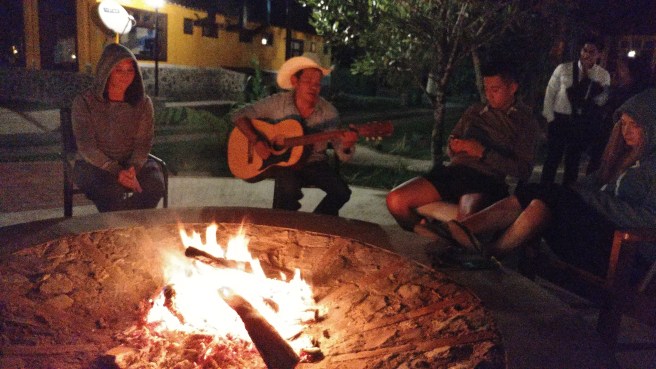
This past summer we were blessed with a hotel that featured a central campfire pit. It was great to relax after a hard day’s work around the campfire, talking about the profound and the sublime, the deep and the shallow, making attempts at humor and suffering groans worthy of the pun. Our team of dissimilar Christians from across the North East and Mid West  became friends and bonded in a wonderful way.

An older gentleman who worked for the hotel would stay late each evening to kindly build us a fire. One evening he brought his guitar and sang for us Guatemalan songs from his youth.

20180811_201344

I’ll never forget the one riff he played that was common to every song. More importantly, I’ll never forget what a blessing he was to all of us gathered round. Indeed, on that cold evening, he brought the warmth.

It is my experience that the people we serve in Guatemala always brings the warmth. A widow raising three young boys invites a neighbor, friend, single mother with eleven children to move in with her. You know, some tasks are done better together than by yourself. That’s some warm love, right there. Brings tears to my eyes.

Family members that cry, hug, and kiss your hand because you just fit their elderly loved one to their first wheel chair never fails to warm my heart. Staffers who volunteer to work both week-end days to serve as translators do so because … well, that’s just how much they love their neighbors, especially those who are most vulnerable – single women and children.

Despite the cold evening temperatures of mountainous Guatemala, what has always warmed my heart is the genuine hospitality and love that I’ve received in return. While it may be our natural tendency to be wary of strangers and to take time to warm up and trust them, I’ve come to know that the warmth I’ve experienced on short-term mission trips is nothing other than a gift of God’s grace and love.

After all, some one, some how, some where has to warm them up!

I’d suggest that what warms people to one another is the heat of God’s grace and love. Divine love burns red hot, like a Louisiana chili pepper, liberating us for a life of discipleship and service, loving God and loving neighbors. Forgiveness and salvation are the twin pinnacles of God’s searing love for us.

God’s love, and his burning desire to share his love, knows no bounds. It doesn’t recognize political borders. It makes no distinction between languages. It doesn’t discriminate due to status, wealth, influence, skin color, or where one goes to worship.

God’s blistering love is bound to warm up everyone serving on a short term mission trip. Yes, everyone gets warmed, even those gathered around a camp fire on those cold mountainous evenings.

Reentry and the Blessing of Guilt

FB_IMG_1534425282693Our short-term mission team recently returned from a week of service in Guatemala. It was a great week. We bonded into a strong, close-knit team. We accomplished a lot of good work in the name of Jesus Christ. Two single mother led families received new houses, 52 people received new wheelchairs, and a lot of food and clothing was distributed during our numerous home visits.

To God be the glory!

FB_IMG_1534509860013My return carry-on bag was packed with filthy laundry and I was wearing the only clean tee shirt and over-sized gym shorts on the flight back home. Pulling into my driveway at 1:30 am felt nearly as good as the hot shower that followed. For the next week, it felt like I could sleep for 12 hours each day. Boy, did my own bed feel good!



Going to work was hard. My body ached. My mind wandered. I felt like it was hard to stray very far from a bathroom. After a few days of adjustment, I was able to determine that I had lost a total of eight pounds, even though we had eaten very well.

Slowly, gradually, life has returned to normal. With the passing of time, I began to discern that something had changed.

A trip to the local supermarket to obtain food for tonight’s dinner cost me about thirty bucks. My internet bill for the cottage is due, totaling seventy-eight bucks. I just paid my thirty-five hundred dollar VISA bill. On Sunday morning, I wrote my weekly pledge check to the church. “Yikes!” I thought to myself, “Money seeps out of our household like sand between your fingers.”

Then, it occurred to me.

The cost for just one good or service is equivalent to the annual income (or substantially more) of most of the families I had just been serving. Income inequality smacked me flat in the face like a shovel, and has left me with a whopper of a guilt laden hangover. I don’t own the entire responsibility for all the economic sin of this world, but I do own my own share of it. What can I say when there is no defense?

“Your honor; I stand guilty as charged.”

Recognizing my own guilt, naming it, and taking responsibility for my own guilt is the beginning of redemption.

What a blessing!

There is no shame in confession. There is no shame in conviction. There is only shame in denial and stubborn self-refusal.

I can’t fix global income inequality. I can’t fix poverty. It is beyond my ability to save the world. This is why we’ve been given a Savior, and it isn’t you or me. His name is Jesus.

It’s a blessing to live in the grace of Christ’s redemption. Jesus Christ confronts our sins, cleanses us of our sins, and rehabilitates us from our brokenness and the brokenness we have caused. He confronts us with our guilt, then leads us down the road towards the redemption and salvation of the world. The price paid for our guilt was his crucifixion. By his blood, our sins are forgiven. By his grace, our redemption, and the redemption of the world, is progressing full steam ahead.

Who could ever imagine that an admission of guilt could become a blessing in God’s kingdom? I couldn’t just a month ago; but, I can today.

I am guilty. At the same time, I am blessed because of my guilt. A difficult re-entry this month from a short-term mission trip to Guatemala taught me this. What else can serving teach us about ourselves, each other, and our God?

Sign me up for another short-term mission trip. Are you in?

20180814_110315_HDR-ANIMATION


Managing Risks

Jesus walked through the storm on the sea. He came near the boat. The disciples were terrified. “But he said to them, ‘It is I; do not be afraid.'” – John 6:20

——-

In seven days I’ll be joining a team headed to Guatemala for another short-term mission trip. We will build two houses, fit 50 people to newly re-manufactured wheelchairs, and distribute food and clothing to many households … mostly single mothers raising children living on the brink of malnutrition. 20170813_083617

Most importantly we will be making friends while sharing the love of Christ.

There are some new members of our team; there always are (which is a good thing!). Undoubtedly, fears and anxiety will surface, not only in their minds, but in the thoughts of their families, friends and loved ones. “Will it be safe?” “What happens if … ?” “I just saw on the news …” “Maybe I made a mistake and should back out.”

I know about fears and anxiety because I’ve been there. This will be my 5th trip to Central America in six years, three of which have been to Guatemala and two to Nicaragua. I still get a little nervous, but each trip gets easier.

A few thoughts.

It is impossible to eliminate all risk. This is true, both home and abroad.

Natural disasters happen. Earthquakes roll and volcanoes blow. Mudslides, floods, and fires happen. Other than taking some common sense precautions, there isn’t much that can be done to manage mother nature.

People can be cruel to one another. Sin manifests itself in violence, oppression, and injustice. God’s laws and civil laws are broken by those who live a life of crime. Ego, hubris, greed, and pride incite atrocious acts, locally, regionally, and nationally.  Tribalism, partisanship, populism, and history can add gasoline to a burning fire. Oh, yes; don’t forget to add in religion, especially deeply held divisive or extremist issues and values.

20150809_183508
Our police escort were all business for the photograph. Immediately after the photo we all broke out in smiles, laughter, and high-fives!

It is possible to do something about the human factor. It is possible to manage risks in such a way that overall risk is reduced to an acceptable or tolerable level. This is my strategy; I pray it can be helpful for you:

  1. Partner with a stable non-governmental organization (NGO) that is based in the location of your mission. Local personnel know the neighborhoods, the security network, the police, and community leaders. Bethel Ministries International in Guatemala know when police are needed for an escort and which neighborhoods to avoid. Bethel works months ahead of time with clergy and faith community leaders to build a network of  support in an area where we will be working.  Trust is built. Friends are made. Risk is reduced.
  2. Follow the rules. Your NGO will provide some basic guidelines for your safety. This is one time where it is essential that you completely comply with their rules. Rules from past trips have been: Travel in pairs. Never walk more than a block from the hotel. Don’t leave the safety of the hotel after dark. Leave the driving up to locals. Handle money with modesty. Keep your passport on you at all times. Trust in the experience and wisdom of those who live locally. They know how to enhance your safety. Risk is reduced.
  3. Follow the example of your team leader and fellow team members who have served on previous mission trips. Listen. Watch. Learn. Then, relax and make a friend, or grow a friendship that has already started. Follow in the footsteps of experience and Risk is reduced.
  4. Draw upon your faith. God has made possible this awesome opportunity to serve and love our neighbors; do you think we are called but meant to fail? No! God gives us partnerships with our NGO and its members. God sends us people to protect us, guide us, even direct us. God gives us the power of prayer, not only for ourselves but also for for those who are supporting our mission. God softened your heart for a reason. God filled it with love to share for a reason. God’s gift of grace is everything. Because of God’s gift, Risk is reduced.

Keep your eye on Jesus. “It is I,” he tells his frightened disciples. “Do not be afraid.”

Have a spectacular, spiritually moving mission experience!