“Five Good Friday Meditations”

John 18:1 – John 19: 42

April 2, 2021

The Rev. Todd R. Goddard, Pastor

Rush United Methodist Church

(The inspiration for these meditations come from “Preaching the New Common Lectionary Year B” by Craddock, Hayes, Holladay, and Tucker. 1990)

Meditation #1: “Resistance”

(John 18:1-12)  http://bible.oremus.org/?ql=389163373

After Jesus had spoken these words, he went out with his disciples across the Kidron valley to a place where there was a garden, which he and his disciples entered. Now Judas, who betrayed him, also knew the place, because Jesus often met there with his disciples. So Judas brought a detachment of soldiers together with police from the chief priests and the Pharisees, and they came there with lanterns and torches and weapons. Then Jesus, knowing all that was to happen to him, came forward and asked them, “Whom are you looking for?” They answered, “Jesus of Nazareth.” Jesus replied, “I am he.” Judas, who betrayed him, was standing with them. When Jesus said to them, “I am he,” they stepped back and fell to the ground. Again he asked them, “Whom are you looking for?” And they said, “Jesus of Nazareth.” Jesus answered, “I told you that I am he. So if you are looking for me, let these men go.” This was to fulfill the word that he had spoken, “I did not lose a single one of those whom you gave me.” Then Simon Peter, who had a sword, drew it, struck the high priest’s slave, and cut off his right ear. The slave’s name was Malchus. Jesus said to Peter, “Put your sword back into its sheath. Am I not to drink the cup that the Father has given me?” So the soldiers, their officer, and the Jewish police arrested Jesus and bound him.

In John,

Jesus does not resist.

Jesus does not resist the detachment of soldiers,

Uniquely described in this Gospel,

Totaling an estimated 600 men.

Jesus does not resist the police from the Chief Priests and the Pharisees,

Estimated to be another 400 well armed men.

One thousand man posse.

Jesus does not resist the political and religious powers of this world

That have joined in opposition to the Word of God.

“In the beginning was the Word …

And the Word was made flesh and dwelt among us.” (1:1, 14)

Jesus does not resist,

But he remains in charge.

His hour had come.

He knew it.

He accepted it.

“Am I not to drink the cup that the Father has given me?” (18:11b)

Take heart.

Jesus remains in charge.

Meditation #2: “Jesus in Charge”

(John 18:13-27)  http://bible.oremus.org/?ql=389165244

First they took him to Annas, who was the father-in-law of Caiaphas, the high priest that year. Caiaphas was the one who had advised the Jews that it was better to have one person die for the people. Simon Peter and another disciple followed Jesus. Since that disciple was known to the high priest, he went with Jesus into the courtyard of the high priest, but Peter was standing outside at the gate. So the other disciple, who was known to the high priest, went out, spoke to the woman who guarded the gate, and brought Peter in. The woman said to Peter, “You are not also one of this man’s disciples, are you?” He said, “I am not.” Now the slaves and the police had made a charcoal fire because it was cold, and they were standing around it and warming themselves. Peter also was standing with them and warming himself.

Then the high priest questioned Jesus about his disciples and about his teaching. Jesus answered, “I have spoken openly to the world; I have always taught in synagogues and in the temple, where all the Jews come together. I have said nothing in secret. Why do you ask me? Ask those who heard what I said to them; they know what I said.” When he had said this, one of the police standing nearby struck Jesus on the face, saying, “Is that how you answer the high priest?” Jesus answered, “If I have spoken wrongly, testify to the wrong. But if I have spoken rightly, why do you strike me?” Then Annas sent him bound to Caiaphas the high priest. Now Simon Peter was standing and warming himself. They asked him, “You are not also one of his disciples, are you?” He denied it and said, “I am not.” One of the slaves of the high priest, a relative of the man whose ear Peter had cut off, asked, “Did I not see you in the garden with him?” Again Peter denied it, and at that moment the cock crowed.

Jesus was arrested and forcibly held that night

In a dungeon beneath the house of Caiaphas.

He was lowered down by a rope.

One way in.

One way out.

One would think the authorities had the upper hand.

They moved the levers of influence.

They had the weapons.

They had the power.

Yet, Jesus remained in charge.

His hour had come.

Since Jesus raised Lazarus from the dead,

The outcome of his trial had been planned and settled.

The trial of Peter, on the other hand, would continue.

The trials of Apostles and Martyrs would continue.

Our trials today continue.

With premeditation,

Jesus was signed, sealed, and delivered to the cross.

God’s will was about to be done.

Meditation #3: Irony

(John 18:28-19:16) http://bible.oremus.org/?ql=389165557

Then they took Jesus from Caiaphas to Pilate’s headquarters. It was early in the morning. They themselves did not enter the headquarters, so as to avoid ritual defilement and to be able to eat the Passover. So Pilate went out to them and said, “What accusation do you bring against this man?” They answered, “If this man were not a criminal, we would not have handed him over to you.” Pilate said to them, “Take him yourselves and judge him according to your law.” The Jews replied, “We are not permitted to put anyone to death.” (This was to fulfill what Jesus had said when he indicated the kind of death he was to die.) Then Pilate entered the headquarters again, summoned Jesus, and asked him, “Are you the King of the Jews?” Jesus answered, “Do you ask this on your own, or did others tell you about me?” Pilate replied, “I am not a Jew, am I? Your own nation and the chief priests have handed you over to me. What have you done?” Jesus answered, “My kingdom is not from this world. If my kingdom were from this world, my followers would be fighting to keep me from being handed over to the Jews. But as it is, my kingdom is not from here.” Pilate asked him, “So you are a king?” Jesus answered, “You say that I am a king. For this I was born, and for this I came into the world, to testify to the truth. Everyone who belongs to the truth listens to my voice.” Pilate asked him, “What is truth?” After he had said this, he went out to the Jews again and told them, “I find no case against him. But you have a custom that I release someone for you at the Passover. Do you want me to release for you the King of the Jews?” They shouted in reply, “Not this man, but Barabbas!” Now Barabbas was a bandit.

Then Pilate took Jesus and had him flogged. And the soldiers wove a crown of thorns and put it on his head, and they dressed him in a purple robe. They kept coming up to him, saying, “Hail, King of the Jews!” and striking him on the face. Pilate went out again and said to them, “Look, I am bringing him out to you to let you know that I find no case against him.” So Jesus came out, wearing the crown of thorns and the purple robe. Pilate said to them, “Here is the man!” When the chief priests and the police saw him, they shouted, “Crucify him! Crucify him!” Pilate said to them, “Take him yourselves and crucify him; I find no case against him.” The Jews answered him, “We have a law, and according to that law he ought to die because he has claimed to be the Son of God.” Now when Pilate heard this, he was more afraid than ever. He entered his headquarters again and asked Jesus, “Where are you from?” But Jesus gave him no answer. Pilate therefore said to him, “Do you refuse to speak to me? Do you not know that I have power to release you, and power to crucify you?” Jesus answered him, “You would have no power over me unless it had been given you from above; therefore the one who handed me over to you is guilty of a greater sin.” From then on Pilate tried to release him, but the Jews cried out, “If you release this man, you are no friend of the emperor. Everyone who claims to be a king sets himself against the emperor.” When Pilate heard these words, he brought Jesus outside and sat on the judge’s bench at a place called The Stone Pavement, or in Hebrew Gabbatha. Now it was the day of Preparation for the Passover; and it was about noon. He said to the Jews, “Here is your King!” They cried out, “Away with him! Away with him! Crucify him!” Pilate asked them, “Shall I crucify your King?” The chief priests answered, “We have no king but the emperor.”

Then he handed him over to them to be crucified.

Oh, the irony of Jesus before Pilate!

Christ, the one in chains, is in charge!

Pilate the governor, shuffles back and forth with indecision

Like a school child trying to please everyone,

Pleasing no one.

Oh, the irony of Jesus before those who would indite him!

The Jewish crowd preached

Righteousness according to the Law, on the one hand,

Yet, they were calling for the murder of Jesus,

A violation of the Ten Commandments, on the other hand.

Oh, the irony of Jesus before his accusers!

How quickly they would confess their true faith:

“We have no king but the emperor.”

On Passover,

The anniversary of freedom from Pharaoh,

Pharaoh is embraced.

Oh, the irony.

Meditation #4: Our Good Shepherd and King

(John 19:17-30)   http://bible.oremus.org/?ql=389165697

So they took Jesus, and carrying the cross by himself, he went out to what is called The Place of the Skull, which in Hebrew is called Golgotha. There they crucified him, and with him two others, one on either side, with Jesus between them.

Pilate also had an inscription written and put on the cross. It read, “Jesus of Nazareth, the King of the Jews.” Many of the Jews read this inscription, because the place where Jesus was crucified was near the city; and it was written in Hebrew, in Latin, and in Greek. Then the chief priests of the Jews said to Pilate, “Do not write, ‘The King of the Jews,’ but, ‘This man said, I am King of the Jews.’” Pilate answered, “What I have written I have written.” When the soldiers had crucified Jesus, they took his clothes and divided them into four parts, one for each soldier. They also took his tunic; now the tunic was seamless, woven in one piece from the top. So they said to one another, “Let us not tear it, but cast lots for it to see who will get it.” This was to fulfill what the scripture says, “They divided my clothes among themselves, and for my clothing they cast lots.” And that is what the soldiers did. Meanwhile, standing near the cross of Jesus were his mother, and his mother’s sister, Mary the wife of Clopas, and Mary Magdalene. When Jesus saw his mother and the disciple whom he loved standing beside her, he said to his mother, “Woman, here is your son.” Then he said to the disciple, “Here is your mother.” And from that hour the disciple took her into his own home. After this, when Jesus knew that all was now finished, he said (in order to fulfill the scripture), “I am thirsty.” A jar full of sour wine was standing there. So they put a sponge full of the wine on a branch of hyssop and held it to his mouth. When Jesus had received the wine, he said, “It is finished.” Then he bowed his head and gave up his spirit.

“I am the Good Shepherd,” Jesus taught.

Indeed, Christ was the Good Shepherd until the end.

As he hung there dying

Jesus made arrangements for the care of his mother,

Mary the wife of Clopas,

and Mary Magdalene.

Jesus, the Good Shepherd, gives his life for his sheep.

Even Pilate knew what the crowd did not:

That Jesus was the King of the Jews.

He had it printed up there in three different languages

So that everyone would know where he stood.

“What I have written I have written,” he informs

Those who just confessed that the emperor was their king.

What would only become apparent in hindsight

Is that Jesus Christ is the King of all God’s creation.

By his death, he promised to ascend from the grave.

By his resurrection, he promised to ascend to the right hand of his Father.

These aren’t empty promises from a wise Rabbi

Who had a large following,

Who’s own followers turned on him.

These promises would be fulfilled

By the One who keeps his word,

Is faithful to his covenants,

Who has the power and the love

To be our King.

These are the promises of our King!

Meditation #5: The New Exodus

(John 19:31-42)  http://bible.oremus.org/?ql=389165782

Since it was the day of Preparation, the Jews did not want the bodies left on the cross during the sabbath, especially because that sabbath was a day of great solemnity. So they asked Pilate to have the legs of the crucified men broken and the bodies removed. Then the soldiers came and broke the legs of the first and of the other who had been crucified with him. But when they came to Jesus and saw that he was already dead, they did not break his legs. Instead, one of the soldiers pierced his side with a spear, and at once blood and water came out. (He who saw this has testified so that you also may believe. His testimony is true, and he knows that he tells the truth.) These things occurred so that the scripture might be fulfilled, “None of his bones shall be broken.” And again another passage of scripture says, “They will look on the one whom they have pierced.”

After these things, Joseph of Arimathea, who was a disciple of Jesus, though a secret one because of his fear of the Jews, asked Pilate to let him take away the body of Jesus. Pilate gave him permission; so he came and removed his body. Nicodemus, who had at first come to Jesus by night, also came, bringing a mixture of myrrh and aloes, weighing about a hundred pounds. They took the body of Jesus and wrapped it with the spices in linen cloths, according to the burial custom of the Jews. Now there was a garden in the place where he was crucified, and in the garden there was a new tomb in which no one had ever been laid. And so, because it was the Jewish day of Preparation, and the tomb was nearby, they laid Jesus there.

The dirty work was left up to the soldiers,

Grunts on the ground.

The very ones who had flogged Jesus,

Dressed him like a comic and struck him in the face,

Pounded stakes through his hands and feet,

And raised up wine on a stick right before Jesus died

Now had the responsibility to remove the corpse from the public’s eye.

It was the soldiers who hand divided his clothes,

Had scorned him with their taunts,

Who had cast lots for his seamless tunic,

To fulfill scripture.

Sometimes the movement of God

Is nearly imperceptible,

Like a 3.2 earthquake three states away.

It was the soldiers who didn’t break a corpse’s legs,

Instead pierced it in the side

“so that scripture might be fulfilled. (19:36)

The soldiers found more courage in scripture and in life

Than Joseph and Nicodemus could only find in death.

Christ dies as the Passover lamb,

Exactly according to scripture,

And thus his caretakers treat his corpse.

This Passover proclaims a new exodus,

Not from Egyptian slavery,

But from bondage to sin and death.

A new exodus has begun;

The water and blood of Christ co-mingled

Becomes a new cosmic reality.

Through Baptism and Eucharist

We now venture out into an unexplored spiritual landscape.

We now leave behind the self, the finality of death.

We now make a new exodus:

We are now the Body of Christ.

We’ve become his body.

“Love One Another”

John 13:1-17, 31b-35

Maundy Thursday, April 1, 2021

The Rev. Todd R. Goddard, Pastor

Rush United Methodist Church

John 13:1-17, 31b-35

Now before the festival of the Passover, Jesus knew that his hour had come to depart from this world and go to the Father. Having loved his own who were in the world, he loved them to the end. The devil had already put it into the heart of Judas son of Simon Iscariot to betray him. And during supper Jesus, knowing that the Father had given all things into his hands, and that he had come from God and was going to God, got up from the table, took off his outer robe, and tied a towel around himself. Then he poured water into a basin and began to wash the disciples’ feet and to wipe them with the towel that was tied around him.

He came to Simon Peter, who said to him, “Lord, are you going to wash my feet?” Jesus answered, “You do not know now what I am doing, but later you will understand.” Peter said to him, “You will never wash my feet.” Jesus answered, “Unless I wash you, you have no share with me.” Simon Peter said to him, “Lord, not my feet only but also my hands and my head!” Jesus said to him, “One who has bathed does not need to wash, except for the feet, but is entirely clean. And you are clean, though not all of you.” For he knew who was to betray him; for this reason he said, “Not all of you are clean.”

After he had washed their feet, had put on his robe, and had returned to the table, he said to them, “Do you know what I have done to you? You call me Teacher and Lord—and you are right, for that is what I am. So if I, your Lord and Teacher, have washed your feet, you also ought to wash one another’s feet. For I have set you an example, that you also should do as I have done to you. Very truly, I tell you, servants are not greater than their master, nor are messengers greater than the one who sent them. If you know these things, you are blessed if you do them.

When he had gone out, Jesus said, “Now the Son of Man has been glorified, and God has been glorified in him. If God has been glorified in him, God will also glorify him in himself and will glorify him at once. Little children, I am with you only a little longer. You will look for me; and as I said to the Jews so now I say to you, ‘Where I am going, you cannot come.’ I give you a new commandment, that you love one another. Just as I have loved you, you also should love one another. By this everyone will know that you are my disciples, if you have love for one another.”

| Centering Prayer |

Today’s message comes in three meditations with a moment of silent reflection following each.

1. Knowing

That the devil had already put it into the heart of Judas to betray him,

Jesus loved his own who were in the world,

He loved them to the end;

Yes, Jesus even loved Judas Iscariot.

Knowing

That the Father had given all things into his hands,

And that he had come from God

And was going to God,

Jesus washed the disciples’ feet and wiped them with a towel,

An act that would have usually been relegated to

The servant of the lowest stature.

It must have been an interesting dynamic

When Jesus stoops to wash the feet of Judas.

What was Judas thinking?

Were his eyes filling with tears?

Or were his teeth clenched in rage?

John leaves little to the imagination what Jesus was thinking:

Love and service.  

Love, then serve.

Start with love.

Always lead with love.

“Have you loved them first?”

I gently asked a fellow Christian,

Who was filled with frustration and anger

Over the apparent apathy of others.

Granted, apathy isn’t in the same league as betrayal;

But both are to be turned back to

Our Lord’s ultimate concern …

Judgment is God’s affair,

Not yours, mind, or anyone else.

Lead with love.

Love the easy to love.

Love these who are more difficult to love.

Love one another with the same love that Jesus had for Judas.

A question for your reflection:

How does the fact that Jesus loved Judas

Enough to wash his feet,

Enough to love him to the end,

Impact your life

And your relationship with Christ?

(Silent reflection)

2. Resistance.

While we don’t know how others responded,

Peter responds with resistance.

He resists Jesus’ effort to love him

Every step of the way.

Knowing

That his hour had come to depart from this world

And go to the Father,

Jesus comes to Simon Peter with a bowl and towel in hand.

Unlike Judas,

Who had conspired with the devil

And had already put his plan of betrayal into motion,

Simon Peter probably hadn’t even thought of denying Jesus.

It mind not even crossed his mind.

Denial had no discernable premeditation.

Bold, brash, and full of himself;

Peter’s self-confidence

And personal belief that

He was taking part in some grand, history making political insurrection

Probably keep him blind to his greatest vulnerability:

Denying Jesus if cornered and threatened.

To one degree, or another,

Isn’t our Christian bravado similar to Simon Peter’s?

Of course, we’d never deny Jesus,

Even if put in a pinch,

We say to ourselves.

Of course, we’d never allow Jesus to wash our feet,

Even though our life might be a wreck and

We are soiled and covered in filth.

Of course, we’d never allow Jesus to love us,

In such a way that would crack our most stubborn defenses.

But then, we find ourselves

Whistling while walking past the graveyard at night,

Wondering,

If it could happen to Simon Peter,

Maybe it could happen to me, too.

Would you or I deny Jesus if cornered or threatened?

(Silent reflection)

3. Christian bravado and pride

Has a potent antidote,

Jesus teaches us;

Humility.

Humble service.

Loving service.

Practically speaking,

Should we be in the business of foot washing for cleanliness sake?

Or, should we be in the business of serving others

To remove all that makes one and the world unclean?

Christ’s love is leading us to clean up the world,

Starting right here,

Right now,

With you and me

Before this Table.

There is no greater symbol of humility,

Of service and love,

Than our Lord, Jesus

Sharing his body and blood

For the forgiveness and salvation of creation.

His body and blood makes us clean.  

The loving sacrifice of Christ’s body and blood

Is cosmic in reach, while

Personal in experience.

Bread and wine fill us

And remind us,

Of God’s great love for us.

Love tenderizes the heart

And leads one to roll up the sleeves.

Love spreads faster than Covid-19

And is more powerful than any treatment, surgery, or therapy.

Love teaches by example

Causing all the world to take notice.

Love one another,

That all the world will

Know

That you and I

Are disciples of Jesus Christ.

Does the world see Jesus in your love?

(Silent reflection)

Amen.

“For This Reason I Have Come”

John 12:20-33

March 21, s021 – Fifth Sunday of Lent

The Rev. Todd R. Goddard, Pastor

Rush United Methodist Church

John 12:20-33

Now among those who went up to worship at the festival were some Greeks. They came to Philip, who was from Bethsaida in Galilee, and said to him, “Sir, we wish to see Jesus.” Philip went and told Andrew; then Andrew and Philip went and told Jesus. Jesus answered them, “The hour has come for the Son of Man to be glorified. Very truly, I tell you, unless a grain of wheat falls into the earth and dies, it remains just a single grain; but if it dies, it bears much fruit. Those who love their life lose it, and those who hate their life in this world will keep it for eternal life. Whoever serves me must follow me, and where I am, there will my servant be also. Whoever serves me, the Father will honor.

“Now my soul is troubled. And what should I say—‘Father, save me from this hour’? No, it is for this reason that I have come to this hour. Father, glorify your name.” Then a voice came from heaven, “I have glorified it, and I will glorify it again.” The crowd standing there heard it and said that it was thunder. Others said, “An angel has spoken to him.” Jesus answered, “This voice has come for your sake, not for mine. Now is the judgment of this world; now the ruler of this world will be driven out. And I, when I am lifted up from the earth, will draw all people to myself.” He said this to indicate the kind of death he was to die.

| Centering Prayer |

It is my habit to listen to podcasts in the car.

I heard one podcast commentator recently say,

“We’re all going to die; and it’s going to be hilarious!”

I nearly drove off the road.

The conversation was about technology.

One spoke about his son watching

YouTube failure videos.

Failure videos are short clips of

People making really bad decisions,

Doing really dumb things,

and often getting really badly hurt …

Why would anyone create a failure video?

It’s all about producing the “failure,”

Posting the video online,

Going viral, and

Hoping popularity and fame results in a paycheck.

Yes, people get paid for such nonsense.

“We’re all going to die; and it’s going to be hilarious!”

Another commentator spoke about artificial intelligence;

Where computers are programmed to learn on their own initiative.

A video from a University of Michigan robotics lab was cited

(https://www.youtube.com/watch?v=QhyMyXRutqY )

Showing a robot learning how to walk.

The implications of a self learning robot

Evoke images of sci-fi movies like “The Terminator”

With robot uprisings that take over the world.

“Be afraid,” the commentator said. “Be very afraid.”

To which the other repeated,

“We’re all going to die; and it’s going to be hilarious!”

Jesus is about to die

and it is anything but hilarious.

Thank goodness our Lord’s suffering, Passion, and death

Didn’t take place in today’s world,

Because it would go viral on social media …

For about 10 minutes.

It would be found and pulled down as inappropriate content.

It would be in the spotlight until the next “breaking news” event broke.

Then it would become an obscure piece in the newspaper

Or a lost soundbite on the evening news.

Jesus is deadly serious.

And so should we.

Early Christian Apostles

Set aside 40 days for all Christians to prepare ourselves

For the passion, suffering, death, and resurrection of Jesus.

Lent was, and remains to this day, a time of preparation.

Early Christian practice

Used the first three weeks of Lent

As a time for inward preparation.

Self-reflection.

Self-examination.

Personal confession.

Repentance.

Forgiveness.

Absolution.

Fasting.

Abstinence.

The final two weeks of Lent

(starting this Sunday)

The focus of the faithful is to pivot

To the suffering and death of Jesus on the cross.

We have two weeks to contemplate the crucifixion of Jesus Christ.

Think Passion and death.

Some Greeks from out-of-town attempt to drop in and cold call Jesus.

The best way to get past the door keeper is to know someone,

Or know someone who knows someone.

Any kind of connection will do.

Philip, with his Greek name,

From Bethsaida, a mixed population of Jews and Gentiles in the north,

Was the perfect go-between.

“Sir, we wish to see Jesus.” (12:21)

As I’ve often said, the Gospel of John is most deeply concerned

With answering the question, “What does it mean?”

What does it mean to see Jesus?

To perceive this Jesus who is about to die?

A good place to start over these next two weeks

Is to create a visual devotional of the passion and crucifixion of Jesus.

This is where the internet is so valuable.

Consider doing an image search.

Start with fine art: The masters. Renaissance art.

Do an image search of crucifixion using the key words “stained glass”. “Cathedrals”. “Artists”. “Guilds”.

Don’t forget to do an image search of crucifixion icons;

You’ll discover some of the most moving visual images of the crucifixion

Mostly coming from our Eastern Orthodox brothers and sisters.

Save your favorite pictures.

Print them out.

Surround yourself with visual masterpieces of the crucifixion of Jesus

Even as you contemplate this faith changing event in your daily devotions and prayers.

We wish to see Jesus.

Perception is more than visual.

Consider diving into the music of the passion and death of Jesus Christ

Over these next two weeks.

Every year I make two tried and true visits:

The first is Handel’s Messiah.

I listen to it over and over again.

During the conclusion of Lent and Holy Week

The second part of Messiah takes on added weight,

For it covers Christ’s passion and death,

His resurrection and ascension.

The second stop I make is the 1970’s rock opera

Jesus Christ Superstar by Andrew Lloyd Webber and Tim Rice.

I play it loud in the car and I sing along with every word.

I play it quietly in the office, filling my environment with Jesus

(I’m playing it as I write this sermon).

I’ve loved Jesus Christ Superstar from the beginning.

Perceiving Jesus as he makes his way to the cross

Can become life changing.

Music is a graceful compliment to the words of passion and crucifixion.

Allow sacred music to help you see Jesus.

Listen for the whisper of God to help answer the question,

“What does the crucifixion mean?”

“The hour has come for the Son of Man to be glorified,” (12:23)

Jesus responded to the unnamed gentile world-travelers who came to see him.

Most of us have a deeply developed Gospel world view

That is rooted in the synoptic Gospels: Matthew, Mark, and Luke.

In each of these Gospels

We have shaped an image

Of a Jesus who was reluctant to die,

Negotiating with the Heavenly Father in the Garden of Gethsemane,

“… if it is possible, let this cup pass from me.” (Matthew 26:39)

Even on the cross, Matthew reports Jesus crying out

“My God, my God why have you forsaken me?” (Matthew 27:46)

The narrative from Matthew and Mark are nearly word-for-word identical matches.

Yet, here in John, we hear in Jesus’ final discourse

With these unnamed Greeks and his disciples serving as his audience

A complete willingness to accept, even embrace, his crucifixion.

John’s Gospel requires us to ask,

Who would embrace their own death?

Why would Jesus welcome his own death?

Faithful followers of Christ

Have heard the promise

And believe his word.

O death, where art thou sting?

There is no sting when we have the courage

To face our own mortality

Believing that

Just as Christ faced his mortality,

Was resurrected and ascended to heaven,

So too, can we look forward to the same gift of grace.

Death becomes no more of a sting

Than stepping from this world and entering the next.

John faithfully allows Jesus to answer the “Why? question.”

“Father, glorify your name.” (12:28)

Jesus dies to glorify God.

The humiliation of public shame, suffering, and death,

Is completely erased

By the glory of God’s gift of resurrection.

The selfless act of crucifixion propels the message of God’s grace

Far beyond a single, isolated act,

In a foreign culture,

In a faraway land,

Separated by thousands of years

Into a cosmic, ongoing truth.

The glory of God

Through death and resurrection

Becomes a compassionate act of inclusion.

The Greeks who came to see Jesus were included in God’s plan for salvation.

The early Church exploded,

Caught fire,

And spread to every corner of the world

Because God was glorified.

We worship today

Because Jesus brings glory to God.

This gift of God’s grace

Only scratches the surface of the enormous love

God has for you and me.

Imperfect as we all are,

God still loves every last one of us.

Indeed, “God so loves the world

That He gave His only Son,

so that everyone who believes in him

may not perish

but may have eternal life.” (3:16)

Crucifixion and resurrection brings glory to God

“And I,” Jesus continues,

“when I am lifted up from the earth,

Will draw all people to myself.” (12:32)

All people are engulfed

In God’s radical hospitality,

God’s extravagant grace,

God’s enormous love.

“For this reason I have come,” Jesus tells us. (12:27)

Dearly beloved,

Over the course of this coming week and Holy week to follow,

Try not to be distracted by the complexities of life.

Avoid distractions.

Do the best you can to ease the anxiety of fragile health and uncertain outcomes.

Be still and avoid the temptation to be swept into disputes and conflicts.

Temper the tongue, step back, and count to ten.

Reject temptations and bring an end to sinful behavior.

Dearly beloved,

Keep your undivided attention upon Jesus.

See and hear Jesus.

Perceive our Savior as you’ve never experienced Him before.

Wear his suffering, and may your suffering be eased.

Witness his death, and may the sting of death in your life be removed.

Dearly beloved,

Journey forward.

Lean into the crucifixion

Knowing full well,

The glory that comes beyond the grave,

The glory of our Lord, our Heavenly Father.

May this glory keep us close to Christ

And draw all people to Him.

Amen.

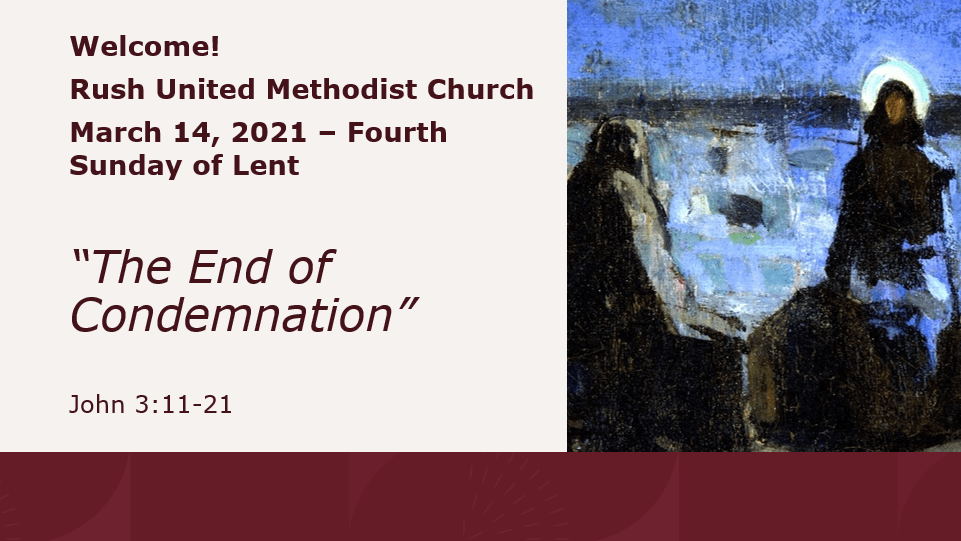
“The End of Condemnation”

John 3:14-21 and Numbers 21:4-9

Lent 4B, March 14, 2021

The Rev. Todd R. Goddard, Pastor

Rush United Methodist Church

John 3:14-21

And just as Moses lifted up the serpent in the wilderness, so must the Son of Man be lifted up, that whoever believes in him may have eternal life. “For God so loved the world that he gave his only Son, so that everyone who believes in him may not perish but may have eternal life.” Indeed, God did not send the Son into the world to condemn the world, but in order that the world might be saved through him.

Those who believe in him are not condemned; but those who do not believe are condemned already, because they have not believed in the name of the only Son of God. And this is the judgment, that the light has come into the world, and people loved darkness rather than light because their deeds were evil. For all who do evil hate the light and do not come to the light, so that their deeds may not be exposed. But those who do what is true come to the light, so that it may be clearly seen that their deeds have been done in God.”

| Centering Prayer |

I had an aunt June

Who liked to complain about nearly everything.

As a young child I remember

How embarrassing it was to go to a restaurant with her.

She’d send

Her coffee back for being too stale,

Her soup back for being too cold,

Her steak back for being too rare or too well done.

Every single time.

Back in the day

When she waited tables

She would ‘never give such shoddy service,’

She’d muse indignantly.

No waitress or waiter could live up to her expectations.

Ever.

Aunt June was hardly unique.

A lot of us like to complain, don’t we?

Some taxpayers complain taxes are too high and the stimulus check will be too small.

Others complain taxes are too low and the stimulus will be too large.

One administration blames its predecessor.

Both parties complain about the other.

“Obstructionists! Hypocrites!” They cry.

Albany complains about Washington and

Washington complains about Albany.

We complain about potholes, police, polls, and pop quizzes.

We complain about rights, responsibility, and reason.

We complain about referees, officials, and umpires.

We complain about ex-boyfriends and ex-girlfriends, ex-husbands and ex-wives.

We would even complain about the weather, if we ….

Oh, wait.

We complain about the weather all the time!

It seems like the COVID-19 pandemic has only made our complaints worse.

We complain because we can.

For western Americans it is about

Free choice.

Freedom of speech.

More than just Constitutional rights;

Free choice is a gift from God.

Free choice is given with the expectation of responsibility.

It is our responsibility

To chose wisely,

To behave responsibly,

To speak kindly, and

To walk humbly.

We are not the first generation of complainers.

Consider our Hebrew ancestors in Numbers 21:4-5

Newly freed from Egyptian captivity:

From Mount Hor they set out by the way to the Red Sea, to go around the land of Edom; but the people became impatient on the way. The people spoke against God and against Moses, “Why have you brought us up out of Egypt to die in the wilderness? For there is no food and no water, and we detest this miserable food.”

The Lord grew tired of their complaining

About no food, no water, and fear of death.

‘Blah! Blah! Blah!

Talk to the hand!

Shut your pie hole!

Enough of your complaining!’

The narrative continues in verse 6:

Then the Lord sent poisonous serpents among the people, and they bit the people, so that many Israelites died.

Be forewarned, people of God.

The Lord’s response to their complaints?

Judgment.

Condemnation.

The Lord sent them boat loads of poisonous serpents!

Our ancestors got the message.

Continuing with verse 7:

The people came to Moses and said, “We have sinned by speaking against the Lord and against you; pray to the Lord to take away the serpents from us.”

They took three actions:

1. They stopped complaining,

2. Confessed their sin,

3. And begged for God’s mercy.

(Right there is sufficient material for a good three-point sermon!)

The episode concludes with verses 8 and 9:

So Moses prayed for the people. And the Lord said to Moses, “Make a poisonous serpent, and set it on a pole; and everyone who is bitten shall look at it and live.” So Moses made a serpent of bronze, and put it upon a pole; and whenever a serpent bit someone, that person would look at the serpent of bronze and live.

This, then is God’s mercy:

Moses was to make a serpent of bronze.

Mount it on a stick.

Lift it up.

Anyone bit by a poisonous snake who looks up at the bronze serpent will live.

God’s merciful promise was:

Look up and be saved.

“So must the Son of Man be lifted up,” (3:14)

Jesus tells shadowy Nicodemus,

“That whoever believes in him may have eternal life.” (3:15)

When we think of Christ being lifted up during this season of Lent,

Many times we focus our thoughts on his crucifixion.

Of course, the crucified Christ is lifted high upon a cross.

But, let think more broadly.

Christ is lifted from the grave.

Christ is lifted into heaven,

Ascending to the right hand of the Heavenly Father.

The Gospel of John encourages the faithful to lift up Jesus Christ,

That he might be glorified and praised.

When we lift up Jesus Christ,

The Light of the World,

Darkness is chased away.

Shadows of sin and evil are washed away in God’s radiant light.

The light of Christ

Reveals his will for our lives and

Sets a moral compass in ourselves and in our community.

The light of Christ

Illuminates God’s values of justice, mercy, and love.

There was a day and time in our not-too-distant past

That John 3:16 had such popularity

That nearly everyone in a crowd, (atheists included)

Could perfectly recite it:

“For God so loved the world that he gave his only Son,

so that everyone who believes in him may not perish

but may have eternal life.” (3:16)

Sadly, I’m not certain this is true today.

Let’s take a closer look.

God so loves the world …

All the people of this world.

God so loves everything created,

In which we live and find happiness.

The person and the context 

Are created and are loved by God.

Just as God loves you and me,

So too does God love others.

We are to love others just as God loves others.

Just as God loves creation,

So too are we to love creation.

Loving creation requires us,

Individually and corporately,

To practice good stewardship of the environment.

Love and care for the world,

Because God loves and cares for the world.

The frequently forgotten balance for John 3:16

Is Jesus’ very next sentence:

“Indeed, God did not send the Son into the world to condemn the world, but in order that the world might be saved through him.” (3:17)

Free choice,

Free speech,

As we have seen,

Can get one into trouble,

Can lead to the darkness.

Once in the darkness, it’s hard to break out.

It’s hard, and it gets harder,

To return to the light the longer one lingers in the darkness.

Quite clearly,

Jesus makes his position clear as crystal

Stating that

Condemnation is not God’s will.

This point is so important, it bears repeating:

Condemnation is not God’s will.

It wasn’t God’s will that those bitten by one of his poisonous snakes

Should be condemned to die.

Neither is it God’s will that those who live in the darkness

Should be eternally condemned to live in sin.

God is sure-as-shooting

In the justice business,

But, condemnation?

Not so much.

We condemn ourselves

By choosing to live in darkness,

By making wrong choices when we know better,

By blaming and complaining,

By failing to take responsibility for our words.

By failing to discipline our behavior.

Rather,

God is in the salvation business.

God had Moses mount a bronze snake on a stick

That all who looked upon it might be saved.

God is in the salvation business,

That all who look upon Jesus and believe in him might be saved.

I recall an old theological saw from my seminary days that states

“Grace may be free, but it isn’t cheap.”

What does this mean?

God’s grace,

The gift of salvation,

Is freely, lavishly, abundantly given.

God’s grace cannot be bought, stolen, or traded.

You will not perish, Jesus promises.

You may have eternal life.

This is God’s gift.

This is what is called “grace.”

There is no price, yet it is priceless.

There is no expectation of reciprocity.

God just gives it away.

Grace is free, but it isn’t cheap.

But there is one qualifying demand,

That we believe in Jesus Christ,

The Son of Man,

The Son of God.

Believe.

Salvation is already yours.

I’ve been a Christian all my life,

Since my infant baptism.

I’ve tried to follow Jesus every moment of every day,

Some days more successfully than others.

And, yet, I know

My belief ebbs and flows like an ocean tide.

My belief never dries up and blows away;

Neither does is maintain record flood levels.

I’ve been around ordained ministry for a long time.

It has been a privileged to be surrounded by beacons of spirituality;

Mentors, guides, and fellow disciples traveling this same river of faith.

Some towers of faith were ordained, many others, not.

At the same time

I’ve seen some of the most faithful stumble and fall,

Some spectacularly on the front page of the newspaper,

Others quietly fading away,

Others becoming utterly defeated

By sanity, addiction, end of life, money, power, or organized religion.

I can see no rhyme or reason;

No discernible patterns upon which conclusions can be drawn.

I refuse to stand in judgment of others.

I can only observe that which I intuitively feel in my own soul;

That belief isn’t a one-and-done proposition.

Belief is a lifetime, ongoing effort.

There but by the grace of God goes I,

I think to myself,

Because I know this to be true.

Whoever believes in Jesus

Will not perish

But may have eternal life.

Every day we are called to believe in Jesus.

Like maintaining a house or treating a patient,

Belief begins with assessment:

Where does my belief stand today?

Where was it yesterday?

What is going to be the trajectory of belief tomorrow?

What assets do I have to shore up my faith?

To turn around negative trends?

What assets do I have internally,

And what assets must I obtain from others?

For example, I can pray and study scripture privately.

But I have to hold myself accountable and

Take part in communal, corporate worship each Sabbath.

Some need more coaching and encouragement than others.

Likewise,

What are the deficits in my life that impact negatively on my faith?

What can I do to reduce or eliminate

People, situations, or behaviors

That undermines my belief? 

Believe in Jesus.

Lord, help my unbelief!

Do not let me fall into the abyss!

Maintaining belief requires intentional action.

A passive, nonchalant posture towards faith development

Is a recipe for disaster.

When we discipline our words and deeds

The ebbs and flows of faith and doubt

Are evened out.

Treatment doesn’t work if you don’t follow your doctor’s orders.

Your house doesn’t get repaired if plans sit on the drawing board.

Faith in Jesus demands action.

Set yourself up for success.

Surround yourself with all the right people.

Stop hanging around with the wrong crowd

That sabotage faith.


Learn from those who are more seasoned in the spiritual life.

Share with those who are traveling the journey with you.

Offer a hand up to those who are coming along behind.

Listen for the movement of the Spirit that dwells within

And don’t be afraid to tap into its power.

Take action to strengthen belief in Jesus Christ!

Lift up Christ.

Glorify and praise him

That his light might shine upon the world.

God brings justice to the world,

But the only condemnation is

That which we heap upon ourselves.

May the light of Christ bring an end to our self-imposed sentence.

May the light of Christ save us.

Believe in Christ.

When doubt inevitably returns,

Oppose it with every effort.

Believe.

Believe in Christ and receive eternity.

Amen.

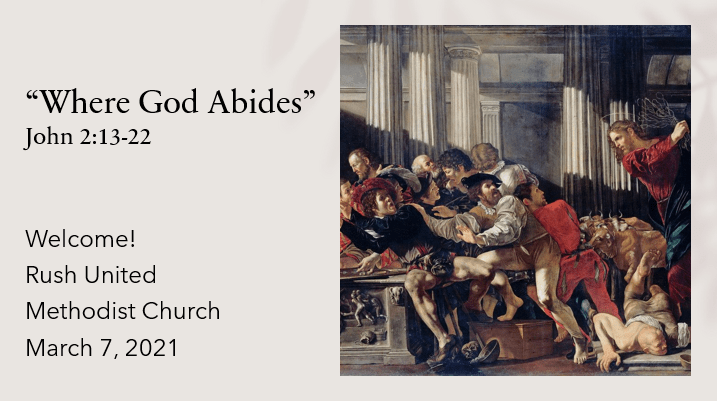
“Where God Abides”

John 2:13-22

March 7, 2021 – Lent 3

The Rev. Todd R. Goddard, Pastor

Rush United Methodist Church

John 2:13-22

The Passover of the Jews was near, and Jesus went up to Jerusalem. In the temple he found people selling cattle, sheep, and doves, and the money changers seated at their tables. Making a whip of cords, he drove all of them out of the temple, both the sheep and the cattle. He also poured out the coins of the money changers and overturned their tables. He told those who were selling the doves, “Take these things out of here! Stop making my Father’s house a marketplace!” His disciples remembered that it was written, “Zeal for your house will consume me.”

The Jews then said to him, “What sign can you show us for doing this?” Jesus answered them, “Destroy this temple, and in three days I will raise it up.” The Jews then said, “This temple has been under construction for forty-six years, and will you raise it up in three days?” But he was speaking of the temple of his body. After he was raised from the dead, his disciples remembered that he had said this; and they believed the scripture and the word that Jesus had spoken.

| Centering Prayer |

Think of a nest;

Of a bird settling into that nest.

“Every bird nests with its kind,”

is says in the Talmud Baba Kammah,

a writing of Rabbinic Judaism,

“and man with its like.”

(http://halakhah.com/babakamma/babakamma_92.html)

The bird settles.

It inhabits.

It hunkers down, nestles in, and wraps the nest around itself.

The bird dwells safe and secure in the nest.

Where does God dwell?

The word Shekinah ( SHeˈkīn-ə )

Is an English transliteration

Of the Hebrew noun meaning

Dwelling,

Settling.

It signifies the dwelling or settling of the

Divine Presence of God.

(http://en.wikipedia.org/wiki/Shekhinah)

The word Shekinah alone

Is a wonderful springboard to the imagination.

It serves as an invitation for the faithful

To search further,

Listen more closely,

Encourage curiosity in one another,

Especially during this time of Lent, asking

Where does God dwell?

Where is God’s neighborhood?

In the beginning,

God is more of a dis-embodied voice,

Speaking to Adam and Eve,

Noah and Abram.

At most, God is described as a vision in a dream.

God first abides

As near as I can tell,

In the Burning Bush that is not consumed on the mountain top.

God speaks to Moses from the Bush,

Telling him to rescue God’s people from Egyptian captivity.

(Exodus 3)

During the Exodus and the period of time Canaan was conquered,

The Tabernacle served as a portable dwelling place

– a tent sanctuary, if you will –

For the Divine presence.

The Tabernacle was also the location of both Ten Commandment tablets

Given by God to Moses on the mountain.

Our Hebrew ancestors transported the Tabernacle

On the journey from Egypt to Palestine.

When Solomon completed construction

Of the Temple in Jerusalem a thousand years later,

The Tabernacle,

The believed residence of God and location of the sacred tablets,

Was permanently located

In the Holy of Holies,

Behind the Inner Temple.

See the book of Kings, chapter 8,

For a beautiful description of the dedication of the Temple.

The Temple was plundered by Nebuchadnezzar in 598 BCE.

Perhaps during this time

The Psalmist proclaimed,

“I will not give sleep to my eyes or slumber to my eyelids,

until I find a place for the Lord,

a dwelling place for the Mighty One of Jacob.”

(Psalms 132:4-5)

The Temple was rebuilt, starting in 536 BCE by Cyrus the Great

As recorded in Ezra and Nehemiah,

Dedicated in 515 BCE, and

Rededicate by Judas Maccabeus in 165 BCE.

Herod the Great renovated and expanded the Temple in 20 BCE.

It is following this last renovation

Which Jesus visited the Temple

And drove out the money changers and merchants from the outer courts

With whips of chords.

“Take these things out of here!

Stop making my Father’s house a marketplace!”

Jesus commanded with zealous consummation.

(John 2:16b)

Where does God dwell?

In the time of Jesus,

It was believed that God abided

Literally in the very Temple

He just cleared.

Jesus answered their criticism with

“Destroy this temple and in three days I will raise it up.”

(John 2:19)

Let’s be clear,

The entire Temple system was held together by a thread.

Organized Judaism resorted to

Taxes, tithes, extortion, and fund raisers

for their very existence.

Selling livestock and changing money were necessary for survival.

And Jesus tells them by words and actions to

Shut it down.

Shut it down?

Where would the Shekinah go?

Where would the Divine presence of God abide?

“That’s just crazy talk, Jesus.

Get hold of yourself, and stay out of our business,”

This was the response Jesus received from religious leaders.

Jesus is asking

Is the Temple necessary?

His table turning disruption answered the question:

Not anymore.

The Gospel today begs the fundamental question of God’s location:

Where does God abide?

Where does God abide?

This was the question of the Samaritan woman

When she asked Jesus about worship.

(John 4:19-24)

Should we worship at Mt. Gerizim or Jerusalem?

“Neither on this mountain nor in Jerusalem.

… true worshipers will worship the Father in spirit and truth.”

When the blind man sees who Jesus is, he worships him.

(John 9:35-38).

He doesn’t direct his worship to the Holy of Holies.

He worships Jesus.

His blindness, both physical and spiritual, is gone.

The man born blind can now see that

Jesus himself is the presence of God.

John confirms the dwelling place of God

In his opening monologue,

“It is God the only Son, who is close to the Father’s heart, who has made him known.” (John 1:18)

At the center of Jesus cleansing the Temple is this fundamental question:

Where does God abide?

Jesus proclaimed: the Temple is his body.

The Shekinah has left the Holy of Holies

And resides within his body.

The Body of Christ is the dwelling place of the Divine Presence.

Let that sink in for a moment.

The Body of Christ is the dwelling place of God.

In the post Passion, Death, Resurrection, and Ascension narrative of the New Testament,

The Body of Christ takes on new meaning.

The Body becomes all of Christ’s followers,

All Christ’s disciples,

The localized and globalized community of faith

Baptized and known as Christians

Who follow Jesus as the Son of God.

This review of Hebrew and New Testament scripture

Is a wonderful tour academic,

But how does this impact you and me today?

1. God moved into our neighborhood

When we became a member of the Body of Christ.

Peterson, in The Message, uses this phrase,

And I like it a lot:

God moved into our neighborhood.

God has never been so approachable

Or as intimate

As God is Right this very moment.

God is with you and is in you.

“Those who love me will keep my word,

and my Father will love them,

and we will come to them and make our home with them,”

Jesus promises.

(John 14:23)

You and I have become the vessel for Shekinah,

The dwelling of God.

2. “Where two or three are gathered in my name, I am there among them,”

Jesus teaches.    

(Matthew 18:20)

Love it or hate it.

God dwells in the local church.

We all love those mountain top experiences in worship

When we experience the presence of God.

But how about those experiences

Of conflict and disagreement?

God is here –

For God dwells with us and is in us.

Take the log out of your own eye,

God is able to help you.

Take your complaint directly to the other,

And if that doesn’t work,

Take another witness with you.

If that doesn’t work,

Go before the elders.

Know that God is here to help work it out.

How about when the local church is part of a denomination

With which you or I might disagree?

Yes, God dwells even here.

God dwells

At district and conference gatherings,

At youth and mission events.

God dwells

At conferences that threaten to divide

And at gatherings meant to revive the Holy Spirit.

Shekinah is in the Body of Christ.

3. Once God dwells in you or me,

The presence of God is always with us.

You and I become the Holy of Holies in the world today.

God dwells in us

And therefore,

God goes where we go

And does what we do.

The world of non-believers and non-followers of Jesus

Comes to God through the Body of Christ.

They experience God through us.

So watch what you say,

Because it reflects upon the God within.

Don’t swear.

Tell the truth.

Speak positively about one another.

Build up one another.

Follow through on your word.

Pay attention to what you do.

Live a transparent life.

Love the Lord and love your neighbors.

When you sin, apologize, seek forgiveness, and strive for repentance.

Reach out and lift up those who are in need,

Both here at home, and to those half a world away.

God doesn’t recognize borders,

and neither should Christians.

If we are the only God non-Christians experience,

Then we better be leading with our A game.

As we go forth today,

The Gospel question for you and I to ponder is this:

Are we living responsibly

As vessels of God,

As God’s dwelling place?

Shekinah is within.

Let’s work individually and collectively

To share God with the world,

That God might nest in the lives of our neighbors, too.

Amen.

(This theme is inspired by the excellent commentary of Karoline Lewis, Associate Professor of Preaching, Luther Seminary, St. Paul, MN, as found at working preacher dot org)

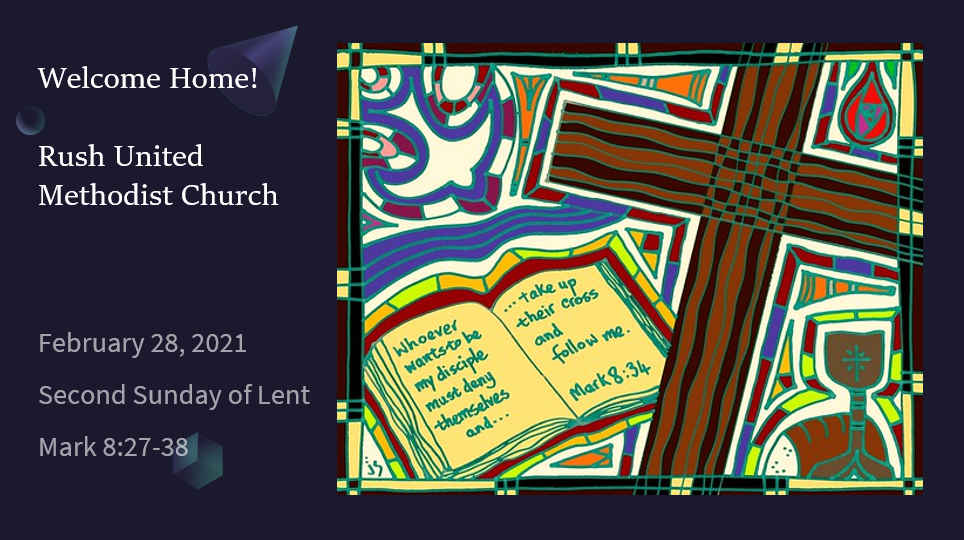
“Caesarea Philippi”

Mark 8:27-38

February 28, 2021

The Rev. Todd R. Goddard, Pastor

Rush United Methodist Church

Mark 8:27-38

Jesus went on with his disciples to the villages of Caesarea Philippi; and on the way he asked his disciples, “Who do people say that I am?” And they answered him, “John the Baptist; and others, Elijah; and still others, one of the prophets.” He asked them, “But who do you say that I am?” Peter answered him, “You are the Messiah.” And he sternly ordered them not to tell anyone about him.

Then he began to teach them that the Son of Man must undergo great suffering, and be rejected by the elders, the chief priests, and the scribes, and be killed, and after three days rise again. He said all this quite openly. And Peter took him aside and began to rebuke him. But turning and looking at his disciples, he rebuked Peter and said, “Get behind me, Satan! For you are setting your mind not on divine things but on human things.”

He called the crowd with his disciples, and said to them, “If any want to become my followers, let them deny themselves and take up their cross and follow me. For those who want to save their life will lose it, and those who lose their life for my sake, and for the sake of the gospel, will save it. For what will it profit them to gain the whole world and forfeit their life? Indeed, what can they give in return for their life? Those who are ashamed of me and of my words in this adulterous and sinful generation, of them the Son of Man will also be ashamed when he comes in the glory of his Father with the holy angels.”

| Centering Prayer |

Gospel means “Good News.”

Our Gospel for today,

Our Good News for today,

Is a passage that should be quite familiar

To many of us lifetime Christians.

Though familiar, I’m with many of you

Listening intently for what God is saying new.

If this text is new to you, or

You are not a lifelong Christian,

Hold on to your saddle,

Because today’s Good News is about to give

Your spiritual journey

Quite an exciting ride.

According to Mark

Jesus recently traveled through the region of Tyre,

A Greek, non-Jewish, gentile city

Northwest of Galilee on the coast of the Mediterranean Sea.

From Tyre, he travels South East to Bethsaida, on the North shore of the Sea of Galilee.

Today, Jesus travels due North

To Caesarea Philippi,

Which is located on today’s Golan Heights,

At the base of Mt. Hermon,

On the border between Syria and Israel.

Geography and local history are important here.

1. First, Caesarea Philippi was the northern most extension of Israel

When it was in its greatest period of expansion and prosperity

Under the rule King David,

One thousand years before Christ.

Though it was ruled by Jews,

No Jewish culture stuck after they withdrew.

At the time of Jesus,

Caesarea Philippi was only populated by Roman and Greeks gentiles.

2. Secondly, Speaking of Romans, Greeks, and gentiles

This village was named after …

… Caesar, the Roman Emperor,

And, Philip II, the son of Herod the Great,

Who earlier named it Paneas,

In honor of the 3rd century BC Greek cult

Who worshiped the pagan god Pan,

A goat-footed god of victory in battle.

The Greek temple can be seen today,

Carved in the side of the mountain.

Pagan worship to Pan was actively taking place

By Gentiles

In this location

At the time of Jesus.

3. Thirdly, located at the base of Mt. Hermon,

Caesarea Philippi is the source of the Jordan River.

The south flowing Jordan

Starts as a mountain spring that gushes forth from a mountain cave.

It is this cave that pagans had carved out their temple to the god of Pan.

That’s right.

The source of the Jordan River,

The water that baptized Jesus,

Springs forth from a pagan temple in Caesarea Philippi.

There is no place in the Holy Lands

That is more diametrically opposed to Yahweh,

  • Our God of creation, covenant, and law,
  • The God of our Jewish ancestors,
  • The religion of Jesus and most of his disciples,

Then Caesarea Philippi.  

Jesus walked into a pagan temple

Takes center stage,

Surrounded by pagan worshippers,

Lifts his voice

And publicly, loudly asked his own disciples in trail

“Who do people say that I am?”

– Mark 8:27

Akin to today?

This isn’t simply like saying,

“One day Jesus walked into a bar.”

This is like saying,

“One day Jesus walked into a wiccan of witches.”

Jesus takes his disciples with him.

Jesus asked them publically to identify himself,

within earshot of everyone present.”

“Who do people say that I am?”

– Mark 8:27

Think to yourself:

What is the most non-Christian setting

You can imagine

or have recently visited?

Where is the voice of the Church,

Not only silent,

But unwelcome?

In your mind’s eye,

Put yourself there.

Place yourself in the center of opposition

And make a public declaration:

Jesus is Lord!

Jesus is the God I serve!

Be prepared to escape and evade like your life depends on it!

You better run, run!

Our Good News for today asks every serious disciple of Jesus

If we are prepared to identify Jesus by

Making a public declaration of faith

In those places in life where Jesus is most opposed.

Where is Jesus most opposed?

Is that where you work?

With family, neighbors, or friends?

Is that with colleagues or collaborators,

Supervisors or staff?

How about the bully on the school bus?

Be they an atheist cousin?

A devilish member of the community who thrives on disruption and destruction?

Or terrorist with a knife in their hand?

Are you and I prepared to

Stare them down and

Make a public declaration that

I serve the Lord and only follow Jesus!

Even amongst his faithful disciples

There was a bunch of mumbling, looking down, avoiding eye contact, and kicking dirt hoping the moment would pass.

‘Well, you could be John the Baptist.

Or maybe Elijah?

Heck, I don’t know.

Maybe you’re one of the prophets?’

It is Peter who speaks up.

Peter is the only one with the courage

To stand up and speak out!

“You are the Messiah!”

– Mark 8:29

Messiah,

Son of God,

The first use of the title

Since the opening chapter of Mark.

Ding! Ding! Ding!

Messiah is the correct answer!

Jesus has publically outed himself as the Son of God

On stage front and center  

Of a pagan temple.

So why in the world does Jesus use this opportunity

Of his public identification

As an opportunity to speak the first of many occasions

About his forthcoming

Suffering, rejection, death, and resurrection?

It would appear

That Jesus is grasping defeat

From the mouth of victory.

The argument could be made

That Jesus is throwing in the towel

Even before he begins to get started.

It is as if Jesus was staring down the pagans

– first stunned into silence

– now growing in rage for having their temple hijacked.

It is as if the pagan crowd surrounded Jesus and his disciples,

Become restless and start itching for violence.

It is as if Jesus threw up his hands and said,

“You win. I give up. Just take me away.”

You and I, like Peter, would have responded with disbelief.  

“What the heck?”

“What in the world is going on here?”

“You’re the Messiah one moment and

The next moment you’re telling us you are going to die?”

Christ’s rebuke is hardly surprising

When one considers

The fact that

Jesus’ suffering, rejection, death, and resurrection

Is as much a part of his identity,

As the fact that he is the Son of God.

Without suffering,

There would be no Son,

No Bethlehem’s baby.

Without Christ dying,

There would be no point to his immaculate conception.

Without the resurrection,

There would be no reason for God to send us his son to save the world.

It is much easier for us,

Looking through the lens of hindsight,

To better see this reality of Jesus

Then did his own followers.

Time and again,

They get it wrong.

It is only after the resurrection,

When the Holy Spirit fills the Church,

Do the disciples turned apostles

Understand Christ’s complete identity:

  • Who Jesus is: Messiah, Son of God
  • Why Jesus came: to suffer, die, and rise from the dead
  • How Jesus changes everything: that the world might be saved

God’s greater plan

Used Jesus as a principle interdiction into humankind,

For the greater purpose

Of a more expansive kingdom.

This surprised the first century Church, and

Has been stunning generations of Christ followers ever since.

How does this revelation of Christ’s greater identity

Impact us today?

Suffering is a shared experience.

It is never alone.

For even when alone,

One is with God.

Even when alone,

One can associate personal suffering

With the suffering of our Lord at his crucifixion.

To suffer as a Christian

Is to allow yourself to crawl upon on the cross,

Let nails be driven into your hands,

And be crucified with Jesus.

Suffering is not to be sought;

But neither is it to be shunned,

For suffering opens new avenues

That can deepen the relationship

Between ourselves and our God.

Death is a shared experience.

We may not like to think about our mortality.

Yet, we all die.

Death is the great equalizer.

It is the final earthly act that unites us.

It is the final act that unites us with Jesus.

As in baptism we put on Christ,

So, too, in death, we are greeted by Christ.

We take his hand

And step through the divide between heaven and earth

Into God’s heavenly kingdom.

Resurrection, likewise, is a shared experience;

For all those who believe in him

Shall have eternal life.

As Christ ascended to the right hand of his Father,

So, too, are we lifted.

Jesus welcomes each of us

And says,

“My daughter,”

“My son,”

“your faith has made you well.”

We are more than healed of our earthly disease,

Our mortality is healed,

Such that we will know death no more.

Crying and mourning will be passed away.

In the final act of today’s Good News,

… which, in my opinion, has been really GREAT News thus far,

Is Jesus challenging those who follow him:

“If any want to become my followers, let them deny themselves and take up their cross and follow me. For those who want to save their life will lose it, and those who lose their life for my sake, and for the sake of the gospel, will save it.”

– Mark 8:34-35

Bold!

Jesus is attempting to recruit a pagan crowd on their home turf!

He’s casting his net for new disciples.

Jesus set’s the terms:

First, deny yourself.

Make Jesus the priority of life,

Subjecting self, family, and tribe to him.

Secondly, pick up your cross.

In other words,

Be prepared to die with Jesus.

Thirdly, follow Jesus.

Learn his words.

Speak his words.

Teach his words.

Behave the way he behaved.

Live as he lived.

Love as he loves.

Others may kill your body,

But no one else can kill your soul.

The risk of not sharing the Gospel,

The risk of not witnessing to the world

about our relationship with Jesus Christ,

is that we will lose our life,

our eternal life;

that our final disposition

will be nothing more than a box in the ground

at Pine Hill cemetery down the road.

The risk of not sharing Jesus Christ with the world

Is that the church today will close tomorrow.

We will all die off

And the property will be sold.

Speak up! Jesus is proclaiming.

Discipleship means you’re

Willing to risk all things mortal for all things eternal.

Witness to Christ,

Share the Good News,

And you’re making an investment

Not only in your eternal life

But also in the next generation of the Church

And every future generation.

Be strong!

Take courage, people of faith!

There is much opposition to Christ in today’s world.

When confronted by those who would oppose our faith,

Make your witness public, loud, and proud.

Wear Jesus on your sleave and make no apologies for him.

Identify

God as our Lord

And Jesus Christ as our Savior.

Be prepared for the consequences.

Know this:

Others may kill the body.

But, only we can surrender our soul.

Live for Christ.

Witness for Christ.

And let God take care of the eternal.

Amen.

Confronting Racism

A Newsletter Article to the Members and Friends of the Rush United Methodist Church

Over a six-week period spanning January and February I participated in an Upper New York Conference supported class titled “Imagine No Racism,” or INR, as most call it. It was my third time in the past five years. Why would I repeat a class that I’d already completed twice before?

Racism matters to me.

If I do not intentionally address the issue of racism, I regress in my cultural competency and ability to pastorally shepherd the Rush United Methodist family. Empathy wanes. I let things slide. I look the other way. Personal discipline is required to intentionally remain engaged in the conversation about the evils of racism and the effort to stamp it out. It is important to make the intentional effort to educate myself, to listen and learn, because I am constantly discovering how complex and pervasive the evil of racism has become today. Listening and learning lifts every voice and makes it sing.

Racism is a Christian issue. Our baptismal vows define racism as anti-Christian and must be renounced and resisted “in whatever forms they present themselves.” Jesus confronted racism often and everywhere. Samaritans were mix-race people who many Jews despised, yet, Jesus identified a Samaritan as a neighbor to be loved. (Luke 10:25-37) Nathanael resisted Philip’s invitation to come and meet Jesus because he asked if anything good could come from Nazareth. (John 1:43-51) Jesus healed a man born blind. The Pharisees investigated and terrorized the man’s parents, who feared being put out of the synagogue. Jesus challenged the religious system that supported an unjust status quo. (John 9:13-34) A Canaanite woman humbled Jesus by her faith when she begged him to heal her demon-possessed daughter. (Matthew 15:21-28)

Sisters and brothers of color depend on Christians in the white community to renounce and resist racism. Thaddeus, a member of my recent INR class, observed the fact that aggressively resisting and renouncing racism might quickly lead to him being dead like George Floyd. As a white person, I must take responsibility to aggressively resist and renounce racism when my black brothers and sisters cannot.

Too often attention is focused on individual abhorrent acts of racism. You have seen the videos on the news or in social media. Each act of racism is gut wrenching. Yet, rarely is attention focused on the institutions, systems, and laws that support wickedness, evil, injustice, and oppression. This lack of light and clarity provides cover for many of us to say “I’m not like that. I’m not a racist” all-the-while justifying apathy and inaction to break down the very systems that allows racism to continue.

Shane Wiegand, a wonderful teacher in the Rush Henrietta Central School District, opened my eyes to the history of structural racism in Monroe County in a class he gives to the community. I learned veterans of color following World War II were ineligible for home mortgages, leading to many families growing up in rental housing, depriving them of building home equity and bequeathing that wealth to future generations. Have you ever heard of deed covenants and redlining? Structural and institutional racism surrounds us. The resulting injustice continues from generation to generation. Do an internet search on “Shane Wiegand”. His class and slides are on YouTube. His research, data, and presentation is stunning.

Racism harms the church and silences the voice of the Holy Spirit. The United Methodist Church, as well as others, has a long history of being guilty of racism. Why are there black Methodist denominations like the African American Episcopal Church (AME) and the African American Episcopal Church Zion (AME Zion)? Because people of color were not welcome and grew tired of being treated unjustly. Being a life-long United Methodist, I own it. As United Methodists, it is our responsibility to own our history, to repent, and to deconstruct racism whenever and wherever possible.

Racism silences the Holy Spirit. This cannot be tolerated. The Holy Spirit speaks through all people, if only you and I listen. When I don’t listen to the Holy Spirit speaking through neighbors of color, I’m turning a deaf ear to God. Lord, forgive me.

When the membership of our church family is rich in diversity we become vital and strong, much more aware of the needs of the community in which we live, and better able to love every neighbor. I’ll never understand the needs of my black or brown neighbor if I don’t ever hear their voice. Diversity doesn’t just happen. A passive approach is insincere. Intentional effort is required to learn and employ effective means of inclusive, welcoming discipleship.

You matter to me. Your race, culture, experience, gender, values, and beliefs matter to me. I hope and pray that you will Imagine a World without Racism and will work with me to make it happen. Learn more about INR at our Upper New York Conference webpage: https://www.unyumc.org/ministries/corr/inr The content and videos are worth your time, attention, prayer, and reflection.

Learn more about the intersection of racism and my personal journey of faith from the MLK Keynote address in January for the Rush-Henrietta Interfaith Clergy Council worship service: It is located on YouTube at: https://youtu.be/BJ67MzOeNUg

With pastoral love,

Todd

“With Wild Beasts”

1st Sunday of Lent, February 21, 2021

The Rev. Todd R. Goddard, Pastor

Rush United Methodist Church

Mark 1:9-15

In those days Jesus came from Nazareth of Galilee and was baptized by John in the Jordan. And just as he was coming up out of the water, he saw the heavens torn apart and the Spirit descending like a dove on him. And a voice came from heaven, “You are my Son, the Beloved; with you I am well pleased.” 

And the Spirit immediately drove him out into the wilderness. He was in the wilderness forty days, tempted by Satan; and he was with the wild beasts; and the angels waited on him.

Now after John was arrested, Jesus came to Galilee, proclaiming the good news of God, and saying, “The time is fulfilled, and the kingdom of God has come near; repent, and believe in the good news.”

Prayer.

Welcome to Lent;

Our 40-day period of preparation by

Prayer, confession, repentance, charity, and self-denial.

This is what we, as Christians, do.

Prayer, confession, repentance, charity, and self-denial.

These are the disciplines we practice,

With focused intentionality,

During Lent.

What are we preparing for? You ask.

These traditional disciplines prepare us annually

To receive the message,

To be spiritually strengthened by the message,

That we might join with Jesus in proclaiming the message.

This is the message:

That by dying, Jesus Christ removes

Our sins and the sins of the world, and

That by rising from the dead, Jesus Christ

Saves us and saves the world into eternal life.

This is the Good News of God,

The Gospel of Jesus Christ.

Hear the message.

Proclaim the message.

Become the living message.

There is another dimension to Lent.

Our annual journey through Lent is an opportunity to be transformed.

By reliving and retelling the story

We make space in our existence for the Spirit to enter,

To warm our soul, open our mind, and reveal God’s will.

With the Spirit’s entry,

We are drawn closer with one another and closer to God.

With the Spirit’s strength, daring, and direction

We are transformed into God’s people

Called to transform the world.

Be transformed

That God might transform the world.

The first Sunday of Lent

Always begins with the Gospel account

Of the Temptation of Jesus in the wilderness.

Matthew and Luke give elaborate, detailed accounts

Of the confrontation between Jesus and Satan.

You’ve heard the story of Satan’s temptations before:

‘Throw yourself down from this mountain and call up angels to save you.’

‘Turn those stones into bread to satisfy your hunger.’

‘All these kingdoms can be yours, if you but fall down and worship me.’

You know the details.

I can still recall as a child in Sunday School wondering

If Jesus was alone with Satan those 40 days,

Who was writing down the details?!!!

Our Gospel of Mark is quite a study in contrast.

There are no details in Mark.

Mark is the shortest of all the Gospel books, and

Is believed to be the source document

Upon which other apostolic traditions authored their own Gospel accounts.

Over time and

By means of great effort and councils,

The Church concluded Matthew, Mark, Luke, and John

Best reflected the core message of Christian faith,

And included them into the collection of sacred texts

That today we call the Bible.

The brevity of Mark

Gives us a little bit more room for interpretation.

We can allow the Spirit to influence our imagination,

To lead us where it is too difficult to go

If mired down in tedious details.

Today, we follow Jesus

1. First, at his baptism, receiving the Spirit, and

The affirmation of God’s words, to,

2. Secondly, Jesus is immediately driven by the same Spirit

Out into the wilderness,

Where he was “tempted by Satan; and

He was with the wild beast; and

The angels waited on him.”

3. Thirdly, Jesus emerges from his harrowing ordeal,

Goes north to Galilee proclaiming the Good News of God.

A few revealing thoughts.

1. The Spirit drove Jesus into the wilderness

To be tempted by the strongest source of personified evil, Satan himself.

This makes me wonder.

I mean, on whose team is the Holy Spirit playing?

What possibly could be the motive for the Spirit of God

To drive Jesus into a confrontation with Satan?

The two greatest opposed sources of power in the world

Are destined to clash in a cataclysmic confrontation

In the Judean wilderness.

Why? is a question I cannot answer.

What we can learn by observation, however, is

Living faithfully,

With the Holy Spirit present and active in your life

Sometimes means blessings,

Sometimes means confrontation,

Nearly always, it means mystery.

Living in relationship with God

Means getting comfortable with the fact

That there is much more we don’t know about God than what we do know.

Divine wisdom has no parity.

God’s memory never fades.

The Lord’s motives can never be fully known.

The Spirit immediately drove Jesus out into the wilderness.

Why do you suppose the Spirit drove Jesus into the wilderness to be tempted by Satan?

Have you been driven into the wilderness?

Did the Spirit drive you in?

See you through?

Bring you out?

2. The site of Jesus’ baptism in the Jordan River is

In the Southern Jordan valley, near Jericho.

The wilderness land to the West leads straight uphill 18 miles to Jerusalem,

A difference of 3,320 feet in elevation.  

That’s a linear slope of 3.5% … quite a steep hike.

When riding from the Jordan up to Jerusalem today,

Ears are constantly plugging and popping

Due to the change in altitude.

This is the wilderness where Jesus was tempted.

Think rocks, cliffs, brown compacted gravel, and steep mountains paths.

Think dry, sediment filled stream beds at the bottom of impassable chasms.

These dry wadis see water only once or twice a year,

When rare Mediterranean storm clouds

Make it over the central mountains.

Think hot in the day and near freezing at night.

Think danger behind every scrub bush,

Bandits and Bedouins, around every turn,

Lurking in every canyon and cave,

Ready to beat you up, rob you blind, and leave you for dead.

Simply being in the wilderness places Jesus in mortal danger.

The Divinity of Jesus is never on the table or up for discussion.

However, the humanity of Jesus is placed at risk.

3. Forty days.

Forty days, or five weeks and five days,

Is a long time to

Roast in the heat of day and freeze in the dark of night.

Sprain an ankle and you’re done for.

Forty days is a long time to go without eating

(as reported in the other Gospels, but absent in Mark).

Forty days is a long time to be in search of water,

And when water is found, to manage it properly.

Forty days is long time to be exposed to wild beasts.

Forty days is a long time to think.

Forty days is a lot of time for the mind to wander.

Forty days in the wilderness makes Jesus very vulnerable.

4. Temptations.

Mark gives no details.

According to Encyclopedia dot com

The religious form of temptation

“Primarily denotes a trial in which (one) has free choice of being faithful or unfaithful to God;

Only secondarily does it signify allurement or seduction to sin.”

(https://www.encyclopedia.com/religion/encyclopedias-almanacs-transcripts-and-maps/temptation-bible)

For the Jewish mind

Faithfulness to the Law

Is faithfulness to God.

Satan is attempting to get Jesus

To break righteous adherence to Jewish Law.

Satan was attempting to elevate the human nature of Jesus

To the detriment of his Divinity.

Tempted by Satan.

It is impossible to know

If this was one temptation drawn out over a full forty days,

Or, if this is multiple temptations over the course of forty days.

What can be observed, however,

Is the fact that temptation was for forty days and nights.

That’s enough to break anyone down.

40 days of continuous, relentless temptation

would make even the strongest person weak.

5. Wild beasts.

Therion in the Greek,

Meaning dangerous, life-threatening carnivores.

Meat eaters.

Imagine being

In the wilderness for forty days surrounded by animals that want to eat you.

Think jackals, wolves, hyaenas, leopards,

And, yes, even lions and cheetahs

Patrolled the Palestinian countryside

Before they were hunted to extinction.

(http://natureisrael.com/mammals.html#predator)

Darkness falls.

Cold descends.

Insects and birds fall silent

As wild beasts approach and surround.

Listen to the sounds of animals creeping and stalking.

Eyes blink in the dark.

I can imagine the night coming to life

With the sounds of circling, hungry, wild beasts

Salivating in the shadows.

It is interesting to me that the detail

About wild beasts is left out of Matthew and Luke’s accounts.

Is this intentional? Or an oversight?

Does it make a difference? Or not?

Forty days in the wilderness is forty days living in anxiety and fear.

6. Angels waited on Jesus.

No. I don’t suppose they took his order

Or served him the daily special.

Angels.

Angels waited on Jesus.

Waiting, or Diekonoun in the Greek,

Which, of course, contains the same root as deacon,

Means “to minister, to serve.”

This is what deacons do; they serve.

Much the same way as Simon Peter’s mother-in-law

Served Jesus after he healed here of her fever.

(No, I don’t believe she brought Jesus a sandwich

Or did his laundry, either.)

At the conclusion of his temptations

Angels ministered to Jesus,

Replacing his weakness with God’s strength.

Though shrouded in mystery,

Exposed to mortal danger, vulnerable, weak, anxious, and living in fear,

God takes care of God’s own.

God takes care of God’s own Son, Jesus.

And, in my experience, God can and will

Take care of you and me, too.

Those angels God places in your life?

Angels are not accidents or coincidences.

Living angels are sent as God’s gift to you

To replace your weakness with God’s strength.

Certainly, on this first Sunday of Lent

There are many unanswerable questions from the Gospel of Mark.

Pay attention to those pinch points where we can align ourselves with the life of Jesus.

Consider times and places in life that are shrouded in mystery,

(Like when the Spirit drove Jesus into the wilderness).

Are we capable of trusting in God to send us His angels

Even though we don’t know Why? How? When?

Even though we don’t know God’s will or motives?

Beloved, it is a sign of faithful maturity

To be at peace with the mystery of God,

Especially when apparent contradictions cause the stomach to churn.

Consider times and circumstances in life

When anxious, frightened, vulnerable, weak, or in mortal danger.

Are you able to trust that God will carry you through

Every crisis, every temptation, every disaster?

When face-to-face with death

And personal faith is in danger of failing,

Can you place your entire dependence upon God,

And come to peace

Even in the presence of remaining uncertainty?

Know this Gospel truth

Taken from Jesus being tempted in the wilderness by Satan himself,

If we depend on God,

God can take the strain.

God will carry your burden.

The Lord takes responsibility for creation.

The Lord makes it, maintains it, and, when necessary, recreates it.

God takes responsibility for humankind,

Making each person in the Lord’s image,

Giving life by the Spirit’s breath.

The Lord strengthens the weak.

God protects the vulnerable.

God calms every fear.

God is willing, able, and eager

To strengthen the sick and bring back to health the broken of this world.

After all, our God is a God of healing and restoration.

At the end of the day,

Let us discipline ourselves.

Find rest.

Find peace.

Just as the Heavenly Father took care of Jesus,

God takes care of God’s own.

God is taking care of you, too.

At the end of this 40-day journey

Through the wilderness of Lent,

Be prepared to proclaim the Good News of God:

Though Jesus was tempted, suffered, died, and rose again,

He did it for the redemption and salvation of the world.

Amen.

“Approaching Inevitable Change”

Mark 9:2-9

Transfiguration of the Lord – 14 February 2021

The Rev. Todd R. Goddard, pastor

Rush United Methodist Church

Mark 9:2-9

Six days later, Jesus took with him Peter and James and John, and led them up a high mountain apart, by themselves. And he was transfigured before them, and his clothes became dazzling white, such as no one on earth could bleach them. And there appeared to them Elijah with Moses, who were talking with Jesus. 

Then Peter said to Jesus, “Rabbi, it is good for us to be here; let us make three dwellings, one for you, one for Moses, and one for Elijah.” He did not know what to say, for they were terrified. 

Then a cloud overshadowed them, and from the cloud there came a voice, “This is my Son, the Beloved; listen to him!” Suddenly when they looked around, they saw no one with them any more, but only Jesus.

As they were coming down the mountain, he ordered them to tell no one about what they had seen, until after the Son of Man had risen from the dead.

| Centering Prayer |

There are occasions in life

Where change becomes inevitable.

It’s a tipping point, or

A singularity.

The confluence of age and circumstances,

Beliefs and values,

Faith and passion

Are taken from the cupboard and refrigerator,

Combined into a mixing bowl,

Poured into a Pyrex dish,

Placed in the oven,

And the temperature is set.

In time

The transformation from raw ingredients

Into a delicious Methodist-style casserole is complete.

The only remaining task

Is for the cook

To make the change;

From stove to table.

Change became inevitable.

For my mother

Inevitable change occurred one day at the Malta Home,

A home for orphans and the aged

Operated by the Knights of Malta,

Outside Lewistown, Pennsylvania.

It would have been 1940.

My mother was a sixteen old orphan,

Her father dying of typhus when she was an infant.

Her older brother, my uncle Dick, showed up under cover of night.

He offered to spring her from childhood bondage

And take her into his home.

Should she stay or should she go?

Life came to a head and change became inevitable.

For my father

Inevitable change occurred when his naval ship was under attack.

Kamikazes had been unleashed

And it was his duty to take the watch in the middle of the fire and fury of battle.

If Leyte Gulf wouldn’t swallow him whole,

He’d become a pastor, a preacher of the Gospel,

He fervently promised the Lord.

Like Jonah he attempted to avoid the inevitable

Until the age of 42,

24 years later,

The year being 1968,

When he turned from the corporate world

And began the ordination process to become a parish pastor. 

Life had come to a head and change became inevitable.

For myself

Inevitable change occurred one March day in Boston exactly forty years ago.

Between collegiate hockey games at the Garden,

My friend brought me to the United Methodist seminary at Boston University.

Exiting the chapel

I looked up to see the statue of Martin Luther King, Jr.

God spoke.

It was time to leave the shoreline behind.

It was time to fish other seas.

Life had come to a head and change became

As inevitable as rain.

Where are the places in your history

When you faced inevitable change?

What was God’s role?

Are you poised on the precipice of inevitable change right now?

What is God’s current role in your life?

Can you trust in God’s cooperation and support

To see you through the inevitable?

….

Jesus had reached the point of inevitable change.

This season after the Epiphany is

Bookended with the words of God,

“This is my Son, the Beloved; listen to him!”

This proclamation came from the clouds at the baptism of Jesus

The first Sunday following the Epiphany.

These words are spoken again today at the transfiguration of Jesus,

The final Sunday after the Epiphany but before Lent.

“This is my Son, the Beloved; listen to him!”

(Mark 1:11b and Mark 9:7b)

In between these past five Sundays

We have tasted a sampling of his Galilean ministry.

(We will return after Pentecost

for a more complete diet of Jesus and his Galilean ministry)

Over these past few weeks,

We have heard that

Jesus taught with authority in the synagogue.

He cast out demons.

He healed the sick.

He raised the dead.

Crowds had been attracted to him for obvious reasons.

Pressure mounted.

Jesus had to retreat to quiet places

To recharge and replenish the drain on his spiritual life.

Addressing one person from a crowd at a time

The demand for his touch

Overwhelmed his ability to supply the world’s needs.

Personal ministry didn’t scale for the God of creation.

Change became inevitable.

God sent his Son into the world

That who so ever believed in him

Would be saved and inherit eternal life.

Jesus came to the world,

Not just to those who appeared at his door

Or those who were lowered through his roof.

The tipping point reached its symbolic climax on that mountain top.

The presence of Elijah and Moses signified the apocalyptic end of the prior age.

The transfiguration of Jesus,

His clothing and face becoming dazzling white,

Announced the dawn of a new age,

A new world order filled with hope and promise.

It was time to pivot.

It was time to wheel South,

Head for Jerusalem, and

Embrace his divinely expected destiny.

Jesus would leave Galilee for the last time,

Returning only after his resurrection.

Jesus altered his trajectory

And began his final ascent to Jerusalem.  

“Shush” he told them,

“tell no one about what you have seen, until the Son of Man has risen from the dead.”

(Mark 9:9)

Jesus faced inevitable change

… suffered for it

… died on the cross for it

… rose from the dead for it

Because his deepest desire

Is to envelop

You and me and the rest of creation

With his love and grace.

There are many who look at American Christianity today

And draw rapid conclusions

 – about churches, denominations, emerging generations –

And where all of this is headed.

Blogs are loaded full of

“5 Points of a Healthy” this

and

“12 Signs of a Dysfunctional” that.

The transition from baby boomers to

X-gens and Next-gens

Is about as graceful or comfortable as passing a kidney stone.

For decades, we analyzed attendance trends.

We experienced declining numbers of children and youth.

Many looked at aging faces in regular worship

And imagine an empty building in little more than 10 or 20 years.

We knew change was inevitable,

We knew it had to come.

We just didn’t know that it would

Sweep our legs right out from underneath us.

Thank you, COVID-19.

The pandemic has undermined our confidence of faith.

We are terrified to pivot with Jesus,

To take a step towards Jerusalem.

We are terrified to trust in him.

Are we able to trust

That Jesus will lead us from the land of

Law and prophets

Into the land of grace and love?

Are we able to trust

That Jesus will lead us from the land of death and dying

Into the land of eternal life?

Can we trust that Jesus will lead us

From scarcity and austerity

To a place where his Spirit abides with us and in us,

A land of abundance and harvest?

Do you trust that Jesus is the source of all healing,

Including healing our world of

This despicable pandemic?

If Jesus is able to heal, cast out demons and raise the dead,

Why is it so hard for us to place our trust in him

For the revival of our church

And a renewed effort to expand God’s kingdom?

As we stand in the swirling whirlpool of inevitable change

Ask Jesus to ease anxiety,

Transform terror into faith,

Change doubt into belief,

Wash us clean of pessimism, and

Fill us with confidence

In God’s amazing grace.

We sing about amazing grace all the time,

It’s about time we believe it.

The post-pandemic Rush United Methodist Church

Is going to be transfigured into something

More awesome and Holy Spirit filled

Than ever before!

Let us pray that God uses this amazing grace

To help us embrace the inevitable changes that are coming

Personally, individually, to each of us,

In every aspect of life,

And the change that is coming to Christ’s Holy Church.

I’m confident

Where God is leading

It is being revealed.

Our future is going to be great!

Let us discipline our lives,

Prioritize faithful habits, and

Discern God’s will and ways are made known to us.

I don’t know what the Holy City will look like when we get there.

That destination may be

A heavenly feast,

Thousands in Sunday worship,

Or the completion of God’s kingdom of justice and peace here on planet earth.

This is yet to be revealed.

But if this is where Jesus is going,

I’m going to follow.

Join me.

Let us follow his lead together.

I don’t know why Jesus would love you and me this much

To turn towards Jerusalem and face the inevitable.

But I do know that it is okay

To simply accept Christ’s love

And place every ounce of your trust in him.

If there was certainty,

It wouldn’t be called faith.

Place your trust in Jesus.

Let us overcome the fears of today

And embrace the inevitable change that is coming tomorrow.

Let us join in the journey with Jesus

That leads to his Passion, death, and resurrection.

Let us walk this lonesome valley with him to Jerusalem

Trusting in him,

Trusting his promise,

Trusting that he is bringing us home.

Amen.

“Living Like Jesus”

Mark 1:29-39

Fifth Sunday after the Epiphany, February 7, 2021

The Rev. Todd R. Goddard, Pastor

Rush United Methodist Church

Mark 1:29-39

As soon as they left the synagogue, they entered the house of Simon and Andrew, with James and John. Now Simon’s mother-in-law was in bed with a fever, and they told him about her at once. He came and took her by the hand and lifted her up. Then the fever left her, and she began to serve them.

That evening, at sundown, they brought to him all who were sick or possessed with demons. And the whole city was gathered around the door. And he cured many who were sick with various diseases, and cast out many demons; and he would not permit the demons to speak, because they knew him. 

In the morning, while it was still very dark, he got up and went out to a deserted place, and there he prayed. And Simon and his companions hunted for him. When they found him, they said to him, “Everyone is searching for you.” He answered, “Let us go on to the neighboring towns, so that I may proclaim the message there also; for that is what I came out to do.” And he went throughout Galilee, proclaiming the message in their synagogues and casting out demons.

| Centering Prayer |

It must be difficult to be a VIP

(Very Important Person).

I have bumped into celebrities on a few, rare occasions.

It always feels awkward.

Beyond a smile of recognition,

What do you do?

Do you say hello?

Shake their hand?

One doesn’t want to offend or bring undue attention.

I met Jim Kelly eight years ago.

He was with people I assume were his family.

I was with my parishioners.

We were in an ICU waiting room at Roswell Park.

No. I didn’t ask him for his autograph.

The sorrow in both of our eyes filled the void

where words might have been.

Intrusions into privacy as the result of fame,

Must make it difficult to navigate through daily life.

Just going to the grocery story or pharmacy must be a burden.

This season of masks probably comes as a big relief.

Strong is the celebrity who does not become jaded,

Who responds with grace,

Appropriately acknowledges fans, and

Doesn’t mind staying long to sign autographs.

Living like Jesus begins with

Spiritual Self-Care.

In the Gospel of Mark

Our author does a marvelous job of

Recording Jesus dancing an increasingly difficult tango

With his skyrocketing popularity.

Jesus goes from a private place to a public place,

Back and forth,

Alternating between concealment and secrecy,

And, publicity and proclamation.

The pendulum swings between messianic secrets

And our post-Epiphany theme of manifestation and revelation.

Jesus makes his public coming out,

Wading into three years of Galilean ministry,

At the same time,

He swears his followers to secrecy and

He is prone to slide away to a quiet place to pray.

Christ is able to remain engaged in ministry

Because throughout Mark

He follows up ministering to the crowds

With retreats into privacy

For spiritual recovery,

For time to pray.

(Preaching the New Common Lectionary, Year B, Advent, Christmas, Epiphany. Craddock, Hayes, Holladay. Pg. 149-151)

This rhythm is healthy;

A good discipline for all followers to emulate.

To live like Jesus

Is to dance a similar rhythm of

Engagement in servant ministry

Followed by restorative rest and prayer.

Living like Jesus

Brings healing to the world.

In every community Jesus visits

The more popular he becomes,

The more difficult it gets

To achieve success proclaiming the message.

He is forced to itinerate.

He must move on.

Last Sunday,

Jesus was in the public synagogue

Where he preached Good News with authority

And cast out an unclean spirit (with that same authority).

He cast out this unclean spirit from a man

Who publicly identified him and challenged him.

The narrative continues.

Jesus leaves the public venue of the synagogue

And goes to the private home of Simon and Andrew.

Simon’s unnamed mother-in-law lived with them

In this multi-generational arrangement,

Common in the time of Jesus.

Jesus takes James and John with him.

It is not a long walk from the Synagogue.

Archaeologists suggest the distance is

Only a few hundred yards. 

They told Jesus about Simon’s mother-in-law.

She was sick in bed with a fever.

Use your mind’s eye to create the scene:

Excavations reveal that housing density was high in Capernaum.

Imagine crowds of people,

“The whole city,” reports Mark,

Filling the streets,

Gathered around her door.

Think of people peeping through the windows,

Hanging from the gutters,

Looking down through cracks in the roof.

Her private residence had become a public spectacle.

We do know

Women often outlive men.  

She was one senior generation older than Simon and Andrew.

There is much we don’t know.

What was her name?

Was she a widow? Or divorced?

Did she support herself or was she dependent on her family?

Was her fever an illness that would have made her contagious or unclean?

Some diseases like leprosy rendered a person unclean, others did not.

What we do know is that her fever was serious because

“They told him about her at once.” (Mark 1:30)

There was an urgency here;

She was experiencing a health crisis that demanded immediate attention.

The newly called disciples turn to Jesus because

They experienced his preaching with authority.

They had just seen Jesus using the same authority to cast out an unclean spirit.

If Jesus had that kind of power and authority

They believed Jesus could

Heal and bring back this woman from near death, too.

The Gospel of Mark lays the groundwork for the Good News:

Trust in Jesus.

Lean into the mercy of Jesus.

Tap into the power of his resurrection.

Living like Jesus

Transforms disciples from passive observers

To active, engaged, productive partners in ministry.

What is immensely helpful to me,

And I hope is insightful to you, too,

The message that Jesus brings

Is more than mere words.

The Gospel of Jesus Christ is more than talk,

It’s action;

Casting out demons and healing people,

Bringing the afflicted back into the land of the living.

Jesus makes an incursion into the shadowland

of sin and evil, of illness and death,

to mercifully bring light, healing, deliverance, and wellness.

The Gospel of Jesus Christ is more than a pastoral sermon on the mount,

It’s answering the summons

To come to the aid and assistance of neighbors in need.

For the Gospel to speak,

One must act.

Living like Jesus

Demands a life of service.

The moment the fever left Simon’s mother-in-law,

She began to serve.

The verb “to serve” is a key term in Mark’s Gospel.

“diakoneo”  (dee-ak-on-eh-o)

Is interpreted as a response of faith.

It is found at three other locations in the Gospel of Mark:

  • The angels in the wilderness serve Jesus after he was tempted by the Devil for 40 days and 40 nights (Mark 1:14).
  • The women who followed Jesus served him (Mark 15:41)
  • Serving epitomizes Christ’s own ministry, “For the Son of Man came not to be served but to serve, and to give his life a ransom for many.” (Mark 10:45).

Simon’s mother-in-law became an

icon of resurrection and a

paradigm of Christian ministry.

(Thanks to Cynthia Briggs Kittredge, Dean, President, Professor of New Testament, Seminary of the Southwest, Austin TX, as found at https://www.workingpreacher.org/preaching.aspx?commentary_id=3547)

The healing of Simon’s mother-in-law

Tells us what Christian discipleship looks like.

Yes, there is a message to be proclaimed,

But there is also servant ministry that needs done.

If you’re a lover of the prophet Isaiah,

You might call it social justice.

Others from a more Christocentric point of view

Might call it kingdom building.

Yet others, using the latest hip language employed by popular church authors,

Might consider it relational evangelism with a missional response.

I call it living like Jesus.

When we live like Jesus

We reveal to the world

Christ manifest within us.

We demonstrate to the world

True incarnation.

This is an Epiphany of light for a world living in darkness!

Living like Jesus means living an authentic, transparent life.

How does this make a difference?

What does this mean for you and me

On our journey of faith?

Living like Jesus

Begins with relationship;

The relationships you keep

And the relationships you make.

Invest in the relationships you have.

God has placed people in your life for a reason.

Take the time and effort to meet and exceed the needs of others

Before meeting your own needs.

Try to expand your social circle.

Seek new friends and learn their stories.

The only motive for making friends is to be a friend.

Never let ulterior motives poison a friendship.

Suppress motives and temptations of money, power, size, and status.

Don’t allow personal opinions or ambition to spoil the pot.  

Don’t judge, lest ye be judged!

Consider every neighbor as a potential friend.

Listen with respect.

Consider their wellbeing.

Be humble.

It’s a privilege to be a friend

Serving in Jesus’ name.

Serve simply because of the joy of serving.

Intentionally reach out to those who have no friends.

Reach out to those who have been cast aside by society

And left for dead.

Make it your purpose to love the difficult to love,

To serve those who are difficult to serve.

If they are unclean, clean them up.

If they are possessed by a demon, cast it out.

If they are sick or injured, heal them in the name of Jesus.

Our compassionate behavior,

Our ministry with the authority of Jesus,

Completes the message

That he came to proclaim.

Like Simon’s mother-in-law,

Serve simply as a response to the faith

That is developing and deepening in your life.

Living like Jesus means serving like Simon’s mother-in-law.

Jesus recognizes the necessary next steps that he had to take.

His message is God’s message to the world,

Not to just one demon possessed person, here,

Or one needing healing, there.

Jesus needed to expand from the individual to corporate,

From single store to the franchise,

The Gospel scales.

The potential is only confided by our imaginations.

God so loved the world.

The Passion of Jesus Christ

Takes redemption, restoration, and healing beyond the personal

To the universal.

God so loved the world.

The Resurrection of Jesus Christ

Takes salvation and eternal life from something personal

To God’s global grace.

God so loved the world.

… That the world might be saved through him.

Trust in the power and authority of Jesus.

Trust in his capacity to rescue one from the edge death or the margins of life.

Trust in his ability to heal and in the power of his resurrection.

The message of Jesus is spoken in the language

Of both words and deeds.

This is what Christ came to do.

Go, and do likewise.

Live like Jesus.

Amen.