“The Only Unforgivable Sin”

June 6, 2021

The Rev. Todd R. Goddard, Pastor

Rush United Methodist Church

Mark 3:20-35

“and the crowd came together again, so that they could not even eat. When his family heard it, they went out to restrain him, for people were saying, “He has gone out of his mind.” And the scribes who came down from Jerusalem said, “He has Beelzebul, and by the ruler of the demons he casts out demons.” And he called them to him, and spoke to them in parables, “How can Satan cast out Satan? If a kingdom is divided against itself, that kingdom cannot stand. And if a house is divided against itself, that house will not be able to stand. And if Satan has risen up against himself and is divided, he cannot stand, but his end has come. But no one can enter a strong man’s house and plunder his property without first tying up the strong man; then indeed the house can be plundered.

“Truly I tell you, people will be forgiven for their sins and whatever blasphemies they utter; but whoever blasphemes against the Holy Spirit can never have forgiveness, but is guilty of an eternal sin”— for they had said, “He has an unclean spirit.”

Then his mother and his brothers came; and standing outside, they sent to him and called him. A crowd was sitting around him; and they said to him, “Your mother and your brothers and sisters are outside, asking for you.” And he replied, “Who are my mother and my brothers?” And looking at those who sat around him, he said, “Here are my mother and my brothers! Whoever does the will of God is my brother and sister and mother.””

| Centering Prayer |

If you are troubled by persistent thoughts of

Wanting to harm yourself or others,

Speak up, tell someone you trust, and ask for help.

If you suspect someone else of thinking about homicide or suicide,

Be direct.

Tell them you care for them.

Ask them directly if they are having persistent thoughts

Of harming themselves or others.

If so, use every influence you possess

To lead them into the care of a physician or mental health professional.

Occasional thoughts are normal;

Persistent thoughts of suicide or homicide are not.

They are a sign of an illness or medical condition

That is treatable with proven interventions.

Relief is achievable.

Lives can be saved

If only we 

Overcome the stigma,

Speak up and speak out, and

Commit our lives to wellness.

I’m leading this message

With straight talk about suicide and homicide because

The Church taught from the mid-13th century on

That suicide was an unforgivable sin.

This terrible legacy continues to this day.

It was Thomas Aquinas who listed six unforgiveable sins

That go against the Holy Spirit,

The first being despair,

Which consists of thinking that

“One’s own malice

Is greater than Divine Goodness.”

(https://en.wikipedia.org/wiki/Eternal_sin)

The flaw:

God’s goodness is limitless,

The intention to do evil or ill will is finite.

God wins, all the time.

Goodness overcomes evil.

God’s amazing grace saves even those

Who harm themselves or others.

So, no.

Suicide is not an unforgiveable sin,

Nor does it condemn one to hell.

Suicide is not an act of despair.

Suicide is always a personal, family, and community tragedy.

Hearts are broken by suicide.

God’s heart is broken.

Healing comes with time, faith, and the love and support of others,

Redeeming the life and memory of the loved one

Who took their own life.

Hearts are repaired when we experience God’s empathy,

Relating our loss to God’s loss of His beloved Son,

Who, through his resurrection,

“We die into the loving, tender arms of God.”

(https://www.franciscanmedia.org/franciscan-spirit-blog/7-things-to-know-about-suicide)

Jesus speaks about one sin that can not be forgiven

In this third chapter of Mark,

Blasphemes against the Holy Spirit. 

He teaches,

“whoever blasphemes against the Holy Spirit

Can never have forgiveness,

But is guilty of an eternal sin.”

(3:28-29)

Blaspheme is a verb meaning

To “speak irreverently about God or sacred things”.

(Oxford Languages, as found at Google dot com)

You might think this harsh of Jesus.

Simply speaking irreverently is worse than

Breaking one of the Ten Commandments or

Breaking one of the Seven Deadly Sins?

It doesn’t sound right.

There is more to the story.

Understanding comes with context.

Allow me to set the Gospel playing field.

Jesus had just been baptized by John and

Endured forty days of temptations by

The head of the Department of Evil,

Satan in the flesh.

Jesus had started his Galilean ministry,

Called his first disciples, and

Casted out an unclean spirit from a man in the synagogue. 

He heals, preaches, calls followers, and

Appoints twelve of his followers

He named “apostles” to do three things:

“Be with him,

Proclaim the message, and

To have authority to cast out demons.” (3:14b-15)

Jesus is in the exorcism business

And business was booming.

Jesus wants his apprentices to

Take up some of the demand and follow in his footsteps.

Today’s gospel is like an Oreo cookie.

It is one narrative

Split by a second story,

A common characteristic of the Gospel of Mark.

It begins with a family context,

Pauses,

Speaks about accusations made by scribes from Jerusalem,

Pauses, and

Concludes with a return statement about family.

Let’s talk about the family of Jesus.

Jesus returns home,

Bringing a crowd with him inside his house.

His family comes to restrain him,

But they can’t get to him because the room was too crowded.

Their assessment of Jesus?

He was insane,

Beside himself.

He, and his brother love traveling salvation show,

were just plain nuts.

Someone is going to get hurt.

Get the straight jacket on him.

Get him out of there.

Take Jesus to a safe place,

Cool his jets, and

Talk some sense into him.

His own family look at Jesus from the outside

And make an incorrect assessment.

His mother, brothers (plural), and sisters (also plural) ask for Jesus. (3:32)

He hears the request, then teaches

“Whoever does the will of God is my brother and sister and mother.” (3:35)

If his own family didn’t get it right,

What chance do you or I have?

What do we fail to hear or see in Jesus

That God longs for us know?

Let’s talk about the cream in the middle

That separates the two ends of the chocolate cookie.

Scribes are like pop up killers throughout Mark.

They pop in and out of the story,

Taking pot shots at Jesus

Throughout his ministry.

Scribes come from Jerusalem to confront Jesus

In a similar way his family confronts him.

But they come to a different, incorrect conclusion.

They didn’t fear for his sanity.

The scribes made a theological claim that

Jesus was the ruler of all demons,

Named Beelzebul,

Associated with the pagan, Canaanite god Baal.

The scribes did not attribute the power of casting out demons to the Holy Spirit.

They claimed Jesus was able to cast out demons

Because he was the head demon,

The leader of the Department of Evil.

Their recursive flaw is obvious:

Satan vs. Satan means the self-destruction of evil.

“If Satan has risen up against himself and is divided, he cannot stand, but his end has come,” Jesus teaches. (3:26)

They look to Jesus and see the work of the devil,

Not the work of the Holy Spirit.

This is the context for “unforgiveable sin.”

The unforgiveable sin, Jesus explains,

Is more than blasphemous or disrespectful talk about God.

It is claiming that the work of the Holy Spirit

In Jesus’s words and actions

Is the work of Satan.

To attribute the work of the Holy Spirit to Satan

Is to thwart the dynamics of forgiveness,

Is to walk away and close the door to redemption,

Is to reject the grace God is granting to us.

To claim that Jesus does Satan’s work

Is to remain shut outside the house,

With the scribes and Jesus’ family,

While his true kindred are inside the house

Doing the will of God

At the feet of Jesus.

Therein lays hell.

Hell is of our own creation,

Our choice to shut ourselves outside,

Making false and misleading claims about Jesus.  

It isn’t so much as belief or unbelief,

Hell is about a stubborn refusal to come into the house of Jesus

And attribute his power and grace to God.

Free choice implies

The free choice to walk away from God.

I can’t make you behave, and neither can God.

It’s a bad choice, but

It is yours to choose. 

Look to Jesus.

What is it that you see?

I see Jesus inviting us to come in from the outside.

There is a place for you and me

To abide in his house,

At his feet.

I see the Holy Spirit,

God working in the words and actions of Jesus.

I see Jesus victorious over Satan,

Casting him and every other demon out from those who are possessed.

I see Jesus winning over the power of evil

Every single time.

Look to Jesus.

What is it that you see?

Amen.

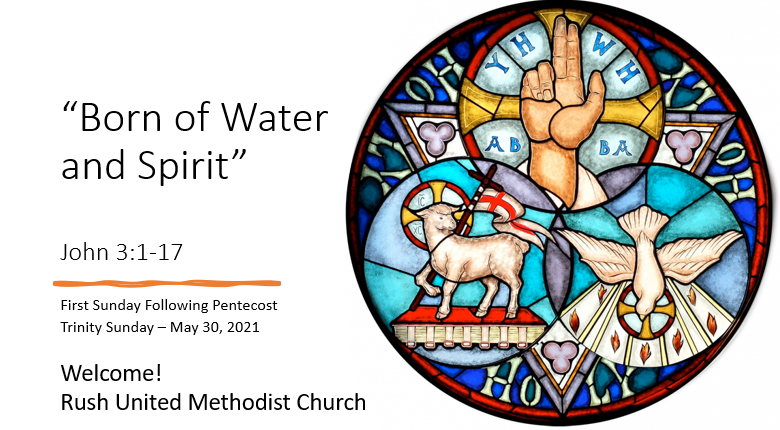
“Born of Water and Spirit”

John 3:1-17 

Trinity Sunday, May 30, 2021

The Rev. Todd R. Goddard, Pastor

Rush United Methodist Church

John 3:1-17

Now there was a Pharisee named Nicodemus, a leader of the Jews. He came to Jesus by night and said to him, “Rabbi, we know that you are a teacher who has come from God; for no one can do these signs that you do apart from the presence of God.”

Jesus answered him, “Very truly, I tell you, no one can see the kingdom of God without being born from above.

Nicodemus said to him, “How can anyone be born after having grown old? Can one enter a second time into the mother’s womb and be born?”

Jesus answered, “Very truly, I tell you, no one can enter the kingdom of God without being born of water and Spirit. What is born of the flesh is flesh, and what is born of the Spirit is spirit. Do not be astonished that I said to you, ‘You must be born from above.’ The wind blows where it chooses, and you hear the sound of it, but you do not know where it comes from or where it goes. So it is with everyone who is born of the Spirit.”

Nicodemus said to him, “How can these things be?”

Jesus answered him, “Are you a teacher of Israel, and yet you do not understand these things? “Very truly, I tell you, we speak of what we know and testify to what we have seen; yet you do not receive our testimony. If I have told you about earthly things and you do not believe, how can you believe if I tell you about heavenly things? No one has ascended into heaven except the one who descended from heaven, the Son of Man. And just as Moses lifted up the serpent in the wilderness, so must the Son of Man be lifted up, that whoever believes in him may have eternal life.

“For God so loved the world that he gave his only Son, so that everyone who believes in him may not perish but may have eternal life. “Indeed, God did not send the Son into the world to condemn the world, but in order that the world might be saved through him.

| Centering Prayer |

Have you ever been with another person,

Such that both hear the same words,

But each derives a different meaning?

Recently, I heard this illustrative story:

People in a hot air balloon are swept up in a storm.

When the storm breaks

They come out the other side

Of the wind, rain, and pitched darkness

Into completely unfamiliar territory.

They reduce altitude

And spot a farmer standing in the middle of a wheat field below.

“Where are we?” yelled the pilot.

“You’re in a balloon!” the farmer shouted back.

Thinking of a better way to rephrase it

The pilot shouted back again, “Where are you?”

To which the farmer replied, “I’m in a wheat field!”

Such is the case of Jesus and Nicodemus.

A leader of the Jews,

Schooled in the law of Moses,

Nicodemus clandestinely approaches Jesus

Under the concealment of darkness

Seeking understanding about the signs Jesus performs.

Clearly in the mind of Nicodemus,

These signs show favor or power from God.

The word in question

Is spoken by Jesus:

You must be born anõthen.

This is one Greek adverb with multiple meanings.

Nicodemus clearly hears it as “again,”

As demonstrated with his silly follow-up question

(“How can anyone be born after having grown old?

Can one enter a second time

into the mother’s womb and be born?”).

However, Jesus’ continuing commentary clearly demonstrates

He meant it to be heard as “from above.”

(Considerable linguistic insight provided by: Sharon H. Ringe, Professor of New Testament, Wesley Theological Seminary, Washington, DC, as found at: https://www.workingpreacher.org/commentaries/revised-common-lectionary/the-holy-trinity-2/commentary-on-john-31-17-3)

“No one can enter the kingdom of God

Without being born of water and Spirit,” Jesus teaches.

In other words,

The only way into our Heavenly Father’s kingdom

Is to have one foot in this world

And the other foot firmly planted in heaven.

Being born of water = think “this world,”

“Think the great flood with Noah and his ark,”

“Think the Red Sea parting for Moses and our Hebrew ancestors,”

“Think the baptisms of John the Baptist for repentance of sins.”

Being born of water

Should cause one to consider

how the God of creation

has a long history of rescuing God’s people;

saving us from unrighteousness, warring intent, and sins of the flesh.

But the world is not enough.

Baptism by water is not enough.

Perfect attendance in church isn’t enough.

Attending seminary and being ordained isn’t enough.

There is nothing humanly possible,

No human effort, no righteous deed, no feat so worthy

That will, on it’s own, open the doors to the kingdom of heaven.

“We are not saved by our works,”

the apostle Paul correctly interprets the Gospel,

“We are saved solely by the grace of God.”

And that grace is the gift of the Holy Spirit.

Being born of the Spirit:

Think the presence of Christ in the absence of his body.

Think wind, Jesus tells us,

“It blows where it chooses,”

(which is to say Christ’s mind is not our mind)

“you hear the sound of it,”

(our senses are aware of the presence of the Spirit)

“but you do not know where it comes from or where it goes.”

(In other words,

don’t spent wasted time

attempting to understand what the Spirit’s next move may be.

Just let it go,

Just let it be.)

Simply be aware;

Watch for signs of the Spirit’s presence and movement.

Listen for it’s rustling.

Discern it’s intent.

Follow where it leads.

Let the Spirit guide you

From the here and now

Forward to God’s deepest desire.

“Very truly, I tell you, no one can see the kingdom of God without being born from above.” – Jesus, John 3:3

Not “again.”

“Born from above!”

Baptized in this world and

Adopted by the Spirit of Christ

From above!

Though we struggle in a world filled with sickness, sin, and death,

The apostle Paul writes in his epistle to the church in Rome,

We have not been abandoned.

In Christ, God has adopted us

As God’s very own children and heirs.

(With thanks to Elisabeth Johnson, Pastor, Trinity Lutheran Church, Watertown, MN)

We have not been left behind

Simply with four historical books of the Bible

That tell us the story of Jesus.

We have been claimed and named,

Bought and paid for,

Accepted and included,

into God’s heavenly family.

The power of adoption,

Or huiothesia in the Greek

(Phonetically: hwee-oth-es-ee’-ah)

Cannot be overstated.

Think chosen,

Preferred over all others.

Parents who have adopted children may understand.

Adopted children might gain understand with age.

It is one thing to give birth,

It is something altogether different

To intentional lay claim to a child,

To gather them in and make them your own.

That intentional selfless act

Is but a taste,

Just an inkling of

The enormous gift of love the Spirit provides.

Grace is an order of magnitude beyond our comprehension.

We don’t have to understand it.

We simply claim it,

Live in it,

Bathe in it,

Drink it in.

Our scriptural lessons for today

From Isaiah, Romans, and the Gospel of John

Help to paint a picture of our Triune God;

A Father’s love that created us,

Made covenant with us,

Taught us how to live,

And desires our obedience;

A Father’s love who sent us his own Son

As a gift to humankind,

To forgive our sins

And to save us into eternal life.

The Gospel is a portrait of

A Son’s love

That taught us to love,

That showed us how to love,

That laid down his own life because of his love

For you and me.

This is what a Son’s love looks like:

Jesus refused to abandon us in the Garden.

By fulfilling His Father’s will

He enables us to call upon God

With the same loving intimacy we heard

Our Lord cry from the cross:

“Abba! Father!”

Jesus paints a picture for Nicodemus of

The Spirit’s love

That has chosen us,

Preferred us,

Adopted us as God’s own.

The Spirit’s love

Desires to abide with us, and in us.

The presence and guidance of the Spirit

Connects us with Christ and

Connects us with each other

As fellow children and heirs of God.

Dearly beloved,

Jesus is talking about

A God that will not let us go,

A God who loves us

We are His children,

Siblings with Christ,

Heirs to the divine inheritance

Of eternal life in God’s completed kingdom.

Come,

Be the Body of Christ.

Cry “Abba! Father!”

And lay claim to God’s grace and love

Given to you.

Amen.

“The Holy Spirit: Proving the World Wrong”

John 15:26-27, 16:4b-15

May 23, 2021

The Rev. Todd R. Goddard, Pastor

Rush United Methodist Church

”When the Advocate comes, whom I will send to you from the Father, the Spirit of truth who comes from the Father, he will testify on my behalf. You also are to testify because you have been with me from the beginning. But I have said these things to you so that when their hour comes you may remember that I told you about them. “I did not say these things to you from the beginning, because I was with you. But now I am going to him who sent me; yet none of you asks me, ‘Where are you going?’ But because I have said these things to you, sorrow has filled your hearts.

Nevertheless I tell you the truth: it is to your advantage that I go away, for if I do not go away, the Advocate will not come to you; but if I go, I will send him to you. And when he comes, he will prove the world wrong about sin and righteousness and judgment: about sin, because they do not believe in me; about righteousness, because I am going to the Father and you will see me no longer; about judgment, because the ruler of this world has been condemned. “I still have many things to say to you, but you cannot bear them now. When the Spirit of truth comes, he will guide you into all the truth; for he will not speak on his own, but will speak whatever he hears, and he will declare to you the things that are to come. He will glorify me, because he will take what is mine and declare it to you. All that the Father has is mine. For this reason I said that he will take what is mine and declare it to you.

| Centering Prayer |

As “Jesus wept” (John 11:35) is the shortest verse in the Bible,

Pentecost is the shortest season in the Church year.

Pentecost is exactly one day long.

Every Sunday following Pentecost is known and organized

Simply by the number of Sundays following Pentecost.

For example, three weeks from today will be

The Third Sunday Following Pentecost.

Pentecost must be a big deal to liturgical peeps.

This liturgical numbering system continues until Advent!

Pentecost comes from the Greek Πεντηκοστή (Pentēkostē) meaning “fiftieth”.

(Wikipedia)

Generally speaking,

Many of our Jewish ancestors hosted

an annual harvest celebration called “First Fruits”.

Ten percent of newly harvested fruits and vegetables

Would be given to the Temple or local Synagogue

To support the Rabbi and to feed the poor.

The culture of the tithe is rooted in the gifts of First Fruits, and

50 days later, Pentecost.

Following the ascension of Jesus

The second chapter of the Book of Acts

Reports the coming of the Holy Spirit

Fifty days after the resurrection of Jesus.

The Spirit descended with “divided tongues, as of fire.”

The Holy Spirit gave each the power to witness

In every language

To all the world.

In Peter’s following sermon to the crowd

He gives his first-hand, eyewitness testimony to

The resurrection of Jesus,

His ascension, and

Being seated at the right hand of his Heavenly Father.

Thus the beginning of a new Messianic Age.

Peter’s testimony led to the first converts to be

Baptized by water and the Spirit and to be taught the ways of Jesus.

The Church was born.

One can loosely say that Pentecost is the birthday of the Church.

Happy birthday, Church!

You just turned 1,989 years old

(assuming Jesus was killed at age 32 and his birth was in 0 AD).

As there are two different Creation stories in the Bible,

Coming from two different sources,

So, too, are there two different Pentecost stories,

Reporting when the Holy Spirit came to the disciples.

The most popular one is the one I mentioned, from Acts 2.

The other Pentecost story is found in John 20:19-23

“When it was evening on that day, the first day of the week, and the doors of the house where the disciples had met were locked for fear of the Jews, Jesus came and stood among them and said, “Peace be with you.” After he said this, he showed them his hands and his side. Then the disciples rejoiced when they saw the Lord. Jesus said to them again, “Peace be with you. As the Father has sent me, so I send you.” When he had said this, he breathed on them and said to them, “Receive the Holy Spirit. If you forgive the sins of any, they are forgiven them; if you retain the sins of any, they are retained.”

I hope Jesus was fully vaccinated before he breathed on them!

With his promise to send the Holy Spirit,

Our Gospel lesson for today is fulfilled.

Jesus ascends.

His replacement,

God in the world,

Is the Holy Spirit.

While Jesus could interact one-on-one,

The reach of the Holy Spirit is global.

Back to our Gospel lesson,

Prior to his death.

Jesus is instructing his disciples in the Upper Room.

Much had been taught and demonstrated about discipleship

Over the final three years of his life.

After Jesus washes the feet of his disciples,

He teaches them about the primacy of love.

He informs them that He is the way to the Father.

Then he pivots.  

Jesus changes the focus from himself

To the promise of the Holy Spirit to replace Him.

Most Christians, especially most Protestants,

Know precious little about the

Third Person of the Holy Trinity,

The Holy Spirit.

In sweeping statements

Jesus gives us a gold mine of information,

Here in the Gospel of John.

First, the Greek word used for the Holy Spirit is “Paraclete”,

(Par·a·clete /ˈperəˌklēt/ noun (in Christian theology) the Holy Spirit as advocate or counselor (John 14:16, 26) – Google search.)

Which means Advocate,

One who speaks and acts on behalf of another.

In antiquity a paraclete was a mediator, comforter, and counselor;

One who instructed, assisted, and enter pleas on behalf of others.

A paraclete’s comfort was more than condolence,

It was sound advice and direction.

(This, and the following portion of the sermon is indebted to the excellent exegetical work found in “Preaching the Revised Common Lectionary”, Soards, Dozeman, McCabe, p.175-177, 1993)

The Spirit provides

True advice and direction.

The Holy Spirit is the Spirit of Truth,

Testifying on behalf of Jesus Christ.

Disciples do the talking;

It’s the Holy Spirit of Truth

Dwelling in us

That gives us words, strength, and conviction.

Don’t sweat it.

We may be agents of the power of the Spirit,

But the work of Christian conversion is done by the Holy Spirit.

The Holy Spirit of Truth –

– Truth:

Jesus is God’s son,

Born and dwelt among us.

(John 1)

– Truth:

Jesus was sent to the world as an act of love

That all the world would believe and follow him,

Not to condemn the world,

But that the world might be saved into eternal life.

(John 3:16-17)

– Truth:

Jesus taught and practiced a life of love,

Suffered and died on a cross to atone for our sins,

Was risen from the dead 3 days later, and

Ascended into heaven.

Testify to this truth and let the Spirit convict.

The Holy Spirit proves the world wrong about sin.

Condemnation under the Law is replaced

By the sacrificial, atoning death of Jesus.

The redemptive and saving grace of Jesus Christ

Extends to all the world,

Including those who have yet to come to believe.

The Holy Spirit proves the world wrong about righteousness.

The resurrection and ascension of Jesus

Clearly identifies who he is and

The authenticity of his teaching and love.

Righteousness is following in the way of the Lord,

Not unrealistic adherence to the Law.

Righteousness is loving the Lord,

Loving our neighbors,

Even loving our enemies.

The Holy Spirit proves the world wrong about judgment.

Though there may be setbacks and exceptions,

The overall trajectory of God’s kingdom is ever upward.

Good wins over evil,

Light prevails over darkness,

Jesus Christ prevails ultimately victorious over Satan and the forces of evil.

Lastly, Jesus teaches

The Holy Spirit will teach and guide you to all truth.

When the Spirit takes up residence in your life,

It is at work to expand your understanding of Jesus.

As the Spirit works

We develop a deeper comprehension of Jesus, …

… a deeper perception, thankfulness, and intimacy with God.

I use visualization to open myself to become

A welcome dwelling for the Holy Spirit to descend and take up residence.

I see the Spirit in the air that I breath.

In every breath,

The Spirit fills me,

Teaches me,

Guides me,

Advocates for me,

Gives me words, and

Develops and deepens my intimate, loving relationship with Jesus.

To recognize the movement and work within myself,

Is to also recognize and honor the movement and work of the Holy Spirit within others.

Watch, listen, learn, discern.

Find truth. Speak truth. Come to truth.

Set the Holy Spirit free

And watch it set our church on fire.

Come, Holy Spirit. Come.

Happy birthday, Church.

Amen.

“Prayer for Unity; Prayer for Protection”

John 17:6-19

May 16, 2021

The Rev. Todd R. Goddard, Pastor

Rush United Methodist Church

John 17:6-19

”I have made your name known to those whom you gave me from the world. They were yours, and you gave them to me, and they have kept your word. Now they know that everything you have given me is from you; for the words that you gave to me I have given to them, and they have received them and know in truth that I came from you; and they have believed that you sent me. I am asking on their behalf; I am not asking on behalf of the world, but on behalf of those whom you gave me, because they are yours. All mine are yours, and yours are mine; and I have been glorified in them.

And now I am no longer in the world, but they are in the world, and I am coming to you. Holy Father, protect them in your name that you have given me, so that they may be one, as we are one. While I was with them, I protected them in your name that you have given me. I guarded them, and not one of them was lost except the one destined to be lost, so that the scripture might be fulfilled. But now I am coming to you, and I speak these things in the world so that they may have my joy made complete in themselves. I have given them your word, and the world has hated them because they do not belong to the world, just as I do not belong to the world. I am not asking you to take them out of the world, but I ask you to protect them from the evil one. They do not belong to the world, just as I do not belong to the world.

Sanctify them in the truth; your word is truth. As you have sent me into the world, so I have sent them into the world. And for their sakes I sanctify myself, so that they also may be sanctified in truth.

| Centering Prayer |

This is the seventh and final Sunday

Of the liturgical season of Easter.

Next Sunday is Pentecost.

Pente-, meaning 50, or

Fifty days following the resurrection,

The Holy Spirit comes and fills the disciples

With tongues as of fire.

So, next Sunday, join the celebration.

Revive the Holy Spirit in your life,

And testify to the spiritual reality

By wearing the colors of fire:

Red, orange, yellow!

Each year, during this season of Easter,

We dive deep into the Gospel of John,

With this Seventh Sunday always focused on the 17th chapter;

Jesus praying for his disciples.

We cover the whole 17th chapter in a three-year cycle,

This year with a focus on the middle third.

Jesus is praying to God

On behalf of his disciples

In the Garden of Gethsemane,

On the Mount of Olives,

Immediately prior to his betrayal by Judas and arrest by soldiers and the police.

Jesus is having a prayerful conversation with his heavenly Father,

The creator of the world,

The one who fathered him,

The one who sent him, to save the world.

His prayer reveals

Much is going through the mind of Jesus;

Certainly, the work, ministry, teaching, and outreach he had accomplished,

Low the past three years.

Certainly, his thoughts turned to his mortality,

Expected suffering, pain, humiliation, and death.

Just as most who are facing impending death

Jesus prays for the wellbeing of loved ones and friends.

Certainly, he prayed for

Their safety,

Their strength to faithfully follow through

With their Apostolic Commission

To bring the world to him.

There are two key themes that catch my attention in Jesus’ prayer:

unity and protection,

As found in verses 11 and 15.

“Holy Father, protect them in your name that you have given me, so that they may be one, as we are one. …

… I ask you to protect them from the evil one.” (17:11b, 17b)

Our Lord’s prayer in Gethsemane

Is an invitation for us to have a deeper conversation about unity.

The unity Jesus prays for is

For disciples to be unified just as

God and Jesus are unified.

What unifies our Divine Creator with our Divine Redeemer?

What is the special sauce that binds God and Jesus together that we should use liberally to bind us together?

May we be united by responsible stewardship of the natural world.

God created it.

Jesus lived in it.

We take care of it.

May we be united by grace.

God knew we needed mercy and forgiveness before we did,

So Jesus was sent and died to take away our sins.

God knew we needed salvation.

Because we are utter failures to even save ourselves.

Jesus was risen from the dead, and so, too, are we.

Grace is the gift of eternal life.

May we be united by love;

The same Old Testament love that shows that our God doesn’t quit on us,

To the love of Jesus

That heals and casts out demons, that

Teaches us to love God and love neighbors so much that we become known, identified, by our love.  

Christian unity is a common rallying cry

And fervent prayer for many when

Facing conflict that threatens division.

Word came to the Apostle Paul twenty years after the ascension of Jesus

That members of the local church he helped establish in the Greek city of Corinth were embroiled in turmoil:

Jealousies, rivalry, and immoral behavior.

Paul appealed to them to be unified by love, the same love God has for the Son,

And the Son has for those who follow him.

Today is no different.

We find ourselves cooking in a boiling stew of

Conflicts and threats of division.

Be it politics, race, or religion …

Be it a controversial zoning variance, vaccine requirements, who should get unemployment benefits, or how to safely open schools …

… There are as many divided opinions and conflicts as there are stars in the sky.

The Church reflects larger society.

External conflict and division are imported into faith communities by members themselves.

It’s unrealistic to expect an absence of

Internal conflict and division.

It is wise to be cautious about unity.

It is possible to be unified in

All the wrong things.

Jesus doesn’t pray for our unity in all things, only in that which unifies himself with the Father.

Unity is not conformity.

Diverse opinions and world views are welcome and

We must create a threat free environment that supports diverse points of view.

There is a dangerous nature of unity that should not be ignored;

The tempting call to be unified by the evil one.

For example,

I do not pray for unity or seek unity

With those who hate, who hurt, who destroy.

It is unholy to seek unity with racists, bigots, or those who employ violence and oppression.

Unity is sacred when we are unified in faithful response to God’s will.

However, unity is unholy and profane if aligned with the evil one.

We, Protestants, tend to get all nervous when talking about “the evil one,” the “devil,” or “Satan.”

Joining hands and singing “Kum Ba Yah” may avoid the topic and make us feel better,

But it does nothing to address the reality of evil in this world.

To deny evil is to enable it.

Jesus doesn’t mince words,

And neither should we.

Jesus engages in a cosmic fight with the evil one and our place is right by his side.

Our Lord’s prayer in Gethsemane

Is an invitation for us to have a deeper conversation about

Divine protection.

“Holy Father, protect them in your name that you have given me, so that they may be one, as we are one. …

… I ask you to protect them from the evil one.” (17:11b, 17b)

Jesus prays for the protection of his disciples.

One can observe that all his disciples, with the exception of John, the beloved,

Ended up being martyred, so,

Why didn’t God protect them?

Jesus isn’t praying for physical protection, although this may take place.

He is asking for protection of Christian unity, and,

Jesus is asking for the disciples to be protected from the evil one.

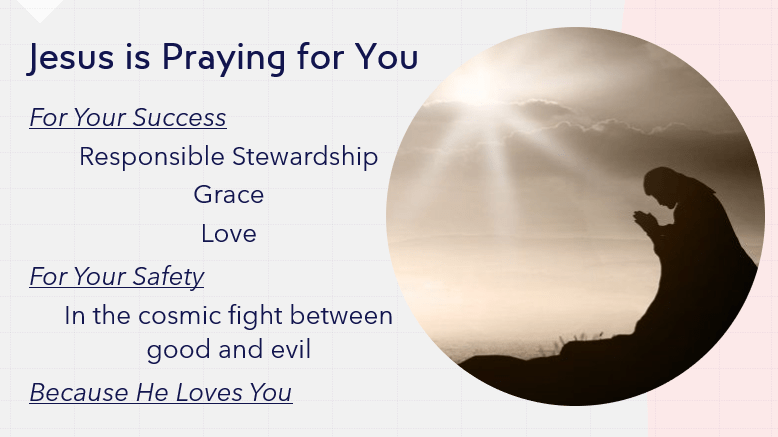
Jesus is praying for you.

God is being petitioned to protect us and all that holds us together: stewardship, grace, and love.

Jesus is praying for your success.

Care for the world, and all that fills it.

Be the grace and love of God, and the Lord will protect you.

Jesus is praying for your safety in the cosmic fight between good and evil.

He is praying for your strength to overcome evil with good.

Jesus is praying for you

Because he loves you.

Simple as that.

Life can get dirty and sloppy real quick.

There is so much that threatens to divide us.

May we focus on what unites us:

Stewardship of God’s creation,

Living as an instrument of God’s grace,

Channeling God’s love to every corner of God’s world.

God will protect you.

Remain focused, and,

By God’s strength,

We will successfully build out God’s kingdom.

In God’s protective safety,

We will defeat the evil one,

Once and for all.

Let us pray:

Holy Father, protect your disciples so that they may be one, as you and Jesus are one.

Protect your disciples from the evil one.

In the name of Jesus,

Amen.

“Chosen Friend”

John 15:9-17

9 May 2021 – Sixth Sunday of Easter

The Rev. Todd R. Goddard, Pastor

Rush United Methodist Church

John 15:9-17

As the Father has loved me, so I have loved you; abide in my love. If you keep my commandments, you will abide in my love, just as I have kept my Father’s commandments and abide in his love. I have said these things to you so that my joy may be in you, and that your joy may be complete. 

“This is my commandment, that you love one another as I have loved you. No one has greater love than this, to lay down one’s life for one’s friends. You are my friends if you do what I command you. I do not call you servants any longer, because the servant does not know what the master is doing; but I have called you friends, because I have made known to you everything that I have heard from my Father. You did not choose me but I chose you. And I appointed you to go and bear fruit, fruit that will last, so that the Father will give you whatever you ask him in my name. I am giving you these commands so that you may love one another.

| Prayer |

“If I could only have one food

To eat for the rest of my life?” Gordie asked.

Vern replies,

“That’s easy. Pez.

Cherry flavor Pez.

No question about it.”

(“Stand by Me”, 1986. https://www.imdb.com/title/tt0092005/)

These lines are from one of my favorite movies of all times,

“Stand by Me” written by Stephen King and directed by Rob Reiner.

The move is about a writer who recounts a boyhood journey

With his closest friends

To find the body of a missing boy.

I believe this movie appeals to me so much

Because it captures my childhood in a nutshell

(except for the missing body part).

“Stand by Me” describes my growing up,

Especially between the ages of 8 and 11.

My family lived in Sinclairville, New York

Midway between Jamestown and Fredonia.

My closest friends were Tommy Jordan and Kevin Kochersberger.

Our foil was Brian, who lived next door to Tommy.

Though we used Brian as comic relief,

He had an intimidating older brother.

Tommy was the son of the undertaker.

Kevin was the son of a college professor and wicked smart.

Brian was the youngest son in a broken, dysfunctional family.

Of course, I was the son of the Methodist preacher in town.

We roamed the neighborhood on banana set bikes,

Built treehouses,

Raided neighbor’s gardens,

Shot off Estes rockets and BB guns,

Road Tommy’s minibike,

Slept outdoors under the stars.

We cleared off snow from local ponds and played hockey with shovels.

We caught crawdads in the creek,

Went sledding down the hill at the town park,

And spied through the bushes when ever Tommy’s father

Brought a stiff to the back door of his funeral parlor.

The 1960s were very good to my friends and me.

Friends.

Like the writer in “Stand by Me”

We’ve all gone our separate ways,

Fallen off each other’s radar.

My friends of yesterday

Might still be only 3 degrees of separation because of social media,

But nothing can recreate that sense of friendship

That I experienced growing up.

Friends.

We were palls, companions, playmates.

We kept each other’s secrets.

We got in trouble together.

We explored the world together.

We stood up for one another.

We were loyal to one another …

And your word was your virtue.

We would not have used this word at the time,

But we loved one another.

Indeed, friend comes from the Dutch vriend,

An Indo-European root meaning “to love.”

(Google definitions)

In John’s Gospel passage,

It should be noted that

Jesus begins with a different kind of love: agápē love. (Ibid.)

Agape, from the Greek,

Describes a selfless, sacrificial,  unconditional love of God for his children,

A love that advocates, that acts, that wills

The good of another.

It is the highest of the four types of love in the Bible.

“As the Father has loved me,

so I have loved you;

abide in my love,” (15:9)

Jesus teaches his friends;

Disciples from whom he will soon depart.

The relationship between the Father and Jesus, the Son,

Is that of agápē love,

A relationship that Jesus has attempted to replicate

Between himself and his disciples,

A relationship that Jesus instructs all disciples to replicate

Amongst ourselves and those who join our community.

Agápē love.

Let’s get to it!

The context of this passage is vitally important

When it comes to describing Agápē  love.

Jesus loves his friends even when they tried to hurt him.

He loved Judas,

As he demonstrated by washing his feet,

Immediately before Jesus foretells his betrayal. (John 13)

Jesus loved Peter,

Who’s feet he also washed,

Even as he foretells of Peter’s denial. (John 13)

Jesus also loved his closest friends:

John, called the beloved.

Jesus loved his friend Lazarus

So much so he wept for him

Before raising him from the dead. (John 11)

Jesus loved each of his disciples.

He prays for them immediately following this passage,

Right before he is arrested in the Garden. (John 17)

Jesus loved his disciples selflessly when he speaks of his future

“No one has greater love than this,

To lay down one’s life for one’s friends.” (15:13)

The cross is the symbol for the supreme act of love

Between Jesus and his friends, his disciples.

The cross remains for us today that same symbol

Of Christ’s love for the world.

Jesus makes an important connection in this,

His farewell discourse,

When he refers to his disciples as friends.

Jesus changes words for love of friends, from

Agápē to Philia.

From the Greek, philia, philon, or friend, (15:13, 14, 15)

Friend means “tenderly loving, kindly affectionate.”

(Interlinear Greek-English New Testament, George Ricker Berry, Baker Rook House, Grand Rapids MI, 1897, p. 105)

Jesus ties his message together with philía love;

Love between friends that is loyal, virtuous, even joyful!

“I have called you friends,”

Jesus teaches,

“because I have made known to you everything

that I have heard from my Father.” (15:15b)

Jesus admits as much:

“I have said these things to you so that my joy may be in you,

and that your joy may be complete.” (15:11)

If there is a common strand of

Gospel DNA that weaves its way through John

It would be love.

“God so loved the world …” (John 3:16a) drives to the heart

Of John’s message to the early Church.

You are loved,

Jew and Gentile alike.

You are loved,

Just as you are,

Saints, sinners, even the dead and resurrected.

You are loved.

You are loved as the Father loved Jesus.

God loves you so much that he sent us Jesus

Who willingly gave his life

That we might inherit eternal life.

Granted, commanding a friend to do something

Isn’t a very friendly thing to do.

No one likes a Mr. Bossy Boss.

That’s why you won’t find the Gospel of John

Full with Jesus’ commandments,

Or references to Jesus teaching

To uphold Moses’ Ten Commandments.

(Like what can be found in Matthew, Mark, or Luke).

Yet, it is important to take note of the one exception in this narrative:

Jesus commands his disciples to love one another,

To be friends.

Love one another,

Just as Jesus taught and lived,

Just as the Father loved Jesus, his Son.

Loving others fulfills all other commandments.

One loves God when one maintains fidelity to God,

Mimics God’s work and rest habits,

And treats God with respect.

When you love your neighbor

You don’t steal from them, lie to them, or covet their stuff.

When you love your neighbor

You don’t sleep with their spouse or kill them.

Loving others is the fulfillment of all commandments.

Loving others is our Lord’s greatest desire.

Love.

Abide in that love.

Dwell in that love.

Make your home in that love and live in that love forever.

Just as God chose to send us Jesus,

So, too, Christ has chosen you to be his friend.

You were led,

Or are being led,

By Jesus to baptismal waters.

Baptism seals each of us eternally with Christ,

Uniting us as friends.

You’ve been chosen.

You’ve been chosen by Jesus.

You’ve been chosen by Jesus to be his friend.

You’ve been chosen to become friends with one another and with the world.

You’ve been chosen to become God’s love in the world.

Abide in his love,

And your joy will be complete!

Amen.

“I Am the True Vine”

John 15:1-8

May 2, 2021

The Rev. Todd R. Goddard, Pastor

Rush United Methodist Church

John 15:1-8

“I am the true vine, and my Father is the vinegrower. He removes every branch in me that bears no fruit. Every branch that bears fruit he prunes to make it bear more fruit. You have already been cleansed by the word that I have spoken to you. Abide in me as I abide in you. Just as the branch cannot bear fruit by itself unless it abides in the vine, neither can you unless you abide in me. I am the vine, you are the branches. Those who abide in me and I in them bear much fruit, because apart from me you can do nothing. Whoever does not abide in me is thrown away like a branch and withers; such branches are gathered, thrown into the fire, and burned. If you abide in me, and my words abide in you, ask for whatever you wish, and it will be done for you. My Father is glorified by this, that you bear much fruit and become my disciples.”

| Centering Prayer |

Like the Good Shepherd from last Sunday,

Today’s image is another expanded metaphor of the infamous “I Am” statements

As quoted by Jesus in the Gospel of John.

“I Am,” Jesus draws from Hebrew scripture to remind his audience

Of God’s self-disclosure

Speaking directly to Moses on Mount Sinai, through a burning bush.

“I Am,” Jesus says,

“The bread of life.”

“I Am the light of the world.”

“I Am,” Jesus repeats, time and again,

“The door,”

“The good shepherd,”

And “the resurrection and the life.”

“I Am,” declares Jesus,

“The way, the truth and the life.”

And today, Jesus proclaims,

“I Am the true vine.”

(John 6:35. 6:48. 8:12. 9:5. 8:58. 10:9. 10:11. 11:25. 14:6. 15:1)

The extended true vine metaphor

Is very helpful in sculpting out the details of Christian life and faith.

Often times metaphors and parables begin to lose form

The harder one pushes.

“I Am the true vine” holds up wonderfully

Under the pressure.

Indeed, God presents it

With a longing desire for us to dig deeper.

So,

Grab your spiritual shovel

And join me in the dig!

Jesus is the TRUE vine, meaning there are false vines.

Beware, the world is full of quacks, charlatans, and snake oil salesman

Who all claim to be second coming of Jesus Christ.

They will promise you the farm

If only you buy what they’re selling,

Drink what they are peddling,

Believe what they are preaching,

Or follow where they are leading.

Beware, even the Devil quotes scripture.

False vines lead gullible and uninformed sheep to slaughter;

To a dark, damp spiritual alley to rob them blind and leave them for dead.

Many will claim insider knowledge,

Some divine divination,

Or will attempt to scare us with threats of assorted dark horsemen

From the impending apocalypse.

Tell them to talk to the hand!

Jesus is TRUE.

He is the only TRUE vine.

Listen and follow none other.

The Father is the vinegrower.

Our heavenly Father created the world and all that is in it.

God cleared the land,

Planted the seed,

Constructed the trellis.

And tends the vines.

God is not some absentee landlord

That created the vineyard then moved on to another project.

The hand of God

Touches his branches,

– touches us –

To thin us, to prune us, and to maximize the yield of fruit.

It is, after all, all about the fruit, isn’t it?

When Jesus abides in you,

And you in Christ,

You will bear much fruit.

All it takes is abiding in Christ;

Which means

Making your home in the love of Jesus.

Spread the Savior’s love extravagantly

To a world that would rather hate,

That is overflowing with hate,

That is burning to the ground with hate.

Center life in God’s love.

Dive in.

Splash.

Drink in the love of God.

This is what it means to “abide.”

When we abide in the Lord,

The one who is our divine gardener,

We can leave the rest up to Him.

Dead branches

Will be cut away and burnt.

Those under producing will be pruned back,

Appropriately pruned;

Not because of any failure on our part.

God prunes to maximize the harvest of fruit.

It is, after all, all about the fruit!

Here is an observation for you:

A branch cannot bear fruit

Simply by a force of will.

If it was my will,

Churches would be filled to overflowing.

Everyone would be engaged in Spirit led missions and ministries and the entire world would be on fire for Jesus Christ.

Many a church growth efforts have been launched in past decades

Only to sink before they ever exit the harbor.

All those leadership development and mega-church seminars have led to a few success stories

But at the expense of thousands of other local churches.

If you’re trying to force fruit,

You’re doing it wrong!

Attempting to force the production of fruit

Is the pinnacle of arrogance and a pathway toward idolatry.

Stop trying to force the fruit.

Be authentic.

Abide in the love of Jesus Christ

And let Christ’s love abide in you.

This is the sweet spot were the greatest and best fruit will be harvested.

When you and I can be the love of Christ living in this world

The rest will take care of itself.

There is great comfort,

Great confidence,

In trusting in our divine gardener.

It is by the efforts of the true gardener that fruit is produced,

Not by anything we have said or done.

Fruit happens organically

Because the vine is true, and the gardener is good.

Apart from Jesus you can do nothing.

Apart from Jesus you can do nothing.

Sadly, most of us assume that doing something is equated with

Wealth, power, status, property

And having a “Leave it to Beaver” type of perfect family.

This is not true.

We all know people who live their lives in the love of Christ

Yet, their poverty overwhelms them,

Cancer is overcoming them,

Or their families are a wreck.

Likewise, we all know people who live with such wealth

And with such disregard for others,

Yet, still find it possible to climb to the highest,

Most privileged seats in society.

What gives?

Apart from Jesus, you and I can do nothing.

It isn’t about doing something.

Jesus is speaking about abiding in his love.

He’s talking about making

Our home in His love.

Separate ourselves from the love of Jesus,

From the love of God,

And the world begins to reveal itself for its true nature:

Treasure rusts.

Property become dilapidated and returns to dust.

Families go their separate ways.

Estates are dispersed.

Status is forgotten as soon as the undertaker makes his house call.

Have faith in the divine gardener’s larger plan.

It is a plan which we cannot know.

Failure to abide in Jesus results in

Destruction and forgotten memories.

There is no future in focusing on fruitless branches.

There is no point in comparing ourselves

To other disciples or other communities of faith.

Our only future is to make our home in the abiding love of Jesus Christ.

We cannot discern what is happening to the rest of the vine.

The work of the other branches is the work of the Father.

Our sole responsibility to the rest of the branches is to love.

If you abide in Jesus, ask and it will be done for you.

Little doubt what a branch is to ask for.

Ask to be fruitful!

The purpose of abiding in Jesus,

Of living in His love,

And welcoming the love of Christ to take root and grow in our lives

Is simply to glorify the Father.

Our faithfulness will result in bearing much fruit.

Living in the love of Christ

And welcoming Him into every aspect of our lives

Will lead us

On our eternal journey that carries us

Directly to the center of His heart.

Glorify the Father.

Abide in Christ.

Live in His love.

Amen.

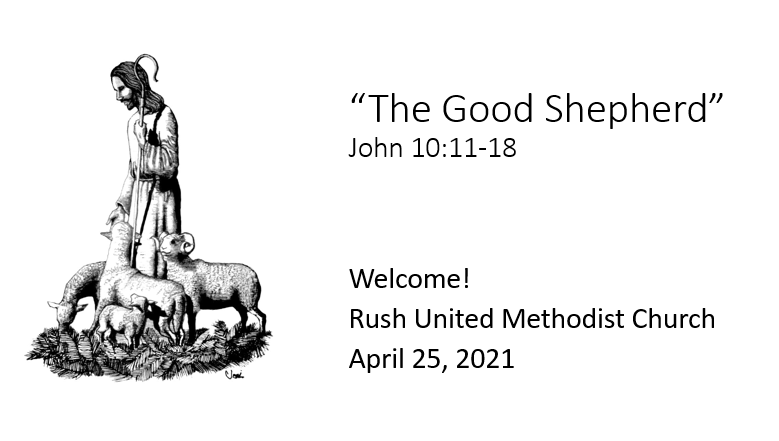
“The Good Shepherd”

John 10:11-18

April 25, 2021 – Easter 4B

the Rev. Todd R. Goddard, Pastor

Rush United Methodist Church

John 10:11-18

“I am the good shepherd. The good shepherd lays down his life for the sheep. The hired hand, who is not the shepherd and does not own the sheep, sees the wolf coming and leaves the sheep and runs away—and the wolf snatches them and scatters them. The hired hand runs away because a hired hand does not care for the sheep. I am the good shepherd. I know my own and my own know me, just as the Father knows me and I know the Father. And I lay down my life for the sheep. I have other sheep that do not belong to this fold. I must bring them also, and they will listen to my voice. So there will be one flock, one shepherd. For this reason the Father loves me, because I lay down my life in order to take it up again. No one takes it from me, but I lay it down of my own accord. I have power to lay it down, and I have power to take it up again. I have received this command from my Father.”

| Centering Prayer |

Today’s Good News marks a

Post Easter shift

From eye-witness accounts of Jesus’ resurrection

  • The empty tomb
  • Twice to the Upper Room
  • On the road to Emmaus
  • On the shore on the Sea of Galilee
  • To the moment of ascension

To reflecting upon who this resurrected Christ truly is and

What it means to us today.

This is a core characteristic of John’s Gospel.

John provides multiple witnesses to the resurrection of Jesus Christ.

The Gospel identifies beyond a shadow of a doubt

The human and divine identity of Jesus.

John challenges early Church Christians,

And us today,

To grow our relationship with Christ,

Deepen our faith, and

Witness to what we know.

Consider the grand opening of John’s Gospel.

“In the beginning was the Word, and the Word was with God, and the Word was God. He was in the beginning with God. All things came into being through him, and without him not one thing came into being. What has come into being in him was life, and the life was the light of all people.

The light shines in the darkness, and the darkness did not overcome it. And the Word became flesh and lived among us, and we have seen his glory, the glory as of a father’s only son, full of grace and truth.”

– 1:1-5, 14

He speaks of God who existed before time began

And through whom all things came into being.

Jesus is the Word,

Became flesh,

And dwelt among us.

Using sweeping “I Am” statements

That echo the great “I Am” of the Torah and prophets

We hear Jesus saying

  • “I Am the vine, you are the branches.” – 15:5
  • “I Am the bread of life.” – 6:35
  • “I Am the light of the world.” – 8:12
  • And today, “I Am the good shepherd.” – 10:11

The reason for this shift

From witness to identity is simple:

John wants identity to become the seed

Of a personal relationship between you and Jesus.

Christ wants into your life.

The context for the Gospel today

Is a larger narrative of a man born blind,

Being outcast and isolated like so many of us have been

Isolated, quarantined, and locked down this past year.

The man didn’t lose his sight.

He was born without sight.

When asked if sin was the cause of his blindness,

Jesus stops,

Makes mud with his spit, 

Spreads the mud on the man’s eyes, and

Tells him to wash in the pool of Siloam.

Simple.

A gift of sight.

From the only source of sight.

Jesus gives him sight, something only a supernatural God can do.

The newly sighted man testifies only to his personal experience.

Pharisees investigates the man and his parents.

This only amplifies the man’s testimony of divine intervention at the hand of Jesus.

Jesus found him, gave him sight, brought him into the fold.

From begging by the side of the road, he is invited into the community, where there is safety and abundance.

This example right here, friends,

Is the work of a good shepherd.

John assumes a knowledgeable Hebrew audience who is

Well educated in Jewish law and tradition.

All would know the familiar 23rd Psalm.

It begins with:

“The Lord is my shepherd.” – Ps 23:1

Who is Jesus?

He’s the good shepherd, John tells us.

At the same time

The Psalmist tells us

The Lord is my shepherd.

Therefore, Jesus is my Lord.

See how the Gospel of John lays his theological foundation?

This Psalm paints a picture of royalty,

Of a Lord

Who is powerful, steady, loving, understanding, comforting, providing.

Many in the crowd probably also knew

the conclusion of Psalm 79.

“… we your people, the flock of your pasture, will give thanks to you forever; from generation to generation we will recount your praise.” – Ps 79:13

Beyond the Psalms

One only has to turn to the prophet Ezekiel

To hear further echoes of John’s Gospel: 

“I myself will search for my sheep, and will seek them out …

I myself will be the shepherd of my sheep,

and I will make them lie down, says the Lord God.”

– Ezekiel 34:11, 15

Who is Jesus?

He’s the good shepherd.

At the same time

Ezekiel reports

The Lord is the shepherd of his sheep.

Therefore, Jesus is my Lord.

QED, John completes the theorem.

Thus, it is demonstrated that

Jesus is Lord.

The question of Jesus’ identity

Is rooted in the Pharisees relentless, often paranoid inquiry

And the crowds enthusiastic curiosity:

Who are you and from where have you come?

The Pharisees had a good thing going

And they didn’t want any backwater redneck to throw a monkey wrench into the cogs of organized religion.

Organized religion was printing money for them hand over fist.

It was laying their golden eggs.

Likewise, the crowds eagerly sought a new Messiah,

A political solution to the Roman occupation and oppression.

They wanted to know if Jesus was the one

Who was sent by God

To save them from their captivity.

Quite patiently

John lays out the case for who Jesus is.

He is NOT an unreliable hired hand who runs in the face of danger.

Jesus stands up in the face of danger

And protects his sheep from all worldly perils.

Jesus calls his sheep,

Feeds and waters his sheep,

And tends to their every need.

Jesus knows each and every one of his sheep by name

And his sheep personally know him.

One-to-one.

With no intermediary.

Jesus is willing to give his life for his sheep,

And we know he eventually does.

Jesus ultimately is the one who

Will bring all sheep together,

Sheep in other folds tended by Jesus of whom we have no knowledge.

He will bring us together to make one flock.

All well and good, if we are to believe

The Good News was only relevant to Jesus’ followers,

His detractors,

And perhaps the first century Church.

That is an argument I’m not willing to sell.

My faith leads me to believe that

The Good News of the Gospel of Jesus Christ is also meant for us today.

John’s message about identity is meant for

Pharisees,

Followers,

Early Church Christians,

And for each of us today,

living out our Christian journey half a world away 2,000 years later.

“I Am the Good Shepherd” begs the question

Who is Jesus to you?

Who is Jesus and why has his life, death, and resurrection intersected with yours?

You’ve heard witness of his death and resurrection the past three weeks.

Now you are hearing the case John makes for his identity as shepherd and Lord.

Is Jesus the topic to be avoided at work and in social circles?

Is Jesus the one who is to be denied if pressed by inquiring minds?

Is Jesus the necessary consequence of doing the right thing by going to church on Sundays?

Perhaps Jesus is simply a historical character who models good moral behavior.

Perhaps Jesus is just the focus of a delusional Church.

Perhaps Jesus is a necessary psychological crutch that we need to get through life.

Everybody has an opinion, and believe me, I’ve heard them all.

I cannot tell you what to believe.

I am only able to witness to you

what I believe.

You are invited to make up your own mind.

Jesus is my shepherd, and he is good.

He has provided for my family and I every day of my life.

I have never been in want of food, drink, or shelter.

I have always been loved and cared for.

Jesus sought me

Just as he sought the man born blind.

Jesus brought me into the fold at my baptism

Just as Jesus gave the blind man the divine gift of sight

Bringing him out of isolation and into community.

I have come to know that

Jesus knows me through-and-through;

The good, the bad, and, yes, the ugly.

There is no hiding from him.

Jesus is the source of my healing when I’ve been broken.

Jesus is the one who judges me and forgives me, when I have sinned, confessed, and begged for forgiveness.

I fully anticipate Jesus will be the one who saves me into eternal life.

I know that Jesus was willing to give his life for me, because he did.

I know that Jesus is at work bringing all of God’s people back into his one fold;

Into his eternal kingdom.

I know it, because I’ve lived it.

I know it, because I’m living it.

This is my witness to you.

Won’t you join me?

In your thoughts this week,

I’d like you to focus on this essential question:

Who is Jesus and why has he come into your life?

Make it be all about you.

This is one occasion where it’s good to make it “all about me.”

Who is Jesus to you?

Why is Jesus in your life?

Let me know where your thoughts and prayers lead you.

Let me know how you have been drawn closer

To our good shepherd.

Amen.

“Simply Be Peace”

Luke 24:36b-48

April 18, 2021 – Third Sunday of Easter

The Rev. Todd R. Goddard, Pastor

Rush United Methodist Church

Luke 24:36b-48 http://bible.oremus.org/?ql=390623186

While they were talking about this, Jesus himself stood among them and said to them, “Peace be with you.” They were startled and terrified, and thought that they were seeing a ghost. He said to them, “Why are you frightened, and why do doubts arise in your hearts? Look at my hands and my feet; see that it is I myself. Touch me and see; for a ghost does not have flesh and bones as you see that I have.” And when he had said this, he showed them his hands and his feet.

While in their joy they were disbelieving and still wondering, he said to them, “Have you anything here to eat?” They gave him a piece of broiled fish, and he took it and ate in their presence. Then he said to them, “These are my words that I spoke to you while I was still with you—that everything written about me in the law of Moses, the prophets, and the psalms must be fulfilled.” Then he opened their minds to understand the scriptures, and he said to them, “Thus it is written, that the Messiah is to suffer and to rise from the dead on the third day, and that repentance and forgiveness of sins is to be proclaimed in his name to all nations, beginning from Jerusalem. You are witnesses of these things.

| Centering Prayer |

Whenever a scripture passage begins with

“While they were talking about this, …”

The preacher better be prepared to talk about what this is.

This is what the disciples were talking about:

Cleopas and another disciple were walking to Emmaus earlier in the day

When the resurrected Jesus appeared and joined them.

Strange; they did not recognize Jesus.

It is as if he was unexpected.

They told the apparent stranger of all the events they had just experienced:

Arrest, passion, suffering, death, the burial of Christ.

They briefed him about the women’s report.

They said the tomb was empty.

They claimed to have met and spoke with two angels who told them that Jesus was alive.

The still unrecognized Jesus calls Cleopas and the other disciple fools for being

Slow of heart and

Not believing in the teaching of prophets (Ouch!).

Then begins to teach them about himself and the scriptures.

As they approach the village of Emmaus

It becomes apparent that the mysterious traveler intended to leave them.

Cleopas and the other disciple invite the unrecognized Jesus to dinner.

At dinner, during the hospitable act of breaking and blessing the bread,

Their eyes were opened.

They saw the Lord.

They recognized Jesus.

Miracle number one: Jesus rose from the dead.

Miracle number two: Jesus vanished from their sight.

They became so excited that

They immediately dropped everything,

Returned to Jerusalem, and

Told the other disciples all that had happened.

“While they were talking about this,” (24:36)

This is the this, our passage begins with today.

“Peace be with you,” Jesus begins. (24:36)

Like every ghost we have ever heard about,

Just as Jesus dematerialized

In the presence of Cleopas and the other disciple just hours earlier,

He now miraculously materializes right in front of the eyes all the gathered disciples.

This is something like right out of a scene of Star Trek.

The Gospel account in Luke is different than John.

In Luke, this is the first post-resurrection appearance of Jesus to all his disciples.

They are startled and terrified.

Already, they were locked away in the Upper Room

For fear of the Jewish authorities and crowds.

‘They came for Jesus.

They bagged their man.

They’re next coming for us,’

Or so they probably thought.

Already, their collective anxiety was through the roof.

When Jesus appears out of thin air,

They are startled and terrified.

Which begs me to asks,

What startles and terrifies you?

“Peace be with you,” Jesus says.

Jesus appears to correlate fear with doubt.

“Why are you frightened, and

Why do doubts arise in your hearts?” he asks. (24:38)

Perhaps, if we address our fears,

We might be able to better able to get a grasp

On our faith and our doubts.

Perhaps, we might be able to

Keep our doubts constrained,

At the same time, we might be able to

Deepen and broaden our faith in the Lord, Jesus Christ.

What startles and terrifies us?

It is impossible for me to speak on your behalf

Or from your experience.

I can only speak from my personal experience of fear.

What do I fear? What terrifies me?

First, and foremost,

My greatest fear is harm coming to my immediate family,

Cynthia, Nicholas, or Christian.

“Peace be with you,” Jesus tells me.

Intellectually, I can think through the theological jungle gym;

God is watching over each of us in the family.

We should – I should – just trust in the Lord.

And leave the rest up to God.

Emotionally, I’m far more at peace

With my own passion, suffering, and death,

Than I am with the suffering and mortality of those I love.

Yet, every day, from my privileged point-of-view,

I experience faithful, God-fearing Christians

Being put through the wringer

Of a loved one’s passion, suffering, and death.

Frankly, I shake my head in awe

At the amazing capacity for faith that you, and others, show me

All

The

Time.

I can only pray that

If, and when, I should have to go through such painful circumstances

That I will have a fraction of the faith and strength to endure my gale.

“Peace be with you,” the Body of Christ reassures me.

What startles or brings you fear?

For many, I’m confident that we share our greatest fear:

Harm, pain, or suffering coming to our family and loved ones.

I’m asking you to join me in deeper introspection.

What do you fear?

Some fear a pop quiz, a final exam, an end of semester grade.

Some fear that teacher, professor, confrontation, being misunderstood.

Some fear the prospect of changing majors, disappointing parents or peers.

Some fear there won’t be a job at the end of the line, only debt.

Some fear that they just don’t fit in, aren’t bright enough, or good looking.

“Peace be with you,” Jesus gives to you.

Some fear Covid19.

Some fear being ruined by the pandemic.

Some fear not being able to pay bills.

Some fear unemployment.

Some fear being forced to choose between food and their prescription medicine.

“Peace be with you,” Jesus says to you.

Some fear the government.

Some fear our government taking away liberties.

Some fear being racially profiled, pulled over, shaken down, and shot down by authorities.

Some fear our local, state, and national leadership.

Some fear war with China, Russia, North Korea, or Iran.

“Peace be with you,” Jesus tells all who follow him.

What do you fear?

Some fear technology, social media, big data.

Some fear the loss of privacy.

Some fear being hacked, personal data and identity stolen, and bank account wiped clean.

Some fear being spied upon.

Some fear losing control of everything.

Some fear science, research, and innovation.

“Peace be with you,” Jesus says to you.

Some fear going to a nursing home, lingering long, becoming a burden.

Some fear pain and suffering.

Some fear disease, loss of cognitive abilities, becoming the victim of abuse.

Some fear falling off the wagon, having a mental health breakdown, overdosing.

Some fear going to the doctor.

“Peace be with you,” Jesus tells you.

Some fear our church will come out of this pandemic wounded, weak, and in decline.

Some fear our church growing, the loss of personal control, the awkward hassle of associating with new people.

Some fear handing over the reigns of leadership to the next generation.

Some fear the Holy Spirit taking control and driving this train!

“Peace be with you,” Jesus says to us.

Some fear prayer, opening a direct, intimate line with God.

Some fear judgment, punishment, wrath, going to hell.

Some fear making peace, ending old grudges and offenses.

Some fear the prospect of forgiving or being forgiven.

Some fear eternal life.

“Peace be with you,” Jesus says to us.

We are the Body of Christ;

It is our responsibility to extend the peace of Jesus,

Even as we are recipients of his peace.

Being vessels of Christ’s peace,

Stills our fears,

Lessens our doubt,

And strengthens our faith.

“Peace be with you,” Jesus materializes right in front of their eyes.

He brings recognition to some of his disciples,

Showing them his wounds.

For those still stunned, whirling, or questioning

Jesus gives them more.

“Have you anything here to eat?” (24:41)

Ghostly apparitions don’t have a functioning GI tract.

More importantly,

The hospitable act of breaking bread had become the signature act of Jesus and those who follow him.

Peace be with you.

Jesus brings assurance to his disciples

By opening their minds to understand scripture,

“That everything written about me in the law of Moses,

The prophets, and

The psalms must be fulfilled.” (24:44b)

Diving deep into scripture;

Academically, critically, emotionally, prayerfully, spiritually, worshipfully;  

Diving deep into scripture and drinking it in completely

Brings peace.

Peace be with you.

“You are witnesses of these things,” Jesus teaches his disciples then, even as he informs us today.

“You are witnesses in my name to all nations, beginning from Jerusalem.” (24:47b-48)

Disciples. Christ followers. That make you and me witnesses.

Witnesses testify.

If you’re not testifying to others about the risen Christ

And what he brings to the world,

You’re doing it wrong.

Christians witness and testify,

Some more, some less,

Some better, some not so certain,

All somewhere on the spectrum between absolute belief and doubt.

Oh, I forgot to add …

Some fear old school evangelism, knocking on doors, inviting people to church!

Some fear speaking up and giving a personal testimony about how God is interacting with your life.

Some fear the witness, the possibility of rejection, ridicule, confrontation.

“Peace be with you,” Jesus tells us.

Take a deep breath.

Start small.

Make a friend.

Be a friend.

Build a network of relationships and fill each full of love.

They will know we are Christians by our love.

Speak from your personal experience.

Marry your word with the hospitality of the table,

Exactly as Jesus did.

God stirs the souls of those who bring together Word and Table.

Start local.

Gain traction.

Spread your witness and experience.

Watch it take off like wildfire.

Be assured,

Responsibility to witness doesn’t rest completely on any one disciple.

The responsibility to take the witness of Jesus Christ global

Is upon the network of friends and relationships we call

The Body of Christ.

“Peace be with you.”

Be not afraid.

Witness to your experience.

Simply be peace.

Simply believe.

Amen.

“Recognition”

John 20:19-31

April 11, 2021

The Rev. Todd R. Goddard, Pastor

Rush United Methodist Church

John 20:19-31

When it was evening on that day, the first day of the week, and the doors of the house where the disciples had met were locked for fear of the Jews, Jesus came and stood among them and said, “Peace be with you.” After he said this, he showed them his hands and his side. Then the disciples rejoiced when they saw the Lord. Jesus said to them again, “Peace be with you. As the Father has sent me, so I send you.” When he had said this, he breathed on them and said to them, “Receive the Holy Spirit. If you forgive the sins of any, they are forgiven them; if you retain the sins of any, they are retained.” But Thomas (who was called the Twin), one of the twelve, was not with them when Jesus came. So the other disciples told him, “We have seen the Lord.” But he said to them, “Unless I see the mark of the nails in his hands, and put my finger in the mark of the nails and my hand in his side, I will not believe.”

A week later his disciples were again in the house, and Thomas was with them. Although the doors were shut, Jesus came and stood among them and said, “Peace be with you.” Then he said to Thomas, “Put your finger here and see my hands. Reach out your hand and put it in my side. Do not doubt but believe.” Thomas answered him, “My Lord and my God!” Jesus said to him, “Have you believed because you have seen me? Blessed are those who have not seen and yet have come to believe.”

Now Jesus did many other signs in the presence of his disciples, which are not written in this book. But these are written so that you may come to believe that Jesus is the Messiah, the Son of God, and that through believing you may have life in his name.

| Centering Prayer |

For a seven-year period

The bishop appointed me ‘beyond the local church’

To serve as the Director of Education for the Alzheimer’s Association.

I learned much about neurodegenerative diseases and how to care for people experiencing these devastating illnesses.

My staff and I taught professionals and family loved ones,

Throughout an eleven-county area.

We taught in nursing homes, group homes, churches, day programs, and firehouses.

We taught professional and lay care partners alike

How to care for people with dignity and respect regarding history, respect, culture, religion, core values, safety, and love.

The pathology and progression of a neurodegenerative disease,

Such as Alzheimer’s, Parkinson’s, or ALS,

Correlates with a change in behaviors and the ability to communicate.

When the region of the brain that controls short-term memory is impaired,

We taught the value of routine: Establish a routine, maintain a routine, and God help those who disrupt the routine!

The value of getting in a rut is that you know where you are going.

As we age, many of us fear the loss of memory or recognition.

The normal slide, starting in our twenties, is called ‘Age Associated Memory Impairment,’ or AAMI.

It’s normal to experience a gentle, gradual, decline of cognitive ability.

A neurodegenerative disease is a sharp deviation from normal and not in a good way.

How does one tell the difference?

I run into a familiar person in public.

I look at their face, but I draw a blank.

It is even more difficult in this pandemic season when everyone is wearing a mask.

“What is his or her name?” I ask myself,

Hoping not to embarrass myself if caught in my failure to recognize.

Researchers and doctors taught us to teach you to perseverate.

Rack your brain for the next 24-hours.

Try to remember.

If you eventually remember, that’s generally a good sign that you can probably wait to report this to your doctor at your next regular appointment.

If, however, after a day of trying to put together a face and a name and you just can’t remember, call your doctor, make an appointment, and inform your doctor of your memory concerns.

You’re welcome.

Recognition.

I raise your awareness about recognition

Because of the difficultly disciples of Jesus had recognizing the resurrected Christ.

Today, John reports his disciples were locked away and fearful from the crowds on the evening of the first day of the week.

Locked down. Fearful.

Everyone of us living through this horrid pandemic should understand what they were experiencing.

Last Sunday we heard about the first two witnesses to the resurrection,

John, the disciple Jesus loved, and Mary Magdalene, the one who misidentified Jesus as the gardener.

John saw the empty tomb and believed. Period.

Mary recognized Jesus when he spoke her name. Mary believed.

In a parallel sort of way, today Jesus first appears to his ten disciples

(12 minus Judas and Thomas).

When he appears he fulfills his prior promise to fill them with the power of his Holy Spirit.

Jesus then appears to a skeptical Thomas a week later, when recognition of the resurrected Lord came when Jesus showed Thomas his wounds.

The disciples witnessed Jesus materialize right before their very eyes.

He kept his promise.

He had the wounds to prove it.

Jesus was alive.

“The disciples rejoiced when they saw the Lord.” (20:20)

Thomas, a week later, was invited to touch his wounds.

Thomas recognized the Lord, not by sight, but by examination of the laceration and puncture marks.

He recognized the Lord, with his witness and confession, “My Lord and my God!” (20:28)

Following today’s resurrection narrative, the Gospel of John reports Jesus appeared to seven of his disciples on the Sea of Galilee.

They failed to recognize Jesus until he gave them a fishing tip that resulted in a miraculous catch of 153 fish. (21:11)

It took a divine miracle brought recognition to those seven disciples.

What can be learned and applied to our lives today?

1. Christian disciples are all over the spectrum between belief and doubt in the resurrection of Jesus Christ.

It’s normal.

You’re normal.

(I’d say ‘I’m normal’, but there may be some who don’t believe me).

Strength of faith does not correlate with absolute belief.

We shouldn’t judge others who express doubt as being weak or flawed.

We should be patient and love those who have normal doubts and applaud their courage to express them openly.

Likewise, I suggest you go easy on yourself if you find yourself somewhere on the spectrum sliding between absolute faith and complete doubt.

Faith is hard work, and doubt is difficult to ignore.

There is no shame or guilt for doubt, regardless of amount or duration.

I recognize doubt as the environment …

… the people, the place, the time, the circumstances …

That are necessary for you and I to have an interaction with Jesus,

To recognize ‘Christ has died. Christ is risen! Christ will come again!’

Recognition results in our confession and witness to the world

That Jesus is my Lord and my God.

2. We each have diverse motives and needs to recognize Jesus.

Each of us are different,

Shaped by our life experiences, childhood development, values, parents, and faith community (or lack, thereof).

For some, recognizing and believing in the resurrection of Jesus comes as easy as water off a duck’s back.

Others need to hear Jesus call us by name.

Others need to see his apparition.

Yet others, require the awareness of the Holy Spirit dwelling within and empowering their life.

Others, like Thomas, need to be able to physically touch Jesus to believe he is alive.

And others need a full-fledged, over-the-top, water-into-wine kind of miracle to open their eyes.

The Gospel of John recognizes the diversity of Christians

And intentionally lays out numerous ways for us to come to recognition.

Doubt is expected and is normal.

God’s grace meets us where we are at.

Grace does not require us to be a square peg pounded into a round hole of doctrine, theology, or belief.

It is by grace alone that we are drawn to that day of Christian perfection, when we, too, will recognize and proclaim, “My Lord and my God.”

3. Faith comes to those who perseverate.

How does this work?

Make your faith and commitment to follow Jesus a priority in your thoughts as you go about your day and make your way through the week.

Perseverate on Jesus;

His life,

His teachings,

His actions, behaviors, and motives,

His love,

His death and resurrection.

Recognition comes to those who perseverate about Jesus.

Facing a difficult test or paper?

Consider the role of Jesus.

He will love you regardless of the outcome.

Fail to study one subject or topic sufficiently?

Jesus is the author of forgiveness and redemption. Study harder next time, like Jesus did when he was a youth left behind at the Temple and was found learning from the Rabbis.

Knock that test out of the park and earn a top grade?

That exceptional grade is just a taste of the salvation offered by a resurrected Lord.

Recognition of the resurrected Christ comes to those who perseverate about him.

Facing the end of life?

Consider the end of Christ’s life.

Can you associate your personal suffering with his suffering, abuse, passion, and death?

He cared for his mother while on the cross.

Consider how Christ is leading you to care for your family for your eventual absence.

Think about Christ’s death, his ability to wholly and completely surrender to the will of his heavenly Father.

Carrying a heavy load of sin or regret to your grave?

Jesus paid your bill and didn’t even leave a receipt.

Atonement for sins?

His permanent scars on his hands, feet, and side

Are a reminder that atonement isn’t a one-and-done proposition.

Atonement is a moment-by-moment, ongoing, intimate relationship with Jesus.

Perseverate your thoughts on Jesus.

Make him a priority in your thoughts as you face every challenge in your life.

Thinking about Jesus all the time does not turn you into a Jesus freak or a holy roller.

Thinking persistently about Jesus Christ creates a worldview that provides the opportunity to address issues of evil and suffering, trauma and pain, war and peace, righteousness and justice, healing and grace.

4. Take time to linger; hang around with Jesus.

Mary lingered outside the empty tomb.

The disciples lingered, a week later in the upper room.

Lingering around Jesus creates space for recognition to happen.

Lingering, watching, waiting is a rhythm that is like that of Advent; The season of anticipation; waiting for Jesus to be born; waiting for Christ to come again.

The God of my experience leads me to believe the day is coming when I will meet Jesus face to face.

Will I recognize him? I hope so.

I’ve been preparing for a lifetime

To grow my faith, deepen my belief, focus my life on Jesus

With the hope and prayer that I have come to recognize my Lord and Savior, Jesus Christ, and enthusiastically witness to his name, that all may come to believe, “and that through believing you may have life in his name.” (20:31)

Are you prepared to meet Jesus face-to-face?

There is no time like the present to start making preparations.

Amen.  

“From Sorrow to Joy!”

John 20:1-18

1st Sunday of Easter, B

April 4, 2021

The Rev. Todd R. Goddard, Pastor

Rush United Methodist Church

John 20:1-18 (http://bible.oremus.org/?ql=389420953)

Early on the first day of the week, while it was still dark, Mary Magdalene came to the tomb and saw that the stone had been removed from the tomb. So she ran and went to Simon Peter and the other disciple, the one whom Jesus loved, and said to them, “They have taken the Lord out of the tomb, and we do not know where they have laid him.” Then Peter and the other disciple set out and went toward the tomb. The two were running together, but the other disciple outran Peter and reached the tomb first. He bent down to look in and saw the linen wrappings lying there, but he did not go in. Then Simon Peter came, following him, and went into the tomb. He saw the linen wrappings lying there, and the cloth that had been on Jesus’ head, not lying with the linen wrappings but rolled up in a place by itself. Then the other disciple, who reached the tomb first, also went in, and he saw and believed; for as yet they did not understand the scripture, that he must rise from the dead. Then the disciples returned to their homes.

But Mary stood weeping outside the tomb. As she wept, she bent over to look into the tomb; and she saw two angels in white, sitting where the body of Jesus had been lying, one at the head and the other at the feet. They said to her, “Woman, why are you weeping?” She said to them, “They have taken away my Lord, and I do not know where they have laid him.” When she had said this, she turned around and saw Jesus standing there, but she did not know that it was Jesus. Jesus said to her, “Woman, why are you weeping? Whom are you looking for?” Supposing him to be the gardener, she said to him, “Sir, if you have carried him away, tell me where you have laid him, and I will take him away.” Jesus said to her, “Mary!” She turned and said to him in Hebrew, “Rabbouni!” (which means Teacher). Jesus said to her, “Do not hold on to me, because I have not yet ascended to the Father. But go to my brothers and say to them, ‘I am ascending to my Father and your Father, to my God and your God.’” Mary Magdalene went and announced to the disciples, “I have seen the Lord”; and she told them that he had said these things to her.

| Centering Prayer |

Last Sunday our worship started with a bang!

Joyous “Hosanna” and waving of palm branches

Was followed by the reading of the Palm Sunday

Entry of Jesus into Jerusalem on a donkey.

“All glory, laud, and honor 
to you, Redeemer, King, 
to whom the lips of children 
made sweet hosannas ring. 
You are the King of Israel 
and David’s royal Son, 
now in the Lord’s name coming, 
the King and Blessed One.”

(Tune: St. Theodulph, Author: Theodulf, Bishop of Orleans, 820 AD)

The Messiah had entered the Holy City! We proclaimed.

We were giddy with revolutionary zeal.

We knew God was on our side

And our occupation and oppression was soon to be ended.

Our taste for freedom had been wet,

And the future never appeared so promising.

But, faster than a whiplash

The wind left our sails;

Our bellows collapsed like a deflated whoopie cushion.

Jesus was arrested, imprisoned,

Tried on trumped up charges,

Sentenced to death, flogged, humiliated,

Crucified, died, pierced,

and his bloodied corpse was buried in a borrowed tomb;

All within the span of three nights and three days.

The passion stunned, froze, and traumatized us.

Hope had been replaced by despair.

Life had been stolen and replaced with meat on a slab.

Light had been replaced by darkness.

It doesn’t get much darker than defeat,

Especially when it appears that

Our God blew the lead in game seven.

Were you there when they crucified my Lord?
Oh, sometimes it causes me to tremble, tremble, tremble.
Were you there when they crucified my Lord?

(Words: Negro Spiritual, Tune: Were You There)

Night fell on Friday.

Darkness overcame all but one candle.

We left the service in darkness and silence.

Today, Good News!

With the dawn’s early light and the rising of the sun,

We have news that Jesus Christ is risen from the dead!

“Christ the Lord is risen today, Alleluia! 
Earth and heaven in chorus say, Alleluia! 
Raise your joys and triumphs high, Alleluia! 
Sing, ye heavens, and earth reply, Alleluia!”

(Tune: Easter Hymn, Text: Charles Wesley, 1707-1788)

Bust out the lilies.

Brush open the blinds.

Break out the Alleluias!

The embargo is over.

Light triumphs over darkness!

Life is victorious over death!

From triumph to shock,

From sorrow to joy,

The path of discipleship

Bucks like a bull that doesn’t want to be ridden.

From our Jewish ancestry

We follow a similar path from Lent to Easter;

Remembering the passion, death, and resurrection of Christ.

Our path resembles the one traveled by our Jewish sisters and brothers

Remembering Passover from a first-person point of view;

Freedom from Egyptian captivity, the gift of the Law, journey through the wilderness, and passage into the promised land of Israel.

To remember

Is to experience the journey.

We tell the story.

We live the story.

We become first-person, eye-witnesses to the story

Of freedom, redemption, and salvation.

When we become so intimately woven into the story

Of passion, death, and resurrection,

We become like the disciple,

“the one whom Jesus loved,” (20:2)

The first to the empty tomb and the first to believe.

We don’t need anything more

Than an empty grave and a pile of bloody burial cloths.

Our relationship with Jesus is so close

That we don’t have to witness his resuscitation.

We don’t have to see his face, his hands, his side, his feet.

We don’t even have to hear his voice.

We are just filled with joy!

We know that Christ is alive!

Christ is risen!

The most important divine interaction with creation has just taken place

And we’ve been privileged to have been a first person eye witness.

Forgiveness and salvation become the capstone.

Christ’s historical ministry has been transfigured into one that

Transcends time,

Glorifies God, and

Brings to creation the gift of the Spirit.

At our Good Friday service light faded to darkness.

White faded to black.

Night fell.

I know some of us are so closely in love and relationship with Christ

That we’ve become one with the “beloved disciple”;

The one who just knows,

And is ready to witness to,

The resurrection of Jesus Christ.

Yes, life sometimes gets in the way of faith.

I get that.

Yes, sometimes we slide on the spectrum between belief and disbelief

Like furniture on a sinking ship.

It is sometimes true for me, too.

But, for many of us,

We need something more.

Often, I need more than just the memory or the experience.

We might be more of a kindred spirit with Mary from Magdala.

Mary Magdalene finds faith another way.

Mary lingers.

Mary’s examination of the empty tomb and cast aside burial clothing

Resulted, first, in her anger –

An assumption that Jesus’ corpse had been stolen,

To, secondly, sadness and weeping –

Over her apparent failure

To care for, and respect, the dead:

“They have taken away my Lord,

and I do not know where they have laid him.” (20:13)

Mary came and saw.

She saw the stone had rolled away.

She saw two angels in white through the tears in her eyes.

Angels! Mind you! She saw angels!

Mary hears the voice of angels, “Woman, why are you weeping?” (20:13)

Mary responds to angels from the Lord by answering their question.

Mary turns and she saw.

She saw Jesus, face to face.

Jesus! Mind you! Mary saw Jesus!

The corpse she had seen dead and buried no more than 72 hours ago

Was standing right in front of her

Fully breathing, alive, and engaged in a conversation.

Holy, Zombieland!

Mary sees, but, as of yet, fails to recognize her BFF.

Mary hears the voice of Jesus.

He asks the same question the two angels asked,

Woman, why are you weeping?” (20:15)

One would think his voice would be familiar to her.

After-all, she had been on the road with his “Traveling Salvation Show”

For the past 3 years.

She thought she was talking to the gardener.

Resurrection was so outside her realm of understanding

It wasn’t even considered.

In her traumatized mind

She was talking to the gardener.

Mary only comes to recognition and belief

When Jesus speaks her name, “Mary!” (20:16)

Remember Jesus earlier teaching

“Very truly, I tell you,

The one who enters by the gate

is the shepherd of the sheep. 

The gatekeeper opens the gate for him,

and the sheep hear his voice.

He calls his own sheep by name and leads them out. 

When he has brought out all his own,

he goes ahead of them,

and the sheep follow him

because they know his voice.” (10:1-4)

The Good Shepherd calls his own by name

And they know his voice.

Like Mary, many of us come to recognize the Risen Christ

Through the Word of Christ,

And by his Word,

We are see and

We are fed.

Remember the majestic opening to the Gospel of John,

“The Word was made flesh … and dwelt among us,” (1:14)

The Word,

Christ’s spoken word and his broken body,

Together with his willingness to call and claim us by name

over our baptismal waters,

Is what keeps our ever ebbing and flowing faith

Confined within acceptable limits.

The Word speaking our name

Brings recognition to us.

Now we know who we’re talking to!

Now we know we are seeing the resurrected Jesus!

Christ is made known and present,

Inviting each of us to engage deeply in relationship with him

And with one another.

To experience the story,

Many will join the movement from sorrow to joy

With the proclamation, “Christ is risen!”

Others will come from sorrow to joy by another route.

We have to have our creaky scaffolding of faith

Sustained and supported by the Word of Christ.

Regardless of how we make progress on the journey

Together we can join the movement from sorrow to joy

Blending our voices this day, proclaiming, “Christ is risen!”

Christ is risen, indeed!

Alleluia!

Amen.

(Thanks for the creative insights to the Beloved Disciple and Mary Magdalene is extended to Craddock, Hayes, Holladay, and Tucker in their 1990 commentary, “Preaching the New Common Lectionary Year B Lent, Holy Week, Easter”.)