“Life Abundant”

May 3, 2020 – Easter 4

The Rev. Todd R. Goddard, Pastor

Rush United Methodist Church


John 10:1-10


“Very truly, I tell you, anyone who does not enter the sheepfold by the gate but climbs in by another way is a thief and a bandit. The one who enters by the gate is the shepherd of the sheep. The gatekeeper opens the gate for him, and the sheep hear his voice. He calls his own sheep by name and leads them out. When he has brought out all his own, he goes ahead of them, and the sheep follow him because they know his voice. They will not follow a stranger, but they will run from him because they do not know the voice of strangers.”

Jesus used this figure of speech with them, but they did not understand what he was saying to them. So again Jesus said to them, “Very truly, I tell you, I am the gate for the sheep. All who came before me are thieves and bandits; but the sheep did not listen to them. I am the gate. Whoever enters by me will be saved, and will come in and go out and find pasture. The thief comes only to steal and kill and destroy. I came that they may have life, and have it abundantly.


1


Prayer.


The Gospel of John loves to record the

I Am statements made by Jesus.

I Am the Bread of Life (6:35)

… the Light of the World (8:12)

… the Door, or Gate, as we read today (10:9)

… the Good Shepherd (10:11, 14)

… the Resurrection and the Life (11:25)

… the Way, the Truth, and the Life (14:6)

… and the Vine. (15:1,5)


In John’s final Revelation, Jesus speaks in the twenty-second chapter

“It is I, Jesus … I Am the root of the descendant of David,

The Bright and Morning Star.”


The Greek Ego Eimi

Is an echo from our sacred Old Testament, Hebrew text,

Meaning “I am, I exist, to be”.

(Interlinear Greek – English New Testament)

We hear God thunder to Abram

“I Am

the Lord who brought you from Ur of the Chaldeans.” (Genesis 15:7)

And to Moses

“I Am

who I Am.” (Exodus 3:14)


What is apparent to me is

There are many ways to speak reverently of God,

And many ways God uses to self-identify.

One isn’t wrong to consider alternatives just as Jesus did.

Consider tender passages of scripture

And think of God as a loving, nurturing mother, or,

Passages of scripture revealing power and strength, and

think of God as a heavenly father.


It’s all good.

There is enough of God to go around …

And more.


Today, Jesus self-identifies as a Gate

Protecting the entrance of a sheepfold.

The Gospel today is a continuation of

The narrative of Jesus healing a man born blind.

The newly sighted man gives testimony to the Pharisees who investigate his healing of what Jesus had done, and

That Jesus was from God.

They drove him out of their flock

Right into Jesus’ flock.

Jesus asks him if he believed in the Son of Man.

“The one speaking with you is he,” Jesus confirmed. (9:37)


Add “I Am the Son of Man” to the list.


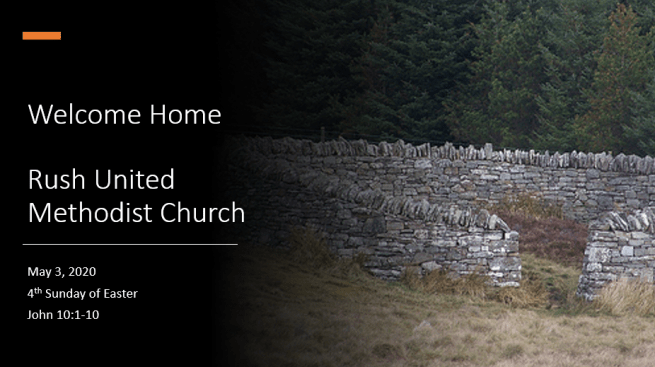
A sheepfold is an enclosure made of stone walls, topped with briars.

A sheepfold has only one entrance, which also served as an exit.

Its purpose was to provide sanctuary for the flock at night,

Safe from thieves and bandits.


Thieves steal.

Bandits, implied by the usage of the Greek, maraud and destroy.

Bandits avoid the gate and attempt to go over the wall.

Bandits could be roving guerrillas involved in insurrection,

Messianic hopefuls,

Garden variety evil people, or

Even religious authorities of the day.

Thieves and bandits threaten the Shepherd and his flock.


“I Am the Gate,” Jesus proclaims.


Sheep are gathered in the sanctuary of the sheepfold,

Like Christians gathered for worship on Sunday.

But when the Sabbath is over and

The sun rises,

The flock isn’t allowed to stay in the sheepfold.

They are driven through the gate and

Led to green pastures and still waters,

Where life is abundant.


Jesus’ disciples were a bunch of old fishermen.

It isn’t surprising they didn’t understand an agricultural metaphor.

So Jesus makes plain his instruction.

“I Am the Gate.”

Sheep that hear my voice know me,

Like the previously blind man who knew Jesus by his voice and

Followed his command to wash in the pool of Siloam.

Sheep know the voice of their shepherd

And follow him.


Sheep may hear the voice of others;

Thieves, bandits, preachers of other faiths, false messiahs, snake oil salesmen, every politician with a promise, and the like.

Sheep don’t follow them.

Sheep stick to the familiar,

The Shepherd,

Who knows them,

Who protects them,

Who leads them to abundant pastures and still water.


“I Am the gate.”

“Whoever enters (or exits) by me will be saved,” Jesus promised.

Salvation is taking part in the ebb and flow of the flock;

Of coming in and going out.


Life, or Zoen, in the Greek means

Literal life,

Spiritual life,

Eternal life. (Ibid.)

Abundant, or Pi-erisson, in the Greek means

More than enough or necessary,

Exceeding expectations.


Life in the flock of Christian disciples

Is this rhythmic tidal surge between

The sanctuary of the sheepfold and abundant life found in green pastures.

It is in the green pastures that sheep get down to work and demonstrate their value.


With pastors serving like sheep dogs working to keep the flock together,

It is in the pasture where the Shepherd shears the sheep of their wool.

They are not harmed.

Their sacrifice is for the benefit of the Shepherd.


Without pushing the “I Am” metaphor too far,

I think the green pastures and still waters of the world

Is were God is calling us to be the greatest benefit to God’s kingdom.

As Church, as a flock, we love the Lord in our worship gathered in the sheepfold.

As Church, as a flock, we love our neighbors in the green pastures of life,

In the community, near and abroad.

Living this life is living abundantly,

Claiming God’s gift of grace and salvation.


How do we apply this text to our life?


  1. Come to Jesus.

Right here, right now.

If you’re not a member of his flock,

He is waiting for you with a hearty “Welcome!”

Come into the fold.


  1. Make a commitment to Jesus.

Learn his voice.

Learn his methods.

Learn his ways.

Get to know him.

Get intimate with him.


  1. Don’t listen to other shepherds.

This flock has one – Jesus Christ.

Tune out and turn off the promises of a better deal.

Know that Jesus laid down his life for you;

That’s how much he loves you.

No one else even comes close.


  1. Abundant life can only be found in the flock led by Jesus.

Christianity is a team sport.

Get on the team and don’t ever quit.

In the unlikely event you have a bad religious experience and do find yourself lost,

Jesus is never going to stop searching for you.

Jesus desperately longs for you to return to the flock.


  1. Pastors will push you through the gate and

Do our best to keep the flock together.

Know that, while sometimes irritating, it’s for our own good.

Pastors are not the Divine Shepherd.

Pastors come and go.

Christians only follow Jesus.


  1. Leave the sheepfold and get to work in the mission field

Loving and serving our neighbors, near and far.

Give up your wool.

Give all your love away.

Like hair on a bald head; it will grow back.

When it does, you can give it up all over again!


  1. Life is good in the flock.

Abundant love.

There is more than enough to go around.

Abundant life.

There is more than enough than our mortal bodies can even imagine.


  1. Are you saved?

Of course, you are.

Salvation comes when we take our place in the flock.

If you’re in, you’re in for good.

Stop obsessing about it.


Join me.

Roll up your sleeves and get to work!

Amen?

Amen.

“Blind Spots”

Luke 24:13-35

Third Sunday of Easter, 26 April 2020, Pandemic Week 8

The Rev. Todd R. Goddard, Pastor

Rush United Methodist Church


Luke 24:13-35

Now on that same day two of them were going to a village called Emmaus, about seven miles from Jerusalem, and talking with each other about all these things that had happened. While they were talking and discussing, Jesus himself came near and went with them, but their eyes were kept from recognizing him. And he said to them, “What are you discussing with each other while you walk along?” They stood still, looking sad.

Then one of them, whose name was Cleopas, answered him, “Are you the only stranger in Jerusalem who does not know the things that have taken place there in these days?”

He asked them, “What things?”

They replied, “The things about Jesus of Nazareth, who was a prophet mighty in deed and word before God and all the people, and how our chief priests and leaders handed him over to be condemned to death and crucified him. But we had hoped that he was the one to redeem Israel. Yes, and besides all this, it is now the third day since these things took place. Moreover, some women of our group astounded us. They were at the tomb early this morning, and when they did not find his body there, they came back and told us that they had indeed seen a vision of angels who said that he was alive. Some of those who were with us went to the tomb and found it just as the women had said; but they did not see him.”

Then he said to them, “Oh, how foolish you are, and how slow of heart to believe all that the prophets have declared! Was it not necessary that the Messiah should suffer these things and then enter into his glory?” Then beginning with Moses and all the prophets, he interpreted to them the things about himself in all the scriptures.

As they came near the village to which they were going, he walked ahead as if he were going on. But they urged him strongly, saying, “Stay with us, because it is almost evening and the day is now nearly over.” So he went in to stay with them.

When he was at the table with them, he took bread, blessed and broke it, and gave it to them. Then their eyes were opened, and they recognized him; and he vanished from their sight.

They said to each other, “Were not our hearts burning within us while he was talking to us on the road, while he was opening the scriptures to us?” That same hour they got up and returned to Jerusalem; and they found the eleven and their companions gathered together. They were saying, “The Lord has risen indeed, and he has appeared to Simon!” Then they told what had happened on the road, and how he had been made known to them in the breaking of the bread.

1

Prayer.


From my personal experience and

Observation of others,

I believe we all have blind spots.

On some issues

I can see with intense clarity.

It is easy to develop a deep sense of empathy and understanding towards others if we share a common past.


My life has been blessed with personal intersections

With aging and Alzheimer’s disease,

Autism and disabilities,

Alcohol and addictions,

College and campus ministries,

Emergency services and mental health.


I say “blessed” because after emotionally working through precipitating incidents,

My faith leads me to question with curiosity

The theological intersection with that particular aspect of life.

Dementia and Theology.

Disability and God’s image and presence.

The intersection of addictions and God.

Life and God’s intentions and plan.

Christ in the storm of crisis.


How is God present in caring for an aging love one?

Where is God’s grace expressed in people with autism, cerebral palsy, Down syndrome?

What does Christ offer to those facing unrelenting, merciless temptations?

How does God participate in revealing to college students and young adults their call, their purpose, in life?

Is it possible to be the love of Christ to the medic sitting on the back step of the ambulance crying their eyes out?


The intersection between life and theology is a privileged place to be.

There are many opportunities for clarity when

We join with other Christians

Traveling a similar path,

The same road.


….


There is clarity in the common experience of bread being broken.


Hit me with a critical incident not in my playbook

And I’m as helpless and dead in the water as anyone else.

When life connects with me in my blind spot,

I collapse like an unconscious boxer imitating a sack of potatoes.


Painful hindsight reveals blind spots

Like light bending around black holes in space.

I can’t fake it when

I’m told to straighten up that my language.

I just don’t understanding.

Or my tone is insensitive and hurtful.

I can tell when my sins of omission cause harm and reveal personal blind spots

When I feel like I want to throw up.


Had I only known …

… her ex-husband was a clergyman

… the father of her children would beat her on a regular occasion.


Had I only known …

… the treasurer who threw the church checkbook in anger was, at the same time, losing his own business to bankruptcy

… the retired teacher who screamed at me and pointed his finger in my face had been abused by principals like this all his life.


Had I only been able to see …

… the son or daughter struggling with gender identity or preference

… the fear in a person of color pulled over by the police.


Had I only been able to see …

… combat in a foxhole, in a jungle, or at 20,000 feet

… the effects of a family chronically anxious for their loved one to return home.


Had I been able to see …

… the lifetime effects of childhood sexual abuse or exploitation

… the painful scars from prior abusive religious experiences.


These are journeys I have not personally traveled.

However, these are journeys that have bloodied me on occasion throughout life.


….


There is clarity in the common experience of bread being broken.


Recognizing our spiritual blind spots

Is the first of many steps the Lord is leading us to take.

For the man born blind to serve God’s purpose,

Jesus healed him and gave him sight.

For the disciples on the road to Emmaus,

Jesus had every intention to open their eyes

And recognize his presence among them.


As in physical blindness,

spiritual blindness can make us more attuned to our other spiritual perceptions.

Thinking of the 5th chapter of Galatians and the Fruits of the Spirit,

Our blind spots can contribute to greater love, joy, and peace.

Our spiritual blindness can make us more patient, kind, and good.

We can access deeper faith,

Become more gentle, and

Exercise more self-control.


Blindness may serve God’s purpose,

Until, according to God’s time,

We may come to see.


Let us be clear:

God doesn’t want us to remain spiritually blind;

Rather, followers of Jesus are invited to change our blind spots into spiritual clarity.

Jesus invites us to his table

To break bread,

And in the breaking of bread,

To be revealed in our midst.


….


There is clarity in the common experience of bread being broken.


Clarity comes in an experience shared with others.

Clarity doesn’t come in isolation,

But in the intimacy of sharing the table with others.

A private spiritual life is starved

Of the bread Jesus offers;

Dying hungry and without recognition of our Lord who breaks it.


….


Humility is required to recognize and address

Our spiritual blindness.

I don’t know all.

I can’t see everything.

I’m unable to know what I don’t know.

Trusting in myself, my intelligence, experiences, or resources goes out with the morning trash.

Humility places our complete trust in the Lord.

We place ourselves wholly in God’s hands.


Humility is required to trust in the Lord and take our place at the table.


Humility turns the world upside down.

The disciples had all the news and they were more than happy to proudly inform the unknown, ignorant fellow traveler.

Yet, “beginning with Moses and all the prophets, he interpreted to them the things about himself in all the scriptures.”


The disciples were the hosts, inviting the traveler to be their guest.

Yet, when Jesus takes his place at the table

He assumes the role of host,

The disciples become to guests,

And Jesus is revealed in the breaking of bread.


Humility is acceptance that God is making all things new.


Humility in faith

Is belief that Jesus is with us

Even when we don’t recognize his presence.

Jesus desires more.

He desires to break through our blind spots, to be seen, and

For us to witness to his resurrection and presence to the world.


To those who have been hurt by my spiritual blindness, I’m truly sorry.

Don’t give up on me.

I’m try to humble myself, place my trust in the Lord, and

To hold on as Jesus heals me of my blindness.


My invitation to you, is to do the same.

Apologize.

Be humble.

Listen.

Learn.

Trust in the Lord.


In the breaking of bread Christ is revealed.

Our spiritual blind spots begin to be transformed

From clumsy ignorance to

Empathy and understanding.

The Christ that has always been with us

Is revealed in all his glory.


Dearly beloved,

Who are the individuals that we are blind to?

Who do we fail to see or understand?

Perhaps they are God’s gift to you and me,

A part of a larger plan

To bring clarity,

To reveal Christ and his love

for all the world to see.


May God heal us of our blindness.


Sing with me.

“Open my eyes, that I may see
Glimpses of truth thou hast for me;
Place in my hands the wonderful key
That shall unclasp and set me free.
Silently now I wait for thee,
Ready, my God, thy will to see.
Open my eyes, illumine me, Spirit divine!”

(Clara H. Scott, 1895)


Amen.

“Finding Peace in the Storm”

John 20:19-31

April 19, 2020 – 2nd Sunday of Easter, 6th Sunday of Pandemic

The Rev. Todd R. Goddard, Pastor

Rush United Methodist Church


John 20:19-31


When it was evening on that day, the first day of the week, and the doors of the house where the disciples had met were locked for fear of the Jews, Jesus came and stood among them and said, “Peace be with you.” After he said this, he showed them his hands and his side. Then the disciples rejoiced when they saw the Lord.

Jesus said to them again, “Peace be with you. As the Father has sent me, so I send you.”

When he had said this, he breathed on them and said to them, “Receive the Holy Spirit. If you forgive the sins of any, they are forgiven them; if you retain the sins of any, they are retained.”

But Thomas (who was called the Twin), one of the twelve, was not with them when Jesus came. So the other disciples told him, “We have seen the Lord.” But he said to them, “Unless I see the mark of the nails in his hands, and put my finger in the mark of the nails and my hand in his side, I will not believe.”

A week later his disciples were again in the house, and Thomas was with them. Although the doors were shut, Jesus came and stood among them and said, “Peace be with you.” Then he said to Thomas, “Put your finger here and see my hands. Reach out your hand and put it in my side. Do not doubt but believe.”

Thomas answered him, “My Lord and my God!”

Jesus said to him, “Have you believed because you have seen me? Blessed are those who have not seen and yet have come to believe.”

Now Jesus did many other signs in the presence of his disciples, which are not written in this book. But these are written so that you may come to believe that Jesus is the Messiah, the Son of God, and that through believing you may have life in his name.


Prayer.


This detestable pandemic has allowed me to engage

the Gospel in new and creative ways.

Perhaps this Gospel passage of Jesus’ resurrection appearance

Isn’t about Thomas and his understandable doubts?


A week ago, Saturday, Ross Douthat wrote an article in the New York Times titled “The Pandemic and the Will of God”.

2

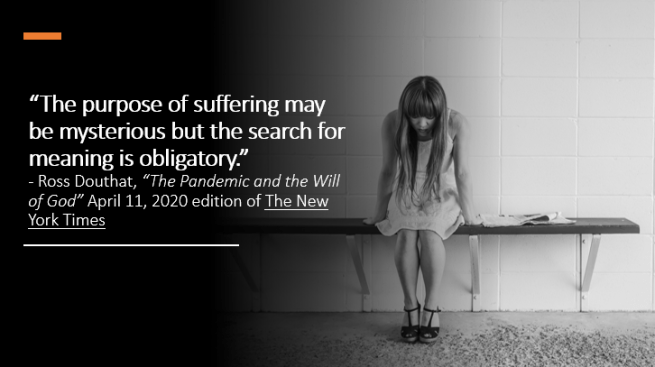
He observed “the purpose of suffering may be mysterious,

but the search for meaning is obligatory.”


This got me thinking.


Let’s take a look at the timeline.


The last 7 days had been an emotional roller coaster.

After spending 3 years supporting Jesus

It had all come to a head.


His disciples knew he was a decent guy,

Reached out to all the right people,

Shunned power and the spotlight.

He even appeared blessed by God,

For he had done many miraculous things.


Jesus entered Jerusalem like the king he was meant to be.

The crowd was whipped up in Messianic expectation,

Throwing him a parade.

Revolution was in the air.

A coup de grâce was all but a done deal,

Returning Israel to its Davidic glory.


Make Israel great again.


Then, Jesus freely surrendered;

Just raised the white flag and gave up the ship.

He didn’t even put up a struggle.

He didn’t defend himself when tried or questioned.

When Jesus gave up,

The crowds gave up on him.


They humiliated him,

Persecuted him,

Mocked him,

Tortured and killed him by public crucifixion.

As the disciples watched his corpse laid into a tomb

No sane member of the remaining 11 couldn’t help but think,

“Next, they’ll come for us.”


Jesus rose from the dead,

Leaving the tomb empty.


Peter and John had confronted the risen Jesus,

Along with Mary Magdalene,

But Peter and John weren’t talking.

They returned home and sat on their hands and kept their mouths shut,

“For as yet they did not understand the scripture that he must rise from the dead.” (20:9)

Certainly, they were just as afraid as everyone else.


As Jesus suffered,

Now his disciples suffered.

Judas took his own life.

Peter was smothered in guilt.

The rest are in shock and grief.


Shock.

Fear.

Grief.

Guilt.

The trauma of crucifixion would give way to anger.

Anger, in time, would give way acceptance,

Would eventually lead to a search for meaning.


Between his burial

And that evening being locked away together,

It must have been an emotionally charged, exhausting day for the disciples.

Suffering is a meal best shared among friends.


The mystery of suffering is unanswerable.


There are no answers to the question:

Why are we suffering this Coronavirus pandemic?

Why do the poor suffer unequally as the rich?

Why do people of different races, religions, or gender suffer more than others.

Why do bad things happen to good people and

Why do good things happen to horrible people?

Why did Jesus suffer and die and disappoint the world?


The mystery of suffering is unanswerable.

But, there is hope.


Instead of going round and round and

Being sucked into an infinite wormhole

That only leads to dis-belief,

Our God and our faith tradition show us another path.

In place of a pointless search for answers

The Biblical tradition points us in a different direction.


The Hebrew book of Lamentations is all about suffering.

Likewise, 28% of the Psalms address suffering.

42 of 150 Psalms are laments,

30 of which are individual,

12 are communal.


Turn to the complaint.

Complain on your own.

Amplify complaints by combining complaints together.

Turn to the complaint into a prayer,

Shape it just right,

And you’ve got yourself a lament.


Human unrighteousness and rebellion suffered the Lord

Such that punishment was swift and violent.

Jerusalem fell in 586 BCE, Israel was defeated, survivors sent to prison camps.

As the Lord had suffered, now it was Israel’s turn to suffer.

Israel in exile suffered terribly.


Look at what was lost!

Prosperity. Hope. A promising future.

Look at what the Lord lost!

Faithful followers. An eternal partnership. The love of Creation.


At the heart of the lament is solidarity;

Solidarity with each other and solidarity with God.

We share the same complaint.

We share the same crushing burden.

We share the same loss with each other and with our God.


And God dwells among us.


A lament is a prayer,

Directed to God,

Organized by the Psalmist and Prophets

Into a common form:

1) Invocation; or calling upon the Lord.

2) Complaint; getting the anger out.

3) Request; for God to help deliver, to persuade God to act.

4) Expression of Confidence, that God will continue to act according to creation’s benefit.

5) Praise; to express happiness that God is true to promises made, for God’s presence, and for God’s love.


….


This past week, I’ve been thinking about the lament

The shocked, mourning, disappointing disciples might have been praying.


Perhaps it sounded like this:


1) Invocation: “O God of creation,

who delivered us from Egyptian slavery and Babylonian exile,

who sent us your Son, Jesus … “


2) Complaint: “you sent us Jesus only to have him killed?

You wanted us to follow him just to die?

We gave up everything: family, jobs, everything to follow him?

Three years of our lives are wasted; down the drain.

Now, they’re coming for us

and a locked door is all that exists

between us and our own crucifixion.

Why have you, O Lord, betrayed us unto death?”


3) Request: “Grant us your peace.”

“Send us as you were sent, to forgive the sins of the world.”

“Give us the power of your Spirit.”

“Strengthen our faith, especially those who didn’t see.”


4) Confidence: “You’ve saved us before;

You can save us again.”


5) Praise: Like we read in Lamentations

Your love never ceases,

Your mercy never ends.

Your grace is new every morning.

Great is your faithfulness!

(from Lamentations 3:21-23)


….


Pay attention to the request:

Grant us your peace.

Jesus came and stood before them, saying “Peace be with you.

As the Father has sent me, so I send you.”

(20:21)


God came and dwelt among them.


Pay attention to the lament’s request:

Give us the power of your Spirit.

“… he breathed on them and said to them, “Receive the Holy Spirit. If you forgive the sins of any, they are forgiven them; if you retain the sins of any, they are retained.”

(20:22)


The resurrected Christ came in solidarity.


Pay attention to the lament’s request:

Strengthen our faith, especially those who didn’t see.

“Jesus said to him, “Have you believed because you have seen me? Blessed are those who have not seen and yet have come to believe.”

(20:29)


….


When there are no answers

Turn to the lament.


Our Old Testament God grieves human infidelity.

Jesus wept for Lazarus.

Explanation isn’t required.

Lament instead, expresses the loss,

Petitions God to help, and

Attempts to persuade God to act.


God comes and dwells among us.


The New York Times Op-Ed author rightly observed

That a healing Christ and a loving God

Dwells among the people of creation,

Caring for the grieving, dying, sick, and suffering.

Jesus comes and stands before them, saying “Peace be with you.”


With presence, there is solidarity.

We are one with each other, and

One with our God.


….


This detestable pandemic

Has thrust upon us a new world order,

An unfamiliar environment for mission and ministry,

For Church and faith,

For relationships and meaning.


There is no answer to “why?”

In its place, God gives us permission to lament.


Your homework for this upcoming week is this:

Write out your prayer of lament.

Let loose!

Let it out!

Shout it out in all CAPS, if that makes you happy!

Get out a piece of paper and write it down.

Edit and add to it every day for the next 6 days.


Follow the path of Prophets and Psalmists.

Keep to the traditional recipe.

1) Invoke! Name our God!

2) Complain! About everything!

3) Request! Ask for the moon, and more!

4) Show Confidence! List what God can do!

5) Praise! List newly found happiness!


Better, beloved, than cheap and superficial answers

Is to lament loud and proud.

Stand firm in the swirl of this hurricane.

We are with one another.

Lo, the risen Christ comes.

The Lord is with us, now and always.

Wth one another, and

With our God.

Amen.

“I Have Seen the Lord!”

Easter, 12 April 2020

The Rev. Todd R. Goddard, pastor

Rush United Methodist Church

John 20:1-18 (http://bible.oremus.org/?ql=264509286)

1

Prayer.


For our sister and brother disciples

living South of the equatorial midsection

this Easter news of resurrection must take on a slightly different meaning.

They are headed into winter.

For Jesus, he suffered, died, and rose from the grave.


It is fall for them, winter lies ahead, and beyond that comes the prospect of spring.

Resurrection is not only the reality of this fall Easter day

but it becomes for our Southern hemisphere neighbors

the hope that follows winter:

that which is to come.

Resurrection is both now

and will soon be

at some future time.


In the American South

spring has sprung in full force.

We see pictures of blossoming cherry trees,

flower beds full of emerging perennials and freshly planted annuals,

and vegetables already planted and staked.


For our Dixy sister and brother disciples of Jesus

Easter is the confirmation of resurrection

that is being experienced

in the present.

right here,

right now,

resurrected life is springing up all around us!

Seeds are sprouting.

Hibernation is ending.

Fish are rising.

Flowers are blooming.

Christ the Lord is risen today!


For us, resurrection may be intellectually incongruent with reality.

Most find ourselves alone and afraid,

Self-isolated, anxious, board, discouraged, and depressed.

Resurrection promises to lift us up.

Spring calls us out.

But, a detestable virus keeps us locked away like prisoners in our homes.


We are one snowstorm,

one apocalyptic blizzard,

one last polar vortex away

from going stir crazy!


We know spring.

Yet, the evidence is only slowly starting to come together.

That 80-degree Monday is completely forgotten by the 28-degree and 3 inches of snow Friday.

This may be the day of resurrection,

but don’t put the snow shovels away until the Fourth of July.


Resurrection is both now,

– thank you, Jesus! –

and it is slowly emerging with a tepid attempt at seasonal warming.

Let’s not over commit,

less our spring planting be too premature

and we lose everything with a late frost.

Like Lazarus,

he was risen only to die another day.


It all is a matter of perspective, isn’t it?

Culture, experience, family values, deeply seeded faith’

all are mixed together with our Gospel of Good News:

firsthand eye-witnesses to the fact

that Jesus had suffered,

Jesus had died and was buried three days in his grave,

and now,

Jesus had risen from the dead.


When we hear the news

straight from the lips of Mary Magdalene,

“I have seen the Lord!”

what does it mean to you and me,

right here,

right now?


  1. Seeing the resurrected Lord Jesus Christ

is a call for each of us to become Christ’s servants in the world.

Heal the sick.

Pray for the dying.

Feed the hungry.

Bind wounds,

cast out demons,

and live lives faithful to God.


Minister to the lowly,

the last, the least, and the lost.

Bind the wounds of those who are whipped by the world and left for dead,

Just like Jesus was whipped,

even though he was innocent,

and crucified on the cross between two common criminals.


Get your hands dirty for the kingdom’s sake.

Plug your nose and get to washing some stinky feet,

just as Jesus did.

Take special care of the widows and orphans,

gather children with safety and love,

be tender and gentle with those with special needs.


Get over ourselves and stop judging others,

Excluding others,

Despising others.

Let us stop objectifying others,

Treating others with disdain, or worse.


Get over ourselves and forgive others without exception.

Also, ask for forgiveness for what we have done to others.

Forgiveness is a two-way street.

Ask forgiveness for our own boneheaded behavior.

As Jesus prayed, “Father, forgive them for they know not what they are doing,”

so, too, should we allow ourselves

to become His redemptive blood

that takes away the sin of the world.


Become the servant of others.

Everyone can do something.

Resurrection means you are needed by someone.

Serve their needs.


What does the resurrection of Jesus Christ mean?


  1. Seeing the resurrected Lord Jesus Christ

is a call for each of us to give our lives for another,

just as Christ gave his life for you and me.

Temper the ego,

deflate the hubris,

and check the testosterone at the door.

The life of faith,

following Jesus Christ,

starts with dying to self

so that we might rise with the Lord.


To be resurrection people,

we must first die to ourselves.

Give money away.

Give it to the poor, Jesus told the rich man.

In fact, give it all away, not just ten percent.

Stop building bigger barns.

Hammer weapons into plows and pruning shears,

throw away every idol,

and work for the benefit of God and neighbor.


To be resurrection people is really quite easy:

love God,

love your neighbor,

and behave like you mean it!

Die to self and all selfish desires.

Give your life for the world,

just like Jesus did.


What does the resurrection of Jesus Christ mean?


  1. Being a witness to the resurrected Lord

is a call to testify to the Good News!

Tell and retell the resurrection story,

that Christ died for our sins

and rose from the dead for our salvation.

This is where other Christians have it all over us vanilla flavored Methodists in spades!

Let new growth spring forth from our evangelical, witnessing roots.

Testify what the Lord has done!


Don’t leave it up to the preacher.

Own the story,

share the story,

spread the story

live the story.


Be the testimony that changes the world.

Don’t stop testifying to the Good News of Jesus Christ

until you take your final breath.

Then, and only then,

Is it permissible to fall silent,

For your witness will pass as an inheritance to the next generation.


If, after hearing the Good News of Christ risen from the dead,

We return to sitting on our hands while keeping our mouths shut,

then we’ve become a fake and a fraud.

We’ve become the problem,

the cause of decline.

When it comes to faith

silence isn’t golden;

silence is death.


Followers of Jesus!

Buck up!

Dry those tears!

Stand up!

Kick in the door of Christ’s empty tomb!

Speak out!

Tell the world what you’ve found.


The Lord’s mission is accomplished.

The tomb is empty.

There is no corpse here.

Christ is risen from the dead!

Shout it from the mountain tops:

Jesus Christ is Lord over both life and death!


Indeed, today we can tell the world

that Jesus Christ reigns victorious over death.

Jesus Christ is Lord of eternal life.

Jesus is God’s gift to you and me,

and the rest of the word.

Tell the world,

“I have seen the Lord!”

Christ the Lord is risen today!

Amen.

Good Friday Reflection

The Rev. Todd R. Goddard, Pastor

Rush United Methodist Church

Friday, April 20, 2020

John 18-19


Prayer.


It’s Good Friday.


The traffic in our mind has come to a stop.

Everyone loves a good wreck,

As long as it happens to someone else.

Hit the brakes.

Join the rubber-necking masses.

Stare with near obscene disregard for decency.


There lies the victim,

Yet uncovered,

Right out in the open

For the whole world to see.


Never mind it was someone’s son or daughter,

Mother or father;

A name, identity,

A history, family, character.

Someone’s friend or foe, teammate or rival.


A corpse is among us.

Like a child at calling hours

We look up at him

Searching for any sign of life.

A breath.

Movement.

A blink of the eye.


Nothing.

Gravity is the only force left,

Like a slow drip from a leaky faucet.


This evening

We’ve known all along

Jesus is the one doing the dying.


We just experienced the Passion narrative.

It isn’t as if we haven’t heard it or read it many times before.

We know the plot,

The characters,

The outcome.

From a garden encounter, sword play, arrest, and trial.

To Jesus bowing his head and giving up his spirit,

We know Jesus is the one doing the dying.


We know we are all about to die.


Oh, these mortal bodies begin to betray us with every passing year.

Aches and pains and doctor visits

Remind each of us

That, one day,

We will be told of our mortal diagnosis.

One day

We will all be changed from the living to the dead.


Our peers begin to thin.

Fewer show up for reunions.

Meeting each other at funeral homes and memorial services

Become increasingly frequent.

Ash Wednesday, Memorial Day, and All Saints Days become rhythmic reminders

That we are all about to die.


We do not know with absolute certainty what happens when we die;

God’s mysterious nature is preserved.


Near death narratives capture our imagination.

Walk to the light; or is it darkness?

The scientific – oxygen starvation.

The theological – light of God.

The unbeliever – “Life is a beach, and then you die.”

Take a look around.

Does this look like a beach?


Resurrection has happened before.

But of those who have been resurrected from the dead;

Lazarus and Jairus’s daughter, raised by Jesus;

Tabatha, raised by Peter;

And Eutychus, raised by Paul;

Each lived again

Only to die another day.

So, they’re not talking.

No one knows with certainty what happens when we die.


So, what DO we know?


  1. We do know that God loves us.

God loves us enough to create us in God’s own image,

To give us the stewardship of God’s wondrous Creation,

And to make an eternal Covenant with us

and with future generations

that God will be our God

and we will be His people.

We do know that God loves us.


  1. We do know that God loves us enough to send us His Son.

Righteousness was too heavy a burden to lift,

An expectation too high to achieve,

A hope that was just one bridge too far.

Righteousness collapses under the weight of original sin.


We know God became our righteousness

When He sent us His Son,

Jesus Christ,

To remove the stain of our personal and collective sin.

Jesus Christ

Wipes clean our slate

As if we were recreated

Brand-spanking-new.


We do know

that God so loves us

that he sent us His only begotten Son.


  1. We do know that God’s love is eternal,

Therefore, life is eternal, too.

Why else would Jesus promise

“Lo, I will be with you always,

Even to the end of the earth”?

(Matthew 28:20)


Why else would Jesus promise

“Where I go

I will bring you unto myself,

So that where I am

You might also be”?

(John 14:3)


Why else would Jesus pray to the Father,

“This is eternal life,

That they may know you,

The only true God,

and Jesus Christ

Whom you have sent”?

(John 17:3)


Why else would our resurrected Lord,

Gift to us the eternal presence of the Holy Spirit?

The resurrected Spirit of Jesus is with us

And is in us.

Therefore, we know God’s love is eternal,

And that life, in the spirit, is eternal, too.


  1. We know this to be true:

Even as the corpse of Jesus is removed from the cross,

Laid on a slab, washed, wrapped, and laid in the tomb,

Death cannot keep him.

Likewise, we know that death cannot keep us, either.


So, let us prepare to visit Jesus

First thing Sunday morning,

Right before dawn’s first light.


Death does not win.

The grave knows no victory.

This is what we believe.

This is what we know.

Death will not keep you or me.


With Jesus,

There is only life,

Life eternal.

Amen.

Maundy Thursday Homily

John 13:1-17, 1 Corinthians 11:23-26, John 13:31-35

4/9/2020

The Rev. Todd R. Goddard, Pastor

Rush United Methodist Church

1

Prayer.


The Sacrament of Holy Communion is a big deal.

We may not have understood how important it is

Until, first, we fasted from it for the season of Lent, and

Now, abstinence from the Sacrament is nearly forced upon us

By this detestable pandemic.


Though fasting is a spiritual discipline I agreed to at my ordination,

It is a discipline which I don’t like and have avoided at all costs.

Being new to the Rush parish this year and

Learning that fasting from the Eucharist during Lent

Was a common tradition,

I didn’t like it, but,

I thought to myself,

“Get over yourself, Todd.

This is a season to learn, grow, listen to what God has to teach you.”


Much of the value of the fast

is not in what you do without,

rather, what you do in its place.

Without celebrating Holy Communion each week,

I spent my Lenten fast

Reading, praying, recalling, discerning, writing and delivering

Six different reflections on the Sacrament,

Published on my blog site at Breaking Yokes dot Org.

(https://breakingyokes.org/2020/04/02/6-lenten-reflections-on-holy-communion-in-the-middle-of-a-pandemic/)


This fast has been remarkably fruitful,

And I thank you for it.

This disciplined, sustained focus has allowed me to

Plumb some of the depths afforded to us by the Sacrament

From mechanics, to memories, to the mystery of God.

I’ve explored the Eucharist with focus and intensity

Unlike I have since attending seminary and

Being examined for ordination 35 years ago.


The Covid-19 pandemic certainly threw a monkey wrench into the discussion.

Plans were made, plans were canceled.

Plans were discerned, thought out, adapted, and made all over again.


In place of a meaningful worship service today,

Complete with tables, dinner, and friends surrounding the altar,

We find ourselves watching from home,

Cut off and isolated,

Alone, and for many,

Afraid.


How does the Sacrament of Eucharist speak

When we are in such a crisis?

How does it work?

How is it relevant?


The Gospel of John

Fills in the color of an otherwise classic black and white movie

Or a staged Da Vinci last supper.

More is at work at the Table than

The consumption of calories and

The commandment to “do this in remembrance of me”

Whenever disciples gather for worship.


The Upper Room is a vaulted room larger than the Table;

It includes the people around it.

This is why virtual communion is so problematic.


It is the bread.

It is the wine.

It is God present with the people,

Disciples of Jesus.


Gathered this evening for the Passover meal

are Jesus and his disciples,

all twelve of his disciples, including

One who would deny him and

One who would betray him to the authorities,

Leading to his death.


The Gospel of John reports

Jesus,

Knowing that he had come from God and was returning to God,

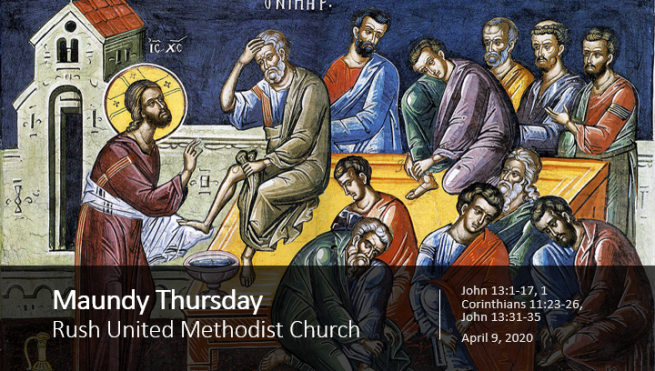
Got up from the Table,

Took off his outer robe and tied a towel around himself.

Jesus poured water into a basin and

Began to wash the disciples’ feet.

“Unless I wash you,” Jesus told Peter, “you have no share with me.” (13:8)


Knowing Peter would deny knowing him,

Jesus washed his feet,

To include Peter in his share.


Love overcomes denial.


Knowing Judas would betray him unto death,

Jesus washed his feet,

To include Judas in his share.


Love overcomes betrayal.


There is nothing that can separate us from the love of Jesus Christ.

Love always wins.


The Eucharistic Table invites us to have a share with Jesus,

To be washed clean of the filth we walk in with, and

To be washed clean of the sins we are about to commit.

Taking a share with Jesus at the Table

Is the privilege of being the recipient of God’s grace,

God’s gift of love to the world,

Love for all,

Deserving and undeserving, alike.


Grace is free, but it isn’t cheap.

Jesus paid for it with his life.


Being on the receiving end of God’s love at Holy Communion

Is coupled with responsibility.


The love of Christ comes with a mandate to the people gathered.

Mandate, from the Latin, Mandatum novum,

In the old English, Mandatum is Maundy, as in Maundy Thursday.


“For I have set you an example,

That you also should do as I have done to you.” (13:15)

“Just as I have loved you, … love one another.” (13:34)


Serve.

Love.

This is our mandate.


To share in the love of Christ,

We are mandated to serve others;

Without judgment,

Without regard,

Without exception,

Without reservation,

With the extravagant grace of God and the love of Christ.


Their past, present, future? It doesn’t matter.

Serve.


To share in the love of Christ,

We are mandated to love others,

Without judgment,

Without regard,

Without exception,

Without reservation,

With the extravagant grace of God and the love of Christ.


Our past, present, future?

It doesn’t matter.

Love.


To share in the love of Christ,

We are to serve and love with the same intensity and abundance

As is God’s amazing, overwhelming love for us.


………


This Maundy Thursday,

At this Table,

Our mandate is to serve:

Wash feet, and serve the consecrated bread and cup,

To the people of God

That all might know

The love of God.


At this Table,

Our mandate is to love:

That all the world might know

That we are disciples of Jesus by our love,

For one-another, and

By our love for our God.


This, then, beloved, is Eucharist:

Bread.

Cup.

People.

Service.

Love.

Amen.


6 Lenten Reflections on Holy Communion in the Middle of a Pandemic

Reflection #1


It was a big deal.

I was in the first grade. I walked home from school. My mother and brother were nowhere to be found. I was free to experiment.

On the kitchen table I placed a loaf of bread and poured myself a cup of Welch’s grape juice. I was going to celebrate Holy Communion all by myself. I prayed hard, just like my mother had instructed. It a prayer of humility, confession for sins – some even I did not know. If we had a kneeler, I would have been kneeling, just like at church before the communion rail.

I ate a slice of Wonder Bread and washed it down with grape juice.

“What do you think you’re doing?” my brother startled me as he walked in from school. “You can’t do that!”

I had done it. The bread, I imagined, was the body of Jesus. The juice, was his blood.

It was a big deal.


Nearly twenty years later, our seminary professor taught us the essentials to withstand withering ordination exams: “a sacrament is entrusted to the ordained, a command of Jesus, an action of God, communicating the spiritual truth of God’s love and grace for humankind.”

You’d be surprised how many candidates for ordination don’t get this vital principle of the Church correct on their first examination.

So sorry. Study up and come back next year.

With the majority of the Protestant House of the Christian Church, we recognize two sacraments: Baptism and Eucharist, also known as Holy Communion. Jesus tells us to do it. God is the primary actor, the ordained is the stand in. God’s love and grace abounds.

Baptism is God’s way to make a person a Christian. Because God does it, we can’t undo it. Redoing what God has done doesn’t make sense.

Eucharist is God’s way to unite us with Christ and with each other, the Body of Christ, in love and grace.

The stewardship of sacraments is given to the ordained, and their designated believers, through St. Peter, the rest of the Apostles, continuing by apostolic succession, to our present generation. Our sign is the cross, our symbol is the yoke we wear.


During Lent, it is our congregation’s tradition to withhold Holy Communion until the fast is broken on Holy Thursday. During these 6 Sundays I will replace the Eucharist with a brief time teaching about the sacrament, it’s practice, and our prayers.

I’ll answer such questions as, “Every Sunday? Really?” “Why is it so repetitive; the same stuff over and over again?” “Sung responses?” “What do the responses mean, anyways?” “Why can’t you do it like another pastor I once had?” “Wine or grape juice?”


At the beginning and end of the day, at the dawn and sunset of life, there remains the mystery of God’s tender love for us. God so loves the world, that he gives us his only Son, that whosoever believes in him might be saved. For God sent his Son to the world, not to condemn the world, but that all the world might be saved.

That’s how much God loves you.

That’s how much God loves our neighbors.


Eucharist.

It’s a big deal, full of more love than we can comprehend.

Thank you, Lord, for your gift of love.

Amen.


Reflection #2


How we give God praise and thanksgiving during worship comes to us through instruction, practice, and tradition. In Acts of the Apostles, chapter 2, we experience the practice of the first generation of Christ’s disciples: “They devoted themselves to the apostle’s teaching and fellowship, to the breaking of bread and prayers.” (Acts 2:42)


Apostles taught and broke bread.


Thus, the community was fulfilling two of three primary commands of Jesus: 1) teach the newly baptized converts “all that I have taught you”, and 2) when you gather, eat the bread and drink the cup “in remembrance of me”. They would fulfill the third of three primary commands of Jesus to love God and love neighbors, by using the remaining bread and wine after Eucharist to feed the hungry and poor.

Therefore, early Christian worship maintained a balance: teaching and sacrament, or “Word and Table”, as we were taught in seminary. The Christian life the other six days of the week is to be devoted to loving neighbors in need, through outreach and mission.


“Balance Word and Table” our seminary professors taught us. 


Table is the sacrament of Holy Communion, also known as Mass, or Eucharist. Over the first one-thousand years of Christianity, dogma, pride, greed, and intimidation perverted the Sacrament of Holy Communion, suppressed the proclamation of the Word, enslaved the people, and contributed to the division of the Church. This division is called the Protestant Reformation. The church divided into Protestant and Roman Catholic about 500 years ago.

Our Roman Catholic cousins continued to emphasize the Eucharist, to the exclusion of the Word. Our Protestant effort emphasized the proclamation of the Word, often at the expense of the Mass. Thus, we stopped celebrating Holy Communion weekly, resorting to monthly, or even, quarterly.

Since the Second Vatican Council in the 1960s there has been a concerted effort by both Protestants and Roman Catholics to return balance to the First Century practice of Word and Table. This effort is called “orthodoxy.”

The sacrament of Eucharist, which is the Greek noun meaning “thanksgiving” in English, is a reenactment of Jesus hosting his final supper with his disciples in the upper room the night before his crucifixion. It’s earliest historical account is found in Paul’s first letter to the church in Corinth, the 11th chapter.

The Sacramental liturgy – a collection of prayers called “the Great Thanksgiving” – and the act – the elevation of bread and wine, the invocation of the Holy Spirit, and sharing the host – is a reminder of God’s great love and sacrificial gift, the gift of his Son Jesus, for our forgiveness and salvation.

In preparation of Holy Communion, we return our gifts to God, our tithes, offerings, bread, and wine. These elements are presented to the altar as a sign of our reciprocal love for God’s love for us.

As we are taught by Jesus in his Sermon on the Mount, before we present our gifts to God at the altar, we must confess our sins, repent, and reconcile our broken relationships. Therefore, confession and reconciliation always precede Holy Communion.

Traditionally, the Lord’s Prayer follows the liturgy of the Great Thanksgiving, but precedes the distribution of bread and wine, because in the Lord’s Prayer we ask for God’s forgiveness of our sins and trespasses.

Once cleansed, we are ready to be fed. The Table is set. Next Sunday, I teach about what we do at the Table; the liturgy of the Great Thanksgiving.


Question from the audience! why is the celebration of the Eucharist reserved for only the ordained? 


The ordained is given the gift of Eucharist by God and charged with its use and safekeeping.


Allow me to explain.

The first Apostle of the Church was Peter. The second was Paul.

Through scripture, the Apostle Paul identifies different members of the Church given unique gifts. (1 Corinthians 12). God gives different people different gifts. To some, God appoints the gifts of apostles, to others prophets, to other teachers, working miracles, speaking in tongues, casting out demons, etcetera.

Jesus tells the Apostle Peter that he is a Rock upon which he will build his Church, “and the gates of Hades will not prevail against it. I will give you the keys of the kingdom of heaven, and whatever you bind on earth will be bound in heaven, and whatever you loose on earth will be loosed in heaven.” (Matthew 16:18-19)

Saint Peter binds the Sacrament of Eucharist and Baptism to the Apostles, and to their subsequent generations.

Early on Apostles became known as Presbyters, Elders, Priests, and Pastors. The titles are synonymous. In the United Methodist Church, the called and appointed Apostles of Jesus are known as Elders.

Celebrating the Sacraments is one of four necessary gifts, given their combination, that the Church recognizes in apostolic leaders. God gives to Apostles the gifts of: Word, Order, Sacrament, and Service – authority to proclaim the Word of God, authority to organize and shepherd communities of faith, authority to celebrate the Sacraments, and a life dedicated to serving those entrusted to your care.

Any one gift, God may grant any individual.

To anyone given all four gifts; we are recognized as Apostles of the church, set apart by ordination, signed by the cross, and yoked by the stole. We are keepers of the keys, the stewards of Sacraments, clergy of the Church.


Reflection #3 (Delivered the 1st Sunday of the Covid-19 Pandemic)


We are fasting from Holy Communion this Lent, anticipating the moment the fast will be broken at Maundy Thursday worship during Holy Week.


It’s a big deal; to be one in a crowd of thousands, who, after a day learning at the feet of the Savior, finds themself hungry. Seeing Jesus take “five loaves and two fish , he looked up to heaven, and blessed and broke the loaves, and gave them to the disciples, and the disciples gave them to the crowds. And all at and were filled.” (Matthew 14:19-20)


Take. Give Thanks. Break. Give.


It was a big deal; to be seated with Jesus around the Passover table, “that the Lord Jesus on the night when he was betrayed took a loaf of bread, and when he had given thanks, he broke it and said, “This is my body that is for you. Do this in remembrance of me.” In the same way he took the cup also, after supper, saying, “This cup is the new covenant in my blood. Do this, as often as you drink it, in remembrance of me.” For as often as you eat this bread and drink the cup, you proclaim the Lord’s death until he comes.” (1 Corinthians 11:23-26)


Eucharist is a big deal.


Take. Give Thanks. Break. Give.


These four basic actions of Holy Communion are the work of God, the command of Jesus, a witness to the Lord’s death and resurrection.

An essential core to every Eucharist celebration is giving thanks, just as Jesus did. Give thanks is the collection of prayers that constitutes what has come to be known since the third century as The Great Thanksgiving.


The final exam in “Intro to Worship” class in seminary was to construct from scratch a Great Thanksgiving based on an assigned passage of scripture. Every element must be used. Miss one and you failed. It was a big deal.

The Great Thanksgiving, also known as the Anaphora or Eucharistic Prayer, is a hymn of praise. It is Trinitarian, though always addressed to the first person of the Trinity, the Father. It is a three-way conversation between the people, the presider, and God. Therefore, it is most appropriately celebrated with the presider facing the people, speaking the language of the people.


  1. It begins with an introductory dialogue; a greeting that invites the people to join in the giving of thanks. A hallmark of the introductory dialogue is the Sursum Corda, Latin for “lift your hearts.”


  1. Learned by rote memorization, the recall and recitation of the introductory dialogue should free the mind to experience the preface. The preface is a prayer based on the assigned scripture for the day, citing a specific work of Christ or a general narration of salvation history.

One of the most spiritually satisfying times of my week is when, in the quietness of my office, I have the joy and privilege to write a new preface; it’s a gift to you, and my gift to God.


  1. Once or twice during the Great Thanksgiving, the prayer spontaneously explodes with congregational acclamations! “Holy, holy, holy” is called the Sanctus, from Isaiah 6:3 and Revelation 4:8. “Blessed is he who comes in the name of the Lord” is called the Benedictus qui venit, from Psalm 118:26 and Matthew 21:9. “Christ has died. Christ is risen. Christ will come again!” is an acclamation of faith, a line in the sand, a stake in the ground, a foundation upon which we stand!

Acclamations are spirited! Emotional! rousing! like a cheer in a stadium or a singing crowd at a concert. Thus, they can be spoken or sung. My preference is for singing!


  1. The celebrant speaks the words of institution, the commemoration of the events in which Jesus instituted the Lord’s Supper. To the best of my ability, the words are spoken the same for every Holy Communion, just as Jesus spoke them.


  1. We remember, called the anamnesis, what Jesus has done for us as we offer this memorial of his sacrifice.


  1. The presider invokes the Holy Spirit to descend on the people and the elements. This is called the epiclesis. It is done that all might obtain the benefits desired from communion, our petitions, and prayers.


  1. The Great Thanksgiving concludes with a triumphant, joyful, Trinitarian doxology, like icing on a cake, that sums up our praise of the Lord, our God.


Correctly employ all seven pieces into a Great Thanksgiving and you pass. Miss one iota, a fraction of a punctuation, and, well … see you next semester.

As the presider, entrusted to the pastoral care of each and every one of you, … who some weeks hang by a thread walking through the valley of the shadow of death, and, other weeks are skipping through life on cloud nine … Eucharist is essential, the oxygen of faith, the blood of belief, sustenance for the journey.

That’s how big of a deal it is.


Amen.


[References:

– “At the Lord’s Table,” Supplemental Worship Resources 9, Abingdon, Nashville, 1981

– “The United Methodist Book of Worship,” The United Methodist Publishing House, 1992.]


Reflection #4 (Pandemic 2)


We are fasting from Holy Communion this Lent, anticipating the moment the fast will be broken at Maundy Thursday worship during Holy Week.


It’s a big deal; the Sacrament of Holy Communion. Take. Give Thanks. Break. Give.


Following giving thanks (the Great Thanksgiving), breaking bread and pouring wine is a joyful part of the Sacrament because it recognizes our unity. As seeds of grain are gathered and unified into the flour of a common loaf, so, too, are we unified in our belief and witness of our risen Lord. As the grapes are crushed and the juice of each berry is channeled into one cup, so, too, are we unified with each other and with our God.

Breaking bread and pouring wine is a humbling experience for me, for I experience anew, at every celebration, my personal sense of unworthiness celebrating the Mass.

Beloved, I am sincere: because God has made a place for me at this, His Table, I am absolutely confident that there is a place at the Lord’s Table for you, too.

Breaking bread and pouring wine is a privilege that captures me in awe, the speechless glory of God’s presence and grace. When I elevate that loaf and break it … wow, Christ is broken for the world, for you, and for me. When I lift the cup … I’m overwhelmed that Christ’s blood washes away the sins of the world. Our past is gone, our present if clean, our future is God’s.


Our Roman ancestors and present-day Catholic cousins came to believe over the centuries the bread actually became the flesh of Jesus and the wine miraculously turned into his blood. This was another gripe that split us into the Protestant house. United Methodists believe the bread and wine are symbols of Christ’s body and blood, not his actual cells and bodily fluids.

One loaf. One cup. This is ideal. Early Apostles celebrated the Eucharist is small groups, in house churches, so it wasn’t a challenge. Given the setting, attendance, and dietary needs of those in attendance, accommodations may need to be made that include many loaves and many cups.

Shot glasses symbolize disunity and is in bad form, except in the midst of a pandemic!


Wine or grape juice? United Methodist practice is to use the unfermented juice of the grape, or, non-alcoholic grape juice. We recognize some struggle with addictions and using wine would become a barrier between themselves and the Table. It’s about being open, welcoming, accessible.


Accessible. Our practice is that Holy Communion needs to be as accessible to everyone. Not everyone will take advantage of it, but it’s their choice. Accessible means there’s room for everyone. No special knowledge or Sacramental understanding is needed. Have a difficulty walking? We’ll bring it to you. Home bound? We need to be organized and deployed to make home delivery!


Next, I’ll talk about giving.

Amen.


Reflection #5 (Pandemic 3)


We are fasting from Holy Communion this Lent, anticipating the moment the fast will be broken at Maundy Thursday worship during Holy Week.


It’s a big deal; the Sacrament of Holy Communion. Take. Give Thanks. Break. Give.


We follow the 4-step example of Jesus when he fed the crowds and served his disciples. 1) Jesus took the bread. 2) Gave thanks in prayer to his Heavenly Father. 3) He broke the bread. 4) And Jesus shared the bread.


I’ve spoken about the first three actions of Jesus on prior Sundays. Today, let us think about Christ’s act of sharing the broken bread and poured cup.


Bread and cup are given to modern disciples, just as Jesus gave to his disciples at the Last Supper. All who desire to draw close to Christ and intend to lead a Christian life, together with children, are invited to receive the bread and cup.


United Methodist do not refuse or deny anyone who presents themselves desiring to receive; though John Wesley regrettably did so on one occasion, which brought scandal and hurt, resulting in him fleeing the American colony of Georgia. Because God is the primary actor in a Sacrament, human subversion or denial is not allowed.


The consecrated bread and cup may be delivered by lay members of the church. When bread is given, we are reminded of the body of Christ, broken for us; God’s great sacrifice for us and our salvation. When the cup is shared, we are reminded of the blood of Christ, shed for us; washing us clean of our sins.


Barriers that inhibit belonging and full participation of those desiring Holy Communion must be identified and overcome. Intellect, ambulation, disability, diet, physical distance are some of the challenges that must be addressed to ensure full inclusion. Consecrated bread and cup may be taken by assistants after the service to those who are homebound and others unable to attend.


Giving should be personal: using the individual’s name (if possible) while making appropriate, non-threatening eye contact. Serving each other acts out our faith that Christ is the giver of this holy meal and that we are receivers of Christ’s grace.


Some celebrants will commune first. My preference is to be the last served. After all have been served, the table is to be returned to order. Left over bread and cup may be distributed to the poor, as was the early church practice, respectfully consumed, or returned to earth and God’s creation.


Next, I’ll conclude our Lenten discussion of Holy Communion. Amen.


[“The United Methodist Book of Worship”, 1992. p.27-31]


Reflection #6 (Pandemic 4)


We are fasting from Holy Communion this Lent, anticipating the moment the fast will be broken this Thursday, at Maundy Thursday worship.


It’s a big deal; the Sacrament of Holy Communion. We follow the 4-step example of Jesus when he fed the crowds and served his disciples. 1) Jesus took the bread. 2) Gave thanks in prayer to his Heavenly Father. 3) He broke the bread. 4) And Jesus shared the bread.


I was 14. The year was 1975. It was the first Sunday of the new quarter. My father, a 51-year-old seminary student and new local pastor at the time, asked me to join him in serving Holy Communion one afternoon to a member of the congregation in the nursing home. She was near death.


I was frightened about death, as most youth would expect to be. But I couldn’t show it. “Sure, I’ll go with you,” I replied as confidently as I could muster. Now, as a 58-year-old long-tenured pastor myself, I can see that my father was probably frightened, too. He was doing his best to hide his fear from me.

Dad led. I followed. We passed the sign on the door that said NPO, meaning nothing by mouth. Bread. Wine. This should be interesting.
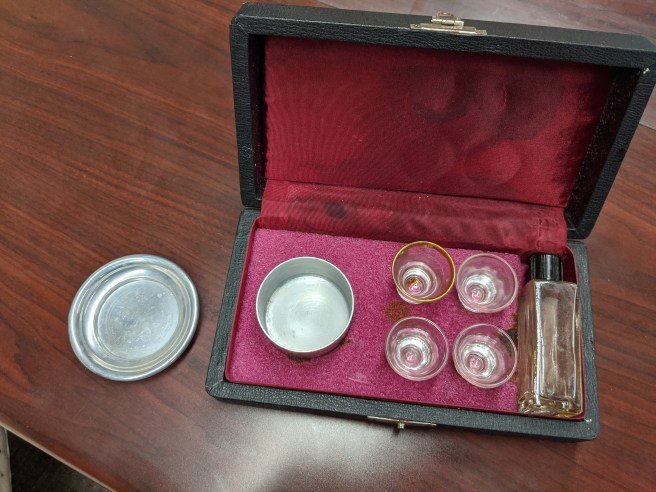
IMG_20200330_105111

Dad carried this traveling communion kit, filled with leftover bread and grape juice from morning worship. It had been given to him by Rev. Harold Geiser, a pastor of the previous generation. This sacred kit has been left to me. It’s really old and well worn, near and dear to my heart.


The elderly woman lying in bed was older looking than just about anyone I’d ever seen. She looked about 65 pounds soaking wet. She was sleeping, breathing hard, and her dried out tongue hung out and looked cracked. I wish I remembered her name.


Dad said “hello.” No response.

Dad read to her the 23rd Psalm. No response.

He said an abbreviated version of the Eucharist prayer. No response.

There was no opening her eyes.

I watched to see her breathing. Because, … you know.


Dad opened the Communion kit and set up the bread and juice. I looked around for any nurse who might have us arrested and tossed out for violating the NPO order.

My father, very gently, placed a crumb of the bread on this woman’s tongue. She pulled in her tongue, closed her mouth, and I could see that she began to suck on the crumb and move it about her mouth. Dad took a straw off her nightstand, inserted it into one of the cups and held it to her lips. She quickly slurped it up and swallowed. She didn’t choke. She never opened her eyes. There was no acknowledgment of our presence. Dad said a prayer and we left.


I have thought a lot about this woman in the forty-five years that have since past.

The mystery of the Sacrament has been brought to focus by this experience. Eucharist intersected with a lifetime of faith; when this woman had come forward, knelt at the altar rail, received bread and cup in her local church. She had participated in Holy Communion as a child, youth, young married mother, and as an aging widow. The presence of the Holy Spirit wove a consistent theological, Sacramental thread throughout her life leading her to the threshold, the thin divide between earth and heaven, mortal life and eternal life.

By some mysterious way, God used the Sacrament of Holy Communion to gather in this sheep of the Shepherd, and to bring her safely and lovingly home.


Holy Communion is this, and so much more; a big deal, a larger mystery than any one can begin to describe; tasting, seeing, experience the presence of God; cleansing, celebrating, uniting, feast of a lifetime; sustaining grace providing everything necessary for the Christian journey; reminding us of God’s great love for humankind.


Join us this Thursday – Maundy Thursday – for breaking the fast with the celebration of Holy Communion at 4:00 p.m.


Over past weeks I have been praying hard, making plans, only to have plans changed, change, and change some more. I have been asking advice from seminary professors, colleagues, and conducting my own research. I’ve been seeking your input; after all, you are the sheep of the fold that God has charged me to be your pastoral shepherd.


I take my sacramental rights and responsibilities seriously.


Join me online. I will celebrate live stream worship and Holy Communion at 4:00 pm. All participants will have three choices. Choose according to your needs and comfort level.


1) Curbside. After the service, bring a disposable cup and paper plate, drive to the church, pause at the front door. Do not get out of the car. The consecrated bread and cup will be safely passed through your car window to you, and you will receive a blessing. The Bread and Cup will be prepared with the same (or better) sanitary procedures as is being conducted by restaurants providing curb side or drive in service.


2) Home Delivery. Those unable to drive to the church, please contact the church office, and we will arrange for a volunteer to safely deliver consecrated bread and cup to your home, where it can be left by your door. Also, contact us if you are willing to volunteer and deliver consecrated elements, with my thanks.


3) Virtual Communion. Bread, Cup, and a gathered community are required. Virtual Communion is not a recognized practice by the United Methodist Church, even though I am aware of its recent practice.


The Church has a history of invoking “In extremis” sacramental procedures during emergencies, such as the bubonic plague and combat. In extremis means “in the farthest reaches” or “at the point of death.”


In light of our present Covid-19 pandemic, as your ordained pastoral leader, and because of my great love for each and every member and friend of the Rush United Methodist Church, after great prayer and discernment, I am invoking Eucharist In Extremis for Maundy Thursday. Therefore, you may prepare in your own home a Cup and Bread for your own consumption.


We will resume regular Holy Communion after Maundy Thursday as soon as possible and permissible. You have my assurance: I will not allow you to starve or die of thirst! This pandemic may prevent us from immediately returning to weekly celebrations of Holy Communion, but together, we will do the best we can.


Amen.

“Hosanna!”

Zechariah 9:9-10, Matthew 21:1-11, 26:1-5

Palm Sunday, 5 April 2020

The Rev. Todd R. Goddard, Pastor

Rush United Methodist Church

1

Prayer.


The Lord provided the prophet Zechariah with great vision.

“Rejoice greatly, O daughter Zion!” he wrote.

“Shout aloud, O daughter Jerusalem!

Lo, your king comes to you;

Triumphant and victorious is he,

Humble and riding on a donkey,

On a colt, the foal of a donkey.”

(Zechariah 9:9-10)


Thus, the Lord had spoken.

The Lord spoke to Zechariah’s generation,

Ending their exile and captivity,

Returning them to Jerusalem,

Restoring the Temple,

Breathing life once again into God’s chosen people,

Reviving the faithful.


God has done it before.

Expect God to save God’s people again!


The Lord’s words spoken by Zechariah

Were also directed to the crowds welcoming Jesus to Jerusalem.

The crowds of would-be followers and disciples of Jesus

Faithfully fulfilled Zechariah’s prophecy.

Rejoice!

Shout aloud!

Your king comes!

The king is triumphant, yet humble, riding on a donkey.


The faithful know God’s word and are willing to follow God’s every command.


Our Palm Sunday worship today is this generation’s

Faithful desire to know God’s word,

To follow God’s every command,

To take our place in God’s unfolding salvation history.


Rejoice! Beloved faithful!

Join together in a virtual cloud,

For our isolation and quarantine is time limited.


God has done it before.

Expect God to save God’s people again!

New life will breathe into our breasts.

Resurrection and life abundant is at hand.


“Hosanna!” the Palm Sunday crowd roared.

Hosanna is a Hallel Psalm,

Taken from Psalm 118:25-26.

It is sung at Passover,

Meaning “Save, we beseech you!”

“Save now!”

Hosanna is a cry

A prayer

For deliverance.


Rarely has Hosanna been more meaningful and to the point than right now.

As we wave our palm branches and

Join the ancient chorus

In the isolation of our homes,

We are praying that God will deliver us,

God will save us, and

God will restore us.


Our gentle and humble King

Who arrives today on a donkey and a colt

Gives us,

His would-be disciples, followers, and supporters

Hope and promise.


Christ has come to save us!

It may not be the salvation we thought was coming,

But it is the salvation and liberation that God has planned all along.


Hosanna! To the health care workers.

Hosanna! To our first responders.

Hosanna! To those sick and dying, and their families.

Hosanna! To all isolated, anxious, and discouraged.

Hosanna! Jesus.

Blessed are you who come in the name of the Lord!

Hosanna! In the highest.

Amen.

“God’s Been Here Before”

Ezekiel 37:1-14 and John 11:1-45

29 March 2020

The Rev. Todd R. Goddard, Pastor

Rush United Methodist Church

1

Prayer.


On the shore of the Chebar River in modern day Iraq

Slept a faithful prophet of our Lord.

He, and many other exiles from Judah,

Lived in a prisoner of war camp,

Enduring terrible suffering, deprivation, and humiliation.

Babylonian captivity was the Lord’s punishment for

The House of Israel defiling their own soil by their own sinful ways and deeds.

(Ezekiel 36:17)


There is no more profound example of quarantine or self-isolation

Then a prison.


As is often the case

God uses dreams as a means of revelation.

On this evening twenty-six hundred years ago

The prophet was visited in his sleep.

He described his Divine vision


The Lord informed Ezekiel

That when he preached to those dry bones

They’d all come together in a rattle.

Flesh, skin, and sinew would be knit together, and

The breath of the Lord from the four winds

Would bring them life.


The dead would live again.

Graves would be opened and the people of Israel would be restored to their land.


“I will put my spirit within you, and you shall live, and I will place you on your own soil; then you shall know that I, the Lord, have spoken and will act,” says the Lord.”

(Ezekiel 37:14)


And so, it came to pass.

Babylon fell.

Israel was restored.

God kept the promise.


God is faithful;

Even when we do not know what to do.


The Exile and Restoration

Wasn’t the Lord’s first plague, redemption, and restoration;

Remember Moses and Pharaoh?


In the isolation of our homes,

I hope we can recognize the fact, that,

While none of us has ever seen a pandemic of this scale

God has been here before.


God’s been through this and has prevailed.


…………………..


The Gospel narrative of Jesus raising Lazarus is long and well known to most of us.


From my Sunday school days, I remember …

  • Jesus delay in going to Lazarus bedside,
  • Mary’s complaint for Jesus failing to make haste,
  • The danger Jesus was in by those who wished to stone him to death,
  • His grief, raw, human grief, streaming down his cheeks, as he cried over Lazarus.


I remember …

  • Jesus praying fervently that resurrection may lead the crowd to belief,
  • Jesus calling out to the tomb where the body of Lazarus lay,
  • Thinking to myself, wow, he must have stunk being four days dead.


I was a volunteer medic on the local ambulance.

I know what four days dead smells like.


In the privacy of my own self-isolation this past week,

Studying the text, meditating and praying upon it,

I have come to see a part of the story of the resurrection of Lazarus

That I had never seen or experienced before.


A house that is in mourning

Is no different than a house in Babylonian exile,

Is no different than a house that is in isolation or quarantine.


Jesus becomes the same

Divine vision of restoration

When he meets Martha

Who comes forth from her Bethany home to greet him as he approached.


Jesus tells her,

“I am the resurrection and the life. Those who believe in me, even though they die, will live, and everyone who lives and believes in me will never die. Do you believe this?” She said to him, “Yes, Lord, I believe that you are the Messiah, the Son of God, the one coming into the world.”

(11:25-27)


Resurrection and life,

Opening the eyes of belief,

Revealing Jesus to the world,

That all – the whole world – may believe.


Resurrection and life.

Life abundant?

you betchya!


Jesus is resurrection and abundant life.


We learn in the following chapter of John how abundant life can be

When the resurrected Lazarus, Mary, and Martha entertain Jesus for dinner.

They feast abundantly.

Lazarus reclined at table with Jesus.

Martha waited on them.

Mary anointed Jesus with oil, filling the house with fragrance.

(12:1-3)


………………


Jesus is resurrection and abundant life.


Hang on to this anchor,

This stake in the ground,

For this is a cornerstone of our belief.


Jesus is resurrection and abundant life.

Burn it into your memory.


Lazarus was dead, and his loved ones were in mourning.

Jesus raised him to life.

God breathed life into his old dry bones.


Life became abundant once again,

As abundant as Israel being returned from Exile,

As abundant as life will become when science wins,

And this pandemic is defeated, destroyed, and fades away.


Jesus is resurrection and abundant life.


God has been through this before;

And prevailed!

God is with us now;

And winning!

God will see us through these days, too,

As difficult as they may be,

And God will bring us life,

Life abundant.


Beloved,

God’s always faithful.

God is always is true.

Rest assured, God’s greatest gift of grace

Is Jesus Christ;

Our rod and our staff,

Our good shepherd,

Our resurrection,

Our abundant life.

Amen.

…………………………………………………………………..

Lenten Reflection on Holy Communion


We are fasting from Holy Communion this Lent, anticipating the moment the fast will be broken at Maundy Thursday worship during Holy Week.


It’s a big deal; the Sacrament of Holy Communion. Take. Give Thanks. Break. Give.


We follow the 4-step example of Jesus when he fed the crowds and served his disciples. 1) Jesus took the bread. 2) Gave thanks in prayer to his Heavenly Father. 3) He broke the bread. 4) And Jesus shared the bread.


I’ve spoken about the first three actions of Jesus on prior Sundays. Today, let us think about Christ’s act of sharing the broken bread and poured cup.


Bread and cup are given to modern disciples, just as Jesus gave to his disciples at the Last Supper. All who desire to draw close to Christ and intend to lead a Christian life, together with children, are invited to receive the bread and cup.


United Methodist do not refuse or deny anyone who presents themselves desiring to receive; though John Wesley regrettably did so on one occasion, which brought scandal and hurt, resulting in him fleeing the American colony of Georgia. Because God is the primary actor in a Sacrament, human subversion or denial is not allowed.


The consecrated bread and cup may be delivered by lay members of the church. When bread is given, we are reminded of the body of Christ, broken for us; God’s great sacrifice for us and our salvation. When the cup is shared, we are reminded of the blood of Christ, shed for us; washing us clean of our sins.


Barriers that inhibit belonging and full participation of those desiring Holy Communion must be identified and overcome. Intellect, ambulation, disability, diet, physical distance are some of the challenges that must be addressed to ensure full inclusion. Consecrated bread and cup may be taken by assistants after the service to those who are homebound and others unable to attend.


Giving should be personal: using the individual’s name (if possible) while making eye contact. Serving each other acts out our faith that Christ is the giver of this holy meal and that we are receivers of Christ’s grace.


Some celebrants will commune first. My preference is to be the last served. After all have been served, the table is to be returned to order. Left over bread and cup may be distributed to the poor, as was the early church practice, respectfully consumed, or returned to earth and God’s creation.


Next Sunday, I’ll conclude our Lenten discussion of Holy Communion. Amen.


[“The United Methodist Book of Worship”, 1992. p.27-31]

“Ten Simple Things”

22 March 2020 – 4th Sunday of Lent

John 9:1-41

The Rev. Todd R. Goddard, Pastor

Rush United Methodist Church

1

Prayer.


Jesus is the light of the world,

The solution to sin,

The promise of our eternal future.

On Christ the solid rock I stand all other ground is sinking sand.


The current pandemic reminds me of how dependent we are on God. Life is fragile. It is as if our efforts to serve the Lord became stale, predicable, too easy and the Lord wants us to be more creative, daring, fresh, and bold. Perhaps God is calling the faithful to create new ways of Christian engagement to deepen faith, strengthen the church, and meet the needs of the world. Talk with me … phone, video, text or email. Let’s work together to identify and address the new opportunities for ministry this current crisis provides.


We are all anxious about unfolding events. The Lord woke me at 4:00 am Thursday morning to give you ten simple things to bring immediate relief to fear, replace anxiety with joy, and wrap each of us tightly in the confidence of God’s love:


1) Turn off the news. The constant stream of information is exhausting. Take a break. The quickly changing environment that upsets routine will begin to slow. Rest. Update yourself with current events on your terms, only to keep yourself and your family safe. Restore. Use the break to grow strong; physically, emotionally, spiritually. Sleep more, eat better, play. Restore.


2) Get outdoors. Spring is here. Go for a walk or run. Revel in God’s glorious creation. Find the Divine Awe creek side, along a hiking trail, overlooking a waterfall, in the smell of a patch of emerging Jack-in-the-Pulpit, raindrops falling on the cheeks, the wind making its way across a field. This is God’s majesty at work. We are a part of God’s greatest masterpiece! Release the joy!


3. Touch the Eternal. Place a small stone in your pocket and carry it with you. Allow the stone to serve as a reminder. The Eternal God who created that stone long before we were born, who loves us so much we are given Jesus, is the same God who will save us to an eternal home long after our mortal bodies are gone. Touch that stone; touch it often.


4. Take your pulse. Lightly touch your wrist. Gently touch your neck. You’re alive! Every heartbeat is a gift from God, a constant reminder of how much we are loved, and an ever-present source of God’s gift of life. Set a routine for taking your pulse, such as before and after every meal, or at waking and before sleep.


5. Breath. Breath deep and slow. Long inhales and long exhales. Purse your lips. Position yourself for maximum effect. Invite the Holy Spirit to enter your ebb and flow. Feel the Spirit’s fullness in your lungs. Experience the tide like movement in and out of your body. Breathe the Holy Spirit upon another (from more than 12 feet away!). Breathe the Spirit as a blessing, using your arms and hands to send it on its way.


6. Check in with your neighbors and each other. Call. Text. Write a note. Stop in Rush Connections using Zoom video. Watch for God at work in others. Be alert to needs that may emerge. Strategize how to meet those needs. When you experience God at work, report it! Witness it to others! I call these observations “Glory Sightings!” Keep a list of your Glory Sightings and share them often.


7. Practice charity. Where there is a need, give. Give joyfully. Give generously. Give sacrificially. Give in the name of God; the One who has given to you and me all good things. Sacrifice means giving something up. Think about what can be surrendered to make your act of charity more vibrant, more real. The happiest, most joy filled people on the planet are those who give. Spread some happiness.


8. Read your Bible daily. Connect with God through the Word God has provided. It’s a tool; use it! The more you use it, the more proficient you’ll get. Experience develops muscle memory in the body, mind, and heart. Set a time every day to experience God’s holy Word. If it has been a while, start by reading the Gospel of Matthew. Read it slowly. Pace yourself. Read small chunks at a time. Read the Gospel from start to finish. Watch for key words and allow God to speak to you through them.


9. Practice Sabbath weekly. Take one day a week off to do nothing except to thank God for the expanse of grace we’ve been given. Make a list of everything God has given you, for which you are thankful. You’ve been given a whole day, so make it a long list! Once you’ve wrung every ounce of thanks out of your body, turn your attention to praise. Give God praise. Praise God in prayer, song, worship, and Sacrament.


10. Wash your hands. Every time you wash your hands, say a prayer. Make it a good prayer, because hands need to be scrubbed frequently and thoroughly. End your prayer while washing with The Lord’s Prayer. Do this and you’ll successfully wash for two minutes or more. You will have made that connection with God that gets you through that very next moment.


Thank you for supporting our congregational leaders and staff with your encouragement, prayers, and kindness. We’re doing the best we can, relying on the grace and love of God.


Personally, thank you for your prayers and kind words.


Beloved, God loves you, and so do I,