“Pilate’s Five Questions”

John 18:33-38

November 21, 2021

Christ the King

The Rev. Todd R. Goddard, Pastor

Rush United Methodist Church

John 18:33-37

Then Pilate entered the headquarters again, summoned Jesus, and asked him, “Are you the King of the Jews?”

Jesus answered, “Do you ask this on your own, or did others tell you about me?”

Pilate replied, “I am not a Jew, am I? Your own nation and the chief priests have handed you over to me. What have you done?”

Jesus answered, “My kingdom is not from this world. If my kingdom were from this world, my followers would be fighting to keep me from being handed over to the Jews. But as it is, my kingdom is not from here.”

Pilate asked him, “So you are a king?”

Jesus answered, “You say that I am a king. For this I was born, and for this I came into the world, to testify to the truth. Everyone who belongs to the truth listens to my voice.”

Pilate asked him, “What is truth?”
| Centering Prayer |

His questions intrigue me, and

Reveal to us where this train is headed.

Pontius Pilate had only five questions for the incarcerated Jesus;

Held and tried on full display before Annas, Caiaphas, and other Jewish authorities.

1. “Are you the King of the Jews?”

Translation: Anyone claiming authority over the Emperor would be guilty of treason and immediately put to death by crucifixion.

Careful, Jesus.

Pontius Pilate is judge, jury, and executioner.

“Do you ask this on your own, or did others tell you about me?” Jesus responds to the question with a question.

Translation: The Jewish authorities want Jesus dead but they didn’t have the authority or stomach to kill him themselves.

Pilate would serve their need for an assassin by proxy.

2. “I am not a Jew, am I?”

Translation: Pilate’s question is a statement that he is not a Jew.

Therefore, his answer to Jesus’ question

Informs Jesus

just who it was

behind the plot to kill him.

Pilate lifts the curtain, and the religious authorities are caught red handed.

Who knew? They blushed.

3. “What have you done?”

Jesus previously reported to the Caiaphas, the High Priest, that he was only guilty of teaching in synagogues and in the Temple.

That got Jesus a slap across the face by a Temple police officer.

(John 18:19-224)

The unspoken charge was blaspheme;

teaching irreverently about God or sacred things;

You know, things …

Like the Temple was corrupt,

Religious authorities preyed on the poor, and

Lust after wealth, power, and control.

What had Jesus done?

The Son of God exposed organized religion as organized crime.

4. “So you are a king?”

Christ’s sovereignty isn’t political, ideological, tribal, or national.

Jesus informs Pilate that his kingdom is comprised of

everyone who belongs to the truth and listens to his voice.

(John 18:37)

Christ’s teachings are truth.

Those on the other side of truth

Pay no attention to Jesus.

Their sovereign is darkness and death.

Those of us who listen to Christ’s teachings and belong to the truth are members of Christ’s kingdom.

Listen and learn from Jesus.

Embrace truth.

Christ is our King.

5. “What is truth?”

The loyal flunkey of Caesar

thought he knew a few things about truth,

as he saw it.

Truth was …

In his eyes,

Pilate had all the power

over life, death, and everything in-between.

Truth and power,

influence and affluence,

all were his to hold or wield

as he saw fit.

Truth was …

In Pilate’s eyes,

the strong rule the weak.

The powerful judge the weak.

Rome demanded peace, obedience, and an uninterrupted flow of cash.

Pilate thought he knew a few things about truth:

It had proved to be politically useful

to befriend the religious authorities

to enlist their help

to keep the peace

to become the pipeline of money

delivering tax income to Rome.

Some considered it collaboration with the enemy.

The religious authorities saw it as a means to an end.

Whatever the justification;

When Rome was happy

Pilate was happy.

Pilate held all the cards,

Jesus had none.

Or, so Pilate thought.

Truth was

the spineless Temple priests

charged Jesus with blasphemy

but didn’t have the courage

to face him themselves

without the power of Pilate and his soldiers

to back them up.

Pity Pilate and his lackey Temple priests.

Their assumptions about truth

had all been wrong.

The question

“What is truth?”

simply points to

the depth of their ignorance,

the absence of faith.

Truth does not change with time.

What was true yesterday

is true today

and will be true tomorrow.

Truth can be replicated by others.

making it universal in its application.

It crosses all divisions

– gender, race, culture, and economics.

Truth is valid

in every time and every circumstance.

Therefore,

Contradiction undermines truth.

It creates an imperfection,

distressing incongruities,

and leads to failure.

The truth about God

is that there is more than what is seen, known, or experienced.

The mysterious nature of God is an ocean to our small island.

Had Pilate been able to see

what we see through the lens of history

he would have seen the fall of the Roman Empire,

the Ottoman Empire,

Nazi Germany,

And the crushing of ISIS.

Pilate would have been faced

with God’s larger truth that

the strong do not rule the weak.

Rather,

in God’s kingdom,

domination leads to failure,

power leads to corruption,

and those who hoard money find it impossible to

thread a needle with a camel.

If Pilate had been able to see

the larger picture,

absent of contradiction, imperfection, and incongruity,

he would have seen that

that God favors the poor,

the weak,

the least, the lost, the disadvantaged,

all those who get left behind.

The truth about God

is rooted deeply in faith.

What is beyond what can be seen

at any one time

is a reality in which

God is immortal, almighty, and in absolute control.

This is God’s kingdom

And Jesus is our king.

While we may be preoccupied

with the minutia of everyday

living and dying,

God is doing far greater things.

God is shaping and molding

into an ultimate, final divine will for all things,

from the vast expanse of the cosmos

to the particular of every human experience.

God creates and recreates everything

From the big to the small,

From the East to the West,

From the North to the South.

Faith that God is in control

frees the self

from equating cure with healing,

from connecting affluence with blessing,

and insisting that punishment

is the only solution for sin.

Faith in God

frees the self

from the necessity to always take charge,

and allows us

to submit,

to serve,

to give,

and to let go.

Faith that God is in control

allows one to recognize

the fact that we do not need to know all things,

to be a part of every decision,

to trust,

ultimately,

to allow God to be God.

Justice will prevail.

Peace will come.

The truth about God

is also rooted in a foundation of love;

the source of every

divine motive

from the beginning of time

through every eon of eternity.

Love overcame the flaw of sin;

the garden’s imperfection.

Love gave Moses a voice

Abraham a covenant

and the prophets a message.

Love birthed Jesus into the human condition,

forgives all flaws

and brings victory over the grave.

Love brings light and salvation

to a world hiding in darkness and sin.

We are a forgiven people because of God’s love.

We are a resurrection people because of God’s love.

We are a claimed people because of God’s love.

Where ever love can be found

it is possible

to trace its origins

back to the source

back to from whence it came

back to the Lord God, Almighty.

“Everyone who belongs to the truth listens to my voice,”

Jesus informs

the faithless personification

of stubborn, selfish, human will.

We know in our heart

that Jesus is right.

But to listen

and to obey

implies

surrender

of the will

to the Divine will.

Yes,

this is the price of Truth;

the only price that we are asked to pay.

“Are ye able,

said the Master,

to be crucified with me?”

to surrender the self

wholly to Christ,

to go

only where he leads?

to follow

only his voice?

“Are you the King of the Jews?”

asked a perfumed, pompous ruler

who thought he knew better.

“My kingdom is not from here,”

Jesus answers.

Thank God.

Thank God

Christ’s kingdom was never built on

political power, military might, or state wealth.

Thank God

we can handle the truth;

The truth is that God is in control.

The truth is that faith is able to free us.

The truth is that eternal love is God’s only pure and unblemished motive.

Amen.

“Not One Stone”

Mark 13:1-10

November 14, 2021

The Rev. Todd R. Goddard, Pastor

Rush United Methodist Church

Mark 13:1-10

As he came out of the temple, one of his disciples said to him, “Look, Teacher, what large stones and what large buildings!” Then Jesus asked him, “Do you see these great buildings? Not one stone will be left here upon another; all will be thrown down.”

When he was sitting on the Mount of Olives opposite the temple, Peter, James, John, and Andrew asked him privately, “Tell us, when will this be, and what will be the sign that all these things are about to be accomplished?” Then Jesus began to say to them, “Beware that no one leads you astray. Many will come in my name and say, ‘I am he!’ and they will lead many astray. When you hear of wars and rumors of wars, do not be alarmed; this must take place, but the end is still to come. For nation will rise against nation, and kingdom against kingdom; there will be earthquakes in various places; there will be famines. This is but the beginning of the birthpangs.

“As for yourselves, beware; for they will hand you over to councils; and you will be beaten in synagogues; and you will stand before governors and kings because of me, as a testimony to them. And the good news must first be proclaimed to all nations.

| Centering Prayer |

Context is the key to understanding.

Nobody likes rising taxes.

The result were public protests and attacks on government officials.

Governor Florus over-played his hand:

He ordered the Temple plundered and the treasury emptied.

This was the spark for the first of three wars

between the Jews and Rome.

Jewish rebels fought back,

Leading the pro-Roman king, Agrippa, government officials, and soldiers

to flee Jerusalem for their lives.

The rebellion was quickly spinning out of control.

Nero, the Emperor, had to act.

First, he sent Gallus to bring his legions of troops from Syria

to restore order and end the revolt.

6,000 troops were caught by Jewish rebels west of Jerusalem

In the Beth Horon pass.

All six thousand were slaughtered.

The Jewish victory attained great support throughout the land

And won over the hearts of the people.

Volunteers poured into rebel recruiting stations

Offering to fight Rome.

Passion and patriotism surged with youthful vigor.

Hold on there, dearly impassioned Jews.

Nero wouldn’t be embarrassed again.

The most experienced general, Vespasian,

was handpicked to crush the rebellion in Judaea.

Avoiding a direct attack on the heavily reinforced City of Jerusalem,

Four legions of troops,

That’s 24,000 soldiers,

landed in Galilee in 67 AD.

For three years, the legions advanced, led by Vespasian’s son, Titus,

Who served as second in command.

Rebel strongholds were eradicated, the fields were salted, and the population was punished.

February, 70 AD found the Roman legions knocking at the gates of the City of Jerusalem.

The Jewish rebels held out against the siege for 7 months.

All food supplies inside the walls were exhausted.

Time was on the side of Rome.

Jerusalem fell on September 7th in the year 70.

The Temple was destroyed, timbers burned, every stone above the foundation was thrown down and smashed.

The fire was so hot you can see the burn stains on the rubble to this day.

Rome found its revenge.

Josephus, the famed Jewish historian, claims 1.1 million people were killed during the siege, and 97,000 prisoners were taken into Roman slavery.

The few surviving Jews fled,

Diaspora-ed under cover of night to the four corners of the world.

Among the traumatized, surviving Jews

Were a small band of disciples

Who, as luck would have it, witnessed Christ’s ascension

38 years earlier.

By the light of the burning Temple,

St. Mark and his band of new Christians,

Convert memories to record,

Put pen to paper and begin a first draft of their Gospel.

Context is the key to understanding.

( Historical references from:

“Remember when Jesus made his final visit to the Temple?”

Mark and his small band of brothers probably opined.

“Jesus asked him,

‘Do you see these great buildings? Not one stone will be left here upon another; all will be thrown down.’” (13:2)

Not one stone.

Not one stone is left.

How right Jesus was.

….

You think these are bad times? End times, even?

COVID-19 pandemic.

Raging inflation.

Supply chain interruptions.

Taxes up.

Health care out of control.

Country divided.

The Capital stormed by rioters.

Hate crimes, more bold and more frequent.

Double talking,

lobbyist owned,

insincere parties, and

lying politicians

Who couldn’t pour water out of a boot even if the directions were printed on the sole?

You think these are bad times?

President Madison probably thought he was living through the end times

As he fled Washington and Major General Robert Ross

Easily routed the city and burned it to the ground.

Confederate John Bell Hood probably thought he was living through the end time

As his troops were overwhelmed and defeated in the Battle of Atlanta.

Sherman burned it to the ground.

Fire and fury,

Defeat and the smell of rotting corpses,

Would lead any woman or man to ask the same question

As our Lord’s disciples: When? What will be the signs?

When? And What? We ask of ourselves.

Lord, deliver us from such evil that threatens to consume us!

Jesus recognized the fact two days before the Passover

That crisis makes one vulnerable

to deception.

He was facing his own crisis,

And this made him vulnerable to temptation.

The crisis made the early Christians caught up in the destruction of Jerusalem during the first Jewish revolt

Vulnerable to every self-proclaimed snake oil salesman

Claiming to be the second coming of Christ.

They will say, “’I am he!’ and they will lead many astray,” Jesus warns. (13:6)

The crisis we see on today’s news

Speaks of wars and rumors of wars,

Of nations rising against nations.

California wildfires sweeping whole towns away,

Volcanoes blowing and spewing,

Earthquakes and famines –

This isn’t the end, Jesus proclaims.

This is just the beginning of labor,

The first contractions.

Christ followers will be vulnerable,

Easily led astray.

We are vulnerable, when facing persecution,

To give up and give in.

Hold strong, Jesus is telling us today!

Now is the time to hold strong.

No one knows when, so hold strong to faith.

No one knows when, so let us prepare ourselves for

Christ to return to anyone, anytime, anywhere, to everyone.

In other words

Stop looking for signs.

Efforts to correlate

the return of Christ and

the establishment of God’s kingdom with earthly signs

is a complete and utter waste of time.

There is great danger in associating

The evil of this world,

The tragic natural catastrophes of this world,

With the will of God.

The Lord is the light; and is not responsible for the darkness.

This is God’s kingdom.

God acts in God’s own time.

Throughout salvation history,

God has always worked for good.

Expect this trend to continue.

Apocalyptical prophecies prey upon the vulnerable,

Especially when facing the trials and temptations of this world.

Apocalyptical forecasting is not only a waste of time,

It distracts us from the task at hand:

 “The Good News must first be proclaimed to all nations.” (13:10)

Hold strong to the faith,

Jesus communicates to his followers,

And proclaim his Good News to all nations.

Share the Gospel.

Spread the Gospel.

Propagate the Gospel.

Make the entire planet aware

Of Jesus Christ, God’s gift of love,

His forgiveness and his salvation.

Not one stone will be left here upon another,

Jesus correctly proclaimed.

Today, all that remains of the Temple in Jerusalem

Are the foundation and front stairs.

Everything else is rubble,

Preserved for pilgrim tours.

When we hear about or look upon the foundation of the Temple,

Known as the Wailing Wall,

May we be reminded of our Lord’s directives:

Stay strong.

Stay focused.

Remain prepared.

Spread the Good News.

Leave the rest up to God.

Amen.

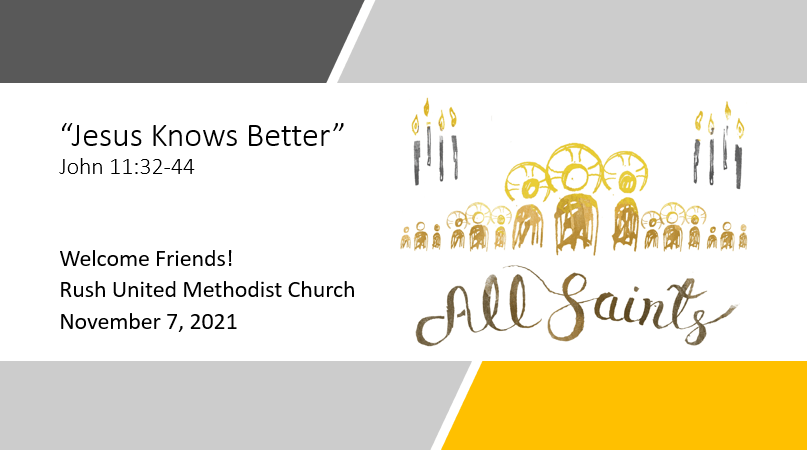
“Jesus Knows Better”

November 7, 2021 – All Saints Sunday

The Rev. Todd R. Goddard, Pastor

Rush United Methodist Church

John 11:32-44

When Mary came where Jesus was and saw him, she knelt at his feet and said to him, “Lord, if you had been here, my brother would not have died.”

When Jesus saw her weeping, and the Jews who came with her also weeping, he was greatly disturbed in spirit and deeply moved. He said, “Where have you laid him?” They said to him, “Lord, come and see.” Jesus began to weep. So the Jews said, “See how he loved him!” But some of them said, “Could not he who opened the eyes of the blind man have kept this man from dying?” 

Then Jesus, again greatly disturbed, came to the tomb. It was a cave, and a stone was lying against it. Jesus said, “Take away the stone.” Martha, the sister of the dead man, said to him, “Lord, already there is a stench because he has been dead four days.” Jesus said to her, “Did I not tell you that if you believed, you would see the glory of God?” So they took away the stone.

And Jesus looked upward and said, “Father, I thank you for having heard me. I knew that you always hear me, but I have said this for the sake of the crowd standing here, so that they may believe that you sent me.” When he had said this, he cried with a loud voice, “Lazarus, come out!” The dead man came out, his hands and feet bound with strips of cloth, and his face wrapped in a cloth. Jesus said to them, “Unbind him, and let him go.”

| Centering Prayer |

“Lord, if you had been here,

my brother would not have died.”

(John 11:21, 32)

Mary repeats the charge first made by her sister, Martha.

Mary and Martha blames Jesus for the death of their brother, Lazarus.

That’s quite the charge to heap on Jesus, don’t you think?

Never mind the fact that Lazarus may

may have died of natural causes.

We just don’t know what caused his illness.

He may have had many complex medical conditions.

Perhaps he didn’t take care of himself.

Never mind the fact that Lazarus didn’t have access to health care as we know it.

And, never mind the fact that Lazarus had lived a good, long life for that day and age.

Their charge

“Lord, if you had been here,

my brother would not have died,”

Speaks much more to the state of grieving sisters

Than it reflects the true nature of Jesus’ pastoral responsibility,

Or lack, thereof.

I’d suggest

“Lord, if you had been here,

my brother would not have died”

Reflects Mary and Martha’s deeper cultural belief about death,

One that most of us share:

That life is good and death is bad.

Death should be avoided at all cost.

Death should be avoided AT ALL COST,

even if it involves intense, chronic suffering.

Death should be avoided AT ALL COST,

even if it cost others a fortune.

Death is the enemy

And it STINGS.

Jesus thinks differently.

His approach to death,

as evident in our Gospel lesson for today,

Tells us he isn’t buying our popular assumptions about death.

Jesus knows better

And challenges us to consider death and its effects more deeply.

A quick Wikipedia search of the word “Saint”

Brings a diversity of beliefs from across Christendom

(and other world religions)

about what a Saint is,

what a Saint does, and

why a Saint is important.

Yes, a Saint is a football player

From New Orleans

With a 3 and 1 record

Playing the Atlanta Falcons today at 1:00 pm.

That’s not the kind of Saint I’m thinking about.

Generally speaking, “a Saint is a person who is recognized as having an exceptional degree of holiness, likeness, or closeness to God.”

(https://en.wikipedia.org/wiki/Saint)

Depending on the context and denomination, a Saint is venerated.

That is, honored or remembered for their high degree of sanctity or holiness.

The word veneration comes from the Latin,

Venerare (vene’ rare), meaning

to regard with reverence and respect.

Traditionally, the faithful disciple of Christ

Demonstrates veneration outwardly by

respectfully bowing or making the sign of the cross

Before a Saint’s picture or icon,

their bodily remains (called relics),

or their statue.

This is why we turn to photo albums and visit cemeteries.

Inward veneration is to remember and reflect upon the individual,

To consider the Christian lessons taught by both word and deed,

That made them holy.

November 1st is the date set by the Western Church

– Roman Catholics and Protestants alike –

to celebrate All Saints Day,

With the following Sunday being set aside as All Saints Sunday.

We Methodist have become very good at the veneration of Saints.

We speak the name, breaking the silence.

The spoken name makes life and death real.

We light a candle and bow in memory of a Saint in our life.

We place the candle and reflect upon the life that was lived.

As the flame ignites and the smoke ascends

Our faith brings assurance that

our loved one has now received their just reward and

has ascended to God in heaven.

This is important.

It is important for our own encouragement and wellbeing.

It is important that the memory and stories of the Saints be told to our children

So that their legacy might live on forever.

This is important because it is an exercise in the intellectual and physical aspects of our faith.

A number of years ago,

I read and reflected a lot on Greek Orthodox spirituality,

As related to books authored by Kyriacos C. Markides.

Dr. Markides is an American professor of sociology.

I highly recommend his book

“The Mountain of Silence: A Search for Orthodox Spirituality.”

(https://www.amazon.com/s?k=9780385500920)

He makes a few points that brings light to the story of Lazarus

on this All-Saints Sunday.

First: The soul moves to Theosis.

That is to say,

By Divine grace,

our soul is transformed and

obtains likeness with Christ

– Union with Christ.

This should sound comfortably familiar

to all of us in the Wesleyan tradition.

We Methodist have always placed a strong emphasis on entire sanctification,

Or the transforming effect of God’s sanctifying grace.

(https://en.wikipedia.org/wiki/Divinization_(Christian) )

John Wesley referred to Theosis as

moving towards Perfection,

a reference to Hebrews 6.

In our earthly life

Some make more progress towards Perfection than others.

Ours is not to judge.

Ours, as a Church, as an Ecclesia

Is to encourage, to support, to facilitate,

To pray for each and every soul and our quest

“To become One with Christ and

One with each other,”

As we pray in the Communion liturgy.

In Eastern Orthodox thought

Death becomes little more than a reference point

In the soul’s obtainment of Theosis.

This is why the Eastern Church prays for the dead;

That each eternal soul might continue to be transformed into the likeness of Christ.

Sainthood is obtained at Theosis,

Either in life or in death.

It is the complete shedding of the ego

Growing into a perfect union with Jesus.

Theosis is heavenly;

And heaven can be achieved by the Saint

Here on earth,

Or in a future heaven.

Secondly, Dr. Markides makes the point that

We’ve come to place

Too much value on the Western approach to the intellectual and scientific.

We have lost our roots that places

Spiritual value on God and the miraculous.

If we rebalance our lives

with the known and the mysterious

With science and theology

Then perhaps the pathway to Theosis becomes much easier to travel.

The intellectual, Western approach to the story of Mary, Jesus and Lazarus

Is to attempt to explain away the miracle of resurrection.

Cells break down at death.

Chemical processes take place.

Flesh becomes putrefied and decays.

Therefore, Lazarus could not have been “truly” dead.

He must have been in a natural, deep coma, from which Jesus aroused.

Right?

Not so fast!

Jesus knows better.

What we have left behind in our unbalanced,

Intellectual approach to God

Is that

the same God who is the Creator of life

Is the Lord of life!

God can breath life into those old dry bones in Ezekiel.

God can give life to a decaying, rotting, four-day-old corpse

formerly known as Lazarus.

Our God is the same One who demonstrated as much

By the resurrection of Jesus!

God could even give life to a stone,

if that suited God’s purpose.

It is not ours to explain how or why.

It is our purpose to live life

in the presence of the Divine mysterious,

To drink in Its grace,

To discover that at its very core

God is love.

The pathway to Theosis is to become the love of God.

The journey towards Perfection is to be transformed into the heart of Jesus.

To be a Saint

Is to live and die on the journey towards God.

We learn in schools, and our intellect is expanded.

We grow with the transformation of our minds

at the feet of teachers, instructors, and professors.

But we experience the transformation of our soul,

by God’s grace alone.

This transformation takes place

In the Ecclesia,

In the Church,

As we become One with the love of God.

We move from brain to heart,

– From thought to love –

As we become One with Christ and One with each other.

This is what redeems and transforms the world.

This is what opens the door to heaven for one and all,

Where one day,

Every knee will bow and

Every soul will be as One with the Lord.

This is the journey of the Saint.

Today

Even as we pray for the journey of those who’ve gone on before us,

Even as we pray for the journey of one other,

By God’s grace,

May the journey towards Perfection

… the journey into love …

Also be yours.

Amen.

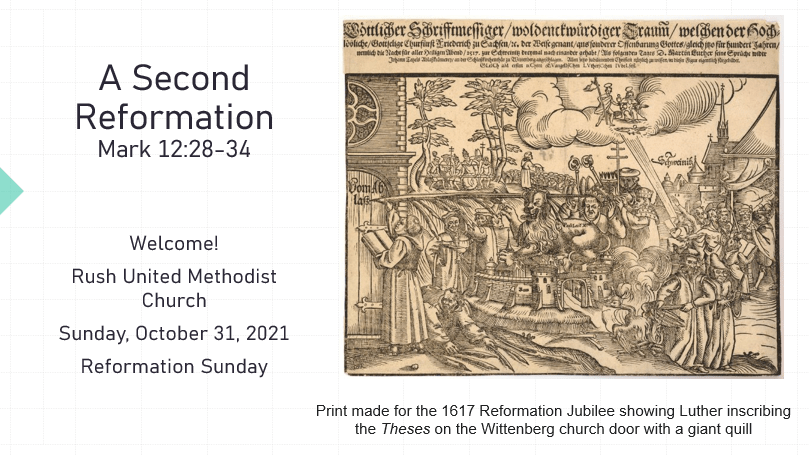
“The Second Reformation”

Mark 12:28-34

October 31, 2021

The Rev. Todd R. Goddard, Pastor

Rush United Methodist Church

Mark 12:28-34

One of the scribes came near and heard them disputing with one another, and seeing that he answered them well, he asked him, “Which commandment is the first of all?” Jesus answered, “The first is, ‘Hear, O Israel: the Lord our God, the Lord is one; you shall love the Lord your God with all your heart, and with all your soul, and with all your mind, and with all your strength.’ The second is this, ‘You shall love your neighbor as yourself.’ There is no other commandment greater than these.” Then the scribe said to him, “You are right, Teacher; you have truly said that ‘he is one, and besides him there is no other’; and ‘to love him with all the heart, and with all the understanding, and with all the strength,’ and ‘to love one’s neighbor as oneself,’ —this is much more important than all whole burnt offerings and sacrifices.” When Jesus saw that he answered wisely, he said to him, “You are not far from the kingdom of God.” After that no one dared to ask him any question.

| Centering Prayer |

Johann Tetzel was

First the messenger, and

Secondly, the project manager.

The message was a difficult one to swallow

Even for this faithful servant.

The cultural and language gulf was enormous.

The request was directed by his superiors towards those

Who had nothing to left to give,

Who had suffered difficulties and calamities,

Famine, plague, crime, and war.

You can’t get blood from a stone.

He transverse the Alps.

As he journeyed through the fiefdoms and villages of Europe

Refugees and immigrants were common,

All in search for a better life.

A third of the dwellings he passed lay empty,

Their families the victim of a raging pandemic,

The plague, or Black Death, it was called.

It was a global tragedy

Unlike any seen before, or since

(Including COVID-19).

Johann’s project was to lead a successful stewardship campaign for the church in Germany.

His efforts would not use the tried-and-true stewardships tools familiar to us today.

No letters.

No every-member visitations.

No pledge cards to return.

No celebration Sundays.

Raising money for a cause de jure  wouldn’t work.

Why build a new cathedral when the current one was perfectly good?

Construction and fund raising planned for 120 years?

What kind of crazy evil-genius would indebt this generation

And the next two or three to come?

Oh, yeah. One who was believed to be infallible.

Johann, like every other emissary from the Holy See,

Was directed to visit every parish priest in their assigned jurisdiction,

Inform each how much they had to annually raise,

And empower the clergy with the necessary means of raising the funds.

Their authorized technique?

Selling indulgences.

What’s an indulgence?

The Church of Rome taught that it is

“a way to reduce the amount of punishment one has to undergo for sins.”

His marketing intelligence was high.

Johann came up with the jingle that had a nice ring to it in German:

“As soon as the coin the coffer rings,

The soul from purgatory springs.”

(https://en.wikipedia.org/wiki/Reformation_Day)

Johann had been quite successful until he came to Wittenburg and

Came face to face with the professor and parish priest, Martin Luther.

Forgiveness is God’s alone to grant, the university professor taught,

And it was wrong of those who claimed indulgences absolved buyers

From all punishments and granted salvation.

“Christians,” he said, “must not slacken in following Christ on account of such false assurances.”

Christ alone forgives our sins.

Christ alone saves us into eternal life.

On October 31, 1517

504 years ago on this very day,

Martin Luther put pen to paper,

Listed 95 complaints related to the oppressive indulgences of the Pope, and

Nailed them to the front door of the Wittenburg church.

Luther’s “Ninety-five Theses”

Would have barely caught the attention of his supervisor, let alone the Pope,

Had it not been for the invention of the newest social media platform of the day:

The printing press.

Gutenberg’s printing press provided the means

For the rapid spread of Luther’s complaints in the common language.

The spark was set to kindling and

The fire of the Protestant Reformation began to rage.

The Roman Catholic Church divided and Protestant protest denominations

Started to spring up, mostly among national influences.

Individual parishes had to make a decision.

Ordained clergy also had a decision to make.

Remain in the Roman Catholic Church

(Pay indulgences and pay for the new St. Peter’s cathedral in Rome for the next 120 years), or,

Break away and join up with a new denomination

Under the Protestant umbrella.

A fresh start

With a new piece of canvas.

Should I stay or should I go?

Sounds familiar, doesn’t it?

Let’s keep it simple, beloved.

Hear the voice of Martin Luther:

“Christians must not slacken in following Christ on account of such false assurances.” (Luther)

Listen to the voice of Jesus and follow his commands:

‘Hear, O Israel: the Lord our God, the Lord is one; you shall love the Lord your God with all your heart, and with all your soul, and with all your mind, and with all your strength.’ The second is this, ‘You shall love your neighbor as yourself.’ (Jesus)

Most of us are aware

Of a similar division that is approaching the United Methodist Church.

The forces that are tearing apart people, parishes, and pastors

Are related to theological differences about human sexuality.

But it runs deeper than that.

Plurality and tolerance was once embraced

When the Methodist and Evangelical United Brethren denominations

Merged in 1968 to form The United Methodist Church.

It was a big tent time and almost all theologies were welcome.

That age has ended.

Theological cracks began to form early on

And have only grown and spread.

Have you noticed?

The world has become more divided, partisan, and intolerant

Since 1968.

Good Christians don’t need to agree on everything.

Good Christians only need to keep their eye on Jesus.

Division is coming.

A unity that keeps us fighting

Is not a unity I’m praying for.

A unity that allows each deeply divided side to be at peace

And focus all efforts on following Jesus

Is the unity that I’m praying for.

Let’s keep it simple, beloved.

Hear the voice of Martin Luther:

“Christians must not slacken in following Christ on account of such false assurances.” (Luther)

Listen to the voice of Jesus and follow his commands:

‘Hear, O Israel: the Lord our God, the Lord is one; you shall love the Lord your God with all your heart, and with all your soul, and with all your mind, and with all your strength.’ The second is this, ‘You shall love your neighbor as yourself.’ (Jesus)

An insightful article in “The Atlantic” caught my attention this past week.

“The Evangelical Church is Breaking Apart,”

“Christians must reclaim Jesus from his church.”

By Peter Wehner

Suggests to me that an even larger division is coming,

One that may be thought of as a second Reformation.

Wehner paints an American landscape of Christianity

Already greatly divided,

Well before the pandemic hit.

He writes,

“The root of the discord lies in the fact that many Christians have embraced the worst aspects of our culture and our politics. When the Christian faith is politicized, churches become repositories not of grace but of grievances, places where tribal identities are reinforced, where fears are nurtured, and where aggression and nastiness are sacralized. The result is not only wounding the nation; it’s having a devastating impact on the Christian faith.”

He observes

Worship is transformed into entertainment.

Teaching doesn’t come from the church but from the media that individuals consume.

Scripture and Biblical ethics are distorted to fit the politics.

This thought prevails:

What I believe is under assault and I need to fight to protect it.

Wehner warns us of history repeating itself,

“Once Christians gained political power under Constantine, that beautiful loving, sacrificing, giving, transforming Church became angry, persecuting, killing Church. We had forgotten the cross.”

We should fear future inquisitions and crusades

As much as we are convicted by or sinful past.

The choice of a potential second reformation is between

Jesus and the Gospels, or,

Rugged masculinity and Christian nationalism.

My belief and experience lead me to believe Wehner is spot on and we should heed his warning.

Self-awareness is the first step in transformational change.

Keep it simple.

Hear the voice of Martin Luther:

“Christians must not slacken in following Christ on account of such false assurances.” (Luther)

Listen to the voice of Jesus and follow his commands:

‘Hear, O Israel: the Lord our God, the Lord is one; you shall love the Lord your God with all your heart, and with all your soul, and with all your mind, and with all your strength.’ The second is this, ‘You shall love your neighbor as yourself.’ (Jesus)

Choose Jesus and his Gospels.

Amen.

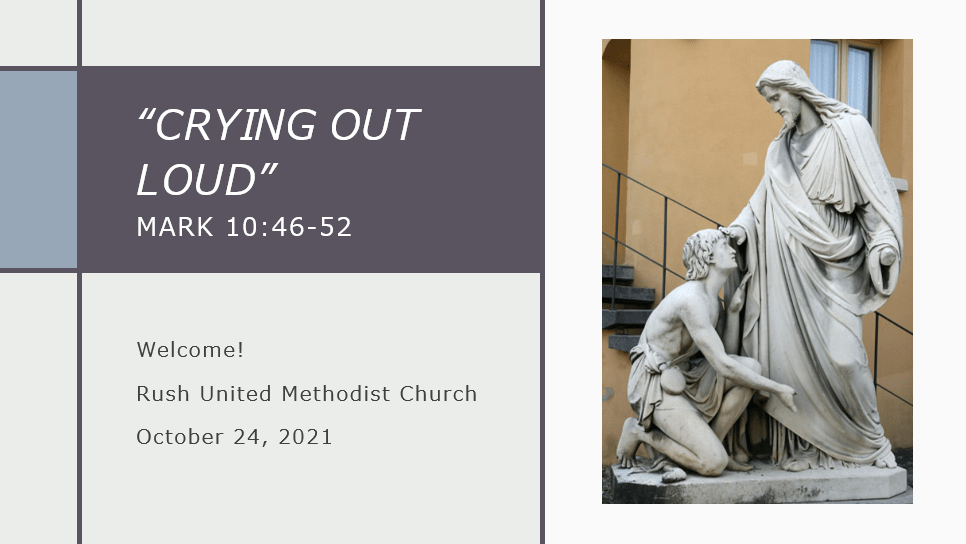
“Crying Out Loud”

October 24, 2021

The Rev. Todd R. Goddard, pastor

Rush United Methodist Church

Mark 10:46-52

They came to Jericho. As he and his disciples and a large crowd were leaving Jericho, Bartimaeus son of Timaeus, a blind beggar, was sitting by the roadside. When he heard that it was Jesus of Nazareth, he began to shout out and say, “Jesus, Son of David, have mercy on me!” Many sternly ordered him to be quiet, but he cried out even more loudly, “Son of David, have mercy on me!” Jesus stood still and said, “Call him here.” And they called the blind man, saying to him, “Take heart; get up, he is calling you.” So throwing off his cloak, he sprang up and came to Jesus. Then Jesus said to him, “What do you want me to do for you?” The blind man said to him, “My teacher, let me see again.” Jesus said to him, “Go; your faith has made you well.” Immediately he regained his sight and followed him on the way.

| Centering Prayer |

Crying Out

Growing up, I loved the Bob Newhart sit-coms;

Both the early series where Bob is a Psychiatrist

And the later series where Bob and his wife own and operate a bed and breakfast in Vermont.

Three characters in the second series have left an indelible impression on my memory:

Larry, his brother Daryl, and his other brother Daryl.

It was absurdly funny to think that two brothers would be named the same.

Neither spoke; they didn’t have to.

Their introduction each week kept the laughs rolling.

If they could have spoken, what would they say?

Were they silent due to an intellectual challenge?

Or were they quiet because of an overbearing older brother?

Maybe they were just the quiet sort?

Two brothers with the same names;

Now that’s funny.

In a similar funny sort of way,

We are introduced to our main character in today’s Gospel:

Bartimaeus, son of Timaeus.

Now that’s funny!

Did you catch the joke? It was meant to make you laugh.

The Gospel author named this blind beggar twice:

Bartimaeus, would have been Bar, or, son of, Timaeus.

In the translation from Hebrew to Arabic

Every New Testament scribe would have burst out laughing and slapped their knee in delight

When they copied the Gospel from one scroll to another:

This man is redundantly named: Son of Timaeus son of Timaeus.

Every town has its character

And our Gospel author is painting a portrait of Jericho’s.

Jericho was an Arab settlement at the time of Jesus (and still is today),

So unlike Jewish towns,

The beggars would be right downtown.

Think small town life.

Everyone knows the son of Timaeus.

It was such a shame that he lost his sight in his younger days.

Now he sits on Main Street (Jericho really only has a Main Street) all day long,

Rattling his tin cup and shouting out to anyone he hears passing by.

The unknowing traveler gets the

Bartimaeus treatment.

#BartimaeusTreatment should be trending on Twitter, by the way.

The Bartimaeus treatment was

The loud, bombastic appeal of a persistent, blind ragamuffin. 

At the same time,

Other travelers would be quietly sneaking past on the other side of the road

Hoping the brash and obnoxious son of Timaeus with two first names

Wouldn’t hear them.

Those who know the son of Timaeus son of Timaeus

Avoid him.

They go out of their way to not deal with him.

They marginalize him.

They keep him contained.

Take a moment to reflect on the people in your social circles.

Who do you avoid?

Who do you marginalize?

“Life would be so much easier if I didn’t have to deal with ____________”

Who are the people in your life with two first names?

<Silence>

Being Healed

Like a fisherman watching a group of anglers headed towards a secret fishing hole

The crowd of enthusiastic people are encroaching on Bartimaeus’ turf.

That gives an edge to

son of Timaeus son of Timaeus.

It makes him a bit cranky.

If he was going to be heard, he had to amplify his message a bit,

Add some spice,

Up his game,

Stretch the truth.

The crowd expected Jesus to become king,

“So why not stretch it out a bit and give him a royal title,”

son of Timaeus, son of Timaeus probably thought to himself.

Look at me!

Pay attention to me!

Coins don’t magically appear in my cup.

Making a scene draws attention.

Attention puts coins in my cup!

“Jesus, son of David!”

A king has money to spare,

“Have mercy on me”

He says as he rolls his diseased eyes and extended his cup

Giving it a little rattle.

Members of the Chamber of Commerce probably had a conniption.

“Can someone please shut that man up!”

That’s just asking for it,

Like poking a hornets’ nest twice,

Like pouring gasoline on a fire.

When Bartimaeus wouldn’t be silenced

The annoyed crowd stopped attempting to mussel him.

They said to him,

“Take heart; get up, he is calling you.”

Something profound begins to take place in his soul.

How do we know?

Consider his actions.

Here’s a hint.

Bartimaeus throws off his cloak.

Blind, begging, homeless ragamuffins

Don’t just jettison clothing, even if they are just rags.

Throwing off his cloak means

The son of Timaeus knew his life as he knew it

Was over.

He isn’t coming back to retrieve it.

Hey! Rich, young ruler: take note.

Son of Timaeus son of Timaeus gives away all that he has

When he tosses his cloak,

Leaving it for the competition,

Leaving it for his fellow beggars.

Faith throws a cloak.

Jesus doesn’t make spit.

Neither does he touch his eyes.

Jesus simply commands him to be healed:

 “Go; your faith has made you well.”

Imagine that.

The one person the crowd wanted to marginalize in the worst sort of way

Ends up having more faith than all of them put together.

And that faith is sufficient to restore a blind man’s sight.

Those people in your life I had you reflect upon just a few moments ago?

Those who you’d like to forget, avoid, or just wish they’d go away?

What faith might they have? …

That causes Jesus to stop,

Stand still,

Call them close,

And heal them?

Faith is contagious.

Allow yourself to be exposed to the faith of those you’d prefer to avoid or make disappear.

Like a virus

Faith exposures

Can, and will, deepen your faith

grow your life,

draw you closer to God.

Following Him on the Way

With the immediacy of Mark

Son of Timaeus son of Timaeus

Regains his sight and

Follows Jesus on the way.

Like some tech companies who leave special Easter Eggs in their web pages,

Our Gospel author

– The same one whose humor is given voice by the naming redundancy –

Leaves us another delightful Easter Egg.

Here, then, is a deeper hidden message for Christians to hear:

“The Way” was a coded phrase,

Often repeated in the Aramaic oral tradition with a wink and a nod,

Meaning the journey of discipleship;

Following Jesus that leads to suffering, death, and resurrection.

To follow Jesus in “The Way” means

You are willing to join with Jesus as your companion;

You’re willing to suffer with him in his humiliation, whips, scorn, and crown of thorns;

You’re willing to die with him on a cross;

And You expect, simply by shear faith,

To be resurrected with him into eternal life.

Son of Timaeus,

Who had sight and lost it by some unknown circumstances,

Only to have his sight miraculously restored by Jesus,

Now leaves his begging cup and cloak behind and

Joins the journey with Jesus that leads to the cross and empty tomb.

The son of Timaeus will suffer like Jesus,

Will die like Jesus,

And will live again in the resurrection of Jesus.

Many of us hope “the Way” for us

Is suffering and death LITE,

With a special second helping of that whole eternal life bit.

“I’d like to have a sharp mind and healthy body, die in my sleep, and have those pearly gates swing wide open for me to enter.”

Isn’t that what most hope for?

Truth is,

To live is to suffer.

To die is universal.

To be resurrected is our Christian expectation.

Truth is,

If we want to follow in “The Way”

We must follow the divine One who was marginalized

And is largely relegated to the sidelines as irrelevant by today’s society.

If we want to follow in “The Way”

We must join a crowd

Of those we’ve previously marginalized, avoided, and treated with contempt.

If we are going to journey with Jesus together

We better start building bridges with one another,

Especially with those who cause us to shrug our shoulders

And we’d rather not even think about.

Following in “The Way”

Causes us to confront our own biases and prejudice.

Following “The Way”

Invites each of us to a deeper spiritual life.

Life’s journey is easy with friends;

But there is not much growth with such shared experiences.

Jesus didn’t come to heal the healthy!

He came to heal the sick and save the sinner!

Life’s journey along “The Way” of Jesus

Is where faith is nurtured, grown, and deepened.

It is where healing pours into the vessel of faith.

It is where lions lay down with lambs,

Opposites attract,

And disagreements are put aside.

Going with the flow on “The Way”

Makes us One with Christ and

One with each other.

Let us be united

On “The Way.”

Amen.

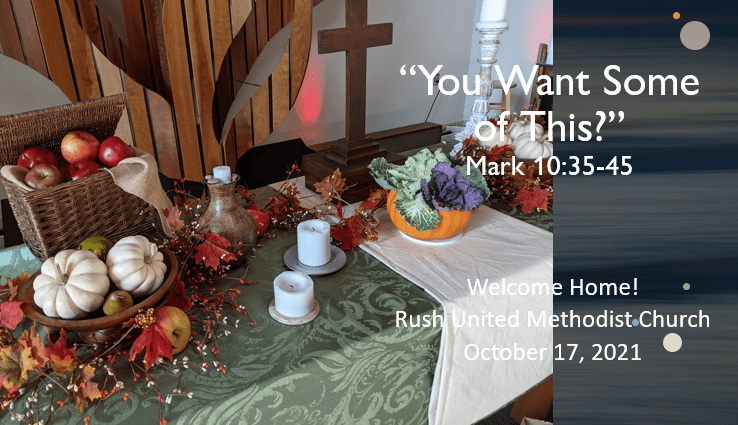
“You Want Some of This?”

October 17, 2021

The Rev. Todd R. Goddard, pastor

Rush United Methodist Church

Mark 10:35-45

James and John, the sons of Zebedee, came forward to him and said to him, “Teacher, we want you to do for us whatever we ask of you.” And he said to them, “What is it you want me to do for you?” And they said to him, “Grant us to sit, one at your right hand and one at your left, in your glory.” But Jesus said to them, “You do not know what you are asking. Are you able to drink the cup that I drink, or be baptized with the baptism that I am baptized with?” They replied, “We are able.” Then Jesus said to them, “The cup that I drink you will drink; and with the baptism with which I am baptized, you will be baptized; but to sit at my right hand or at my left is not mine to grant, but it is for those for whom it has been prepared.”

When the ten heard this, they began to be angry with James and John. So Jesus called them and said to them, “You know that among the Gentiles those whom they recognize as their rulers lord it over them, and their great ones are tyrants over them. But it is not so among you; but whoever wishes to become great among you must be your servant, and whoever wishes to be first among you must be slave of all. For the Son of Man came not to be served but to serve, and to give his life a ransom for many.”

| Centering Prayer |

I was a big fan of the HBO series, The Sopranos.

Tony Soprano was a New Jersey crime boss who ruled his criminal empire with an clenched, iron fist.

His captains: Christopher, Sil, and Paulie …

Each climbed their way to the top of the organization.

All three of them were constantly maneuvering to be Tony’s favorite and successor.

A good boss has a succession plan.

Tony Soprano was no different.

He was constantly testing and grooming his captains.

On numerous occasions Tony and one of his boys

Would get into a BIG DOG confrontation.

Tony would emerge triumphant.

Enraged, he’d ask, “You want a piece of me?”

Then he pinned them to the floor and showed him his clenched fist.

“You want some of this?”

The message was clear: if you want to be the Boss, you have to best the Boss.

I must confess,

Our Gospel message for this morning made me think of The Sopranos.

Three observations.

1. You want some of this?

You must be baptized into Christ, and  tempted by the Devil.

“So, John and I were thinking,” James stammers.

<Eyes shift left and right>

“Can we ask you a favor?”

“What is it?” Jesus asks, knowing full well the answer to his question before he asks it.

<Eyes roll back>

“Can we sit at your right and left hand when you are crowned king?”

James and John had expectations that didn’t include a cross.

They were hoping for a throne instead.

“If you want some of this” Jesus points to himself,

“You have to join me in my baptism.”

On the surface, this sounds like a simple request.

James and John fall for it without thinking it through.

“We are able.”

They were probably thinking of that glorious moment

When Jesus rose from the water,

The heavens parted,

The dove descended and

The voice of God spoke from the heavens,

“This is my Son, the Beloved, with whom I am well pleased.”

“We are able,” they boldly proclaimed with sugar plums dancing in their heads.

<Jesus closes his eyes and shakes his head>

This probably was not Jesus’ intention.

My guess is that Jesus was thinking about what happened after his baptism.

The launch of his public ministry began

With him driven into the wilderness,

Cold and hungry for 40 days,

Enduring multiple, repeated, merciless temptations from the Devil personified.

You want a piece of me?

Those who are baptized in Christ,

As each of us are here today,

Will face the same severity of trials and temptations Jesus did.

We will not be sheltered, protected, or hidden away by God.

Rather, being baptized in Christ,

Disciples of Christ are given the assurance

That the same Jesus who bested the Devil in the wilderness

Will be the same Jesus who is right by your side when you face your 40 days with the Devil.

I’m counting on it.

I don’t know about you;

But I’m not strong enough to endure the world’s pain and suffering, trials and temptations alone.

The only way I’ve been able to survive to this point in my life

Is by keeping Jesus by my side.

During a formative period in life

I swam laps three times a week

At the local High School.

My goal was not to lose weight or count laps.

I was the slowest swimmer in the pool.

Others sported fancy Speedo’s.

I wore high drag cargo suits.

I was there for other purposes.

My goal was to discipline my mind and focus on Jesus for 40 minutes at a time.

No cell phone.

No interruptions.

Just the silent sound of rushing water.

I had two strategies.

The first was to say the Jesus prayer one time for every two or three strokes:

“Lord Jesus Christ,

Son of God,

Have mercy on me.”

Wash, rinse, repeat.

Pull, breath, glide, repeat.

The second strategy was to recite in my mind as much of the Gospel as I could remember:

Starting in Matthew with the descendent list from the line of Jesse, and

Ending with “Low, I will be with you always, to the end of the age” as the risen Jesus ascends into heaven.

There is a lot in between.

There is great treasure in the details.

It would take me multiple days to complete even snippets of a narrative.

Recall, recite, rinse, repeat.

It is amazing how much can be reconstructed after a lifetime of reading, studying, and preaching the Gospel.

As you go through your regular routine,

give it a try.

In silence

Feel the river,

Watch the fire,

Walk the trail,

Hike the woods,

Peddle your bike,

Paddle your kayak forward

With Christ at your side.

2. You want some of this?

You must drink of the cup that Christ drinks, and die with him on the cross.

“Yes, we’d like to sit at your right hand and your left hand,” James and John requested.

You want some of this?

Then “you must drink of the same cup that I drink,” Jesus responds.

One thing about Jesus,

Is that when he hosts a gathering and he shares a meal

He does it nearly the same way every time.

Remember when he fed the crowds with five loaves and two fishes?

He took the bread,

Gave thanks to God,

Broke the bread, and

Shared it with the people.

It was the same formula in the Upper Room.

It was the same formula after a day on the road to Emmaus.

And it was the same formula remembered and written down in Paul’s first epistle to the church in Corinth.

Undoubtedly, Jesus had fed his disciples, including James and John,

Numerous times,

Both recorded and not recorded,

Following the same Sacramental formula.

James and John had expectations that didn’t include a cross.

They were hoping for a free meal instead.

“We are able,” they eagerly replied.

Their response reminds me of

A candidate for ordination

Giddy with anticipation

Of the new privilege about to be entrusted to them;

Celebrating the Sacraments for the first time.

What an incredible privilege it is to

Baptize a baby and

Celebrate the Eucharist.

36 years later,

It remains a humbling, fearful, exhilarating, awe-filled experience.

“We are able,” James and John declared.

What a guy.

What a pair.

When we share in the cup of Christ,

We also share in his death.

Death is not nearly as cool or glamorous as giving thanks, breaking and sharing bread and cup.

Twelve hours is a long time to hang and bake in the hot Middle East sun.

Hands and feet pierced.

Flies buzzing around.

Sweat dripping.

Thirst growing.

Breathing labored.

The crowd watching for that final  breath.

Twelve hours is a long time to hang there and think

About what you’ve done and what has remained undone.

It is a long time to have a dirty sponge filled with vinegar shoved into your face.

It is a long time to be all alone in the middle of a crowd.

Have you ever set vigil with someone dying?

It is an experience that can’t be forgotten.

There is fear of what is coming.

Anxiety grows as

The diaphragm weakens,

Fluids migrate,

Pain medication is applied.

Often, there are words that need to be said.

There may be good-byes to be made.

There is darkness that descends.

And the abyss comes into view.

I’m a pretty brave guy

– except when it comes to snakes and heights and death.

I don’t fear dying.

I fear dying alone.

I would be a mess of anxiety and depression

If I only had my thoughts with me

When I’ll step through the curtain that defines the end of life,

Hoping on a wing and a prayer that eternal life is waiting on the other side.

My guess is that I’m not alone in very natural mortal fears.

This is what I know:

I know I must have Jesus with me.

That is why I drink of his cup.

When we share in Christ’s cup

We welcome Jesus into our lives.

We walk side-by-side.

We become companions and friends.

Christ is right there,

Present with us when we face our final breath.

Jesus died the death we fear.

He has stepped through the curtain to the other side into God’s glory.

Jesus knows the way.

Jesus is the one I have to have with me when I die.

I hope and pray that you do, too.

The Apostle Paul and many others tell us

To live every day prepared to die.

That means inviting Christ to journey with us,

Right by our side,

Every moment of every day of our life. 

Regardless of the circumstances of our death;

Quick and painless,

12 hours in the hot sun, or

12 years suffering greatly from the agony of a terminal disease;

Jesus Christ,

By our side,

Is the only way to step through into eternal glory.

3. On the right and left of Christ in his glory, is reserved for servants, who like Christ, have given their life for many.

You want some of this?

“Are you able …” Jesus says,

To become a servant and slave of all?

Oh, yes! “We are able!” James and John proclaim proudly.

‘One will sit on the right-hand side of the throne,

The other will sit on the left.

We’ll even arrange for some scantily clad Egyptian women

To stand behind us and cool us with palm branches,’

They are probably thinking to themselves.

Not so fast!

Jesus cools their jets.

“Whoever wishes to become great among you must be your servant,” Jesus tells them,

“And whoever wishes to be first among you must be slave of all.”

Dismiss the Egyptian slave women,

Pick up their palm branches,

Start cooling the air.

Oh, yes, we want Jesus to be at our side,

Right by our side,

Every moment of every day,

Because, well, you know;

<air quotes>

“That time” will eventually come.

God’s grace might be free, but it isn’t cheap.

Jesus tells his disciples,

And those of us who are here today,

That if you want Christ by your side,

Then dedicate your life to be at the side of others.

As Jesus serves you,

So must you serve others.

As Jesus taught us,

So must we teach.

As Jesus showed us how to live,

So, too, we must follow in his example.

As Jesus forgives,

So must we forgive.

As Jesus loves,

So must we love.

Live a life dedicated to living at the side-by-side serving others:

Don’t pass by on the other side of the road; stop, come to the side of the bloodied man in the ditch and see to his recovery.

Don’t ignore the hungry; stop and feed them.

Listen to the blind calling out from the side of the road, stop, and heal them with God’s love.

Reach out to the prostitute who wants to be made clean, and offer her living water.

Cast out demons from those who have the Devil in them.

Give your life, and I’ll give mine, for the service of others,

Just as Jesus has done for us.

‘You want some of this?’ Jesus asks.

If you want some of Jesus, invite him to your side.

Invite Jesus to travel life’s journey with you.

He will be with you during good times and the dark nights of your soul.

He will be with you when you step through the divide into God’s eternal glory.

Journeying with Jesus

Means dedicating our lives

To the service of others

That, all of us

Might taste and see

God’s grace and eternal glory.

Amen.

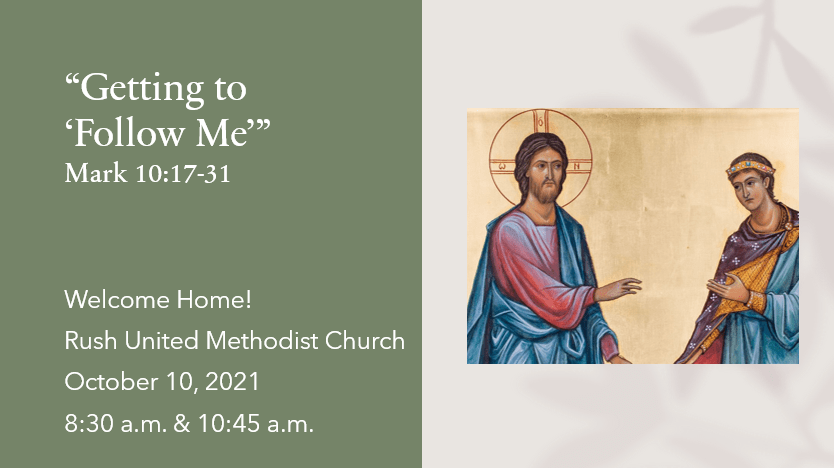
“Getting to ‘Follow Me’”

Mark 10:17-31

October 10, 2021

The Rev. Todd R. Goddard, pastor

Rush United Methodist Church

Mark 10:17-31

As he was setting out on a journey, a man ran up and knelt before him, and asked him, “Good Teacher, what must I do to inherit eternal life?” Jesus said to him, “Why do you call me good? No one is good but God alone. You know the commandments: ‘You shall not murder; You shall not commit adultery; You shall not steal; You shall not bear false witness; You shall not defraud; Honor your father and mother.’” He said to him, “Teacher, I have kept all these since my youth.” Jesus, looking at him, loved him and said, “You lack one thing; go, sell what you own, and give the money to the poor, and you will have treasure in heaven; then come, follow me.” When he heard this, he was shocked and went away grieving, for he had many possessions.

Then Jesus looked around and said to his disciples, “How hard it will be for those who have wealth to enter the kingdom of God!” And the disciples were perplexed at these words. But Jesus said to them again, “Children, how hard it is to enter the kingdom of God! It is easier for a camel to go through the eye of a needle than for someone who is rich to enter the kingdom of God.” They were greatly astounded and said to one another, “Then who can be saved?” Jesus looked at them and said, “For mortals it is impossible, but not for God; for God all things are possible.”

Peter began to say to him, “Look, we have left everything and followed you.” Jesus said, “Truly I tell you, there is no one who has left house or brothers or sisters or mother or father or children or fields, for my sake and for the sake of the good news, who will not receive a hundredfold now in this age—houses, brothers and sisters, mothers and children, and fields with persecutions—and in the age to come eternal life. But many who are first will be last, and the last will be first.”

| Centering Prayer |

In 1989 I was left an inheritance.

Our neighbor George

Left me his tackle box and all of his fishing equipment.

It was enough to fill the back of his son-in-law’s pickup truck.

George loved the fact

That I led a fishing camp for Junior High boys at Casowasco,

One of our United Methodist Camp and Conference Centers

on Owasco Lake.

I recruited volunteer staff and led this six-day camp

Each summer for many years.

Most of George’s equipment went to support efforts to teach kids to fish.

What remains today, 25 years later,

Is safely tucked away at the family cottage.

It was a privilege to have had George remember me in his will.

With his inheritance has come a few lessons I still ponder.

I didn’t do anything to earn his inheritance.

We were simply friends and neighbors.

Over the years our families grew together.

We both loved to mow our lawns at the same time on our

Nearly identical gray Sear’s lawn tractors.

We both loved being members of the Dresden Fire Department.

During the day when most others were at work

George and I put out a lot of fires together;

Just the two of us.

Inheritance can’t be earned.

Rather, inheritance is about belonging.

Inheritance is about growing, developing, maturing relationships;

Sharing together this journey of life and faith.

I’ve also learned that for there to be an inheritance,

Someone has to die.

This is a bitter lesson.

I’d give back all George’s fishing equipment ten fold

Only to have an afternoon with him talking over the back split-rail fence.

I loved George dearly, and still miss him a lot, 32 years later.

“Good Teacher, what must I do to inherit eternal life?”

(Mark 10:17)

All of us who follow Jesus

Belong to a pretty special group.

We are known by our love,

Our authentic desire

To lead our lives the way Jesus led his life,

Our desire to discern and follow God’s will, and

Our commitment to live according to God’s Law.

At our baptism we were accepted by God,

Hereafter, we belong.

We are accepted and included.

Period.

Inheritance is about belonging.

According to the researcher Erik Carter

Belonging in a community

United by faith

Is about being

  • Present,
  • Invited,
  • Welcomed,
  • Known,
  • Accepted,
  • Supported,
  • Cared For,
  • Befriended,
  • Needed, and
  • Loved.

(Thanks to Professor Erik W. Carter, as found at erikwcarter.com/belonging)

Jesus, the Good Teacher first correctly steers this anonymous man

Towards that which gives identity to Christians,

And to our Jewish ancestors:

Living according to the Law of Moses,

Which came as a gift from God.

We don’t follow laws to belong.

We belong, therefore, we desire to fit in.

We want to follow God’s Law.

Jesus establishes the Law as the bare-bones foundation,

Upon which he builds out the rest of his kingdom.

Eternal life cannot be earned any more than an inheritance.

The resurrection of Jesus Christ grants eternal life for all who accept it.

There isn’t enough righteousness, or right living,

To earn someone a ticket to heaven.

Saying “yes” to Jesus Christ,

Accepting salvation as a divine gift of grace,

Means living in relationship with God and others.

Belonging to the “Eternal Life Club” individually, and collectively,

Means changing priorities.

We don’t live for ourselves.

When we live according to God’s Laws,

We live for others and

We live for God.

When Jesus tells us

“go, sell what you own, and give the money to the poor,”

He is calling us to reorder our priorities in life.

Place the needs of the poor before your own needs.

Make the last first.

Making the last first in our lives

Is all about belonging,

Of being in community,

Of living as benefactors of God’s inheritance;

Of God’s amazing grace.

Jesus does one other amazing thing here.

Belonging to the “Kingdom of God Club”

And accepting the inheritance,

Is about rejecting the idols of this world.

When we think of idols,

We are most likely to think of a golden calf and pagan worship.

Not so fast, partner!

An idol is anything that is owned, possessed, or sought after

That steals attention from God,

Impairs our ability to discern God’s will, and

Damages our ability to fulfill God’s will for our lives.

Stuff becomes our idols.

The house, the car, our property, our savings;

All of it, from man-caves to the Mercedes in the driveway,

From flower beds to 401k’s,

… all of it has the ability

To become the focus and purpose of our life

In place of …

In substitution for …

Our Lord, Jesus Christ.

Property and wealth can become a barrier between us and those Jesus calls us to serve.

It makes it nearly impossible to follow him

Unless and until we remove those barriers.

Give it away.

Simplify.

Even still, recognize the fact

That we are dependent on God

If you and I are ever going to get through the eye of a needle.

Getting to “follow me”

Means that we are willing to go out on a limb.

We are willing to stop trusting in ourselves and our own accumulated resources.

It means that we are willing to place our trust in Jesus, and

Follow him wherever he leads.

I have to sit on my hands, close my mouth, and submit my will

All the time

If I am to faithfully follow Christ.

This is my choice.

It isn’t a simple one.

But, for me, it’s the right choice.

I invite you to make the same personal choice.

Allow Thy will be done; not my will be done.

Getting to “follow me”

Means belonging to a community of people

Who are crazy enough for Jesus

To place the needs of the poor in front of our own.

Being Christ’s disciple doesn’t fit in American politics.

We don’t comfortably fit in an

Endlessly consumer driven, materialistic, self-centered world.

Christians don’t belong in a world that is racist,

That doesn’t welcome the sojourner, the alien, or the refugee.

We don’t belong in this kingdom, or any other earthly kingdom;

We belong in God’s kingdom!

We belong kneeling beside Jesus

Washing the feet of others,

Serving the poor;

Those who live in poverty

And those whose spirit is broken.

Stop blaming welfare abusers.

Start thinking about single parent moms trying to raise a family.

Think about elders, spent down and spent out,

In the twilight days of life,

Feeling warehoused until they die.

Think about our neighbors who weave cloth

Sunup to sundown

For seven bucks a month,

So I can wear beautiful stoles and

My Thanksgiving table can be adorned with a lovely table runner.

Think about our friends whose delayed development

Means a lifetime of dependence, isolation, segregation, and loneliness.

Think flood victims, hurricane victims, and those who have lost their homes to wild fires.

Think about refugees at the boarder yearning to be free.

Think about people who lost everything to addictions, medical conditions,

Or just plain lousy circumstances and tough luck.

Think about the poor.

Think about others first.

Serve others

Before thinking about ourselves.

“Blessed are the poor,” Jesus preached.

Who are the poor in your life?

Who are the poor Christ is calling you to include in this belonging community?

It is time to act:

“go,

sell what you own, and

give the money to the poor, and you will have treasure in heaven; then

come,

follow me.”

Go. Sell. Give. Come.

“Follow me,” Jesus commands.

Getting to “follow me”

Is a daunting, yet awesome task.

I’m here to assure you,

It is well worth your effort.

Finally, to receive an inheritance

Someone must die.

To lead our lives the way Jesus did,

To discern and follow God’s will,

Means we must be willing to follow Jesus to his cross.

Selling all that I own and giving the money to the poor

Is relatively simple

Compared to being willing to give up my own life

For the sake of Jesus and his Gospel.

Christ died to grant us this inheritance.

Where, death, is thy sting,

Come Easter morning and

Our resurrected Lord steps out of his tomb?

Death no longer has a hold of us.

Will our death be painful for our family and loved ones? certainly.

Mourning and grief still cuts like a knife.

Yet, belonging

Provides a divine inheritance;

The gift of eternal life.

Dearly beloved,

Don’t work for a place in heaven.

There are no tickets to be had.

Simply belong.

Take your place with me,

Side-by-side with Jesus.

May we trust Jesus enough

To sell as much as we can,

To give all we can to the poor.

May the bonds of belonging to the Body of Christ

Give us the courage

To make the last first and

To take our place at the end of the line.

Belong, and invite others to belonging.

Be one with Christ and one with each other.

Claim your inheritance.

Eternal life is already yours.

Amen.

“Divorce”

Mark 10:2-16

October 3, 2021, World Communion Sunday

The Rev. Todd R. Goddard, Pastor

Rush United Methodist Church

Mark 10:2-16 (http://bible.oremus.org/?ql=405569750)

Some Pharisees came, and to test him they asked, “Is it lawful for a man to divorce his wife?” He answered them, “What did Moses command you?” They said, “Moses allowed a man to write a certificate of dismissal and to divorce her.” But Jesus said to them, “Because of your hardness of heart he wrote this commandment for you. But from the beginning of creation, ‘God made them male and female.’ ‘For this reason a man shall leave his father and mother and be joined to his wife, and the two shall become one flesh.’ So they are no longer two, but one flesh. Therefore what God has joined together, let no one separate.”

Then in the house the disciples asked him again about this matter. He said to them, “Whoever divorces his wife and marries another commits adultery against her; and if she divorces her husband and marries another, she commits adultery.”

People were bringing little children to him in order that he might touch them; and the disciples spoke sternly to them. But when Jesus saw this, he was indignant and said to them, “Let the little children come to me; do not stop them; for it is to such as these that the kingdom of God belongs. Truly I tell you, whoever does not receive the kingdom of God as a little child will never enter it.” And he took them up in his arms, laid his hands on them, and blessed them.

| Centering Prayer |

I am often asked about my position on theology and sexuality:

Where I stand on the Church and gay marriage,

And the ordination of homosexuals.

My stock answer remains:

When Jesus teaches about it, I’ll preach about it.

Jesus doesn’t bring up the topic once.

Not once.

Jesus teaches at length about not judging others,

How God so loves the world,

And the universal, unconditional nature of God’s grace.

I’ll preach about these Gospel topics all day long. 

Jesus doesn’t address homosexuality,

But he does teach about the issue of divorce.

In fact, he teaches the crowd,

the Pharisees (Jewish lay leaders),

and his followers

quite a lot about divorce.

(My comments on Mark 10:2-16 are heavily dependent upon the exceptional scholarly work of Matt Skinner, Associate Professor of New Testament, Luther Seminary, St. Paul, MN.)

………..

Here are four points of context:

1. We assume divorce is a modern phenomenon;

It isn’t.

In the first century, during the time of Jesus,

Divorce was a generally accepted part of the cultural landscape.

It was just as painful and prevalent then as it is today.

2. Marriage in the ancient world

was primarily a means of economic and social stability.

Women were considered property of the father,

Women were sold to a husband in marriage

through the exchange of a dowry.

Marriage united family, created offspring, increased wealth,

strengthened the tribe, kept the peace, and maintained the family lineage.

When a marriage failed, …

Everyone lost.

3. Jewish leaders in the time of Jesus

spoke about how divorce was bad for society,

The debate was mostly focused on the legal imperative.

The legal foundation for their belief is found in Torah, Deuteronomy 24:1-2:

Suppose a man enters into marriage with a woman, but she does not please him because he finds something objectionable about her, and so he writes her a certificate of divorce, puts it in her hand, and sends her out of his house; she then leaves his house and goes off to become another man’s wife.

In other words

Deuteronomy assumes divorce will occur

and prescribes legal procedures for carrying it out.

This legal procedure ensured dependent women and children

A defense against rumor and slander;

A very important consideration for survival,

Let alone remarriage.

Some hardhearted Pharisees who question Jesus

Conveniently fail to mention the strong, moral imperative in the Law

That provides justice for the vulnerable: women and children.

Other Pharisees who question Jesus and attempt to trap him,

Call into question the permissibility of divorce

Citing Genesis 2:24 and Malachi 2:13-16, which read:

Therefore a man leaves his father and his mother and clings to his wife, and they become one flesh.

Experts in the Law were not in agreement on the issue of divorce.

Scripture appeared contradictory and could be read both ways.

What better controversy to trap Jesus

Than one that is hotly debated by religious authorities?

4. Which brings us to the setup for the Gospel passage;

this narrative is one of many in a long succession

about how religious authorities attempt to trap Jesus,

to find cause to have him arrested,

and to have him put to death.

Jesus is riding the razon’s edge.

His life and death hung on every word.

This passage, and Jesus’ response, must be viewed through this lens.

……………..

What does Jesus teaching about divorce

Mean to you and me?

Let’s look carefully at his words:

1. Jesus answers a question with a question.

He knows the minefield the Pharisees have laid.

He knows they are divided among themselves.

He knows their absolute devotion to the Law.

He knows that Hebrew scriptures, the Law and the prophets,

are in conflict and less than clear.

‘Jesus,’ they asked, “Is it lawful for a man to divorce his wife?”

“What did Moses command you?” Jesus questions back.

“Moses allowed a man to write a certificate of dismissal and to divorce her.”

Good answer! They know the Law; at least Genesis and Malachi.

But Jesus sees their callous and hardened heart:

“Because of your hardness of heart he wrote this commandment for you. 6But from the beginning of creation, ‘God made them male and female.’ 7‘For this reason a man shall leave his father and mother and be joined to his wife, 8and the two shall become one flesh.’ So they are no longer two, but one flesh. 9Therefore what God has joined together, let no one separate.”

Better answer! Jesus favors two becoming one.

He moves beyond the simple justice advanced by the Law

Takes it a step further

And advocates for the value of equality and unity and eternity.

Jesus makes the point that this is what the institution of marriage is all about:

Two equal partners.

One without the other breaks the whole thing.

Two cogs that drive the wheel;

Take one cog away and the whole process brings the wheel to a stop.

God joined two into one,

Therefore, no one can break the one.

Two equal partners that are so unified

They become one flesh,

One body,

Until death do they part.

What sensible Pharisee will discount Genesis 2 in public?

Not one of them.

They slink away, like the snakes they are,

defeated once again in their attempt to trap Jesus.

They lost the debate because

Jesus uses the Law as the foundation for his teaching.

He builds upon the Law with a new covenant

That is rooted in grace.

2. Jesus uses the early confrontation with the adversarial Pharisees

as a talking point later in the day

in the privacy of a house

surrounded by his disciples.

They, and we, want to know more.

Jesus continues.

“the disciples asked him again about this matter. 11He said to them, “Whoever divorces his wife and marries another commits adultery against her; 12and if she divorces her husband and marries another, she commits adultery.”

Jesus is speaking specifically against those who leave their spouse for others,

Be it the husband or the wife.

His point is that

Divorce does not offer a legal loophole to justify adultery.

Be warned, Jesus tells us frankly,

Do not initiate divorce as a means to get something or someone else.

Do not sacrifice a spouse to satisfy one’s desires or ambitions.

It is no accident that this passage is immediately followed by

The disciples attempting to keep children away from Jesus

And his powerful response:

“Let the little children come to me; do not stop them; for it is to such as these that the kingdom of God belongs. 15Truly I tell you, whoever does not receive the kingdom of God as a little child will never enter it.” 16And he took them up in his arms, laid his hands on them, and blessed them.

Jesus’ approach to children is hardly surprising

Given the way he so frequently

Held them,

Loved them, and

Used children as teaching examples.

Do not sacrifice a spouse,

Do not sacrifice the children,

To satisfy one’s sexual desires or ambitions.

Jesus doesn’t throw anyone away.

He doesn’t throw anyone under the bus.

And neither should we.

3. Women, take heart.

Men, listen carefully.

Jesus elevates women to a place of equality in marriage,

Hardly seeing women as passive objects or property.

To Jesus’ first century audience,

Equality in marriage was revolutionary.

Responsibility is balanced:

If a man leaves for another – Guilty of adultery, according to Deuteronomy.

If a wife leaves for another – Guilty of adultery, according to Deuteronomy.

This wass such a volatile position to take in the ancient world

The parallel narrative in Matthew 19:9 conveniently omits it!

Also, by speaking of a man committing adultery against a woman,

Not against her father or past husband,

Jesus implies that adultery involves more than the violation of property rights of another man.

Adultery concerns accountability to a partner.

Jesus is calling us to accountability in marital relationships.

If you make a wedding vow,

Keep it.

Failure to keep your word is an offense

Against your spouse,

Against every witness of your wedding, and

An offense against the Lord.

4. I applaud Jesus for not avoiding the issue;

Especially later in the day when

His disciples asked him to elaborate on the issue of divorce behind closed doors.

His words help us better understand why failed marriages

Bring such pain to couples, extended families, and communities.

Jesus explains the pain our God experiences when marriages fail.

Jesus brings into laser focus the hurt and brokenness that come,

Even when divorce appears to be the best choice among all available options.

Divorce is the final option only in the case of abuse.

Abuse breaks the vows

“To have and to hold” and

“To love and to cherish.”

Jesus brings special attention to children.

The most vulnerable are often the most traumatized when parents divorce.

The church has learned over the centuries

That to impose these words uncritically,

Without interpretation,

as inflexible commands,

is to do violence, deny protection, and withhold grace

to the women and children who need it most.

Dearly beloved,

Yield not to the temptation to avoid Jesus teaching about divorce,

For it teaches us far more than first meets the eye.

Jesus urges us to regard marriage in stark contrast

To our culture’s tendency to treat commitment and love as conditional.

Jesus is opposed to adultery.

The Law is followed.

Women and children are elevated,

And women are afforded equal accountability in the marriage relationship.

No one is to be thrown away.

In marriage, the self becomes sub-servant to the married whole.

Two become one.

One flesh,

Connected to the One,

Lord, and savior of us all, Jesus Christ.

Amen.

“Non Sequitur”

Mark 9:38-50

September 26, 2021

The Rev. Todd R. Goddard, Pastor

Rush United Methodist Church

Mark 9:38-50

John said to him, “Teacher, we saw someone casting out demons in your name, and we tried to stop him, because he was not following us.” But Jesus said, “Do not stop him; for no one who does a deed of power in my name will be able soon afterward to speak evil of me. Whoever is not against us is for us. For truly I tell you, whoever gives you a cup of water to drink because you bear the name of Christ will by no means lose the reward.

“If any of you put a stumbling block before one of these little ones who believe in me, it would be better for you if a great millstone were hung around your neck and you were thrown into the sea. If your hand causes you to stumble, cut it off; it is better for you to enter life maimed than to have two hands and to go to hell, to the unquenchable fire. And if your foot causes you to stumble, cut it off; it is better for you to enter life lame than to have two feet and to be thrown into hell. And if your eye causes you to stumble, tear it out; it is better for you to enter the kingdom of God with one eye than to have two eyes and to be thrown into hell, where their worm never dies, and the fire is never quenched.

| Centering Prayer |

Non sequitur.

I had to look it up.

A non sequitur is a statement that does not logically follow

From the previous argument or statement.

From the Latin, non sequitur means “it does not follow.”

In this, his first recorded statement in the Gospel of Mark,

The disciple John demonstrates that he’s a candidate for

King of the non sequitur!

John clearly had not been listening.

The lessons of the teacher,

As he addressed Jesus,

Weren’t being heard or comprehended.

This Gospel passage is a continuation from last Sunday’s Gospel.

Jesus was teaching his disciples that

He would suffer, be killed, and three days later, rise again.

They couldn’t believe him.

Jesus taught his disciples who were debating who the greatest was;

“Whoever wants to be first must be last of all and servant of all.” (9:35)

They didn’t hear him.

Jesus took a child in his arms as a teaching example

(visual aids can be really helpful)

And teaches that

“Whoever welcomes one such child in my name welcomes me.” (9:37)

A child was a metaphor for welcoming new followers of Jesus.

No one was listening.

The disciples couldn’t believe Jesus.

They didn’t hear him.

No one was listening.

It’s not like that’s never happened to you and me.

(Snoring differentiates those who are closing their eyes to focus on my sermon from those who close their eyes to nap!)

John drops the mother of all non sequitur’s

When he broaches the topic of

Others casting out demons in the name of Jesus.

‘Well, if they’re not against us,” Jesus replies,

‘they’re for us.’ (9:40)

Let’s get this train back on the track.

What was Jesus talking about?

Oh, yeah.

He’s holding a child.

He was talking about welcoming children,

New followers, in his name.

Welcome others.

Hold new followers of Jesus tenderly.

Welcome every new follower with respect, acceptance, and love.

Jesus puts the train back on the track

And tells John, and the rest of the disciples,

Exactly what NOT to do.

Do NOT be a stumbling block for a new follower.

Do NOT set a bad example that would cause another to stumble.

It would be better to go to hell

Than to cause a new follower to stumble.

Hell.

You know,

That place we don’t like to talk about.

Yeah, where there is an unquenchable fire,

Where worms never die. (9:43, 48)

Gehenna

Is the word Jesus uses to give hell a name;

Not the more neutral words Sheol or Hades.

Gehenna, by definition,

Is the destination of the wicked.

Gehenna is quite fitting.

Holding a child,

Jesus says that causing a child-like follower to stumble

It would be better for one to go to Gehenna,

The valley outside Jerusalem

That, in prior years,

Was known to be a location

For pagan child sacrifice.

By the time of Jesus,

Gehenna was a garbage dump;

A garbage dump with a nasty, haunted history.

Jesus is literally trying to scare the hell out of his disciples.

Now that’s some salty teaching!

Do NOT be a stumbling block to any other follower

On their journey with Jesus,

Especially, don’t be a stumbling block for new followers,

Children in faith.

Jesus should be scaring the hell out of us, too.

Think with me, for a moment,

The many ways we become a stumbling block for other Christians.

Hypocrisy.

Deceit.

Behavior that is inconsistent with the teaching of Jesus.

It’s easy to criticize and dismiss other followers of Jesus

Because their beliefs are different than ours,

Their denomination is different than ours,

Their worship is different than ours.

They like different music.

They pray differently.

They might even say “Amen” if the preacher gets on a roll!

High church, low church.

Charismatic, reserved.

Too catholic, not orthodox enough.

“Whoever is not against us is for us,” Jesus taught. (9:40)

In other words: STUFF IT!

Stop the criticism.

Criticizing other Christians

May be the greatest of all non sequiturs:

Diverting our thoughts

Derailing our efforts,

Threatening us with a wicked eternity.  

Christians criticizing Christians

Is the stumbling block Jesus wants us to avoid

To keep our focus on what is truly important.

Ending the criticism begins with me.

I can’t control the behavior of others,

But I can discipline myself.

I can remove stumbling blocks for others

By setting a good example of following Jesus.

Keep a laser focus on what is truly important,

What Jesus is teaching:

Welcome visitors and others.

Invite them to follow Jesus.

Set a good example for how Christ followers should behave.

Lead by serving

Those who Jesus served.

Keeping that laser focus on Jesus

Is what I’d call

“Salty.”

Amen.

“Greatness on Jesus’ Terms”

Mark 9:30-37

September 19, 2021

The Rev. Todd R. Goddard, Pastor

Rush United Methodist Church

Mark 9:30-37 (http://bible.oremus.org/?ql=404358195)

They went on from there and passed through Galilee. He did not want anyone to know it; for he was teaching his disciples, saying to them, “The Son of Man is to be betrayed into human hands, and they will kill him, and three days after being killed, he will rise again.” But they did not understand what he was saying and were afraid to ask him.

Then they came to Capernaum; and when he was in the house he asked them, “What were you arguing about on the way?” But they were silent, for on the way they had argued with one another who was the greatest. He sat down, called the twelve, and said to them, “Whoever wants to be first must be last of all and servant of all.” Then he took a little child and put it among them; and taking it in his arms, he said to them, “Whoever welcomes one such child in my name welcomes me, and whoever welcomes me welcomes not me but the one who sent me.”

Prayer.

A while back,

I read a book titled: Union Pacific: The Reconfiguration, by Maury Klein.

It is a detailed corporate history from 1969 to the present

Of the Union Pacific Corporation (UPC),

A holding company that ran businesses in numerous market sectors:

Energy, Information, Real Estate, and Transportation.

Of course, my interest comes from my love of the railroad industry,

And this corporation finds its roots in the Union Pacific Railroad.

What caught my interest is how deeply human a corporation can be;

Finding the right employee for the right job,

Firing the dead wood and fast-tracking the best and brightest,

Tearing down stifling, inflexible, historical culture

And replacing it with analytics, nimbleness, and efficiency.

When billions of dollars are on the line,

Egos must be stroked,

Compensation must be generous,

Scandals need to be swept under the carpet,

And job titles reflect more pride than purpose.

Though enjoyable, this isn’t pleasure reading:

I can apply this history

To the non-profit boards on which I’m privileged to serve.

Though scale, service, purpose, and incentives might be different,

What makes a company great,

And what makes an employee great,

Is debated just the same.

What defines greatness?

Who says what is great?

….

Jesus weighs in on the topic of greatness.

His view of greatness is in stark contrast to the corporate world.

As his followers,

We should pay attention.

Jesus catches his disciples arguing amongst themselves.

They fell silent with shame when queried about what they were arguing about.

It must have been like

Asking a child whose face is covered in chocolate

What they’ve been eating.

Of course, Jesus knows the answer.

He knows what they’d been arguing about.

He knows the answer before he asks.

Here is a teachable moment;

An opportunity that Jesus won’t let slip away.

“Whoever wants to be first must be last of all and servant of all.” (9:35)

There are three details for us to pay attention to in his sentence:

1. A want, or desire, to be first.

2. Making the self last of all.

3. Making the self servant of all.

Beloved, strive to be first

By seeking Christ and his kingdom first

This day and

Every day of your life.

Take discipleship with mortal seriousness.

Learn about Christ, follow Christ, behave like Christ

To the very best of your ability.

Make the spiritual journey with Jesus Christ

Our ultimate concern and

Our deepest passion.

Making ourselves last means

That others eat first.

The needs of others,

Specifically, the needs of people like those Jesus reached out too,

Must take priority over our needs. 

Serving all means

We actually need to roll up the sleeves and get our hands dirty

In Christian ministry.

It is vitally important to

Push ourselves away from the conference room table

And take our place in the serving line.

The only way to serve all

Is to descend the social ladder

And to welcome those who Jesus associates with.

“Throughout his ministry,”

Elisabeth Johnson writes,

Jesus “associates with the last and the least in society –

Gentile women (Mark 7:24-30),

bleeding women (Mark 5:24-34),

lepers (Mark 1:40-45), r

aging demoniacs (Mark 5:1-20),

tax collectors and other notorious “sinners” (Mark 1:13-17).

He even welcomes and makes time for little children, much to the disciples’ consternation (Mark 10:13-16).”

(As found at Working Preacher dot Org)

……

What defines greatness?

Who says what is great?

…..

Jesus takes a little child into his arms

And teaching his disciples

“Whoever welcomes one such child in my name welcomes me.” (9:37)

Jesus is making a few points about greatness that we shouldn’t overlook.

1. He uses a child as a teaching illustration.

2. He takes the child into his arms.

3. Jesus uses the word “welcome” to define what it means to be his disciple.

A child, except the first-born male,

Was considered as property,

An asset of their father.

A child was equal in social status

With women, slaves, and gentiles.

Go to the bottom of the social ladder

And there, you and I will find where God wants us to serve.

Taking a child into his arms

Reflects the love, respect, and dignity to which Jesus is calling us.

We are called to serve with the same quality,

The same tender loving care,

As we would hope to be treated.

Welcome, Jesus teaches.

To serve one

one must be committed

to welcoming one.

In other words we don’t simply serve and remain silent.

When we serve, Christ wants us to do so in his name.

Let the benefactors of our service know

That we serve because Jesus teaches us to,

And that, just as Jesus has welcomed me,

So, too, is Jesus welcoming you.

Service and following Jesus go hand in hand.

Missions and evangelism can never be separated.

Mission and evangelism are brothers from other mothers.

…..

What defines greatness?

Who says what is great?

…..

Our Gospel passage this morning begins with Christ’s second prediction

About his suffering, death, and resurrection.

The disciples didn’t understand his lesson the first time.

They’re so ashamed they didn’t get it

They were afraid to ask or inquire further.

The Gospel of Mark has its own unique characteristics.

It culminates in the crucifixion of Christ,

Treating the resurrection almost as a post-script.

This characteristic is highlighted when one conducts a careful comparison

Of each of the three narratives where Jesus

Teaches his disciples that he will suffer, die, and rise again.

The scale tilts heavily in favor of atonement;

To a lesser degree, on resurrection and eternal life.

Furthermore, when one considers the overarching trajectory of the Gospel of Mark,

It is important to note that not one of his disciples

Make it all the way to the cross with Jesus.

Peter denies Jesus.

Judas betrays him and goes out and hangs himself.

Everyone else scatter, for fear of the Jews.

Simon of Cyrene had to be volunteered out of a crowd to carry his cross.

Where’d they all go?

The only ones who made it to the end with Jesus were

Women “looking from a distance,

Mary Magdalene,

and Mary the mother of James the younger and of Joses,

and Salome.” (15:40)

The point Jesus is making with his predictions, response, and instructions

Is that greatness comes to those who journey with Jesus to the cross.

Are we willing to follow Christ to the point of death,

All our earthly days?

Are we willing to confess our sins and repent of our sins,

Allowing the atoning blood of Christ to wash us clean

All our earthly days?

Great faith doesn’t come from believing;

Greatness comes from following Jesus,

From cradle to grave, and beyond.

Follow Jesus to the cross.

Allow your temptations, burdens, sorrows, and pain to be crucified with him.

And you, my beloved,

Will taste greatness.

….

What defines greatness?

Who says what is great?

Jesus tells us:

Serve others.

Lead others to become his followers.

Follow Christ to his cross.

Amen.