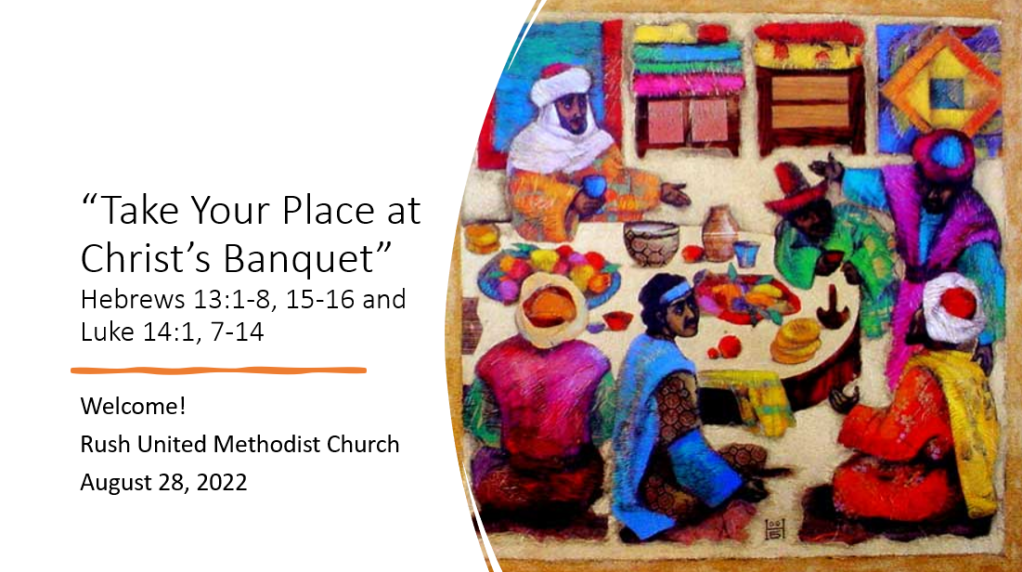
“Take Your Place at Christ’s Banquet”

Hebrews 13:1-8, 15-16 and Luke 14:1, 7-14

August 28, 2022

The Rev. Todd R. Goddard, Pastor

Rush United Methodist Church

Luke 14:1, 7-14

On one occasion when Jesus was going to the house of a leader of the Pharisees to eat a meal on the sabbath, they were watching him closely.

When he noticed how the guests chose the places of honor, he told them a parable. “When you are invited by someone to a wedding banquet, do not sit down at the place of honor, in case someone more distinguished than you has been invited by your host; and the host who invited both of you may come and say to you, ‘Give this person your place,’ and then in disgrace you would start to take the lowest place. But when you are invited, go and sit down at the lowest place, so that when your host comes, he may say to you, ‘Friend, move up higher’; then you will be honored in the presence of all who sit at the table with you. For all who exalt themselves will be humbled, and those who humble themselves will be exalted.”

He said also to the one who had invited him, “When you give a luncheon or a dinner, do not invite your friends or your brothers or your relatives or rich neighbors, in case they may invite you in return, and you would be repaid. But when you give a banquet, invite the poor, the crippled, the lame, and the blind. And you will be blessed, because they cannot repay you, for you will be repaid at the resurrection of the righteous.”

| Centering Prayer |

I don’t know about you, but

I’ve always been uncomfortable with social status,

as it presents itself to us, in our culture.

For example, when I’m around a powerful person ….

someone who has wealth, political office, an academic, or a celebrity ….

I’m uncomfortable.

(Photo of Groundbreaking for Candence Square Veteran Housing,

Canandaigua NY 2012. Senator Chuck Schumer, center. I’m far left.)

I worry that I’ll say something improper,

without class or sophistication.

I worry that they will take notice of

my complexion or the fit or brand of my clothes.

I worry that I’ll trip on the carpet,

step into a hole,

spill something discoloring,

or break wind during a moment of deafening silence.

Though I know they put their pants on one leg at a time just like I do,

the attitude, tone of voice, and the look all has to do with

being privileged,

exclusive,

that says

“sorry, we don’t associate with your kind.”

Likewise,

I have discomfort at the complete opposite end of the spectrum;

but it comes through the radiation of discomfort that emanates from others when I’m around.

While I’ve always felt comfortable

in blue jeans and flannel shirt pitching in at a work bee,

cleaning up the fellowship hall, or drying dishes in the kitchen,

I often get a sense that some

would rather not have the preacher be there.

I don’t know if the issue is the education I’ve earned,

the salary I receive,

or the fact that ministers are supposed to be righteous,

and comparatively,

that might be embarrassing.

Perhaps it has to do with the perceived authority of the office ….

or maybe it is a combination of these factors.

But the fact remains,

though invited,

that waitress really doesn’t want to pull up a chair and join me in good conversation.

One might think that I am most at ease in a gathering of my peers;

people of equal status.

But if you are anything like me,

when I’m around peers,

other subtle issues sneak in and skew the playing field.

And that makes me uncomfortable.

I’m care to watch what I say, how I  say it, and how it will be interpreted.

One never knows who will be the boss some day!

There are issues of comparison and competition,

Compensation,

envy, power, and pride.

“Oh, you’re serving the Rush Church,”

“You must be very important.”

In interfaith settings

Issues of gender, race, and religion

often makes everything far more complicated.

“You must make one heck of a preacher,” you’d probably think sarcastically to yourself. “Can’t get along with those over you, under you, or next to you?

Well, just who can you get along with?”

I’ll tell you.

And my response comes largely from our Epistle lesson from Hebrews

and our Gospel lesson from Luke.

With whom do you keep company?

I love being around humble people;

not necessarily that I’m humble,

but when I’m around truly humble, God loving people,

I feel I have the most to benefit by their example.

Humility has a lot to teach me.

Though I’ve come a long way in 61 years,

there is so much more to living a humble life

that one day I pray that I might embrace.

The gift of simplicity and downsizing,

becoming green in energy consumption,

and protecting the environment is a humble stance.

It recognizes the fact that others are in the room,

and that they have an equal claim to the same resources,

the same benefits,

the same God

we’ve come to know and experience in our lives.

I love being around loving people;

people who not only love those who obviously return their love ….

parents, siblings, children, cousins ….

but also those who love the unlovable, just because they can.

These are the people who volunteer in homeless shelters,

read to inner-city kids,

collect gloves and mittens for seniors and children,

and are people who visit the prisoner, the sick, the shut-in, and the dying.

Sometimes loving people are outwardly demonstrative,

other times, quiet and reflective.

But just remember, whether or not one is emotional, touchy, or huggy

has little to do with how loving they may be.

Some of the most loving people I know are quiet and reserved.

Almost without exception,

loving people recognize the fact that

love first comes from God,

and that God’s love is meant to be shared.

I love rubbing elbows with hospitable people.

These people may have the most to teach me.

Hospitable people anticipate the needs of others and address them,

aggressively and pre-emptively,

before those needs become a problem.

Hospitable people greet the traveler with a warm washcloth,

to remove the grit and grime from their face and hands.

Hospitable people know the value of a warm meal and a hot shower.

Hospitable people put others first in line, themselves second.

They know, they are assured, that God has set a place for them.

Hospitable people smile and rarely complain,

they laugh a lot and give up their last umbrella to a stranger if it begins to rain.

Hospitable people are aware that the kindness they show to any one person,

at any time over the course of their life,

may be the kindness that they show to an angel,

as the Apostle wrote in Hebrews.

I love being around people who make it their effort

to give all their money away and tend to be habitually broke.

Not broke because they don’t have an adequate job or income.

Rather, they are broke because they have recognized God’s abundance and blessing.

Their lifestyle has benefited, often greatly.

But now they are giving it back to society, to the poor, the sick and the less fortunate.

People who give generously are some of the happiest people I know.

Because they know

that even the most modest, simplest gift can change a life.

I like being around people who are modest.

I don’t want to share in your sexuality;

neither do I want to invite others into this aspect of my personal life.

This might explain why I get nervous when the topic is raised casually.

Sexuality is a gift from God,

but it is not meant to be worn on the sleeve,

to be spoken of crudely,

or to be a source of titillation.

The faith community is strongest

when it embraces monogamy, fidelity, and respects the secrets of two brought together by God’s whisper.

Finally, I am most content when

I’m surrounded by people who share the same love for Jesus Christ as I do.

He is my Lord, and I am his disciple.

I’m not going to surround myself with a crowd

who is going to drag me down and tempt me to do things I’d later regret.

I need to be with people who love and follow Jesus.

They are the ones who have so much to teach me.

I want to follow their example.

And I want to set a good example for faithful living for others to follow, too.

When we share a common love for Christ, what can others do to us?

Nothing.

When we share Christ, we will be humble.

We will be loving.

We will be hospitable.

We will be giving.

We will be modest.

We will be as one in the Body, this the Body of Christ.

Choose well the company you keep.

Humbly take your place at the banquet.

Have no worry; you will be invited by our heavenly host

exactly where God wants you to be.

There is room for everyone, who with a humble and loving heart approach the table.

Take your place at Christ’s banquet.

Taste and see the goodness of our Lord.

Amen.

“Setting the Thanksgiving Table”

Luke 13:10-17

21 August 2022

The Rev. Todd R. Goddard, Pastor

Rush United Methodist Church

Luke 13:10-17

Now he was teaching in one of the synagogues on the sabbath. And just then there appeared a woman with a spirit that had crippled her for eighteen years. She was bent over and was quite unable to stand up straight. 

When Jesus saw her, he called her over and said, “Woman, you are set free from your ailment.” When he laid his hands on her, immediately she stood up straight and began praising God. 

But the leader of the synagogue, indignant because Jesus had cured on the sabbath, kept saying to the crowd, “There are six days on which work ought to be done; come on those days and be cured, and not on the sabbath day.

”But the Lord answered him and said, “You hypocrites! Does not each of you on the sabbath untie his ox or his donkey from the manger, and lead it away to give it water? And ought not this woman, a daughter of Abraham whom Satan bound for eighteen long years, be set free from this bondage on the sabbath day?” 

When he said this, all his opponents were put to shame; and the entire crowd was rejoicing at all the wonderful things that he was doing.

| Centering Prayer |

When I was a child,

My mother would set the Thanksgiving table four or five days prior to the gathering.

Once the table was set,

she was free to work on the meal;

Thawing the turkey,

Making the stuffing,

Baking the pies,

Pealing the squash and potatoes.

We had to be especially careful in the dining room,

Less someone bump the table and break a piece of my mother’s precious china.

The end result, of course,

Was a grand meal, attended to by family and friends,

Wrapped in love and prayers of thanksgiving

For all the Divine blessings our family and friends had received.

Delving into our wonderful Gospel lesson for today from Luke

Is a lot like setting the Thanksgiving table.

Of course, once the table is set,

The meal begins,

And like the formerly bent over woman in the story,

She “began praising God!”

So, too, this passage leads us to praise and thank the Lord.

Thanksgiving and praise are beautiful things.

There is a lot for us to consider setting the Gospel’s table.

  • This is an account only found in Luke; You’ll not find this in Matthew, Mark, or John.
  • We have a story of a miracle; a healing tainted by religious controversy.
  • It is a narrative of a woman injured by the spirit of Satan, bound for eighteen long years.
  • There is the leader of the synagogue being charged with hypocrisy as well as violations against religious law.
  • There is a question of “who’s in and who is out”, who is a daughter of Abraham and who isn’t. Jesus is redefining the people known as Israel.
  • And, where I’d like to start the discussion today, is the simple observation that Jesus sees this nearly invisible woman.

Where did she come from?

This woman appeared, Luke wrote.

She appeared in the crowd

In the synagogue where he was teaching,

Presumably in a village,

A stopping-off point on his journey,

From Galilee in the North

to Jerusalem in the South.

She doesn’t see Jesus

Unless she strains,

Then only out of the top of her eyes.

She is bent over.

She is looking at the ground and the legs of people surrounding her.

She can only look down.

It is only with great difficulty that she would be able to look people in the eye when speaking and listening.

Being bent over means that she had lost over the past 18 years

All social fluidity and

Ease of conversation.

This bent over woman had lost dignity and social standing in her community.

Jesus sees this woman,

Whom the world did not see.

Though she is bent over and a fraction of her height,

She would have been surrounded by people of greater height.

He picks her out in the midst of the crowded synagogue.

Jesus sees her and chooses her

Even though this woman gave no indication

That she came for any favors from Jesus.

This leads me to the first conclusion about our Gospel for today:

Jesus seeks out the lost, the least likely,

The most easily overlooked people in the world.

It is his intention to seek out those who are different than the crowd,

The last, the least, the lost,

Even though they may not want to be found.

Jesus is on the hunt.

He isn’t satisfied until his Father’s will

For healing and wellness is fulfilled.

If one searches rigorous demographic data

It doesn’t take long to discover that people with disabilities are the least likely to self-identify with a community of faith.

In short, people with different abilities

are the most unchurched people in America.

It is sad, but true.

Unlike Jesus who intentionally seeks out people different than the norm,

Congregations worship in buildings that exclude people with special needs.

Services are conducted without inclusion in leadership or music, without sensitivity to sight, sound, feel, smell, or taste.

Sadly, for many, people just freeze them out,

Or, worse yet, nice Christian people simply ask them to leave

Because of distracting behaviors.

The very people Jesus seeks to save,

Organized religion finds reasons to exclude.

Let’s not be that church.

Let’s not be those Christians.

Let’s be more like Jesus,

Look, see, and welcome

The invisible

Marginalized

People of the world.

Jesus call’s this woman closer,

Tells her “Woman, you are set free from your ailment.” (13:12)

He lays hands on her,

And she immediately stands up straight

And began praising God.

Image for a moment,

The joy this woman experienced when she stood up straight

For the first time in 18 years!

She could look people in the eye.

She could carry on a conversation.

Salvation was for her, expanded in depth and breadth.

This unnamed, previously invisible woman

had been socially imprisoned, and now,

Jesus set her free.

Her dignity was restored.

She had been imprisoned by a spirit

Jesus named as Satan (13:16),

But now, she had shaken loose of it,

Simply at the hand of a Savior who

Saw her,

Sought her,

Healed her,

Reclaimed her as God’s own child.

Like Baskin Robins,

Salvation is scooped in more flavors than eternal life.

What is it that imprisons or enslaves you?

What holds you back?

Where is Satan holding onto the scruff of your neck

Giving you a good thrashing as if you are in a death grip?

Where has your dignity been crushed?

It is time to experience the touch of Jesus,

To stand up straight,

And to be saved.

Salvation isn’t the only concept Jesus intends to expand upon.

Just like Jesus will soon call the traitor and chief tax collector, Zacchaeus,

A “Son of Abraham,”

Jesus enlarges the circle of who he considers people of Israel.

Jesus enlarges the circle of who he includes in the kingdom of God.

Indeed, throughout his life Jesus is constantly making the family of Abraham bigger, and bigger, and bigger.

Before long, non-Jews – Gentiles – will be added to the family.

The blood of the cross

Is inclusive of the whole world.

This sense of inclusion is very important to understand Jesus’ trajectory and ministry. 

Inclusion in God’s kingdom is the foundation

Of the Christian experience.

One barrier often cited by people with different abilities, is this:

‘Jesus healed the bent over woman,

The blustering blind Bartimaeus by the side of the road,

And the guy lowered through the hole cut in the roof,

But he hasn’t healed me.’

The pastor in me, needs to pause, take a deep breath, and ask,

“Yet?”

… meaning, that one anticipates healing at some future time.

Likewise,

“How do you know you haven’t already been healed?”

… meaning, can you imagine what your life would be like without Jesus?

Furthermore,

“What does healing look like to you?”

… in other words, let’s talk about expectations.

Where do your expectations intersect with God’s grace?

This is an interesting concept

That floats to the surface

With our Gospel today:

Where do expectations intersect with grace?

Another theological barrier often cited is this:

“If I’ve been created in the near perfect image of God

Then my physical, mental, developmental, medical disability

Isn’t anything that needs to be healed or cured.”

“I’m good, just the way I am.”

Many in the different-ability community have grown confident in knowing

That God created them in God’s near perfect image.

I agree whole heartedly!

Like the first chapter of Genesis so eloquently states,

“Man and woman were created in the image of God,”

And they … “were very good.”

– Genesis 1:27, 31b

The person with Down Syndrome?

near perfect image of God.

That person with Cerebral Palsy?

Near perfect image of God.

That man with Autism,

Nealy perfect.

The girl with Developmental Delays?

Yep. She’s nearly perfect, too.

The difference with our Gospel lesson today

Is the report of Satan being introduced in this woman’s past.

Luke goes to great effort

To indicate that it was this spirit that crippled her,

And that it was Jesus who named that spirit, “Satan.” (13:16)

The lesson that can be learned from the Gospel,

Choreographed with our real-world experience,

Is that

It is really important to be careful about judging others,

Especially when it comes to

Distinguishing between who is normal and who isn’t normal,

Who is in need of healing and who is not.

Our personal assumptions

Can unintentionally lead to inflicting pain and destructive trauma.

The approach Jesus takes consistently

Is to treat people as individuals,

Not as labeled groups.

He approaches this bent over woman

As a friend in need

Doing all that he can to bring her salvation. 

The last item set on our Thanksgiving table

Is the miserable leader of the Synagogue.

Both in the Bible and remaining true today,

Leaders of organized religion,

Lay and clergy alike,

Can be stubborn, miserable pups

(Present company included).

This man is indignant (13:14).

Indignant.

He harangues Jesus to the crowds,

“There are six days on which work ought to be done;

Come on those days and be cured, and not on the Sabbath day.” (13:14)

In other words,

“Can’t you wait, ma’m?”

“JUST ONE MORE DAY?”

No.

She cannot wait one more day!

She cannot wait one more second!

This helpless victim in the cosmic struggle between good and evil

Has been living in hell for 18 years!

That’s a long time;

She can’t wait one moment longer.

What points to God more powerfully

Then channeling the miraculous powers of God?

And oh, that Law you seem to love to quote,

Jesus notices

With a pinch of spice and a dash of irony,

Is the same law you hypocrites break when

You tie and untie your ox or donkey

On the Sabbath.

If you’re spewing judgement,

Jesus teaches,

Talk to the hand.

Like watching the confession of an exposed televangelist,

It is easy to smirk with the satisfaction that he deserves what he’s got coming.

Nobody loves a hypocrite

Like a publicly exposed hypocrite!

The dignity the bent over woman gained

Was the pride the leader of the Synagogue lost

When his hypocrisy was exposed for the world to see.

Translated for us today,

Our Gospel is a clear warning against legalism.

Legalism exposes the hypocrisy in our own lives.

Since all are guilty of sin,

A legalistic approach to scripture

Always does harm to ourselves, our neighbors, and to God’s kingdom.

Likewise, Jesus states

“Do not think that I have come to abolish the Law or the Prophets;

I have not come to abolish them but to fulfill them.”

– Matthew 5:17

This makes Jesus Christ the only judge any of us need to face.

Judging others becomes the height of idolatry,

For passing judgment is substitution of ourselves in place of God.

It doesn’t work that way.

Judgment is exclusively the Lord’s prerogative.

Avoid the temptation to pass judgment on others.

Examine and judge yourself,

But leave the judgment of others up to God.

Instead of judging others

Love them.

Lastly, weaponizing scripture

To justify personal beliefs and opposing others

Is to turn our backs on the overwhelming gift of grace

That Jesus brings into our world.

It is by God’s grace that each of us have been saved through faith.

It is by God’s grace that Jesus died for our sins.

It is by God’s grace that Jesus brings to us salvation,

Served up like ice cream in every kind of flavor.

Christ is the human embodiment of God’s gift of grace to humanity.

Like the bent over woman who Jesus heals,

Who immediately stands and praises God,

So too should we take our place

At God’s table of Thanksgiving

And join together with our praise.

Judge not, less ye be judged; leave the judgment up to God.

Err on the side of grace.

It’s better to bite your legalistic tongue.

Treat people as individuals; each a beloved child of God’s kingdom.

Seek out people who the rest of the world does not see, or sees but ignores.

Discern the need.

If you don’t know, ask.

Observe, orient, decide, act.

(attributed to Colonel John Boyd, USAF)

Meet the needs of the world.

Exceed expectations.

Beloved friends and neighbors,

Our Gospel today has set a table of Thanksgiving,

Resting solidly upon the rock of Jesus Christ,

Graciously offering to each of us a feast

For which it is incumbent

To offer our praise and glory to God.

Amen.

“Interpreting the Signs”

Luke 12:49-56

August 14, 2022

The Rev. Todd R. Goddard, Pastor

Rush United Methodist Church

Luke 12:49-56

“I came to bring fire to the earth, and how I wish it were already kindled! I have a baptism with which to be baptized, and what stress I am under until it is completed! Do you think that I have come to bring peace to the earth? No, I tell you, but rather division! From now on five in one household will be divided, three against two and two against three; they will be divided: father against son and son against father, mother against daughter and daughter against mother, mother-in-law against her daughter-in-law and daughter-in-law against mother-in-law.”

He also said to the crowds, “When you see a cloud rising in the west, you immediately say, ‘It is going to rain’; and so it happens. And when you see the south wind blowing, you say, ‘There will be scorching heat’; and it happens. You hypocrites! You know how to interpret the appearance of earth and sky, but why do you not know how to interpret the present time?

| Centering Prayer |

Buckle in.

Pull tight your restraining belts.

Like strapping on a fighter jet

Or stepping into an extreme rollercoaster

The Gospel of Luke is taking us for an uncomfortable ride.

Last Sunday, Jesus gave us a pail of cold water to the face

With scriptural contradictions about behavior

And God’s scandalous, amazing, revolutionary, upsetting grace.

Jesus continues the scandal today.

If Jesus doesn’t upset you,

You may want to check your pulse,

Because, when he says

‘I came to bring fire!’
‘I bring division!’

Many of us may have flatlined,

Asystole cold as ice,

Seized up like an engine that ran out of oil.

Jesus has us riding this bucking bronco,

his Gospel directives and teachings,

for the next couple of months.

Jesus seeks not our comfort.

Jesus seeks our faithfulness;

Our complicit effort to overturn

The current world order anchored in evil and sin.

Jesus is seeking for us to enter into a divine collaboration to create

God’s kingdom new, on earth as it is in heaven.  

Jesus disrupts our routine and

Leaves us holding the bag of responsibility

To continue his work.

Getting routine disrupted is uncomfortable at best,

Life threatening, life ending at worst.

With every step Jesus makes towards Jerusalem, time is running short.

It is the same urgency he intends to instill into the heart of every one of his disciples.

With every beat of our heart,

With every breath we take,

Time is running out.

……………..

What are we to make of Jesus preaching about

Burning down and dividing households?

Juxtapose what he says today with his prayer for Christian unity in the Garden of Gethsemane.

(Take an aspirin and call me in the morning.)

What are we to make of interpreting the signs?

A few thoughts.

1. Passion.

The intense passion of Jesus

Communicates to us his deepest desire

For the transformation of the world.

The current order is flawed and unsustainable.

The world must be turned upside down.

Repair or replace?

Isn’t the question we ask when a major appliance breaks down?

Prophetic tinkering just didn’t get the job done.

Judges and Kings just couldn’t stay the course.

Either they couldn’t keep hand to plow, or, despite best intentions,

Were unable to fulfill God’s will.

Jesus is in the business of full stop renovation,

Out with the old,

In with the new.

A God in the business of continual re-creation

Is One to get passionate about.

A God with the open invitation to join in this effort

Is One to praise and thank.

Got passion?

If not, where has it gone, and

More important, how can you get

The passion of Jesus back into your spiritual life?

2. Choices.

For the world to be transformed into the Kingdom of God

Choices must be made.

Hard choices.

Jesus isn’t talking superficially about

What kind of cookies to supply coffee hour after worship

Or weather to bring a casserole, salad, or desert to our picnic in the pavilion.

Jesus is talking about family splitting decisions,

A willingness to divorce ourselves from

Anyone and anything

that destroys, obstructs, or distracts God’s will, efforts, and progress.

Church isn’t play and

Discipleship isn’t kindergarten.

Divorce is painful, but

Choices must be made about what is to be left behind.

Divorce means some things, not all things, must be ended with the same finality as wood on a campfire.

Like our parking lot sorting shed,

Some church relic’s need to be tossed,

Others must be allowed to sunset and fade away,

To make way for what God is creating new

Right here in our midst.

Divorce means making the hard decisions,

Painful decisions sometimes.

Walking away and leaving yesterday behind frees us to live today and face tomorrow.

Choose to journey with Jesus.

Accept our new roll and responsibility

For the transformation of the world.

3. Interpretation.

Reading the signs and

Making an informed opinion of what the signs mean

Is not simple or easy.

Nor is it for the faint of heart.

Pity the fool whose conclusions are made in haste or undisciplined emotion.

Our brightest and best have trouble reading the present times,

What makes you or me think that we can do better?

“Why do you not know how to interpret the present time?” Jesus asks.

It is essential for disciples of Jesus to maintain situational awareness

Of what is transpiring in the world

To make the best-informed decisions.

Be alert.

Be awake.

Gather every ounce of information possible.

Listen.

Learn.

Reason.

Resist the temptation to judge.

Pray.

Watch and listen for the Holy Spirit to respond.

The need for interpretation is not an invitation for the preacher

To create policy or legislation, or

For the layperson to abandon scripture, tradition, reason, and experience.

Interpretation doesn’t shape the facts to fit the opinion.

Beloved,

Cut each other a little slack.

Recognize the fact that we are all questioning.

Each of us struggle with the question, “What does it mean?”

Interpretation is hard work and the risks of getting it right or wrong are enormous.  

Take the risk, anyways.

4. Urgency.

When the house is on fire there is an urgency

To get out of the door.

Jesus is bringing the fire,

Meaning we must get it into high gear.

You and I see the storm clouds approaching,

The wind and the rain marching across the field,

Meaning its past time to take cover.

The time to take cover was yesterday.

Get in the storm cellar.

Hunker down in the bathtub.

Get going.

Now!

What is Jesus in such a hurry about?

Jesus is in a hurry for our repentance.

Recognize our faults, seek forgiveness for our sins, make changes to amend our ways.

You and I only have a limited amount of time,

A limited number of breaths and heartbeats

To get it done.

Do better, and

Bring the world along with you.

Likewise, Jesus urgently is in need for the Church to bear fruit.

Otherwise, what’s the point?

Prune the vine and burn the branches.

Harvest what God has sown, nurtured, created, grown.

The Church bears fruit when it lives out its mission:

… to make disciples of Jesus Christ for the transformation of the world.

… to share the body and blood of Christ when we gather in Christ’s name.

… to love the Lord our God, with all our heart, mind, soul, and strength, and to love our neighbor as ourselves.

…………

If the Gospel offends, good;

You’re paying attention.

Better to be offended and saved from the fire.

Where’s your passion?

Got any passion in your spiritual journey? If not, why not?

If it’s gone, what are you going to do to get it back?

You’ve got choices to make.

Time to put on the big-boy pants and decide

What gets left behind and what doesn’t.

What needs to get done to prepare for God’s current and future creation?

Interpret the signs.

Slowly.

Carefully.

Deliberately.

Prayerfully.

Then, and only then,

Act urgently and decisively.

Repent.

Bear fruit.

Live the mission for the transformation of the world.

Amen.

“Your Father’s Good Pleasure”

Luke 12:32-40

August 7,2022

The Rev. Todd R. Goddard, Pastor

Rush United Methodist Church

Luke 12:32-40

“Do not be afraid, little flock, for it is your Father’s good pleasure to give you the kingdom. Sell your possessions, and give alms. Make purses for yourselves that do not wear out, an unfailing treasure in heaven, where no thief comes near and no moth destroys. For where your treasure is, there your heart will be also.

“Be dressed for action and have your lamps lit; be like those who are waiting for their master to return from the wedding banquet, so that they may open the door for him as soon as he comes and knocks. Blessed are those slaves whom the master finds alert when he comes; truly I tell you, he will fasten his belt and have them sit down to eat, and he will come and serve them. If he comes during the middle of the night, or near dawn, and finds them so, blessed are those slaves. “But know this: if the owner of the house had known at what hour the thief was coming, he would not have let his house be broken into. You also must be ready, for the Son of Man is coming at an unexpected hour.”

| Centering Prayer |

We learn to live with contradictions in our lives

or else we go crazy.

Consider for a moment Science and Religion.

Those who know me well

know that I am a child of the Scientific method.

In other words, if you want me to believe something

prove it to me.

Spare me the anecdotes and testimonials,

I require a higher standard.

With my undergraduate in mathematics

taking a lot of engineering and computer science courses,

coupled with my advanced EMT training and learning from neuroscience researchers at the University of Rochester and around the world,

I demand the rigor of scientific studies

that can be replicated by others,

that are assured of the removal all subjective influence by evaluators,

and that can demonstrate safety and efficacy.

Safe and effective.

That’s the goal, isn’t it?

We want things to work.

And we want them to work safely.

Here is the contradiction:

I’m aware that there is great mystery in the world.

Things happen in the absence of scientific explanation.

People from non-western cultural backgrounds

appear to be in much better acceptance

of this reality than I am.

Our Eastern Orthodox sisters and brothers would give an eye roll

with any Western skepticism of Jesus’ miracles

and demand for scientific explanation.

Roman Catholic colleagues would refer the unexplained

to committee for further examination

for Papal consideration and possible sainthood.

Even the faithful in non-Christian traditions

appear to be more comfortable with

experience serving as an equivalent

or even superior

means of discernment

than that of the scientific method.

In late Spring 1964 I was struck by a car

In front of Lincoln Middle School,

Jamestown NY.

The car slammed me into a curb,

breaking my skull.

(That might explain a lot)

Headaches were eased by aspirin

whose methods of efficacy still are not known.

My skull healed without any medical treatment

other than the physician’s directive for my mother to

“wake the boy every hour for the first night.”

I didn’t die.

To me it is a mystery.

In the Spring of 1981 I walked through the doors of

Marsh Chapel on the campus of Boston University

stood in front of a statue of Martin Luther King, Jr.

I was swept away by the unexplainable.

An Aldersgate moment, if you will;

Similar to John Wesley’s heart being strangely warmed follow a prayer meeting on Aldersgate Street in London, England.

My mind let go,

I was awash in love,

I experienced the complete acceptance of grace,

and had my inner spiritual polarity reversed.

The direction of my life was changed from becoming a chemical engineer

to becoming a servant of Christ and his Church.

My heart was strangely warmed.

I cannot explain it.

In 2009 I stood on a wind and storm-tossed boat on the Sea of Galilee

(this is an actual photograph, above)

reading the Gospel narrative of Jesus calming the storm.

I looked out to the water, the weather, and the terrain

and commanded wind and the rain to be still

just as Jesus did.

And it became

still.

Immediately still.

I cannot rationally or scientifically explain it.

In my life,

I have stopped trying.

I have stopped trying to explain the contradiction of Science and Religion;

the juxtaposition of proof vs faith.

I have become comfortable living with the two

in dynamic tension,

perhaps the two even engaged

in an intimate slow dance

that is the pinnacle of human experience.

For me, this has come with a confidence of faith

grown through maturity and experience.

I know

The God of my experience

Is in control.

I can let go.

Grow comfortable with contradictions

or go crazy.

I choose the former.

Our Gospel lesson for today highlights two apparent contradictions

that has caused encyclical temper tantrums and ecclesiastical melt-downs

in the Church for centuries.

Allow me to lay it out for you

to see for yourselves.

Jesus continues to travel with his disciples on the road

From Galilee, in the north,

to Jerusalem, in the south,

to his eventual passion, death, and resurrection.

Jesus tells them, and,

By extension, he tells us today,

Our hearts follow our treasure.

We are directed to prepare

And remain alert for Christ’s eventual return.

To forgive sins and

To conquer death

Jesus only had to die.

Likewise

To have our sins forgiven

We must overcome death and be raised into eternal life.

Do you see a common theme here?

It’s death.

Which, fortunately, is the one certainty that lies in each of our future.

The only thing we must do is die.

All the good works in the world are not going to matter one iota.

Be the saint, if you want to,

or be a sewer dwelling rat.

With Christ,

he died for us all.

Adolf Hitler and Mother Teresa:

both are in.

Vlad the Impaler and Gandhi the peacemaker:

both are in.

Your bully and your beast;

Yep, they’re in.

Your fellow classmate, teacher, or overbearing boss; in.

Your adversary and your ex;

your tormentor and your evil twin;

they are in, too.

“But God proves his love for us in that while we still were sinners Christ died for us.”

(Romans 5:8)

This, my beloved, is often referred to as “The Scandal of Grace”.

Love it or leave it.

This is the Good News of God’s grace.

And God’s grace isn’t going away.

Grace never leaves you or me.

Our Gospel lesson for this morning is just one example of the contradiction

that turns the thoughtful disciple of Jesus

to the medicine cabinet for a bottle of antacid.

The parable that Jesus tells us this morning

clearly conveys the message to

Be awake!

Be alert!

“Be dressed for action and have your lamps lit.”

The Son of Man is returning at any moment

and we must be prepared.

Blessed are those slaves whom the master finds alert when he comes; truly I tell you, he will fasten his belt and have them sit down to eat, and he will come and serve them. If he comes during the middle of the night, or near dawn, and finds them so, blessed are those slaves. “But know this: if the owner of the house had known at what hour the thief was coming, he would not have let his house be broken into. You also must be ready, for the Son of Man is coming at an unexpected hour.” (12:37-40)

The contradiction is this:

On the one hand, it sounds like our behavior doesn’t matter:

we are simply redeemed and saved by the grace of God

won for us by the cross and the resurrection.

On the other hand, it sounds like our behavior does matter:

We must prepare for the coming of the Son of Man.

What gives?

In my opinion, and,

In my interpretation of the Gospel,

The answer to the question

 – Does Christian behavior matter? –

comes from a confidence of faith

and willingness to live with the contradiction

by dancing with God

and observing the following:

Regarding personal salvation; no, behavior does not matter.

Regarding the salvation of the world and the transformation of the world into the kingdom of God; yes, Christian behavior does matter. A lot.

The answer comes in the opening verses of our Gospel for today.

It is our Father’s good pleasure to have already given us the kingdom,

Like an old car in need of restoration,

now we are being asked to take part in the transformation of the world;

not with the goal of our own personal salvation

but with the goal of God collectively saving humanity.

God has already given us the kingdom,

rendering all our possessions and money useless.

Our treasures might as well be catapulted

to the eternal depths of the Labrea Tar Pits.

Things, property, money lose their power and value

because

God has already given us everything.

The rest is up to us.

Instead of investing our time and effort in what has no value

invest in the unfailing treasure of heaven.

Give your whole heart to the treasures of heaven

that the earth might be transformed.

Give your whole heart

to bringing the kingdom of God

to the kingdoms of this earth.

A confidence of faith

residing in the certainty of God’s favor;

revealed, lived, died, raised, and ascended in Jesus

gives us the freedom to die to our self.

We don’t need to worry about our final disposition.

We are confident in our redemption and eternal life.

This confidence of faith gives us

the freedom to live for others.

Why reach out to families living with food insecurity in Rush and Henrietta all-the-while serving up lunches at “A Meal and More” in downtown Rochester?

Why should we care about the children and families in our neighborhood supported by the love and Christian values of PromiseLand Childcare?

Why love individuals with intellectual and developmental disabilities and their families in Monroe and Livingston Counties?

Why maintain a relationship with people dying and the care of their children half a world away in South Africa?

Because we are confident

that God means to transform the world

and make all creation

into God’s eternal kingdom,

just as it is in heaven.

“Do not be afraid,” Jesus assures us.

It is okay to live with apparent contradictions of faith in life.

In time

a life awash in God’s grace

becomes a life of confidence;

of discipleship

following in the example of Jesus

to bring justice, peace, and love to our broken and sin filled world.

This is your Father’s good pleasure

dearly beloved.

It’s up to you and me

To make it so.

Amen.

“When Something is Enough”

Luke 12:13-21

July 31, 2022

The Rev. Todd R. Goddard, Pastor

Rush United Methodist Church

Luke 12:13-21

Someone in the crowd said to him, “Teacher, tell my brother to divide the family inheritance with me.”

But he said to him, “Friend, who set me to be a judge or arbitrator over you?” And he said to them, “Take care! Be on your guard against all kinds of greed; for one’s life does not consist in the abundance of possessions.”

Then he told them a parable: “The land of a rich man produced abundantly. And he thought to himself, ‘What should I do, for I have no place to store my crops?’ Then he said, ‘I will do this: I will pull down my barns and build larger ones, and there I will store all my grain and my goods. And I will say to my soul, ‘Soul, you have ample goods laid up for many years; relax, eat, drink, be merry.’ But God said to him, ‘You fool! This very night your life is being demanded of you. And the things you have prepared, whose will they be?’ So it is with those who store up treasures for themselves but are not rich toward God.”

| Centering Prayer |

It’s good to know that Jesus practices what he preaches:

If your brother has a log in his eye,

take the log out of your own eye,

then go directly to him

and help him get the log out of his eye.

Don’t invite others into your dispute with someone else.

Just as importantly, don’t let yourself get sandwiched in between two others who are in dispute with each other.

This important quality is taught in

Introduction to Pastoral Care the first year of seminary.

It is call triangulation.

Don’t do it.

Don’t get caught in it.

Jesus avoids triangulation this morning;

getting himself caught between two brothers feuding over a family estate.

By Jewish law at the time of Jesus

The entire estate went to the eldest son.

So, the argument is coming from a younger son

Without a legal claim

Who desired an abundance of possessions.

It is sad their focus is on the inheritance

and not on giving thanks to God

for the life that made the inheritance possible.

Guard against all kinds of greed, Jesus tells us.

The problem of greed,

as Jesus correctly observes,

is that greed steals the focus away from God,

away from one another

– where life is lived –

and inappropriately places that focus on the abundance of possessions.

When we chose possessions and property over people

we surrender our lives

and find ourselves increasingly isolated.

When we chose possessions over God

we surrender our souls

and find ourselves increasingly without meaning.

The issue does not appear to be one of quantity.

In other words, I find little evidence in the Gospels that wealth, per se, is evil.

It doesn’t matter if your net worth is ten dollars or ten billion.

Rather, the issue is what you do with what you’ve been given.

The stewardship of time, talent, and treasure

Is continually addressed by Jesus

as being one of where your life focus lies.

Do you think about things?

Do you obsess about money, income, expenses, or things?

Because when we do, you’re not thinking about God.

We’re not listening to the whisper of the Spirit

about God’s will for our lives

or our things.

If we keep our eye on Jesus

and live according to the will of the Holy Spirit

God can get anyone through the eye of any old needle.

Life doesn’t consist in the abundance of possessions.

Life only has meaning when it’s lived faithful to the will of God.

Not for nothing,

but when one person has an abundance

it often means

it has come at the expense of another.

When there is a huge difference in wealth,

where people with much

live next to people with little

– poverty, hunger, powerlessness –

a culture of greed and crime is nurtured and fertilized.

I’ve seen the devastating results of income and wealth inequality

In Nicaragua, Guatemala, Israel, and Palestine.

Inequality,

And its associated consequences, exists right here in Monroe County.

Like a meteorological flux in temperature

The resulting gusts of crime and evil

Destroys communities, neighborhoods, and families.

Is this the world Jesus wants to preserve?

Absolutely not!

Christians cannot be in the business of nurturing and growing greed

in others or in ourselves.

Loving our neighbor means

reaching out from our abundance

to the last, the least, the lost, the left behind,

the poor, the widow, the orphaned, the diseased, and the left for dead.

This is not political.

This is all about the kingdom of heaven that Jesus desires

by the transformation of the earth.

Unlike last Sunday’s mislabeled scripture

(“The Lord’s Prayer” should have been labeled “The Disciple’s Prayer”)

today’s parable from Jesus is correctly titled

“The Parable of the Rich Fool”.

Fools are not unique to wealthy people.

In my humble opinion

fools are evenly distributed across the socioeconomic spectrum.

Today, however, Jesus is talking about a rich fool.

His foolishness operates at many levels.

First, the rich man is a poor planner.

He planted way too much for his established capacity

to harvest, store, market, and transport his crop.

Let’s just say

Math wasn’t his strong suit.

Neither was business, economics, or project planning.

This dude is in way over his head.

What a fool.

Secondly, before you tear down existing production capacity,

wouldn’t it make more sense to build the new, improved barns first,

so that production could be seamlessly transitioned from the old barns to the new one?

What would happen if your contractor walked off the job?

or weather struck and building was delayed

with the fields full of rotting crops?

Even I can see that this would be foolish.

What a fool.

Thirdly, you’d rather place your faith in your storage capacity

than in God?

Seriously?

So, what happens next year when drought hits and your oversized barns are emptied?

Eventually the food is going to run out.

Empty barns are expensive to maintain.

Markets go up and markets go down.

But the everlasting love and sustenance of God never waivers.

It’s foolish to trust in anything but God!

Fourth, eat, drink, and be merry?

Dude, grow up.

What about the farm workers

who made the abundant harvest possible?

Are you seriously thinking of partying it up in front of those

by whose sweat and hard work

pulled you away from the brink of failure?

That’s mighty selfish of you!

How about throwing a party for those who earned it

and not for yourself

and your foolish failure to plan?

Fifth, think of God.

God created the land, the seed, the water, and the sunshine.

God gave life to the seed.

God created the land to produce,

To sustain all God’s creation.

To under utilize or abuse

the fields God created to support humankind

Is an ungrateful response to God’s amazing grace.

We all know a fool when we see one.

So does God.

“You fool!” God says to him.

What God gives, God can take away.

Life, given by God, can be demanded this very night.

… this very moment.

Abundance, given by God, can be redistributed

by your estate and a handful of lawyers in a New York minute.

And what will it have gained you?

Is this the legacy you want to leave behind?

Meaning comes

when we make Christ our life’s focus.

This is when we are rich towards God.

Meaning comes

when we slice out greed from our heart

and replace it with love of God and love of neighbor.

Meaning comes

when we are so focused on Jesus

that the background noise of this world is drowned out

and we can only hear the Spirit’s whisper.

Greed is such an easy temptation;

this is why greed must be greatly opposed.

Who wouldn’t want to see a swelling retirement account,

a beautiful house,

and a swag-o-licious sports car in the driveway?

Who wouldn’t want to attend a church

with a million-dollar endowment,

new carpets,

a new parking lot,

and a perfectly manicured lawn?

Yet, these things have the potential to divert our eyes off the prize.

The prize is Jesus.

God has given us all we need

with overflowing abundance.

The question is

how are we distributing our wealth

of time, talent, and treasure?

Waste is a sign of poor stewardship.

Vital and effective worship and outreach

Is a sign that we are practicing good stewardship,

Making investments in our neighbors,

And taking time for our God.

What kind of stewards have we become?

My eyes are on Jesus

when I share generously out of my abundance.

My eyes are on Jesus

when I encourage others to listen to the Gospel

and apply the stewardship of Jesus to their own lives.

Dearly beloved,

join me

in placing this vanity behind us.

Let us stop building bigger barns

and let us build bigger

the kingdom of God.

Amen.

“A Posture of Persistence”

Proper 12C, July 24, 2022

The Rev. Todd R. Goddard, Pastor

Rush United Methodist Church

Luke 11:1-13

He was praying in a certain place, and after he had finished, one of his disciples said to him, “Lord, teach us to pray, as John taught his disciples.”

He said to them, “When you pray, say:

Father, hallowed be your name.

Your kingdom come.

Give us each day our daily bread.

And forgive us our sins,

for we ourselves forgive everyone indebted to us.

And do not bring us to the time of trial.”

And he said to them, “Suppose one of you has a friend, and you go to him at midnight and say to him, ‘Friend, lend me three loaves of bread; for a friend of mine has arrived, and I have nothing to set before him.’

And he answers from within, ‘Do not bother me; the door has already been locked, and my children are with me in bed; I cannot get up and give you anything.’ I tell you, even though he will not get up and give him anything because he is his friend, at least because of his persistence he will get up and give him whatever he needs.

“So I say to you, Ask, and it will be given you; search, and you will find; knock, and the door will be opened for you. For everyone who asks receives, and everyone who searches finds, and for everyone who knocks, the door will be opened.

Is there anyone among you who, if your child asks for a fish, will give a snake instead of a fish? Or if the child asks for an egg, will give a scorpion? If you then, who are evil, know how to give good gifts to your children, how much more will the heavenly Father give the Holy Spirit to those who ask him!”

| Centering Prayer |

Prayer is a teachable skill.

At a young age

Parents, Sunday school teachers, and pastors alike

Teach our children

Prayers for bedtime,

Prayers before a meal,

Prayers at the communion table.

Guidelines and expectations are set:

Don’t let your thoughts stray;

The posture for prayer,

Often, hands folded and head bowed;

Even how to pray in public,

Usually, keep it short and simple!

Mechanics are taught by rote memorization

And burned deeply into our memories

For recall at a moment’s notice.

The goal is to create idealism,

A placid countenance,

A reverence regarding prayer

That becomes acculturated into life-long Christian practice.

We age,

We mature,

We ripen into adulthood,

And the silver polish of prayer begins to develop tarnish.

Life experiences create questions beyond mere mechanics:

How does God answer prayers?

Why aren’t my prayers always answered?

Tragedy, illness, suffering, death

Can create a tremendous amount of

Christian frustration,

disappointment,

misunderstanding,

and pain.

I asked, Lord.

I begged you, Lord.

Yet, you didn’t appear to hear my cry.

You told me to pray like this;

I prayed like that,

And nothing seemed to happen.

Indeed,

There may come patches in life

Where we stop praying altogether.

Yes, we bow,

Close our eyes,

We may even recite,

But it is oh, so easy for our minds to be elsewhere …

Simply because we’ve become

chronically under whelmed.

Results often don’t appear to live up to our expectations.

Late life brushes with mortality,

Taking inventory of one’s ultimate concern,

I’ve observed.

Often creates a renewed passion

To re-engage in an active prayer life.

No place in the Gospel narratives

Is a better place to begin

A deeper reflection about prayer

Than this eleventh chapter of St. Luke.

In thirteen short verses we are given

The Lord’s prayer,

A parable on prayer, and

Several sayings on prayer.

Answers to our deeper questions

Can be squeezed from scripture.

The words of Jesus

Give us direction

And set the larger context

In which conclusions about prayer can be made.

I don’t know why we’ve come to call

Jesus’ response to the disciples question

“The Lord’s Prayer.”

Given the disciples exposure to our Lord’s practice,

(Luke gives at least nine accounts of Jesus praying)

it might more appropriately be called

“The Disciples’ Prayer”

[With thanks to David Lose, Marbury E. Anderson Biblical Preaching Chair, Luther Seminary, St. Paul, MN, as found at workingpreacher.org]

More plain,

more simple

than Matthew’s version,

Luke offers a more down to earth signature

That emphasizes bread for tomorrow,

The importance of forgiveness,

And an intimate invitation to address the Holy One of Israel,

Whose name no Jew would ever speak or write,

To address God as Pater,

Father;

As a child would ask a loving parent

For anything of need or desire.

Pray simply.

Pray intimately, Jesus teaches us.

“Suppose one of you has a friend,”

Jesus begins his parable with a premise

That almost sounds like an attempt at Scottish humor or a skit from Monty Python.

(Knock)

“Go away!” is the first response to the knock.

(Knock)

“I’ve got company, and nothing to serve.”

“Can you help me?”

“We’re already in bed; go away!”

(Knock)

Persistent knocking, however,

Persistent pleading

brings results.

“Alright, already! Let me see what I can find you.

Just stop the knocking; you’ll wake the entire neighborhood!”

I’m told by Greek scholars

That the word Persistence,

Anaideia,

Is better translated as

“shamelessness.”

It implies

a boldness that comes from familiarity and

the knowledge that the neighbor is beholden by the community’s expectation of hospitality.

The friendly neighbor is probably thinking to himself,

“you know I can’t turn you away!

Let me see what I can find you,”

As he sighs in resignation.

I like this boldness;

This parables’ posture taken towards prayer.

Pray with Anaideia!

Pray boldly.

Pray persistently.

Pray shamelessly, Jesus teaches us.

In a similar way,

Ask, search, knock.

This is often thought of as a directive to be persistent.

However, it appears that when these commands are coupled

With Jesus’ hyperbolic, rhetorical questions

… Who would give your child a snake when they asked for a fish? …

… Who would give your child a scorpion when they ask for an egg? …

one can advance these sayings beyond the obvious:

Ask, search, knock may be

more about confidence

… knowing that you will receive what you ask for …

and more about trust

… trusting that God will respond to your every petition …

than it is about persistence.

Yes, persistent prayer is the obvious reach that Jesus is making.

Yet, confidence and trust are the foundation that lay just below the surface

Text, letter

Description automatically generatedFor those willing to dive deeper.

Pray with confidence.

Pray, trusting that God will respond, Jesus teaches us.

So, where does this leave us?

Like the original disciples

We love the questions about mechanics:

How?

Why?

When should we pray?

Given the complexity of life

And our innate desire for instant solutions

…. Point zero nine seconds for a Google search, finding 14 billion results …

…. 40 minutes to resolve the toughest case on CSI or Law and Order …

it is entirely understandable

why most of us never move beyond

the mechanical question about prayer.

Yet, for those who are spiritually evolving and curious

It is important to recognize that

Jesus is more interested in invitation than explanation.

Prayer becomes the means

To invite us into a relationship with God,

“offering us

the opportunity to approach

the God whose name is too holy to speak

and whose countenance too terrible to behold

with the familiarity, boldness, and trust of a young child

running to her parent

for both provision and protection.”

[Quotation by David Lose, Marbury E. Anderson Biblical Preaching Chair, Luther Seminary, St. Paul, MN, as found at workingpreacher.org]

Indeed, prayer is less about getting

Then it is about

being in relationship with God.

Though God may know all our needs before we ask,

Today we are invited to ask anyways.

Ask because we are invited into the conversation with our Creator,

We are invited into an intimate relationship with our God.

We are invited to ask

With the confidence that

Regardless of the outcome

Our relationship with God

Can bear the strain,

Will survive the immediate need,

And finally, will continue to deepen and grow.

Perhaps our relationship with God

May even depend upon God hearing our every need.

Pray intimately.

Pray shamelessly.

Pray with confidence, trusting that God will respond.

Pray, beloved, and be drawn closer to God.

Amen.

“Learning from Martha”

Luke 10:38-42

July 17, 2022

The Rev. Todd R. Goddard, Pastor

Rush United Methodist Church

Luke 10:38-42

Now as they went on their way, he entered a certain village, where a woman named Martha welcomed him into her home. She had a sister named Mary, who sat at the Lord’s feet and listened to what he was saying. But Martha was distracted by her many tasks; so she came to him and asked, “Lord, do you not care that my sister has left me to do all the work by myself? Tell her then to help me.”

But the Lord answered her, “Martha, Martha, you are worried and distracted by many things; there is need of only one thing. Mary has chosen the better part, which will not be taken away from her.”

| Centering Prayer |

I marvel at the diversity of relationships

I’ve observed between siblings, in general, and sisters in particular.

Some are so close they are able to complete each other sentences.

Some are competitive.

Others are cooperative.

Some intuitive, others distracted.

Gender matters among siblings.

Sibling relationships are shaped and molded by life circumstances.

Birth order, emotional health, acceptance, and love are key ingredients for healthy development.

Crisis, trauma, stress, violence, abuse can poison an otherwise healthy relationship and lead to separation, disease, even death.

Caring for an aging loved one

Sends ripples throughout sibling relationships.

Hold on tight when it comes to death, mourning, and estate distribution.

At the end of the day

When the sun is setting

Sit with your sibling (if so blessed) and drink in the moment

In the presence of God.

Close the gap and be at peace.

The narrative of Mary, Martha, and Jesus is as familiar

As a thirty-year-old pair of shoes.

Familiarity with scripture comes with its own danger.

It becomes easy to take it for granted,

As if all God’s gems of truth have already been extracted,

As if there is nothing left to learn.

What is to be learned?

What does it mean?

How can I apply it to my life?

1. There is much to be learned in this familiar passage.

It is found only in the Gospel of Luke.

It is absent from Matthew, Mark, and John.

John has a narrative about a different Mary and Martha,

Who have a brother, Lazarus, who live in Bethany,

But that is a different family.

It is a part of Luke’s travel narrative,

A description of events between Jesus, his disciples, and those encountered

As they make their way south from Galilee

To Jerusalem, his geographical and theological destination.

Our narrative follows Jesus sending and receiving 70 disciples

To bring peace, cure the sick, and proclaim the close proximity of God’s kingdom.

Jesus answers a lawyer’s question about inheriting eternal life

By teaching him the parable of the good Samaritan,

As we heard last Sunday.

Still early in his multiple day journey

Jesus is welcomed into the home of Mary and Martha.

Much of the painting is left incomplete.

Where are the parents? (if there are any)

Are there any other family members or guests?

How many?

Mary remains silent.

She doesn’t say a word.

The dialogue is exclusively between Martha and Jesus.

There are two dangerous pitfalls to avoid

When interpreting and discerning this narrative.

First, is to avoid casting Mary and Martha as an archetype

Of two different, exclusive approaches to discipleship:

One to learn, the other is to serve.

Learning and serving are not mutually exclusive.

It’s not a zero-sum game.

Both can be true.

Neither may be true.

One way is not greater than another.

Secondly, gender matters; avoid typecasting.

Generalities easily do violence.

They are women.

They are sisters.

Most importantly to Jesus

They are individuals with names

Created in the near perfect image of God.

2. What does it mean?

“Martha, Martha,” Jesus gently chides,

“You are worried and distracted by many things;

there is need of only one thing.

Mary has chosen the better part,

which will not be taken away from her.” (10:41-42)

One thing.

Perhaps Jesus is communicating to Martha

That he doesn’t expect a fancy, multi-course meal.

Or, maybe Jesus is advocating for simplicity,

A simple, uncomplicated approach to discipleship.

I’d suggest the one thing Jesus is referring to

Is the Word of God.

Logos, in the Greek.

The Word of God,

As spoken by Jesus and received by Mary,

As taught by Jesus to his disciples, the crowds, and powers that be,

As recorded by Gospel authors, editors, and redactors,

As birthed and baked into the values of the early Christian Church,

As delivered, received, and discerned by us today.

Pay attention to the Word of God,

The language of Jesus.

Listen with a critical ear

Because questions are good.

Questions lead the curious to previously unrecognized truth.

God speaks through these truths

And reveals Divine will for our

Individual and collective lives.

The Word of God brings reverence and caution.

We worship God, not the Word.

The Word is the bridge between God’s will and our will,

But it is not the focus of praise or thanksgiving.

Be cautious;

The devil quotes scripture,

Knows it better than you or me.

Be cautious;

Keep scripture clear of motive and intention,

Subverting the will of God

To the will of the self.

Be cautious;

Not proof text, that is,

to take scripture out of context.

Be reverent;

Handle the words of Jesus with sacred respect.

Learn the trajectory of God’s salvation history embedded in the Word

And humbly find your place in it.

3. How can I apply it to my life?

Jesus correctly identifies the source of Martha’s anger and resentment.

He tells her she is worried and distracted by many things.

Worry and distractions.

When I worry,

My relationship with God suffers.

I fail to rely upon God and tend to trust in my own ability or strength.

Worry that isn’t checked and contained

Can contribute to chronic anxiety,

A decline in mental health.

If the object of worry can not be changed,

Turn it over to God.

God created it.

God can change it.

If the object of worry can be changed,

Be the change

That God has called you to be.

See the need,

Meet the need,

Exceed expectations.

The distractions of Martha

Encourages us to examine the distractions of our own life.

Distractions steal our focus away from Jesus.

Like Martha,

We may be distracted by doing good things

Instead of doing the right thing.

I suspect we share many of the same distractions.

Here are my top ten.

  1. Idle talk, instead of issues of the heart and soul.
  2. Money. Accumulation, compensation. stewardship, temptations, investments, especially in this period of inflation and recession.
  3. Pride. My need to justify myself, prove myself, show my best side while hiding my least lovely characteristics.
  4. Body shape and size. Weight, diet, consumption, calories, clothing, surgery, appearance, grooming, looking good and feeling good, even though I disappoint myself ten out of ten times.
  5. Health. Aches, pains, disease, questions, the unknown. Decline, and rate of decline. Repair, and rate of rehabilitation. Memory.  
  6. Aging. Changes, transitions, housing, nourishment, who is in and who is out of my social circles.
  7. The mysterious nature of God and faith. “It’s mysterious for a reason!” I tell myself.  
  8. Unhealthy thoughts about sex. Objectification. Violence. Exploitation. Boundaries. Inuendo. Identity. Attraction. Disgust.
  9. Politics that are unbending, not listening, offensive, aggressive, that don’t square themselves with the Gospel. 
  10. The human manipulations of the Church, the Body of Christ. Denominations. General Conference. Schism. Unification. Appointments. Power. Authority.

This is my list.

I encourage you, dearly beloved,

To put pen to paper and make your own list.

What are your distractions

That keep you from the better part

The one thing

That Jesus is talking about?

Not the good thing,

But the right thing,

The Word and will of God?

Amen.

“Get in the Ditch”

Luke 10:25-37

July 10, 2022

The Rev. Todd R. Goddard, Pastor

Rush United Methodist Church

Luke 10:25-37

Just then a lawyer stood up to test Jesus. “Teacher,” he said, “what must I do to inherit eternal life?” He said to him, “What is written in the law? What do you read there?” He answered, “You shall love the Lord your God with all your heart, and with all your soul, and with all your strength, and with all your mind; and your neighbor as yourself.” And he said to him, “You have given the right answer; do this, and you will live.” But wanting to justify himself, he asked Jesus, “And who is my neighbor?” Jesus replied, “A man was going down from Jerusalem to Jericho, and fell into the hands of robbers, who stripped him, beat him, and went away, leaving him half dead. Now by chance a priest was going down that road; and when he saw him, he passed by on the other side. So likewise a Levite, when he came to the place and saw him, passed by on the other side. But a Samaritan while traveling came near him; and when he saw him, he was moved with pity. He went to him and bandaged his wounds, having poured oil and wine on them. Then he put him on his own animal, brought him to an inn, and took care of him. The next day he took out two denarii, gave them to the innkeeper, and said, ‘Take care of him; and when I come back, I will repay you whatever more you spend.’ Which of these three, do you think, was a neighbor to the man who fell into the hands of the robbers?” He said, “The one who showed him mercy.” Jesus said to him, “Go and do likewise.”

Prayer.

Once upon a time

A man fell into a pit and couldn’t get himself out.

Many people came by:

  • A subjective person came along and said, “I feel for you down there.”
  • An objective person came along and said, “It’s logical that someone would fall down there.”
  • A Pharisee said, “Only bad people fall into a pit.”
  • A mathematician calculated how he fell into the pit.
  • A news reporter wanted an exclusive story on his pit.
  • A fundamentalist said, “You deserve your pit.”
  • An IRS man asked if he was paying taxes on the pit.
  • A self-pitying person said, “You haven’t seen anything until you’ve seen my pit.”
  • A charismatic said, “Just confess that you’re not in a pit.”
  • An optimist said, “Things could be worse.”
  • A pessimist said, “Things will get worse.”
  • A Methodist preacher ran home to look up how many times the word “pit” is found in the bible.
  • A doctor told the man to make an appointment with his office next week so he could take a look at his wounds.
  • A lawyer offered his services to make the responsible parties pay.
  • His children asked him if this meant that their trip to the mall was canceled.
  • His father told him, “You’ve made your bed, now sleep in it.”
  • Jesus, seeing the man, took him by the hand and lifted him out of the pit!

(taken from Homiletics, ne David Gibbs, ex Barbara Johnson in Ecunet)

We have been taught over the centuries

that the Parable of the Good Samaritan

is a story about a Samaritan who does a good deed for a hapless victim,

and, therefore,

disciples of Jesus should go and do likewise.

I mean, isn’t this the final word of Jesus?

“Go and do likewise”

‘See this, do that.’

That’s a little too predictable and one dimensional, in my opinion.

What if this story had been given a different title, such as,

the Parable of a Man Beat to a Pulp and Tossed in a Ditch?

What if there’s more here than meets the eye?

The Gospel today challenges us

To dig deeper than the moral outer crust of the Parable of the Good Samaritan.

A closer look at this exchange between the lawyer and Jesus may reveal

more grace than works,

more love than obligation,

more God and less me.

Let’s consider the possibilities …

Every good script needs a cast of characters.

Jesus gives us some good ones.

First, there is a lawyer who seeks Jesus out to ask him the question:

“what must I do to inherit eternal life?”

On its face this may appear to be an innocent question.

Hidden behind the curtain, however,

is the possible motive that the un-named lawyer wants to trap Jesus

by eliciting a self-incriminating confession

that Jesus was breaking one or more of the 613 laws of Judaism.

Trap Jesus into confessing.

Then kill him before he reaches Jerusalem and the Passover crowds.

This was a simple trap,

because the question of eternal life

was hotly debated between competing Rabbinical schools of the day.

Regardless of how Jesus answers,

he’d be wrong and held for contempt

by either the scribes and lawyers, on the one hand,

or the priests and Sadducees, on the other.

Conservatives vs Liberals, so to speak.

The wisdom of Jesus is apparent

when he avoids a direct answer

and follows with a safe question:

“What is written in the law? What do you read there?”

Rabbinical tradition is to learn by asking questions and listening for the response.

The lawyer is all too eager to show off his knowledge

– who knew? a lawyer with an ego! –

He combines two separate passages of law

to love God

and love neighbor.

“Do this and you will live,” Jesus responds.

Great answer for the lawman,

“Follow the law, and you will live.”

Sheriff Baxter would shout out with an “Amen”!

The frustrated lawyer won’t give up.

“Wanting to justify himself,” he begins.

In other words, he wants Jesus to hang himself no matter what.

“And who is my neighbor?”

Which leads us to the

Second lens through which we can view this fictional parable,

Created and told by Jesus himself: A review of the cast of characters.

We start with the victim.

He is silent.

He took a risk and it didn’t turn out well.

He travels a dangerous road.

He is beat to a pulp and discarded like trash, kicked to the curb.

This man hangs on a thread between the here, and the hereafter.

Next are the robbers.

Martin Luther King, Jr described their philosophy of life:

“What’s yours is mine.”

They are thieves, felons, predators

in the worst sense of the word.

They devised schemes to boost their profits

and improve their efficiency.

They remind me of carjackers and gang bangers today.

Then, there is the Priest and Levite.

MLK’s philosophy of life:

“What’s mine is mine.”

These are the elite, the pampered;

contemporaries of the lawyer.

The Priest was preoccupied on his rotation at the Temple.

The Levite was preoccupied on keeping himself clean according to Jewish cleanliness law.

God forbid he touch a corpse.

Both were foolish to travel alone,

perhaps inflated with the false sense of security,

“it could never happen to me.”

The innkeeper, though interesting, is not central to the parable,

other than to say he extends credit to his best and most frequent customers.

Which brings us to the Samaritan.

MLK described his philosophy as

“What’s mine is yours.”

He came prepared

– a first aid kit stocked with oil, wine, and bandages.

He was willing to place himself in danger to help another

– even at personal risk –

– even if the other person was a different race, color, or belief –

– even if the likelihood of being repaid was zero.

He was a frequent traveler with good credit.

He was a mixed-race Samaritan

who would have been despised

by the blue-blood Jewish lawyer.

Jesus knows how to weave a good tale.

On the surface

Jesus responds to the question of

“What must I DO to inherit eternal life?”

One cannot DO discipleship.

We are called to BE disciples.

The distinction is important.

Discipleship isn’t a cookbook approach to life.

Despite popular belief

following Jesus isn’t about perfectly following the law,

or perfectly following the example of Jesus, for that matter.

Being a disciple of Christ isn’t about obtaining merit badges through life

of good deeds, trophies for the mantle, or plaques for good citizenship.

There is no book of list or general ledger for each person that details

“Naughty” and “Nice”

where the Lord, completes a final tally in the great beyond

to determine each person’s eternal destination.

Such lists might be known to Santa Claus but they are entirely outside the grace of the Gospel and

out of character for Jesus.

Salvation by works alone does not square itself with God’s revealed salvation history.

Individuals whose spiritual journey never leads them past the moral crust

of Christianity

are absolutely crushed and devastated when they can’t

live up to their own expectations.

After all, we all have feet of clay.

On the top level of this multi-level parable,

Jesus makes the point

that to be people of God

– to be his disciples –

is to be person who LOVES:

One doesn’t do love.

One can be, however, in love with God and neighbor.

Martin Luther got this right:

He knew that no works can avail for salvation.

Only Christ’s righteousness,

as described by the Apostle Paul throughout his Epistles,

– grace through faith –

Only by the grace of Jesus Christ are we saved into eternal life.

We can do nothing to earn it.

As a result of God’s grace

We are called to LOVE God

and LOVE our neighbors as ourselves.

LOVE isn’t a passive spectator sport.

Being disciples of Christ means

we become immersed in the LOVE of God and LOVE of neighbor.

Our hearts are warmed with the love of God when we gather for praise and worship.

We become the love of God when we reach out in compassion to our neighbors in need,

especially, the last, the least, the lost, the beat up and left-for-dead.

If we become the love of God,

It is impossible to pass by the other side.

We can’t leave someone on the road left for dead.

God’s love propels us to act instinctively;

to patch up and take the helpless victim to the hospital,

to tend to his care and make certain all bills are paid.

(That’s how you spell UNIVERSAL HEALTH CARE)

“Go and do likewise,” Jesus tells the Lawyer.

“Go and do likewise,” Jesus tells you and me today.

I teased earlier that there is more here than meets the eye.

Indeed, Jesus has embedded a jewel prime for our picking

for those who will stop and search a third step further.

We,

being the good Christians we like to think we are,

have for centuries listened to this Parable of the Good Samaritan

and identified ourselves with the Samaritan.

Of course,

we would be the virtuous one

who goes out of our way

to act compassionately

to assist this hapless victim,

thus demonstrating the pure love of God,

wouldn’t we?

Before we break our arms giving ourselves a self-congratulatory pat on the back, consider this:

What if we get off the road and get into the ditch?

That is,

what if we identify ourselves

with the broken, bloodied victim in today’s parable?

Jesus did.

The victim beat to a pulp didn’t say a word; neither did Jesus.

He was led down the Via Dolorosa, much like the beat-up man traveled the road to Jericho.

Jesus was beaten, bloodied, and crucified on a cross.

He gave his life completely for our behalf.

Jesus more than teetered between life and death in the ICU,

Jesus became dead.

The man headed for Jericho was left for dead.

Likewise, let’s reconsider the Samaritan.

He empties himself,

sacrifices himself,

puts in play everything,

– chips all in –

– even life itself –

on behalf of this unknown victim in a ditch.

Like Jesus,

the Samaritan dies to self

that others might live.

If we get off the road and into the ditch this morning

it means that we are prepared to make ourselves dead.

Don’t be so startled.

Despite the futility of attempting to delay it for as long as possible,

each of us end up dead to this world,

sooner, or later.

To die to this world is to hang on the cross with Jesus.

As in baptism,

So too in death,

Does our path converge with Jesus.

To die to this world is to expend all our riches

give up all our status, hubris, and ego.

To die to the self

that others might live?

That, my beloved, is where love truly begins.

When we get off the road and get into the ditch

we can begin to see that this isn’t only a parable about a moral imperative

or a command to love God and neighbor;

this is also a parable about the grace of God.

When you’re on life support laying in the ditch of life,

there is not one thing you can do to inherit eternal life.

What needed done,

has already been done

on the cross of Calvary.

God so loves you and this world

that He sent His only Son,

not to condemn the world for our multiple moral shipwrecks and repeated failures,

but to save the world,

you and me,

into everlasting life.

An ocean of grace awaits us

when we get ourselves off the road

and into the ditch.

So, today, three things,

from simplest to most difficult:

1. Take the right and moral road when confronted with those in need.

Christians: if you see need,

meet it; and do so, in the name of Jesus Christ.

2. Love; love God and love your neighbors.

Be the love of God in this world.

God’s love provides all the passion any of us need.

3. Lastly, claim the grace already given you,

paid for by the cross on which Jesus died.

God loves you,

and so do I.

Amen.

“Closing the Gap”

Luke 10:1-11, 17-20

July 3, 2022

The Rev. Todd R. Goddard, Pastor

Rush United Methodist Church

Luke 10:1-11, 17-20

After this the Lord appointed seventy others and sent them on ahead of him in pairs to every town and place where he himself intended to go. He said to them, “The harvest is plentiful, but the laborers are few; therefore ask the Lord of the harvest to send out laborers into his harvest. Go on your way. See, I am sending you out like lambs into the midst of wolves. Carry no purse, no bag, no sandals; and greet no one on the road.

Whatever house you enter, first say, ‘Peace to this house!’ And if anyone is there who shares in peace, your peace will rest on that person; but if not, it will return to you. Remain in the same house, eating and drinking whatever they provide, for the laborer deserves to be paid. Do not move about from house to house. Whenever you enter a town and its people welcome you, eat what is set before you; cure the sick who are there, and say to them, ‘The kingdom of God has come near to you.’

But whenever you enter a town and they do not welcome you, go out into its streets and say, ‘Even the dust of your town that clings to our feet, we wipe off in protest against you. Yet know this: the kingdom of God has come near.’

The seventy returned with joy, saying, “Lord, in your name even the demons submit to us!” He said to them, “I watched Satan fall from heaven like a flash of lightning. See, I have given you authority to tread on snakes and scorpions, and over all the power of the enemy; and nothing will hurt you. Nevertheless, do not rejoice at this, that the spirits submit to you, but rejoice that your names are written in heaven.”

| Centering Prayer |

The X, Y, and Z planes are quite easy for most of us to comprehend.

If I remember my high school and undergraduate mathematics correctly,

X gives width

Y gives height

and Z gives depth

to a three-dimensional world.

“Ah, yes; but what about time?” one might ask.

Yes, of course.

When one adds the element of time passing to a three-dimensional space

The world comes to life,

objects appear to move.

A two-dimensional photograph is converted into a three-dimensional movie.

Instead of a looking at a snapshot,

it is as if George Eastman had a stack of Kodachrome

or Walt Disney had a stack of cartoons,

and by the magic of stop motion,

a continuous sequence of frames over time gives the illusion of real life.

X, Y, Z, and Time gives us four dimensions,

but is there a fifth?

Rod Serling seemed to think so.

He often opened episodes of The Twilight Zone speaking about a fifth dimension,

a parallel universe,

and the gap between our world and the other was narrowing.

Elon Musk and Neil deGrasse Tyson agree.

They call the fifth dimension the “simulation hypothesis”.

If there is an argument against

Living in a parallel, simulated world,

they can’t find it.

“Scott Aaronson, a computer scientist at the University of Texas at Austin, is more expressive … “If there were bugs in the program running our universe, like in the Matrix movies, those could clearly have observable effects,” he says. “Just like God appearing in a thundercloud could be pretty good empirical evidence in favor of religion.””

(https://www.nbcnews.com/mach/science/what-simulation-hypothesis-why-some-think-life-simulated-reality-ncna913926)

The kingdom of God,

The kingdoms of this world,

Converging.

I wonder if Serling was familiar, and

if Musk, Tyson, and Aaronson are familiar,

with our Gospel for today?

(Probably not.)

It appears that the closer Jesus comes to Jerusalem,

the closer the gap is closed

between the kingdom of God and humankind.

Jesus had just been transfigured right before the eyes of his disciples.

He had preached, taught, exercised, healed

and even foretold of his own death

(as if that did any good).

Immediately preceding our text today,

Luke reports “When the days drew near for him to be taken up,

he set his face to go to Jerusalem.” (Luke 9:51)

If you were a Samaritan,

this meant you weren’t Jesus’ vacation destination.

He planned to travel through you

to get where he was going.

Where he was going was to the Temple in Jerusalem,

whose authorities had questioned Samaria religious authenticity for the past 500 years.

Being the spurned and shunned stepsister of Jerusalem based religious authorities,

disdain and resentment festered throughout the Samaritan countryside.

At best, Jesus could expect a cold shoulder from the locals.

At worst, Jesus probably expected to be tarred and feathered

and run out of town on a rail.

Isn’t discipleship boatloads of fun?

Yet, the closer Jesus comes to Jerusalem,

the closer the gap is closed

between the kingdom of God and ourselves.

“Pair up!” Jesus commanded,

probably reminiscent of Noah organizing the world’s animals.

One would think that Jesus would have had six pairs,

totaling 12 disciples,

however, it appears that his traveling salvation show

had picked up some interns, Klingons, and hippies along the way.

The prior chapter of Luke reports Jesus feeding five thousand.

Some had wanted to follow, …. just as soon as they got their father buried.

Others wanted to follow, …. just as soon as they finished plowing their fields.

But Jesus rejects such nonsense

like Ken Jennings dismisses a frustrating attempt to buzz into a Jeopardy answer.

“No one who puts a hand to the plow and looks back is fit for the kingdom of God.” (Luke 9:62)

Snap.

Game.

Set.

Match.

Jesus.

5,000 is cut down to 70 eager volunteers

for his next missional foray.

The high standards of discipleship come at a cost.

“The harvest is plentiful, but the laborers are few;” Jesus observes. (Luke 10:2)

Some things never change; do they?

I mean, look at ourselves.

We had 111 people present last Sunday (online and in person)

and we recognize,

we know,

that we are a tiny boat adrift a seemingly unlimited ocean of un-Churched neighbors.

You know the statistics.

The fastest growing religious demographic are

those who have no religious affiliation or backgrounds.

Today, Jesus is sending thirty-five pairs of willing disciples

into a hostile and foreign land,

where the risk of rejection is about 99 percent.

Who would think of walking away from 99 to go after that lost one percent?

Pairs are a beautiful thing.

Especially in the face of rejection.

The message?

The message was the problem.

On top of bluebloods traveling from the north,

the mixed breed Samaritans were going to have their world turned upside down by the message:

The sick, who had grown accustomed to excluding,

would be healed and would have to be reassimilated.

Those possessed by demons

who had been cast as the antagonist for every one of life’s malaise,

would be cast out.

If they couldn’t blame the demon possessed people from across the tracks;

Now who would they blame?

Peace proclaimed on every house?

How could this be,

unless debts would be forgiven, jails emptied, and the dirty washed clean?

And, oh, by the way, expect free room and board.

Yea, like that is going to happen.

If you are not received, simply walk away.

Apparently rudeness is cross-cultural, multi-ethnic, and is multi-lingual.

“We won’t stand for it!” I can hear the Samaritans howling

as they hurl the 35 teams out of their villages

and shut their doors

to keep the night out.


“What? Does Jesus expect us to change?”

With embellished hand gestures:

“Reject us?

We reject you!”

So, “wipe the dust off your feet and move on,” Jesus instructs his disciples.

In a world of self-promotion,

self-made men and women

struggling to climb the ladder of social success

or employment ranks,

the thought of taking on a lab partner

or a project collaborator

just rubs our rhubarb the wrong way.

We might be raised dependent upon our parents,

but if there is any lesson to be learned in our adolescence,

it is the idea that adults must stand on their own two feet.

We don’t depend on others.

Dependence is almost a dirty word

reserved for the poor, the last, the least, the lost, the left behind;

yes, even the widow.

Pairs are a beautiful thing,

Jesus teaches us by his example.

Pairs teach us humility,

shared strength,

mutual support.

The professor of preaching, David Lose, correctly recognizes

“When one falters, the other can help.

When one is lost, the other can navigate.

When one is discouraged, the other can hold faith for both for a while.

That’s what the company of believers does

– we hold on to each other,

console each other,

encourage and embolden each other,

and even believe for each other.”

When it comes to pairs,

nearly everyone is eligible to pair up.

All are welcome to the table.

Pairs might even teach us the value of dependence upon God.

With every new village Jesus visits,

where the way has already been prepared by his ministry teams,

– in the face of ridicule and rejection

and in an environment whose foundation is –

on the one hand, total vulnerability,

and on the other hand, complete and utter dependence –

we get the picture

that

the gap is closing

between heaven and earth,

between the kingdom of God

and the kingdoms of this world.

Jesus is making his way to Jerusalem where the gap will be closed

once and for all.

Convergence.

“The kingdom of God has come near,” Jesus repeats twice today

to his willing ministry teams.

Pay close attention to what Jesus repeats,

an old seminary professor once taught me.

“The kingdom of God has come near,” Jesus proclaims today.

With every new town visited,

with every passage of every one of our life events

– marriage, children, career, retirement, and the final twilight –

the gap narrows

until it closes in on the cross of Jesus Christ,

we meet Jesus in his death,

and are washed clean by his complete and total redemption.

Sometimes, I know,

Loneliness can be overwhelming.

It is possible to be feel

So isolated from God.

There are times I feel the same way, too.

Yet, today, we are given the encouragement to

pair up!

Everyone, take a partner

with whom we can share the spiritual journey,

a friend to lean on,

a confidant with whom you can depend.

Pair up!

and move forward.

Because when we faithfully lead the way for Jesus,

we draw nearer to the cross,

the gap is lessened,

convergence is imminent,

the kingdom of God comes near.

Amen.

“No Room for Mediocrity”

26 June 2022

The Rev. Todd R. Goddard, Pastor

Rush United Methodist Church

Luke 9:51-62

When the days drew near for him to be taken up, he set his face to go to Jerusalem. And he sent messengers ahead of him. On their way they entered a village of the Samaritans to make ready for him; but they did not receive him, because his face was set toward Jerusalem. When his disciples James and John saw it, they said, “Lord, do you want us to command fire to come down from heaven and consume them?” But he turned and rebuked them. Then they went on to another village.

As they were going along the road, someone said to him, “I will follow you wherever you go.” And Jesus said to him, “Foxes have holes, and birds of the air have nests; but the Son of Man has nowhere to lay his head.” To another he said, “Follow me.” But he said, “Lord, first let me go and bury my father.” But Jesus said to him, “Let the dead bury their own dead; but as for you, go and proclaim the kingdom of God.” Another said, “I will follow you, Lord; but let me first say farewell to those at my home.” Jesus said to him, “No one who puts a hand to the plow and looks back is fit for the kingdom of God.”

| Centering Prayer |

There are two essential Christian tasks

Every faith community faces

which draws a chorus of groans and eye-rolls

from even the most loyal and faithful:

suggesting a stewardship drive, and

deciding to recruit new members.

Today’s message is not about stewardship.

It is about discipleship: making disciples for Jesus Christ.

For the first 200 years of the Methodist movement,

we were the leaders in evangelistic

disciple making efforts.

Circuit riders won the West on horseback,

planting more than one church per day,

building more churches than post offices.

It is quipped that Methodist won the west on horseback,

The Presbyterians by stagecoach, and

The Episcopalians by Pullman coach.

We Methodist were rightly called “Evangelicals;”

Back when evangelical meant

Recruiting and instructing disciples of Jesus.

Over the past 40 or 50 years

Most mainline, Protestant denominations,

Have been in decline.

Then, the pandemic.

Now, the impending schism of our own United Methodist Church.

Many well-meaning programs have been implemented

to plug the leak in the dike,

to keep the dam from breaking,

to stop the flow of people leaving the denomination

… but to no avail.

We carefully inspected our motives and metrics,

“It’s not a numbers game.”

“It is not to build up the budget.”

“It’s not growth for growth sake.”

… but to no avail.

We observe the freedom of independent churches

Where the message is a fundamental black-and-white simplified gospel

of prosperity, works righteousness, and cheap grace.

… yet the decline continues.

Be careful of what you wish for.

Dangerous, unintended consequences wait at every turn.

We desire commitment,

but we’re afraid to say the “C” word

For fear of scaring even more people away.

It is frustrating to observe boomers, gen x, gen y, and gen z folks

searching for religious meaning in their lives,

being easily led astray by political operatives,

motivational speakers,

fortune telling psychics,

and salespeople of good feet shoe inserts.

.

We know that people’s hearts are warmed when they are introduced to Jesus.

Still, we have not had to radically change our passive evangelistic approach

From one of basic hospitality welcoming the occasional visitor

to a more transformational or effective means.

Nope.

We will not go door-to-door.

“We don’t want to be like Mormons or Jehovah Witnesses.”

What then are we to do?

We are out of practice making disciples.

Where do we start?

….

Today’s Gospel lesson is a great place to start!

Luke 9:51-62.

It is part of the travel chapters in Luke,

Where Jesus makes his way from Galilee

To his final destination, Jerusalem.

Our lesson identifies four essential elements to bring disciples to Jesus:

1) How NOT to be effective disciples for Christ,

2) Ability to travel required,

3) No excuses accepted for family leave, and

4) No “but first…” clauses.

First, how NOT to be an effective disciple for Jesus.

Disobey Jesus at your own risk.

In the first 6 verses of this 9th chapter of Luke,

Jesus teaches his disciples what to do if they are rejected.

“Where ever they do not welcome you,

as you are leaving that town

shake the dust off your feet as a testimony against them.” (6:5)

In our Gospel lesson for today,

messengers sent ahead of Jesus into a Samaritan town are not welcomed.

James and John asked if eternal fire would be sufficient punishment.

“But he turned and rebuked them.”

Bottom line: Disciples of Jesus do not punish,

or threaten those who refuse to welcome Jesus.

Do what Jesus tells you; “shake the dust off your feet” and move on.

Don’t be easily discouraged.

When Jesus began his Galilean ministry

and today when Jesus turns and starts to head to Jerusalem,

he is rejected and turned away in disappointment by hostile locals.

In Galilee, he was turned away by family and friends in his own hometown.

Here, Jesus is a failure in reaching out to people in a Samaritan village.

Fact is, failure is to be expected when ever we make attempts to introduce Jesus to others.

Neither should we be wishy-washy, spineless, or passive.

In today’s lesson, it says Jesus “set his face to go to Jerusalem.”

He set a goal and was determined to follow through with it.

Jesus was so determined because he had YOUR life on the line.

He knew that he was to suffer,

die for our sins,

and be resurrected from the dead

for our salvation.

He did not ask for a vote, or even seek consensus re: going to Jerusalem.

It is what had to be done to be faithful to his heavenly Father,

so Jesus went.

Secondly, ability to travel is required.

The first of three potential disciples states:

“I will follow you wherever you go.”

This is an absolute, unqualified promise.

We are led to assume he is willing to follow Jesus to Jerusalem, even unto death.

Jesus couldn’t ask for a better prospect, could he?

This person is willing and presumably able to follow Jesus wherever he goes.

There are certainly many wonderful places and opportunities

followers of Jesus may be led.

This first potential disciple could have been put in front of the parade

leading Jesus to Jerusalem:

everyone would take notice of him

carrying Jesus’ flag through towns and country.

But there are also many other places Jesus goes that are less rewarding.

Jesus tells him that foxes and birds have homes to go to,

“but the Son of Man has nowhere to lay his head.”

Jesus has no home.

Jesus may lead the follower to homelessness,

to live among the homeless,

to spread the Good News to the lonely, the poor, the last, least, and left behind.

Luke doesn’t tell us if man followed Jesus;

if he is willing to give up his home.

Neither does Jesus tell this man

That he may have to travel with him to the cross and death.

Thirdly, as painful as it may be, there are no excuses accepted for family leave.

The second of three potential disciples come to Jesus.

He extends to him the open-ended invitation “follow me.”

What a sad story this potential disciple had to tell: his father had just died.

Most of us know how painful it is to experience a death in the family.

The proper, honorable, respectable thing to do

Is to take part in all the funeral and burial arrangements.

If anyone would have a legitimate excuse

to put on hold a decision to follow Jesus for a day or two,

it certainly would be a man whose father just died!

In a rare glimpse of Jesus’ dark humor, he replies,

“Let the dead bury their own dead.”

But it is also an important metaphor: “as for you, go and proclaim the kingdom of God.”

If you are dead, go and bury your father’s corpse.

Don’t be dead.

But if you are alive, then proclaim the kingdom of God.

Jesus is calling this man to life!

Only those who are truly living can proclaim the kingdom of God.

Life in the kingdom of God is good and grace filled

Even in the midst of mourning and grief.

Life in the kingdom of God

Weeps forgiveness, reconciliation, and love.

It is overjoyed by the right.

It is always moving on to perfection.

We never learn if this man follows Jesus;

if he is truly dead and he returns to bury his father,

or if he is alive to Christ,

and goes with Jesus to proclaim the kingdom of God.

Finally, there are no “but first…” excuses.

The third of three potential disciples come to Jesus.

We can assume that he received the same invitation from Jesus

as the second man,

“Follow me.”

He begins with a promise, “I will follow…”

(Notice the future tense, will)

“but let me first…”

Oops!

This man has a conditional clause.

He has a higher priority than following Jesus;

something more important than proclaiming the kingdom of God.

I call these “butt first clauses”

because it’s like he wants to back into the agreement to follow Jesus,

to take an inside track,

or expect preferential treatment.

We generally prioritize our time;

do what is most important sooner rather than later.

So when this man says, “let me first say farewell to those at my home,”

he is telling Jesus that

while he may be leaving family for a time,

those back home will continue to be more important to him than Jesus.

“Let me put you on hold.

I have a more important call coming in.”

Jesus calls upon an image from Jewish heritage,

citing the story of Elijah calling Elisha as he was plowing the field.

If one is a disciple of Jesus,

charged with making other disciples

and teaching them the teachings of Jesus,

charged with proclaiming the kingdom of God,

charged to follow all the commands of Jesus,

then, discipleship to Jesus Christ comes first.

The plowed field is straight when eyes are forward and concentrated on Jesus.

Looking back, and the plow goes off course.

Jesus first.

Eyes on Jesus.

All other demands are secondary.

We never learn if this man follows Jesus;

if his priority is with Christ,

with family back home

or someplace else.

These travel narratives in Luke

Rewires the brain,

From our expectations of what we think discipleship involves

To what Jesus expects of those who follow him.

Passive evangelism,

Of waiting for visitors to just walk through our doors is

Like taking our hand off the plow and looking back to the good old days

When worship and Sunday school rooms were filled.

Post-pandemic and denominational division

Mean only the strongest will survive.

Survivors will be those who keep their eyes ahead,

Focused on Jesus Christ,

Making discipleship

… Making disciples …

Our top priority.

Let us be resolved

to walk with Christ,

to go wherever he leads.

Today’s lesson tells us what not to do:

don’t disobey Jesus,

don’t get discouraged by failure,

and don’t get wishy-washy or lazy.

In other words, obey his call, be determined, and just do it.

Following Jesus is a call to homelessness.

It is a call go wherever Jesus calls you to go.

Following Jesus means that we choose life over death and burying the dead.

Life is fulling lived when we witness to the emerging kingdom of God.

Following Jesus finally means that we are required to make priorities in life.

Jesus needs to be at the top of the list.

Each person must decide for themselves

whether or not they will follow Jesus;

whether or not they will pay the price of discipleship,

whether or not they’ll keep the hand on the plow

and eyes on Jesus.

Amen.