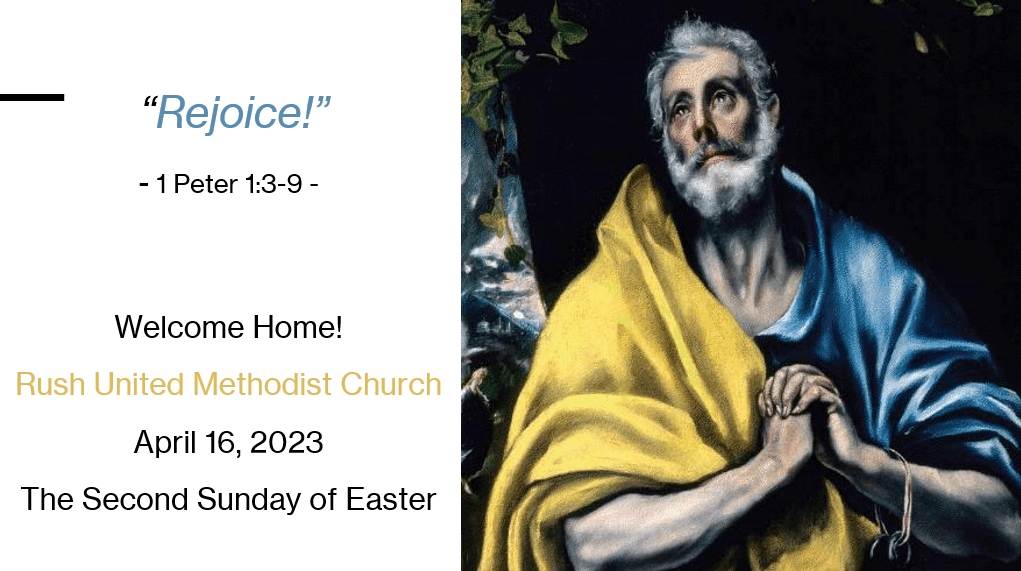
“Rejoice!”

1 Peter 1:3-9

April 16, 2023

The Rev. Todd R. Goddard, Pastor

Rush United Methodist Church

1 Peter 1:3-9

Blessed be the God and Father of our Lord Jesus Christ! By his great mercy he has given us a new birth into a living hope through the resurrection of Jesus Christ from the dead, and into an inheritance that is imperishable, undefiled, and unfading, kept in heaven for you, who are being protected by the power of God through faith for a salvation ready to be revealed in the last time.

In this you rejoice, even if now for a little while you have had to suffer various trials, so that the genuineness of your faith—being more precious than gold that, though perishable, is tested by fire—may be found to result in praise and glory and honor when Jesus Christ is revealed. Although you have not seen him, you love him; and even though you do not see him now, you believe in him and rejoice with an indescribable and glorious joy, for you are receiving the outcome of your faith, the salvation of your souls.

| Prayer |

Blessed Easter to each of you, my beloved,

And may the resurrection of Jesus Christ

Deepen your faith and grant you assurance

Of your redemption and salvation.

Over the course of this and following Sundays of Easter

You will hear wonderful Gospel narratives

Of the resurrected Christ

Appearing to his disciples,

To crowds, and

To others

Granting to each

Eye-witness accounts

Of God’s miraculous acts of mercy and grace.

I’m taking this Easter opportunity to

Allow the Gospel to speak for itself,

To stand on its own two feet,

That you might be fed by its imperishable Truth.

In its place,

I will be preaching a series of sermons

From 1st Peter,

A remarkable letter

To the faithful

dispersed and scattered

Throughout Asia Minor,

Primarily in modern day Southwest Turkey;

The Roman provinces of Pontus, Galatia, Cappadocia, Asia, and Bithynia.

The author of First Peter speaks fondly

To the faithful,

Referring to them as “elect” or “chosen”

Drawing upon Israel’s unique status in the Old Testament as chosen by God.

He is appealing to their former Jewish persona,

Now transformed by Christ’s own election,

As eyewitness of Christ and his resurrection,

As exiles of the diaspora,

As strangers in a strange land.

(Much of the content of today’s sermon is inspired by the exceptional commentary by Richard Carlson, Pastor, First Lutheran Church, Kearney, Nebraska as found at working preacher dot com.)

…..

I remember the feeling of being a stranger in a strange land

As the jetliner made its final approach.

Below was the large city of brick-and-mortar huts topped by rusty tin roofs.

Above each was smoke curling up,

evidence of the morning meal being prepared

over a cook fire

in each walled off compound.

Numerous, decades old

Decaying Russian Hind helicopters

Rested in the weeds just off the taxiway.

I was a stranger in a strange land.

“Do not be afraid,” I was reminded of Jesus’ greeting

To the women at the tomb,

To the disciples hiding in the Upper Room,

To the disciples on the road to Emmaus.

Seated next to me waiting to deplane

Was Tony, a native son of Nicaragua,

A true brother in Christ,

One who’s faith and hard work

Led him to America with his family

To play baseball for the Baltimore Orioles and the Rochester Red Wings.

Tony was beaming ear to ear.

He was so excited to return home

Leading our mission group

To share the Gospel and love of Christ,

Build homes for the homeless

(mostly, his cousins and extended family),

And to host a vacation Bible School for 300 village children.

I didn’t speak the language.

I was thousands of miles away from home.

I didn’t know what I had gotten myself into.

But, what I did know,

Is that the love of Christ is universal.

I felt like one of those exiles,

A stranger in a strange land,

To whom Peter authors this letter.

Peter reminds the faithful

That they do not belong to the pagan reality in which they dwelt,

Anymore than I belonged to the Noreiga communists in Nicaragua.

Instead they belong to God,

Our God who specifically singled them out,

Chose them before the foundations of creation,

Made and formed by the Holy Spirit

Through Christ’s obedient and sacrificial death.   

Christians have been born anew,

Or born again, according to some translations,

Into God’s holy family.

This new birth is the result of God’s enormous mercy,

Not because of any decision we’ve made

Or because of any extraordinary faith.

It is by God’s mercy that we are given a new beginning.

This new beginning is not a one-and-done affair.

We are born new every day,

Transformed, reformed, refreshed, and renewed

By God’s mercy every moment of every day.

This continuous Divine effort by our merciful creator

Results in us a living hope

Of salvation that begins in the here and now

And extends into eternity,

The gift of our Savior, Jesus Christ.

Jim and I made our way off the main cobble stone street

Through numerous back alleys

In an attempt for him to point out to me

The numerous homes prior mission teams had built.

We were two big, tall, non-Spanish speaking, white Americans

In a village full of short, underfed, non-English speaking Nicaraguans.

We rounded a corner

Were a man with a large machete ran up to us.

I shrank back, but his incongruent smile, eased my fear.

He pointed to a tree,

Jim nodded,

And up he went

To cut down clusters of plantains, a type of banana,

For us visitors to eat.

The plantains were delicious.

His welcome and hospitality transcended language barriers.

Out from a house came a young couple,

The woman holding a newborn,

Sucking from a bottle of sugar water.

Underfed, tiny, wrapped in a small blanket,

The baby fussed.

They recognized Jim and it was like old home week!

The mother turned to me

And thrust her baby into my arms.

It had been a while since I held my own infant boys

And I was a little out of practice,

But, by God’s mercy and grace

I held the child close

And kissed his forehead.

The plantain man and neighbors who gathered

Let up a cheer

At the love I showed to a newborn baby.

Indeed.

Salvation had long ago been accepted

And was being refreshed.

I was being reborn,

New every day.

Peter has a way of describing this inheritance

With triple adjectives:

Imperishable.

Undefiled.

Unfading.

Salvation is imperishable.

The act of Christ’s death and resurrection

Can not be undone and

Will not be destroyed.

Christ’s motive was as pure

And the love of the one who Created us.

Nothing can degrade or tarnish

That which is perfect.

Salvation will never fade away.

It has not dimmed through generations of saints,

And it will not fade in today’s generation.

The light of Christ and his salvation

Has never shone brighter than today.

Our inheritance is not one of land,

As was promised by God in his everlasting covenant

With our ancestors.

Our inheritance is eternally protected by God’s power.

It is now, and will be, safe in God’s care.

Nicaragua is a land of suffering,

The second most impoverished land in the Western Hemisphere.

Poverty and malnutrition are pervasive.

Corruption and social ills flow in the polluted water they drink.

After lunch

A number of us were resting

in front of the house

After a day of vacation Bible School and house building.

We sat on the curb that lined the cobble stone, narrow street.

A pickup game of soccer was being played

By some of the children and members of our group.

People came and went from the friendly Pharmacia across the street.

Down the center of the street staggered a heavily intoxicated man.

The soccer game merely adapted to the other side

As he made his way towards us.

I braced for what was going to happen next.

He stopped,

Stood up straight right in front of me,

And passed out, face down in the gutter.

Nobody moved.

The soccer game came to a halt.

I rolled him face up to protect his airway

And then

Time stood still.

The broken man at my feet was the personification of suffering,

Dressed in rags, dirty as the unleashed dogs that roamed.

The children urged the soccer game to continue.

None of us spoke.

Tony came out,

Recognized the broken man as one of the town drunks

And told us not to worry.

The man rested, then roused, struggled back to his feet

And resumed his staggering journey down the street.

There are such unfortunates

For whom suffering is too much,

Yet, for whom

is offered a place at the table with Christ

just as there is a place for you and me.

Our place at the table

Is God’s gift of mercy

Secured for us

By the cross of Jesus Christ.

Suffering, Peter writes, comes with the territory of faith.

Christian suffering is grounded in Christ’s suffering.

Not only is there a cause for suffering in the present,

There is a purpose to it.

Suffering is a testing ground

“so that the genuineness of your faith

May … result in praise and glory (in the future)

When Jesus Christ is revealed.”

Peter is pointing us forward

To the future

To the promised return and revelation of Jesus Christ.

Salvation has come

And soon will be

When Jesus Christ is revealed.

What does that future eschatological time look like?

I don’t know.

But I do know this:

I love

because Jesus loves.

I believe

because in Him is an indescribable and glorious joy.

Words fail me,

But the joy of Christ fills my heart.

Beloved, the Apostle Peter

The first Father of the Church

To whom Jesus bestowed the keys of forgiveness

Has much to teach us in this, his first letter.

First Peter is short in length,

but full in belief.

I trust you will take the time and opportunity

To read it thoroughly during these days of Easter,

During this season of resurrection,

That your faith might be refreshed,

Your hope may be restored,

And your salvation may be complete.

Thank you, Lord, for your gift of Peter to the Church,

For his assurance when we find ourselves exiles in a strange land,

For his insight into God’s marvelous mercy,

For his confidence in the midst of suffering,

For his faithful embrace of Jesus Christ,

For his faith in your greatest gift of love,

The salvation of a formerly lost world.

Amen.

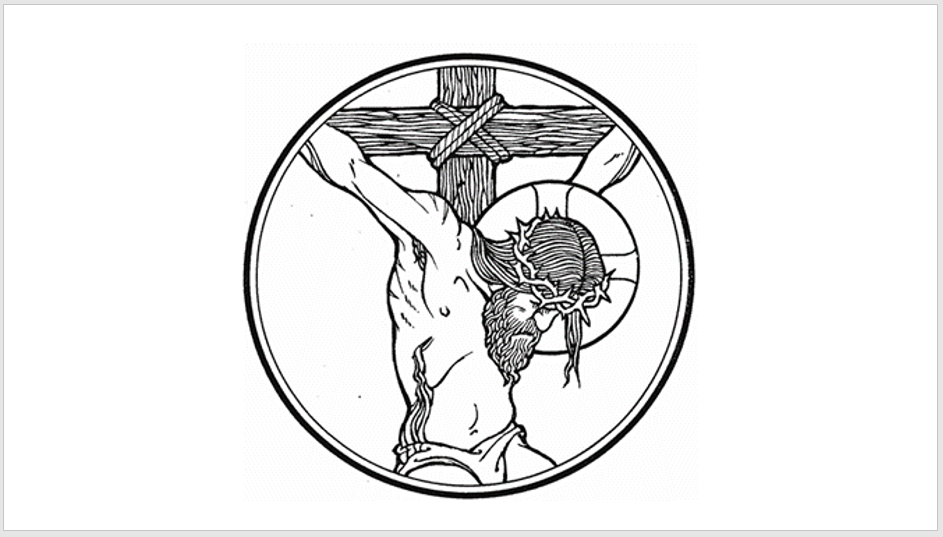
Good Friday Reflections

April 7, 2023

The Rev. Todd R. Goddard, Pastor

Rush United Methodist Church

John 18:1-19:30

| Centering Prayer |

Ten candles extinguished this evening

Leaving only one,

One Pascal candle

To provide for the Light of the World.

We sit in the near-dark

Filled with inner doubts and fears;

Questions so deep

Words and language fail

Abandoning each

To random destinies.

The aging human is one

Constantly in a state of change.

Experience molds and shapes personality.

Physical changes whispers a message we don’t want to hear;

Weakness, dependency, mortality.

Faith, wavering between fleeting and dark roast bold,

Develops deeper acknowledgment

Of compromise, peace, and acceptance.

As I age,

I view the Passion

With new and fresh

eyes and ears

every revolution around the sun.

I have changed since last year.

You have changed, too.

Four fresh thoughts.

1.  Jesus knew all that was to happen to him.

It says so in John 18:4.

Across the Kidron

In the garden known as Gethsemane

In the dark

Jesus saw them approaching

Making a racket,

Metal clanging against metal,

Marching awkwardly,

Murmurs, grumbles, complaints,

The barking commands of one in charge.

“Lanterns and torches and weapons,” (18:3)

John records.

Ironic, don’t you think?

Lanterns, torches, and weapons

Come for the Light of the World

Come for the Prince of Peace.

Judas, who betrayed him, was standing with them. (18:5)

His work was done.

His betrayal complete

Playing out for all the world to see

Revealed by

Lanterns and torches and weapons.

Other than Judas and the others falling to the ground,

According to John,

He had no other role to play.

Why did Judas even show up?

Judas took his shot

And quietly exits stage left.

What is a revelation to you and me

Is familiar to Jesus.

Jesus knew.

What unfolded for the world to witness

With morbid fascination

Was known by Jesus prior to every tragic circumstance.

Yet, Jesus went willingly.

Without hesitation.

Destined.

Ordained.

As moved by the unseen hand

Of a reluctant, yet willing,

Loving, heavenly Father.

Jesus knew.

What if we knew?

Perhaps we know.

For some, knowing is instinctive, intuitive,

The revelation of Divine will.

For others, knowing comes only by

Hard knocks, overwhelming obstacles, insurmountable odds.

How one gets from point A to point B

Is not so important

As long as one bleeds, dies, and is resurrected with Jesus. 

Know,

Just as Jesus knew,

You have been forgiven.

You are forgiven, and you will be forgiven.

Know you were born to be saved.

You live the life of salvation from sin and death.

And, when mortal life ceases your salvation will bring you eternal life.

Jesus knew.

I thought you should know, too.

2. Peter, Oh Peter.

How could you?

Peter, the Rock,

The first Apostle,

The one Jesus bestowed the keys of the Church,

The keys!

The keys!

Peter,

Caught outside the gate

in the courtyard of Caiaphas

addressed by an anonymous guard,

denied knowing Jesus.

Integrity is what you do when no one is watching.

Jesus was out of earshot

inside being grilled by Caiaphas.

Peter was in a crowd outdoors.

Peter thought no one was listening

No one was watching.

However, Peter wasn’t alone.

He was with another disciple, John reports. (18:15)

That disciple was known;

Known to the high priest

And known to the woman standing guard at the gate.

Yup. A woman guard.

When the other disciple brought Peter in,

Through the gate,

The woman guard inquires in the negative,

“You are not also one of this man’s disciples, are you?”

“I am not,” replied Peter. (18:17)

“I am not”

Completes the portrait

Of a yellow-bellied coward

Fleeing responsibility,

Unaware and unconcerned of the unintended consequences

Of abandonment.

Peter becomes the personification of moral abandonment,

Of ethical desertion.

Yet

If God can build a Church

Upon Peter and this broke-down legacy

There is hope

There is promise

This church can be rebuilt.

Rebuild.

Refresh.

Renew.

Revitalize.

Resurrect!

The job is ours.

By us

For us

With God’s will and strength

To build!

Build

From the smoking remnants of bygone eras

Wrecked by power, greed and virus,

Divided by politic and government,

Devastated by sin and death,

And the thin faith of Christmas and Easter attendance.

Build

Upon Christ.

Take responsibility

And accept the keys to the front door.

“I am!” is the faithful response.

“I am a disciple of Jesus!”

“I was!”

“I was with him!”

“I will.”

“I will faithfully follow Jesus

Accept his every responsibility

With every breath

With every beat of my heart.”

….

3. Truth.

The thirty-seventh verse of chapter 18 caught my imagination.

When Pilate asked about his royalty

Jesus responds

“For this I was born,

And for this

I came into the world,

To testify to the truth.

Everyone who belong to the truth

Listens to my voice.’” (18:37)

Truth matters.

The world says otherwise.

Don’t believe the world.

Believe Jesus and his testimony.

I think I know what truth is.

You think you know what truth is.

Fact is, neither of us know truth

if we don’t listen to the voice of Jesus.

Hebrew scripture informs us about Jesus,

But is no substitute for the voice of Jesus.

New Testament letters inform us

Of early belief and practice

But is no substitute for the voice of Jesus.

Both orient us to the feet of Jesus.

But neither is a substitute for Christ himself.

Resist taking part in the half-truths,

white lies,

and bold-face lies of the world;

lies told by others,

lies told to others,

lies you tell yourself.

Resist lying.

You will sleep more soundly.

Your conscious will thank you.

Your soul will discover a new freedom

A new opportunity

To explore the fullness of Christ,

His words,

His actions,

His ordained mission

To unlock the chains that bind you

To set you free

To live with meaning and purpose

In God’s emerging kingdom.

Truth.

One source.

One destination.

One place where truth can be found.

Jesus.

In Christ alone

Is truth.

4. Beware the Crowd.

Pilate asked the crowd,

“Shall I crucify your king?”

Who responded,

“We have no king but the emperor.” (19:15)

Beware public opinion.

Beware poling the congregation

As well as

Beware poling the population.

Crowds give anonymous feedback

Without fear of consequences, intended, or otherwise,

Often with a benign ignorance

Of human complexity and motive.

I understand

Popular opinion is the pinnacle of democracy.

Majority rule is the gold standard

Which the Gospel of Jesus Christ threatens to destabilize.

For there is among the faithful

A higher power

A gift given

To the observant

To the faithful.

The Holy Spirit speaks and works

Through individuals and small groups,

Is not bound by majority rule,

Yet, remains

The truth to which Jesus spoke.

The Holy Spirit gives conscience to individuals

Irregardless of position

– in the majority or in the minority.

The Holy Spirit

Plants seeds of truth

Deep in the hearts and minds

Of the committed to discern the whispers of God

The directives of the Divine.

The Holy Spirit is the source of truth,

Truth to be told

In spite of popular opinion, temptation, trials, or repercussions.

Truth spoken to power.

Truth with better than golden purity.

There you have it.

You’ve got what I have to give.

Jesus Christ knowingly,

Willingly,

Lovingly,

Gave his life on the cross,

His witness

His gift

God’s grace

That you may be redeemed and saved,

That Christ’s Church universal may be redeemed and saved,

For this is Truth

The witness that points us and moves us forward.

His body is a corpse.

His Spirit has left.

A puncture of his side and lungs

Will make certain there is no resuscitation.

Other than clean up,

laying the corpse in the tomb,

sealing the door, and

posting a guard

our job here is done.

Our job here is done.

Amen.

Maundy Thursday Reflection

The Rev. Todd R. Goddard, Pastor

Rush United Methodist Church

April 6, 2023

John 13:1-17, 31b-35

Now before the festival of the Passover, Jesus knew that his hour had come to depart from this world and go to the Father. Having loved his own who were in the world, he loved them to the end. The devil had already put it into the heart of Judas son of Simon Iscariot to betray him.

And during supper Jesus, knowing that the Father had given all things into his hands, and that he had come from God and was going to God, got up from the table, took off his outer robe, and tied a towel around himself. Then he poured water into a basin and began to wash the disciples’ feet and to wipe them with the towel that was tied around him.

He came to Simon Peter, who said to him, “Lord, are you going to wash my feet?”

Jesus answered, “You do not know now what I am doing, but later you will understand.”

Peter said to him, “You will never wash my feet.”

 Jesus answered, “Unless I wash you, you have no share with me.”

Simon Peter said to him, “Lord, not my feet only but also my hands and my head!”

Jesus said to him, “One who has bathed does not need to wash, except for the feet, but is entirely clean. And you are clean, though not all of you.” For he knew who was to betray him; for this reason he said, “Not all of you are clean.”

After he had washed their feet, had put on his robe, and had returned to the table, he said to them, “Do you know what I have done to you? You call me Teacher and Lord—and you are right, for that is what I am. So if I, your Lord and Teacher, have washed your feet, you also ought to wash one another’s feet. For I have set you an example, that you also should do as I have done to you. Very truly, I tell you, servants are not greater than their master, nor are messengers greater than the one who sent them. If you know these things, you are blessed if you do them.

When he had gone out, Jesus said, “Now the Son of Man has been glorified, and God has been glorified in him. If God has been glorified in him, God will also glorify him in himself and will glorify him at once. Little children, I am with you only a little longer. You will look for me; and as I said to the Jews so now I say to you, ‘Where I am going, you cannot come.’ I give you a new commandment, that you love one another. Just as I have loved you, you also should love one another. By this everyone will know that you are my disciples, if you have love for one another.”

| Centering Prayer |

Why is today called Maundy Thursday?

What is a Maundy, anyway?

I’m glad you asked.

Over the course of 2,000 years,

Christianity has developed some interesting traditions.

Maundy is derived through Middle English and Old French

From Jerome’s original Latin word: Mandatum.

This is also the origin of the modern English word: mandate.

Mandatum is the first word of the statement by Jesus

In the Gospel of John 13:34.

“Mandatum novum do vobis ut diligatis invicem sicut dilexi vos”

Which means,

“I give you a new commandment, that you love one another. Just as I have loved you, you also should love one another.”

There you have it:

Maundy equates with Mandatum,

Our Lord’s new commandment

To love one another,

Just as Jesus loved his original disciples.

But, I must ask, what gives?

The Gospel of John explicitly reports

Jesus is giving his disciples in the Upper Room

A NEW commandment.

The Latin “novum,” meaning “new” is right there for all to see.

We all know Leviticus 19:18 which states

“You shall not take vengeance or bear a grudge against any of your people, but you shall love your neighbor as yourself: I am the Lord.”

The command by God

To love your neighbor had existed from the time of Moses,

Born in 1,592 BCE, according to Jerome.

You shall love your neighbor as yourself

Had been taught faithfully in Rabbinical schools,

In Temples and Synagogues,

To the people of Israel

For more than 1,500 years.

What’s new about that?

What was new for Jesus

Was not

To love your neighbor as yourself,

But,

How to love your neighbor.

The events of the Upper Room and the Last Supper

Were a demonstration in

How to love your neighbor.

Listen carefully.

Better, yet.

Watch and learn

How we are to love our neighbors.

You’ll notice our Gospel of John reading is split into two sections,

John 13:1-17 and John 13:31b-35.

I don’t know about you, but

I’m always curious about what is being left out.

In today’s Gospel,

After Jesus washes his disciples’ feet,

He tells everyone at the table that one of them will betray him.

One of them,

Who we know was Judas,

Will turn him over to be arrested, tried, and killed.

“The one who ate my bread has lifted his heal against me.”

John 13:8b

And

“I tell you, one of you will betray me.”

John 13:21

After Jesus identifies Judas as the one who will betray him,

By first placing the piece of bread into his hand,

Judas immediately went out.

And it was night, John reported.

This is how you love.

Jesus washed the feet of the one who would betray him

Unto death.

Jesus fed the one who would turn him over to the authorities

For arrest, torture, and crucifixion.

Jesus would love that one man

Even though he fled into the night,

Forever separating himself from Jesus and the other disciples.

Jesus would serve him.

Jesus would feed him.

Jesus would forever love him.

There was nothing that could separate Judas from the love of Jesus.

Nothing!

Not even a hangman’s noose.

Not for nothing,

But for Peter, too.

Jesus washed Peter’s feet

And fed him

Even though the hour was drawing neigh

When Peter and the rest of the disciples would flee for their lives

And Peter would deny ever knowing Jesus.

Not once,

But three times.

Three times Peter denied knowing Jesus.

Jesus served Peter,

Washed his feet,

And fed him, too.

That’s how you love your neighbor as yourself.

This is what’s new.

So, consider

All the neighbors you have in your life

With whom you have unresolved differences.

Think of the people

Where darkness has come

Between you and them,

Where sin has shoved you apart

And pride,

yours or theirs,

Has prevented forgiveness, repentance, and healing from taking place.

These are the people Jesus calls us to love,

On this Maundy Thursday

With his mandatum:

Love one another.

Love.

Love through service.

Wash feet.

Be hospitable,

Before, during and after breaking bread together.

Love.

Even if the one with whom you are at impasse with

might have a tongue of venom and is quick to spread lies about you.

Love.

Even your sworn enemy.

Love.

Even if the one you are serving

might be harboring violence or homicide against you in their heart.

Love.

Even those like Peter or Judas,

Who would deny ever knowing you if caught in a jam,

Who would betray you to a certain death for just a few bucks.

Love.

Serve and feed the world,

Even if the world has turned against you.

Serve and feed the world,

Because,

By your service

And by your generosity,

Everyone will know

That you are disciples.

You are disciples of Jesus.

Amen.

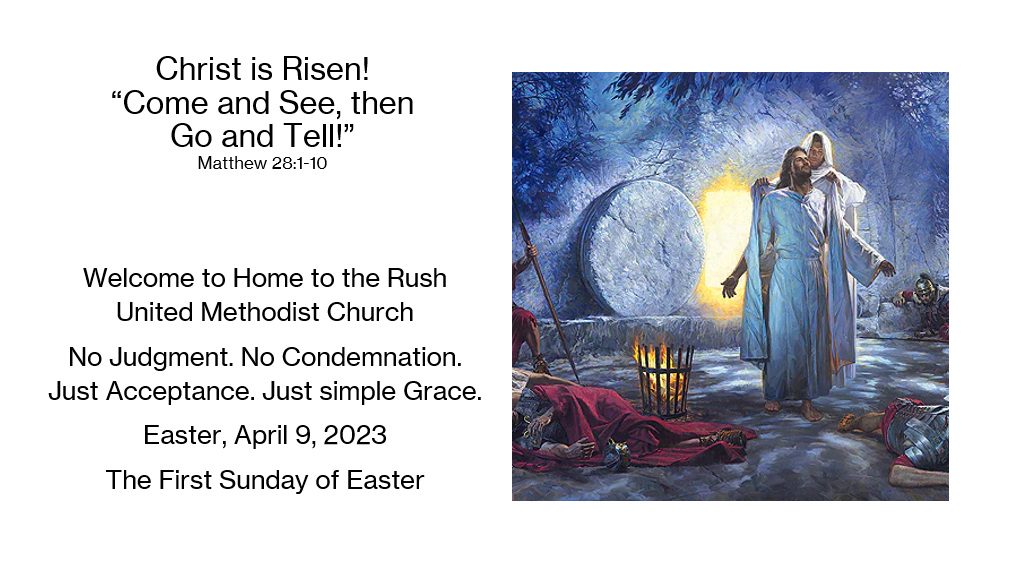
“Come and See, then Go and Tell!”

Matthew 28:1-10

Easter – April 9, 2023

The Rev. Todd R. Goddard, Pastor

Rush United Methodist Church

Matthew 28:1-10

After the Sabbath, as the first day of the week was dawning, Mary Magdalene and the other Mary went to see the tomb. And suddenly there was a great earthquake; for an angel of the Lord, descending from heaven, came and rolled back the stone and sat on it. His appearance was like lightning, and his clothing white as snow. For fear of him the guards shook and became like dead men. But the angel said to the women, “Do not be afraid; I know that you are looking for Jesus who was crucified. He is not here; for he has been raised, as he said. Come, see the place where he lay. Then go quickly and tell his disciples, ‘He has been raised from the dead, and indeed he is going ahead of you to Galilee; there you will see him.’ This is my message for you.” So they left the tomb quickly with fear and great joy, and ran to tell his disciples. Suddenly Jesus met them and said, “Greetings!” And they came to him, took hold of his feet, and worshiped him. Then Jesus said to them, “Do not be afraid; go and tell my brothers to go to Galilee; there they will see me.”

| Centering Prayer |

Pilate’s guards,

professional Roman soldiers,

stood watch.

A garrison with rotating sentries,

a camp fire and a pot for cooking suspended over the fire,

tents, possibly, offered modest protection from the morning dew.

Soldiers were posted at the request of the Chief Priests,

Approved by Pilate,

undoubtedly welcomed the pre-dawn light and

the promise of warmth.

Since Friday night they stood guard at the door

of the stone sealed tomb,

lest His body be stolen

by souvenir hunters,

by grave robbers,

by revolutionary zealots.

Sunday morning was dawning.

Mary Magdalene and the other Mary went to see the tomb.

Matthew’s narrative reports they simply went to see …

To see the grave

Where the corpse of Jesus

Had been laid.

What, with guards and a sealed, solid rock door,

there wouldn’t be much to see.

It would have been too soon for inscriptions or markers.

Yet, still they came.

The earth shook underfoot.

An angel of the Lord,

a male it is reported;

an angel dressed in white,

white as snow,

and looking like lightening,

descended from heaven

right before their eyes.

He rolled back the stone door

and he climbed on top

to sit.

Now, there’s something you don’t see every day!

There was no fight,

no quarrel,

no skirmish.

The soldiers may have been prepared to fight with Peter,

but they weren’t prepared for this

angelic intersection with the mortal world

of geological tectonic plates and

astrological black holes disrupting the cosmic order.

Fear and panic overtook these low ranking soldiers;

they shook and passed out cold

like cord wood in the wood pile.

Afterwards, Matthew reports

they were paid money

to lie about their incompetence

“just tell them that you were asleep

when they came and stole his body.” (28:12)

Like a leprechaun perched on the Blarney Stone

the angel sat and took it all in.

The women’s fear is even palpable today.

Certainly the angel could feel it.

He began to speak.

“Do not be afraid;” he assured them.

“Do not be afraid”

were words that were familiar to Mary.

Remember the annunciation?

This wasn’t her first rodeo,

Neither was it her first visit by an angel.

The angel knew the women’s desire,

The depth of their mourning,

The breath of their bereavement,

The tenderness of their love.

He knew whom they sought.

“He is not here; for he has been raised, as he said.”

He is raised as he said.

The body had exited the tomb

before the stone door was rolled away.

The angel only opened the door

for the benefit of the witnesses.

“Come and see, then go and tell,” the angel commanded.

Go.

Tell them

“He has been raised from the dead.”

Go.

Tell them

“He is going ahead of you to Galilee.”

“Come and see, then go and tell,” the angel commanded.

The women obeyed

just as they were told.

They went with an interesting mixture of fear and joy.

Just as quick as they went

He suddenly stopped them with “Greetings!”

They looked,

probably two or three times

shaking the cobwebs and rapidly blinking.

It was Jesus!

Upon recognition,

They fell,

They held His feet,

They saw the pedal punctures,

and they worshiped Him.

They looked,

They fell,

they held,

and they worshiped.

It is a simple formula.

It didn’t take a whole lot of faith

with him standing right in front of you.

Jesus was dead, but is now alive.

This is the Good News of this Easter day.

Jesus was dead, but is now alive.

QED the mathematician would conclude,

“that which was to be demonstrated.”

(“quod erat demonstrandum” -if you have to know!)

Jesus had died, and now he is risen.

For two thousand years we’ve been proclaiming this fact.

For fifty generations,

Christians have been passing down this witness.

This testimony has been as common as our baptismal waters,

as longstanding as Christianity,

as continuous as the ranks of Saints and apostolic succession,

as self-evident as the Declaration of Independence,

as true as the sky is blue.

This is our witness:

Jesus had died, and now he is risen.

There isn’t a corner of the globe today

where this light hasn’t shined.

2.38 billion

– that’s a “B” for billion –

– The largest religious group on this planet –

Over 2 billion Christians are united this Easter Day

Celebrating the fact that

Jesus had died, and now he is risen.

“So, what’s the big deal?” the cynic asks.

In a loveless world

filled with liars and false promises,

fake politicians,

hypocritical preachers,

poisoned by threat-based theology of going to hell,

and identity thieving computer hackers;

in a world consumed by darkness and evil personified

that will hate you,

hit you,

hurt you,

take your last dime,

spit on you,

and leave you in the gutter for dead;

in a world filled with survival of the fittest,

single elimination,

tribal councils,

dog eat dog,

and win at all costs …

… we are thrown a life line.

… we are invited to journey by a road less traveled.

… we are invited to meet the only one –

– the only one –

who can truly save us.

We are invited home to an eternity of grace,

A home filled with love.

For we are offered the Savior,

Jesus,

raised from the dead

willing to share the journey with us

offering to us

fully-shared participation in everlasting peace,

the gift of eternal life.

If you want to be left alone

in the belief that this is all that life will ever have to offer;

work hard,

play hard,

buy everything you can,

consume as much as possible,

and everyone else be damned;

then, well, God bless you.

You don’t have to catch His life line.

But, if you are willing to make a change,

If you are willing to take a chance,

If you want what we have,

If you are able to mix faith with hope,

and shake together a little pinch of vision

for what God’s possibilities might hold,

then reach out and grab the life line

Jesus is tossing you.

Jesus is throwing the life ring of salvation for you to catch.

Hold on tight.

Fall to his feet and hold on tight!

Look up and see His face.

Do not be afraid, Jesus repeats the angel’s assurance.

Do not be afraid, Jesus is telling us this Easter.

Do not be afraid that others might doubt,

Or that we might find ourselves

Enduring seasons of personal doubt.

Do not be afraid, for,

Low, my Spirit is with you always.

Go! Tell the world what God has done for you.

Go! Witness to the fact that

Jesus had died, and now he is risen.

Just get up and go!

Prepare yourselves and prepare the world

That the risen Christ is our Savior,

His Spirit is with us always,

And, that one day,

He intends to meet us again.

Alleluia!

Amen.

“So Much Anticipation”

Matthew 21:1-11

April 2, 2023

The Rev. Todd R. Goddard, Pastor

Rush United Methodist Church

Matthew 21:1-11

When they had come near Jerusalem and had reached Bethphage, at the Mount of Olives, Jesus sent two disciples, saying to them, “Go into the village ahead of you, and immediately you will find a donkey tied, and a colt with her; untie them and bring them to me. If anyone says anything to you, just say this, ‘The Lord needs them.’ And he will send them immediately.” This took place to fulfill what had been spoken through the prophet, saying, “Tell the daughter of Zion, Look, your king is coming to you, humble, and mounted on a donkey, and on a colt, the foal of a donkey.” The disciples went and did as Jesus had directed them; they brought the donkey and the colt, and put their cloaks on them, and he sat on them. A very large crowd spread their cloaks on the road, and others cut branches from the trees and spread them on the road. The crowds that went ahead of him and that followed were shouting, “Hosanna to the Son of David! Blessed is the one who comes in the name of the Lord! Hosanna in the highest heaven!” When he entered Jerusalem, the whole city was in turmoil, asking, “Who is this?” The crowds were saying, “This is the prophet Jesus from Nazareth in Galilee.”

| Centering Prayer |

John Wesley, Methodism’s historical church father,

Reflecting on our gospel Palm Sunday lesson from Matthew wrote the following,

“it is for the comfort of my soul

for the honour of his humility,

and for the utter confusion of all worldly pomp and grandeur.”

Indeed, with historical hindsight,

We are comforted by the fact that Jesus had arrived

At his final.

earthy.

destination.

We know his triumphant entry into Jerusalem leads to his death

And the redemption of the world.

Triumphant entry: Yeah!

Death: Complete despair.

Redemption: God’s plan, necessary pain, all along.

(Pause for contemplation)

The crowd had no clue.

They expected Jesus to be their political solution

To end the Roman problem.

They expected Jesus to lead the rebellion

That sends Pontius Pilate and his legions back were they came from.

They expected Jesus to enter the Temple gate

And cleanse organized religion of all its internal rot.

We expect Jesus to die by Friday,

Less all our Holy Week plans become disrupted and fail.

The crowd had no clue.

Their shouts of acclamation,

Here-to-fore stifled by our Christ,

Less it draw cause for the religious authorities

to prematurely interrupt his agenda

are now allowed to go unrestrained.

There is no longer need for caution;

Jesus knows death is imminent.

The comfort we find in this triumphant entry

Is deeply rooted in the personal reality

That the actions of Jesus,

To suffer and die,

Are for my personal gain.

(Pause for reflection)

When did you and I become so self-centered?

Jesus is looking into a crowd of people shouting Hosannas,

Just as we proclaim at Holy Communion.

He knows who will be responsible for his death.

This same crowd will be the ones who,

In a few short days,

Will shout “Crucify him! Crucify him!”

Yet, he humbly sits on a donkey and makes his way

Through the confusion of worldly pomp and grandeur.

Looking into the eyes of your betrayer will give a person chest pains.

For Jesus, looking into the eyes of his betrayers lands him on a cross;

Exposed, bleeding, and dying

Out in the open

In plane sight

For all the world to see.

And so it is

When we lift high the name of Jesus on Sunday

But deny him the other six days of this week

We take our place in the crowd whose “Hosannas” are replaced with “Crucify him”.

Hosanna literally means, “Lord save us”.

Don’t we still want to be saved the other six days of the week?

Or are we content to roll the dice and take our chances?

(Pause to reflect)

Let us not forget our roots!

Jesus came from Galilee

Where he taught, healed, forgave sins, and resurrected the dead.

Jesus came from the town of Nazareth

From which he began a ministry

of reaching out to everyone that society had tossed out and left for dead:

the poor, blind, deaf, mute, diseased, disfigured, prostitutes, and people caught in adultery.

This, and more, define our deeply ingrained roots.

Love the Lord your God, with all your heart, mind, soul, and strength;

And love your neighbor as yourself.

The values of his preaching, teaching and healing

are riding that donkey into Jerusalem this morning.

Let us not forget our roots!

We drag our sorry, sinful, backsliding selves into worship every Sunday

Smug in the knowledge of God’s redeeming grace,

Yet remembering the Christian values that have surfaced and taught to us

Since our earliest memories.

Sitting on my father’s lap;

is that so different than the picture of Jesus with all the children coming unto him?

Taking my place at the dinner table and saying grace;

Is that so different than what took place in the Upper Room?

My mother cleaning up my bicycle induced laceration;

Is that so different than the women who went to clean, dress, and prepare the bloody corpse of Jesus?

Our roots teach us, inform us, guide us.

Listen to what our ancestors have to say.

Listen.

(Pause)

Though everyone loves a parade,

We should think twice before we take our place in this crowd.

Homicide should never be an aspiration.

OK, so, we aren’t the crowd.

We shouldn’t be the stained, soiled, or deeply flawed disciples

(Lord knows how Peter and Judas end up).

And we certainly can’t claim to be the Christ.

We are left asking, “where is our place in this triumphant parade story?”

What role are to we play this coming Holy Week?

Our role is to be the eyes and ears of Christ this Holy week.

We are to humbly look to the world,

See the need,

And to respond

just as Christ would respond.

Jerusalem was far from perfect;

So too is the world in which we live.

Can we respond with the love of Christ

In the midst of people who hate you with a smile,

People who would knife you in the back while they are singing your praise,

With people who are so superficial that they would toss you away like an old rag?

Can we enter Jerusalem with Jesus

To squirm in prayer and sweat with blood?

To taste and see the temptation to bolt and run?

Can we look upon the one who denies us and love her?

Can we look upon the one who betrays us and love him?

Can we look down from the cross and see our mother crying?

Can we hear creation groaning in travail, as if in childbirth?

Can we hear the rustle of Divine movement in our midst?

Can we hear the needs of the world

And be so moved by love to meet every need?

So much anticipation.

So much anticipation filled the air

At this triumphant entry,

Let us now be his eyes and ears

And journey with him

Into this Holy Week.

Amen.

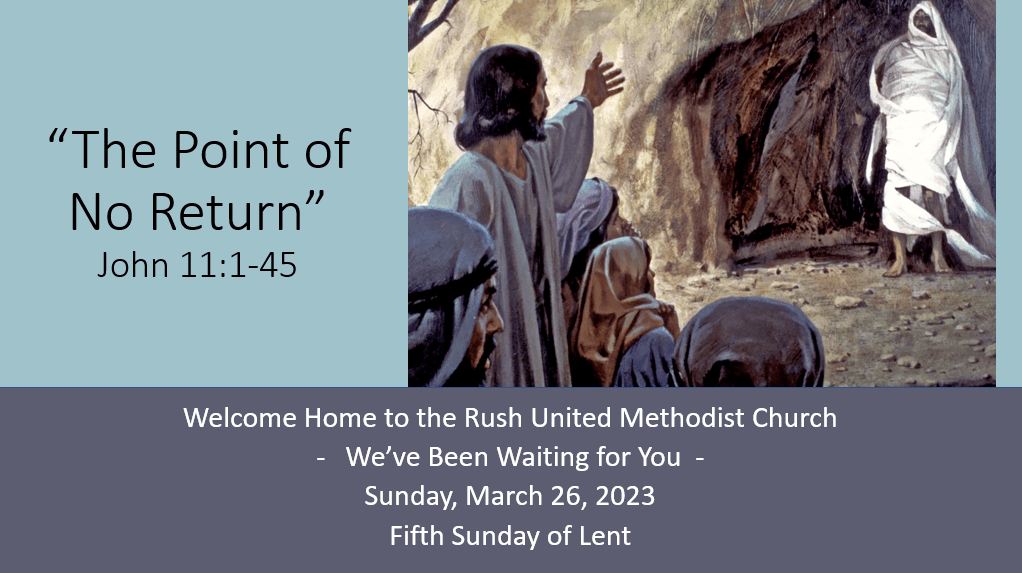
“The Point of No Return”

March 26, 2023

John 11:1-45

The Rev. Todd R. Goddard, pastor

Rush United Methodist Church

http://bible.oremus.org/?ql=263529740

| Centering Prayer |

Few life events are more painful

than the death of a loved one;

a husband, a wife,

a mother or father,

brother or sister,

a family member,

or a friend.

John’s Gospel narrative today

is 37 verses of Jesus getting ready to raise Lazarus from the dead

and six verse of Jesus actually lifting Lazarus out of the grave,

giving him life.

Prior to our passage

Jesus and his disciples had fled the Temple

after the Jews questioned him,

picked up stones,

and threaten to kill him.

Ever looked down the barrel of a gun?

Yeah, Jesus needed to get away

To have a panic attack!

Today, Jesus is found

“across the Jordan

to the place where John had been baptizing earlier,

and he remained there.” (10:40)

This was at least 18 miles away,

as the crow flies

and 3,300 feet straight downhill.

The road between the Jordan River and Jerusalem

snakes back and forth to compensate for the steep slope.

The road today, built on the same path

Jesus would have traversed

is about 33 miles.

What takes 45 minutes by car today,

Took about 2 days to walk

in the time of Jesus.

This is important

because word of Lazarus’ illness

would have made its way to Jesus

two days after Mary and Martha’s brother became mortally sick.

Mary and Martha,

sent their message

“Lord, he whom you love is ill.”

(11:3)

Jesus’ friend, Lazarus,

the brother of Mary and Martha,

must have died two days after his sisters sent notice to Jesus of his illness.

Jesus lingered for two days after receiving the news,

then traveled an additional two days to Bethany,

a near suburb of Jerusalem,

only to find that Lazarus

had been four days dead and buried in a cave,

where his corpse stinketh greatly!

As certain as a spear penetrating Jesus’ side,

this is not a resuscitation attempt

we’re talking about here.

Lazarus, brother of Mary and Martha,

all dear friends of Jesus,

has died.

Few life events are more painful

than the death of a loved one;

a husband, a wife,

a mother or father,

brother or sister,

a family member,

or a friend.

We live in a death averse culture.

Intellectually, we all know we are going to die.

Emotionally, we are a train wreck of denial, delusion, and delay.

We say people “passed”

when in fact, they died.

People say “we lost them,”

as if they lost their way home from the market.

We hope to die without struggle;

to “die in our sleep.”

Yet, we know death comes to many

with a lot of pain and suffering.

We send the corpse of our beloved to undertakers

to delay the decay,

clean them up and present them to family and friends

looking like they aren’t even dead;

“oh, he (or she) looks so natural.”

The higher the profile of the person;

the greater the outpour of public sentiment, grief, and nutty conspiracy theories:

– perhaps Elvis isn’t dead!

– shadows in bushes on the grassy knoll proves a second shooter!

Even, low these 40 days of Lent,

this liturgical season is a constant grind

of anticipatory death and grief

that accumulates

and is plowed

into the deepest recesses of our spiritual identity.

We side with Jesus’ humanity

and want the Father to take away his cup,

because, with hindsight,

we know what lies ahead during Holy Week.

Jesus’ weighted keel

gives stability to the narrative of him raising Lazarus from the dead:

“This illness does not lead to death;

rather it is for God’s glory,”

Jesus calms his disciples,

“so that the Son of God may be glorified through it.”

(11:4)

Illness and suffering are some of the means

through which God can work.

Resurrection is for God’s glory.

Illness and suffering are tools

through which God works.

When biology and physical fail us

due to age, illness, or trauma,

in my experience,

this is the most important time

to listen for

to watch for

the hand of God

guiding our path;

the whisper of His will

in our ear;

the love of God

wrapping us in His arms.

This six-week period of recovery from my knee replacement

Has been a painful, personal reminder

To watch and wait for God to act,

To weave grace and healing into my life

And into the lives of others.

My pain made me crazy, near suicidal,

Yet, I had to remind myself,

It was “so that the Son of God may be glorified.”

It is through those times of

many dangers, toils and snares

that faith is deepened and broadened,

and as resurrection people

we are invited in

to a closer walk with Thee.

There is no doubt:

suffering is terrible.

Few life events are more painful

than death,

the death of one you love

or one who loved you.

Lazarus lingered with a mortal illness for days.

Jesus was scorned, whipped, stripped, and spit on from arrest to his traumatic death.

No one wants to suffer;

yet, when we do,

it becomes for us an opportunity to

taste and see

the presence of God in our midst;

because suffering is for

God’s greater glory.

—-

In the Gospel of John

this raising of Lazarus story

is the last of the signs

that point to who Jesus is and why Jesus has come,

and begins the pivot to the second half of John,

often referred to The Book of Glory,

which is

Christ’s Passion, death, and resurrection.

These signs include

stories of Jesus teaching,

healing and casting out demons,

and beginning to draw large crowds

which captured the attention of Jewish authorities and Rome.

Crowds can incite riots, insurrection, even revolution.

Last week we heard about Jesus giving sight to a man born blind;

more than mere miracle,

but the complete creation of a visual / neural network right before their eyes.

The interrogation by the religious authorities confirms

they are getting nervous about Jesus

winning over the crowds

and converting people away from Judaism

to become his disciples.

But today,

today,

Jesus crosses the point of no return.

More than mere magic,

raising Lazarus from the dead,

in front of such a large crowd of followers,

so publicly

and so rapidly communicated throughout the Passover pilgrims,

demonstrates the fact

that Jesus has authority

even over death itself.

The authority of organized religion would be

forever relegated

to cellars and backwaters,

to cults and delusional movements,

headed for nowhere.

The authority of the Chief Priests, scribes, and leaders of the Temple

surpassed Jesus’ flesh and humanity.

Yet, it is the Divinity of Christ …

… today in full view for all to see …

with the raising of Lazarus

that exceeds earthly authority.

This Divine authority has no limits or end.

It is eternal.

In the mind of the Chief Priest,

Jesus, the man, must die.

We are resurrection people!

We cannot be people of the flesh,

as Saint Paul so eloquently writes in his letter to the church in Rome,

“To set the mind on the flesh is death.”

(Romans 8:6)

The story of Lazarus is the story of resurrection!

He lives another day to later dine with Jesus

while Mary anoints Jesus’ feet with perfume.

The story of Jesus is the story of resurrection!

Less we get too bogged down in the suffering of Lent and Holy Week,

we know from hindsight

we are resurrection people

as soon as Christ steps out of the empty tomb.

Resurrection is all around us!

Our resurrected life

Begins in our mortal living.

In baptism, we are claimed by the God who created us,

and we become a resurrected disciple in the here and now.

In our future death, we are given victory over the grave,

and welcomed home with resurrection into eternal life.

We are even resurrection people

at the consummation of all history,

when time comes to an end,

and we are joined with the Alpha and the Omega.

Resurrection is all around us!

Our Gospel narrative from John

begs us to open our eyes,

to experience

the resurrection taking place in our midst

that the glory of God may be seen.

Old enemies reconcile,

Sometimes to our surprise,

Sometimes in spite of us;

that’s resurrection!

Health is restored,

Pain is relieved,

Cancer goes into remission;

that’s resurrection!

God’s love envelops a grieving family

A casserole goes into the refrigerator,

A note is sent,

Or a plant is left on the doorstep;

that’s resurrection!

… and every resurrection

is for God’s greater glory!

Ask yourself this:

where am I witnessing resurrection this week?

Where are dry bones being knit together and

the breath of the Holy Spirit is breathing life into lifeless bodies?

May your awareness

lead people to Christ and his authority.

May your awareness

be for the glory of God.

Amen.

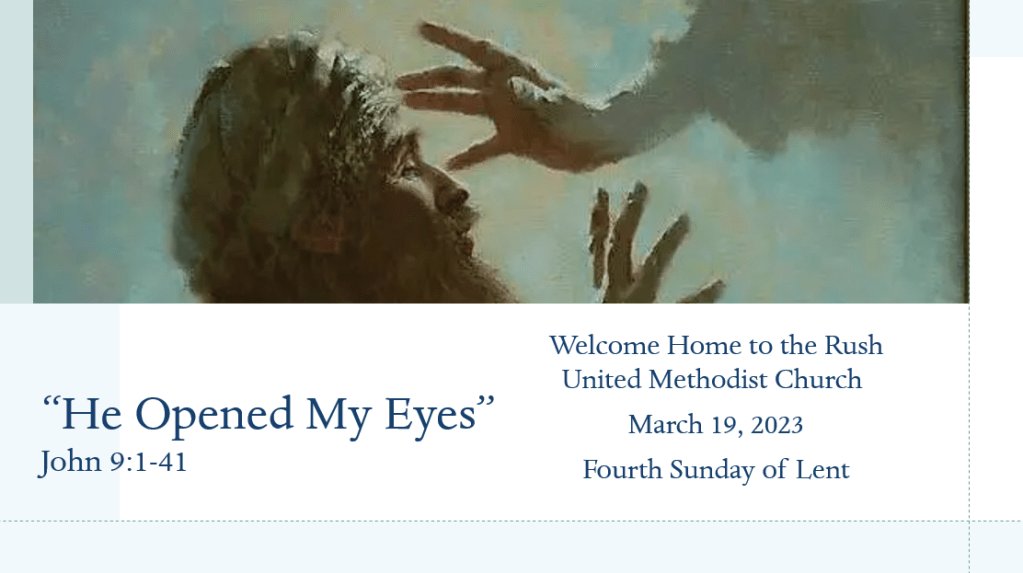
“He Opened My Eyes”

John 9:1-41

March 19, 2023

The Rev. Todd R. Goddard, pastor

Rush United Methodist Church

| Centering Prayer |

I’ve got questions.

1. Does it matter that that this person was born blind, as opposed to being blinded after birth? Would your opinion be different if you had been born blind?

2. Did the man born blind need fixing?

3. Are trials God’s way to punish us for some unfaithful act we’ve committed?

4. Is blindness literal, or a metaphor for spiritual blindness?

5. What was the purpose of this miracle?

6. Why does John take such effort to report all the details of this miracle?

Just because the Gospel has been my life’s focus, interest, and study doesn’t mean I don’t still have questions.

What questions dare you ask?

Let’s first look through a wide aperture,

Take in a wide-angle view of the Gospel.

Today’s gospel slowly

Almost painfully

Unfolds for us

In such a way

That it is a perfect metaphor

For Lent.

Lent begins in darkness;

Total, complete,

Dark-as-dark-as-the-darkest night,

Black-as-the-blackest ink.

The darkness of the wilderness

Is caste by the devil

With temptations

And all that is evil.

For forty days and forty nights

Jesus resists,

And we are given hope

That He just might be the light.

Perhaps the world does not need

To wait in darkness anymore?

Indeed, as Lent unfolds,

Light appears

Slowly, but surely.

And progressively

More and more light creeps in.

The penitent disciple of Christ

Travels the journey

And undergoes an awakening.

Nicodemus sneaks away

Under cover of darkness

To come and inquire of Jesus.

You must be changed

– Born from above –

Jesus teaches him.

For all those who believe in Jesus

Will be saved.

The first sliver of light

breaks into the darkness.

The water at Jacobs well

Is replaced with living water.

He is that living water;

Drink him in

And never thirst for more.

His light is lifted up.

And today,

His light increases in intensity

Such that even those born blind

Still can see.

Time to zoom in,

To listen,

To look,

To explore God’s amazing gift of the Gospel of John.

Chapter 9 is not a miracle story,

Although, it begins with a miracle.

This is a story of enlightenment

Coming to a man born blind.

Receiving his vision

Is just the beginning of his

Spiritual awakening

and awareness.

First his neighbors are amazed,

But they don’t know what to do with him.

So they bring him to the authorities;

The religious authorities.

(How’s that for neighbors!)

His sight divides the opposition.

Some noted Jesus didn’t observe the Sabbath.

Others wondered how a sinner could be blessed.

“What do you say about him?”

they asked.

“It was your eyes he opened,”

they accused.

(And we were led to believe

they were the authorities!

If they were the authorities,

Why would they have to ask?)

He said, “He is a prophet.”

Ah! Here we have it:

The second sign of this man’s

Spiritual awakening.

The man born blind,

The one who Jesus gave vision,

For the first time,

Has now moved beyond the literal miracle.

This man makes his first statement of faith:

“He is a prophet!” He witnesses.

“He is a prophet!” (9:17)

He says

To a less than receptive audience.

Conjecture.

Opinion.

Spit balling.

Eliminate all the obvious answers and go with what is left.

Jesus is a prophet.

How’d that go over?

The crowd is

One that will soon join in cries “Crucify Him!”.

The crowd is

One that smells blood in the water.

The crowd is

One that has homicide flowing in their veins.

Witness.

Witness makes

The light shine brighter.

Note to self: witness make the light shine brighter.

Just as Jacob’s well served as

A baptismal font

And Jesus became himself

Living water,

A means of initiation

Into Jesus’ community,

So too has His saliva

Mixed with dirt

Spread on the eyes

And washed in the pool

Known as Siloam …

… this mud

Has become a baptismal rite

of cleansing,

of joining,

and of eternal life.

Unsatisfied,

And still divided,

The religious authorities drag in his parents.

Fearing their own skin,

The parents only report the facts.

They do not draw conclusions.

The authority’s flaw

Was to call this man back a second time.

With a diverse mix

Of sarcasm, logic, law, and lecture

Our healed man,

With a masterful stroke,

Demonstrates the fact that

He now stands in nearly complete illumination.

“Never since the world began”

the new disciple speaks,

“has it been heard

that anyone

opened the eyes of a person born blind.

If this man were not from God,

he could do nothing.” (9:33)

And with that,

They drove him out.

Jesus immediately seeks him out

To bring the circle round full

to a close.

“Do you believe in the Son of Man?”

“Who is he, sir?

Tell me so that I may believe in him.”

“You have seen him,”

and the one speaking with you is he.”

Illumination is complete.

The final sign of his spiritual awakening has taken place,

with his words,

“Lord, I believe.”

“Lord, I believe.”

“And he worshiped him.” (9:38)

As Lent unfolds,

Light appears

Slowly, but surely.

Progressively

More and more light creeps in.

Gathering light is poignant in the northern hemisphere.

The days are getting longer.

With gathering light

the penitent disciple of Christ

Goes through an awakening.

How about you?

Are you rising?

Most of us love to muck around in darkness,

Believing no one sees what we are doing.

Some of us love

the penance of Lent,

and would be content to remain forever

in its half-lit world

filled with shadows and doubts.

Some eventually long to return to darkness,

While others become restless

and eager to look ahead

To possibilities that may be further revealed.

We recognize the fact that

Lent is not a place

to make our spiritual home.

Rather, Lent is the journey,

nothing more than a journey,

Of increasing illumination

That culminates when all is revealed

By the eternal light of Easter,

Emanating from the empty tomb

Of our resurrected Savior, Jesus Christ.

Where there is light,

There is only Jesus.

And where there is Jesus

There can be no darkness at all.

Be in the light,

Dear friends.

Live in His light.

Amen.

“A Woman’s Witness”

John 4:1-42

March 12, 2023

The Rev. Todd R. Goddard, Pastor

Rush United Methodist Church

John 4:1-42

Now when Jesus learned that the Pharisees had heard, “Jesus is making and baptizing more disciples than John” —although it was not Jesus himself but his disciples who baptized— he left Judea and started back to Galilee.

But he had to go through Samaria. So he came to a Samaritan city called Sychar, near the plot of ground that Jacob had given to his son Joseph. Jacob’s well was there, and Jesus, tired out by his journey, was sitting by the well. It was about noon. A Samaritan woman came to draw water, and Jesus said to her, “Give me a drink.” (His disciples had gone to the city to buy food.) The Samaritan woman said to him, “How is it that you, a Jew, ask a drink of me, a woman of Samaria?” (Jews do not share things in common with Samaritans.) Jesus answered her, “If you knew the gift of God, and who it is that is saying to you, ‘Give me a drink,’ you would have asked him, and he would have given you living water.” The woman said to him, “Sir, you have no bucket, and the well is deep. Where do you get that living water? Are you greater than our ancestor Jacob, who gave us the well, and with his sons and his flocks drank from it?” Jesus said to her, “Everyone who drinks of this water will be thirsty again, but those who drink of the water that I will give them will never be thirsty. The water that I will give will become in them a spring of water gushing up to eternal life.” The woman said to him, “Sir, give me this water, so that I may never be thirsty or have to keep coming here to draw water.” Jesus said to her, “Go, call your husband, and come back.” The woman answered him, “I have no husband.” Jesus said to her, “You are right in saying, ‘I have no husband’; for you have had five husbands, and the one you have now is not your husband. What you have said is true!” The woman said to him, “Sir, I see that you are a prophet. Our ancestors worshiped on this mountain, but you say that the place where people must worship is in Jerusalem.” Jesus said to her, “Woman, believe me, the hour is coming when you will worship the Father neither on this mountain nor in Jerusalem. You worship what you do not know; we worship what we know, for salvation is from the Jews. But the hour is coming, and is now here, when the true worshipers will worship the Father in spirit and truth, for the Father seeks such as these to worship him. God is spirit, and those who worship him must worship in spirit and truth.” The woman said to him, “I know that Messiah is coming” (who is called Christ). “When he comes, he will proclaim all things to us.” Jesus said to her, “I am he, the one who is speaking to you.”

Just then his disciples came. They were astonished that he was speaking with a woman, but no one said, “What do you want?” or, “Why are you speaking with her?” Then the woman left her water jar and went back to the city. She said to the people, “Come and see a man who told me everything I have ever done! He cannot be the Messiah, can he?” They left the city and were on their way to him. Meanwhile the disciples were urging him, “Rabbi, eat something.” But he said to them, “I have food to eat that you do not know about.” So the disciples said to one another, “Surely no one has brought him something to eat?” Jesus said to them, “My food is to do the will of him who sent me and to complete his work. Do you not say, ‘Four months more, then comes the harvest’? But I tell you, look around you, and see how the fields are ripe for harvesting. The reaper is already receiving wages and is gathering fruit for eternal life, so that sower and reaper may rejoice together. For here the saying holds true, ‘One sows and another reaps.’ I sent you to reap that for which you did not labor. Others have labored, and you have entered into their labor.” Many Samaritans from that city believed in him because of the woman’s testimony, “He told me everything I have ever done.” So when the Samaritans came to him, they asked him to stay with them; and he stayed there two days. And many more believed because of his word. They said to the woman, “It is no longer because of what you said that we believe, for we have heard for ourselves, and we know that this is truly the Savior of the world.”

| Centering Prayer |

There are times the Gospel lesson

Just shocks me

With a new awareness,

With a new revelation,

With a new way of being presented;

Like sticking a wet finger in a light socket.

What new have we learned from this familiar story from John?

I’ve read and heard many sermons based on the Woman at Jacob’s Well

Where the preacher expounded at length

About this woman

Who came from a morally corrupt background,

Met Jesus at the well,

And had her sins forgiven.

I may have even preached a few of those sermons, myself.

Did anyone here today,

Who just experienced the proclamation of the Word,

Hear a statement proclaiming this woman was a sinner?

Did anyone hear Jesus forgiving her

Her sins?

No!

I challenge the modern assumption that this woman was morally corrupt!

She had been widowed or abandoned

By no fault of her own

By five …

…. Count them …

By five different men.

This woman wasn’t a sinner seeking forgiveness.

This un-named woman was a victim of men who treated her like property.

She was abandoned, isolated, marginalized, dehumanized.

There are times the Gospel

Is electrifying.

So, if this isn’t a narrative about sin and forgiveness,

What is this previously-assumed-to-be-familiar Gospel passage about?

In the preceding chapter of John

We heard last Sunday about Jesus in Jerusalem

Being visited under cover of night by Nicodemus,

A leader of the Jews.

(John 3:1)

Jesus is in the seat of power,

Being visited by the personification of power.

That narrative ends with one of Jesus’ most memorable statements:

“God so loved the world …”

(John 3:16)

Today, Jesus gives us a glimpse of what the rest of the world looks like.

He’s traveled north, into rural Samaria,

Meeting a woman

Who Jewish society treated as property,

As mixed race,

As abandoned, widowed, and marginalized.

She was the personification of one who has no power.

The contrast couldn’t be more profound.

Nicodemus and the power of the Sanhedrin and the power of Rome,

Vs. an unnamed Samaritan woman at a well.

Jacob’s well is significant.

Jacob met Rachael here.

In the days before

Tinder, Match Dot Com, and online dating,

This is where people came together to socialize, network, and, yes, to flirt.

The local water source was where people congregated.

This woman

Who has no name

Was at the well

To not only draw water,

But to find relationship.

She is seeking opportunities to belong.

She is searching for someone or a group of people

That will add value to her lonely, isolated, tragic life.

And it is here,

At Jacob’s well,

That she meets Jesus.

There are times the Gospel

Just shocks us.

In the Gospel of Matthew we have heard Jesus identified

On multiple occasions

As the Son of God.

At his baptism,

At his transfiguration,

We’ve heard the voice of God pronounce,

“This is my Son, the Beloved, with whom I am well pleased.”

There are no such pronouncements in the Gospel of John.

There are, however, famous “I am” statements,

The first of which occurs here:

“The woman said to him, “I know that Messiah is coming” (who is called Christ). “When he comes, he will proclaim all things to us.” Jesus said to her, “I am he, the one who is speaking to you.””

(John 4:25-26)

“I am” harkens back to Hebrew scriptures,

To our Jewish heritage,

To the mountain where God encountered Moses.

I am who I am” the Lord proclaims.

Since then, “I am” is shorthand for Yahweh,

For the Creator and Lord of all.

John takes “I am” and runs with it:

I am the Good Shepherd”

I am the Way, the Truth, and the Life”

I am the Vine, you are the branches”

Today’s Gospel from John is the first pronouncement of Jesus’ identity.

We not only learn who Jesus is,

Yahweh, the Creator, and Lord of all,

John reveals why Jesus has become God in the flesh.

The one and only time the Gospel of John uses the word “Savior”

Is found right here in verse 42:

The Samaritans … “said to the woman, “It is no longer because of what you said that we believe, for we have heard for ourselves, and we know that this is truly the Savior of the world.””

(John 4:42)

This narrative from the Gospel of John

Is a Rosetta Stone for his theology,

For the belief of the Early Church community

That sprung up around the Apostle John.

John identifies Jesus as God

And reveals his foundational theme

Of why he has come:

Jesus has come to be

The Savior of the world.

Jesus is calling us to a new understanding of “Savior” and “Salvation.”

Salvation is more than salvation from death.

Salvation is more than being saved into than eternal life.

The Savior of the world also brings salvation from isolation and marginalization.

Salvation is also being welcomed into friendships, relationships;

Into community.

God’s power doesn’t come from force or violence,

It comes from love.

God’s love might be academically explained

To people of power,

In positions of power,

In places of power.

But God’s love is experienced,

God’s love is poured out as life-giving living water

To people who have no power

Who exist on the fringes

Who, through no fault of their own,

Are marginalized by the world we live in.

This woman is searching for relationship

And Jesus gives her what she is seeking.

The major criticism of younger adults,

Millennials and GenX-ers,

Is that the Church has lost its relevance;

That we love God,

But that we’ve forgotten to love our neighbors.

“Go to church on Sunday

But forget about Jesus the rest of the week”

Is a biting, but astute, observation of our children and grandchildren.

Why isn’t the Church feeding the hungry,

Instead of writing a check?

Why isn’t the Church building a wheelchair ramp

For a neighbor newly immobilized,

Instead of hosting a Bible Study or gathered for a meeting?

Why isn’t the Church standing up and speaking out

Against racism, homophobia, and antisemitism?

Instead, many see the Church as judgmental, uncaring, and unconcerned.

Jesus goes to this woman and saves her.

Just as Jesus goes,

So too should you,

For you are the Church.

You are given the permission, the authority, the power of the Holy Spirit to go and save the world.

This essential, foundational passage from the Gospel of John

Prods us to go with love,

With God’s love,

And to make healthy relationships,

Founded upon Christ,

the solid rock upon which we stand.

Love others.

Serve others.

Bring the powerless back from the margins

And give them relationship.

Include the last, least, lost, and left behind into the Body of Christ, too.

The concluding point that is important to make

Is to recognize the result of this woman being saved by the Savior:

She runs back to town and tells everyone

“everything I have ever done.”

The Samaritan towns people were so convinced of her witness

They came to Jesus.

They sought Jesus out.

They invited Christ into their lives

And asked him to stay in their homes for two days!

And Jesus did!

“We know this is true!” They in turn witnessed.

Jesus “is truly the Savior of the world.”

This is what the salvation of Jesus Christ does to people’s lives.

Snatching people from loneliness, isolation, powerlessness, and the margins,

Giving and receiving life-giving relationships,

Nurtured by Christ’s living water,

Results in conversion, discipleship, and witness.

Our local church (little c)

And our catholic Church (big C)

Is alive and well today,

In part, because of the salvation of this woman by Jacob’s well,

Her encounter with Jesus,

Her testimony to her fellow Samaritans,

And for her continued testimony

That has trickled down

Generation upon generation thereafter.

Jesus saves.

Because of a woman’s witness,

So, too, dearly beloved, salvation has come to you and me.

Continue the legacy of Christ’s salvation.

Reach out with his love.

Reach out with Christ’s love to the margins.

That’s where the marginalized are found.

Reach out to save another …

And another …

And another …

That, one day, every knee will bow and every tongue will confess

That Jesus Christ is the Savior of the world.

Amen.

“Directing the Wind”

John 3:1-17

March 5, 2023

the Rev. Todd R. Goddard, Pastor

Rush United Methodist Church

John 3:1-17

  Now there was a Pharisee named Nicodemus, a leader of the Jews. He came to Jesus by night and said to him, “Rabbi, we know that you are a teacher who has come from God; for no one can do these signs that you do apart from the presence of God.” Jesus answered him, “Very truly, I tell you, no one can see the kingdom of God without being born from above.” Nicodemus said to him, “How can anyone be born after having grown old? Can one enter a second time into the mother’s womb and be born?” Jesus answered, “Very truly, I tell you, no one can enter the kingdom of God without being born of water and Spirit. What is born of the flesh is flesh, and what is born of the Spirit is spirit. Do not be astonished that I said to you, ‘You must be born from above.’

  The wind blows where it chooses, and you hear the sound of it, but you do not know where it comes from or where it goes. So it is with everyone who is born of the Spirit.” Nicodemus said to him, “How can these things be?” Jesus answered him, “Are you a teacher of Israel, and yet you do not understand these things? “Very truly, I tell you, we speak of what we know and testify to what we have seen; yet you do not receive our testimony. If I have told you about earthly things and you do not believe, how can you believe if I tell you about heavenly things?

  No one has ascended into heaven except the one who descended from heaven, the Son of Man. And just as Moses lifted up the serpent in the wilderness, so must the Son of Man be lifted up, that whoever believes in him may have eternal life. “For God so loved the world that he gave his only Son, so that everyone who believes in him may not perish but may have eternal life. “Indeed, God did not send the Son into the world to condemn the world, but in order that the world might be saved through him.

| Centering Prayer |

When my father

Made the decision to

Walk away from his

Well-paying corporate finance job

In 1968,

I was seven years old.

He left to go back to school

And begin serving as a lay preacher in the new United Methodist Church

When he was forty-two years of age.

The world thought he was nuts.

His family did, too.

I remember in the summer of ‘68

Standing before the front doors

Of his first church,

Aptly named “Open Meadows UMC”

Standing by the wrought iron railing

Looking out across the road

And seeing fields of wheat

in three directions.

It was hot.

The wheat was golden brown.

I could see,

And for the first time I could understand,

Even at the young age of seven,

The connection

Between the invisible waves that swept across the fields

And the blowing of the hot, summer wind.

I will never forget that beautiful landscape

Awash in a sea of wind-swept grain.

In the 55 years that have passed

Since that hot summer day

I’ve learned a few things about the wind.

1. We’d like to believe that we can direct the wind.

Yeah. Not so much.

We can’t.

The winds of March prove otherwise!

Trees crack and fall over.

Debris rocket down the road.

Emergency crews cut up ice encrusted limbs fallen across the road

And utility crews work frantically to restore power.

Though our attempt at planting

Snow fences every fall

May go a long way towards safer roads

The occasional drift

Still finds a way

to make the unsuspecting driver

skid into the ditch.

The unanticipated white out

still cause pile ups

In spite of the best engineering

On the planet.

2. We think we are the only ones

who have wind.

We live in such small, self-centered worlds

Rarely leaving town,

Let alone the region, state, or country.

It becomes easy to mistakenly

Believe that all the world

Beyond our horizon

Is the same

And that we don’t need to be concerned with it.

There probably isn’t wind there, anyways,

Because we can’t see or feel it.

New Orleans becomes one and the same as Iraq.

Kenya might just as well as be Ruwanda or Darfur.

What’s the difference anyways?

We ask rhetorically.

They don’t have any stinkin wind;

You and I both know,

The wind only blows in Rush!

3. I’ve noticed that wind can be both good and bad.

Just as the wind can turn a windmill

Pumping water or generating electricity for the public’s good

That very same wind can

Blow the windmill down

Leading to regional flooding and power outages.

The same wind that brings satisfaction

To children flying a kite

Can bring despair and tears

When the kite gets blown into the trees.

The same wind that dries flooded valleys

Whips the Santa Anna up California canyons   

driving brush and forest fires that consume farms and family homes.

Wind show no favorites

Makes no distinction between

the righteous and the unrighteous.

The same wind that had given me a pleasurable sail

Also swamped my boat.

Allow me to bring these observations

A little closer to home;

To hang some Biblical flesh

On these old bones.

Jesus tells the night stalking Nicodemus,

“The wind blows where it chooses,

and you hear the sound of it,

but you do not know where it comes from or where it goes.

So it is with everyone who is born of the Spirit.”

My personal experience

Confirms the accuracy of Jesus’ observation.

We hear the sound of the Spirit.

We experience the Spirit though our senses.

I feel God’s presence and approval

When making the right choice.

And I certainly have felt

The disapproval of God

When I’ve exercised my freedom

To make the wrong choice,

A choice contrary to God’s will.

As you reflect on your own experience,

Would you agree?

The Spirit does affect our thoughts.

It slips into the prayer life.

The Spirit’s desire slides into our conscience.

And sometimes

the Spirit will even smack us right between the eyes

With a reality check.

Everyone experiences it;

But only the few alerted and primed recognize the Spirit’s presence and guidance

For what it truly is.

We hear the sound of the wind

And we are made aware of its presence.

Less I push Jesus’ metaphor too far,

I believe,

Because it is my experience,

That there may be times in life in which

There is no perception of wind.

It may be blowing elsewhere,

But it doesn’t appear to be blowing here.

The Greek root for Spirit

Is pneuma,

Which literally means “breath.”

One can think of pneumonia

As a disease of breathing,

Or pneumatic tires

As tires inflated with air or breath.

What I believe is Jesus’ intent

Is to say that

Where there is

Air and breath

There is the Spirit of God,

Whether or not we perceive its presence.

Unfortunately, his intent

Is often lost in translation.

But it is vitally important to understanding his word:

The Spirit is omnipresent.

It is never further away

Than your next breath.

The problem often is that

We are memory dependent creatures.

We fail to be faith dependent disciples.

We forget;

Especially when times are affluent and abundant.

Like Israel

We forget how close God truly is;

How intimate God has made his dwelling in us.

We forget

Because we become numb in self-indulgence

To perceive the presence of the ever-present Spirit

Of our Heavenly Father.

We don’t know from where the wind comes,

Jesus tells us.

The Spirit is absolutely independent

To make its presence known

Or to remain hidden away

(But ever present).

The Spirit’s presence may be experienced

At any given moment.

This leads us to mistakenly

Believe that we can engage God in a game

Of divine fetch

As if there were no limits

To our petitions and intercessions.

We pray for winning lottery numbers

And when we lose

We whine like spoiled children.

Oh please!

God’s will trumps our will

Ten out of ten times.

When we fail to get our way,

We’ve failed to be obedient disciples.

We have failed to discern or follow

The will of God.

Yes, we are told

To ask

And it will be given.

But where we fail

Is when we are too impatient

to hear the rest of the thought:

We are told to ask

what the will of God is

In each particular setting and circumstance.

This is why

It is easy to mistakenly believe that

God somehow pops into

And out from life,

With seemingly sporadic randomness.

When we ask

“What is God’s will”

we refocus and become aware

of the Spirit already in our midst;

of the Spirit who had never left our side.

We don’t know

Where the Spirit goes.

All the barriers that

We like to place

Somehow get circumvented

By the relentless nature of the Spirit.

Some will be blown over and destroyed.

Barriers are built by humans:

Barriers of class, order, sexuality, gender identity,

religion, faith, values, and belief.

Barriers are created

By the implicit violence

Of assumptions,

Labels of “disabilities” or “retardation,”

Of rich or poor

Or black or white.

Barriers to the Spirit are created

When we choose a broad brush

To paint a world of divinely intentional created individuals.

Three strikes and you’re out

Is a barrier often used

To justify locking someone up

For the rest of their life

Or leading them to the hangman’s gallows.

Yet, we often fail to consider the

Presence and power of the Spirit

Even in the lungs of the condemned.

I have the privilege of experiencing the Spirit’s presence and movement with

Every letter I receive from my incarcerated parishioners.

Consider the issue of homelessness.

Labeling someone as homeless

allows us to inflict the violence of accommodation

because we rarely seek to understand

and correct the underling problems of individuals

that contribute to their homelessness.

So, where does this leave us?

What truth

Does this metaphor convey

That builds a foundation for faith?

1. Ultimately, God is in control; not humankind.

Less we throw up our hands

In self-serving fatalism

Consider the four-thousand-year history

Of our awareness of God’s initiative

Into the human condition.

God has taken responsibility for this creation.

God has made every effort to improve

Our circumstance.

We are in the sorry state of affairs

Specifically because we have failed to be

An obedient people,

Both collectively,

And as individuals,

Present company included!

2. God acts and reacts according to God’s motives.

Not ours.

Sometimes we know God’s motives.

Sometimes we think we know God’s motives.

But mostly, we don’t.

We see in a mirror dimly.

God’s greater plan

goes beyond the horizon of our experience and comprehension.

God’s greater plan

Exceeds the limits of our earthly life spans.

God’s greater plan

May, or may not, be synchronized with our plans.

But know this as true,

Based on our scripture, tradition, history, and experience

God’s greater plan

Is always in our self-interest;

It is always for our benefit.

It is always for the good.

God’s greater plan is motivated by love.

3. Finally, I believe we can take away

from this passage for this morning,

especially as we consider it through the lens of Lent,

the fact that the driving nature

behind the passion and death of Jesus

wasn’t driven by human motives,

as we are often tempted to assume.

It wasn’t.

We can’t blame Pilate or Herod or Judas or the Jews

For what happened to Jesus,

Because it was God’s will

That worked through them

To bring about a far greater divine motive;

A motive that is known in part, and

A motive that remains largely mysterious.

What we know,

What we are told

Is that God so loved the world

That he sent his Son to atone and to save.

It was, and is,

God’s intent

To bring you forgiveness of your sins,

By means of Jesus’ death upon the cross,

And to give you the gift of eternal life,

Won for us

With his victory over the grave.

“The wind blows where it chooses,:

Jesus tells Nicodemus,

“and you hear the sound of it,

but you do not know

where it comes from

or where it goes.

So it is with everyone

who is born of the Spirit.”

Because of this passage

We know:

God is in control.

God’s ways are not our ways;

yet this is good,

Because God always acts for our benevolence.

And it is God’s desire

To act because of God’s great love

To bring forgiveness and salvation to our world.

Amen.

“Life’s Tests”

Matthew 4:1-11

First Sunday of Lent

February 26, 2023

The Rev. Todd R. Goddard, Pastor

Rush United Methodist Church

Matthew 4:1-11

Then Jesus was led up by the Spirit into the wilderness to be tempted by the devil. He fasted forty days and forty nights, and afterwards he was famished. The tempter came and said to him, “If you are the Son of God, command these stones to become loaves of bread.” But he answered, “It is written, ‘One does not live by bread alone, but by every word that comes from the mouth of God.’” 

Then the devil took him to the holy city and placed him on the pinnacle of the temple, saying to him, “If you are the Son of God, throw yourself down; for it is written, ‘He will command his angels concerning you,’ and ‘On their hands they will bear you up, so that you will not dash your foot against a stone.’” Jesus said to him, “Again it is written, ‘Do not put the Lord your God to the test.’” 

Again, the devil took him to a very high mountain and showed him all the kingdoms of the world and their splendor; and he said to him, “All these I will give you, if you will fall down and worship me.” Jesus said to him, “Away with you, Satan! for it is written, ‘Worship the Lord your God, and serve only him.’” 

Then the devil left him, and suddenly angels came and waited on him.

| Centering Prayer |

Imagine a time and a place far beyond here and now.

Imagine you and I are living in Seville, Spain.

Imagine we are living amid the Spanish Inquisition.

Now, imagine Jesus returned.

Jesus heals.

He performs miracles.

The people recognize and adore Jesus …

Which draws the attention of the Church and its’ inquisitors. 

Imagine Jesus being arrested.

Jesus is tried and sentenced inside an hour

To be burned to death tomorrow morning.

Into our Lord’s cell

Steps the Grand Inquisitor.

Imagine the pregnancy of this moment.

The Grand Inquisitor informs Jesus

That the Church no longer needs him.

In fact, the return of Jesus would do nothing more than

Interfere with the mission of the Church.

Citing our Lord’s decisions not to capitulate to the Devil’s temptations in the wilderness,

The Grand Inquisitor tells Jesus that

While he is capable of wielding the freedom of choice wisely,

The people cannot.

The masses cannot be trusted with freedom.

This is why we have the Church,

The Grand Inquisitor informs Jesus,

For the Church is an institution where

Only a few are strong enough to

Bear the burden of freedom.

Let humankind live and die happy in ignorance.

Imagine the Grand Inquisitor telling Jesus that he was wrong

To reject each temptation by Satan.

Turn the stones to bread,

As men always follow those who feed their bellies.

Cast yourself down from the temple and be caught by your angels.

That would cement your divinity in the minds of people

And they would follow you forever.

Take control over every kingdom of the Earth

And the salvation of all people would be ensured for eternity.

Jesus, you were so, so wrong, the Inquisitor scorns.

Imagine, for a moment, the silence that follows.

Instead of answering,

Imagine Jesus rising,

Stepping forward, and

Kissing the Grand Inquisitor.

The cell door opens

Imagine Jesus walking away.  

This scene I’ve asked you to imagine

Is the Cliff notes version of the Russian poem

Titled “The Grand Inquisitor”

By Fyodor Dostoyevsky,

As found in his novel, “The Brothers Karamazov.”

When we experience Jesus being tempted in the wilderness

The first Sunday of each-and-every Lent,

We tend to romanticize our Lord’s experience.

Experiencing “The Grand Inquisitor” strips us of all romanticism.

We are denuded of all allusions that

Jesus’s temptation in the wilderness by the Devil

Was a one-and-done item to be checked off

From his list of earthly accomplishments

That needed completed before his Passion and Death.

Forty days and forty nights in the Judean wilderness

Isn’t some sort of naked and afraid reality television show

Where Jesus is competing for daily immunity

Or facing nightly elimination.

Jesus is confronting issues of power and presumption;

Temptations you and I routinely fail.

The experience of Israel wondering in the wilderness

For forty years was a time of testing,

A humbling time for the people Israel,

allowing hunger

To teach them t

hat one does not live

by bread alone.

(Thanks to Preaching the New Common Lectionary, Craddock, Hayes, Holladay, and Tucker, 1986)

Likewise, Jesus is fasting

And being tested.

Jesus is fasting.

How has your Lenten fast been going?

Oh, you’ve failed already?

Good for you

You’re in good company.

I’m right there with you.

I attempted to fast from anger.

I, too, have already failed.

Turn to your left and right.

They’ve already failed, too.

We’ve all failed

And taken a bite of the Grand Inquisitor’s bread.

Unlike you and me,

Temptation is not some minor morality challenge.

Temptation for Jesus is a high stakes game of life or death.

Temptation is a testimony to his strength.

The greater the strength, the greater the temptation.

Temptation for Jesus

Is between our God of absolute,

Cosmically creative power,

To which all other gods are subordinate,

And the Devil personified himself.

The Devil is unable to even hold a candle

To Jesus Christ,

The Light of the World.

Great temptations are a sign of great power;

Powers and presumptions that must be addressed

In Christ’s Passion journey to the cross.

How does Jesus speak truth to power?

How does he respond to the Devil

Who “took him to a very high mountain

and showed him

all the kingdoms of the world and their splendor”?

– Matthew 4:8

How does Jesus answer the charges of the Council,

The accusations of the high priest, all the chief priests, the elders and the scribes?

– Matthew 14:53

How does Jesus answer Pontius Pilot who asks him

Are you the King of the Jews?

– Matthew 15:2

To the Grand Inquisitor,

Jesus responds with a kiss.

To Pilate, Jesus’ silence is deafening.

All of which begs us to ask,

What is our relationship with power?

How do you and I speak truth to power?

And, what does this say about our faith and belief?

Faith is something more than

Believing the right things,

Reciting the approved creeds,

Or falling in line with official Church teaching.

Faith is more than believing in an unseen God.

The temptations of Jesus in the wilderness

Leads us to view a life of faith

From an entirely different point of view.

Like Jesus

Lead with your strengths.

Your strength is your time.

Prioritize your time and make God your highest priority.

Your strength is your treasure.

Spend wisely, intentionally, deliberately, conservatively, extravagantly.

Spend what God has given you for the glory of God.

Your strength is prayer.

Spend time in prayer.

Listen.

Wait.

And listen some more.

Prayer is your great strength,

As it was a great strength of Jesus.

Living a life of faith,

Placing trust in God,

That God will see you through every temptation and trial in life,

Will sometimes make us look foolish.

We will be mocked by great thinkers of logic.

We will be mocked by those who don’t believe in miracles.

We will be mocked by Grand Inquisitors,

And we will be mocked by the Devil himself.

Even still,

We must speak truth to power,

Leading with the strength God gives us,

Leaning on the support of our collective selves

And on the everlasting arms of Jesus.

If Lent teaches us anything,

It is that it’s going to get worse before it gets better.

Jesus is in for a hard landing when he returns from the wilderness.

He’s soon to discover that John the Baptist has been arrested and jailed.

Jesus is going to be arrested himself,

Accused, held, beaten, and eventually killed.

Jesus will lead with his strength,

His love for you and me.

His desire for our forgiveness

And for the redemption of all of Creation.

It is going to get worse before it gets better.

The Church is in for a hard landing

If we don’t repent of our exclusive and dehumanizing ways,

If we don’t cleanse the money changers from our temples and churches,

If we continue to undermine our love of God and our love of neighbors,

If we don’t wholly surrender our will

To the will of Jesus Christ.

Beloved members and friends,

Beloved disciples of Jesus Christ,

Speak truth to power;

Because the greatest power of this earth

Remains subordinate to the absolute power of God, Almighty.

The tests and trials of this world come

In proportion to the strength Christ has already given you.

Stand strong.

Stand proud.

Stand together.

And let us speak of Jesus,

The truth of this world.

Let us speak truth to power.

Truth always wins.

At the conclusion of Lent,

The tomb will be emptied,

Jesus always wins.

Amen.