20. Orientation

Dayton, Ohio is hot in the summer. I arrived in early August, 1983 in my new-to-me yellow Volkswagen Rabbit. My two-room apartment in Fouts Hall was right out of 1930, complete with steam radiators and huge windows painted shut.

Down the hall, I met my first seminary chum, Doyle, who’s dad was a district superintendent from North Dakota, where the wind blows so hard one leg of a chicken is shorter than the other, simply to stand up straight. Doyle was one of the few classmates who was fresh out of college. Most of the others were second career budding preachers, who sold their mortgaged homes and moved their families to Dayton.

Doyle sported a bushy beard and a ponytail that hung to his waist. In other words, we became instant friends. We set out together for supplies and to scout the neighborhood. Kroger’s would become our main go-to. One week worth of groceries cost less than twenty bucks.

The first day of our three-week orientation found us in Breyfogle chapel, eight to a pew. There were about 40 of us, early morning tired, fearful of the great unknown. The Master of Divinity degree is a three-year master’s degree, ninety hours of post graduate reading, writing, discussions, classroom lectures, and practice. Add in a six-hour Clinical Pastoral Education stint (both an MDiv and CPE were required for ordination at that time) and each of us sitting in the pews were wondering if we could cut the mustard.

Home conferences would have their say, too. Just because a candidate for ordination presents themselves with the proper credentials does not mean the Board of Ordained Ministry would approve a recommendation to the elders and full clergy members of conference for ordination. The process was fraught with risks. Discernment sought increasingly large circles of people who would support, or not, an individual’s perceived call to the ordained.

Ordination may be the best union in the world, but it can be the most difficult to have entry granted.

In walked Dr. Kendal Kane McCabe, professor of preaching and worship, son of a bishop, single, perfectly comportmented, dressed in full blown Anglican cassock (black) and surplice (white lace), clerical dress unknown to all but a few. A full clerical collar completed his persona. This should be interesting.

Dr. McCabe passed out copies of the Daily Office. I had been used to my mother reading me the daily devotions from the Upper Room over breakfast cereal when I was young. It was always a relief when the closing prayer did not end with the Lord’s Prayer, drawing out the pain.

The Daily Office was a scripture-based collection of short, small, three times a day worship experiences that we were all expected to practice. The faculty had authored the Daily Office, tailoring the content for us young seminarians. It invited us to contemplate deeper questions of God, call, grace, and love. It was neither painful or drudgery, rather, it would serve as a common talking point during coffee breaks or before class.

Opening worship was led by Dr. McCabe, joined by various seminary professors, and the president. Dr. Schafer played the magnificent pipe organ and I attempted to sing without my voice breaking.

Around me were students from Iowa, Oregon, Kentucky, New York, Pennsylvania and all places in-between. The Eucharist balanced the scripture and sermon. It was without question, high church, complete with sung responses, bells and smells. This was quite a departure from my experience where one groveled at the feet of Jesus seeking undeserved table scraps. Instead of little cut cubes of white bread and Welches grape juice served in shot glasses, the elements were consecrated pita bread and a common chalice; actually, two chalices. One with fermented fruit of the vine, the other, not.

I recall a lot of silence in that opening worship. In between time were filled with large gaps of nothing, separating scripture from sermon, sermon from prayer, prayer from Eucharist, Eucharist from benediction. The magnificent chapel was a space of awe and wonder, reflecting an image of the God from our shared United Methodist experience. Immortal. Indivisible. God only wise. Alpha and Omega.

An open lane! Five other lanes were packed with lap swimmers and water walkers. I hurried out of the locker room and stood at the pool’s edge claiming it for my own, when behind me I heard the question, “mind if I join you?”

Crap.

“Yes, please do,” was my polite response. I slipped into the water and began my crawl stroke. Of course, my new lane buddy must have been an Olympic goal Metalist, slicing past me like a rocket shot out of a cannon. The only thing I saw of her was the fading bottom of her kicking feet.

Halfway through my meager attempt at exercise, the lane next to me lost both of its swimmers, becking me to come hither. I slipped over with the smile of freedom on my face. Just as I made the turn I noticed a mountain size of a man standing at the end of my lane.

CRAP!

I eased right as I approached the end. He leaned over and politely asked permission to join me. “Yes, please do,” I repeated, making me question my own honesty. Requesting permission is more about etiquette; to alert the other swimmer to one’s presence, to avoid collision and the potential of broken bones. My new lane buddy was more like an out-of-control washing machine, threatening to swamp me each time we passed.

Needless to say, when I finished, I dragged my sorry excuse of a lap swimmer out the pool and found serenity under a refreshing hot shower.

Common Meal was a tradition at United. During orientation it was held daily. During the school year, it was held every Wednesday at noon, following 11 am chapel. Faculty, staff, and students were strongly encouraged to attend. Over food we would grow to know one another, explore the latest lecture or book, talk about papers that were due, or just enjoy each other’s company. Our diversity invited us to challenge our personal beliefs, faith, and culture. Women and ordination, sexuality, doctrine, and the next General Conference (the global gathering of Clergy and lay delegates that speaks definitively for the United Methodist Church) were common topics about the tables.

I so loved sitting at Dr. McCabe’s table for Common Meal. He was an ideal model for a parish pastor, far different from my experience with my father. Being a preacher’s kid (PK for short) meant your father was also your pastor, definitely a conflict of interest, especially when it came to personal questions and confessions.

Dr. McCabe was proper. He spoke with clarity. He stood and sat as if he was schooled in a military academy. He knew his specialty through and through, presented at international conferences, publish widely, and spoke of prominent scholars on a first name basis. He probably knew the Lord’s first name.

At the conclusion of our first Common Meal, we were sorted into Core Groups; a collection of eight diverse students, matched with a professor and with a prominent pastor of one of the large local churches. Dr. Kathleen Farmer, a professor of Old Testament and Don, Brethren pastor, served as our leaders.

Core Groups were required to meet weekly for all three years of our seminary experience. We discussed the classes we were taking, classes we wanted to take, challenges in our student churches or community agencies, shared devotions and prayer, and often didactics (word-for-word renditions of our work experiences).

The curriculum’s expectation was that first year students would work in a social services agency, second year students would serve as a student pastor in a local congregation, and the third year was reserved for time to complete CPE. A Federal work study program allowed each eligible student to work for $5 an hour for up to 20 hours a week at a community agency. That was enough to buy groceries and put gas in the car.

That first week we visited at least three agencies who were willing to take on student interns. My first visit would be sufficient. Eastway Community Mental Health Agency (https://www.eastway.org/) caught my attention. I ended up working for Eastway all three years of seminary, granting me a deeper understanding of the human condition and the previously unknown world of mental health.

Eastway was a large agency, led by a United alumnus, that served people with mental health concerns. It offered short term in patient treatment, drop in centers for individuals with chronic disease, a battered women’s shelter, a crisis center, individual and group counseling, and probably a whole lot of other things I never knew about.

Crisis Services provided intervention, stabilization, and referral 24/7/365, on the phone, on scene, or at one of our offices. We had the contract to conduct psychiatric assessments at all nine city hospitals, Dayton Police Department, and the Montgomery County Sheriff’s department. If it was breaking news at 11 pm, there was probably an Eastway counselor present to talk the person off the ledge. I had been a math major, with a concentration in computer science. What was I doing working in a 24/7 crisis center working with homicidal or suicidal people?

Eastway would change my life in profound ways, giving me the skills and tools to conduct comprehensive clinical psychiatric assessments, deescalate conflict, establish control out of chaos, and respond with newly discovered empathy towards others. I’d learn to become the Quiet in the midst of the Storm.

What was I doing at Eastway? Only God would reveal.
19. God’s Call to Ordained Ministry & Pine Valley

Reflecting back, I was not developmentally prepared to leave home and go away to college for my first two years at Clarkson. I was undisciplined and exploited my newfound freedoms in behavior that I’m not proud of. Hungover one Sunday afternoon, I met up with Bill, the college chaplain assigned by the United Methodist Church to North country colleges, to visit a local church Youth Fellowship gathering. Bill grabbed a hold of my shirt, pulled me close, and looked into my bloodshot eyes. “What does God want you to do with your life?”

There was a question I had never considered. God’s will for my life. Hum. 

The winter of my sophomore year, the Clarkson hockey team traveled to Boston to play in the ECAC tournament at the Garden. I loaded up a car load of fraternity brothers and made the road trip to support our team. I dumped the others off at their hotel and I met up with Phyllis, a graduate music student at Boston University, and a fellow Casowasco summer staff member. I slept on her apartment floor and Phyllis gave me the grand tour between games. 

Late one night we were locked away on the observation deck of the Hancock Tower watching airliners take off and land across the bay when Bill’s question kept returning to my thoughts. What is God’s will for my life? Engineering? Two kids and a boat in the driveway, earning a big salary at a large company? Or, was it something else?

Phyllis gave me a tour of BU, ending at Marsh Chapel, the cornerstone of the School of Theology. She introduced me to professors and students she had come to know during her time there. Serene. Peaceful. Powerful was the space. We exited the chapel and before us was a sculpture dedicated to BU’s most popular graduate, the Rev. Dr. Martin Luther King, Jr. On the pedestal were his words to “I have a dream.” 

The sun was just right. My heart was strangely warmed. I knew God was calling me to do what my father had done: serve as a pastoral shepherd of local churches. 

My laps this morning flew by. I replaced a 101 year old regular lap swimmer. “Did you warm up the lane for me?” I asked. “Yep,” he smiled, “and I made sure all the water in the lane remained wet.” God bless his soul.

One, one. One, two. One, three. Two, one. Two, two. Two, three, I counted as each lap passed me by. The cool water hydrated my dried out skin, giving me a break from the omnipresent summer heat and humidity. 

Push. Glide. Stroke. Breathe. Wash. Rinse. Repeat. Swimming laps is a beautiful thing, especially in retrospect when they are completed.

I was 19 years old, had transferred from Clarkson to Elmira College, and moved back home to settle myself down. The commute for my Junior year would be from Chemung, NY where my father served the Chemung and Willawanna parish. A major in Mathematics would ensure my transferred credits would be translated into a bachelor’s degree in four years and a ticket to graduate school. Math and computer science, back in the age of programing with IBM punch cards in BASIC or FORTRAN on a computer main frame the size of a house, would be my home.

That fall the phone rang. It was the District Superintendent, Bill Swales, calling. “I’ll go get my dad,” I replied. Bill knew me well from Casowasco and my solar panel hot water engineering days. “No, I want to talk to you.”

“What’s up, Bill?”

“I heard you were thinking about going into ordained ministry,” he said. He didn’t question my call, judge my youthful lack of maturity, or my utterly lack of knowledge.

“Yeah,” I replied. “Well, kind of. Maybe. I don’t know.”

“Well I have a church for you,” Bill offered. WHAT? Does he even know that I’m a 19 years old kid without a clue, my subconscious screamed. “What would I preach about?” I innocently asked.

“Well, you’ve got a Bible, don’t you?” Bill replied. Besides, your dad could help you along. “Plus, it pays $55 a Sunday, right out of the offering plate.”

“I’ll take it!”

Oh, boy. I’d have to put up or shut up. 

Pine Valley was about a 20 minute drive from home and a full hour from Casowasco. My first vehicle was a Datsun pickup truck, rusted to the rims, hand painted with a brush by the previous owner with green latex paint. Holes in the floor boards ensured a shower when it was raining. It was impossible to put the stick into reverse without opening the passenger door. Flies gathered on the inside of the windshield and died on the dashboard. It was the perfect vehicle for a pastor. 

The people of Pine Valley were so gracious and kind. They knew that their role as a part of the larger United Methodist Church was to give prospective pastors a start with a taste of ministry, or, to help ease into retirement those who were ready to go. I was a member of the former category. 

My first funeral was for a patriarch, a retired contractor with a large family. Dad gave me the Book of Worship. The undertaker told me when to enter, where to stand, and when to leave. Just read from the book, I thought to myself. How hard could that be? Another pastor entered and sat in the last row, a kind gesture of support. 

Note to self: when leading a funeral, print the deceased name on a sticky note and post it in the Book of Worship. The second lesson I heard from Ted’s funeral was to write in the title “The Lord’s Prayer” so I wouldn’t forget it. Sounds silly, but for a newbie, these little tips lasted me 41 years in the parish. 

From November 1981 until June 1983 I commuted to Pine Valley every Sunday morning to lead worship and preach. It fit my summer schedule working at Casowasco and my routine the rest of the year when school was in session. My first sermon was “On Christ the Solid Rock I Stand.” The rest is history. 

Kind. Gracious. Faithful. These were the people of Pine Valley who affirmed my call to Ordained Ministry, who encouraged me to continue down the path towards seminary. These salt-of-the-earth people would be found in every small church I served. They were God’s gift to me, mentors, cheerleaders, even financial supporters. Each, beloved. 

By the time I graduated in 1983 and was headed to United Theological Seminary, I had saved enough to trade in that Datsun for a used VW Rabbit. With a car loaded to the gills, I set course for Dayton, Ohio and three years of the unknown, leaving tears and gratitude behind.

18. Casowasco – 2040

It is wonderful to recall fond memories of my youth, call to ministry, and deeply felt connections to Casowasco. But, I ask, what of Casowasco’s future? What can Casowasco become by the year 2040, a mere fifteen years from now?

Two conditions that must be honored are related to the property being sold to The United Methodist Church in 1948, namely, the site carry on the “Case” name (i.e. Casowasco), and, that the land be use in ministering to youth and children. These conditions must be honored. Our word matters.

In earlier years, stable leadership and the popularity of summer church camp proved widely successful. Former campers and staff have enriched local churches with exceptional lay members and clergy. In recent years, the popularity of summer church camping waned, leadership frequently changed, and Casowasco oversite lacked mission, vision, and accountability. Today, Casowasco sits empty, the property is heavily capitalized and in need of repair. Consultants have been employed by the church to lead discussions and to create a plan for the future.

One consideration that should not be given the light of day is selling the property. This would harm the integrity of the Upper New York Conference, alienate prior campers and staff, and violate our word to Gertrude Case, her family, and estate. Legacy needs preserved. Cremains need to be honored. Furthermore, the potential for real estate development is high. This would lead to an environmental disaster to the woods, watershed, and lake.

A vision forward is needed.

For a vision to be transformed into mission and evaluative goals, the first priority for the next 15 years is to create a solid foundation upon which Casowasco may be resurrected. To this end,

  1. The stewardship of Casowasco should be transferred to an independent not-for-profit corporation, while the ownership of the property must remain with the annual conference.
  2. A solid financial footing must be established by a capital fund drive by the annual conference to stabilize and eventually to improve the property, facilitate donor development, and to pursue investment and grant opportunities.
  3. An effective not-for-profit board should be exclusively United Methodist, employ capable, stable leadership, establish a long-range plan, and be held accountable for the achievement of measurable and realistic goals.
  4. The long-range plan should stabilize the property, enact sound economic principles for the buildings and grounds, and make plans for future site development.
  5. The long-range plan should grow the financial foundation, support an aggressive development effort, and be flexible to a changing market for camping and retreat ministries. Casowasco can become financially sustainable, especially when the potential for fund raising is unleashed. Prior campers and staff will be generous in their support, provided the necessary policies have been put in place to ensure fidelity and trust.
  6. The long-range plan should include for the gradual implementation of site use.

What might the Casowasco experience be like in the year 2040? I can imagine three opportunities for the future of Casowasco

  1. Children and Youth Ministries
  2. Lay and Clergy Development
  3. A Finger Lakes Education and Cultural Experience

Children ministries should be maintained on a deliberately modest scale, anchored to one lodge or site, should be themed, and should be limited to a limited number of weeks throughout the summer. Perhaps one lodge should survive and become the sole host for children’s seasonal camping.

Youth ministries should anchor district and conference councils of youth ministries, provide short term camping experiences over educational breaks, and, possibly serve as an educational incubator for innovative local church Christian education initiatives. Think: training and running an effective vacation Bible school by hosting a Bible school academy every spring. Think: youth retreats, training efforts for youth mission trips, youth trip camps.

Lay development. Casowasco should be dedicated to training, empowering, and deploying effective lay leaders in our churches. Casowasco could host efforts to license and credential lay ministers and local pastors. Think: Mission academy, to develop the mission potential of local churches; Stewardship school, to develop effective stewardship programs; and Justice Institute, to develop and deploy effective justice ministries throughout the conference, impacting the entire world.

Clergy Development. Casowasco can become a leader in clergy support and professional development, as well as nurturing physical, emotional, and spiritual health. Think: Preaching Academy, where pastors can hone their homiletical skills; New Pastor Start Up school, to orient new pastors to serving in our conference; Clinical Pastoral Education; spiritual guidance and retreats; and Board of Ministry meetings, retreats, and interviews. Consider partnering with The Upper Room, evangelism and discipleship ministries, local seminaries and universities.

A Finger Lakes Education and Cultural Experience. Casowasco can be transformed into an educational center of excellence, teaching visitors about the geology, flora, and fauna of the Finger Lakes, ecology and environmental history, history of native Americans and colonials, the Burned Over District of religious fanaticism, women’s suffrage, industrialism, and the Great Gatsby Era, as reflected by the Case family history. Think Elderhostel, Ted Talks, corporate leadership retreats. Think retreats that support sobriety, serenity, and spirituality. The only limit is our imagination.

These thoughts are not an attempt to derail the process of discernment that is taking place. Listening is essential. United Methodist across New York and beyond have much to teach us. Intentional, gentle policies and procedures must be put in place that honors the legacy of Casowasco, rebuilds trust, and affirms a future that only God knows, even as we faithfully attempt to discern God’s will moving forward.

I’m praying the Casowasco discernment process bears fruit, worthy of the Lord. God dreamt big; in six days the earth was created, and the Lord took an additional day for rest. I’m praying for the day that Casowasco will return to bearing fruit, worthy of the Kingdom. Decades of decline must end. The tomb is empty; Christ is risen, and so, too, should the Church. Parishes need to be resurrected and placed on a growth trajectory. Casowasco can be that springboard of new life, grace, peace, and hope for the future.

17. Casowasco – Fishing Camp

Casowasco is a tree lined retreat on the southwest shore of Owasco Lake, one of the picturesque Finger Lakes in central New York. Carved deep by retreating glaciers from an earlier age, Owasco, we were told, was the Native American name for “the crossing,” a trail that traversed the north end of each of the lakes.

The lake plunged to hundreds of feet of depth just off the Casowasco point, such that when I scuba dived the area it was like I was descending along an underwater cliff. I never made it deeper than 92 feet, which was plenty of depth to explore the cove and retrieve antique bottles and other such artifacts. Owasco lake is known for its ample stock of Lake Trout, Browns, and Rainbows, as well as perch, crappies, and bass.

Summer camp sessions ran from Sunday afternoon until Saturday morning. Individual lodges would feature themes. Camps were led by clergy volunteers and staffed by volunteer lay members from their church, with summer staff filling in where ever there was a need. I took my turn as a counselor at Older Elementary camps up at Mt. Tabor, connected to the main campus down below by the notorious Jacob’s Ladder, 164 steps of near vertical assent. Not my favorite, even though it sported “Counselor’s Bluff” where one could stop and catch your breath.

I staffed a tennis camp. No thank you; it got miserably hot out on the tennis courts. And, no, I had never played tennis. Not a recipe for success. I worked a bike camp, but, being a big guy I found the 35 miles a day on the road a non-starter. My hemorrhoids thank you.

Then, there was fishing camp, led by Charlie who was the pastor of the large United Methodist Church in Geneva, NY. Charlie had been leading the fishing camp for years before my arrival, and would continue on until I took it over ten years later in the mid-1990s. Charlie was mischievous, always had a twinkle in his eye, and had a heart for the kids and their safety.

He fished from a boat he won in a raffle at the St. Mary’s festival. Gambling, being a vice dis-allowed by God fearing Methodists, Charlie justified his win by saying it was his way to practice ecumenism and foster good relations with our Roman Catholic sisters and brothers. Bishop Yeakel turned a blind eye, so Charlie kept his boat.

Charlie fished for Lake Trout by pulling copper, and out fished everyone else by the bucket full. Pulling copper is an old method of fishing. Copper wire was unwound from a spool that replaced the turntable of an old Victrola. Semi-stiff and weighted, it would hang straight down from the boat.

A large silver spoon with hook was attached to the end. Jerking it along the bottom gave the appearance of a wounded bate fish. Lake trout pounced and Charlie would real them in. He’d return with three five-gallon pales chuck full of Lakers, which would result in an all-camp tutorial on how to clean fish and a lesson on wrapping and freezing the tasty filets.

Captain Bill was a charter boat operator we recruited to be on staff. He was an expert at trolling for trout. Bill’s service was to repay the pastoral care he and his family received when his younger son was dying with brain cancer. For years, Captain Bill launched his own 35 foot charter boat, supplied his own fuel, opened his heart, and taught campers about life, faith, and fish. Quality, bar none.

Mark, a young clergyman and a lifelong friend, would bring his boat and teach kids to jerk for perch and bass along shore and near the shallow end of the lake. Later years, Bill, my Lay Leader from Dresden, and, Vito, an auto parts store manager from my later church, would join us. Both were also expert fishermen, especially when it came to crappy, perch and bass.

Pete was a former camper enrolled at Cornell studying fishery sciences. Pete lived for fish, studying their environment, and protecting their habitat. He was smart as a tack, an expert in the field and an academic behind a computer screen, teaching me how to hand code my church web page back before Al Gore invented the internet.

Pete was a fly fisherman, second to none. He and Les (see my pervious post about Les sulking in the shrubs listening for appointment scuttlebutt) taught us all how to tie flies, cast, and stalk fish in every kind of setting. I’d frequently wake at 5 am to spy Pete fly fishing, standing in a row boat just off shore in the fog at morning’s first light. Pete’s passion for flyfishing was contagious. He taught me everything I know.

Arrangements were made to take the camp to the Onondaga County Fish Hatchery, where we were met with members of the local flyfishing club and the owners of the local Orvis store, who kindly supplied all the rods and equipment. Club members taught the campers how to catch trout. When a trout rises to strike a floating fly, it is like sticking your finger in a light socket! It is electrifying to experience the strike, set the hook, and reel it in. Arrangements were made with the director of the hatchery such that we could keep all the fish we caught, but, once we left the property, we were on our own.

Driving back to Casowasco that night with tired out campers and about 200 pounds of illegal trout in our trunk, we were careful not to break any speed limits. Cleaned outside the camp kitchen and frozen in the walk-in, each camper was able to take home Saturday morning at least ten pounds of Lake trout filets.

Every fish was a blessing.

—-

When I pushed off the side of the pool to begin my laps this morning, I had thought my reminiscence of Casowasco had come to an end. Oh, there are a thousand of stories I could share, some better, some worse, some funny, others, well, let’s not mention them in print. I’m full of it, afterall. The feedback has boosted my pride, but, to be honest, my ego is aging and the need for popular acceptance is waning. So be it.

The water was cool. My lane this morning was mine alone, meant for solitary contemplation, meditation, prayer. The water pulled and resisted, giving me a glimpse of the underwater world, that, absent of chlorine, could easily support … fish.

Pete was the apple of my eye when he graduated from Cornell. There were no openings at that time with New York State Department of Environmental Conservation, but with his impeccable credentials and enthusiasm, it was easy for Pete to find a staff position with the State of Wisconsin. He was married the summer before he left for out west in the middle of a fly-fishing stream. Though Pete assured me he’d take his vacation to attend my fishing camp each year at Casowasco, it was a sad goodbye as he packed his car with clothes and fishing gear and drove off to new adventures.

God knows how much we all loved Pete. He was like a little brother from another mother.

Pete was killed in a motor vehicle accident just a few weeks after he started his new dream job. His sobbing mother told me that his car was t-boned at an intersection that broke his spine and killed him instantly. Would Mark and I conduct his funeral? It was hard to believe. All of us reacted with grief and sorrow.

It was a bone-chilling cold February day we gathered at Casowasco’s unheated lakeside chapel to celebrate Pete’s short but bountiful life. Snow flakes drifted slowly to earth. One’s breath hung in the air. It was so cold the slide show we created from years of fishing camp froze and refused to cycle. Pete’s ashes were in an urn on the altar. Mark and I led the service, the family spoke, we eulogized, we prayed, we cried. Faith and eternal life were woven like a thin strand of 6-pound test fishing line.

At the final benediction, Mark and I carried the urn, led family and friends outside to the shore at the point. With Owasco’s waters gently lapping, we shoved off in a rowboat and interned Pete’s ashes back from where they came, into the waters from which he was baptized, welcomed into the loving arms of our God of the ages, the earth, the sky, the seas.

Each time I return to Casowasco, I think of Pete. Of fishing camp. Of all the dearly beloved souls God has included in my circle of life. When I stand on the point and look out at the lake, I know the trout are rising and Pete is near. What a blessing. What a blessing.

16 Casowasco – The Dodge Power Wagon and Cynthia

My first summer on the camp staff, I was purebred maintenance. I didn’t have to interact with campers, and I liked it that way. In time it dawned on me that campers were the reason for us to exist; so, “maybe,” I thought to myself, “I should do something about it?”

Instead of hanging out at the staff house, I began to visit campfires each evening, join in the singing, even taking part in silly games or skits. In later years, summer staff, myself included, would rotate into and out of the role of counselor, sleeping in the same cabin as nippers and leading them throughout the day. Note to self: always claim the bed closest to the light switch. Also, when one nipper pees the bed, everyone airs out their sleeping bag the next morning on the clothesline.

There were three camp vehicles only the maintenance guys were allowed to drive. The yellow and white International tractor, about 20 shaft horsepower, the all-important mount for the hydraulic front loader, with brakes so bad it wouldn’t hold you if every direction was up. It was great for chaining and dragging timber, filling a dump truck with cinders, or depositing grease from the kitchen behind cars parked outside the staff house. Who? Me?

Then, there was the John Deere 3020, a 60 shaft horsepower bull, built of green painted iron, pumping hydraulic oil and testosterone. That John Deere would work all day and spit nails at night. It took many lessons before Don would give you the okay to operate it by yourself. It was a glorious day that Don told me to “take the Deere down to the creek (pronounced “crik”) and use the backhoe to learn how to move gravel around.”

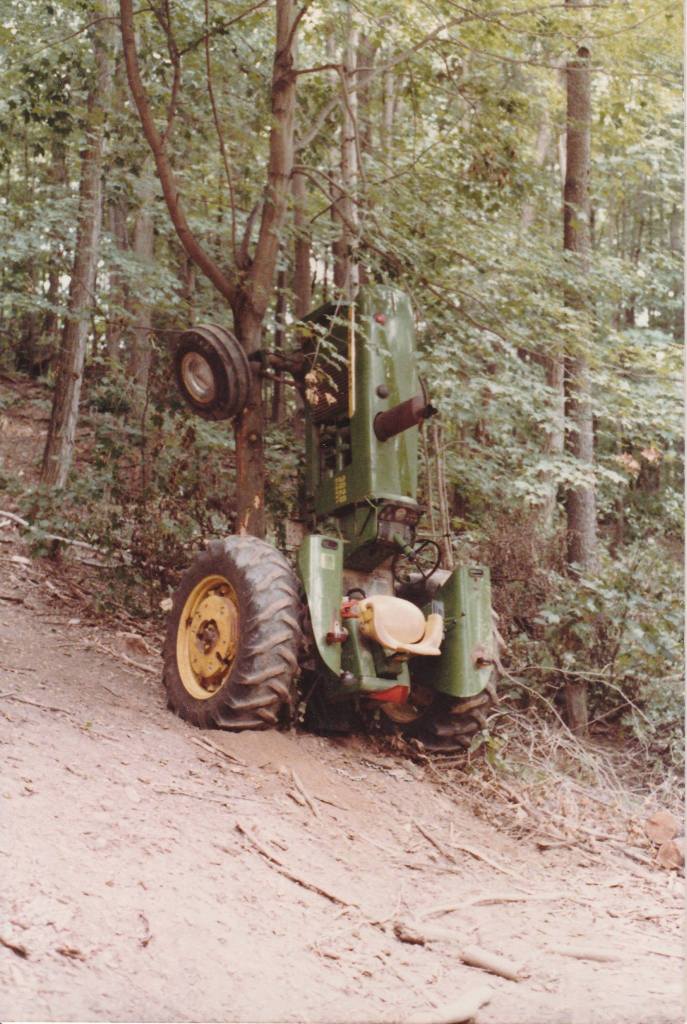
One “one-year-wonder” maintenance guy who thought he knew everything let the John Deere get away from him and he treed it nearly vertical, a hair’s width away from flipping it over backwards and crushing himself to death.

Then, there was the Dodge Power Wagon. Drop that baby into low range and it had power to eat trees and poop potted plants. It had dual wheels in the rear and a hydraulic dump bed that made it the ideal vehicle for bringing milk back from Auburn Dairy, taking loads of trash to the dump, or fetching new canoes from the Grumman factory in Marathon. It had an indestructible clutch and was known to slalom itself through trees in the Highlands. Like, nobody ever noticed? Yeah, right.

Saturdays were made for trips to the town dump. Carter on the kitchen staff loved to swing full garbage bags into the dump bed. It looked exciting enough, other staff would join in and all I had to do was lean on a post and look cool. I’d drive a load to the environmentally sad excuse for a landfill, back up to the edge, and pull the dump lever. Hearing the deposit was like music to my ears. I always will remember the town employee, sitting in his air-conditioned cab, idling his front loader, while looking at porn and sneaking nips of whiskey. He was fired, I’m told, one day when he was so drunk he rolled his loader into the pile.

The Dodge, with its tilt bed, was also useful for staff visits to the Auburn Drive-In Movie Theater on Saturday nights. A bit of bleach and a good scrub down after the dump run and the back of the truck was like new. We’d load it full of mattresses, sleeping bags, snacks, and libations and head out for a well-deserved night out. We’d park in the back row, lift the tilt bed a third of the way, and we had the ideal viewing platform for the larger-than-life movie screen. There was enough room for twenty of us. Many a budding romance began in the back of that Power Wagon.

One Saturday morning, the loading of garbage commenced. Carter looked like an Olympian discus champion. Onlookers and participants began to gather. As I sat back and watched others paint my white picket fence, I noticed one of the new female staff members jogging by, intent on keeping in shape, working up a sweat that was, well, something for me to ogle.

Something stirred. Flittered. You know. Like a prairie dog, I sat up and took notice. A thought like a flash of lightning grabbed my attention. Her name was Cynthia, and she was the new camp nurse.   

The pool this morning was a cool contrast to the heatwave we’ve been experiencing.

I lost count this morning of my laps, which is a rare thing for me to do. Instead of pushing out laps like counting contractions in labor, this morning I was distracted by thoughts of Casowasco and, yesterday, my first Sunday serving two new part time churches in retirement.

Was that three, or four laps?

People were nice, but there wasn’t a familiar face in either group. Everyone welcomed me, the new guy. I don’t feel like I am anything special. Like Lincoln was reported to say, “I can make a brigadier general in five minutes, but its hard to replace a hundred horses.” Forcing myself to be extroverted left me exhausted by the time I returned home.

The people tolerated the new guy. What will keep me coming back, however, is the honesty, is the authenticity, is the genuine love of God and neighbor that I’ve always found in small country churches. What a blessing! What a gift of grace.

The bush hog broke; rather, a blade was bent and needed replacing. My boss, Don, used the front loader to lift it vertical with a chain, giving us access to the naked underside. Smart, I thought. Don really knows what he is doing.

I held steady the giant steel disk on which the blades were attached while Don used a sledgehammer and wedge to pry the disk off the shaft. “You got it?” Don asked me before he gave it another wack. “I got it,” I confirmed as I tightened my grip.

Bam! The disk popped off and dropped to the ground. I was no match; the steel disk probably weighed fifty pounds more than I could lift. Had I been wearing steel toe work shoes, my life would have been radically different, tragic, possibly. The disk landed on top of my foot, split the nail of my big toe, and filled my boot with blood. Don put me in the Dodge and off we sped to the emergency room.

Twelve hours later, I was back at Casowasco, high as a kite on painkillers, my foot wrapped in tape and gauze, in the Nurse’s Quarters trying to make sense of my discharge instructions.  “Let me help you,” Cynthia told me.

“Yes, ma’m.” You can help me all day long!

I spent the next two weeks in her quarters, getting my wound cleaned and dressed, whether I wanted to, or not. I was out on disability, smiling on painkillers, and in the care of the attentive, and very good-looking, camp nurse.

Holy cow was Cynthia ever good to me. Before I could run another load of laundry, we became an item. I have no other explanation, except for God’s wonderful, bountiful, amazing grace. This year, we will be celebrating our fortieth wedding anniversary.

Once I returned back to work, things got a little cool between us. I couldn’t explain why. Perhaps because her dad was a pastor (like my dad) and served the Bishop as the Dean of the Cabinet? Yet, I found Cynthia lovely and gracious, highly intelligent, and personally driven. She had transferred from Ohio Wesleyan to Syracuse University to complete a degree in nursing, which added a whole extra year to her undergraduate. She had more grit than me, I thought to myself. Personally, I liked her pipe smoking dad, her Latin teacher mother (both had served on the Casowasco staff in the 50’s), and her older and younger siblings.

Cynthia’s father, Irving, already had an eye on me. He chaired a conference committee I was on. He ordered a truckload of firewood, which I dutifully delivered and dumped in his back yard in Syracuse. And the staff enjoyed surprising Irv, and his fellow District Superintendents, more than once having a cold one at the Owasco Inn in Moravia after the Bishop had left Casowasco for the night.

During my last year on the Casowasco staff, the summer of 1983, I was headed out for seminary, arriving early for a multi-week orientation for new students. I packed my car and headed for Dayton, Ohio. God was having me turn a new chapter in my life. Little did I know, the one being closed did not include Cynthia. That chapter was just starting to be written. Our relationship, though ebbed and flowed, was just getting started. Thank you, Lord!