6. Dairy Farmers, Bus Drivers, and Don Jordan

Grades three through six were wonderful years, nestled in the rolling hills of the Town of Charlotte, Village of Sinclairville. Summers were filled with sleep outs in pup tents, playing army with toy guns, ramming around town on our banana seat bikes, and raiding neighbor’s gardens. Rows of carrots and onions would mysteriously disappear. Winters were spent sledding East Avenue hill, building snow forts, and playing hockey on the local farm pond with shovels for sticks and figure skates, shoveled clear of snow. We were all too poor to buy hockey skates, sticks, and pucks. No matter, in our minds we were winning the Stanley Cup at least once a week.

My friends, Tommy and Kevin, became masters of building tree forts. Tommy’s dad was the local undertaker in town, proprietor of Jordan’s Funeral Home. On his huge property was a piece of woods, his mother’s garden, dirt piles for us to jump on our bikes, and long driveways to race our skateboards. We scoured the neighborhood to come up with lumber and nails. A refuse door was a golden ticket. It would rest on two boards nailed between two trees, making the perfect platform for fighting off imaginary advancing enemy soldiers.

Oh, we loved to play soldiers. On rainy days we’d play indoors with little green men. Americans always won, exactly as reported by reports from Viet Nam on the CBS evening news with Walter Cronkite. Two of Sinclairville’s sons were sacrificed for our nation’s freedom. Walter and Peter. Two, out of a village of a couple of hundred. Over fifty years later and multiple visits to the Wall, just the thought of these two deaths cause my heart to break.

Walter was a helicopter pilot, Peter was an army infantryman, or so the grapevine reported. Peter’s younger brother was in special Ed class and loved to play around with us kids. We always made a place for him. The effects of Walter and Peter’s deaths weighed heavily on us. Ripples and whispers flowed though church pews and over back picket fences. Pain and grief were palpable, even though we kids had no idea how to respond.

Tommy, Kevin, and I would often lay in wait for Tommy’s dad to return from a call. His black Cadillac hearse would drive up the street and we’d scramble to take our places concealed in the hedges. We parted the bushes just enough to peek out and see his father pull the bagged corpse on the stretcher from the hearse and wheel it into the back door of the funeral parlor. Maybe, we hoped, we’d see an arm flop off the side. One summer day, we planned an ambush. Six pallbearers solemnly carried a casket out the front door, led by a somber preacher. We three suddenly stood up and raked the bereaved family, pallbearers, and corpse with our toy machine guns. Mrs. Nickerson, the family’s hired doorkeeper grabbed us by the nape of the neck and promptly removed us from the premises. Dinner that evening was eaten in shame and silence.

My third grade teacher, Mrs. Thompson, was a wonderful teacher and member of Dad’s congregation. She was married to a hard-working dairy farmer. Our bus driver, Ken Scott, bus 59, was also a dairy farmer. His callous hand laid out punishment to anyone who disrupted the silence or respectability of his bus.

When hunting season opened in November, senior high kids would carry their loaded shot guns to the bus stop. Because, well. You never knew when you’d see a twelve-point buck. The chamber would be emptied and the gun handed over to Ken for safe keeping until getting off the afternoon bus run. Not certain of the success of this innocent strategy, but it certainly reflected the culture and values of rural, western New York.

As I think about it, guns were part of the fabric of the community. Kevin had a beebee gun and a shooting range set up in his basement. My dad had a secret shotgun hidden in the stairwell that we all knew about. My sister’s boyfriend, Larry, had a gun until he shot out a neighbors basement window and his father took it away from him. His dad was a B-24 pilot shot down over the Polesti Oil Fields and held as a POW in a German camp until liberated. He kept a secret German Lugar in his attic, whose mysterious story us kids could only imagine.

The point was never about guns. Values came from the people, neighbors, all dirt poor, working farmers, teachers, undertakers, and bus drivers who genuinely cared for their neighbors. They coached the little league teams and responded to calls as members of the volunteer fire department. They bought ten cent Cokes from Kenny’s barbershop and drank them around the wood stove in front of Peterson’s Agway. We worshiped together, either in the Baptist, Catholic, or Dad’s United Methodist churches. We laughed, loved, and mourned together as neighbors, as friends, as God’s beloved community.

The Beloved Community; where all are loved. All are cared for. All are valued. All supported and supporting each other.

Good information about God’s Kingdom, even for an elementary school kid.
5. Discipline, Honor, Integrity and Herb Larson

The mechanical linkage groaned, then clinked, as my dad downshifted into second gear then released the clutch. We were driving a U-Haul, one of many rentals during my youth, pulling into the town of my father’s next pastoral appointment. In that time and in that era the Bishops of the United Methodist Church believed in frequent itinerancy, historically rooted in early American circuit riders, riding horseback from town to town, visiting newly planted lay-led churches, bringing Holy Communion, whether the people wanted it or not. Moving preachers around tall steeples with associated compensation packages was an effective carrot and stick approach to supervision, families be damned.

Up the hill dad drove into town; his new church building up ahead on the right, nestled across from the village park. A towering crane was planted in the front yard, its telescopic reach extended, holding taut cables lashed to the church bell that was being removed before it fell on its own accord. A raging tornado drove through town six weeks earlier, leaving indiscriminate destruction in its wake. It lifted and rotated the church building off its foundation, removed the roof into the next zip code, and flung church pews far and wide, as if they were seeds and it was spring planting. Our first parsonage was in equally bad shape.

The prior pastor, Roger B. Smith, skilled in construction, was arranged to remain for a time to assist my father, who knew equally well how to swing a hammer, to get the church, parsonage, and village back into livable shape. It was the beginning of a life-long friendship, rooted in mutual respect, love of neighbor, and the success of a shared mission. Values I drank in and never forgot. Roger went on to become a prison chaplain at Attica.    

Sinclairville was a blessed appointment for my father and our family. The church afforded him time to complete his undergraduate degree to prepare for seminary. My Sunday school teacher was the local bank vice-president, Herb Larson. He also played the organ and led the choir. When the basement flooded, he donned rubbers over his wingtips and squeegeed water dressed in his 3-piece suite just like the overall clad farmer and ever-smiling postmaster. Moses and the bull rushes. Jesus turning water into wine. Saul blinded on the road to Damascus. I may not remember the sermon I just (masterly) delivered, but those foundational Bible stories taught to me my Mr. Larson were deeply implanted in my DNA.  Full stop, impressive.

Laps in the pool this morning were mindless. I had to share a lane, so my stroke selection was limited to crawl and breast. No dogging it with elementary back. No time to think. E-gads, I am selfish. Privileged, too. I had to rely upon the memories of last week’s laps to complete my memories.

Billy Glass was a NFL footballer who played for the Cleveland Browns. When the league went to Sunday games, he quit because Sunday was the day of resurrection, Christianity’s day of rest, our Sabbath. He wasn’t going to work on Sundays so he became a charismatic evangelist leading a traveling salvation show. He came to Jamestown and my father said we had to go. Pick up the babies and grab the old ladies, Neil Dimond sang. Tears filled my eyes as I responded to Billy’s emotional pleas to come down the aisle and dedicate my life to Christ. I was already Baptized, but this was my first personal claim. He touched me and made me whole.

Third grade began with me seated across the table from Celia and Kimberly, two of the most beautiful girls I ever set eyes upon. Coach Asquith caught my friend Scott peeing in the shower, so he made him stay after school to deep clean and disinfect the shower and locker room. Band instruments were assigned and there weren’t enough French horns to go around, so I left wanting. My older sister was dating the mayor’s son and I caught them necking on the living room sofa. I told Larry to “Cut that out, otherwise you’re going to get my sister pregnant.” Day hauled me into his office and told me about tadpoles swimming upstream. What?

H. Ray Harris was a retired widower who was kind enough to stop by every three months to celebrate Holy Communion for my father’s church. Mom always hosted a big Sunday dinner afterwards. Roast beef. Mashed potatoes. The whole nine yards.

His God son, Jeff, came one Sunday. He was a college student preparing for parish ministry, assigned to a tiny church in South Dayton. I was to go with him, I guess, to broaden my experience. He unlocked the church door and I set about to explore the place. I walked right up behind the pulpit, peered over the top (remember, I was a third grader) and could see in my mind’s eye a crowd of thousands waiting for me to proclaim the Gospel. The call was stirring.

Sinclairville had two Little League teams, farm teams we called them, and I was the catcher for team 2. Original name, don’t you think? I was the biggest kid on the team, so who better to guard the plate? I loved to talk smack to batters to distract them. After one game, as we were lined up to shake hands, another kid gave me a shove. I shoved back. Dad wasn’t there, so, so what? I smashed into him and began to trade punches, leading to an all out may lay. Everyone choose a partner. Arms and legs intertwined. Snot and blood. Howls and grunts. Coach pulled us apart, and I thought I caught an approving smile.

Emboldened with confidence, we set about to the next days practice. Our two hometown teams practiced on adjoining baseball diamonds. Before the coaches arrived we started yelling smack to the other team. Both teams came together and I faced off with the other team’s catcher. We punched, grappled, and wrestled each other to the ground. The crowd swelled and began to cheer. I pinned him to the ground with my knees on his shoulders. His face was without defense. As I lifted my right arm to give the fatal blow, I felt something. A pause. A thought. If I wasn’t careful, I could kill him. I stopped myself. Discipline. Honor. Integrity was at stake. I let him up. I never struck anyone else ever again. God saved me, when I was unable to save myself. Violence was not my calling. God had different plans.

4. A Smidge of Grey

Though abiding in the house on Harding Avenue for one year, there was another wrinkle in the time / space continuum. First-grade worked my brain hard, in search of comprehension, understanding, acceptance, values, and faith.

I woke from sleep late at night, darkness enveloping me. Daring to only open a slit between eyelids, less I be discovered, I stole a glance at my bedroom door. It began to open. No. It wasn’t the wind. It wasn’t the unseen hand of a sibling playing a trick on me. My eldest brother, Steve was already in college. Bryan and Cindy, well, they were doing what all junior high kids were doing at four in the morning; sleeping.

The door opened, making no sound, not even a creak in the ancient iron hinges. The space beyond, newly revealed, appeared to be misty, white, with a smudge of grey, floating, as if supernaturally given life. My stare was returned with silence. It was a standoff. Stalemate. Like kissing my sister, boxers butting heads before parting, a tied homecoming game.

At that time, in that place, it was just my Creator and me. The only option available was running away bravely. I did.

Aunt Thelma was dead. Fallen down her cellar staircase. Mother said it was no wonder, consider all the prescription medications she was taking. Apparently, she liked to doctor shop. Remember, this was the late 1960s. Coca-Cola probably was still manufactured with cocaine.

Uncle Toad (his real name was Cloyde) and Aunt Thelma lived in the central Pennsylvania burrow of Lewistown. Dad’s older brother, Toad was the surrogate father of a family abandoned by a two-bit moonshiner and a piss-poor bottler of home-made beer. It’s told when the August heat endured long, dozens of cases of homemade beer hidden in the attic blew their tops, soaking the house and home with the sticky, smelly aroma of yeast and hops.

So much for cover and concealment, gramps. Idiot. No wonder my grandmother kicked him out.

It didn’t matter; Toad was doing a fine job raising his brothers and sisters all by himself: John, Buck (Charles, my dad), Ann (Ann-a-Mary to us kids), Elsie, and Don.

We traveled as a family from Jamestown, NY to Lewistown, PA in dad’s Mercury Comet to take part in mourning Aunt Thelma’s death. Family time in the car. Nothing like it. There is a whole culture, faith, ethnicity, gender, family thing about death and grief.

Pennsylvania Dutch, we proudly self-identified. We were German, descendant Lutherans. Stoic. Hard working. Honest. I was a first-grader, a sponge, my developing brain soaking it all in.

Our family didn’t soften the blow. No sugar coating. Aunt Thelma was dead. Not passing over. Not just passed. Dead as the woodchuck bloating on the side of the road.

I’d heard about corpses but had never seen one. There she was, dressed nicely with more makeup than an amateur’s attempt to decorate a cake. Fingers, gaunt, pale, drawn. Eyes and mouth closed. I looked carefully from behind my mother’s skirt to see if there was any evidence of breathing. Nothing. Everything appeared as if Aunt Thelma was sleeping; except, she was in a box! A highly polished, very expensive looking box, with a hinged double door. (Did I mention she wasn’t breathing?) What in the?

Now, there’s something you don’t see everyday.

That night, right before going to bed, a guest in the home of a family friend, I spied the doorknob to the unseen attic, watching for the first sign of movement. Aunt Thelma was right behind that door; I just knew it. Aunt Thelma was gone, but not quite; absent, yet remembered; mortal, yet eternal, home with God.

Uncle Toad wept at her grave, his whole body rhythmically convulsing, hands rubbing his bald head. I cried, too; hurt for my father’s brother, his pain, suffering, and uncertainty about the future. Shared pain. Family love. Assurance of eternal life, spoken by the Lutheran pastor. That is what got us through.

Values matter.

I didn’t want to swim this morning. I stayed up too late. I near-napped through my morning meeting, eyes heavy, the coffee not nearly strong enough for my liking. The pool was quiet, the water cool. The Beatles played for the water aerobic class in the adjacent outdoor pool. One of the overhead lights flickered, apparent to only those of us swimmers choosing some variation of backstroke. Good thing I don’t have a seizure condition. The final lap brought relief, and a smile from Abe in the next lane over.

As my arms pulled through the water, I thought of death, or near-death experience from Harding Avenue.

My sister, Cindy, played the flute. At least, that was the instrument she was learning to play at Lincoln Junior High. An end-of-the-year, outdoor, band concert was scheduled and families and music boosters were invited to attend. Dad wheeled the Mercury Comet into a parking spot on the brick paved street, and we, as a family, headed out to the chairs the school district had set up for us. A perfect, or near-perfect, June day. 1967.  

The sun was bright.

Wait. I had a pair of sunglasses in the car, in the glovebox. Without asking permission, more like a first-grader’s spasm, I ran across the lawn back to the car, paused at the street, remember looking left, then right. Thinking to myself the car, stage right, was sufficiently distant to facilitate my crossing, I bound into its path. Thirty miles an hour of bumper and grill slammed me into the curb. My world went black.

Nothing. No time. No space. Nothing. Like the plug had been pulled and the TV abruptly turns silent and black. All that was missing was a box.

Concussion separated me from time and space. I heard the quiet beating of my heart in my ear. An eye opened, just enough to jumpstart another of my missing senses. The world was silent and white, blurry with a smell of sterility, glass paneled, metal cabinets overtop a stainless-steel counter. Where was I? What happened? How long have I been out?

In walked man and woman, each focused on their own agenda, their own task at hand. White. His face was covered, her face was not. Murmurs. A glance. A smile, warm and kind. Look! He is alive! My mother appeared, held my hand, gathered me into her arms. Before I knew it, I was home in my own bed. Fifty-seven years later, the bump on the back of my head is a daily reminder of my own mortality, the closeness of sudden death, the seemingly inconsequential, random acts of life.  

The moment matters. This moment matters. Death. Nothing. Followed by life, a gift, a welcome into a divine abode, abundant love, amazing grace.

God wasn’t done with me. Heck, I hadn’t hardly finished the first grade. God had plans.

3. Epiclesis

Shit was about to get real, as they say. Dad sold his Sears and Roebuck kit house, assembled with the help of mom’s brothers, bought a house in town, and enrolled full-time at the local State University teacher’s college. His call to parish ministry, started at age 19 in the South Pacific. His call was about to pull out of the station at age 42 and begin its journey from college, to seminary, and ordination. Little did he know. Little did I know.

“Part-time, student pastors” we call them back in the day. Put a Bible in their hand, the love of Jesus in their heart, give them a blessing, frame a certificate autographed by the bishop, commission them good to go, and send them out to save the world.

Open Meadows not only defined the local geography but served also as the name of the small country church overlooking Chautauqua Lake. It was surrounded by, you guessed it, open meadows of wheat as far as the eye could see.

Dad had just delivered one of his earlier, unvarnished sermons about the wind of the Spirit; no one knows from whence it comes or where it goes (John 3:8). I sat in the tiny sanctuary, looking at the hole in the wall from an errant hunter’s shotgun slug, thinking about deer hunters, the wind, and the Spirit of God. I was six years old, the summer before entering first grade.

As I walked out the front doors of the church, I stood on the concrete stoop, enclosed by a wrought iron railing, the kind my father used to make, flanked by descending stairs, left and right. I saw the gentle, wave-like movement of mature wheat in the fields surrounding the church. Sun warmed my cheek.

The Spirit was moving. I felt the wind, and I was there to experience it. God with me. God calling me.

Laps. I’m swimming laps, as I have, off and on throughout my life. I love to swim, I just hate the drudgery of it all. Ultimately, I’m lazy. And a glutton. More the better, except when it comes to exercise. Going to the pool. Anticipation, which leads to anxiety. Lately, I’ve been trying to find motivation by imagining the luxury of the hot show waiting for me after I’m done. 15 laps. That’s all. Olympic swimmers can do that in minutes. It takes me half an hour. Instead of thinking about how much I have to go, I’m trying to mourn the laps that have passed, never, ever, to be swum again.

Today, I hit the water and punched “play.” Memories of first grade in that new house in Jamestown flooded back. 603 Harding Avenue, corner of Harding and Steward, right behind Fairmont Elementary School, just up the hill from the local corner store.

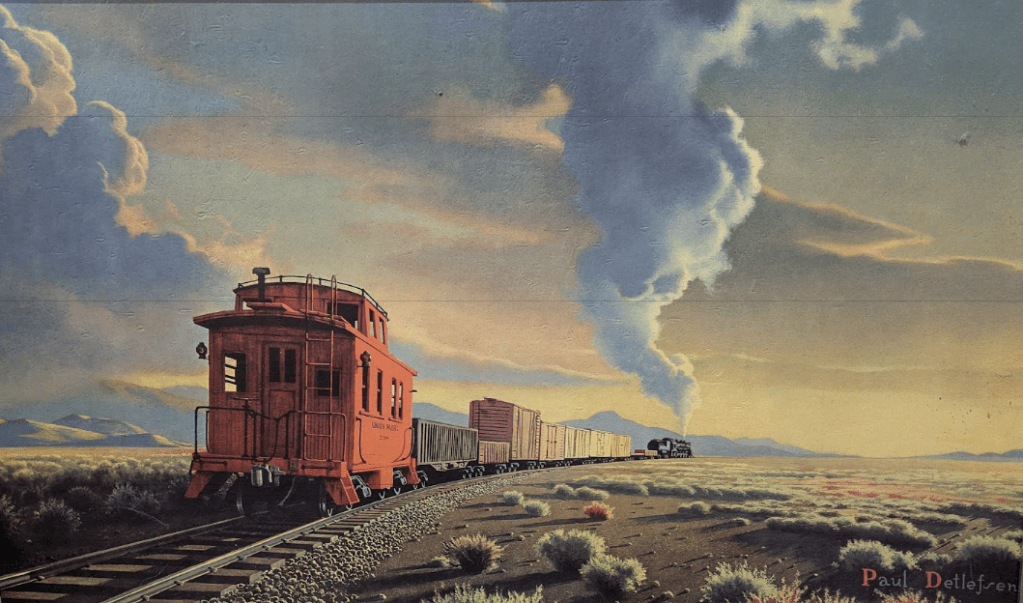
Prior owners of the house left a print on the living room wall, after they observed me spying it on a pre-purchase walk through. Paul Detlefsen, painter. The Big Red Caboose. Trains. Now we are talking. I loved trains, not the toys, the real deal. High horsepower. I’ve loved trains ever since Uncle Toad took me as a child down to the local yard to watch the Pennsylvania drill cars. That print has been with me ever since, much to my wife’s chagrins. The painting connects me to that house.

Neighbor. His name was Mike. We were both in the same grade. An Italian family. His dad made wine in their basement. Forbidden fruit, but, um, mmm, good. The house had a great back yard, where all the neighborhood kids played. We laughed, learned, and played tricks on one another. I learned to ride a bike on the brick surfaced neighborhood street.

The joy of bike riding was tempered by humiliation. I shit my pants trying to get to the bathroom in time. The stupid “Stop/Go” sign hanging from the bathroom door knob cost me that crucial extra half-second. When I got home from school, mom made me stand in the shower and wash out my own cloths. Thankfully, I was only at Fairmont for one year.

I kicked a hole in the wall in anger at my brother for not letting me return empty pop bottles, cashing them in for ice pops. “Just wait until dad gets home,” he grinned, knowing the licking that was in store for me. Mom got home and said, “Just wait until your father gets home.” Great. Like mother, like son. Waiting was torture.

Dad got home and we ate in silence. Bucky was good at the silence. After dinner he pulled the belt off his pants, bent my bare ass over his lap, and released his anger on my backside. I remember looking over my left shoulder, seeing my mother doing the dishes, pleading, “Now Bucky, don’t hurt the boy.” Thanks mom, for throwing me a solid.

The house, however, wasn’t about my failures, punishment, or humiliation. The kitchen was where I first celebrated Holy Communion, at the age of six. I walked home from school, got out from the refrigerator some of Welch’s grape juice and a loaf of bread, and went about celebrating Holy Communion, just as visiting Elders had done for my father at Open Meadows United Methodist Church once every three months. My brother, entered stage left, fresh home from Lincoln Junior High, asked, “What are you doing?” I told him.

“You can’t do that,” he replied.

Why? You just can’t, that’s why.

Well, I did. I had done it. What God has done, can not be undone. Like baptism. Like Holy Communion. I felt the wind of the Spirit and the warmth of the sun. God affirmed what I had done. God was calling. I didn’t know what or where. But, even at the age of six. I knew God’s sight was on me. God had plans. I just had to figure them out.

In time. All things, in due time.

2. “From Whence I Came – Tears of a Birthing Mother”

Tail-end. If ever there was a term to define my genesis, it would be tail-end. The last, unlucky jet scheduled to deliver ordinance, allowing the opposed to accurately direct their fire. The slowest runner in gym class. The fourth of four children to be born to Bucky and Alice, my father and mother destined to die.

Bucky, my dad’s childhood nickname, was born and raised a good Lutheran in central Pennsylvania, signed up for the Navy after Pearl Harbor, and served horrific years as a medic, Pharmacist Mate, third class. A nineteen-year-old kid recovering the corpses of 19-year-old battlefield casualties, shipping them home to suffering and bereaved families. First to France, then to the South Pacific, the hand of God delayed his landing at Iwo Jima in the first wave. When kamikaze planes broke a nearby warship at Leyte Gulf taking all hands with it, Dad made a foxhole promise to God that he would give his life to ministry, if allowed to survive. Alcohol abuse suppressed his demons and lent excuses to his delaying tactics.

Alice was born to a large family, but never lived to see her father, who died of Typhus while working timber. My grandmother tried to make ends meet, selling bread to the people in Lewistown, PA, but when the great depression hit, like a rising tide, the family was swept away. Mom found herself a resident of Malta Home, operated by the Knights of Malta, an orphanage, self-sustaining farm, and old age home for the poor. Children worked. Mom scrubbed. She ran away at age 17, where my uncle Dick took her in. Uncle Dick stood firm in the doorway as two, PA State Troopers demanded Alice’s return. “Over my dead body.” It just wasn’t worth it.

Alice, meet Bucky. Bucky goes to war, returns broken, unenumerable memories of death, and fueled with alcohol. The story goes that Alice told Bucky that if he ever again landed a hand on her in anger, they were done. Done. Fine’. Nada a second chance. Mom would and could make it on her own. She could, too. Dad swore off the booze, or so we thought, the demons suppressed, and life became the Shangri la of the baby boomer generation.

Dad welded for a living, taking night classes to become an accountant. The Saint Louis Arch, Navy submarine hulls, and neighborhood porch railing  were the achievements of his calloused hands. My siblings arrived by C-section, all three, the last with the obstetrician’s warning that a fourth pregnancy would lead to her death. Anger reared its head, and my older brothers paid the price. Bucky’s promise to mom diverted, his promise to God delayed.

My mother became pregnant with me, and prepared herself to die, willingly accepting her fate that I might live. Willing to die that I might live. Familiar? She cried throughout my entire pregnancy, I’m told. Despite the obstetrician’s willingness to abort the tail-end Charlie, and the obscure state lines (with all their legal complications) I was born of Caesarian section in June, 1961, riding the final wave of the Baby Boomers. Tubes tied. A tic-tack-toe board of abdominal scars, my mother lived to die another day.

I may be a tail-end Charlie, but I’m a walking, talking, breathing miracle to be alive.

Dad had gotten a hold of a Methodist Book of Discipline during his service years, liked what he read, and was willing to be swept into the ocean of God’s amazing grace as taught by John Wesley. I was made a disciple of Jesus as an infant upon the baptismal vows promise by mom and dad at the Stillwater Evangelical United Brethren church, outside of Jamestown, NY. The cold water induced audible farts, I’ve been told.

Our family attended the Camp Street Methodist Church in town, becoming the United Methodist Church in the great merger of 1968. Yeah, the same year the Tet Offensive turned society upside down, when MLKing and Bobby Kennedy were shot. Camp Street hosted a wonderful Vacation Bible School; songs taught to me then bring comfort to me today. The pastor was Harold K. Guiser.

As a toddler I recall walking down the hall past his study. I looked in to see him in his black robe preparing for worship. God-like. Vitalis slicked back hair. Black, winged-tipped dressed shoes. The real deal. He saw me standing there, eyes unblinking. “Would you like a Bible,” he asked, calling me by name. I still have that New Testament and Psalms right by my side.

Reverend Guiser towered in the pulpit. He caught my attention one Sunday, even as I squirmed in the pew. “We all face a fork in the road,” he stated to a complacent congregation sitting in silence. I thought of my mother’s sterling four prong forks. “Each of us must choose,” he said. I thought to myself, I want to be on the winning team! I chose Jesus.

Choices. Choices matter. My choice was to go with Jesus.