
Mark 13:24-37
December 3, 2023
The Rev. Todd R. Goddard, Pastor
Rush United Methodist Church
“But in those days, after that suffering,
the sun will be darkened,
and the moon will not give its light,
and the stars will be falling from heaven,
and the powers in the heavens will be shaken.
Then they will see ‘the Son of Man coming in clouds’ with great power and glory. Then he will send out the angels, and gather his elect from the four winds, from the ends of the earth to the ends of heaven.
“From the fig tree learn its lesson: as soon as its branch becomes tender and puts forth its leaves, you know that summer is near. So also, when you see these things taking place, you know that he is near, at the very gates. Truly I tell you, this generation will not pass away until all these things have taken place. Heaven and earth will pass away, but my words will not pass away.
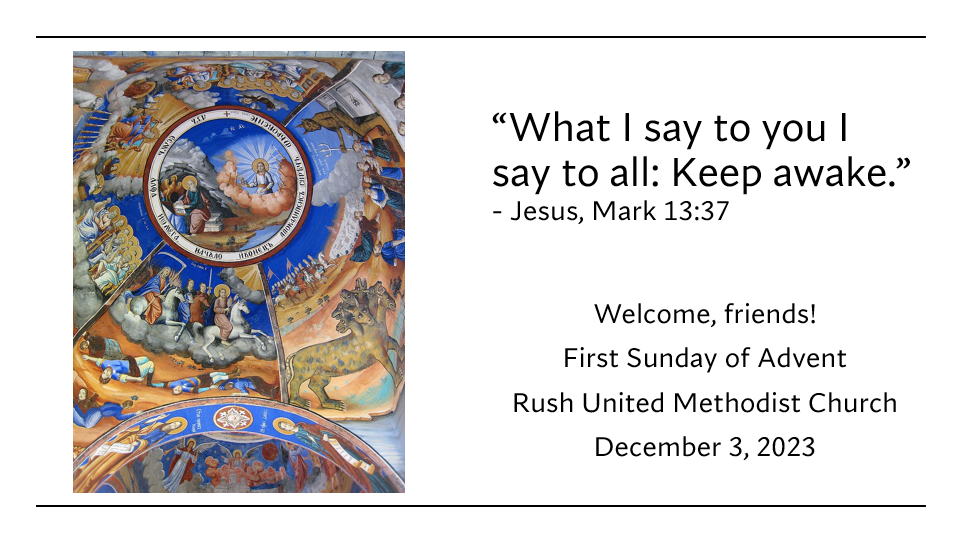
“But about that day or hour no one knows, neither the angels in heaven, nor the Son, but only the Father. Beware, keep alert; for you do not know when the time will come. It is like a man going on a journey, when he leaves home and puts his slaves in charge, each with his work, and commands the doorkeeper to be on the watch. Therefore, keep awake—for you do not know when the master of the house will come, in the evening, or at midnight, or at cockcrow, or at dawn, or else he may find you asleep when he comes suddenly. And what I say to you I say to all: Keep awake.”
| Centering Prayer |
Our gospel lesson for today from St. Mark
is a part of a chapter
that is very different from the rest of the book.
Up to the thirteenth chapter of Mark
the narrative has to do with the life and teachings of Jesus.
Following this chapter,
the narrative takes a turn toward Jerusalem,
taking the audience through the passion, death, and resurrection of Christ.
However this thirteenth chapter
sticks out like an underfed Thanksgiving turkey or
a reindeer with a red nose.
It is as if
Jesus underwent a complete change of personality.
Instead of preaching, teaching or healing,
Jesus begins to foretell the future,
specifically about the coming of the Son of Man.
He starts to prophecies:
making predictions about future events based upon current realities.
Biblical scholars have identified
the characteristics of this chapter as “apocalyptic,”
a common style and message that is found
in both Jewish and early Christian history.
Indeed, similar words and phrases can be found in the Old Testament book of Deuteronomy, Daniel, Ezekiel, and Isaiah,
as well as in the New Testament book of Revelations.
The common apocalyptic theme revolves around
The culmination of history,
An end time,
When all is revealed,
The Son of Man returns, and
God’s judgment is proclaimed.
In every case, apocalyptic scripture is authored
at a time of crisis or historical stress.
In the Old Testament
some of it was written during the time of Exile,
when people were taken from their land,
farms and houses were destroyed,
families where separated,
war, hunger, and starvation were widespread, and
people were taken hostage to a foreign land.
Sounds painfully familiar.
The Old Testament time of Exile was one where prophets looked at the social fabric,
connected the crisis of the community with unfaithfulness to God’s Laws, and,
on God’s behalf, proclaimed judgment upon the people.
In the New Testament,
apocalyptic writers borrowed from their Jewish roots
when their Christian community faced persecution and death
at the hand of the Romans.
Christians were hunted,
captured,
fed to the lions,
boiled in oil, and
crucified upside down before mass crowds.
Believe it.
Before the Roman emperor Constantine was converted
and brought with him the empire in 322 A.D.,
there were some truly dark days for Christianity,
marked by torture and martyrdom.
Apocalyptic sprang forth in these crisis environments
like ice cold water from a mountain stream.
“Parousia” became the key desire.
Parousia means “the coming, to become present, God present with us.”
Christians facing martyrdom
prayed fervently for Parousia,
for Jesus to come and to free them from persecution.
Expectations were high:
Come, Jesus come!
Kick out the oppressors and
rise up the oppressed into a new kingdom
– on earth as it is in heaven –
where peace, love, and justice will reign.
It was this context
in which our gospel author was writing.
In today’s world,
Apocalyptic could only find agency
In a Hamas tunnel or a Ukrainian trench.
The thirteenth chapter of St. Mark’s gospel
was written in the midst of deadly persecution
to a people facing violence and death at every turn,
because of their faith,
their choice to become a disciple of Jesus Christ.
Antiochus IV, and his legions of Roman soldiers,
were tightening down the civil strife and unrest
that engulfed Judea in the second half of the first century.
It is in this context that Mark recalls from the oral tradition
Jesus’ answer to the disciple’s questions:
when? and
what will be the signs?
I understand Jesus to be
anticipating the needs of all those who would, and will, suffer for him.
Jesus was not only speaking to his disciples,
But he is also speaking to the members of the first century church, and
to you and me today.
Jesus will return and
God’s kingdom will be established
after the temple is destroyed,
after much suffering, and
after many cosmic disruptions:
the sun and moon will darken,
the stars will fall, and
the heavens will be shaken.
Then the event will take place,
the Son of Man will come,
not like MacArthur landing on a beach,
but from a cloud,
with power and majesty.
Justice will be executed and
the elect will come from everywhere to join him.
But when will this be?
(I’d like to know,
You know,
So I can plan accordingly)
Jesus clearly tells his disciples that
it can happen at any time.
Just like a budding fig tree is a sign
of the end of the rainy season in Palestine and the start of the hot summer,
so too will there be signs of his coming.
Only God knows exactly when.
If everyone knew, well, then
no one would have to keep watch.
No one would have to act
with a sense of imminence and urgency.
The early church acted with a sense of imminence and urgency
Unlike any time before or since.
That first century church took the Gospel and shared it,
as if there was no tomorrow,
because they believed there wasn’t.
They made it their imminent concern
to spread faith in Jesus Christ
– his redemption and salvation –
to all four corners of the globe.
Success was most pronounced in places of
crisis and persecution.
“If Jesus planned on gathering his elect,
then we should try to make as many people his elect
as quickly as we can,” or so it was reasoned.
When they talked about saving people to Jesus Christ,
they actually meant it.
For only the elect, the chosen, the few, the faithful
would be gathered and saved.
As time went on and no big event took place,
no flashy Parousia occurred,
the church faced a crisis of faith.
Theologians returned to the drawing board.
Either Jesus wasn’t coming, or
he is coming in some other fashion than a global consuming apocalyptic event.
After 2,000 years,
With few exceptions,
the church (and I) have stopped waiting
for a literal, big time event.
Yes, there are still a few,
mainly from conservative fundamentalist backgrounds who are still in crisis,
who still wait,
who still calculate the coming of the Lord,
who run the numbers and roll the dice.
But for the large part,
the end has been rethought.
As for me and my house,
The end has come, and is yet coming.
This message of Jesus
is something that has obtained greater clarity with
notable life events and
with the passing of time.
For me,
after prayer, biblical study, and a lifetime of spiritual development,
the coming of Jesus is an event that occurs
when we surrender our will to God’s will,
when we receive the forgiveness of our sins,
and when we claim Christ’s salvation as our own.
The Holy Spirit fills us in our salvation.
The death of this mortal body
Ceases to be a life-and-death struggle or apocalyptical crisis.
Death becomes an occasion for celebration.
The struggle and pain of this mortal life is ended.
The final journey is complete.
Christ has come, we say.
Christ is come.
Christ will come again.
But, for many,
the coming of Jesus is an event that occurs at the onset of death.
No one knows when death comes,
not even the death-row felon.
It can be as quick as the next heartbeat or
as long as the slow 2 to 20 year progression of Alzheimer’s disease.
Death can be at our doorstep with the change of a traffic light or
Death can wait for over a hundred years.
When death comes,
and I can assure you it will for each of us,
that is when our Lord will come.
How or why, I don’t know.
I only know that it takes faith to believe;
faith in the assurance of Jesus when he said,
“Lo, I will be with you always.”
Christ will come to judge the quick and the dead.
Until that time comes,
we are told to keep watch,
to actively wait,
to act with the same sense of imminence and urgency
that empowered the early church.
This is the message that is ours this day.
This is the value of the biblical apocalyptic for our church 2,000 years later.
This is the value of apocalyptic, for your faith and mine.
Advent is the time of watching,
of waiting expectantly,
for the coming of Jesus.
The past narratives of the annunciation, conception, and birth of Jesus,
the writings of the Old Testament prophets, and
the proclamation of John the Baptist in the wilderness
all become the living sign and symbol
of the Christ that is certain to come.
We are called
to carry out our Christian commission to make disciples of all the earth,
baptizing in the name of the Father, Son, and Holy Ghost,
We are called
to spread the Good News of the Gospel of Jesus Christ – to love our God and our neighbors – as if there is no tomorrow,
because there may not be.
Jesus has given to us this sense of urgency.
Watch.
Wait.
The time is coming.
It is coming soon.
Be prepared.
Prepare others.
Prepare the world for the coming of the Lord.
The good thing about urgency
is that it makes one put life into perspective.
Priorities have to be made.
If something just isn’t important enough, it doesn’t get done.
There is just enough time to get done everything that needs done,
So don’t become distracted by the irrelevant.
Disregard the unimportant.
When our priorities get out of alignment,
we lose the sense of urgency,
of the imminence of Christ, and
we fall deaf to this morning’s Gospel message.
To a large extent this church,
and every church,
has lost some of its sense of urgency.
The maintenance of the building becomes more important than
Filling our pews or growing our Sunday School.
The pastor’s popularity becomes more important
than winning people to Jesus Christ.
Restructuring of the institutional framework becomes more important
than creating disciple making ambassadors and placing them into the mission field.
It is easy to forget that
Each of us is a hair’s breadth away from disability, coma, or death.
It is easy to slow down and become complacent with the status quo.
With a loss of inertia and momentum
It quickly becomes too much effort to change and grow.
But scriptures tell us this morning that
this is no time to be complacent.
- There is no time to kick back and relax.
- There is no time to allow negative or pessimistic attitudes to keep us from moving forward.
- There is no cost that is too big to keep us from completing the will of God for us and for our lives.
- There is no time to be held back for a lack of committed people. The Lord has you and me.
- There is no time to toil over figures which add up to defeat or failure.
Lean into Christ.
Together we make three.
There is a majority the general population who are unchurched,
who need to be made disciples of Jesus and baptized by his Spirit.
What does apocalyptic mean for us today?
It means that
we are called to recapture the zeal and vitality that was once ours,
both here (at Rush) and for the church around the world.
This apocalyptic urgency is a gift to us,
to you and me and our church.
It is a gift from God.
It is one of God’s many ways to inspire us,
to cheer us on,
that we might thrive and grow into the future.
Leave here today with a sense of urgency in everything you do.
Open yourself and allow yourself to be filled with the Holy Spirit.
Watch and listen for what God is calling you to do.
Pray.
Listen.
Discern.
Then do what God wants you to do.
Do it with excellence.
Do it with a sense of urgency.
That is the only way to keep watch!
Behold, the Lord is closer than you think,
even behind the next door.
The word of our Lord.
Thanks be to God.
Amen.
 Breaking Yokes