
Matthew 15:10-28
August 20, 2023
the Rev. Todd R. Goddard, Pastor
Rush United Methodist Church
Matthew 15:10-28
Then he called the crowd to him and said to them, “Listen and understand: it is not what goes into the mouth that defiles a person, but it is what comes out of the mouth that defiles.”
Then the disciples approached and said to him, “Do you know that the Pharisees took offense when they heard what you said?”
He answered, “Every plant that my heavenly Father has not planted will be uprooted. Let them alone; they are blind guides of the blind. And if one blind person guides another, both will fall into a pit.”
But Peter said to him, “Explain this parable to us.”
Then he said, “Are you also still without understanding? Do you not see that whatever goes into the mouth enters the stomach, and goes out into the sewer? But what comes out of the mouth proceeds from the heart, and this is what defiles. For out of the heart come evil intentions, murder, adultery, fornication, theft, false witness, slander. These are what defile a person, but to eat with unwashed hands does not defile.”
Jesus left that place and went away to the district of Tyre and Sidon.
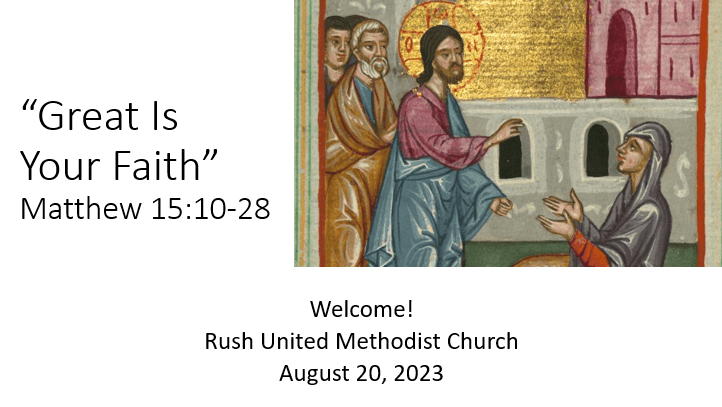
Just then a Canaanite woman from that region came out and started shouting, “Have mercy on me, Lord, Son of David; my daughter is tormented by a demon.”
But he did not answer her at all.
And his disciples came and urged him, saying, “Send her away, for she keeps shouting after us.”
He answered, “I was sent only to the lost sheep of the house of Israel.”
But she came and knelt before him, saying, “Lord, help me.”
He answered, “It is not fair to take the children’s food and throw it to the dogs.”
She said, “Yes, Lord, yet even the dogs eat the crumbs that fall from their masters’ table.”
Then Jesus answered her, “Woman, great is your faith! Let it be done for you as you wish.”
And her daughter was healed instantly.
| Centering Prayer |
Our Gospel lesson for this morning is quite remarkable.
It flies in the face of over a thousand years of Church doctrine.
It is this very inconsistency,
between the Biblical Word and Church doctrine,
that makes us squirm uncomfortably in our seats
when we experience the fullness of this passage
spoken and left to hang in our midst.
The fourth verse of the hymn, “Jesus Is All the World to Me”
helps define the issue.
It goes,
“Jesus is all the world to me, I want no better friend; I trust him now, I’ll trust him when life’s fleeting days shall end …” (Will Thompson, 1904, The United Methodist Hymnal, No. 469).
Our trust in Jesus doesn’t waver,
and it shouldn’t.
Our trust in Jesus is predicated upon the assumption
that Jesus never changes.
Jesus is the constant
in our relationship with the Divine.
That unchanging nature of Jesus brings us comfort, at times.
Though life might toss you about
and lead you down numerous valleys of the shadow of death,
the one thing that remains constant is Christ.
If all else fails us in life,
at least the one thing we can count on
is that Jesus will remain the same.
He is the same today as He was yesterday,
as He will be tomorrow.
The Jesus we received as a child,
is the same Jesus
that I will leave with my children.
Of this we are assured!
This unchanging nature of Christ
sent me rummaging through my old textbooks from seminary.
I searched the tried and true systematic theology
titled “Principles of Christian Theology,”
by John Macquarrie.
In his section The Person of Jesus Christ,
I found what I was after.
He writes
“The core of traditional Christology is, of course, the two-nature doctrine of the Chalcedonian definition, which speaks of one and the same Christ, Son, Lord, Only-begotten, recognized in two natures, without confusion, without change, without division, without separation; the distinction of nature being in no way annulled by the union, but rather the characteristics of each nature being preserved and coming together to form one person and subsistence, not as parted or separated into two person, but one and the same Son and Only-begotten God the Word, Lord Jesus Christ.”
(Macquarrie, J., Principles of Christian Theology, Charles Scribner’s Sons, New York, 1966. p. 273)
There you have it.
Since The Fourth Ecumenical Council of Chalcedon
held in 451 AD,
the new orthodox doctrine has been laid down.
We believe in the unchanging nature of Jesus,
and have been doing so for the past 1,500 years.
A thousand years after the Council of Chalcedon,
Martin Luther, the Protestant reformer
penned the descriptive hymn “Ein’ Feste Burg”
or “A Mighty Fortress Is Our God.”
Listen to his second verse
“Did we in our own strength confide, our striving would be losing, were not the right man on our side, the man of God’s own choosing. Dost ask who that may be? Christ Jesus, it is he; Lord Sabaoth, his name, from age to age the same, and he must win the battle.” (United Methodist Hymnal, #110)
Apparently Luther intended to bring this doctrine
of the unchanging nature of Christ with him
to the newly reformed protestant church.
A hundred and fifty years later,
a contemporary of John Wesley, Isaac Watts,
certainly reflected on the psalmist
when he wrote the 4th verse of “O God, Our Help in Ages Past”
“A thousand ages in thy sight, are like an evening gone; short as the watch that ends the night, before the rising son.” (United Methodist Hymnal, #117)
The Psalmist wrote in the 90th Psalm,
“For a thousand years in thy sight are but as yesterday when it is past, and as a watch in the night.” (Psalm 90:4 KJV).
It certainly doesn’t appear to be much change over time
in the nature of God.
Three hundred years after Luther
and a hundred-fifty after Isaac Watts,
a minister in the Free Church of Scotland,
Walter Chalmers Smith,
wrote in 1867 these well-known verses to our favorite hymn:
“Immortal, invisible, God only wise, in light inaccessible hid from our eyes, most blessed, most glorious, the Ancient of Days, almighty, victorious, thy great name we praise.” (United Methodist Hymnal, #103)
This hymn is likely to be sung and affirmed
in any Christian church today.
Romans Catholics,
Eastern Orthodox,
and we Protestants alike –
all affirm
the unchanging, unmoving, immortal, invisible
nature of Jesus Christ.
As I look back at the history and development
of United Methodist doctrine,
I find in The Book of Discipline, Article II,
in the Doctrinal Standards of the Methodist Church to read:
“The Son, who is the word of the Father, the very and eternal God, of one substance with the Father, took man’s nature in the womb of the blessed Virgin; so that two whole and perfect natures, that is to say, the Godhead and Manhood, were joined together in one person, never to be divided; … “ (The Book of Discipline of the United Methodist Church 2004, P.103, pg. 60)
With this preamble
about the unchanging nature of Jesus Christ,
we are confronted this morning with Jesus,
who, when confronted by a desperate mother –
pleading for his mercy on behalf of her demon possessed daughter,
tells her “I was sent only to the lost sheep of the house of Israel.” (Matthew 15:24).
Jesus! that is cold!
Jesus is the one who left Jewish territory,
Invading this woman’s world.
Furthermore, this Canaanite woman,
An unclean outsider,
Demonstrates she has a better grasp of Jesus’ identity
Then his hand-selected disciples.
(With thanks to Carla Works, Professor of New Testament, Wesley Theological Seminary, Washington DC, as found at Working Preacher dot org)
This woman is persistent.
Note to self: persistence pays off,
when it comes to faith.
Be persistent.
She bites and doesn’t let go.
She comes back a second time,
kneeling at the feet of Jesus, pleading
“‘Lord, help me.’
He answered, “It is not fair to take the children’s food and throw it to the dogs.” (Matthew 15:25-26).
I may have done a lot of foolish things in my life,
but I have never in public
compared a parishioner to a dog.
But, there you have it
– if you want it that way –
the unchanging,
stubborn,
Pennsylvania Dutch nature of Jesus Christ,
laid right out before us
for all the world to see.
It fits the doctrine perfectly.
Knowing what I know,
having my background, experience and theological education,
if the story ended here,
I would have to cash in my credentials
as a baptized disciple of Christ and leave the church.
If I had to fall in and adhere lock-step
to an incomplete doctrine like this,
I would have never been able to take
that one additional step and responsibility of faith
– I would have never gone to the extra effort to developing
a personal relationship with Jesus Christ.
He would continue to be
a name in a book,
a principle in a text,
a bullet point in a lecture.
But Jesus is more.
I know Jesus Christ as a personal Lord and Savior,
just as much as I know him as the savior of the world.
Jesus, in my life, and in my experience,
is always changing.
He changes in response to the faith
I’m working, churning, growing.
The woman,
wells up in faith and confidence and says,
“Yes, Lord, yet even the dogs eat the crumbs that fall from their masters’ table.”(Matthew 15:27).
And I say, “yea! You go girl!”
Jesus would either change and embrace faith as it is brought to him,
or he would walk away unmoved.
It was his call;
his choice to make.
Jesus answered her,
“Woman, great is your faith! Let it be done for you as you wish.”
And her daughter was healed instantly. (Matthew 15:28)
I follow Jesus because
I know he moves and changes, develops, and grows.
If he were an unmoving, unchanging, uninvolved stone,
he could be replaced with
just about any other rock, idol, or fad that pass through life.
Jesus changes;
Meets me where I am,
Meets you where you are, too.
In fact, Jesus is so moved,
so involved in your life and mine,
that he responds to the human condition of sin.
He moves to bring forgiveness to repenting believers.
He allows himself to die upon a cross,
as a ransom payment,
for our trespasses.
And he makes one addition move,
in response to the mortal nature of humankind;
Jesus gives to us the gift of eternal life
by means of his resurrection from the grave.
Throughout Jesus’ life, he is moving.
He is responds to pleads of faith,
to a woman who falls at his feet begging for her demon possessed daughter,
to an unclean woman who reaches out to touch his garment,
to a woman drawing water from a well,
to a father whose child has died,
to two friends in mourning,
whose brother had died and laid three days cold in a tomb.
It is this nature of Jesus
– a God who responds with compassion and grace
to the desperate pleads of God’s people.
It is the grace of Jesus Christ that makes me his disciple.
It is the grace of Jesus Christ that makes him
a moving, changing, relational forgiver of sins, and savior of souls.
It is the grace of Jesus Christ
that comes to you today
in the form of an invitation,
to bring your life before him,
to kneel next to the mother in today’s Gospel, and plead,
“Accept me, Jesus. Accept even me.”
This amazing grace of Jesus Christ,
to forgive sins of sinners like us,
and to save wretched mortals like us,
is built on a solid foundation,
an absolute
which the doctrines of the Church
make every attempt to establish and reveal, and that is this:
The only thing unchanging about the nature of God
is God’s unchanging love for us.
The love of God for you,
His child is unending, unchanging, and without limits.
That’s what is unchanging about Jesus Christ.
The apostle Paul assures us
there is nothing that can separate anyone from the love of Christ.
Nothing; period.
In many ways,
I find I’m like that stubborn woman kneeling before Jesus,
refusing to take no for an answer.
That persistent faith is what opened the heart of Christ,
releasing the floodgates of grace.
Like that woman, join with me.
Lay your life before Jesus.
And don’t take no for an answer, either.
Dearly beloved, that persistent faith will save you, too.
Amen.
 Breaking Yokes