
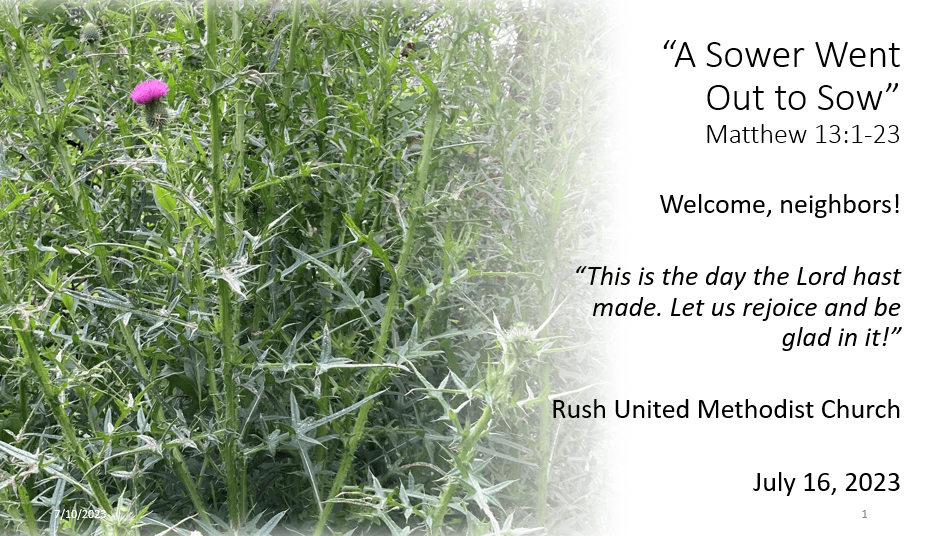
July 16, 2023
The Rev. Todd R. Goddard, Pastor
Rush United Methodist Church
Matthew 13:1-23 (NRSV)
That same day Jesus went out of the house and sat beside the sea. Such great crowds gathered around him that he got into a boat and sat there, while the whole crowd stood on the beach.
And he told them many things in parables, saying: “Listen! A sower went out to sow. And as he sowed, some seeds fell on the path, and the birds came and ate them up. Other seeds fell on rocky ground, where they did not have much soil, and they sprang up quickly, since they had no depth of soil. But when the sun rose, they were scorched; and since they had no root, they withered away. Other seeds fell among thorns, and the thorns grew up and choked them. Other seeds fell on good soil and brought forth grain, some a hundredfold, some sixty, some thirty. Let anyone with ears listen!”
Then the disciples came and asked him, “Why do you speak to them in parables?”
He answered, “To you it has been given to know the secrets of the kingdom of heaven, but to them it has not been given. For to those who have, more will be given, and they will have an abundance; but from those who have nothing, even what they have will be taken away.
The reason I speak to them in parables is that ‘seeing they do not perceive, and hearing they do not listen, nor do they understand.’ With them indeed is fulfilled the prophecy of Isaiah that says:
‘You will indeed listen, but never understand, and you will indeed look, but never perceive. For this people’s heart has grown dull, and their ears are hard of hearing, and they have shut their eyes; so that they might not look with their eyes, and listen with their ears, and understand with their heart and turn— and I would heal them.’
But blessed are your eyes, for they see, and your ears, for they hear. Truly I tell you, many prophets and righteous people longed to see what you see, but did not see it, and to hear what you hear, but did not hear it.
“Hear then the parable of the sower. When anyone hears the word of the kingdom and does not understand it, the evil one comes and snatches away what is sown in the heart; this is what was sown on the path. As for what was sown on rocky ground, this is the one who hears the word and immediately receives it with joy; yet such a person has no root, but endures only for a while, and when trouble or persecution arises on account of the word, that person immediately falls away. As for what was sown among thorns, this is the one who hears the word, but the cares of the world and the lure of wealth choke the word, and it yields nothing. But as for what was sown on good soil, this is the one who hears the word and understands it, who indeed bears fruit and yields, in one case a hundredfold, in another sixty, and in another thirty.”
| Centering Prayer |
In recent days
Jesus has been traveling around the countryside,
stopping at many different cities,
always being followed by his disciples and the crowds.
The Pharisees had started to plot against Jesus,
planning how to destroy him.
He healed a man’s withered hand
and allowed his disciples to pluck and eat grain,
both events took place on the Sabbath.
This apparent violation of the Law raised their ire.
This morning we find Jesus by the Sea of Galilee,
perhaps in Capernaum,
where he taught as a child in the synagogue
and healed Peter’s mother-in-law.
Because so many followers crowded around him,
he got into a boat and slipped just offshore,
creating for himself the perfect, natural amphitheater
– Jesus on center stage –
with his audience rising up on the nearby shore.
It was a natural built,
Minor league coliseum;
The perfect setting for the Master to
Take center stage
To teach thousands of followers.
Jesus took advantage of the setting
by teaching his followers and the crowd in parables
– short stories whose purpose
is to make a point by analogy, comparison, or illustration.
Many have speculated
why Jesus spoke and taught so frequently in parables.
Why would his message be transparent to some
But intentionally opaque to others?
It is important to remember
The dangerous environment in which Jesus was immersed.
When surrounded by threats,
it was safest to speak in generalities,
with vagueness,
less one be arrested, tortured, and killed.
The less specific, the better.
Yet, Jesus’s parables were specific enough
so that, while some were left wondering what he was talking about,
his followers knew exactly what he was saying.
This, of course, makes all of us nervous
when we don’t immediately grasp the meaning of a parable!
Have no fear.
While some may believe
that Jesus is teaching in some kind of secret, cryptic code,
it only makes sense that he was
just being wisely cautious.
So this morning,
place in your mind’s eye
the image of Jesus in a boat,
floating just offshore.
He could have been at Durand Eastman beach, Casowasco, or Chautauqua.
Around him would have been a crowd of hundreds
– perhaps thousands –
standing and sitting at the water’s edge,
straining to hear his every word.
I highly recommend the book “Simple Church”
by Thom S. Rainer and Eric Geiger.
In this short book the authors describe two kinds of churches;
A simple church and a complex church.
The complex church is
One that deploys a smorgasbord of programs, events, and opportunities.
Generally, the larger the church,
the more resources it has to offer to members and friends.
Many have come to associate
activity with vibrancy,
especially those in the hierarchy.
While this complexity of programs may have curb appeal,
Especially to the occasional church shopper,
The author’s research has shown that complex churches
Foster stagnation, status quo, even decline.
The alternative is the simple church;
One that intentionally nurtures movement through the spiritual journey,
starting with the new Christian,
engaging people with vibrant worship,
leading each to deepen their faith
while reaching out to neighbors.
Love God,
Grow deep,
Reach out
To put it simply.
This simplicity is patterned after the first century description of church
In the Acts of the Apostles.
Programs that don’t reach up,
Grow people deep,
Or reach out
Are slowly, but intentionally eliminated.
New seeds are sown
To bring laser focus on leading people,
Moving and growing with people
In faith development
That leads to outreach and missions.
Simple churches, the authors cite in their research
Are becoming examples of new life,
Fertile growth,
And vibrant communities of faith,
Just as they once did two thousand years ago.
The key to transformational change
Is keeping it simple,
Seeking fertile soil,
Faithfully sowing seeds,
Nurturing the growth that God is providing.
…
In today’s parable
Three quarters of the seeds sown are complete and abject failures.
Henry Ford once said,
“Failure is simply the opportunity to begin again,
This time more intelligently.”
Keep sowing seeds.
It is, indeed, exceptionally easy for us
to dwell upon all of our efforts which have failed
– those ideas which have fallen upon the path
while others have come along and snatched them away,
or plans which have fallen upon rocky ground
and have quickly grown up but have just as quickly died away,
or hopes and dreams which have fallen in the midst of thorns
and others have quickly choked them off
before they could even begin to grow.
Yet, Jesus promises us that
“other seeds
fell on good soil and brought forth grain,
some a hundredfold, some sixty and some thirty.”
At the time of Jesus,
the finest harvest might bring in tenfold
– or ten times the amount of grain planted.
Farmers in the crowd listening to Jesus would have had a good chuckle.
Even with modern technology,
a good crop might bring in forty-fold.
Jesus wasn’t naive.
He was making a statement:
some of our efforts will succeed beyond our wildest dreams.
Some of the efforts and energies that we put in working for the Lord,
will bloom and grow far beyond the sum of everything we put into it.
Those ministries which take off,
do so not because of what we do,
but because of what God does
in and through us.
It is God who provides for the fertile soil.
It is God who provides for the necessary rain and sunshine.
We are simply required to sow seeds
and to nurture that which grows.
Successful kingdom building,
doing the Lord’s work,
requires a partnership with God and ourselves.
…
A few observations.
1. First, a seed is a seed is a seed.
That is, every seed is the same as every other seed,
worthy of the same consideration by the sower.
The only difference in the final outcome
depends upon where it is sown.
Seeds,
our visions, ideas, and plans for ministry
Come to us from God
Our Divine Creator.
Every seed is created with the same potential;
worthy of our efforts to sow.
If Jesus is telling us that only one in four
Stand a chance of taking root and prospering
We can’t risk losing any seeds.
It is wonderful to dream.
The more dreaming the better.
That is why we must be bold in our approach to mission and ministry;
Sowing every seed God gives us.
The more seeds that are sown,
the more opportunity for some seeds to grow
and grow abundantly.
2. Secondly, wise sowers will seek out the best soil.
Soil isn’t going to change its nature for our sake.
This is what it means for us today:
Avoid mission creep.
Avoid efforts that steal away the focus.
As my mother would say,
“Just because you can, doesn’t mean you should.”
Be smart in sowing.
Seek out fertile soil.
Search and find where the need is greatest;
Where the longing of the heart
and people’s deepest concerns can best be fed.
Jesus zeroed in on the deepest needs in his life and ministry.
He sowed seeds with the poor, the marginalized, with women, and children.
Jesus sowed seeds with those who were suffering illness, disease, and grief.
Jesus sowed seeds with a tax collector who was seeking a new heart
And with a paralyzed man lowered through a hole in the roof.
Let us boldly ask ourselves,
Where is the fertile soil today?
Where are we being led to sow God’s seeds?
3. Third,
from Jesus’s parable of the sower,
Jesus is preparing us to expect failure.
Despite our best efforts
Only twenty-five percent of the seeds fall upon fertile ground.
Keep sowing seeds!
I’ve learned with age and experience
That even failed efforts to grow God’s kingdom have merit.
Seeds that were sown twenty years ago,
Kindness that was extended,
Love that enabled you to go the second mile,
Grace that flowed through you and touched another,
May eventually take root.
Timing is everything.
Even worn paths
change and grow over with time.
Choking weeds eventually give way to trees and streams.
Rocky ground might slowly give way to rich topsoil.
Timing may be the key,
So, cultivate a culture of sowing.
Keep sowing,
Especially in the face of apparent failure,
If for no other reason
Then to maintain the discipline of sowing.
Jesus sowed throughout his ministry.
He only ended up with a handful of disciples in the end.
He had to repeat his message
of suffering, death, resurrection, and ascension
… multiple times …
Because those seeds didn’t take root
Until his disciples were changed by their experience and
They could find clarity with hindsight.
Yet, Jesus continued to sow
In his resurrection and
through his Holy Spirit.
Christ continues to sow seeds today
In and through our thoughts, words, and prayers.
His Spirit hasn’t stopped sowing
And neither should we.
Keep sowing.
4. Fourthly,
It is very clear that Jesus promises us that
even one small seed,
one idea,
one goal;
planted in fertile soil,
nurtured, cared for, and supported by God and the community,
can lead to a harvest abundant,
a harvest beyond our wildest dreams,
a vibrant ministry of our church of unmeasurable success.
One.
Seed.
Indeed, that one successful seed
Will more than make up for the other three that failed.
If one seed has the potential of a hundred-fold,
imagine what ten good seeds can do
– or a hundred!
Indeed, we are only limited by our ability to dream
and our capacity for faithfulness.
We are only limited by our ability to dream
and our capacity for faithfulness.
The goal of our Lord
for us, as individuals,
and for us, as His Church,
is the establishment
and fulfillment
of the kingdom of God,
bringing people to Jesus Christ,
nurturing each in our lifelong journey of faith.
God has called us to be faithful sowers,
people who are willing to work without ceasing,
committed to bringing about a successful harvest.
God supplies the seeds,
We simply sow as best we can.
God provides the soil, rain, and sunshine;
the growth and fulfillment of that kingdom.
Expect disappointments and failures.
Lots of them.
If you are not failing,
You’re not trying.
However, it is very clear that,
for those seeds landing upon fertile ground
which we tend, care, and nurture,
the harvest will be abundant beyond belief.
This foreknowledge easily makes up for lost seeds and efforts.
Can we dream?
Are we faithful?
If we can and
if we are,
let us sow.
Those who have ears to hear, let you hear.
Thanks be to God.
Amen.
 Breaking Yokes